




Abstract
The complexities and changing experiences of human connections have long been debated. In the digital age, technology becomes an increasingly crucial dimension of sociality. This article critically discusses the sociality of ‘hidden’ young people who shut themselves in the bedroom and are typically assumed to be socially withdrawn. This article challenges this reclusive depiction and presents qualitative evidence from the first study of this phenomenon in the UK/Scottish context, while studying this comparatively across two sites. Thirty-two interviews were conducted with Hong Kong and Scottish youth ‘withdrawn’ in the bedroom for 3 to 48 months; hidden youth’s sociality was found to be more nuanced and interconnected than previously assumed. This article argues that young people can become especially attached to online communities to seek solace and solidarity as they experience social marginalisation. Technology and online networks play an important role in enabling marginalised young people to feel connected in the digital age.
Keywords
Introduction
Nobody sees me anymore . . . I have been in my room, without playing PS3 or watching TV . . . Just sitting in the dark, texting my pals.
How long can someone stay in their bedroom and not go outside? This question is particularly contentious when it is wrestled with enduring sociological debates on the nature and meanings of human sociality (Lupton, 2015). Classic social theories emphasise physical, face-to-face contact being quintessential to human connectedness; the digital age, however, has had important implications for the experiences and understanding of sociality (Orton-Johnson and Prior, 2013). Human interactions have been diversified in the age of ‘deep mediatisation’ and digital technologies have become a crucial dimension of sociality (Couldry and Hepp, 2017).
The opening quotation of this article highlights the article’s focus on a particularly interesting and instrumental case that extends this contentious debate. This article discusses new evidence and critical insights on the sociality of young people in Hong Kong and Scotland who shut themselves in the bedroom and do not go outside for months and years on end. This phenomenon is commonly referred to as ‘hidden youth’ in East Asia, which has emerged as a topical social issue in the past decade (Li and Wong, 2015). However, this issue remains under-researched and has limited recognition in the West compared with East Asian contexts (Furlong, 2008). This article presents insights from the first study of this phenomenon in the UK/Scottish context, while studying this comparatively across two sites.
The aim of this article is to critically reflect on ‘hidden’ young people’s sociality based on examining their lived experiences and to challenge the common interpretation of ‘hidden’ youth as withdrawn from society (Teo, 2010). This article will argue a more nuanced analysis is needed to fully capture the multiplicity of the young people’s connectedness and highlight assumptions about their self-seclusion and loneliness inside the bedroom are problematic. To do so, the article draws on recent theoretical debates on the construction of the social, particularly in digital sociology and media studies, and shed light on the diverse processes and meanings of being social in the digital age (Papacharissi, 2011; Rainie and Wellman, 2014).
This article uses an exploratory approach and focusses on examining the degree, range and importance of different aspects of the young people’s sociality. This study will unpack the complexities of the young people’s interactions by using qualitative interviews with ‘hidden’ youth in two contexts – Hong Kong and Scotland. The following research questions were raised:
How socially connected do ‘hidden’ young people feel? How should their sociality and experience of connectedness be described?
How do the young people interpret and manage their sociality? In what ways do their connections with people vary across different dimensions of the social, including offline and online environments?
Contested theories of the social
How young people engage in the social has been at the centre of the hidden youth debate (Furlong, 2008). To critically examine the sociality of ‘hidden’ young people, this article first seeks to understand what sociality means in the digital age. The discussion then turns to existing debates on hidden youth and how their sociality is interpreted thus far. This will highlight gaps in the knowledge to be addressed in this study.
There has been a long-standing debate on the concept of the social, particularly in sociology and social theory, in which the nature and meanings of interpersonal connections and interactions are contested and considered to be central to this debate (Mulqueen and Matthews, 2015). Relationships and interactions among people are a key and fundamental element of the social; sociality, or the tendency of being social and forming connections with others, is thought of as an innate quality of how human beings function. Sociality can be reinforced by relational bonds and communications, and key to this is the development of a sense of connectedness and solidarity among individuals. Sustaining such interactions and social bonds is an important aspect of how individuals experience and engage in the social. Sociality is, therefore, argued to be a basic and essential component of human life, which organises ‘people into “social” relations with one another’ (Sewell, 2005: 329). Being social is considered as beneficial to individuals, particularly for young people (Allan and Catts, 2012; Morrow, 1999). Marwick (2015) argues that experience of social connectedness is particularly important for adolescence.
Classic theories about what constitutes as being social emphasise the importance of physical interactions (Blumer, 1986). For example, in symbolic interactionism and phenomenology, face-to-face interactions are viewed as quintessential to how humans socialise (Mead, 1934; Schultz, 1932). Berger and Luckmann (1966) suggest interactions that are proximate, sustained and stable play a vital role in how people feel connected.
However, the advent of the digital age, marked by rapid diffusion of technology in the fabric of everyday life, created new contexts, dimensions and social structures that sociality is made and occurs (Lupton, 2015). The growing use of technology has had a significant impact on many aspects of human life, particularly in how people connect through online and offline environments (Orton-Johnson and Prior, 2013). boyd and Crawford (2012) highlight the pervasiveness of global online platforms and datafication in everyday social life. Being social is increasingly shaped by globalising social norms diffused by technologies (Castells, 2009). In this context, technological infrastructure and online networks are increasingly important to how people connect with one another.
In the advent of the digital age, the process of social connection is also increasingly individualised (Baym, 2010). Agency and motivation become particularly important to social connections as the choices of interactions diversify. This has important implications on how one’s sociality is described and examined. According to Rainie and Wellman (2014), the concept of ‘networked individualism’ captures the ‘shift [in] people’s social lives away from densely knit family, neighbourhood and group relationships toward more far-flung, less tight, more diverse personal networks’ (p. 11). This is especially important as digital interactions and online communities become increasingly prevalent in everyday life. Couldry and Hepp (2017) argue to understand this as a ‘deep mediatisation’ of the nature of the social.
This perspective reflects the increased importance and intertwining of human connections and digital media, such as texting, emailing, online chats, blogging, social media and sharing multimedia content through apps and platforms (Gardner and Davis, 2013). The integration of mediatised platforms represents a significant change in the construction of sociality. Since early 2000s, the use of digital media has been widely spread especially among the younger generation (Creeber and Martin, 2009; Livingstone and Helsper, 2007). The ‘digital’ becomes an integral aspect of young people’s social experiences (Bennett and Robards, 2014; Livingstone and Brake, 2010). Digital media are, therefore, considered as increasingly significant to the construction of young people’s sociality. Technological platforms can be an important space where young people find a sense of belonging, solidarity and connectedness (Buckingham, 2008).
A youth perspective
By focussing on ‘hidden’ youth, this article offers an original youth perspective and draws on recent debates in youth studies to understand emerging experiences of the social in a digital age. Doing this not only allows the article to contextualise the sociality of ‘hidden’ youth, but also focusses on those who struggle most with rising precarity and rapidly eroding life trajectories in the 21st century, as described by Furlong et al. (2018).
Youth is conceptualised as an important transitional phase that sits between childhood and adulthood (Bynner, 2005). Coles (1995) describes youth as a state of ‘semi-independency’, in which one negotiates expectations and various choices to become fully independent. However, there are increased ambiguities and vulnerabilities that are attached to this stage of life, and when the transition begins and ends is increasingly blurred (MacDonald and Marsh, 2005; Roberts, 2007). In recent research and policies, the most common age range to define youth is 16 to 24 (Bendit, 2006).
However, it is important to recognise that youth is not only defined by age, there are various framings of youth in different life domains and socio-cultural contexts (Bynner, 2001). Recent discussions challenge the classic assumption of youth transitions being a linear and sequential process (Shildrick et al., 2013). Other work also reveals the prevalence of less predictable and more diverse realities of youth experiences (Furlong and Cartmel, 2007; Wong, 2019). Wyn and Woodman (2006) highlight social change in the 21st century has intensified the insecurity and marginalisation of youth. Increased number of young people struggle in ‘constantly-changing’ life trajectories, as youth transitions become more contingent on one’s opportunities to mitigate barriers and explore choices in societal institutions and connections (Arnett, 2014).
It is also no coincidence that the age of the beginning of youth typically falls on when a young person is expected to complete compulsory schooling. Recent literature emphasises that entering employment after education is crucial for young people to be recognised as independent and gain full social rights (Antonucci et al., 2014). In the contexts studied in this article, youth is considered as 16 to 24 in Scotland and 15 to 24 in Hong Kong, reflecting the local policy contexts and transitions from school to work typically expected.
Hidden youth— ‘withdrawn’ from the social?
Hidden youth emerges as an interesting extension of discussions in East Asia concerning young people’s social connections (Teo and Gaw, 2010). Recent research observes that an increased number of young people shut themselves in the bedroom and do not go outside for a protracted period of time – from 3 months to over 10 years (Li and Wong, 2015).
The concept of hidden youth was first discussed in Japan in the late 1990s, and Saito (2013 [1998]) coined the term ‘hikikomori’, which asserts young people’s self-seclusion as a new form of mental disorder. Psychiatric research (Ogino, 2004; Teo et al., 2015) dominates existing scholarship in ‘hikikomori’ and its focus has been on seeking psychological explanations and clinical diagnosis of ‘hidden’ behaviours. This work associates hidden youth with depression, social anxiety and personal developmental issues (Krieg and Dickie, 2013). Estimation suggests there are up to 1 million ‘hikikomori’ in Japan alone (Saito, 2013 [1998]). The phenomenon quickly gained recognition in other East Asian contexts, for example, China and South Korea (Chan and Lo, 2014b). Latest figures indicate that more than 41,000 young people in Hong Kong are ‘severely withdrawn’ (i.e. ‘hidden’ for more than 6 months), totalling to 5% of the youth population (Wong et al., 2015).
In the mid-2000s, acclaimed youth studies scholar Furlong (2008) began to challenge the psychological perspective and was one of the first scholars to emphasise the importance of explaining ‘hidden’ behaviours through macro-structural processes and social change in post-industrialised economies (such as Japan and advanced economies elsewhere). Furlong (2008: 316) suggests ‘shutting out the world’ and being ‘hidden’ is a coping mechanism for young people who face unresolved crisis in the search of self-identity during youth; self-seclusion is a devastating response linked to increased insecurities of the labour market and education in 21st century. Recent sociological work also recognises how socio-cultural factors, such as shifts in global economy and labour opportunities, coupled with education systems’ failure to mitigate these changes, contribute to the cause of hidden youth (Berman and Rizzo, 2018; Li et al., 2018). Social work researchers, such as Victor Wong (2009a), argue ‘hidden’ young people reject and disengage from society due to frustration and socio-economic exclusion. Chan and Holosko (2016) and Chan and Lo (2014a) also importantly show hidden youth does have some degree of social contacts via the internet. However, this body of research remains insistent on asserting hidden youth as self-isolated and turning to solitary ways of living (Li and Wong, 2015). This leads to a predominant conception that hidden youth are socially withdrawn (Wong, 2009b). The common framework to define ‘hidden’ behaviours highlights ‘social withdrawal as a scenario in which young adults isolate themselves from both societal institutions (such as school, education or work) and social relationships (such as sites of everyday interaction, friendships, dating)’ and interactions with families and communities (Husu and Välimäki, 2017: 606).
Gaps addressed in this study
The current discussions of hidden youth are strongly driven by a presumption that the young people are living solitary lives in the bedroom. The existing research also appears to confine being social to having offline, face-to-face interactions. It neglects the potential heterogeneity and emerging experiences of how young people experience social connectedness in a digital age (Couldry and Hepp, 2017). Conversely, the young people’s everyday lives in the bedroom and what they in fact do in this space have yet to be explored in depth. A critical discussion of the social has hence been largely missing in the existing hidden youth research. This article will critically reflect on how digital sociological debates shed light on the constructions of the sociality of ‘hidden’ youth and highlights the complexities of social connections in a digital age.
It is important to stress that this article grounds itself in the sociological perspective of ‘hidden’ youth and interprets ‘hidden’ behaviours as explained by socio-cultural factors such as rising precarity of the labour market (Furlong et al., 2018). This leads to the understanding that ‘hidden’ youth is not necessarily a phenomenon caused by the digital age, unlike other discussions related to youth seclusion, such as ‘otaku’ (Ito, 2013), which links subculture to rise of online addictions. Nonetheless, this article recognises that ‘hidden’ behaviours may be shaped, and arguably sustained, by new lived realities, such as increased connectivity in the bedroom via digital media as highlighted by Li et al. (2018).
The working definition of ‘hidden’ youth employed in this study refers to young people who shut themselves in the bedroom for a protracted period and disengage from the social to varying extents. It is useful to think of this as a ‘spectrum’ and place early stages of disengaging from some aspects of the social (e.g. education and work) on the one end and, on the other, a more ‘extreme’ observation of full seclusion and being severely disconnected from all forms of social connections and relationships (e.g. family, friends, and peers). It is also valuable to compare young people’s accounts against underpinning assumptions of the existing frameworks of the concept of ‘hidden’ and thereby examine whether they have any real analytic hold on the lived experiences of young people.
Methodology and research design
To examine ‘hidden’ young people’s experiences of sociality, utilising the interpretive approach was considered as most appropriate (Schwartz-Shea and Yanow, 2012). The emphasis on understanding the details of the lived experiences of ‘hidden’ young people was an important aspect of the research design. This study paid particular attention to examine details of the participants’ everyday lives and sensitive to explore various (and potentially contradicting) elements of the young people’s sociality (Mason, 2002).
To closely understand the participants’ views and ‘life as lived’, a series of semi-structured interviews with ‘hidden’ young people were conducted (Marshall and Rossman, 2015: 18). The participant-centred approach was suited to query how the young people themselves perceived their social interactions and sociality, instead of assuming they were isolated and ‘withdrawn’.
Site selection
Using the sites of Hong Kong and Scotland, this research was designed to consider the heterogeneity of how ‘hidden’ young people experience connectedness. Previous evidence (Wong, 2009a) suggests that Hong Kong is a useful context to find young people who are ‘severely hidden’, especially due to its highly competitive and elitist environment that favours high-achievers. This study was able to recruit young people in Hong Kong who were deeply disconnected from work and school and hardly had offline interactions with family, peers and friends.
Scotland, on the other hand, was the most likely choice to identify young people who were on the lower end of the spectrum of ‘hidden’ behaviours. Scotland has one of the highest rates of youth Not in Education, Employment, and Training (NEET) in Europe, and the significant increase of precarity in youth in Scotland due to the Global Financial Crisis is widely recognised (Adams, 2012; Finlay et al., 2010). Although the term ‘hidden youth’ is not yet recognised and is under-researched in Scotland, it serves as a useful context to reflect on the structural factors (e.g. insecurity of the labour market and lack of opportunities), similar to Hong Kong, that influence young people to respond and begin to disengage from societal institutions and other relationships (Wong, 2019). In Scotland, this research was able to identify young people who were at early stages of disengagement from work and school, have few interactions with people and spend most of their time in the bedroom. Scotland, therefore, not only offers important learning about ‘hidden’ youth in a new empirical context, but also provides a different setting to Hong Kong to reflect on the heterogeneity of ‘hidden’ experiences of young people.
Data collection and analysis
A total of 32 ‘hidden’ young people were interviewed; 12 interviews were conducted in Hong Kong and 20 interviews were in Scotland in 2014. The questions asked in the interviews centred around themes including:
What the participants normally did in their daily life;
The participants’ perceptions, feelings and experiences about being social;
Decisions and feelings around being in the bedroom versus going outside;
Experiences of whom they interacted with, how they interacted and feelings towards such interactions (including friends, peer groups and family)
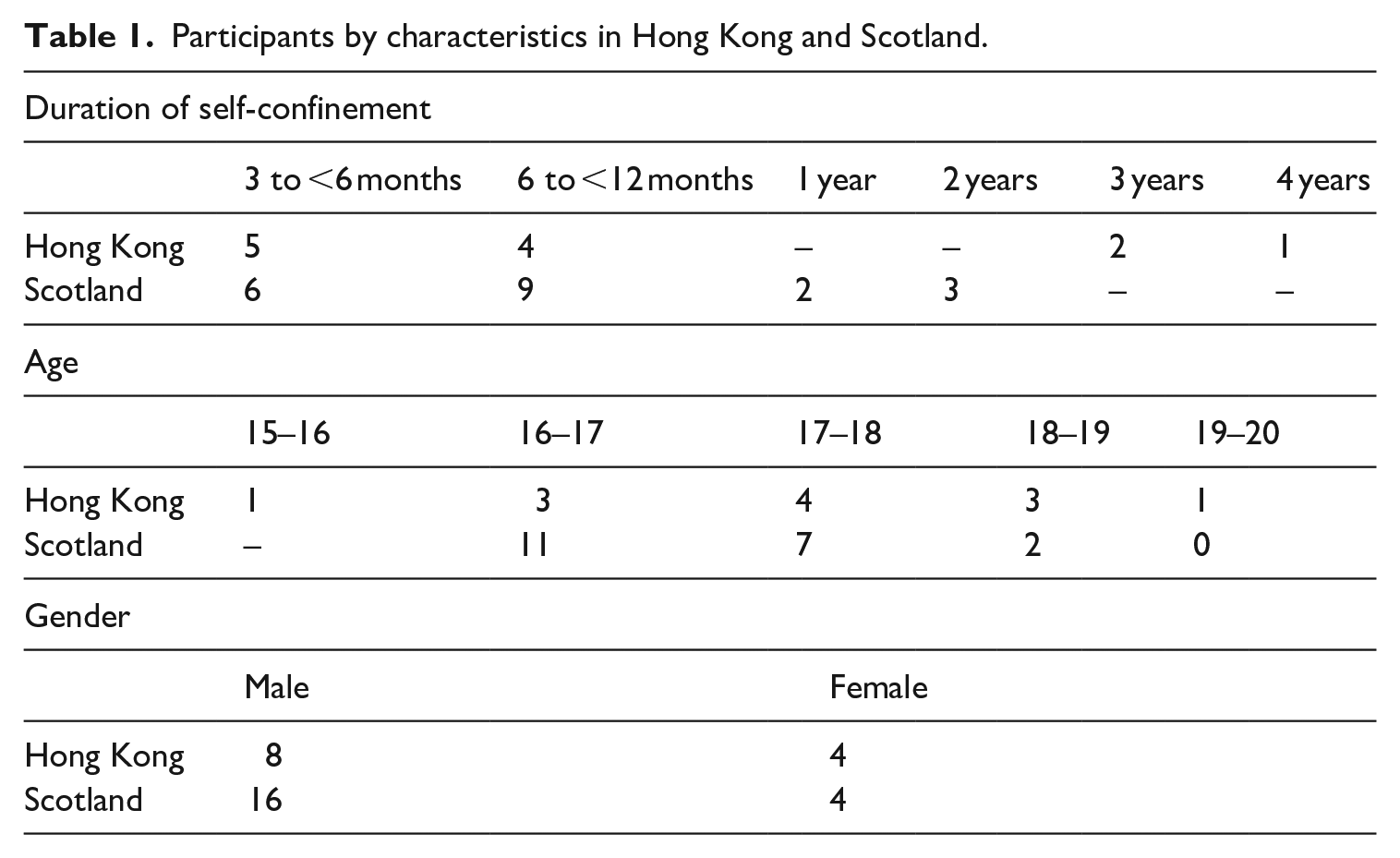
The sampling was guided by the aim to select young people who were on different places across the spectrum of ‘hidden-ness’. The sample included a variety of levels of seclusion in terms of the time that participants had been ‘hidden’, ranging from at least 3 months to 2 years in Scotland and 4 years in Hong Kong. The sample also included participants of different demographic characteristics including a mixture of young people of ages from 15 to 20, of different genders and from various socio-economic backgrounds (Table 1). In Hong Kong, the participants were recruited through youth workers in non-governmental organisations and schools. Similarly, Local Councils and youth workers who worked with disengaged young people in Scotland acted as gate-keepers to identify participants.
Participants by characteristics in Hong Kong and Scotland.
In the analysis, I reflected on the voices of different genders equally and carefully, despite there being more individuals identified as male who responded to the recruitment. However, the analysis based on gender differences did not yield sufficiently meaningful results within the scope of this study, and within the focus of this analysis, the participants’ experiences were not identified as varying significantly based on identity differences such as genders or socio-economic backgrounds.
The main limitations of the research lie in the difficulties of recruitment and having limited avenues to establish contact with young people ‘hidden’ in the bedroom. The fieldwork ultimately relied on external agencies to access participants and was thereby faced with potential biases in the identification of participants. This also created a limitation in this study of not being able to consider the experiences of young people who could be most ‘hidden’ and not engaged with anyone. Nonetheless, most participants in this study expressed that they were only temporarily engaged in the external agencies’ services. They could be committing as little as 0 to 1 day a week, and in some cases, only received services for up to 12 weeks.
This study carefully approached the ethics of conducting research with young people who were potentially vulnerable and acquired approval of the Ethics Review Committee at the University of Edinburgh. This study considered maintaining transparency of the research process and protecting the participants’ identities to be the key principle of ethical research with young people (Curtis et al., 2004). All the participants’ information was de-identified and names were replaced with pseudonyms. Direct, informed consent was established from all young people participated in the study. A support framework and supporting resources were available in every interview, particularly should sensitive information be shared.
The data analysis was guided by key principles of inductive research commonly found in qualitative research (e.g. Charmaz, 2006). Thematic analysis provided a systematic mechanism to segment the interview texts and code them according to emerging themes.
Connectedness through online networks
The findings showed that there were remarkable similarities in the participant’s accounts in Hong Kong and Scotland. The findings revealed that all 32 participants had some forms of interactions with people through digital media. While the participants had very limited offline, face-to-face interactions outside, they showed contrastingly high levels of interaction with people such as friends, peer groups and even family members online. All but two participants felt more socially connected through digital environments despite being shut in the bedroom. Many participants talked about using various online platforms that allowed them to interact with large, diverse networks of people and communities. Some young people talked about chatting with dozens and hundreds of people online every day and thereby depict a rather different picture of ‘hidden’ young people’s sociality: There’s a programming forum that I go on . . . People that I frequently talk to but not like on a daily basis . . . [are] like 200 people . . . [and] 30 people that I chat with on call [on Skype every day]. (Michael, 17, Scotland)
This can be partly explained by Livingstone’s (2009) work on the prevalence of ‘bedroom culture’. Many youth social activities and experiences are increasingly moving away from the outdoors and into the bedroom due to increased use of personal devices. This sheds light on the previously overlooked social dimensions of the seemingly private and lonely space, as ‘media-rich’ bedrooms have the potential of ‘bringing in’ interactions with people outside through digital media (Livingstone and Bovill, 2001). This perspective is important to recognising the technological affordance of the space of the bedroom for ‘hidden’ young people beyond its physical elements and boundaries and, more importantly, underline the implications of digital transformations of social relationships. In the digital age, connectivity and sociality are increasingly facilitated and transformed by uses of online platforms, as observed overwhelmingly in the case of ‘hidden’ youth in this study.
In addition, the participants described preferring digital interactions compared with face-to-face. This was particularly striking in the participants’ accounts of interactions with family members they lived with. For example, some young people, particularly in Scotland, talked about preferring to use Facebook Messenger to talk to their parents, even about mundane matters: My mum, my dad, [and] my sisters . . . [it’s] just easiest to contact them by Facebook . . . Like my mum asks me to do something like help cleaning or something. I’ll message her say, ‘sure’, and she’ll usually ask me over Facebook. (Alan, 18, Scotland)
This emphasises the role and diffusion of digital media in the participants’ daily experiences of social connections. However, in a different way compared with many people living in the digital age, ‘hidden’ young people showed contrasting patterns of sociality in and outside of the bedroom. The characteristics of how the participants connected with people were more conflicting and asymmetrical than the majority of people (Rainie and Wellman, 2014).
The participants highlighted spending long hours with large groups of online communities and people simultaneously on a daily basis. This was most striking in the participants’ accounts of massively multi-player online (MMO) gaming platforms, such as ‘League of Legends’. The young people could be talking to other users for 8 to 12 hours a day, mainly about strategies and gameplay, and many of them also developed genuine and deep friendships. The below quotation from a 17-year-old female from Hong Kong represents a typical account of connections developed through online platforms: I usually play online games right from when I wake up till I go to bed! . . . There are some friends there I can talk to about stuff . . . There’s one guy I’ve known for 2 or 3 years . . . we don’t only talk about the game but personal stuff sometimes too. (Kaman, 17, Hong Kong)
In Scotland, more participants talked about connecting to online networks through Internet-enabled consoles, such as X-box and PlayStation 3. However, it is important to note that the participants’ interactions were not only related to gaming. Other forms of digital platforms such as social media, Internet forums, streaming platforms and VoIP software (e.g. Skype and TeamSpeak) were also important to how the participants felt socially connected. Below is a typical quotation from a 17-year-old male, who had been ‘hidden’ in the bedroom and not in work and left school for more than a year: I don’t really have many ‘real’ friends any more . . . Going outside can just be really boring . . . Once in a blue moon, you’ll find this really good team, which communicates really well, and it just makes playing in that game completely worth it! . . . It feels a lot more like, I could be in this game rather than ‘in real life’ right now. (Nathan, 17, Scotland)
Hidden youth are not self-secluded but interconnected
The findings revealed that ‘hidden’ young people were not necessarily reclusive nor self-secluded as previously assumed. All but two participants in Hong Kong and Scotland did not describe themselves as feeling isolated or lonely, despite their physical confinement in the bedroom. The accounts of their everyday lives highlighted that they did not necessarily want to be alone nor ‘cut-off’ from society as described in past studies (e.g. Furlong, 2008; Saito, 2013 [1998]): I don’t like being alone by myself . . . So when I am playing online games in the bedroom, I will also use Skype to chat with people . . . It doesn’t matter whether we see each other’s faces or not . . . I just want to hang out with friends, especially if I get to chat with them online. (Kakei, 18, Hong Kong)
This suggests that ‘hidden’ young people should not be reductively imagined as choosing to live in solitude. This also makes analysing ‘hidden’ young people as socially ‘withdrawn’ problematic and inaccurate, as the concept does not fully capture and describe the multiplicity of how the young people experience connectedness.
The above quotation also highlights a crucial finding of this study: how ‘hidden’ young people are being social, and their sociality, is more nuanced and complex than previously suggested (Wong and Ying, 2006). This article argues ‘hidden’ young people should be conceptualised as being interconnected and having diverse experiences of connectedness in online and offline contexts. This multiplicity of their sociality is highlighted by Papacharissi’s (2011) notion of the ‘networked Self’. This concept helps illustrate how ‘hidden’ young people are interconnected with different groups of people in online and offline environments to varying degrees. Moreover, ‘hidden’ young people’s sociality is in fact underpinned and shaped by multiple forms of networks, and their sociality could hence be described as heterogeneous dependent on the settings and groups.
Motivations and ‘pull’ and ‘push’ factors
Another key finding of this study is the importance of taking ‘hidden’ young people’s agency and autonomy into account while recognising the structural barriers they face. The findings highlighted the participants’ motivations and how they managed and adapted their sociality in online and offline contexts of interactions. Below is a typical interview quotation taken from a 16-year-old female from Hong Kong, who had been ‘hidden’ in the bedroom and hardly went outside of her bedroom for 4 years after school exclusion: I just don’t want to be out . . . When I am in my bedroom, I can still do all the stuff I want! . . . If I can choose, I will definitely choose not to go out. (Meifung, 16, Hong Kong)
This was echoed by many participants who felt more drawn to connect with people online inside the bedroom than going outside. The interviews highlighted five main ‘pull’ factors and motivations to connect with online communities. Online social interactions were repeatedly described by the participants as being more exciting, offered more variety, flexibility, convenience and fluidity than face-to-face interactions. The following quotation provides a vivid account of the excitement and variety offered by digital interactions: [Being online] is definitely a lot more exciting . . . It takes you to some place that you can’t actually get to in ‘real life’ . . . Like some guy who is a little too into the game is cheering down his microphone as he charged on towards the enemy . . . Oh, it really just makes it . . . I will just never get out . . . I will be like: PC is so much better than going outside. (Nathan, 17, Scotland)
The participants expressed a strong sense of enjoyment and sociality in their experiences of online interactions. Online connections were considered as more appealing and equally as authentic as interactions offline by the participants: Online games are just so great . . . Hundreds of people . . . everyone works in teams . . . and use headsets to talk . . . it’s just so ‘real’, it’s exactly like chatting and being with people you know. (Yatchung, 16, Hong Kong)
The participants also described connections online as being ‘easier’ to adapt and control than offline connections. Many participants found digital interaction more flexible, convenient and fluid and were, therefore, more drawn to connections online: The initial friendship step . . . is much easier when online. So if you are in school . . . it’s really awkward . . . But if you’re just chatting [online], it’s not awkward . . . you are not face-to-face with them . . . [and] like nothing matters about that conversation . . . So, it’s basically just there and then . . . It’s easier to get to know people and talk . . . If you don’t like the people, you can just leave. (Michael, 17, Scotland)
As highlighted by Schroeder (2010), ‘social encounters in online worlds are often fleeting . . . it is possible to enter and exit these spaces and encounters more easily’ (p. 172). The participants typically found this transient characteristic to be a ‘pull’ factor of online connections. Many participants also found interactions through online platforms appealing because they were able to constantly connect with different people: You are always connected to big groups of people, it just feels so exciting. Like, wow, we are all together! . . . the whole atmosphere is just electric! It’s a whole bunch of people and they are all with you. (Kaipong, 17, Hong Kong)
An individual could therefore belong to many temporary social groups at the same time, as argued by Baym (2010). One Scottish participant, in particular, highlighted interactions through digital media allowed him to connect with people with similar interests, beyond his immediate neighbourhood, easier and quicker. Other participants in Hong Kong, including individuals identified as male and female, expressed similar sentiments towards connecting with people online interested in subcultures popular in Hong Kong, such as Japanese and Korean pop music and anime (Delwiche, 2006). Hence, the findings reflected that ‘hidden’ young people’s experiences of sociality could be strongly shaped and influenced by personal motivations and autonomy.
Importance of online interactions for hidden youth
However, the study also found ‘push’ factors that led young people to become especially attached to interactions inside the space of their bedrooms. The participants’ accounts suggested that they felt alienated and marginalised in society, thereby relying on emerging digital social structure and online interactions as an alternative form of connection to offline or face-to-face social interactions. Digital interactions and online communities appeared to be particularly important to how the participants felt socially connected. Participants reflected feelings of a lack of genuine opportunities in work and education. As a result, many felt a strong sense of disparity and hopelessness towards their future. This was expressed in reference to the high levels of pressures in Hong Kong’s competitive culture (Holliday, 2000). Whereas participants in Scotland talked about the economic ‘austerity’ in the Scottish case (Scott and Mooney, 2009).
Fraser et al. (2017) characterise Hong Kong as a ‘hyper-competitive’ environment that stresses productivity in the labour market and skills. This context is influenced by the free-market values embedded in Hong Kong’s socio-economic system, which reinforces an emphasis on individual performance and fosters an elitist system that favours high-achieving individuals (Lau, 2005). This led to many young people experiencing intense pressures to compete and succeed in education and the labour market from a young age. Many participants echoed this concern and reflected on the intense demands that they felt to aspire to a ‘top’ career and education trajectory. However, many participants also found themselves marginalised in this context as they had low qualifications and were excluded from work and education. Below is a typical quote from a 17-year-old female who had been ‘hidden’ in the bedroom for 4 years after being excluded from school: I haven’t got any qualification, so what future do I have? . . . A lot of people with higher qualifications are competing against you . . . Otherwise, why would so many people want to keep studying and be well-educated. (Kaman, 17, Hong Kong)
The above quotation illustrates that many participants in Hong Kong perceived their opportunities in societal institutions and connections to be highly precarious because of their lack of qualifications. Since Hong Kong’s transition to a knowledge-based economy in the 2000s, opportunities in the labour market have become more dependent on education level, qualifications and skills (Lung, 2012). Many participants reflected that the precarity and lack of opportunities to meaningfully engage in societal institutions in the offline environment, such as the labour market, became a significant ‘push’ factor from them to shut themselves in the bedroom and rely on other forms of connections to seek a sense of connectedness online.
The findings in Scotland reflected similar sentiments from the participants towards the importance of online connections and mitigating marginalisation in offline societal institutions and connections found in the Scottish context. Furlong et al. (2018) highlight that precarity of work has grown in the last 40 years in nations across the United Kingdom. This is reflected by significant increase of precarious forms of employment (e.g. temporary and 0-hour contracts) and an upward trend of youth unemployment and underemployment. These socio-economic changes foster new hardships for young people and traditional securities in work are progressively removed (Finlay et al., 2010). In this context, many participants in Scotland reflected a strong level of pessimism and alienation towards engagements in an increasingly insecure and depressed labour market. The young people talked about concerns of lack of jobs and struggled to find work or stay in education as labour demand declined, especially after the 2008 global financial crisis. Several participants repeatedly used phrases such as ‘job cuts’ and ‘not many jobs going’, which reflected frustrations towards rising youth unemployment and insecure labour market opportunities (Adams, 2012). This was particularly emphasised by the Scottish participants, as Scotland suffered from a slow economic recovery after the global financial crisis, unlike Hong Kong (Antonucci et al., 2014). The quotation below offers a typical account of how the Scottish participants felt their opportunities to engage in the labour market were diminished: I was wanting to do like an IT apprenticeship . . . My hobby is building computers . . . I was trying to see if I can get a job . . . There is like no jobs out there. (Alan, 18, Scotland)
This illustrates how the participants were preoccupied with concerns about marginalisation and lack of opportunities in the precarious socio-economic conditions in the Scottish context. Many participants felt strong disparities towards their life prospects, as they struggled to secure work opportunities and became more likely to be constantly going ‘in-and-out’ of work than previous generations (Shildrick et al., 2013). Importantly, despite the different socio-economic settings in Hong Kong and Scotland, the responses from the young people towards changes in offline societal institutions and connections were similar – shut themselves in the bedroom and adapt their connections to online platforms as an alternative means to be connected to the social.
In both Hong Kong and Scotland, many participants also felt being excluded and marginalised to ‘precarious work’, which refers to low-skills, low-paid and short-term jobs that offer little sense of security or a meaningful path and prospect of a career (Furlong et al., 2018). Many participants in this study described similar sentiments of feeling powerless and found engaging in work and school meaningless in the increasingly insecure labour market. Several participants described feeling trapped and seeing ‘no way out’, and the lack of opportunities created a sense of pessimism and fatalism, and hence, a depressed view of their own future: I am not smart, I didn’t do well in school, and pretty much suck at everything else I do, of course, I am not going to do well like other people . . . There are many jobs out there, sure there are. But why would anyone want to do them? . . . Like dish washing . . . it’s just so ‘back-breaking’ . . . It’s not like the earning is that bad, but . . . you are being forced to do something that you don’t even want . . . I might as well just stay in my room and play online games. (Kakei, 18, Hong Kong)
This quotation presents an illuminating description of precarious work being described as ‘back-breaking’ by several participants in Hong Kong. The term in Chinese literally means something is hot and bitter and is used to represent something that is barely worth the effort. Many participants considered low-skilled, precarious work as highly undesirable and meaningless to one’s future. This led to many feeling a sense of powerlessness towards connections in societal institutions in the offline environment: People say to me, just apply for anything, doesn’t really matter. But to me it does, cos’ I want to do what I want to do, not what someone else wants me to do . . . If it becomes too hard . . . I probably would just give up . . . I prefer to stay at home . . . It’s just more relaxing . . . just [go on] computers and gaming. (Alan, 18, Scotland)
The findings above suggest that ‘hidden’ young people could feel alienated and marginalised in society and turned to seek solace and connectedness through online communities inside the bedroom. Experiences of precarity did not necessarily influence the types of digital media or platforms young people use, but they intensified frequency of use and young people’s reliance on uses of online forms of communications and connections inside the bedroom. The study concludes that ‘hidden’ young people’s high levels of online interactions could be a response to mitigate experiences of social barriers and marginalisation, as similarly suggested by Castells (1997), and thereby adapt their sociality in online and offline contexts. This points to further aspects that should be taken into account to fully comprehend the sociality of ‘hidden’ young people, and personal motivations and structural environments have to be considered hand-in-hand.
Conclusion
To conclude, emerging experiences of online social connections are also significant when understanding the sociality of ‘hidden’ youth. The digital sociological perspective helps reveal previously neglected experiences of connectedness and potential multiplicity of their sociality. This article thus offers a novel perspective and challenges previous assumptions of the young people’s self-seclusion and lives in solitude in the bedroom. In addition, this study revealed that digital interactions are especially significant to how ‘hidden’ youth feel socially connected; they rely on online communities to seek solace and alternative forms of social connections. This suggests high levels of attachments to online interactions in the bedroom can be a form of response from young people to mitigate struggles and experiences of marginalisation and increased precarity of work and education in the 21st century. This prompts us to reflect on the complexities of social connectedness in the digital age. In future studies, more attention is needed to address the multiplicity of young people’s sociality in offline and online environments and the inter-relationship between the two. Questions about how best to describe and understand a young person’s sociality, even as more seemingly shut themselves inside the bedroom, will provide useful avenues for discussions in the future.
Finally, the evidence on the importance of online connections for ‘hidden’ youth from this study also has a wider impact on our understanding of the social. Although there remain sceptical claims about the detrimental effect of technology on the future of society (e.g. Turkle, 2011), this article highlights that technology is not only intertwined, but also reinforces and creates new opportunities of being social. Emerging technological transformations, especially in the context of digital communications and media, have significant implications on how the social is experienced and social connections are formed. The nature of human connections is shifting and increasingly facilitated by use of technologies and mediatised platforms. Digital media has to be recognised as having a positive and crucial role in mediating young people’s connections, especially for those who are marginalised and alienated in society. Also, observations that young people are physically secluded or spending extended time on digital devices may not necessarily mean they are isolated from the social. The quality and importance of online communities and interactions must not be overlooked, and emerging experiences of connectivity and sociality intertwined with online and offline environments have to be understood. This article serves as a useful resource to expand this ongoing, topical debate and argues for a new imagining of the social, in which the separation of the ‘social’ and ‘digital’ is problematic and the two become increasingly meaningful to imagine as mutually constitutive in the digital era.
Footnotes
Funding
The author(s) received no financial support for the research, authorship, and/or publication of this article.
