



Abstract
In this study, we examine young people’s self-reported negative (“toxic”) online gaming conduct via a qualitative survey (N = 95) of active game players aged 15–25 in Finland. Drawing from young people’s lived experiences, we present negative gaming conduct as a complex whole, stemming from a combination of online disinhibition, affective intensity, game cultural conduct norms, and individual preferences. We explore online gaming environments as spaces with different technological and communicative affordances. In this study, we demonstrate how not all negative gaming conduct is equal in intent or outcome and introduce the concept of banal toxicity: outwardly hostile but routine conduct that lacks emotional intensity and serves little strategic purpose yet is conducive to an overall social landscape of negativity.
Introduction
Especially since the advent of mobile technology, digital media use has been more and more intertwined with everyday life. For many people, a considerable amount of time each day is spent on different digital media platforms. Increasingly these platforms, whether online games, message boards, or social media sites, have come to be explored as spaces (e.g., Steinkuehler & Williams, 2006). Digital media spaces occupy a curious position: they are distinct from our physical interactions, yet closely linked to them; they have a “less real” quality to them yet can be an extremely mundane part of life (Apperley, 2010; Pargman & Jakobsson, 2008).
The acronym IRL (in real life) to distinguish offline activities from online ones persisted as a part of internet communications since at least the early 1990s (see Rheingold, 1993). While the original acronym was likely more or less a joke, the realness of online activities and spaces compared to offline ones has been a crucial part of both academic and public discussions of digital media use (Heim, 1993). These questions can have profound implications, such as when considering whether online friends are real friends (Henderson & Gilding, 2004) or whether online harassment is a crime on par with offline harassment (Marshak, 2017). In a digital gaming context, discussions have revolved for example around the potential offline effects of violent or sexist game content (Breuer et al., 2015; Mathur & VanderWeele, 2019), the ownership of virtual goods (Watkins & Molesworth, 2012), and the escapist qualities of digital gaming (Calleja, 2010; Snodgrass et al., 2014).
Although commonly used in everyday discussions, the division between online and IRL is somewhat misleading. With the ubiquity of online communications, there are many instances in which conflating IRL with offline is not accurate: sometimes online is understood as technology, and sometimes as the distinct spaces technology creates. An instant message to one’s partner on which groceries to buy or a video call with a colleague is obviously an online activity, yet it is very much IRL rather than the cyberspace adventures the IRL/online distinction suggests. Likewise, the roles taken on at many different activities—such as playing role-playing games, going to night clubs, or boxing—can be very distinct from, for example, one’s persona at home with family, despite the activities taking place offline (see Goffman, 1956).
The online/offline distinction is especially pronounced in the case of online gaming. Although gaming is a mundane activity, in most games the fantastical characters, locations, and interactions are clearly separate from the players and their everyday surroundings. Online games have been described as separate “third places” (Steinkuehler & Williams, 2006), denoting their social role as distinct from other everyday contexts.
The separation, or at least experience of separation, of online gaming environments from other mundane social settings brings with it opportunities for conducting oneself differently, for example experimenting with different identities and social roles. Although this freedom is commonly viewed as one of the positive qualities of online gaming (e.g., Jansz, 2015), it also results in what is commonly viewed as a major problem in gaming: players’ negative conduct and often an overall hostile atmosphere.
In this qualitative study, we examine young people’s perspectives on their own negative online gaming conduct. We pay special attention to how the distinction between online gaming spaces and other everyday contexts influences and enables this conduct, and how young game players perceive the phenomenon.
Background
Many online games, especially those focused on competition, are notorious for their hostile atmosphere. Despite a variety of design solutions such as limiting communications (Arjoranta & Siitonen, 2018) and providing reporting tools (Kou & Gui, 2021), many multiplayer games and the communities surrounding them feature a communication environment often described as “toxic” (e.g., Munn, 2023): in these environments hostile and aggressive expressions, including discrimination such as racism (Gray, 2012; Ortiz, 2019) and sexism (Vergel et al., 2024), are routine and even a social norm (Hilvert-Bruce & Neill, 2020; Karhulahti, 2022; Ruotsalainen & Meriläinen, 2023). The phenomenon more severely impacts groups whose belonging to game cultures is commonly challenged, such as women, sexual and gender minorities, and players of color (Cote et al., 2023; Fox & Tang, 2017; Gray, 2012).
The hostility of gaming spaces appears to be a combination of many elements, including the affectivity and intensity of competitive gaming (Adachi & Willoughby, 2011; Karhulahti, 2022; Ruotsalainen & Meriläinen, 2023), different affordances of games (Arjoranta & Siitonen, 2018), normative beliefs about game culture (Cook et al., 2018; Hilvert-Bruce & Neill, 2020), victimization leading to perpetration (Cook et al., 2018; Kordyaka et al., 2020), and structural discrimination (Gray, 2012; Ortiz, 2019; Vergel et al., 2024). Another commonly discussed (Gray, 2012; Kordyaka et al., 2020; Liu & Agur, 2023) element is the online disinhibition effect (Suler, 2004), which we address next.
The Online Disinhibition Effect
The online disinhibition effect, as discussed by John Suler (2004), describes the psychological phenomenon of individuals being socially less restrained and expressing themselves more openly in online environments compared to offline ones. The effect encompasses both benign and toxic (the word used by Suler) behavior as well as the ambiguous space between them. Alongside individual differences such as personality styles, Suler (2004) lists six intersecting and interacting factors that bring about the effect. These six factors are as follows: (1) dissociative anonymity, which allows individuals to detach their online persona from their offline one, (2) invisibility, which prevents others from physically seeing or hearing one, (3) asynchronicity, which removes the necessity of coping with others’ immediate reactions, (4) solipsistic introjection, the construction of a fantasy representation of another person and assimilation of this representation into one’s psyche, (5) dissociative imagination, the conscious or unconscious dissociation of online fiction from offline fact and potentially treating online interactions as a separate, fantasy sphere, and (6) minimization of status and authority, brought about by the reduced reliance online on traditional offline status markers such as wealth or gender.
The negative dimension of online disinhibition has been widely studied in relation to various online spaces, such as social media (Lowry et al., 2016; Soares et al., 2023) and different forms of online behavior, like cyberbullying (Antoniadou et al., 2019; Sourander et al., 2010; Wang et al., 2023). All six dimensions of the online disinhibition effect appear to contribute to negative behavior online (Wang et al., 2023). Benign online disinhibition remains less studied, but evidence suggests that anonymity leads to more positive self-disclosure in online spaces (Lapidot-Lefler & Barak, 2015).
The effect has been discussed in previous work on negative gaming conduct. In their study of Multiplayer Online Battle Arena (MOBA) game players, Kordyaka et al. (2020) found that toxic online disinhibition was the most meaningful predictor of negative in-game conduct. The authors also argued that the feeling of being unidentifiable was particularly relevant in engaging in negative behavior. Their findings are supported by the results from Liu and Agur’s (2023) interview study, which found that anonymity played an important part as, compared to non-anonymous contexts such as gaming with their friends, players felt like their negative actions had less severe consequences for themselves. In another interview study of game players, Ruotsalainen and Meriläinen (2023) noted that the lack of seeing another person’s offline reaction to online hostility made toxic behavior mentally and socially easier for the perpetrator (see also Sourander et al., 2010).
The above-mentioned qualitative explorations of negative conduct from the perspective of its perpetrators (Liu & Agur, 2023; Ruotsalainen & Meriläinen, 2023) have considerably deepened our understanding of the dynamics of negative conduct, but as interview studies they have drawn from a small number of informants. The study at hand utilized a qualitative online questionnaire (see Braun et al., 2021) to address the large gap between these interview studies and larger quantitative studies (e.g., Kordyaka et al., 2020) and to bring together different strains of research on negative conduct.
Method and Data
This study is a thematic analysis (Braun & Clarke, 2021) of qualitative survey responses (N = 95) from respondents in Finland. Of the respondents, 73 (~77%) were men, 4 (~4%) were non-binary, and 15 (~16%) were women, with 3 respondents (~3%) not disclosing the information. Respondent ages ranged from 15 to 25 (M = 20.5, Mdn = 20). Our study addressed two research questions:
Research Question 1 (RQ1). What functions for negative conduct can be identified in the responses?
Research Question 2 (RQ2). What factors influence negative online gaming conduct?
The qualitative data was collected during February and March 2023 using an online questionnaire targeted at digital game players aged 15–25 who, based either on their own or others’ assessment, regularly behaved or had behaved in a negative manner while playing online games. The questionnaire link was distributed on social media platforms (Facebook, Discord, Twitter/X). As the study coincided with the Assembly Digital Culture Festival in Helsinki, Finland (https://assembly.org/en), posters and flyers with a link to the questionnaire were also put up at the event. The questionnaire was available in both Finnish and English, but all responses were in Finnish.
In addition to background questions (age, gender, possible migrant background, and possible minority status), the questionnaire consisted of six open-ended questions that addressed the respondents’ views on their own negative (worded in the research call as “toxic” or “salty”) conduct in games. In this article, we focus on two questions of the survey: Question 2 (“Do you behave the same while gaming and outside of gaming?”) and Question 3 (“Describe a situation where either you yourself or others thought that you were behaving in a toxic or salty manner”).
Despite scholars’ lack of consensus on their definition (Kowert, 2020; Ruotsalainen & Meriläinen, 2023), we elected to use the words “toxic” (Fin. toksinen) and “salty” (Fin. suolainen) in the study as based on our previous work we knew them to be understandable to our target population of young game players. The behavior in question was defined to the respondents using the following wording: In this study, by salty or toxic behaviour we mean behaviour in games or around them (e.g. gaming communities or social media) that you consider inappropriate, impolite, or mean, or someone else might or has considered to be such. Depending on the situation also for example griefing, trolling, or trashtalk can be seen as such behaviour.
We followed the ethical research principles for research with human participants set by the Finnish National Board on Research Integrity TENK (2019) during the design and conducting of the study. As the survey was targeted also at underaged participants, a short and understandable informational text about the study was provided at the start of the survey along with a link to the official, more detailed privacy notice of the study. While participation in a study does not require parental consent from children aged 15 or older in Finland, respondents under 18 were advised to inform their parents of participation in the study. Because the questionnaire consisted of open-ended questions, respondents were reminded not to disclose identifying or sensitive information and had full control of their level of disclosure.
In our thematic analysis, we utilized a combination of data-driven and theory-driven approaches (see Braun & Clarke, 2021). In addition to an inductive exploration of the data, we also specifically looked for occurrences of the online disinhibition effect. We carefully read all the responses to the questions and proceeded to code the data. In this coding process, we identified and made notes of facets we considered interesting and relevant (e.g., Annoyance at our own team, Self-reflection). After an initial round of coding, we started over, refining our codes, merging overlapping ones, and removing redundant codes. We continued this iterative process until we were satisfied with our selection of 83 individual codes. Next, we grouped these codes into thematic wholes or subthemes, which were then in turn grouped into larger, overarching main themes. The thematic structure is displayed in Figure 1.
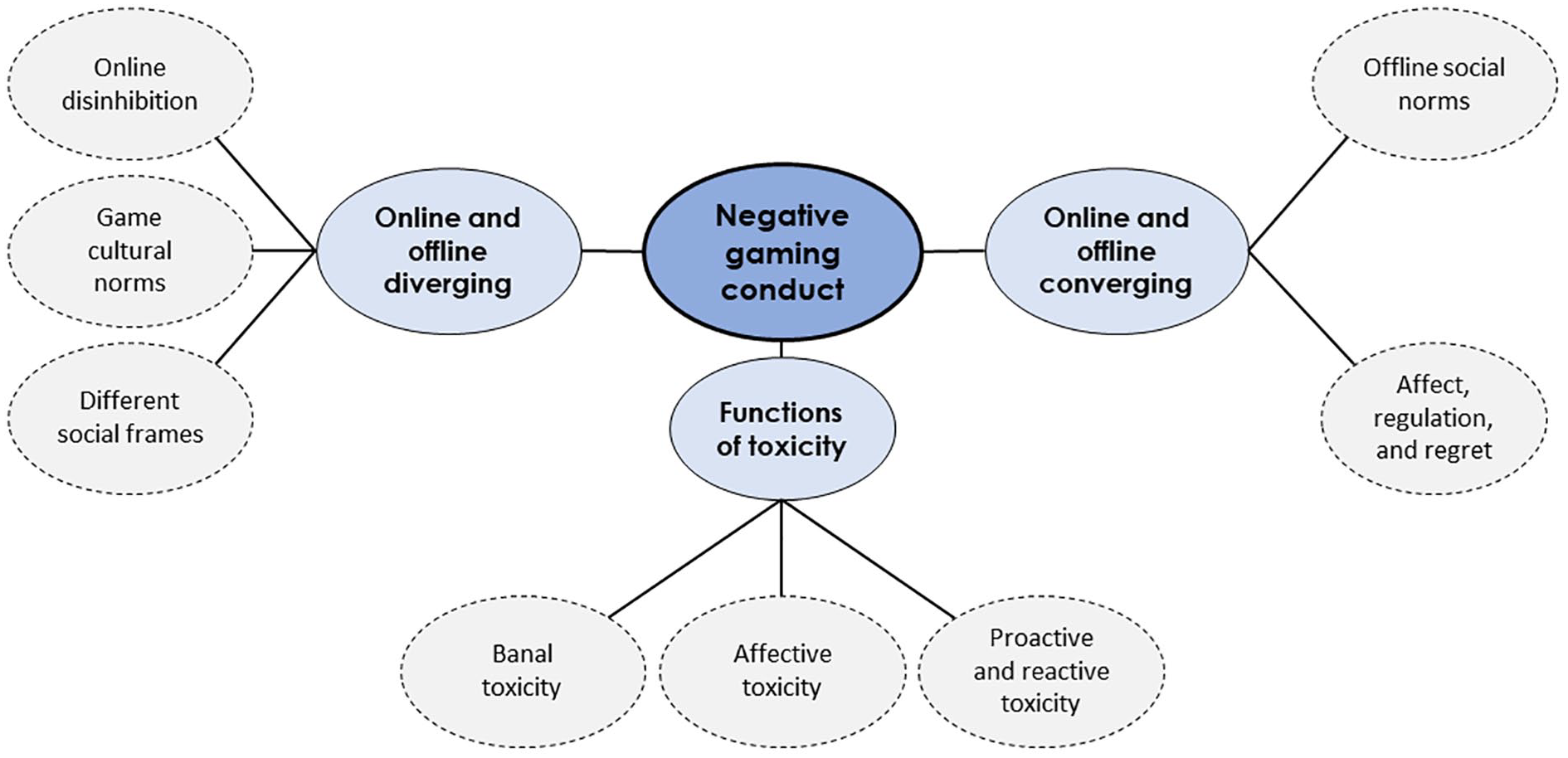
Map of main themes and subthemes.
Analysis
We present our analysis structured by our three main themes: Functions of toxicity, Online and offline diverging, and Online and offline converging. As the theme names suggest, the first theme addresses the different functions of negative or toxic behavior, the second theme features respondents’ perceptions of online gaming spaces as distinct from other everyday interactions, and the third discusses views of online spaces as closely tied to the rest of everyday social life. Our first main theme answers RQ1, whereas the two other main themes answer RQ2. All the quotes are from the data of this study and have been translated from Finnish by the authors.
Functions of Toxicity
Our respondents described a range of different reasons for negative behavior. This diversity is an important facet of the phenomenon, as outwardly similar acts can have very different social functions.
Proactive and Reactive Toxicity
Respondents discussed both proactive and reactive toxicity. In the former, respondents initiated negative behavior over in-game events, whereas in the latter the respondent reacted to negative behavior targeted at them. Proactive toxicity was often sparked by a teammate’s perceived poor performance and could sometimes result in others turning on the player in question, resembling the social dynamics around bullying (see Kwak et al., 2015). This highlights how often in gaming playing badly is seen as an acceptable reason for being berated. Christopher Paul (2018) has discussed this phenomenon via the concept of toxic meritocracy, forefronting the persistent yet false assumptions prevalent in the game cultures that everyone is in the same position to become skilled at playing games and that being a skillful player is the ultimate goal of playing games: I started berating my team member when they failed and I got the rest of the team to join in. It definitely didn’t have a positive effect on that player, but maybe the rest of the team worked together better afterwards.
Another player’s toxicity was a commonly stated reason for a respondent’s own toxic behavior. In these instances, players might not generally have a permissive view of toxicity but could still find justification for toxic behavior in some situations. Some players specifically mentioned that they only behaved in a toxic manner as a reaction, not proactively. It is easy to see how this kind of response can lead to a self-amplifying loop of toxic behavior (Liu & Agur, 2023; Ruotsalainen & Meriläinen, 2023): Usually I’m only toxic if another person is first e.g. in a game my sister got her share of another player’s misogyny and I joined the game and spammed the chat full berating the player in question and laughing at them. Maybe not the smartest thing to do but I feel like because their behaviour wasn’t smart either I can stoop to the same level. You can’t have a sensible conversation with everyone and kindly ask them to stop.
Affective Toxicity
Competitive multiplayer gaming is often emotionally intense, which can result in negative outbursts. While players often find ways to express their frustration in other ways, such as by shouting at their screen in the privacy of their home (Ruotsalainen & Meriläinen, 2023), frustration is also commonly vented at other players, sparked by the heat of the moment (Kordyaka et al., 2020): I’m a very emotional person and especially display my anger to others. As examples many times I’ve played Among Us [(Innersloth, 2018)] with both friends and strangers things have gotten completely out of hand. The idea of the game is finding the traitor among the others. I’ve not only shouted at others that I’m not the traitor or done nothing “sus” [suspicious], but I’ve also been called a whore in the game several times during conversations, which has left me pretty speechless and angry for several days. Playing Splatoon [(Nintendo, 2015)] or Genshin [Impact] [(miHoYo, 2020)] I’ve been so furious about my own stupidity that I’ve gotten out of my chair and jumped up and down screaming bloody murder and maybe throwing something around, but nothing has ever broken during game sessions, apart from maybe my mental state.
Banal Toxicity
A key finding of this study, in some responses we identified what we call banal toxicity, a form of everyday negative behavior. It does not appear to have the strategic (cf. Karhulahti, 2022) or bonding (cf. Kaye et al., 2022) functions of “trashtalk,” and while sometimes stemming from frustration, it lacks the considerable emotional release discussed above or the element of seeking thrills and personal enjoyment (cf. Cook et al., 2018). Instead, it appears as rote negativity “just because,” enabled by social norms that do not contest such behavior and sometimes even encourage it. Gaming can be an extremely mundane activity (Pargman & Jakobsson, 2008) and it follows that negative conduct can be as well: The players of your own team disturb you or do not understand the game and try to give you advice. I yell back even though I know it won’t help anything: D On CSGO [Counter-Strike: Global Offensive (Valve Corporation & Hidden Path Entertainment, 2012)] I was playing soloqueue [playing with strangers] and on the B-site of Cache [a map in the game] I had to play alone when no one on the team could find it in themselves to come and help, I chewed out brother Russian and that’s about it, it didn’t fix the situation but it’s not like I was invested anyway.
Online and Offline Diverging
Views of online play spaces as distinct from other areas of everyday life were clearly present in the responses. These views were a central factor in negative gaming conduct, and lend support to both earlier findings (Kordyaka et al., 2020; Liu & Agur, 2023) and the use of the online disinhibition theory (Suler, 2004) in studying the topic.
Online Disinhibition
Some respondents explicitly expressed the idea that they were “two different people” online and offline. In the first quote below, it is also interesting that the respondent refers to off-game as “off-duty.” The wording reflects a mental and social distinction between gaming and other interactions; the figure of speech is typically used to make a distinction between work and private life: I’m like two different people in-game and off-game. “Off-duty” I try to be an especially nice and good person, whereas while gaming I sometimes get cranky. If I tilt [lose control] in a game, I start snapping at my gaming buddies and tell them very plainly that they’re shit in the game and have no business being in the competitive gaming mode. They should learn new characters/roles, so they wouldn’t be team-sabotaging onetricks [someone who exclusively plays a single character]: human trash. So it’s easy to slip into the very deep end without noticing and question a person’s right to take part in the game, even though they’re of course meant for everyone. In the real world I’m a completely different person.
Seeing gameplay as separate from other everyday interactions was not synonymous with negative conduct; respondents also mentioned benign disinhibition and the opportunities provided by games for being and acting differently. This echoes Jansz’s (2015) ideas of games as “private laboratories” for identity exploration—although obviously in the context of online gaming, the laboratory is not exactly private. Scholars have noted (e.g., Steinkuehler & Williams, 2006; Stenros, 2014) that games can provide a social space distinct from other everyday environments, and this notion was present in the responses to our questionnaire as well: I’m really quiet and reserved outside games but when gaming I’m much more relaxed (socially) and don’t really think about my every word and reaction. It has its upsides and downsides.
Game Cultural Norms
Game cultural norms of condoning or not resisting negative behavior have been repeatedly identified in previous studies (Hilvert-Bruce & Neill, 2020; Karhulahti, 2022; Lajeunesse, 2023; Ruotsalainen & Meriläinen, 2023), and could be perceived in our study’s responses as well. Several respondents brought up the idea that negative behavior was simply a part, even a natural part, of gaming. While not necessarily supportive of negative behavior, these responses tended to downplay its relevance: this was just the way gaming was: Dunno it’s an online game you gotta remember that in there you say whatever I behave in games according to the frame set by the community. If the community is toxic, so am I.
The banality of toxicity is apparent in one respondent’s description of their reaction to dying in an online game. Although the respondent describes an emotional reaction, compared to everyday face-to-face or digital interactions, their response comes across as disproportionate and echoes Hilvert-Bruce and Neill’s (2020) findings of aggression being perceived as more acceptable in an online gaming context. The respondent’s other responses suggest that this was not their usual behavior in non-gaming contexts. It is also interesting to note that the respondent uses a word typically used to insult women, despite presumably having no knowledge of the target’s gender, demonstrating how players may strengthen sexist game cultural norms without directly engaging in gendered harassment: I was shot in the head and it pissed me off because the enemy was at an angle where I couldn’t see them, so I yelled in the chat, you fucking stupid whore, in English.
It is important to note that respondents’ perceptions and normative views on online conduct did not necessarily translate directly into their behavior. Respondents could discuss a clear distinction between offline and online or have permissive views on online conduct in general but mention that these did not alter their conduct. The next quote is a reminder that normative beliefs are only one of the many factors that shape behavior: I behave in a similar manner in games and outside them. In my view you’re allowed to behave differently in games compared to the rest of everyday life, if you want to. I don’t want to behave differently myself, because I don’t see it as necessary. I do however think about online conduct in the sense that I only say things I’m also prepared to say face to face.
Different Social Frames
Seeing gaming as distinct from other social situations did not necessarily imply that they were seen as less meaningful. A few respondents explicitly likened the changes in their conduct while gaming to other everyday situations in which people alter their behavior and self-presentation based on social context (Goffman, 1956; see also Bullingham & Vasconcelos, 2013).
In addition to the distinction between the gaming context and other interactions, there was also a crucial distinction in social encounters within the gaming context, namely that of playing with friends as compared to playing with strangers. In the following quote, the respondent brings up both phenomena: gaming allows the players to behave in a way that would be inappropriate in a work context, but the players are also ready to tone down their conduct toward visiting players. This example also demonstrates the importance of the social contract between players in relation to negative conduct (Karhulahti, 2022; Kaye et al., 2022; Ruotsalainen & Meriläinen, 2023). While the respondent describes negative behavior in their gaming group, they also explicitly mention that this is seen as socially acceptable. As Kaye et al. (2022) found, outwardly hostile behavior can have a socially bonding function between friends (see also Dynel, 2008): Our gaming group has played together for about 7 years. Our language is really inappropriate and we are at the very least impolite towards each other. I believe it’s a way to let off steam. In the game you say to your friends what you don’t dare say to your boss at work. In our group that’s ok. Things change immediately if there’s a guest star present. Then we use proper language and don’t put others down. I never [behave the same in-game and off-game], because it’s kind of a similar thing as behaving differently in different friend groups. When I play by myself and if I get annoyed I might start to bully players who are worse than me (spawn killing or/and t-bagging). If I play with friends, I have never (at least not yet) gotten angry or started to behave in a toxic manner.
Here what is important is not so much what is the activity taking place or if it is online or offline, but rather who the activity is enacted with. Playing with friends instead of strangers removes or reduces the element of anonymity and encourages offline conduct norms to take precedence over game-cultural ones, which are much more permissive of hostility.
Online and Offline Converging
Although many respondents conducted themselves differently in online and offline spaces, many others behaved, or at least tried to behave, similarly in both contexts. This was sometimes mentioned as a conscious effort that recognized the game’s cultural and online norms discussed above. Players could also be swept up in intense gaming moments and end up reflecting on their conduct afterward.
Offline Social Norms
The line separating offline and online, game and non-game, is porous rather than solid; gaming always takes place bounded by the everyday, rather than separated from it (Apperley, 2010; Pargman & Jakobsson, 2008; Taylor, 2009). Consequently, behavioral norms from everyday life beyond games also influence player behavior, as is evident in the following response: I try my best to behave in the same way [as in other everyday contexts] and above all in a nice and positive way. Sometimes I use black humour with my closest friends, but I respect others and their boundaries. I have worked as a game educator and therefore been a public character/role model for several years, so I pay special attention to my behaviour when playing in public. Everyone should be themselves in the game-world as well, but just like in real life, others should be respected and treated kindly.
For this respondent, gaming life is no longer lived under the veil of anonymity, but her public persona is mixed in and she holds herself to everyday behavioral norms and standards also when gaming. Earlier research suggests that playing as a public person, for instance streaming while playing, can have a moderating effect on negative behavior (Ruotsalainen & Meriläinen, 2023) and that closing the gap between online and offline identities helps to reduce negative behavior (Kordyaka & Kruse, 2021).
Affect, Regulation, and Regret
The considerable affective load present while playing competitive games was noted by several respondents. Players could be drawn into negative behavior yet regret it and their perceived loss of control afterward as the intense moment passes. Players were conscious of situations that frustrated them, and some discussed developing ways to calm themselves and handle frustrations: Especially before, if a player in the same game with me was joking and didn’t take the game seriously, I might tell them to find another game to play and not to spoil the game for the others. Usually with slightly more colourful word choices. These situations stayed in my mind for a while and the toxic message/speech I used gave me a brief feeling of good mood, but knowing these “trolls,” they just enjoy how their actions make others angry. I realised this and I was feeling even worse when I couldn’t control myself. A few times I’ve “ragequit” [left the game in anger]. Usually in the situation I have been on a losing streak and the last drop has been e.g. the game crashing, or when on your screen it looks like you shot the enemy first/hit the enemy but still died/the game thinks this didn’t happen. Even in these situations, I always try to say that I’m leaving now, bye, and not just leave without saying anything. During the situation, of course, I have been frustrated and certainly irritated & angry, but when I’ve had time to calm down for a while and do something else (for example drink water, go outside with the dogs, read memes) it became easier and I realised that there is nothing I can do, sometimes it happens like this. Over time, even these situations have practically been reduced to zero, as my own tolerance and means of handling frustrating situations have improved.
It was fairly common for respondents to mention that while they sometimes got angry while playing, they consciously did not take it out on other players. In the quote below, one respondent compares their conduct to their behavior while driving (see Popuşoi et al., 2018), illustrating how affective intensity or anger does not inevitably result in a total loss of control and hostility toward others, but can be vented in other ways: For the most part [I behave the same as in other everyday contexts]. I’m swearing whenever things are messed up but I hardly ever say anything about it to other people in the game and I do the same thing in my free time e.g. in traffic.
Seeing the consequences of negative in-game conduct could spark reflection and challenge game cultural norms as two normative orders clashed together. When in-game interactions were viewed through another lens and re-framed as having implications outside the game, some respondents could perceive them differently. Although this kind of re-framing is not a guarantee of remorse or self-reflection (Gray, 2012), the clash of norms can serve as a moment of realization especially for younger players (see Ruotsalainen & Meriläinen, 2023): When I was younger, around 15–17 years old, I played [Counter-Strike] quite actively, quite often after tight games I would use quite colourful language against my own team. I remember for example when my own team screwed up a 8-14 situation and the game ended 16-141 so I said in the chat pretty damn bluntly to my real life friend without thinking about it. well the next day at school I heard from the teacher how they had seen the situation as bullying and then I realised the situation and started to regret it.
Discussion
Behavior in games is influenced by multiple factors. Especially in the context of competitive games, affective intensity, and existing conduct norms, the technological and communicative affordances of games and gaming platforms, society’s and game culture’s discriminating structures, and the effect of online disinhibition come together to make online gaming spaces socially challenging and often outright problematic. However, rather than seeing this as inevitably leading to online gaming spaces being irredeemably hostile, we argue that a careful understanding of the dynamics of these spaces, and more importantly, acting on this understanding, can in the long run help make these spaces more accommodating and socially sustainable. There are three key findings, with both theoretical and practical implications, that we wish to draw attention to:
The Role of Online Disinhibition
Our study adds to the literature that identifies toxic online disinhibition as an important factor in negative gaming conduct. Our findings suggest that it is especially the combination of online disinhibition and game culture norms permissive to negative conduct (discussed below) that make it very easy for players to slip into negative behavior even if they do not especially enjoy, value, or even condone it. From the perspectives of both theory and practice, it is important that negative conduct is not perceived only as an issue of individual psychology, although it obviously plays an important part.
The line between online and offline is blurry at best and to a degree the same holds true for play and non-play; while our findings demonstrate how for many respondents the line between play and non-play exists, it is not drawn as an absolute nor in the same way or place for all the respondents. Instead, players change and adjust their behavior in accordance with who they are playing with: some situations and social contexts are seen as more meaningful and relevant than others, similar to other everyday interactions. It is not solely being online that makes the difference in behavior (Litt et al., 2020), but the nature of online gaming as a socially and technologically bounded, often affectively intense activity in which different frames that shape interaction overlap. In addition to the online versus offline divide, playing with friends versus playing with strangers and playing casually versus playing seriously also contribute to conduct.
The Banality of Negative Behavior
In an environment perceived as accepting of hostility and verbal abuse, negative behavior lost much of its impact on our respondents, whether as perpetrators or victims. The majority of our respondents did not come across as particularly hostile, antisocial, or sadistic, and only a few mentioned for example trolling or griefing for their own amusement. Players might be well aware that toxic behavior was not helpful or would amount to little or no change for the better yet went along with the conduct norms of gaming spaces, attacking others when they felt like it, responding in kind if they were attacked, and not restraining their negative responses to in-game events. This banal, “just because” negative conduct should be considered and further dissected in future research, as it appears to capture an essential dimension of the phenomenon. In our data engaging in banal toxicity appeared exclusively in the responses of respondents who identified as men, plausibly pointing to a gendered phenomenon. However, due to the skewed sample, it would be premature to claim it as such.
Negative behavior was commonly framed as everyday and even boring and habitual. In many cases, it appeared to be normative behavior with no meaningful function beyond following the norm. As such, banal toxicity appears to be habitual and to a degree adopted by the players to navigate a multiplayer environment. As a habit, it is constructed in relation to the players’ material, social, and technological environment, to habit assemblages, such as game affordances (Bennet, 2023; Zhu, 2023). This banality stands in stark contrast to the potential negative outcomes of toxic gaming behavior and the emotional labor it may require from targets. This is especially true for some individuals because negative conduct often features racialized and gendered slurs; players are in unequal positions while navigating game spaces (Fox & Tang, 2017; Gray, 2012; Ortiz, 2019). This can lead to certain words becoming affectively sticky: women and racial minorities, for instance, are in this way othered and become normalized targets of hate and disdain (Ahmed, 2013). Banal toxicity, while everyday by its nature, is not harmless or inconsequential.
The banality of toxicity could also serve as a psychological protection, as it allowed some players to shrug off hostility from others; for them, it was just the way gaming was. It needs to be considered, however, that most of our respondents were not part of a minority. This likely allowed them to more easily ignore toxic behavior as it did not connect to systemic discrimination toward them.
A Change for the Better Is Possible
While it is unlikely that negative gaming conduct could ever be completely eradicated, this does not mean that its impact cannot be mitigated. The ubiquity and normativity of negative conduct can be simultaneously viewed as both a major challenge and a potential feature to leverage. Norms are extremely difficult to change quickly; the grassroots work to contest toxicity in gaming spaces requires considerable labor and leaves the individuals and communities doing so vulnerable to harassment and burnout (Lajeunesse, 2023). Game design solutions (Kordyaka & Kruse, 2021), active and well-functioning moderation not reliant only on automation (see Kou & Gui, 2021; Kowert & Cook, 2022), and community management (Sparrow et al., 2021) should all be utilized to construct gaming environments where it is easier for players to contest toxic behavior norms. In gaming culture more broadly, players and gaming communities have demonstrated their ability and willingness to push back against hostility and discrimination (Boudreau, 2022; Nakamura, 2012), and it is conceivable that a similar phenomenon could happen in in-game settings as well.
In the context of practical solutions, the everydayness of toxic behavior means that many players engage in it without thinking or out of habit. Especially the banal toxicity we identified could likely be mitigated to an extent by making players more aware of their behavior and introducing game design features that raise the threshold for hostile communications. If a player is not particularly invested in being hostile, requiring some effort might help discourage this behavior. In the case of emotional outbursts, requiring the player to expend effort to communicate their frustration might lead them to seek emotional release in ways other than abusing other players—both this study and previous work (Kahila et al., 2022; Ruotsalainen & Meriläinen, 2023) have shown that many players do this already.
Actions having direct consequences seem to play a role in behavioral change for players. Many of our respondents demonstrate how they think different behavior in games is a result of the lack of any real consequences either in-game or out-of-game. Having faced or risking facing real-life consequences appears to motivate toward more positive behavior, and, importantly, not only because of a fear of punishment but also through reflection. Several respondents explicitly said they would never replicate their gaming behavior in offline contexts, and positioning everyday social norms in contrast to game cultural norms could help reduce banal toxicity in particular.
Game spaces can challenge and alter existing social hierarchies, allowing players to exhibit behaviors that are not possible in their everyday life— both good and bad. Although respondents brought up the role of anonymity in enabling toxic behavior, it is unlikely that removing anonymity would go a long way in solving the issue, as part of the negative behavior is based on highly affective situations, and coping requires considerable emotional skills from the players. Moreover, the benign side of online disinhibition and its links to anonymity should not be overlooked. Some of our respondents discussed how they are more open and talkative in game spaces than in other everyday contexts. Forcibly limiting communication opportunities would also limit opportunities for positive interactions while not necessarily eliminating negative conduct, as demonstrated by players’ creative transgressive use of communication features and moderating tools in games such as Hearthstone (Blizzard Entertainment, 2004) and League of Legends (Arjoranta & Siitonen, 2018; Kou & Gui, 2021; Riot Games, 2009).
While some respondents discussed their negative behavior as having very little emotion connected to it, negative behavior seems to be made even more prevalent by the affective intensity of some of the game spaces. Our respondents described feelings of frustration, annoyance, and anger, and how these feelings would come out as negative behavior, in turn prompting further negative behavior and strengthening it as the default, normative response. As is visible in our data, many respondents view negative behavior as an unwanted and unfortunate part of online gaming and attempt constantly to behave in a positive manner while playing video games, condemning toxicity. It is also not uncommon for a player behaving in a negative manner to come to regret their own behavior later, as the emotional intensity of the situation subsides (Ruotsalainen & Meriläinen, 2023).
Strengths and Limitations
The questionnaire provided us with rich data on game players’ own perceptions of their negative conduct. A qualitative questionnaire allowed us to strike a balance between in-depth responses and a larger number of participants (Braun et al., 2021). Many of the respondents brought up details that would have been very difficult to plan specific survey questions for and interviewing 95 respondents would have been a massive task for two researchers. This said, the qualitative questionnaire is also a methodological compromise; a quantitative survey would likely have yielded more responses. As part of this research project, we also conducted interviews which have been documented in another article (see Ruotsalainen & Meriläinen, 2023).
While the questionnaire explicitly stated to respondents that they could use any style of language and did not have to worry about grammar, a qualitative questionnaire nevertheless requires a good deal of attention and effort in formulating thoughts and experiences into writing. This likely discouraged participation from potential respondents, as approximately a hundred people opened the survey yet did not respond to it. To make participation easier for potential respondents not fluent in Finnish, we also provided a version of the questionnaire in English, but this did not garner any additional responses.
The sample was self-selected and primarily featured White, young, Finnish gaming men. While skewed, it is plausible that this reflects negative gaming conduct as a phenomenon; many of the respondents discussed their experiences with competitive online games, and men are overrepresented in these games’ player bases. Hostility in the game cultures has been connected especially to masculinity and men’s conduct (Braithwaite, 2016; Salter & Blodgett, 2012), and our sample may indicate the gendered nature of negative gaming conduct. However, due to the gender imbalance in the sample, we have mostly refrained from analyzing the influence of gender in this article.
Given the transnationality of online gaming, it is almost certain that our interviewees had encountered and perpetrated negative interactions with either Finnish or non-Finnish players, but we currently have no knowledge of whether a particularly Finnish type of online gaming conduct exists in a culture seen as less talkative and stereotypically introverted (Ilmarinen, 2018). While current knowledge points to negative conduct being identified, perpetrated, and motivated similarly to Finland in samples from different nations such as China (Liu & Agur, 2023) and Australia (Türkay et al., 2020), a research setup specifically examining the influence of national social norms on online conduct would shed light on another important facet of the interaction between online and offline environments.
Conclusion
Our study paints a picture of a space that allows and even encourages conduct different from other everyday settings, and as a result can be safe and liberating, but also hostile, unpleasant, and excluding. Our results illustrate the complexities, contradictions, and different functions of negative gaming conduct, as players might behave in a negative manner out of habit, yet also dislike the toxicity of gaming spaces, experience regret over their actions, and empathize with people they have insulted in the heat of an intense gaming moment. Especially when discussing young people whose emotional and communication skills are still developing, this complexity needs to be acknowledged, particularly when coming up with potential solutions.
The results illuminate the diversity of young online game players in their views toward the online–offline divide and remind us of the relevance of considering online gaming spaces in the context of studying social media use, as argued by Casey O’Donnell & Consalvo (2015). Many of the respondents used expressions such as “in real life” or “I’m a different person” when referring to the difference between in-game and out-of-game situations, demonstrating that, despite our respondents having grown up and lived their lives in a dramatically different digital media landscape compared to the early social internet of the 1990s, fundamental questions of what is perceived as real and meaningful still persist when discussing online interactions.
Footnotes
Acknowledgements
The authors would like to thank Assembly for allowing us to conduct our research at the event, Matilda Ståhl for her comments on the manuscript, and the two anonymous reviewers for their valuable feedback.
Declaration of Conflicting Interests
The author(s) declared no potential conflicts of interest with respect to the research, authorship, and/or publication of this article.
Funding
The author(s) disclosed receipt of the following financial support for the research, authorship, and/or publication of this article: This study was funded by the City of Helsinki Youth Services project Non-toxic—non-discriminatory gaming culture and the Research Council of Finland project Center of Excellence in Game Culture Studies (CoE-GameCult, grants 353265 and 353267).
