




Abstract
Adolescents commonly use media and communication devices during academic activities, also referred to as academic-media multitasking. Although there is evidence for the short-term effect of academic-media multitasking on academic achievement, support for its long-term effect is lacking. Therefore, we investigated the long-term relationship between academic-media multitasking and academic achievement, and the possible underlying mechanism of academic attention problems using a three-wave longitudinal study, with time intervals of 3–4 months, among 1215 adolescents (11–15 years, 52% boys). Although academic-media multitasking and academic achievement were cross-sectionally related, the findings showed neither support for a direct nor indirect long-term relationship between academic-media multitasking and subsequent academic achievement scores. However, academic-media multitasking was associated with an increase in subsequent academic attention problems. This study indicates that concerns regarding the long-term impact of academic-media multitasking on academic achievement need to be qualified.
Keywords
The omnipresence of mobile communication technologies has increased adolescents’ opportunities to use media and communication devices during academic activities. Consequently, adolescents often use media and communication devices during homework and while attending class, not only for academic but also for non-academic purposes (Wallis, 2010). Using media during academic activities for non-academic purposes is referred to as academic-media multitasking (AMM). About half of adolescents indicated that they sometimes or often watch television, use social media, or engage in text messaging during their homework (Common Sense Media, 2015). Furthermore, approximately 64% of adolescents reported that they regularly text while attending class (Lenhart et al., 2010).
This rise in AMM can be explained by the affordances of new technologies, such as social media which allow their users to interact with their peers constantly (Rosen et al., 2013). Moreover, how frequently someone engages in AMM may also depend on individual characteristics such as higher task motivation, self-efficacy (Calderwood et al., 2014), self-regulation (Sanbonmatsu et al., 2013; Wei et al., 2012; Zhang, 2015), or attention problems (Baumgartner and Sumter, 2017), as well as on situational factors, such as boredom, time pressure (Carrier et al., 2015), or emotional needs (Wang and Tchernev, 2012). Concerns have been voiced that this increase in AMM has a detrimental impact on adolescents’ academic achievement (for reviews, see Carrier et al., 2015; Jeong and Hwang, 2016; Levine et al., 2012; Van der Schuur et al., 2015). Academic achievement has been operationalized as grade point average (GPA) or course grades (e.g. Junco and Cotten, 2012; Rosen et al., 2011), or as homework or lecture outcomes, such as a test on one specific lecture (e.g. Pool et al., 2003; Wood et al., 2012). Overall, the literature has yielded consistent negative relationships between AMM and academic achievement (e.g. Clayson and Haley, 2013; Junco and Cotten, 2012; Wei et al., 2014).
Although studies in the field of AMM on academic achievement have rapidly accumulated, it is marked by two main gaps. First, evidence on the long-term effects of AMM on adolescents’ academic achievement is lacking. Specifically, studies have either examined the short-term impact of AMM on homework and lecture outcomes (e.g. Armstrong et al., 1991; Rosen et al., 2011; Wood et al., 2012), or the cross-sectional relationship between AMM and GPA or course grades (e.g. Junco, 2012; Junco and Cotten, 2012; Ravizza et al., 2014). Therefore, it is yet unknown whether frequently engaging in AMM results in lower academic achievements in the long-term (Carrier et al., 2015). Second, potential underlying mechanisms that may explain how AMM negatively affects academic achievement in the long-term have not been investigated. Previous research has suggested that academic attention problems (i.e. having difficulties focusing on academic tasks) may function as an important underlying mechanism (Ophir et al., 2009). AMM may in the long-term hinder adolescents’ general ability to focus on the academic activity, which may lead to lower academic achievement.
This study will address both gaps by conducting a longitudinal study among adolescents in which we aim to examine: (1) the long-term relationship between AMM and subsequent academic achievement scores and (2) the possible underlying mechanism of academic attention problems in this long-term relationship.
The short-term effects of AMM on academic achievement
Several experimental studies have investigated the short-term effects of AMM on academic achievement scores. These studies focused largely on college student samples (e.g. Rosen et al., 2011; Wei et al., 2014; Wood et al., 2012) and examined specific aspects of AMM, such as engaging in text messaging while in class (Rosen et al., 2011) or watching TV during a homework assignment (Pool et al., 2003). These experimental studies consistently showed that AMM has a moderate negative impact on homework and lecture outcomes (e.g. Jeong and Hwang, 2012; Srivastava, 2013; Wood et al., 2012). For example, watching television while reading decreased reading comprehension (e.g. Armstrong and Greenberg, 1990; Jeong and Hwang, 2012). In addition, watching television during a math assignment deteriorated performance on the math assignment in question (Pool et al., 2000). Similarly, students who frequently engaged in text messaging during a lecture showed lower performance on a test related to that lecture, than students who did not engage or sometimes engaged in text messaging (Rosen et al., 2011). Overall, we can conclude that there is a short-term impact of AMM on academic achievement.
Researchers have proposed two explanations for AMM’s negative short-term impact on adolescents’ academic achievement. First, the time displacement hypothesis (e.g. Lee, 2009; Nie and Hillygus, 2002) states that adolescents who engage in AMM may spend insufficient time on the academic activity, because the time spent on media directly displaces the time spent on academic activities (e.g. Fox et al., 2009), which may, in turn, hinder their academic achievement. Second, cognitive capacity theories assume that because individuals have a limited pool of cognitive resources, they are unable to sufficiently process different content simultaneously (e.g. Lang, 2000, 2006; Salvucci and Taatgen, 2008, 2010) When engaging in AMM, adolescents need to allocate their cognitive resources to both the academic content and the media content. Consequently, they may not have sufficient cognitive resources left for processing the academic content sufficiently, resulting in lower performance on academic tasks (Chen and Yan, 2016; Junco, 2012; Junco and Cotten, 2012).
The long-term effects of AMM on academic achievement
Researchers have implicitly or explicitly assumed that AMM may also have a long-term influence on adolescents’ academic achievement, reflected in their GPA or their course grades (Junco, 2012; Junco and Cotten, 2012; Levine et al., 2012). However, all of the existing studies are cross-sectional. Therefore, it remains unclear whether adolescents who frequently engage in AMM perform worse in school over time. There are two main explanations for the possible long-term effect of AMM on academic achievement.
The first explanation is that AMM interferes with adolescents’ long-term learning process. Learning is often a reflection of the extent in which multiple pieces of information on a specific topic have been integrated over time (Mercer, 2008). Specifically, adolescents first need to learn the basic principles of a topic before they can expand and deepen their knowledge (Frey et al., 2016). When AMM repeatedly interferes with adolescents’ homework and lecture outcomes, this may interfere with their learning process over time because crucial pieces of information that need to be integrated could be missing. Because AMM may hinder adolescents’ long-term learning process over time, this could in the long-term result in lower academic achievement.
A second explanation for a long-term negative impact of AMM on academic achievement is that frequently engaging in AMM may result in academic attention problems (Ophir et al., 2009), which in turn has a negative impact on academic achievement scores. Based on the definition of attention problems (American Psychiatric Association, 2013), we refer to academic attention problems as difficulties with regulating and guiding attention, for example, experiencing difficulties in sustaining attention, getting easily distracted, and being forgetful, during academic activities. To understand the possible long-term impact of AMM on academic attention problems, we rely on the literature regarding the effect of media-media multitasking (i.e. the simultaneous use of multiple media; Shih, 2013) on attention problems (Ophir et al., 2009; Van der Schuur et al., 2015).
Researchers have argued that frequently engaging in media-media multitasking may over time result in a habit characterized by continuous scattered attention (Ophir et al., 2009). Specifically, the constant switching between several media activities may interfere with adolescents’ general ability to focus on one activity because they are accustomed to continuously respond to internal (e.g. boredom) and external (e.g. social media alerts, talking peers) triggers (Ophir et al., 2009). Similar to media-media multitasking, adolescents who repeatedly engage in AMM may become used to being constantly distracted during their academic activities and may find it increasingly challenging to focus and sustain their attention on the academic task (e.g. Levine et al., 2012).
Academic attention problems are problematic for adolescents’ academic achievement because the ability to focus attention on an academic activity is crucial for processing the academic content efficiently (Wei et al., 2012). Previous studies already indicated that attention problems interfere with academic achievement, even after controlling for IQ and socio-economic status (for a review, see Polderman et al., 2010). Moreover, the predictive effect of attention problems on academic achievement seems to be almost as strong as the predictive effects of motivation and cognitive ability (Birchwood and Daley, 2012), two of the most important precursors of academic achievement (e.g. Gottschling et al., 2012). Thus, because AMM could lead to more academic attention problems, this may indirectly interfere with adolescents’ academic achievement.
The present study
Both explanations of why engaging in AMM interferes with adolescents’ academic achievement in the long-term are plausible. Both explanations focus on within-person processes between AMM and academic achievement, in that they state that the academic achievement of this adolescent decreases over time if he or she engages in AMM more frequently. To investigate both explanations, we conducted a three-wave longitudinal study to examine within-person relationships between AMM and academic achievement over time. Specifically, we hypothesize that the frequency of AMM is negatively related to subsequent academic achievement within adolescents (H1). In addition, we examine the role of academic attention problems as a potential underlying mechanism, and hypothesize that academic attention problems will mediate the negative relationship between AMM and subsequent academic achievement within adolescents (H2). To examine these longitudinal relationships, we conducted a three-wave longitudinal study with time intervals of 3–4 months. We decided for these rather short time intervals for two reasons. First, researchers have advised to use shorter time intervals if no prior studies on a specific effect exist (Cole and Maxwell, 2009). Second, particularly in adolescence, developmental changes may occur quickly and are thus best captured with these shorter time intervals (e.g. Light et al., 2014; Van den Akker et al., 2014).
Methods
Sample
We conducted a three-wave longitudinal study to examine various types of media multitasking and domains of adolescents’ functioning in seven secondary schools across the Netherlands. For six of the seven schools, data were available on adolescents’ academic achievement. Of these six schools, 1090 adolescents participated in Wave 1, 1075 in Wave 2, and 1057 in Wave 3. The attrition across the three waves can mainly be explained by illness, student numbers that could not be matched, and busy school schedules during the assessment points that allowed some classes not to participate in one of the waves. In total, 1215 adolescents filled out the survey in at least one wave (52% boys). The age of these adolescents ranged between 11 and 15 years old in the first wave (Mage = 12.68, SD = 0.76). Fifty percent (n = 608) of the adolescents were in their first year (Grade 7) and 50% (n = 607) were in their second year (Grade 8) of the secondary school. In the school system of the Netherlands, students immediately move from elementary school to secondary school after Grade 6. Data from these 1215 adolescents were used in the analyses. Similar to other western countries, the Netherlands is characterized by high media use and a high Internet and smartphone penetration among adolescents. Among youth aged 12–25 years, 99% have access to a smartphone at home or own their own smartphone, and 95% use the Internet (almost) every day (Centraal Bureau voor de Statistiek [CBS], 2018).
Procedure
Before the start of the study, we obtained ethical approval by the ethical committee of the University of Amsterdam. After contacting schools via e-mail, seven schools agreed to participate in the larger longitudinal study with multiple classes of Grades 7 and 8. Of the seven schools, six schools agreed to provide information on adolescents’ academic achievement scores. Data were collected three times during one school year, namely in November 2014, in March 2015, and at the end of June 2015. These data collection time points were selected because they were all around the end of a school term (first term, midterm, and final term).
Of the participating classes, we obtained passive informed consent of the parents and informed assent of the adolescents. Both parents and adolescents received information about the study and were assured that their participation was completely confidential and voluntary. The participants filled out the online survey in class, which took approximately 30 minutes per wave, under supervision of a member of the research team and/or the teacher. After each wave, the participants received a small incentive (monetary value around US$0.50).
Measurements
AMM
The measure of AMM consisted of 17 items and was based on the Media Multitasking Index (MMI) developed by Ophir et al. (2009). Participants had to indicate how often they typically engage in the following media activities for non-academic reasons during homework (nine items, activities 1–9) and while attending class (eight items, activities 2–9): (1) watching television, (2) reading, (3) listening to music, (4) talking on the phone, (5) sending messages via phone or computer, (6) using social network sites, (7) watching movies on the computer, (8) playing video games, and (9) other computer activities. We excluded watching TV while attending class, because this is a very unlikely combination. The items were introduced with “Can you indicate how often you typically use the different media during your homework/while attending class? When answering, think only of media use that has nothing to do with your homework/the class.” An example item for media use while attending class was “During class, I read or send messages via phone or computer.” An example item for media use during homework was “During homework, I watch television.” AMM was rated on a 5-point scale, 0 = never, 1 = almost never, 2 = sometimes, 3 = often, and 4 = very often. All 17 items were averaged into one mean index for AMM (Wave 1: M = 0.83, SD = 0.57, Cronbach’s α = .86; Wave 2: M = 0.92, SD = 0.63, Cronbach’s α = .89; Wave 3: M = 0.98, SD = 0.68, Cronbach’s α = .90). A higher score indicated more frequent AMM.
Academic attention problems
The scale of academic attention problems was based on the School Questionnaire for elementary and secondary school (Smits and Vorst, 1990). We aimed to measure both attention problems in class and during homework. The scale originally consisted of eight items on attention problems in class. For this study, we selected four items from this scale that could be easily adapted to the homework environment. In total, we included eight items for academic attention problems, four items on attention problems in class and four items on attention problems during homework.
The four items on attention problems in class were as follows: (1) “I find it hard to keep my mind on my work throughout the class”; (2) “In the classroom, I often think about things that have nothing to do with the class”; (3) “I get easily distracted in class”; and (4) “I can easily keep my attention on the class (reversed).” The four items on attention problems during homework were as follows: (1) “I find it hard to keep my mind on homework all the time”; (2) “While doing homework, I often think about things that have nothing to do with my homework”; (3) “I get easily distracted while doing my homework”; and (4) “I can easily keep my attention on my homework (reversed).”
The eight items were rated on a 5-point scale, 0 = completely untrue, 1 = untrue, 2 = somewhat true, 3 = true, and 4 = completely true. The items were averaged into one mean index for academic attention problems (Wave 1: M = 1.97, SD = 0.81, Cronbach’s α = .90; Wave 2: M = 1.96, SD = 0.81, Cronbach’s α = .90; Wave 3: M = 1.90, SD = 0.78, Cronbach’s α = .88). A higher score indicated more academic attention problems.
Academic achievement scores
Adolescents’ academic achievement was operationalized as the academic achievement scores, which was based on the documented first term, midterm, and final term course grades of the adolescents. The term course grades were provided by the schools around the same time as the survey data collection of each wave. The course grades ranged between 1 and 10, with a 5.5 or higher needed to pass a course. We selected three term course grades (Dutch, English, and Math) to calculate one composite academic achievement score for each wave (Wave 1: M = 6.85, SD = 0.97; Wave 2: M = 6.71, SD = 0.95; Wave 3: M = 6.63, SD = 1.01). We chose these three courses because these are mandatory subjects within the Dutch educational system. Moreover, this strategy has been used in previous studies (e.g. Busch et al., 2017; Scholtens et al., 2013).
Demographics
We asked the respondents about their sex, age, and grade. For sex, we asked the respondents to report if they were a boy (coded as 0) or a girl (coded as 1). For age, we asked the respondents how old they were. For grade, we asked them if they were in their first (coded as 0) or second year (coded as 1) of secondary school.
Analyses
To examine our hypotheses, we applied a random-intercepts cross-lagged panel model (RI-CLPM; Hamaker et al., 2015). The RI-CLPM has recently been developed to tackle serious shortcomings of the common cross-lagged panel model (CLPM; Curran and Bauer, 2011; Hamaker et al., 2015). Most importantly, the CLPM combines between-person variance and within-person variance. Aggregating these sources of variance is worrisome because it is unclear whether the cross-lagged paths reflect between-person or within-person relationships. Consequently, interpreting these cross-lagged paths may lead to inaccurate conclusions regarding the causal relationships within individuals (Hamaker et al., 2015). Because we are specifically interested in these within-person relationships, we employed the RI-CLPM (for full descriptions of the model see Hamaker et al., 2015). The RI-CLPM is able to disentangle between-person variance from within-person variance. Specifically, by controlling for the stable between-person correlation and stable confounding variables (e.g. age and biological sex), the RI-CLPM provides insight into the within-person cross-lagged correlations (Hamaker et al., 2015).
Because we aim to examine the within-person effects, we first calculated the intra-class correlations (ICC) for AMM, academic achievement scores, and academic attention problems over time to test if there is sufficient within-person variance. For AMM, the ICC was .63, demonstrating that 63% of the variance was explained by between-person variance and that 37% of the variance was explained by within-person variance over time. For academic achievement scores, the ICC was .58, indicating that 58% of the variance was explained by between-person variance and 42% by within-person variance. For academic attention problems, the ICC was .68, meaning that 68% of the variance was explained by between-person variance and 32% by within-person variance. These ICC’s are similar to ICC’s in other studies that have used the RI-CLPM (e.g. Beyens et al., 2018; Keijsers, 2016; Te Poel et al., 2016 Vangeel et al., 2018). This indicates that an important part of the variance was due to the within-person variance, which supports the need to examine within-person relationships between AMM and academic achievement over time.
The RI-CLPM was modeled following the detailed description of Hamaker et al. (2015). At the between-person level, random-intercept factors of each variable were added to the model. The observed scores were the indicators of these random-intercept factors, with all factor loadings constrained to 1. To control for the stable between-person relationship over time, a covariance was added to the model between the random factors. At the within-person level, each observed variable loaded on its own latent factor and these factor loadings were constrained to 1. These latent constructs are based on the individual’s deviation of the expected individual mean. Similar to the CLPM, stability paths, cross-lagged paths, covariances at Wave 1, and covariances between the disturbances at Waves 2 and 3 were added between the within-person latent factors.
The RI-CLPM was examined in Mplus 7 (Muthén and Muthén, 2012). To deal with the missing data across the three waves, we employed the Full Information Maximum Likelihood estimation (Muthén and Muthén, 2012). We controlled for the clustering in our data on class level. We evaluated the model fit using the chi-square measure of exact fit, the root mean square error of approximation (RMSEA) and its 95% confidence interval (CI), and the comparative fit index (CFI). RMSEA values below .05 and CFI values above .95 implied good fit, whereas RMSEA values below .08 and CFI values above .90 implied satisfactory fit (e.g. Kline, 2004).
Results
Descriptive statistics
Table 1 displays the correlations, means, and standard deviations for AMM, academic achievement scores, and academic attention problems of Wave 1. Similar patterns were found for Waves 2 and 3. Similar to previous studies, AMM was negatively related to academic achievement scores, and positively to academic attention problems. In addition, as expected, academic achievement scores were negatively related to academic attention problems.
Zero-order Pearson correlations, means, and standard deviations for academic-media multitasking, academic achievement scores, academic attention problems, age, and sex, at Wave 1.
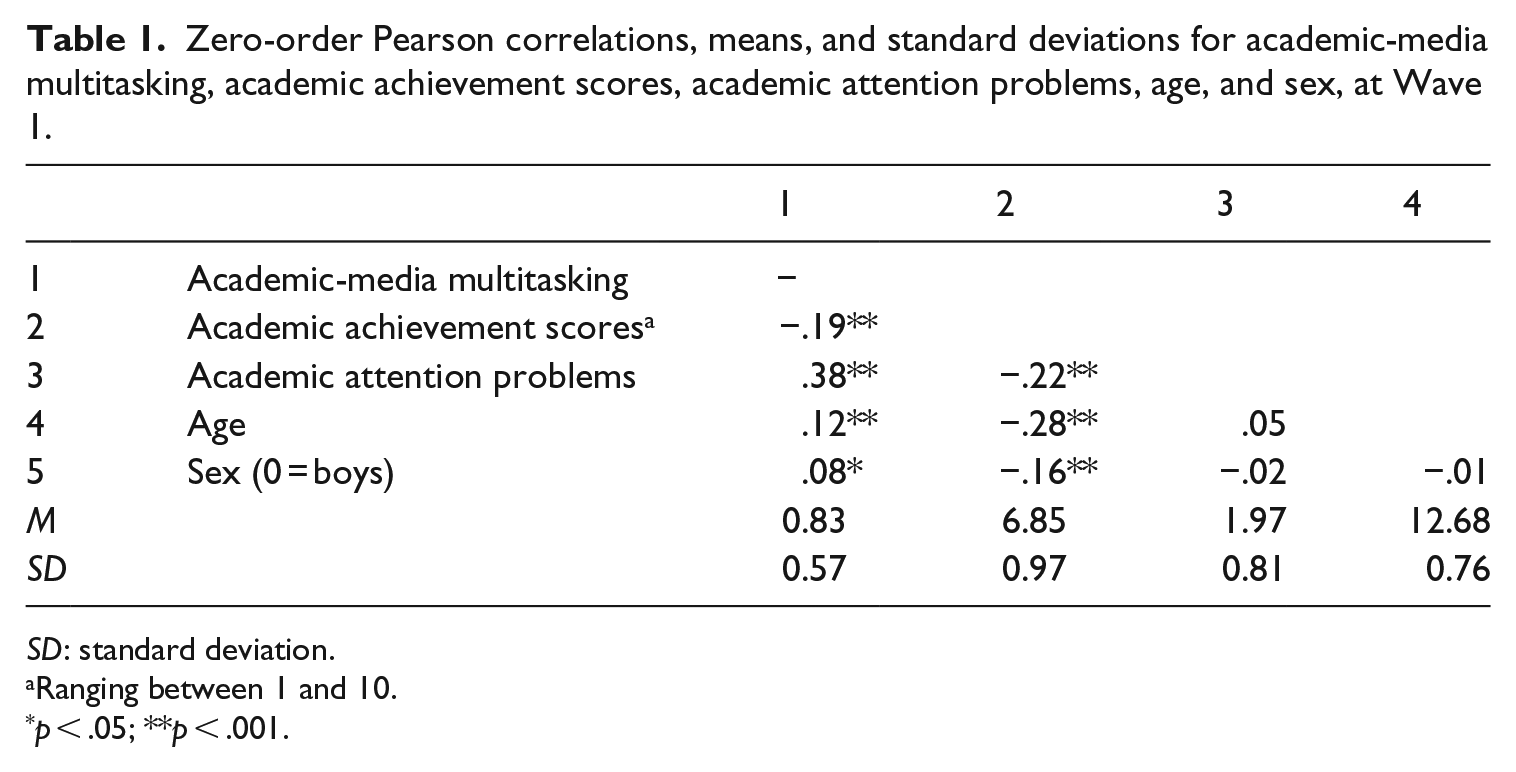
SD: standard deviation.
Ranging between 1 and 10.
p < .05; **p < .001.
The long-term relationship between AMM and academic achievement
The RI-CLPM of the long-term relationship between AMM and academic achievement is depicted in Figure 1. The model fit was satisfactory, χ2(5) = 16.21, p = .006; RMSEA = .04 (95% CI = [.02, .07]); CFI = .99. At the between-person level, there was a significant negative correlation between AMM and academic achievement scores (b* = –.28, p < .001), which means that adolescents who engaged in AMM more frequently had lower academic achievement scores across the three waves.
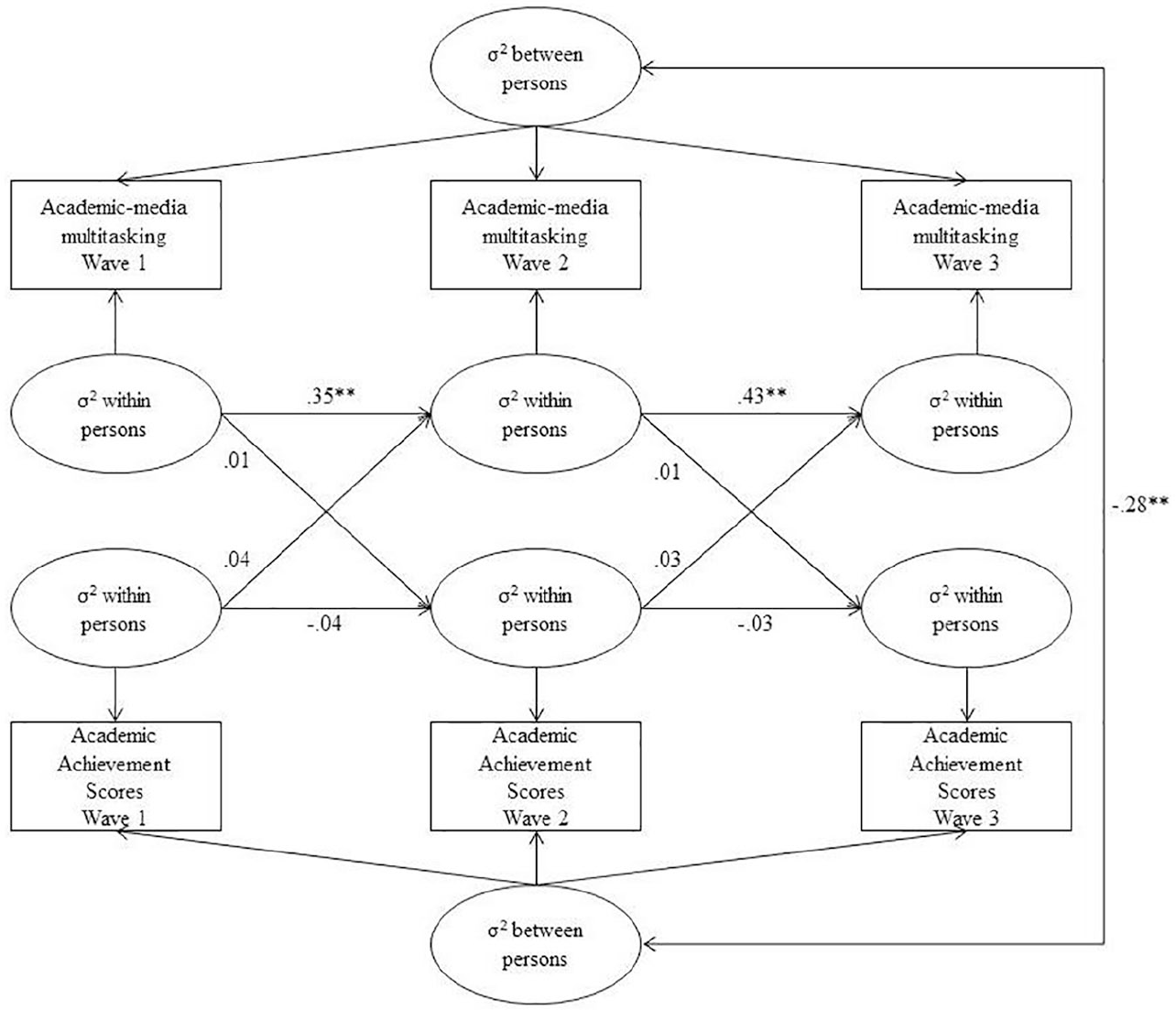
Simplified model with the standardized maximum likelihood parameter estimates for the between-person correlation and the within-person relationships between academic-media multitasking and academic achievement scores.
Inconsistent with H1, the within-person correlation of AMM to subsequent academic achievement scores was not significant from Wave 1 to Wave 2 and from Wave 2 to Wave 3 (both b* = .01, p = .899; see Figure 1). In addition, we included the cross-lagged paths from academic achievement scores to AMM. The findings showed that the within-person correlation between academic achievement scores and subsequent AMM was not significant from Wave 1 to Wave 2 (b* = .04, p = .585) nor from Wave 2 to Wave 3 (b* = .03, p = .577). We also examined two additional models in which we included media use during homework and media use while attending class separately. However, for both models, we found no significant cross-lagged paths. The results were highly similar to the overall model. Thus, in contrast to H1, we did not find support for a long-term relationship between AMM and subsequent academic achievement.
Examining academic attention problems as underlying mechanism
Because we found no evidence for the direct relationship between AMM and subsequent academic achievement scores, it was not possible to examine the mediating role of academic attention problems. However, we did examine if there was an indirect relationship of AMM on subsequent academic achievement scores via academic attention problems. Therefore, we added academic attention problems to the model (see Figure 2). The model showed good fit, χ2(12) = 21.92, p = .038; RMSEA = .03 (95% CI = [.01, .04]); and CFI = 1.00.
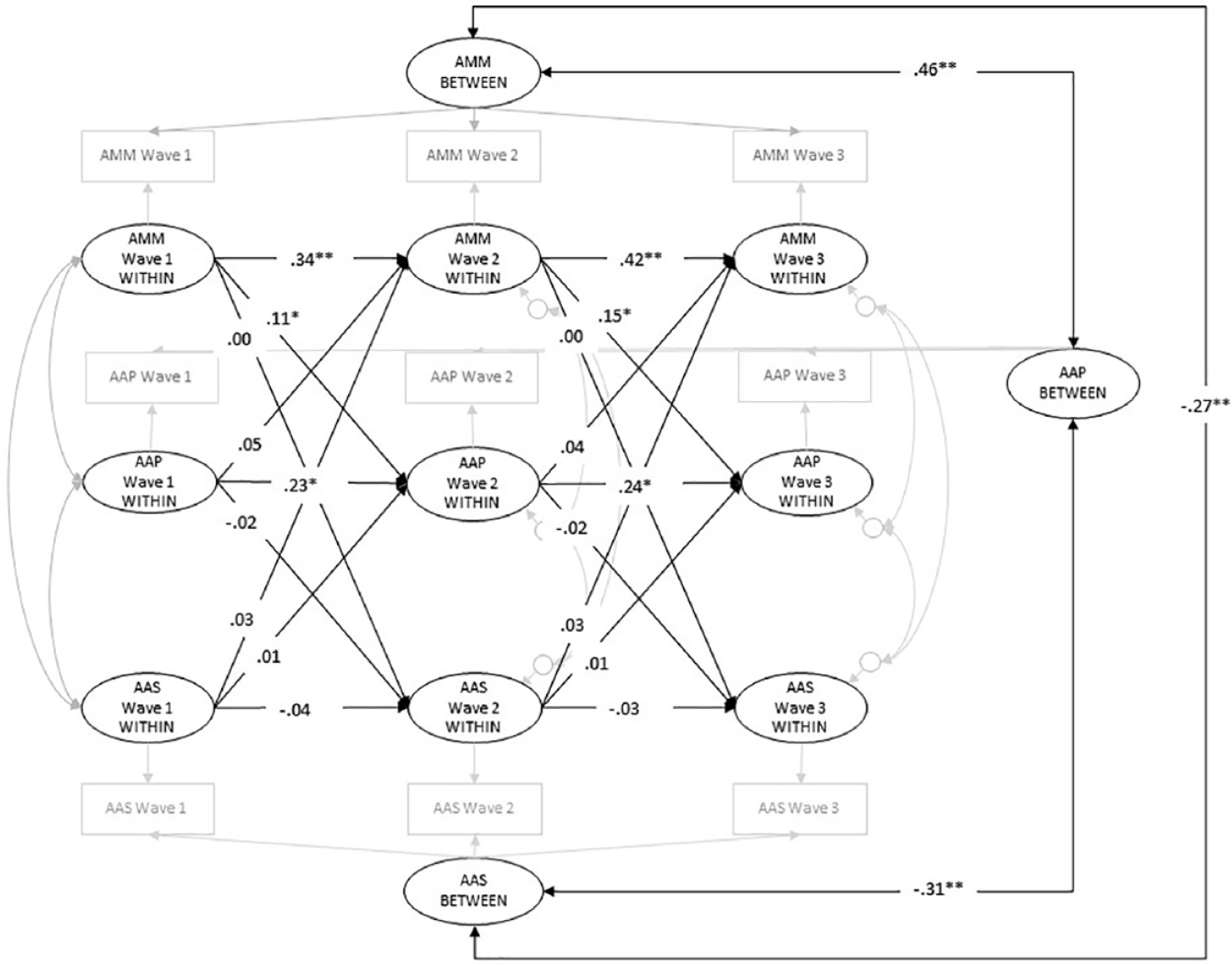
Simplified model with the standardized maximum likelihood parameter estimates for the within- and between-person relationships between academic-media multitasking, academic attention problems, and academic achievement scores.
At the between-person level, there was a significant correlation between AMM and academic achievement scores (b* = –.27, p < .001), AMM and academic attention problems (b* = .46, p < .001), and academic attention problems and academic achievement scores (b* = –.31, p < .001). This indicates that adolescents who more often engaged in AMM had lower academic achievement scores and reported more academic attention problems across the three waves. In addition, adolescents who reported more academic attention problems had lower academic achievement scores across the three waves.
The findings regarding the within-person cross-lagged paths showed that AMM positively predicted academic attention problems from Wave 1 to Wave 2 (b* = .11, p = .031) and from Wave 2 to Wave 3 (b* = .15, p = .028). However, the within-person correlations between academic attention problems and subsequent academic achievement scores were not significant from Wave 1 to Wave 2 (b* = –.02, p = .827) and from Wave 2 to Wave 3 (b* = –.02, p = .828). Thus, this implies AMM was not negatively related to subsequent academic achievement via academic attention problems, which did not support H2.
Discussion
The ubiquitousness of mobile media and communication devices has significantly increased adolescents’ opportunities to engage in AMM. It has been shown that adolescents’ engagement in AMM is related to their GPA and course grades (e.g. Junco, 2012; Junco and Cotten, 2012; Ravizza et al., 2014) and has a short-term impact on their academic achievement (e.g. Armstrong et al., 1991; Rosen et al., 2011; Wood et al., 2012). These findings indicate that AMM would also deteriorate adolescents’ academic achievement in the long term. Therefore, we investigated the potential long-term relationship between AMM and subsequent academic achievement. To examine the long-term relationship, we employed a RI-CLPM, which allowed us to test within-person processes over time by controlling for the stable between-person relationship. Overall, this study has yielded three important findings regarding the relationship between AMM and academic achievement scores.
First, we found a moderate stable negative association between AMM and academic achievement scores at the between-person level. This implies that adolescents who engaged in AMM more frequently had lower academic achievement scores than adolescents who engaged in AMM less frequently across the school year. This finding at the between-person level can be compared to previous cross-sectional findings that showed small to moderate negative relationships between AMM and GPA or course grades (e.g. Junco, 2012; Junco and Cotten, 2012; Ravizza et al., 2014). These cross-sectional relationships have been typically interpreted as possible evidence for the assumption that AMM causes a decrease in academic achievement.
However, in contrast to these common beliefs regarding the effects of AMM on academic achievement, the second main finding is that there was no support for the long-term relationship between AMM and subsequent academic achievement at the within-person level. This suggests that, although adolescents who engaged in AMM more frequently had lower academic achievement scores, AMM did not further deteriorate their academic achievement scores over the period of one school year. Thus, the potential causal effect of AMM on academic achievement could not be supported by our longitudinal findings. This indicates that the long-term effect of AMM on academic achievement may be more complex than previously assumed.
More research is needed to understand why studies show that AMM has an effect on academic achievement when considering immediate effects but not when studying long-term effects. Several underlying mechanisms and individual difference variables are needed to be included in future research to elucidate these contradictory findings. For example, a possible explanation for why AMM does not deteriorate academic achievement in the long term might be that adolescents use metacognitive strategies to counteract the potential negative short-term effects of AMM. Metacognitive strategies reflect processes that guide one’s own learning, such as planning, monitoring, and evaluation (Karlen, 2016). These metacognitive strategies may help adolescents to compensate for engaging in AMM, and to strategically select when they engage in AMM. For example, adolescents may compensate for their multitasking behavior by spending more time on studying or homework at other times. This would suggest that by engaging in AMM, adolescents may take longer to finish their homework and study tasks, but they may still be able to complete them on time and do them equally well as students who did not engage in AMM. Moreover, adolescents may strategically select when they engage in AMM. Specifically, they may select moments in which their multitasking behavior does not interfere with important academic activities. For example, they may engage in AMM the week after an important exam rather than the week before an important exam.
Although it must be emphasized that the possible buffering role of these metacognitive strategies have yet to be examined, metacognitive strategies may also explain the contrasting findings of our longitudinal study and findings of experimental studies, which consistently found detrimental short-term effects of AMM on academic achievement (e.g. Armstrong et al., 1991; Rosen et al., 2011; Wood et al., 2012). In these experimental studies, participants are typically forced to multitask during specific learning situations. These experimental AMM situations may limit the use of metacognitive strategies, such as compensation and strategically choosing when to engage in AMM. In line with this reasoning, experimental studies that allowed students in the AMM condition to spend more time on the academic activity found no significant impact on homework outcomes (Bowman et al., 2010; Fox et al., 2009). Similarly, a meta-analytic review showed that when individuals have control over their media use during non-media activities this resulted in minimal information loss (Jeong and Hwang, 2016). This may suggest that when adolescents have the possibility to apply important metacognitive strategies, AMM may not be as harmful for their academic achievement as previous research has suggested. In future studies, researchers are advised to examine if these metacognitive strategies indeed buffer the negative short-term effects of AMM.
Because our findings indicate that the consistent cross-sectional relationship between AMM and academic achievement may not be due to causal effects of AMM on academic achievement, we need to consider other explanations for the negative cross-sectional relationship between AMM and academic achievement. An explanation could be that confounding factors are responsible for the negative relationship between AMM and academic achievement. One confounding factor may be academic self-regulation. Although academic attention problems and academic self-regulation are related concepts, academic attention problems solely capture an individual’s ability to focus attention during academic activities (American Psychiatric Association, 2013). Academic self-regulation is a broader concept that includes an individual’s ability to “monitor, regulate, and control their cognition, motivation, and behavior” (Wolters et al., 2005: 251). Academic self-regulation has been acknowledged as a key predictor of both AMM and academic achievement. Specifically, the lack of self-regulation has been associated with more AMM (Sanbonmatsu et al., 2013; Wei et al., 2012; Zhang, 2015) and lower academic achievement (Blair and Diamond, 2008; Duckworth and Seligman, 2005; Robbins et al., 2004). Thus, is could be that low self-regulation in adolescents explains both, their engagement in AMM, and their lower academic performance.
The third main finding is that AMM positively predicted academic attention problems 3–4 months later. Thus, adolescents who engaged in AMM more frequently seemed to become more easily distracted during academic activities over time. This first indication of a long-term relationship between AMM and subsequent academic attention problems provides support for the scattered attention hypothesis (Ophir et al., 2009). To date, researchers have relied on this hypothesis to explain the effect of media-media multitasking (i.e. the simultaneous use of multiple media) on attention problems. However, our findings showed that this hypothesis could be transferred to other types of media multitasking as well. Specifically, when adolescents repeatedly engage in AMM, this may result in a habit of scattered attention during academic activities.
Surprisingly, academic attention problems were not related to subsequent academic achievement scores over time. Although adolescents who often engaged in AMM became increasingly distracted during academic activities, this had no influence on their course grades. This finding may be due to the short time intervals used in this study. Previous research has shown that finding a long-term relationship between academic attention problems and subsequent academic achievement may depend on the chosen time interval. For example, one study found negative long-term relationships between attention problems and subsequent overall GPA within a 5-year interval (Grades 6–11), but not within a 1-year interval (Grades 11–12; Scholtens et al., 2013). Thus, the time intervals adopted in our study may not be sufficiently long to discern long-term relationships between AMM and subsequent academic achievement.
Limitations and suggestions for future research
The limitations and insights of this study provide important directions for future research. First, most studies into AMM have been conducted in the United States. These studies have consistently yielded negative short-term effects of AMM on academic achievement (e.g. Junco and Cotten, 2012; Rosen et al., 2011). Similar to these previous studies conducted in the United States, we found cross-sectional negative relationships between AMM and academic achievement. To date, no studies have focused on the long-term relationships between AMM and academic achievement. Our study provided the first attempt to fill this gap. Due to the similarities in cross-sectional relationships found in our study and previous research from the United States, we believe that the findings of this study should apply also to other western countries with high smartphone and social media use. Future research in different countries should extend on our study and clarify whether and how our results can be replicated in other countries with different media use patterns.
Second, future studies are advised to examine in more detail why AMM may not interfere with adolescents’ academic achievement in the long run. For example, cross-sectional studies are advised to include possible third variables, such as academic self-regulation, to examine if the cross-sectional relationship is spurious. In addition, future research should investigate if adolescents apply metacognitive strategies to cope with the negative effects of AMM on academic achievement. These studies may examine if adolescents compensate for engaging in AMM by spending more time on the academic activity or by strategically choosing moments in which they can engage in AMM.
Third, future studies may use different sampling procedures and measurement techniques to improve our understanding of the relationship between AMM and academic achievement. For example, to understand the time span in which the effects of AMM on academic achievement may occur, we need longitudinal studies that include various time intervals to examine both its short-term and long-term effects. On one hand, the time interval of 3–4 months might have been too short to detect an indirect relationship between AMM and academic achievement through academic attention problems. On the other hand, even a shorter time interval may be needed to detect a direct relationship between AMM and academic achievement, as experimental studies have found short-term effects of AMM on academic achievement scores (Rosen et al., 2011; Wei et al., 2014; Wood et al., 2012). This study particularly examines the relationship between AMM and academic achievement within one school year but across different school terms. Future studies could, for example, both examine AMM within a school term and across school terms. In addition, in our study, AMM and academic attention problems were assessed with subjective self-report measurements. To address this limitation, future studies are advised to combine various subjective (e.g. surveys, experience sampling surveys) and objective measurements (e.g. automated tracking software) to measure AMM.
Finally, although in this study, no evidence was found for a long-term relationship between AMM and subsequent academic achievement, it may be that for specific subgroups AMM does lead to a deterioration of their academic achievement. First, this study focused on adolescents in secondary education. It could be that the results are different in other populations, such high school students or adolescents from other countries. Therefore, future studies are advised to examine these relationships by including a wider age range and a cross-cultural design. Second, in line with the Differential Susceptibility to Media Effects Model (Valkenburg and Peter, 2013), which posits that media effects are not universal, it is important to investigate potential moderators in future studies. Important predictors of AMM could also be considered as moderators. For example, adolescents’ academic self-regulation may play a moderating role in the long-term effect of AMM on academic achievement. Specifically, adolescents with low levels of academic self-regulation may find it difficult to cope with the ongoing media distractions during important academic activities (Wei et al., 2012). Consequently, AMM may have a stronger impact on academic achievement for adolescents with low levels of academic self-regulation, compared to adolescents with high levels of academic self-regulation. By including possible moderating variables, future studies will be able to unravel for which adolescents AMM may be harmful for academic achievement.
Conclusion
Following the cross-sectional and experimental studies in the field, this study was the first to investigate potential long-term effects of media multitasking on academic performance. Although the correlational data of this study does not allow drawing conclusions about causality, this study provides first evidence that concerns regarding the long-term impact of AMM on academic achievement that needs to be qualified. Most importantly, this study emphasizes the need to disentangle within-person and between-person relationships to fully understand the relations between AMM and academic achievement.
Footnotes
Acknowledgements
We would like to express our gratitude to the schools, teachers, parents, and adolescents for their participation in this study. This research would not have been possible without their consent and cooperation.
Funding
The author(s) received no financial support for the research, authorship, and/or publication of this article.
