




Abstract
Narcissistic admiration and rivalry have been studied in various social relationship contexts, with findings indicating that the former is related to initial popularity while the latter tends to cause problems in the longer term. In particular, the social partners of individuals with high narcissism tend to have higher costs and fewer benefits. But how does narcissism affect the perception of a long-term friendship? To gain insight into perceived friendship quality in dependence on narcissism, NT1 = 831 individuals reported on their narcissism and relationship quality with a close friend at four measurement occasions (NT2 = 619, NT3 = 484, NT4 = 420). We analyzed bivariate relations and random intercepts cross-lagged panel models (RI-CLPM) of narcissistic admiration and rivalry, and two positive (appreciation and intimacy) and two negative (conflict and dominance) indicators of friendship quality. Our results generally supported findings that narcissistic rivalry tends to lead to less positive and more negative experiences in social relationships. Narcissistic admiration and rivalry were both found to be positively related to conflict. Narcissistic rivalry was negatively related to appreciation and intimacy. At the within-person level, observed with the RI-CLPMs, appreciation influenced later narcissistic rivalry and was influenced by narcissistic admiration and rivalry. Thus, not feeling appreciated was related to subsequent increases in narcissistic rivalry, while more agentic and antagonistic behavior was related to subsequently lower perceptions of appreciation. We discuss that negative effects of narcissistic rivalry found in previous research for friendship formation also seem to emerge in the phase of friendship maintenance.
Keywords
Social relationships fulfill our fundamental need to belong (Baumeister & Leary, 1995), positively affect our well-being (Cohen & Wills, 1985; Pinquart & Sörensen, 2000; Sherman et al., 2006), our happiness (Demir & Weitekamp, 2007), and our physical and mental health (Chopik, 2017; Uchino, 2009; van Harmelen et al., 2017). To maintain positive and satisfying relationships, individuals have to engage in behaviors that foster the continuity and development of their relationships (Oswald et al., 2004). Otherwise, the relationship quality suffers, with rising relationship costs (Clark & Grote, 1998), which can ultimately lead to relationship dissolution. Particularly, in voluntary and non-exclusive relationships, such as modern Western friendships, maintenance behaviors that keep the relationship quality high are important, as both individuals’ effort rather than familial or other ties (Blieszner & Roberto, 2004) is believed to make their relationship last. Providing assurance and support, self-disclosure, spending time together, and constructive problem-solving have been suggested to be important for friendship maintenance (for an overview see Fehr, 2012; Oswald, 2017) and to lead to high relationship quality (e.g., Sprecher & Hendrick, 2004).
While these behaviors seem normal to most individuals, they can be a challenging endeavor for individuals with high narcissism, who tend to overlook the feelings and needs of others, do not return favors, and react with rage, defiance, and humiliation if threatened (Jones & Paulhus, 2010; Morf & Rhodewalt, 2001). While individuals with high narcissism tend to be liked when first met, due to their charming, self-assured, and entertaining behaviors (narcissistic admiration), they are often less appealing in the longer term, due to their selfish, insensitive, and aggressive behaviors (narcissistic rivalry; e.g., Back et al., 2013; Leckelt et al., 2015; Paulhus, 1998; Wurst et al., 2017). The relationships of individuals with high narcissism have therefore been described as alternating between idealization and devaluation (Maaß et al., 2018; Morf & Rhodewalt, 2001). This underlying dynamic apparently provides a weak foundation for the maintenance of a friendship and leads to the question of how the two narcissism dimensions of admiration and rivalry affect the perceived quality of long-term friendships and vice versa.
In the present study, we collected data from individuals at four measurement occasions spanning the course of 1 year to gain insight into the bidirectional links between narcissistic admiration and narcissistic rivalry on the one side, and perceived positive and negative aspects of friendship quality on the other. We calculated bivariate correlations in order to compare our results to previous studies observing between-person effects. However, we were mainly interested in changes at the within-person level to complement the existing research picture which mainly relies on between-person approaches. The within-person approach allowed us to observe how, for example, deviations from the average in narcissistic rivalry at one time are affected by deviations in perceived appreciation at a previous time point. In this way we could draw inferences about the temporal dynamics (see Brauer et al., 2022) between narcissism and friendship quality. In other words, using RI-CLPM, we could observe the bidirectional relationship between narcissism and friendship quality over time, with repeated measures of one variable accounting for changes in repeated measures of the other variable.
In the following section, we describe the development of friendships and how aspects of friendship quality vary across time before looking at the narcissism aspects in social relationships in general and their relation to friendship quality in particular.
Friendship stages
While there is a profound body of research on family and romantic relationships, surprisingly, friendships are less often the focus of research (Berscheid & Regan, 2005; Fehr & Harasymchuk, 2019; Harris & Vazire, 2016). One reason might be that friendships are less binding, exclusive, and regulated compared to family or romantic relationships (Harris & Vazire, 2016) and thus their influence on people’s lives may be less intense. Another reason may be that it is harder to define what a friendship is. For example, it is not as set what makes a friend a best friend or whether one can have only one best friend or a few equally very good friends. This is also reflected in the literature, where several working definitions of friendship have been proposed, but no agreement on a universal definition exists (Fehr, 1996; Wrzus et al., 2012). Summing up several important characteristics of modern Western friendships Wrzus et al. (2017) described them as voluntary and informal relationships between peers, which rely on reciprocity and are perceived as pleasant and positive (see also Blieszner & Roberto, 2004; Demir et al., 2007; Fehr & Harasymchuk, 2019; Hartup & Stevens, 1997).
Since friendships are less normative and regulated compared to other relationships, it has further been assumed that friendships are more susceptible to effects of personality differences (Wrzus et al., 2017). For example, highly agreeable individuals tend to take better care of and have more flourishing friendships (Jensen-Campbell et al., 2002; Selfhout et al., 2010) than those who are less agreeable. The moderate (Cohen, 1992) negative correlation between agreeableness and narcissistic rivalry, and the weak negative relation with narcissistic admiration (Back et al., 2013; Leckelt et al., 2018) provide first hints that individuals with higher narcissism may perceive their friendships to be of lower quality. The moderate positive correlations of antagonism from the Personality Inventory for DSM-5 with both narcissism aspects (Rek et al., 2021; Wright et al., 2013) point in a similar direction.
Fehr (1996, 2012) proposed a model of the development of friendships distinguishing among three stages of friendship development: friendship formation, friendship maintenance, and friendship deterioration. During these three stages, the importance of different relationship variables varies: While physical attractiveness, reciprocity of liking or contact frequency are particularly important during friendship formation, self-disclosure and (emotional) support become more important during friendship maintenance (Fehr, 2012; Oswald et al., 2004). Similarly, Buhrmester et al. (1988) suggested that it is social skills that are important during friendship formation, and warmth and support during friendship maintenance. Constructive problem solving and conflict resolution skills become more important to avoid dropping into the deterioration stage or ending in dissolution (Fehr, 2012). Furthermore, perceived equity and equality are important features of friendship quality (Mendelson & Kay, 2003) and may protect friendships against dissolution. Given these features that make a friendship last or dissolve, even the layperson might wonder, why a person would maintain a friendship with a narcissistic individual and how in turn narcissistic individuals perceive friendships.
The lack of a clear definition of a phenomenon (such as friendship) also makes the phenomenon difficult to measure and evaluate. Here, we operationalized friendship with four indicators of perceived friendship quality: appreciation, intimacy, conflict, and dominance (Furman & Buhrmester, 1985; Walper et al., 2010). We chose these indicators capturing positive and negative aspects of friendships in order to evaluate deviations in the perception of friendships as a function of individual difference variables, namely narcissistic admiration and rivalry. While the assessment of positive and negative aspects of friendship quality is generally recommended (Berndt, 2002), we assumed that it would be particularly interesting to observe the influence of a maladaptive trait such as narcissism, which tends to exert a negative influence on social relationships. We chose the four friendship aspects of appreciation, intimacy, dominance, and conflict to align our measure with key features of friendship models (Furman & Buhrmester, 1985; Walper et al., 2010).
Narcissism in social relationships
While individuals scoring high on narcissism attract and fascinate others on the one hand, they can be unappealing or even repelling on the other hand. Both, however, serve the maintenance and validation of the grandiose self, which lies at the core of narcissism (Morf & Rhodewalt, 2001). To explain this, Back et al. (2013) suggested two pathways: the desire for social admiration, reached through assertive self-enhancement, and the prevention of social failure, reached through antagonistic self-protection. Assertive self-enhancement is expressed in charming, self-assured, and exaggerating behaviors (Back et al., 2010; Campbell & Campbell, 2009; Paulhus, 1998) and feelings of uniqueness and entitlement (Emmons, 1984), which have been subsumed under narcissistic admiration (Back et al., 2013). Positive affirmation of these behaviors is thought to boost self-enhancement. Antagonistic self-protection is expressed in selfish, hostile, and aggressive behaviors (Bushman & Baumeister, 1998; Morf & Rhodewalt, 1993; Vazire & Funder, 2006) and feelings of supremacy, which have been termed narcissistic rivalry (Back et al., 2013). A threat to these feelings of superiority has been assumed to strengthen self-protection.
Previous studies have shown that narcissistic admiration drives liking in new acquaintance settings, whereas narcissistic rivalry leads to disliking and unpopularity over time in peer (Leckelt et al., 2015) as well as in romantic relationships (Wurst et al., 2017). Even over a timespan as short as 3 weeks, narcissistic admiration was shown to lead to initial popularity (Leckelt et al., 2015), while narcissistic rivalry had an increasingly negative effect (Leckelt et al., 2015, 2020). That the initial popularity of individuals with high narcissism is rather short-lived was also demonstrated by Czarna et al. (2016), who found that over 3 months, the popularity of individuals with high narcissism increased less than the popularity of individuals with lower narcissism (see also Paulhus, 1998).
However, to our knowledge, all studies that have observed narcissism with regard to friendships focused on relatively short time periods after first acquaintance, and little is known about the phase of friendship maintenance (see also Maaß et al., 2018). Clearly, once this friendship stage has been reached, the initial dynamics of narcissistic admiration and rivalry and their outcomes have been overcome. Yet it remains unclear whether and how these traits continue to affect relationship quality. The only evidence of narcissistic admiration and rivalry in long-term relationships stems from romantic relationships: For romantic relationships lasting at least 1 year, it was found that individuals higher on narcissistic rivalry evaluated their partners less positively and were likewise perceived less positively by their partners (Study 5; Wurst et al., 2017). Furthermore, in long-term contexts, narcissistic rivalry was related to conflicts and lower perceived relationship satisfaction and quality in both the targeted individual and her or his romantic partner (Studies 6 and 7; Wurst et al., 2017). More generally, in couples dating for five and 11 years on average, a moderate negative correlation between grandiose narcissism and relationship satisfaction has been found (Casale et al., 2020; Gewirtz-Meydan & Finzi-Dottan, 2018).
Narcissism and friendship qualities
Maintaining a friendship appears to be easier for some individuals than for others (Wrzus et al., 2017), and we propose that the friendships of individuals with higher narcissism, especially those scoring higher on rivalry, will be of lower quality and involve more difficulties. To test this, we observed two positive (intimacy and appreciation) and two negative indicators (conflict and dominance) of friendship quality in this study.
Intimacy, often also called self-disclosure, has been a common variable in research on friendships and identified to be of great importance for friendship maintenance (Fehr, 2012; Oswald, 2017). It has been suggested that intimacy is less important for an individual with high narcissism, as self-disclosure may make it difficult to retain one’s overly positive self-image (Campbell, 1999; Maaß et al., 2016) 1 . Thus, an individual scoring high on admiration may invest less in interpersonal strategies such as intimacy to maintain a relationship and rather direct attention towards the self. If personal information is shared, it is likely primarily superficial and may hamper actual intimacy (Maaß et al., 2018). We had no specific prediction for the relation between narcissistic admiration and perceived intimacy, as we considered either a positive or no substantial relation plausible. We assumed narcissistic rivalry to be negatively related to perceived intimacy, as the sharing of information of gradually increasing depth in a lasting friendship (Fehr, 2012) would likely diminish the narcissist’s feelings of superiority, as his or her positive self-image could be undermined. We also assumed that at the within-person level, deviations from average levels of narcissistic rivalry would be negatively associated with deviations in perceived intimacy and vice versa.
The enhancement of worth through appreciation is an aspect of friendship quality that may be particularly relevant with regard to narcissism. Appreciation involves the approval, affirmation of one’s own worth, and respect shown to one by someone else (Furman & Buhrmester, 1985). Appreciation has recently been observed in a study on narcissism in romantic relationships, where it was termed respect (e.g., “I approve of the person my partner is.; “Vrabel et al., 2021). It was found that narcissistic admiration was not related and narcissistic rivalry negatively related to perceived respect from one’s partner (r = −.21). An expression of appreciation could be the time spent with a friend, as a reassurance of worth. Spending time with a friend was found to be positively linked to narcissistic admiration but unrelated to narcissistic rivalry (Leckelt et al., 2019). Based on these findings, we had no clear assumption regarding the relation between appreciation and narcissistic admiration. Based on Vrabel et al. (2021), we assumed a negative relation between appreciation and narcissistic rivalry. Similarly, at the within-person level we assumed that upward deviations from the average in narcissistic rivalry would go along with downward deviations in perceived appreciation and vice versa. This would reflect that a person showing more narcissistic rivalry behavior than usual might feel less appreciation. Likewise, a person feeling less appreciated than usual might then exhibit more rivalry behavior than usual.
Dominance, as a behavior exhibited by individuals higher on narcissistic admiration (e.g., Leckelt et al., 2020), is an interesting quality of friendships, as it represents the relative power in a friendship. Equity and equality have been found to be important features of friendship quality (Mendelson & Kay, 2003); thus, high dominance is likely to be detrimental to friendships. Closest to dominance in previous research related to narcissism is the concept of perceived power (e.g., “My partner has more influence than I do on decisions in our relationship”), which has been observed in romantic relationships by Vrabel et al. (2020). They found a weak positive relation between narcissistic admiration and perceived power, whereas narcissistic rivalry was not substantially related to perceived power. Therefore, we expected a positive relation of dominance with narcissistic admiration and had no specific assumption regarding the relation with narcissistic rivalry. Within individuals, we expected upward deviations in narcissistic admiration to be related to upward deviations in dominance and vice versa. This would reflect that a person showing more narcissistic admiration behavior than usual might then show more dominant behavior, and when showing more dominant behavior than usual subsequently show more narcissistic admiration.
Conflict, as a mainly negative component of friendship quality, is important because when it frequently occurs, it can lead to friendship deterioration (Laursen & Adams, 2018). Even though closer friendships may permit a certain amount of conflict, a successful conflict management is necessary to maintain a friendship (Canary et al., 1995). In both friendships and romantic relationships, it has been found that narcissistic admiration is weakly to moderately related to problem-focused behavior as well as weakly related to revengeful behavior, while narcissistic rivalry is moderately related to revengeful and weakly negatively related to problem-focused behavior (Back et al., 2013). Revenge-oriented behaviors, particularly when they are exhibited openly and over a longer period of time, will likely lead to conflict and may eventually lead to friendship deterioration. Wurst et al. (2017) simultaneously regressed conflict on admiration and rivalry and found a weak negative relation to admiration and a weak positive relation to rivalry. Based on these previous findings, we expected narcissistic rivalry to be positively linked to conflict, while we had no specific expectation with regard to narcissistic admiration and conflict. At the within-person level, we assumed that upward deviations from the average in narcissistic rivalry would go along with subsequent upward deviations from the average in perceived conflict and vice versa. This would reflect that a person showing more narcissistic rivalry behavior than usual might then perceive more conflict. Likewise, a person perceiving more conflicts than usual might then exhibit more rivalry behavior. We had no specific expectation for narcissistic admiration.
Potential mechanisms of change in friendship quality and narcissism
In their contextual reinforcement model, Campbell and Campbell (2009) suggested that the influences of narcissistic behavior on (romantic) relationships vary over time based on fluctuations in the relational benefits and costs for both an individual with high narcissism and their interaction partner. Similarly, the Narcissism in Situations Framework (NARCIS; Maaß et al., 2018) proposes that person and situation factors influence the expression of narcissistic behavior. For instance, while in one situation experiencing admiration from a friend may lead the individual with high narcissism to feel more appreciated than usual, in another situation a negative interaction may trigger self-defense, leading to subsequent conflict. Previous research showing negative associations between narcissism and relationship quality in long-term relationships at the between-person level (e.g., Wurst et al., 2017) led us to assume that the effects found for friendship formation (Back et al., 2013; Leckelt et al., 2015) would resurface if there is a deviation from the average. Thus, after the formation stage, the friendship may settle and the initial effects of narcissistic admiration and rivalry might be overcome. However, if the system is disturbed (by deviations from the average), the processes may be reignited, in the sense of perceiving one’s friend anew and therefore reevaluating the friendship quality.
The present study
Overall, research on friendship maintenance and narcissism is rare (see Maaß et al., 2016 for an exception) and to our knowledge, how narcissistic individuals perceive the quality of their long-term friendships has not yet been observed. Furthermore, there is little longitudinal evidence regarding the friendships of individuals with high narcissism (e.g., Leckelt et al., 2015). We tried to narrow this gap by observing narcissistic admiration and rivalry and their relations to two positive (intimacy and appreciation) and two negative indicators (conflict and dominance) of friendship quality across four time points spanning a period of 1 year. At the between person-level, we observed correlational relations between the narcissism and friendship quality aspects. Our focus, however, was on the within-person level. In order to reflect potential effects of a within-person deviation from one’s typical narcissistic behavior or friendship experience, we used random intercepts cross-lagged panel models. We considered these models to be particularly suitable for our data as they are able to capture fluctuations around stable person means (Lüdtke & Robitzsch, 2021), such as the aspects of narcissism in this study.
Method
Procedure
Social media platforms, flyers, and email lists were used to recruit participants. To ensure that participants reported on the maintenance phase of their friendship, we asked participants to report on a friendship that had lasted for at least 2 years. Moreover, we asked participants to report on the relationship with their best or at least a close friend, as best friends have been found to report higher levels of friendship quality compared to both close and casual friends, and close friends higher levels than casual friends (Oswald et al., 2004). The intervals between the four measurement occasions were 3 months each. Participants received up to three email reminders asking them to continue their participation. After each assessment, participants received feedback on different personality traits. Psychology students additionally received course credit. We used the survey platform formr for data collection (Arslan et al., 2020).
Participants
A total of N = 831 individuals from all over Germany participated. Of these, n = 619 continued their participation at T2, n = 484 at T3, and n = 420 at T4. At T1, the age of participants ranged from 18 to 79 (M = 26.2, SD = 8.2, Mdn = 24), 80.6% identified themselves as women, 18.5% as men, while 0.9% indicated another or no gender. The majority of the sample had finished secondary (50.3%) or tertiary education (31.6%). In total, 64.9% of the sample reported being students, 27.9% that they were working and not studying. Participants reported on their own narcissism levels and the relationship quality to a good friend. 62.1% reported on their relationship to their best friend, 26.2% to a very close friend, and 11.7% to a less close friend. Participants had been friends with the person they reported on for 9.23 years on average (SD = 7.11, Mdn = 7).
Chi-square and t-tests were used to compare the age, gender, education and friendship length of individuals at T1 with those who continued to participate at T2, from T2 to T3, and from T3 to T4. No differences emerged (see Table S1 in the supplement for details). With regard to narcissism, individuals at T1 scored higher in admiration and rivalry than those who continued to participate at T2 (see Table S2). With regard to friendship quality, individuals at T1 scored lower in appreciation and intimacy and higher in dominance than those at T2 (see Table S2). For the following measurement occasions, no differences emerged. Data, codebook, and code can be found on the Open Science Framework (https://osf.io/vf6ry/).
Instruments
Narcissism
At T1 the Narcissistic Admiration and Rivalry Questionnaire (NARQ; Back et al., 2013) and at T2 to T4 its abbreviated version NARQ-S (Leckelt et al., 2018) was used to assess narcissistic admiration (e.g., “I deserve to be seen as a great personality”) and narcissistic rivalry (e.g., “I want my rivals to fail”). For comparability, at T1 only the items of the NARQ that are part of the NARQ-S were used. Each narcissism aspect was assessed with three items on a rating scale ranging from 1 (not agree at all) to 6 (agree completely).
Friendship quality
An adapted version of the Network of Relationships Inventory (NRI; Furman & Buhrmester, 1985) that had previously been employed in the Panel Analysis of Intimate Relationships and Family Dynamics study (pairfam; Walper et al., 2010) was used. The four constructs appreciation (e.g., “How much does your friend like or approve of the things you do?”), conflict (e.g., “How often are you and your friend angry with or get mad at each other?”), dominance (e.g., “How often does your friend assert him/herself, when you disagree?”), and intimacy (e.g., “How often do you share secrets and private feelings with your friend?”) were assessed with two items each. The rating scale ranged from 1 (never) to 5 (always).
Analytic strategy
All analyses were conducted in R (R Core Team, 2020), mainly using the package lavaan (Rosseel, 2012). First, all measurement models were tested for measurement invariance to ensure comparability of the constructs over time. For narcissistic admiration and rivalry, the test for configural invariance was followed by tests for metric, and scalar invariance. For the friendship quality constructs, only metric and scalar invariance were tested. Here, each construct was assessed with only two indicators, thus the factor loadings were fixed to 1 to ensure identification of the measurement models. These equal factor loadings already meet the requirements of metric invariance. Decreases of more than .010 in the comparative fit indix (CFI) and of .015 in the root mean square error of approximation (RMSEA) were interpreted in favor of the less restricted models (Chen, 2007). These cut-offs where chosen above those suggested by Meade et al. (2008), as the latter have been proposed to be too conservative (Little, 2013). When scalar invariance could not be established, we tested for partial scalar invariance.
We used random intercepts cross-lagged panel models (RI-CLPM; Hamaker et al., 2015) to observe the effects of temporary deviation from the average narcissism level (admiration and rivalry) on temporary deviation from the friendship quality level (appreciation, conflict, dominance, and intimacy) and vice versa. This model is an extension of the more commonly used cross-lagged panel model (CLPM) overcoming some of its problems. In the RI-CLPM, latent random intercept factors are added to the CLPM, with all its factor loadings constrained to 1. These random intercept factors capture the stable between-person differences and consequently the cross-lagged effects capture the within-person deviation. For example, a significant cross-lagged effect might indicate that individuals scoring higher on rivalry than they usually do experience a subsequent increase in conflict or a decrease in appreciation, which means a deviation from the average of those variables. In comparison, a substantial cross-lagged effect in a CLPM would indicate that individuals scoring high on rivalry relative to others experience a subsequent rank-order increase in conflict or decrease in appreciation compared to individuals scoring low on rivalry. Similarly, a substantial autoregressive effect in RI-CLPM implies that time points in which an individual scores higher than usual are likely to be followed by time points in which the individual again scores above the score expected based on the person’s average. In the CLPM, by contrast, a substantial autoregressive effect would represent individuals’ rank-order stability from one time point to the next. Due to equally spaced intervals between time points and to improve interpretability, the effects were constrained to be equal across time. Such equality constraints across waves have been recommended to reduce complexity and improve precision (Orth et al., 2020; see also Oh et al., 2021). Full information maximum likelihood estimation was used to handle the missing data issue.
Results
Descriptive statistics
Means and Standard Deviations at T1-T4.
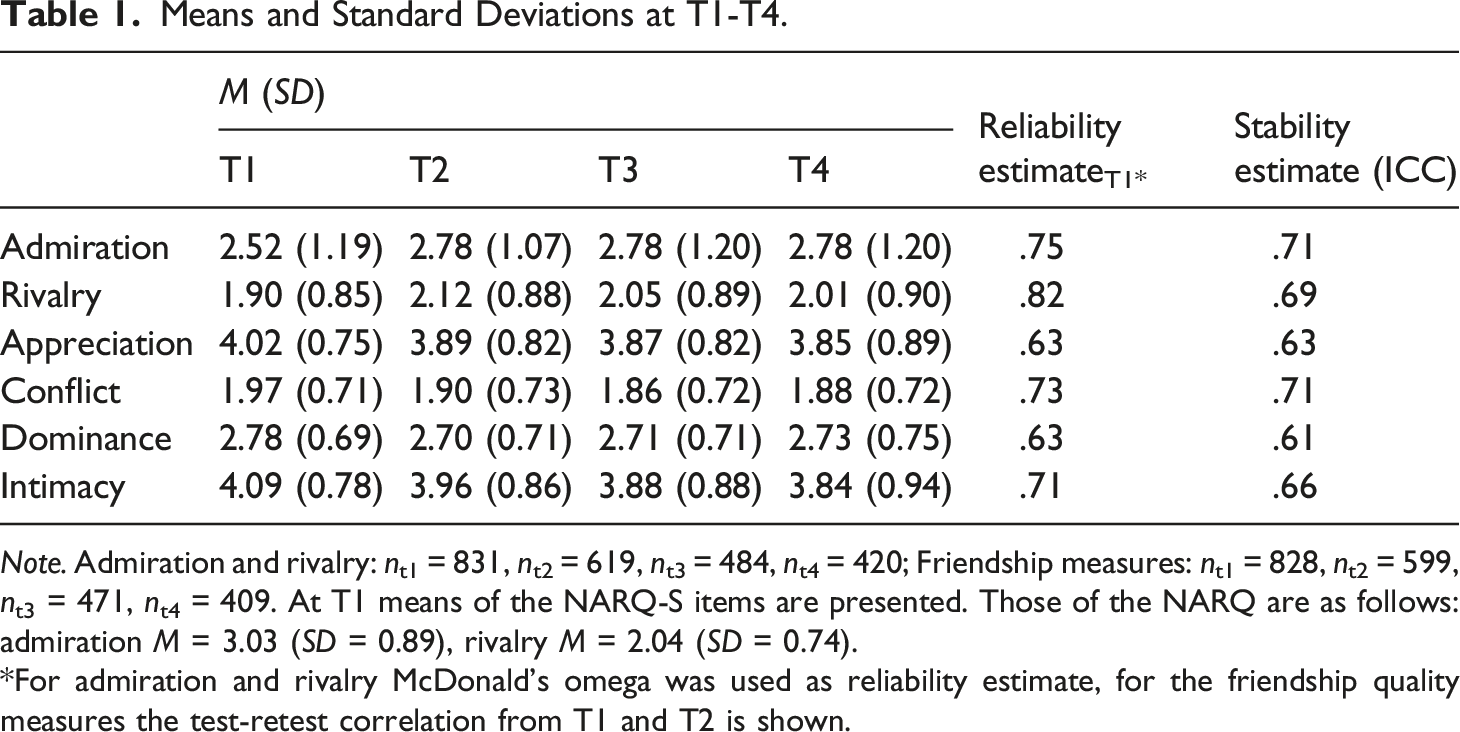
Note. Admiration and rivalry: nt1 = 831, nt2 = 619, nt3 = 484, nt4 = 420; Friendship measures: nt1 = 828, nt2 = 599, nt3 = 471, nt4 = 409. At T1 means of the NARQ-S items are presented. Those of the NARQ are as follows: admiration M = 3.03 (SD = 0.89), rivalry M = 2.04 (SD = 0.74).
*For admiration and rivalry McDonald’s omega was used as reliability estimate, for the friendship quality measures the test-retest correlation from T1 and T2 is shown.
Correlations Between Narcissism Aspects and Friendship Quality Indicators.
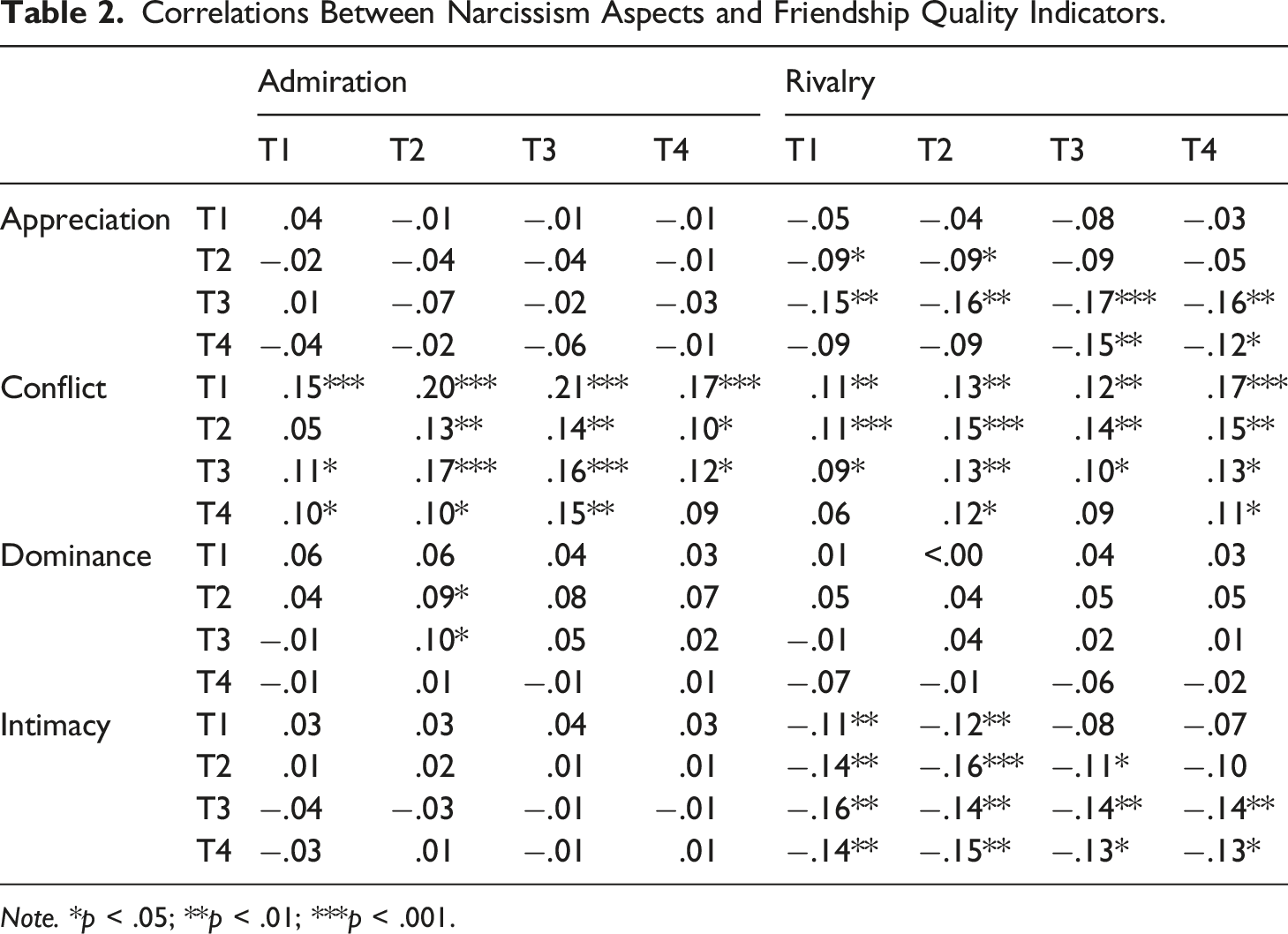
Note. *p < .05; **p < .01; ***p < .001.
Measurement invariance
The results of the measurement invariance tests are shown in Table S4 in the supplement. Based on Chen’s (2007) guidelines, we found scalar invariance for narcissistic admiration and all four friendship quality constructs. For narcissistic rivalry, we found partial scalar invariance with loosened equality constraints for one item (“I want my rivals to fail”).
Random intercepts cross-lagged panel models
Unstandardized Autoregressive and Cross-Lagged Effects of Random Intercepts Cross-Lagged Panel Models.
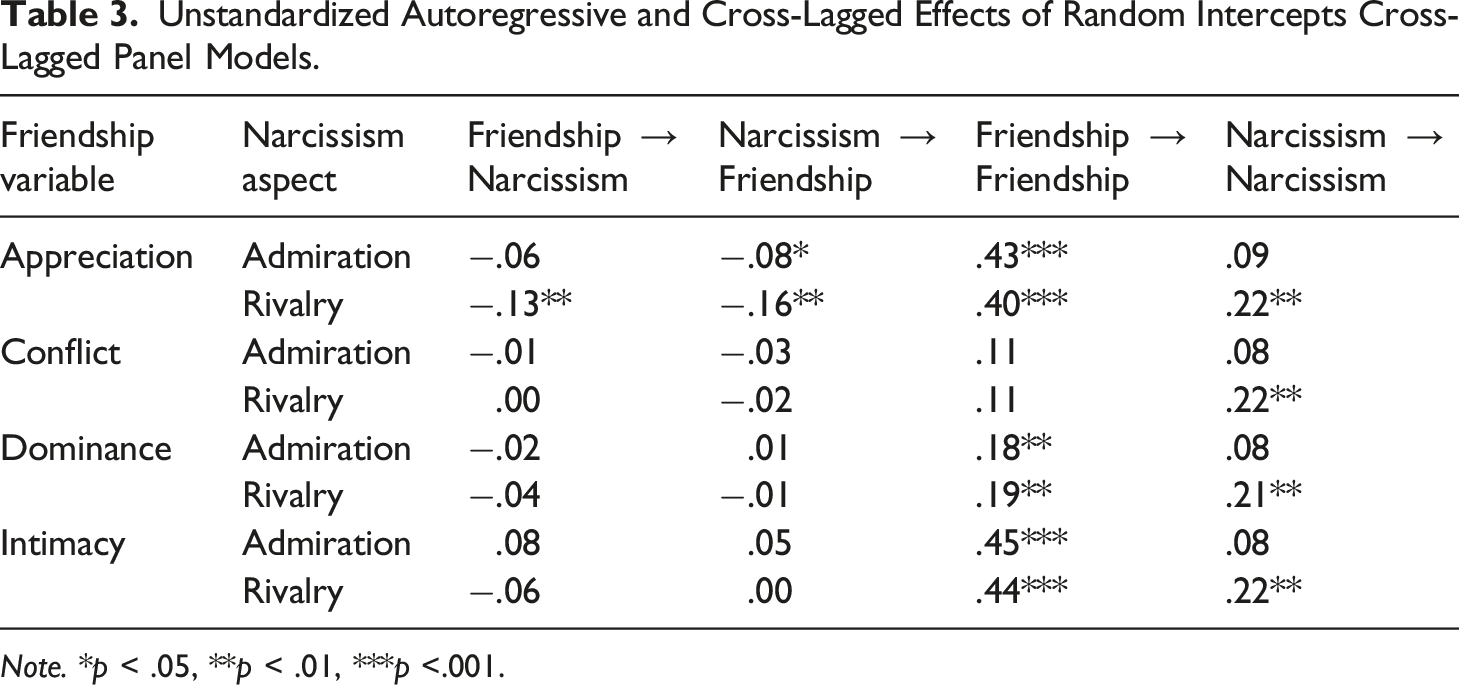
Note. *p < .05, **p < .01, ***p <.001.
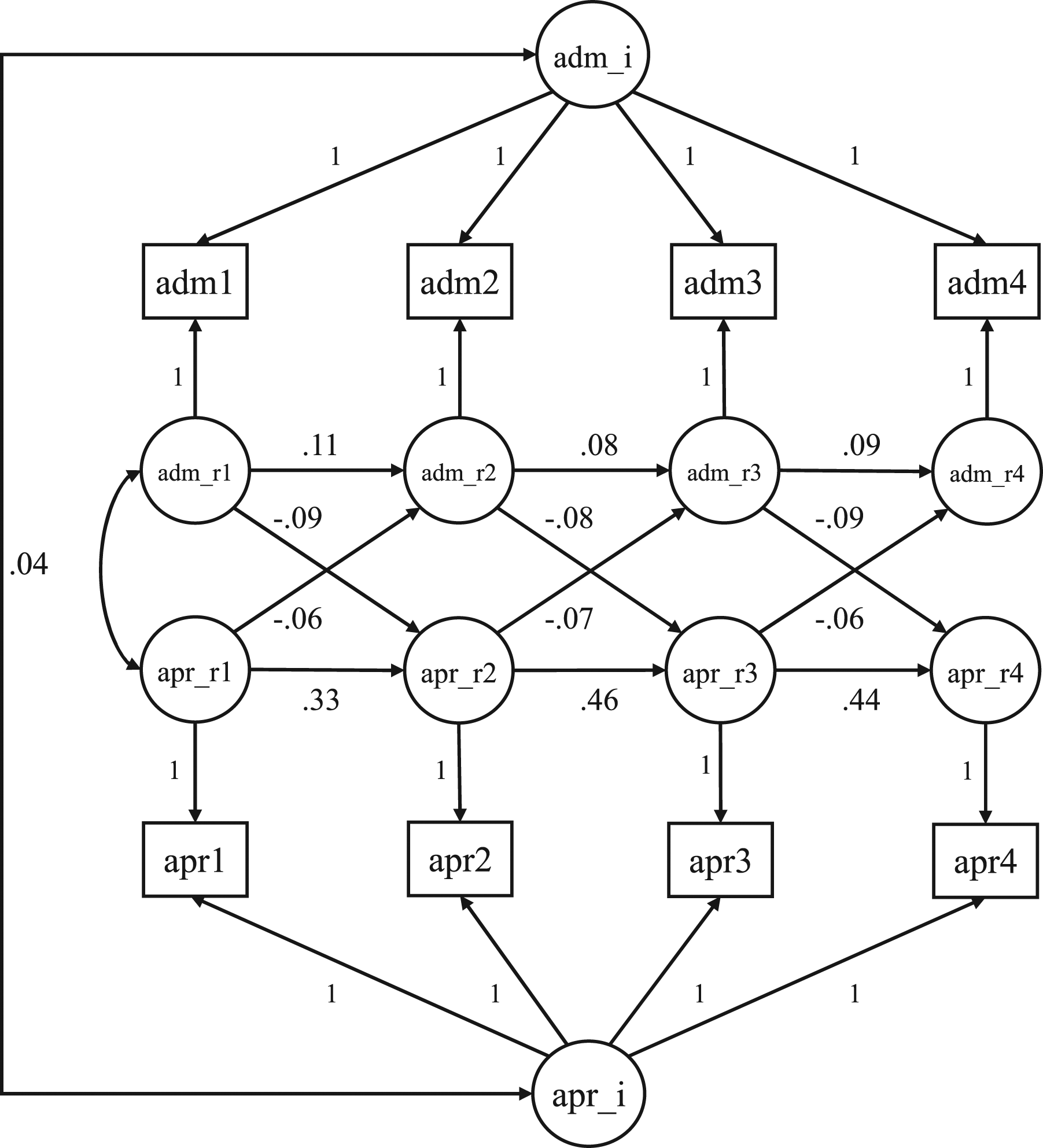
Random intercepts cross-lagged panel models of admiration and appreciation. Note. Adm = admiration; apr = appreciation. Standardized parameter estimates are shown. Correlated residuals are not depicted. Autoregressive effects of appreciation are significant with p < .01, cross-lagged effects of admiration on appreciation are significant with p = .04.
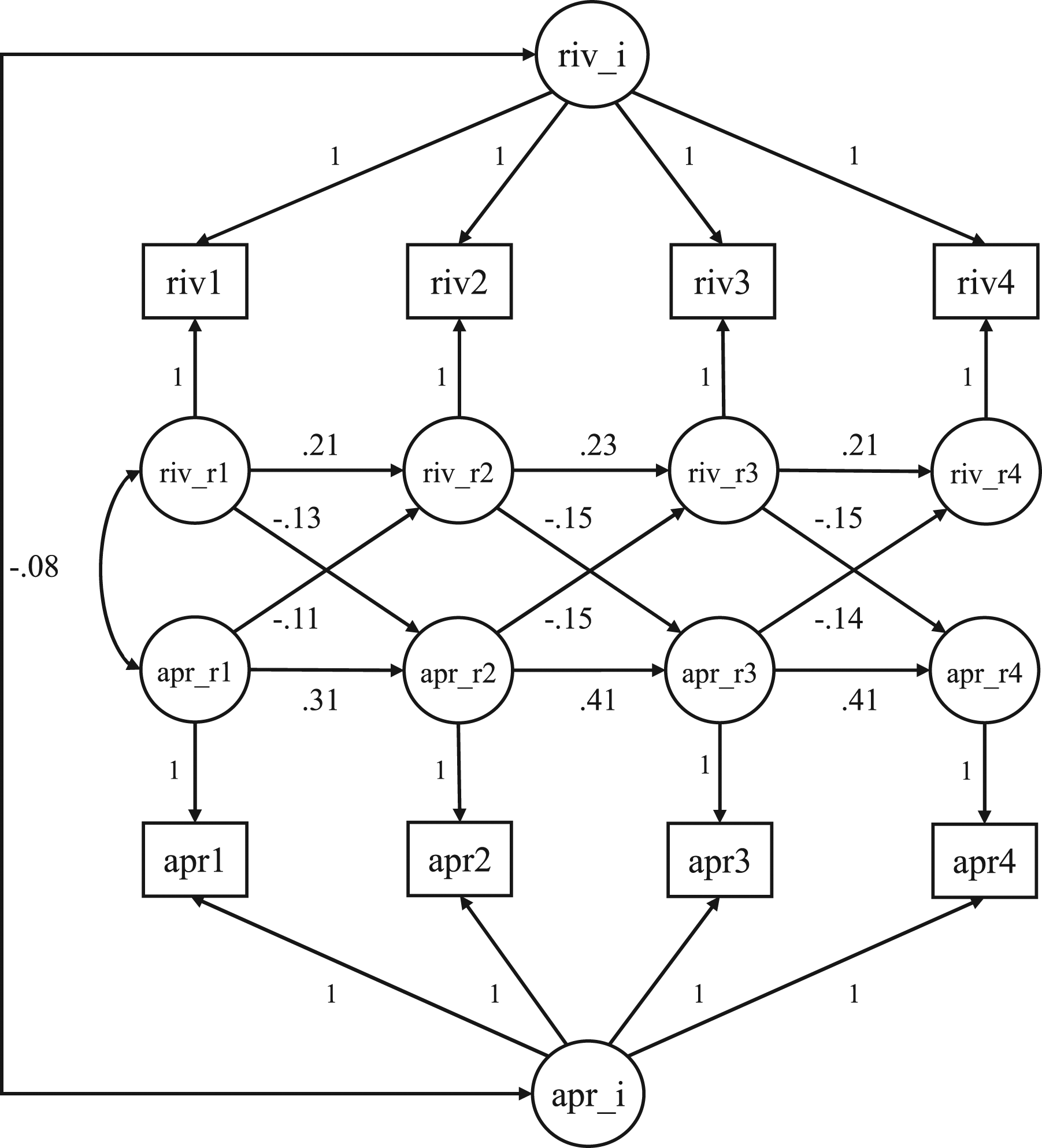
Random intercepts cross-lagged panel models of rivalry and appreciation. Note. Riv = rivalry; apr = appreciation. Standardized parameter estimates are shown. Correlated residuals are not depicted. All autoregressive and cross-lagged effects are significant with p < .01.
Moreover, the variance of the random intercepts was significant across models, implying trait-like differences between individuals on both narcissism aspects and all four friendship quality indicators. For conflict and admiration, we found a significant positive relation between the random intercepts of r = .21, p < .001, suggesting that individuals scoring generally higher in admiration generally experience more conflict. This also applied to individuals scoring generally higher on rivalry, r = .19, p = .006. The random intercepts of intimacy and rivalry were negatively related, r = −.17, p = .001, suggesting that individuals scoring generally higher in rivalry perceive generally less intimacy.
Discussion
In the present study, we observed how narcissistic admiration and rivalry are related to friendship quality across four time points. While previous studies mainly observed short-term acquaintances (e.g., Czarna et al., 2016; Leckelt et al., 2015) we focused on intraindividual changes in long-term friendships that had existed for at least 2 years. Moreover, we focused on the effects of deviations in narcissistic behavior and friendship experience from their respective within-person averages. Our main findings showed that perceived appreciation at one time point was related to deviations in narcissism aspects at the subsequent time point and vice versa. Thus, if one feels less appreciated the processes of narcissistic admiration and rivalry exhibited during friendship formation seem to be reignited. The other indicators of friendship quality (perceived conflict, dominance, and intimacy) do not seem to influence the stability of narcissistic admiration and rivalry, at least not within the 3-month interval between time points chosen here. We discuss this in further detail below and examine the potential fit of our findings to existing models.
How do aspects of friendship quality and narcissistic admiration and rivalry interact?
Between-person level
Based on previous research, we assumed narcissistic rivalry to be negatively related to intimacy and appreciation, which was confirmed by the bivariate correlations within time points and also tended to apply across time points. This finding shows that in particular in friendships of individuals scoring higher in rivalry, positive aspects of friendship quality are missing, which might be a reason why those scoring higher in rivalry generally have fewer close friendships (Degro et al., 2021).
Furthermore, we expected both narcissistic admiration and rivalry to be related to conflict, which was supported by the bivariate correlations. Interestingly, the relations of both narcissism aspects to conflict were similar, even though one might have expected theoretically and also based on previous studies (e.g., Back et al., 2013) that the relation between narcissistic rivalry and conflict would be higher than the relation between narcissistic admiration and conflict. We found no differences in conflict between time points across the 1-year study period. Thus, perceived conflicts did not necessarily seem to lead to relationship dissolution. This could further inform the contextual reinforcement model by Campbell and Campbell (2009) by showing that friendship dissolution does not seem to happen as soon as the costs and benefits do not match once the maintenance stage of a friendship is reached. In addition to the costs that can arise from conflict, conflict could also weaken the benefits that come from appreciation or social support by interrupting or weakening ongoing processes (see Laursen & Adams, 2018 for similar reasoning). Further information on the content of conflicts and how they are handled would be needed to better understand the influence of conflicts on friendships with individuals with higher narcissism. With the data assessed, we also cannot rule out that individuals with more conflicts may have dropped out of the study and dissolved their friendships.
We also assumed that narcissistic admiration would be related to dominance, which was generally not found. This contradicts the positive relations found between narcissistic admiration and dominant-expressive behavior (Leckelt et al., 2020) as well as perceived power (Study 1; Vrabel et al., 2020). However, Vrabel et al. (2020) could not replicate their finding in a further study (Study 2). In part, our result could be related to the items we used to assess dominance, which focused on the friend rather than the targeted individual (e.g., “How often does your friend assert him/herself, when you disagree?”). Self-rated dominance was only assessed indirectly, which might not have been ideal.
In sum, based on the bivariate correlational results, the finding that rivalry is the more problematic part of narcissism for social relationships compared to admiration (Leckelt et al., 2015, 2020; Vrabel et al., 2021; Wurst et al., 2017) was confirmed for long-term friendships.
Within-person level
We observed the temporal interdependency of narcissistic admiration and rivalry with four friendship quality aspects at the within-person level. RI-CLPM showed that individuals’ perception of appreciation played a crucial role: Individuals who scored lower on narcissistic admiration or rivalry than they usually would have subsequently increased in perceived appreciation, and those who felt less appreciated than usual subsequently increased in rivalry. These findings indicate that not feeling valued and appreciated has an important connection to narcissistic rivalry. In turn, the antagonistic and self-protective behavior characteristic of narcissistic rivalry (Back et al., 2013) seems to lead to feeling less appreciated. Processes which have been found to play a crucial role during the formation of friendships (e.g., Leckelt et al., 2015) thus appear to continue to play out in the maintenance of friendships. It also would have been reasonable to assume that feeling more appreciated than usual leads to an ego boost (see NARC; Back et al., 2013), which increases self-promotional behavior, i.e., leads to higher admiration. However, that was not supported by our data.
For conflict, dominance, and intimacy, we did not find any effects on narcissistic admiration and rivalry or vice versa. This is noteworthy, as, for example, the zero-order correlation between narcissistic rivalry and conflict was expected and found to be negative, which could have led to the expectation that perceived conflicts are likewise influential at the intraindividual level. The narcissistic admiration and rivalry concept (NARC; Back et al., 2013) also predicts that social conflict leads to ego threat, increases in self-defense, and eventually higher narcissistic rivalry. This was not confirmed in our data. Even though participants were asked to focus on the past 3 months when answering the questions regarding their perceived friendship quality, it could be that conflicts were of a short duration and in hindsight evaluated as less influential, while appreciation might have been perceived as more continuous. More and closer assessments would be needed to explore this possibility.
Overall, our results indicate that it is worthwhile to consider both the between- and the within-person level when studying narcissism in the context of social relationships. Conflict, intimacy, and appreciation showed substantial relations with the two narcissism aspects at the between-person level, while only perceived appreciation was influenced by and influenced narcissism at the within-person level. In the evaluation of these results, it should be noted that the effects of a single friendship are likely to be rather small, as most individuals have several others with whom they also interact, such as their romantic partner, other friends, co-workers or family members. Thus, the effect of a low-quality friendship might be counterbalanced by the relationship to another person.
How do our results link to theoretical models?
Our findings for appreciation indicate that the processes assumed by the NARC model (Back et al., 2013), which have been shown to occur during relationship formation, are at least partly reactivated in long-term friendships. The RI-CLPM only allows for testing for temporary deviations from stable person means, but given the general stability of narcissism we considered this the best approach to test interactional effects of narcissism and friendship quality in our data with only 3 months between assessments (see Oh et al., 2021 who applied RI-CLPMs with 1 year between assessements). The temporary influences of friendship quality could ultimately also lead to changes in narcissism, as described in the NARCIS (Maaß et al., 2018) or more broadly in the TESSERA framework (Wrzus, 2021; Wrzus & Roberts, 2017). The latter postulates that the accumulation of state changes leads to long-term personality change. A triggering situation (T) could be telling a friend about a job success, with the individual expecting (E) the friend to react with appreciation. The friend might express less appreciation than usual and expected (states /states expression; SSE), which then could trigger an aggressive or devaluing reaction (RA) towards the friend (i.e., higher rivalry). When similar situations happen repeatedly (and across relationships), the individual would maintain or even increase their level of narcissistic rivalry. To actually test whether the TESSERA framework can explain changes in narcissism aspects within friendships, observations at a more fine-grained level would be needed. Event-based assessments could be used when an individual meets the target friend in order to better observe triggering situations and expectancies.
Limitations and future directions
Studying narcissism in long-term friendships across four measurement occasions makes this study unique. Nevertheless, some limitations have to be considered. First, our sample was not very balanced in terms of gender, as the majority of participants reported being women. Given the gender differences in narcissistic admiration and rivalry, with men generally scoring higher than women (e.g., Leckelt et al., 2018), and gender differences in friendship maintenance behaviors (Oswald et al., 2004) and perceived friendship quality (Zhou et al., 2012), the results should be generalized with care. Second, the used instruments were all relatively short, assessing the constructs with two or three items each. This helped to minimize participant burden but potentially limited score reliability and construct coverage (see Kemper et al., 2018 for a summary). Third, attrition was relatively high, with a bit more than half of participants continuing their participation until the last assessment (see Table 1), as the only motivation to continue participation was feedback on some of the assessed traits. Differences in narcissism and friendship quality between time points were found only between T1 and T2, where the attrition was highest with about 25% of the sample dropping out. We cannot rule out that interactional problems were a reason for dropout, as the full sample of participants at T1 perceived their friendship quality to be lower (except for conflicts, where no differences emerged) and rated themselves as more narcissistic than those who continued to participate at T2. Thus, the current effects might be even more pronounced if the individuals who perceived more problems in their friendships had stayed in the sample. Fourth, we did not explicitly indicate that the friend participants reported on should not be a family member or their romantic partner. However, as participants in romantic relationships were asked to also report on their romantic relationship quality the latter is rather unlikely.
In future research, it would be interesting to observe different kinds of relationships to compare the effects found for friendships to, for example, romantic relationships. It might be assumed that effects are stronger in romantic relationships, which are usually closer and more committed. Moreover, an aspect that is lacking in a friendship may be compensated for in another friendship, which is unlikely in a romantic relationship. Whether such compensational effects occur in individuals who are friends with someone scoring high on narcissism could be explored by examining two friends’ perspective on their own relationship and other friendships they have. An individual may be willing to accept receiving relatively little emotional support in a friendship with an individual higher in narcissism when other friendships compensate for it. Also, the aspects of relationship quality that are influential in different relationships may vary. For example, we did not find a robust relation between narcissistic admiration or rivalry and dominance within friendships, while in general, the relation between grandiose narcissism and dominance is well established (see Edershile et al., 2019). Moreover, it would be interesting to use a dyadic design exploring the relation between two friends’ narcissism and its impact on friendship quality to take interdependencies into account (Kenny et al., 2006).
Conclusion
We observed the relation of the narcissism aspects admiration and rivalry with positive and negative friendship quality indicators to understand how narcissism relates to the perception of long-term relationships. Narcissistic admiration and rivalry were both found to be related to conflict, while rivalry was also negatively related to intimacy and appreciation. At the intraindividual level, we found that those individuals who scored lower on narcissistic admiration or rivalry than usual experienced a subsequent increase in perceived appreciation, and those who perceived lower appreciation than usual experienced an increase in rivalry. Our assumption that the effects found for friendship formation (Back et al., 2013; Leckelt et al., 2015) would reignite during friendship maintenance if there is a deviation from the average was at least partially supported. Overall, it seems worthwhile to look at different aspects of friendship quality to better understand the influence of narcissism on long-term relationships, and also to differentiate between inter- and intraindividual effects.
Supplemental Material
Supplemental Material - Narcissism and friendship quality: A longitudinal approach to long-term friendships
Supplemental Material for Narcissism and friendship quality: A longitudinal approach to long-term friendships by Journal of Social and Personal Relationships in Journal of Social and Personal Relationships
Footnotes
Declaration of Conflicting Interests
The author(s) declared no potential conflicts of interest with respect to the research, authorship, and/or publication of this article.
Funding
The authors disclosed receipt of the following financial support for the research, authorship, and/or publication of this article: This work was supported by the German Research Foundation [DFG: ZI 1792/9-1].
Open research statement
As part of IARR’s encouragement of open research practices, the authors have provided the following information: This research was not pre-registered.
The data used in the research are available. The data can be obtained at  or by emailing:
Supplemental Material
Supplemental material for this article is available online.
Notes
References
Supplementary Material
Please find the following supplemental material available below.
For Open Access articles published under a Creative Commons License, all supplemental material carries the same license as the article it is associated with.
For non-Open Access articles published, all supplemental material carries a non-exclusive license, and permission requests for re-use of supplemental material or any part of supplemental material shall be sent directly to the copyright owner as specified in the copyright notice associated with the article.
