



Abstract
Existing research indicates that incidental exposure to political information on social media may function as an equalizer, stimulating political engagement among the politically detached. In this article, we challenge this notion and propose that there are good reasons to assume that incidental exposure may reinforce existing gaps. We test the equalizing against the reinforcing hypothesis using data from a two-wave panel study (N = 559). We find a positive main effect of incidental exposure on low-effort digital participation. However, this effect was not conditional on political interest, as the equalizing assumption would have suggested. More interestingly, we found that the effect of incidental exposure on high-effort digital participation was conditional on political interest. However, against the assumption of equalization, individuals with low levels of political interest were negatively affected by incidental exposure, thus lending support for the reinforcement hypothesis. Possible reasons for these findings are discussed.
Keywords
Social network sites (SNS) provide important new spaces for citizens’ informational and participatory activities. Existing studies indicate that SNS use is positively related to political participation and that this relationship has become more robust over time (Boulianne, 2018). However, the bulk of these studies are cross-sectional surveys, which cannot explain the causal direction of the relationship. Moreover, more robust methodological studies indicate that only active political social media activities may increase participation (e.g. Dimitrova et al., 2014; Strömbäck et al., 2017), while general SNS use may have no or even negative effects (e.g. Theocharis and Lowe, 2016; Theocharis and Quintelier, 2016). As a consequence, the recent scientific discourse is divided about the important question whether SNS can narrow or even close existing participatory gaps.
The optimistic view argues that even politically detached individuals are incidentally exposed to political messages which are shared by network acquaintances (Tang and Lee, 2013; Xenos et al., 2014). However, some studies find that mere incidental exposure may be insufficient to stimulate political engagement (e.g. Heiss et al., 2019; Theocharis and Lowe, 2016; Theocharis and Quintelier, 2016). These studies suggest that if individuals do not actively search for political information, they may be less likely to learn from such information. What is more, there is some theoretical reason to assume that mere non-political browsing and clicking behavior may even decrease the likelihood for incidental political exposure (Kaiser et al., 2018; Knoll et al., 2018). Individuals with high non-political motivations may thus rarely engage with political messages and if they do, they may engage in slacktivist behavior at best (Baumgartner and Morris, 2010; Vitak et al., 2011).
This study contributes to fill two major research gaps. First, and most importantly, existing research on the relationship between social media use and political participation in general and the relationship between incidental exposure and participation specifically lack panel studies (notable exception: Weeks et al., 2017). We contribute to fill this pressing research gap and use data from a two-wave panel study to investigate the relationship between the frequency of incidental exposure and digital political participation. For example, Valeriani and Vaccari (2016) found indeed robust cross-country evidence that incidental exposure may positively predict digital participation specifically among individuals with low political interest. However, their findings are based on cross-sectional data. A key goal of this present study is thus to replicate their findings using two-wave panel data. Second, we use a more nuanced measure to investigate digital political participation by distinguishing between low- and high-effort participation (Knoll et al., 2018; Valentino et al., 2011). This is important because past research has indicated that social media may in fact only spur lower effort slacktivist participation but not digital activities, which may require more cognitive and time resources (Vitak et al., 2011). However, there are also higher effort digital activities which individuals may perform (see Knoll et al., 2018).
We contribute to fill these research gaps using data from a two-wave quota-based panel study, conducted in the context of the 2017 national election in Austria. In doing so, we seek to replicate the findings reported in Valeriani and Vaccari (2016), using similar models. We first replicate their findings in a cross-sectional model to assess the predictive validity of our incidental exposure measure. We then proceed to using autoregressive panel models to provide more robust evidence on the relationship between incidental exposure and political participation.
Social media and participatory gaps
Political participation has been discussed as an important feature of modern democracy. More specifically, participatory activities may increase citizens’ knowledge, efficacy, and community thinking and thus contribute to the development of a robust democracy (Barber, 1984; Pateman, 1970). An important prerequisite for active participation is that citizens inform themselves about politics and are provided with opportunities for political participation. On social media, informational and participatory activities are highly entwined, as users can interact with political messages they encounter (Heiss et al., 2018). Even though SNS may thus provide new important platforms for political activities, they also provide new spaces for non-political activities, including entertainment activities or non-political social interaction (Ekström et al., 2014; Theocharis and Quintelier, 2016). Thus, it remains questionable whether the participatory features alone may be sufficient to stimulate participation among individuals with lower political interest.
Prior (2005, 2007) has shown that individuals, who have access to higher choice media (at that time: Internet, cable TV), were more likely to be affected by their own user motivations. More specifically, strong entertainment and low news orientations decreased individuals’ knowledge levels and voting intentions when they had access to high-choice media. Prior explains his findings also with the decreasing likelihood of incidental exposure. He proposes that incidental exposure may “become less likely in a high-choice environment because greater horizontal diversity (the number of genres available at any particular point in time) increases the chance that viewers will find content that matches their preferences” (Prior, 2005: 579). In line with this, a whole body of research on reinforcing spirals indicates that high initial political involvement increases selective exposure to news which in turn increases individuals’ political involvement (e.g. Norris, 2000).
Some authors warn that such circles may become even more pronounced in the social media environment. For example, Van Aelst et al. (2017) note that “the increasing supply has made for a better match with the demand for political information among the most politically interested and the demand for non-political information among those not interested in politics” (p. 18). In line with this, recent experimental and panel studies indicate that social media use per se may hardly foster individuals’ political engagement (Shehata and Strömbäck, 2018; Theocharis and Lowe, 2016; Theocharis and Quintelier, 2016). These studies stress that social media may in fact be a “demobilizing force whose functions distract the users’ attention from politics” (Theocharis and Lowe, 2016: 1480). In line with these assumptions, existing panel research indicates that only political social media use may in fact positively affect political participation (e.g. Dimitrova et al., 2014; Ekström et al., 2014; Strömbäck et al., 2017).
Despite these pessimistic findings, there is also some reason to believe that social media may incorporate specific features, which can stimulate political participation among the lower involved more robustly compared to other media (Valeriani and Vaccari, 2016; also see: Fletcher and Nielsen, 2017; Xenos et al., 2014). Most importantly, individuals are embedded in comparably large and heterogeneous networks including a high number of weak ties (see Lee and Kim, 2017). In this environment, individuals exert only “partial control” over the information they receive (Bode, 2016). For example, while they may unfollow or hide certain political information from time to time, they may often restrain to do so for non-political relational reasons (e.g. maintain relationships). Thus, while past media innovations (cable TV, Internet in early phase) may have decreased opportunities for incidental political exposure (Prior, 2005), SNS may again increase such opportunities.
Some researchers have stressed that in this context politically uninvolved individuals may still encounter political posts which are shared by network acquaintances (Tang and Lee, 2013) and may then engage in low threshold political expression (Gil de Zúñiga et al., 2014). Such expression may first stimulate cognitive resources, which increase their personal involvement with politics and induce “message release effects,” such as that other individuals may respond to the message and force the expresser into political discussion (Pingree, 2007). Thus, incidental exposure may specifically increase political participation among the lower involved, who would otherwise not be exposed to any political content (Valeriani and Vaccari, 2016).
Theoretical framework
While some authors argue that social media may increase existing involvement gaps (see Van Aelst et al., 2017), others stress that even politically uninterested individuals may still become incidentally exposed to political information (Fletcher and Nielsen, 2017) and that incidental exposure may in fact decrease participatory gaps (Valeriani and Vaccari, 2016). In the following sections, we outline theoretical arguments for these two competing hypotheses. First, we revisit the arguments for the equalizing hypothesis. Then, we challenge these arguments and discuss arguments for a reinforcing hypothesis.
Equalizing effects
Valeriani and Vaccari (2016) argue that incidental exposure can decrease participatory gaps because such exposure has a stronger positive effect on individuals with the less initial political involvement compared to the highly involved. They also find support for this assumption in a large-scale cross-sectional study. The first reason might be that SNS provide lower interested individuals with a broad range of low-cost political activities they can perform. For example, each time they encounter a political post by accident, they may quickly comment or like the post. Expressing themselves politically on social media may then increase their political involvement (Pingree, 2007) and the likelihood for future political participation (Gil de Zúñiga et al., 2014). The effect of such low threshold activities may be stronger for individuals with low initial political engagement because such individuals (compared to higher involved individuals) would not intentionally turn to political news in traditional media (Oeldorf-Hirsch, 2018). Thus, if they are also not incidentally exposed to political information, they may not see any political information at all.
The second reason why low-involved individuals may benefit from incidental exposure is that political messages are often shared by influential individuals in their network (see Messing and Westwood, 2014). For example, Tang and Lee (2013) argue that accidental exposure may attract the attention of low-interested individuals when political messages are shared by good friends. Furthermore, they argue that, for example, initially lower involved young people may “befriend” or follow public actors which then become “important sources of political information and viewpoints” (p. 766). While the politically involved may process political information primarily due to the content, lower involved individuals may be more likely to process political information when such information comes from high-impact sources, who are most likely to be encountered in personalized social media networks.
Third, Knoll et al. (2018) stress that incidental exposure creates situations in which low-involved individuals engage in implicit (i.e. superficial or even unconscious) processing of political content and that even shallow processing may induce behavioral effects. For example, if a non-political-motivated user frequently encounters posts on mass animal farming in her newsfeed, the content of these posts may become more and more accessible in mind, even if these posts are not consciously or systematically processed (Fishbach and Ferguson, 2007; Higgins, 1996). At some point, latently present goals (e.g. animal protection) become salient and induce even less interested individual to engage in more intentional political behaviors (Fishbach and Ferguson, 2007; Higgins, 1996; Knoll et al., 2018).
Finally, there is some reason to believe that highly politically involved individuals may even be negatively affected by incidental exposure. For example, highly involved individuals may intentionally expose themselves primarily to attitude-congruent information in high-choice media environments (Stroud, 2008, 2010). Frequent incidental exposure may increase the likelihood to see cross-cutting political posts, for example, political advertising from disliked candidates or opinion-challenging political posts from network acquaintances. Mutz (2002) argued that such cross-cutting exposure may lower individuals’ motivation for participation because they develop ambivalent political views. However, there is also evidence that political diverse network may stimulate political participation (Quintelier et al., 2012; Weeks et al., 2017) and that exposure to strongly contradictive messages specifically may induce disconfirmation bias, thus increasing participatory motivations (Taber and Lodge, 2006).
Reinforcing effects
Even though existing studies have dwelled on the positive potential of incidental exposure to decrease participatory gaps, there is also some evidence for reinforcing effects over time (e.g. Heiss et al., 2019; Kim et al., 2013). First, there is reason to believe that individuals with higher political involvement may become more frequently incidentally exposed to political content. This is because highly involved individuals may be more likely to follow and like political sources and engage in browsing political content on their newsfeed (Knobloch-Westerwick and Johnson, 2014; Oeldorf-Hirsch, 2018). This behavior creates a more politically oriented social network (Knoll et al., 2018). For example, if an individual has liked and followed multiple political sources, posts from these sources will pop up in the newsfeed even if this person is currently looking for non-political content. Second, active political behavior (e.g. browsing for and interacting with political posts) may inform SNS algorithms. Social media algorithms aim at constantly “improving” the content visitors see based on data collected about their behavior and content preferences (Thorson and Wells, 2015). Following this reasoning, “not clicking on ‘news’ stories will likely reduce the amount of news that appears in one’s feed, thereby amplifying an individual’s own predispositions” (Thorson and Wells, 2015: 318). Thus, there is strong reason to believe that even though incidental exposure may occur unintentionally, it does not occur “by chance” and initially higher involved individuals may benefit more robustly from incidental encounters (Kaiser et al., 2018: 19).
Second, no matter if political information is encountered intentionally or incidentally, individuals with higher political involvement may be more likely to appraise the content they encounter as relevant and thus engage in explicit (i.e. systematic) processing (Knoll et al., 2018; also see Kim et al., 2013). Such explicit processing is expected to have considerably stronger effects compared to mere heuristic or unconscious processing. For example, highly politically interested individuals may care about a broad range of political issues and link encountered information to their own political preferences (e.g. How does a new law contribute to or inhibit personal political goals?). Relevance appraisals determine the way how (or whether) an individual engages in systematic processing (Cho et al., 2009). In line with this reasoning, Karnowski et al. (2017) have found that individuals who have topical interest in an incidentally encountered news article engage in further reading the content of the article. Furthermore, a study by Weeks et al. (2017) suggests that incidental exposure to cross-cutting opinions may specifically increase engagement among highly involved partisans. These individuals may appraise opinion-challenging information as especially relevant because it challenges their political identity and thus increases their need to “reaffirm and reinforce their political self-concept” (Weeks et al., 2017: 373).
Third, even if highly involved individuals do not appraise a message as relevant for in-depth processing, priming effects of implicit processing may still be stronger among higher involved individuals compared to lower involved individuals. The reason is that highly involved individuals are expected to have stronger existing political goals compared to detached individuals (Knoll et al., 2018; also see Heiss et al., 2019). However, only if individuals have already formed political goals (i.e. identified a wanted and attainable political state), implicit processing may activate such goals and affect behavior (see Fishbach and Ferguson, 2007; Higgins, 1996). Thus, implicit processing may activate political goals more robustly and frequently among higher involved compared to lower involved individuals.
Furthermore, there is also some reason to assume even negative effects of incidental exposure on individuals with lower levels of political involvement. To begin with, politically detached individuals may react negatively to unwanted political content. Recent research indicates that individuals who encounter undesirable dissonant political views engage in unfollowing, unfriending, or blocking behavior to avoid this kind of content (see Zhu et al., 2017). However, exposure to such unwanted political content may still be possible via incidental exposure (see Bakshy et al., 2015). Individuals who report low levels of political interest may generally tend to appraise political content as irrelevant and may thus develop psychological reactance when frequently exposed to such (unwanted) political content. Miller (1976) has shown that excessive exposure to unwanted political messages may induce reactance effects, leading to a more negative evaluation of the message. This may be especially true in electoral times, because “when individuals believe that a persuasive manipulation infringes upon their right to decide for themselves, they often react in a manner opposite to the persuader’s intention” (Miller, 1976: 230). Such reactance effects may be especially strong among individuals with an initial aversion to politics. For example, if individuals have non-political user motivations and seek non-political content frequent exposure to unwanted political issues may simply “annoy” them, resulting in less political participation (see Worchel and Brehm, 1970).
Second, individuals may lower their political efficacy if they frequently encounter political posts from friends and people from their network, who are highly politically involved and create and share political information they can hardly understand. This is because individuals assess their own skills and knowledge based on social comparison and “the people with whom individuals compare themselves influence how they judge their ability” (Bandura, 1993: 121). Social media are important spaces for upward social comparison, that is, comparison with perceived superiors who are active in one’s network (Vogel et al., 2014). While upward comparison may have some positive effects (e.g. inspiration), it most often induces negative affect and poorer self-evaluations (Vogel et al., 2014). If politically detached individuals compare their own knowledge and skills with those of highly active friends, they may feel even less efficacious, resulting in lower levels of political participation (see Halpern et al., 2017).
Based on the conflicting arguments presented in the previous two sections, this study investigates the following research question:
RQ. Does incidental exposure to political information increase or decrease the participatory gap between individuals with low and high political interest?
Low- and high-effort digital participation
In this study, we follow Valeriani and Vaccari (2016) and focus on digital participation because such activities can be directly performed in incidental exposure situations and may then also stimulate offline engagement (Kim et al., 2017). We conceptualize digital political participation in terms of the effort needed to implement them (see Knoll et al., 2018; Valentino et al., 2011). We define effort as “the amount of time and energy a person devotes to a specific participatory activity” (Knoll et al., 2018: 3). For example, individuals may quickly “like” or “share” a political post on social media. However, there might not be much elaboration preceding such activities and individuals may often like or share information based on heuristic cues, such as humoristic or emotional content (see Heiss et al., 2018). We characterize such activities as low-effort participation. However, the Internet and social media specifically also provide space for more effortful participation. For example, individuals may write a longer political comment, in which they express political thoughts and standings, may write a personal message to a public actor or journalist or even create a political group (e.g. on Facebook). Such high-effort activities may be highly beneficial and contribute to a participatory political culture as proposed by participatory democracy theorists (e.g. Barber, 1984).
There is reason to believe that incidental exposure may have different effects on low- and high-effort digital participation. This is because incidental political exposure usually occurs in low involvement situations. For example, Boczkowski et al. (2018) found that people’s attention on social media is highly fragmented, that political content is only a small part of individuals’ information mix, and that users thus tend to devote only limited time resources to incidentally encountered political content. Incidental exposure may thus often lead to mere implicit (i.e. heuristic or unconscious) processing, stimulating low-effort participation at best (Knoll et al., 2018; also see Heiss et al., 2019). In line with this reasoning, Oeldorf-Hirsch (2018) found that incidental news exposure on Facebook was positively related to low-effort social media activities (e.g. liking and sharing), but negatively related to in-depth elaboration, an important prerequisite for higher effort political participation (see Cho et al., 2009; Knoll et al., 2018). Based on this reasoning, we follow:
H. Incidental exposure will have more pronounced effects on low-effort participation compared to high-effort participation.
Method
We conducted a two-wave online survey in the context of the Austrian national election 2017 (N = 559). The recruitment of participants was implemented by the private company Survey Sampling International (SSI). We defined representative quotas for age, gender, and education. SSI sent out 14,688 invitations and 953 individuals started the survey (6.49%). Because the questionnaire was mainly concerned with SNS use, we sampled 18- to 65-year-old people who did not report to never use Facebook, Twitter, YouTube, and Instagram. 1 Questions on the demographics and social media use were asked at the very beginning of the questionnaire. One hundred and eighty individuals did not complete the survey, were screened out because of full quotes, or did not meet the defined criteria. Fifty-eight of those individuals were screened out because they reported to never use social media. Furthermore, eight individuals were excluded because of extremely short- and long-response periods, leaving us with a sample of 765 individuals. Some 73% of these individuals responded in the second wave (final N = 559). Our final sample is composed of 50.27% female. Some 19% had college degrees, 27% had degrees from college-bound high schools, and 48% apprenticeship or vocational schools. 2 The remaining participants held degrees from compulsory schools. Participants were between 16 and 65 years old (M = 44.49, standard deviation [SD] = 12.61). The first wave was conducted between 29 August and 2 September 2017. The second wave was implemented 1 week before the actual election. Data were collected between 5 October and 12 October. Hence, the participants were exposed to 1 month of intensive election campaign in the period between the two waves.
Independent variables
All independent variables were measured at wave 1. The dependent variables (digital low- and high-effort political participation) were measured at both wave 1 and wave 2. If not stated otherwise, the variables were measured on 7-point scales. We followed Valeriani and Vaccari (2016) as well as Tewksbury et al. (2001) and measured incidental exposure (M = 3.99, SD = 1.74) with the following question (1 = never, 7 = often): How often are you accidentally exposed to political posts in your social media newsfeed without having actively searched for or intentionally included such information in your newsfeed (e.g., by “liking” news sources or politicians)?
We measured political interest (Spearman–Brown coefficient ρ = .92, M = 4.90, SD = 1.81) with two items asking how much respondents were interested in (a) politics and (b) the current election (1 = not interested, 7 = very interested).
Dependent variables
We measured digital political participation as low- and high-effort participation (see Knoll et al., 2018; Lu and Myrick, 2016; Valentino et al., 2011) asking for six activities. For each activity, participants responded whether or not they performed the activity in the past month (i.e. yes or no). We measured low-effort digital participation (Mw1 = 0.87, SDw1 = 1.06; Mw2 = 0.80, SDw2 = 1.03) by asking participants whether or not they have engaged in (1) liking or sharing a political post on social media, (2) adding a short comment to a political post on social media, and (3) signing an online petition related to a political issue. We measured high-effort digital participation (Mw1 = 0.25, SDw1 = 0.58; Mw2 = 0.21, SDw2 = 0.57) by asking participants whether they engaged in (1) writing a longer political comment online (e.g. Facebook message, Email, Blog entry) to convince other with their arguments, (2) contacting a politician or journalist via Email or social media to increase awareness of political issues, and (3) creating a political group online (e.g. WhatsApp, Facebook) in order to increase awareness of political issues. With these formative indicators, we created cumulative scales for both high- and low-effort participation. The scales reach from 0 (performed no activity) to 3 (performed all three respective activities; see Kim et al., 2013 or Matthes, 2012 for similar approaches). Note that for a formative scale “there is no underlying construct that explains the correlations among those indicators. Each indicator represents an independent dimension in its own right” (Matthes, 2012: 28). Thus, internal consistency measures and factor analysis cannot be applied (see Bollen and Diamantopoulos, 2015).
News use
To measure news use, we asked respondents how frequently they used SNS (M = 2.75, SD = 1.87), newspapers (M = 4.68, SD = 1.88), TV (M = 4.70, SD = 1.94), radio (M = 3.87, SD = 1.96), and the Internet (M = 3.34, SD = 1.94) to get information on the current election.
Control variables
Political efficacy (α = .91, M = 4.85, SD = 1.68) was measured with three items asking respondents whether they agreed that they (1) felt competent enough to participate in political decision-making processes, (2) were at least as well-informed about politics compared to other people, and (3) had a good understanding of political issues in Austria. Political trust (α = .93, M = 2.33, SD = 1.26) was also measured with three items asking respondents whether they agreed that (1) politicians in Austria would keep what they promise to the people, (2) they could trust Austrian politicians to make decisions which are in the interest of the people, and (3) politicians in Austria were honest to the people. Ideology (M = 4.06, SD = 1.32) was measured with a single item asking respondents to position themselves between left (1) and right (7). Education was assessed with two dummy variables, high education representing college degree and medium education representing college-bound high school degree. All others (vocational school degrees and apprenticeships) served as reference category.
Results
First of all, correlation analysis indicates that incidental exposure is positively related to political interest (r = .24, p < .001) and even more strongly to SNS news use (r = .35, p < .001). Thus, individuals who are highly politically interested and actively seek news on SNS are also more likely to become incidentally exposed to political information.
Before running the panel model, we look at the cross-sectional results in wave 1. We conduct this first step in order to assess whether we can replicate the cross-sectional findings from Valeriani and Vaccari (2016) with our data. A successful replication would speak for the predictive validity of our incidental exposure measure. In the second step, we will then test whether these results remain also stable when using panel data. Panel models are better suited to make causal conclusions and thus a more robust test of the investigated relationships compared to the cross-sectional results. As our dependent variables are count variables (i.e. counting the number of participatory activities), we use Poisson (low-effort participation) and negative binomial (high-effort participation) regressions to analyze our data. We use these models because political activities are usually rarely performed and the resulting participation scores follow a non-normal distribution. In fact, the variance of such count variables is often similar or even larger than the mean. The standard models to estimate count responses are Poisson models, which we use to estimate low-effort participation (see Hilbe, 2011). Furthermore, we use negative binomial regressions to predict high-effort participation because we find signs of overdispersion in this variable (i.e. due to few occurrences, the variance is considerable larger than the mean; see Hilbe, 2011). 3 In all models, we controlled for demographics, political trust and efficacy, ideology, and media use. We use these control variables to make our results comparable to the results reported in Valeriani and Vaccari (2016). In a larger model (not reported), we have also controlled for individuals’ social media platform use (Facebook, Twitter, Instagram, YouTube), however, these variables did not contribute explanatory power. We used the jtools package in R to probe and plot the moderation effects (see Long, 2018).
Cross-sectional model
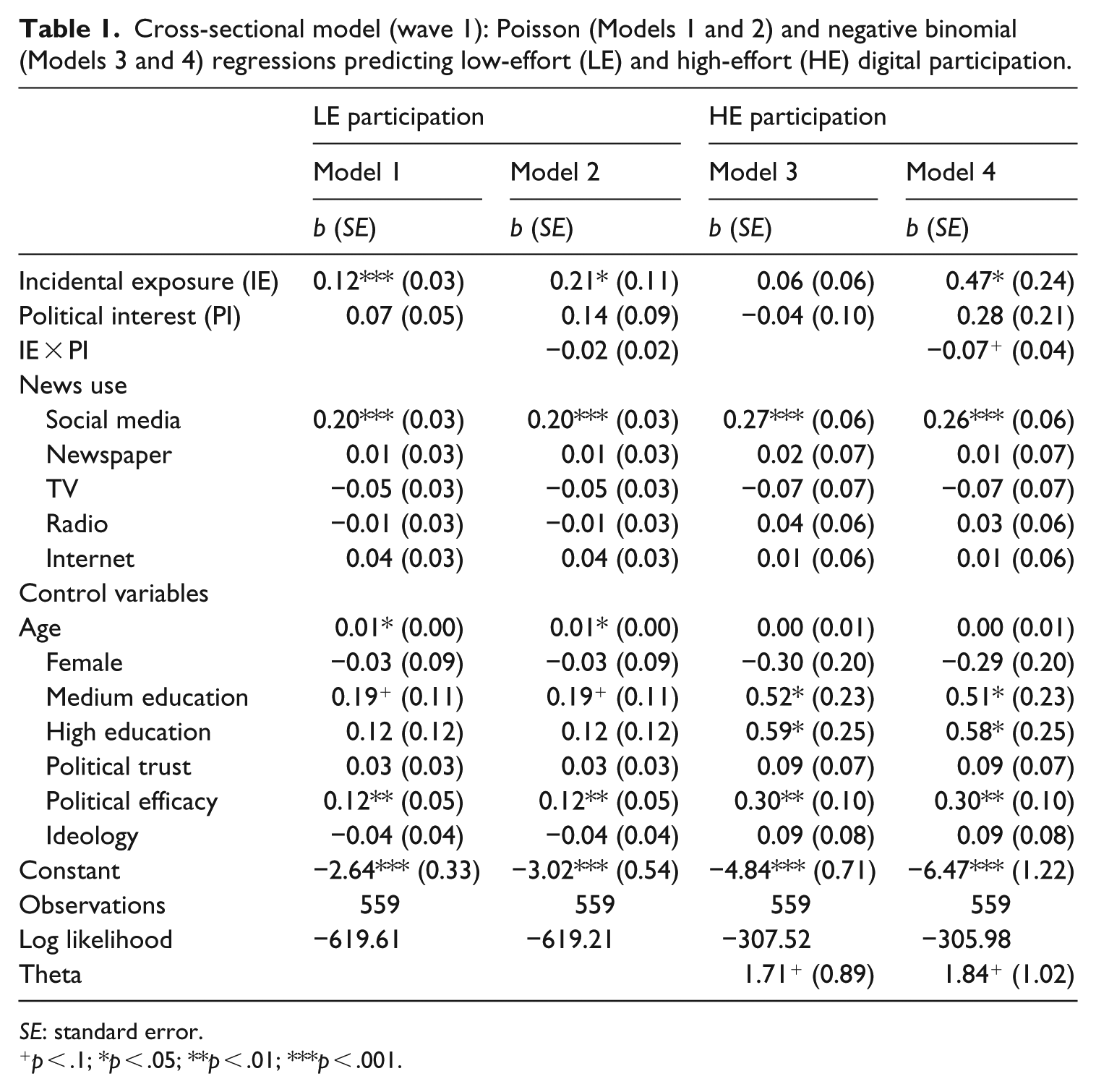
The cross-sectional results are shown in Table 1. The results indicate that incidental exposure is a significant predictor of low-effort political participation (b = 0.12, p < .001), but not for high-effort participation. Setting all covariates to their mean value, individuals with a low level of incidental exposure have an expected low-effort participation count of 0.56 (confidence interval [CI = 0.47, 0.66]), individuals with a high level of incidental exposure have a count of 0.86 (CI = [0.75, 0.98]). The interaction of political interest and incidental exposure points in the same direction as in the study of Valeriani and Vaccari (2016). However, only the interaction effect on high-effort participation is significant at the marginal level (p < .10). An investigation of the conditional effects indicates that for individuals with low political interest (1 SD below the mean), a low level of incidental exposure (1 SD below the mean) is associated with an expected high-effort participation count of 0.11 (CI = [0.06, 0.21]). For low-interested individuals with an incidental exposure level of 1 SD above the mean, the expected count is boosted to 0.26 (CI = [0.16, 0.42]). For highly politically interested individuals, the expected count is slightly lowered from 0.18 (CI = [0.11, 0.29]) to 0.17 (CI = [0.11, 0.25]). Taken together, the results point in very similar directions compared to those reported in Valeriani and Vaccari (2016). Even though we used a smaller sample and a more sophisticated measure of participation, we still find a significant main effect of incidental exposure on low-effort participation and a similar interaction effect on high-effort participation. Hence, the cross-sectional results indicate an overall good predictive validity of our measures.
Cross-sectional model (wave 1): Poisson (Models 1 and 2) and negative binomial (Models 3 and 4) regressions predicting low-effort (LE) and high-effort (HE) digital participation.
SE: standard error.
p < .1; *p < .05; **p < .01; ***p < .001.
Panel model
To address our research question and hypothesis, we ran autoregressive panel models predicting low- and high-effort digital participation from political interest and incidental political exposure. By controlling for the lagged score of the dependent variable, these models explain changes from waves 1 to 2, which are not explained by individuals’ initial participation score (i.e. at wave 1). Thus, these models reduce problems related to omitted variable and selection bias. Most importantly, panel models reduce the problem of reverse causation because changes in participation from waves 1 to 2 cannot affect first wave attitudes or behavior (see Prior, 2005).
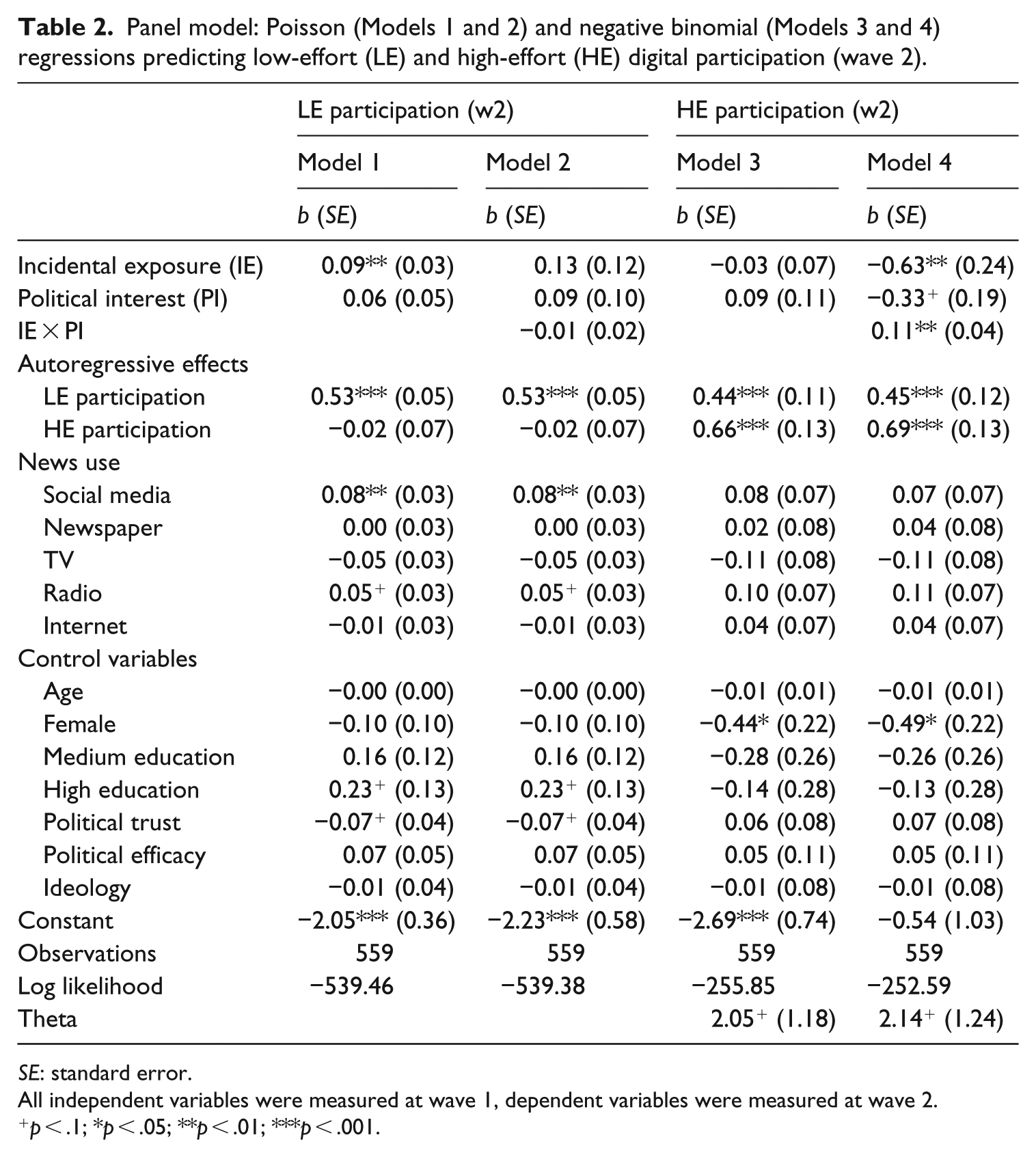
Table 2 (Model 1) indicates that the frequency of incidental exposure has a positive main effect on low-effort political participation (b = 0.09, p < .01). This indicates that, keeping all covariates (including low-effort participation at wave 1) constant, individuals who reported high values of incidental exposure (w1) score higher in low-effort participation (w2) compared to individuals who scored low on incidental exposure (w1). Setting all covariates to their mean values, the expected count of low-effort political participation (w2) is 0.48 (CI = [0.40, 0.57]) for individuals with low incidental exposure (1 SD below the mean) and .65 (CI = [0.56, 0.76]) for individuals with high incidental exposure (1 SD above the mean). Model 2 shows the results for the interaction effect of incidental exposure and political interest on low-effort participation. The effect is weak and fails to reach statistical significance.
Panel model: Poisson (Models 1 and 2) and negative binomial (Models 3 and 4) regressions predicting low-effort (LE) and high-effort (HE) digital participation (wave 2).
SE: standard error.
All independent variables were measured at wave 1, dependent variables were measured at wave 2.
p < .1; *p < .05; **p < .01; ***p < .001.
Models 3 and 4 show the results for high-effort digital participation. We found no significant main effect of incidental exposure on high-effort political participation (Model 3). Thus, our findings lend some support to our hypothesis that incidental exposure may primarily predict low-effort, but not high-effort participation. However, we did find support for a conditional effect of incidental exposure on high-effort digital participation, depending on individuals’ levels of political interest (b = 0.11, p < .01). Figure 1 depicts the nature of this interaction effect. The left plot shows the relationship between incidental exposure and high-effort participation for different levels of political interest (all covariates set to mean values). The plot indicates a slight positive effect for individuals with high political interest and a more robust negative effect for individuals with low political interest. Note that even though the plot suggests that uninterested individuals score higher on high-effort participation than interested individuals when rarely incidentally exposed, these differences are insignificant. In fact, slope analysis indicates that the effect of political interest is only significant (p < .05) for individuals with higher levels of incidental exposure (higher than 5.80 on the 7-point scale).
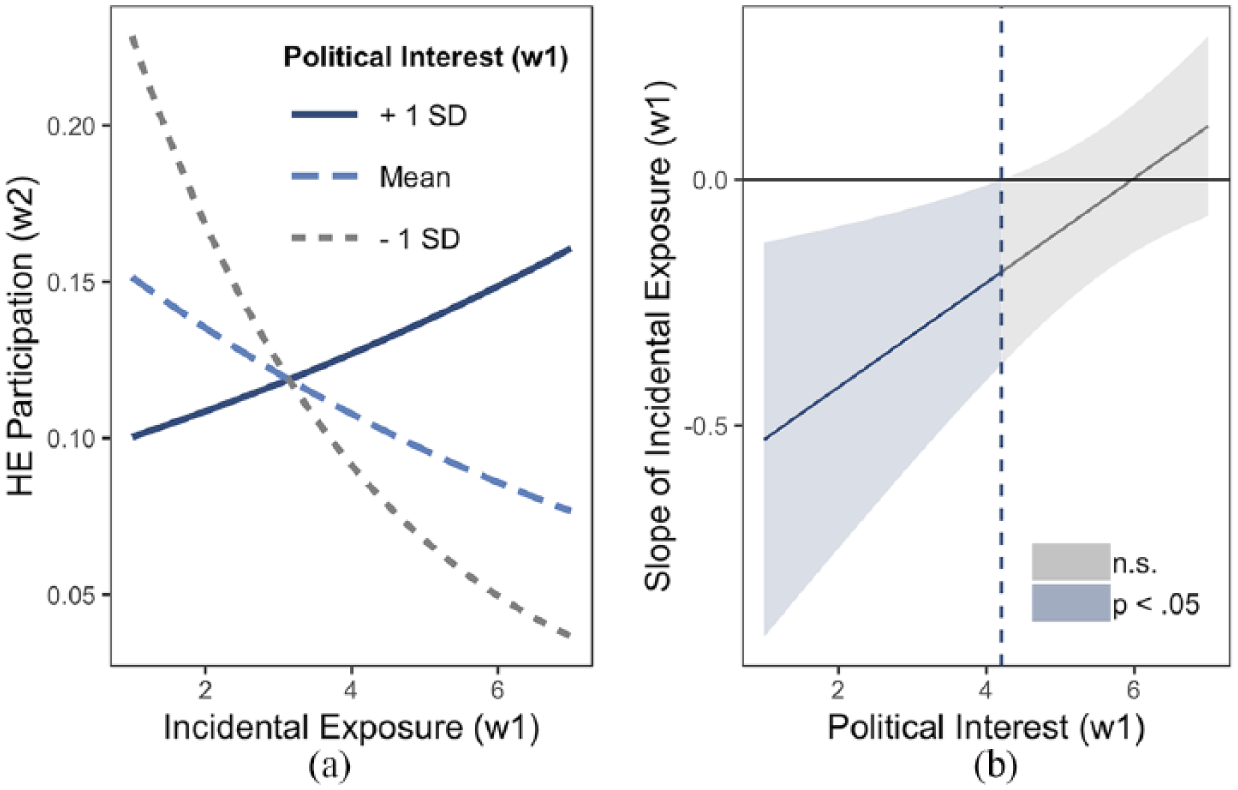
Visualizations of the interaction effect of incidental exposure (w1) and political interest (w1) on high-effort participation (w2). The left plot (a) shows the relationship between incidental exposure and high-effort participation for different levels of political interest, when setting all covariates to their mean values. The Johnson–Neyman plot (b) indicates the size and significance of the slope of incidental exposure throughout all observed levels of political interest.
The second plot in Figure 1 (right side) indicates that the effect of incidental exposure is significantly negative for individuals with political interest levels lower than 4.20 (representing 36% of the sample). Even though the effect turns positive for individuals with higher levels of political interest, this effect does not reach statistical significance.
Additional findings indicate that SNS use for news stimulates low-effort political participation (b = 0.08, p < .01; see Model 1). Furthermore, Model 3 indicates that higher scores in low-effort political participation increase the expected counts of high-effort political participation (b = 0.44, p < .001). However, we did not find that high-effort participation boosts low-effort participation. 4
Discussion
Valeriani and Vaccari (2016) provided convincing evidence that incidental exposure is positively correlated to digital participation among individuals with low political interest. We used panel data and tried to replicate this finding. We find no support for the assumption that incidental exposure may equalize participatory gaps over time. In fact, we find evidence for reinforcing gaps. From a methodological viewpoint, it is not surprising that cross-sectional and panel findings differ. Panel models reduce key problems associated with cross-sectional studies, including omitted variable bias, selection bias, and reverse causation (see Prior, 2005).
Results from this panel analysis have shown that frequent incidental exposure may indeed increase low-effort digital activities, however, this effect was equally distributed among lower and higher involved individuals in our sample. Thus, incidental exposure may increase low-cost political activities across the whole range of political interest. The reason might be that low-effort activities can in fact be performed without much cognitive of physical effort. Even politically detached individuals may thus perform such activities, for example, because they are exposed to political posts from good friends or posts which include mobilizing heuristic cues (e.g. emotional content). However, the real impact of incidental exposure on low-cost participation may be more robust among the politically involved. For example, we found that political interest was positively correlated to incidental exposure in our sample. This is because highly interested individuals are more likely to follow political sources and actively browse political content. Such behavior may then facilitate incidental exposure (Kaiser et al., 2018; Thorson and Wells, 2015). Following this reasoning, more interested individuals become more frequently incidentally exposed to political content and hence benefit more strongly from its positive effects.
Even more importantly, we found no support for a positive main effect of incidental exposure on high-effort political participation both in the cross-sectional and in the panel models. This is in line with theoretical accounts which suggest that incidentally exposed information is less likely to be systematically processed compared to content which is deliberately sought and consumed (Knoll et al., 2018; also see Heiss et al., 2019). In fact, only in-depth processing and cognitive reflection may lead to higher effort political participation. More importantly, we found that incidental exposure even decreased high-effort political participation among individuals with low political interest. We provided two theoretical explanations for this effect, which need to be further examined. First, the role of psychological reactance in the context of incidental exposure needs to be further explored. For example, if politically uninterested individuals are frequently exposed to unwanted political content in their network, they may react with reactance and become even less willing to engage in more effortful participation. Second, self-comparison may play a crucial role when individuals judge their own self-efficacy. For instance, if uninterested individuals encounter political posts from more sophisticated individuals in their newsfeed, they may reassess and lower their own efficacy. However, we were unable to trace these psychological mechanisms in detail with the data at hand and future research needs to investigate these using experimental and in situ observational designs.
Finally, this study attempted to use more nuanced measures of political participation which go beyond a mere online–offline distinction. In fact, lower effort activities (e.g. signing an online petition) may be performed very quickly and do not necessarily coincide with higher effort activities (e.g. contacting a politician, see Gibson and Cantijoch, 2013). However, lower effort activities may lead to more effortful participation over time, as indicated by the positive effect of low- on high-effort participation in our analysis (also see Vaccari et al., 2015). Furthermore, lower effort digital participation can be directly performed in incidental exposure situations and may thus be especially likely to be affected by incidental exposure (e.g. liking the encountered post). Lower and higher effort offline activities are comparably distant behaviors and may thus be only indirectly affected by incidental exposure (i.e. through low-effort digital activities, see Kim et al., 2017; Vaccari et al., 2015).
Limitations
There are also some limitations. First of all, this study is limited to one national case. As Valeriani and Vaccari (2016) have shown, the degree to which individuals are incidentally exposed to politics may vary across countries. Second, our study was conducted in an electoral period. In electoral times specifically, political candidates and parties use campaign money to boost and advertise their posts on social media, which may result in comparably high rates of incidental exposure. Related to that, the time period this study observed was quite narrow. In electoral times, a narrow context may be sufficient because in electoral times political parties and their supporters are highly mobilized and individuals are more attentive to political issues. However, it might be especially fruitful to replicate the findings of this study over a longer period of time. Third, we used a rather global measure of incidental exposure across different platforms. However, the degree of incidental exposure may vary across platforms, such as Facebook or Twitter (see Halpern et al., 2017; Kim and Lee, 2016). For example, Kim and Lee (2016) argue that platforms used for relationship motives (e.g. Facebook) may facilitate incidental exposure more strongly compared to platforms used for informational motives (e.g. Twitter). These platform-specific affordances need to be further explored. Finally, we used survey research and thus relied on a memory-based measure of incidental exposure. This is far from ideal, because individuals need to remember incidental encounters, which may be especially hard for lower involved individuals. In this study, we relied on the item most widely used in previous studies, most importantly to make our results comparable to the findings reported in Valeriani and Vaccari (2016). The item was high in predictive validity, since we were able to closely replicate the authors’ findings in a cross-sectional model. However, future research may also use more nuanced measures of incidental exposure (e.g. Weeks et al., 2017) as well as innovative methods, such as mobile experience sampling, to trace in situ exposure behavior (Karnowski et al., 2017).
Conclusion
Despite these limitations, this study contributes to research which links incidental exposure to participatory gaps. Our study provides evidence that incidental political exposure on SNS may reinforce rather than close existing participatory gaps. Thus, technological features, which enable incidental exposure, may be insufficient to stimulate engagement among the inattentive. In fact, only if individuals develop a motivation (i.e. interest) to engage with political information, they may appropriately benefit from incidental encounters. In the time of social media, educational institutions, political parties, and the news media thus need to continue their effort to stimulate political interest among the inattentive.
Footnotes
Acknowledgements
This research was partially supported by the Austrian Science Fund, project AP3108111/21.
Funding
The author(s) received no financial support for the research, authorship, and/or publication of this article.
