




Abstract
This study examines how citizens made use of online platforms to direct diverging critiques and demands at the Finnish Immigration Service during what has come to be known as the refugee crisis in Europe. Focusing on peak periods of debate, identified using big data, we closely observe how public scrutiny of the immigration service occurred in the interactions between online users, the news media and the agency itself. Our analysis indicates that networked publics can be regarded as influential drivers of accountability for government agencies, which often feel obligated to justify their actions to these publics. However, the operation of networked publics as accountability agents remains heavily dependent on the broader public debate, which is still largely shaped by news media organisations, political elites and the officials themselves.
Introduction
The democratic potential of the Internet and digital media technologies has been debated for over two decades. Optimistic early accounts of the potential for new media to facilitate democratic and participatory processes – or to precipitate radical social change – have recently found counterarguments in increasingly cautious and critical interpretations that point to the unequalising effect of power and technology on online activities (Carpentier, 2011; Fenton, 2016; Iosifidis and Wheeler, 2016; Jenkins, 2014; Tufekci, 2017). One contribution to this debate focuses on the ways in which new media can be used to enhance democratic accountability. There have been high expectations concerning online platforms’ potential to increase public agencies’ openness, transparency and interactivity while strengthening citizens’ capacities to publicly scrutinise and criticise the conduct of authorities (Bertot et al., 2012; Dutton, 2009; Feenstra and Casero-Ripollés, 2014). Yet, as Keane (2011) points out, the multiplication of actors and mechanisms monitoring authorities may also have detrimental effects on democracy and the legitimacy of its key institutions. The question thus remains whether, and how, new media technologies may facilitate greater accountability and citizen empowerment in liberal democracies (Meijer, 2007; Vanhommerig and Karre, 2014).
When addressing the relevance of new media platforms for increasing government accountability, they must be understood not simply as communication channels between authorities and citizens but as forums for public communication that involves various institutions and practices. As well as individual citizens, participants in the monitoring of officials’ actions can include activist groups, civil society organisations, researchers, politicians, journalists and media organisations. These officials may in turn address these interested publics via various forums. What we refer to as social accountability constitutes a communicative interaction between a public organisation and such interested publics that relates to a specific issue concerning authorities’ conduct (Bovens, 2007a; Schillemans, 2008). Citizens can participate in this process through online activities such as monitoring and claims-making, which potentially grants them agency as drivers of accountability. It is unclear, however, how the broader public communication environment shapes the dynamics of social accountability. Who gains power to influence this interaction in the contemporary ‘hybrid media system’ (Chadwick, 2013), which involves multiple actors interacting via both older and newer media platforms?
This article delves into these questions by studying public challenges to the Finnish Immigration Service (henceforth, Migri) during what has come to be known as the refugee crisis in Europe. In Finland, as in many other countries in the European Union (EU), the arrival of a record number of asylum seekers in 2015 generated a polarised public debate over asylum policy. Actors involved in the debate included the government, introducing increasingly restrictive immigration policies; anti-immigration groups and parties demanding tighter control over borders; and activists and nongovernmental organisations (NGOs) fighting what they described as inhumane migration policies, such as deportation and detention. As the principal government agency responsible for asylum matters, Migri became subject to intense scrutiny and criticism from these civil society actors. If we approach these criticisms as diverging accountability claims presented to the agency, the refugee debate becomes an interesting case for analysing how public authorities are subjected to social accountability. Accordingly, we examine how Migri responded to public criticism over its role and conduct in the refugee situation and to what extent the agency recognised and addressed networked publics as its accountability agents.
Social accountability in the hybrid media era
Accountability constitutes a central mechanism in the operation of liberal democracies, enabling powerful governmental institutions to be sanctioned by the governed (Warren, 2014). As such, accountability consists of justifications for the uses of power, and it is typically perceived as a ‘social relationship in which an actor feels an obligation to explain and to justify his or her conduct to some significant other’ (Bovens, 2007b: 184). Whereas existing political and legal systems represent formal mechanisms of accountability in public administration, authorities are also held accountable through more informal communicative interactions in public forums (Peters, 2014; Schillemans, 2008). This social accountability refers to ways in which stakeholders, civic associations, the press or individual citizens impose accountability on public agencies (Bovens, 2007a; Moore, 2014).
Social accountability relies on the assumption that the public sphere operates as ‘the court of public opinion’, where different kinds of actors present public claims against powerful institutions (Moore, 2014). These ‘accountability agents’ scrutinise the conduct of public officials, make evaluative judgements about them and voice their claims in public in an attempt to obtain broader support (Moore, 2014). As the literature points out, even if such accountability agents cannot impose formal sanctions, their demands can put significant pressure on authorities to answer for and justify their actions in public debate (Bovens, 2010; Damgaard and Lewis, 2014; Meijer, 2007; Moore, 2014; Schillemans, 2008). Ideally, this process enhances public trust in authorities and government agencies become more sensitive to citizen expectations (Damgaard and Lewis, 2014). In this sense, officials explaining and justifying their actions in public forums is not simply a matter of reputation management but a key aspect of democratic government (Olsen, 2013; Warren, 2014).
The news media and journalism have long been recognised as important drivers of government accountability in liberal democracies (e.g. Bovens, 2007b; Christians et al., 2009; Schudson, 1982). Yet the various roles the media play in accountability processes have only recently become the subject of a growing amount of studies (e.g. Bonner, 2009; Djerf-Pierre et al., 2013, 2014; Jacobs and Schillemans, 2016; Maia, 2009). According to these studies, the news media may engender accountability simply by creating visibility – thereby enabling citizens to evaluate their leaders’ conduct – or by exposing potential abuses of power that trigger formal accountability processes (Jacobs and Schillemans, 2016; Jantz and Neby, 2013). In addition, the news media may provide civil society groups with opportunities to voice critiques of public authorities and put pressure on them to justify their conduct (Bonner, 2009). Finally, the practices of investigative and watchdog journalism demonstrate the active role journalists can play in demanding that authorities explain their actions, exposing their failures and putting questions of responsibility and blame on the table (Norris, 2014; Waisbord, 2000).
These recent studies on the roles of the news media in facilitating accountability not only point out how directing public attention is relevant for the activation of social accountability; they also highlight the continuing centrality of the news media in shaping these processes. At the same time, however, their often narrow focus on traditional news media risks overlooking the fact that interested publics, including citizens and civil society groups, may be much more directly involved in accountability processes. This direct involvement, in turn, has potentially been enhanced by recent developments in communication technologies, which allow citizens to form loosely organised networked publics and to influence the public agenda (e.g. Castells, 2009; Chadwick, 2013; Papacharissi, 2002; Tufekci, 2017).
When addressing the importance of new communication technologies, and social media in particular, in shaping processes of social accountability, there are at least two key aspects to take into account. First, accountability relations may increasingly be played out in public without the involvement of traditional news media. Using various social media platforms, interested publics can share information quickly and develop shared perceptions about the conduct of public officials and direct criticisms and demands at them (see Chadwick, 2013; Dutton, 2009; Vanhommerig and Karre, 2014). Facebook and Twitter, for instance, allow individuals and civil society organisations to directly address officials and politicians and demand public responses from them. Conversely, public authorities themselves can take advantage of these platforms to address citizen critiques and explain their actions, hence increasing government responsiveness (e.g. Bertot et al., 2012; Tolbert and Mossberger, 2006). Indeed, part of the dynamic of social accountability is the result of public authorities having to decide how to respond to criticism, paying attention to certain accountability agents while disregarding others, for example.
Second, the capacity of individuals and civil society organisations to successfully call authorities to account depends on their ability to engender broader attention and support for their accountability claims (Moore, 2014). In this sense, the news media – the traditional agenda setter of public communication – continues to play a key role (see Bonner, 2009). Nevertheless, the rise of social media has created new dynamics in the circulation of public information (Iosifidis and Wheeler, 2016; Sayre et al., 2010). In this ‘hybrid media system’, characterised by the intertwining of ‘old’ and ‘new’ media institutions, practices, and contents (Chadwick, 2013), journalists closely follow relevant discussions on social media and often find story ideas and suitable sources on these platforms. Simultaneously, news stories remain essential sources of information for online publics (Papacharissi, 2015). Arguably, this mutually constitutive relationship between the news media and networked publics may strengthen both these groups’ capacity to act as watchdogs and the public accountability of authorities. Journalistic exposés of apparent wrongdoing may lead to an avalanche of online appeals and demands for officials to explain their actions, and, conversely, journalists may tap into online discontent to challenge the information released by officials.
Thus far, there has been little research on how networked publics and the news media interact to enforce government accountability. Similarly, the impact of the hybrid media environment on social accountability processes remains understudied. Media-induced publicity has long been considered rather volatile, with public attention rapidly shifting from one issue to the next (Downs, 1972; Petersen, 2009). In the hybrid media era, these attention cycles tend to develop at an even faster pace (Chadwick, 2013). Moreover, studies have shown that online platforms are hierarchical and exclusive and that the attention economy of social media is highly unequal in terms of access and visibility (e.g. Castells, 2009; Papacharissi, 2002; Tufekci, 2017). Accordingly, our aim is to shed light on how the potential realignment of power that may result from the rise of social media might alter the capacity of different actors to shape public processes of accountability.
The refugee debate, contesting publics and Migri’s social accountability
Immigration policy is a highly conflictual field, with debates on asylum seekers and refugees in particular tending to become politicised and polarised (Reichersdorfer et al., 2013). For Western governments, immigration continuously poses moral and political dilemmas, for example, the question of how to respect international conventions and democratic standards while appeasing anti-immigration sentiment (Ambrosini, 2018: 14). The unforeseen increase in the number of refugees arriving in EU countries in 2015 increased these existing tensions, and the ensuing public debate has significantly impacted the politics and policies of countries taking in these immigrants (e.g. Dekker and Scholten, 2017; Greenhill, 2016).
Previous research indicates that social accountability processes evolve through public debate that is often characterised by disagreements over whether any wrongdoing occurred and whether the actors involved are to blame (Boin et al., 2017; Olsen, 2013). Since the public arena has been expanded to include a much larger number of actors, accountability relations have become even more complex and authorities are often forced to deal with multiple and conflicting expectations (Kuipers and t’Hart, 2014; Moore, 2014; Vanhommerig and Karre, 2014). This became apparent during refugee-related events in Finland, where a series of extraordinary measures by the government, coupled with a widespread crisis discourse in public forums, generated two antagonistic reactions among civil society in autumn 2015. On one hand, the rapid establishment in municipalities across the country of new reception centres for arriving asylum seekers prompted citizen activism that aimed to pressure public authorities into blocking the entry of migrants. In addition to inciting panic about an uncontrollable flood of migrants, this anti-refugee mobilisation explicitly targeted Migri, aiming to raise public concern over the agency’s role in establishing and overseeing reception centres, as well as suspicion about the impartiality and professionality of its asylum decisions.
On the other hand, many volunteers, civil society organisations, and experts mobilised not only humanitarian relief but also solidarity and anti-racism campaigns to defend the rights of asylum seekers. As the centre-right government coalition, which included the nationalist-populist Finns Party, reacted to the refugee situation by introducing increasingly restrictive measures for asylum seekers, Migri faced growing criticism from these liberal actors. A key event in this regard was Migri’s release of new country guidelines for Iraq, Afghanistan and Somalia on 17 May 2016, stating that these countries were now considered safe for returning asylum seekers. The new guidelines were expected to significantly diminish the likelihood of asylum seekers being eligible for subsidiary protection and therefore decrease the number of residence permits granted. From that point on, Migri became subject to a series of controversies that questioned the validity of the agency’s decisions and its capacity to conform to international human rights standards and obligations.
Methodology
To study the dynamics of social accountability between Migri and the networked publics during the refugee situation, we combined various datasets. First, to get an overview of patterns in social media debates concerning the agency, we collected an extensive dataset of messages posted on platforms including Twitter, Facebook, Instagram, Google Plus, and YouTube, as well as hundreds of online discussion forums and thousands of blogs. The dataset was acquired from Futusome, a commercial provider that collects Finnish social media content. Its database was queried for all public messages sent between January 2015 and May 2017 that included the word ‘migri’ or ‘maahanmuuttovirasto’ (the agency’s name in Finnish) or the Twitter handle @maahanmuuttovir, in the message body or headers, yielding a total of 66,845 messages. 1 Second, since Migri uses Twitter as its primary public communication tool, we paid specific attention to Twitter as a platform that facilitates Migri’s interaction with its publics. To this end, we used a custom scraper to collect all tweets sent by the agency within the same period by extracting the tweet IDs directly from the Twitter user profile page and then querying the Twitter application programming interface (API) with the IDs. 2 This dataset contained a total of 5694 messages. Third, we collected from Migri’s website all press releases issued by the agency during this time. This dataset contained 145 press releases.
Figure 1 illustrates the general volume of online commentary referencing Migri between January 2015 and May 2017. It indicates that Migri became subject to heightened public scrutiny around August 2015, which also marked the beginning of the so-called refugee crisis in Finland. Moreover, Figure 1 signals that online communications related to Migri were characterised by distinct peaks that typically lasted from 24 to 48 hours. We approached these peaks as indicative of instances of heightened public attention with regard to Migri’s conduct on a specific issue. Characteristic of the hybrid media environment (Chadwick, 2013), these moments were formed and shaped in fast-paced interactions between a diverse range of actors across various online and news media platforms. In order to gain more detailed insight into how networked publics imposed social accountability on Migri, we selected 18 of the highest peaks based on the overall volume of messages posted online. Each message contained a timestamp, which allowed us to arrange them chronologically and trace how the peaks of public debate developed through time. We conducted a close examination of the messages posted during these moments and followed any links to news pages or other sites. The aim of this analysis was to examine (1) what specific issue or event triggered the public focus on Migri, (2) which online platforms were most important to mobilising discussion on Migri, (3) who the principal actors involved were and how they shaped the public debate during the event, (4) how the news media was involved in shaping the debate, (5) what kinds of accountability claims were presented about Migri’s conduct and (6) how Migri responded to accountability claims and criticisms during the event. To further inform this analysis, Migri’s press releases were coded regarding the principal topic addressed by the agency using the qualitative analytics software Atlas.ti. We also coded press releases for any references to public concerns and critiques about the agency’s conduct.
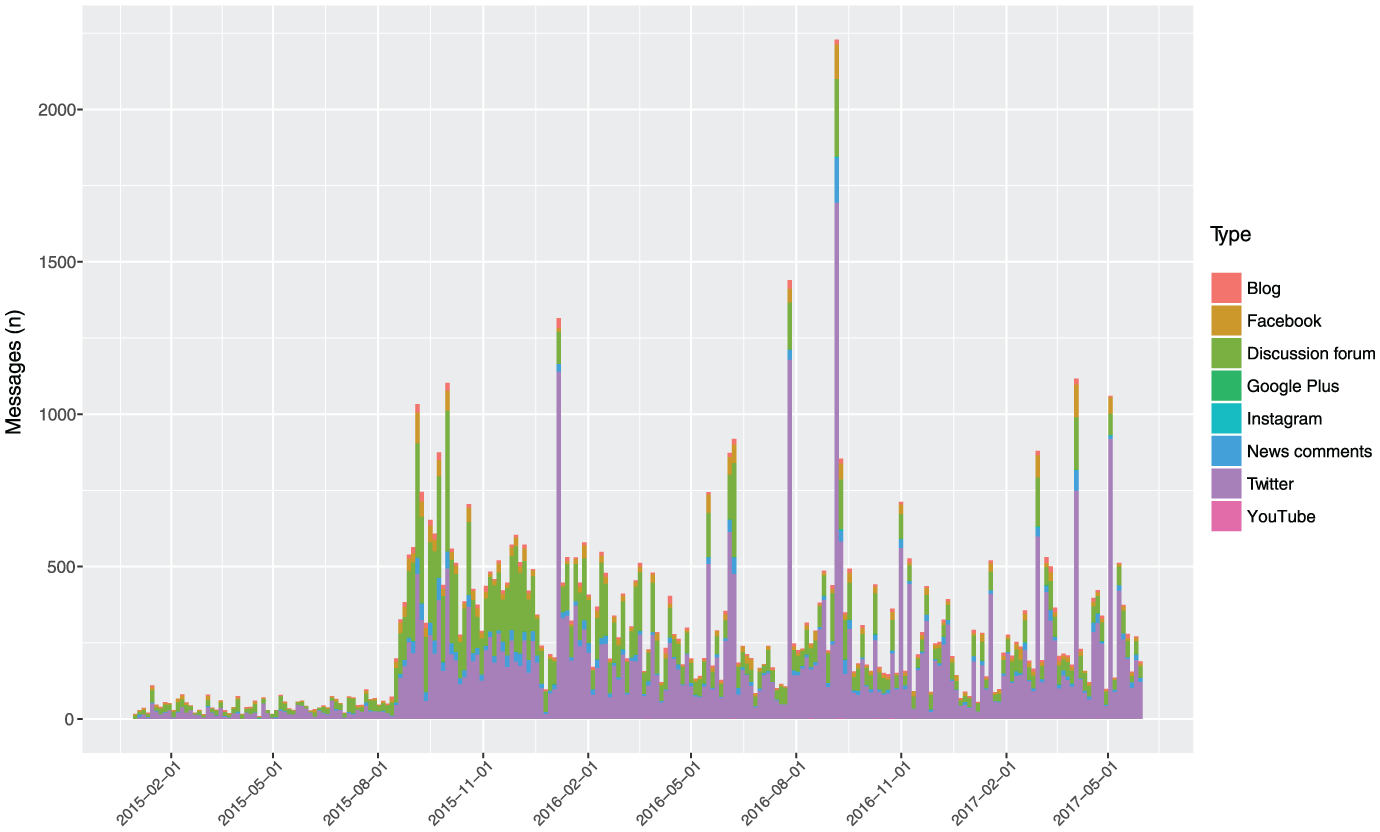
Timeline of mentions of Migri across social media platforms.
Analysis: networked publics as accountability agents
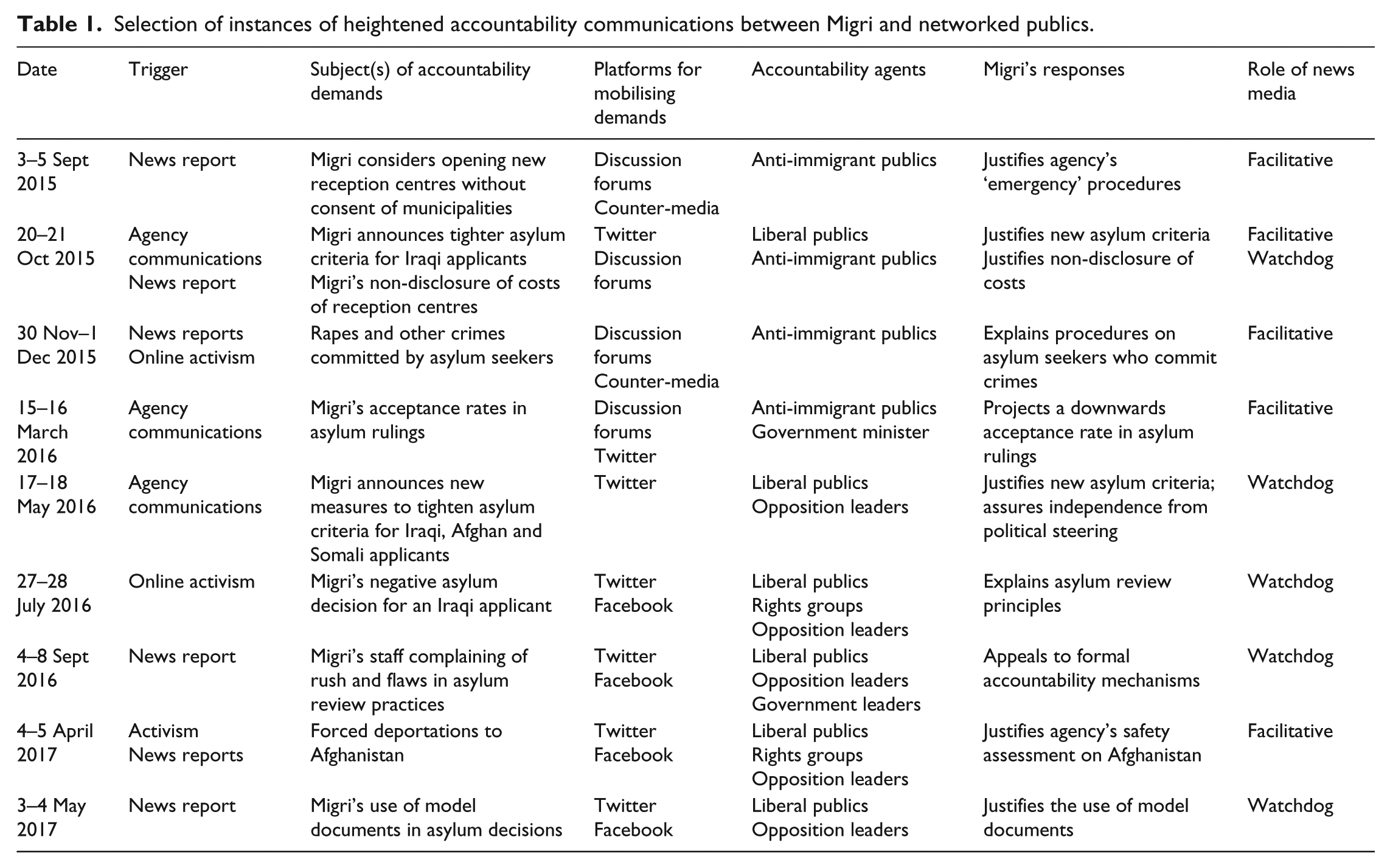
Table 1 presents a summary of 9 out of the 18 moments that were analysed for this study. Table 1 identifies what triggered the heightened debate, the main subject(s) of accountability demands in the debate, the primary online platforms where the discussion took place, the principal agents demanding accountability from Migri, the agency’s main responses to these criticisms and the role of the news media in the enforcement of social accountability. Given the heightened polarisation that characterised the broader public debate on refugees, Migri was confronted by highly divergent accountability claims and actors during the refugee situation. In what follows, we observe three moments more closely, one arising from Migri’s own public communications, one building on autonomous online citizen activism and one originating from mainstream news media reporting.
Selection of instances of heightened accountability communications between Migri and networked publics.
Agency communications triggering an anti-immigrant backlash
On 15 March 2016, Migri held a press conference to brief the public about the asylum situation and new administrative procedures that were intended to streamline asylum application reviews. The agency livestreamed the press briefing on Periscope and several national news organisations reported on or livestreamed it on their websites. While the news reporting was matter-of-fact and neutral, online commentary both during and after the press conference was highly critical of Migri. The primary basis for this critique was statistical information which appeared on one of the presentation slides during the press briefing. This information indicated a considerably higher acceptance rates for Iraqi and Somali applicants in Finland than in most other European countries over the preceding 2 years. A handful of online users spotted this apparent discrepancy and shared their observation on Twitter and discussion forums. They presented the statistics as supporting evidence for their belief that Migri officials were either too lax and incompetent when making asylum decisions or deliberately working to maximise approval rates. The following tweet – posted as a reply to a doubtful user who called Migri to explain the comparatively high acceptance rates and asked how it separates ‘liars’ from those ‘in real danger’ – illustrates how the agency attempted to publicly defend the professional expertise of its officials: @Maahanmuuttovir: @[citizen] In interview it is assessed whether grounds exist for int’l protection. Senior officials are trained to use various interview techniques.
While a handful of citizens challenged Migri directly on Twitter, a larger debate was brewing on online discussion forums, particularly Hommaforum, a nationally well-known forum that is closely aligned with anti-immigrant, radical-right groups (Ylä-Anttila, 2018). The debate was boosted by a notorious far-right counter-media site, MV, as well as a conservative, nationalist news site, Kansalainen [‘Citizen’]. They published sensationalist articles based on Migri’s statistics, claiming that Finns had been fooled by the government’s earlier promises to implement a stricter asylum policy. Sharing these stories on social media provoked a large number of reactions. In the following 36 hours, 180 discussion forum posts and 230 tweets and retweets commented on Migri.
Initially, the critiques presented on Twitter and on anti-immigrant online platforms failed to trigger responses from other actors. In their coverage of the press briefing, major news outlets ignored Migri’s comparatively high asylum approval rates and the online criticism of them. Aside from a few responses to its most persistent Twitter critics, Migri made no further efforts to publicly explain its conduct. However, the pressure on Migri grew on 16 March, when Sampo Terho, head of the parliamentary group for the nationalist-populist Finns Party, appeared in the party’s online newspaper and criticised Migri’s ‘liberal’ policy as being ‘costly for Finland’. Terho’s critique was noteworthy for the fact that as part of the government coalition, the Finns Party had previously had little recourse to publicly challenge official policy. Several other Finns Party members of parliament and local representatives quickly followed suit and criticised Migri in blogs and Facebook updates. The fact that members of a government party had joined Migri’s critics seems to have impacted the calculations being made at the agency. On 17 March, the director of Migri’s asylum unit gave an interview to the Finns Party newspaper, in which he assured its readers that Finland’s asylum policy had indeed been tightened and that the results of that would become evident in Migri’s upcoming asylum decisions.
While these assurances were met with the usual suspicion by commenters on anti-immigrant forums, Migri’s message to the readers of the Finns Party newspaper proved to be accurate. As Migri began to process the 25,000 pending asylum applications from the preceding year, the share of accepted Iraqi asylum applications dropped dramatically, from 85% in 2015 to 21% from April to December 2016. 3 Despite the fact that all applications were reviewed individually and hence there was no way to set a target rate for acceptance, in March 2016, Migri’s leadership was still able to project a dramatic reduction in the acceptance rates due to changes in asylum legislation and agency policy. Whether or not we interpret Migri’s tightening of asylum policy as a result (in part) of increased pressure from anti-immigrant publics, the agency’s public interventions nonetheless clearly communicated its responsiveness to these publics.
This signals the strengthened role of anti-immigrant publics as Migri’s accountability agents. As Table 1 indicates, prominent accountability demands directed at Migri by networked publics in autumn 2015 frequently derived from concerns promoted by anti-immigrant activism. They included the high number of arriving asylum seekers, the opposition of local communities to the opening of new reception centres in their municipalities, the crimes committed by asylum seekers and the cost of the growing asylum system – including social security payments and the contracting of reception centre services – to taxpayers. In its press releases, Migri often explicitly acknowledged them as public concerns. The agency also attempted to provide these publics with satisfactory justifications, addressing questions, for example, about its authority to open new reception centres without the official consent of municipalities (Migri, 2015c), the safety of reception centres (Migri, 2015b) and the deportation of asylum seekers found to be guilty of serious crimes (Migri, 2015a).
Online activism inciting pro-refugee demands
On 24 July 2016, a city employee from southern Finland posted the text of an Iraqi applicant’s declined asylum request decision on her personal blog. The decision acknowledged the personal persecution and torture experienced by that asylum seeker in Mosul, but concluded that the applicant could seek refuge elsewhere in Iraq and was therefore not entitled to international protection. Though it initially received little attention, the blog post started making the rounds on Twitter three days later, when a prominent Left Alliance politician shared the link on her feed. By the end of the day, Migri had received 383 critiques, comments and questions via Twitter from local politicians, human rights activists, journalists specialising in refugee issues and other interested citizens.
These networked publics called Migri to account on several grounds. Some critics expressed incredulity about the ‘Kafkaesque’ language and style of the official decision, pointing to its conclusion, which was seemingly at odds with most of what was stated in the preceding text. Others questioned the decision’s disregard of the United Nations High Commissioner for Refugees’ guidelines concerning the application of the internal flight principle (where authorities regard flight within the country of origin as feasible) as grounds for denying international protection. Finally, some accused the agency of making an inhumane decision that, though it may not violate current legislation, revealed officials’ disregard of basic moral standards when interpreting the law. As one citizen expressed, the decision was an example of the ‘comprehensive bypassing of humanity’ in Finnish asylum policy.
The agency was quick to engage its critics, responding to the first question it had received on the matter on Twitter in a little over 20 minutes. Only 15 minutes later, the agency published a press release addressing the issue, explaining the asylum review process and the principles used to assess the feasibility of the internal flight principle (Migri, 2016c). As networked publics continued to press Migri on the matter, the agency justified its actions in 36 subsequent tweets. It instructed its publics to focus on ‘relevant’ passages in the decision – not on passages dealing with torture, but on those concerning internal flight. Migri also emphasised that officials make decisions according to the law and not based on personal feelings such as sympathy: @Maahanmuuttovir: @[citizen] @[citizen] @[journalist] @[citizen] Asylum reviewer’s job is difficult, that is why it heavily relies on law, not on feelings.
Before long, the heated Twitter exchange attracted the attention of the news media, which then brought the controversy to a broader audience. Finland’s main commercial television network, most prominent daily newspaper and largest tabloid newspaper, among others, published parts of the asylum decision and reported on the controversy it was causing on social media. In some of these reports, Migri’s officials explained the agency’s new policy of applying the principle of internal flight to Iraq. Finally, on 29 July, Migri published another press release outlining its asylum decision procedures, this time in response to citizens’ grievances about Migri’s ‘inhumane’ policies (Migri, 2016a). In line with an earlier tweet in which Migri had reminded its critics that the agency had already granted international protection to more than 2000 individuals in the first half of the year, the press release emphasised that ‘all possibilities for granting protection are reviewed when making asylum decisions’. This language – which marked a striking contrast to the way in which the agency had highlighted its tough stance regarding asylum seekers only a few months earlier – indicated that the agency had shifted its rhetoric to better match the public it recognised as its principal accountability agent at that time.
The capacity of networked publics to raise accountability demands usually relies on the public availability of information, making such demands highly dependent on the news media or the public agencies themselves (Meijer, 2007). This instance, however, demonstrated the autonomous capacity of networked publics to call Migri to account by generating a major controversy, even without an initial push from the mainstream news media. The contemporary hybrid media environment enables citizens to produce information themselves and share it with interested publics via online media platforms (Chadwick, 2013). In favourable circumstances, this information generates growing online attention, captures the interest of the news media and pushes public officials to respond, thereby engendering forms of social accountability. In this particular case, the way the online publication of Migri’s asylum decision succeeded in generating a public controversy resembles whistleblowing or leaking as a form of citizen monitoring of public authorities (e.g. Hunt, 2006).
Journalistic revelations generating accountability demands
Although individuals were able to self-organise and generate public controversies, it was also evident that networked publics remained highly dependent on major news outlets for obtaining wider public recognition for their accountability claims and building pressure on Migri to respond. As an indication of the continued centrality of major news media outlets in driving social accountability, the single largest moment of controversy surrounding Migri by the time of publication is attributable to traditional watchdog journalism.
On 4 September 2016, Helsingin Sanomat, Finland’s foremost national newspaper, published an investigative report on Migri’s internal decision-making. Based on confidential, unnamed sources within the agency, the article pointed to flaws in the process of revising the country assessments that guide reviews of asylum applications. It also highlighted the pressure Migri’s staff faced to process asylum applications quickly and how staff members were incentivised to make negative asylum decisions. The story raised serious questions about potential errors in asylum decisions and the way in which Migri’s decision-making had become subject to undue political interference.
As a result of the report, many people denounced Migri and its leadership in online forums. Follow-up media coverage by Helsingin Sanomat and other outlets further increased online commentary and news sharing among interested publics. In the face of criticism, Migri’s leadership defended its output targets for asylum officials and rejected claims that their streamlining of review procedures had endangered due process. The agency repeatedly justified its conduct by referencing formal accountability mechanisms, arguing that the Ministry of the Interior had supervised and directed the agency’s activities and that most of Migri’s decisions and country assessments had been confirmed by the administrative courts. When Migri issued a press release on the matter (Migri, 2016b), it underscored the latter argument on Twitter: @Maahanmuuttovir: Our #asylum decisions are legitimate. The admin court has overruled less than 2% of decisions due to our error. [Link to press release]
A key factor in building up public debate on the issue was the active engagement of liberal opposition politicians whose comments could be circulated by news outlets. They called for a reassessment of Migri’s review practices and better resources for Migri’s asylum officials. By articulating public outrage in a politically meaningful way and challenging the government’s support of Migri, opposition leaders were thus able to work towards triggering mechanisms of formal accountability. Therefore, further reporting on the issue ensued, as journalists demanded reactions from key government ministers. However, despite public pressure, the three-party coalition government remained unanimously behind the tightening of asylum policies. Both the prime minister and finance minister expressed support for Migri’s asylum practices, effectively dismissing the new disclosures. They also emphasised Migri’s independence as an asylum authority and denied putting any political pressure on the agency. Government leaders and Migri’s leadership thus established an alliance, supporting each other against challenges from the political opposition, the news media and the liberal public.
Migri’s two publics of accountability
As Table 1 indicates, Migri’s social accountability appears to have been driven primarily by anti-immigrant concerns in the early stages of the refugee situation. From May 2016 onward, however, a distinctly liberal public, one driven by concerns about the asylum system’s capacity and willingness to guarantee the rights of asylum seekers, emerged as a strong driver of Migri’s accountability. The agency’s communications reflected this shift in the public debate. With frequent assurances about due process and the lawfulness and appealability of its decisions in press releases (e.g. Migri, 2016a, 2017), a marked shift in tone was apparent in Migri’s communications. Instead of emphasising its strict procedures and review processes (a response demanded by anti-immigrant citizens), the agency attempted to persuade its liberal critics that asylum seekers’ rights and interests were being protected.
The liberal and anti-immigrant publics demonstrated similarities and differences in their operation as accountability agents. First, in both cases, the primary triggers for generating attention peaks about Migri were the agency’s own communications along with news media reports. Although both publics disseminated information and rumours about new developments in the refugee situation, they were heavily dependent on the availability of official information and national news contents for the mobilisation of large-scale outcries about Migri’s perceived failures.
Second, as illustrated by the involvement of MV and Kansalainen in the March 2016 events, popular counter-media sites with an anti-immigrant, nationalist-conservative bent played an important role in scrutinising Migri’s activities and helping to build up public outrage about its conduct. Conversely, liberal publics typically relied on mainstream media reporting and used Twitter to challenge Migri directly. 4
Third, the absence of visible support from national politicians and political parties was notable in the operation of anti-immigrant publics as accountability agents. Although nationalist-conservative MPs from government parties were active participants in the Finnish refugee debate, they mostly refrained from criticising Migri in public – in this regard, the involvement of a leading Finns Party politician in the March 2016 incident was highly atypical. In contrast, opposition leaders representing liberal-left parties were frequently involved in mobilising public criticism against Migri during moments of controversy. This indicates how the political context, for example, government composition, can shape the dynamics of social accountability. Opposition politicians may feel more enabled to publicly criticise authorities, whereas government party politicians tend to refrain from critiques which might be interpreted as putting undue political pressure on officials.
Fourth, the relationship between mainstream news media and anti-immigrant publics was ambivalent. Although news reports operated as essential sources for anti-immigrant online mobilisation, journalists working for major news outlets refrained from explicitly supporting anti-immigrant causes. Nevertheless, the media often accorded both visibility and validity to anti-immigrant accountability demands by reporting on Migri’s responses to such issues. Thus, even as major news outlets were not strong drivers of accountability claims deriving from anti-immigrant concerns, they still indirectly facilitated the operation of anti-immigrant publics as accountability agents. In contrast, the news media often played a much more active role in supporting Migri’s liberal accountability agents. Prominent journalists occasionally joined aid organisations, citizens, opposition politicians and researchers in publicly questioning the agency, while the news media’s intermittent role of watchdog mostly coincided with liberal concerns about Migri’s potential violations of asylum seekers’ rights. As a result, a close interdependence developed between liberal publics and major news outlets when calling Migri to account.
Discussion
As Moore (2014) points out, processes of social accountability can have significant outcomes, prompting organisations to reassess their conduct, either in fear of losing public legitimacy or because they feel morally compelled to do so. During the early stages of the refugee situation in particular, anti-immigrant publics were, to a significant extent, able to represent the voice of ‘the people’. By consistently raising the same critiques regarding Migri’s ‘lax’ asylum policy in discussion forums and news comment sections, anti-immigrant publics were able to shape the news agenda and persuade the agency to address their concerns. Moreover, the government’s decision to introduce new asylum policy restrictions can be partly interpreted as a response to anti-immigrant mobilisation. Our analysis thus supports earlier studies, which suggest that heightened public scrutiny of officials working on a particular issue may place that issue higher on the public agenda and help shift decision-making from the administrative to the political level (Bonner, 2009; Dekker and Scholten, 2017; Jacobs and Schillemans, 2016; Jantz and Neby, 2013).
Conversely, Migri’s liberal critics appear to have gained few concrete results from their continued public scrutiny of the agency. This suggests that the broader political context plays a large role in determining the outcomes of social accountability. In Finland, the nationalist-conservative government coalition pushed Migri to implement increasingly restrictive asylum measures during the refugee situation. As a result, the agency could not respond to the liberal publics in a manner that would assure them of the legitimacy of its asylum policy. Indeed, our analysis indicates a continued – if not increased – mistrust of the agency, especially among liberally oriented publics. Far from restoring trust in the legitimate use of public power, in circumstances such as these, social accountability processes may in fact further erode trust in government (Warren, 2014). The inability of Migri’s liberal critics to bring about any true changes in the agency’s policies through public appeal has increasingly led those critics to adopt other measures, including street demonstrations and civic disobedience (YLE, 2017). 5
The radicalisation of liberal publics indicates that social accountability has complex implications in liberal democracies. Although the intense public scrutiny of Migri has resulted in few observable changes in its decision-making processes, social accountability should by no means be dismissed as meaningless. As Migri has been forced to repeatedly explain its conduct, the public has become increasingly aware of asylum as a societal issue and interested in influencing the politics of asylum through electoral and civic means.
Conclusion
This study has illustrated the efforts of two antagonistic groups to influence the operation of the asylum system in Finland. In liberal democracies, joining like-minded publics in efforts to make authorities accountable to particular political demands through constant monitoring and criticism of their conduct is one of the principal means of participating in the political process (Keane, 2011; Rosanvallon, 2008). In this sense, new media do seem to be providing spaces for increasing participation that can have a significant impact on public debate and even influence authorities’ behaviour. However, as the analysis here has indicated, the outcomes of such participation may not necessarily serve liberal-democratic ends.
The growing public and scholarly attention on the uses of digital networks by various conservative, anti-immigrant and right-wing groups in recent years has made it increasingly evident that, rather than advancing inclusive participation, grassroots activism can turn social media into a tool for spreading undemocratic values and limiting the rights of others (Jenkins, 2014). New media certainly have an impact on the practices of civic participation, but they hardly determine the outcomes of contemporary political and ideological struggles over the scope and means of participatory democracy (Carpentier, 2011; Fenton, 2016; Tufekci, 2017). Rather than focusing on one platform at a time, the relevance of new media for these struggles must be analysed in the broader context of political communication, which is defined by complex interactions between authorities, networked publics and the traditional news media (Chadwick, 2013). In observing these interactions in the context of social accountability, this study demonstrates the continuing power of elite actors such as politicians, major news media journalists and other public opinion leaders in shaping the public debate (see also: Tufekci, 2017). If anything, this should give us pause when making claims about any democratic advances brought about by new media.
Footnotes
Acknowledgements
The authors thank the Digital Content Communities research group at Aalto University for providing the Twitter scraper that was used in the data collection for this study.
Funding
The author(s) disclosed receipt of the following financial support for the research, authorship, and/or publication of this article: Research for this article was supported by the Helsingin Sanomat Foundation.
