



Abstract
Journalism as an institution is increasingly under pressure in hybrid media systems. Various far-right actors use social media platforms as a key staging ground for contesting legacy media. Drawing on affect theory and discursive institutionalism, this article empirically examines how journalistic authority was challenged on Twitter during far-right riots in the German city of Chemnitz in 2018. Through these public and networked contestations, we see the emergence of “affective publics” that form around shared and competing emotions. Through social network analysis, we examine the networked polarization around #Chemnitz. By applying in-depth textual analysis, we then untangle how far-right actors attack legacy media by strategically mobilizing and performing outrage. Based on our findings, we propose to understand journalism as an affective institution, whose authority is perpetually contested as affective publics gain agency. Such an understanding involves a profound questioning of the notion of objectivity that has been constitutive of journalism in the 20th century.
Keywords
Introduction
Journalism as an institution is increasingly under pressure in hybrid media environments. Its legitimacy and the validity of its interpretations of public events have become the subject of public contestation. These contestations cannot be adequately understood by focusing only on facts and arguments but must be identified in their very affective structure. In particular, the threats posed by the far-right are an essential part of what Papacharissi (2015) has termed “affective publics,” in which facts, arguments, sentiments, and emotional evaluations merge into a stream that, we argue, aims to undermine the legitimacy of journalism as an institution that provides interpretations of current events.
In this article, we focus on the case of the 2018 far-right riots in the city of Chemnitz as part of the post-2015 anti-migration sentiment in Germany. The protests erupted when two male migrants were named as suspects in the fatal stabbing of a male Chemnitz resident. Immediately after the suspects were identified as asylum seekers, several far-right parties, organizations, and movements called for a demonstration disguised as a funeral march. This march quickly turned violent as far-right protesters began chasing people they believed to be migrants or refugees in the streets. These protests were countered by solidarity rallies over the next few days. With the participation of state intelligence agencies, political actors, and civil society representatives, the Chemnitz case developed into a controversy in which journalism as an institution that provides observations and interpretations of events was massively challenged.
We look at the Twitter hashtag #Chemnitz to investigate how journalism’s institutional boundaries are negotiated and challenged by the affective publics that emerge around hashtags connected to conflictual events. By applying social network analysis (SNA), we look into (RQ 1) the role of legacy journalism and its opponents, that is, actors, whether human or automated, who challenge or oppose the institutional authority of journalism on social media. In particular, we focus on (RQ 1.1) who the actors occupying influential positions in the network are, (RQ 1.2) the position of legacy media in the network, and (RQ 1.3) far-right media’s position in it. In addition, SNA also allows us to (RQ 1.4) reveal the networked and affective structure of the public around the hashtag #Chemnitz. Through in-depth textual analysis, we examine (RQ 2) how emotions are articulated in interactions with legacy media and (RQ 3) how the affective dynamics of these interactions contribute to contesting journalism’s institutional boundaries. Due to the context of massive far-right mobilization surrounding the events in Chemnitz online and offline, this case study also contributes to existing scholarship with an in-depth look into the affective dynamics of far-right actors’ strategies to challenge journalism’s legitimacy as a democratic institution.
By introducing affect theory to capture the characteristics of current disputes in journalism, combined with recent debates in neo-institutionalism, particularly discursive institutionalism (Hanitzsch & Vos, 2017), we develop an approach that understands emotions and affects as catalysts and outcomes of social conflict, including the conflictive negotiation of journalism’s institutional power and legitimacy.
We will first discuss our understanding of emotion and affect as essential forces of sociality and apply this to an understanding of journalism in hybrid media environments, which we will then connect to recent debates on discursive institutionalism. We describe the background of the #Chemnitz case as an event in which highly racist articulations took place in public space and discourse. After describing our data, we discuss the two methodological approaches used: network analysis to describe the formation of polarized publics and “reading for affect” as a type of textual analysis applied to identify the production of affect through language. Finally, we discuss our findings and propose an understanding of journalism as an affective institution whose authority and legitimacy are consistently negotiated within affective publics.
Literature Review
Affect, Emotions, and Media
To understand the dynamics of public discourse around conflictual events, we need to seriously consider emotions and affects as its essential elements. As a part of the “emotional turn in journalism studies” (Wahl-Jorgensen, 2020), we suggest to use an approach informed by affect theory to sketch out the very nature of current contestations of journalism as an institution.
Our study’s understanding of affect and emotions is grounded on theories in the social sciences and the humanities that highlight both the relationality of these concepts and the interplay between them (Gregg & Seigworth, 2010; Wetherell, 2012, 2015). Affect and emotion are regarded as constitutive forces of sociality where humans are characterized by their ability to affect and to be affected by others—be they human or non-human bodies. Media are an indissoluble element of such an affective relationality as they themselves produce, amplify, circulate, and archive affects and emotions. To distinguish both, we regard affect as “more of a force, power, and intensity than a property of a biological body” (von Scheve & Slaby, 2019, p. 45) that emerges in the interactions between bodies (human and non-human). Emotions, on the other hand, are “conceived of as object- or situation-directed affective comportments that are sorted into culturally established and linguistically labeled categories or prototypes” (von Scheve & Slaby, 2019, p. 43). Thus, emotions are considered complex, culturally formed expressions and evaluations, and as such, they are stabilized, reproduced, circulated, and sometimes challenged by media itself. Building on the concept of “feeling rules” (Hochschild, 1979), we argue that journalism plays a central role in the process of how we learn to feel adequately and thus establish social norms and regulations.
Journalism as an Affective Institution
To look into how journalism’s institutional boundaries are negotiated and challenged within affective publics, it is necessary to first retrace how it has gained the social power to establish feeling rules and how hybrid media systems (Chadwick, 2013) catalyze challenges to this power. For this, we draw on the theoretical framework of new institutionalism, in particular discursive institutionalism (Hanitzsch & Vos, 2017). This informs our understanding of journalism as an affective institution that continuously asserts its social function as a mediator in public discourse by also providing emotional interpretations of events. Discursive institutionalism helps reveal how journalists discursively construct and defend their authority as a profession against challenges from various other actors. Vos and Thomas (2018) argue that journalism continuously asserts its institutional authority through the consolidation of the objectivity norm, the standardization of reporting practices, and a commitment to “the truth” (p. 2002). This is in line with scholarship that focuses on objectivity standards as a constitutive element of journalists’ practices and professional identity throughout the past decades (e.g., Anderson & Schudson, 2019; Tuchman, 1972). This also means striving for detachment and emotional distance toward sources and events as a way to ensure objective reporting (Hopper & Huxford, 2017, p. 94).
Recent research focusing on affect and emotion in journalism, however, shows that, contrary to journalism’s normative ideals around objectivity and emotional detachment, affect and emotion are often at the center of various debates among journalists, especially in moments of institutional crises (Lünenborg & Medeiros, 2021; Schmidt, 2021). These moments force journalists to reflect and publicly negotiate their approach to emotion as part of their work. A growing body of empirical work also asserts that emotions are central to how journalists interview sources (Glück, 2016; Richards & Rees, 2011), develop storytelling approaches for conveying complex stories (Dennis & Sampaio-Dias, 2021; Rosas, 2018), or deal with challenging situations in conflict or crisis reporting (Šimunjak, 2022; Stupart, 2021).
In addition, making emotions visible by covering them and leaving others invisible by deeming them not newsworthy is a constitutive part of journalistic work. This way, journalism contributes to legitimizing certain emotions by allowing them to circulate in public discourse (Pantti & Wahl-Jorgensen, 2011; Wahl-Jorgensen, 2017). However, our study focuses on emotions that are deemed legitimate by the media but become the subject of contestation on social media.
Affective Publics and the Challenges to Journalism
Journalism has been facing mounting challenges to its interpretative functions as publics become increasingly complex and the lines between legacy media and personalized networks of communication become blurred in the continuous “context collapse” (boyd, 2011, pp. 50–51) that characterizes social media platforms. Thus, the Habermasian divisions between public and private communication—as well as between rationality and emotions—become insufficient for analyzing the performative and networked nature of current public communication. Empirically, an essential step for analyzing these dynamics is looking into which actors occupy influential positions in the network and how legacy media relate to them—are legacy media accounts or individual journalists also influential? Are they mentioned by influential actors? In our work, we draw on discursive institutionalism in connection to the concept of affective publics (Lünenborg, 2020; Papacharissi, 2015) to answer these questions. This helps us understand journalism’s boundary work (Carlson & Lewis, 2015)—that is, how journalism defends its institutional autonomy—as a conflictual process of negotiation that takes place among different types of actors in networked media environments.
Affective publics conceptualize publics as being constituted not only by the exchange of arguments but also through the circulation of emotion and affect as part of the interplay between media technologies, social media platforms, multimodal media texts, and users’ practices (Lünenborg, 2021, pp. 13–14). As users assemble around specific hashtags or perform affective media practices (Lünenborg & Maier, 2019) such as liking, sharing, or commenting on social media posts, they collectively challenge legacy media’s authority to decide upon which topics are relevant enough to be covered and how journalism circulates and interprets affect and emotions surrounding these topics.
Moreover, within hybrid media systems (Chadwick, 2013), individual actors have space and tools to provide their own emotional interpretation of current events, thus challenging journalism’s claim to regulate emotions. This emphasizes (de)institutionalization processes, as “discursive work . . . creates an institution, recreates it as new actors are socialized, and reshapes it during discursive contestation or reflection” (Hanitzsch & Vos, 2017, p. 121). Often, the sheer mass of expressions of anger or solidarity on social media alone may be considered newsworthy in and of itself (Bruns & Hanusch, 2017, p. 17). Frequently, this leads to the spillover of debates started on social media into legacy media coverage, as was the case with #MeToo, #BlackLivesMatter, and other hashtags that mobilized massive user participation and later became front-page news worldwide. However, as our analysis also shows, these challenges are not limited to the decision of what is news—the way legacy media cover events also turns into a topic of contention, mobilizing affects.
This becomes especially visible in moments of crisis. Journalism often covers such moments by employing intense and frequent updates. The ensuing constant affective flow may pose problems of its own when the breaking news headlines are not followed by further context. Constant updates, when devoid of more in-depth contextualization, create “intensity, 24/7, but no substance” (Papacharissi, 2017, p. 52). As a result, audiences may become constantly alarmed by breaking news without being sufficiently informed about crisis events. Connected to this affective flow, journalism also covers crises as something to be monitored, but not necessarily critically engaged with, as Chouliaraki and Stolic (2017) found in their study of the coverage of the so-called refugee crisis in Europe. By adopting a monitorial, distant tone, journalism encourages the audience to engage in “a light-touch ‘checking up’ on events that enables a vague awareness” (p. 1168) of what is happening, rather than more active stances.
This combination of permanent alertness and impassive tone produces contradictory sensations that become explicit on social media. Drawing, in part, on an ecology of far-right media, specialized forums, and hashtags on commercial social media platforms that mobilize publics through a variety of affective flows (Deem, 2019; Ekman, 2019; Strick, 2021), the far-right is one of the loudest groups to question how journalism covers events on social media. Scholarship on far-right actors’ relationship to journalism reveals how challenging journalistic routines and established news values is an essential part of how these actors mobilize their sympathizers while trying to bring their own narratives into legacy media reporting (Krämer, 2018). This is embedded in a wider rejection of democratic institutions’ legitimacy in general, fueled by anti-elitist sentiment (Mudde, 2019; Quiring et al., 2021, p. 3500). Paradoxically, this rejection is often driven by far-right users’ particularly strong engagement with legacy media sources and a dissonance between their own interpretation of events and the way legacy media cover them (Guhl et al., 2020; Krämer et al., 2021). Anger, in particular, becomes a central emotion for the construction of far-right users’ “identity as oppositional truth-seekers who see it as it really is, an anger that is fueled by confronting established sources and confirmed by visiting alternative ones” (Ihlebæk & Holter, 2021, p. 1218). Building on far-right actors’ hostile discourse toward journalism, permeated by terms such as “lying press” and conspiracy ideologies around journalists’ collusion with “elites” (Krüger & Seiffert-Brockmann, 2018), social media users often target journalists online (Reporters Without Borders, 2018, pp. 7–11).
However, journalists’ widespread adoption of social media not only makes them a target of far-right hate speech but also allows them to engage in discursive exchanges with different publics more directly. For instance, they employ one of Twitter’s affordances, retweets, to circulate opinions and humorous tweets by other users without explicitly showing their own support for those contents (Molyneux, 2015). Journalists’ Twitter use seems to be a further arena for the discursive renegotiation of journalistic norms (Barnard, 2016; Bentivegna & Marchetti, 2018) while also being part of affective publics which substantially differs from the discourse produced by journalism generally.
Other actors that constitute affective publics and enter such discursive exchanges with journalists employ very distinct emotions in their efforts to provide their own interpretation of events and explicitly display emotions such as rage, sarcasm, or joy. While professional journalists, influencers, politicians, alternative journalists, and social media users convene to form affective publics, in our case around a hashtag on a social media platform, these diverging emotional interpretations may clash. This case study expounds on how institutional boundaries of journalism are renegotiated affectively in this process.
The Present Case: #Chemnitz
In the following section, we draw on an empirical analysis of Twitter data during the far-right riots in Chemnitz, Germany, in 2018. The protests broke out as two male asylum seekers were named suspects in the fatal stabbing of a male Chemnitz resident. Immediately after the suspects were publicly identified as asylum seekers, several far-right parties, organizations, and movements called for what was cloaked as a funeral march. The funeral march quickly developed into violent riots as far-right protesters started chasing down people on the streets, whom they perceived to be migrants or refugees. The riots further included chants such as “Foreigners Out” or “We are the People” as well as public displays of Hitler salutes, which are illegal in Germany, and physical attacks against Black people and People of Color (BPoC) and reporters.
Counter-protesters promptly mobilized on Twitter using the hashtags #wirsindmehr (“We are More”) and #HerzstattHetze (“Heart Instead of Hate”). Thousands from all over the country took to Chemnitz to show up at anti-fascist demonstrations and a concert titled “Wir sind mehr” (Nimz & Rietzschel, 2018). During the riots, over a dozen protesters and several police officers were injured, resulting in prosecutions. Finally, the head of Germany’s domestic security agency at the time was dismissed after making controversial comments, in which he disputed whether far-right protesters had attacked BPoC on the streets of Chemnitz as was documented in a video testimony (Smee, 2018). What started as a local event thus transformed into a nationwide discussion around the issue of far-right extremism in Germany as well as institutional racism and Islamophobia. Moreover, the intense clashes between far-right and anti-fascist movements on site and on Twitter under the hashtag #Chemnitz turned this event into what The Guardian called a “high-stakes battle over the soul and future of their country” (Connolly, 2018). Given the mobilization and prominence of emotions in the discourse, we conceive the public that emerged around the events of Chemnitz as affective. As is common for far-right rhetoric (see, for example, Krämer, 2018), the discourse around #Chemnitz included heavy attacks on legacy media coverage. We employ a multi-method approach to a random sample of tweets, combining SNA and qualitative textual analysis to reveal the affective nature of these attacks, the discursive strategies actors employ to circulate such affects, and their engagement with the broader networked public that has formed around #Chemnitz. In the following sections, we describe the data and methods in more detail.
Data
The analysis centers on a random sample of 10,000 tweets featuring #Chemnitz posted between 26 August and 1 September 2018, the first week following the murder. 1 During this period, the hashtag was featured in 646,747 tweets. Twitter hashtags play a crucial role in forming and temporarily sustaining publics around a specific issue or an event (Bruns & Burgess, 2015). They condense public discussions, in which news blends with playful commentaries, memes, or GIFs, allowing for the mobilization of activists and for audiences to follow live updates as the events unfold (Papacharissi, 2015). Current academic discussions stress, however, that hashtag-based samples should not be understood as representing dominant attitudes in a given society but rather as temporary and limited snapshots of multiple intersecting and constantly fluctuating discourses (Shugars et al., 2021). Nevertheless, they can provide a meaningful image of how publics that emerge on social media and are structured by the affective affordances of the platform make sense of specific issues.
Methods
Social Network Analysis
As a first step, we applied SNA, a method that examines and visualizes relations between social actors and the intensities of these relations (Knoke & Yang, 2020). Based on these data, it further identifies influential actors who control the flow of information within social media networks. Densely connected actors then form groups or communities. Visualizing the public that emerges around #Chemnitz through SNA enables a deeper understanding of their affective structures by revealing possible tensions between groups competing for authority and legitimacy. Moreover, SNA posits a relational perspective on actors as embedded in social structures and emphasizes how their actions are enabled or impeded through their specific constellation within the network. Actors then become relevant for social research precisely because of their (albeit temporary) belonging to certain communities (Haas & Malang, 2010, pp. 89–90).
To identify influential actors, we applied different centrality measures (Knoke & Yang, 2020, pp. 10–13). In-degree centrality measures the number of times an account has been mentioned, retweeted, or replied to. Thus, offering an indicator for the attention gained within the network, as regardless of whether the content of the tweet is validated or not, these interactions increase its visibility. Out-degree centrality represents the number of times an account interacts with others and allows to identify the intensity of their voice within the discourse. Eigenvector centrality weighs the degree centrality of a node depending on the centrality of nodes it is connected to, thus providing a measure for the potential influence and resonance through direct and indirect ties. We then ran a modularity detection algorithm to identify communities and reveal the network structure, and visualized the network in the open-source software Gephi.
Reading for Affect
In a second step, we performed a qualitative text analysis of a smaller sample of tweets explicitly referencing legacy media. For this, we removed identical tweets (i.e., retweets without additional comments) and a small number of tweets written in different languages, leaving a sample of 4,985 unique tweets written in German or English. Finally, we isolated the tweets featuring references to legacy media, resulting in a sample of 1,181 tweets that we used for the analysis.
We applied the approach “reading for affect” (Berg et al., 2019), based in sociology and literature studies, and analyzed the sample in MAXQDA. This approach can be understood as a specific type of discourse analysis that aims to identify affect in multimodal language and combines three dimensions of analysis: “(a) the attribution of emotion words to specific actors, material, or ideational entities; (b) linguistic collectivization, i.e., social collectives being portrayed in their agentic and bodily qualities; and (c) the materiality of discourse itself” (Berg et al., 2019, p. 52; all emphasis added). We built the categories of analysis inductively along these three dimensions, coded, and analyzed the sample manually.
Results
The Networked Polarization of #Chemnitz
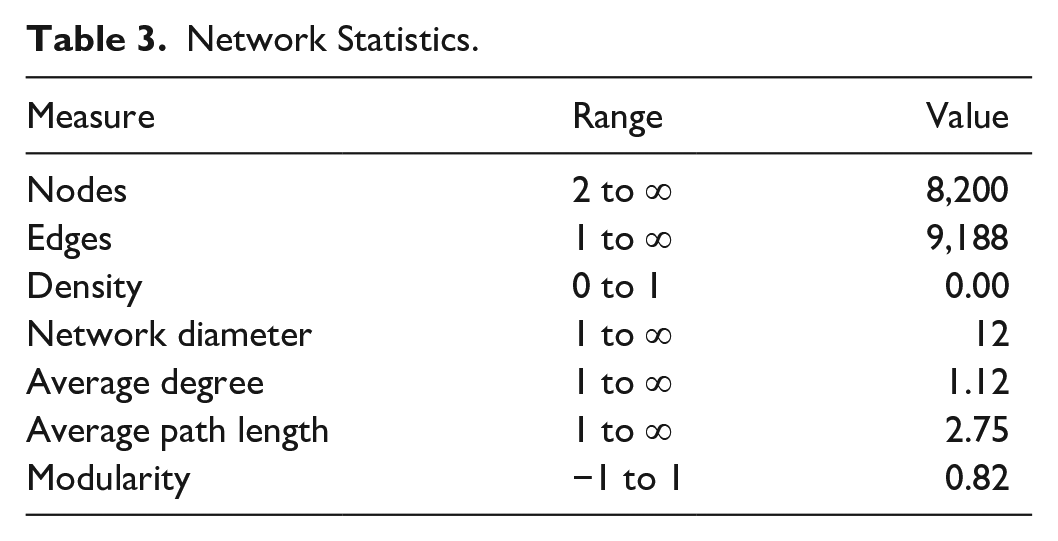
For SNA, we extracted each user’s direct interactions (retweets, replies, mentions) with others and visualized the network (Graph 1). Mentions in retweets and self-loops, that is, accounts not engaging with anyone, are not displayed. The network features 8,200 nodes representing accounts and 9,188 directed edges comprising 8,535 (92.89%) retweets, 378 (4.11%) mentions, and 275 (2.99%) replies. We assigned the following node attributes to determine how different types of media are positioned within the network: (a) legacy media, (b) legacy media actors, (c) far-right media, and (d) far-right media actors (Table 1). We characterize far-right media as “imitated counterpublicity in which critical race rhetoric is coopted to mobilize white supremacist sentiment and organize white tribal politics” (Tischauser & Musgrave, 2020, p. 284). Following this definition, we use far-right media as an umbrella term for content creators (including bloggers and YouTubers) who strategically perform their opposition to perceived mainstream discourses and legacy media in particular and use White-nationalist rhetoric. Media categories (a and c) refer to accounts of different media organizations (press, TV, radio, and online) as well as their sections and news programs. Actor categories (b and d) refer to individual journalistic actors such as editors, journalists, or reporters, especially those aligned with either legacy media or far-right media reporting live from the event. In the category of legacy media, we also included regional and local editions for Chemnitz and the State of Saxony.

Network visualization of retweet, reply, and mention interactions around #Chemnitz.
Representation of Different Media Accounts in the Network.

First, we found that the authorship of tweets is dispersed quite evenly and we could not find any actors with significantly high out-degree centrality, which is common for Twitter networks (Romero & Kleinberg, 2010). As the sample also largely consists of retweets, we focus on in-degree centrality to determine which actors gain most attention (RQ 1.1) and how different media accounts are positioned in the network (RQs 1.2 and 1.3). The account that is referenced the most in the network (in-degree = 140) belongs to the police of the State of Saxony (@PolizeiSachsen), which is not surprising, as the events included several police investigations. Textual analysis further showed that users would often direct their questions at the police and retweet this account, as it corrected disinformation circulating on Twitter. Moreover, Twitter users accused the police of delayed and subdued reactions to far-right violence, which also drove the interactions with their account.
Regarding the role of media, we found that of the 10 accounts with the highest in-degree centrality, 5 belong to legacy media and legacy media actors including several individual reporters, German public broadcast’s satire late-night program heute-show, and main news program Tagesschau (Table 2). Eigenvector centrality paints a similar picture: 6 out of 10 accounts with the highest eigenvector score belong to legacy media actors (Table 2). Individual journalists either acting as local reporters or specialized in the coverage of the extreme right thus attracted significant attention with their live reporting from Chemnitz, posting updates, videos, and images of the riots on Twitter. They often interacted with each other, usually retweeting each other’s posts or reposting pictures taken by others to complement and substantiate their own reporting. But they were also a major reference source for many others: As Graph 2 shows, these reporters constitute the core of one of the larger sub-networks. 2 As for legacy media, we find that while most of their accounts also appear in Sub-Network 1, others are rather dispersed on the peripheries of both sub-networks. For instance, conservative-leaning legacy media such as Focus Online or Frankfurter Allgemeine Zeitung as well as the local newspaper Freie Presse are positioned on the peripheries of Sub-Network 2, which is dominated by different far-right actors. Moreover, some legacy media accounts such as the tabloid newspaper Bild, the liberal newspaper Süddeutsche Zeitung, and few regional and local media appear between the two sub-networks as “bridges” (Smith et al., 2014, p. 7), meaning that users from both sides frequently refer to them. Such referencing, however, include critical engagements, as we will explore through qualitative analysis.
Top 10 Actors With the Highest Centrality Measures.


Sub-Network 1.
The accounts of far-right media and media actors were rarely referenced compared to legacy media. Among far-right media actors, we found that the YouTuber Brittany Sellner (@BrittPettibone) and the editor of far-right blog Philosophia Perennis David Berger (@DrDavidBerger) share the highest number of ingoing ties (in-degree = 36). Among far-right media, the account of the weekly newspaper Junge Freiheit is the most referenced in the network (in-degree = 37). Far-right media and media actors only appear in Sub-Network 2, but even here, other actors inhabit more influential positions, such as the far-right party Alternative für Deutschland (AfD) and its representatives (e.g., Alice Weidel) (Graph 3). Interestingly, central positions in this sub-network were also taken by alias accounts, that is, accounts with unidentifiable Twitter handles often referred to as spam accounts, trolls, or bots (Keller & Klinger, 2019). Some of these accounts (e.g., @OnlineMagazin or @Hartes_Geld) gained so much attention within the discourse of #Chemnitz that they are featured among the 10 highest ranking actors in the whole network (Table 2). Textual analysis revealed that these accounts consistently attacked legacy media’s coverage of the Chemnitz events. The technical affordances of the platform thus seem to exacerbate the highly affective offense against legacy media.

Sub-Network 2.
After applying centrality measures, we analyzed data for modularity to detect communities in the network and reveal its overall structure (RQ 1.4) using the Louvain algorithm in Gephi (Blondel et al., 2008). Modularity measures to what extent a network is divided into modules (communities) and how closed or open these communities are. The network of #Chemnitz shows a high modularity score of 0.82 (Table 3), which points to strong connections within the communities and loose connections between them. Moreover, the network is divided into 807 modules varying in size accounting for “disrupted public spheres” on social media platforms (Bennett & Pfetsch, 2018). However, these communities are aggregated into two larger sub-networks rendering a polarized network (Graph 1), which is common for political topics such as migration, as people are often divided on such issues (Smith et al., 2014, p. 13). Polarized groups do not (directly) engage in arguments with each other but rather talk past one another while referring to opposing sources. In the case of #Chemnitz, the far-right sub-network (Graph 3) clearly depends on alias accounts as their main source of information, while Sub-Network 1 (Graph 2) tends to follow the news coverage of legacy media journalists reporting on the ground. This poses challenges to journalism as a significant part of the network gets their information from actors who make claims to authority previously reserved for journalism. In networked publics, journalistic actors thus struggle to claim legitimacy beyond certain communities. Through a close reading of those tweets directly addressing or referencing legacy media and legacy media actors, we want to understand the affective dynamics of these challenges.
Network Statistics.
Contesting Journalism Through Networked Outrage
Employing the “reading for affect” approach, we now discuss how emotions are articulated in interactions with legacy media (RQ 2) and how publics invoke affect and emotions to contest journalism’s institutional boundaries (RQ 3). To answer these questions, we draw on our qualitative analysis of 1,181 tweets referencing legacy media and media actors. The results are presented along the method’s three dimensions of analysis to make clear the discursive strategies that permeate challenges to journalism in the context of affective publics. Applied to our research questions, these dimensions are: (a) how emotions are attributed to or directed at legacy media and journalists and how these emotions are (de-)legitimized; (b) how legacy media or the nation is construed as a collective body with ascribed affective qualities; and (c) what linguistic style renders the affective texture and intensity of the tweets in their multi-modal form, for example, the use of metaphors, hyperboles, irony, or sarcasm.
Overall, although news coverage around Chemnitz was criticized by various activists for different reasons, we found that far-right actors on Twitter specifically questioned and attacked journalism’s institutional authority. Moreover, we identified a variety of (a) emotions and affects directed at legacy media, ranging from anger and hate to disgust as well as shock (e.g., by referring to the news coverage of the murder as “outrageous,” “distasteful,” “despicable,” “disgusting,” or “unbelievable”). Our analysis revealed, however, that the often-combined expressions of these emotions mobilized a networked outrage (Castells, 2015) directed at journalism, which renders the focus of our following discussion.
Regarding RQ 2, we first discuss how outrage toward journalism is articulated focusing on the legitimization of this emotion, which is mainly rooted in two claims shared among far-right actors. First, they accuse media of intentionally deflecting from what they perceive as the main problem, framed in the xenophobic terms of “migrant crime” or “asylum seeker attacks.” Within this narrative, far-right actors employ distinct linguistic styles, especially irony and extreme juxtapositions, as dominant strategies to transmit and also provoke outrage. In these contexts, media are accused of not caring about the death of Daniel H. as the victim of the attack, but only about disparaging protesters. Short snippets shared by legacy media on Twitter and screenshots of Google news headlines ripped out of context are often used as evidence. News and opinion pieces on far-right riots were also interpreted as examples of how legacy media downplayed the atrocity of the murder. For instance, a wave of outrage was triggered by a tweet by a daily newspaper, which quoted an op-ed suggesting that the far-right is using this case as an “occasion” to mobilize hateful riots (Rietzschel & Nimz, 2018). In replies and retweets, many users highlighted the use of the term “occasion” and expressed outrage by ironically juxtaposing the quote with their own appraisals: “For some it is a brutal death of a young father. For others, merely an ‘occasion’. . . #Chemnitz.” 3
The struggle over the legitimacy of what becomes part of the news coverage around Chemnitz and the emotional interpretations aligned with it became especially visible as journalists started reporting (and tweeting) about the physical and verbal threats they encountered while covering the demonstrations. The following tweet was widely retweeted among the far-right, marking journalists’ emotions and physical experiences as illegitimate or irrelevant against the backdrop of the initial event: An allegedly hindered team of journalists becomes a national affair. Two men being stabbed in #Chemnitz, one of them fatally, because they wanted to help an assaulted woman, does not interest anyone. German affairs 2018. (#Saxony, 26 August 2018, 10:31)
4
Our analysis thus highlights how Depending on whose feelings are at stake in a certain situation, ascribing emotions can . . . have different effects ranging from the construction of a deeply felt solidarity up to the ultimate exclusion of certain entities on the grounds of their feelings (which are deemed inappropriate). (Berg et al., 2019, p. 52)
This also becomes clear when, compared with the “aloofness” attributed to legacy media, far-right users’ tweets heighten the contrast with their own affective state. In some cases, this happens through the performance of grief, which further intensifies the outrage toward legacy media: RT @OnlineMagazin  #Germany: The end of the funeral march for the killed 35-year-old Daniel who was slaughtered by two illegal #Merkel-refugees in #Chemnitz. The German press and media will again claim that only about 200–300 citizens and patriots have participated. (https://t.co/YLgEBGUr0q, 26 August 2018, 19:53)
These tweets also afford a sense of belonging for all those who are presumably antagonized by legacy media, described here as “patriots.” This relates to the second claim of the far-right, namely that legacy media do not take the “rightful anger and frustrations” of the protesters into consideration and instead dub them Nazis. To counter these claims, fear, insecurity, and frustrations are performed and attributed to “German people,” (b) constructing the nation as a collective body with ascribed affective qualities. Another response to a tweet by legacy media exemplifies this: Unbelievable—a person was brutally stabbed, two others were injured, do you not understand the fear of the people? Germany is becoming a #knifestabbersland—you cannot sweep this under the carpet. (28 August 2018, 03:26)
Referred to as “knife-stabbers’ land,” Germany is imagined as a threatening place causing “fear of the people.” In these tweets, migrants and refugees are construed as illegal, dehumanized subjects to be feared. Knife emojis and racist neologisms such as “Messerkultur” (“knife-culture”) often convey these feelings without explicitly naming them—a common far-right strategy also referred to as a dog whistle and usually deployed to bypass platform regulations banning hate speech (Bhat & Klein, 2020). Some far-right actors also claim that the protesters do not have a problem with migrants but rather with legacy media as argued by this far-right blog: @jouwatch The outrage of the citizens of #Chemnitz is directed at the #lyingpress not the #migrants. The brave men, who wanted to help a woman, also have Russian and Cuban roots. Two of them are already dead, one of them died through 25(!) knife wounds. (27 August 2018, 08:50)
As a result, tweets attacking journalistic authority often express their outrage not only through content but also through their linguistic style by, for example, using high-alert emojis or capital letters, constituting a particular (c) linguistic style that renders the affective texture and intensity of the tweets in their multimodal form. Moreover, some of the tweets are also explicit about the intensity of their emotions. For instance, referring to news headlines about the riots, one far-right alias account writes, “These are the headlines when migrants kill. That’s more despicable than the offence itself.” In addition, we argue that different ways of expressing outrage and its varying intensities produce different discursive effects. While some Twitter users emphasized their fears and frustrations in a resigned manner, many far-right actors capitalized on outrage to issue warnings and intimidate media practitioners: RT @deutsch365  #Chemnitz ...... We declare war against #hatemedia, TOGETHER!!! ‼‼‼Please SHARE ‼‼‼ #Chemnitz #demo #citizendialogue #systemmedia #newscoverage #gez #press #media https://t.co/7p8EHHkuYW (28 August 2018, 11:04)
As mentioned above, irony and sarcasm are frequently used as powerful linguistic strategies to emphasize the presumed discrepancies between the news coverage and the felt truth. Nikunen (2018) observed that irony is commonly used within anti-migration discourses because it allows social exclusion and normalizes hate through detachment from what it conveys. Irony is often applied by using specific mocking vocabulary for specific social groups that is well-known within these communities but might be understood differently by the general public. For instance, in addition to the outrage present in many tweets, ironic or sarcastic tweets in our material often referred to Germany as “Buntland” (“colorful country”) to ridicule legacy media’s presumed positive coverage of migration issues.
As illustrated in the examples discussed in this section, through strategic and performative mobilization of outrage, far-right actors construct legacy media as a collective body with specific affective qualities. With regard to RQ 3, we argue that it is precisely through this outrage-based collectivization that journalism’s institutional boundaries are challenged. The collectivization often occurs by using pejorative labels such as “lying press” that echo Nazi-rhetoric or were reclaimed by more recent far-right movements such as PEGIDA (Patriotic Europeans Against the Islamisation of the Occident) or the Identitarian Movement (see Graph 4 for visualization). Not only spam accounts but also far-right media such as Junge Freiheit, as well as the far-right party AfD and its members, perpetuate the discreditation of legacy media by circulating these labels, especially “Staatsfunk” (“state media”) and “Lügenpresse” (“lying press”) (see also Krämer, 2018). Furthermore, far-right accounts also use a variety of neologisms such as “Merkelpresse” (“Merkel-press”), “Haltungsmedien” (“opinion press”), or “Tendenzjournalismus” (“tendency journalism”) when referring to legacy media as a collective body. These labels convey conspiracies about partisanship, leftist bias, and the state’s control over media. As such, they elicit anxieties about journalism and cultivate distrust.
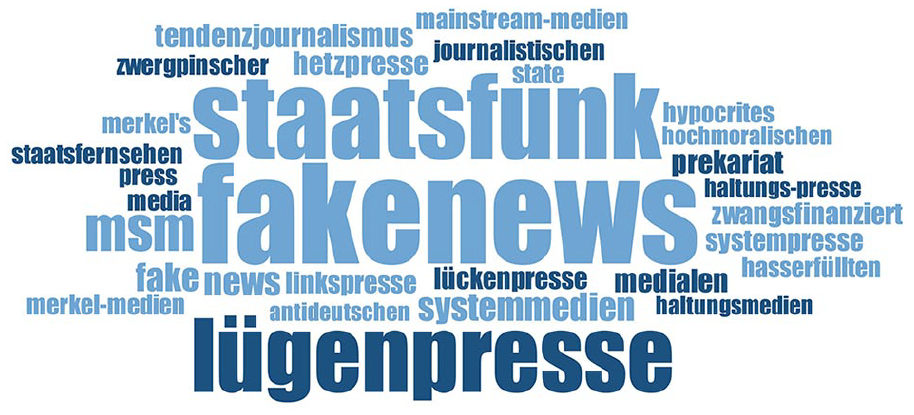
Wordcloud visualization of collectivizing pejorative labels used for legacy media.
Importantly, we do not conceptualize outrage as a single emotion autonomously responsible for contesting journalism’s boundaries. As we displayed, it is the interplay of a myriad of emotions ranging from anger and hate to contempt and disdain for journalism as an institution, along with linguistic styles that convey the intensity with which these emotions are performed, that are channeled into a networked outrage.
Discussion
Our analysis illustrates how networked affective publics emerge around the issues they care about and the challenges this development poses to journalism. Specifically, we outlined how outrage is channeled, performed, and perpetually intensified through different modes of “affective media practices” (Lünenborg, 2020, p. 38) by the far-right on Twitter. It is mainly through capitalizing on this outrage that legacy media’s news coverage and the authority of journalism as an institution are contested. Journalism as an institution thus becomes part of an “affective arrangement” (Slaby, 2019), that leaves the established terrain of objectivity and detachment.
Network analysis provides useful tools to visualize these tensions and reveal how affect relates to social ties and actors’ belonging to certain communities. In the discourse around #Chemnitz, we identified a far-right sub-network which is mainly driven by alias accounts spreading disinformation and attacking journalistic news coverage. At the same time, we found another sub-network that significantly relies on individual legacy media journalists posting live updates from Chemnitz. The network polarization is thus also manifested through opposing appraisals of journalistic authority.
In addition, we showed how “reading for affect” as a specific method of close reading enables us to consider the dimensions of affect that play out when users interact with legacy media on Twitter. The analysis of (a) emotion words showed how journalism as an institution is intensely attacked, predominantly by far-right actors who ascribe either an uninvested or a purposefully deceitful affective position to the former, in contrast to their own performed affective states of grief and fear, but also patriotism. Rooted in critical discourse analysis, “reading for affect” reveals how emotion words work and what they do to the bodies they touch. In this vein, we displayed how, by using pejorative terms and hashtags, legacy media is constructed as (b) a collective body conspiring with the state against far-right protesters generalized as “the people” or “the patriots.” Conversely, migrants and refugees are collectivized as a violent and “illegal” group. This collectivization occurs by using what Ahmed (2004) refers to as “sticky signs” (p. 130) that are imbued with and provoke certain emotions. In this case, fear circulates through knife emojis and words such as “eingeschleppte Messerkultur” (“dragged-in knife-culture”) or “Messerstecher” (“knife-stabbers”) establishing a community of “German people” endangered by “others.” In these examples, far-right actors channel different emotions and also strategically use ideologically framed rhetoric. These findings emphasize the need to refuse the separation of affect from discourse and, as Wetherell (2012) urges, to consider affect as a constitutive element of discourse. Finally, the analysis of (c) discursive materiality revealed how affect is visible in both content and intensities transmitted through these tweets. In the far-right tweets, intensities were often made visible using a myriad of linguistic devices from irony and sarcasm to more formal characteristics such as capital letters, exclamation points, certain emojis, or misspellings.
Our findings contribute to the vast scholarship on the far-right’s relationship to journalism by revealing how some of its known mobilization strategies such as questioning journalistic practices (Krämer, 2018) or delegitimizing journalism through anti-elitist discourse (Mudde, 2019; Quiring et al., 2021, p. 3500) are permeated by affect and emotions, analyzing how these are generated on a discursive level. We also provide a closer look into how these affect and emotions circulate on networked publics, posing dire attacks to journalism and its emotional interpretations of events.
It is important to stress that our study has several limitations. Due to restricted access to historic tweets at the time of the analysis, we were only able to analyze a limited sample. Moreover, as some accounts were removed, some content (e.g., links or attached audiovisual content) and background information for actor categories could not be reconstructed, a typical problem in unstable and dynamic media environments. As mentioned earlier, hashtag-samples only provide a limited part of larger discourses. Despite the advantages that hashtags provide by organizing otherwise dispersed discourses and making them accessible for research, we should thus keep in mind that this research only provides insights into a fragment of a temporally and spatially situated discourse.
Nevertheless, our analysis of the affective dynamics surrounding the public of #Chemnitz highlights current struggles over legitimate speaker positions in society. Journalism as an institution—historically consisting of media organizations and individual journalists whose position has been enabled and secured by both media law and informally established practices—currently faces antagonists who strategically violate precisely this institutional character. This article shows how this violation is produced and reinforced by the strategically orchestrated mobilization of affect that fundamentally challenges journalism’s ability to establish society’s “feeling rules” (Hochschild, 1979). As part of discursive institutionalism, journalism must rethink its own role in current hybrid media systems in relation to these new antagonists. The “boundary work” (Carlson & Lewis, 2015) necessary to do so must not only reflect on its commitment to rationality—to provide society with knowledge and arguments—but must sufficiently take into account the affective dimension of its capacity, that is, the organization of belonging and exclusion.
Footnotes
Declaration of Conflicting Interests
The author(s) declared no potential conflicts of interest with respect to the research, authorship, and/or publication of this article.
Funding
The author(s) disclosed receipt of the following financial support for the research, authorship, and/or publication of this article: This work was supported by German Research Foundation (DFG) as part of CRC1171 Affective Societies.
