




Abstract
A key question regarding the ongoing process of digitalization is whether it enables societies to overcome patterns of inequality or whether these patterns are fostered in the digital sphere. The article addresses this question for the case of online volunteering by examining the profiles of online and offline volunteers in terms of sociodemographics, resources, networks, and psychological engagement. We apply quantitative methods using a unique data set that provides comprehensive information on online volunteering. Our results suggest that two mechanisms are at work simultaneously: mobilization and reinforcement. The profile of “pure” online volunteers differs from the profile of “pure” offline volunteers (mobilization). Meanwhile, the hybrid type combining online and offline volunteering attracts individuals resembling offline (reinforcement) and online volunteers (mobilization). Thus, online volunteering seems to be both: a remedy for existing inequalities in volunteering and a way to reinforce existing patterns of social participation in increasingly digitized societies.
Introduction
Ever since the Internet became available to a broad public, it has rapidly changed our daily lives. It has changed the way we communicate, work, search information, and engage in many other everyday activities (Haythornthwaite and Wellman, 2002; Rainie and Wellman, 2012). Hardly surprising, the Internet also opened up new pathways for unpaid benevolent activities and engagement such as volunteering. Online volunteering is a side effect of the currently unfolding overarching process of digitalization. However, empirical evidence on online volunteering and its individual-level determinants is scarce. For traditional offline volunteering, levels of engagement, for example, in terms of associational volunteering, are decreasing, especially among young people (Freitag et al., 2016; Putnam, 2000). Given the well-documented beneficial impact of offline volunteering on individuals and societies—ranging from improved individual well-being, to occupational achievements, up to decreased neighborhood crime rates, and so on (Putnam, 2000; Wilson, 2000)—unequal civic participation constitutes an increasing societal concern. In this respect, a key question is whether new forms of engagement such as online volunteering can overcome these patterns of inequality or whether they are exacerbated in the digital sphere. 1
Such inequalities represent a threat to social cohesion, and the associated lack of social capital harms the excluded strata of society. Thus, it is important to examine whether online volunteering helps to overcome or foster these inequalities. Theoretically, we follow the arguments made by Vissers and Stolle (2014) on online political participation. On one hand, the Internet might be yet another tool for volunteering that attracts the same people as offline volunteering (see also Robles et al., 2013). Thus, it might reinforce existing patterns of stratification regarding the resources, motivations, and networks of volunteers. On the other hand, differences in the nature of online and offline volunteering might also mobilize different kinds of people. If that is the case, online volunteering has the potential to democratize volunteering by attracting individuals who do not carry out offline social work. This would be a sign of hope for those who fear that digitalization will foster existing structures of inequality in society.
Existing research often focuses on specific activities on the Internet that fall in the category of online volunteering, such as contributing to a Wikipedia entry (Amichai-Hamburger et al., 2008; Loveland and Reagle, 2013) or the free provision of resources, for instance via Couchsurfing (Rosen et al., 2011). The aim of this article is, however, to comprehensively examine online volunteering from a theoretical and empirical perspective using data from a representative population survey. We approach the topic in an exploratory manner and build on different strands of literature. To develop theoretical expectations, we draw on the research scrutinizing the correlates of volunteering (see Wilson, 2000, 2012, for an overview), in particular the Civic Voluntarism Model (CVM) proposed by Verba et al. (1995). Furthermore, we refer to conceptual research on online volunteering (e.g. Amichai-Hamburger, 2008) as well as studies focusing on online political participation (Oser et al., 2013; Vissers and Stolle, 2014). We use the Swiss Volunteering Survey 2014 to test our arguments empirically, since this is the first representative population survey that includes a measure of online volunteering. In international comparison, Switzerland ranks regularly among the leading countries, exhibiting the highest associational volunteering rate besides Germany and the Netherlands in Europe (Freitag et al., 2016). At the same time, offline voluntary engagement is declining in Switzerland (Freitag et al., 2016), which makes it a paradigmatic case to study online as compared to offline volunteering.
Multinomial Heckman selection models reveal that both mechanisms seem to be at work, reinforcement and mobilization. While the CVM is able to explain offline-only volunteering, online-only volunteering is driven by different determinants. The explanations converge in the hybrid type that combines offline and online volunteering. Additional analyses show that the CVM is especially unable to explain volunteering of younger generations for whom online volunteering seems to be particularly attractive.
Who volunteers?
Volunteering is generally defined as “any activity in which time is given freely to benefit another person, group, or organization” (Wilson, 2000: 215). Although this is rarely made explicit, most people still associate volunteering primarily with real-life or “offline” activities. Existing research distinguishes mainly two manifestations of this kind of offline volunteering: formal volunteering occurring within an organization or association, and informal volunteering outside of organizations such as neighborhood help (Carson, 1999; Stadelmann-Steffen et al., 2010; Wilson and Musick, 1997). What distinguishes these activities from wage work is the fact that volunteers receive no (or only symbolic) remuneration for their productive voluntary engagement, although recipients of these acts clearly benefit from this kind of volunteering (Bühlmann and Schmid, 1999).
To explain volunteering in terms of individual-level determinants, different models are discussed in the literature focusing on factors such as subjective dispositions, human resources, the life course, and social contexts (for an overview, see Wilson, 2012). We make use of an approach that integrates different aspects into one comprehensive model: the CVM. Following this model proposed by Verba et al. (1995), the correlates of political and social participation can be distinguished along three lines: resources, recruitment, and engagement. To start with, volunteering is linked to human resources and individual sociodemographic factors that relate to time, money, and skills (Verba et al. 1995: 271). Undisputedly, education represents one of the most powerful and consistent predictors of virtually all forms of volunteering (Gesthuizen et al., 2008; Janoski et al., 1998; Putnam, 2000: 118, Wilson, 2012). Highly educated individuals have certain capabilities and knowledge, and a broader sensitization for societal challenges (Gesthuizen and Scheepers, 2012). Furthermore, highly educated individuals have generally higher status jobs and are therefore more likely to be asked to volunteer than lowly educated individuals (Janoski et al., 1998; Wilson, 2012). A related factor to time resources is age. The link between age and volunteering is not assumed to be perfectly linear, but in general it is expected to be positive. While the school context might be fruitful for volunteering, young adults have a low probability to do voluntary work (Wilson, 2000, 2012). In middle age, when people typically have established their professional career and founded a family, the rates of volunteering rise. Different mechanisms may account for this effect. The entrance of kids in schools might generate free time and provide opportunities for volunteering through children’s activities (Wilson, 2000). Moreover, a change in values and attitudes over the life course might also account for rising rates of volunteering. Especially, individuals in their later life might value volunteering more because they realize that they will themselves need help in the near future (Wilson, 2000). There is, however, little evidence that people start to volunteer after retirement because they gained time resources. Volunteering seems to be more like a habit that people develop over the life course (Wilson, 2012). Finally, the relationship between gender and volunteering is rather complex. While women are more likely to hold pro-social values and norms, so to say social skills that fuel volunteering, men are more likely to attain the necessary civic skills through jobs and education (Schlozman et al., 1994; Wilson, 2000). Thus, gender effects are highly dependent on the form of voluntary work as well as the stage in the life cycle (Wilson, 2000, 2012).
Apart from sociodemographics and human resources, volunteering is—to a varying extent—a collective activity facilitated by recruitment through social networks such as friendships and organizational memberships. These social networks supply information, provide support, and create obligations (Wilson and Musick, 1997). In particular, churches and religious institutions provide a contextual setting that is fruitful for the establishment of the aforementioned social networks and the promotion of social norms (Traunmüller, 2012). Religious institutions offer opportunities to obtain civic skills and gather information, turning religion into a gateway to other forms of social participation (Lam, 2006; Ruiter and De Graaf, 2006). Especially, Protestantism is found to increase the propensity to volunteer because of its participatory structures and values (Ruiter and De Graaf, 2006; Traunmüller, 2012).
Finally, psychological engagement plays a key role in volunteering. While concrete motives for one or the other voluntary work might differ, norms of generalized reciprocity as well as social trust likely serve as a general motivational basis for volunteering. Existing research reveals clear connections between pro-social norms such as different manifestations of reciprocal norms or trust and various forms of offline volunteering (Manatschal, 2015; Manatschal and Freitag, 2014; Putnam, 2000). Drawing on Putnam’s (2000: 118) notion that altruistic behaviors and attitudes “tend to go together,” generalized reciprocity expressing the idea that “doing good always pays off” and social trust should thus coincide with a higher propensity to volunteer.
Bringing online volunteering into the picture
If volunteering is highly dependent on resources, recruitment, and psychological engagement, unequal provision of these factors implies inequalities in volunteering. The crucial question is whether these inequalities are reinforced by new opportunities of online volunteering or whether online volunteering is an opportunity to overcome inequalities by mobilizing different people. Online volunteering can be defined as a “type of civic engagement where the volunteers perform their tasks using the Internet either from their home or other offsite locations” (Mukherjee, 2011: 253). Beyond this definition, no standard conceptualization of online volunteering exists in the literature. Therefore, we draw on Wilson’s (2000) definition of volunteering saying that time should be given freely to benefit others without receiving a direct reward. Accordingly, online volunteering includes a variety of activities like administering the website of a club, moderating a Facebook group, contributing to a Wikipedia entry, recording a non-commercial instructional YouTube video, or engaging in Couchsurfing. Thus, the activity does not necessarily need to be interactive and it might also include the provision of infrastructure, but the online volunteer has to invest time and others have to benefit from it. Given the pioneering character of this study, we cannot draw on a standard theoretical framework to explain online volunteering. Instead, we approach this question by comparing the nature of online and offline volunteering and derive theoretical expectations about the determinants of online volunteering therefrom.
Structural similarities between offline and online voluntary activities make a reinforcement of inequalities likely. For both kinds of activities, people need certain skills and motivations. The sort of skills and motivations might depend more on the degree of formalization than on the sphere where the activity takes place (offline or online). If a person engages in formal volunteering, organizational skills, such as coordinating with others and getting things done in time, might be necessary. For informal volunteering, skills and motivations, like caring for others, are of higher importance. Giving private mathematics tutoring to pupils in the neighborhood and explaining mathematical basics to a broader public on YouTube might necessitate fairly similar skills and motivations. Thus, the degree of formalization is expected to determine the required skills and motivations. Online and offline volunteering, however, not only require certain skills, but they also provide learning opportunities to enhance skills and self-efficacy. This aspect will be especially interesting for those who have an instrumental perspective on volunteering and see it as an investment. Again, however, learning and qualification opportunities might differ across activities (e.g. formal or informal volunteering) but less so across spheres of volunteering (online or offline). Formal volunteering for an association, for instance, especially if documented with a certificate, may be a more important job qualification than informal engagement, regardless of whether this formal engagement occurred online or offline. Given these similarities of online and offline volunteering in terms of requirements and benefits, we may expect that both spheres of volunteering attract the same kind of people. Their engagement is supposed to be enabled by the same type of resources, networks, and psychological motivations. In other words, higher education, a higher overall socioeconomic status, social trust, religious norms and norms of reciprocity, social networks, as well as higher age and potentially also being male would increase the likelihood of becoming a volunteer in both spheres.
Taking a contrasting perspective, differences in the characteristics of online and offline volunteering support the argument that online volunteering has the potential to mobilize different kinds of people. For instance, offline volunteering is in general less flexible than online volunteering. It usually takes place at a fixed point in time and is restricted to local activities as well as to a limited variety of topics (Amichai-Hamburger, 2008: 554, Cravens, 2000). These constraints can be easily overcome in online volunteering. On the Internet, people can volunteer for whatever cause and whenever they want. What is more, potential benefits of online volunteering can virtually extend all over the globe. The flexibility of online volunteering may especially attract young people who are still in education or at the start of their professional career. In this phase of life, which is often characterized by mobility and rapid changes, flexibility in time and place becomes a key factor for assuming a voluntary activity. Moreover, online volunteering may attract young people particularly due to the variety of topics one can volunteer for on the Internet. Finally, as “digital natives” (Hargittai, 2010), young people representing the “generation Y” (born after 1980) and following generations are just more used to the Internet. Especially, the use of social media and networks is more common among young people and has the potential to strengthen their civic and political engagement (Skoric et al., 2016; Xenos et al., 2014). Thus, we expect that the higher affiliation of young people to the Internet should also facilitate their access to online volunteering. Whether accessibility is still higher among men than women and should therefore make men more likely to volunteer online is debated in the literature. Recent findings still report a gender gap in self-reported Internet skills, while actual knowledge and performance do not differ between men and women (Van Deursen and Van Dijk, 2010, 2015). We argue that self-perceived skills will, however, be more crucial for the accessibility of online volunteering. Individuals with low self-perceived skills will not feel well-equipped for volunteering online. Thus, the accessibility of online volunteering should be higher for men. Beyond flexibility and accessibility, online volunteering implies, in most cases, a higher degree of anonymity (Amichai-Hamburger, 2008). At least for some online volunteering activities, neither face-to-face contact with fellow volunteers nor direct contact with the addressees is necessary (Rafaeli et al., 2009). Thus, the level of obligation and commitment should be lower. This may imply a lower relevance of networks and psychological engagement.
In conclusion, these theoretical considerations result in two contrasting expectations, as illustrated in Table 1. Given the structural similarities of online and offline volunteering, one can expect the same resources, networks, and motivations to be decisive (reinforcement). If this is the case, the overlap of online and offline volunteering should be considerably large, implying that a high share of respondents should fall into the hybrid category combining online and offline volunteering. Meanwhile, important differences between the two spheres of volunteering fuel the expectation that online volunteering will attract different people than offline volunteering (mobilization). Accordingly, the overlap between the two forms of volunteering expressed by the hybrid category should be relatively small. The two arguments oppose each other, but it is also highly plausible that they are simultaneously at work. The similarities of offline and online volunteering likely reinforce existing patterns of stratification, while the differences may help to overcome them.
Theoretical expectations.
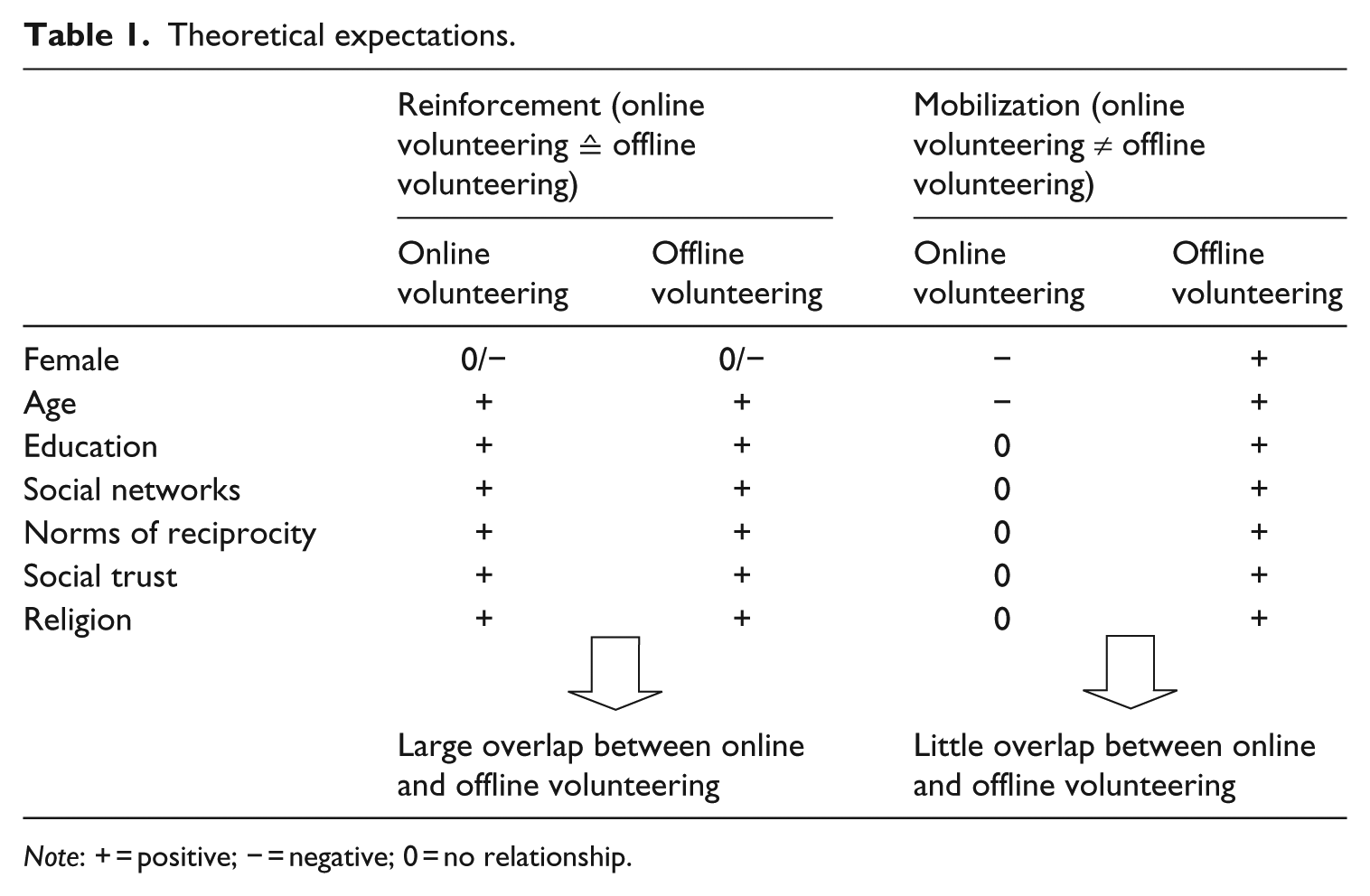
Note: + = positive; − = negative; 0 = no relationship.
Data and research design
To test the theoretical expectations outlined above, our empirical analysis bases on the latest wave of the Swiss Volunteering Survey conducted in 2014. Random sampling for this survey was conducted by the Swiss Federal Statistical Office based on Swiss register data and applying a three-stage stratification: Inhabitants of small cantons (strata 1), young adults (strata 2), as well as immigrants (strata 3) have been oversampled. A mixed-mode survey method was applied, where respondents could decide whether to answer the questionnaire online (Computer-Assisted Web Interview [CAWI]) or by phone (Computer-Assisted Telephone Interview [CATI]). 2 As a result of these measures, important sociodemographic and socioeconomic conditions of the Swiss population are well represented in the survey (Reimann, 2015).
Our outcome of main interest is a nominal variable, which captures different types of volunteering as well as non-volunteering. The variable comprises four categories: offline-only volunteers, online-only volunteers, volunteers who combine their offline engagement with online volunteering, and non-volunteers. Using a nominal variable instead of dichotomous variables for the four categories enables us to neatly capture each engagement profile and disentangle the dynamics between the different engagement types. The category offline-only volunteers denotes individuals who engage in informal and/or formal volunteering offline, and who do not volunteer online, using the following two survey items: We would now like to ask you about all the voluntary or honorary work you performed for any associations, organizations, or public institutions over the past four weeks.
3
Have you carried out one or more activities of this type? (Offline volunteering, formal) Did you perform another type of unpaid work beyond volunteering in associations or organizations, such as transport aid, babysitting (children other than your own), neighborly-aid, or supporting any kind of projects or events, etc. in the last four weeks? (The work has to be for the benefit of people outside one’s own household) (Offline volunteering, informal)
Conversely, the category online-only volunteers includes persons who volunteer exclusively online, but not outside the Internet. Since online volunteering is a rather new phenomenon, and to the best of our knowledge no established concept and measure available yet, we developed a measure of online volunteering drawing on Wilson’s (2000: 215) notion of volunteering. The following exploratory question on online volunteering uses several specific examples for unpaid beneficial, that is, voluntary, activities: Apart from the already discussed forms of volunteering, the Internet provides manifold options to volunteer online, meaning for unpaid work or engagement. I mention now several examples of online volunteering. Please let me know for each example, whether you have already volunteered online in this manner: – Host the website of an association or organization – Contribute to an entry on Wikipedia or open street map – Write an informative entry on a forum or blog, or a newsletter which is published online – Found and/or moderate a Facebook group – Publish how-to manuals/videos on Youtube or similar online platforms – Collaborate in open source projects (e.g. Linux, open office, etc.) – Offer online consultancy or expertise – Offer infrastructure online (e.g. Couchsurfing) – Other (Online volunteering)
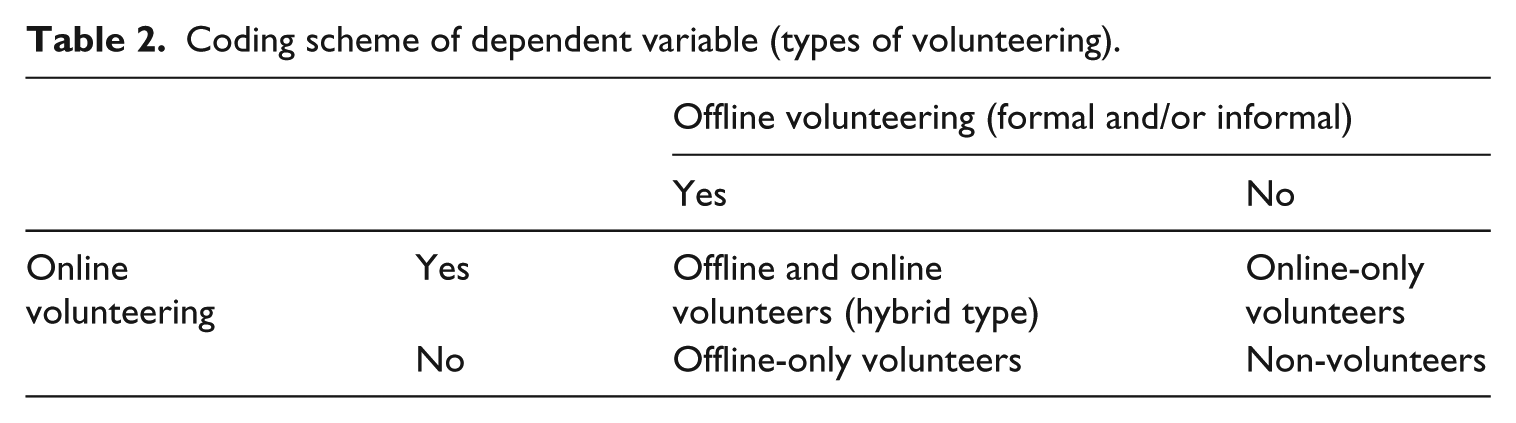
Individuals indicating at least one of the activities mentioned above are considered online volunteers. The comprehensive category offline and online volunteers captures all individuals who engage in at least one form of offline volunteering (i.e. formal, informal, or both) and who also volunteer online. Non-volunteers, finally, who do neither volunteer offline nor online, constitutes the baseline category of our empirical analysis. Table 2 illustrates the coding scheme.
Coding scheme of dependent variable (types of volunteering).
As Figure 1 shows, the largest share of all respondents are offline volunteers, suggesting that conventional real-life volunteering still represents the most widespread type of engagement overall (40.3%). The fact that comprehensive, meaning online and offline volunteers (17.9%), and not solely online volunteers (9.3%), represent the second largest engagement group, may be a first sign that the two types of engagement are not, or at least not entirely, mutually exclusive and may share certain commonalities. One-third of all respondents do not volunteer at all (32.5%).
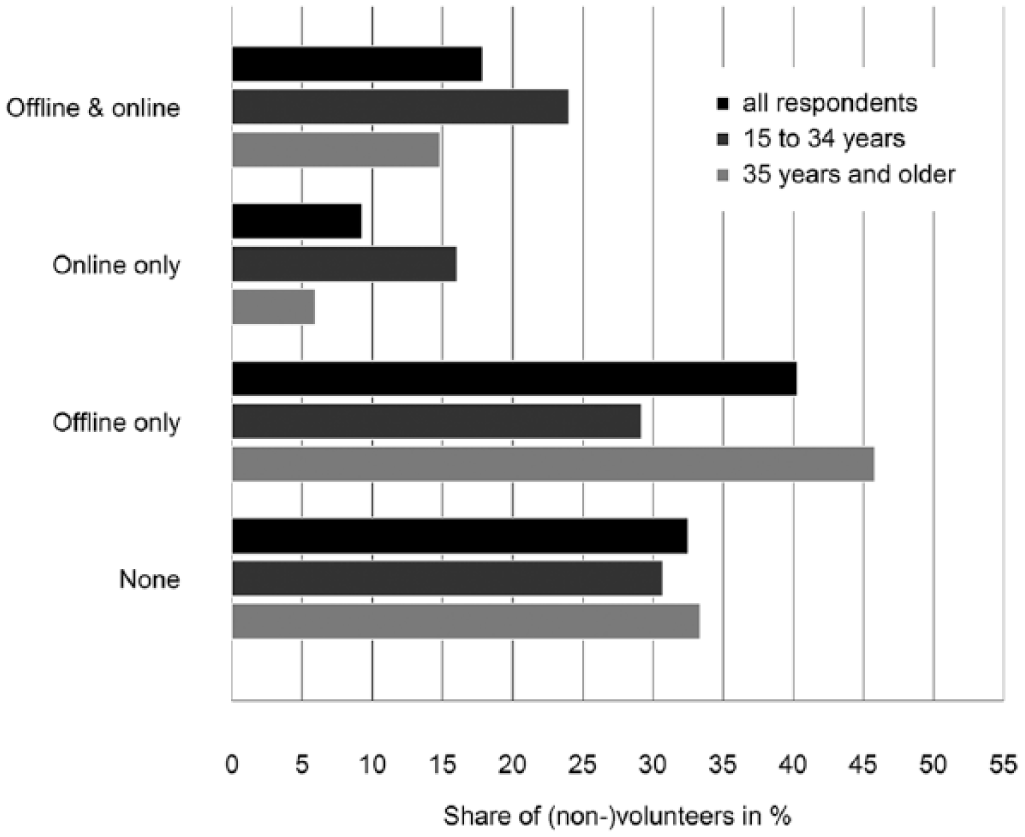
Distribution of (non-)volunteers across engagement types and age groups.
A look at the respective shares for different age groups (15–34 years, 35 years and older) further reveals important generational differences. While the share of offline volunteers exceeds the share of offline and online volunteers among older respondents by three times, the difference almost disappears among younger respondents between 15 and 34 years, who are often referred to as “generation Y,” the first generation growing up with the Internet (Hargittai, 2010). The pattern highlights the increasing relevance of the Internet offering attractive volunteering opportunities for this young generation of “digital natives.” In the empirical analysis, special attention shall be given to these pronounced generational differences.
Our main explanatory variables include measures for sociodemographics, human resources, recruitment, and psychological engagement. We integrate gender and age as sociodemographic individual characteristics into the analysis. Age will also be crucial to test our generation-based expectations. Human resources are captured by education as one of the most powerful and consistent predictors of virtually all forms of volunteering. Recruitment is measured by social networks, as well as religious affiliation and practice in terms of churchgoing frequency, while psychological engagement is captured by generalized reciprocity and social trust. More detailed information on all variables, their operationalization, and descriptive statistics can be found in Table OA1 in the Online Appendix.
Methodologically, we use multinomial regression analyses in combination with Heckman selection models. Multinomial regression analysis allows us to model the nominal outcome of our dependent variable, whereas the selection model is necessary to address non-randomness in our sample. More specifically, we account for the self-selection of Internet users, who are eligible for online volunteering, whereas non-Internet users are not. To do so, we model Internet use on the first stage of our selection model, calculate the inverted selection propensity (inverse Mills Ratio) of Internet use, and control for it in the second stage of our analysis, the multinomial outcome model. 4 To fully specify our first-stage selection model, we add the following variables: A dichotomous variable indicating Internet use serves as the outcome variable on this first analytical stage. Furthermore, and in addition to the explanatory factors mentioned above, we include individual information on income and citizenship as independent variables in our first-stage selection model. Canton fixed effects will be used to account for unobserved cantonal heterogeneity. Running the models with cantonal controls for language region and degree of urbanization—two well-documented factors influencing volunteering and Internet use in Switzerland (Freitag et al., 2016; Kriesi and Baglioni, 2003; Stadelmann-Steffen et al., 2010)—instead of the cantonal fixed effects produces very similar results.
Empirical results
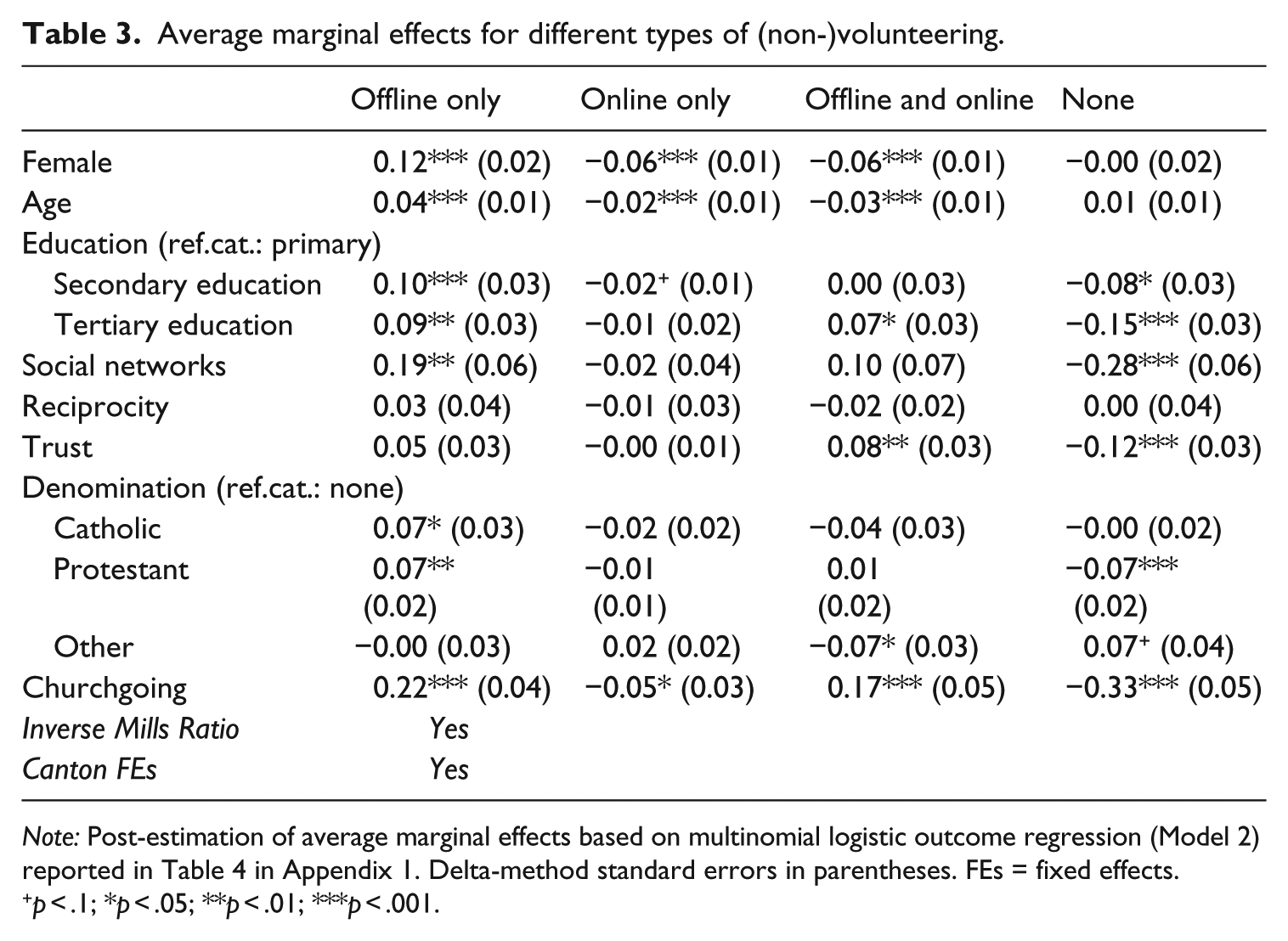
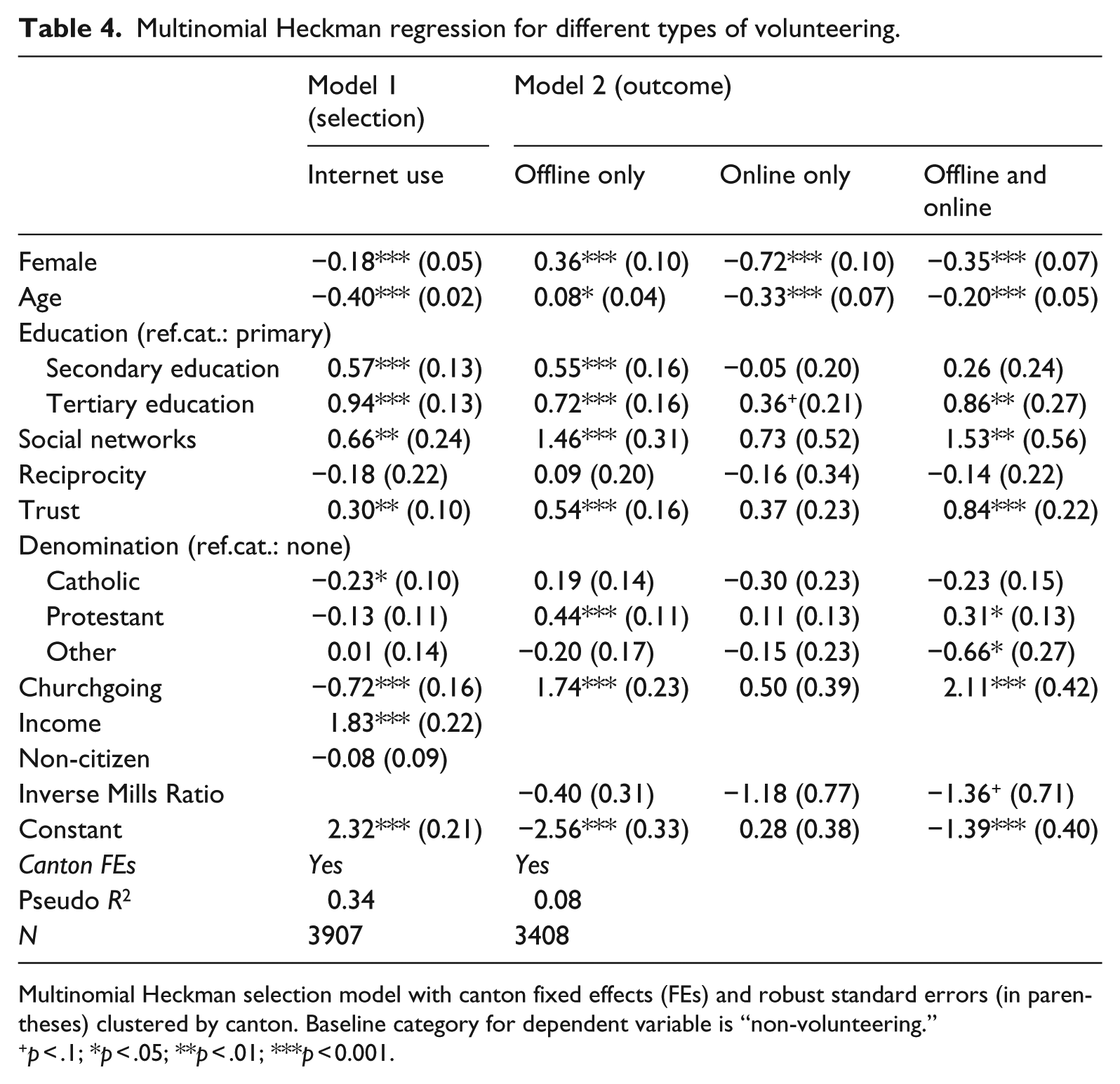
The results of our multinomial Heckman regression models for different types of volunteering are presented in Table 4 in Appendix 1. Since coefficients from multinomial logistic models can be difficult to interpret, we complement the main analyses reported in Table 4 by post-estimation procedures. We focus on the average marginal effects to discuss the results (Table 3). They facilitate a substantive interpretation of the profiles for the four engagement types, allowing for a first assessment of whether the propensity for online and hybrid (online and offline) volunteering can be read as a product of reinforcement, mobilization, or both.
Average marginal effects for different types of (non-)volunteering.
Note: Post-estimation of average marginal effects based on multinomial logistic outcome regression (Model 2) reported in Table 4 in Appendix 1. Delta-method standard errors in parentheses. FEs = fixed effects.
p < .1; *p < .05; **p < .01; ***p < .001.
A glance at the results for the pure volunteering types, offline only and online only, respectively, reveals clear differences between the resource profiles of volunteers engaging exclusively in the two arenas. In line with our theoretical expectations, sociodemographics and human capital (resources), as well as social networks and religious belonging and practice (recruitment), turn out to be distinctive factors characterizing offline volunteers.
Changing, for instance, the gender of an otherwise identical individual from male to female increases the likelihood to volunteer only offline by 12 percentage points. Meanwhile, 10 additional years of age elevate the same probability by 4 percentage points. An increase in educational attainment from primary to secondary or tertiary education raises the probability to volunteer offline only by 10 and 9 percentage points, respectively. Religious denomination and practice are further distinctive traits of offline volunteers: frequent as opposed to no churchgoing raises the likelihood of mere offline volunteering by 22 percentage points. Interestingly, pro-social values (psychological engagement) do not affect the likelihood to volunteer only offline.
For individuals who volunteer only on the Internet, in turn, these resources do not seem to matter much. In stark contrast to the pure offline category, most of the factors that are distinctive for this group are irrelevant to characterize online-only volunteers. Worth mentioning is the inverse gender pattern for online volunteering, which is in line with our theoretical expectations: switching gender from male to female in otherwise identical individuals decreases the probability to volunteer only online by 6 percentage points. Besides male gender, young age also increases the likelihood to volunteer online only, respectively (minus 2 percentage points for 10 additional years of age). The findings confirm, thus, the picture of young people as “digital natives” (we return to the question of generational differences in more detail below). Overall, the stark differences in the profiles of the two exclusive volunteering groups reported in Table 3 suggest that the decision to volunteer offline or online is driven by different factors. Yet, this is not the whole story. Based on our theoretical argument outlined above, we would expect that if the two arenas of volunteering attract very different people, there should be little overlap between the profiles of online and offline volunteers (expectation of mobilization). As Figure 1, however, showed, hybrid types combining offline and online volunteering are rather popular: 18% of all respondents (and 24% of the 15–34 years old) indicate a hybrid engagement type, whereas, for instance, only 9% of all respondents volunteer online only.
A look at the group combining online and offline volunteering in the third column in Table 3 suggests that in this hybrid form of engagement the profiles of offliners and onliners converge. Like offliners, volunteers pursuing offline and online activities are typically endowed with more resources, for instance, in terms of education: changing education from primary to tertiary increases the probability of a hybrid engagement by 7 percentage points. Recruitment via frequent churchgoing seems also to apply to this hybrid category. Unlike for the offline-only profile, social trust becomes a significant trait for the offline and online engagement type: a change from “you cannot be too careful” to “most people can be trusted” increases the propensity to engage both, offline and online, by 8 percentage points. Overall, similarities with the offline-only category in terms of resources and recruitment support the assumption that those who engage offline would also engage online (reinforcement). The findings for age and gender, in turn, corroborate our mobilization expectation, as they align with the pattern for the online-only category. Switching from male to female decreases the likelihood to engage offline and online by 6 percentage points. The same decrease amounts to minus 3 percentage points for 10 additional years of age. The last columns in Table 3 finally illustrate the lack of resources, recruitment, and psychological engagement among non-volunteers.
In the light of the pronounced generational differences revealed in Figure 1 and Table 3, we rerun the analyses for different age groups. Given their early socialization with the Internet, the following analyses focus on the difference between representatives of the generation Y, or digital natives (15–34 years old), which are compared to older respondents (35 years and more). The results of the respective multinomial Heckman selection and outcome analyses are shown in Table OA2 in the Online Appendix. Similar to the preceding analyses, the discussion of the results will focus on the average marginal effects as they facilitate a substantive interpretation of the engagement profiles. To visualize differences across generations, Figure 2 illustrates the average marginal effects graphically.
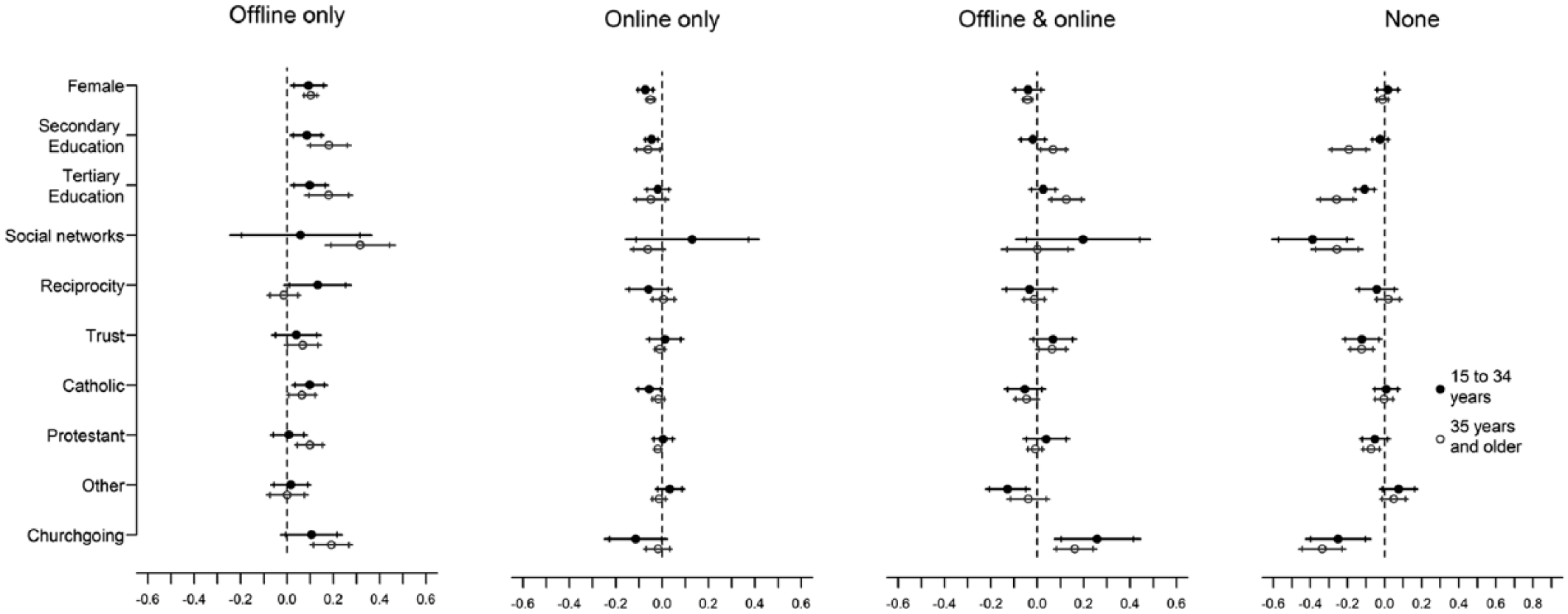
Determinants of volunteering across engagement types and age groups.
A look at the left graph in Figure 2 reveals that the resource-intense profile from the CVM characterizing offline-only volunteers applies well to older respondents (35 years and older), whereas the variables of the CVM are less systematically related to offline volunteering in the younger age group. To start with the similarities, switching from primary to tertiary education increases the probability to volunteer only offline by 10 (young) and 18 percentage points (old), respectively. The female overrepresentation does also hold for both generations. Recruitment via social networks or religion (Protestantism and churchgoing frequency) does, however, only explain offline volunteering propensity among older respondents: changing from a socially isolated respondent of 35 years or older to a socially connected individual of the same age, for instance, increases the probability to engage only offline by 32 percentage points. The same switch from socially isolated to strongly connected individuals does, however, not alter the offline-only volunteer propensity among 15- to 34-year-old respondents. Corroborating further the findings reported in Table 3, the variables of the CVM are not able to explain online-only volunteering, irrespective of the age group. The female underrepresentation in the online-only engagement type holds for both groups, the 15–34 years old as well as the 35 years and older.
Again, the CVM is most helpful to explain the hybrid (online and offline) engagement among older respondents, although denominational factors are no longer a defining trait of older volunteers in this group. Apart from the factor churchgoing frequency, which increases offline and online engagement propensity among both, young (plus 26 percentage points) and older respondents (plus 16 percentage points), the variables of the CVM do not contribute to the explanation of a hybrid engagement among young respondents. The rightmost graph in Figure 2 finally confirms that non-volunteering relates to a lack of resources, recruitment, and psychological engagement in both groups, younger and older respondents.
A possible source for concern are potential mode effects of CAWI (Internet) and CATI (telephone) interviews. To account for potential mode effects (e.g. respondent selection into a specific mode or response effects depending on survey mode) and, thus, to test the robustness of our findings, we rerun the models reported in Table 3 separately for telephone—and Internet respondents only (see Tables OA3 and OA4 in the Online Appendix). The findings are very similar to the main results reported in Table 3, and there are no signs of a systematic distortion of the findings due to survey mode.
Discussion
In this study, we set out to answer the question whether online volunteering is driven by the same determinants as offline volunteering. Our aim was to evaluate whether inequalities in social participation are reinforced in the virtual sphere or whether online volunteering can overcome them by means of mobilization. We addressed this question using a data set providing, for the first time, insights on the extent of online volunteering based on a comprehensive population survey carried out in 2014 in Switzerland. Following the established CVM by Verba et al. (1995), we argued that offline volunteering requires certain sociodemographic factors, human resources, recruitment through social networks, as well as psychological engagement. We discussed whether these factors may also stratify volunteering online (reinforcement) or whether online volunteering attracts and mobilizes different kinds of people (mobilization). Our findings support both ideas. Online volunteering seems to reinforce existing patterns of inequality in volunteering, but it has also the potential to mobilize and lure different kinds of people into social participation.
To start with, we find that the CVM explains why individuals become offline volunteers. They have more social networks, are generally more trusting, have higher education levels, and are more religious (in terms of denomination and practice). Our differentiated analyses across age groups, however, reveal that this holds only for older respondents (35 years and more). The CVM is clearly less precise to capture the profile of young offline-only volunteers between 15 and 34 years. One possible explanation relates to the fact that they might still be in the process of acquiring the resources and building up the social networks necessary for volunteering. Regarding psychological engagement, it seems that young respondents are mobilized through different values than the ones included in our model.
Conversely, the variables of the CVM are not related to pure online volunteering. We observe this pattern in a similar way among younger and older respondents. From a theoretical perspective, we have argued that differences between online and offline volunteering suggest online volunteering will attract different kinds of people. The higher degree of flexibility and anonymity on the Internet goes along with a lower degree of commitment and obligation. This makes online volunteering a low-threshold activity, for which no extensive resources, social networks, or a particularly pronounced psychological engagement is necessary. Meanwhile, technical skills and a certain affinity for digital technology are more important, which explains why young people as “digital natives” are more eager to volunteer online. Also, a gender gap is still visible in this respect, with men being more likely to volunteer online than women.
This support for the mobilization thesis among pure online volunteers is, however, only part of the story. A look at the third category of volunteers who combine offline and online volunteering reveals “hybrid” explanations. In other words, for the hybrid category of offline and online volunteering, both mechanisms appear to be at work. On one hand, there is evidence for the mechanism of reinforcement: the profile of the hybrid category is more resource-intense than the one of pure onliners and resembles the profile of pure offliners. Like in the category of pure offline volunteers, this resource pattern can, however, only be observed for respondents who are 35 years or older. On the other hand, mobilization seems to occur since men and young respondents are more likely to volunteer offline plus online. For the subset of young respondents, the gender effect is, however, not significant.
To sum up, our findings suggest that both scenarios, reinforcement and mobilization, apply for online volunteering. Reinforcement seems to occur among individuals commanding the resources, networks for recruitment, and psychological engagement of offline volunteers, who combine their activities with online volunteering (hybrid type). At the same time, mobilization seems to be at work because online volunteering seems to attract persons with other characteristics than the ones necessary for offline volunteering. Our results are in line with studies on online political participation, which show that reinforcement and mobilization take place (Vissers and Stolle, 2014) and that especially young people are mobilized through online political participation (Oser et al., 2013).
Further research is needed to complement the preliminary and exploratory findings presented here on the nature and extent of online volunteering. To better understand this new phenomenon, its relevance for voluntary engagement, and its impact on, and interaction with, conventional forms of offline volunteering, it is essential to collect additional data and to further develop the conceptualization and measurement of online volunteering, ideally also in different social contexts. While we would expect that the findings presented here are generalizable to other countries with high, but declining, offline volunteering rates, such as Germany, the Netherlands, or the United States, additional research in different countries is required to test this assumption. Future research should also tackle the question of measurement and carefully think about potential improvements. It would, for instance, be important to indicate more clearly in the formal and informal survey questions that the voluntary work takes place offline. Another limitation of this study regards causality. Using cross-sectional data, our analyses cannot prove causation. Nevertheless, our finding that pure offline and pure online volunteers have very different individual profiles strongly suggests that mobilization of formerly not engaged individuals is happening, and not mere conversion of former pure offliners into pure onliners. However, quasi-experimental or panel studies are needed to prove this causal expectation.
From a theoretical perspective, future studies should focus on the hybrid form of engagement as well as on finding better explanations to account for the volunteering of young people. Regarding the hybrid category, we had only cautious and exploratory expectations concerning determinants and size of this category. Our finding that the two theoretical explanations (reinforcement and mobilization) converge in this hybrid form of engagement shall inspire future research and contribute to theory building regarding the determinants of this comprehensive form of volunteering. Moreover, our results demonstrate the limits of the CVM in explaining volunteering, especially for youngsters. Putting a stronger emphasis on psychological underpinnings of volunteering, such as personality traits or motivational aspects, might contribute to a more encompassing understanding of volunteering online and offline. Since personality is related to Internet usage (see Amichai-Hamburger and Hayat, 2013), psychological factors might also be relevant to characterize online volunteers. Recent research on volunteering in general (Ackermann, 2018), as well as more specific work on Wikipedia contributors, demonstrates how personality can be accounted for in research on volunteering offline and/or online (Amichai-Hamburger et al., 2008; Rafaeli and Ariel, 2008). In conclusion, more research, empirical evidence, and theoretical reflection are needed to guarantee that our understanding and conception of volunteering are not outdated, but moves with the times. Our study is a first step in this direction and might be interpreted as a sign of hope for those who worry about the future of volunteering in a digital world. Offline volunteers seem to be willing to combine their engagement with online volunteering. What is more, online volunteering may even mobilize different people and thus remedy existing inequalities in volunteering. Volunteering in a digital world might become more socially equal because online volunteering is able to attract people with a profile different from offline volunteers, especially in terms of resources and networks.
Supplemental Material
OnlineAppendix_Online_volunteering_as_a_means_to_overcome_unequal_part – Supplemental material for Online volunteering as a means to overcome unequal participation? The profiles of online and offline volunteers compared
Supplemental material, OnlineAppendix_Online_volunteering_as_a_means_to_overcome_unequal_part for Online volunteering as a means to overcome unequal participation? The profiles of online and offline volunteers compared by Kathrin Ackermann and Anita Manatschal in New Media & Society
Footnotes
Appendix 1
Multinomial Heckman regression for different types of volunteering.
| Model 1 (selection) | Model 2 (outcome) | |||
|---|---|---|---|---|
| Internet use | Offline only | Online only | Offline and online | |
| Female | −0.18*** (0.05) | 0.36*** (0.10) | −0.72*** (0.10) | −0.35*** (0.07) |
| Age | −0.40*** (0.02) | 0.08* (0.04) | −0.33*** (0.07) | −0.20*** (0.05) |
| Education (ref.cat.: primary) | ||||
| Secondary education | 0.57*** (0.13) | 0.55*** (0.16) | −0.05 (0.20) | 0.26 (0.24) |
| Tertiary education | 0.94*** (0.13) | 0.72*** (0.16) | 0.36 + (0.21) | 0.86** (0.27) |
| Social networks | 0.66** (0.24) | 1.46*** (0.31) | 0.73 (0.52) | 1.53** (0.56) |
| Reciprocity | −0.18 (0.22) | 0.09 (0.20) | −0.16 (0.34) | −0.14 (0.22) |
| Trust | 0.30** (0.10) | 0.54*** (0.16) | 0.37 (0.23) | 0.84*** (0.22) |
| Denomination (ref.cat.: none) | ||||
| Catholic | −0.23* (0.10) | 0.19 (0.14) | −0.30 (0.23) | −0.23 (0.15) |
| Protestant | −0.13 (0.11) | 0.44*** (0.11) | 0.11 (0.13) | 0.31* (0.13) |
| Other | 0.01 (0.14) | −0.20 (0.17) | −0.15 (0.23) | −0.66* (0.27) |
| Churchgoing | −0.72*** (0.16) | 1.74*** (0.23) | 0.50 (0.39) | 2.11*** (0.42) |
| Income | 1.83*** (0.22) | |||
| Non-citizen | −0.08 (0.09) | |||
| Inverse Mills Ratio | −0.40 (0.31) | −1.18 (0.77) | −1.36 + (0.71) | |
| Constant | 2.32*** (0.21) | −2.56*** (0.33) | 0.28 (0.38) | −1.39*** (0.40) |
| Canton FEs | Yes | Yes | ||
| Pseudo R2 | 0.34 | 0.08 | ||
| N | 3907 | 3408 | ||
Multinomial Heckman selection model with canton fixed effects (FEs) and robust standard errors (in parentheses) clustered by canton. Baseline category for dependent variable is “non-volunteering.”
p < .1; *p < .05; **p < .01; ***p < 0.001.
Acknowledgements
An earlier version of this article was presented at the Annual Congress of the Swiss Political Science Association in 2017. The authors are grateful to the participants in the panel, Simon Lanz, Isabelle Stadelmann-Steffen, as well as the three anonymous reviewers for valuable comments and suggestions on previous versions of this article.
Funding
The author(s) disclosed receipt of the following financial support for the research, authorship, and/or publication of this article: The collection of the data used in this article was funded by Schweizerische Gemeinnützige Gesellschaft (SGG).
Notes

Supplemental Material
Supplemental material for this article is available online.
Author biographies
References
Supplementary Material
Please find the following supplemental material available below.
For Open Access articles published under a Creative Commons License, all supplemental material carries the same license as the article it is associated with.
For non-Open Access articles published, all supplemental material carries a non-exclusive license, and permission requests for re-use of supplemental material or any part of supplemental material shall be sent directly to the copyright owner as specified in the copyright notice associated with the article.
