



Abstract
This article critiques the current national decision model (NDM) used primarily by police organizations in England and Wales, highlighting its limitations in supporting detective decision-making processes. Although the NDM is effective for ensuring accountability and ethical considerations, it lacks an explicit reasoning stage crucial for the complex decision-making required in detective work. By examining the cognitive processes of abduction, retroduction, deduction and induction, the article argues for the integration of reasoning into the NDM to enhance its utility in investigative contexts. This proposed revision aims to improve decision-making outcomes, reduce the risk of miscarriages of justice and better support detectives in their critical decision-making. The article suggests that a more structured and systematic approach to reasoning within the NDM could lead to more transparent and effective decision-making practices, ultimately benefiting both police practitioners and the communities they serve.
Policing is often applied as a generic term, but it actually encompasses a myriad of roles and activities. In addition to frontline emergency response units, police organizations have teams of specialists fulfilling functions such as traffic, tactical response, forensics, human resources, training and detective (Villiers, 2011).
The detective function is crucial to the effective running of the criminal justice system (Rossmo, 2021). Detectives are responsible for determining whether a criminal offense has occurred and, if so, identifying the specific offense. Their role also involves identifying victims, witnesses and other relevant evidence in the case to facilitate the identification and prosecution of the perpetrator while ensuring the exoneration of those who are not involved. The trust and confidence of communities in their police is partly reliant on the police detective's ability to solve crime and bring offenders to justice.
In North America, approximately 16% of police personnel serve as detectives (Rossmo, 2021). Although the detective field has generated a multimillion pound international industry of true crime and fictional media due to intense public fascination with the idea of the ‘sleuth’ (Cummins et al., 2014; Rossmo, 2021), the focus of academic research can be divided into two main strands: the typology of detectives and the solvability factors that lead to successful case closures (Bryant, 2010; Dabney, 2019; Fallik, 2017; Hällgren et al., 2020).
This study aims to fill a notable gap in the academic literature concerning the cognitive processes underlying detectives’ decision-making. Employing a theoretical framework to scrutinize the intricacies of detective decision-making and the pivotal role of reasoning therein, we critique the notable omission of this cognitive aspect in the prevailing model of police decision-making, namely the UK national decision making model (NDMM). Consequently, we advocate the integration of a ‘reasoning’ stage within this model to accurately support detective decision-making processes.
Detectives and decision-making
To gain a comprehensive understanding of detective decision-making, it is necessary to explore initially the relevant literature on detective typologies and personality research. By examining the roles, traits and cognitive profiles of detectives, crucial insights can be obtained into the manner in which their professional thinking processes are developed, as well as the possible influence of biases and heuristics and the potential effect this may have for the criminal justice system.
Tong and Bowling (2006) explained that the process of detection encompasses art, craft and science. Detection is considered an art because it involves an intuitive, instinctive ability to recognize ‘who did it’, which Wright (2013) describes as a potentially supernatural sense—a ‘hunch’ or a ‘detective's nose’ used to detect evidence and apprehend the perpetrator. Detection is also regarded as a craft because it requires experience to master investigative techniques, extract information from traumatized victims and negotiate confessions from suspects (Stelfox, 2013). Finally, detection is a science because of the level of understanding of the advanced techniques required to build a case, especially in the modern era with advances in DNA and digital evidence recovery, and ensuring its admissibility within the technicalities of the legal systems in which detectives operate (Bevan, 2023; Stelfox, 2013). In reality, detection within complex policing environments is a combination of all these facets.
Studies have also examined the personalities and typologies of people who choose to follow the detective profession (Dabney, 2019). In reflecting on prior categorizations of detectives as ‘snatchers’, ‘dodgers’ and ‘negotiators’, Dabney (2019) in his ethnographic research of a US homicide unit introduces a four-part typology for considering detective styles: (a) victim-focused, (b) suspect-focused, (c) case-focused and (d) a hybrid of all three.
Whatever typology a detective may fall into, all detectives are charged with completing their organizations’ criminal investigative function. Rossmo (2021) describes this as a three-stage process: (a) the collection and assessment of evidence, (b) the identification of potential suspects and (c) proving the case against the perpetrator. This is not a chronological process; the stages often overlap and are not mutually exclusive. Detectives must gather all available evidence and place weight on its significance, admissibility and reliability to build a prosecution file against an identified perpetrator (Ask and Fahsing, 2019). Therefore, although evidential factors are of course significant in solving crime, just as crucial is the detective’s ability to make good decisions regarding the weight of each piece of evidence, setting the relevant avenues of inquiry, and following the procedure to bring the right alleged perpetrator to stand trial. As scientific evidence becomes much harder to challenge in court, it is often the detective's conduct of the investigation and the decisions they make that are now open to as much, if not more, scrutiny than the evidence of guilt in a trial process (Stelfox, 2013). Even in seemingly clear-cut cases in which substantial evidence directly implicates a suspect, if detectives make procedural errors or fail to follow proper processes, the accused may be acquitted on technical grounds. Defense lawyers will focus on these procedural and technical areas rather than on the evidence itself (Bevan, 2023). Therefore, the levels of responsibility, scrutiny and accountability fall heavily on the shoulders of detectives.
A detective's decision-making can be subject to pressure from a number of factors that can be grouped into personal, procedural and cultural (Figure 1).
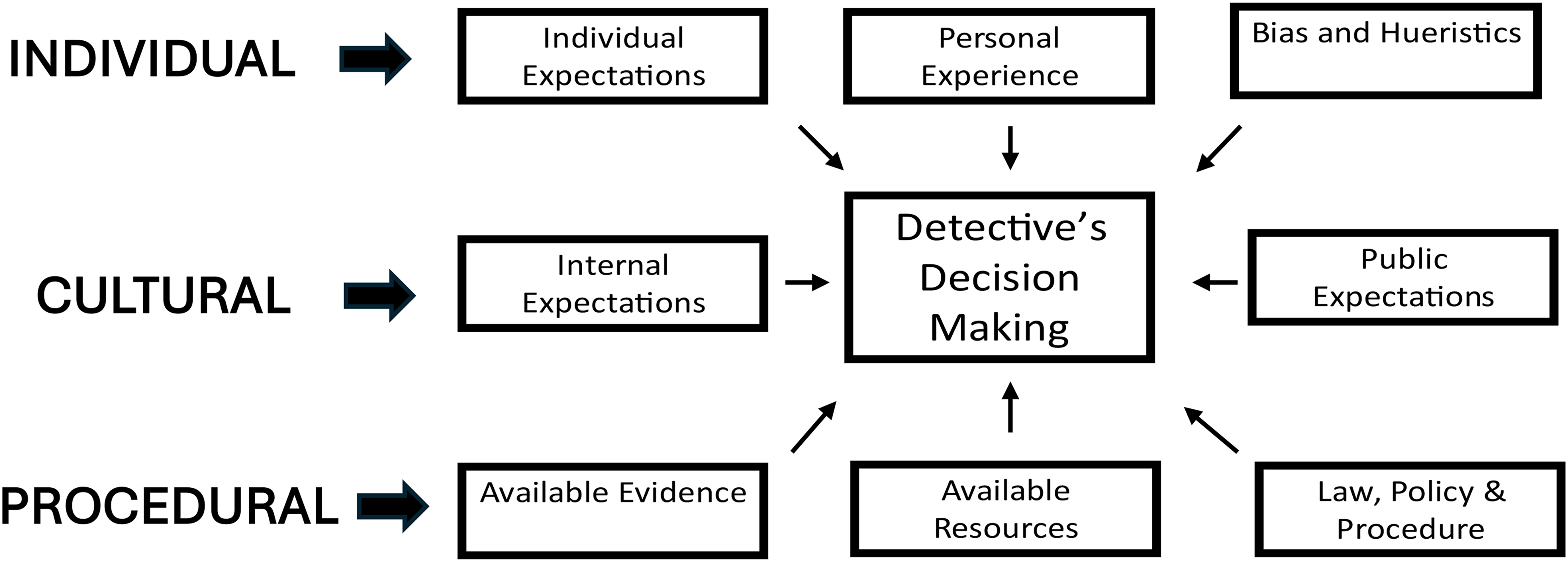
Pressure factors in detective decision-making.
Personal factors appear to have the greatest impact in cases in which there has been a miscarriage of justice leading to investigative failures or wrongful convictions (Lidén, 2023; Olaborede and Walt, 2021; Rossmo, 2021; Rossmo and Pollock, 2019). At the personal level, detectives experience internal stressors related to the significance they place on their personal pride and reputation. This includes the pressure to maintain a high ‘clear-up rate’, which is often a key measure of their professional success (Simon, 2007). Their professional expertise, level of training and ability to apply it also impact their confidence in making decisions (Stelfox, 2013). However, the most critical personal factors impacting decision-making relate to heuristics and bias: personal mental processes that shape thinking and decision-making. Because of constraints in time, knowledge and resources, people often rely on simple heuristics for decision-making, which, although generally effective, can lead to significant and systematic biases in certain situations (Tversky and Kahneman, 1974). These often-subconscious short cuts that a detective employs to weigh the value of evidence based on previous experience, recent related events or a belief in simply getting sufficient evidence to get a case ‘across the line’ so that they can move onto the next one, all impact how a detective makes decisions within an investigation (Bevan, 2023).
For instance, the use of stereotypes around missing teenagers not being at risk, but simply up to no good, and ‘the husband did it’ in domestic-related crimes. Confirmation bias has the most significant impact on all these processes (Lidén, 2023; Meterko and Cooper, 2022; Rossmo and Pollock, 2019). Detectives may give place significance on evidence that supports their opinion, rather than applying a more balanced weighting, at the expense of other probative evidence (Elaad, 2022). This is because the gathered evidence may not fit their preferred explanation or construct of the case. In a comprehensive examination of 50 international miscarriages of justice cases, Rossmo and Pollock (2019) sought to identify the failures within the criminal justice process that resulted in wrongful convictions. The study revealed that confirmation bias was the primary cause of investigative failures in 74% of the sample.
Cultural factors further contribute to the complexity of a detective's decision-making process, with expectations from the team, victims, families and wider community, who may exert emotional pressure on the detective to achieve a guilty verdict (Dabney, 2019). Team dynamics, especially in the initial stages of investigating major crimes, can transform an investigation into a social endeavor with shared investment to achieve success (Hällgren et al., 2020). The responsibility of providing answers, justice and closure adds a layer of complexity to a detective's decision-making, potentially influencing their approach to case handling.
Finally, procedural considerations encompass the sufficiency and reliability of evidence, resource availability and adherence to legal frameworks (Coupe, 2014). Detectives navigate cases ranging from ‘slam dunks’, in which ample evidence identifies the perpetrator, to ‘stickers’, characterized by the absence of suspects and limited evidence (Bevan, 2023). Ethical decision-making considerations become crucial as detectives employ innovative and audacious methods to generate evidence, sometimes pushing the boundaries of accepted practices when they feel constrained by the criminal justice system (Westmarland, 2013).
These influences on detective decision-making make for a difficult landscape for both the detectives themselves and researchers who examine them. The mixture of craft, art, science and procedural frameworks that creates constraints produces a complex system within which to reason through decision-making. For every variable, there is consideration, and then a trade-off. This is a dynamic cognitive process and is difficult to ‘pin down’ enough to properly measure. Recognizing the multifaceted factors influencing detective decision-making, police organizations advocate for the retention of an ‘open mind’ (College of Policing, 2023). Investigative policies and training programs emphasize the mitigation of closed-mindedness and bias by promoting hypothesis-generating techniques and decision-making models for detective personnel (Bevan, 2023; Sunde, 2020).
Decision-making models in policing
Decision-making is a daily necessity for all roles inside policing. Frontline officers regularly decide whether to deprive people of their liberty, use force or seize evidence in highly time-pressured incidents. Detectives then decide on the submission of a file to the prosecution services for consideration, further investigative avenues or the closure of ongoing cases. Each of these actions in both disciplines relies on the complex series of cognitive mechanisms introduced earlier, while being built on a framework of already gathered experience. When an officer decides to do A, B or C, there is inevitably a collation of information that is relevant to that decision at that moment of time, when placed in the context of that officer's past (Clark, 2023). It is also true that decision-making in uniform roles may be distinctly different from decision-making in detective roles (Stubbs and Friston, 2024), simply because of the experiential build-up in that officer over time within very different operational environments.
This difference is supported by the theory of the Bayesian brain (Friston, 2012; Seth, 2016), in which the brain is described as a probabilistic computation engine that actively uses information, generates working models of the world, and then chooses an interaction method based on that information. More recently, this has been further developed and characterized in cognitive science as ‘active inference’ (Friston et al., 2013), a process whereby a person actively gathers information, infers from it based on their already gathered experience, generates a model through which to understand it, and then seeks to influence the world by choosing to act (Parr et al., 2022). This is a growing area of research that develops upon the older Bayesian brain hypothesis, representing the brain as being involved in a dialogic process of active intervention in the world, rather than acting as a passive but interpretive recipient of information.
In policing, this process is always operational for all officers. Police officers will seek to rely upon what is often a long body of experiential learning, while operating within a codified system of ‘allowed’ actions—usually guided by the law and various policies or guidance. In this respect, one can reasonably state that police decision-making is bound and hemmed in by tangible fences. Indeed, it could be said that police decision-making often becomes subject to increased scrutiny when these fences are broached, instances that are often referred to in the context of police legitimacy (Bradford et al., 2014).
If these decisions can be highly influential in terms of the actors that the police encounter (and many certainly can be), then it is fair to ask what is in place that assists officers with decision-making. Officers have training, educational, life and specific incidence-related experiences. This collection provides a foundation for any decision, helping them to form prior-held beliefs (Evans et al., 2002) that assist with further decision-making. Although there have been some studies on police training and decision-making (Andersen and Gustafsberg, 2016; Paoline and Terrill, 2007), there are no systematic or meta-analyses that allow for sustained theoretical development in this area.
In the absence of a firm evidence base regarding training and education, public scandals in England, such as the Hillsborough disaster (Hillsborough Independent Panel, 2012; Scraton, 2016), have led policing governance bodies to develop models that assist officers with decision-making in operational contexts. The most prevalent model in this area is the NDM (College of Policing, 2024), which was introduced following the Flanagan Review (2008). The Authorised Professional Practice (APP) guidance is available on the College of Policing website (2013) and is widely used operationally in policing throughout England and Wales, and internationally. There are also conflict management approaches (College of Policing, 2020) contained in the APP that seek to help officers de-escalate encounters with the public. This model has some theoretical base, but again lacks empiricism in its evaluation. The APP in the case of the Hillsborough disaster indicates that the evidence base is ‘moderate’; however, only three cited sources on the application of a single model are provided, along with some practical advice from practitioners. The cited evidence in this area remains underdeveloped.
The main use of the NDM in operational contexts lies comfortably within public order, but there are no research articles that directly examine its operation. There is a scarcity of research that examines the NDM's inception. It is fair to say that the empirical support for its structure, content and application is in its infancy. There is no cognitive science, neuroscience or psychological research that directly supports the current mechanics of the NDM or evaluates the outcomes when it is applied. This is a significant research gap, because the model may be both productive and counterproductive in any number of contexts. This illustrates a very clear gap with regards to its testing; there is no data to reliably indicate the efficacy of the NMMD. Questions can be raised about why such a model has come into being if the evidence base is lacking, especially since it has been operationalized in several countries as a legitimate method of police decision-making. The rapid adoption and acceptance of the NMMD as good practice reflects the pragmatic culture prevalent in policing (Loftus, 2010). There is little in the model that seeks to mitigate existing biases and heuristics (Eck and Rossmo, 2019), but it is still unclear whether this was the intention of the model when it was introduced.
Flanagan, when recommending its creation, Flanagan, when recommending its creation, argued in favour of creating decision-making frameworks that promoted professional judgement and individual accountability and were based first and foremost on the consideration of professional ethics (Bevan, 2023).
This happened amid a general rise in the commentary on the use of ethics in police decision-making, as discussed by Neyroud (2019), who also noted the conspicuous absence of evaluation for both the implementation of ethics in police decision-making and the NDM itself.
Applying a critical eye, creating a model that supports decision-making based on professional ethics, yet fails to address the quality of that decision-making, could be seen to be fundamentally lacking; the NMMD currently represents an accountability model that judges ethical decision-making on an individual basis and not on the quality of the outcome. Although judging the quality of an outcome may be difficult within a complex policing profession, it should not be neglected when such models are created. It is also unclear whether the NDM can be more or less effective when the context is considered. Several research questions can be derived from this.
What psychological research supports the NDM in its current form? What cognitive science research supports the NDM in its current form? What neuroscience research supports the NDM in its current form? Does the NDM integrate ethics into decision-making successfully? Does the NDM produce improved outcomes compared with more naturalistic decision-making models?
When considered as a whole, these gaps present police practitioners with a practical problem: is the decision-making model used daily actually supporting decision-making in their business? Taking this a step further, the model is advocated by the College of Policing (2024), can such a model that does not include a decision-making or reasoning stage support detectives in making the complex decisions required, and mitigate the personal, procedurals and cultural experiences that may unduly influence them?
Reasoning in detective decision-making
As in policing, scientists are required to make decisions in their work. When they conduct scientific inquiry, they engage in cognitive processes that combine logic and experience (Lawson, 2010). Philosophers such as Socrates and Descartes posited that logic is the fundamental means of acquiring knowledge, whereas Hume and Bacon argued that experience is a prerequisite for knowledge. Nonetheless, it is now widely acknowledged that scientific communities use both methods to gain knowledge in various ways (Chang, 2012), and these have been discussed as being present throughout police investigations (Bryant, 2010). The creation of scientific knowledge typically begins with puzzling observations of natural phenomena (Lawson, 2010) (Figure 1). Similarly, police investigations normally start from suspicion of a crime, reports submitted to the police, investigative leads, rumors or information implying a potential crime, except in cases in which perpetrators voluntarily confess to the police (Uchii, 2010). These are puzzling observations gathered through experience. For instance, police investigators collect information by visiting a crime scene or listening to people involved in the crime to determine whether a crime really occurred (result) and to identify who the real perpetrator was (e.g., making hypotheses). At a crime scene, the evidence discovered is the result of criminal activity (cause), which was done during a past event. Thus, criminal investigations commence with the outcome of a crime and progress toward uncovering its underlying cause (Uchii, 2010).
Owing to the nature of their work, police officers can be considered empiricists. One of the fundamental tasks in their work is to gather evidence of things that have happened prior through physical experience, and then use these collections of evidence to judge whether a hypothesis can be considered reasonable or beyond reasonable doubt. Because there is no way to return to any actual crime scene and experience the crime, the evidence gathered allows detectives to form the best available picture of what has happened (Ask and Fahsing, 2019). They do this using a combination of evidence and reasoning. Erroneous reasoning in criminal investigations can lead to incorrect conclusions; organizing and structuring reasoning in investigative contexts has often been overlooked by practitioners and scholars (Eck and Rossmo, 2019; Rossmo, 2016). Reasoning is thus fundamental to decision-making because it serves as the cognitive process through which individuals evaluate information, weigh options, and arrive at conclusions or courses of action. This is a fundamental aspect of the work carried out by detectives in all their key activities. Reasoning has been explored in numerous fields of inquiry, ranging from philosophy to physics (Lawson, 2010); however, only a few studies have focused on how reasoning is used to solve crimes via investigative decision-making (Bryant, 2010; Eck and Rossmo, 2019; Rossmo, 2016; see also Ask and Fahsing, 2019; Carson, 2009).
When considering prior discussion of the NDM in police decision-making (College of Policing, 2024) and Lawson's reasoning model (Lawson, 2010), it is difficult to discern where one fits into the other. This is despite the obvious fact that detectives constantly use reasoning in their decision-making. To explore this gap, the following section explores the four forms of reasoning as it could be applied to detective work and thus sets the foundation for understanding where or how it could be applied to operational use of the NDM in practice.
Abductive reasoning: Observing crime and forming hypotheses
A criminal investigation begins by drawing hypotheses about what happened based on the observed evidence; this is known as abductive reasoning. The term ‘abduction’ refers to ‘a form of reasoning employed to account for perplexing phenomena’ (Aliseda, 2006: 28). Crimes are often unobserved, and to unveil knowledge, detectives need to formulate new ideas using their creativity. Abductive reasoning involves forming the most plausible explanation or hypothesis given the available evidence, even if it is not necessarily the only possible explanation. Detectives often use abductive reasoning to generate theories about what might have occurred based on incomplete or ambiguous evidence. For example, if a detective finds a broken window and signs of forced entry at a crime scene, he might abduce that the perpetrator entered through the window. Abduction is a logical operation that introduces new ideas (Barrena and Nubiola, 2019). Detectives strive to uncover clues, leads, and evidence that can establish a causal link between the crime in question and its perpetrator(s), despite various challenges. Detectives proceed to a crime scene as soon as the crime is reported. Upon arrival, they carefully observe the scene and gather any relevant evidence that may be present, which can be from human memory, the surface of a physical object, victim, suspect, or an image or video captured by a video-recording device. This evidence provides a material foundation that ensures that the hypotheses of detectives are not solely based on guesswork, intuition, hunch, or naive conjectures (Bryant, 2010). To make a valid interpretation of the observation, detectives must have solid, constant, accurate rule(s), or declarative knowledge (Aliseda, 2006). For instance, detectives should have an understanding of scientific knowledge (forensic and medical knowledge), experience, information, or shared investigative skills (Carson, 2009). In other cases, they need experts who can provide relevant knowledge, which can lead to more accurate inferences between what happened in the past and what they see now.
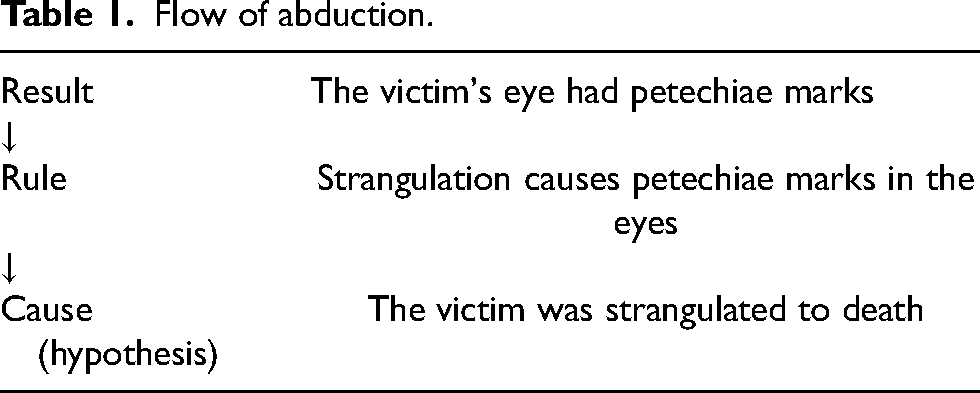
To illustrate the complexity and importance of reasoning in detective decision-making, consider the following case handled by Detective A. In this scenario, Detective A was called in for a murder case in which a female victim was lying dead on the ground facing upwards. The detective observed a substantial amount of blood scattered around the victim's body. In addition, the victim appeared to have stab wounds on her hands and abdomen. The detective saw petechiae (red spots) in the eyes, the whites of the eyes were partially filled with blood and there were scratch marks around the victim's neck. The detective then hypothesized that although the blood seemed to belong to the victim, the main cause of death was strangulation. Certainly, these are possibilities, and other scenarios may also exist (e.g., heavy bleeding in the throat blocking air intake).
In summary, abductive reasoning in investigation contexts begins with puzzled observations of a crime scene or evidence logically connected with concrete facts or knowledge, arriving at the best possible hypothesis by using experience and logic (Table 1).
Flow of abduction.
Retroductive reasoning: Modifying initial hypothesis
After formulating a hypothesis through abduction, it must first undergo an inferential test, which Peirce (1955), who is best known for setting the foundation of reasoning, referred to as retroduction (Lawson, 2010). Retroduction is a concept that has not been discussed much in previous research articles on investigative reasoning (Bryant, 2010; Rossmo, 2016). Lawson (2010) explained that retroductive reasoning follows an ‘if–then–therefore’ pattern, which is important for evaluating alternative explanations, but it is a weak test of a hypothesis because it only requires the hypothesis to explain the observation that led to its generation, rather than providing a more robust explanation or supporting data (Table 2).
Flow of retroduction.
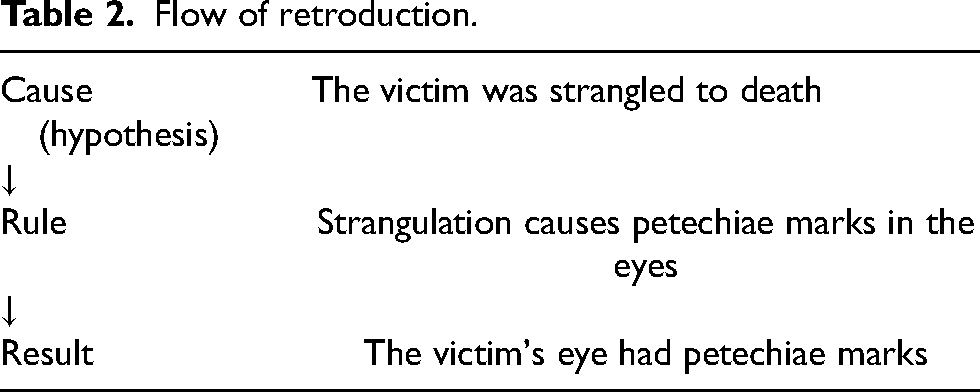
Another example further underscores the challenges of hypothesis testing in detective work. Imagine that Detective B, who is on the same team as Detective A, returns from the crime scene and generates the hypothesis that the killer has stabbed the victim to death using a knife. This hypothesis is contrary to that of Detective A. In a team meeting with colleagues and leaders, Detective B heard of Detective A's analysis. Detective B subconsciously starts by comparing his stabbing hypothesis with Detective A's strangulation hypothesis, testing the stabbing hypothesis (e.g., does the proposed cause explain what I already know?). ‘If’ the victim was stabbed to death with a knife, ‘then’ it caused serious damage to the organs and excessive bleeding. However, some red dots were observed in the victim's eyes (the result of low oxygen intake and rupture of capillary vessels). ‘Therefore’, the victim's death may not have resulted from stabbing. When a hypothesis engenders serious doubt, the detective can ultimately reject the initial assumptions and return to abductive reasoning to generate alternative hypotheses (Carson, 2009).
As illustrated in the aforementioned instance, detectives employ retroduction to refine and validate their initial hypotheses during a police investigation; it is a method of fitting previous hypotheses to gathered data to test their reliability (Lawson, 2010). Retroduction may typically occur in meetings with other teammates or forensic experts when detectives solidify or modify their initial hypotheses before sufficient evidence to pursue a charge is available.
Deductive reasoning: Making predictions for further investigation
Deduction is a conclusion that follows on from our knowledge (Evans, 2019). This type of reasoning involves drawing specific conclusions from general principles or premises. Detectives often use deductive reasoning to make logical connections between evidence and possible explanations. For example, if a detective knows that only a certain type of weapon could have caused a particular injury, they might deduce that the prime suspect is the one who owns that weapon. Deductive reasoning commences with rules, premises, or universal principles, and concludes with specific inferences or predictions. This mode of reasoning includes a broader range of logical concepts and methods collectively referred to as logic (Bryant, 2010). The biggest advantage of deduction is that the conclusion should be valid if all premises are valid. When detectives have valid evidence and knowledge, they can predict new facts about a crime that are as yet unveiled, but within the scope of the information residing on the premises. Valid evidence, such as physical or forensic evidence at a crime scene, can be used as valid facts or declarative knowledge that is impeccable by nature, unless a suspect attempts to stage the scene. Therefore, deductive reasoning is often described as crime scene reconstruction, which makes forensic scientific knowledge (rule) and physical evidence (cause) lead to a valid prediction or result (Turvey, 2012).
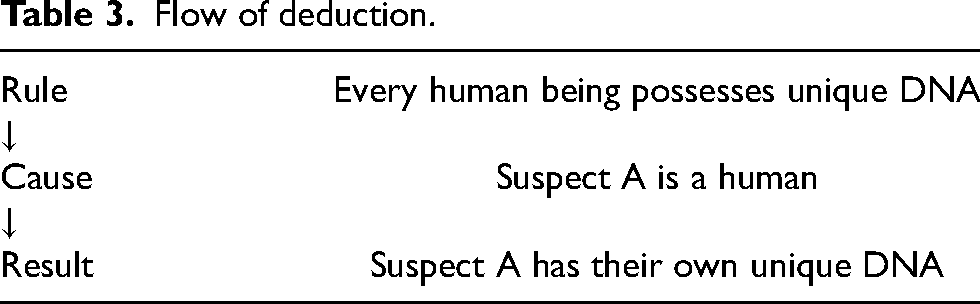
For example, every human possesses unique DNA. If we apprehend Suspect A, a human individual, we can logically deduce that the suspect must possess unique DNA (Table 3). In turn, the deduction guides an investigator to take further investigative action, such as collecting evidence around a victim's neck or from a place with which the suspect potentially makes physical contact (Lawson, 2010).
Flow of deduction.
Detectives use deductions that lead to predictions about possible new observations of criminal evidence that can prove or disprove their hypothesis. Securing sufficient evidence is crucial in the criminal justice system, and deduction may be a good method when used appropriately (Bryant, 2010). However, deductive reasoning, although possessing certain advantages, is not without limitations (Bryant, 2010). At its core, it enables us to expand upon our existing knowledge by demonstrating the implications of our assumptions, rather than directly contributing to the discovery of new knowledge (Lawson, 2006).
In addition, deductions are contingent on connections with declarative knowledge. Therefore, it is imperative that thinkers possess declarative knowledge to comprehend the implications of any given hypothesis (Rossmo, 2016). In other words, our conclusions and inferences rely exclusively on the validity of the premises, rules, facts, and declarative knowledge. Deduction (and abduction) is contingent upon relevant circumstances specific to the current situation, which can be characterized by declarative knowledge (Lawson, 2006).
Inductive reasoning: Testing crime hypotheses
To test hypotheses of crimes, detectives need to use induction. Inductive reasoning is a method of establishing declarative knowledge, facts, or rules through a process of generalization from a series of observed evidence (Table 4). Inductive reasoning involves generalizing based on specific observations or evidence. Detectives may use inductive reasoning to test hypotheses or theories about what happened based on the evidence they gather from a crime scene or witness statements (Carson, 2009). For instance, if a detective notices a pattern in several cases where the same type of tire tracks are found at the scene, they might induce that the same perpetrator is involved. This form of reasoning has been widely utilized in daily life and has been the foundation of numerous scientific discoveries (Bryant, 2010; Lawson, 2010).
Flow of induction.
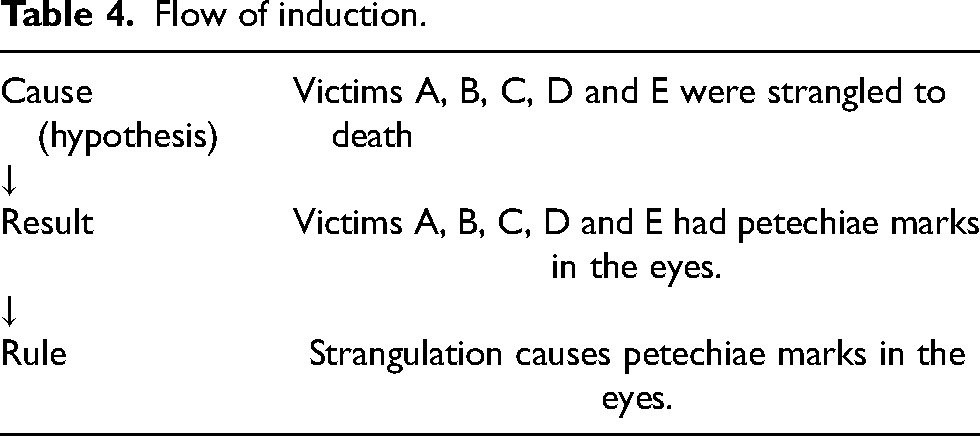
It has been proposed that inductive reasoning may be inherently present in the human brain, because it appears that most individuals can use this method without explicit instruction (Bryant, 2010). For example, we naturally generalize that the sun rises in the east and sets in the west because of the repeated observations of its rotational cycle on a daily basis. However, in the North Pole, this rule does not apply, because there is only south, and the sun does not set for some time during the year (Chang, 2014). A well-known example of the ‘white and black swan’ dilemma further demonstrates that inductive reasoning has innate limitations in generalizing particular instances (Taleb, 2010).
Despite this limitation, police detectives must use different types of induction to solve their crimes; they often reason based on previous case experiences, biases, stereotypes, heuristics, or common sense regarding particular crimes and suspects (Bryant, 2010; Rossmo, 2016). This can be explained, to some extent, by the lack of physical evidence at crime scenes (Eck and Rossmo, 2019). For instance, a robbery occurred in a jewelry shop where no forensic evidence, such as CCTV footage, DNA, or fingerprints, was found. Detectives may attempt to contact pawn and jewelry shops to trace the perpetrators in the robbery case, because they have witnessed in previous cases that most robbers often have huge debts and are motivated by easy money, and detectives have often been successful with this strategy. In addition, most murder victims are killed by someone they know (Bricknell and Doherty, 2021). Thus, it is more effective and time-saving for the police to go directly to someone who has a relationship with the victim rather than someone completely irrelevant.
These investigative processes can be interpreted as making observations of the evidence and are conducted to examine whether the observation explains the result of the crime. Thus, induction is a final and crucial method in the process of generalizing a guilty or not-guilty decision about a suspect or fact from specific instances or cases (collected evidence); therefore, a detective's hypothesis can turn into a valid decision substantiated by the evidence.
Lawson (2010) pointed out that there are weaknesses when one uses induction. First, the generation of explanations is a product of the human imagination, which can lead to a multitude of alternatives and predictions. Consequently, the subsequent observation of a specific predicted outcome can theoretically be attributed to multiple factors. Second, one cannot be certain that a contradictory explanation is incorrect because the discrepancy between the prediction and observation may be attributed to a faulty test, faulty deduction, or incorrect explanation. Lawson concluded that, in light of these uncertainties, it is essential to approach explanations with caution and consider multiple possibilities.
Social and cultural contexts can play a role in scientific discovery (Brannigan, 1981; Collins, 1985); social pressure in police forces, such as the pressure to solve crimes, confirmation bias, peer pressure, and social influence effects, are known to influence detectives’ behaviors (Ask and Fahsing, 2019; Fahsing & Ask, 2015; Rossmo and Pollock, 2019). Recognizing the limitations of inductive reasoning is crucial for detectives because it is inherently flawed and using it requires caution (e.g. heuristics). The inherent risk in the use of inductive reasoning by detectives lies in the issue of generalization from observations, especially when these observations are scarce or not representative (Bryant, 2010).
Figure 2 shows a simplified version of Lawson's reasoning model, which can explain and provide a structure for the pattern of detective reasoning processes in police investigations. Senior investigating officers, as well as field investigators, can utilize this simplified reasoning model when making investigative decisions, which can facilitate further constructive argumentation and hypothesis testing, and therefore assist police forces in meeting the legal requirements for achieving justice for victims.
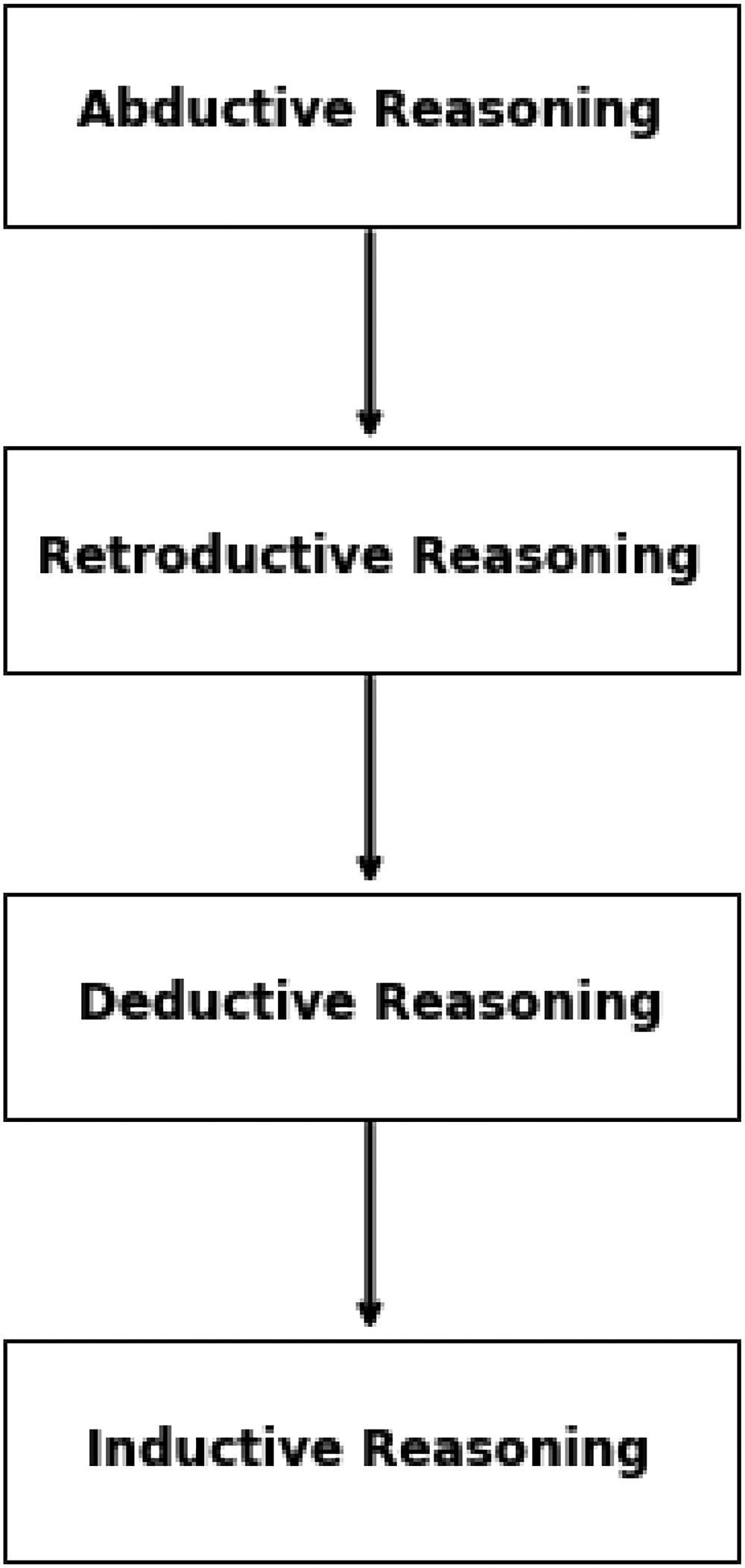
Reasoning process in investigation.
Discussion
Policing is a varied profession, and it is fair to say that decision-making in an operational, frontline, and extremely time-sensitive context profoundly differs from deliberation over time in some detective-based disciplines. In this article, detective decision-making is situated within structured investigative settings (College of Policing, 2023), placing the decision-maker in a slow-paced, complex, and interdependent environment. This necessitates a decision-making model that consciously adjusts or allows for differentiation in role and environment. If the use of a model for decision-making in policing is required for the purposes of accountability (e.g. an analysis of judgment in a court of law), but is not currently addressing the purpose or quality of the decision-making itself, then there is room for improvement. The NDM itself contains five stages; the first four address the gathering of information, assessing risks and threat, evaluating powers and policies, and identifying options and contingencies. These are all stages that take place prior to taking a decision, with the fifth stage being ‘take action and review what happened’. There was a significant gap between the first four stages and the fifth stage, in which the actual decision was made. There is an assumption inherent in the model that when the first four stages have been completed, this allows an ‘improved’ decision to be made, yet improved how, for whom, and for the purpose of what? If the original intention of the Flanagan Review was to enshrine ethics into decision-making and create a decision-recording system for accountability, then the NDM offers contributions to both these areas. However, the reasoning process that should occur when the first four stages have been completed is absent. How does the current NDM model help in decision-making?
Through its discussion of the four stages of reasoning, this article proposes that they are implicit in the NDM and often unconsciously used by detectives every day (Figure 3). These four stages are the tools through which decisions are made. If this is the case, then a great deal of the decision-making process within the NDM will not be recorded, or if it is, this is in spite of the model and not because of it. This is especially true of the detective world, because the context of investigation often allows for slow decision-making, and thus, more time for the process of reasoning. It is likely that the brain relies on different methods of processing and cognition to navigate the immediate demands of public order, compared with the rational application of reasoning over time. For this reason, it is likely that the NDM does not service the detective world well and may, in fact, only service the explicit inclusion of ethics and the development of official recording practices for accountability purposes. Both outcomes are desirable, and as such, there is no evidence to suggest that the model is unfit for the primary purpose for which it was designed. Although it was called the NDM, it could be more accurately referred to as a decision-recording tool for the purposes of accountability, and not a decision-making model. For the model to assist with detective decision-making, it is not the recording and gathering of information, the perceived risk and threat, the considerations of powers and policy, or the development of contingencies that actually make the decision. The decision-making process rests in the application of reasoning, and the ability to reason properly should be explicit in the NDM for it to be called the NDM at all. It is possible to address this absence through the inclusion of reasoning into the decision-making model, and it is this significant research gap that this article seeks to address. By using a theoretical base for the development of decision-making through reasoning and empirical testing, it is possible to close this gap and propose models that have some rigor behind their creation and use.
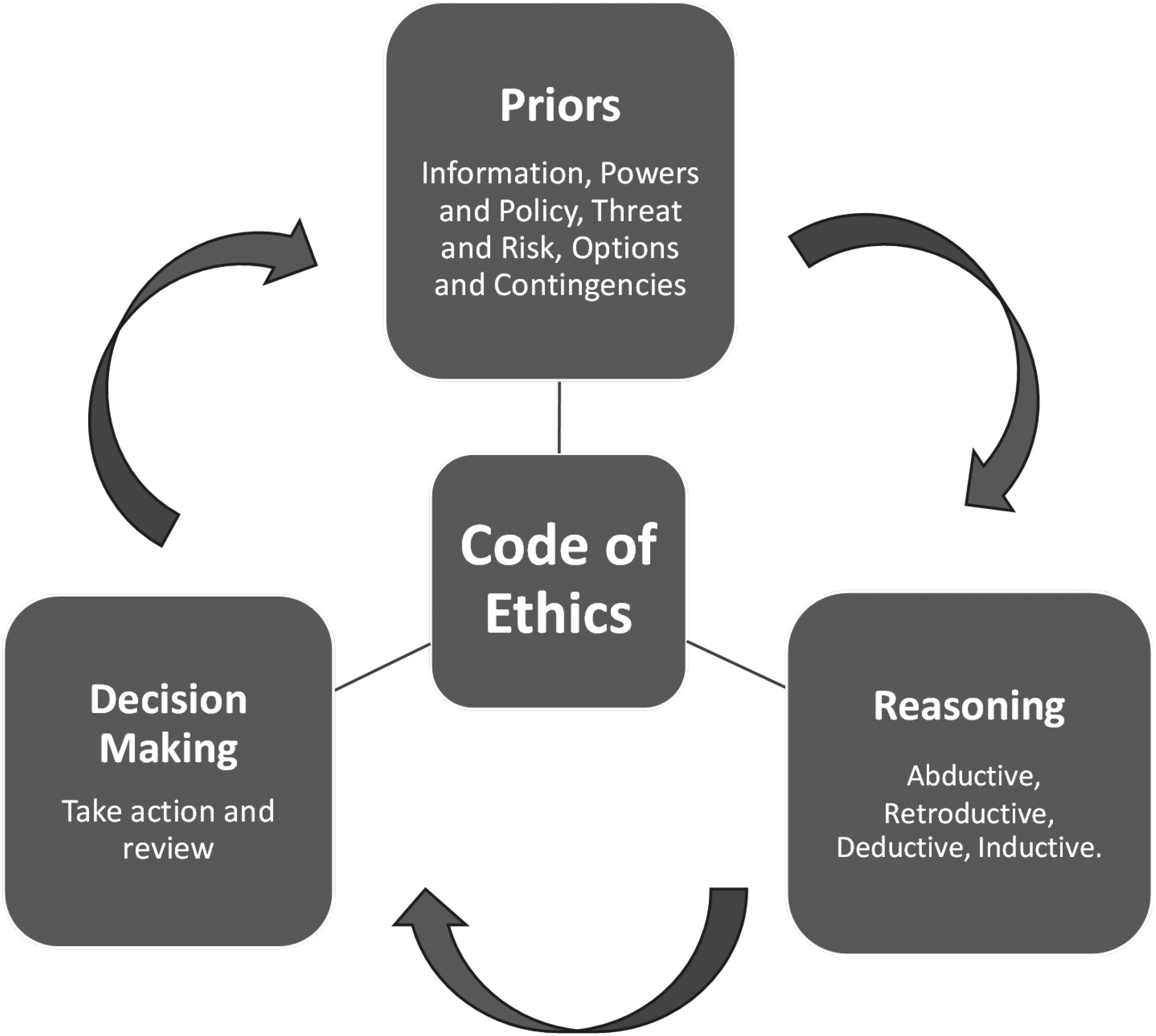
Proposed decision-making framework.
Reasoning has been subject to research (Lawson, 2010; see also Bryant, 2010; Carson, 2009; Evans, 2019; Uchii, 2010) and has been split into four categories. First, abductive reasoning may help generate hypotheses or theories to explain observed crimes or evidence (Bryant, 2010; Uchii, 2010). Abduction can be valuable when forming the best possible explanations with limited, incomplete, or ambiguous information associated with criminal investigations, and it can help individuals uncover the root causes of the crime in question by introducing new ideas (Carson, 2009). Second, by tracing the chain of events backward, detectives can identify the factors that contributed to a particular outcome or situation. In retroductive reasoning, detectives can subconsciously test whether the tentative hypothesis explains the evidence or facts observed at a crime scene, which helps them reject or accept their hypothesis (Lawson, 2010; Uchii, 2010). Third, deductive reasoning involves drawing specific conclusions from general principles. While decision-making, deductive reasoning can assist detectives by applying their existing knowledge or theories to specific situations. Detectives can make future predictions about undiscovered evidence to test their crime hypotheses (Evans, 2019; Lawson, 2010). Finally, inductive reasoning involves making generalizations based on specific observations or evidence. Inductive reasoning can help detectives prove their hypotheses using the collected evidence and extrapolate them to draw conclusions about their investigations, which is useful for making probabilistic assessments or forecasting future outcomes based on past experiences (Bryant, 2010; Uchii, 2010).
The inclusion of reasoning in the NDM will facilitate the actual act of making a decision in a more structured and systematic way. This will aid transparency with regards to the initial purposes of the NDM (ethics and recording purposes), because it actively links the priors (the first four stages of the NDMM), more accurately to a reasoned outcome.
Conclusion
Detectives carry a significant responsibility. The decisions they take bring justice to families, deprive people of their liberty and safeguard public trust in the ability of law enforcement to ensure their safety. The efficacy of their endeavors hinges upon their capacity to execute judicious and rational judgments. Yet owing to complexity, emotions, incomplete evidence, and a myriad of personal, procedural and cultural influences, making the right decisions consistently is not an easy task. Arrest a perpetrator prematurely, and you may not have sufficient evidence to charge so they must be released. Arrest later, in order to bolster a case, and you risk them absconding or committing further crimes. Fundamental challenges arise regarding the weight accorded to evidence, the veracity of witness testimonies, reliance on intuition, and the ethical boundaries permissible when securing evidence. These are the decisions that are the daily business of a being detective.
The College of Policing suggests the NDM is ‘suitable for all decisions and should be used by everyone in policing’ (2024). As a tool to ensure accountability, ethical standards and structuring what powers are relevant based on the information available and the level of threat and risk, the model is useful. The NDM nonetheless falls short in providing guidance on how to decide on which actions you should take after you have identified options and contingencies (stage 4). It does not facilitate how to make pivotal decisions such as arrest timings, witness credibility assessments, or actions specific to detective work. Detective work is a very different element of policing from frontline and public order decision-making. Adding the four stages of reasoning—abductive, retroductive, deductive, inductive—to the existing NDM framework could actively assist with the ‘making’ of the decision. Each of these types of reasoning can help detectives make informed decisions throughout the investigative process, from gathering evidence and problem solving, to identifying suspects, evaluating options and building cases within a pre-existing accountability model. The four reasoning methods can be particularly effective for team leaders or commanding officers, helping them understand the underlying patterns of reasoning in investigative contexts, so that they can more actively assist detectives in generating and testing alternative hypotheses. In conclusion, this article has argued for the testing of a revised model for decision-making, with the conscious inclusion of reasoning as an actual step in the model. This is in order to explore providing an evidence base for reasoning's potential utility in improving detective decision-making, and ultimately preventing further miscarriages of justice.
Footnotes
Declaration of conflicting interests
The authors declared no potential conflicts of interest with respect to the research, authorship, and/or publication of this article.
Funding
The authors received no financial support for the research, authorship, and/or publication of this article.

Supplemental material
Supplemental material for this article is available online.