



Abstract
This eight-agency case study analyzes the characteristics of four high-and four low-performing police agencies, as measured by their long-term crime clearance rates. High and low performers were identified through a systematic assessment of 30 years of clearance rates of robberies, aggravated assaults, burglaries, and homicides for the largest 100 police departments in the United States. Researchers then conducted in-depth case studies of eight of these agencies—four of the highest and four of the lowest ranking in terms of their investigative practices. Comparisons of high-and low-performing agencies reveal differences in organizational structure; leadership and resources; selection, training, and performance review for investigators; case assignment and investigative processes; and community interactions. These findings provide direct guidance to agencies seeking to strengthen their investigative organization and practices.
The State of Investigations in the United States
Fans of television shows like Law and Order, Homicide: Life on the Street, Dragnet, CSI, or Perry Mason, or followers of the indelible sleuthing of Sir Arthur Conan Doyle’s Sherlock Holmes may believe that detective work is the elite occupation of a select group of individuals within police agencies. Film and television mythologies also feed into the public’s beliefs that the best available technologies and strategies are used to solve crimes. Indeed, in the last half-century, American police agencies have seen much advancement and innovation in criminal investigations. These advances include the standardization and computer automation of case documentation and processing, improvements in forensic science and investigative technologies to identify suspects more accurately and quickly, and the employment of crime analysts to help solve crimes and identify repeat offenders. In recent years, the use of closed-circuit television (CCTV) videos, cell phone and computer device data, and body-worn cameras has also increased exponentially in criminal investigations. Alongside these technological advances, police agencies devote significant resources to investigations, especially for homicides and shootings. Before the COVID pandemic, for example, the Law Enforcement and Administrative Management Statistics (LEMAS) survey (United States Department of Justice, Office of Justice Statistics, Bureau of Justice Statistics, 2016) found that in agencies with 100 or more officers, approximately 27% of sworn personnel were specifically assigned to investigative functions. 1
While fictional portrayals of detective work are loosely based on reality, actual police investigations are much more varied in importance, scope, processes, and outcomes. At least in the United States, many (if not the majority of) serious crimes do not result in an arrest or resolution, including homicide and aggravated assaults, despite the investigative advances noted above. We recognize that there are different definitions of what might constitute a case “clearance” or “resolution” (Baughman, 2020; Bottomley & Pease, 1986; Greene, 2007; United States Department of Justice, Federal Bureau of Investigation, 2017) and there are inconsistencies in how agencies classify “cleared” crimes (Spohn & Tellis, 2010). However, even if we use the inclusive definition of crime clearance employed by the Federal Bureau of Investigations (FBI) Uniform Crime Reporting (UCR) system (which includes those crimes resulting in arrest or exceptional clearance 2 ), clearance rates for various offenses have remained low for decades. In the latest year for which the most comprehensive data are available (2019), 3 approximately 1.2 million violent crimes were reported to the police, of which 54.5% were not cleared by an arrest or exceptional means. Homicide clearance rates have declined since the 1960s, dropping from the 90% range to 61% by 2019. Recent estimates indicate that the 2020 national homicide clearance rate may have been as low as 50% (Kaplan, 2021). In addition, of the nearly 6.9 million serious property crimes in 2019, about 82.8% remained unsolved. Clearance rates are worse for more frequent crime types. For example, according to the UCR, robbery (the taking of property from a person by force, threat, or fear 4 ) clearance rates have averaged in the 30%–38% range since 1981. Clearance rates for burglary (the unlawful entry of a structure to commit a felony or theft 5 ) have remained even more abysmally low at 14%–15%. Even for aggravated assaults (an attack on a person that intends to inflict severe injury 6 ), where the perpetrator is often known to the victim, clearance may only occur 50%–60% of the time.
The long-term stability (and in some cases, decline) of clearance rates over the last three to four decades, despite advances in investigative technologies or even significant fluctuations in crime rates, has led some to question whether the police can do anything to improve their ability to solve crimes (see discussions by Braga et al., 2011; Travis et al., 2014). Perhaps most crimes just have a “natural” clearance probability based on aspects of the crimes themselves. Indeed, research conducted during the 1970s by the RAND Corporation (see Chaiken, 1975; Chaiken et al., 1977; Greenwood et al., 1975; Greenwood & Petersilia, 1975) raised questions about the utility of investigations. The RAND study found that investigations and detective work seemed less connected to solving crimes than pre-existing solvability factors and the initial patrol officer response, leading to a conclusion that perhaps resources should be spent on patrol work, not investigations for non-homicidal crimes (Chaiken et al., 1977).
The findings of the RAND study permeated American policing (see discussions by Bayley, 1994; Braga & Dusseault, 2018; Eck, 1983, 1992; Wellford et al., 2019). Whether due to the result of these studies, limited resources, or other reasons, agencies began to regularly practice solvability triaging (sometimes called “red-lining”) of reported crimes. Solvability triaging involves an initial review of a crime to determine if it has enough case characteristics to make its investigation fruitful. Although rarely done for homicides, triaging is a regular practice in American policing today for robberies, burglaries, autothefts, and even serious assaults (Lum et al., 2018). The idea behind using solvability factors for triaging is that scarce resources should not be spent investigating crimes that have little probability of being solved because of, for example, a lack of cooperating victims or witnesses, the absence of suspect identification, or other critical pieces of information.
At the same time, more recent studies on police investigations have indicated that there is more to predicting crime clearances than case characteristics and solvability factors. Scott et al. (2019), Vovak (2016), and Worrall (2016) have all discovered that agencies across the U.S. vary in their long-term patterns of crime clearance. Some agencies consistently perform much better (or worse) than the national average in terms of clearance rates for specific types of crime. In addition, evaluations of specific agencies suggest criminal investigations can be improved through better management, training, policies, use of technology, and investigative techniques (see, e.g., Barao et al., 2021; Braga et al., 2019; Braga & Dusseault, 2018; Carter, 2013; Carter & Carter, 2016; Coupe, 2016; Coupe & Kaur, 2005; Cronin et al., 2007; Fox & Farrington, 2015; Keel et al., 2009; Koper & Lum, 2019; Lee, 2020; Marché, 1994; Mouzos & Muller, 2001; Police Executive Research Forum, 2018; Ritter, 2008; Roman et al., 2008; Schroeder & White, 2009; Wellford & Cronin, 1999; Wellford et al., 2019; see Prince et al., for a review of this research). Although situational factors of crimes may partially contribute to their resolution, the growing body of scientific evidence on investigations leaves us more optimistic about the role of police effort and organization in crime clearance than we were in the 1970s and 80s.
Why do some agencies perform consistently better than others over time? As Scott et al. (2019), Vovak (2016), and Worrall (2016) have found, jurisdictional crime rates or even organizational demographics, such as the size of an agency, are not the reasons. To explore this question, we identify and conduct in-depth case studies of the investigative practices of eight agencies—four high performing (HP) and four low performing (LP)—in terms of their ability to clear cases over time.
Determining the Sample of “High” and “Low” Performing Agencies
There are thousands of agencies in the United States to potentially study, from small to large, each with year-to-year clearance rate trends that may fluctuate. For this study, we drew our sample of case studies systematically from the 100 largest U.S. agencies at the time we initiated this project. Using data derived from the “Offenses Known and Clearances by Arrest,” summary data as reported to the FBI UCR program, 7 and using a statistical technique known as trajectory analysis (see Nagin, 2005; Nagin & Land, 1993), we created yearly trends for over three decades of the most up-to-date data at the time we began this study (1981–2013) for four types of offenses (homicide, aggravated assault, robbery, and burglary) for each of these agencies.
The methods and results of these trajectory analyses are described in-depth in Scott et al. (2019), and we only summarize them here. The trajectory analyses revealed that not all agencies perform similarly as to their long-term clearance rates for various types of crime. Some agencies showed clearance rate trajectories above national averages, while others were below. Some agencies consistently improved over time, while others have declining rates. Variations also exist in terms of agency performance for specific types of crimes. These empirical variations in clearances and the growing research on investigations strongly suggest that national average trends mask individual agency differences. In other words, agencies are not fated to stable and low clearance rates or even a “natural” clearance rate based on characteristics of the crimes. Instead, some agencies consistently performed better than others regarding their ability to clear crime.
The results of that trajectory analysis allowed us to rank agencies from low to high performers with regard to their 30-year clearance rate trends across the four types of crime. In turn, this approach provided a more systematic basis for selecting eight agencies 8 to conduct our multi-agency case study. To rank the agencies, we employed three different methods, giving us similar results and confidence in our final sample. The first method involved using ordinal labels for each trajectory group and summing these labels across each agency. For example, the robbery clearance solution consisted of five distinct trajectories. The lowest clearance trajectory was counted as 1, and the highest as 5 (a process that was repeated for the trajectory solutions for homicide, aggravated assault, and burglary). We then summed the ordinal label across crime types for each agency. The highest summed numbers were considered “high performing” (HP) clearance agencies, and the lowest summed numbers were “low performing” (LP) clearance agencies. A second method utilized the probability weighting (provided by the trajectory analysis) belonging to the particular trajectory grouping (between 0–1). For each agency, we multiplied the probability of an agency belonging to that trajectory, then divided by four. The results were highly consistent with the first method. In a third method, we employed multi-trajectory modeling, which simultaneously estimates trajectory groups for multiple outcomes. We found that the agency groupings from the multi-trajectory model consistently corresponded to placements in the ordinal and weighted distributions of summed group numbers across the single outcome models.
Agencies Selected for Case Studies (Anonymized).
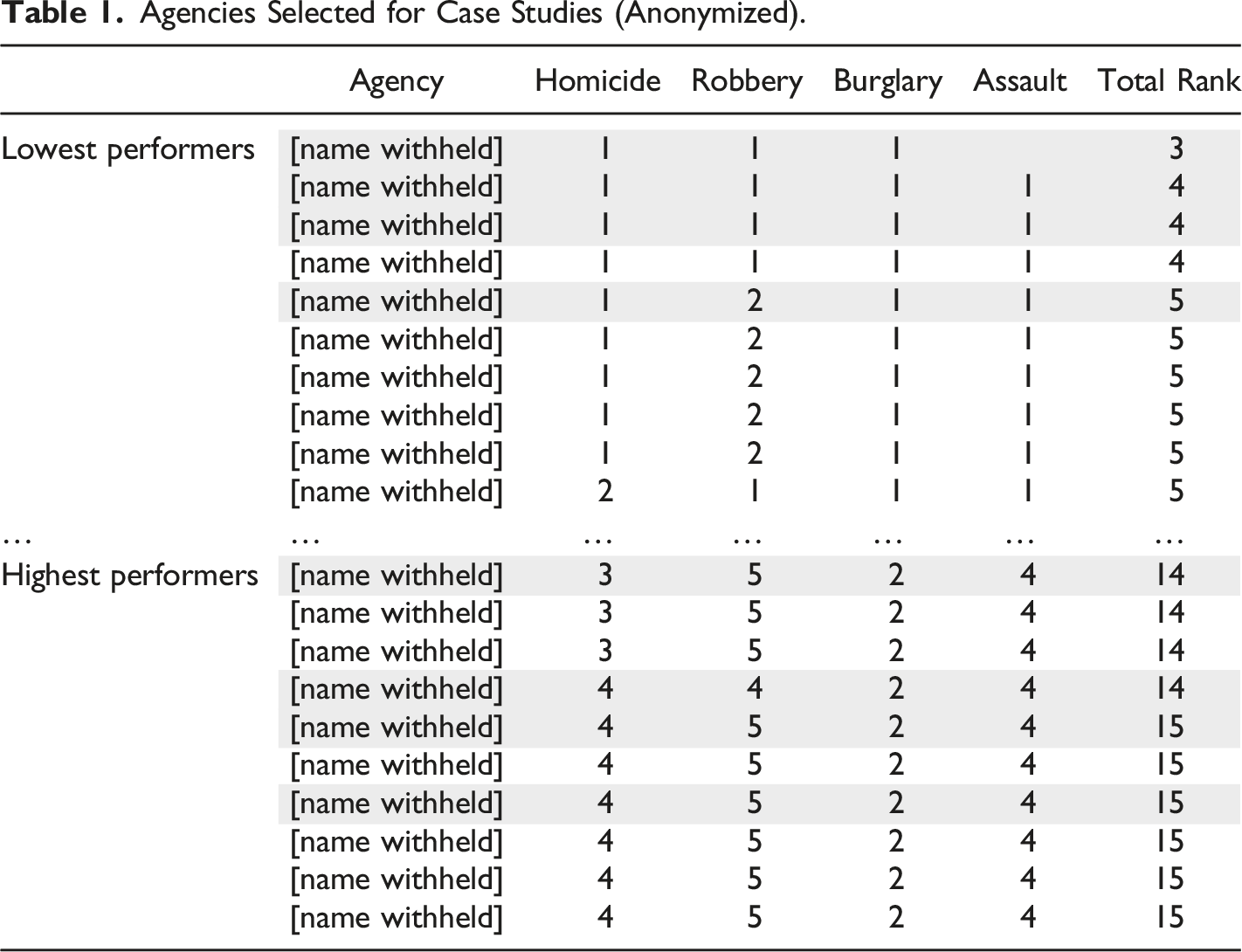
The eight agencies selected have between 500 and 3000 officers. They are geographically dispersed and do not cluster in any particular region of the United States. The populations of these eight cities range from approximately 250,000 to one million and are racially and ethnically diverse, some with proportions of nonwhite populations of over 50%. The low-performing jurisdictions tended to have higher crime rates across the four crime types than the high performers (although not markedly so).
Analyzing Agencies Through In-Depth Case Studies
We scheduled 3-day site visits with each agency to interview multiple people and groups involved in investigations. For each agency, we sought to interview high-ranking commanders overseeing investigations generally; commanding officers of units involving the investigation of homicide, robbery, aggravated assaults, and burglary; shift commanders or supervisors involved in direct supervision of investigators for each of our four crime types; detectives who investigate homicide, robbery, aggravated assaults, and burglaries; patrol first-line supervisors who would understand the relationship and requirements of patrol for investigations of homicide, robbery, burglary, and aggravated assaults; and individuals from investigative support services such as crime scene investigators, crime analysts, forensics officers, other units that provide regular investigative support services across these investigations.
The research team developed several interview instruments for the study, specific to each group (all instruments available at Lum et al., 2018). To create the instruments used, the team relied on prior instruments from studies of investigations (specifically, Wellford & Cronin, 1999; Wellford & Cronin, 2000), the breadth of investigations research (for a general review, see Prince et al., 2021), and extensive team member experience in investigative research and practice to create the instruments. The research team also consulted with three subject matter experts with decades of law enforcement and investigative experience to develop, review, and further modify these instruments. The interview instruments were specific to the rank and unit of the interviewees, but the questions could be grouped into five major themes under which our findings are organized: 1. Organizational structures: These questions probed the overall structure of the organization and where detective units are positioned in that structure; the division of labor; the connectivity of detectives to other units; the infrastructure for information sharing with other units and with patrol; and the resources given to investigations. 2. Leadership and resources: These questions were designed to understand the leadership, supervision, and accountability of investigators; the performance measures and expectations set for detectives and how they are used; and how investigative resources are deployed and prioritized. 3. Selection, status, training, and performance review: These questions included how investigators and their supervisors are selected and trained; requirements to become a detective; whether detectives receive special pay and incentives; how they view their status within the agency; how investigators and supervisors are evaluated and reviewed; and whether they can be removed for poor performance. 4. Case assignment and the investigative process: These questions included how cases are initially assigned to investigations; whether agencies have formal processes for investigations; the activities at the initial crime scene; the initial response of investigators; their subsequent investigative process, including interviews; support from other units (e.g., forensics, intelligence); technologies or other innovative tools used in investigations; the relationship with the states attorney/prosecutor’s office; and whether victim and witness services are available. For homicide specifically, questions about handling cold cases were asked (which are not included in this specific analysis). 5. Community interaction: Finally, we asked personnel how much investigative units engaged with the community. This could include using social media to provide information on cases; engaging with community groups to strengthen cooperation or involvement in investigations; or other specific initiatives involving the community.
Number of Individuals Interviewed Across the Eight Agencies.
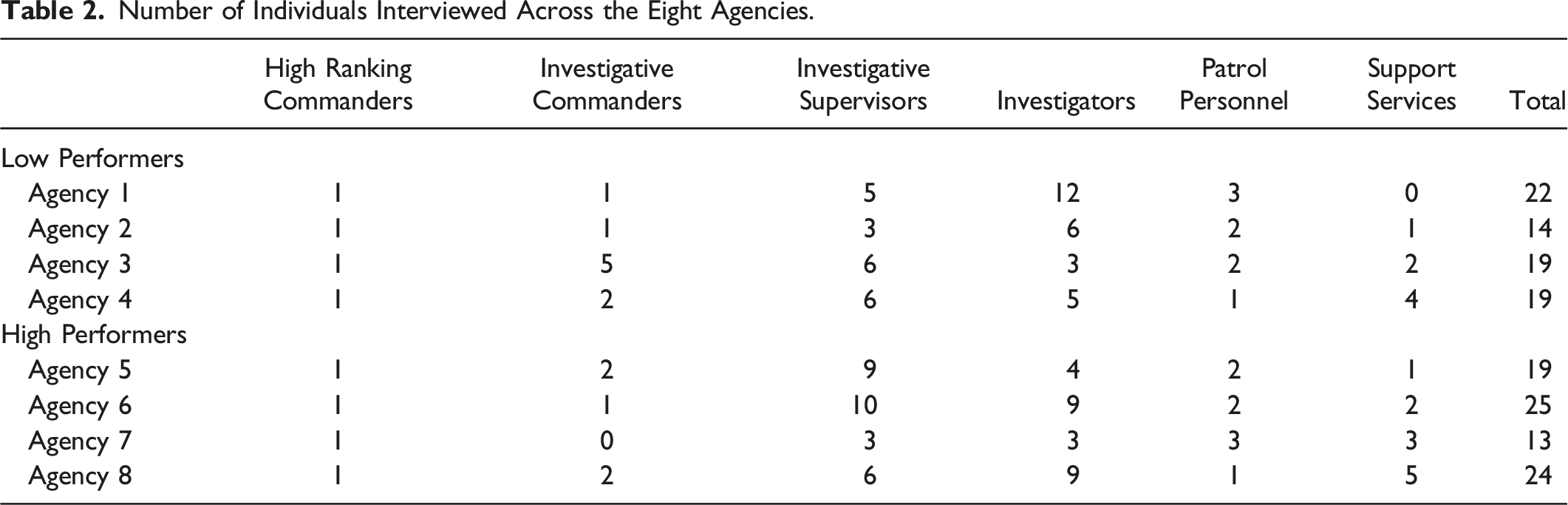
Once the interviews were completed, we coded our notes for each agency and each crime type using a detailed coding instrument. 10 We then summarize that coding as the appendix to this article by counting the total number of agencies within the HP and LP groups that had the specific characteristic listed (organized by the themes above). These findings are displayed for robbery, burglary, and assault investigations (but not for homicides 11 ). As the appendix shows, we found significant differences between the HP and LP agencies for each of the five themes described above. We describe the rich findings next and provide a bulleted summary at the beginning of the discussion section for the reader’s convenience.
Findings
Organizational Structure
Although homicide investigations are almost always centralized and jurisdiction-wide, this is not often the case for more frequently occurring crimes such as robberies, burglaries, and assaults. Past research has not agreed on whether centralized or decentralized investigative units yield better investigative outcomes (see review by Prince et al., 2021). Our in-depth interviews –especially for robbery and burglary investigations—seemed to concur with this general lack of agreement in the literature. High performing and LP agencies both had centralized and decentralized robbery and burglary units, respectively. The only exception was for aggravated assault. Interestingly, most of the high-performing agencies had decentralized aggravated assault units compared to low-performing units, whose units were more centralized.
However, HP agencies differed on other structural characteristics, which were consistent across the three types of crimes. High-performing agencies, for example, had more highly structured oversight of investigations with a clear chain of command in their robbery, burglary, and aggravated assault units. For LP agencies, oversight structures were more mixed and inconsistent, with two of the four LP agencies having more loosely structured robbery and burglary investigations. Additionally, HP agencies tended to have more routine, formalized, varied, and numerous information-sharing relationships and approaches with other units (patrol, investigations, support services). High performing personnel perceived and expressed these relationships more positively than their LP agency counterparts.
Leadership and Resources
Robbery, burglary, and aggravated assault units in HP and LP agencies differed on several dimensions related to leadership and resources, as shown in the appendix. For example, although both HP and LP agencies have investigative units that meet regularly with leadership, all robbery and three of the four burglary and aggravated assault units in HP agencies tended to have more formalized meetings compared to their LP counterparts. In addition, for all four HP agencies, the leadership was much more likely to use some form of workload analysis to set the number of investigators needed for each unit, while this was less of a consideration in LP agencies. Leadership in HP agencies also provided more support and methods in ensuring that information is shared across units (e.g., Compstat meetings, emails, bulletins, via crime analysis, real-time crime centers, and intelligence units), which was not the case for LP agencies who relied on traditional bulletins or email.
High performing agencies were also more likely than LPs to use multiple performance metrics for investigators in robbery, burglary, and assault units, although the types of performance metrics varied across these units. For aggravated assaults more specifically, our interviews revealed that LP agencies tended only to track specific types of aggravated assaults (and sometimes under certain conditions). For example, one LP agency did not track the progress of aggravated assault investigations unless they were nonfatal shootings. In addition to performance tracking, leadership in the two HP agencies we visited went so far as to set specific robbery and burglary clearance goals for their units, which was not the case in any of the LP agency units.
All four high-performing agency detectives and supervisors were more likely to express that they were adequately or well-resourced and supported by leadership. For all but one HP agency, robberies and aggravated assaults were considered high-priority crimes. All four HP agencies also had few complaints about access to equipment. This was not the case for investigative units in LP agencies. Only personnel in one of the four LP agencies asserted they were adequately resourced, and none believed their leadership prioritized investigations. Three of the four LP agency investigators and supervisors also argued that their leadership was much less open to hearing about complaints or feedback compared to their HP counterparts.
Selection, Status, Training, and Performance Review
Differences were found when comparing robbery, burglary, and assault units within HP and LP agencies on dimensions of detective selection, status, training, and performance review. Agencies did not differ as much on detective application processes. For example, all the agencies had some formal application process in which officers or detectives initiated their move into investigative units. Compared to two HP agencies, three LP agencies had interview processes for aggravated assault unit investigator applicants. However, two HP agencies (compared to none of the LP agencies) required experience or special skills related to investigations to become an investigator (with three agencies requiring specific training for robbery investigations).
Differences were more evident, however, between HP and LP agencies once officers became detectives. For example, detectives in all HP agencies viewed their unit assignments as prestigious, a sentiment we did not find in any LP agencies. In two HP agencies, detectives receive a special rank across the investigations units we interviewed; this was not the case in any LP agencies. Additionally, detectives receive extra pay for being an investigator in three HP agencies (compared to one LP agency). In terms of training new detectives, three of the four HP agencies and all LP agencies use informal mentoring as part of their on-boarding process. However, formal training was required for new investigators in three HP agencies but only one LP agency across the three investigative units examined. Neither LP nor HP agencies consistently expressed concern about receiving training on investigations.
Interestingly, differences in how investigative supervisors are selected were more nuanced across HP and LP agencies. For example, at least 12 two LP agencies required a certain number of years of general supervisory experience (not of investigations) to become an investigative supervisor. No HP agencies required a specific number of years as a general supervisor. However, one HP agency did require some experience supervising investigators for robbery and burglary, and two HP agencies required some experience supervising investigators for aggravated assaults. No LP agency required specific investigative supervisory experience. In addition, two HP agencies provided investigative supervisors training once they were on-boarded compared to none of the LP agencies. Combined, these findings indicate that HP agencies value specific and formal training and experience for superviros in investigations compared to LP agencies.
Both HP and LP agencies had systems in which investigators and investigative supervisors were appraised of their performance by their respective supervisors. But differences existed in the performance metrics used. When speaking to supervisors in HP agencies, detectives and supervisors seem to be evaluated on the thoroughness of the investigation, teamwork, and dedication, or the amount of time cases remain open. In two to three HP agencies (depending on the crime type), investigative supervisors were evaluated on their ability to clear cases, compared to only one LP agency. Investigative supervisors were evaluated on other performance metrics in all four HP agencies (but only in two LP agencies for each crime type). All HP and LP agencies have processes to remove detectives from their posts for poor performance, although this removal process was not frequently used in either.
Case Assignment and the Investigative Process
We asked agency personnel several questions regarding how cases were assigned to investigators and the investigative processes they used. We note these findings are numerous and provided in detail in the appendix. We highlight some of the findings below.
Case Assignment and Initial Processing of Cases
Given the tradition of triaging cases in U.S. investigations, we were curious whether HP and LP agencies differed in their triaging practices. Triaging differed significantly across the three different crime types. Two differences between HP and LP agencies were that HP agencies were (1) much more likely to be notified by patrol of cases and (2) much more likely to assign all cases to an investigator, even if the amount of investigation applied might be low. This was the case for all HP agencies for robberies and aggravated assaults and three HP agencies for burglary. With LP agencies—three of the four agencies did not assign all robbery and assault cases to an investigator. In all four LP agencies, “red-lining” cases (shelving cases without further investigation or follow-up) was a regular practice. For example, 30%–75% of robbery cases in LP agencies might not be assigned for investigations. Low performing agencies also triaged burglary cases; in two LP agencies, less than half of all burglaries were assigned to a detective, and cases not assigned were no longer investigated or followed up upon.
High performing agencies were more likely to investigate most cases and send investigators directly to the crime scene for all three offenses (three to four HP agencies, depending on the crime type, vs. no LP agencies). High performing agency detectives were also more likely to be available around the clock to respond to crimes (two or three HP agencies, depending on the crime type, vs. one LP agency for all crime types). High performing agencies (three out of four for each crime type) were more likely than their LP counterparts (one out of the four across crime types) to have deadlines for when investigations should be submitted. The fact that HP agencies tend to assign investigators to most cases may also be why detectives from HP agencies tend to interview victims in the hospital more frequently and witnesses more quickly than in LP agencies for these crimes.
Differences between HP and LP agencies were less stark regarding response resources, overtime, and workloads. Although more HP agencies had access to tablets, laptops, digital cameras, and voice recorders than LP agencies, LP agencies were more likely to have take-home cars available to investigators on call (three LP agencies compared to one or two HP agencies, depending on the crime type). Some agencies paid detectives additional wages for being on-call, but no consistent pattern emerged between HP and LP agencies. Overtime was provided “as needed” in both HP and LP agencies, and no pattern emerged regarding overtime limitations. However, LP agencies had much higher robbery caseloads per detective, despite not being assigned all robbery investigations. This is likely because LP agencies tended to be located in areas with higher crime rates than their HP agency counterparts (although we note that Vovak (2016) did not find a link between crime and clearance rate trajectories when examining all agencies with 100 or more officers).
Compared to burglary or robbery, aggravated assaults are often prioritized in many agencies. In all eight agencies, patrol units notify assault units directly of serious assaults, especially nonfatal shootings. While all HP agencies assign an investigator to all serious assaults, this was not the case with all LP agencies. One LP agency assigned all cases, while others only assigned nonfatal shootings or the most serious assault cases. All four HP agency assault detectives, compared to none of their LP counterparts, respond to the scene of aggravated assaults as first responders. Because of this, HP assault investigators tend to be available around the clock or have investigators on call for overnight occurrences. This was much more varied in LP agencies, and in two LP agencies, assault investigators were only available on weekdays during regular business hours. During our visits, we noticed that LP agencies also sometimes have a lagged response, ranging from a few hours to a few days. Two HP agencies assigned more than one investigator per case; none of the LP agencies did so. Both LP and HP agencies provide overtime to assault investigators as needed, and two HP agencies are paid additional wages for being on-call compared to one LP agency.
The Investigative Process
Regarding the investigative process, there were some similarities. For example, robbery and burglary detectives from HP and LP agencies used various standard investigative practices, including scene and forensics processing, interviewing witnesses, and the like. All the agencies we visited had some form of case management system for robberies. Both HP and LP agencies have supervisors that are involved in reviewing reports. Both HP and LP regularly used regional databases for investigations and were less likely to use of technologies such as license plate readers or gun shot detection systems.
However, there were also notable differences between HP and LP robbery and burglary investigations. All HP agencies had detailed standard operating procedures and investigative checklists for robbery investigations (three HP agencies also had them for burglary). In contrast, two LP agencies had detailed SOPs, and two maintained file checklists for burglary and one for robbery. For those robberies and burglaries in which investigators respond to the scene, HP agencies were more likely to keep crime scene logs and require the responding patrol officer to write a report. This was not consistently found for LP agencies. All HP agency robbery and burglary detectives receive high levels of support from forensics, intelligence, and crime analysis units for investigations, and all have access to tablets or laptops. This compared with none of their LP agency counterparts. High performing and LP agencies also differed in conducting interviews and lineups. Three HP robbery and all four HP burglary units are more likely to record all interviews compared to two LP robbery units and one LP burglary units. For three HP agencies, lineups were generated by a detective unaware of the suspect’s identity compared to none of the LP agencies. In all the HP agencies we visited, robbery detectives remarked that their relationship was generally good with prosecutors. In contrast, two of the four LP agencies remarked this relationship was more neutral (and the other two, good).
For aggravated assaults, there were similarities and differences in the investigative process of HP and LP assault units. When responding to a scene, HP and LP assault investigators are typically in charge of the scene once they arrive. However, three of the four HP agencies kept a log at the crime scene, compared to none of the LP agencies. These logs keep track of officer and detective actions, and two HP agencies went further by requiring those named on the log to submit reports. As with robbery and burglary units, aggravated assault detectives from all HP agencies cited high levels of support from crime scene, intelligence, crime analysis, and digital evidence units compared to none of their LP counterparts. For example, only one LP agency assault unit cited high levels of support from crime scene units for aggravated assaults, while three claimed “some” or “little” support. Low performing agency assault units also cited lower levels of support from intelligence, crime analysis units, and digital evidence collection.
The resources available to HP and LP agencies for aggravated assaults also differed. Three HP agencies had access to agency-funded cell phones, laptops or tablets, and digital cameras compared to only one LP agency. All HP agencies use social media for their investigations, compared to two LP agencies. Interestingly, gunshot detection systems were unavailable in any HP agencies, while two LP agencies used this technology. License plate readers were rarely used in any of the agencies we examined. Finally, for aggravated assaults, almost all the agencies have some case management system except for one LP agency. Mandatory and regular case reviews occur for aggravated assaults in all four HP agencies (compared to two LP agencies), although supervisors eventually will review reports in all agencies. Three HP agencies have a deadline for the initial report and subsequent reports for aggravated assaults; this was only the case in one LP agency. For all agencies, the state’s attorney’s permission is not required to make an arrest. Aggravated assault investigators in both HP and LP agencies remarked that they had a good or neutral relationship with their state’s attorneys.
The use of exceptional clearances in investigations can be controversial. For example, excessive use of exceptional clearances may boost clearance rates, even though arrests or crime resolution were not achieved in those cases. All HP agencies had specific circumstances and policies that described when exceptional clearances could be used for robbery, aggravated assaults, and burglaries. Only two LP agencies had these specific policies in place, but noted that they use exceptional clearance sparingly, such as due to a death of an offender. We are uncertain how to interpret these findings. Exceptional clearances are usually a small percentage of total clearances of agencies. However, their use may inflate clearance rates. Specific and written policies for exceptional clearance may restrict or expand the use of exceptional clearances, depending on how those policies are interpreted and used. An agency without any specific policy could use exceptional clearances more, without recording their use, or less, depending on agency practices. Whether these findings about exceptional clearances drive an HP or LP agency’s overall long-term clearance rate trends is unknown; unfortunately, the UCR does not distinguish between exceptional and non-exceptional clearances.
Community Interactions
Detective units across all the agencies we visited did not regularly engage with the community (outside of interviewing victims, witnesses, or gathering evidence). However, in at least three HP agencies (all four for burglary investigations), leadership did engage with the community about solving cases and helping with investigations (compared to two LP agencies). Additionally, at least two HP agencies (for robbery and aggravated assaults) and three HP agencies (for burglary investigations) attempted to link investigations and investigative deployment to community policing or community priorities. This was only consistently the case for one LP agency across the three crime types. Further, members of HP agencies were more likely than their LP counterparts to cite a good relationship with the community (two to three HP agencies depending on the investigative unit, compared to only one LP agency for each crime type).
Two HP agencies (compared to no LP agency) used specific initiatives to improve community relationships as they related to investigations. For aggravated assaults especially, three HP agencies, compared to one LP agency, used specific initiatives to encourage witnesses to come forward to offer information to the police. All four HP agencies (compared to two of their LP counterparts) used social media to engage generally with the community about crime. More specifically, all four HP agencies used social media specifically for the community to interact with investigative units for robbery and burglary, and three HP agencies did so for aggravated assaults. This was not the case for LP agencies (one LP agency did so for assaults and burglaries, and two for robbery). However, the differences were less stark regarding using community meetings for investigations in LP and HP agencies.
Implications for Police Practice and Research
This study was the first to use a systematic approach (trajectory analysis) to identify a sample of eight jurisdictions for in-depth case studies to discern characteristics of high-and low-performing police agencies regarding their investigative organization and practices. Overall, we discovered that high-performing and low-performing agencies differed in several investigative practices and organizational aspects related to robberies, burglaries, and aggravated assaults. In summary, high-performing agencies: • Have more structured oversight and formal interactions between investigative units and agency leadership; • Are more likely to have investigative units that have good relationships with other units and that share information regularly and well with other units; • Have investigative units that have specific goals and performance metrics for both the unit and for investigators within that unit; • Assign most, if not all, serious crimes to an investigator, at least for preliminary review. While this is expected for homicides, HP agency investigative units also do this with robbery, burglary, and aggravated assaults cases; • Have investigators who more frequently respond to the initial crime scene shortly after crimes have been reported; • Have investigators who either have (or are required to have) specialized experience before joining investigative units or are expected to be formally trained on specific skills once they join those units; • Have standard operating procedures for investigations, where cases are managed carefully and have requirements for completion; • Support their investigative units with both resources and symbolically (units are viewed as prestigious and investigations are seen as a priority); and • Have more opportunities for interactions with their communities generally and for investigations specifically (especially using social media). High-performing agencies characterize their relationship with their communities as positive and are more likely to have specific initiatives to improve community interactions for investigations or to encourage witnesses to come forward.
We note that in our examination of homicide cases more specifically (Wellford et al., 2019), we used these characteristics to create an organizational “best practices scale” for each agency. In that analysis, we found that this scale was highly correlated to the case status of individual homicide cases that we evaluated across the eight agencies. Specifically, for each one-unit increase in the number of organizational best practices a department adheres to, there is a 95% increase in the likelihood of solving a homicide. In total, the findings from that and this study indicate that while case solvability might be somewhat important to clearing cases, organizational practices and approaches to investigations also play a significant role in an agency’s ability to solve crimes.
These results provide police practice and research with the knowledge to tackle investigative reforms. At the most practical level, our study and others reviewed by Prince et al. (2021) point to several tendencies of higher-performing investigative units and processes that agencies can mimic. These tendencies are not based on informal consensus or beliefs about what constitutes “good investigations” but on systematic study and observation. This more evidence-based approach to investigations based on these findings could improve investigative practices toward specific outcomes, such as the clearance of crimes or the restitution or reassurance of victims or the community. There have already been efforts in these areas, and we point to specific initiatives by RTI International’s Center for Policing Research and Investigative Science 13 and the National Policing Institute’s National Resource and Technical Assistance Center for Improving Law Enforcement Investigations 14 as two examples.
Our case studies also reveal a wealth of possible interventions that need further testing to fulfill an evidence-based perspective (Sherman, 2013). For example, Braga and Dusseault (2018) test an intervention that strengthens agency investigation structure and detective effort and find positive results for shootings investigations. Wellford et al.’s (2019) study of homicide investigations links investigative effort, case features, and organizational factors for homicide investigations, suggesting a more holistic approach is needed rather than improvement in one specific area of the investigative process. Others, such as Vaughn (2020), suggest that case characteristics (e.g., victim, suspect, community, or crime attributes) of serious crimes may require different levels of effort by detectives, promoting a more complex understanding of how cases might be triaged or selected for investigation, or how detectives might approach their cases. Our findings point to interventions and processes in structure, leadership, resources, information sharing, on-boarding and training, performance review, case assignment, and community interactions that need further testing. Testing such interventions would also require developing measures of these efforts and their key constructs and outcomes, beyond the yes/no or counts we have created here (see discussion by Cook et al., 2019). For example, a formal training regime matched with case management tracking could determine whether specific elements of investigations (as taught in training) were applied (and at what stage) in the investigation. Initiatives designed to increase community willingness to participate in investigations might be measured by the quantity, quality, and speed of witness statements and information. The effectiveness of strengthening performance metrics and regular case review could also be examined against how long cases take to be resolved, or their clearance outcomes. Indicators of HP and LP agencies can provide initial guidance on developing these measures and constructs.
Such adjustments needed to improve police investigations, however, might prove challenging in the current environment. Our case studies found that LP agencies not only had higher caseloads, but also lacked adequate resources, information-sharing infrastructure, and accountability and supervision mechanisms. Low-performing agencies may need significant investment in human and technological resources to achieve characteristics of HP agencies. The current environment of policing will undoubtedly exacerbate such a goal. For instance, the most recent LEMAS survey (see Goodison, 2022) indicates that agencies post-COVID have reduced their investigative capacity and resources (from 27% of sworn personnel in 2016 to 15% on average in 2020). This decline may be partially due to COVID’s impacts on the supply of law enforcement (see Lum et al., 2022). However, the decline may also be due to demands for police reform and defunding, recruitment and retention problems in many organizations, and in some places, the shifting of detectives back to patrol to fill vacancies due to officers (and detectives) leaving agencies prematurely. Combined with increases in crime in several jurisdictions (and for specific types of crimes that often require significant investigative resources), improving investigations in evidence-based ways may be challenging.
At the same time, community members and groups are concerned not just about police reform but also about rising crime, declining crime clearance, and the possibility that clearance rates may vary geographically and demographically. Research has not provided a clear answer as to the extent and causes of this disparity (see discussion in Prince et al., 2021). Nonetheless, the reduction in investigative resources and concerns by community members about crime and crime clearance rates suggest that more investment might be needed in strengthening investigations beyond adding more detectives. Organizational structure, oversight and accountability, specific training and expectations, high-quality information sharing and use of technologies, and specific community-based programs may be required.
More generally, our findings indicate that agencies are not fated to a particular clearance rate for various types of crimes. Just as we now know that police can be effective in preventing crime (see Lum & Koper, 2017; National Academy of Sciences, 2017; National Research Council, 2004; Sherman, 2013; Weisburd & Eck, 2004), so too can law enforcement agencies develop the policies, practices, and resources needed to solve crime. The more significant challenge is whether agencies and their communities have the will, resources, and support to make adjustments to be more effective in their investigative practices.
Supplemental Material
Supplemental Material - Differences Between High and Low Performing Police Agencies in Clearing Robberies, Aggravated Assaults, and Burglaries: Findings From an Eight-Agency Case Study
Supplemental Material for Differences Between High and Low Performing Police Agencies in Clearing Robberies, Aggravated Assaults, and Burglaries: Findings From an Eight-Agency Case Study by Cynthia Lum, Charles Wellford, Thomas Scott, Heather Vovak, Jacqueline A. Scherer, and Michael Goodier in Police Quarterly
Supplemental Material
Supplemental Material - Differences Between High and Low Performing Police Agencies in Clearing Robberies, Aggravated Assaults, and Burglaries: Findings From an Eight-Agency Case Study
Supplemental Material for Differences Between High and Low Performing Police Agencies in Clearing Robberies, Aggravated Assaults, and Burglaries: Findings From an Eight-Agency Case Study by Cynthia Lum, Charles Wellford, Thomas Scott, Heather Vovak, Jacqueline A. Scherer, and Michael Goodier in Police Quarterly
Footnotes
Author Note
During this project, Mr. Scott was a graduate research assistant at the University of Maryland. During this project, Ms. Vovak and Ms. Scherer were graduate research assistants at George Mason University.
Declaration of Conflicting Interests
The author(s) declared no potential conflicts of interest with respect to the research, authorship, and/or publication of this article.
Funding
The author(s) disclosed receipt of the following financial support for the research, authorship, and/or publication of this article: This research was supported in part by the Arnold Ventures (N/A).

Supplemental Material
Supplemental material for this article is available online
Notes
Author Biographies
References
Supplementary Material
Please find the following supplemental material available below.
For Open Access articles published under a Creative Commons License, all supplemental material carries the same license as the article it is associated with.
For non-Open Access articles published, all supplemental material carries a non-exclusive license, and permission requests for re-use of supplemental material or any part of supplemental material shall be sent directly to the copyright owner as specified in the copyright notice associated with the article.
