




Abstract
Police recruitment in England and Wales has seen a large upsurge in recent years, with a government mandate to raise officer numbers by 20,000. Alongside this request, considerable pressure remains for the police service to diversify and recruit an increasing number of officers from under-represented groups. Although there are signs that the diversity of police forces in England and Wales is increasing, there is a paucity of available information and research on how this is happening. Existing research on current positive action programmes is underdeveloped. This study considers evidence gained from 26 long-form phenomenological interviews with new policing recruits in a single police force from the north of England. The interviews were structured using social network theory, allowing in-depth exploration of how recruits socially navigated their respective recruitment journeys. The sample provided comparative data on the journey for those experiencing positive actions and those without access to these initiatives. The data gathered offer a picture of recruits’ experiences during recruitment, allowing significant insight into the levels of social support they received. Social support is a critical element of well-being and retention. Empirical findings indicate that particular police recruitment stages exist as social building blocks for policing identity. These building blocks can be unequal depending on existing social resources. This differential identity-building during pre-socialization leads to a proposal for services to consider their positive action initiatives in a different light and ensure that they lead to the development of longer-term, supportive relationships for under-represented recruits.
Introduction
Police recruitment in England and Wales has been increasing for several years owing to the mandate from the UK Government to raise police numbers by 20,000 across the country (National Statistics, 2022). This mandate was welcomed by police forces, who had endured several years of compounded cuts and reductions in overall police numbers owing to a programme of austerity (Hesketh et al., 2015). Police forces in England and Wales expend much of their budget on staffing (Mills et al., 2010), and austerity led to curtailed recruitment, with some forces not recruiting for several years at a time (Hargreaves et al., 2016). The change from a recruitment void to a recruitment ‘boom’, led to a fluctuating level of service, creating a potential generation gap in the police workforce in England and Wales that is little understood. As the period of austerity lifted, services were required to quickly initiate the recruitment ‘boom’ period (National Audit Office, 2022). This was accompanied by renewed politically driven requests for higher levels of diversity, led primarily by the Home Office (House of Commons, 2017). Although unconnected, pressure from the United States (US) following the murder of George Floyd bled into the media in the United Kingdom (Muir, 2020), resulting in race-related riots in parts of England and Wales and the emergence of the ‘Defund the Police’ political movement (Fleetwood and Lea, 2022). This extra pressure highlighted race-related issues for policing in England and Wales, generating significant publicity around the service's failure to address the much-needed increase in the proportion of under-represented recruits.
This context is captured in the Baroness Casey Review (2023), where it is noted that the uplift resides within a demographic landscape that is 82% White and 71% male in the Metropolitan Police (herein referred to as the ‘Met’), alongside a funding reduction of 18% in real terms. It is also noted that the Met has issues with trust and public confidence in under-represented communities. Although the Met itself does not represent policing across England and Wales, its proximity to the legislative body and its recent scandals, such as the murder of Sarah Everard, have thrust policing as a public service into the public consciousness. The Casey Review has created an impetus for change in policing that is perhaps on a par with the Macpherson Inquiry into the death of Stephen Lawrence (MacPherson, 1999). Police recruitment is discussed in the report, with the overall conclusion that workforce planning is underdeveloped and, in areas such as vetting, could become dangerous to the public that the police serve. Without drawing this rather heavy and broad brush across all police forces, the report justifiably raised public and political concerns about who is recruited and who is retained within the police.
Amid these developing pressures, over recent years police forces across the country have been able to lift the barriers that had been placed around recruitment during austerity. They began to take regular cohorts of police recruits alongside the hyper-salient purpose of increasing diversity. As recruitment opportunities increased in volume over time, so did the application of positive action initiatives (‘affirmative action’ in the US) to address potential demographic imbalances in the current police recruitment programmes. These are ‘layered in’ processes in addition to the ‘normal’ recruitment stages that seek to address disproportionate outcomes. The purpose of this qualitative interview-based investigation is to explore the differing identity-building experiences of police recruits as they navigate the recruitment process, thus illuminating the nature of the social support that they did, or did not, receive. This research asserts that in the experiences of recruits themselves as they navigate recruitment, aspects of their policing identity are developed, and that this has implications for how those recruits enter and experience their policing service.
The next section discusses police recruitment as a process in England and Wales, followed by a discussion of the literature on how experience of these processes may build policing identity over time.
Police recruitment processes in England and Wales
Hesketh and Stubbs (2023) discuss the teleology of police recruitment in England and Wales as enduring persistent change over the past few decades. The goal of simply recruiting police officers is complicated by the politically salient purpose of increasing the levels of diversity in the service. Police recruitment research that focuses on racial disparity in the US has been in place for half a century (Decker and Smith, 1980; Regoli and Jerome, 1975) and is still ongoing (Gibbs, 2019; Gibbs et al., 2020); recent research has indicated that social distance between the police and the community plays a significant role in potential recruitment. England and Wales have slowly added to the growing body of research evidence (Holdaway, 1991, 1994) as the issue became more politically salient. Holdaway discusses this as the developing relationship between the concept and expression of race and the police known as ‘racialization’ (1997, 2003). As racialization has become increasingly salient, individual service recruitment approaches have been altered to address perceived or evidenced deficiencies and disparities in policies and processes, usually through the use of positive action layers within the recruitment process. There is little contemporary research that empirically examines the experience of police recruits as they navigate this layered recruitment process, which is characterized by a complicated mix of national and local approaches (Hesketh and Stubbs, 2023). The College of Policing (CoP) online process ‘Structured Entrance Assessment for Recruiting Constables Holistically (SEARCH)’ is currently offered to services that wish to utilize a standardized process of nationally based online recruitment. This is then combined with in-force chosen stages, all of which differ for each constabulary. The studied recruitment process is presented in Table 1.
Police recruitment tables.
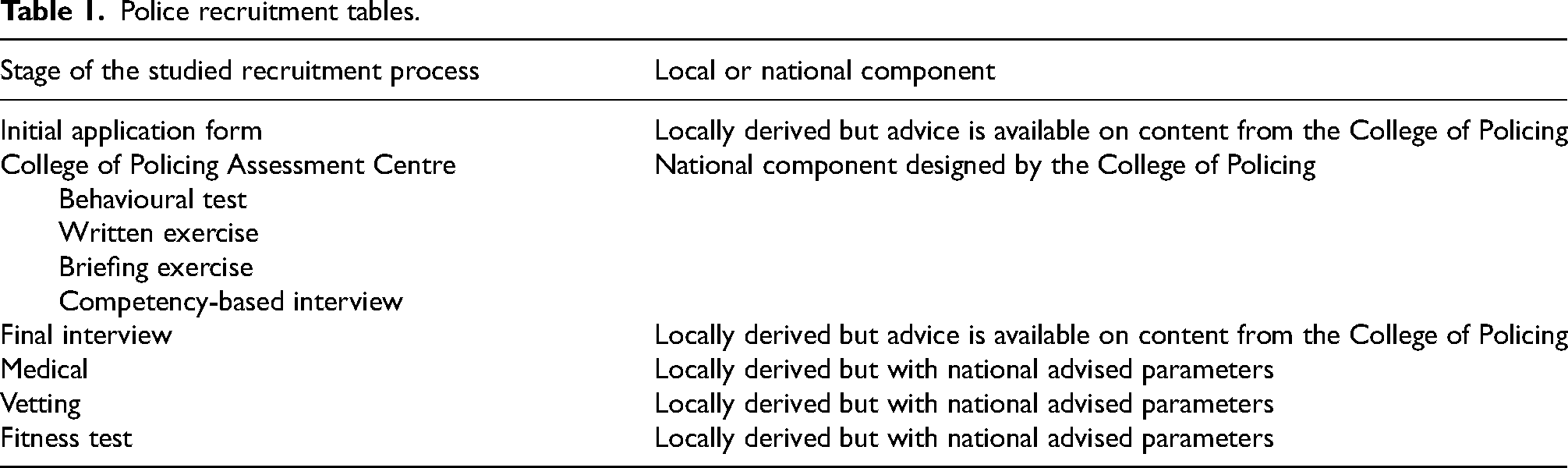
The system represents a ‘pick-and-mix’ for English and Welsh police forces, who all ‘buy in’ to the CoP national process at some point. Services can choose to include ‘pre-sift’ stages such as an application form before the CoP process and will often offer ‘post-sift’ processes afterwards; for example, a final interview. In some services, this means recruits may have to find social and personal resources to navigate up to ten different stages; each stage represents a particular challenge for potential recruits, because they form hard ‘gates’ in the way that the processes are conducted. A ‘gate’ in this context is whether a stage is simply passed or failed, and each stage listed in Table 1 is completely different from the next. There is little opportunity for candidates to perform across a range of in-service and national processes; as a candidate fails at a stage, they are removed from the process. The human resource department in the researched context allocated two staff members to the administration of this process; there was simply no facility to offer any bespoke support for candidates from their perspective. Overall, this process represents a traditional, attrition-based recruitment model, with large numbers at the start of the recruitment window (a time ‘opened’ for recruitment), that are whittled down to very small numbers at the point of actual recruitment. Candidates must navigate each stage as if it had its own requirements, because at any point, they may fail the process and must reapply at stage 1 during the next available window.
Research on the iterations of these localized processes is lacking. Statistics from 2017 (College of Policing, 2017) for the previous national CoP process indicated that there was significant disparity (15.4%) with regard to the performance of Black and Minority Ethnic candidates. This information was collated through a Freedom of Information request by the Thames Valley Police to the CoP, illustrating the accessibility of these statistics. More recent statistics (College of Policing, 2021) following a change to the online assessment centre instigated during Covid-19 lockdowns indicate that the disparity has reduced to 9%, but it is still present. These reports do not indicate disparity at the granular level of individual stages (or even exercises) in the CoP process; they also do not cover how potential candidates experience recruitment processes. It is important to note that, for many candidates, the recruitment process itself may be their first tangible contact with police officers and staff, therefore representing an opportunity to develop relationships with the candidates themselves and lower any perceived social distance between them (Gibbs et al., 2020). The importance of quality and fair processes (Blader and Tyler, 2003; Tyler and Bies, 1990) and their impact on long-term recruitment have yet to be examined.
In light of this collection of different approaches, police forces in England and Wales all utilize some form of ‘positive action’ to address perceived disparity in their own respective recruitment processes. ‘Positive action’ takes its meaning from ‘affirmative action’ (West, 1998), having first being discussed in context in 1964 in the Civil Rights Act in the US. The term had no special meaning other than the use of specific actions to remedy disparity or discrimination with regard to employment law. In the context of this article, it represents an additional layer of support for potential police recruits, who may be the subject of disadvantage in the recruitment process. It is important to emphasize that positive action does not represent positive discrimination (Hatch and Sherrott, 1973), an intervention that requires particular conditions for it to be legally supported.
The desire for positive action is generated by the requirement for representative outcomes in police recruitment (Cook and Hegtvedt, 1983). This requirement has its roots in the theory of representative bureaucracy (Krislov, 1974), which suggests that the more physical the representation of a particular group within an institution, the more representative its actions may become. Krislov discussed this as a matter of degree, and it has since been discussed in the debate on active and passive representation (Bradbury and Kellough, 2011; Sharp, 2014). It is assumed that more officers from under-represented groups will lead to improved policing and perceptions of policing in the community. Although there has been a much more general challenge towards affirmative action in the US (Eastland, 1992; Holzer and Neumark, 2000; Plous, 1996; Pojman, 1998), there is supportive, developing, empirical evidence for its use in policing in England and Wales (Hong, 2015, 2017). Positive action as a process is an optional addition to already existing processes, and police forces are not currently formally required to examine or specifically remedy where disparity occurs.
This means that positive action is difficult to examine across England and Wales. There are no readily available national statistics that portray the overall picture of disparity in localized policing recruitment processes. National data were not collected from individual stages within each service. To illustrate this clearly, an example of this lack of information means that it is not possible to discern whether final interviews in individual services are discriminatory; the data are not collected at this depth in any place other than the originating service if it is collected at all. Scrutiny of potential disparities in police recruitment at the macro-level is therefore only possible using broad statistics provided by the CoP in the online assessment centre (2021). As a result, decisions made on disparity in the policing recruitment process are based on localized, partial data sets that may record disproportionate attrition at each stage of their respective recruitment process. It is not possible to evaluate the efficacy of positive action at the macro level. The Home Office report on police diversity (Home Affairs Select Committee, 2016) found this to be the case. A wide swathe of recommendations was made to services to address the disparity present in the national and internal processes, but the data set contained no granularity and was unable to direct positive action initiatives with any degree of specificity. Therefore, in-force positive action initiatives are ad hoc, localized and difficult to evaluate meaningfully. They operate in particular stages within internal and external processes, which are only subject to internal scrutiny. The outcome is a patchwork of remedial services that may or may not be based on evidence. Police recruits’ recruitment experience is therefore allocated via a ‘postcode lottery’, based on the geographical area to which they apply.
The recruit's experience of the recruitment process and the building of the police identity
Notwithstanding the briefly discussed evidence base for increased representation within police forces, police recruitment has been subject to large amounts of political influence (Home Affairs Select Committee, 2016; House of Commons, 2017) and is, therefore, an active source of pressure for police executives. Since the post-2016 recruitment ‘boom’, police forces have pursued positive action at a scale unlikely to have existed at any time in recent memory. This targeted support is designed to assist under-represented candidates through the recruitment process, bringing them ‘up’ to the level of other more-represented candidates. By default, this means that the candidate's performance within the current recruitment paradigm requires uplift, implying a shortcoming on behalf of the candidate. This presupposes that the recruitment process is itself objective, and support should be given to under-represented candidates to help them ‘pass’ the objective test. It is possible that various recruitment stages are socially entrenched and embedded (Granovetter 1973, 1985, 1988, 2002, 2017), meaning that some candidates able to access social resources will be able to harness significant advantages. This is referred to as ‘social embeddedness’ and describes how reliant on social interaction the process is. If the recruitment processes in England and Wales are highly embedded in existing social structures, this would place high value in a candidate having existing social connections in the police force. This has been the subject of recent research (Hesketh and Stubbs, 2023; Stubbs et al., 2023; Stubbs and Tong, 2024), and the results illustrate relatively high levels of social embeddedness in the studied service. Each social interaction that is aligned with a particular stage in the recruitment process is a generative opportunity to develop recruits’ policing social identity.
Police recruits in receipt of positive action therefore experience very different journeys from those of recruits who do not receive it. This may impact police recruits’ perceptions of policing as a whole and provide socially informed building blocks that affect the building of the policing identity (Charman, 2017). It is possible that experiencing positive action in police recruitment may be a damaging or disadvantageous process for under-represented and represented recruits; it is also possible that positive action builds their confidence and skill in navigating the process. Because of this lack of examination, best and worst practices may persist over time. Without scrutiny from the CoP or His Majesty’s Inspectorate of Constabulary and Fire & Rescue Services, accountability is a matter of ‘opt-in’ by individual forces. Fundamental research is required into the experiences of police recruits to understand properly their experience of police recruitment and what it may mean for their eventual induction into the police and the building of their policing identity. This is not to be confused with existing socialization studies such as those of Chan (2001), Charman (2017), Fielding (1988) and Van Maanen (1973); the area of initial observed socialization has been well discussed and debated. This article focuses on the time before recruitment and the recruit's experience of recruitment itself.
Identity is negotiated dialectically between social actors (Saayman and Crafford, 2011; Scott, 2016), and as such, social and other related contacts with the constabulary and its employees during recruitment act to construct the recruit's policing identity over time. This temporal area of research has previously been referred to as anticipatory socialization (Sang et al., 2009; Scholarios et al., 2003) and has been discussed in the police literature (Bennett, 1984; Charman, 2017; Van Maanen, 1973). It refers directly to the development of police identity before candidates are successful in recruitment. We posit that this term is incomplete, because it assumes that the process of socialization is teleological in its entirety; that is, the potential recruit gathers experiences and negotiates his or her identity with the purpose of becoming an officer – in anticipation. It is highly possible that any number of experiences occur before the decision to ‘become’ as Goffman (1968) would define it, and these experiences may heavily influence that decision irrespective of the purpose of eventually becoming an officer being present. This period is difficult to observe, but social interactions may be utilized by the candidate in any number of ways during the recruitment process.
The experience of navigating the police recruitment process can therefore be clearly defined as a period of anticipatory socialization, because the decision to become an officer has been formally declared and pursued. The recruit is directly and knowingly involved in the building of his or her policing social identity. Research has shown that the formation of identity and its relative strength (salience) within the recruit's identity landscape (Hoelter, 1983) influence well-being (Haslam et al., 2012; Jetten et al., 2012), and this has significant relevance when discussed in the context of increasing representation over time within the policing service. Navigation of the recruitment phase as a process provides a formative identity construction phase (Ibarra, 2004; Saayman and Crafford, 2011) in a recruit's police career; therefore, a consideration of effectiveness in any police recruitment process requires evaluation of variables other than success or failure. Recruitment is not just an instrumental phase that seeks to bridge the gap between in and out of a police force, it represents a collection of social building blocks that shape and build the foundation of professional policing identity (Hesketh and Stubbs, 2023).
Following this logic, it is fair to suggest that there may be a positive and developmental method that builds salience in police recruits’ policing identity, but there may also be potential challenges and drawbacks. As potential officers traverse the recruitment process, it is possible that they are being supported and ‘built-up’ into the policing identity from those that are already within it. It is also possible that they experience a far more difficult experience in building their identity. When social identity is applied as a lens, it generates a clear question about the potential creation, building and sustenance of budding police officers’ identity salience.
This study directly addresses this research gap by asking: How does the experience of the police recruitment process build the policing identity for those successful candidates who experience it?
Method
This research took place in a large constabulary in the north of England. The researched constabulary suffered relatively large cuts during the austerity period and lost 15% of its police officers. Internal access was negotiated through the existing social connections of the lead researcher, who was a police supervisor within the force during the research. This position of insider (Dwyer and Buckle, 2009) provided significant access benefits during this stage of the research and ultimately provided the purposive (Etikan, 2016) sampling that enabled the research. Access in policing research often creates difficult challenges, but the insider status allowed informal negotiation to take place between the researcher and the head of the training department, who supported the permission that was ultimately granted by chief officers to interview fresh police recruits who had just navigated the recruitment process. Once this permission was granted, the purposive element of the sampling became simple; candidates were selected through convenience (Stratton, 2021) from the training centre located in the lead researcher's constabulary.
Curiously, although rank was a salient issue in the authorization of the research, it was consciously minimized during candidate recruitment, as per Davis (2020). Visible artefacts of rank, such as epaulettes and formal uniforms, were removed during participant recruitment, and the agency of the new officer was emphasized. Candidates were approached within the first week of training via a visit to their classroom before their input began, and the aims of the research were explained. They were then requested to complete consent forms in their own time and return them anonymously to the trainer’s desk. The forms were collected by the lead researcher once the class had ended to minimize any unconscious rank-based coercion to take part in the study (Davis, 2022). Recruitment took place from four class intakes of police officers, and the recruitment rate was approximately 21%.
This study consists of 26 long-form interviews (Creswell, 2003) structured using Granovetter's theory of social embeddedness (2017). Social embeddedness theory allows the investigation of social influence and interactions throughout a recruit's experience of the process and the gradual building of their targeted police identity. This structured the data collection and allowed for participant-led interviews (Warren and Karner, 2005) that often ran into several hours as recruits discussed their experience of the police recruitment process. Although the interview guide was structured around social influence, as per the selected theory, participants were allowed to explore the stages of recruitment as they experienced them. This allowed researchers to use the existing coding structure from the theory, but also draw themes (Boyatzis, 1998; Vaismoradi et al., 2013) that were not directly referenced in Granovetter's work. This method allowed direct study of the social identity-building process in the forthcoming analysis. The interviews were coded using NVivo version 11 (Edwards-Jones, 2014; Leech and Onwuegbuzie, 2011; Richards, 1999), and the resulting theory-based and non-theory-based themes were collated and analysed. Saturation was reached at 23 interviews (Guest et al., 2006) but 3 further interviews were conducted to ensure validity (Creswell and Miller, 2000). Of the candidates, 22 self-defined as White, with 3 British Asian participants and 1 from a self-defined mixed race background. The gender split was 11 males and 15 females.
Results
The codes generated through the analysis indicated a varying approach to the gathering of recruitment-relevant information and support for police recruits while undergoing the anticipatory socialization of the recruitment process. Participants with developed and timely social relationships with existing officers (n = 21) utilized their social contacts throughout the recruitment process. These instances of contact were narrated by recruits and subsequently inductively coded into a typology of ‘instrumental’ and ‘pastoral’ support. Those who received support related to positive action (n = 5) still gathered instrumental support but received significantly less pastoral support, and in some cases, negative pastoral support. This support was coded into categories generated from the data.
The researcher categorized pastoral support as ‘soft’ emotional support. It often took the form of encouragement for the adoption of the new policing identity or congratulations upon completion of a particular stage. It was a general collection of supportive ‘coaxing’ into the newly forming identity.
Instrumental support was provided in the form of ‘hard’ informational support or critical, instrumental advice. This took the form of information that resembled assembly instructions such as ‘put this here’, through to evaluation of the recruits’ choice of approach; for example ‘This example you have used in the application form is bad’.
Below we provide examples of each type of support and their relative distributions.
Pastoral support
Pastoral support is often received from friends and family; a typical example of this type of support is represented by the following: Up north, family wise, it's just me and my mum. And then I’ve got my partner […] and my stepdaughter. They were very like … involved with all the aspects. You know, every single time I did anything, I was on the phone to them on the way home […] I was constantly speaking to them about it, you know saying how I thought things went. And then, if I had any kind of down feelings about it, like if I didn’t think something had gone well, they would be like, don’t be so daft. It went fine, you’re just panicking. Family were just, spot on. (Interviewee 12 White female) My husband has been, is so supportive. He's been really encouraging and he's said ‘you will walk the next part etc.’ so he's been, very for it all the way through. Er, and my brother as well, he was very supportive. He said ‘I think you’ve got a really good chance. I think you’ll be really good, I can really see you doing it.’ So they were really supportive of it. (Interviewee 20 White female)
The group of recruits that received positive action contained two who received pastoral support. Others from this group (n = 2) discussed negative pastoral support, which is represented by the following: As a kid growing up, [I experienced] racist comments. Because she's White, so she's had to go through explaining to people why I’m not the same colour as her. Going to school to sort out, you know, people calling me this, that and the other. I think she's just worried about that being on top of being a copper, the effect it's going to have on me. But, she's like, she's very supportive. My parents are divorced but I do speak to my dad quite regularly, a few times a week. But at first he weren’t that keen. But, as I told him more about what's involved, and the clear progression, and the fact that I am going to be helping people, he's like warmed to it now. (Interviewee 17 mixed race female)
A further example from Interviewee 8 illustrates the comparative social status of policing within his close familial social group: You know even if there was somebody in the community in the local area, I could say, ‘well such a person, they’ve done it, you know they’ve gone up the ranks and they’ve made something of themselves.’ But I didn’t have anyone. I didn’t even know anyone who was in the police. So no success stories to follow it through. (Interviewee 8 Asian male)
Instrumental support
Instrumental social support was present at all stages of the recruitment process but at unequal frequencies. It is often characterized by technical support that pertains to particular stage requirements. Instrumental support was characterized by assistance with the first-stage application form. Probably my mum and dad. They helped me out a lot with my application. [probes] they read through the questions with me and helped to … because I used to work with my mum and dad as well, so they could like pick out scenarios to use to answer the questions. It was helpful. And then, they helped me like structure them as well. (Interviewee 13 White female)
Instrumental support was temporally bound. It was related to particular recruitment stages, contained clear assistance and, in comparison, pastoral support was construed by the recruit to be important in very few cases (n = 2). In terms of social building of identity, this occurred at a high frequency across both groups that received positive action (n = 5) and those that did not (n = 20).
Instrumental support was also highly represented among the candidates who received positive action (n = 5). A representative example is as follows: So, after each process I was invited to headquarters, and we got a presentation about it and what was going to be expected of you. So, I had the opportunity to have a practice interview, and assessment centre. And also practice doing the incident statement. So, I feel like I’ve had quite a lot of help in that respect, because otherwise I can imagine it's really, really hard to pass each stage. (Interviewee 17 mixed race female)
The support in this case was stage specific and its purpose was not to build any sort of identity in the candidate; the support simply assisted them to pass the stages that were presented to them. This is significantly different from the ‘pushing’ of the candidate from the already existing social identities possessed by the recruit. Positive action is essentially a function from within the targeted identity, attempting to “pull in” under-represented recruits’: I liked that fact that they e-mailed you the feedback the very next day and that's throughout the whole process: every time you went in, you sat a test, or you had a mock interview, you got a breakdown of the feedback e-mailed to you the next day and there wasn’t any delay in that throughout the whole process. Everything positive action said, they did and I was quite shocked that on one or two occasions when we’d gone over there was quite a lot of people in that class and to have them, we were there in the evening and to have the results with you next day like feedback to say what you did good in, what you could improve on, I found that really, really good service. (Interviewee 8 Asian male)
It is clear that positive action was a good experience for the candidates, who all (n = 5) expressed gratitude and support for the intervention. However, when the lens of social identity is applied, the comparative building of long-term police identity salience becomes clearer. Pastoral support was rated as the most important form of support in candidates (n = 18), and this represents a ‘pushing’ of police recruits from existing social identities. Instrumental support was supplied through existing social identities in all samples, yet its origin was distinctly different. Existing pastoral support is often twinned with instrumental support for candidates with existing social ties in policing. This represents a double layer of identity-building support for those with existing police ties and a distinct platform for the building of lasting and solid identity salience in police recruits. For those accessing instrumental support from positive action, the ‘pulling in’ to the service results in temporal support that ceases upon the point of recruitment. It is also possible that candidates receiving instrumental support through positive action are more likely to receive negative pastoral support, resulting in identity salience unsupported by existing social ties.
When the previously discussed coded instances of pastoral and instrumental support are modelled, they illustrate quite different journeys into the organization (Figure 1).
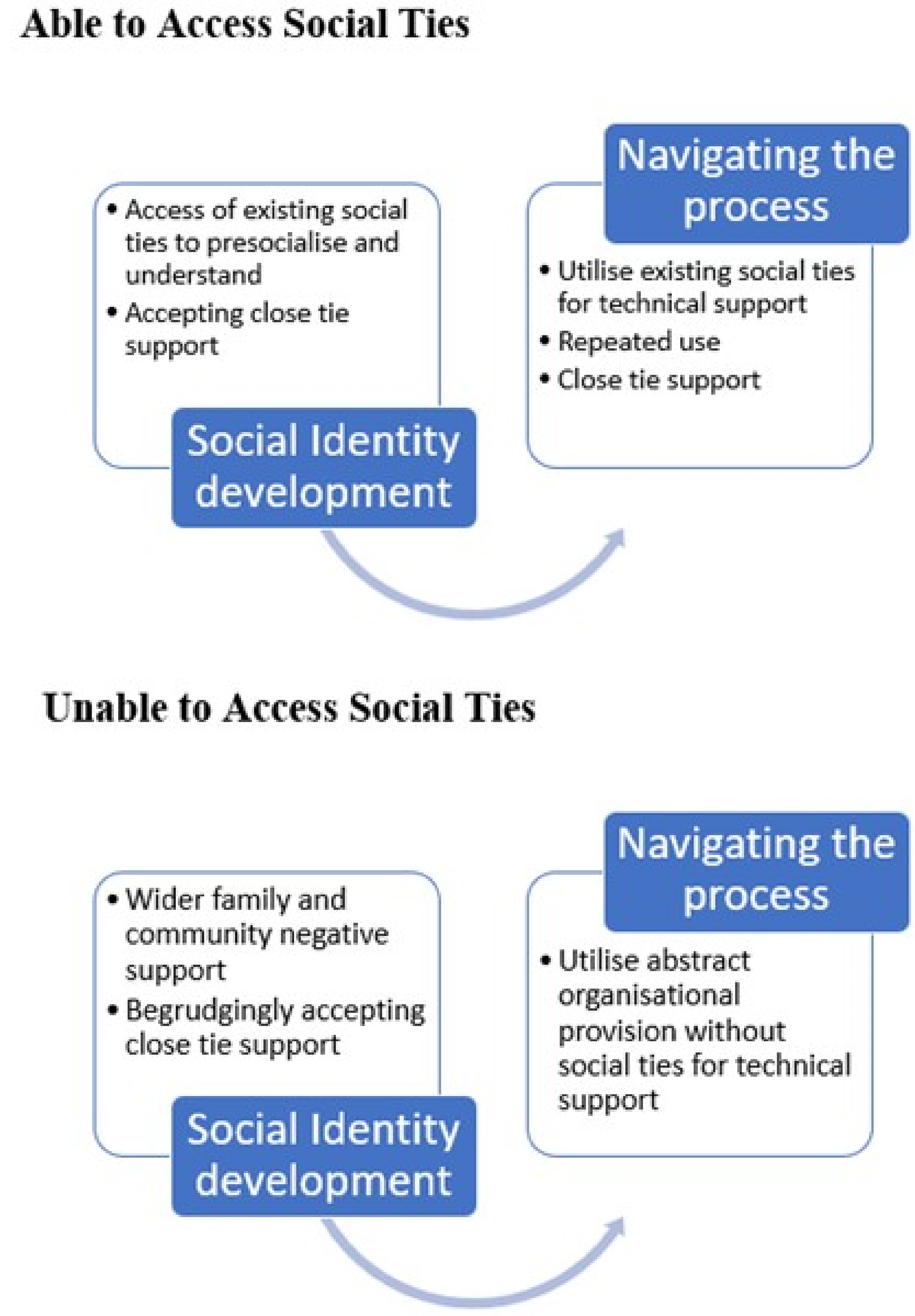
Access to social ties.
Figure 1 illustrates the process of identity development discussed by those candidates utilizing existing social ties, with navigation of the process being laden with real, social tie-based support. This is in contrast to those candidates who accessed positive action, who instead experienced support from the organization, but not from those already within the desired identity. Although technical support is present in both instances of the navigated process, those without social tie access experience a very different type of identity development. An organization that only offers instrumental support does not offer recruits experiencing positive action a sustained source of pastoral support, and therefore does not build their policing identity through agents who will provide a continuing social resource post-recruitment. Those new recruits who had access to social ties, were pushed in by existing social ties and experienced sustained social resources as they traverse the formalizing of their policing identity through socialization. Those who did not have access to social ties were pulled in by the organization – an abstract entity that does not offer persistent social resources after the recruitment process. Existing social ties are similar to identity buoyancy aids that offer support that is unbounded by the recruitment process.
Conclusion and implications
The illuminated typology of social support for currently successful candidates illustrates the existence of a highly contrasting journey for those who have and those who have not gained access to existing social connections. Those with social connections receive a conjunction of pastoral and instrumental support, which operates as a driving force that emerges from existing social connections. Those already within complimentary embedded social networks experience a pushing from within their existing networks. They do not have to establish new social networks or relationships to experience this impetus; it simply reinforces their choice to become officers. It endorses their choice of profession along with their newly chosen, developing identity. The previously discussed results illuminate the socially influenced experience of police recruitment and explore the differing experiences of those who can and cannot access existing social ties in policing. The results illustrate that social ties matter to the building of police identity, and may also suggest some empirical support for the disparity in police recruitment processes.
Candidates without any existing endorsing social connections face a very different challenge. They first apply for the police without support from existing social connections, a choice that may bring alienation and social struggles within their existing social identities. They must then create a new social relationship with the positive action team, which forms strong instrumental support for them as they traverse the recruitment process. This instrumental support is temporal and lasts only for the duration of the process. It does not function as an existing social connection pushing them from within, but instead represents a newly formed, external social connection, pulling them from without. The traversal of changing identities during the shifting of an occupational identity (Ibarra, 2004) is a complex and difficult experience for anyone but carries more complexity when the social building blocks differ.
This difference leads to separate considerations, such as candidates’ ongoing well-being within the policing organization. In social psychological literature, identity salience has implications for the level of support that a person may receive from within that identity (Haslam et al., 2012; Jetten et al., 2017), which may be more pronounced in a profession in which feelings of physical safety are reinforced by very strong group cohesion, sometimes referred to as the blue code of silence (Skolnick, 2002; Westmarland, 2005) and developed feelings of defensive solidarity (Bowling et al., 2020; Loftus, 2010). Enhanced social identity salience within an individual enhances their feelings of connection with those who are already a part of that identity, which can theoretically lead to higher levels of well-being through feelings of belonging and belief in the existence of ongoing social support.
If identity salience can therefore be considered a ‘social starting block’ then questions can be asked about how positive action in this study led to the building of comparable starting blocks for those unable to access existing social connections. This led to those candidates receiving temporal support from a newly formed social connection, a connection that may dissipate entirely upon starting service. In terms of staff retention of those from under-represented backgrounds (Charman and Tyson, 2023; Barron and Holdaway, 2016), this implies that the social identity journey for candidates from under-represented groups is far more uneven than that for others with social connections, who enjoy building their relative identity salience from their initial choice to become police officers.
An additional layer to consider is the negative social influence of candidates who received positive action interventions. Not only do they have to form new social connections to receive instrumental support, but they also receive negative pastoral support. This does not build identity salience in those candidates, it performs a ‘lowering’ of relative salience from within their existing social identity landscape; this represents another significant barrier to entry that is simply not measured, or considered in existing, instrumental-based positive action initiatives. This places the starting blocks of identity salience building and creation as starkly different for those who have social connections related to policing and those who do not. The theoretical implications of this in terms of recruits’ well-being over time are significant and may contribute to a lack of feelings of belonging or available social support for those who do not have such social connections already in place. Over long periods, undeveloped social identity may even lead to resignation (Barron and Holdaway, 2016) and a lack of feelings of belonging (Charman and Tyson, 2023).
This research indicates that an improved understanding of the phenomenon of police recruitment from the viewpoint those who are traversing it may illuminate improvements in positive action that are much needed. Given that landscape is currently very difficult to decipher properly in terms of disproportionality across services in England and Wales, this research indicates that changes may be necessary not only for the purposes of raising representation. New recruits from under-represented groups may face challenges in gaining social acceptance and support over time and, thus, in developing feelings of belonging. The social building blocks for service, despite the best efforts of positive action initiatives, may not assist in developing representation over the life of the police force, and may also be creating stored, identity-based challenges. Those with underdeveloped social identity salience may also experience ongoing pastoral stigma from within their existing social identities, resulting in an uneven and distinctly different social identity landscape.
Although it would be unwise to generalize across the whole of the English and Welsh landscape using this study, the 26 interviews were conducted to understand a research gap more fully. This should not preclude significant conclusions being drawn because recruitment processes are similar across both countries, and the results could be used to generate new avenues for research and inform tentative change in some practice. An example of this would be to ensure that positive action processes, wherever they are conducted, retain some aspect of longevity, because the difference between persistent social support and temporal, instrumental organizational support is so starkly represented. Other possible avenues include a landscape review of recruitment processes in England and Wales to examine their structure and vulnerability to social influence, and the potential gathering of social tie information by police forces at the point of recruitment. The latter could be used to predict uneven social tie development and therefore provide an evidence base for bespoke support for under-represented candidates.
Footnotes
Declaration of conflicting interests
The authors declared no potential conflicts of interest with respect to the research, authorship, and/or publication of this article.
Funding
The authors received no financial support for the research, authorship, and/or publication of this article.
