



Abstract
Police workforce retention has become a persistent managerial concern. The public response to recent events of police misconduct have fuelled the perception that police may be seeking other career paths following the murder of George Floyd in 2020. Despite growing evidence, current research has been unable to ascertain what conditions may prompt officers to voluntarily separate from police work following Floyd’s murder, or whether the impact varies across demographic groups. Drawing upon a survey of over 600 police officers across eight police departments in the United States, the current inquiry examines what percent of officers reported reconsidering their career following the George Floyd incident, and whether demographic information and occupational attitudes could predict whether officers reconsidered their careers. Findings indicated that female officers were more likely to strongly agree that it made them reconsider their careers, and that instrumental concerns (i.e., public support, personal liability, localized fallout, and concern over media attention) were also influential.
Introduction
Scholars of police organizations have stated that the maintenance of a police agency’s workforce requires effective and balanced recruitment and retention efforts (Orrick, 2008; Palmer et al., 1998; Taylor et al., 2006; USDOJ, 2020; Wilson et al., 2010). Historically, the ability of police agencies to attract and retain quality officers has been linked to several factors, such as economic conditions, compensation, organizational climate, and the level of danger and citizen hostility that is perceived among officers (Haarr, 2005; Jurkanin et al. 2001; Koper et al., 2001; Orrick, 2008; PERF, 2019; Taylor et al., 2006). When police resign from their positions, whether to leave their agencies or the profession entirely, departments are faced with many negative consequences. These include monetary costs of recruiting and training new officers, increased workload stress for remaining officers, declining organizational health from imbalanced officer tenure, and potential misconduct issues from large scale new hires (Orrick, 2008; Stanley, 2008; Wilson et al. 2010).
Sentinel events of police misconduct have also emerged as a potential catalyst for officer resignations. In prior research, police turnover has been hypothetically linked to high-profile incidents such as the beating of Rodney King and its associated effect on officer morale (Cannon, 1999; Martin, 2005). Despite the hypothesized links, police workforce research following the Rodney King incident has rarely focused on police misconduct as a potential force driving voluntary resignations. These trends were theoretically explained by business cycles, the availability of alternative careers, and changing generational preferences (Orrick, 2008; Wilson et al., 2010). Since the 2014 protests associated with the Michael Brown incident, public outrage at police misbehavior has raised the possibility that perceptions of police professional integrity could influence the degree to which some officers would reconsider their career (Blumberg et al., 2020). This insight was coupled with a new focus on police integrity as a cornerstone principle of police operations, providing a new way of interpreting management trends. Seen through this lens, more recent research has empirically linked police resignations to the murder of George Floyd (Mourtgos et al., 2021), an indication that the nature of his killing may be impacting police officers differently. The impact of this particular event on police career consideration is potentially stronger than previous incidents of police misconduct because of the marked shift in overall public opinion towards the police that occurred (Boudreau et al., 2022; Brantingham et al., 2022; Reny & Newman, 2021). Beyond the generalized recruitment and retention concerns of simply finding and keeping enough qualified personnel, police agencies have also long been under public and political pressure to increase diversity, equity, belonging, and inclusion within their ranks (Raganella & White, 2004; Rossler et al., 2019). Several scholars have considered this as a possible solution to problematic police behaviors and to increase legitimacy with communities of color (Raganella & White, 2004; Rossler et al., 2019). The tragic irony of gross police misconduct involving the murder of an African American man (e.g., George Floyd) by a police officer is that not only might it spur voluntary separation from a policing career but may also have an outsized effect on officers of color, officers who are female, and early career officers. The nature of his murder, coupled with the reaction on social media, mass protest, and influence on shifting public opinion is unparalleled in reaction to a police incident (Boudreau et al., 2022; Reny & Newman, 2021; Silverstein, 2021), and had a more substantive impact on the day-to-day wellbeing of black Americans (Lin et al., 2022). Additionally, the impact of the Floyd murder may be felt stronger in officers who experience changes in perceptions of their work environment, or who have more sympathetic attitudes toward social justice movements. While some current research has indicated that the murder of George Floyd had an immediate and lasting impact on voluntary separations from policing, research has not been able to directly indicate it as a cause, nor has any inquiry addressed whether it impacts officers of color, women, or early career officers differently (Mourtgos et al., 2021).
Drawing upon a survey of over 600 police officers in eight agencies throughout the United States, the current inquiry investigates the degree to which officers reconsidered their careers because of the murder of George Floyd, and whether these feelings are related to officer demographic variables, as well as attitudes toward the public, police work, personal liability, and their support for police accountability activist movements (e.g., Black Lives Matter).
Literature Review
Police turnover is an issue with serious consequences for police organizations, the public, and individual officers. One major concern with respect to police organizations and turnover is the cost of recruiting and training new officers. Departments invest significant time and monetary resources into a recruit’s academy and field training experiences (Buehler, 2021; McCampbell, 1987). In total, the financial costs of replacing an officer are about one to five times the officer’s salary, and it may take a year from the beginning of the hiring process to the time where an officer is a contributing member of the department (California POST, 2006; Orrick, 2008; Whetstone et al., 2006). Work related stress also lowers officers’ morale (Clements et al., 2021; Constantinou, 2021) and is linked to myriad work performance issues among police officers, which may further diminish police-community relations and harm recruitment efforts (Chanin & Sheats, 2018; Long, 2019; Oliver, 2015; Wolfe & Nix, 2016). Job stress is also linked to negative health outcomes for police officers, such as chronic heart health issues, mental health concerns, and substance abuse issues (Magnavita et al., 2018; Violanti et al., 2017).
With respect to the causes of police turnover, research typically identifies work environment as an important consideration (Allisey et al., 2014). Allisey et al. (2014) report that internal work environment concerns such as autonomy in work, role clarity, reasonable job demands, supportive peers, supportive managers and input on organizational decisions predicted intentions to quit via job stress and satisfaction (Allisey et al. 2014). Similar results, with respect to job satisfaction, stress, and in some instances the intention to leave as a result have been reported in a substantial amount of other research on both police as well as other criminal justice practitioners (Adams & Buck, 2010; Brough & Frame, 2004; Gächter et al., 2009; Paoline & Gau, 2020; Stinchcomb & Leip, 2013).
Somewhat surprisingly, research indicates that external environmental concerns seem to be less reliably predictive of intentions to quit among police officers, as well as antecedents such as job satisfaction and work stress (Shane, 2010). In recent research, Paoline and Gau (2020) reported a null relationship between officer perceptions of citizen hostility and job satisfaction. Additionally, officers who perceived their work to be dangerous reported higher levels of job satisfaction (Paoline & Gau, 2020), which is a conceptually counterintuitive finding. Alternatively, research conducted by Adams and Buck (2010) reported that as perceptions of citizen hostility increased among officers, their intention to leave their jobs also increased, which is more in harmony with traditional conceptualizations. 1 While there does not seem to be a reliable connection between citizen hostility or job danger and reconsideration of one’s career path, we believe that these issues merit further inquiry.
Further supporting the subordinate influences of external work environment features is the lack of impact that sentinel events that diminish police legitimacy have on turnover. Policing has experienced several crises of legitimacy as a result of condemnable actions by the police throughout history (e.g., Watts riots, Detroit riots, beating of Rodney King). Similarly, more recent incidents have spurred protests and civil unrest following the recent acquittals or lack of official response to the police killings of Michael Brown, Laquan McDonald, Sandra Bland, and Philando Castile (Routley, 2020). The much-ado-about-nothing trend with respect to police leaving their positions because of public scrutiny and widespread negative perceptions about the institution has been historically consistent. Research examining police staffing concerns due to high-profile cases indicates that effects minor and short in duration (Rhodes & Tyler, 2019). While not directly related to turnover, the impact of public scrutiny has been overstated as an influencing police behaviors such as diminished proactivity, increased violent crime, and officer felonious assault victimization (Mac Donald, 2015; MacDonald, 2016; Maguire et al., 2017; Shjarback & Maguire, 2019; Sierra-Arevalo & Nix, 2020).
Despite the empirical reality of police historically remaining in their positions in the face of significant losses in political capital, enhanced scrutiny, and negative media attention (Routley, 2020), the concerns over the murder of George Floyd, and the way in which he was killed was both qualitatively and quantitatively different that other police killings. It was truly unique in a negative way. Indeed, some early empirical research has indicated that the George Floyd situation is unique and is a significant point source for police departures (Mourtgos et al., 2021), bolstered by a large-scale body of more anecdotal evidence from single cities across the United States (MacFarquhar, 2021; PERF, 2021).
When considering recruitment and the potential of career-interested persons to remain in patrol careers, findings post-George Floyd are limited by the lack of data capable of addressing how distinctive the George Floyd murder is relative to other instances of police use of force. Early research surrounding police departures from their chosen occupation into other career paths is certainly notable, but it does suffer from some limitations such as examining only patterns in single departments that may also experience other historical artifacts such as changes in city government, leadership, or organizational culture (Brough & Frame, 2004; MacFarquhar, 2021; Mourtgos et al., 2021; PERF, 2021). Similarly, the death of George Floyd also occurred during a global pandemic, which also coincides with many other reasons police officers may leave their jobs, including fears over COVID-19, resistance to vaccination mandates, and significant economic disruption including hiring incentives in many other industries that may pull officers away when outside opportunity is high (PERF, 2021).
Prior research has also struggled to adequately address potential differences in who may be more likely to leave, or consider leaving, directly because of the murder of George Floyd. Policing as an institution has been under immense pressure to increase the inclusion and belonging of people of color and women into policing (McCrary, 2007; McGreevy, 1996; Raganella & White, 2004). Research has yet to identify whether the potential exodus due to the killing of George Floyd is having an outsized impact on officers of color and those with less experience in the profession, which is reasonable given the divergent manner in which people of color and young people perceive the police.
One group who may be more impacted in career persistence by the murder of George Floyd are officers of color, particularly officers who are Black and African American. Members of Black and African American communities generally hold the least favorable views of police in America (Weitzer & Tuch, 2005), and research has linked the lower levels of perceived legitimacy to disinterest in police patrol work (Rossler et al., 2019). Given this empirical relationship, the murder of George Floyd could produce an outsized perceived loss of legitimacy among African American police officers. Furthermore, diminished support from family, friends, and community for police officers may lead to higher pressure to leave policing for African American officers, and other officers of color.
Furthermore, women who are police officers may also be differentially impacted by the global attention focused the violence perpetrated against criminal suspects. Certainly, internal treatment of women in police agencies (e.g., sexual harassment, tokenism, and lack of supervisory support) and family-career conflict are highly influential for retention (Brough & Frame, 2004; Rabe-Hemp, 2008a; Seagram & Stark-Adamec, 1992), and sentinel events are likely less influential. Related to the murder of George Floyd, research has found that women who are police officers tend to use less extreme controlling behaviors (Rabe-Hemp, 2008b) and use less force in arrest decisions compared to officers who are men (Garner & Maxwell, 2002; Schuck & Rabe-Hemp, 2005). Research has also found empirical support that women are more empathetic than men, on average, and it is reasonable to consider that higher aggregate levels of empathy may be contrary to the identity placed on police officers by many members of the public following the murder of George Floyd. Given this prior literature, reactions among police officers who are female to unprecedented events such as the Floyd murder should be examined. Certainly, gender may be an influential predictor of whether someone is likely to reconsider their career following an event that puts their personal identity and public perceptions of their career at odds (see Fryers, 2006).
Additionally, early career officers may perceive and respond to the killing of George Floyd in a different manner than later career officers. Perceptions of both occupational prestige and organizational reputation have been shown to influence employee intentions to leave (Dalton et al., 2020; Ahmad Saufi et al., 2023; Guerrero & Challiol-Jeanblanc, 2017). Early career officers may not be as solidly embedded in their workplace or career path (early career employees tend to have lower organizational commitment – see Stevens et al., 1978; Tandon et al., 2020), and a sentinel event like the murder of George Floyd, and the way in which it occurred, may make them reconsider the career path. Additionally, much like the experiences of African American officers, early career officers may face more social justice pressures from their immediate social group who are more heavily involved in social and political causes, on average (Carnegie, 2022).
Finally, the murder of George Floyd has influenced (or at least perceived among police officers) calls for police reform. This includes diminished public support for the police, modifications to protection from personal liability, local community perceptions, and negative media attention. Officers who are sensitive to these concerns have been historically linked to, or are emerging, as predictors of officer job satisfaction and voluntary separation from police agencies (Kappeler, 1997; Oliver, 2019; Pride, 2021; Scogin & Brodsky, 1991).
Recently, officers who express concerns over public support for police in their community have been linked to increasing desire to leave the field of policing. Officers are reporting in exit interviews that the national climate surrounding the institution of policing is leading to police seeking jobs outside of patrol (PERF, 2021). Additionally, administrators have expressed the belief that senior officers are retiring at their earliest possible opportunity to avoid structural reforms to policing that does not involve meaningful input from all parties (PERF, 2021). Certainly, officers have expressed negativity surrounding media attention on the police and list it as a reason to leave (Lehman, 2021), but others are also bolstered in communities where they perceive local community support to be high (PERF, 2021).
Another shift in the perceptions of police officers related to reform is the increased potential for liability, including roll-backs of qualified immunity and increasing calls for police to purchase personal liability insurance (Kappeler, 1997; Pride, 2021; Scogin & Brodsky, 1991). Many police officers are becoming increasingly apprehensive about their career choice in light of the belief that officers will no longer be protected from lawsuits, and that if they are indeed sued, that juries are increasingly willing to find them liable (Oliver, 2019; Pride, 2021). Given this prior research, the litigaphobia (i.e., fear of being sued) officers feel is not new, but officers who express these fears may be more sensitive to the reforms perceived to be inevitable by them following the brutal murder of George Floyd, the distribution of that scene through social media, and the resulting global protests.
Research Objectives
To expand upon prior inquiry into this area, the current research examined three research objectives with respect to the impact that the murder of George Floyd had on officers’ intentions to stay in their current line of work. First, the current inquiry examined whether police officers reconsidered their career directly as a result of the George Floyd incident. While large scale voluntary departures have been noted in research (Mourtgos et al., 2021) and media (MacFarquhar, 2021; PERF, 2021), we asked officers whether they had any career doubts specifically as a result of the killing of George Floyd. Second, the current inquiry considered whether police officers’ demographic information influenced whether they have reconsidered their career because of the George Floyd incident. Finally, the current inquiry considered whether perceptions of noteworthy and rapidly changing instrumental issues related to sentinel events of police misconduct (i.e., public support, personal liability, departmental fallout, media fear) influenced the reconsideration of one’s policing career.
Methods
Survey Design and Administration
Data for the current inquiry are drawn from Police Retention and Career Perceptions, a study which explored, using a national sample of police agencies of varying size and jurisdictional character, police officer attitudes toward their careers at a critical time in United States history. The study utilized an approximately 180-item survey questionnaire to probe officer attitudes toward either remaining in or leaving the profession, as well as critical questions pertaining to the specific workplace climate at each surveyed agency, the officers’ salaries and benefits, physical aspects of officers’ positions, and their impressions of organizational values. Many items were rooted in prior research, while others were required to be developed to address unique or timely issues. The survey was distributed to sworn police officers from the following roster of participating agencies in the United States: Topeka (Kansas) Police Department, Vernon Hills (Illinois) Police Department, Smyrna (Georgia) Police Department, Biloxi (Mississippi) Police Department, Frederick (Maryland) Police Department, Thornton (Colorado) Police Department, Bryan (Texas) Police Department, and Portland (Oregon) Police Bureau. The agencies demonstrated geographic and organizational variance across multiple dimensions, including jurisdictional size and location, sworn personnel size, political and operational environment, jurisdictional character, and community support.
Participating agencies were selected to ensure geographic variance in responses from sworn officers, as well as administrative strategies for workforce management and officer retention. Care was given to equally capturing agencies of different size and jurisdictional character. Issues of consideration included median household income, existence of colleges and/or universities, population and demographic trends, and historical familiarity with criminal justice research. At the time of survey distribution, the United States had begun recovering from the first wave of the COVID-19 pandemic and was aware of heightened public scrutiny of policing tactics. These two challenges were the subject of survey questionnaire items capturing officer perspectives on their agencies’ approaches to navigating crisis.
After pretesting the instruments with agencies not included in the sample, survey administration to participating agencies proceeded in two ways: electronically and in-person. Due to the COVID-19 pandemic and its associated restrictions on researcher interaction with survey participants, three of the sites (Topeka, Vernon Hills, and Smyrna) were surveyed using Qualtrics software in the form of an online survey which was linked via email from research staff to all sworn personnel and distributed by those agencies’ training or command staff to an internal roster of these employees. This allowed for more widespread survey distribution throughout these agencies’ sworn officer populations and resulted in a stronger impression of response rate given that numbers of emails sent could act as actual participant numbers. In this manner, the response rate for the three electronically surveyed agencies was calculated to be 60.1%. The Qualtrics software prohibits duplicate surveys based upon a researcher use of a mechanism recording IP addresses and linking them to survey completion. The software reports completed surveys in Microsoft Excel format.
For the in-person participating agencies, researchers decided to administer the survey at two locations: briefings prior to patrol shifts in order to survey patrol officers, and individual meetings to distribute the survey to specialized units and non-patrol personnel. This maximized study visibility and survey availability but prohibited a true accounting of the total amount of sworn personnel that could have participated, confining the response rate figure to a measurement of available sworn personnel on the dates researchers visited the sites. In this manner, researchers were able to calculate the response rate at these five sites to be 78.2%. This was based upon a total of 56 actual survey administration points across the five agencies during the face-to-face administration method. Personnel who may have encountered the survey at different points in the researcher visits were asked not to take the survey again had they already done so. In the in-person modality, participants took the survey on paper in a self-administered format and all completed surveys were subsequently coded by research staff.
Due to the COVID-19 pandemic-related restrictions on travel, Topeka, Vernon Hills, and Smyrna data were collected via an online survey that was available from 3/15/21 to 3/30/21. This period corresponds roughly with the time period that is shortly after the City of Minneapolis agreed to a civil settlement with George Floyd’s family. Furthermore, most respondents would have taken the survey before Derek Chauvin’s state criminal trial began on March 29th, 2021. The remaining sites were visited in person. The dates for those locations are as follows: Biloxi (6/3-6/5/21), Frederick (7/26-7/29/21), Thornton (8/9-8/12/21), Bryan (9/20-9/22/21) and Portland (11/7-11/12/21). The survey period in Biloxi is after Chauvin was convicted in state court, but prior to sentencing. The remaining sites were surveyed after Derek Chauvin was sentenced in state court, but prior to him pleading guilty to federal charges.
Dependent Variables
The dependent variable for the current inquiry is the degree to which currently active police officers agree with the statement that the George Floyd incident made them reconsider their choice of a career in policing. To examine this, we assessed officer agreement on a four-category scale (1 = strongly agree, 2 = agree, 3 = disagree, 4 = strongly disagree) with the following statement: ‘The reaction of many members of the public to the George Floyd incident in Minneapolis has caused me to reconsider my law enforcement career’ (reverse coded). Prior research has indicated that the killing of George Floyd has caused an exodus from policing that has not occurred from other high-profile incidents of gross police misconduct (Mourtgos et al., 2021). Given those prior limitations, we seek to model the degree to which officers reconsidered their career choice as a function of officer demographic characteristics (i.e., race, gender, experience, and relationships with other officers), organizational assignment (i.e., patrol officer), perceived public support for the police, concerns over liability, public fallout, media scrutiny, and sympathies for the Black Lives Matter movement.
Independent Variables
Given the racially charged nature of the killing of George Floyd, as well as the public response to it, it stands to reason that the inseparable link between police racial discrimination and the incident may have affected officers of color differently than white officers (Perrott, 1999). Black officers, despite hiding features about themselves and adopting police occupational culture to avoid internal discrimination, often feel responsibility to represent their heritage group in policing (Gartland, et al., 2022). This push to benefit society from inside policing is often at odds with personal and vicarious perceptions of the police and pursuit of a police career (Perrott, 1999; Rossler et al., 2019). As such, we include three dummy variables that measure the self-reported race or ethnicity of each respondent to an open-ended question. From respondents open-ended questions, seven different racial or ethnic categories were coded. Given sample size limitations, these seven categories were recoded into three dummy variables representing respondents who identified as Black or African American (0–1), Latino or Hispanic (0–1), or another race (0–1), with white officers serving as the reference category.
In addition to race, a dummy coded variable was created for whether a respondent was female (0–1) with male serving as the reference category. Officer experience was also included in the analyses, in addition to whether the officer had ever had a long-term significant other who served as a police officer (0–1), and whether they had an immediate family member (e.g., parent, sibling) who served as a police officer (0–1). Furthermore, a variable was created to determine the influence of an officer working in patrol (0–1), with all other assignments serving as the reference category.
Previous research has indicated that it is not simply demographics or organizational assignment that may influence the impact that the George Floyd incident had on career continuity among officers, but also their perceptions of public reactions (MacFarquhar, 2021; PERF, 2021). As such we hypothesize that perceived public support, liability concerns, perceived public fallout from George Floyd’s murder, media scrutiny, and sympathy with the Black Lives Matter movement may all influence whether officers reconsidered their career choices.
To measure the degree to which officers perceived the public as no longer being supportive of the institution of policing, we assessed agreement on a four-category scale that was used for all independent variables (1 = strongly agree, 2 = agree, 3 = disagree, 4 = strongly disagree) with two indicator statements: ‘The current ‘anti-police’ sentiment among the public does not represent the majority of citizens’ beliefs’ and ‘Despite what you see in the media, most of the public supports the police these days.’ The summation of responses to these two statements produced our scale for public support (α = .824).
Liability concerns have also been hypothesized as to why police officers may be leaving their jobs, particularly in the wake of police reform efforts across states such as Colorado, California, and Minnesota (MacFarquhar, 2021; PERF, 2021). The decision to leave due to liability concerns is one i.e. quite instrumental (e.g., it affects personal concerns of wellbeing) rather than expressive (e.g., I do not share principles with the institution of policing). To measure perceived liability concerns we assessed agreement with the following statements: ‘I am afraid of being sued because of my job’ (reverse coded), ‘In police work, a person stands a good chance of being sued’ (reverse coded), and ‘I am apprehensive about potentially having to purchase personal liability insurance’ (reverse coded). The summation of these three items produced our scale of liability concerns (α = .714).
Much like concerns over liability, officers also have instrumental fears over negative media attention. Media scrutiny concerns (α = .698) were measured using a four-indicator index based upon agreement with the following statements: ‘I personally fear negative media attention because of my job’ (reverse coded), ‘I am bothered by the way my department is portrayed in the news media’ (reverse coded), ‘I am bothered by the way law enforcement as a profession is being portrayed in the news media’ (reverse coded), and ‘I have seen fellow officers in my agency engage in less proactive work for fear of negative media attention’ (reverse coded).
While the murder of George Floyd made worldwide headlines and sparked protests both throughout the nation and even across the world, little research has examined whether a localized effect has had impacts on police officers. To address the influence that relationships with and treatment of police by the public might have on officer willingness to stay in their jobs, we asked officers their agreement with two statements designed to address more localized fallout from the George Floyd incident. The two statements were: ‘I have noticed a negative change in the relationship between community members and police officers where I work since the George Floyd incident’ (reverse coded) and ‘The agency I work for has faced significant public criticism since the George Floyd incident’ (reverse coded). Adding responses to these two indicator statements produced the scores for our Floyd Fallout (α = .789) index. Finally, to measure support for the goals and objectives of the Black Lives Matter movement, we assessed agreement with the following indicator: ‘The “Black Lives Matter” movement has opinions that need to be heard by police officers and leaders’ (reverse coded).
Additionally, we held the influence of agency constant through a series of seven dummy variables. These variables are Biloxi (1 = Biloxi (MS) Police Department, 0 = All others), Smyrna (1 = Smyrna (GA) Police Department, 0 = All others), Topeka (1 = Topeka (KS) Police Department, 0 = All others), Vernon Hills (1 = Vernon Hills (IL) Police Department, 0 = All others), Frederick (1 = Frederick (MD) Police Department, 0 = All others), Thornton (1 = Thornton (CO) Police Department, 0 = All others), and Bryan (Bryan (TX) Police Department, 0 = All others). The most frequently occurring agency in the data set was Portland (OR) Police Bureau, which served as the reference category.
Analyses and Findings
Descriptive Statistics
Descriptive Statistics for Dependent Variable.
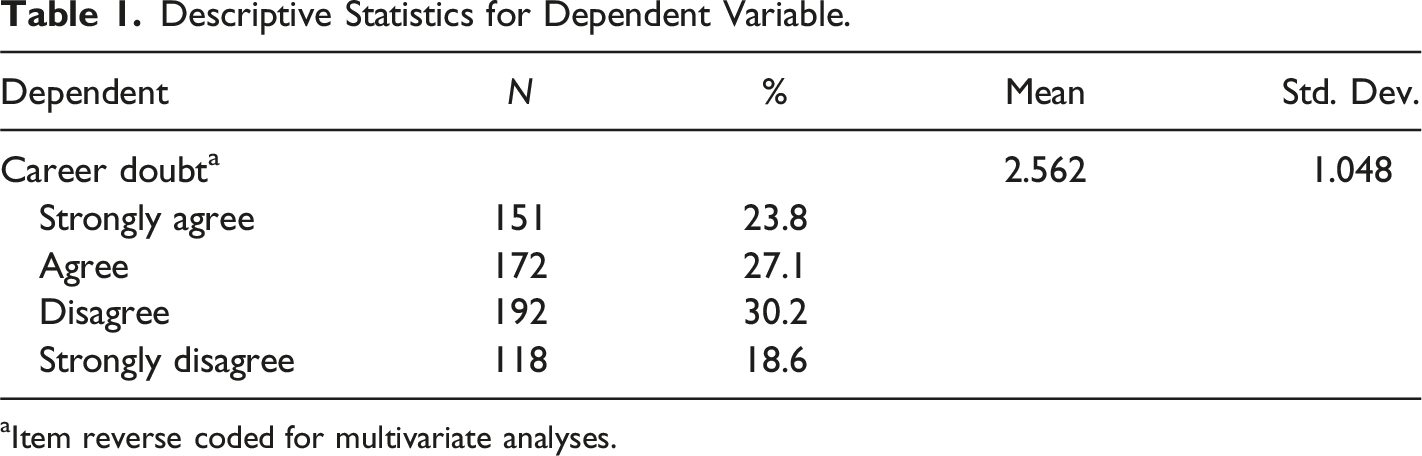
aItem reverse coded for multivariate analyses.
Descriptive Statistics for Independent Variables.
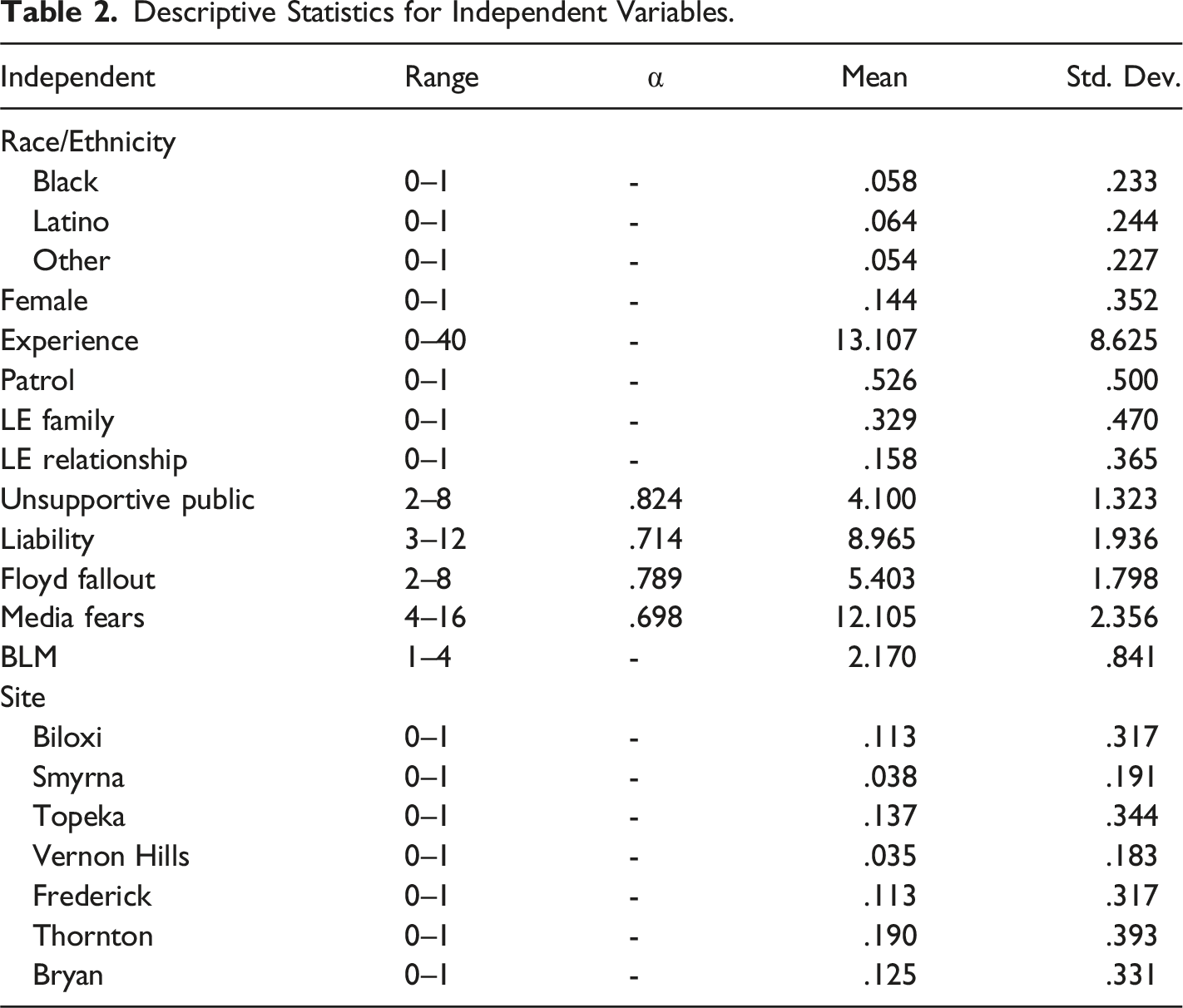
The multivariate analyses include not just demographic characteristics, but also attitudinal considerations of officers. Some of these measures indicate that the public reaction to George Floyd may have made their work harder, but do not necessarily reflect a shifting social consciousness about the work done by the institution of policing in America. These measures include whether the officers perceived support from the public (unsupportive public, α = .824, range = 2–8, x̄ = 4.10), their concerns over civil liability (liability, α = .714, range = 3–12, x̄ = 8.97), public fallout (α = .789, range = 2–8, x̄ = 5.40), and concerns over media attention (α = .698, range = 4–16, x̄ = 12.11). Similarly, officers’ perceptions may also include agreement with the statement that police agencies should consider some of the positions and critiques of groups such as Black Lives Matter (BLM, range = 1–4, x̄ = 2.170). As shown in Table 2, we also included seven dummy codes for research site, with Portland serving as the reference category.
Ordered Logit
In survey research, criminal justice being no exception, indicators with ordered response sets are quite common. In general, the typical analytical strategies for ordinal dependent variables are to condense Likert type responses (e.g., strongly disagree to strongly agree) into binary data and then apply binary logistic regression strategies or to use a proportional odds (PO) model to evaluate the ordinal outcome variable as it was designed (Liu & Koirala, 2012). One substantial limitation of the proportional odds strategy is that it bears the restriction of proportional odds, often referred to as the parallel lines test or assumption (Liu & Koirala, 2012). The nature of ordinal data in actual research and the assumptions of multivariate models produces an environment where the proportional odds assumption is frequently violated.
This paradox of proportional odds testing leaves researchers with a few options for analysis given the restrictions. Prior research has frequently elected to resolve the issue by condensing the variable into a dichotomous outcome, completely ignoring the problems, or conducting multinomial regression or a series of binary logistic models that represent the underlying ordered logit analyses without the PO assumption. Generally, these strategies either ignore data or represent a lack of parsimony by estimating coefficients for variables in models that do not violate the proportional odds assumptions (Bender & Grouven, 1998; Brant, 1990; Liu & Koirala, 2012; O’Connell, 2006).
One solution that has been offered by Fu (1998) and Williams (2006) is to allow the effect of explanatory variables to shift across cut points in a series of models, but also constrain the coefficients for variables that do not violate the proportional odds assumptions as equal across those models. The STATA gologit2 command can estimate partial proportional odds (PPO) models. What is useful about this command relative to other PPO modeling techniques is that it estimates slopes for all predictor variables across several cut-points determined by the values of the dependent variable, and then puts equal slope constraints on the coefficients of predictors that did not violate the proportional odds assumptions of equal slopes across the cut-points (Liu & Koirala, 2012). When only a few predictor variables violate the assumptions, the results provided by gologit2 provide a parsimonious analytic strategy that does not contain the errors which occur when the assumptions are violated.
Predictors of Career Reconsideration Following George Floyd.
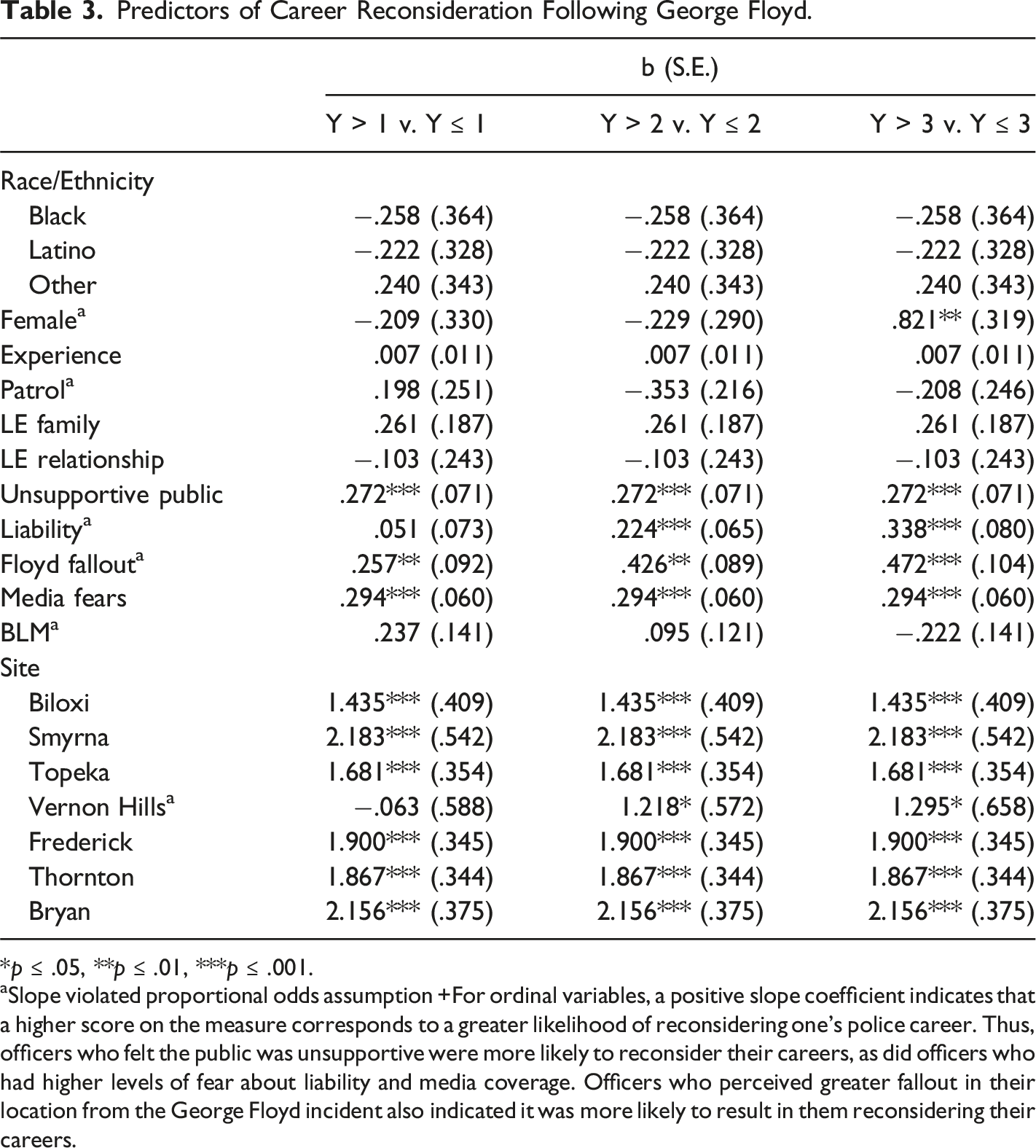
*p ≤ .05, **p ≤ .01, ***p ≤ .001.
aSlope violated proportional odds assumption +For ordinal variables, a positive slope coefficient indicates that a higher score on the measure corresponds to a greater likelihood of reconsidering one’s police career. Thus, officers who felt the public was unsupportive were more likely to reconsider their careers, as did officers who had higher levels of fear about liability and media coverage. Officers who perceived greater fallout in their location from the George Floyd incident also indicated it was more likely to result in them reconsidering their careers.
In terms of the findings for predictor variables that did not violate the assumptions of parallel slopes, several significant relationships were revealed. As shown in Table 3, officers who viewed the public as unsupportive were significantly more likely to indicate that the George Floyd incident caused them to reconsider their career (b = .272, SE = .071). Similarly, officers who were uneasy about unwanted media attention also reported being more likely to reconsider their careers (b = .294, SE = .060). In terms of effects for department, officers in all sites were more likely to reconsider their careers after the killing of George Floyd, than officers in the Portland Police Bureau, on average. This is also true for Vernon Hills when comparing the last two cut points.
For variables whose effects did vary across cut-points, significant effects were found for gender, liability concerns, and fallout following the George Floyd incident. Female officers were significantly more likely to strongly agree versus all other responses when asked whether the George Floyd incident caused them to reconsider their careers (b = .821, SE = .319). As officer concerns over personal liability resulting from their work increased, the likelihood of agreeing or strongly agreeing (b = .224, SE = .065), as well as strongly agreeing compared to all other responses (b = .338, SE = .080) also increased. With respect to the public fallout resulting from the George Floyd incident, officers who reported experiencing a change in public sentiment resulting from his murder reported significant differences across all cut-points. The slope coefficients increased across all bands, indicating that those officers who reported the least fallout were significantly more likely to report that they strongly disagreed versus all other responses (b = .257, SE = .092) that they were reconsidering their career. Similarly, officers who reported the most public fallout from the killing of George Floyd reported being significantly more likely to agree or strongly agree (b = .426, SE = .089), and strongly agree versus all others (b = .472, SE = .104), that they reconsidered their careers as a result. No significant findings were reported for any race or ethnicity, experience, patrol assignment, relationships with other police, or having a supportive perception of the Black Lives Matter movement.
Discussion
Several intriguing insights emerge from these analyses, and much of the impact of these findings is paradoxical. It provides a unique lens by which findings from other analyses, notably that of Mourtgos et al. (2021), are amplified, and it provides a unique context in itself that supports future research into police turnover in the post-George Floyd era. But the caution lies in misinterpreting the magnitude of these findings without the longitudinal context needed to make statements about the staying power and historical significance of the George Floyd murder. We feel that the event has had profound impact upon the contemporary police retention landscape, with the caveat that the potential transformative impact of Floyd’s murder cannot yet be determined. This impact should be considered even if the magnitude of voluntary separations across the United States remains small.
First, in a somewhat unusual fashion for current criminal justice and other social research, the most compelling finding may come from the descriptive analyses. Over 50% of officers surveyed across eight different police departments reported that the killing of George Floyd made them reconsider their career. Like the limited prior research on this topic, our research echoes the work of Mourtgos et al. (2021) that this incident had an immediate impact on the police milieu. While all researchers lacking a meaningful comparison to the effects of sentinel events such as the civil rights movement or the Rodney King incident, the current inquiry provides additional support that police officers may be leaving their profession in specific departments due to the murder of George Floyd.
Second, the context in which the George Floyd murder occurred drives consideration that this event represents a watershed moment in contemporary police history, and accentuates the potential for it to affect police career consideration to a marked degree. As previously noted, research into public opinion stemming from the George Floyd incident has noted a more acute public scrutiny, and even critique, of police-public relations (Brantingham et al., 2022; Reny & Newman, 2021). It is notable that public critique and ethical conflict on the job have been shown, in terms of wellness, to have a cumulative impact on officer ethical decision making (Blumberg et al., 2020). The synergistic effect of the Floyd murder with other social, political, and economic factors may have magnified the incident in the minds of police officers, their agencies, and the public at large (Barbot, 2020; Boudreau et al., 2022). Like the Rodney King incident, the raw brutality of the Floyd murder was captured on video. Thus, moral injury (to the public and police alike) is amplified by the additional impact of social media, which accelerated reaction to the video and incident itself (Barbot, 2020; Eichstaedt et al., 2021). This took place as the nation was reeling from other high-profile police uses of force which affected the nation’s conscience, such as the Michael Brown incident in 2014, the Freddie Gray incident in 2015, and the Breonna Taylor incident mere months before the Floyd murder, all of which resulted in public protest (Leach & Teixeira, 2022). However, none of these tragedies were visually captured and disseminated in such an impactful way as the killing of George Floyd, lending support that the Floyd incident potentially impacted the public as well as police professionals in a more profound manner (DeVylder et al., 2022; Graziano, 2018; Walsh & O’Connor, 2019).
Additionally, the COVID-19 pandemic, which had necessitated the shutting down of schools, places of employment, and other institutions, was still having a large impact on day-to-day life for most of the world. This undoubtedly led to public unease about a social and political climate that had been simmering for months (DeVylder et al., 2022; Eichstaedt et al., 2021; Leach & Teixeira, 2022). Furthermore, the global economy, despite the pandemic lockdown, presented opportunities for employment that would possibly have attracted police officers who viewed the Floyd murder as an impactful reconsideration (Allam et al., 2021; Allisey et al., 2014; Yeo & Jeon, 2023). This is also coupled with the Covid-related health risks associated with police work relative to other professions, which likely had an impact on actual departures, and represents a historical threat to validity when only voluntary departures and the timeline of Floyd’s murder are considered (Scheer et al., 2022). Researchers have not yet begun to empirically disentangle these incidents from the overall climate in which George Floyd encountered the Minneapolis Police Department, but it follows fairly that officers reported that the incident had a direct impact on their careers.
Third, aside from the immediate context, the current inquiry was able to highlight some specific reasons why the killing of George Floyd was so impactful on officers reconsidering their career, and why it will likely have stimulated the process of continual exit related to diminished job satisfaction and stress. Officers who had meaningful concerns about public support, fallout in their community, media attention, and personal financial culpability were all more likely to say they reconsidered their careers. Contrary to our expectations, no significant findings were found for race or ethnicity, indicating that the effects were similar for any coded ancestry when compared to white or Caucasian officers. These two findings taken together provide support for the hypothesis that the reconsideration of a police career is not because of divergent personal principles regarding oneself versus the institution, but rather over instrumental concerns in the working environment. Of course, more research on these mechanisms and their impacts is warranted.
One significant aspect of the current inquiry is that these analyses clarify and provide context for what has been a growing concern for police leaders: the phenomenon of litigaphobia, or the fear of being sued, and its potential effect on police careers and morale. Recently, police reform advocates have targeted the suspension of qualified immunity to hold police officers accountable for misconduct (Kindy, 2021). The removal of qualified immunity protection by the state legislature in states such as Colorado (see Sibilla, 2020) have been linked by police supervisors to recruitment and retention concerns (Pride, 2021). Our analyses reveal that as concerns for liability (and presumably, the accountability mechanism for which it represents) increased in the wake of George Floyd’s murder, so did officer disposition to reconsider the career. The authors feel this finding indicates an impression of how fear of lawsuits may interact with officer morale and may spark discussions of litigaphobia and its underpinnings. This provides new insight into the manner by which institutional efforts to hold officers accountable may resonate in the wake of George Floyd’s murder. Litigaphobia as a phenomenon has been understudied in police contexts; the term was used by Brodsky (1988) and expanded to address fear of litigation among police specifically (Scogin & Brodsky, 1991). An ‘excessive and irrational’ preoccupation with well-publicized instances of litigation (Scogin & Brodsky, 1991, p. 41), especially civil lawsuits, against police has been said to cloud judgment and interfere with performance of duties in other research (Breslin et al., 1986; McCoy, 1984). Supervisory and command staff have also said to have utilized litigaphobia as an impetus to drive in-service training opportunities, as well as a climate of discussion for new hires in the profession (Chiarlitti, 2016; Vaughn et al., 2001). In light of these concerns, it is apparent that fear of civil lawsuits can be such a pervasive worry that it may alter police officers’ perspectives on the ability to perform basic legal duties such as perform arrests and engage in proactive police work.
Fourth, the direct impact of the George Floyd murder on police officer career impressions cannot be overstated, especially when it comes to officers who are women. The contemporary landscape of police recruitment reveals accentuated concern about the hiring of women (USDOJ, 2021). While this is a long-standing concern among police organizations, it is drawing increased focus since the Floyd murder. It was surprising the degree to which women officers’ reconsideration of law enforcement careers was directly impacted by public reactions to Floyd’s murder, which presents opportunities for reflection on a number of circumstances that are largely unknown from the study. The impact of specific details of the incident itself (e.g., the variety and scope of physical force used on Floyd, the charges brought against the officers involved, the presence and inaction of subordinate officers, the range of reactions from the public and police leadership) are unknown from this finding and should intrigue law enforcement leadership and researchers alike. This incident may represent a form of role or identity conflict for women in policework and demands more attention from police leaders in strategizing retention policies and practices (Gibbs, 2019). An enormous amount of institutional energy has been devoted in recent years to police recruiting for diversity, and the outsized impact of this violent incident on female police officers’ consideration of their profession has serious implications for initiatives such as 30-by-30 (30 x 30 Initiative). Urgent attention should be given to ensuring that this effort will not be jeopardized and potentially reversed by significant impacts on recruitment and retention of police officers who are female, given the circumstances of the George Floyd murder, or the continuing deaths at the hands of police that shock the conscience (i.e., Tyre Nichols).
Considering this finding, we feel that strategies addressing officer retention should consider this issue in specifically addressing women’s overall wellness. While the Floyd murder and its public reaction were unprecedented in scope, they did not occur absent other potential conflicts in the minds of women in the field which may have a cumulative effect on their desire to remain or separate (USDOJ, 2021). After joining the ranks, many women have expressed feelings of disconnectedness and isolation which are unique to agency culture, and few agencies strategize for women’s wellness in this regard, leaving open the possibility that an incident such as Floyd’s murder could act as a tipping point for interest in the profession (Todak, 2017). Women officers are acutely aware of numerous institutional biases related to policing such as identity conflict between sworn police officers and the public (as were expressed in the wake of George Floyd’s murder across social media and possibly in secret among police training and workplace environments) that could distance women from the idea that they are somehow acquiescing to such behavior simply by remaining in the career (Todak, 2017). Police leaders need to prioritize the establishment of authentic support systems and opportunities for dialogue for women officers to express dissent and dissatisfaction with this identity, and with messages that are interpreted by women that the relative reaction of policing as an institution could be insufficient in addressing their concerns.
Fifth, a pressing question emanates from the finding regarding impressions of a public fallout, of any kind, and its interaction with officer disposition to reconsider their career. The data demonstrate that officers with some form of awareness that the murder of George Floyd has disrupted the relationship between the police and the public are more apt to strongly reconsider their career. The higher the perception, the stronger the consideration. Since evidence exists that the public reaction to George Floyd resulted in a changed tone towards police misconduct, further research should explore the interplay between ‘public sentiment’ and ‘career reconsideration’ (Boudreau et al., 2022; Brantingham et al., 2022; Eichstaedt et al., 2021). Are officers sensing (as the public does) that their relationship with the public at a local level, or community policing efforts, or officer safety risks, or possibly their relationships with the African American communities, are disrupted, and one or many of these drives career reconsideration? If officer impressions of a change in public sentiment drive career reconsideration, locating the points at which this becomes most acute will assist police leaders in diagnosing ways they (and the broader law enforcement community) can address public concerns in their respective communities about what this event means for the future of policing. This will also contextualize research that demonstrates a shift in public sentiment towards a more critical perspective (Boudreau et al., 2022).
Implications
The murder of George Floyd traumatized communities, citizens, and police officers alike, and attention should be devoted to applying lessons learned in an honest and proactive manner. Both researchers and practitioners may find these results to be helpful in reconsidering police career preparation across several dimensions, as appropriate. With respect to these findings, this means not minimizing the prominent impact of this event on the workforce, the community, or future scholarship in the field. The reasons for its magnified stature are unclear and likely outside of the scope of this work, but it is apparent from the data here that the George Floyd murder had a profound impression on law enforcement and communities alike.
In addition to protecting the rights of communities to voice concerns about how George Floyd’s murder may impact them, police practitioners should conduct assessments of the impact of George Floyd on their officers as well, given the results here. Care should be given to open discussion and monitoring for wellness aspects of the potential effects on officers, as well as the potential for doubts about one’s career and future in law enforcement professions. Likewise, as evidenced in these findings, discussion about the context of litigaphobia and the impact of fear of lawsuits related to George Floyd (however that may be ascertained) should be discussed, and training be offered to mitigate irrational fears as well as reinforce important characteristics of integrity and accountability.
Critically, police researchers need to pursue further explanation as to how the interaction between the murder of George Floyd and police disposition to leave their careers operates, especially with regard to the unknown intervention between community concern and police morale. Specifically, studies may be undertaken that explore the effect of changes in community approval of police actions and policies, on police morale and job satisfaction. Current research on police stress, legitimacy, and workforce management could be invigorated by these findings as platforms for renewed attention to police-public relationships and policy-building. Moreover, longitudinal studies should be undertaken to ascertain the long-term impact of the George Floyd murder upon police attitudes to determine the course of this episode on American police policies, attitudes, and workforce trends. It is tempting and perhaps erroneous to assume that, due to the outrage associated with this event in American history, the George Floyd murder precipitated a permanent change in the landscape of police-community relations; we feel that defining the longitudinal impact of this change can assist agencies with defining their progress from specific points in the recent past.
Limitations
Certainly, the current inquiry is not without limitations. The first being that we did not actually measure departures from police agencies but relied upon officer’s assessment that the murder of George Floyd made them question their career choice. While empirically validated theoretical models support a stepwise process by which officers leave (Allisey et al., 2014), intentions and actually vacating the profession are two entirely different issues.
Second, we were not able to assess attitudes directly following the killing of George Floyd. It is possible that officers who were the most influenced by his murder actually left the profession before our survey was administered. This would leave a sample that did not include officers who already departed as a result and would underestimate the effects that the murder of Mr. Floyd had on the police. This is particularly true if there was differential attrition base upon values of our independent variables.
We also acknowledge that there are limitations to the data set arising from the lack of follow-up questioning to ascertain specifically what about the George Floyd murder causes an officer to reconsider their career, and believe that deeper issues such as prior officer history with and investigation for incidents of misconduct, local political climate, departmental policy reaction to the Floyd murder, and other intervening issues are intriguing avenues for future research exploration. Knowing the specific psychological processes that officers undergo following high profile incidents such as these would allow departments to develop highly targeted policies for officer retention, namely wellness and counselling services.
Footnotes
Declaration of Conflicting Interests
The author(s) declared no potential conflicts of interest with respect to the research, authorship, and/or publication of this article.
Funding
The author(s) received no financial support for the research, authorship, and/or publication of this article.
