




Abstract
Police recruitment across the UK is under intense political and social pressure to increase representation and legitimacy. This layered in to a quest to raise the number of police officers in England and Wales by 20,000. However, despite decades of reform initiatives, police recruitment continues to be a challenging and potentially exclusionary process for candidates from ethnic minority backgrounds. Research in this area mainly comprises macro-level process evaluation and subsequent extrapolation of the results into positive action initiatives. There is a paucity of research at the micro-interaction level among social actors. In this paper, we present a case study of police recruitment in a large English Police Constabulary over four recruitment cohorts in 2018. We conducted 26 long-form, in-depth interviews with new police recruits. Utilising the embeddedness theoretical framework based on sociological studies of the labour market, we attempt to understand police recruitment at the micro-social interaction level. We demonstrate that police recruitment has a high level of social embeddedness within the Constabulary. Candidates utilise social connections throughout the recruitment process to develop competence in the recruitment stages, while also building their respective police social identities. Although positive action recipients also receive significant organisational and instrumental support, they build a relationship with the abstract organisation and not existing police officers. This creates an imbalance in social identity development and may have implications for how positive action initiative recipients may struggle within the policing environment. Further implications exist for positive action design and implementation.
Introduction
When considering the application of positive action within police recruitment, enquiring about its purpose before analysing its effectiveness is important. In an era of identity politics and the racialisation of public discourse, one can assume why positive action exists and what is its function. Its application can become unexamined and routine regardless of how subverted or obscured that purpose may have become. Positive action initiatives exist for a reason, yet this purpose is more layered and contextually complex than is often discussed. In this article, we explore these areas of complexity, asserting that the wider purposes of police legitimacy may not be served by its current iteration.
The application of Occam’s Razor (Blumer et al., 1987) to police recruitment processes defines their goal as filling a vacancy for the position of a police officer within the organisation. The goal exists similarly for the individual who is to become that police officer, and in turn, fill the vacancy. Therefore, the fundamental purpose is to hire, and that of the individual is to be hired. However, when examined more closely, variables such as qualifications, skills, experience, character and temperament are all important and appear to play a significant role in police recruitment for good reason. Internationally, a police officer’s work has been categorised as ‘dirty work’ (De Camargo, 2005, Huey and Broll 2015; Schneider et al., 2020; Workman-Stark 2022) in which the exposure to the opportunity for corruption is high (Skolnick 2002; Westmarland 2005; Westmarland and Rowe 2018). Hence, some filters that seek to select the ‘right’ candidates are needed for appropriateness and accuracy.
This selection of ‘right’ candidates concerns the application of a set of value judgements by the police force in question. Recruitment standards are set differently at varying selection points, resulting in a logical and structured process that applies filters at each stage. In England and Wales, what are commonly referred to as the Home Office forces, of which there are 43, police recruitment typically covers the following stages:
This approach varies significantly across the 43 Home Office forces in England and Wales, and no mandated position exists on utilising the College of Policing selection methods. This results in a so-called ‘post-code lottery’ for candidates, as each of the 43 forces can select its own composition of recruitment from a suite of options. A recent Equality Impact Assessment conducted by the College of Policing (2021a) for the implementation of the Police Education Qualification Framework (PEQF) comments in its conclusion about the availability of data across this process, stating that assessing disproportionality within the process is incredibly difficult. This results in variable geographic standards in police recruitment, with some consistent elements such as the National Selection Centre threaded throughout.
Research in England and Wales illustrates this, as studies focus on particular recruitment processes (Linos et al., 2017; Linos and Riesch 2020). Studies with a slightly wider scope have investigated multiple constabularies and the effects of diversity recruitment such as Hong’s work in Wales (Hong 2015; 2017). Moreover, broader studies have involved research spanning decades of attempts to diversify the police in the United States (Bannon and Wilt 1973; Decker and Smith 1980; Hochstedler et al., 2016; Kringen and Kringen 2014; Nicholson-Crotty et al., 2017; Regoli and Jerome 1975; Wilkins and Williams, 2008; Zhao and Lovrich 1998; ; Zhao et al., 2006). These studies are well summarised by Rowe et al., (2015), who note specific issues by analysing the literature, including incompatible ethnicity classifications and the tenuous gap that is often assumed between increasing representation (Bradbury and Kellough 2011; Krislov 2012) and increasing police legitimacy or effectiveness in under-represented communities.
Despite the difficulties in meaningfully comparing these studies, the need to diversify the workforce remains politically driven in England and Wales (House of Commons Home Affairs Committee 2016). This has resulted in constabularies developing their own versions of local recruitment processes and positive action, with Chief Officers deciding the stages of recruitment processes while receiving advice from human resource (HR) professionals. This, in turn, has created a recruitment approach that is locally influenced and socially constructed, indicating a significant localised opportunity for political influence to alter or subvert the internal standards established within police forces. However, studies investigating the impact of this opportunity on recruitment standards remain scarce. Her Majesty’s Inspectorate of Constabulary and Fire and Rescue Services (HMICFRS), a police inspection body, inspects, to a limited extent the outcomes of the processes in terms of their diversity levels and overall health in terms of resource (HMIC 2017), but does not inspect the force’s process standards themselves, leaving them without adequate or systematic scrutiny.
In this study, we focus on the experience of police recruits in a single constabulary in England and Wales as they navigate this locally and nationally constructed process. We examine the differences in their experiences, draw conclusions from shared themes that illustrate the building of the police identity during their journeys, explore their lived experience of police recruitment, and provide some direction for future police recruitment-based research.
Layered teleology
Given the above description of the macro police recruitment landscape in England and Wales, exploring the purpose, or telos (Mayr 1992) of recruitment in depth is valuable. If value judgements are to be formulated at each stage of the process (as candidates are filtered out), these must be based on criteria. These criteria are decided upon and then implemented. These can be as practical as setting a pass rate on a particular exercise, such as an application form or an interview. With the pass rate established, objective scoring frameworks are employed to assess candidates and provide some defensibility (for the organisations) as they make decisions to apply these filters. Therefore, applicants are filtered at different rates, with some of this data remaining within the force, and other data remaining at the national level. Scrutiny of this process is very difficult and entails considerable time to access the data required to understand even a single application of recruitment standards in police services. The same is not true of research in the United States (US), with some recent studies employing larger, cross-state datasets (Smith 2003; Rowe et al., 2015; Hochstedler et al., 2016; Nowacki et al., 2020).
Given this variable and the localised nature of police recruitment in England and Wales, national-level statistics that indicate in detail the relative success of demographic variables on police recruitment do not exist. Comparing the final interview success rates of under-represented candidates across police services as an example is not possible. However, amalgamated national data in England and Wales indicate that diversity-based recruitment in England and Wales has been steadily rising for some years.
The data illustrate that the change in this area has been incremental and gradual. This is reinforced by recent reports compiled by the Parliament and the Home Office (House of Commons Home Affairs Committee 2016) that indicate the pace and level of change are politically unacceptable. Both reports clarify that the levels of recruitment must change, and forces must prioritise diverse recruits from several different backgrounds to meet the changing demographics of society. This criticism is sustained and is an outcome of decades of scrutiny that originated in the Scarman Report (1981) and was heavily reinforced by the Macpherson Report (1999). This criticism has persisted through various reviews that examined their relative impact (Foster et al., 2005; Holdaway and O’Neill, 2013; Rowe 2007; Rowe and Garland 2013; Souhami 2020). Therefore, the police services have considerable political pressure to acknowledge that the rate of under-represented officer recruitment has a problem and to instigate changes to the process to rectify it.
Pass rates of White and BME police recruitment applicants (College of Policing, 2017).
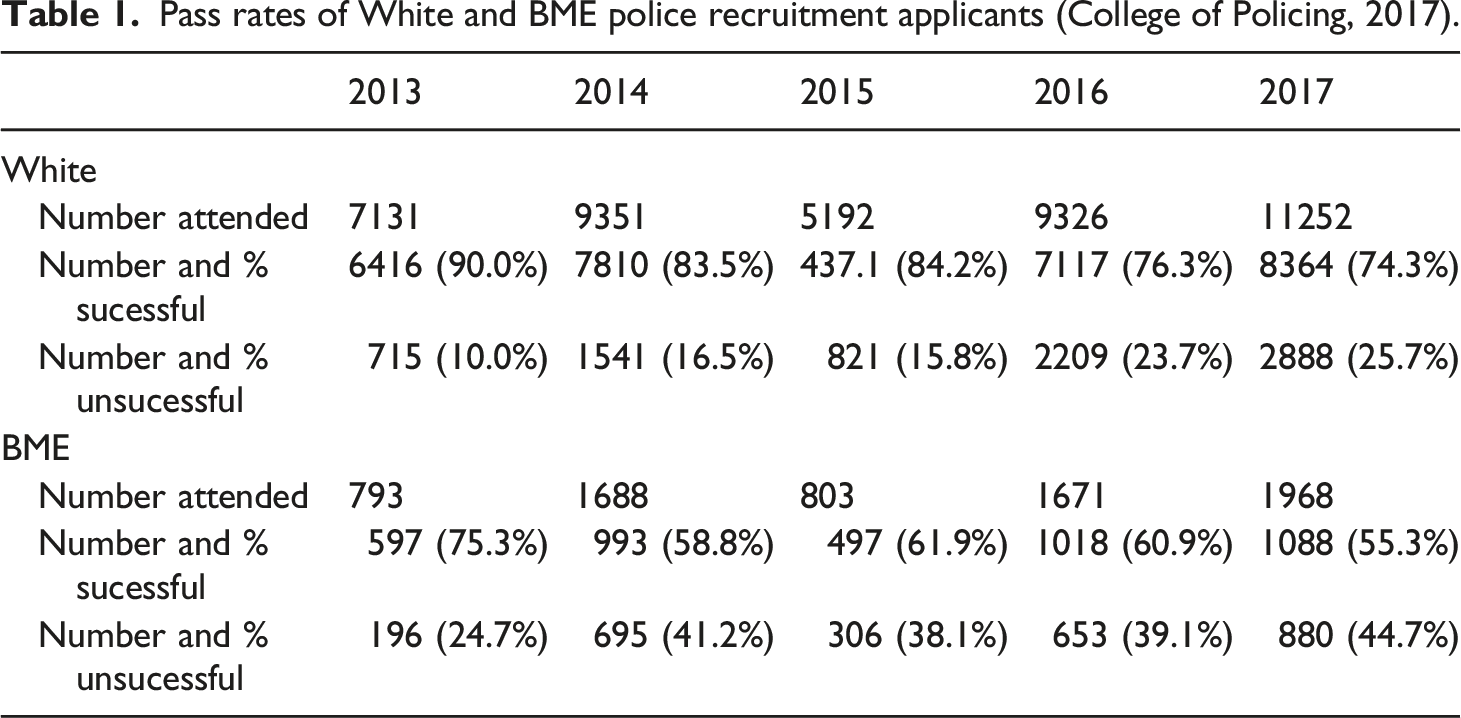
This FOI request illustrated differing rates of success for white and black, minority, and ethnic (BME) candidates in the National Assessment Centre between 2013 and 2017 as follows:
More detail and a greater cross-section of the variables involved would enable a stronger analysis; however, the overall figure suggests that the success rate of BME candidates during these years was comparably lower than that of white candidates, illustrating that under-represented candidates experience police recruitment differently from white candidates. This raises important questions about potential disproportionality and has prompted the continued use of positive (affirmative in the US) action as a means to assist under-represented candidates through the police process in a way that provides them with the same probability of success. It aims to ‘lift’ (this term has been chosen as a literal representation of what is required to raise scores in recruitment processes) under-represented candidates up to the same level of success as white candidates. Notably, at this point, we assume that one of the causal variables is race. It is a variable chosen specifically for close measurement. This choice is a strong indicator that race is important for police recruitment, as data on socio-economic class, for example, do not exist. Holdaway (1991, 1997) and Holdaway and O’Neill (2006) discuss this phenomenon as part of the racialisation of the police force. Therefore, a race-related variable has been added to police recruitment, which exists in addition to that of just hiring an effective officer.
This change in telos is an interesting development that has not received the attention that it deserves. When the telos of a process is changed, the assumption that the process itself receives significant attention and review is fair. If the aim of something shifts, the assumption that the method of achieving it must also shift is also valid. In practice, the recruitment processes did not shift; instead, the application of positive action initiatives began. This occurred in the US against the backdrop of the development of representative bureaucracy theory, a feature that has become far more widespread among many public institutions (Hong 2017; Krislov 2012; Murji 2014). The theory posits that greater legitimacy is achieved through proportionate representation within representative bureaucratic mechanisms within any given social setting. This application of representative bureaucracy theory as a backdrop for these recruitment changes obscures other historical reasons for diversifying the police, including the findings of Macpherson (1999) and Scarman (1981) reports. The problems at the forefront of both of these reports were at the level of interaction among social actors; they extensively discussed community relations and police tactics and approaches. Increasing representation does not necessarily affect these interactions among social actors, and this in itself begins to lead to questions about a layered telos. If the goal of diversity-based recruitment is simply diversity in terms of under-represented minorities becoming police officers, the underlying assumption is that this will influence or lead to a change in the actual police behaviour. The existing empirical support for this assumption is underdeveloped in almost all aspects (Hur 2012; Nicholson-Crotty et al., 2017; Smith 2003). This is known as the passive/active representation dichotomy (Bradbury and Kellough 2011; Wilkins and Williams 2008) and has been the subject of debate in research for decades. The teleology is depicted in Figure 1. Layered teleology.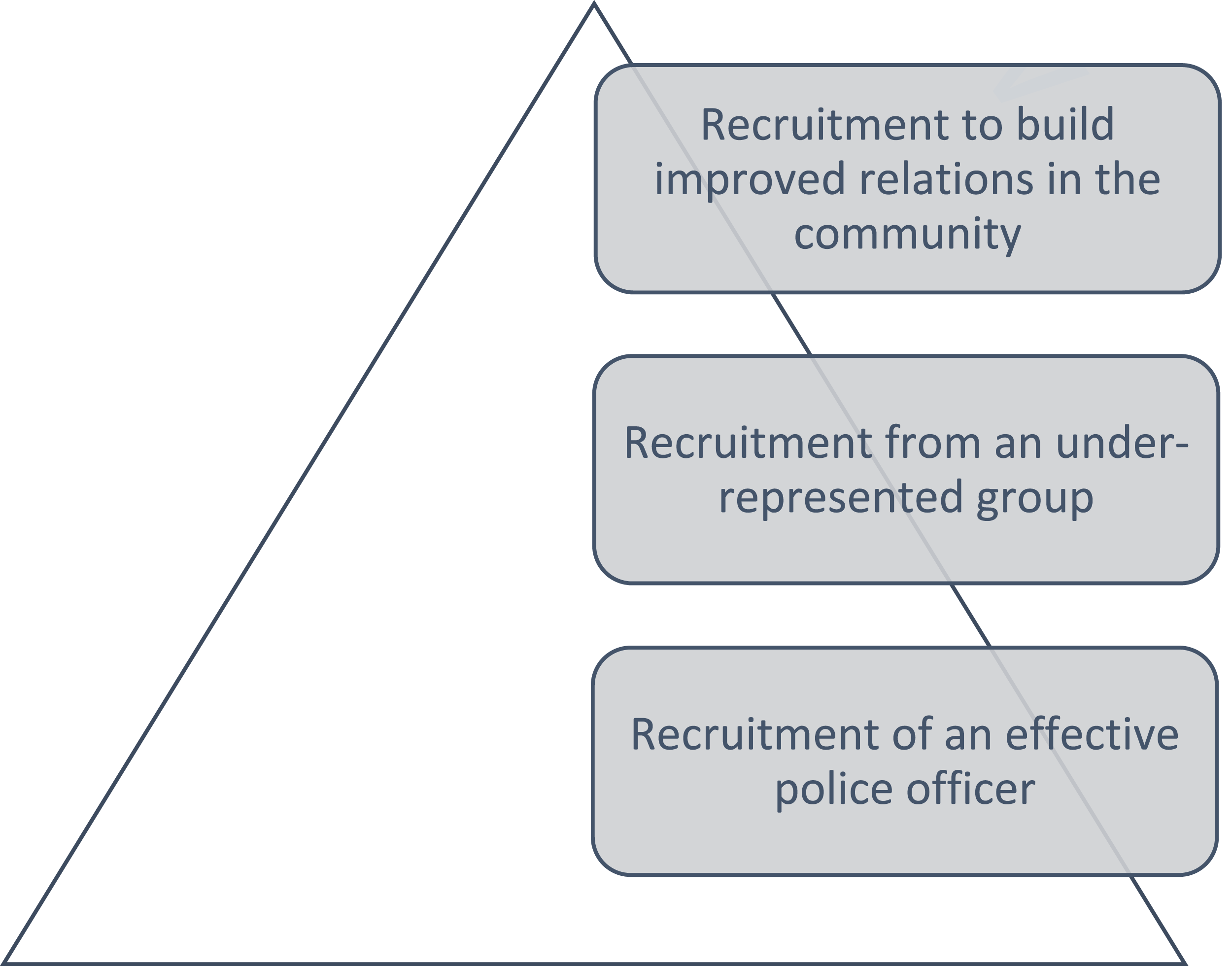
This teleology contains assumptions between each layer. The political pressure is such that the middle layer of under-represented recruitment has been observed to create some perceptions among officers that standards are being lowered to generate increased diversity (Johnston 2006). This creates an altered hierarchy and may generate a lack of perceived organisational justice around hiring processes. The link between the middle and lower layers is also debatable. Research has indicated that increased diversity in the police department can have little to no effect on particular crimes in under-represented communities (Smith 2003; Nicholson-Crotty et al., 2017) and may even create discord or internal challenges around values (Hur 2012). Recent studies in Wales offer some support for representation as an ideal influencing community relations (Hong 2015; 2017), although it is by no means comprehensive. This implies that in practice, while the above teleology is ideal, in reality, the layers are disconnected and based on poorly developed, weakly evidenced theory. The connecting areas in between are messy and unclear, which results in selective use of these layers, and an almost discarding of other layers in some cases (Figure 2). Prevalence of social support by stage.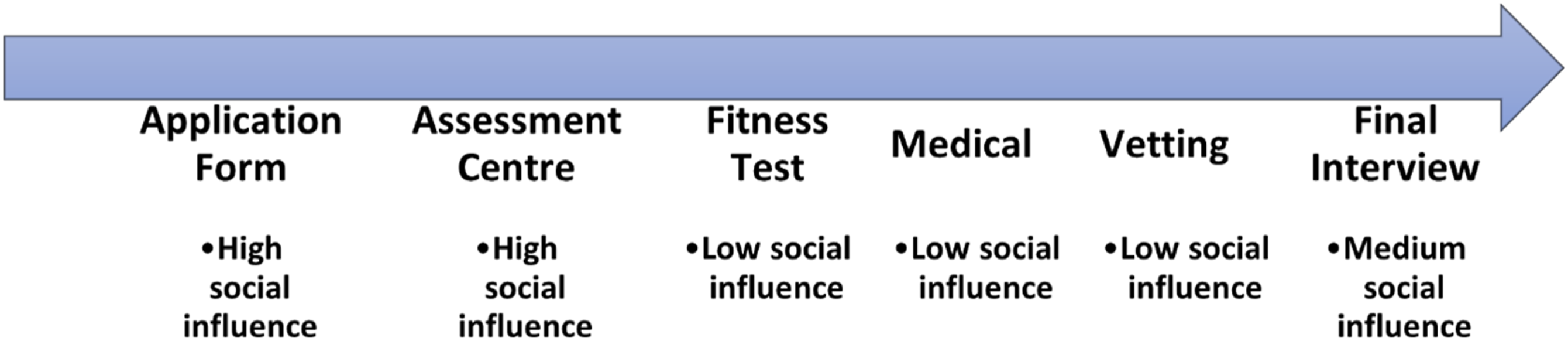
During the Coronavirus Disease 2019 (COVID-19) pandemic, a switch in the method away from the SEARCH police recruitment assessment centres to an online assessment centre was observed (College of Policing 2021b). The recent evaluation of this process indicates that some improvement has occurred in this area, with the gaps in attainment closing within certain exercises of the assessment centre. In this study, we focus on the recruitment process before the COVID-19 pandemic, including the in-person assessment centre that was present before the pandemic.
Gaining access to the data to allow rigorous and systematic analysis of potential disproportionality in police recruitment is very difficult. Notwithstanding the disparity of almost 20% in terms of success rate between white and BME candidates raises questions about the different experiences between the two groups. What is present within the current process of police recruitment in England and Wales that may cause this disproportionality and where does this difference become concentrated? The varying stages of recruitment and the varying administrators of those stages complicate any meaningful analysis, rendering a proper investigation of where the real disproportionality is generated difficult. This then further frustrates the design of positive action, which essentially represents an attempt to rectify a problem in police services that all experience things differently. In practice, this represents a case of politically enforced, well-meaning pressure, overriding careful analysis and real understanding. Police forces have been designing positive action interventions to address poorly defined problems in existing recruitment processes to reach an altered, overarching and relatively new telos of representative bureaucracy, which may or may not have any effect within the communities with whom solid relationships need to be built and sustained.
The literature review in this area illustrates that the dominant assumed telos of diversity in police recruitment research is that of representative bureaucracy. The layered and more nuanced teloi comprise those contained in reports, including Macpherson’s (1999) and Scarman’s (1981), whose aims are noticeably in the realm of increased legitimacy and procedural justice in under-represented communities, even if the means to achieve these goals are poorly defined in these reports (House of Commons Home Affairs Committee, 2009; Rowe 2007; Souhami 2020). This is reflected in the typology of research in this area. The link between these different teloi is speculative and empirically underdeveloped, although examining it reveals that it should be more specifically integrated. No study has been conducted in either the US or England and Wales that investigates the experiences of the candidates themselves as they navigate this layered teleology. This is the area where social actors interact, a space for micro-social interactions.
Relevance of labour market research
To investigate what happens at the micro-transaction level during police recruitment and explore disproportionality as it occurs necessitates gathering data from the phenomenon as it is experienced by the candidates. This data should not focus solely on racial variables as identifying disproportionality without a control variable that identifies the difference between groups is difficult. Although the assumption in the previously discussed literature suggests that race is a causal variable for police behaviour, a further examination could reveal that the real influencing variable is social class. Therefore, the dataset also contains a basis for the comparison of minority candidates. For a process to affect a particular population disproportionately, it must be imparting some level of benefit to the other population. Where this benefit is held and how it is accessed is the focus of this study.
The process of recruitment has been examined in a broader context with regards to social influence for decades in other areas of sociology, most notably through Granovetter (2002, 2017), who argued that labour markets cannot be analysed appropriately, or remedies identified where anomalies exist if the social conditions of that labour market are not suitably understood. Granovetter (1973) argued not only for an economic, but also social understanding of the job market. His theory of embeddedness (2002) posits that abstracted labour markets should never be divorced from micro-social interaction if they are to be understood in any real sense. This is an argument with strong parallels to that of Holdaway and Rock (2005) concerning criminology as a discipline (2005).
Granovetter argues that the social conditions of labour markets should be considered when contemplating any interventions. He theorises that some occupations have heavily embedded labour markets, where social interactions before employment are incredibly important, whereas others are less socially dependent. This area has not been thoroughly investigated with regard to police recruitment, although it has been speculated upon.
Presocialisation as a concept is ascribed to the profession of policing in several major studies (Conti 2006; Charman 2017; Fielding 1988; Van Maanen 1973). The axiom behind this concept is that the neophyte wishing to become an initiate engages in the process of ‘becoming’ a priori. Before the process of conscious becoming, the choice to become must be formed. This effort represents a gathering of the required knowledge and skill needed to navigate the policing recruitment process. This decision which is ‘made’ (as in made conscious) at some point by the candidate before embarking upon the police recruitment journey, includes a complex gathering of profession-based information – the information that aids directly in the pursuit of their end goal to become a police officer. The disproportionality evidenced in police recruitment may actually occur here and then may manifest itself at the point of execution within the recruitment process.
In policing literature, the stages of socialisation encompass pre-socialisation as a stage in and of itself. Van Maanen (1973) provides the term ‘anticipatory socialisation’, and Conti (2006) expands this concept to develop a typology of progression from non-police to police. He describes these stages as civilian, contestant and anticipatory recruit, and utilises Goffman’s Mortification of the Goffman (1961) as an analytical framework. In this study, the candidate remains a civilian until becoming a contestant at the point of the decision to embrace the goal of ‘becoming’. When the decision to become a police officer is formed, they may immediately begin to access social mechanisms that aid the realising of this goal, gathering relevant information, sometimes over very long periods. Bennett (1984, p. 48) suggests several sources of this information, separated into media, friends, and relatives who express opinions and transmit impressions of the occupation, and actual police groups that contain police officers or staff that work within the organisation. He describes the gathering of this information from these groups as an opportunity to, ‘…transmit information to the applicant such as perceived status, future role expectations, and self-conceptions as well as attitudes and values which enhance acceptance of policing as an occupation’. (p. 48).
Therefore, the transmission of the recruitment-based information does not only comprise hard and technical support, such as how to pass a section of the assessment centre, but also encompasses the situation of social status, future expectations of development and progression, development of self-conceptions, and attitudes and values. It is a conscious attempt by the candidate to not only achieve the goal of being hired but also establish socially constructed boundaries and goals that constitute the organisational identity within themselves. This acknowledgement is important as it frames the discussion as one that focuses on the relative success of candidates within the police recruitment process as well as how the gathering of information represents a much wider, socially informed process of becoming. In this study, we aim to help understand this process, and thus, provide insights into the wider implementation of positive action initiatives in police recruitment.
Method
This study is based on a case study of one police constabulary in England and Wales. The method is designed to access rich, in-depth data (Creswell 2003) on the navigation of police recruitment processes by successful recruits. The constabulary is a county force of approximately 6000 officers and staff. The selection of the constabulary was one about practical access (Stake 1995). As serving employees, the authors could access a set of recruits over several recruitment windows in a short period. In the early stages of this research, the objectives were discussed with the Chief Constable, and access was granted for the duration of the study, in return for the learning to be shared following completion of the research.
Recruitment of the sample for this research occurred over four separate police recruitment windows and was necessarily purposive (Yates 2003). These windows were all treated similarly in terms of the stages involved; all the participants went through exactly the same process. All participants were provided with a research briefing about the content and context of the research and their agency in choosing to participate was emphasised repeatedly. Confidentiality and anonymity for the participants were assured not only at the point of recruitment but also pre and post-interview.
The research was divided into two phases. The interview guides were informed on the labour market theory from Granovetter (2017), although the questions were left very open-ended and wide in their composition (Turner 2010). Initial scoping was limited to four interviews. The participants were then invited to provide feedback on the interview composition and content. Some minor adjustments were made and then the interviews were conducted across the whole recruited cohort. In total, 26 long-form, in-depth interviews were conducted with new police recruits. When recruited, all the recruits had just started their service, with 2–3 weeks of service in total. This ensured that their recollections of the recruitment process were recent and the pre-socialisation was not overly tainted by actual socialisation. The interviews occurred in 2018 over 4 months and were all between 45 min and 90 min in length. All the interviews were audio-recorded and transcribed verbatim.
The analytical approach was both inductive and deductive in nature (Cho and Lee 2014). The theoretical basis of labour market theory provided a deductive framework, but the open nature of the questions and the relatively untapped phenomenology (Husserl, 1970) of police recruitment allowed for significant induction. Not guiding the discussion of recruitment only from the perspective of social interactions was important. The recruits were allowed to discuss their experiences as per their wishes, with only some directed questions about how they used their social contacts throughout the process. This ensured a richer, rounder picture of the process itself as experienced by the recruits. NVivo10 was then utilised to code the responses. This happened in two stages, with the initial stage being a full coding process of the line-by-line data, and the second stage being thematic coding, where these line by line codes were grouped according to the content.
In line with the inductive and deductive methods, codes were generated using both Granovetter’s (2017) theoretical framework and without the theoretical framework (Charmaz 2017; Charmaz and Thornberg 2021). This allowed an analysis that integrates lived experience with theoretical impact. The final stage of analysis involved theorising, where the generated codes were assessed in line with Granovetter’s (2017) theoretical framework.
Social embeddedness of support and positive action
Candidates’ existing social ties and usage.
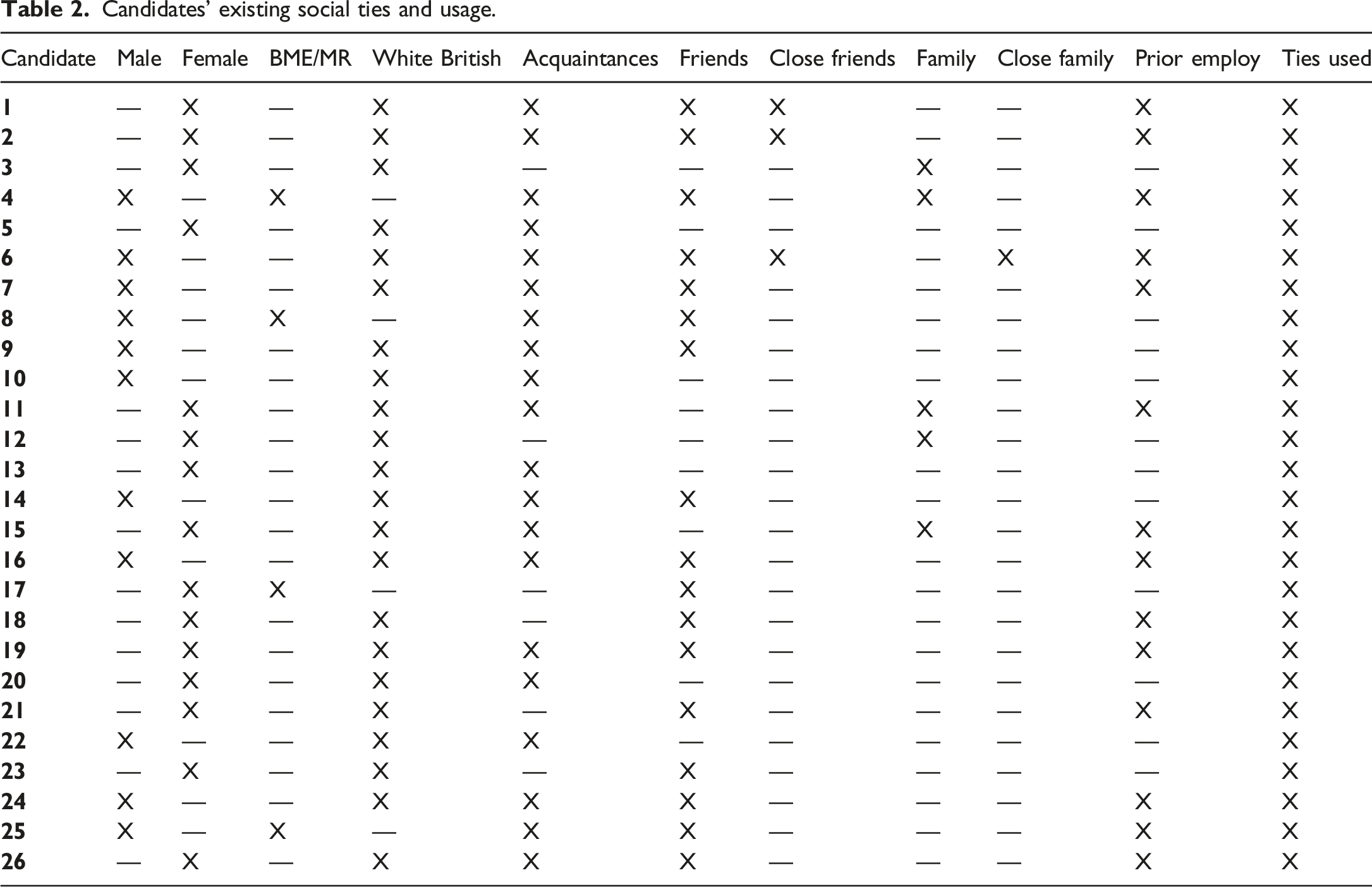
The right column illustrates that every candidate accessed social support at some point during their recruitment journey; notably, over half of the candidates were prior employees. This offers a significant challenge for forces pursuing representative bureaucracy because this can simply represent an external, internal labour market (Manwaring 1984). This is a labour market characterised by extensive sharing of insider-based knowledge (Grieco 1987), where opportunities invariably reach candidates already connected to the existing workforce.
To understand exactly where this support was utilised during the process, we explored this with the candidates during the interview and then coded its frequency and depth. This resulted in the following finding:
This finding indicated that the initial application form, the National Assessment Centre and the in-force final interview were the stages with the highest level of social embeddedness. These were the stages that candidates sought support for, and often found it. If the theory is to be understood within this context, it would suggest that a socially based resource is being exchanged between existing social ties and potential police candidates, and that information is perceived to be especially useful in particular stages. Each direct contact with a friend or family member that endorses their choice to become a police officer, represents an opportunity for the building of identity salience (Stryker and Serpe 1994) and feelings of belonging (Haslam et al., 2005; Jetten et al., 2012; Tajfel 1974a). These contacts are strong aspects of pre-socialisation (Charman 2017).
By contrast, six of the 24 candidates could access positive action support for the above-discussed stages. Interestingly, in most of these cases, any opportunity for social support was ‘swapped out’ for positive action support.
On the first examination, the candidates who experienced positive action received similar support in terms of instrumental support for passing the stages of the police recruitment process. They were offered feedback on application examples, assessment centre composition and approaches, and were able to access a form of coaching for the final interview. This is all true, and in some way levels the playing field. However, the levelling, in this case, occurs within the technical and not the social domain. This raises important questions for forces implementing positive action to remedy disparity. Returning to the initial questions discussed earlier within the layered teleology section, we next examine the disparity of what and for what.
Typology of positive action and the positive action paradox
The candidates who received positive action assistance in the recruitment process valued it very highly. They believed that it was instrumental in their hiring. Within any organisation, to receive feedback on one of the operational processes is positive, yet applying a critical perspective begins to illuminate differences in the type of support that is offered to candidates who qualify for positive action intervention. By definition, positive action interventions are interventions designed and delivered by the organisation. This is an abstracted entity, as the organisation as a tangible being does not exist. The relationship among those receiving the positive action is also temporal and neither endures beyond the point of recruitment nor affirms social identity. The relationship that is developed is often with the HR or positive action team. They are not police officers, and no friendship or long-term relationship is cultivated. Positive Action in this instance is instrumental and not pastoral in nature.
Referencing the building of identity in this respect is important. As potential police officers are coached and supported by current police officers into becoming one, a multitude of social micro-interactions builds and sustains their journey. This method of pre-socialisation differs considerably from that cultivated and sustained through positive action. These differences are illustrated in Figure 3. Situating Positive Action.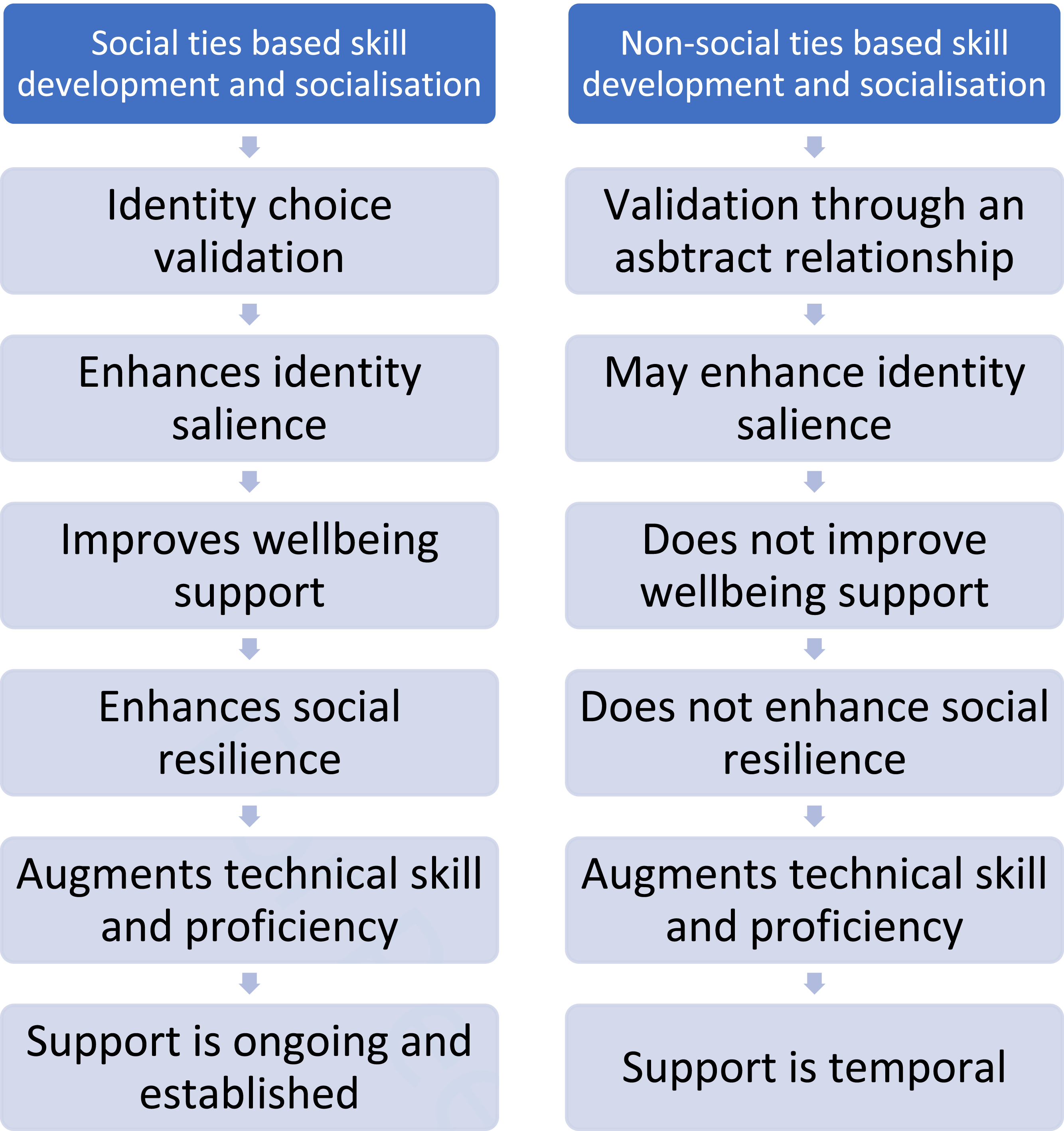
Figure 3 is supported by existing theories in social identity research (Haslam et al., 2005; Jetten et al., 2012; Levine and Manning 2014; Tajfel 1974b). As identity affirming actions occur through access to social ties, the identity of the police officer has been already developing in the candidate. Social encouragements and endorsements are tangible. Persons from within that occupational identity encourage the candidate to become. The opposite is true of formalised positive action, which offers instrumental and technical support to candidates, who in turn develop relationships with the abstracted organisation and not individuals who are already embodying the prospective identity of the candidate.
These two methods of pre-socialisation can be defined as social reinforcement and technical reinforcement, respectively. A proper evaluation of these methods warrants that their efficacy concerning their respective goals should be discussed.
Notably, the layered teleology discussed earlier is not fully addressed by either method of pre-socialisation. The change in policing behaviour in under-represented communities is not consciously acknowledged. Instead, the previously discussed empirically underdeveloped reliance on representative bureaucracy exists leading to changed behaviour within the organisation. This presents an enduring problem for those wishing to view police recruitment as a solution to problems posed by the Macpherson (1999) and Scarman (1981) inquiries. In an interesting paradox, the ultimate telos of improved relationships with under-represented communities may even be damaged through the use of technical reinforcement, as under-represented police officers begin their careers with underdeveloped social support compared with other officers who received social reinforcement. This is an invisible advantage, yet supported by developed theory in the area of social identity and wellbeing (Jetten et al., 2012).
Implications and limitations of the typology
Any binary typology is weak to some extent, as it fails to acknowledge inherent social complexity. However, the boundaries in this respect are measurable and clear, as they essentially represent a ‘have and have not’ approach to pre-socialisation. Layers of grey will exist between the two models, although setting them in direct opposition enables identification of the extremes. This helps acknowledge the influence of social interaction on police recruitment, something that has been previously underdeveloped and under-researched.
Pre-socialisation in policing has been discussed speculatively in leading ethnographies (Conti 2006; Fielding 1988; Van Maanen 1973), and more recently in a mixed-method study by Charman (2017). In this study, we presented an empirical basis for the implementation of positive action against varying levels of pre-socialisation in an attempt to assist with designing organisational interventions that resemble social ones. Without this aspiration, the level playing field often discussed with regard to ethnic minority recruitment will never be attained.
Although the empirical evidence discussed above illustrates this micro-level social support in action, and embeddedness as a labour market theory provides empirical support for its connection with the macro-level policing labour market, the ultimate question remains – ‘why’ disparity that can be ascribed to the variable of race exists. It is fair to say that new recruits’ friends and families, who have assisted them socially through the police recruitment process, would not have supported them with the sole intent of disadvantaging other candidates without that support. This levels an important criticism toward any allegation of the police recruitment process itself being ‘racist’ and can be explained through theory in other developed areas such as homophily (McPherson et al., 2001). This theory suggests that ‘birds of a feather will flock together’; in other words, a person’s friends and family often share the same worldview, values, backgrounds, income class and heritage. This is a social phenomenon and is based on empirical, mathematical analysis of social networks. Therefore, social reinforcement is very likely to pass to the demographic setup that forms the current workplace demography, simply through existing social processes. This would be supported by the data displayed in Figure 4. Under-represented ethnic minority police officers over time(UK Home Office, 2022).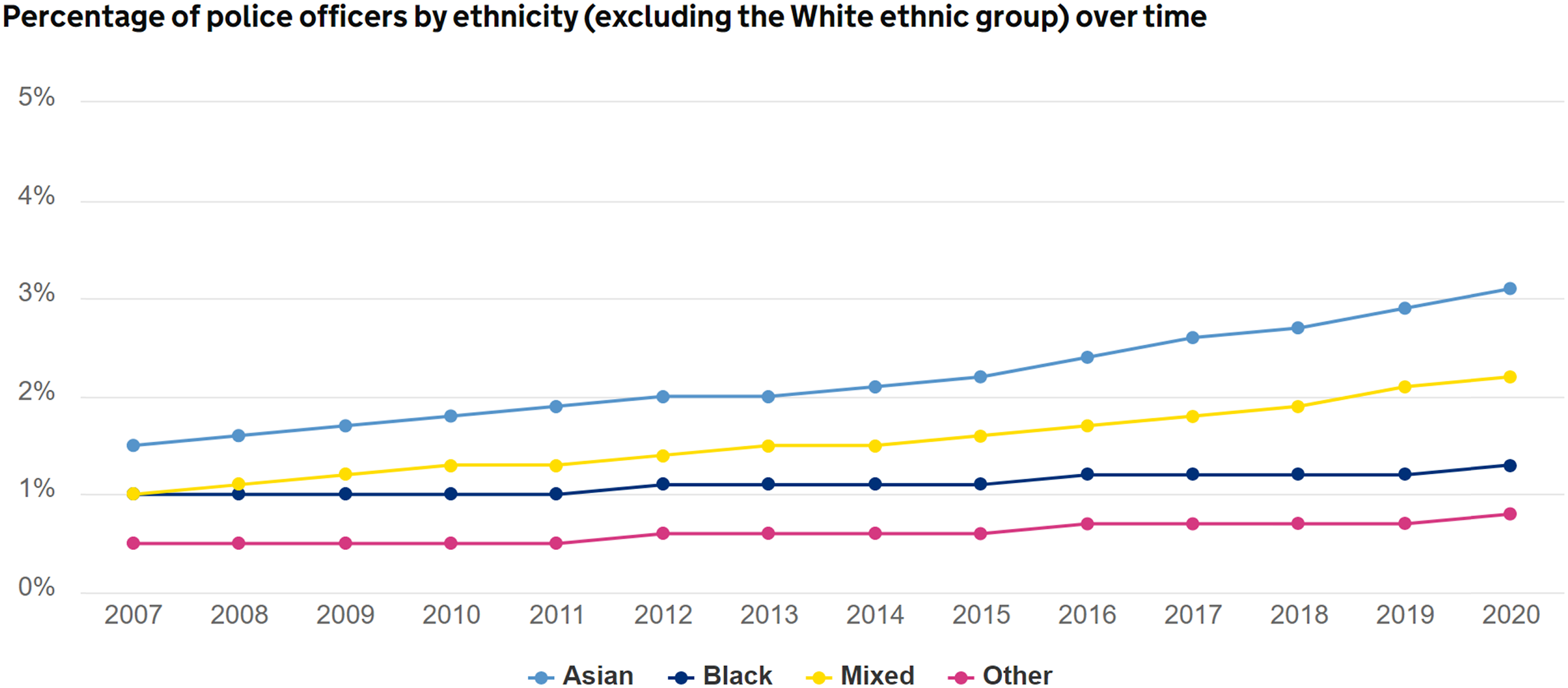
If this is the case, then the application of technical reinforcement will only address very specific disproportionality problems with the police recruitment process, and likely not affect any enduring issues experienced through policing under-represented communities. This implies that the police rely upon a weakly developed, empirical framework that links representative bureaucracy with operational policing effectiveness.
Other implications lie in the area of identity-based belonging for new police recruits. This area is speculative and relies upon the usage of social identity theory. Developed identity salience links empirically to feelings of belonging and acceptance, which have direct implications for wellbeing (Jetten et al., 2012). Each instance of assistance from existing police officers not only enhances the development of skills and knowledge needed to navigate the recruitment process but also develops these feelings in the recruit. This means that as police recruits sit in the horseshoe formation in a training school, the first day will already have those who strongly feel a part of what they are becoming and those who still have a long period of socialisation to overcome. These ‘starting blocks’ should not be underestimated, as theory links them to social support access (Haslam et al., 2005) and physical support in times of emergency (Drury 2018; Levine et al., 2005). This second issue of access to physical support in the policing profession is crucial.
Future research
Within the figurative patchwork quilt of police recruitment in England and Wales lies the establishment of a system of social reinforcement among potential police recruits. In this study, we do not present any type of control group; therefore, understanding how pervasive and instrumental this social reinforcement actually is in the police recruitment process nationally is difficult. Therein lies the actual ‘level’ of embeddedness. In this study, we illustrated high levels of embeddedness in a single constabulary, across four separate recruitment windows; however, generalising from this study would be premature. Introducing even crude methods of social measurement in other police recruitment processes, such as the measurement of familial or social connections with existing officers, may offer an insight into this level. In extremis, a very careful measurement may even render control for social influence. This would require significant theoretical and empirical development.
The development of positive action typology and application offers an opportunity for applied research, where the level of belonging and social support is measured among new police recruits. Integrating more aspects of social support into existing positive action initiatives, such as the ascribing of serving police officers as mentors for under-represented potential recruits, the organisation of ‘ride-alongs’ with existing police teams, and the ability for under-represented groups to be introduced and interact with officers already serving, is possible. These may all be attempted and measured with little threat or disruption to existing processes.
The findings discussed earlier illustrate that particular stages of the process are more socially embedded than others. This is an important finding as it explains what makes a process embedded within the police context, and what does not. The results suggest that the longer a stage of the process has been used or existed, the more socially embedded it becomes. This is an area ripe for future research, as a greater understanding of embeddedness in the police context may directly inform the disproportionality in police recruitment, and therefore, assist with process redesign and the creation of evidence-based positive action.
Finally, as the police service of England and Wales is set to increase by 20,000 police officers (Home Office, 2019), having a greater understanding is paramount to the successful recruitment and retention of suitable candidates from all communities.
Footnotes
Declaration of conflicting interests
The author(s) declared no potential conflicts of interest with respect to the research, authorship, and/or publication of this article.
Funding
The author(s) received no financial support for the research, authorship, and/or publication of this article.
