



Abstract
The interviewing of suspects is a key component in the investigation process. Although a great deal of research on interrogation and interviewing techniques has been conducted in the past, much of this work has been undertaken outside South East Asia. This new study examined Malaysian police officers’ reported rate of use of a large variety of investigative interviewing techniques categorised into six domains: rapport and relationship building, context manipulation, emotion provocation, confrontation/competition, collaboration and presentation of evidence. Eighty-eight police officers primarily from the criminal investigation department, narcotics crime investigation department, commercial crime investigation department, and traffic enforcement and investigation department participated in a pen-and-paper survey. Findings revealed that many police officers in the current study report adopting investigative interviewing techniques that are largely in line with ethical, non-coercive guidelines.
Introduction
The interviewing of suspects is an important component in the criminal investigation process to ensure that the guilty are convicted and that false accusations do not occur. Most countries in the world adopt one of two methods of questioning: accusatorial and information-gathering (Meissner et al., 2012; Snook et al., 2021).
The accusatorial approach, more commonly used in the US, Canada and many developing countries, operates on the presumption of guilt, and the aim of the techniques used is primarily to obtain a confession to the crime. According to Kassin and Gudjonsson (2004), this interrogation questioning style typically involves several components: isolation, in which the suspect is detained in a confined space and left to experience anxiety and uncertainty; direct confrontation, in which the suspect is told (sometimes falsely) that there is incriminating evidence against them and is disallowed denials; and minimisation, in which, for example, the interrogator offers justification for the crime. Such tactics are psychologically manipulative and often increase the risk of false confessions (Gudjonsson, 2021). Although the actual rates of wrongful convictions due to false confessions cannot be fully determined, this phenomenon is known to occur, a proportion of defendants who have been found guilty have been later exonerated via DNA evidence. False confessions are estimated to make up approximately 27% of all wrongful convictions in the US, as documented by The Innocence Project (n.d.). Experimental research has also shown that implying leniency through minimisation techniques can cause innocent interviewees to falsely confess (Luke and Alceste, 2020; Russano et al., 2005).
By contrast, the information-gathering method of interviewing, more common in Western Europe, prohibits the use of psychologically manipulative tactics and mandates the recording of interviews (Principles on Effective Interviewing for Investigations and Information Gathering, 2021). This approach is characterised by rapport-building, active listening and suspects being permitted to give their version of events without interruption. Studies have shown that interviews using the information-gathering approach result in lower likelihood of false confessions without lowering the rate of true confessions compared with the accusatorial approach (Evans et al., 2010; Goodman-Delahunty and Martschuk, 2020).
However, in reality, interviewers often use a mixture of techniques. Kelly et al. (2013) noted that instead of characterising interviewing methods in a dichotomous form (e.g. accusatorial vs information-gathering) – which often does not satisfactorily describe interviewers’ or interviewees ‘experiences – it can be more useful to use a taxonomy comprising six broad domains, namely: (a) rapport and relationship building; (b) context manipulation; (c) emotion and provocation; (d) confrontation/competition; (e) collaboration; and (f) presentation of evidence (involving a large sample of techniques).
To date, relatively little is known about the interrogation/interviewing techniques used in South East Asian nations because of the lack of empirical studies. One example is a study in Indonesia in which Muniroh and Heydon (2022) concluded that confronting techniques such as fabricating evidence and asserting dominance existed in police interviewing. Similarly, the use of authority to induce compliance from the interviewee has been reported to be prevalent in the Philippines (Goodman-Delahunty and Howes, 2016). In Vietnam, case studies of high-profile wrongful convictions carried out by Le et al. (2022) demonstrate that confession-driven, guilt-presumptive, torture-based techniques are used by the Vietnamese police. Singapore is arguably the only country in South East Asia known to have officially adopted an interviewing model that is based on the United Kingdom's PEACE model (Chin et al., 2022), and is also the only country in South East Asia known to have started video-recording of suspect interviews (Lum, 2018). In Chin et al.'s (2022) study, it was found that investigators frequently engage in pre-interview planning and rapport-based behaviours with suspects as opposed to intimidation-related behaviours. However, there has only been one published study that provides information about suspect interviewing practices in Malaysia. According to Chung et al. (2022), many interviewing officers in Malaysia have indicated that they use maximisation tactics and repetitive questioning in their interviews with suspects.
Investigative interviewing issues around the world may be similar to some extent, but cultural disparities may create problems for interviewers in achieving successful results. For example, Teoh and Huang (2019) highlighted the fact that Taiwan has a high-context culture, in which suspects may be more compliant to authority and this may in turn influence the dynamic of investigative interviews. Given such a scarcity of publications in South East Asia, it is important to determine the interviewing techniques police within the region report using. The current study employed Kelly et al.'s (2013) taxonomy to examine the extent to which investigating officers serving the Royal Malaysia Police endorse a range of interviewing strategies. This study provides a useful gauge of practitioners’ professional practice and knowledge in a country where the topic of investigative interviewing is underexplored.
Method
Participants
Questionnaires were distributed to 110 police officers serving the Royal Malaysia Police, 88 (80%) of which were returned. There were 70 male officers and 18 females, aged 26 to 57 (M = 37.33, SD = 7.23). The majority of the sample were ethnic Malay (78.4%), followed by ethnic Chinese (8.0%), ethnic Indian (6.8%) and other ethnicities (5.7%); one officer did not report their ethnicity (1.1%). The mean length of service was 12.06 years (SD = 9.0 years, range: 0–36 years). The officers mainly came from one of four departments, 34.1% were from the criminal investigation department, 21.6% were from the narcotics crime investigation department, 21.6% were from the commercial crime investigation department, 18.2% were from the traffic enforcement and investigation department; the remaining 4.5% came from other departments and either held leadership positions, were from operations/administration or served as raid officers. Almost all of the officers (92.0%) interview suspects or detainees in their current role. About half (48.9%) were serving as investigating officers at the time of the study, 29.5% were senior investigating officers, and 21.6% held other roles. The average number of years in interviewing experience is 6.81 (Mdn = 5.26, SD = 5.54, range: 0–28 years).
Materials
Respondents were first asked to provide demographic information, including age, sex, ethnicity, length of service, current role in the force and years of experience conducting investigative interviews. Respondents were also asked to rate their current investigating skills from poor to excellent. Officers then ranked four interview goals according to importance (1 = most important to 4 = least important) in obtaining: (a) a true and accurate account, (b) a confession/prosecution, (c) tactical information for quick decisions and (d) strategic information for longer term decisions.
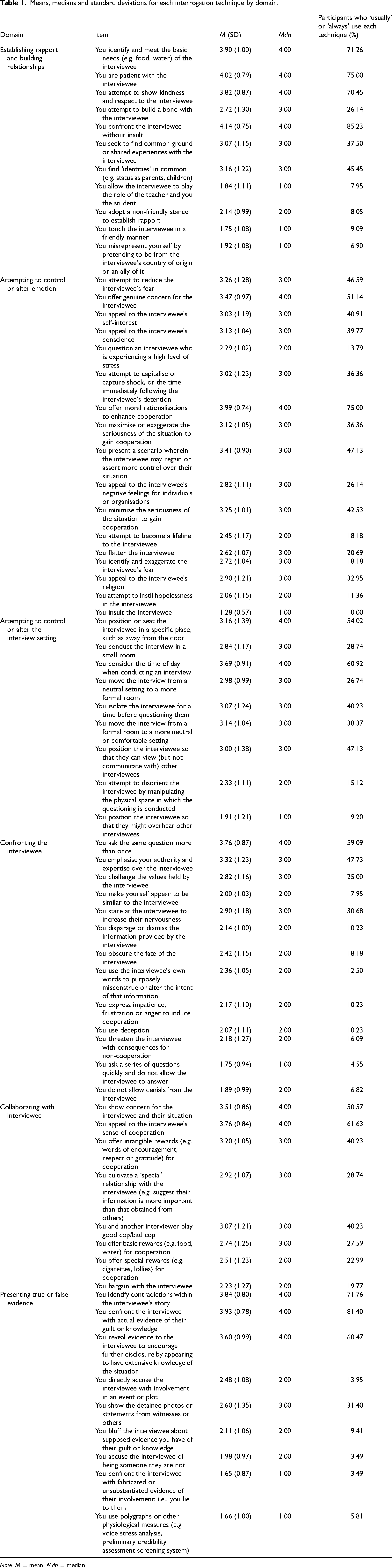
The questionnaire was that used by Sivasubramaniam and Goodman-Delahunty (2021) (see also Redlich et al., 2014). It contained 67 statements on a five-point Likert scale, in which respondents self-report the frequency with which they use each interviewing technique (1 = never to 5 = always). Following Kelly et al. (2013) the techniques are categorised into six domains: (a) establishing rapport (11 items, e.g. You attempt to build a bond with the interviewee); (b) attempting to control emotion (17 items, e.g. You attempt to reduce the interviewee's fear); (c) attempting to control interview setting (9 items, e.g. You isolate interviewees for a time before questioning them); (d) confronting the interviewee (13 items, e.g. You threaten interviewees with consequences for non-cooperation); (e) collaborating with interviewees (8 items, e.g. You show concern for the interviewees and their situation); and (f) presenting true or false evidence (9 items, e.g. You bluff the interviewees about supposed evidence you have of their guilt or knowledge) (Table 1). For each domain, respondents were also given a blank space to list any other techniques they employ should they wish to do so.
Means, medians and standard deviations for each interrogation technique by domain.
Note. M = mean, Mdn = median.
The questionnaires were administered in pen-and-paper format in Malay, the official language of Malaysia.
Procedure
The questionnaires were administered to the investigating officers prior to a talk the last author had been invited to deliver. Respondents were given time to read the participant information sheet and were asked to indicate their consent to participate by ticking a box on the consent form. They were asked not to write any identifying details that could link the survey to themselves. This project was reviewed and approved by the University of Reading Malaysia Research Ethics Committee.
Results
Investigative interviewing skills
Overall, 62.5% of respondents rated their skills as ‘average’, 20.5% rated their skills as ‘above average’, and 11.4% rated themselves as ‘excellent’. Very few respondents (3.4%) thought they were ‘below overage’, and 2.3% did not provide a response.
Investigative interviewing goals
Slightly over half (51.1%) of respondents were of the opinion that their most important goal as investigative interviewers was to obtain a true and accurate account. Around one-quarter (27.3%) indicated that gaining a confession or prosecution was their most important goal. Only 13.6% took the view that obtaining tactical information for making quick decisions was most important, whereas the remaining 11.4% stated that strategic information for longer term decisions was the most important goal. The percentages do not total 100% because there were 10 (11.36%) invalid responses in which participants rated several goals as equally important (as opposed to ranking them).
Investigative interviewing practices
Table 1 shows the extent to which officers in the current sample reported that they engage in specific interview techniques when interviewing suspects. Figure 1 illustrates the mean frequencies for the six domains. A one-way repeated measures analysis of variance with a Greenhouse–Geisser correction revealed that there were statistically different frequencies across the six domains, F(3.98, 334.35) = 16.65, p < .001, partial η2 = .17. Post hoc analysis with Bonferroni adjustment further revealed that the respondents were significantly less likely to confront the detainee, compared with establishing a rapport, with a mean difference of 0.52 (95% confidence interval (CI) [−0.78, −0.26], p < .001), attempting to control emotion with a mean difference of 0.45 (95% CI [−0.67, −0.23], p < .001), manipulating interview setting with a mean difference of 0.47 (95% CI [−0.72, −0.22], p < .001), using collaborative techniques with a mean difference of 0.56 (95% CI [−0.83, −0.29], p < .001), and presenting true or false evidence with a mean difference of 0.23 (95% CI [−0.43, −0.03], p = .01). Respondents were also significantly less likely to be presenting true or false evidence during an interview, compared with establishing rapport with a mean difference of 0.30 (95% CI [−0.51, −0.08], p = .001), controlling interviewee's emotion with a mean difference of 0.22 (95% CI [−0.40, −0.04], p = .006) and using collaborative techniques with a mean difference of 0.34 (95% CI [−0.61, −0.07], p = .004).
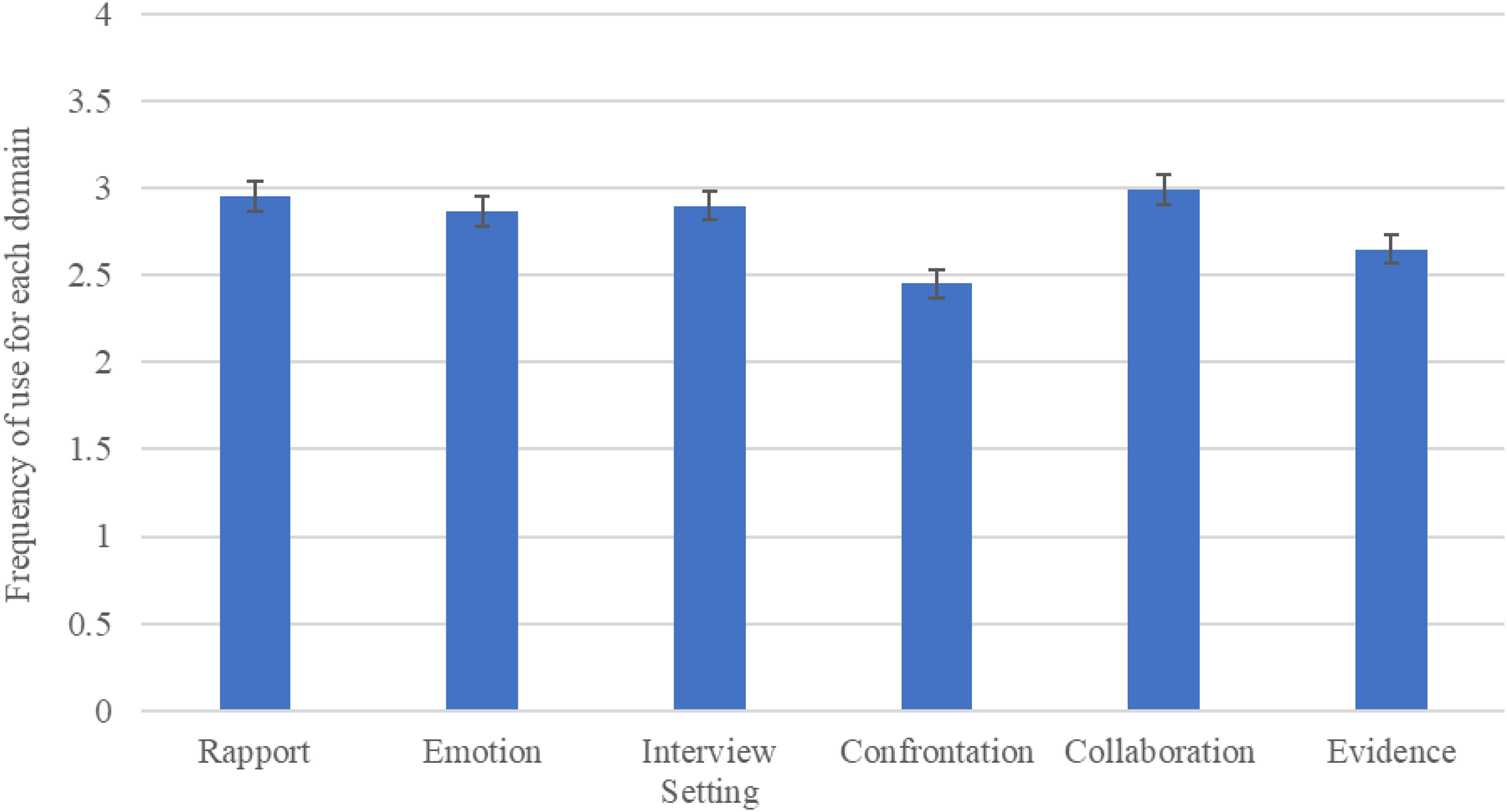
Frequency of use for each of the six domains of interrogation methods.
A summary of the most and least frequently used techniques based on medians are reported below.
Establishing rapport and building relationships
Respondents reported that they are usually or always patient with the interviewee, meet their basic needs such as providing food and water, show kindness and respect, and confront them without insult. The officers almost never touch the interviewee in a friendly manner, play the role of the interviewee's teacher or misrepresent themselves in terms of their nationality.
Attempting to control or alter emotion
It appears that respondents usually or always offer genuine concern as well as moral rationalisation to gain interviewee cooperation, and almost never insult interviewees to provoke them.
Attempting to control or alter the interview setting
Respondents usually conduct the interview in a specific place and consider the time of day when planning an interview. They are less likely to position the interviewee so that they might overhear other interviews being conducted.
Confronting the detainee
Respondents usually or always ask the same question more than once, but seldom ask a series of questions quickly or do not allow the interviewee to answer.
Collaborative techniques
The collaborative techniques that were reported as frequently used include appealing to the interviewee's sense of cooperation and showing concern for him or her.
Presenting true or false evidence
Respondents reported that they usually confront the interviewee with actual evidence of his/her guilt and identify contradictions in their stories. They also tend to reveal evidence to the interviewee to encourage further disclosure by appearing to have extensive knowledge of the situation. Respondents reported that they very seldom present false evidence of the suspect's involvement or using physiological measures (e.g. polygraphs).
Means comparison analyses were conducted to examine whether there were differences in the self-reported frequency of each interview technique by demographic characteristics of sex, department, current role and whether officers conducted investigative interviews at the time of the study. An independent-samples t-test showed that male officers (M = 3.07, SD = 0.78) used collaborative techniques more than female officers (M = 2.66, SD = 0.63), a statistically significant difference of 0.42 (95% CI [−0.81, −0.02]), t(85) = −2.09, p = .04. A one-way analysis of variance showed that the frequency of interview setting manipulation was significantly different among officers with different roles, F(2,84) = 4.36, p = .016. Specifically, Tukey post hoc analysis revealed that senior investigating officers (M = 3.21, SD = 0.61) reported controlling or altering the interview setting more than investigating officers did (M = 2.79, SD = 0.66), with a mean difference of 0.43 (95% CI [0.05, 0.80], p = .023. Senior investigating officers also controlled or altered the interview setting more than officers in other roles did (M = 2.75, SD = 0.56), with a mean difference of 0.46 (95% CI [0.01, 0.92], p = .045. No other group differences were statistically significant. Regression analyses also showed that age, years of experience as a police officer, and years of experience conducting investigative interviews did not predict the frequency of use for each interview technique.
Discussion
This study drew upon work by Kelly et al. (2013) that outlined a taxonomy of interview techniques consisting of six broad domains. In terms of rapport-building, more than 70% of officers reported that they always approach interviewees with patience, kindness and respect, as well as fulfilling interviewees’ basic needs. Being able to establish and maintain rapport can enable better communication (Gabbert et al., 2021), and is in line with the human rights movement that protects the dignity of the interviewees (Principles on Effective Interviewing for Investigations and Information Gathering, 2021). Officers reported being unlikely to touch the interviewee in a friendly manner (fewer than 10% of the respondents reported ‘usually’ or ‘always’ doing this), presumably because any physical contact can lead to accusations of police use of force. Furthermore, techniques such as showing concern or appealing to the interviewee's sense of cooperation were reported as being used by officers to develop collaboration.
Regarding confrontational techniques, more than half of the officers reported that they do usually ask questions more than once. However, repeating questions can be a form of interrogative pressure, because it implies to interviewees that their initial answers were wrong and that a different answer is expected (Baxter et al., 2006; Gudjonsson, 2003). It is therefore not a method of questioning that is recommended in international investigative interviewing protocols, such as the PEACE model (Walsh and Bull, 2012). The officers, however, reported that they rarely ask multiple questions at once without giving the interviewee a chance to respond after each question. Multiple questions should be avoided because they can make it challenging for interviewees to determine which question they are meant to answer, resulting in less and inaccurate information (Snook et al., 2012). It is therefore a positive sign that this technique was reported to be used infrequently. Indeed, that there are higher means in the rapport-building and collaboration domains in comparison with the confrontation domain indicates a preference for non-coercive techniques.
Many (75%) officers also reported using minimisation techniques such as moral rationalisation to gain an interviewee's cooperation. Offering rationalisation or face-saving excuses, which may include blaming another party or other extenuating circumstances for the offence, or by downplaying the seriousness of the offence, can make suspects think that they are still a good person and deserve to be treated less harshly, and increase their likelihood of producing self-incriminating evidence (Kassin and McNall, 1991). However, the use of non-verified rationalisations would seem unjustified and unethical. Although such minimisation techniques may lead to true admissions, they also lead to a greater likelihood of false confessions (Kelly et al., 2019). It is therefore recommended that officers use these techniques with great caution.
According to previous studies, such as those featured in The Innocence Project in the US (see also review by Kassin and Gudjonsson, 2004), presenting false evidence of the suspect's involvement is a ploy that is sometimes used in some countries. Another devious technique that some interrogators use is to falsely claim that the suspect has failed a lie-detector test (notwithstanding the questionable scientific validity of polygraph testing to date; Kotsoglou and Oswald, 2021). Such interrogation techniques are coercive in nature and can lead to false confessions (Leo, 1996) – so it is reassuring that Malaysian police officers report not resorting to these techniques, with only 3.49% of respondents reported to ‘usually’ or ‘always’ use fabricated evidence to lie to detainees or suspects. Challenging the suspect's account by emphasising their inconsistent statements and disclosure of evidence are techniques that are largely in line with ethical practices (Bull, 2014; Soukara et al., 2009).
Manipulating the context in which the interview is taking place is a crucial aspect that can affect the level of stress of the person being interviewed. Although about 60% of respondents reported that they consider the time and place when conducting an interview, it is not clear from this study whether this manipulation is aimed at heightening the interviewee's stress to induce compliance or to alleviate their fear so that they are in a better position to provide accurate information.
Male officers reported using collaborative techniques more than female officers. This finding is rather surprising, given that in previous studies male officers have been found to endorse and use accusatory or dominant techniques more frequently than female officers (Cleary and Bull, 2019; Golub and Pavliček, 2013). At present males make up the majority of the Royal Malaysia Police force (UN Women, 2020), and the sex distribution in the current sample seems to be representative of the police population. The difference in the use of interview techniques may indicate that further training on effective interviewing practices is needed.
Senior investigating officers also tended to change the physical and temporal space in which an interview occurs more often than other officers, suggesting that more experienced officers are aware of the effects that context manipulation can bring. For example, laboratory studies have shown that a spacious interview room with windows can make people more forthcoming with information compared with those interviewed in a smaller, bare room (Dawson et al., 2017). There is, however, a lack of empirical attention towards the context manipulation domain to date, hence more research is required (Kelly et al., 2021).
The current study has some limitations. The survey was administered just before a relevant lecture. Also, the (relatively large) sample was limited to those officers in attendance, who were mainly those who serve in the Klang Valley region of Malaysia, where its capital city Kuala Lumpur is located. The participants may also have a tendency to underreport coercive techniques given the news of deaths in custody in recent years in Malaysia (Zolkepli, 2021).
Conclusion
The ‘Principles on Effective Interviewing for Investigations and Information Gathering’ (2021; also known as the Méndez principles) aim to encourage modification of police practices; in particular, eliminating coercive interrogations, in line with the global anti-torture movement. These principles are based on published research on how to improve the effectiveness and accuracy of information-gathering from suspects and to prevent wrongful convictions.
From the findings of the current study, it appears that many police officers in Malaysia adopt investigative interviewing techniques that are largely in line with ethical, non-coercive guidelines. It is, however, premature to conclude whether such techniques are actually carried out in practice throughout Malaysia. It is important that investigators have the necessary knowledge and skills to conduct effective interviews to prevent miscarriages of justice. Chin et al.'s (2022) study in Singapore is an example of how governmental policies and continuous training can result in changes in police practice. It is hoped that Malaysian academics and practitioners alike will engage with research, advocacy and capacity-building efforts to prevent all forms of torture and ill-treatment and to adopt effective and ethical principles of investigative interviewing (Bull and Rachlew, 2019).
Footnotes
Acknowledgements
The authors thank the Royal Malaysia Police and Royal Malaysia Police College Kuala Lumpur for their support on this project.
Ethical Approval
All procedures performed in this research were in accordance with the ethical standards of the institutional and/or national research committee and with the 1964 Helsinki Declaration and its later amendments or comparable ethical standards.
Informed Consent
Informed consent was obtained from all individual participants included in the research.
Declaration of Conflicting Interests
The author(s) declared no potential conflicts of interest with respect to the research, authorship, and/or publication of this article.
Funding
The author(s) disclosed receipt of the following financial support for the research, authorship, and/or publication of this article: This work was supported by the Ministry of Higher Education Malaysia through the Fundamental Research Grant Scheme (grant number FRGS/1/2020/SS0/READING/03/2).
