



Abstract
Abuse of position for a sexual purpose (APSP) in police officers is a serious form of corruption that often re-victimises highly vulnerable people such as victims of domestic abuse and rape. It is thought to be underreported by victims because they fear disbelief and negative repercussions. As a consequence, such behaviour may go undetected for a long time. Using a content analysis of 10 completed APSP investigations conducted by an English police force, the research explored the characteristics and behaviour of both the police officers and victims involved. The results suggest that there may be differences in behaviours and victim selection within APSP perpetrators. Two perpetrator types are tentatively suggested: the shark and the fisherman. The shark is characterised by those who make rapid sexual contact with a specifically targeted highly vulnerable victim, often causing lasting harm. The fisherman uses a more tentative approach, casting a wide net to many potential victims (with similarities to grooming) but often failing to make sexual contact. The behaviour of both offending styles, and the implications for internal police investigations, is discussed.
Introduction
Since 1829, the philosophy of British policing has been one of policing by consent. This philosophy – attributed to prime minister and father of modern policing, Robert Peel, but most likely originating from Police Commissioner Richard Mayne – is one of policing with public cooperation, trust and respect (Jackson et al., 2012; Lentz and Chaires, 2007). When police officers are involved in corruption and misconduct, public trust and respect can be hugely undermined. It is therefore essential that corruption is dealt with promptly and robustly (College of Policing, 2015). The terms corruption and misconduct when applied to policing are used interchangeably; however, corruption generally involves violating the policing role for the purposes of personal gain and misconduct refers to breaking internal policies and procedures (Porter and Warrender, 2009). Therefore, for the purposes of this article, abuse of position for a sexual purpose is described as a form of corruption given that it involves officers seeking personal gain in the form of sexual contact. Although this behaviour does also involve the breaking of internal policies, a definition of corruption is more appropriate due to its seriousness and impact.
On 4 March 2021, serving Metropolitan Police Officer, Wayne Couzens abducted and murdered Sarah Everard. Over the preceding two years, details emerged of potential warning signs and opportunities to remove Couzens from a policing role, which were not actioned; these included multiple incidents of exposure and a nickname – The Rapist (The Guardian, 2023). This crime and recent coverage of another Metropolitan Police Officer – David Carrick – who used his police-issue handcuffs and firearm to control and sexually assault women has led to a notable downturn in public confidence and trust towards the police in the UK (The Guardian, 2023; YouGov, 2022). The consequence of this can be a reduction in cooperation between police and public through reduced reporting of crime and reduced legitimacy (Merry et al., 2012).
Abuse of position for a sexual purpose
One form of corrupt behaviour is ‘abuse of position for a sexual purpose’ (APSP), which is defined by the National Police Chiefs Council of England and Wales (NPCC) as: [A]ny behaviour by a police officer or police staff member, whether on or off duty, that takes advantage of their position as a member of the police service to misuse their position, authority or powers in order to pursue a sexual or improper emotional relationship with any member of the public. (NPCC, 2017: 4).
A review of APSP by Her Majesty's Inspectorate of Constabulary and Fire & Rescue Services (HMICFRS) in 2019 found police forces were referring an increasing number of cases to the Independent Office for Police Conduct (IOPC): 100 in 2016, rising to 172 in 2017, but with a slight decrease to 143 in 2019 (HMICFRS, 2019). The true extent of APSP is difficult to quantify; not all cases are referred to the IOPC, and not all victims report the perpetrators owing to a fear of repercussions or not being believed (NPCC, 2017; Stinson et al., 2015). In addition, some victims may not understand that the officer’s behaviour is an abuse of their position, particularly if the relationship is consensual and between adults (HMICFRS, 2019).
Victims
Research into APSP frequently finds that victims have previously experienced domestic abuse and or/sexual assault and there are often additional vulnerabilities present such as traumatic life events and substance abuse (Cottler et al., 2014; Sweeting et al., 2020). Because of the pre-existing imbalance of power between an officer and victim, vulnerability is not specifically mentioned in the NPCC definition; however, the presence of additional vulnerability in victims is seen as an aggravating factor when assessing the officer's behaviour (NPCC, 2017).
Recent research has suggested that victims of APSP by police often suffer adverse outcomes to their mental health, namely post-traumatic stress disorder and depression (Stringer et al., 2020). One study found that sexual abuses by police officers may also be associated with an increased risk of victim suicide (DeVylder et al., 2017). APSP has also been linked to at least one murder; Katarzyna Ryba – a victim of domestic abuse – who was murdered in front of her child by her ex-partner. The police officer assigned to protect Ms Ryba, Police Constable (PC) Richard Allen, had engaged in sex with her shortly before (BBC News, 2010).
Perpetrators
Officers who engage in APSP are almost always male, and generally are described as ‘street level’ in the United States and ‘front-line response’ in the United Kingdom (UK) (Lopez et al., 2017; Sweeting et al., 2020). Officers who have a committed criminal abuse of position such as rape, tend to be in the early stages of their service and aged between 36 and 43 (Stinson et al., 2015). Research involving psychometric testing of police officers found links between corruption (including sexual misconduct) and having a poor work ethic, greater impulsivity and depression (Arrigo and Claussen, 2003; Detrick et al., 2004). Although this research has illuminated some of the potential risk factors for identifying officers who may be involved in APSP, there is much left to uncover about who they are, how they select their victims and their behaviour.
The purpose of this exploratory research is to examine a number of proven cases of APSP using a content analysis approach. This method of detailed, qualitative analysis of full case files will contribute new information to this area of police corruption. APSP is a current priority for the NPCC and, as part of the strategy to address it, there is a recommendation to develop a risk assessment tool for the early identification of officers who may be involved (NPCC, 2017). This study aims to understand the service history, perpetrator and behavioural characteristics of police officers through an examination of 10 completed investigations into APSP by two English police forces.
Method
The participating police forces provided the first author with a total of 10 case files involving disciplinary investigations in relation to APSP. The cases dated from 2014 to 2018 and were analysed at police headquarters by the first author in late 2019. Each case had an extensive investigation log with timed and dated entries, which provided a full history of the allegation and subsequent enquiries in detail. In addition to this log, cases typically included victim and/or witness statements, records of calls and text messages, photographs, information relating to social media accounts and maps.
A senior officer within the counter corruption units (CCU) had uploaded the full case investigation documents onto a secure police laptop. This was placed in a secure room within the CCU, to which only the first author and the senior officer had access. The first author accessed every piece of documentation available for each case and recorded information on a university laptop, in a password-protected document, saved onto a secure drive. The participating force asked that no personal or identifiable information be recorded for any of the cases.
The first author recorded the information from the case documents into categories relating to: personal details pertaining to the officeers such as age, gender, marital status; similar details pertaining to the victim; and behaviours demonstrated by the offender, such as sending sexually explicit photographs, or providing the victim with their personal phone number. The second author reviewed and confirmed the coding in the first four cases for quality control purposes.
Ethical approval for this research was granted by the first author's ethics committee. The participating force also required both authors to undergo management-level police vetting and online data protection inputs before accessing the data.
The cases were analysed using content analysis. This was chosen because it is an ideal method for the exploration and coding of large quantities of textual information to perform quantitative counts of identified codes (Elo and Kyngäs, 2008; Vaismoradi et al., 2013). A three-step methodology was followed, as detailed by Bengtsson (2016). First, each individual case was read in its entirety before inductive codes were generated. These codes related initially to categories such as the joining date of the police officeers, how they met their victim, behaviour shown by the officer towards the victim and so on. In the second stage – re-contextualisation –cases were re-read and compared with the codes to ensure no information had been missed. Third, the inductive codes were subdivided into categories, for example: temporal data, joining dates, dismissal dates, service data, rank and role, and number of postings.
For the purposes of this research, the targets of the officers are referred to as victims. This is in part due to the police terminology within the case studies and is not intended to be interpreted in a negative way against the women and men targeted by the police officers in this research.
Results
Table 1 shows the personal and service-related characteristics of the 10 officers. Officers in the cases are referred to as officers A–J.
Personal characteristics of officers A–J.
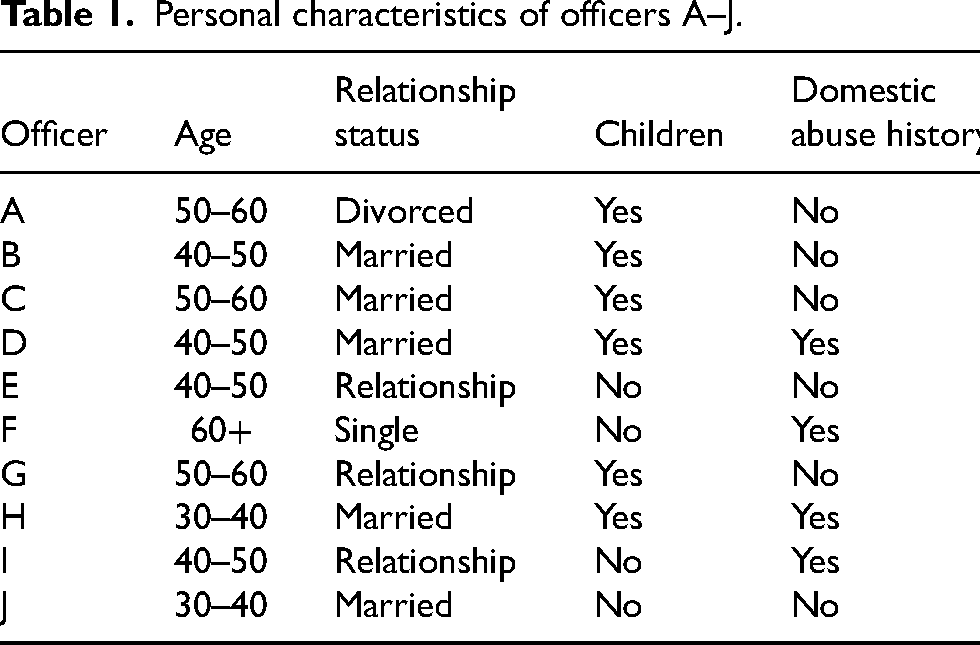
Four of the 10 officers were between 40 and 50 years of age, with the next highest age range being 50–60 (three officers). Eight of the 10 officers were either married or in relationships; one officer was single at the time that he engaged in APSP; and one officer was divorced. Six of 10 officers had children. Four officers were known to CCUs for a having a history of domestic abuse with their current partners. Table 2 explores the police service characteristics of the 10 officers.
Service characteristics of officers A–J.
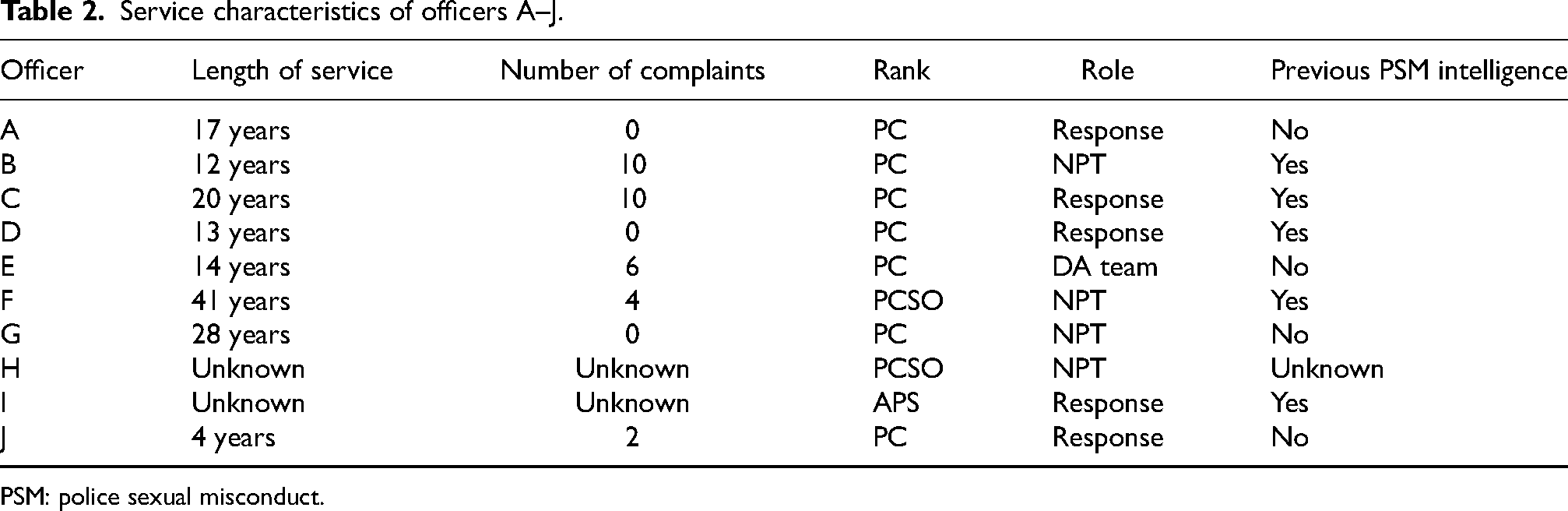
PSM: police sexual misconduct.
In eight cases, the length of the officer's service was known, and this ranged from 4 to 41 years. Officer F had 41 years’ service and had been a PC before rejoining the police as a police community support officer (PCSO). The average length of service across the eight cases, for which it was known, was 18.62 years. Excluding the two cases for which complaint history was unknown, three officers had not been the subject of any complaints (from colleagues or members of the public). Two officers (B and C) had 10 complaints each. The majority of officers (seven) held the rank of PC and two officers were PCSOs. Officer I held the rank of acting police sergeant. This means that Officer I was still technically a PC but was permitted to act as a police sergeant to gain evidence for future promotion. With the exception of Officer E, the officers worked in public-facing roles, either on response teams 1 or as part of neighbourhood policing teams. Five officers had been the subject of previous sexual-related intelligence logs before being investigated for APSP. Intelligence logs can be generated following information from the public or colleagues and are generally sanitised to ensure that the source of the information cannot be identified. In this way, they differ from complaints where the name of the complainant is known to CCUs. Table 3 provides personal information on the victims targeted by the police officers.
Victim characteristics.
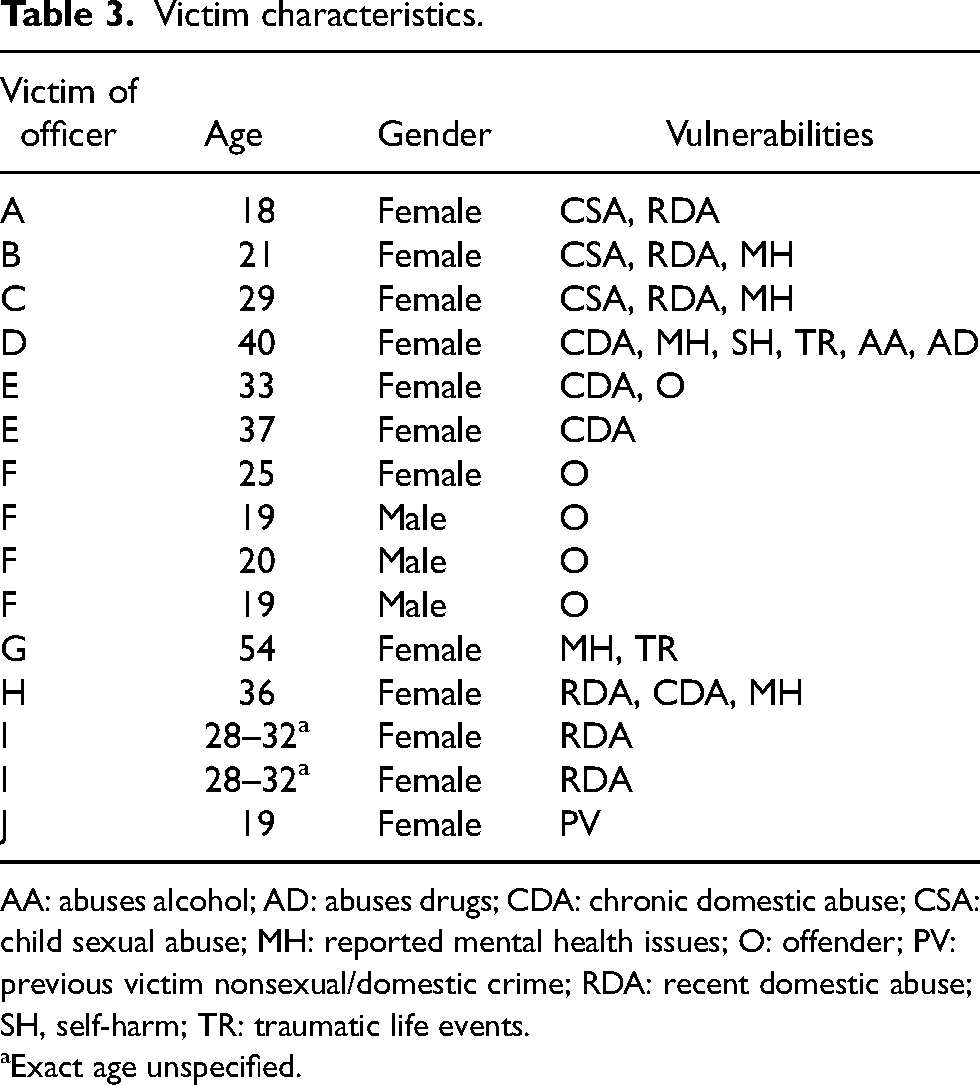
AA: abuses alcohol; AD: abuses drugs; CDA: chronic domestic abuse; CSA: child sexual abuse; MH: reported mental health issues; O: offender; PV: previous victim nonsexual/domestic crime; RDA: recent domestic abuse; SH, self-harm; TR: traumatic life events.
Exact age unspecified.
Apart from Officer F, the target gender of the victims was female. There was wide variation in the ages of the victims, from 18 to 54 years. Three officers had targeted more than one victim and in these cases, it appeared that the age of each victim targeted was similar, e.g. Officer F's three victims were aged between 19 and 25. Ten separate categories of victim vulnerability were recorded with 11 of 15 victims having one or two vulnerability categories. The victims of officers D and H had the greatest number of vulnerabilities, totalling six and four, respectively. Figure 1 shows the victim vulnerability types as percentages. The two most frequently recorded vulnerabilities across the 15 victims were recent domestic abuse (20%) and mental health issues (17%).
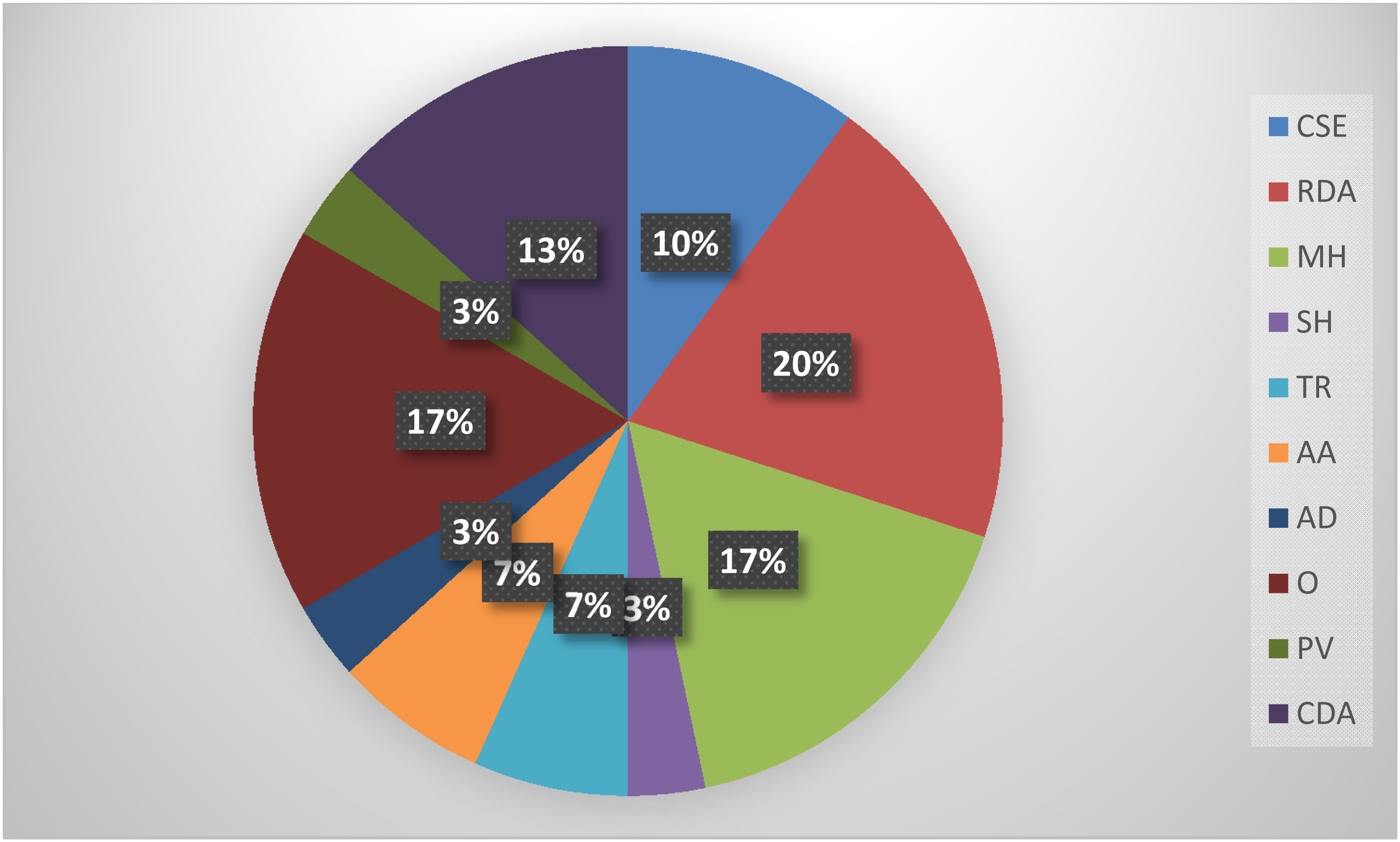
Victim vulnerability frequency.
Officers made varying numbers of checks on their target victim using police systems. Two officers had not conducted any system checks at all, but Officer F had conducted 15 separate checks on his target victim. The remaining six officers made between four and seven checks. Only one officer (B) used his work-provided email address – which was traceable and auditable – to contact the target victim. The other nine officers used personally controlled methods, such as via Facebook or provided their personal mobile phone number. All 10 officers made their first contact with their victim after being called to attend the victim's home address following a report of a crime or incident. In four cases, the officer unexpectedly reattended the victim's address without advising them first. Although all but one officer used terms such as ‘sweetie’ and ‘darling’ in their communication with the victims, the context of this usage varied. The first messages that officers A, B, C and I sent to victims were enquiries about how the victim was feeling, with offers of further help from the police. These gradually moved into more personal messages, e.g. commenting on the victim's physical appearance, enquiring whether the victim had a partner and adding kisses (xxx) to the end of messages. Officers D, E and J used similar language in messages, but its usage was immediate and, in the cases of officers D and E, sexually explicit. Officers D, E, G, H and J established physical, sexual contact with their target victim, and in all but one case this occurred within 48 hours of the first meeting. Officers A, B, C, F and I did not establish any physical sexual contact with their target victims. This finding, and the differences in how officers approached and communicated with their victims, is explored further in Table 4.
Comparison of officer characteristics based on whether sexual contact with the victim was established.
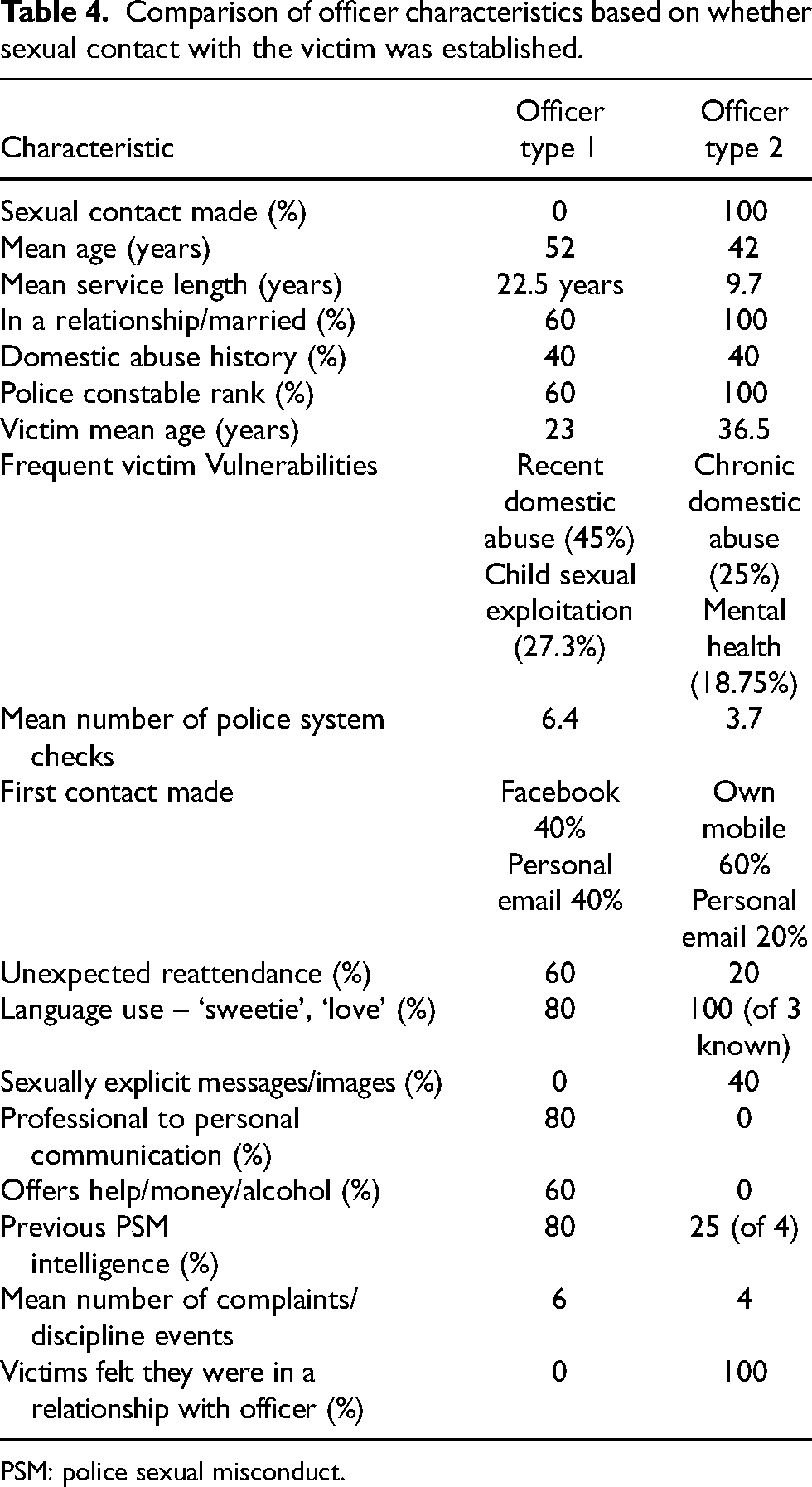
PSM: police sexual misconduct.
The characteristics and behaviours of officers who established a physical sexual relationship with their victim appear to have some differences from those of officers who did not. Officer type 1 (officers A, B, C, F and I), those who did not establish physical sexual contact, were older, with more police service compared with type 2 (D, E, G, H & J). The mean victim age targeted by officer type 1 was lower, with a mean of 23 compared with 36.5, suggesting that the age gap between officer and victim is greater in type 1 officers. In addition, the messages and statements of the victims of type 2 officers all suggested that they considered themselves to be in relationships with the officer, whereas four victims of type 1 officers described the officer's contact with them as inappropriate and ‘creepy’.
In 80% of cases, type 1 officers’ communication style was characterised by the gradual move from welfare checking to more personal comments, but this was not seen in type 2 officers. Furthermore, four type 1 officers had previously been the subject of sexual intelligence logs and they also had a slightly higher number of complaints and disciplinary actions against them. Three type 1 officers (60%) unexpectedly reattended the victim's address, this appeared to be lower for the type 2 officers at 20%.
Both officer types first met their victims after deployment to the victim’s address and, either through the nature of the incident they attended or through making their own checks, they would have been aware that these victims were vulnerable. There were some differences in the categories of vulnerability across officer types. Just under half of the victims of type 1 officers had experienced recent domestic abuse and just under one-third had experienced child sexual exploitation. The victims of type 2 officers were known to have a greater range of vulnerabilities such as life trauma, alcohol and drug abuse, in addition to just under one-quarter having known mental health issues and a one-fifth experiencing chronic domestic abuse.
In terms of similarities, officers across both types were working in public-facing roles as PCSOs or PCs. In all but one case, officers used personally controlled communication to contact their victims. However, type 2 officers used their personal mobiles in 60% of cases compared with 40% of type 1 officers who used Facebook. The four officers who were known to have a history of domestic abuse with their current partner were equally split across both officer types.
Discussion
The content analysis of these 10 cases of APSP have provided some insight into the personal, service and behavioural characteristics of these officers, and also some indication of victim characteristics, such as the nature of their vulnerabilities and how they responded to the officer. There is some evidence to suggest two typologies of officer, which may be dependent on whether the officer established sexual contact with the victim. Officers within the type 1 category have been classified as ‘fishermen’ owing to their behaviour towards victims being tentative and exploratory, akin to assessing a bite on a fishing line to establish whether to attempt to reel it in or discontinue. Type 2 officers have been classified as ‘sharks’ owing to their rapid victim selection, how quickly sexual contact between victim and officer was established, and the lasting damage sustained by the victim.
Personal and service characteristics of fishermen and sharks
Fishermen were, on average, both older and had more police service than shark. Comparing this with previous sexual misconduct research, Stinson et al.’s (2015) media report analysis of arrested police officers in the United States found the most common age range to be 36–45 years with an average service length of 5 years. Using a similar media analysis, Rabe-Hemp and Braithwaite (2013) reported a mean age of 35 years and a service length of 9 years. These findings appear to align more closely to the sharks who had a mean age of 42 years and 9.7 years of service. However, the officers in the two aforementioned studies faced criminal proceedings following allegations for offences such as rape and sexual assault, whereas the officers in the current research did not. Therefore, the US research was likely to have included the most serious, criminal cases, as these would be more likely to receive media coverage (Lopez et al., 2017). However, in line with Stinson et al. (2015) and Rabe-Hemp and Braithwaite (2013), all officers worked in a public-facing role, a factor that is recognised to facilitate sexual misconduct owing to the easy access to vulnerable people (Maher, 2003). To clarify, the 10 officers in this sample were all dismissed from their policing roles but did not face criminal charges. The potential reason for this twofold. First, there were no allegations forthcoming that the officer's behaviour fell under the criminal definition of sexual offence. Second, there is legislation that can cover APSP within England and Wales known as Misconduct in a Public Office (MIPO). MIPO legislation dates from the 1700s and must involve a public office holder (such as a police officer or member of parliament) knowingly conducting themselves in a way which would damage public trust (Law Commission, 2020). Prosecuting police officers under this legislation for APSP is possible but rare because it must be proven that the officers were on duty at the time of the APSP and that their actions damaged public trust. This legislation is currently under review with the aim of achieving greater clarity as to who it applies to, which behaviours and in which circumstances (Law Commission, 2020).
First meeting
In all cases, both officer types first met their victim while they were on duty, and as a result of responding to a crime or incident. Previous findings relating to sexual misconduct occurring on or off duty vary: Stinson et al. (2015), reported an almost equal number of on/off-duty occurrences, but Cottler et al. (2014) reported 96% of sexual misconduct in their sample had occurred on duty. The behaviour of fisherman and sharks during this first meeting appeared to have key differences. Three of the fishermen reattended the victim's home address without warning after establishing contact over social media or email. These visits were made when the officer was still on duty and, where cases provided this information, occurred within 24 h of first meeting the victim. By contrast, only one shark did this; the other four instead provided the victim with their personal email address or mobile phone number. Sharks made it clear this was their own, personal number for the victim to use if they had any issues or needed further information (e.g. the provision of photos of injuries/crime scene). Providing a personal phone number to a member of the public met in the course of duty is deemed by the College of Policing as ‘usually inappropriate’ and is strongly advised against (College of Policing, 2020: 2). Therefore, fishermen tended to make an unsolicited approach to the victim, both in person and via email/social media, whereas sharks provided the victim with a means to contact them.
Behaviour towards the victim and selection
The behaviour of the fishermen draws upon several similarities seen in manipulative and family-infiltrator sex offending. For example, the perpetrator using their occupation to meet and select potential victims and favouring vulnerable women (especially those living alone). In this style of sex offending, the offender's occupation itself may be used to facilitate access to the victim under the guise of a work-related purpose – demonstrated here by the unexpected reattendances by the officer (Beauregard et al., 2007; Rebocho and Silva, 2014).
Furthermore, the behaviour of fishermen draws some comparisons with sexual grooming behaviour. Sexual offenders have been reported to express a preference to groom young women who have been sexually abused, because they are considered to be easier targets (Craven et al., 2006). Fishermen’s victims had all experienced recent domestic abuse and three were known to have experienced child sexual abuse; survivors of child sexual abuse have a significantly increased risk of re-victimisation in early adulthood (Papalia et al., 2017; Widom et al., 2008). In addition to this, grooming behaviour follows a process of selection, gaining access and then gaining trust (Winters and Jeglic, 2017). The selection and access phases are often characterised by the offender gradually abusing a position of trust/authority (Craven et al., 2006). Fishermen appear to have selected vulnerable, very young women and purposefully moved their communication from police-related to more personal content. To gain the trust of the victim, grooming will also involve offers of help, alcohol or complimenting the victim's appearance; this was observed in three fishermen (Burgess and Hartman, 2018; Winters and Jeglic, 2017; Wolf and Pruitt, 2019).
The behaviour of the sharks followed a different course. Having provided their mobile number and received contact from the victim, sharks quickly planned to meet again; in all but one case, sexual contact was made during this second meeting. Unlike the fishermen, whose contact style was a more tentative and gradual move away from professional conduct, sharks’ contact style was a direct move from the professional to sexual with no obvious evidence of grooming. In this way, the sharks appear to have increased confidence; they were able to select a victim and be upfront about their intention to have sexual contact.
The victims of the sharks were – with the exception of Officer J – highly vulnerable women. Most were long-term victims of domestic violence and had experienced domestic abuse from multiple partners throughout their adult lives. Combined with domestic abuse, there were other issues: drug and/or alcohol dependencies, previous self-harm or serious mental health issues. Three victims in particular had experienced significant personal trauma in their lives. As far as can be ascertained from the case documents, the victims of the sharks appeared to be considerably more vulnerable than the victims of the fishermen. Cottler et al.'s (2014) research into women with drug convictions who had been the victims of police sexual misconduct found that marginalised women with significant vulnerabilities were at a greater risk of being targeted. Potentially, these additional vulnerabilities gave sharks increased confidence in their approach and reduced the need for these officers to gain the trust of the victim. In addition, the average age of the victims in Cottler et al.'s (2014) research was 36.2 years and therefore similar to the findings of this study, suggesting that extreme vulnerability is a factor in victim selection in the UK as well as in the United States.
Relationship between officer and victim
Despite the fishermen's persistence towards their victims, there is no evidence to suggest that any of them had considered having any type of intimate relationship with the officers. The female victims described the officer's behaviour as ‘odd’, ‘patronising’ and ‘creepy’, and they had sought advice from family members or support workers. It might have been that the age gap between themselves and the officers was so great that they never considered having relationships with the officers. It is worth considering that when the officer tried to move away from online messages and towards arranging a physical meeting, the victims refused and sought to end contact. As a result, fishermen tended to be reported to the CCU within days or weeks of their first meeting with the victims.
By contrast, the communication between victims of sharks and the officers suggested a belief that they were in a romantic relationship with the officer. Unlike the fishermen, early messages sent by sharks were explicitly sexual; they also included kisses and terms of endearment of the sort that may be exchanged between romantic partners. Two of the sharks also sent their victims intimate pictures. Previous research into the sending of ‘dick pics’ suggests that a primary concern of men sending such images in the context of a relationship is the risk of the recipient making the images public (Waling et al., 2020). It is therefore interesting that these two sharks voluntarily sent these images; where not just their erect penises were shown, but their faces and their police uniforms. Given the extreme vulnerability of the recipients, and the clear imbalance of power in the relationship, the motivation for sending these images may have been to demonstrate their power and control over the victim rather than to elicit feelings of desire (Oswald et al., 2020).
Possibly because of their belief that they were in a relationship with the shark, victims did not disclose the behaviour as quickly as the victims of fishermen. The victims of officers D and E did not make known any disclosure for years; the victims of officers G and I took months. The victim of Officer H would have possibly never disclosed the relationship if her child had not inadvertently revealed it. In all other cases, however, there appeared to be a crisis point in the relationship when the victim decided to report the officer. This was either the discovery that the officer was involved with other women or an incident of non-consensual sex. Potentially, the officer could have remained unreported for longer had the crisis point not occurred. In addition, the victims of sharks in this sample reported the officer directly to the police rather than to another agency or family member.
The victims of both Officer E and Officer D stand slightly apart from other victims of sharks, in that there was evidence of coercive and controlling behaviour in the relationship. Officer E repeatedly asked his victim to engage in sexual acts she was uncomfortable with. The victim of Officer D repeatedly experienced having all contact cut off without warning, causing her distress. It is also worth considering that three victims of sharks reported experiencing adverse outcomes from their involvement with the officers: self-harm, anxiety and self-destructive behaviour. Some of these issues were pre-existing, although they may have been exacerbated by the APSP. Although victim outcomes of sexual misconduct in police officers remain largely unexplored, recent US research has found a link between sexual misconduct and resultant adverse mental health in victims (Stringer et al., 2020). This echoes the findings of general research into sexual assault and increased reporting of depression, suicidal ideation and post-traumatic stress disorder (Brooker et al., 2018; DiMauro et al., 2018).
Justification and concealment of behaviour
From the sample of ten officers, only three were formally interviewed by their CCU. The other seven made no comment during their interviews or refused to be interviewed. The officers who did go through this process were all of the fisherman type and there were some similarities in their accounts. Fishermen-type officers denied that their behaviour was inappropriate and suggested the messages were no more than ‘banter’. One claimed to be actively seeking sex due to the lack of intimacy in his marriage. Three stated their contact with the victims, and repeated checks on them using police systems, were to assess their suitability as potential police informants (although the behaviour exhibited would fall far outside such protocols; Home Office, 2021).
The justification and minimisation of behaviour demonstrated by the fishermen is commonly reported in all types of sexual offender and serves to help the offender deflect criticism both from themselves and others (Ward et al., 2007). In some cases, behaviour towards the victim contradicts the offender's values, or how society expects them to behave (Szumski et al., 2018). In these cases, the offenders may create internal scripts to give themselves permission to engage in the behaviour, e.g. my wife won't have sex with me, so I’m justified in seeking it elsewhere (Kettleborough and Merdian, 2017). Minimisation and denial also serve to maintain the offender's self-image; in this case, as police officers rather than abusers of police authority (Yates, 2009). There may also have been an element of self-protection because these officers were aware that they could potentially lose their jobs and attempted to minimise and justify their behaviour as a last effort to avoid being dismissed.
Whereas fishermen tended to make more checks on their victims using police systems, which required them to justify this behaviour later, on average, sharks made fewer checks. This may suggest that sharks were more conscious of the need to conceal their behaviour at an early stage. In support of this, four of five sharks did not unexpectedly return to the victim's address, a behaviour that would be potentially traceable via radio- and car-mapping systems. Although police officers are likely to be forensically aware via their experience and training, there is some evidence to suggest that forensically aware offenders select better targets, e.g. victims and circumstances that will decrease their risk of detection (Beauregard and Bouchard, 2010). This might also offer an explanation as to why four of the five victims of sharks had an increased number of vulnerabilities: they were purposefully selected as less reliable and easier to control.
Contact vs non-contact overview
A final consideration is the difference between shark- and fishermen-type officers in their ability or otherwise to make sexual contact with the victims and this draws some interesting comparisons with research into offender narratives. Youngs and Canter (2013) proposed four offender narrative roles to explain intent in relation to the commission of their offending. These narrative roles are: revengeful mission (self-defined strong and powerful offender), tragic hero (enactment of offender's tragedy), professional role (expertise and mastery of the environment) and victim (offender is powerless and does not accept responsibility for offending). Sharks may fall into the professional role narrative because of the high confidence they appeared to demonstrate in their approach to the victim and also the elements of expertise in their awareness of how they might be caught (e.g. use of work number/excess system checks) and avoidance of this. Sexual offenders who use a professional role narrative and who make sexual contact with their victims are thought to be motivated purely by sexual gratification and have little/no consideration of the impact of their behaviour on those around them (Hamilton and Sanchez, 2019). This would lend support to the psychological impact experienced by the victims of the sharks and the officers’ apparent ease with engaging in behaviour that fell far outside the expected norm for a police officer. By contrast, the fishermen may utilise a tragic hero narrative – this is evidenced in part by their resistance to taking responsibility for their actions. Hamilton and Sanchez (2019) reported that non-contact offenders tended to use the tragic hero narrative; offenders justify their actions as a consequence of elements outside their control. An example of this would be the fisherman who was looking for sex outside his marriage and, rather than address this in a conventional way, made inappropriate sexual advances to a young victim of crime.
Limitations and future research
The primary limitation of this research is the small number of cases available for analysis. However, access to full investigations is not often provided to researchers, and despite the small number of cases, the first author was able to access all relevant documents and consider them in detail. The conclusions drawn regarding the two types of police offender in this research are therefore exploratory and require further enquiry from a wider sample. This research is currently in progress, with a proforma of potential risk factors created from this exploratory study already distributed to all police forces in the UK. In the meantime, there are several avenues police forces could take that may assist in prevention. First, analysis of these cases revealed instances in which information was known locally: to the officer's own squad but not to the CCU. Such information – for example, if an officer is having multiple affairs, or is disappearing and uncontactable during duty hours – could prove useful to CCUs. The authors are aware of at least one UK police force that has developed an online ‘notepad’ system where line managers can document both good practice and concerns about behaviour, and such a system could assist in bridging this knowledge gap. Second, the authors are working with two English police forces to assess the efficacy of psychometric testing as part of the police recruitment process. If certain traits can be linked with an increased risk of sexual misconduct and other types of police corruption, this may be beneficial in assisting the police with selection of recruits.
Conclusion
There can be no place in the police for officers who abuse their position for a sexual purpose. As this research has demonstrated, the women and men who become victims of this behaviour are some of the most vulnerable in society. The duty of the police when coming into contact with such vulnerable people is to protect them and prevent them from additional victimisation, not to exploit them further. Although the majority of police officers would never engage in such behaviour, it is essential that police forces are able to identify and remove those who do quickly. The content analysis used in this research has been beneficial in initially exploring the understanding of the characteristics and behaviours of the officer and the victim(s), to identify potential variables of interest for the next phase of the research. It seems there may be two types of APSP police offender: the fisherman, who selects a much younger victim and gradually pushes the professional boundaries of contact, but who does not achieve sexual contact; and the shark, who selects extremely vulnerable victims and rapidly establishes sexual contact. Of the two types, sharks appear to cause the greatest harm to their victims and, akin to a proficient criminal, take care to cover their tracks from the outset. The behaviour of the fishermen has some similarities with grooming; however, their intended victim reports the behaviour early on and this identification, together with their use of greater numbers of police system checks, brings them to the attention of CCUs at an early stage. With respect to assessing the risk factors of APSP and police sexual misconduct more generally, there is potentially a four-way typology of officer: those who target victims external to the police, those who target colleagues, and whether or not sexual contact was established.
Further research is required to expand on the findings of this study and to understand how closely the behaviour of these officers aligns with other similar cases and to what is previously known of sex-offender psychology.
Footnotes
Acknowledgements
The first author acknowledges retired Police Inspector Richard Newton for his influence in setting the benchmark for the high ethical standards of conduct which aided her assessment of the behaviour of the officers included in this research. The authors would like to acknowledge the police officers and police staff of the CCU of the participating force for their efforts in hosting us and allowing access to, and preparing, the data used in this study.
Declarations
The authors report no conflict or interest regarding with submission. The authors can confirm that this research article is not under consideration and any other journal. Ethical approval for this research was granted by Bournemouth University’s ethics board under reference 23871. The research was conducted in accordance with The British Psychological Code of Human Research Ethics. The research was funded as part of a matched PhD by Dorset Police and Bournemouth University.
Declaration of conflicting interests
The author(s) declared no potential conflicts of interest with respect to the research, authorship, and/or publication of this article.
Funding
The author(s) received no financial support for the research, authorship, and/or publication of this article.
