




Abstract
Police sexual misconduct encompasses a range of behaviours: from sexually inappropriate language directed towards colleagues or members of the public to engaging in sexual relationships with vulnerable members of the public. All types of police misconduct are thought to be under-reported, in part because of the ‘blue wall of silence’ where police officers fail to report colleagues’ wrongdoing for reasons of loyalty and a fear of retribution. A sample of 382 English police officers were invited to assess eight fictional police sexual misconduct scenarios to ascertain whether the scenario was a breach of the Code of Ethics, the expected level of discipline and if they would report the officer. Reporting likelihood was increased when officers perceived the scenario to be a breach of the Code of Ethics and worthy of a higher level of discipline. Female officers were more likely to report sexual misconduct than male officers, and scenarios involving direct colleagues were less likely to be reported. Non-reporting was greatest for sexual harassment between colleagues and the seriousness of this behaviour was minimised as justification for non-reporting. Use of confidential reporting was minimal with direct reporting to a line manager to be the preferred option.
Introduction
In 2018, a misconduct hearing within the small, and largely rural, Dorset Police force heard that Sgt Stephen Hughes had made sexually inappropriate and offensive remarks to female police constables. Hughes admitted telling one female officer that he wished he could breastfeed from her, and another to make him tea because ‘you’ve got the tits’. A further 31 allegations against Hughes involving four other female officers were dismissed by the misconduct panel. Hughes was found guilty of misconduct and issued with a final written warning (Dorset Police Public Misconduct Hearing—Sgt Stephen Hughes, 2018). The Chief Constable of Dorset thanked the officers who had spoken up against Hughes for their courage in reporting him.
The behaviour of Sgt Hughes fell below the standards of conduct defined by the police Code of Ethics, which states that officers must ‘ensure behaviour and language could not reasonably be perceived to be abusive, oppressive, harassing, bullying, victimising or offensive by the public or your policing colleagues’ (College of Policing, 2014: 6). The sexualised nature of his comments could also constitute sexual misconduct and sexual harassment (Maher, 2003; Zhu et al., 2019). This type of colleague-on-colleague sexual misconduct was found to account for 21.9% of a recent sample of police sexual misconduct cases (Sweeting et al., 2021). Another type of sexual misconduct, termed abuse of position for a sexual purpose, in which officers engage in sexual or improper emotional relationships with vulnerable members of the public, is currently a national priority for research (NPCC, 2017). As with non-sexual police corruption, incidents of sexual misconduct are extremely damaging to the morale and well-being of staff, the mental health of victims and the reputation of the police (Brown et al., 2018).
Policing provides a unique working environment, in which officers are granted powers of entry, and use of lethal force if necessary, combined with lone working and sometimes, minimal supervision (Hickman et al., 2016). The frequent danger of policing can give officers an aggressive outlook in their working lives that may increase the chances of abuses of power and authority occurring (Paoline et al., 2000). Stinson et al. (2015) state that the powers afforded by a policing role combined with unsupervised access to vulnerable people result in a working environment that is ‘conducive’ to sexual misconduct.
Reporting corruption in the police – including sexual misconduct – may be frustrated by the blue wall of silence. The blue wall of silence, otherwise referred to as the blue code or blue line, is the idea that police officers will not report corrupt behaviour owing to a fear of reprisals from colleagues or supervisors and/or feelings of loyalty towards the perpetrator (Wieslander, 2019). Perpetrators may also be so confident of their colleagues’ loyalty that they feel shielded from scrutiny (Lee et al., 2013). Reasons for non-reporting may be more complex than loyalty and fear. In testing the blue wall of silence in the UK, Westmarland and Rowe (2018) found that the seriousness of the corrupt behaviour was also a factor, with officers seemingly more willing to overlook less serious corruption, but more likely to report criminal behaviour. In addition to this, confusion regarding which behaviours are unacceptable, and uneven responses to corruption by the police as an organisation, may also contribute to non-reporting (Lee et al., 2013; Westmarland and Rowe, 2018)
In much of the previous research, testing the ‘blue wall’ has been intrinsically linked to testing police integrity. Klockars et al. (2000) devised a scenario-based approach in which officers are invited to read short vignettes, each covering a different type of misconduct such as accepting gratuities or allowing a colleague to evade arrest, officers are then invited to assess how serious they believe the behaviour in the scenario to be; the level of discipline they would expect to see; and if they would report the behaviour. This method has been replicated in many studies and consistently finds that officers are more inclined to report behaviour they perceive to be the most serious (Hickman et al., 2016; Klockars et al., 2006; Westmarland and Rowe, 2018). Police sexual misconduct has yet to be explored using this methodology and, as it is known to be unreported both by victims and police officers, it is vital to understand how officers define, perceive and report it (Maher, 2010; Stinson et al., 2015).
A feature missing from previous scenario-based testing is further understanding of how relationships between colleagues influence reporting. In previous research, participants have been asked to evaluate the behaviour of ‘an officer’ without the relationship between the participant and the fictional officer being specified directly. The pilot research reported here aims to explore whether there is a ‘blue wall of silence’ in the context of reporting police sexual misconduct; how seriously officers perceive different typologies of sexually inappropriate behaviour; and if reporting is influenced by the participant/officer-in-scenario relationship.
Method
Sample
Senior officers from each counter-corruption unit in England were approached via the National Police Chiefs' Council (NPCC) and asked to share an anonymous online survey with all serving police officers. In total, 382 police officers across six regions (comprising eight police forces) – South West, South East, East Anglia, North West, North East and Yorkshire & Humberside – completed the survey in full. Table 1 gives the demographic data for the participating officers compared with that for England and Wales (Home Office, 2019).
Demographics of survey sample and comparison with national police data.
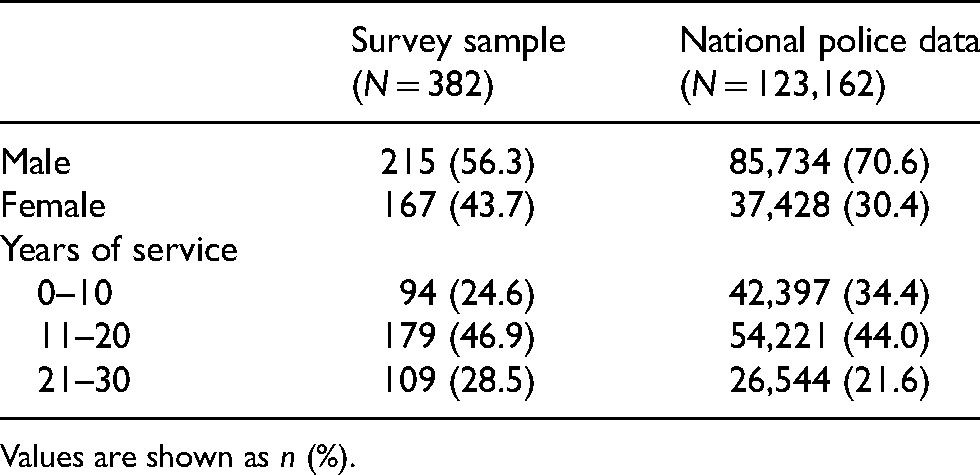
Values are shown as n (%).
Scenarios
The survey comprised eight scenarios, written to include a range of sexual misconduct types demonstrated by UK police officers, as found by Sweeting et al. (2021). To ensure the scenarios were realistic, each was based loosely on a real-life incident of sexual misconduct encountered by the first author during her service as a police officer. In addition to this, the scenarios took account of whether the behaviour was witnessed directly by the participant; in comparable studies, vignettes have been written in the third person, for example ‘a police officer routinely accepts free meals, cigarettes, and other items of small value from merchants on his beat’ (Hickman et al., 2016: 9). The researchers felt that writing the scenarios in the second person would encourage participants to think more about their responses and visualise the behaviour before responding (Hills et al., 2020).
Finally, four of the scenarios included behaviour perpetrated by a colleague of the participant, for example someone on the same squad or team, and four included behaviour perpetrated by a police officer from a different force, squad or team.
The eight scenarios are detailed below.
Scenario 1: Sex on duty (public place, colleague)
You are single-crewed on duty at night and patrolling a quiet industrial estate on the edge of town. Your attention is drawn to a vehicle in a far corner. As you get nearer, you see that the vehicle is a police car and two members of your squad are having what appears to be consensual sex inside.
Scenario 2: Sex on duty (police station, non-colleague)
You are on duty and are asked to travel to another area of your force to collect something. When you arrive, the station seems deserted. You look around trying to find someone to help you. On opening a door at the far end of the station, you see what you perceive to be two police officers having consensual sex.
Scenario 3: Sex with domestic violence victim (colleague)
You are double-crewed with a member of your squad when you are called to attend a domestic assault. The offender has already been arrested by other colleagues. You and your colleague are tasked with securing a statement from the victim. You do this and return to your station. Your colleague returns to the victim's address telling you they’ve forgotten something. When they return, they tell you that they’ve had consensual sex with the victim and plan to do so again.
Scenario 4: Sex with rape victim (non-colleague)
You hear from several trusted colleagues that an officer from a different department is having a consensual sexual relationship with a recent victim of rape. You are told that this officer is in charge of the victim's case and the relationship has been going on for some time. As far you are aware, no one has reported this officer yet.
Scenario 5: Colleague makes sexual comments about colleague (colleague)
You are at a pre-shift meeting with your squad. Everyone is getting settled down before the meeting starts and are talking with each other. A colleague points at the newest member of your squad and whispers ‘I wouldn't mind a ride on that’. They then make sexual hand gestures towards this squad member. This is the third time you’ve heard them directly make sexual comments towards this squad member. The squad member does not appear to have heard the sexual comments or seen the hand gesture.
Scenario 6: Approach to MOP (colleague)
You are asked to attend a fight involving several people. By the time you reach the scene, the fight is over, but you are asked to take details of any witnesses. You approach a member of your squad who is talking to a member of the public (MOP). You hear them ask for this person's phone number even though they are repeatedly saying that they were not a witness. Your colleague continues to ask them for their phone number until they reluctantly give in. Your colleague later tells you that they have sent this person explicitly sexual messages.
Scenario 7: Distribution of private images (non-colleague)
You are doing some paperwork when an officer from another team approaches you and thrusts their phone in front of your face. You find yourself looking at an image of a naked person who you recognise to be a fellow police officer. The officer tells you that they’d gone through the pictures on a colleague's phone without their knowledge and found this image. The officer tells you that they’ve sent it to several colleagues and ask if you’d like to be sent the image too. You decline.
Scenario 8: Showing pornography (non-colleague)
You are finishing a shift and head to the locker room to get your things. When you enter, you see an officer from another squad sitting on the floor. They are very upset and tell you that the person they are regularly crewed with shows them pornographic images when they work together. The officer has asked them to stop but they have not. The officer has not reported the behaviour.
Variables
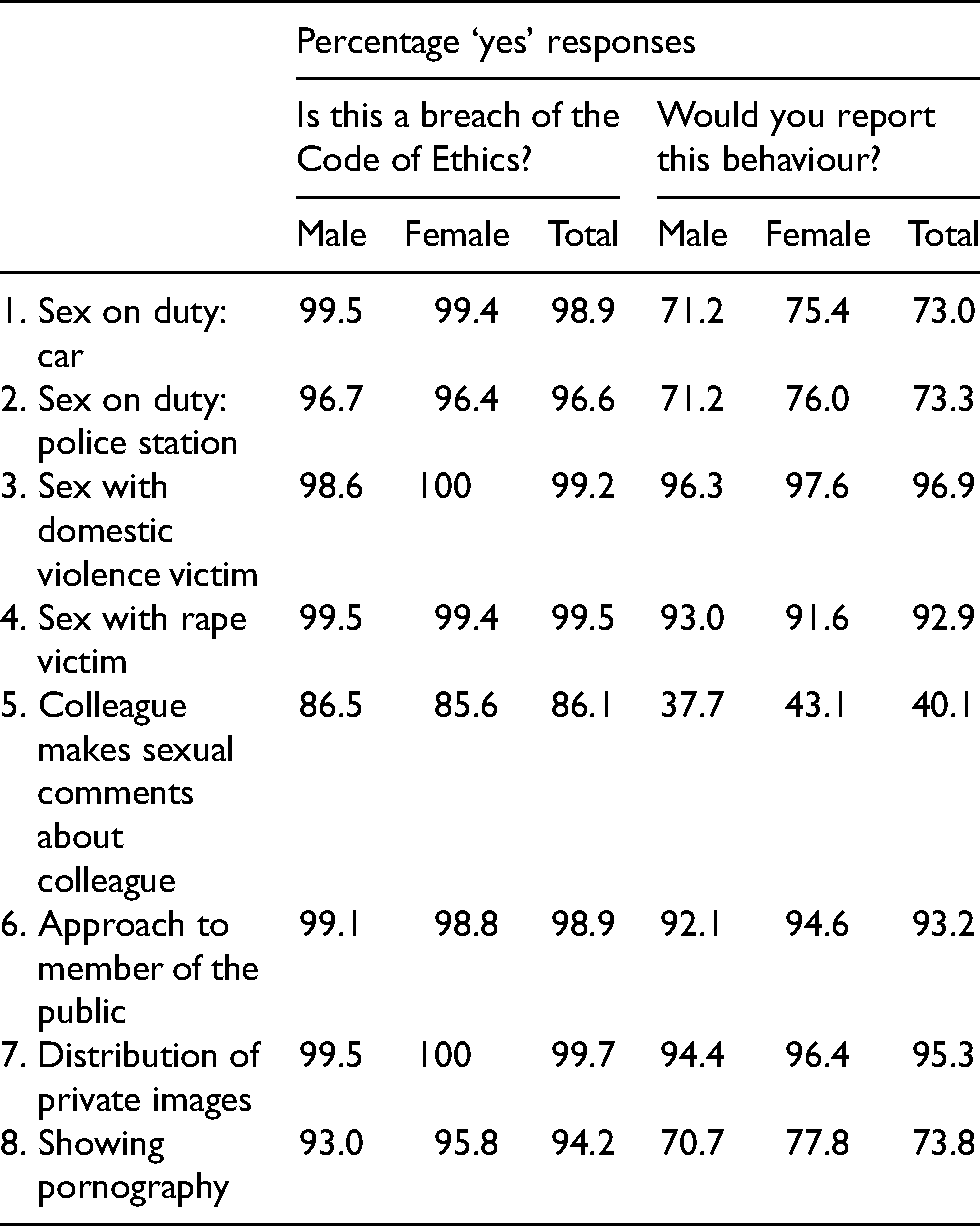
For each scenario, participants were asked three questions: would this behaviour be regarded as a breach of your force's Code of Ethics; do you think you would report these officer(s); and assuming this/these officer(s) have clean disciplinary records, what level of discipline, if any, do you think would follow? For the first two questions, officers were able to respond with ‘yes’, ‘no’ or ‘not sure’. The third question relating to discipline was designed to test the participant's perceived seriousness of the misconduct, without influencing their responses by use of the word ‘serious’. Participants could choose from the five misconduct outcomes used by police forces in England and Wales: none, verbal warning, written warning, final written warning and dismissal. Participants were also invited to include a short free-text response to explain their choices. Table 2 provides an overview of participant responses by gender and Table 3 provides a breakdown of participants expected disciplinary outcomes for each scenario.
Participant responses by gender when asked ‘is this a breach of your force's Code of Ethics’ and ‘would you report this behaviour’?
Expected outcomes as expressed by participants (%).
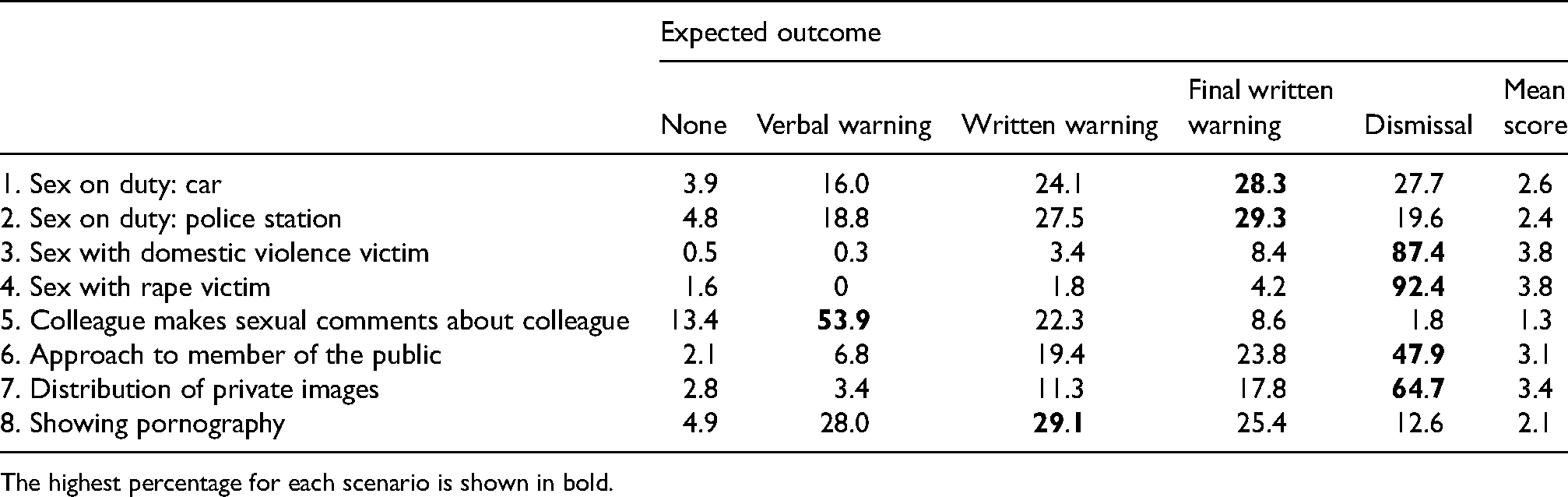
The highest percentage for each scenario is shown in bold.
Chi-squared tests to understand whether there was any difference between gender and perceiving the behaviour as a breach of the Code of Ethics, and gender and assigning a higher level of disciplinary action did not yield significant results.
Analysis: Cumulative link mixed model
The data were analysed using a cumulative link mixed model (CLMM), selected because of the ordinal nature of the survey responses. A CLMM allows for the analysis of ordinal data with the inclusion of random effects across participant responses (Chen et al., 2020). For the first model, the dependant variable was the participant's intention to report the behaviour based on perceived seriousness; if it was a breach of the Code of Ethics; involved a direct colleague or not; and participant's gender and length of service. The random term for the model was participant region, because of potential differences in sexual misconduct training across forces in the UK. Each of the 382 participants assessed eight scenarios, giving a total of 3056 responses.
The first model was fitted initially with using the Laplace approximation to calculate the maximum likelihood function. This was then repeated using the Gaussian–Hermite quadrature method, with seven quadrature nodes to achieve a more accurate approximation (Christensen, 2009). Table 4 lists the results of the first model, which suggest that the likelihood of reporting increases significantly when the behaviour is considered to be a breach of the Code of Ethics, when the behaviour is perceived as serious and when the misconduct involves an officer who is not a colleague. In addition, male officers appear to be less likely to report sexual misconduct compared with female officers. To further explore this, Table 4 shows the likelihood ratios of reporting for each significant variable. Of note is the increasing likelihood of reporting as perceived seriousness increases.
Model estimates for reporting with inclusion of ‘region’ as the random term.
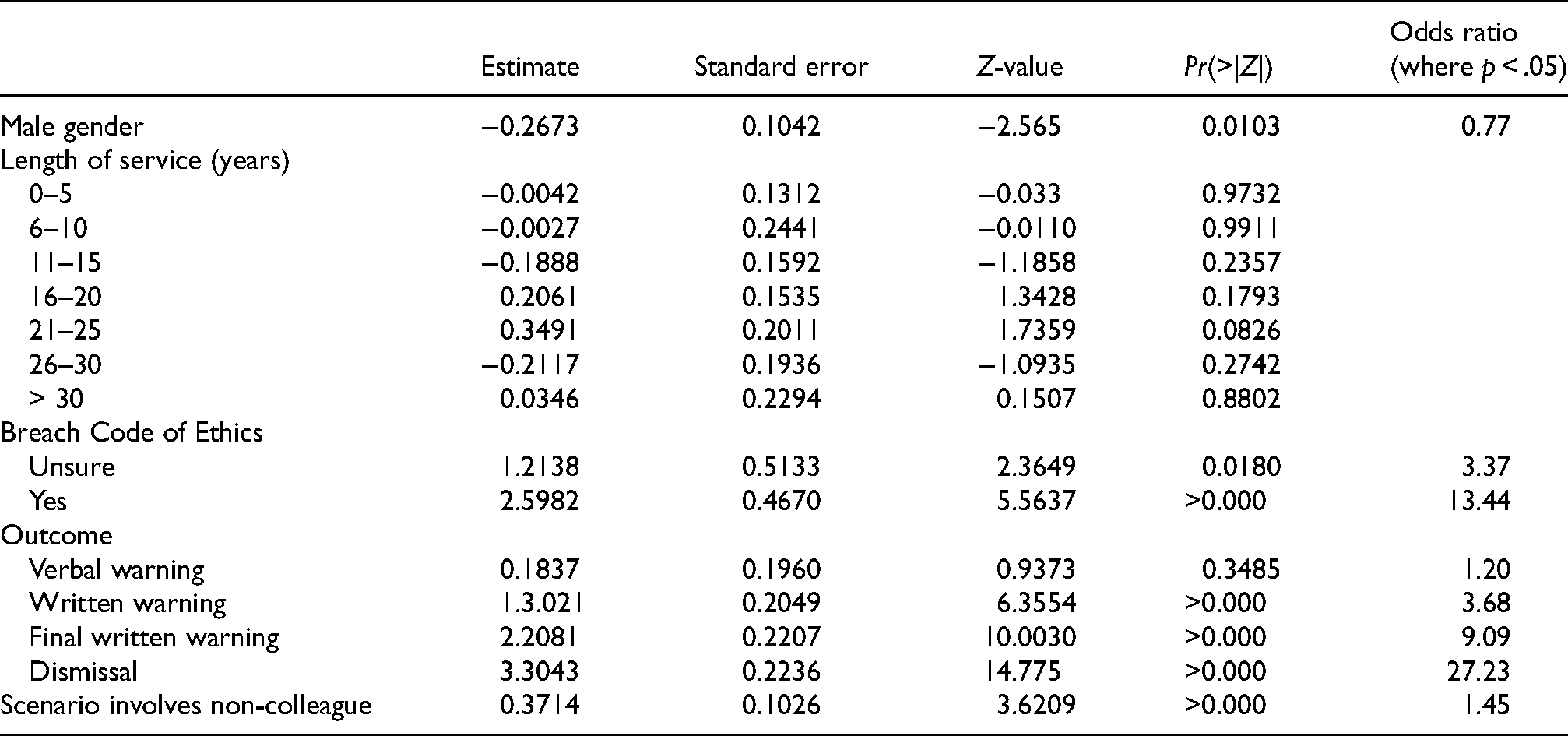
To test the effect of the random term of ‘region’, the model was repeated omitting the random term and the results compared using analysis of variance (ANOVA) [F(3039,3040) = 3095.209, p < 1], indicating that there was no significant difference in reporting likelihood across regions. Finally, likelihood ratio tests were performed on the explanatory variables to ensure the model did not violate the proportional odds assumption; all results were non-significant with only slight variations in log-likelihoods indicating no violation of the proportional odds assumption.
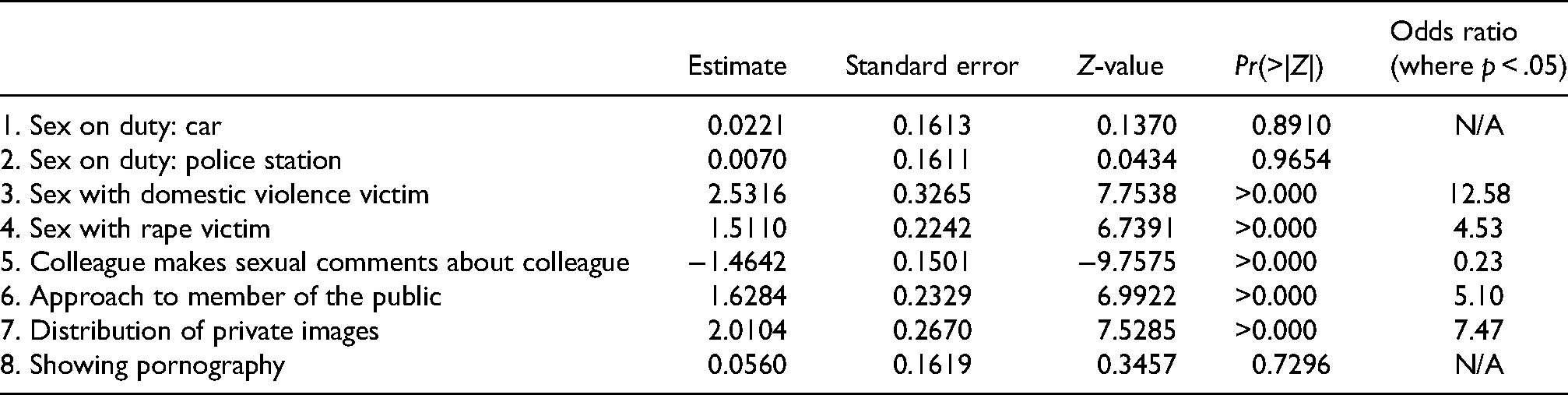
A second CLMM was conducted with the same dependant variable of reporting, but this time using the eight misconduct scenarios as predictor variables. The results of this model are shown in Table 5. Scenarios 3, 4, 6 and 7 were rated as the most likely to be reported, with no significant effect observed for scenarios 1, 2 and 8. Scenario 5 was the only one found to have a negative estimate, suggesting that participants were less likely to report the behaviour in this scenario. The odds ratios of reporting the significant results for this model support these results are also shown in Table 5.
Model estimates for reporting by each scenario.
Analysis: Reporting pathways
Participants were given the opportunity, via a free-text box, to provide a short explanation of how they would report the misconduct in each scenario. The results are shown in Table 6.
Reporting pathways for each scenario.
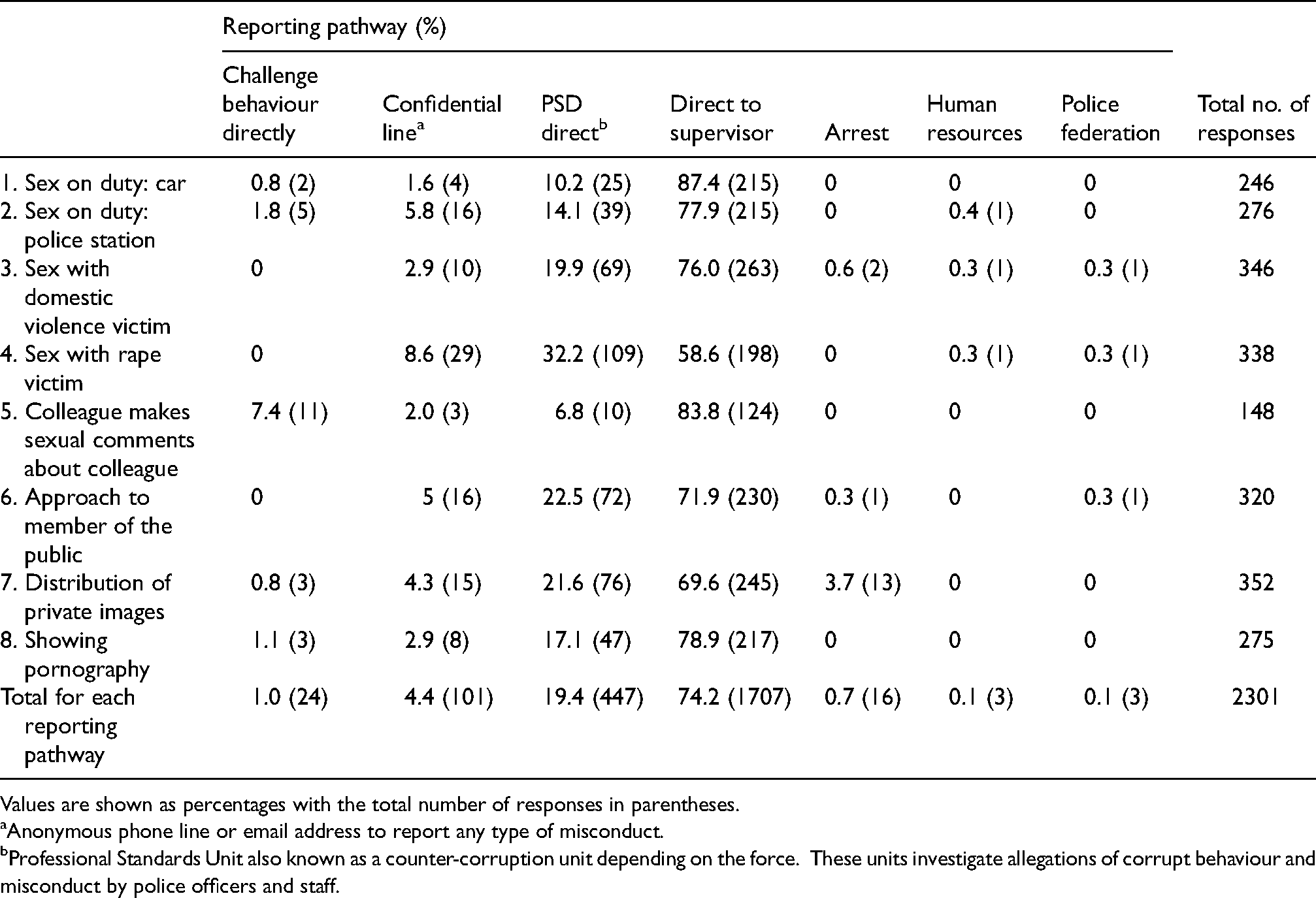
Values are shown as percentages with the total number of responses in parentheses.
Anonymous phone line or email address to report any type of misconduct.
Professional Standards Unit also known as a counter-corruption unit depending on the force. These units investigate allegations of corrupt behaviour and misconduct by police officers and staff.
Analysis: Reasons for non-reporting
Participants who selected ‘no’ or ‘not sure’ when asked whether they would report the behaviour in each scenario were invited to provide a short free-text explanation why. These text responses were analysed using a conceptual content approach. This method was chosen as ideal for uncovering the presence and frequency of the main non-reporting reasons from participants’ short text responses (Indulska et al., 2012). Following the methodology of Elo and Kyngäs (2008), the free-text responses were open-coded based on comment similarities, for example ‘I wouldn't know how to report’ would have the same meaning as ‘I wouldn't know who to report this to’. Following the open coding stage, the identified codes were grouped into themes with the intention of reducing similar categories into broader categories. The purpose of this was to identify codes that belong to a particular theme and to create ‘comparison between these data and other observations that do not belong to the same category to provide a means of describing the phenomenon’ (Elo and Kyngäs, 2007: 111).
Table 7 provides an explanation of each main theme with examples from the participants’ responses. The most frequently recorded theme was comments that served to minimise the severity of the behaviour in the scenarios as justification for not reporting it. However, the exception to this was scenario 4 in which the most common non-reporting reason was participant concerns that they had not witnessed the behaviour personally and, therefore, it may not be true. Table 8 shows the percentage of non-reporting reasons by scenario.
Explanation of the main themes with examples from participant responses.
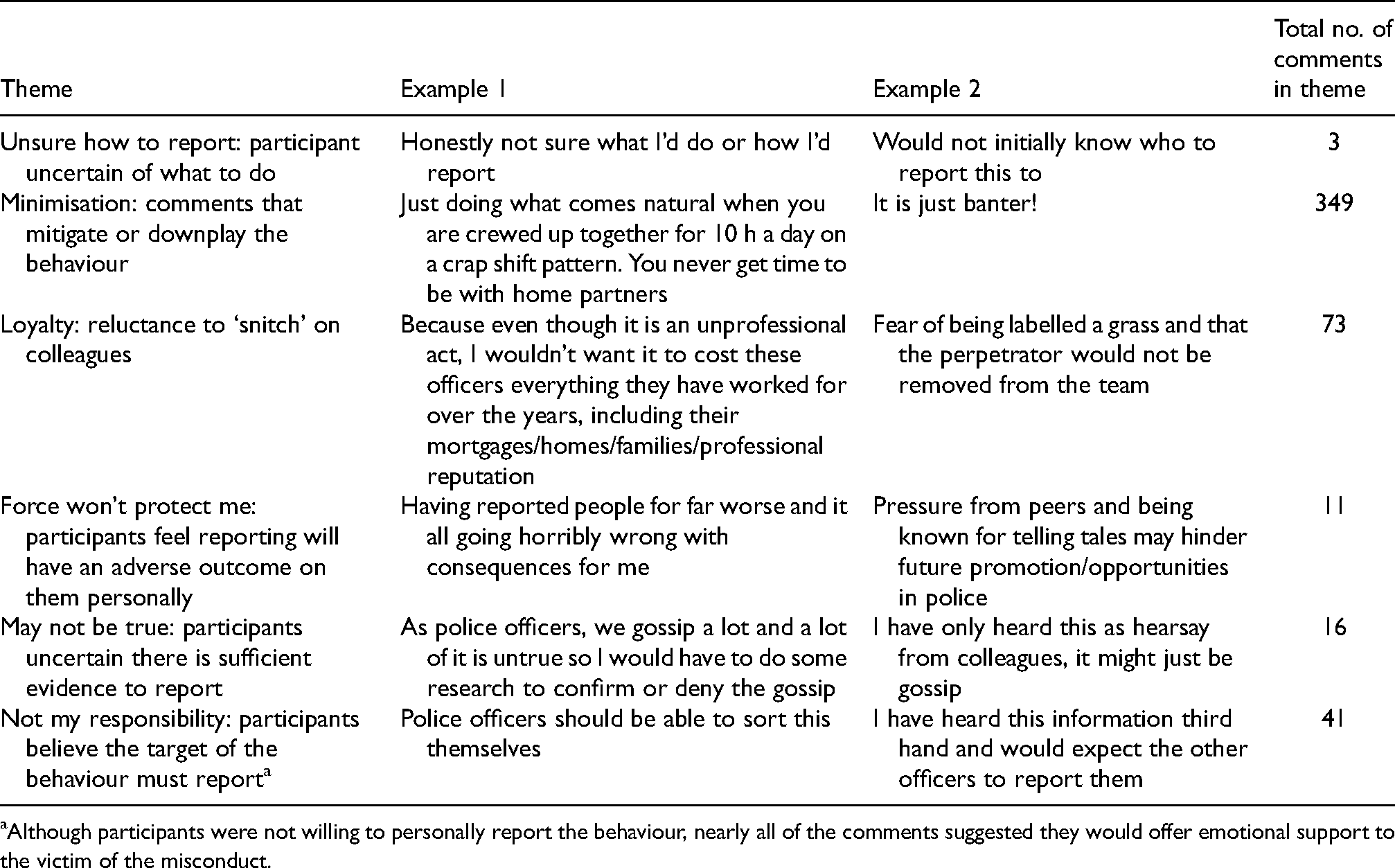
Although participants were not willing to personally report the behaviour, nearly all of the comments suggested they would offer emotional support to the victim of the misconduct.
Non-reporting reasons for all eight scenarios.
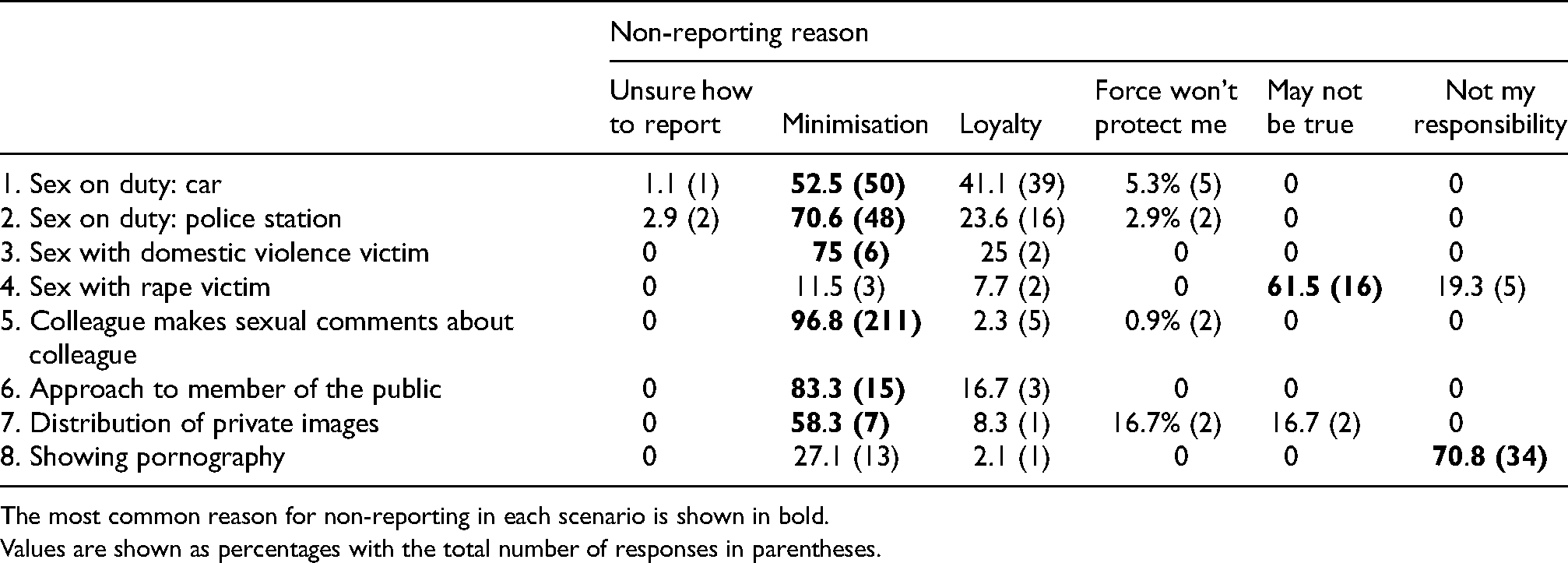
The most common reason for non-reporting in each scenario is shown in bold.
Values are shown as percentages with the total number of responses in parentheses.
A greater percentage of male officers used minimisation as a reason not to report sexual misconduct than female officers; however, there no statistically significant difference was found. Similarly, 18.3% of female officers did not report due to loyalty, slightly higher than 12.5% of male officers, but again, there was no statistically significant difference.
Discussion
Sexual misconduct is a serious type of police corruption with the potential to cause grave harm to vulnerable victims of crime and damage the reputation of the police. There is a body of research into how police officers perceive and report non-sexual types of corruption such as theft, acceptance of gratuities and interference in investigations, but less light has been shone onto sexual misconduct. Using anonymous, scenario-based testing, we demonstrated that male officers are less likely to report sexual misconduct compared with female officers; reporting likelihood is increased if the behaviour is considered to be a breach of the Code of Ethics and if the behaviour is considered serious enough to necessitate formal discipline. Officers may perceive certain scenarios as more serious if the behaviour is covered by criminal law as well as internal regulations; for example, sex with a vulnerable victim or rape victim is gross misconduct, and also may be misconduct in a public office. We also found that police officers prefer to report sexual misconduct directly to their line managers, with very little use of confidential lines. Although reporting was high across all scenarios, with the exception of scenario 5, the small numbers of officers who decided they would not report the misconduct tended to minimise the seriousness of the behaviour as a means to justify their actions.
Gender differences in reporting likelihood
The results of this study suggest that male officers are significantly less likely to report sexual misconduct compared with female officers. Across the eight scenarios, the percentage of male officers who would report the misconduct was slightly higher than that of female officers only for scenario 4 (sex with rape victim). In a previous US study examining police integrity and likelihood to report misconduct using non-sexual scenarios, no significant difference between genders was found (Hickman et al., 2016). However, in a similar Slovenian study, female officers were found to be statistically less likely to report non-sexual misconduct compared with male officers (Lobnikar et al., 2016). The researchers suggested this was due to Slovenian police culture, in which female officers are less likely to reach the higher ranks; this in turn promotes cynicism and distrust, ultimately reducing the likelihood of reporting. Different again were the results of similar Australian research, in which male officers were less likely to report scenarios involving inappropriate acceptance of gratuities and excessive force (Porter and Prenzler, 2016).
In this research, the gender difference may be explained by the nature of the scenarios. Although each was written to be gender neutral, police sexual misconduct research consistently identifies the majority of perpetrators to be male and the victims to be female (Lopez et al., 2017; Stinson et al., 2015). In support of this, a number of participants assigned genders to the scenarios in their free-text responses – ‘she’ was used for the victim and ‘he’ for the perpetrator for example: ‘If he continued, I would then report him to my supervisor’. Furthermore, in the scenario involving an officer abusing their power with a recent victim of rape, the victim is even more likely to be perceived as female because the legal definition of rape in England and Wales specifies that the offender must have a penis (Waterhouse et al., 2016).
Another potential reason for this difference may lie in how women experience and perceive such behaviour. Research into workplace sexual harassment and misconduct suggests that women perceive a wider range of sexually inappropriate behaviours as unacceptable compared with men, and men are more likely to provide mitigating reasons and rationalisations for such behaviour (Bénabou et al., 2018; Cheng and Hsiaw, 2019). However, no significant differences were found between gender and believing the behaviour to be a breach of the Code of Ethics or gender and assigning a higher level of discipline; suggesting that the female officers in this research did not view the behaviour in the scenarios any differently from the male officers. Previous research into police ethical standards suggests that female police officers are more ethical than male officers and this may provide some explanation for this increased likelihood of reporting (Adebayo, 2005). It is possible that the female officers in this research were more likely to report the behaviour because they unconsciously assign female victim/male perpetrator roles to the scenarios and therefore empathise more with the victim in the fictional scenario. Such an effect has been found in rape myth acceptance research with female participants demonstrating higher levels of empathy with rape victims in scenario-based testing (Nason et al., 2019).
Research into gender perceptions of different types of sexual misconduct provides some support for this. Studies into the non-consensual distribution of intimate images (as in scenario 7), finds that female participants demonstrated greater empathy for the female victim compared with male participants. In addition, male participants were more likely to blame the victim for the image distribution (Zvi and Bitton, 2020). This is a similar theme across much research into sexual offences where females identify more closely with female victims of rape, sexual harassment, etc. compared with males (Grubb and Harrower, 2009; Sleath and Bull, 2017). To examine this further, scenarios covering a range of sexual misconduct scenarios that specifically assign genders to both the victim and the perpetrator are recommended. Furthermore, testing the creditability of the victim and any perceptions of blame should also be included. Such research is more akin to scenario-based testing in sexual assault and rape research rather than previous sexual misconduct research but would be an effective method to understand this finding further.
Perceived seriousness and reporting likelihood
As in previous scenario-based testing of police corruption, participants were asked if the behaviour of the officer(s) was a breach of their force's Code of Ethics, and also to assign the disciplinary outcome expected on the proviso that this was the officer's first offence. In this research, the majority of officers believed the behaviour in each scenario was a breach of the Code of Ethics and this belief strongly predicted that they would report it. Being unsure if the behaviour was a breach of the Code of Ethics did not reduce the likelihood of reporting and was still a significant predictor.
The Code of Ethics for police officers in England and Wales contains specific advice on matters of police sexual misconduct, namely ‘you must ensure that any relationship at work does not create an actual or apparent conflict of interest, not engage in sexual conduct or other inappropriate behaviour when on duty, not establish or pursue an improper sexual or emotional relationship with a person with whom you come into contact in the course of work who may be vulnerable to an abuse of trust or power’ (College of Policing, 2014: 6). This, by definition, identifies all the scenarios in this research as breaches of the Code of Ethics and additionally, the Code requires officers to report colleagues’ wrongdoing.
Westmarland and Rowe (2018) drawing on data collected in 2011, and therefore preceding the roll-out of the Code of Ethics, questioned whether this ‘new code’ would be strong enough to counter ‘the blue code’ – the unwillingness to report misconduct or corrupt behaviours in colleagues. The findings of this research suggest that an understanding, or even partial understanding, of the Code of Ethics generally has a positive impact on reporting likelihood for sexual misconduct.
The perceived seriousness of each scenario – measured using the expected disciplinary outcome – found that officers who believed that the perpetrator(s) in each scenario would be dismissed were more likely to report the behaviour. Lower levels of discipline, such as final written warnings or written warnings, also predicted reporting. To summarise, officers are increasingly likely to report sexual misconduct in line with the increasing severity of the expected discipline. Both of these findings are replicated in studies of non-sexual police corruption (Hickman et al., 2016; Klockars et al., 2000, 2006; Vito et al., 2011).
In addition to this, officers appeared to perceived certain types of sexual misconduct as more serious and therefore were more likely to report them. The likelihood of reporting ratios for the scenarios ‘sex with rape victim’ and ‘sex with domestic abuse victim’ were the highest of the eight scenarios and identified these are being the behaviours perceived most seriously. The behaviour of the officer in both of these scenarios potentially falls under the definition of misconduct in a public office, which may be dealt with under criminal law and carries a maximum sentence of life imprisonment (Crown Prosecution Service (CPS), 2018). It would also be considered as abuse of position for a sexual purpose (NPCC, 2017). The scenario with the next highest reporting likelihood and perceived seriousness was the non-consensual distribution of a colleague's intimate photos – again, this is potentially a criminal offence under the Computer Misuse Act (CPS, 2020) and there is also potential for the behaviour in the next highest reported scenario (6) to be considered as harassment. This suggests that officers are more likely to report sexual misconduct that they understand is serious enough to be treated as a criminal offence.
The 17 non-sexual misconduct scenarios devised by Klockars et al. (2000, 2006) also include some potentially criminal behaviour. For example, a scenario in which an officer pockets a watch from a burglary at a jeweller’s (theft/theft by finding) and another in which an officer transports a drunken colleague home instead of arresting him for drink driving (perverting the course of justice/misconduct in a public office). In a study of UK-based police officers using 11 of Klockars scenarios (Westmarland and Rowe, 2018), the most seriously perceived offences were also those that had a criminal element: two theft-related scenarios and two including deliberate actions to pervert the course of justice, and these were more likely be reported. By contrast, similar studies using the Klockars scenarios and US police officers did not find potentially criminal behaviours to be viewed as more serious (Hickman et al., 2016; Lim and Sloan, 2016).
It is possible that, in the UK at least, police officers evaluate the behaviour in the scenarios using their own understanding of criminal law, and as suggested by Westmarland and Rowe (2018), assign seriousness based on their experience of outcomes of similar cases. For example, the offence of misconduct in a public office carries a higher criminal sentence than that of harassment. For sexual misconduct, a criminal aspect might therefore override the blue wall of silence: when a police officer behaves like a criminal, are they not considered to be true police officers in the eyes of their colleagues any longer? This is an aspect of police misconduct and integrity which would benefit from further research.
The effect of colleague
Four of the eight scenarios in this research were designed to explore any impact on reporting of perceived seriousness if the officer in the scenario was a direct colleague. The results of the CLMM find that officers are less likely to report sexual misconduct if the behaviour involved a direct colleague.
In previous misconduct and corruption research using or based on Klockars’ research, the scenarios do not explicitly identify the relationship between the participant and the officer in the scenario. This is important to explore, because collegial loyalty is one of the cornerstones of the blue wall of silence (Demirkol and Nalla, 2020; Paoline et al., 2000). However, it may not be correct to assume that police officers feel the same loyalties towards a colleague within a different force area whom they have never met and a colleague with whom they are regularly crewed. The results of this research suggest that there may well be a difference and officers appear to feel a greater sense of loyalty to their teammates. Wider research testing how willing individuals are to report wrongdoing consistently finds a greater reluctance to report friends, even if they are not considered to be close friends (Clampet-Lundquist et al., 2015; Willard and Burger, 2018). It is worth considering that teams or squads of officers may have greater social cohesion and bonds. This may be positive, insofar as it can increase motivation and productivity, but the negative side to this can be a reluctance to report misconduct (Kleinewiese, 2020; Graeff and Kleinewiese, 2020).
An additional factor noted in much of the research into the blue wall of silence is non-reporting because of a fear of retribution from colleagues (Holgersson, 2019; Wieslander, 2019). If sexual misconduct is perpetrated and witnessed by an officer(s) within the same team and a complaint is made, it is potentially more likely that the complainant will be identified and, possibly, face retaliation.
Non-reporting reasons
As mentioned above, the main reasons for the non-reporting of police corruption and misconduct, including sexual misconduct, are loyalty to colleagues and/or fear of retribution (Maher, 2003; Westmarland and Conway, 2020). The results of analysis on reasons for non-reporting in this study find very limited support for loyalty and retribution; however, the largest non-reporting reason was the theme of minimisation.
In the two sex on duty scenarios, comments relating to minimisation often included a justification for the officer's behaviour, for example, suggesting that it is no different from taking a meal break or that the behaviour was consensual. A warning (from the participant, not a supervisor) would be enough to resolve the issues. This was similar in scenario 5 – the least reported and least seriously perceived behaviour – in which despite the fictional officer having engaged in this type of behaviour on two previous occasions, a gentle warning at most was considered sufficient. Many participants pointed out that if everyone in their force got disciplined for making comments of this nature, there would be no officers left. As in other misconduct research, behaviour perceived as less serious is less likely to be reported (Hickman et al., 2016; Klockars et al., 2004; Westmarland and Rowe, 2018) but it is interesting to consider some officers’ apparent need to minimise the seriousness of this behaviour.
This finding therefore suggests that the blue wall of silence is less evident when applied to sexual misconduct and that there may be an alternative explanation for non-reporting. A potential reason for this could be the culture of the police. Enduringly described as aggressive, competitive and still predominantly masculine, it promotes an environment in which inappropriate sexual behaviour may be minimised (Brown et al., 2018). This minimisation has also been evidenced in other male-dominated fields such as medicine, higher education and politics (Bull and Rye, 2018; Hinze, 2004; Krook, 2018; Mathews and Bismark, 2015). Sexual misconduct in these other fields is accounted for by the ingrained cultural and societal equality towards women, which normalises the behaviour and, in turn, exacerbates its prevalence in male-dominated working environments (Sundaram and Jackson, 2018). Therefore, the problem in using police culture as an explanation is that it will always, to some extent, assume that all police officers think and act in the same way, when it is far more likely that officers’ individual backgrounds, personalities and experiences both before, and after joining the police, shape their beliefs (Demirkol and Nalla, 2020). It is possible that the non-reporting officers who minimised the behaviour in these scenarios did so because of the combined effects of the societal norms, for example, sexually inappropriate language is really only banter, and their own beliefs, for example, sex on duty is no more serious than taking a meal break because ‘what I do in my break time is my own business’.
In the scenario involving a non-colleague having sex with a recent victim of rape, the largest reason for non-reporting was due to participants’ concerns over the veracity of the allegation. Although the scenario states that the information comes directly from a trusted colleague, the small percentage of officers who did not report it felt that there was not enough evidence for them to act. This may be accounted for by the participants’ understanding of hearsay; unverifiable information, with a few exceptions, is to be avoided in police work as it is not admissible evidence (CPS, 2019). This suggests that some officers need more than third party information before reporting serious sexual misconduct.
Reporting mechanisms
An unexpected finding of this research was the low reported use of confidential reporting of sexual misconduct (4.4%) with the majority of officers preferring to report directly to their line managers. A confidential telephone line or email address protected by legislation gives officers the option of making a report directly to their professional standards unit without providing any identifiable information about themselves (Police and Crime Commissioner North Yorkshire, 2016). Wright (2010) also reported police officers’ preference to report general misconduct to line managers with 50% of officers believing that the confidential line/email method was not ultimately anonymous. The results of this research suggest that there is no difference in reporting processes when the misconduct is sexual.
The 78.4% of officers who would report directly to their supervisor is a positive finding, as this indicates high levels of trust and confidence in line management. Reporting misconduct to a line manager is also the recommended course of action in the Code of Ethics (College of Policing, 2014). However, it is worth considering the potential impact of social desirability bias (SDB) on this finding. SDB is the tendency of individuals to over-estimate how likely they are to carry out a desirable action, in this case reporting to a supervisor (Chung, 2003). SDB has been evidenced when testing rape myth acceptance in police officers using scenario-based testing, with recommendations for including SDB scales in police research to quantify its effect (Venema, 2018).
Positive officer/line manager relationships promote organisational trust which, in turn, increases the likelihood that officers will report misconduct (Wolfe and Nix, 2017). In many cases, reporting direct to a line manager would remove anonymity and, therefore, it is possible that in cases of sexual misconduct, officers perceive the matter to be so serious that they do not feel a need for the report to be confidential. Officers may report to their supervisors rather than to professional standards units as they place greater trust in them. Westmarland and Rowe (2018) found that supervisors consistently take positive action on reports of corruption and misconduct. When supervisors are seen to have no tolerance for corruption and take it seriously, officers tend to follow suit (Lee et al., 2013).
Limitations
In comparison with many studies of non-sexual corruption, this research did not require officers to provide their ranks. The rationale behind this was to encourage as many participants to respond to the survey as possible. The first author, having served in the police for some time, was aware of the suspicion many police officers place on anonymous surveys – especially those shared via the force intranet system. It was decided that demographic information regarding the participants should be limited to gender, length of service and region of service, which would not be sufficient to identify any individual respondent. It would have been beneficial to analyse the potential effects of rank and to include police staff as well as warranted officers.
The scenarios in this pilot research were designed to reflect realistic examples of police sexual misconduct and to explore the likelihood of reporting. Unlike police integrity scenarios, which have been in use for 20 years, testing sexual misconduct in this way is a new approach. Potentially, the addition of colleague versus non-colleague within the scenarios could be omitted for future exploration given the exploratory nature of this research.
Future research
In addition to exploring the effects of rank on reporting likelihood and seriousness perception, there are many areas for future enquiry. Further understanding of why a minority of officers considered sex with a victim of rape or domestic violence not to be a breach of the Code of Ethics would be beneficial and could be incorporated into future police training. A study to examine the level of evidence officers require before making a report of sexual misconduct to supervision across different misconduct types is also recommended. Furthermore, the sexually inappropriate language scenario was perceived as the least serious scenario and therefore the least likely to be reported; further work is planned to explore the incidence and impact of sexual bullying in the police.
As highlighted in the discussion, SDB might have influenced how participants responded to the scenarios and including a measure to assess this, such as the Marlowe–Crowne scale is recommended for future research.
Footnotes
Acknowledgement
The authors would like to thank Dr Bernhard Angele for his technical support and advice on the use of cumulative link mixed models.
Declaration of conflicting interests
The author(s) declared no potential conflicts of interest with respect to the research, authorship, and/or publication of this article.
Funding
The author(s) disclosed receipt of the following financial support for the research, authorship, and/or publication of this article: This work was supported by the Dorset Police (grant number DK11110).
