




Abstract
Police sexual misconduct is an under-researched type of police corruption. Although rare, it has serious negative ramifications for both the victims and the reputation of the police. When officers join, there is an extended period of training during which potential warning signs of sexual misconduct may be displayed. This research explored how police trainers identify and deal with sexual misconduct in new recruits. Six focus groups across four police forces in the South of England were conducted – a total of 25 police training staff. Data was analysed using thematic analysis. Sexually inappropriate language and sexual touching was witnessed during training, with both recruits and trainers as victims. Police trainers are confident in dealing with such incidents; however, more serious allegations did not result in disciplinary action. Victims and witnesses were reluctant to report incidents, and this may hinder the early identification of recruits who require more discipline or who are potentially unsuitable for police work.
Introduction
Sexual misconduct in police officers is a serious form of police corruption which encompasses a broad range of behaviours. The definition of US researcher Maher (2003, p357) defines police sexual misconduct (PSM) as ‘any behaviour by a police officer whereby an officer takes advantage of his or her unique position in law enforcement to misuse his or her authority and power to commit a sexually violent act, or to initiate or respond to some sexually motivated cue for the purpose of personal gratification’. Police sexual misconduct may include non-consensual behaviours such as rape, sexual assault and voyeurism in addition to activities such as consensual sex on duty, initiating sexual relationships with vulnerable victims/witnesses and sexually inappropriate language and gestures which may be directed to the public and/or colleagues (Lopez et al., 2017; Maher, 2003; Stinson et al., 2015).
In England and Wales, PSM is considered to be a breach of the police Code of Ethics; the standard of conduct and behaviour expected from every serving officer (College of Policing, 2014). The Code of Ethics states that officers must: ‘not engage in sexual conduct or other inappropriate behaviour when on duty’ and to ‘ensure behaviour and language could not reasonably be perceived to be abusive, oppressive, harassing, bullying, victimising or offensive by the public or policing colleagues’ (College of Policing, 2014: 6).
PSM
Police sexual misconduct is an under-researched form of police corruption – especially within England and Wales. It is also relatively uncommon with approximately 220 proven cases per year as compared to 837 proven cases of other types of corruption (HMIC, 2017; IOPC, 2012). However, the impact it has to the lives of victims, and importantly the reputation and trust in the police, is immeasurable. Often, victims of PSM are highly vulnerable members of society with histories of drug abuse, sexual abuse and mental health issues (Cottler et al., 2014; Sweeting et al., 2020). Adverse outcomes for victims who are external to the police include depression and post-traumatic stress disorder (Stringer et al., 2020). Police sexual misconduct can also occur between colleagues in the form of inappropriate sexualised language and overfamiliar touching (Brown et al., 2019). Police officers and staff who experience or witness this behaviour have been found to have lower productivity levels and higher levels of stress (Brown et al., 2018). Finally, some consensual sexual activity between officers is also considered to be PSM, for example, sex on duty. Sweeting et al. (2020), recorded 6.5% of a total sample of 155 cases of PSM in England and Wales involved officers engaged in sexual contact when on duty. Officers who engage in sexual relationships with colleagues are expected to declare any potential conflicts of interest to their supervisors, for example, if the officers work on the same team or if one or both parties are married to other people
Policing is unique in many ways due to its associated dangers, unpredictability and opportunities for lone working – sometimes with poor supervision (Demirkol & Nalla, 2009; Stinson et al., 2015). The working and organisational culture of the police can therefore be aggressive, assertive and, despite drives to promote greater workplace diversity, predominantly masculine (Brown et al., 2018; Loftus, 2010). In addition, feelings of loyalty to colleagues and/or fear of retribution or ostracisation may prevent officers from reporting misconduct (Holgersson, 2019; Westmarland & Rowe, 2018; Wieslander, 2019). Whilst police culture may provide a partial explanation for the occurrence of PSM, it is likely that individual factors are also involved (Maher, 2003). The concept of the ‘bad apple’ – an individual who has joined the police pre-disposed to abuse the power the role affords, may account for some instances of PSM (Melig, 2012). However, bad apple theory implies PSM is an isolated issue which can be easily resolved by simply dismissing bad apple officers. It is far more likely that the working environment, the organisational culture, and individual factors combine together to account for PSM (Lee et al., 2013; Lopez et al., 2017).
Outcomes for police officers involved in PSM can be variable. In the US, many officers involved in PSM are simply moved to another station rather than face disciplinary action (Rabe-Hemp and Braithwaite, 2013). Countrywide variations in both the frequency and outcomes of PSM have also been recorded in the US. States such as Texas have been found to have a greater frequency of PSM than Eastern states, and similar offences have been dealt with by imprisonment in one state and by an apology letter in another (Stinson et al., 2015). Such variations have also been recorded in England and Wales where 94% of officers in the south of the country were dismissed for abuse of position for a sexual purpose compared with 66.7% in the north (Sweeting et al., 2020).
Police training
New police officers who are suddenly immersed into the policing environment are believed to undergo a strong socialisation process (Oberfield, 2019). A component of this is the impact of learning what it means to be a police officer; the potential dangers of the role and the potential scrutiny faced from the public, media and the organisation (Branch, 2020). Recruits may therefore form strong personal bonds with their colleagues and see themselves as set apart from the rest of society (Boivin, et al., 2020) New recruits are generally at their most principled with high levels of integrity on joining and they remain this way during training (Blumberg et al., 2016). An effective training environment must therefore bring the positive elements of socialisation such as team working and cohesion, together with problem solving and decision-making skills (Belur et al., 2019).
Police training in England and Wales consists of several phases which vary slightly in length across different forces. Generally, recruits can expect to spend the first 18–22 weeks of training within a classroom environment where they are taught and are tested in criminal law and police procedures (Essex Police, 2020; North Wales Police, 2020). Police trainers are serving police officers or civilians who have successfully completed an extensive learning programme (College of Policing, 2013). Trainers closely supervise new recruits in a way which can be lost once a recruit is sent out into the real world of policing. The aim is to foster an environment of guidance, structure and social support which results in increased feelings of internalised commitment to the police (Chevalier et al., 2019).
There is little previous research into sexual misconduct in police recruits, but there is some cross-over with the use of psychometric testing during recruitment. Arrigo and Clausen (2003) identified a lack of conscientiousness as a notable predictor of future misconduct in police recruits. Detrick et al. (2004), also linked this trait to non-graduates from police training – some of whom were dismissed for sexual misconduct – in addition to arrogance and emotional vulnerability. Reingle-Gonzalez et al. (2016) found intensive recruitment of police officers in North America – requiring larger class sizes and increased yearly intakes – resulted in higher relative frequency of PSM during the training phase. Given that the Government have promised an extra 20,000 new police officers by 2023, it is important to ensure that police forces are able to recruit without compromising on standards of trainee officers (Full Fact, 2019; Home Office, 2019).
Sexual misconduct by police has serious consequences for victims who are often highly vulnerable. In addition, it also damages the reputation of the police, potentially leading to mistrust by the general public and a lack of reporting or general support. The early identification of officers who engage in this behaviour is therefore critical, and a current priority of the National Police Chiefs Council of England and Wales (NPCC, 2017b). It is therefore important to understand how early in an officer’s career sexual misconduct may occur and even if PSM can occur as early as the first weeks and months of service.
The current research seeks to: Identify if sexual misconduct occurs within the initial training phase of police recruits and if so: What behaviours occur? The seriousness of such behaviours? How do police trainers identify PSM during training? How do police trainers deal with allegations? And are there any potential barriers to the identification of PSM within the training environment?
Method
Demographic information for participants across the four forces.
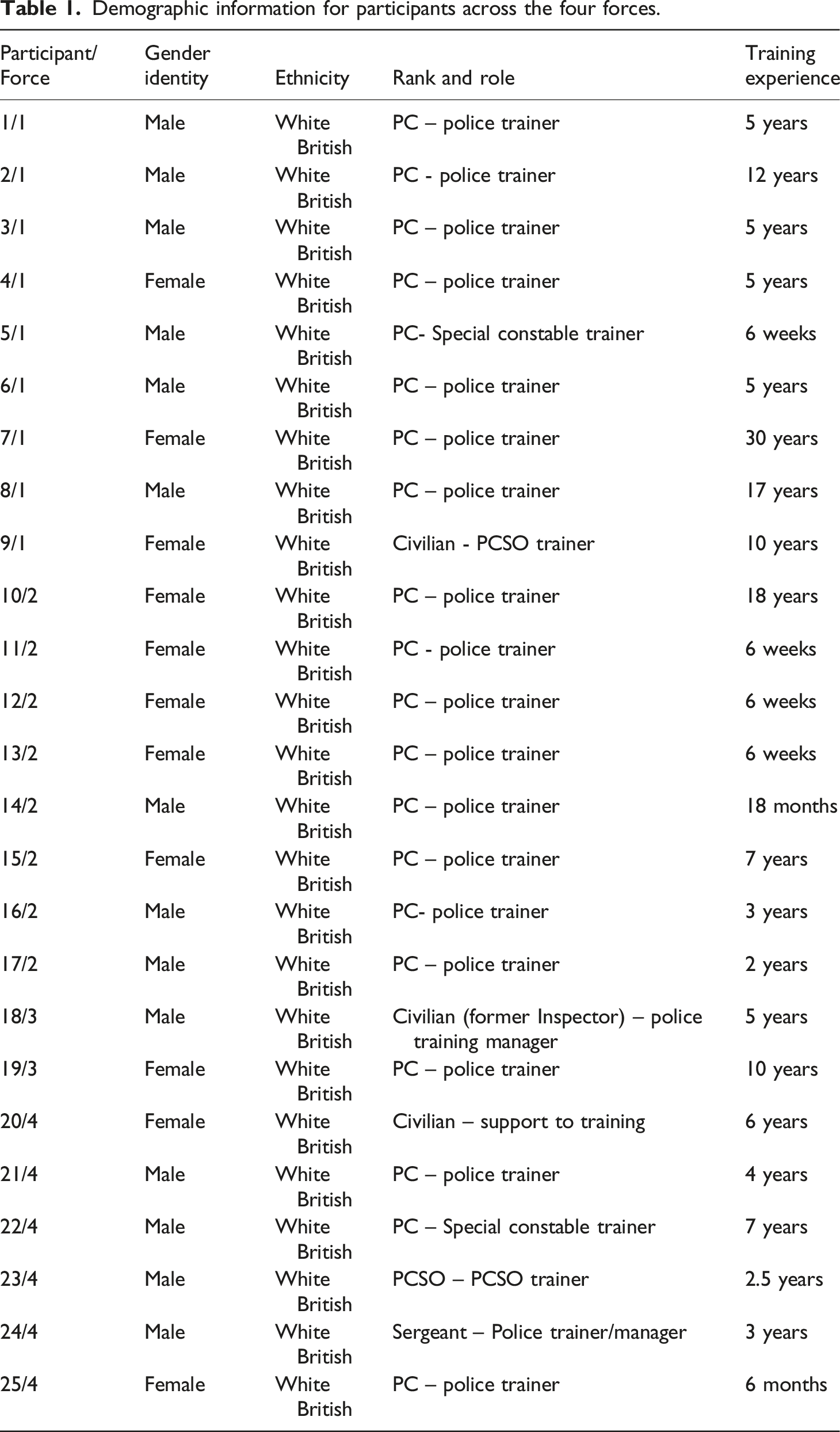
The focus group approach was selected as an effective method to explore the fairly novel topic of PSM in recruits, and to understand the trainers’ opinions and perspectives; both as individuals and within their teams (Braun & Clarke, 2013). At a surface level, police trainers are a homogeneous group and work together on a daily basis: however, they would also have had different career paths prior to training and diverse individual experiences. Striking this balance between homogeneity and heterogeneity of participants is an effective way to elicit vigorous discussion within focus groups (Acocella, 2012).
Procedure
The training Sergeant or in one case, Inspector, from each force’s training unit arranged a suitable time for the focus groups. The researcher requested that each group include around five trainers to both maximise data collection, yet also ensure that each participant would have the opportunity to fully engage in the discussion. Braun and Clarke (2013), suggest groups of between three and eight are an ideal size to manage and encourage in-depth discussions. The training Sergeant/Inspector was sent the participant information form in advance of the focus groups and was asked to share this with interested police training staff, advising them participation was optional. The trainers were given a copy of this and the opportunity to ask any questions when the researcher/s attended to run the groups. The consent forms were provided prior to commencing the groups. The researcher also outlined the ground rules for the sessions, namely, allowing each participant the chance to speak, to avoid speaking over each other and to involve one another in the conversation.
Focus groups
For five out of the six groups, the researcher/s travelled to the participating forces and ran the focus groups in a quiet room within the training block of police premises. Due to issues with room availability, focus group three was conducted over Skype. The atmosphere of the group conducted over Skype was noticeably different to the groups conducted in person in that the conversation felt somewhat stilted at the beginning and the researcher was less able to observe the body language and reactions of the participants. Fortunately, the Skype group consisted of only two participants, as conducting a larger group in this way would have possibly amplified these issues. The focus groups each lasted for approximately 1 hour. At the beginning of the focus groups, trainers were asked to introduce themselves by their first names only and provide a brief history of their police careers, including the approximate date of their move into the training department. Trainers were also asked to state which type of recruits they train, for example, police officers, police community support officers (PCSOs) or Special Constables, their current rank and their ethnicity.
The participants were asked: do you have any experience in dealing with student officers who behave in a sexually inappropriate manner during training? If so, what behaviours have you observed? In which environments have any incidents occurred, for example, on or off duty? Where you have not directly witnessed something, how have recruits or colleagues made you aware of it? If you were made aware of a report of sexual misconduct by a recruit, how would you deal with it?
Analysis
The focus groups were recorded and transcribed verbatim. All personal details were anonymised, including geographical details relating to each force. An inductive thematic approach was selected for the data analysis. This method is ideal for research questions where there has been little previous research, as the analysis is driven by the current data and not by pre-existing theory (Braun & Clarke, 2013). The inductive thematic approach is also well suited to this research as it seeks to understand the experiences and perceptions of the participants (Clarke & Braun, 2017).
This analysis was carried out in accordance with the six stage method recommended by Braun and Clarke (2013). The researcher familiarised herself with the transcripts before summarising lines and sections of text into initial codes which were relevant to the research questions. The initial codes were then reviewed and organised into broader themes which were then checked against the transcripts to ensure all related data had been identified. NVivo software was used throughout the coding process.
Reflexivity
The research (first author) is a serving police officer. During her own training and during her career, she has worked with a small number of police officers who have been dismissed for sexual misconduct. There are advantages of police officers conducting such research, in that they have a pre-existing knowledge of police terminology, procedures and experience of police training. However, there is also potential for the researcher to interpret the experiences of the trainers in accordance with her own (Dodgson, 2019; Palaganas et al., 2017). The first author decided to disclose her status as a police officer to the participants but did not disclose her own experiences and emphasized her role as a researcher wishing to elicit and understand their experiences. The decision to disclose this was made to balance the need between understanding the issues of PSM during training as a researcher and being honest and open with the participants (Lazard & McAvoy, 2020). In an effort to avoid bias, the second author (who is not a police officer) was present for the first two focus groups and during the initial part of the coding process.
Findings and discussion
The participants provided in-depth and often highly detailed accounts of their experiences of identifying and dealing with sexual misconduct in police recruits. Three main themes were identified: types of sexually motivated behaviour during training; identifying and dealing with PSM and barriers to reporting. The main themes and sub-themes are presented in Figure 1. Main themes and sub-themes.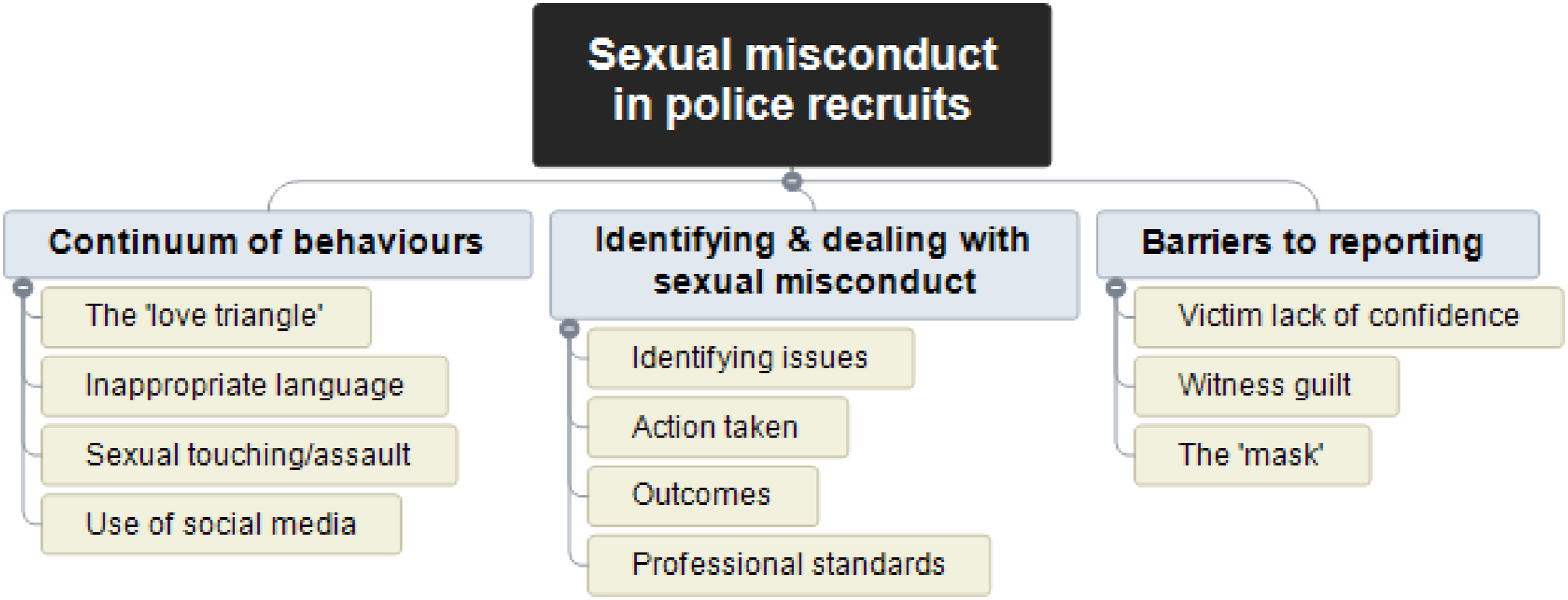
Types of sexually motivated behaviour during training
Police trainers described a range of sexually inappropriate behaviours they had observed in recruits during training. These ranged from consensual relationships between recruits to inappropriate sexualised language to sexual assault.
The ‘love triangle’
The consensual relationships engaged in by recruits were frequently described by the trainers as ‘the love triangle’. Recruits engaged in the love triangle were already in intimate partner relationships upon joining the police but would engage in sexual relationships with other recruits. The trainers were able to identify this behaviour fairly quickly and would notice changes within the group dynamics. Recruits engaged in this behaviour would often shield or assist their love interest during training exercises. This behaviour would also create tensions and disruptions within the classroom – one trainer referred to this as changing the ‘internal politics of the group’. They have relationships amongst themselves, there is a lot of that. There’s been lots of internal politics around someone sleeping with someone else’s girlfriend. P14 Male, Police Trainer We call it the triangle - where you have a couple of students in the same class who were engaged - cue a third party - so that relationship wasn’t going so well and probably was destined to end. Then you’re talking about things like them protecting each other during class. P22, Male, Special Constable Trainer
Although disruptive, this behaviour as described by the trainers is unlikely to fall within the remit of internal disciplinary action. The College of Policing’s Code of Ethics states officers must ‘ensure that any relationship at work does not create an actual or apparent conflict of interest’ and therefore this could be considered unprofessional behaviour (College of Policing, 2014: 6). Consensual sexual relationships between recruits are potentially inevitable but their occurrence did cause the trainers some frustrations as there was little they could do to prevent it from happening.
Inappropriate language
The next level of sexual misconduct involved sexual language towards other recruits or used more generally. In all but one case, it involved male perpetrators. This was less common than the ‘love triangle’ and was dealt with on a scale ranging from verbal advice – for example, when a female recruit made a comment that the Chief Constable was ‘fit’ – to dismissal when the behaviour was persistent or directed towards specific individuals. Recruits who had previously been Special Constables or PSCO’s appeared to arrive with more confidence and trainers noted they had a greater tendency towards using inappropriate ‘banter’ from an early stage. The comments started really at the beginning of the course, but he lost his job when he - it wasn’t just comments during sexual offences lessons - he didn’t try to masturbate on girls, but he pretended to. He thought it was funny. P19, Female, Police Trainer There was an incident with some ex-PCSOs where I ended up having to be part of the investigation…the language they were using was inappropriate here at HQ and …their behaviour was being investigated. They lost their positions because of that. P2, Male, Police Trainer
Interestingly, the female trainers, especially in forces one and two reported comments which, although not sexually inappropriate, were perceived as sexist. This included expressing opinions that women were not capable of being police officers or more covert behaviours such as checking the advice given by a female trainer. It is more over recruits talking about women belonging in the kitchen, things like that. Women should be at home having babies rather than working in a full-time career role as a police officer. P12, Female, Police Trainer It is subtle things; It is about how they’ll refer to somebody and who they go to …they will approach the males to ask the question rather than myself as the female. P9, Civilian, PCSO Trainer
Incidents of inappropriate sexual language were typically initiated by male recruits who already had a police background and therefore were potentially more confident in this environment. Labelled by the participants as ‘banter’, this has been described as rough words, insulting, but usually good natured and almost always manly (Kingshott, 2013). Banter is often believed to be an outlet for the stresses of police work and a way of strengthening bonds between colleagues (Atkinson, 2017). However, sexualised banter within the police has been found to increase stress and decrease productivity in both targets and bystanders (Brown et al., 2018).
Recent research into police culture finds that it is currently in a state of change: moving away from sexism and outdated attitudes towards a more progressive and inclusive culture (Brown et al., 2019; Metcalfe, 2017). It is therefore concerning to find that recruits who already have a police background are bringing elements of an old and outdated culture into the present training environment. The potential implication of this for the non-police recruits is a belief that sexism and sexually inappropriate language is an expected part of police life. Furthermore, workplace sexual harassment and sexist beliefs may be predictive of future involvement in physical sexual assault (Stander et al., 2018: Tharp et al., 2013).
Sexual touching/assault
Finally, the most serious type of sexual misconduct during training related to sexually inappropriate touching or assault. In three cases, a recruit sexually touched another recruit without consent. Two were male perpetrators, and the third involved a female recruit touching the genitals of several male recruits. The trainers themselves had also been victimised – with one female trainer having been sexually assaulted twice by students whilst training. Another female trainer reported unwanted sexual contact by her line manager, and another told how a very senior officer sexually assaulted one of her students as she walked past. Finally, an incident of one trainer sexually assaulting another during a training exercise in stop and search was also disclosed. Although each of the three forces reported incidents of sexual assaults during training, none resulted in the dismissal of the accused. The senior officer had placed his hands over her breast; quite clearly grasping it in a sexual manner. P9 – Female, PCSO trainer One student had inappropriately touched the other … patting on the bum. P25, Female, Police Trainer A male colleague who was quite fond of female probationers …he was being a trainer, a teacher. He would do things, ask them for hugs, take them into the office for a hug, kissing them. P13, Police Trainer
In total, six incidents of sexual touching were reported across the five participating forces and it was an unexpected finding that both recruits and trainers had been both victims and perpetrators. From the trainer’s descriptions, there appear to be two types of sexual assault: unwanted/unwelcome touching and sexual assault in line with the criminal definition, that is, non-consensual touching of breasts/buttocks. There is little research regarding the frequency of such incidents within the police. Brown et al. (2018), reported 18% of a total sample of 1776 police staff had experienced touching which made them feel uncomfortable and 12% had experienced unwanted hugs/kisses. A freedom of information request by The Guardian newspaper identified 829 incidents of internal sexual misconduct within a 6 year period; however, these included both sexual harassment and sexual assault (The Guardian, 2019).
The difficulties in successfully dealing with such incidents were twofold: recruits were reluctant to report and support allegations involving other recruits; and where the perpetrator was another trainer or police officer, the action taken appeared limited. For example, after one trainer complained about another, the accused was simply moved to another force area for a short period. Similarly, in another force when a recruit was allegedly sexually assaulted by a senior police officer, trainers reported this to the professional standards unit, but no further action was taken.
Previous US research raises the issue of ‘officer shuffle’ where officers involved in sexual misconduct and/or sexual violence do not face disciplinary action and are simply moved to another department or area - a course of action that does not protect victims (Rabe-Hemp & Braithwaite, 2013; Stinson et al., 2015). The findings of this research provide limited evidence of this: however, to effectively tackle sexual misconduct, the NPCC itself recognises that the police must be both consistent and fair in its response to such allegations (NPCC, 2017b).
Use of social media by recruits
Trainers across all forces bought up the subject of social media usage by the recruits and how this can pose difficulties with the groups. Many recruits set up class chat groups as a means of bonding outside of the classroom, however, this frequently caused problems as some ‘banter’ caused offence. Trainers often felt recruits behaved differently online than in class. Furthermore, this inappropriate online behaviour could persist for some time before being reported to trainers. We have had incidents where inappropriate comments have been made on those WhatsApp groups. And fortunately, … they have reported that and that has been dealt with. But otherwise, we wouldn’t know about it…they think that doing WhatsApp is more secure and they’re not gonna get caught out. P4, Female, Police Trainer The behaviour that they tend to show to us is not the behaviour that they show to each other. I think it is difficult for us to realise how many in a group potentially could be a problem because you can have someone who is very polite and always punctual, does their work, doesn’t cause any issues but on a WhatsApp group could be an absolute terror! P17, Male, Police Trainer
The increased social media usage by recruits was concerning to all trainers. Police guidelines state that any communication sent between work colleagues via social media should not breach the Code of Ethics or standards of professional behaviour (College of Policing, 2013). As new recruits, the trainers would ensure that they are aware of this, but their understanding of what is acceptable may not be as well developed as that of longer serving police officers. It may also be related to their previous career: for example, two recruits from an ex-military background discussed making a bomb over a group chat – this might have been acceptable in the military but was not deemed to be so by the police. The use of social media groups in this way can merge the boundaries of work and professional life and create additional problems for both recruits and the trainers (Mainiero & Jones, 2013). Interactions between recruits which previously were only possible within the training environment now have the potential to continue outside of it and, as the trainers have found, they are often unaware of the inappropriate behaviour for some time.
Identifying and dealing with sexual misconduct
Identifying issues
Trainers described how in some cases they were able to identify issues of sexual misconduct during training especially for ‘love triangle’ behaviour. This would typically manifest as showing off in classes for their partners, losing concentration and using their mobile phones during teaching. A poor attitude to learning and disruptive behaviour in the classroom was also cited by trainers as the types of behaviour which had been a precursor to incidents of sexual misconduct. Trainers across all forces felt confident in their ability to identify sexual misconduct. They are always on their phones …. Their attitudes change because they are conscious that their partner was in the room. They would start showing off or acting up or not concentrating. P1, Male, Police Trainer I think we’re very good - and I am going to blow our trumpet - we are very good in this department at identifying and dealing with anything along those lines. P24, Male, Police Trainer
In cases involving ‘love triangles’, trainers described changes in behaviour by the recruits which alerted them to potential issues. Trainers identified behaviours such as looks and glances between involved parties as well as loss of concentration in the classroom. For incidents involving inappropriate language or sexual touching, this was more likely to be identified after they had been made aware of it by a victim or witness, suggesting this behaviour did not take place within sight or earshot of the trainers. Retrospectively, trainers recalled recruits who had previously been disciplined for sexual misconduct had demonstrated disruptive behaviour and a poor attitude to learning. This finding is in line with previous research into the behaviour of police recruits who had later been dismissed for misconduct (including sexual misconduct) which found they had lower levels of conscientiousness than successful recruits (Detrick et al., 2004).
Action taken
The trainers were asked how they would deal with incidents of sexual misconduct by recruits. Across every force, trainers were able to describe in great detail how they would go about this. Many trainers described the need to secure evidence from mobile devices for example. They also appeared to be both comfortable and confident in seeking advice and support from their line manager, if necessary. Several trainers cited their moral obligation as police officers to act and that if they did not, this could put their own job at risk. I would challenge initially in terms of their behaviour if it wasn’t serious. I’d be having that one-to-one discussion where I’d refer to our values and behaviours and what’s expected. I would give them the details around what the escalation process was. ... if that behaviour continued then I’d go straight to an action plan or development plan1. P7, Female, Police Trainer It’s self-preservation as well. I’m not gonna get into trouble for anyone. If I witnessed and thought that anything was going on and if you don’t say anything, you’re almost just as guilty and I’m not losing my job for anyone. It should feel awkward for me to not report it. I’m also not losing my job for anybody. P2, Male, Police Trainer
Outcomes
The majority of incidents involving love triangles and inappropriate use of language were dealt with in the training department without the need for escalation to the professional standards units. Trainers described the flexibility within their procedures to deal with lower levels of sexual misconduct in ways directly tailored to the situation. Where there was a victim of sexual misconduct, trainers worked with them to ensure their wishes were taken into consideration where possible. The most serious incidents were referred straight to professional standards. In three cases, trainers felt professional standards took too long to investigate and the eventual outcomes were not as severe as the trainers expected them to be. I feel confident that we … and senior officers within this department would deal with it properly, but where it goes after that and whether they make the right decisions, sometimes I’m not sure. P18, Male, Police Trainer We agreed that I would do a generic awareness of the types of language that we would use when referring to other people. And she was in agreement with that. I gave an input around professionalism, and behaviour. So, although it was specifically aimed at one individual, it was a good exercise for the group, and it stopped. We resolved it and she was happy. So, I think it was a success. P24, Male, Police Trainer
Trainers were confident in the procedures they would follow if they were made aware of sexual misconduct by a recruit during training. Although the processes of reporting and dealing with misconduct are decided on by each police force (College of Policing, 2013), the findings of this research highlighted little variation, with trainers describing recording the initial allegation, securing evidence (such as screen shots of messages), and then seeking advice of their line manager, who would either escalate it to their professional standards unit if serious, or deal with it locally. For more minor issues, there was flexibility in procedures to allow trainers to consult with the victim of the misconduct to ensure that their wishes were considered before acting on the allegation.
Less serious allegations tended to be dealt with inside the training department – to the self-reported success of the trainers who were satisfied that their intervention had a positive outcome and stopped the behaviour. More serious incidents were referred to professional standards units. Only one force expressed dissatisfaction with outcomes from professional standards and believed that they were both slow to act and did not involve them in the investigation. In relation to a specific example of sexual misconduct, the trainers of this force could not understand why the recruit was not criminally charged for their actions and was allowed to quietly leave.
The trainers’ confidence in their force’s misconduct procedures is slightly at odds with the earlier finding that more serious incidents of sexual misconduct did not result in disciplinary actions. The only force who did not report current serious sexual misconduct issues was the only one which did not have a line manager taking part. It is possible that the trainers in focus groups with their managers felt unable to express any concerns fully.
Professional standards
All the trainers described their roles with pride and clarity; ensuring they got the best from their recruits and acted quickly when there were any issues. They recognised their importance to recruits but would always decline social event invitations so as not to blur the boundaries of their role. They also expressed personal feelings of disappointment and sadness when recruits engaged in inappropriate behaviour. Regardless of what the public think, I think there is a lot of pride in this organisation and pride as individuals and what we do. P3, Male, Police Trainer I don’t socialise with students outside of work, …some trainers in the past have and that is down to them …. I like to maintain that professional distance P21, Male, Police Trainer In week one they are sat there saying, ‘I’m going to be well-behaved’. We don’t enjoy it you know, it’s really sad when one of them misbehaves in that way. P19, Female, Police Trainer
Some trainers mentioned their preference not to attend any social events arranged by the recruits to avoid blurring their professional boundaries. Attending such events would allow trainers to observe the recruits’ behaviour in a social setting and may potentially identify more occurrences of sexual misconduct. However, it is understandable that trainers would not wish to give up their personal time to do this
Barriers to reporting
Lack of confidence in reporting by victims
Trainers across all four forces noted recruits who were victims were reluctant to report sexual misconduct akin to the lack of reporting in sexual offending research more generally. When discussing this, trainers noted little had changed over time and the reluctance to ‘grass’ on colleagues is pervasive within policing. I don’t think it’s an easy thing to do. As a probationer, I had to put in complaints about bullying … and my life was made a misery. P10, Female, Police Trainer I think with our generation, …if something was said that was wrong, we would just challenge it and say it directly. Whereas this generation don’t. P6, Male, Police Trainer
Witness guilt
Although they empathised, trainers were frustrated by the lack of support recruits sometimes gave to investigations of sexual misconduct. Witnesses were reluctant to come forward when incidents had occurred in the classroom or during a night out with known witnesses; no amount of encouragement could persuade the recruits to support the investigation. The primary concern from witnesses appeared to be guilt, in that by coming forward, a colleague could lose their job. This was concerning as trainers felt a need to identify and deal with problem recruits before they left training. Obviously, it was referred to PSD [Professional Standards Department] and it was surprising how many of the rest of the group decided to say that they hadn’t heard or seen any of this going on. P19, Female, Police Trainer You do have them in tears when they’re making the statement worrying that someone is gonna lose their job and it’s gonna be their fault. And we say, ‘well if it’s happening now and to a police officer, what can happen when they are sitting in front of a vulnerable victim?’ P20, Female, Police Trainer
It was reported by participants that both victims and witnesses of sexual misconduct during training appeared very reluctant to make formal complaints. Recruits often struggled emotionally, knowing their statement might result in a recruit losing their job or them being labelled a ‘whistle-blower’. Interestingly, trainers described similar experiences when they were recruits, suggesting another potentially enduring issue within the police.
Previous research into police attitudes to sexual misconduct has described this as part of the ‘blue wall of silence’ (Kutnjak Ivković et al., 2019; Maher, 2003). This wall is reportedly strengthened by collegial loyalty, organisational resistance in encouraging reporting and supervisors turning a blind eye (Lee et al., 2013). Though conducted in the US, this research suggests police officers may be shielded from detection by their colleagues. In the present study, the participants stated they actively encouraged reporting and acted quickly when made aware of incidents. As such, the only evidence of organisational resistance or turning a blind eye was a general reluctance in reporting and lack of consequences (in some instances), and subsequent reluctance to support allegations.
It should be considered that when faced with sexual misconduct, either as a victim or witness, there are three options available; leave the organisation, speak up, or choose silence – possibly due to organisational loyalty (Hanson, 1970; Hedin and Lane, 2020). Having only just committed their time and effort to join the police, recruits are unlikely to leave. Speaking up risks guilt of a fellow colleague’s potential dismissal, ostracisation by the rest of their team or possibly, fear of gaining a reputation as a troublemaker. Such impacts have been seen in nurses who are whistle-blowers (Peters et al., 2011). However, the expectation on police officers is to report any form of misconduct and if recruits are unable to do so, there is a possibility that officers who are involved in sexual misconduct go undetected. As one trainer pointed out – if recruits are unable to report sexual misconduct directed at a colleague, how can they be expected to report the same behaviour directed to a vulnerable victim of crime? One possible solution is to address this during training – for example use of anonymous surveys may determine the specific reasons why recruits are reluctant to report, and these could be addressed in tailored teaching sessions. Workplace whistleblowing is more likely to occur when employees are encouraged to do so and feel confident that they will be supported (Dungan et al., 2015), therefore instilling this message from the first days of a recruit’s service may be beneficial
The ‘mask’
Despite trainers’ perceived confidence in identifying and dealing with sexual misconduct issues during training, there were concerns across all forces that some recruits are able to ‘mask’ their true personalities and motivations for joining the police. Trainers stated that it took some time for recruits to reveal their true personalities. It’s quite difficult I think for us because for 24 weeks, you can put a mask on. I believe that.. Then they go on to the tutor unit and you’re now in the culture of what it’s like out there. It’s not as sterile as it is here.. You hear some of the students who were really well behaved are suddenly saying inappropriate things like ‘so-and-so is sexy’. And the guards just go down. P25, Female, Police Trainer It’s not until you get to training school in about week three or four when you start to see people’s true personalities You look great on paper but you’re not. It looks like we have a class full of amazing people on paper but actually most of them are no good. P14, Male, Police Trainer
Trainers felt that some recruits were not displaying their ‘true’ personality or belief system within the classroom environment and described this as the ‘mask’. There were two ways that the mask might slip; through behaviour in online chat groups or further into the recruit’s training. In using social media and online messaging, users are unable to see and gauge the reactions of those reading their comments. This provides an environment where users can express more extreme views and yet distance themselves from their comments because they were not made face-to-face (Suler, 2004). There is some research to suggest that there is little difference between online and offline personalities and beliefs (Kosinski et al., 2014; Quercia et al., 2011). The trainers’ concern that some recruits can mask their true selves in the classroom but reveal them online may therefore be justified.
Similarly, some recruits who appeared to be model students in the classroom would begin to behave in a sexually inappropriate way later in their training. It is possible that, as with behaviour online, these recruits felt safer in expressing these views when not being monitored by trainers or once they felt more secure in their new roles as police officers. This finding is in line with the concept of the ‘slippery slope’ – in police corruption research, this denotes an officer taking gradual and initially tentative steps into wrongdoing (Dean et al., 2010; Punch, 2009). Although this theory is more generally applied to a broader definition of police corruption, the findings of this research suggest it may also apply to sexual misconduct – this is further evidenced by the finding of a continuum of behaviours.
The effect of the ‘mask’ as a barrier to identification is important. Trainers can only identify and deal with inappropriate behaviour if they know it is occurring and, unless they witness it or are alerted to warning signs, it needs to be reported by the other students. Once out of classroom, recruits are under less scrutiny and there is the potential for the behaviour to persist and evolve.
Conclusion
Sexual misconduct in police officers can occur as early as the training phase. We find that there is a continuum of sexually inappropriate behaviours, ranging from sexual relationships between recruits, inappropriate language to sexual touching. Police trainers are alert to the signs of issues forming between recruits and feel confident in dealing with sexual misconduct once it has been reported. Recruits who are victims and witnesses of sexual misconduct are often reluctant to make a formal complaint or to support investigations. This reluctance to report is persuasive and may be compounded by the cohesion of recruits who form strong bonds during training. Measures to encourage reporting should be considered as this reluctance can enable unsuitable recruits to pass through training undetected.
Although police trainers were able to quickly deal with sexual misconduct between recruits, more serious incidents involving assault, which were dealt with outside of the training unit, did not result in disciplinary action. A review of case files to ascertain potential reasons for this could be the focus of future research. Recruits’ usage of social media can also present issues and some may demonstrate unacceptable behaviours and beliefs which may not be revealed in the classroom.
Limitations
Although 10 forces were approached, only four forces were able to take part in this research and all were from the South of England. As such, the sample cannot purport to be representative, yet initially explores the concept and provide some useful information on how sexual misconduct may be present during police recruit training. Although the focus group method was successful in generating vigorous discussion, it was noted that the civilian trainers contributed less than the police officers. This may, in part, be due to the researcher’s role as a police officer unintentionally encouraging a greater response from the other police officers. Furthermore, the police officers in the groups were generally very eager to speak and this may have drowned out the voices of the civilian trainers. It is also possible that some of the responses from the trainers were affected by the presence of their supervisor taking part in the group. Although the supervisors had knowledge of the incidents of sexual misconduct discussed in the group, their presence may have had an impact on certain areas of the discussion. For example, when trainers were asked about their confidence in the process of dealing with sexual misconduct, their opinions on this would reflect on the how the training departments are managed and supervised. Having their supervisor present may have hindered expression of their true opinions. In future, it may therefore be beneficial to conduct one to one interviews with trainers and/or utilise anonymous surveys.
Future research
It would be beneficial to establish the full extent of sexual misconduct by recruits on a National level. If the issue is widespread, there may be a case for revision of the current recruitment process to ensure fewer problematic recruits are selected for training, by enhanced used of certain psychometric tests for example. Another consideration would be to analyse the recruitment application forms and interview documents of recruits who were later dismissed for sexual misconduct. This may uncover any differences in experience or background when compared to recruits who have displayed good conduct in their careers. Further research into the reasons why new recruits are so reluctant to report misconduct to trainers is also advised. This could improve reporting processes and tailor training inputs to further encourage early reporting.
Footnotes
Declaration of conflicting interests
The author(s) declared no potential conflicts of interest with respect to the research, authorship and/or publication of this article.
Funding
The author(s) received no financial support for the research, authorship and/or publication of this article.
