




Abstract
There is a high drop-out or attrition rate of Modern Day Slavery (MDS) cases in the Criminal Justice System although there has been a paucity of academic research examining the factors that could be related to this attrition. Similar work has been carried out examining attrition in rape cases (Feist A, Ashe J, Lawrence J et al. (2007) Investigating and detecting recorded offences of rape. Home Office Online Research Report, 18/07. London: Home Office). The aim of this study was to examine whether factors of MDS cases were associated with and could predict referral to the National Referral Mechanism (NRM) (either by the police or other agencies). Two hundred and sixteen suspected cases of MDS were examined, 29 of which had been referred to the NRM. Content analysis was used to extract variables from the cases. These pertained to aspects of the offence (e.g. types of exploitation, offender strategies), the victim (e.g. gender, ability to speak English), and the offender (e.g. details on any recruiter, transporter and exploiter). Cases were more likely to be referred when the victim was locked, controlled or had their movement restricted, not recruited in the UK, when the trafficking flow was non-domestic, when debt bondage had occurred and when the recruiter was not in the UK when they recruited the victim. Cases were less likely to be referred when sexual exploitation was suspected, there was more than one victim and when the exploitation was thought to be occurring/have occurred in a brothel, massage parlour and or via a website. These findings may indicate that certain victims are more likely to come forward and/or that the cases are more likely to be considered MDS by those investigating the cases. Recommendations for practice include a consideration of the best way to handle suspected cases of sexual exploitation, considering adopting investigative strategies from domestic violence investigations, proactively addressing the gaps in the data and better linking of data. Limitations and future research ideas are discussed.
Modern Day Slavery (MDS) offences include slavery, servitude, forced or compulsory labour and human trafficking; the latter is when a ‘person commits an offence if the person arranges or facilitates the travel of another person with the view to the victim being exploited’ (Modern Day Slavery Act, 2015: 2). Exploitation within MDS could include slavery as above, sexual exploitation, providing services and organ removal. The National Referral Mechanism (NRM) is the ‘framework for identifying and referring potential victims and ensuring these victims have the appropriate support’ within England and Wales (Home Office, n.d.). Referrals can be made by ‘first responder organisations’ in England and Wales, which include police forces, government organisations (e.g. Border Force), local authorities and non-government organisations (e.g. Salvation Army). In 2020, police forces constituted one-third of referrals in England and Wales (Home Office, 2021). For adults to be referred to the NRM, they have to consent to being referred. Even though other organisations can refer potential victims to the NRM, there is an expectation that all NRM referrals should be reported to the police, even without the victim's consent (if victims do not consent, then the report is made as a third party referral and there is no obligation for the victim to cooperate with the police) (Home Office, n.d.). Once a case is referred to the NRM, a Single Case Authority (SCA) at the Home Office will consider the case and make a reasonable grounds decision (whether there is reasonable grounds to believe that the person is a victim), within five working days. A positive reasonable grounds decision entitles the victim to certain types of support (e.g. accommodation and subsistence, mental health care and legal support) for 45 days before a conclusive grounds decision is made (where, if positive, the victim is entitled to 14 more days of support and help with moving out of the NRM system).
To date, there has been no published, systematic analysis of the factors that might be associated with progression of cases within the Criminal Justice System (CJS) or through the NRM in the UK. Gadd et al. (2017) mapped positive and negative conclusive NRM outcomes in Greater Manchester Police but did not examine factors that could be related to whether cases were referred to the NRM. Identifying such factors that might predict referral (or non-referral) may help more victims receive support and could shape the training given to first responders. Similar research has been carried out in the area of rape; Feist et al. (2007) examined attrition in 676 rape offences across eight UK police forces. Using descriptive analysis and multiple regression, they pinpointed factors that were associated with withdrawal from the CJS process. Their recommendations helped shape UK police's response to rape, with a focus on better victim support. A similar study is needed for MDS.
The problem of attrition
Although there is a high drop-out or attrition rate of MDS offences in the CJS and a low conviction rate for trafficking offences both nationally (Home Office, 2017) and globally (Matos et al., 2019; UNDOC, 2014). Equally, while the number of cases referred to the NRM in the UK have increased since 2014 1 (Home Office, 2020), the proportion of cases in which a person is recognised as a victim of MDS and given support is relatively low. In total, 10,613 referrals were made to the NRM in England and Wales in 2020 (Home Office, 2021), 3454 cases were given conclusive grounds decisions (although this figure will have included cases referred in previous years), and 3,084 were given a positive decision (Home Office, 2021). It is therefore clear that securing convictions for offenders and support for victims is challenging, and warrants attention.
Difficulties in identifying victims
The hidden nature of human trafficking and MDS means that they are difficult crimes to spot and to investigate (Bales et al., 2015); indeed United Nations Office on Drugs and Crime (2017: 3) relate that it is difficult to gather evidence on human trafficking cases; there are ‘complex evidential issues many of which hinge upon the particular nature of this covert crime and the behaviour of victims, whose testimony is often the central piece of evidence’. The inherent techniques used by the traffickers ensures that victims are often out of view of the police and other law enforcement agencies who may be incentivised to report the offences (Farrell and Pfeiffer, 2014; Nicholls and Heil, 2014).
Exploiters will often use particular methods to control their victim's behaviour and it is these very methods which might mean that victims are not, or do not want, to be identified by the police or other organisations (Hopper and Hidalgo, 2006). Forms of physical control may make escaping difficult; many victims will not have access to transport, they may be physically isolated and have their movement restricted, controlled or closely monitored (Anti-Slavery International, 2006). Financial methods are also used, which can affect whether victims are willing to make a statement to police or ask for support in other ways. These can include debt bondage (Anderson and Rogaly, 2005; Helfferrich et al., 2011), controlling the victim's bank accounts (NCA, 2015) or holding wages for ‘safekeeping’ (Scott et al., 2012). Often, victims are controlled by traffickers who exploit the victim's migrant status. Exploiters can also retain or withhold the victim's identification documents (Geddes et al., 2013) and tie the victim to accommodation or the work itself (e.g. sponsoring work permits). Victims with an irregular migration status might rely on the traffickers for work and therefore have a connection with the country within which they are being exploited (Farrell and Pfeiffer, 2014). Indeed Clawson et al. (2009) report how a victim's fear of deportation and/or arrest may influence entry into or progression within the CJS and healthcare systems.
Other victim characteristics or vulnerabilities may be associated with seeking help or being identified as a victim. For example, many victims may speak little or none of the local language (Clawson, et al., 2009), may have no knowledge of their physical surroundings (Aronowitz et al., 2010; Farrell and Pfeiffer, 2014; Scott et al., 2012), or physical and cognitive difficulties may prevent victims from escaping the situation and seeking help (Farrell and Pfeiffer, 2014).
Victims often fear retribution or reprisal from the trafficker that may affect whether they are willing to make a statement to police, testify in court or access healthcare and support (Bales et al., 2015; Cockbain and Brayley-Morris, 2017; Helfferrich et al., 2011; Hopper and Hidalgo, 2006). Farrell and Pfeffer (2014) point out that often, the victim or victim's family live in the same community as the trafficker(s). This fear would be evident, especially as traffickers often use physical, sexual and verbal violence (e.g. threats of violence, threats of denunciation in the case of irregular immigrants, threats of eviction from accommodation, bullying and intimidation, and using cultural and spiritual threats such as placing the victim under a Voodoo curse) to control and maltreat victims (Andrevski and Lyneham, 2014; Anti-Slavery International, 2006; Aronowitz et al., 2010; Baarda, 2015; Helfferrich, et al., 2011). Some victims may even fear returning to the circumstances from which they came (Farrell and Pfeffer, 2014).
MDS victims may face stigmatisation and discrimination from those in authority. This, as well as the trauma experienced by many victims, may lead them to have difficulties relating to other people, which may lead them to distrust or fear the general public and those in law enforcement and healthcare (Judge et al., 2018). It could also be the case that victims believe they will be treated as a criminals and may fear the police will not help them (Farrell and Pfeffer, 2014). Matos et al. (2019) found that some victims are fearful that law enforcement officials were working alongside the traffickers, while Judge et al. (2018) explain how the trauma experienced by trafficking victims may mean they have difficulty relating to other people.
Attrition from the CJS has also been linked to victims’ feelings of guilt, shame or embarrassment (Judge et al., 2018), which could be related to previous experience with the CJS (Farrell and Pfeiffer, 2014). This could also be due to the stigma and discrimination sometimes directed towards victims of MDS (Judge et al., 2018; Matos et al., 2019). Fear and trauma may also lead to difficulties in relaying information to those in law enforcement, which may have an impact on whether the victim is believed (Villacampa and Torres, 2017, 2019; Zimmerman et al., 2003).
The relationship between the exploited and the exploiter may deter victims from coming forward. There could be an emotional, and perhaps, traumatic bond that the victim may have with their exploiter in sexual exploitation (Reid, 2016; Sapiro et al., 2016) and a level of trust that victims will have with the trafficker which will deter them from getting help or seeing themselves as a victim (Farrell and Pfeffer, 2014).
Victims may not self-identify as a victim of exploitation, which might be a barrier to disclosing their experiences to organisations or testifying in court (Bales et al., 2015; Clawson et al., 2009; Craig et al., 2007; David, 2008; Lutnick, 2017). It could be that victims either might think the situation is of their own making or that they are a criminal (Matos et al., 2019) because they may have entered the country illegally (Farrell and Pfeffer, 2014). Others may identify instead with being migrants ‘whose journeys have gone wrong’ (Smit, 2011: 187) or it could be they believe they are in a better position than they were before being exploited (Gibbs et al., 2015). The process of exiting the trafficking situation may mean that certain benefits are withdrawn, such as food, clothing, routine, shelter, stability and financial support (Cockbain and Brayley-Morris, 2017; Judge et al., 2018). Victims may also be concerned that they will be lonely or isolated once they leave their current situation (Lutnick, 2017; Reid, 2016). Although a great deal of the argument above focuses on the victim's willingness to come forward in order to be identified, interestingly, Bjelland (2017) examining a sample in Norway, found that victim cooperation in an investigation was not related to whether the cases had a successful outcome in the CJS.
Difficulties locating the victim or suspect
Victim cooperation aside, one investigative challenge may be that victims cannot be found or that they run away during the investigation (because of the reasons outlined above). Matos et al. (2019) found that cases were often unsuccessful if a victim for an offence was not identified and/or located in police investigations in Portugal. Even if a potential victim was identified, the researchers found that failure to identify a suspect led to the attrition of cases. Bjelland (2017) examined human trafficking cases reported to the police in Norway from 2003 to 2013 and found that, if a suspect had already been identified when the case had been reported then it was more likely that they would be convicted of the offence. Bjelland (2017) also found that if there were two or more suspects, this would more likely lead to a criminal charge at the police investigation stage than in cases in which information on the number of suspects or other information on the suspect was not known.
Difficulties in determining whether MDS has occurred
Aside from the factors outlined above, there may be evidential and investigative issues or challenges in terms of establishing whether MDS has occurred. The way in which police investigations are carried out in MDS cases may influence outcome. Successful prosecutions have been found to be related to proactive police investigations (where specialised investigators have identified patterns and built up intelligence on the types of crimes in their area) rather than reactive (responding from ‘tip-offs’ from the public or from other agencies) (Farrell and Pfeffer, 2014; Matos et al., 2019). In some forces and/or countries, MDS may not be a high priority (Farrell et al., 2016), or particular types of exploitation may be prioritised (Farrell and Pfeiffer, 2014). There may also be a lack of knowledge or training among law enforcement professionals in general (Farrell and Pfeiffer, 2014) and in terms of particular types of exploitation (e.g. criminal exploitation; Villacampa and Torres, 2017, 2019).
Professionals may hold particular stereotypes about victims of trafficking (Villacampa and Torres, 2017, 2019), or may believe that the public would not support certain types of exploitation (e.g. labour) or victims (e.g. male) (Farrell and Pfeiffer, 2014). This might influence whether the offence is thought to have occurred. There may be perceptions that victims may be criminals themselves (Halter, 2010; Villacampa and Torres, 2019), perhaps because some victims do not attempt the situation within which they are exploited (Cockbain and Brayley-Morris, 2017). Indeed, victims can often face stigmatisation and discrimination from CJS professionals and those working in healthcare systems (e.g. Macias-Konstantopoulos et al., 2015), including victim blaming (e.g. in sexual exploitation and irregular migration; Farrell et al., 2014) and perceptions of good and bad, deserving and undeserving victims (Farrell et al., 2014; Verhoeven et al., 2015). There has been some evidence to suggest that factors such as race, class and gender may influence the decisions of prosecutors in sexual assault trials (see Farrell et al., 2014), which needs to be explored within MDS cases. Farrell et al. (2014) did find a link between attrition and citizen status, finding that trafficking cases involving US citizens were more likely to be forwarded to prosecutors by the police. Lastly, because victims may not always be able to speak the local language, and interpreters may be needed, this could impact on the level of rapport that may be needed at police interview (Clawson et al., 2009), which may influence perceptions of the victim. Likewise, cultural differences in non-verbal behaviour (e.g. making eye contact) may impact on whether the victim is believed or not (Clawson et al., 2009).
The majority of research in this area outlined above has centred on the barriers or obstacles to identifying, prosecuting, convicting human trafficking and MDS cases, and victims accessing support services (Matos et al., 2019). The research has mostly examined systems in the United States (Farrell and Pfeiffer, 2014), with some research conducted in Europe (e.g. Germany, Helferrich et al., 2011; Spain, Villacampa and Torres, 2019; Portugal, Matos et al., 2019). Reporting and collecting data on MDS remain persistently challenging owing to the hidden nature of the offence (Weitzer, 2004). Although the field's limited focus on international movement and sexual exploitation (Goodey, 2008; Tyldum and Brunovskis, 2005) has left domestic trafficking and other types of exploitation largely overlooked (Laczko and Gozdziak, 2005).
The current study
The above review suggests that there are difficulties in identifying victims, suspects and establishing whether MDS has occurred. It may be that certain cases are more likely to carry on through to referral than others owing to these reasons. This study, therefore, aims to examine factors that might be associated with, and which may predict referral to the NRM.
Method
Sample
The data comprised 232 suspected MDS cases which were closed and involved at least one adult victim 2 (aged 18 or over) logged by UK police from 1 February 2016 to 1 January 2018. These cases were identified through daily scanning of police systems to identify possible offences, and via referrals by third parties (e.g. the public or other organisations). Duplicate cases, those that pertained to people smuggling, and those which were of Grade 5 intelligence 3 were deleted, leaving 216 cases. These were checked against a database of NRM referrals so that the case outcome (in this case whether the case had been referred to the NRM or not) could be coded. The data were housed in an Excel spreadsheet which included some fixed format fields, e.g. date the case was logged, the particular type of MDS indicator that was present (e.g. sexual exploitation), and free-text fields. The latter included intelligence and research information (given by officers, other agencies and members of the public), actions taken, results of investigations, whether the case had been referred to the NRM, the type of business within which the exploitation took place, the victim's date of birth, gender, nationality, any offender’s 4 date of birth, nationality and gender, whether a court case had come about as a result of the offence, and any court results (including sentencing details).
In 13.4% of cases (n = 29), the case was referred to the NRM, leaving 86.6% (n = 187) which were not. In 62% of cases (n = 134), there was more than one victim. In 62.5% of cases (n = 135), one or more of the victims was female, in 20.8% (n = 45) one or more of the victims was male, and in 3.7% of cases (n = 9) at least one male and female victim were involved. In 13.0% of cases (n = 28), the victim's gender was unknown. The types of exploitation that was suspected included sexual (60.6%, n = 131), labour (24.1%, n = 52), criminal (7.4%, n = 16) and domestic servitude (1.9%, n = 4). In 3.2% of cases (n = 7) more than one form of exploitation was used and in 2.8% of the cases (n = 6), a type of exploitation was suspected but the nature of the exploitation was not known. In 14 cases, the source of the report was given; this consisted of non-governmental agencies (such as the Salvation Army) (2.8%, n = 6), the Gangmasters Licensing Authority (0.9%, n = 2), the National Health Service (0.9%, n = 2), another police force (0.5%, n = 1), a member of the public reporting directly to the police (0.5%, n = 1), a joint report from an non-governmental organisation and a local authority (0.5%, n = 1), and UK Visas and Immigration (0.5%, n = 1). Of the cases that were not referred to the NRM, 65.8% (n = 123) of these were not progressed because there was either no evidence of modern slavery having occurred and/or the potential victims did not disclose that they were being exploited, and no further action was given. In 18.7% of cases (n = 35), the reason why the case was not referred was not given, and in 7% of cases, the report was referred to another authority or organisation (such as Gangmasters Licensing Authority, UK Visas and Immigration or another police force). In 5.9% of cases (n = 11), the potential victim(s) fled, could not be found or the premises within which the potential victim(s) were thought to be could not be found. In five cases (2.7%), the potential victim was arrested for another offence such as cannabis cultivation or solicitation.
Variables and coding dictionary
Each case was examined and content analysis was used to derive variables from the information recorded. Content analysis is the way in which ‘the researcher evaluates the frequency and saliency of particular words or phrases in a body of original text in order to identify key words or repeated ideas’ (Namey et al., 2008: 138). This method was used to identify victim characteristics, offender characteristics (i.e. characteristics on any recruiter, transport or exploiter involved in the offence) and offence behaviours (e.g. methods of control used; verbal, physical or sexual violence). The content analysis was ‘data driven’ (Glaser and Strauss, 1969). The researcher read and re-read the cases, making notes about the characteristics and behaviours before the content analysis was conducted (as suggested in Namey et al., 2008).
From the initial examination of the data, a content dictionary was developed which began to outline and define the variables. Although the initial content analysis method was considered ‘inductive’, the author was aware of various literature that had previously identified behaviours within human trafficking and MDS cases (e.g. Ioannou and Oostinga, 2014). Therefore, close examination of this literature, helped define and develop the coding dictionary used in this study.
After the coding dictionary was developed, each case was examined and the frequency of variables was coded. Most were coded dichotomously, based on whether the variable was present within case (1) or absent (0). This unobtrusive method of coding of qualitative data is often used when coding police data that are not collected for research purposes. Previous studies have claimed that using non-dichotomous coding within the content analysis of police data could be unreliable (Canter and Heritage, 1990). The variables that were continuous or categorical were dichotomised. This meant that instead of variables such as nationality being a categorical variable (e.g. nationality = British, Polish, Nigeria), each of the nationalities were coded as being a variable in itself (e.g. British = 1 or 0). This was carried out for several variables including: victim/recruiter/trafficker/exploiter's nationality, recruiter/trafficker/exploiter's relationship with victim, recruiter/transporter/exploiter's set-up, gender of victim/recruiter/transporter/exploiter, recruiter/transporter/exploiter location, trafficking flow, transport when entering/once in the UK. The variables pertaining to victim/recruiter/transporter/exploiter's age, which were originally continuous variables were also dichotomised, into being over or under 40 (0 = absent, 1 = present). Outcome of the case (whether it was referred to the NRM or not) was dichotomised also: 0 = not referred, 1 = referred. To test the reliability of the coding dictionary, a random sample of 46 cases (20% of the sample) was examined by two trained researchers. The Cohen's kappa scores for the variables was a perfect agreement (kappa of 1) for the variables. The full list of variables and their frequencies are available on request
Analysis
Only variables that were present in more than 5% of cases were used. Cross-tabulations between these variables and whether the case was referred to the NRM were calculated using Fisher's exact test. This was used to provide a more accurate test statistic and to overcome the violation of the assumption that all cells would have frequencies of five or more (Fisher, 1922). Owing to the large number of Fisher's exact tests that were carried out, a Bonferroni correction was applied to the critical p value to control Type I error. Because 46 tests were carried out, the new p value used was 0.001087. The phi coefficient (φ) was used to measure effect sizes (Sheskin, 1997). Phi values of ±0.1 indicate a small effect size, whereas values of ±0.3 and ±0.5 indicate medium- and large-effect sizes, respectively (Cohen, 1988).
Any cross-tabulations that yielded a significant Fisher's exact test for the cross-tabulations between the variables and NRM referral outcome were inputted into bivariate logistical regressions to see how well the variables (the predictor variables) predicted NRM referral outcome (the outcome variable). Before carrying out the logistic regressions, the assumptions of logistic regression had to be examined to ensure that they were not violated.
Beta values were calculated which give an indication of how likely an NRM referral is (or is not), given the presence of a particular case variable.
Results
Factors associated with NRM referral
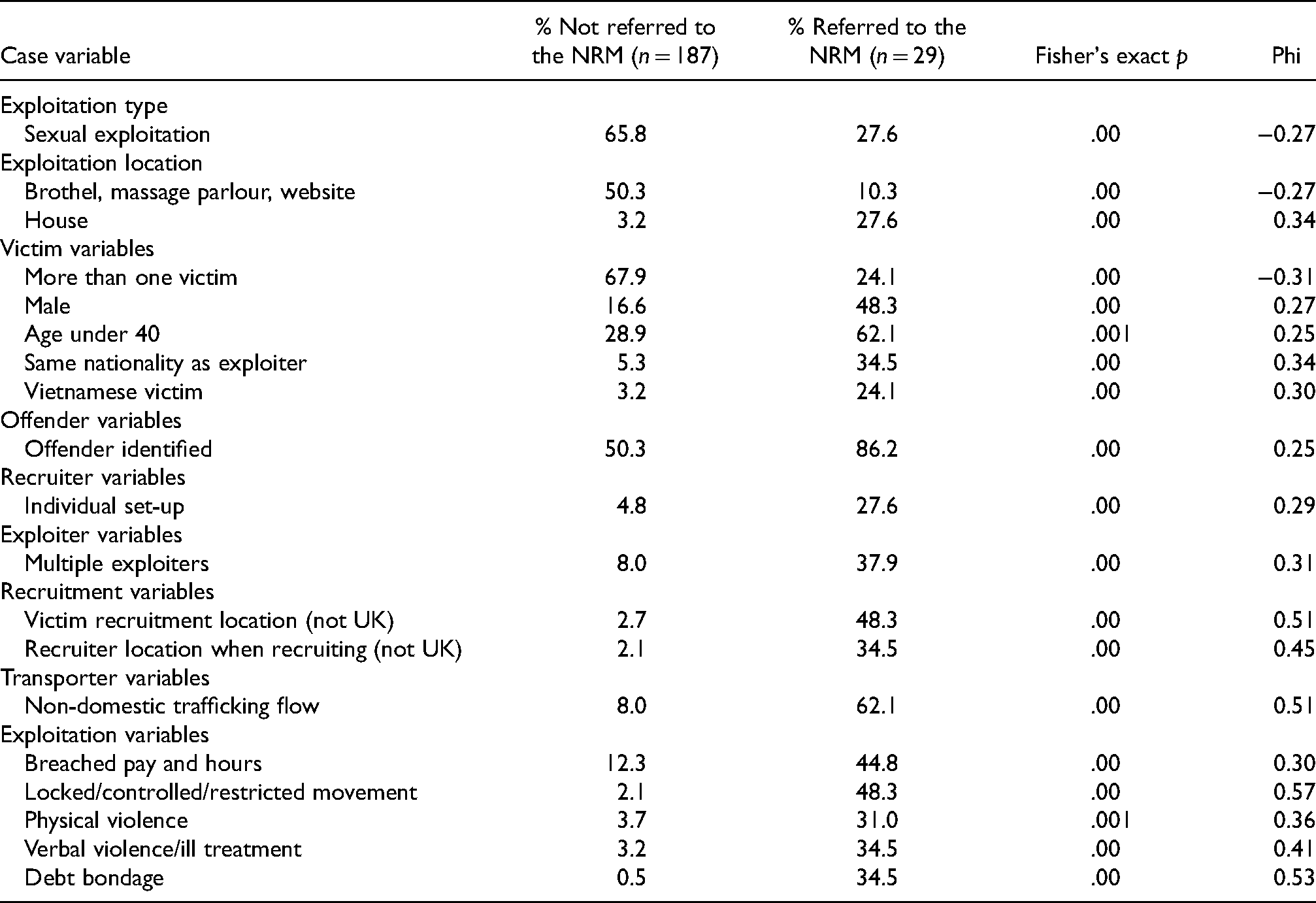
Forty-six variables were found to occur in more than 5% of cases; these were used in the cross-tabulations to see if any were significantly related to NRM referral. Eighteen associations were found to be statistically significant at the adjusted alpha level and are shown in Table 1. These yielded medium (±0.3) and large (±0.5) phi values (φ), which show medium to strong effect sizes (Cohen, 1988). Most significant associations showed a positive relationship with NRM referral (as seen in the positive phi value); that is, when the case variable was present, an NRM referral was made. Three associations had a negative relationship with NRM referrals; if a potential case contained more than one victim, was for sexual exploitation or the exploitation occurred in a massage parlour, brothel or website, the case was less likely to have been referred to the NRM.
Cross-tabulation table for 2 × 2 Fisher's exact tests and effect sizes showing significant associations between case variables and NRM referral outcome (N = 216).
Factors that predicted NRM referral
Any significant associations were further assessed within bivariate logistic regressions (enter method) to examine how accurate the aspects of the cases were at predicting NRM case referral. These models provided a measure of assessing how accurate the independent variables (aspects of the case) were at predicting the dependent variable (NRM case referral). As explained above, any continuous case variables were dichotomised. Table 2 shows the results of the logistic regressions; namely the beta value (β), standard error (SE), significance of the predictor variable, chi square (χ²) and significance of the model, and the Nagelkerke variance estimate (R²).
Logistic regression showing accuracy of case variables when predicting NRM referral outcome (N = 216).
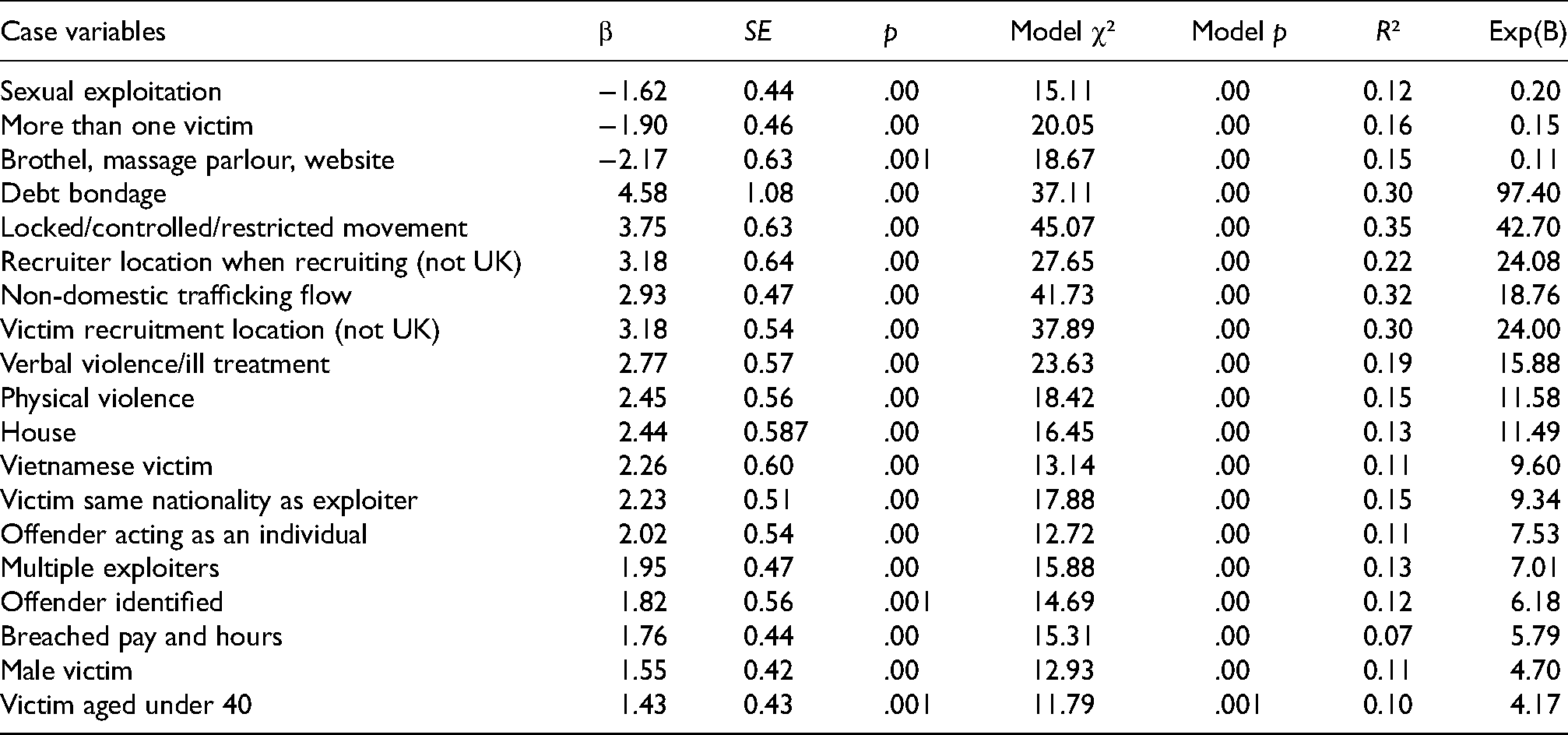
All logistic regression models were statistically significant and the Nagelkerke R2 values showed that the models explained 7% (breached pay and hours, and locked, controlled, restricted movement, respectively). The higher the variance, the higher the models fitted the data (i.e. the better the model is of predicting whether the case will be referred based on this variable). Variables with the highest R2 values were when the victim was locked, controlled or had their movement restricted, when the victim was not recruited in the UK, when the trafficking flow was not within the UK (i.e. it was non-domestic), when debt bondage had occurred and when the recruiter was not in the UK when they recruited the victim(s).
The first set of regressions refer to those variables that are negatively associated with NRM referral; these were when sexual exploitation was suspected, when there was more than one victim and the exploitation was thought to be occurring/have occurred in a brothel, massage parlour or website. When the MDS type was sexual exploitation, the case was 20% less likely to be referred to the NRM compared with if the case was not sexual exploitation. When there was more than one victim, the case was 15% less likely to be referred than if there was not more than victim and lastly, when the exploitation occurred in a brothel, massage parlour or website, the case was 11% less likely to be referred to the NRM than if the location was not this type of location.
For those with positive associations with NRM referral, the highest beta value was for debt bondage. This means that, if this variable was known, the case was 97.9% more likely to be referred to the NRM than if this information was not known. Other high beta values were when victims were locked, controlled or had their movement restricted (42.7% more likely to be referred), when recruiters was not in the UK when they recruited the victim(s) (24.08% more likely to be referred), when the victims were not recruited in the UK (24% more likely to be referred), when the trafficking flow was not in the UK (i.e. from outside the UK or the whole event happened outside the UK) (18.76% more likely to be referred) and when the victims had been ill-treated or had threats against them (15.88% more likely to be referred).
All models provided different levels of predictive accuracy (the ability to correctly classify whether a case can be assigned to a particular NRM referral outcome based on using the beta value and constant generated by the model), compared with randomly classifying a case based on random probability. Based on random probability, the accuracy of using any of the variables to predict whether a case was referred to the NRM or not was 86.6%. The presence of some of these variables within a case made this predictive accuracy increase. These were: locked/controlled/restricted movement = 91.2%; debt bondage = 90.7%, victim recruitment location (not UK) = 89.8%, recruiter location when recruiting (not UK) = 89.4%, breached pay and hours = 86.6%, verbal violence/ill treatment = 88.4%, trafficking flow (non-domestic) = 88.0%, Vietnamese victim = 87.0%, physical violence = 87.5% and when the exploitation occurred in a house = 87.5%.
Discussion
The aim of the current study was to examine the factors that may be associated with and could predict whether a MDS case would be referred to the NRM. A key finding is that cases involving non-domestic trafficking were much more likely to be referred to the NRM (i.e. when the victims were recruited outside the UK, the recruiters were outside the UK when they recruited the victims, when the trafficking flow was non-domestic). This means that, in these cases, more victims were either more likely to identify as being a victim and/or their cases were more likely to be identified by the police, another agency or the public. This sub-sample was made up of a heterogeneous group of cases, some of which involved victims from both European Union and non-European Union countries that had been trafficked to, and then exploited, in the UK. Some of these victims had an irregular immigration status and were trafficked to the UK, others may have been trafficked and exploited in other countries (outside the UK) but the offences only came to light once in the UK. For those who had irregular migrant status, it would be assumed these victims would be more frightened of coming forward because of their immigration status (see review above). What may be happening instead is that these victims are coming to the attention of the police because of their irregular status or because they have been arrested for an offence relating to the MDS (e.g. cannabis cultivation). Once these victims are in contact with the police (or other agencies), information on their MDS exploitation is discovered. This is difficult to ascertain because the source of the report was recorded in only a small proportion of cases. Further research is needed to examine the pathway to reporting and the characteristics of cases and victims in more detail.
Sexual exploitation offences were negatively associated with NRM referral as well as when the exploitation location was a brothel, massage parlour or on a website advertising sexual services, and when there was more than one victim. Many of the cases that were not referred (nearly two-thirds of cases) were investigated by an officer who found either no evidence that the victim was being exploited, or could not locate a victim. Suspected sexual exploitation was the most frequent type of exploitation occurring within the sample, which is echoed in previous research. Farrell and Pfeffer (2014) found that sexual exploitation is often more likely to be investigated than other types of exploitation, because a great deal of intelligence in this instance is from ‘tip-offs’ from members of the public but, when it comes to building a case for exploitation, victims can be misclassified as sex workers rather than victims of sexual exploitation and so cases are usually dropped. It is worth considering whether this is happening within the cases referred to the police in this data set and or whether some victims are reluctant to come forward because of factors such as the relationship they have with their trafficker (Reid, 2016; Sapiro et al., 2016), the pressure exerted on them from these offenders or other strategies used by the offender (Helfferrich et al., 2011). Further research is needed to examine whether prior beliefs and attitudes of investigating officers influence the classification of victims, whether there are better ways of identifying victims of sexual exploitation, and how best to differentiate between sex workers and those who are being exploited.
Other factors that were seen to be important include when the victim was male, the same nationality as the exploiter and when the victim was Vietnamese; these cases were more likely to be referred to the NRM. This is in-line with Home Office statistics showing a high proportion of Vietnamese victims are referred to the NRM (Home Office, 2021), although females make up more adult victims than males. This highlights the need to systematically explore reasons why certain types of victims are more likely to be referred. For example, referral may be a tactic used by organised crime groups to evade prosecution for particular crimes.
Certain offence behaviours/offender strategies were positively associated with and were able to predict NRM referral including physical violence, verbal violence or ill-treatment of the victim, when they had been locked in somewhere, and/or had their movement restricted and/or controlled, where there had been some breach of pay and hours, and when debt bondage had been used as a recruitment and subsequently, a control strategy of the offender. These results are an artefact of the criteria for referral. For referral, an adult must identify with being a victim and therefore, may be more willing to disclose what has happened to them. We may only know that certain offender strategies are used, such as physical violence, if the victim comes forward. More weight must be placed on other variables, which do not rely on victim cooperation, to predict referral.
The positive associations with NRM referral when an offender was identified and where there was more than one exploiter is in line with other studies (Bjelland, 2017; Matos et al., 2019) and may come as an unsurprising finding. Bjelland et al. (2017) highlight the importance of identifying a suspect in terms of successful criminal outcomes and it seems this is also the case for NRM referral. Even knowing any information on an offender (whether that be recruiter, transporter or the exploiter) is associated with a victim being referred for support.
There are a number of limitations to this study, which should be acknowledged. The main limitation is that we will only know that certain aspects of the case (e.g. physical violence, debt bondage) have occurred if the victim is willing to be identified as a victim. In terms of being able to draw conclusions on attrition, the sample size used is small, and the number of positive and negative NRM referrals is unequal (referral made in 29 cases, as opposed to no referral made in 187 suspected cases). Small samples are relatively common in studies using real crime data because, unlike experimental studies, more ‘participants’ cannot be obtained where offences have not occurred. Future research should examine the same issues outlined here with larger data sets and, preferably an equal number of referrals and non-referrals (although understandably, this might be difficult as there are only a small proportion of NRM referrals). Research should also examine the difference between cases that have had positive and negative reasonable grounds and conclusive grounds from the NRM and examine whether variables are associated with case outcome (rather than NRM outcome) (e.g. offender prosecuted). Prospective tracking of cases through the CJS and NRM process would also be useful.
All studies that explore cases reported to the police may not be representative of the general population; cases that do not come to the attention of the police may have strikingly different characteristics from those that are reported. Using police data to investigate psychological mechanisms has long been considered a problematic task (see Alison et al., 2001 for a full review). Issues around the consistency of the information recorded, the validity of the variables derived from them, and biases of recall. It would be ideal to be able to supplement the data used in this study, such as interviewing police officers who are charged with identifying and investigating MDS cases.
Finally, it is worth noting that the reasons for referral/non-referral in this study need to be further explored. This study solely examines the characteristics that are associated with and could predict referral within this sample. Hypotheses can be put forward for why these factors may or may not be associated with referral (as surmised in this discussion) but research is needed to determine these further. This article does not suggest that police forces are or are not following correct procedure in regard to referral, merely that certain factors seem to be related to this process and this article should be used as a springboard for examining this in more detail.
There are several recommendations for practice identified from this study. The first refers to the handling by police forces of suspected cases of sexual exploitation. This study highlighted the high number of cases involving the suspected sexual exploitation of groups of victims that were logged but not referred to the NRM. It could be that the victims identified in these cases were not coerced into carrying out sexual acts, but others may be victims of MDS. In light of what we know about the potential for misclassification of such victims from the literature and/or the difficulties they have in coming forward for support, it is worth considering the best way to handle cases of potential sexual exploitation. The second recommendation is around considering transferring best practice in the investigation of domestic violence cases. The low rates of NRM referral suggest that: (a) victims may not be willing to come forward; and (b) MDS is not suspected in a high proportion of cases. Parallels have been made between the challenges in securing successful prosecutions for MDS offences with those within domestic violence cases (Farrell et al., 2014). Although the focus of the current study is on investigations, it might be worth considering whether there is any best practice from domestic violence investigations that could be considered within MDS investigations. The current study has shown that there are certain types of cases and victims who are less likely to be referred to the NRM and it is worth thinking of strategic ways to tackle the attrition of these cases.
The last recommendation is around data integrity. Recording data on MDS has its challenges, as outlined above. Some way of tracking cases through the system from when an offence is suspected, up until the investigation is complete (in whatever way that it is), would be useful to examine the data fully. It might be worth having a predefined, drop-down menu that has a variety of different case outcomes and which can be easily filled in by the officers or analysts tasked with collating information on MDS. A national, standardised system that could be used to collate data on MDS cases would be ideal, if not ambitious. This way we would have a better way of being able to map the outcomes of cases, share information and better understand attrition.
Footnotes
Declaration of conflicting interests
The author(s) declared no potential conflicts of interest with respect to the research, authorship, and/or publication of this article.
Funding
The author(s) disclosed receipt of the following financial support for the research, authorship, and/or publication of this article: This work was supported by the University of Liverpool (grant number Knowledge Exchange and Impact Voucher).
