




Abstract
This article presents qualitative findings from a mixed-methods research study examining the extent and nature of human trafficking across the island of Ireland from January 2014 to September 2019. Specifically, this article focuses on information gathered from interviews with service-providers for victims of human trafficking. Participants were asked if they had information regarding victims of trafficking who had not been identified as victims of human trafficking by either An Garda Síochána in the Republic of Ireland or designated ‘first responders’ in Northern Ireland. If so, they were asked why the victims were not identified. Reasons included failure to identify victims by members of the police services and unwillingness of victims to work with the police services for a variety of reasons. To improve the accuracy of human trafficking statistics and provide services to more victims, we recommend that victim identification processes are broadened to include all relevant service-providers.
Keywords
Introduction
Human trafficking is described as a crime that is hidden in plain sight. Difficulties in estimating numbers of human trafficking victims are well known and documented. Nationally and internationally, those who monitor human trafficking have used a broad range of indicators. While indicators may be based on actual numbers (e.g. of convictions, of victims using state services), other indicators are estimates based on extrapolation from existing data. Across the island of Ireland, trafficking victims who have ‘counted’ as victims for reporting purposes are those who have engaged with the police services and associated governmental agencies. However, reports from external watchdogs, such as the Trafficking in Persons report (TIP report, US Department of State, 2021–2023) and Group of Experts on Action Against Trafficking in Human Beings (GRETA, 2021, 2022), have critiqued victim identification mechanisms that exclude service-providers for trafficking victims, consistently suggesting that a multi-agency approach is necessary to be more inclusive and help more victims.
This article presents findings from a mixed-methods research study which examined the extent and nature of human trafficking across the island of Ireland from January 2014 to September 2019. Specifically, this article focuses on information gathered from interviews with service-providers in relation to identifying victims of trafficking. We asked participants if they had information regarding victims of trafficking who had not been identified as victims of human trafficking by either An Garda Síochána (AGS) in the Republic of Ireland or designated first responders in Northern Ireland. 1 If so, we asked them why the victims had not been identified. We found that the national statistics in both countries were not including many known victims of human trafficking. This article presents the reasons that known victims were not ‘counted’ as victims. In some instances, members of the police forces did not identify victims. In others, victims refused to identify as a victim to police services for many reasons including fear of deportation or retribution from their trafficker(s). Instead, they sought assistance from relevant service-providers. To more correctly document and provide national services for all known human trafficking victims, we argue that all relevant service-providers who work with trafficking victims should be included in national victim identification systems.
While this article is a case study of two countries, the findings are relevant beyond the confines of this article, shedding light on issues surrounding victim identification due to practices and perceptions by the police, other relevant organisations working with victims of trafficking and the victims themselves. Specifically, the contributions of this article are threefold. First, it is the first cross-national investigation of trafficking across the island of Ireland. While designed as an all-island study, not a comparative study, it does offer insights into how different identification systems impact national statistics. Both countries inhabit the same small island, yet their statistics on victims and types of human trafficking are quite different. Second, it uses qualitative data from service-providers and other organisations that work with victims of trafficking/exploitation, providing key, previously untapped, insights into issues with the national identification systems from experts working within them. Third, it links current issues within both the Irish and Northern Irish identification systems with a broader literature on the politics of victim identification, highlighting issues relevant to who is allowed to identify victims, which victims can be identified as victims and why victims may not engage with the process.
Context
Internationally, the definition of human trafficking agreed by the 2005 Council of Europe anti-trafficking convention is known as the Palermo Protocol to Prevent, Suppress and Punish Trafficking In Persons, especially women and children (henceforth referred to as the Palermo Protocol). The elements of the Palermo Protocol are shown in Table 1. To identify a victim of trafficking, there must be an act, means and purpose associated with trafficking (Anti-Human Trafficking Unit (AHTU), 2019).
Elements of the Palermo Protocol to prevent, suppress and punish TIP.
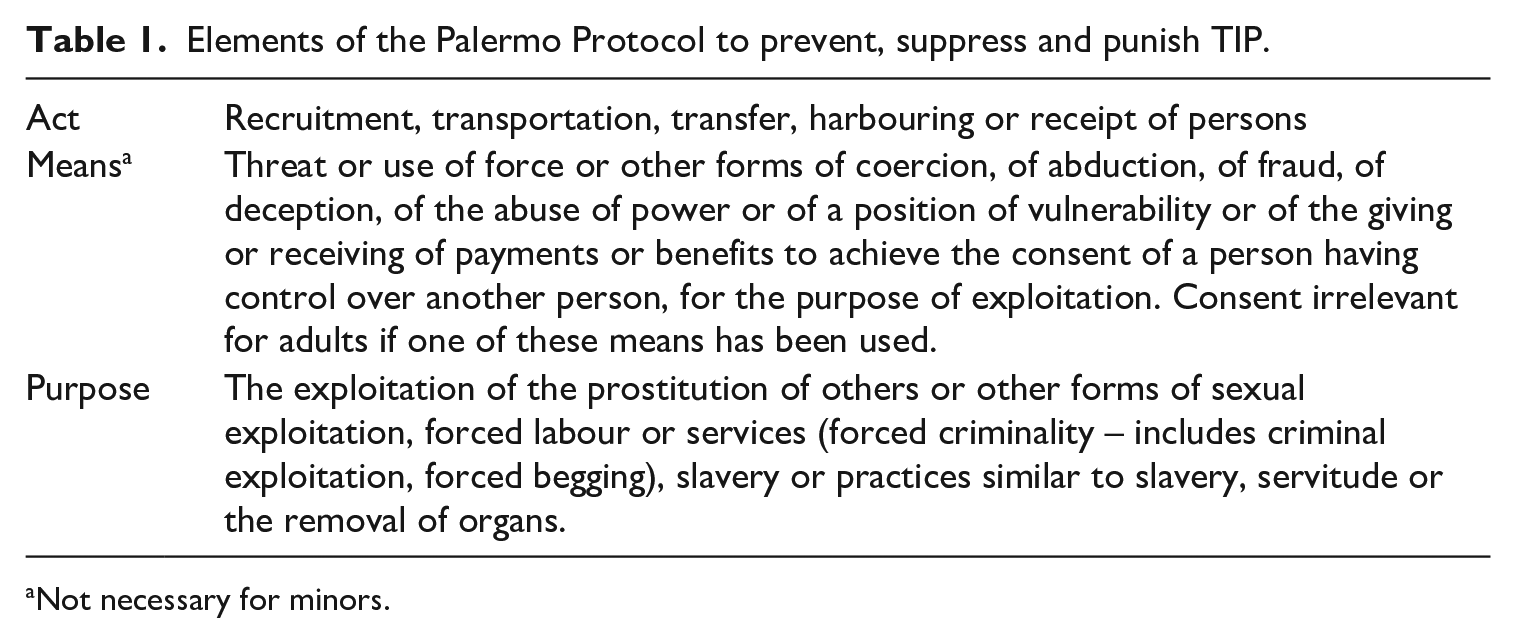
Not necessary for minors.
However, there are variations in how countries have legislated to incorporate the Palermo Protocol. This complicates cross-national comparisons. Allain (2019) highlights variations in legislation related to exploitation stemming from the wording, ‘Exploitation shall include at a minimum . . .’ (p. 4). While some countries have copied types of exploitation verbatim from the Protocol, others have added other types of exploitation or added provisions (e.g. whether the victim was drugged). Another critic, Kenway (2021) has highlighted the ambiguity in the wording regarding sexual exploitation. The Palermo Protocol states, ‘. . . the exploitation of the prostitution of others or other forms of sexual exploitation’. Kenway argues that the addition of ‘or other forms of sexual exploitation’ makes the definition of sexual exploitation ambiguous; it allows people to interpret it as either pro- or anti-sex work, depending on their own standpoint (pp. 77–78).
To provide context on how data on human trafficking are produced in both the Republic of Ireland and Northern Ireland, Table 2 briefly summarises legislation, identification and victim services during our research. 2 As shown in the table, definitions for human trafficking are slightly different. Northern Ireland explicitly includes modern slavery (slavery, servitude and forced labour) within types of exploitation. Also, they require the act of transporting the victim. However, as defined by the Palermo Protocol (see Table 1), the act of trafficking does not require transporting the victim. More reflective of the Palermo Protocol, the Republic of Ireland does not separately specify transport or modern slavery but includes them in their broader definition of human trafficking (see Doyle et al., 2019 for a more extensive comparison). As discussed by Doyle et al. (2019), the differences in the wording of Irish and Northern Irish legislation for labour exploitation and modern slavery makes no real difference in terms of trafficking identification; in similar cases, at least in principle, both countries should identify the same victims. However, for other types of trafficking, such as trafficking for sexual or criminal exploitation, the requirement for transport of the victim in Northern Ireland but not in the Republic of Ireland could mean that victim identification could be different for those victims depending on where on the island of Ireland they began the identification process.
Comparison of trafficking legislation, identification and services for human trafficking victims in the Republic of Ireland and Northern Ireland during research.
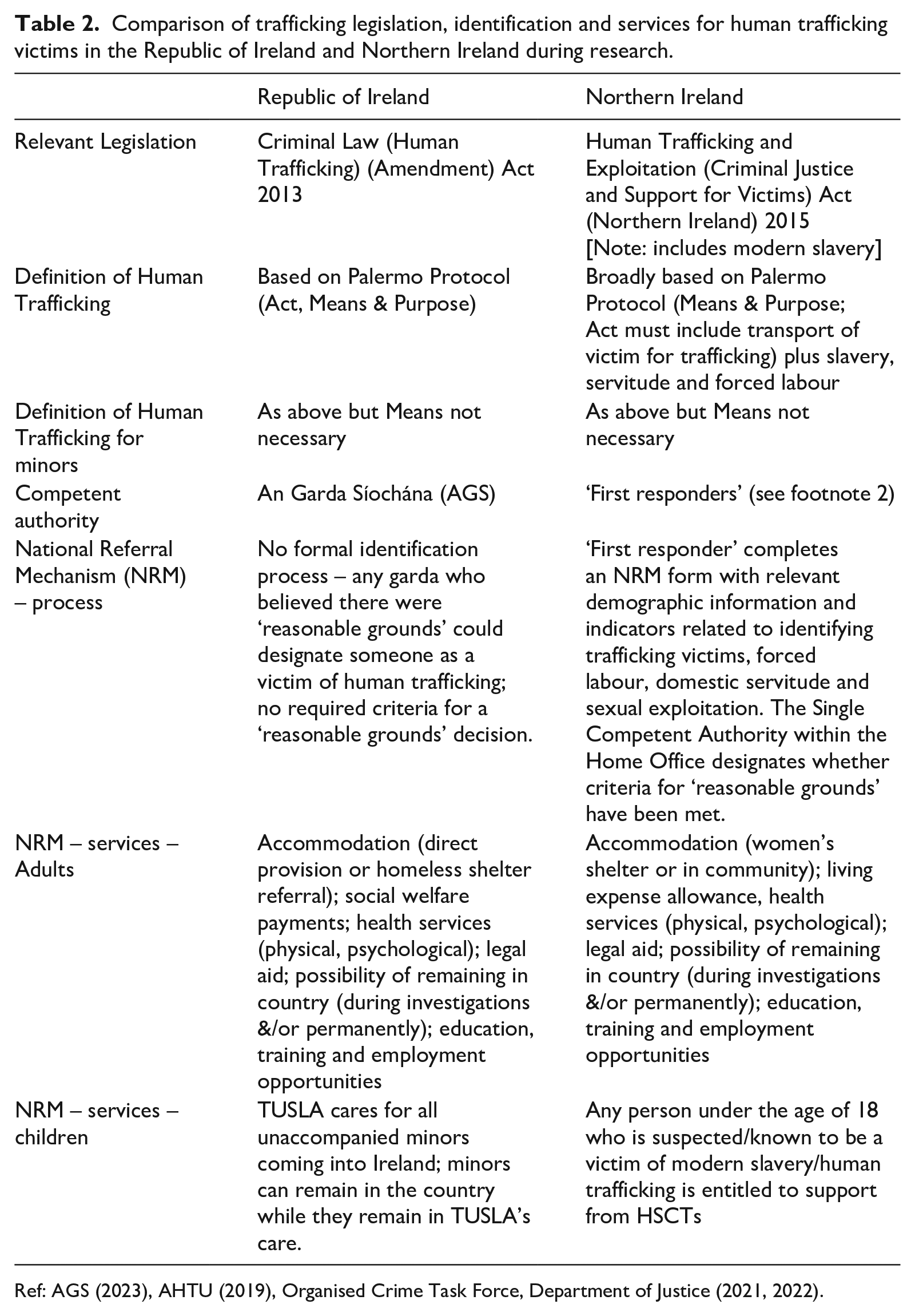
Ref: AGS (2023), AHTU (2019), Organised Crime Task Force, Department of Justice (2021, 2022).
Identification as a victim of trafficking allows a victim to enter respective national referral mechanisms (NRM), the suite of services provided for victims (as shown in Table 2). Research by Doyle et al. (2019) found that services provided by the state could be minimal – a temporary visa and a subsistence allowance – and not necessarily inclusive of all services associated with the NRM. However, victims appreciated any services they could get. GRETA (2021, 2022) & the 2023 TIP report have advised that identification of victims of trafficking within NRMs should include organisations such as service-providers that work with victims of trafficking so that more victims will be included in national NRMs. While the Republic of Ireland is changing its identification process, it is not clear which service-providers will be designated as first responders. The Criminal Justice (Sexual Offences and Human Trafficking) Bill 2023 only refers to ‘Trusted Partners’ with no detail as to which organisations will be included. Northern Ireland was already using a multi-agency approach for victim identification at the time of this research, though ‘first responders’ were only government agencies. 3 National statistics for human trafficking are the numbers in respective NRMs, gathered from national police databases. These numbers, as shown in Tables 3 and 4, do not include victims who have only engaged with a service provider. The numbers for both countries from 2014 to 2019 (through the month of September) are shown in Tables 3 and 4.
Human trafficking statistics, Northern Ireland, January 2014–September 2019.
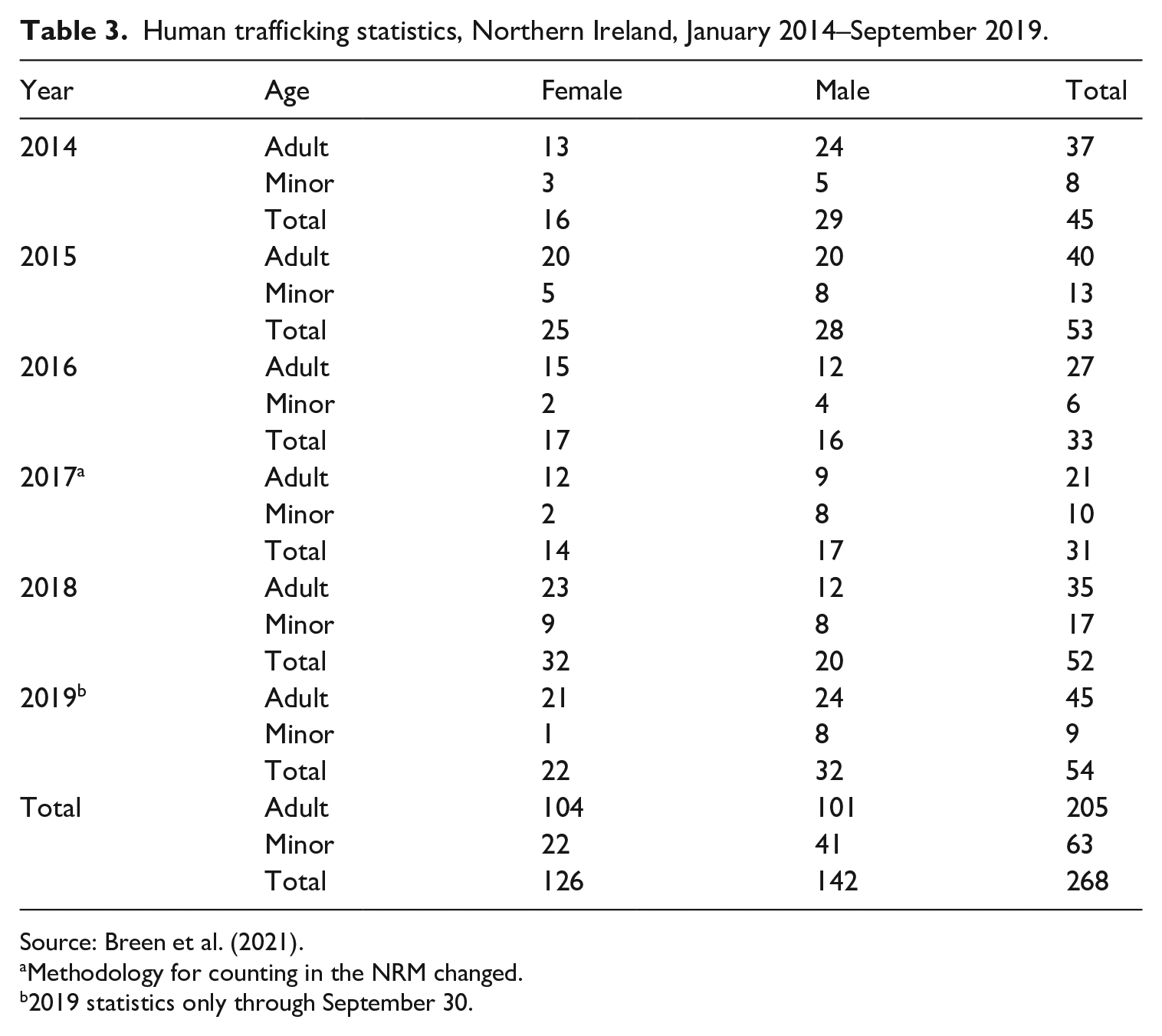
Source: Breen et al. (2021).
Methodology for counting in the NRM changed.
2019 statistics only through September 30.
Human trafficking statistics, Republic of Ireland, January 2014–September 2019.
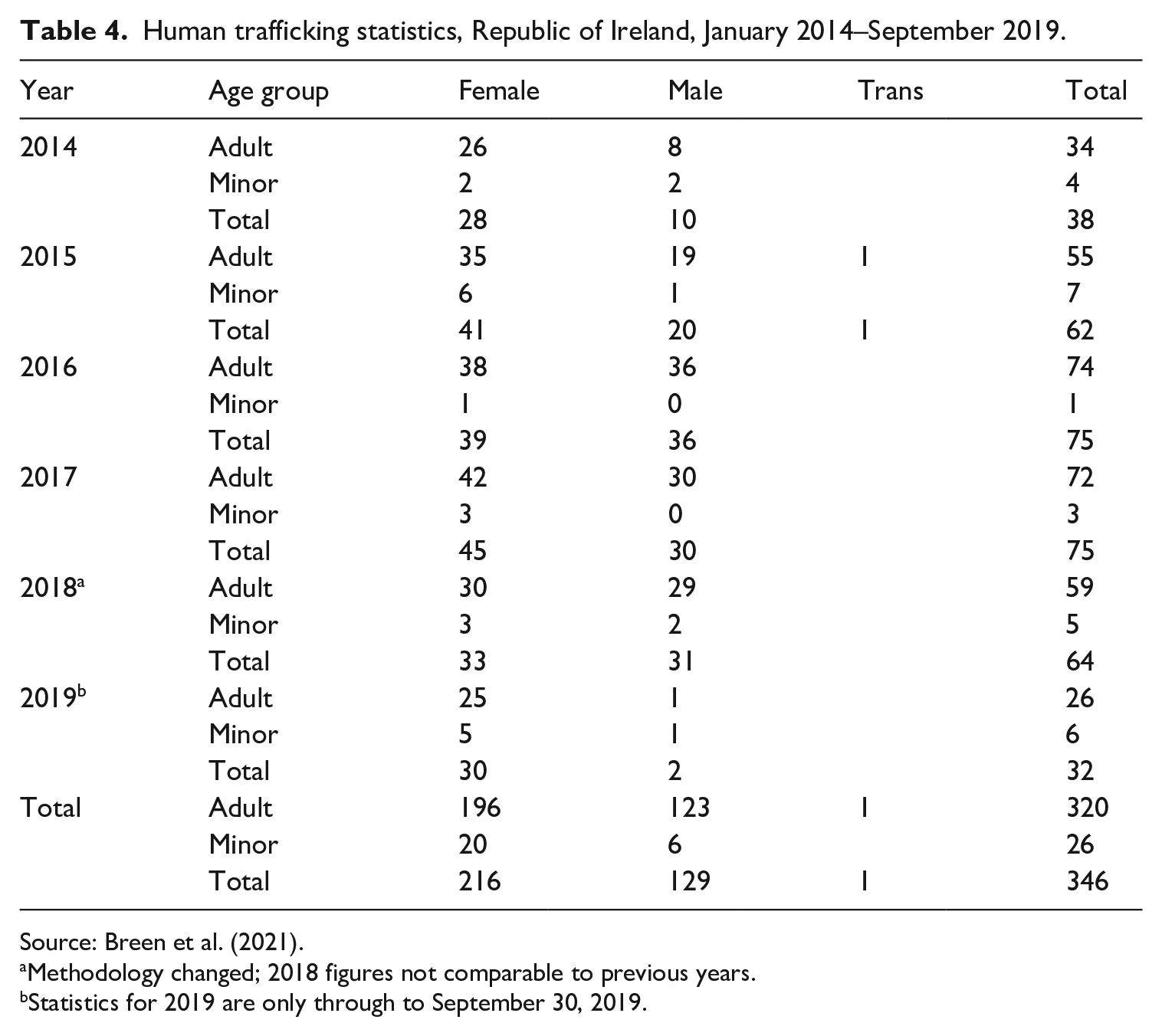
Source: Breen et al. (2021).
Methodology changed; 2018 figures not comparable to previous years.
Statistics for 2019 are only through to September 30, 2019.
Northern Ireland has identified more victims per capita than the Republic of Ireland, with a substantial increase of victims identified recently (GRETA, 2021). Just under seven million people live on the island of Ireland with roughly one quarter living in Northern Ireland. However, over 40% of documented trafficking victims were identified in Northern Ireland from 2014 to 2019. Since victim identification processes are different in both countries, those who can enter respective NRMs are slightly different, meaning that associated figures are constructed differently. For instance, there were nearly two and a half times as many children identified in Northern Ireland compared with the Republic of Ireland during the research time period. The designation of a minor as a victim of trafficking changed in the Republic of Ireland in 2017. At that time, the Department of Justice (DoJ) (IE) removed all minors sexually exploited by an adult ‘without any commercial element’ from Irish statistics. According to the DoJ (IE), this was to bring the definition of a child trafficking victim (and thus the data) in line with other countries’ definitions (AHTU, 2017: 5). This effectively removed nearly 60 children from trafficking statistics. Subsequently, no children were identified as victims of trafficking in 2020 and 2021, while four were identified in 2022 (US Department of State, 2021–2023). However, the United Kingdom has noted an increase in children designated as trafficking victims over recent years, from 1279 in 2016 to 4946 in 2020. Within Northern Ireland, 16 children were referred into the NRM in 2020 (GRETA, 2021: 12). According to the GRETA (2021) report, the increase was related to an increase in children designated as trafficking victims due to criminal exploitation, such as criminal gangs using children as drug runners. Within the Republic of Ireland, children exploited for criminal purposes by criminal gangs are not designated as trafficking victims even though these children could be designated as trafficking victims based on the Palermo Protocol. Instead, the Irish government has recently introduced a bill, known as ‘Fagin’s Law’, which makes grooming children for criminal activity a criminal offence. 4 Those prosecuted in the Republic of Ireland under the proposed ‘Fagin’s Law’ would face up to 5 years in prison. While maximum sentences for human trafficking in both Northern Ireland and the Republic of Ireland are life imprisonment, only Northern Ireland identifies children exploited for criminal activity as trafficking victims.
While not shown in the tables, the prevalence of types of human trafficking recorded in both countries also varies considerably. According to published reports from the AHTU 5 in the DoJ (AHTU, 2017, 2018, 2019), trafficking for sexual exploitation was the predominant form of trafficking in the Republic of Ireland from 2015 to 2019, with 1.16 times the number of victims for sexual exploitation compared with victims for labour exploitation (156 (sex) and 134 (labour)) between 2015 and 2019 (note: these numbers do not include 5 cases in that time period that were trafficked for both sexual and labour exploitation). The situation in Northern Ireland was reversed. According to the United Kingdom’s published year end NRM summaries (National Crime Agency (NCA), 2015–2019), labour exploitation was the predominant form of human trafficking, with 1.4 times the number of victims for labour exploitation compared with victims for sexual exploitation (116 (labour) and 83 (sex)) between 2015 and 2019. This could reflect differences in legislation, with the Republic of Ireland not requiring transport as an act associated with trafficking for any purpose, while Northern Ireland only ignores transport in cases regarding slavery, servitude and forced labour. However, as reported by the AHTU (2017, 2018, 2019), very few victims in the Republic of Ireland named Ireland as their country of origin. Another explanation could be that traffickers choose one country over the other for types of trafficking. Given that the countries share the same basic geographical location, this seems unlikely. Another possibility is that the police services in each country are prioritising – intentionally or not – identification of human trafficking in some types of exploitation cases over the others.
Literature
Critics highlight the dangers of relying on government indicators as a measure of ‘truth’ (Andreas, 2010; Andreas and Greenhill, 2010b; Feingold, 2010; Merry, 2016). Merry asserts that indicators ‘reflect the social and cultural worlds of the actors and organisations that create them and the regimes of power within which they are formed’ (pp. 4-5). Yet, national trafficking statistics are presented as objective measures and used to compare phenomena across nation states. Large numbers imply a significant problem requiring considerable resources for services, while small numbers would suggest the opposite. Organisations and activists that have often been critiqued for large unsubstantiated estimates ( ‘guestimates’ (Andreas, 2010)) related to human trafficking include the Walk Free Foundation (producers of the Global Slavery Index (GSI)), the International Labour Organisation (ILO), Kevin Bales and the US Department of State, producers of the well-known TIP Reports (reliant at times on estimates produced by the ILO and Kevin Bales) (Andreas, 2010; Merry, 2016; Weitzer, 2014). At one extreme, the GSI had estimated a total of 8000 victims of trafficking in the Republic of Ireland and 136,000 in the United Kingdom in 2018 (Walk Free Foundation, 2018). However, it is unclear where these numbers were coming from, with Weitzer (2014) noting that the GSI methodology seemed to rely on a bizarre extrapolation from one country to another based on a ‘medley of unstandardized and thus non-comparable sources’ (p. 227).
The TIP reports have consistently critiqued the Republic of Ireland for under-identification of victims. 6 While the annual TIP reports have their own critics (e.g. Andreas, 2010; Gallagher and Chuang, 2012; Merry, 2016; Warren, 2010), they still garner attention. While most of Western Europe has been classified in the TIP reports as being Tier 1 (including the United Kingdom, which includes Northern Ireland), in 2018, the Republic of Ireland dropped from Tier 1 to Tier 2, meaning that it was ‘making an effort but not meeting minimum standards’. In 2020, it dropped down to the Tier 2 watch list, meaning that ‘it was not trying hard enough’. In 2022, Ireland climbed back up to Tier 2 where it remains today (US Department of State, 2021–2023). However, according to the Republic of Ireland’s statistics, there are small numbers of human trafficking victims annually, suggesting that human trafficking there is not a significant problem. In fact, according to their statistics, the numbers have decreased over time (GRETA, 2022). 7
The United Nations Office on Drugs and Crime (UNODC) tried to better estimate numbers of trafficking victims in selected countries by using Multiple Systems Estimation (MSE), a methodology which relies on lists of victims identified by different organisation within a country. Based on the likelihood of a victim appearing on multiple lists, MSE estimates the probable number of trafficking victims within a country. From these data, they estimated that for the years 2014–2016, the number of victims should have been 50% higher in the Republic of Ireland than currently recorded. UNODC also calculated an MSE for the United Kingdom. They estimated that the number of trafficking victims in the United Kingdom was about four times higher than currently indicated by the NCA (UNODC, 2018). However, UNODC itself stressed that estimating these numbers was difficult due to the complexity of finding and comparing data internationally. Challenges arose from: definitional and interpretive ambiguity, lack of primary data collection ‘based on sound sampling and documentation procedures’, variability in policies and related documentation, and, most importantly, the hidden nature of the crime itself (UNODC, 2015: iii–iv).
Who’s counting
In specifically critiquing recorded crime from police records to count the incidence of human trafficking, Van Dijk (2015) states, the collection of international statistics on crime is challenging due to varying legal definitions, reporting patterns and recording practices. For this reason, official figures on police-recorded crime are increasingly seen as input statistics of criminal justice systems that cannot, and should not, be used to measure the level of crime or trends in crime (p.2).
At best, Van Dijk sees statistics from police records as imperfect performance indicators of trafficking policies within jurisdictions. However, police data continue to be used to monitor human trafficking, even by the UNODC and Eurostat. Best practice from trafficking ‘watchdog’ organisations such as GRETA and the US Department of State recommend a multi-agency approach including service-providers to victim identification processes. 8 At the time of this research, indicators for human trafficking across the island of Ireland had been based only on published government statistics from police records. The purpose of this research was to find out who was missing from these statistics and why.
Methods
This article stems from the findings of a mixed-methods research project. The project was designed in conjunction with police forces and departments of justice across the island of Ireland to discover who was missing from the NRMs in the Republic of Ireland and Northern Ireland during a 5-year time period, from January 2014 to September 2019. 9 The initial focus of the project was on quantitative data; survey data were gathered from participating service-providers for each potential victim of trafficking who was known to them but not identified by either of the police services. 10 Qualitative data were also collected to help explain the availability and likely information included (and not included) in the quantitative data.
To make it possible to study both countries at the same time, the project executive board for this research chose to use the Palermo Protocol definition of trafficking to identify ‘probable victims’ (see Table 1). For this research, ‘probable victim’ refers to individuals who had worked with relevant service-providers and, according to the service provider, met the criteria of the Palermo Protocol, but were not in an NRM. As such, it was necessary for each service provider who participated in this research to indicate that there was an act, means and purpose associated with trafficking for each probable victim. Twenty-seven organisations (statutory, non-statutory and nongovernmental organisations (NGOs)) participated in the research. Of these, 18 organisations (six from Northern Ireland, 11 from the Republic of Ireland and one that works in both) provided the information that formed the basis of this article. 11
This article presents findings from interviews with the service-providers that took place before and during the quantitative data collection. Initially, we asked participants if they knew (and had ‘data’ regarding) victims of human trafficking who were not identified and referred into either NRM; if so, we then asked why these victims were ‘missing’. By presenting data gathered from these service-providers, we highlight important issues related to the identification systems including policies restricting who is allowed to identify victims, which victims can be identified as victims and reasons victims do not want to engage with the identification process, all of which impact the numbers of victims in respective NRMs receiving state services.
Who is and is not counted?
As shown in Table 1, the Palermo Protocol includes a broad range of criteria to identify a trafficking victim. Some criteria are associated with common representations of trafficking victims. Specifically, victims who have been transported, threatened or physically forced/abused and sexually exploited would all be likely to be identified internationally as human trafficking victims (Dempsey, 2017; Uy, 2011). However, there are other criteria which are not as commonly associated with human trafficking. For instance, someone who is recruited – not necessarily transported – by a trafficker with a means associated with trafficking (see Table 2) who is then exploited also meets the international definition of trafficking. However, these victims, often undocumented migrants, often remain unidentified. As stated by Andreas and Greenhill (2010a), The problem with politicized counting is not simply that the numbers may be inaccurate, but the fact that the very process of counting can create rigid and oversimplified categories. There is numerical discomfort with ‘grey areas’ . . . The categories and the counting process demand clear – even if highly misleading and oversimplified – distinctions between ‘innocent trafficked victims’ and ‘illegal economic migrants’ (pp. 274–275).
From survey data gathered from NGOs participating in the research (Breen et al., 2021), we found that official statistics on human trafficking victims did not include all trafficking victims across the island of Ireland; in fact, they did not even represent all victims of trafficking known by the respective police forces. In comparing the number of probable human trafficking victims from our survey data with NRM data from 2014 to 2019, 12 we found that for the Republic of Ireland, the official statistics were underestimating the number of trafficking victims by at least 38%. Within Northern Ireland, official statistics were underestimating the number of victims by at least 20% (p. 83). A more recent report by the Irish National Rapporteur for 2021 also found discrepancies between NRM statistics and information provided by service-providers 13 (Irish Human Rights and Equality Commission (IHREC), 2022). Given that the project data and the IHREC data only included a subset of organisations in both countries that encounter trafficking victims, our larger estimates are also likely to be underestimating the number of trafficking cases in both countries.
Interviews with service-providers offered a variety of reasons to explain the discrepancy between information provided in the official statistics and the information provided by service-providers. In some cases, failure to identify a victim had to do with a lack of knowledge by members of the police forces of the criteria associated with human trafficking. In other cases, it was because the victims of trafficking would not self-identify or agree to be referred into the NRM. While these ‘unidentified’ victims may have been known to service-providers (who are not able to refer into the NRM), they would not engage with police services. The remainder of the article presents more details of these findings.
Lack of knowledge by police service
In numerous cases, a probable victim had interacted with the police services but had not been recognised as a trafficking victim by the police. Participants in the Republic of Ireland mentioned this most often in terms of trafficking victims for labour exploitation who were dealt with by the police strictly in terms of labour exploitation. In many of these cases, the AGS asked no questions regarding acts or means associated with trafficking. As such, no data/evidence was collected by AGS on all criteria associated with trafficking. Obviously, not all labour exploitation of migrants is trafficking (see, for example, Murphy et al., 2022 for a discussion of the continuum of exploitation in Irish fishing). However, there is no way of knowing unless the recording officer asks relevant questions regarding all three criteria associated with human trafficking.
According to one interviewee,
14
very few of the victims of trafficking for labour exploitation that they had worked with in the Republic of Ireland recently had been identified as trafficking victims. They know of five cases that were inspected during that time-period (during the research period); they (the victims) have been awarded substantial settlements for non-payment of wage. There seems to be willingness to deal with labour exploitation issues but not trafficking cases (Organisation 11).
When that interviewee had discussed these cases with police services, the police said that they – the police – had no authority to help in these situations.
According to another interviewee who worked in the Republic of Ireland, ‘there are jurisdictional issues. Gardai generally see labour exploitation as a civil, not a criminal issue. It is not clear when it – labour exploitation – becomes a criminal issue; therefore, it is often relegated to civil’ (Organisation 12). This also means that the AGS, then, did not necessarily look for other signs of trafficking (i.e. aims and means) when a probable victim of trafficking for labour exploitation presented themselves or was referred. A number of those interviewed in both countries suggested that this oversight may not be entirely accidental (Organisations 1, 8, 11 and 12). As recounted by an interviewee from the Republic of Ireland, many workers are being exploited – especially foreign workers in foreign owned businesses (the food industry). If you go through all the indicators of trafficking, many of those workers would meet the definition of human trafficking. There is a high level of complicity (Organisation 8).
Another reason for lack of identification of probable trafficking victims was related to the ‘fuzzy’-ness of their cases, like the ‘grey area’ discussed by Andreas and Greenhill (2010a). Certainly, in the case of probable victims of trafficking who had initially been smuggled onto the island of Ireland (and had no legal right to reside there), there was a perception that the police believed that the probable victims ‘knew what they were getting themselves into’ when they started that process. However, a number of interviewees in both countries (Organisations 1, 6, 7 and 17) described stories of probable victims who were trafficked while being smuggled (e.g. children who were required to work for their smugglers; women who were trafficked for sexual exploitation while being smuggled). Given what the victims had endured, it was difficult for some of them to remember (or know) who their trafficker was or where the exploitation took place, especially for victims who travelled/were transported through multiple countries. Confusion (actual or apparent) on the part of the probable victim in these situations made it less likely that the competent authority would identify them as a trafficking victim (Organisations 7 and 13). As recounted by an interviewee working in Northern Ireland, this could be because of trauma, ‘they are told that stories lack credibility, but it is very plausible that someone may have “holes” (forgot details) in their story due to trauma’. They also suggested that it could be due to a lack of gender- and culturally appropriate services: . . . Women from certain cultures will not discuss certain topics like sex or abuse . . . in front of someone from a different caste/social class or gender, such as a reporting officer or an interpreter. (The interviewee gave an example of a Somalian woman who was sexually victimised while being smuggled.) She had not mentioned this in her initial screening interview. . . ., her credibility was questioned by the competent authority because she had ‘changed her story’. However, those questioning her during her first screening interview were men (the translator and the police officer) – she said that she could not discuss such things with them and, therefore, didn’t say anything (Organisation 7).
Similarly, participants in both countries believed that the police were consistently not recognising individuals who were trafficked for criminal exploitation as trafficking victims, at least not initially. In these cases, the victim had often come to the attention of the police because of the crime(s) that they committed. Their actual status as a victim of crime only become apparent once they were in jail. Interviewees in both countries recounted relevant stories (Organisations 1, 7, 9, 12, 14 and 15). In the Republic of Ireland: The Gardai are focused on immigration. If someone has been trafficked for criminal activity, that person will serve time . . . . . . . a Chinese woman was found locked in a marijuana growing house, no paperwork, no English. She was still sentenced. All of those who cultivate drugs are thrown into prison. There were ten young Eastern European men . . . one after the other were trafficked to Ireland, picked up in Dublin and brought to ___ for criminal exploitation – only after the 5th or 6th did people start realising that there was a pattern (Organisation 14).
Similarly, in Northern Ireland: . . . (a probable victim) had borrowed money to leave Vietnam (she is a lesbian). She was brought into the UK with a couple who deserted her . . . . She was ‘found’ by a friendly, older man. He brought her back to his house to mind his marijuana plants; . . . Much of the time she was locked in the attic of a large house with the plants. She had no English and couldn’t read English; ultimately, she was charged with seventeen offenses/convictions including stealing electricity and growing marijuana (Organisation 15).
Women (and men) in ‘forced prostitution’ are often not recognised by the police as trafficking victims. This is partially because it can be difficult to prove all criteria related to trafficking, especially for those who agreed to sex work but not the type of sex that they were forced to do, something that came up with a number of interviewees in the Republic of Ireland (Organisations 2, 3 and 4). In differentiating between those who are in prostitution and those who are trafficked, one interviewee stated that ‘the difference is about consent and control’ (Organisation 4). Another concurred, There is a spectrum from trafficked to prostitute – the area in the middle is tricky . . . . Consent to certain things but not to the situation they are in – nuanced – very difficult to prove. (Organisation 2).
Lack of knowledge (or refusal to acknowledge) by trafficking victims
Across the island of Ireland, it has been necessary for a victim to self-identify as a victim of trafficking to be referred into the NRM. However, many probable victims are not aware of the criteria associated with trafficking and would not self-identify as such. Representatives from organisations in both countries said that most of the probable victims that they work with would have no idea that they were trafficked and would not identify as such (Organisations 2, 5, 6, 11, 14, 16 and 18). One interviewee in the Republic of Ireland said that a service user ‘did not realise that they were being exploited until she saw a flyer . . . that described labour exploitation which also provided a contact number for getting help’ (Organisation 14). Another, who had worked with victims in both countries said: Even of those who knew that they were being abused (e.g., racial insults) and treated badly (e.g., long shifts without adequate pay), many were happy to be receiving pay, even though it is less than (minimum wage). Some money is better than no money. There was also the fear that if they complained, they might be sent back to situations that were worse (e.g., no housing, no work) (Organisation 11).
Others retain a loyalty to their trafficker. For women groomed by traffickers into situations of sexual exploitation, they will simply deny that they have been trafficked and remain loyal to their trafficker/pimp (Organisation 5).
And those who do not want to be counted
However, even in situations where it is obvious to a probable victim that they are the victims of exploitation, they often do not seek help. This was discussed by interviewees in both countries for a variety of reasons. In the case of women who were trafficked for sexual exploitation who had agreed to come to Ireland for sex work, there can be a sense that they were somehow responsible for their trafficking, that they had somehow ‘colluded with their trafficker’ and were, therefore, also to blame (Organisations 2, 5). This is enough to keep some victims in hiding.
At the other end of the spectrum are those who will not testify against their trafficker because of fear. Often this fear is for the safety for children and other family members that they have left behind. As stated by one interviewee from Northern Ireland, ‘. . . threats to family and children are very real and just as effective (such as) “I know where your children are”. Women can be too scared to even mention these threats to the police’ (Organisation 7). There are other fears that keep victims of trafficking from engaging with the police. Those who fear imprisonment, such as those who have a criminal past or who have been trafficked for criminal exploitation, also may want to stay hidden. In both countries, there were probable victims who did not want to engage with the police services out of fear of repatriation (Organisations 1, 11, 15, 16 and 18). As discussed by a participant in Northern Ireland, for those who are discriminated against in their home country (e.g. Roma), their work situation may be seen as a ‘step forward’ and they are ‘resigned to their lot’ (Organisation 1). They do not want to go back to a country where they believe their treatment will be worse. For probable victims who are LBGTQ +, they may be in physical danger, even of death, in their home countries, which makes them extremely vulnerable to exploitation (Organisations 7, 15 and 18). Interviewees described instances of transexual women from Brazil who cannot return home; their families have told them to leave. In Ireland, however, they can experience extreme violence when doing sex work (Organisation 18). They refuse to identify as trafficking victims. For others, there is simply the fear of the unknown. While their current situation is not good, at least they have a place to live and are often paid something by their trafficker, even though it can be well below minimum wage. Victims in both countries were sending money back home and supporting families (Organisations 1, 5, 11 and 14). As explained by one interviewee in the Republic of Ireland, Traffickers are smart. No longer do they take papers and keep all of the money. Instead, they give their victims small amounts of money and a place to live. . . . The women generally send money home to their families and the families become dependent on the money. The families don’t want the women to return. Even the Western Union trail provides a defence for the trafficker; he can say that she was able to send money home (Organisation 5).
Others were paying off debts accrued for a variety of reasons, such as fees associated with smuggling and gambling; they see their ‘trafficking’ as a legitimate way to pay off debt as described by the same interviewee: If someone accepts money from a Chinese gang to pay off these debts, then they need to pay that money back. They do not see it as trafficking if they are sent to Dublin to work first in a restaurant, then a take-away, and then a massage parlour (all in one day) without pay until the debt is repaid – the women see this as a legitimate way to pay off the debt. They will not deviate from their community; they do not want help from the Irish state or the IOM because the Chinese government will then find out about them – this will bring shame to their families (Organisation 5).
Ultimately, as stated by another participant from the Republic of Ireland, What’s the incentive to enter the NRM? Within their current situation, they are surviving. . . . there is a continuum between victimisation and agency; it’s not all about victimisation. People figure out strategies that they use to survive (Organisation 14).
This sentiment was echoed by interviewees from both countries (Organisations 9, 15 and 17).
Certain sectors where exploitation is more common, such as fishing, mushroom picking, car washes, nail bars and prostitution, for instance, attract those with minimal skillsets and/or language deficiencies who are desperate for any work. Even after identification as a victim of trafficking and referral into the NRM, some return to those jobs afterwards because they have no other choice, as described by one service provider in Northern Ireland: Some former identified victims of trafficking go back to the activity that they were trafficked for – drugs, prostitution – because they have found no other way to support themselves. They are trying to survive. They seem stuck in survival mode – will they ever move past that? – this is something that I worry about – certainly not all victims, but some (Organisation 9).
There are also those who do not seek help due to an inability to engage with the police services in either country due to: vulnerability, intellectual disability, lack of confidence in their communication skills or lack of English language skills (Organisations 1, 9, 12 and 15). One interviewee in the Republic of Ireland referred to this inability as a ‘capacity issue’, saying that ‘regardless of how a question is asked, they may not be able to understand’ (Organisation 12). Others from Northern Ireland suggested that it may also have to do with the trauma that the victims have experienced from their exploitation (Organisations 7 and 9).
Conclusion
This article has highlighted issues within both the Irish and Northern Irish identification systems with a broader literature on the politics of victim identification, focusing on restrictions on who is allowed to identify victims, processes which restrict which victims can be identified as victims, and reasons why victims do not want to engage with the identification system. All of these impact who receives services through NRMs and who is ‘counted’ as a victim of trafficking in national statistics for both countries. At present, the only victims who ‘count’ are those who are willing and successful in obtaining a referral into state services through NRMs. This research has provided some explanations as to why victims are not in NRMs across the island of Ireland. In some instances, a ‘first responder’ or competent authority does not recognise that they are dealing with a probable victim and does not ask questions related to all three criteria associated with trafficking. In other cases, a victim may not be willing to self-identify. Within the Republic of Ireland, a victim may not be willing to cooperate with a criminal investigation against their trafficker. In both countries, there are victims who will not engage with the police or related services, mostly due to fear – of authorities, of the trafficker, of imprisonment, of deportation and repatriation, of the unknown. Others are simply unwilling or unable to ‘relive’ the trauma of their experiences in trying to convince the authorities that they are a victim. Given the limited ability of service-providers to refer victims into NRMs, national statistics in both countries are artificially low. It also means that there are probable human trafficking victims who are not being identified and who are not receiving state services.
To combat trafficking, as stated by Feingold (2010), trafficking must be seen as a process, not an event. If we are to be able to have any long-term impact on the problem, we must use research to identify the most cost-effective areas for intervention. Identifying and ameliorating structural vulnerabilities . . . is essential in this regard (p. 73).
Changes in NRMs specific to identification of human trafficking victims on the island of Ireland that make victim identification more victim-focused and more inclusive are likely to increase the numbers eligible for state services. While estimates of victims across the island of Ireland may be nowhere near GSI estimates from the Walk Free Foundation (hundreds vs many thousands), we know that there are victims who are not being identified or referred into NRMs across the island of Ireland.
Human trafficking is often referred to a crime that is hidden in plain sight, meaning that victims continue to be exploited without being identified – ‘counted’ – as reflected in statistics on trafficking. Both countries need to continue expanding the authority to refer a victim of trafficking into respective NRMs to include more civil society organisations, especially service-providers. In the instance of the Republic of Ireland, the requirement that all victims in the NRM cooperate with the AGS in prosecution of their trafficker needs to be removed. All organisations working with victims should be required to provide regular, up-to-date training on criteria associated with trafficking/exploitation and how to provide gender- and culturally appropriate services to probable victims. Obviously, for this to happen, the Republic of Ireland needs to create clear and detailed eligibility protocol for entry into the NRM as is currently being proposed in the Criminal Justice (Sexual Offences and Human Trafficking) Bill 2023. Expanding NRMs to include all relevant service-providers outside of government agencies who are in contact with victims has the potential of increasing the numbers of victims identified as trafficking victims and thus the need for services for victims. It will also make the identification systems more victim-centred and make services to trafficking victims more inclusive.
Footnotes
Appendix
Updated trafficking legislation, identification and services for human trafficking victims in the Republic of Ireland and Northern Ireland.
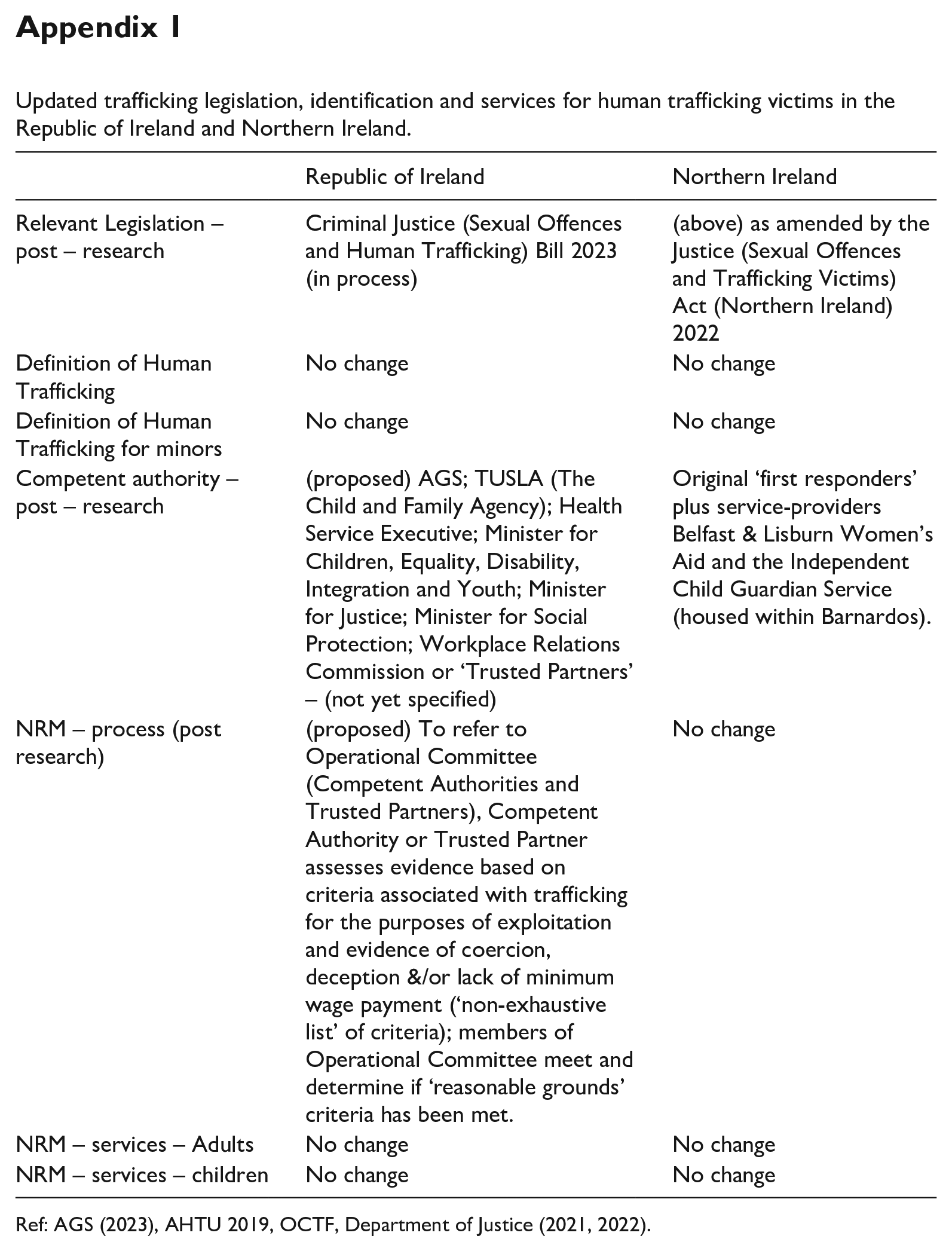
| Republic of Ireland | Northern Ireland | |
|---|---|---|
| Relevant Legislation – post – research | Criminal Justice (Sexual Offences and Human Trafficking) Bill 2023 (in process) | (above) as amended by the Justice (Sexual Offences and Trafficking Victims) Act (Northern Ireland) 2022 |
| Definition of Human Trafficking | No change | No change |
| Definition of Human Trafficking for minors | No change | No change |
| Competent authority – post – research | (proposed) AGS; TUSLA (The Child and Family Agency); Health Service Executive; Minister for Children, Equality, Disability, Integration and Youth; Minister for Justice; Minister for Social Protection; Workplace Relations Commission or ‘Trusted Partners’ – (not yet specified) | Original ‘first responders’ plus service-providers Belfast & Lisburn Women’s Aid and the Independent Child Guardian Service (housed within Barnardos). |
| NRM – process (post research) | (proposed) To refer to Operational Committee (Competent Authorities and Trusted Partners), Competent Authority or Trusted Partner assesses evidence based on criteria associated with trafficking for the purposes of exploitation and evidence of coercion, deception &/or lack of minimum wage payment (‘non-exhaustive list’ of criteria); members of Operational Committee meet and determine if ‘reasonable grounds’ criteria has been met. | No change |
| NRM – services – Adults | No change | No change |
| NRM – services – children | No change | No change |
Acknowledgements
The author would like to acknowledge and thank her colleagues – Professor Michael Breen and Professor Michael Healy, the Project Executive Board of the HTEPII, the funders, the anonymous reviewers of the article and, most of all, the participants.
Declaration of Conflicting Interests
The author(s) declared no potential conflicts of interest with respect to the research, authorship and/or publication of this article.
Funding
The author(s) disclosed receipt of the following financial support for the research, authorship and/or publication of this article: Funded by An Garda Síochána, the PSNI, Department of Justice (IE), Department of Justice (NI) and Mary Immaculate College, Limerick, Ireland.
