




Abstract
The policing of measures to control the spread of the SARS-CoV-2 virus is a core aspect of the current corona crisis. This article concentrates on differences in policing the corona crisis in France and the Netherlands. There are huge differences in policing the corona crisis between the two jurisdictions: France with a very strict, repressive approach, and the Netherlands with a more pragmatic, communicative and responsibilizing style. These differences can be understood by looking at the underlying frames about the relationship between state and citizens. The differences in frames about the relationship between police and citizens are more or less similar between the two countries. In France, the dominant frame is of policing as a matter of ‘force’ and ‘war’; the Dutch policing style is framed in terms of responsibilization, communication and persuasion. Despite these important differences, there are also similarities. In both countries there have been fundamental criticisms of the legal basis of the corona measures and of the way that these have been policed. The issues of protest and criticism are often related to the specific dominating frames, in a paradoxical way. The Dutch approach, with its emphasis on proximity, communication and shared responsibilities, may be more effective in realizing compliance with the anti-corona rules than the French one, with its distrust of citizens, use of sanctions and war-like rhetoric. The question is raised of whether the Dutch approach will also be successful if awareness of the dangers of the virus and of the importance of self-control declines.
The COVID-19 pandemic is not only a worldwide health problem with dramatic consequences, but also a matter of social order. The pandemic has had a huge impact on social relations and the stability and taken-for-grantedness of many institutions and organizations. To control the virus and its impact, governments have tried to create a new (temporary) social order, with new rules for interactions that have had direct consequences in almost every domain of our lives. This order has proved to be unstable, fragile and is in a permanent state of change, resulting in tensions and conflicts. Policing and control of this social order must be seen as core elements of the current corona crisis.
To date, several studies published in this field have shown important differences in the responses of governments to this pandemic (Toshkov et al., 2020). Similar differences have been found between jurisdictions in how they have been policing the current corona crisis (OECD, 2020; Roché, 2020b; Sheptycki, 2020). 1 In this article, we deal with these differences in policing and with the question of how we can understand them. The relevance of this analysis is not limited to the current corona crisis. In times of crisis, it may be easier to observe the often-hidden and self-evident routines and assumptions of policing agencies.
Here, we want to show that differences in policing the corona crisis may arise because countries differ in their (policy) frames (Goffman, 1974; Lau and Schlesinger, 2005; Schön and Rein, 1994; Van Hulst and Yanow, 2016) of policing, rule enforcement, and the relations between the state and citizens in general. These largely implicit political frames create certain images of problems and of solutions to these problems by focusing on some specific issues and on what counts as relevant, valid or important. By doing so, they also give meaning to the position, tasks and responsibilities of the state and other actors. Frames contain certain symbols, language and anecdotes. Their rhetoric power may give direction to decisions and behaviour. As a consequence, frames can be very convincing and hard to refute, but may also be confronted with opposition and resistance.
In this article, we investigate policing of the corona crisis in France and the Netherlands in the spring of 2020. These countries present highly contrasting styles of policing the corona crisis. On the one hand, France had a tough policy of enforcement. As we will see, it reflects a rather state-oriented and repressive conception of the role of the public police, in which police officers are in charge of controlling citizens and maintaining public and social order (de Maillard and Skogan, 2021). On the other hand, in the Netherlands, a more pragmatic policing style, including elements of negotiation management (Della Porta and Reiter, 1998; Della Porta et al., 2006), has dominated, with much emphasis being placed on voluntary compliance and with the use of sanctions only as a last resort (at least at the policy–rhetorical level).
First, we briefly explore development of the corona crisis in both countries and how the governments responded to the pandemic. Next, we deal with policing in the two countries. The article then focuses on the tensions and problems in reaction to policing and enforcement in the context of the corona crisis. Finally, we deal with the main differences in policing styles and how we can understand them.
This article was written in May and June 2020. Therefore, information about developments after 23 June 2020 could not be included. At that point, the corona crisis was still evolving. Although the initial confusion and uncertainty with regard to the pandemic had diminished, in many respects it was still difficult to get a complete and accurate view of what had happened during this crisis and what the long-term impact of the SARS-CoV-2 virus would be. Still, we believe that it is important to try to understand how different countries responded to this crisis, even if not all relevant data are available and it is still difficult to see the full contours and impact of the corona crisis.
This article is based on policy documents, available studies, information delivered by the mass media, personal observations and some interviews with key persons involved in policing of the rules and ordinances created to control the SARS-CoV-2 virus and reduce its impact. In all cases, we have checked the information conveyed by the mass media.
The development of the pandemic and of governmental responses
France
On 16 March, President Emmanuel Macron declared a state of medical emergency and a national lockdown, to be enforced on 17 March, a week after the Italian government (10 March) and following the governments of Spain (16 March) and Austria (17 March). On 24 January, the first three patients (Chinese and/or French of Chinese origin) were hospitalized in Paris and Bordeaux. On 14 February, a Chinese tourist succumbed, and on 25 February, the first French citizen officially died of SARS-CoV-2 in the region of Paris (Oise), a 60-year-old teacher and municipal councillor. By the end of February, France had recorded 68 cases, and by 15 March, the day of the municipal elections, 4,469 persons were infected and 36 had died. 2 Three months later, on 16 June, 157,716 persons had been infected and 29,547 had died. In order to face the epidemic, the French government had more hospital resources (total number of beds minus psychiatric beds) than the European Union (EU) average: 514 beds compared with 435 beds per 100,000 inhabitants. 3
The debate about health policy has been framed around the lack of face masks and tests. The government asserted that the risk of importing cases from Wuhan, China at the end of January was ‘very weak’, 4 and repeatedly denied the value and importance of face masks during the pandemic until the end of lockdown. Contrary to Central European countries, masks have not been assessed as important tools by the French authorities during the lockdown period. 5 On top of this, the French government has long denied any shortage of face masks. The Minister of Health said ‘We have dozens of millions of masks in stock’ at the end of January. 6 However, by mid-March, it appeared that doctors and nurses in hospitals were massively underequipped, including in the most severely afflicted region (the east of France). Leading medical doctors wrote infuriated ‘op eds’ in the media against the official position, according to which face masks were useless and even dangerous. 7 On 4 April, the Minister of Health started to amend his position on the importance of masks. Later, on 28 April, the Prime Minister acknowledged before the French Senate that there had been a ‘risk of shortage’. A similar scenario developed in France regarding tests for the virus: their importance was downplayed, a shortage denied and their use limited. Medical researchers and doctors, again, were furious about the bureaucratic hurdles placed before them in preventing the production and use of tests. 8 Government policy has mainly revolved around the implementation of lockdown as a tool to ‘flatten the curve’ and, by displacing sick persons from the eastern part of the country to less-impacted regions, to allow hospitals to cope with the volume of infected persons with serious respiratory problems. At the beginning of May, when the end of lockdown was approaching, face masks were being deemed by government as a key instrument against the virus, together with physical distance: on 2 May, the Minister of the Interior expressed his intention to make mask wearing compulsory on public transport. The public authorities’ response has been seen by the French public as one of the most controversial and negatively assessed in comparative terms. 9 Compared with the two other largest European countries, the United Kingdom and Germany, the degradation of support for the French government is well documented (Roché, 2020a).
The government’s delay in understanding the challenge, and its lack of resources probably influenced the wider virus policy, although it is not the only factor at play. Lockdown came as a shock to the public, since on 26 February the football stadium of Lyon was filled with Juventus supporters for a Champions League match, despite northern Italy’s critical health status, and on 15 March the government decided that municipal elections could be held throughout the country without health risks. The impact of holding the election on the spread of the disease has remained a subject of controversy.
In France, lockdown consisted of an accumulation of various measures, some targeted at institutions, others at individuals. All measures were imposed as a block from day one, without any variation according to the local context or stages. At the institutional level, on 16 March, the President claimed ‘we are at war’, and announced his intention to govern without Parliament, with the latter’s consent, by means of executive orders for what concerned ‘strictly crisis management’. However, the interpretation of ‘strict’ has proven lax if one considers the scope of the restrictions on civil liberties. On 22 March, the President obtained approval from Parliament, which in addition suspended the guarantee of the constitutionality of laws. 10 On 3 April, the Minister of Justice issued an order according to which pre-trial detention was extended without a hearing of any types by judges. The President of the Ordre des Avocats, one of the most prominent bar associations, Louis Boré, explained that this had not happened since 1793, during a period of the French revolution called the ‘Terror’. 11 During the COVID-19 period, the Council of State (the highest French administrative court), which has a function to protect civil liberties, has agreed with all the restrictions of freedom that have arisen due to government initiatives.
Regarding citizens, the French national government responded by adopting a quite aggressive stance against the allegedly undisciplined French population, while at the same time issuing an erratic series of statements regarding the efficient means of protecting oneself from the virus (see the section on ‘Policing the corona crisis’). Domestic limitations on freedom, on top of the closure of national borders, airports and harbours, consisted of a lockdown and use of a self-authorization form to be filled out and carried for each presence outside the home (for sports activities, limited to one hour within a one-kilometre radius around the home; with a prohibition on the use of bicycles) and a ban on public gatherings (including ceremonies such as funerals). Shops that did not sell ‘essential goods’, and also schools and universities, were closed. 12 The government apparently expected the public to immediately understand and abide by laws that changed all aspects of everyday life. While visiting the Pasteur Institute (a major French research centre on viruses) on 19 March, the President lamented that the rules were not being ‘perfectly respected’. The Minister of the Interior echoed his statement, talking of citizens as ‘imbeciles’: ‘there are people who think that they are modern heroes when breaking the rules whereas in fact they are imbeciles’. A lack of understanding and adaptation of behaviour is not what has been observed by Google mobility data: between 18 February and 18 March, French persons have reduced their recreational activities by 88% and their use of public parks by 82%. 13 These percentages are higher than for British citizens, who have a reputation for self-restraint.
The Netherlands
In the Netherlands, the first person with SARS-CoV-2 was identified on 27 February 2020, almost 5 weeks after the first cases in other parts of Europe. Since that day, the number of persons diagnosed with the disease has been increasing extremely rapidly, especially in the southern regions of the country. In the period up to 23 June 2020, 49,722 persons were diagnosed with COVID-19. The real number is probably much higher, because in the Netherlands many persons with corona-like symptoms have never been tested. Over this period, 11,853 persons with corona have been hospitalized and 6,095 patients have died. The peak of the corona pandemic in the Netherlands was between 27 March and 10 April. Since then, the numbers of new patients, of persons who are hospitalized, and of deaths due to the coronavirus have been declining (RIVM, 2020).
One of the most debated issues during the corona pandemic in the Netherlands has been the lack of intensive care unit (ICU) capacity in hospitals and the lack of protective equipment such as face masks. Emergency measures have been taken, such as the transportation of patients to hospitals in Germany and the creation of provisional ICUs in sports halls and conference centres.
Three different stages may be distinguished in how the Dutch government responded to the pandemic. In the first weeks after the virus outbreak in the Netherlands, the government used a rather informal and somewhat reluctant strategy. For instance, on 9 March 2020, the government made a call to all people in the country to comply with elementary rules of hygiene to reduce spread of the virus, such as the use of tissue paper, washing their hands frequently, sneezing into the elbow, and not shaking hands. Three days later, the Dutch government asked everyone to work at home if possible, with the exception of ‘essential professions’. Events and meetings with more than 100 attendees were cancelled.
A first shift in the government’s policy was on 15 March, about 2 weeks after the first COVID-19 case in the country. At that moment, the number of persons with COVID-19 had increased to 1,596, and 625 corona patients had been hospitalized (RIVM, 2020). Instead of only calls to citizens to comply voluntarily with the rules of hygiene and to maintain a distance of 1.5 metres, the government decided to opt for more drastic interventions. Immediately, all pubs, restaurants, gyms and comparable institutions had to close. Schools and childcare institutions went into lockdown. The next day, the Prime Minister gave a televised speech about the corona crisis, which in the Dutch context is quite unique. He tried to persuade the Dutch audience about the drama that was unfolding. He warned that ‘the virus would be with us’ for a long time. A day later, the government announced the first economic emergency programme to support both employers and employees who were now confronted with serious economic problems.
The second stage in the government’s response began on 21–22 March. Despite the government’s call, during that weekend, with its beautiful weather, large numbers of people went to parks, beaches and recreational areas. For the government, this was a sign that many people did not recognize the seriousness of the situation and were not complying voluntarily with the anti-corona rules (Hendriks, 2020). The Minister of Justice and Security called this behaviour ‘messy, laconic, and anti-social’. He announced that from then on, any breaking of the anti-corona rules might be sanctioned. 14 On 26 March, the Dutch government published an emergency ordinance model, containing several behavioural measures to prevent spread of the coronavirus. This ordinance entered into force immediately, with some minor regional variations. Although the ordinance was much more drastic than the original policy of persuasion and relying on voluntary compliance, the government did not want to present its policy as a ‘complete lockdown’. For that reason, the Prime Minister introduced the term ‘intelligent lockdown’ as the Dutch approach. 15
The third stage of the government’s response to the corona pandemic began on 21 April 2020. At that point, the numbers of new COVID-19 patients and cases of hospitalization and of deaths had been declining for almost 2 weeks. Under the condition that this downward trend would continue, the government announced the first steps to loosen the anti-corona regime. Children were allowed to take part in sport again, in groups, in the open air. In about 2 weeks, elementary schools and childcare facilities would open again. All other measures were continued.
At first, the government was reluctant and hesitant to ease the anti-corona restrictions. However, even before the elementary schools were open again, on 6 May, the government published a so-called ‘road map’ of its exit strategy. This contained the main successive decisions that would be taken in the near future to get out of lockdown. The general rule that everyone should stay at home as far as possible would be replaced by a new rule that those with corona-like symptoms should stay at home and that people should avoid any crowding and maintain a social distance of 1.5 metres. On 1 June 2020, pubs, restaurants, theatres and secondary schools would open again. These measures to loosen the anti-corona regime would only be taken if the declining trend continued.
Policing the corona crisis
France
On 17 March, the national police and gendarmerie were immediately mobilized by the government to enforce lockdown. In total, about 100,000 agents (between 60,000 and 65,000 gendarmes and between 35,000 and 40,000 police officers) ensured compliance with lockdown on a daily basis (Sénat, 2020). Very quickly, a series of controls were put in place: according to data from the Ministry of the Interior, about 130,000 corona-related fines were imposed on 23 March and 260,000 on 27 March (see Figure 1). This mobilization took place at a time when the police and gendarmerie services themselves had officers affected by the coronavirus (there were 150 confirmed cases and 9,000 civil servants confined in the national police on 24 March). The health instructions also required a reorganization of crews and patrols to comply with the social-distancing rules. A police commissioner in the Paris region told us that he had lost 50% of his staff at the beginning of the confinement because of implementation of these rules. In addition to human resources, the police and gendarmerie also used drones to monitor gatherings of people and to communicate prevention messages. Between 24 March and 24 April, drones were used in 251 surveillance missions and 284 information missions (Sénat, 2020).
As of 24 March, police officers and gendarmes were also joined by municipal police officers. At the beginning of lockdown, the municipal police (there are 22,000 municipal police officers in France) did not have the power to control and fine citizens who were not carrying their self-authorization forms. However, municipal police unions and mayors had requested that their powers to issue tickets be extended to ensure compliance with confinement. The law instituting the state of health emergency (24 March 2020) gave them this ability. It is a power that many mayors have seized, in the name of the health security of their fellow citizens, mobilizing their staff on the control of certificates, in a context in which a decrease in recorded delinquency and the small numbers of people in public spaces have reduced their traditional public-security missions. From this point of view, the state of emergency is further contributing to increasing the pluralization of the police forces in France. At the end of the period, according to figures from the Ministry of the Interior, 150,000 corona-related fines had been issued by municipal police officers.
The Ministry of the Interior has been exceptionally keen on counting the numbers of stops and fines, and on communicating numbers to the public as a sign of its performance. The counting of stops is an unprecedented fact: up to that point, the Ministry of the Interior had been opposed to any disclosure of such numbers. From day one of lockdown to the end, corona-motivated stops and fines have reached astounding numbers. There had been 8.2 million recorded stops by 5 April, 12.5 million by 16 April, and 15.5 million by 22 April. France is divided into police and gendarmerie areas: the population is divided evenly between the two forces, although the police operate on 5% of the physical territory, in the large cities. Apparently, the burden of their distribution has been equally shared by the police and the gendarmerie. In total, again according to Ministry of the Interior figures, between 17 March and 11 May 2020, more than 20 million checks were carried out and 1.1 million ‘corona tickets’ were issued. In other words, the mobilization of law-enforcement agencies was essentially based on a logic of control of containment violations. Although, in relation to the population as a whole, only 4% of the checks carried out resulted in the issuance of tickets, these figures are still very high. Not only has the level of the financial penalty been raised (from €38 to €135), but the number of fines reached 1.1 million units the day before the end of lockdown. As can be seen in Figure 1, the cumulative number of fines follows a linear pattern, indicating consistent enforcement throughout the period, with a decline at the end. On the basis of the available figures on three dates, we can compute a ratio of fines per 100 stops, which amounts to 5.8 on 5 April, 8 on 15 April, and 4.2 on 18 April.
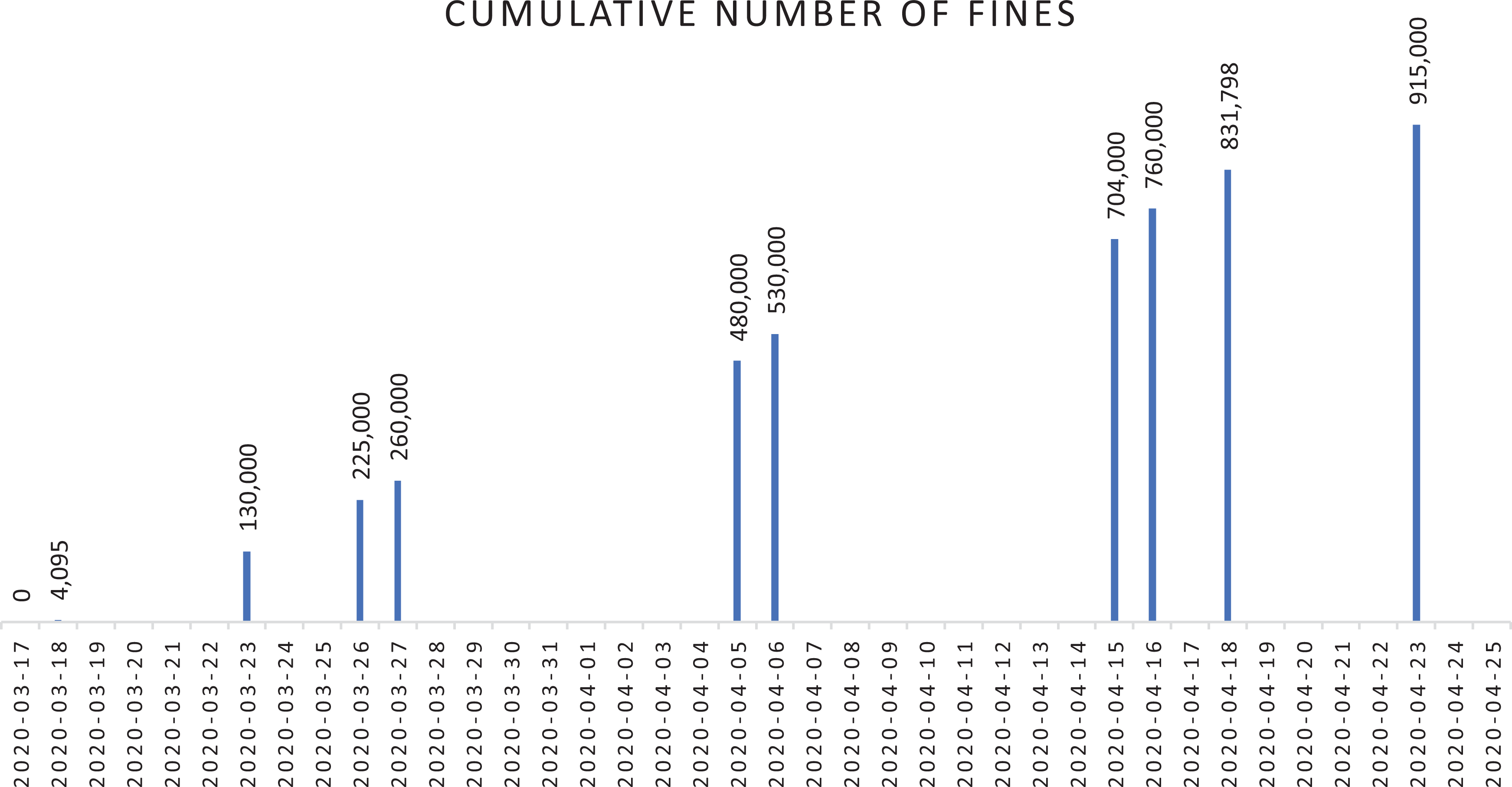
The cumulative number of corona-related fines at certain dates during lockdown in France (source: Ministry of the Interior).
This massive mobilization of the forces of law and order can be interpreted as part of a vertical logic in which the government affirms its will to protect citizens from themselves through punishment. The dominant logic in which the police are involved is that of a state situated above the population and controlling it in order to reduce the spread of the virus. The political discourse, as well as that of high-ranking police officials, attests to this. On 16 March, in his televised speech, President Macron spoke with a strong martial tone, repeating six times ‘we are at war’ and declaring ‘We are not fighting against an army or another nation, but the enemy is there, invisible, elusive, and advancing’. This speech was immediately relayed by the Minister of the Interior on 17 March: ‘What the President described were the most restrictive measures in force in Europe today. We are fighting a battle, we will enforce them […] Our objective is not to punish, but we will’. 16 In front of the television cameras, the speech by the Prefect of Police of Paris (the highest-ranking official in charge of the police for the Paris conurbation, i.e. 6 million inhabitants) clearly indicated the priority given to controls, in a rather threatening manner: ‘There are places in Paris where the instructions are not understood quickly enough. You know me – I will make them understood quickly enough, if ever the perfectly clear explanations of the government had not reached everyone’s ears’. 17 Restriction, control, and the state of war are therefore at the heart of political and police discourse.
Despite its centralized nature and the fact that central government has authority over the two main police forces, there appear to be some distinct differences in approach between them. The national gendarmerie has deployed a partially different discourse, putting forward notions of listening and solidarity in the context of its action ‘#répondreprésent’ (# respondingpresent): ‘in addition to the fundamental mission of protection, “responding present” is a real offer of solidarity to respond to the concerns of the territories’. Policies of assistance and protection of vulnerable people (senior citizens) were thus announced. However, control missions remained an essential part of the gendarmerie’s activities during this period of confinement (17 March to 11 May): approximately 11,500,000 people and 9,500,000 vehicles were checked and 468,000 offences were recorded by the gendarmerie.
This general logic may also have been amplified according to geographical areas. Some mayors (mostly right-wing), particularly in the South of France, have issued orders creating curfews, whereas others have banned people from moving more than 10 metres from their homes. Some prefects (representatives of the state in the départements) (administrative units) have also tightened the bans: the prefect of Morbihan (in Brittany) has banned the sale of strong alcohol (to reduce the increase in domestic violence), before unanticipated effects (increased tension with the police, health problems, and the buying of alcohol in neighbouring départements) led him to withdraw his measure. 18
The Netherlands
Four weeks after the virus outbreak in the Netherlands, the Dutch government published the emergency ordinance for the prevention of the spread of the SARS CoV-2 virus. The ordinance included prohibitions on (organized) meetings and interactions at less than 1.5 metres in groups of three or more persons not belonging to one household, excluding children under the age of 12. With the emergency ordinance, schools, childcare, restaurants, bars, sport and fitness facilities, saunas and so on were closed. Professionals working in close contact with clients had to stop their work, except for the healthcare professions. The emergency ordinance also included the formal power to close certain areas and to terminate public transport. With the emergency ordinance, citizens had to comply promptly with all instructions given by policing officers. The ordinance was extended and adapted slightly on 24 April and 11 May 2020.
The Public Prosecution Agency published a ‘circulaire’ for enforcement of this emergency ordinance. This enforcement was based on both administrative and criminal law. In the case of administrative enforcement, the offender could be sanctioned with a maximum fine of €4,000 and closure of the company. In the case of criminal law enforcement, the organizers of prohibited activities could be fined a maximum of €4,350. A fine of €390 or, in the case of minors, €95 could be imposed if the person had participated in prohibited meetings, did not comply with the 1.5-metre social-distancing rule, was in a closed area or did not follow the instructions of the policing officers. Several agencies have been involved in the enforcement of the anti-corona rules, among them the National Police and municipal enforcement officers (Terpstra et al., 2013).
In the first weeks of the corona crisis, it was often not clear to the policing officers what they should do and how they should operate. Afterwards, officers said that in the first weeks there was much confusion among them and many formal and technical errors were probably made in the enforcement of the anti-corona rules. After some time, some general principles that should be followed in the enforcement of the emergency ordinance were accepted.
The first principle said that the police alone could not control the coronavirus: ‘only together we can control corona’. Second, the policing officers were doing their job to contribute to the ‘health of us all’, (re)defining the police as part of the community and their job as a public good. Third, the enforcement strategy was presented as three successive steps: ‘first, we start a conversation, then (if that would not work) we warn, next (if people still have not changed their behaviour) we may intervene’. In this view, the use of sanctions should only happen as a last resort, not as a goal in itself. 19 The Dutch police should constantly ask citizens to use their ‘common sense’ and ‘to take their own responsibility’. It was only if that was not going to work that the police should use sanctions. 20 According to this principle, self-control was of high priority; enforcement should be additional.
Is this just a matter of police rhetoric, image work, or presentational strategies (Manning, 1997)? It certainly is, but that is not the only consideration. This can be shown by looking at the numbers of fines imposed for breaking the anti-corona rules in the Netherlands. Between 26 March and 31 May 2020, 13,930 corona fines were imposed. About 56% were imposed by police officers and most of the other fines by municipal enforcement officers. 21
Despite the strong emphasis of the Dutch policing agencies on responsibilization (Garland, 2001), communication, persuasion and self-control, other means and strategies have also been used in policing the corona crisis; for instance, new policing technologies. Several times, the police have used drones, both for surveillance of crowded places and to warn people that social gatherings were not allowed and that they should keep at a distance. 22 The Dutch government also wanted to introduce apps to support self-control. A smartphone app should be able to issue a warning if a person was in contact with someone contaminated with the coronavirus. Next, such a person should stay at home for at least 2 weeks. 23 This proposal raised much criticism, as it was seen as an unacceptable intrusion of the state in citizens’ private lives. This ‘appification’ of self-control had not been realized until this moment. The creation of these apps proved much more difficult than the government suggested. More coercive police methods were not completely absent. For instance, at one of the small protest demonstrations against the anti-corona measures on 5 May 2020 in the Hague, the police arrested 80 people who did not comply with the 1.5-metre rule. 24 However, the use of drones, apps and coercion are exceptions to the rule that the Dutch policing agencies generally used methods such as responsibilization, conversation and warning, with sanctions only as a last resort.
To understand the Dutch approach, one should realize that this is not just a matter of technical rationality and instrumentalism; policing the corona crisis also has important symbolic aspects. The meaning given to this policing has many parallels with how governmental officials try to present and communicate their view on the position of the state in times of corona, in the context of its relationship with citizens. An example is the Manual Communication Strategy Corona Virus, published by the government in April 2020. The document shows that communication and framing – for instance, the use of certain words and the avoidance of others – are seen as essential in the Dutch strategy to manage the corona crisis. The message is that ‘only together we can control corona’. According to this manual, we should prefer phrases such as ‘we wash our hands’ instead of the more authoritarian ‘you must wash your hands’. This suggests togetherness, collective decisions and self-control, and not commands from the state. Phrases such as the ‘war against the virus’ or the ‘front line’ should not be used. 25 ‘War-like language’, with ‘orders and prohibitions’, is seen as ineffective in the Netherlands, because ‘it would not fit in with how we are’. 26
The Dutch Prime Minister often repeated his central message: it is not the state alone that is responsible, but all of us are: ‘it begins and ends with the behaviour of all of us’. At one of his press conferences, he rejected a suggestion by a journalist that the Netherlands should follow other countries with their much tougher and stricter enforcement of the anti-corona rules: ‘In such a country I do not want to live. I do not want to play as if I am the boss’. With this approach, he showed a more egalitarian view on the relations between the Dutch state and citizens. He also showed an aversion to strict and tough enforcement. Control of the coronavirus is not just a state responsibility; citizens have their own responsibilities. In his view, it is not the duty of the state to act as if citizens are ‘irresponsible children’: ‘We do this together. And if people are so stupid as to sit in a crowded tram, then it is their own choice. […] we are not a children’s playground here’. 27
The chairman of a regional safety agency articulated a similar view: a state that is dependent on pure enforcement is ‘pitiful’. The intrinsic motivation of citizens is seen as much more important for the management of the corona crisis than strict enforcement by the state: ‘This is more a societal mission than a task of the state. Of course, in extreme cases there can be enforcement of the rules. But a state that is dependent on rule enforcement is a pitiful state. In the end it must come from the intrinsic motivation of shop owners and their customers. […] You make an appeal to the people. It is not because the state says so’. 28
The Minister of Justice and Security had a similar view about visits to restaurants, which opened again after 1 June. Restaurant owners suggested that persons not belonging to one household would be allowed to sit at one table. The minister emphasized the importance of maintaining a distance of 1.5 metres, in restaurants as well: ‘That is the agreement that we made, that is the rule. But in the end it is your own responsibility what you do’. Not only does this reflect a liberal view of the relations between the state and citizens, but it is also motivated by pragmatic considerations: ‘It will become an impossible job for policing officers […] if they have to ask for a birth certificate and certificate of municipal registration every time they see two people at a restaurant table’. 29
Problems, resistance and debates
The social order created to reduce the spread and impact of the coronavirus has raised several new problems, created resistance and caused new debates. Interesting differences can be found between France and the Netherlands.
France
The implementation of lockdown has given rise to much controversy and debate. Although there have been no collective mobilizations against lockdown such as in the United States, the state of health emergency and police action have generated a variety of criticisms, by parties ranging from police unions to non-governmental organizations, lawyers, doctors, epidemiologists and social science researchers, relayed by the media and the social networks.
The first issue, which was largely internal to police forces, concerned the deployment of personnel in an epidemic context to ensure the health security of officers. Under what conditions must police officers wear masks? How should these masks be made available? Against the background of a shortage of masks, the orders of the various directorates of the national police – in particular, the general directorate of the national police and the Paris Prefecture of Police – contradicted each other (on the topics of the right of every officer to wear a mask and the provision of masks only for specific missions). Some trade unions threatened to use their right to withdraw because they considered the protections to be insufficient. This conflict between police directorates and police unions became public during a meeting between the Director General of the National Police, the Director General of Health and the police unions, at the end of which the latter emerged particularly dissatisfied: ‘We were given a speech by the Director General of Health, who was tongue-in-cheek and bewildered by the epidemic, to try to convince us that the virus is not transmitted so easily when we respect the barrier measures [1.5 metres] and wash our hands...’ 30 In other words, between trade union tensions, a lack of masks and the application of health rules, the mobilization of the national forces was under strain.
But it is in the relationship with the public that the debate has taken hold. We saw earlier the severity of the lockdown measures and of the corona-related sanctions. First, at the legal level, some lawyers denounced the fact that any citizen could undergo an identity check without any prior indication of an offence, condemning a reversal of the paradigm of the rule of law: any citizen on the street is a ‘(potential) delinquent’. The possibility of prison sentences for individuals fined several times (three times in 30 days) provoked reactions from defenders of civil liberties, criticizing the illegality of the measure, which sees repetition of an offence as a crime in the legal sense without its basis being proven, and its perverse effects, ‘imprisonment exposing the convicted person to contamination in detention and risking spreading the virus’. 31 Again in the legal arena, after an appeal concerning the relevant legal framework justifying the use of drones (and, in particular, the possibility of recording individual identifications), the Council of State, in a decision of 18 May, banned them in the absence of a regulatory text specifying the conditions for their use and, in particular, the protection of personal data.
The abusive use of force in the control of lockdown has been highlighted by numerous media reports: the kicking or punching by police officers of people lying on the ground, the use of tear gas and tasers, and people being beaten or insulted. 32 These abuses have been highlighted by Amnesty International on the basis of an analysis of 15 filmed cases of checks and arrests. Amnesty has concluded that there was an unjustified use of force, which therefore amounted to cruel, inhuman and degrading treatment; the use of dangerous techniques; and discriminatory comments during police operations. 33 Poor neighbourhoods (what in France are known as ‘banlieues’, or neighbourhoods on the outskirts of cities) have witnessed a concentration of these difficulties. A greater number of lockdown controls have been carried out in these areas than in the rest of the country. Quantitatively, although figures are not available at the neighbourhood level, the data made available by the Paris Prefecture of Police show a higher number of checks and reports in départements with a lot of deprived areas. On 25 April, the cumulative number of stops and fines in the region of Paris and related to the virus was published (cf. Figure 2). It appears that the proportion of stops ending in a fine has substantial territorial variability. In Paris itself, with a wealthy core of 2 million, the number of stops is the highest, but the ratio is of six fines per 100 stops. Around Paris, in the most well-off départements of greater Paris (département 92), the ratio rises to 8.7 fines per 100 stops (+30%), then 13.7 (département 94), and reaches a maximum of 17 fines per 100 stops in Seine Saint-Denis (département 93), the poorest area of greater Paris. This it almost three times as many as in inner-city Paris. Several investigations conducted by journalists have reported repeated checks and altercations. These various investigations, conducted mainly by journalists and non-governmental organizations, led to the writing of an open letter to the government (signed by 24 non-governmental organizations on 13 May), calling for an end to the practices of discriminatory checks and fines. 34
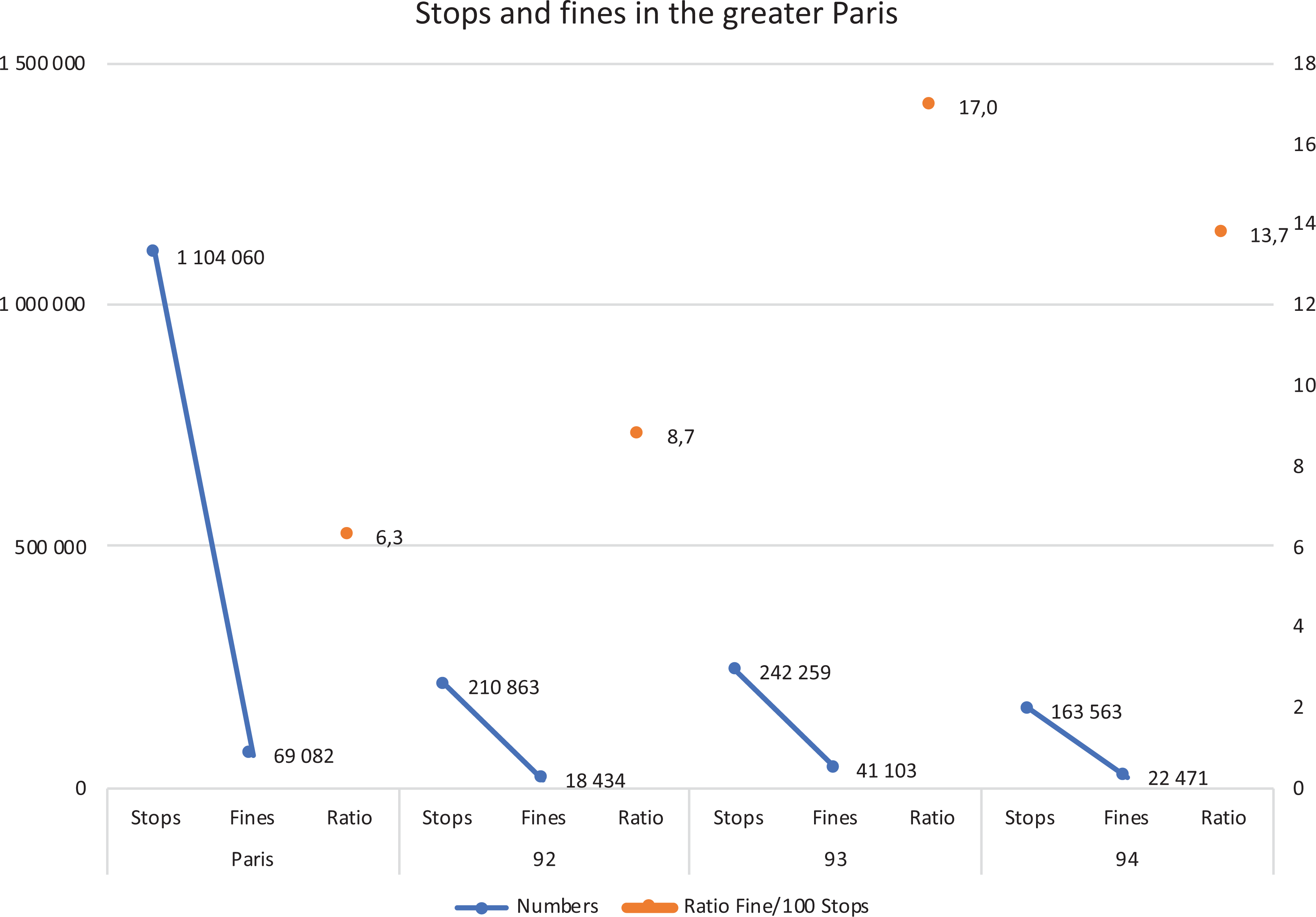
Stops, fines and the ratio of fines per 100 corona-related stops in the five départements (administrative units) of the greater Paris region, France (source: Ministry of the Interior).
Finally, since the beginning of June, tension has shifted to the question of the right to demonstrate in the context of a health emergency. Following the George Floyd affair in the United States, many demonstrations have taken place in France, particularly in connection with the mobilization of several committees (and, in particular, the Truth for Adama Committee), which the Paris Prefecture of Police initially did not authorize. Interestingly, the debate on controls has recently bounced back on the issue of identity controls: the Defender of Rights (a French Ombudsman) defended the necessity and possibility of a traceability (administrative registration) of identity controls, which had been proposed in 2012 by the future President of the Republic (F. Hollande) before being abandoned. According to the Defender of Rights, the fact that the police and gendarmerie published the figures of checks during lockdown means that this monitoring of checks, as well as their consequences, can be technically implemented.
The Netherlands
After the outbreak of coronavirus in the Netherlands, it was often unclear what the new situation would mean and what consequences it could have, for both citizens and policing officers. Fear, uncertainty and lack of knowledge predominated in those days. Given the reputation of the Dutch as anti-authoritarian and individualistic (Hofstede et al., 2010), 35 it was quite amazing that large numbers of people accepted the drastic transformation created by the anti-corona rules, even if this took away much of their freedom to move.
Enforcement of the corona measures took up much of the time available to police officers and municipal enforcement officers, especially in the first weeks. Particularly in the weeks after the start of lockdown, these policing officers often found groups of youngsters in public places who were not following the anti-corona rules while hanging around on the streets or playing football in the park. Many of the corona fines were imposed on members of these groups. Often, a cat-and-mouse game evolved between the police and these youngsters. At the time that lockdown began, policing officers often paid visits to pubs, bars and cafes to convince the owners to close and to warn them. There were pubs that continued in a hidden way, with customers going in through the back door. In some cases, high fines were imposed and bars were closed by the police. After some time, illegal ‘corona parties’ were organized, in some cases with large numbers of visitors. 36
As lockdown evolved and numbers of hospitalized corona patients and deaths began to fall, impatience with regard to ‘returning to normal’ became more visible. Representatives of economic sectors that had suffered damage because of anti-corona measures could not wait to start their businesses again. Some of them threatened to take their cases to court. 37
The promises of the government to loosen the anti-corona regime contributed to a revolution of rising expectations. Increasing numbers of people gradually started to visit shopping centres and recreational areas, not always in line with the anti-corona rules. This complicated enforcement of these rules, not least because the policy of loosening restrictions made it less clear what the exact rules were, not only for citizens, but probably also for policing officers. New conflicts arose between groups of youngsters and municipal enforcement officers. After some incidents, the union of unarmed municipal enforcement officers asked for more weapons so that their members could better protect themselves. For several days, municipal officers decided not to issue any anti-corona fines as a protest against their lack of arms and protection. 38
Since 28 April 2020, there have been some demonstrations in the Netherlands against the government’s anti-corona policy. The demonstrators (generally not more than 100–200) have belonged to very different ideological groups, such as owners of small companies and freelancers, anti-5G activists, anti-vaxxers, anti-migrant activists and believers of conspiracy theories. At one of these demonstrations, a leaflet was distributed that provided some information about the views of these demonstrators: ‘Our human rights are seriously neglected. […] we know that there is much more going on than what mainstream media and the government tell us. We see in what direction these measures will force us. We do not want a totalitarian state […] Our freedom of movement has been limited. Our social freedom has been limited’. 39
Some demonstrations have resulted in clashes with the police. This was particularly the case at a demonstration in the Hague on 21 June 2020. This demonstration was organized by a group called ‘Stop the Virus Madness’, which claimed that SARS-CoV-2 was not a serious threat to public health, that the anti-corona measures undermined fundamental rights and private life without a proper legal basis, and that there was no legitimation of the current emergency situation. 40 The demonstration resulted in a serious clash with the police and about 400 persons were arrested.
The growing criticism of the anti-corona measures has also referred to the legal aspects. A first issue concerns the vague concepts and unclear standards that were used in the emergency ordinance. For instance, who are members of one household (are students living in one house members of one household?) and what is the difference between a meeting and a social gathering? This may have contributed to arbitrariness in rule enforcement, a topic that is often complained about. Another issue is that persons who have been fined for breaking anti-corona rules will have a criminal record. This may have negative consequences for future job opportunities.
Some more fundamental points of criticism have been put forward by several lawyers, who have stated that some of the prohibitions of the emergency ordinance are unconstitutional and not proportional. They have claimed that emergency ordinances do not allow long-lasting breaches of fundamental rights and liberties. 41 For that reason, the government decided to introduce a new bill that should have its entry into force no later than 1 July 2020. However, the bill raised a lot of criticism, including of the government’s advisory bodies. The new bill was said to be in conflict with the principles of the democratic constitutional state and it was asserted that it would give unacceptable powers to the minister, without proper consultation by parliament. 42 At the present time, it is not clear if, when, and how this bill will be accepted. 43
Concluding remarks
The comparison between France and the Netherlands shows huge differences in their styles of policing the corona crisis. France has had a very strict and repressive approach, whereas in the Netherlands a more pragmatic, communicative and responsibilizing style has been predominant. These differences can be illustrated by the numbers of fines imposed for breaking anti-corona rules: in the Netherlands 208 fines and in France 19,643 on average per day, while the former has a population of 18 million and the latter of 67 million. After taking the difference in population size into account (the population of France is 3.7 times greater than that of the Netherlands), the difference in the relative numbers of fines is impressive.
Recently, Sheptycki (2020) has suggested that differences in how the police in different jurisdictions have responded to the corona pandemic might be understood in terms of police ‘force’ versus ‘service’. Our detailed analysis shows that these terms are not sufficiently adequate to understand the differences in policing of the corona crisis between France and the Netherlands. In both countries, force (or the awareness that force may be used; Bittner, 1970) is an important element in the promotion of compliance with the anti-corona rules, although it has been considerably more accentuated in France. The difference is not (only) a matter of (police) ‘service’. As this article shows, it is more important, in understanding these differences, to focus on some underlying and deep-rooted frames about the relationship between the state and citizens. The political culture of the elite may be at stake: among EU countries, those with higher scores for the protection of civil liberties (based on the indexes of the World Justice Project) appear not to have embraced ‘tough on citizens’ solutions, as measured by two indexes of ‘exceptionalism’ (based, on the one hand, on the combination of indicators of exception to the rule of law and, on the other, on the number of limitations of civil liberties or the intensity of police and military measures for enforcing those limitations; Roché, 2020b). The Netherlands’ score on these indexes positions the country at one end of the spectrum, closer to Germany or Norway, whereas France lies at the other end, closer to Belgium or Romania. 44 In France, the view prevails that the relationship between the state and citizens is strictly hierarchical, with a considerable distrust of citizens. At least at the policy–rhetorical level, the Netherlands’ frame consists of a more egalitarian view of the relationship between the state and citizens and of common public responsibilities, not only of the state, but also of citizens and other social actors. More or less similar are the differences in frames about the relationship between the police and citizens. In France, the dominant frame of policing the corona crisis is a matter of ‘force’ and a ‘war’, whereas the Dutch policing style is mainly framed in terms of responsibilization, communication and persuasion (and the use of sanctions only in exceptional cases and as a sign of a ‘pitiful state’). The contrast between the policing frames can be illustrated by the difference in meaning and importance of the notion of community policing. In the Netherlands, community policing is a generally accepted element of the self-image of the police (Adang et al., 2010). In the French police generally, a much more averse attitude prevails in relation to community policing (de Maillard & Terpstra, 2020), although there are differences between the two French police forces in their relations with citizens, partially reflecting differences in the cultures of the two forces, both at the top and at the rank-and-file level (Dieu, 1993).
Despite the important differences in policing styles between the two countries, there are also similarities. As has been shown before, the use of force is not completely absent in the Netherlands, and strategies of communication and persuasion may also be found in the French police (especially in the French gendarmerie). So the differences are marked, but not absolute. We should not overstate the homogeneity of each national framing of police action. Also, in both countries there have been fundamental criticisms of the legal basis of the corona measures and of the way in which they have been policed. However, in several respects, the issues of protest and debate have also differed between the two countries. In France, a main issue has been the complaint that the police have used excessive and unjustified force when controlling compliance with lockdown – in particular, but not only in the ‘banlieues’. In the Netherlands, one of the key issues has been whether municipal policing officers have had the communicative skills needed for the ‘soft’ Dutch policing approach. Both examples indicate that issues of protest and criticism are often related to the specific dominating frames, albeit in a paradoxical way.
A final issue is the effectiveness of policing in times of corona. It might be expected that the principles of procedural justice, the proximity of and accessibility to the police, and high levels of citizens’ trust and legitimacy are important in promoting citizens’ compliance with the rules, also in times of corona (just as in normal times) (Bradford, 2017; Schaap, 2018; Stott et al., 2020; Tyler, 2004). It might be expected that the Dutch approach, with its emphasis on proximity, communication and shared responsibilities, would be more promising than the French one, with its distrust of citizens, its strong use of sanctions and its war-like rhetoric. However, the efficacy of the three principles mentioned may be strongly context dependent. This raises the question as to whether the Dutch approach will also be successful in times of rising expectations, with a declining awareness of the dangers of the virus and of the importance of collective self-control. Because this paper has concentrated on the first three months of the corona crisis, we are unable to answer this important question here.
Footnotes
Declaration of conflicting interests
The author(s) declared no potential conflicts of interest with respect to the research, authorship, and/or publication of this article.
Funding
The author(s) received no financial support for the research, authorship, and/or publication of this article.
