




Abstract
Traditional UK policing relies on Peelian principles of policing by consent in which public views of police legitimacy are crucial. This study used a mixed methods survey design to explore the impact of the Coronavirus Act 2020 on public perceptions towards the police in one UK force region. The findings indicate that self-reported compliance with COVID-19 measures was significantly related to trust in local policing. Qualitative responses indicate that police enforcement of Covid regulations was believed to infringe on individual liberties while losing focus on ‘real crime’ and decreasing trust in police.
Introduction
The relationship between the police and the public has often been a complex one, requiring trust, transparency, and legitimacy. Police are traditionally tasked with ensuring and maintaining public order and safety, preventing crime, and protecting the public (White and Fradella, 2020), while respecting the institutions, laws, and human rights. According to Mason et al. (2014), the invisible pendulum continuously sways between benevolent-and enforcement-related behaviour of the police. If, and when, it shifts towards the latter, the quality of their public service might suffer (Bouranta et al., 2015). Coronavirus acted as an unexpected and exceptional event which resulted in additional police powers following emergency legislations (Newiss and Charman, 2021; Sheldon, 2021). In a context in which policing was traditionally viewed as democratic and consent-based (Twomey, 2020), such as the United Kingdom (UK), this can attract wider (public) debate and scrutiny (Newiss and Charman, 2021). To this end, this exploratory study was part of a wider project seeking to examine the impact of the Coronavirus Act 2020 on public perceptions towards the police, and their use of powers, through a mixed methods survey within one force area in the UK. The aim of this study was to generate evidence-based recommendations to the police, both locally and nationally, to use their powers in an appropriate way that encourages public trust in the police and enhances their feelings of police legitimacy.
The Coronavirus lockdown restrictions
On the 23rd March 2020, the UK Prime Minister announced an immediate national lockdown under the Coronavirus (2020) Act and Health Protection (Coronavirus, Restrictions) Regulations. The Coronavirus (2020) Act ensured people stayed at home and granted the police additional enforcement powers to: (i) instruct the public to go home, leave an area or disperse; (ii) ensure parents are taking necessary steps to stop their children breaking these rules; (iii) issue a fixed penalty notice of £60, which will be lowered to £30 if paid within 14 days; and (iv) issue a fixed penalty notice of £120 for second time offenders, doubling on each further repeat offence. Similarly, the public were told to engage in social distancing and self-isolation. Such measures are defined as non-pharmaceutical public health interventions (NPIs), and their aim was to reduce the spread of the disease while the pharmaceutical interventions (i.e. vaccines) were being developed (Baum et al., 2009; Mitchell et al.1, 2011; Song et al., 2020).
Although prior research indicates public support for NPI measures as a way of protecting the society as a whole and being a good citizen (Teasdale et al., 2014), thus supporting criminological theories of normative (i.e. ‘it’s the right thing to do’) motivations for compliance (Murphy et al., 2020: p. 479), Williams et al. (2020) found that misunderstanding of guidelines, incomplete epidemiological knowledge, and lack of enforcement resulted in non-adherence to the proposed measures during the 2020 pandemic. Namely, in the initial stages of the lockdown, the same message was reinforced across the four nations in the UK (England, Wales, Scotland, and Northern Ireland) by central and local governments, as well as by the National Health Service. However, since healthcare is one of the devolved powers, every nation soon set its own regulations, published its own statistics, and started its own public health campaigns (McCormick, 2020). Different and everchanging rules were confusing to the public, but also to the authorities tasked with their enforcement (Sheldon, 2021). This brings into question the plausibility of their administration, given the absence of clear and transparent guidelines (Williams et al., 2020), as well as the emerging questions around the legitimacy of the police to implement those health-related restrictions.
The role of the police
The police are the only agency that is legitimised to use violence to ensure public order, safety, and security of law-abiding citizens (Mason et al., 2014). When examining the public perceptions on COVID-19 restrictions in Wuhan, China, Song et al. (2020) found that people appreciated tasking authorised police officers with protecting the public interest and providing psychosocial support for those affected by the quarantine restrictions. However, in the UK, Sheldon (2021) argued that making police responsible to enforce national and local restrictions to the global health pandemic are, arguably, criminal justice responses to the health issue, and Twomey (2020) raised concerns about the police legitimacy in managing a public health crisis. Likewise, in the United States, White and Fradella (2020) further questioned whether the pandemic should be a police issue, given the high levels of discretion in enforcing these new laws and regulations.
Satisfaction with the police
Public trust in the police is necessary for their effectiveness and community cooperation (Bouranta et al., 2015; Sheldon, 2021). People are usually ready to comply and limit their personal liberties in line with the police authority as a part of the implied agreement that the state will do the same to ensure overall safety and security (Mason et al., 2014; White and Fradella, 2020). Police are not an isolated institution and attitudes towards them will likely be related to the individual’s experiences with the broader government, their perception of the efforts involved in handling the (pandemic) situation, and the overall political regime (DeAngelis and Wolf, 2016; Pak et al., 2021).
Legitimacy is another concept that could impact the relationship with the police. It evokes feelings of respect, participation, and compliance with the institution, as well as with the individual officers (Mason et al., 2014; White and Fradella, 2020), increasing the perception of procedural justice (i.e. being treated with fairness and looked after) (Jackson and Bradford, 2010). Some research claims that the two concepts are interlinked; if the use of powers is perceived as legitimate, the public are less likely to resist them (Walters and Bolger, 2019). Furthermore, studies support that trust in authority competence and integrity, predicts voluntary compliance with decisions and laws (Murphy et al., 2020).
Newiss and Charman (2021) examined the public perceptions of enforcing Covid restrictions in one police force in England during April and June 2020, and found 22 expressions of gratitude but 102 expressions of dissatisfaction. While a third of those referred to concerns around the lack of adequate response to crime, a similar number was dissatisfied with the officer’s apparent COVID-19 breaches or a perceived lack of consequence to the breach (Newiss and Charman, 2021). Williams et al. (2020) also found that people were critical of the police both for choosing to enforce social distancing measures and for their inability to do so (e.g. due to ambiguity of specific terms such as leaving the house for essential purposes).
Police and social media
Social media communication strategies are emerging among the police forces around the world to support crime prevention and to serve as a general information and communication platform (Grimmelikhuijsen and Meijer, 2015; Severson and Poole, 2020). For example, since the start of the COVID-19 pandemic, many local and national police departments started sharing their efforts in fighting the pandemic online too. Social media is cheap, easy to use, direct, and readily available (Grygiel and Lysak, 2020), without the need for special equipment. Grimmelikhuijsen and Meijer (2015) argued that social media transparency and participation can strengthen the public perception of police legitimacy and, in turn, increase voluntary compliance (Nikolovska et al., 2020). Cartwright and Shaw (2020) examined public perceptions’ regarding the police use of social media on a sample of UK residents policed by a large force in North England. They found that 38% of their sample indicated that they were following the police on social media. Out of those participants, 86% of respondents stated that this contact positively influenced or changed their opinion regarding the police service. The types of posts they were most attracted to were related to ongoing, live crime events and missing persons appeals (Cartwright and Shaw, 2020).
These engagement strategies can sometimes backfire with people sharing negative images and examples of police misconduct (Colbran, 2020; Grimmelikhuijsen and Meijer, 2015). Twomey (2020) argued that images and videos of the police (mis-)conduct, nationally and internationally, can shape the public’s view of policing in the UK, especially in times of globalisation and instant sharing of information. If legitimacy is socially constructed with effectiveness and procedural fairness relying on social perception, the role of social media is crucial. During COVID-19 restrictions and wider social, economic, and political instabilities, social media became a powerful tool to (de-)legitimise the police, question their authority, and elevate the existing tensions between the public and the police. For example, posts and comments about the (mis-)use of force to disperse congregations during COVID-19 restrictions fuelled the public mistrust in the police. Maybe paradoxically, some of those gatherings were intended to demonstrate dissatisfaction with the police disproportionate use of force and/or to commemorate victims of police violence (e.g. the international Black Lives Matter movement or Reclaim the Streets movement sparked by the murder of Sarah Everard in the UK). Although academic research on the use of social media in the wake of recent events is yet to follow, the overwhelmingly negative sentiment towards the police is travelling fast through these modern ways of communication.
Method
Procedure
The study was approved by Liverpool John Moore’s University Ethics Committee on the basis that it used anonymous data from which no individuals were identifiable. Throughout the research, care was taken to maintain the security of the data and participants gave full informed consent prior to completing the survey. The link to complete this anonymous survey was made publicly available online and distributed via social media accounts, utilising a snowball sampling technique. The final sample was 203 individuals.
Participants
Sample demographics.
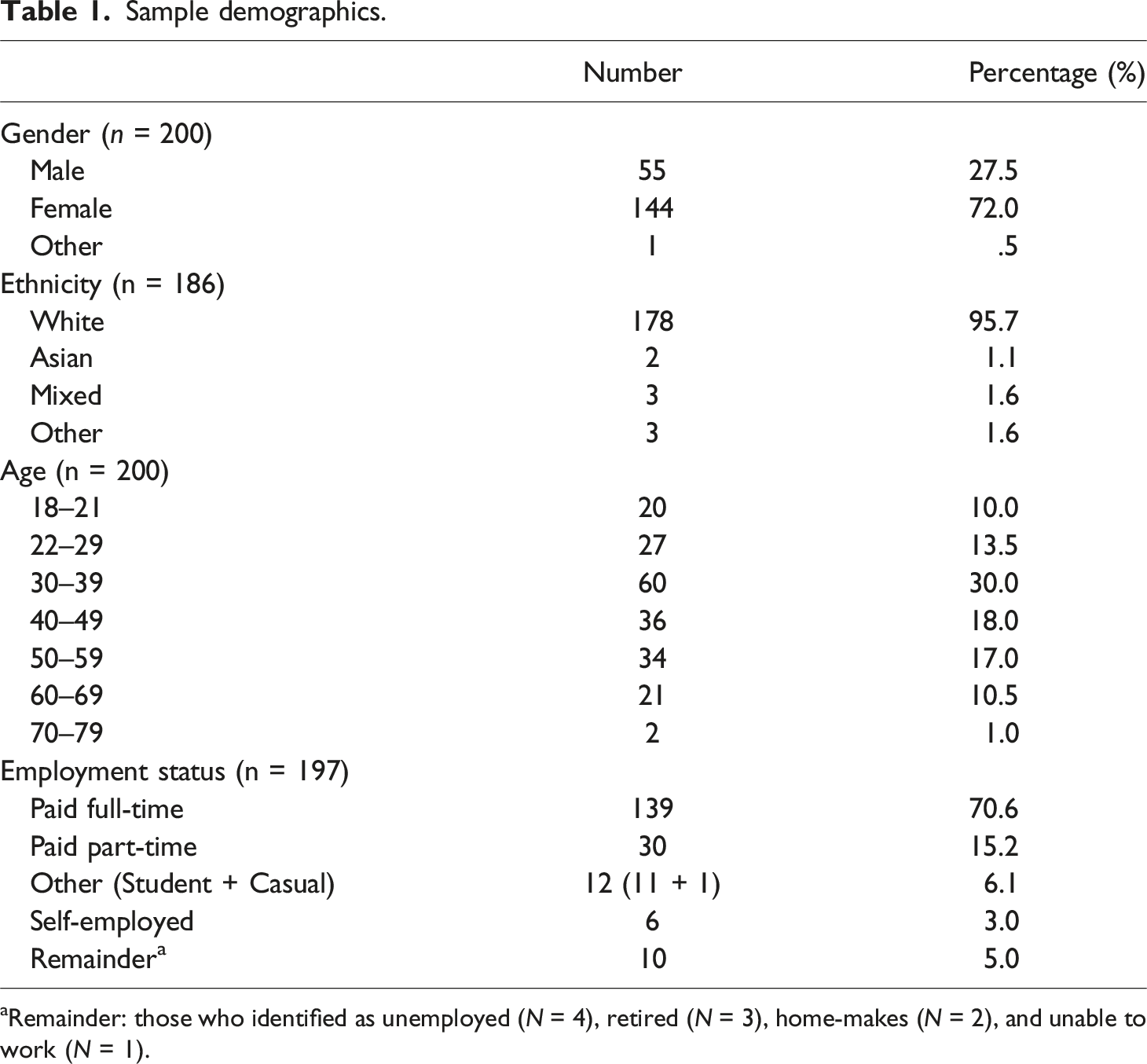
aRemainder: those who identified as unemployed (N = 4), retired (N = 3), home-makes (N = 2), and unable to work (N = 1).
Measures
This study collected primary data via a public, online survey using Qualtrics survey software. The survey was sent out in early November 2020 and was closed in early April 2021, therefore capturing public perceptions during the second and third national lockdowns in the UK as well as the gradual lifting of restrictions via Step 1 of Prime Minister Boris Johnson’s ‘roadmap’. The survey gathered predominately quantitative data using closed questions (i.e. Likert style scales), capturing self-reported perceptions of The Coronavirus (2020) Act, police use of powers such as compliance with restrictions, trust in the police, confidence, and satisfaction in the police. However, some open questions were also included to enable participants to share experiences and views in their own words. Likert style scale items that related to each other in terms of thematic content were tested for internal reliability using Cronbach Alpha and, if found to be above an acceptable measure of reliability (α > 0.0.7), were summed to create total scores for each measure. Therefore, total scores were created to measure: (i) compliance to COVID-19 restrictions and (ii) perceptions of policing during COVID-19 restrictions.
Limitations
This study was exploratory. As such, the sample size in this study was small and all participants were recruited from the one force region within the UK. Whilst this sample approach was purposive in order to specifically get a snapshot of local policing issues within that force area, considering the size of the population, generalisability of these findings is limited. Furthermore, there is a lack of diversity in this sample with a strong skew towards a predominately white sample. This means that key findings and themes may represent this samples’ views without taking into consideration the perceptions of other members of the public, specifically those from an ethnic minority background. Future research should specifically target a more diverse and larger sample to address this issue.
Analysis
The quantitative information extracted from the surveys was entered into a new SPSS dataset for descriptive and inferential statistical analysis. Descriptive analysis and exploration of variables in line with parametric test assumptions was conducted first. T-tests and one-way ANOVA were performed to assess whether differences across variables were statistically significant (p < .05), Spearman’s correlation coefficients were used to examine the relationship between scale variables, and Chi-Square tests were used to examine associations between categorical variables. Only significant results are reported here.
The qualitative (open question responses) were analysed using an inductive thematic analysis approach in accordance with Clarke and Braun’s (2017) guidance. Where responses appeared to contain data that was particularly interesting, relevant, or meaningful to the research topic they were highlighted and then coded. Codes that contained similar data were grouped together to create themes and sub-themes reflecting emerging patterns within the dataset. This process was an iterative one with the emerging themes being repeatedly reviewed and refined. To ensure consistency in coding, two of the authors independently read and coded a random sample of 30% of the qualitative responses. An inter-rater reliability score was computed for this coding sample and found to be 73% which was deemed acceptable for this type of research. Disagreements were resolved through discussion.
Findings
Police contact
Out of 186 respondents, 34 (18.3%) experienced some form of contact with the police during the pandemic, yet only 11 of those were related to the Coronavirus (2020) Act. For most Covid-related police contacts, (n = 7, 60%) the police officer was not in company of Public Health officers. 60% (n = 7) of the participants who experienced a Covid-related police contact said they were satisfied with the way they were treated. However, the contact did not change their opinion on police for most (n = 9, 82%). From the five contacts initiated by the police, the tactics used when engaging with the public ranged from engaging and explaining, to encouraging members of the public to change their behaviour. Although there was one instance of almost enforcement, this was deescalated beforehand.
Compliance
Attitude responses to perceived compliance of COVID-19 restrictions.
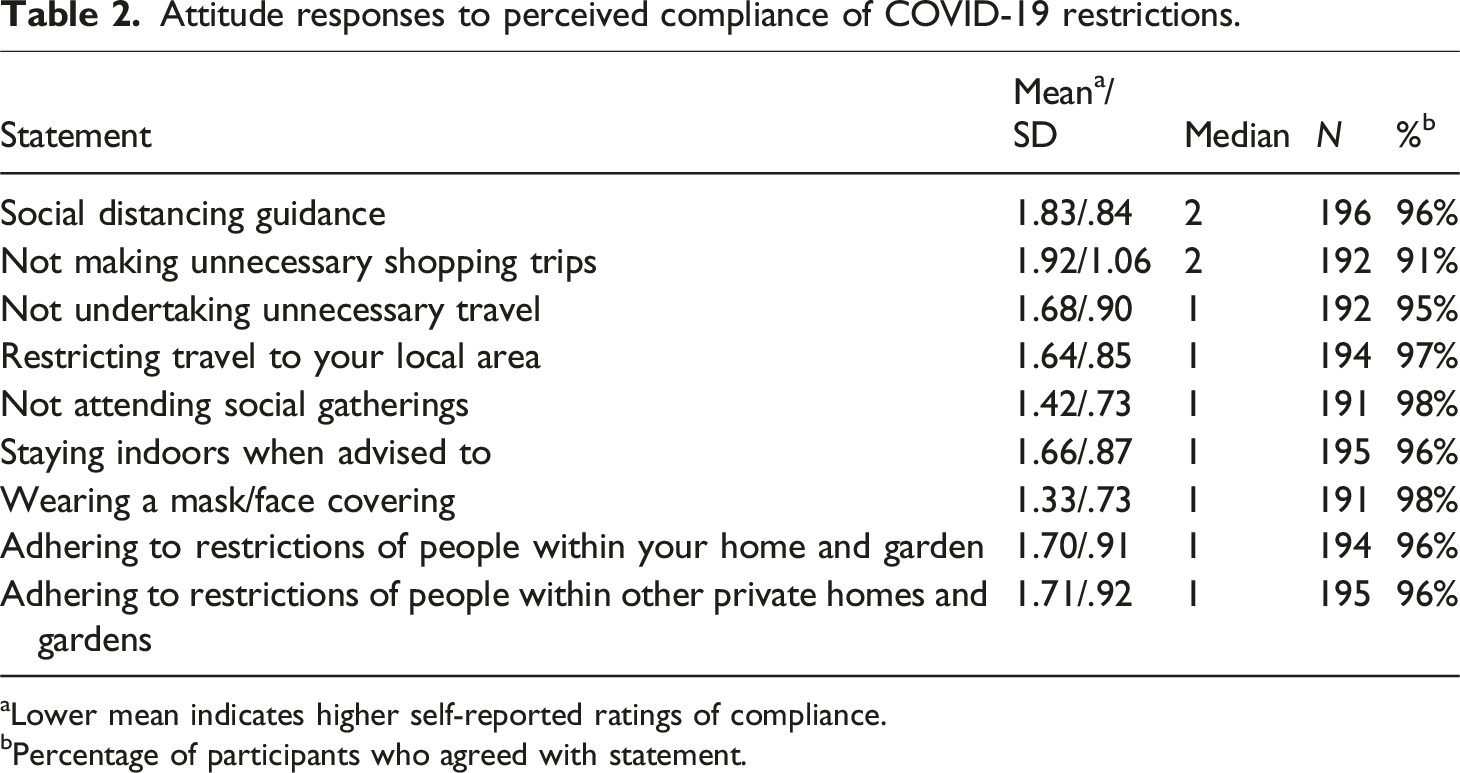
aLower mean indicates higher self-reported ratings of compliance.
bPercentage of participants who agreed with statement.
Exploration of the relationship between age (in years) and compliance ratings indicated a significant negative relationship, r (182) = −0.269, p < .001, as age increased, so did ratings of compliance with COVID-19 restrictions (as lower mean score indicates higher compliance). Correlational analysis demonstrated a significant, negative correlation between trust in local police to be fair and transparent in their enforcement of laws and regulations associated with COVID-19 and compliance, r (172) = −0.260, p < .001. This indicated that as trust rating increased, higher levels of compliance were reported by participants. A one-way ANOVA examined the effect of how trust in police had changed over the pandemic on participants’ ratings of compliance with COVID-19 restrictions. A significant effect was found, F (2, 168) = 3.916, p < .05, which indicated that those who reported a decrease in their trust in police reported significantly lower compliance ratings (M = 16.79, SD = 7.40) than those who stated their trust had remained the same (M = 13.94, SD = 4.39).
Perceptions of policing
Attitude responses to perceptions of policing during COVID-19.
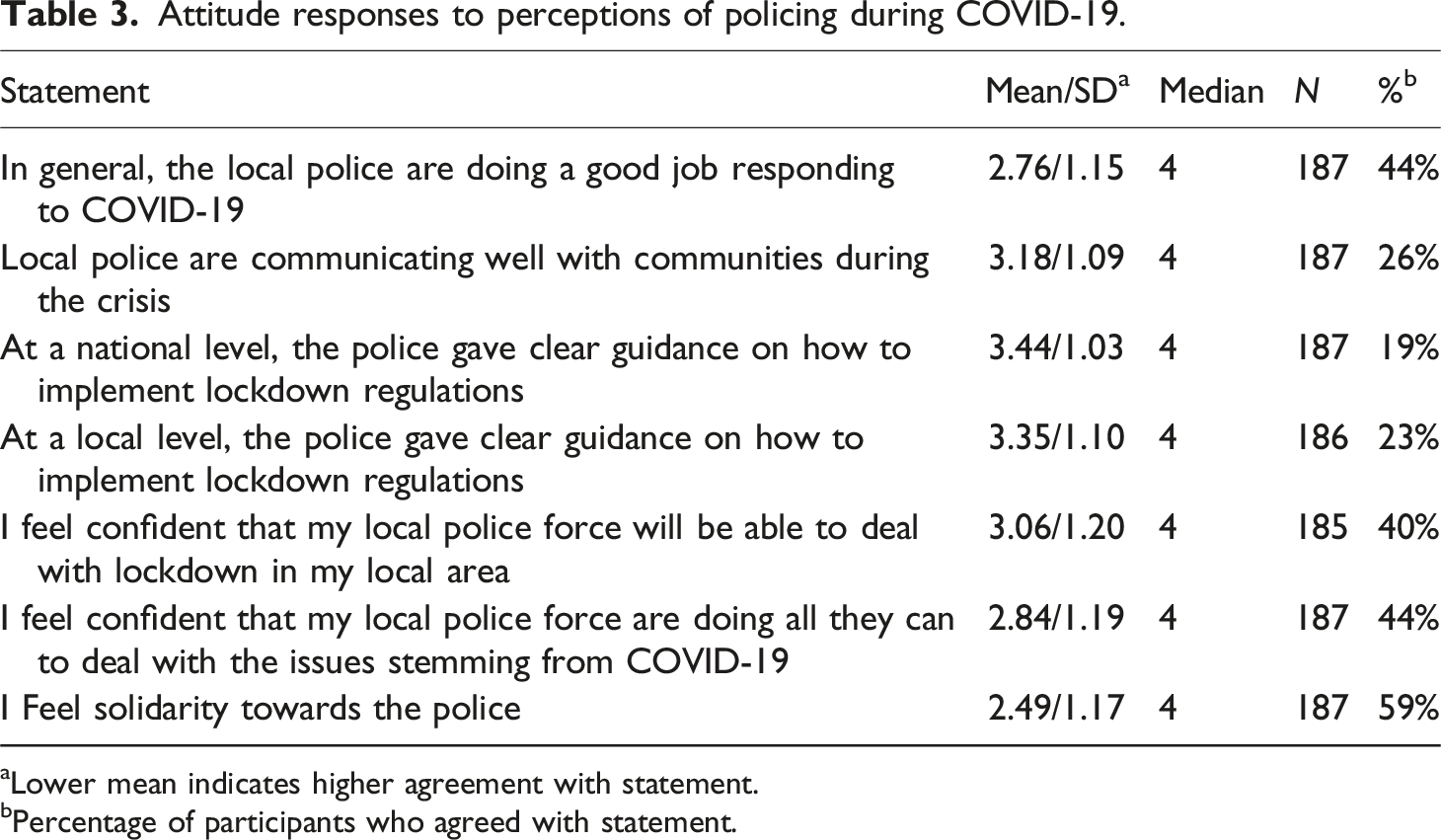
aLower mean indicates higher agreement with statement.
bPercentage of participants who agreed with statement.
Exploration of the relationship between age (in years) and perception of policing indicated a significant negative relationship, r (182) = −0.181, p < .05. This demonstrated that as age increased, so did positive perceptions of policing during COVID-19 restrictions. Correlational analysis examined the relationship between trust in local police to be fair and transparent in their enforcement of laws and regulations associated with COVID-19 and perceptions of policing during COVID-19 restrictions, which indicated a significant, strong, negative correlation, r (182) = −0.744, p < .001. This indicated that as trust rating increased, there were higher levels of positive agreement on perceptions of policing during the pandemic. A one-way ANOVA examined the effect of how trust in police had changed over the pandemic on participants’ perceptions of policing during the pandemic. A significant effect was found, F (2, 178) = 34.074, p < .001. Post hoc tests revealed ratings on perceptions of policing significantly differed across the three police trust categories. This indicated that those that stated their trust in the police had increased were most likely to respond positively to statements about their perceptions of policing during COVID-19 (M = 14.27, SD = 4.82), followed by those that stated their trust had stayed the same (M = 20.0, SD = 5.61), with those stating their trust rating had decreased during the pandemic reporting the highest negative rating of perceptions of policing (M = 27.31, SD = 5.00).
A non-significant effect of viewing clips of police enforcement on perception ratings of police was reported (p > .05). However, when exploring the question ‘Have you seen updates posted by your local police force in relation to their enforcement of COVID-19 restrictions?’, a significant effect was found (one-way ANOVA), t (2, 178) = 3.774, p < .05. Those that had seen local postings from police reported significantly higher (positive) ratings of perceptions of policing (M = 19.48, SD = 7.49) compared to those that had not seen local police force postings that recorded significantly more negative views on policing during the pandemic (M = 22.29/SD = 5.70). Furthermore, when asked ‘Should the police communicate use of powers in relation to Covid-19 on social media?’ those that responded yes (n = 138) were significantly more likely to have more positive perceptions of policing during the pandemic (M = 20.75, SD = 6.35) compared to those that stated no (n = 15), who recorded significantly negative perceptions of police (M = 25.20, SD = 6.06).
Social media
Out of 183 respondents, 132 (72.1%) had seen videos/clips of police enforcement of COVID-19 regulations on social media. About a third of these participants indicated that those videos/clips changed their feelings towards the police (n = 45, 34.1%). From 39 participants who provided additional, qualitative information of the extent and direction in which this change in their perception toward the police occurred, the narratives were predominantly negative. Namely, only four participants expressed positive sentiments towards the police after viewing the content on social media: two individuals indicated that their confidence in the police had increased, one felt like the police were protecting people, and the last commented on how the police maintained impartial to those breaking the rules. 25 individuals (64%), however, argued that seeing the social media content decreased their trust in the police, made them angry, and demonstrated examples of misuse of force. Six individuals provided general comments and four indicated neither a positive nor a negative change toward the police but did highlight an understanding of the complexity of the policing role in these circumstances. For example, as one participant stated: “Some videos have circulated of violent police which I do not agree with. However, I do understand that there is sometimes no other option when faced with an extremely difficult situation created by the public.” (P84)
Regarding the negative accounts, there was some distinction between the media portraying the police negatively (i.e. the content being negative) and the perception of the police themselves as bad. For example, almost a third of the participants who stated that seeing online content about the police changed their views in a negative way (n = 8; 32%) stated that the videos they have seen were shocking, the posts were undesirable, and the clips showed the police in a damaging light, detaching those accounts of the police from the police themselves. Others directly described the experience as affecting their trust in the organisation itself and confidence in their legitimacy: “Police brutality, police appearing untrained and not understanding how to resolve conflicts without extreme violence. I have no faith in the police anymore (P39).”
The most common emerging theme within these narratives was the abuse of power (n = 6; 24%), followed by the perceived harshness toward businesses (n = 3; 12%). Abuse of power was often connected to unnecessary use of force, feelings of disgust, and lack of implementing the laws that gave the police that power in the first place: “Officers clearly abusing their powers and assaulting members of the public. I am disgusted and sickened” (P53).
Decreased trust in the police (n = 3; 12%), as well as inconsistency in treating different protester groups (n = 3; 12%), emerged too. For example, some observed that football fans were being treated more leniently than women protesting violence toward them, or anti-lock-down protesters were treated harsher than those participating in the Black Lives Matter movement. Some participants argued that the police demonstrated using very little listening or empathy skills and handled situations in a disgraceful and unjust way. Three individuals (12%) referred to the over-the-top policing that made it seem like they were living in a police state and felt controlled rather than safe. One participant stated that social media was exposing real problems with the police, yet there was not much the public could do. He felt vulnerable and powerless in challenging the police.
Qualitative views of the local policing of restrictions
From 203 survey participants, 72 (35%) added valid text comments about the local policing of Covid restrictions. Although some accounts could be understood as reflecting the individuals’ dichotomised positive or negative views of the police, many could be perceived as value-free, as a neutral remark or observation. Often themes overlapped (e.g. lack of resources and police officers led to a diminished enforcement of the new rules). As such, they were not mutually exclusive, so the sum of participants in all themes would exceed the total number of entries (n = 72). Three key themes were identified. These included: (i) a lack of resources and support from the government to police the pandemic, which led to (ii) inconsistent visibility and enforcement of the rules, and (iii) a consideration of the appropriateness of the police to enforce public health restrictions.
Lack of resources and governmental support
The participants predominantly saw the government in a negative light (n = 15, 21%), which then affected the police ability to manage and implement guidelines. This was mostly due to unclear and everchanging Covid rules and restrictions that were problematic to understand, apply, and adhere to. In this sample, it was perceived that ‘shambolic government guidelines’ (P98), ‘undermined by noncompliance by public figures’ (P100) led to inconsistent rule enforcement, making it ‘difficult to maintain trust with the community’ (P26). One individual argued that excessive, intimidatory, and often unnecessary enforcement stemmed from police officers’ uncertainty in the rules. This can make them overly aggressive when challenged by the public, ‘even when genuine and done politely’ (P144).
Related to this, 12 survey participants (17%) reflected on the lack of officers to enforce the new rules, lack of resources, and lack of power to have a say in the matter. For example, P20 felt ‘they [police] don’t have enough power and say in anything to enforce laws’ and P92 thought ‘the police are limited in what they can do to tackle Covid related issues due to budget & resource’. Some expressed empathy for the police, stating that the expectations placed on the organisation were unrealistic and unfeasible. For example, P155 thought that policing ‘must have been especially difficult’ because of the local uncertainties, as well as little information coming from the government on how to achieve these new job roles. P26 felt ‘quite sorry for the police’, as they needed to enforce the laws that the public does not completely understand.
Police visibility and rule enforcement
Regarding the perceived presence of the police, there were again some opposing views among the participants. Out of 21 comments (30% of the sample) that mentioned police visibility, only five indicated that they noticed a higher police presence. Yet, even then, some comments were negative with two individuals arguing that increased police presence made them feel uncomfortable, rather than safe, with one stating that it felt like ‘1984’ (P201). In contrast, two participants wanted to see a higher police presence to provide them with reassurance. Among the 16 entries that claimed that there was no increase in police visibility, the accounts varied from supporting the police to being angry. P31 stated ‘It doesn’t happen full stop. I work in a supermarket and the lack of policing is unreal’, while P67 argued that policing the pandemic ‘seems non-existent, barely any visibility’. Visibility was connected to the perceived enforcement of rules. Five accounts specifically mentioned lack of enforcement of the local area travel ban. P85 and P93 believed that more should have been done to stop visitors from areas of higher restrictions to enter their tier two areas. P47 would also like to have seen more police around while commuting, ‘especially due to many people not wearing their masks on the trains which makes me feel uneasy when traveling to work’.
Appropriateness of police authority
Nearly half of the responses to this question could be thematically grouped as questioning the appropriateness of police authority over Covid rules, as well as their ability and legitimacy to enforce them (n = 34, 47%). This was related to the perceived lack of police officers to cope with the increased demand (i.e. being understaffed) (n = 5, ∼15%), lack of money/resources to undertake even their regular duties, let alone the additional Covid-related ones (n = 8, 24%), the requirement to administer unclear, everchanging, and overall confusing rules (n = 13, 38%), as well as the belief that police should not be interfering with individual freedom or use Covid as an excuse to over-police health issues, while under-policing the ‘real’ crime (n = 9, 26%).
As per P162, police were perceived as being understaffed and underfunded, so putting the responsibility to police Covid restrictions in their hands was seen as unfair. This individual argued that money should have been spent on creating a special team dedicated to this issue. P118 thought that the focus of policing should be on ‘real criminal activity’ and another individual believed that Covid was just an excuse to under-police crime (P5). Equally, P83 asserted that there were more important issues for the police to be addressing ‘than trying to look for groups of people to arrest for breaking ridiculous Covid-19 unclear rules and guidance’. Two participants directly linked policing health to erosion of their civil liberties, freedom of speech and movement, indicating that police should not be handling public health issues: “Police should not enforce anything to do with covid, people need to be allowed to live their life and have freedom of movement and speech.” (P106)
When looking at the use of power, 11 survey entries (15%) reflected on this issue. Three out of 11 entries claimed there was no excessive force used whilst the other eight entries thought excessive and unlawful force was at times used, joint with intimidation. When looking at the perception of sanctions, only five individuals commented on the perceived impact of sanctions and three reflected specifically on the Fixed Penalty Notices (fines) that were given to those who broke Covid restrictions. One individual (P98) was concerned that such consequences would impact people differently and disadvantage those from the lower social status, while making no effect on the more affluent members of the society. Another participant argued for a general lack of concern for fines among the public, as they ‘don’t see them as a realistic threat or a possibility’ (P76), which is related to a lack of police visibility. P1 argued that some people ignored the rules because there was ‘very little engagement and advising, let alone enforcement’ from the police. As they were seen as doing very little, if anything, there was no deterrent effect for breaking the rules.
Discussion
This sample demonstrated a high self-rated compliance for all listed COVID-19 measures. Specifically, and in support of previous research, older participants (Bouranta et al., 2015; DeAngelis and Wolf, 2017) and those with high levels of trust in local policing demonstrated higher ratings of compliance, whilst those who indicated that their level of trust in police had decreased since the pandemic had reported lower levels of compliance. This suggests trust in policing to be important to compliance with public health measures and supports previous literature (Mason et al., 2014; Nikolovska et al., 2020; Sheldon, 2021; White and Fradella, 2020) and reflects criminological theories of normative compliance motivations and the positive impact of trust in authority integrity on this (Murphy et al., 2020).
Whilst the majority (59%) of this sample said they felt solidarity with police, the rest of the positive police perception statements had lower than 50% agreement, with the clarity of national police guidelines scoring the lowest. When distinguishing between the local and the national level of policing, the participants in this sample were slightly more in favour of their local police force and believed that they gave clear guidelines on lockdown restrictions. On the contrary, the lowest score was given to the question on the clarity of the guidance relating to the implementation of lockdown regulations given at a national level. This mirrors some aspects of the wider discussion on police legitimacy and procedural justice, whereby good relationships between the local police and the public they serve are much more likely to result in compliance and respect towards the police (e.g. Bottoms and Tankebe, 2012; Walters and Bolger, 2019; White and Fradella, 2020). As such, it could be inferred that the local police have a better rapport with their community than the perception that the public hold of the police more broadly at a national level, which could also explain high levels of solidarity. This further highlights a potential need for repairing trust between the public and national policing messages delivered via His Majesty’s Inspectorate of Constabulary and Fire & Rescue Services (HMICFRS), the College of Policing and senior policing representatives (i.e. Chief Constables) commentating on related issues to the press, rather than local policing efforts.
As with compliance, older participants, and those with high levels of trust in local policing indicated more positive police perceptions, whilst those who indicated that their level of trust in police had decreased since the pandemic had reported lower satisfaction with the police, which again indicates the importance of public relationship with the police. Whilst most of this sample (75%) indicated that they trusted their local police force to be fair and transparent in enforcement of COVID-19 regulations, 25% did not, which could cause concern or demonstrate space for improvement in community trust levels. Even though for the majority (75%), their level of trust had stayed the same during lockdown, for 19% of it has decreased, indicating again a potential need for improvement of or rebuilding trust post-pandemic. This supports the findings of Newiss and Charman (2021) who in examining the public perceptions of enforcing Covid restrictions in one police force in England, found a vast majority of the sample were dissatisfied.
Only 11 participants had experienced police contact that was related to Coronavirus Act 2020 and the majority of these were not in company of Public Health officers. 60% were satisfied with the way they were treated, but 40% were not. The lack of Public Health officer attendance indicates a misunderstanding of the enforcement of these laws. This conclusion is supported by core finding of public distrust in the government handling of the virus and specifically the lack of clear guidance from the government, which was said to impact the ability of police to appropriately police the restrictions. An increased clarity on this may have legitimised any new law, enforcement, or guidelines. A remedy to this issue could have been to create special teams for dealing with COVID-19 rules and regulations, as suggested by one participant: these multi-agency teams could include a public health official, police, local authorities, but the direction should be from a public health perspective. This has been replicated in education, with regular meetings with the council and health officials, who drive the direction of information to the public in regard to restrictions and may have helped with the perception of officers during this time.
132 participants had seen clips of police enforcement of COVID-19 regulations on social media, and 34% said it changed their feelings towards police, with the majority of those qualitatively saying that it decreased their trust in police. This ranged from being disappointed in the videos and believing the clips shone a negative light on the police, to being disgusted and losing trust in the police and their legitimacy. This supports previous literature in that images and videos of police (mis-)conduct that have been shared online can shape the public’s view of policing (Colbran, 2020; Grimmelikhuijsen and Meijer, 2015; Twomey, 2020). The variety of videos people have seen of police brutality were shown here to have an impact on public feelings of trust towards the police. Therefore, the onus is on officers to act with respect, dignity, and fairness in their interactions with the public. The few positive accounts on the impact of social media on perceptions towards the police mostly expressed compassion and sympathy toward the difficult role the police were in, lacking clear guidance. It could be argued that social media posts were mostly understood as a type of a self-fulfilling prophecy, just reiterating what people already thought they knew about the police or deteriorating the already unstable relationships between the community and the police. However, quantitatively, those that had seen local postings by their police force reported significantly higher (positive) ratings of perceptions towards policing which supports broader findings of the role of social media engagement as a tool which can strengthen the public perception of police legitimacy (Cartwright and Shaw, 2020; Grimmelikhuijsen and Meijer, 2015). This suggests scope for further exploration to understand the mechanisms for using social media to increase trust and legitimacy of policing whilst mitigating the negative impact of certain images/videos on these factors.
General qualitative responses suggest that Coronavirus (2020) Act brought a lot of confusion around rule enforcement, unclear guidelines, and a polarising effect among the public. Some stood in solidarity with the police and felt sorry for them. Like the concerns of Twomey (2020) and White and Fradella (2020), others thought the police had no right enforcing those rules, infringing on individual liberties, and being strict with Covid regulations, while losing the focus from real crime. This reflects current discussions regarding the balancing of public health priorities with civil liberties whereby the government have been accused of violating civil and political rights in the handling of the COVID-19 pandemic (Flood et al., 2020; Gostin et al., 2023). A subset of individuals within this group also argued that the police were using their extended powers as a justification to overstep the boundaries that were previously negotiated with the public (e.g. more intense Stop and Search policies). Many directly blamed the government for this lack of clarity, consistency, and communication of the restrictions which supports the findings from Sheldon (2021) and Williams et al. (2020). As suggested by past research, the findings from this study indicate that attitudes towards the police will likely be related to the individuals’ experiences with the broader government and their perception of the efforts involved in handling the pandemic (DeAngelis and Wolf, 2016; Pak et al., 2021). Here, a chronic lack of knowledge of the measures that can be enforced and that the public need to adhere to was observed. Therefore, clarity from the College of Policing and the National Police Chief’s Council regarding new directives to police on how to enforce the laws and the rules tied to it consistently across forces may have supported enforcement of restrictions. This could have been combined with increased community engagement about these measures. Pandemics will happen again in our lifetime, to have these measures in place is preventative and will ensure a public health focus is at the forefront.
Footnotes
Declaration of conflicting interests
The author(s) declared no potential conflicts of interest with respect to the research, authorship, and/or publication of this article.
Funding
The author(s) disclosed receipt of the following financial support for the research, authorship, and/or publication of this article: This work was supported by the British Academy under the Special Research Grants (COVID-19) funding scheme.

Data Availability Statement
Participants of this study did not agree for their data to be shared publicly, so supporting data is not available.