




Abstract
How the police prepare for and engage with a citizen who is deaf and uses British Sign Language (BSL) is a national problem. From the perspective of deaf sign language users, the police remain largely inaccessible and unprepared in how to accommodate their linguistic needs. Four regional forces have responded to this issue by introducing a local solution, a bespoke 101 non-emergency video relay service (101VRS). Independent VRS companies function as the auxiliary service, mediating video calls to a 101 helpline. This service was identified as a simple solution that relied on minimal resourcing and input from the police. In using Pinch and Bijker’s social construction of technology (SCOT) framework, we look at competing interpretations of the 101VRS concept and how this has led to a range of intended and unintended solutions and problems (Pinch TJ and Bijker WE (1984) The social construction of facts and artefacts: or how the sociology of science and the sociology of technology might benefit each other. Social Studies of Science 14(3): 399–441). To maintain the investment in improving access to the police, we recommend harmonization of 101VRS nationally, and ongoing consultation with how front-line services can become better prepared at assisting deaf citizens.
Keywords
Introduction
How the police assist or deal with a deaf sign language user is a national issue, especially for unplanned encounters. Without proper provisions, deaf people remain vulnerable to predatory behaviours, such as hate crime and domestic abuse (British Deaf Association, 2015). This preliminary study examines four UK police forces who introduced a local solution to reform how deaf people access front-line services. These forces contracted an independent video relay service (VRS) to function as an auxiliary service, fielding 101 non-emergency video calls (101VRS) from deaf people onto a force control room (FCR). These VRS platforms have been presented as an opportunity to shift the burden for ensuring the police are accessible away from deaf individuals to the public service.
Through analysis of six semi-structured interviews and two semi-structured focus group interviews, we apply the social construction of technology (SCOT) framework (Pinch and Bijker, 1984) to understand how VRS technologies have been introduced as a solution in some police forces, and how the concept of 101VRS relies on interpreters’ willingness to occupy a broader role to retain its usefulness to deaf citizens. With limited access or provision, the 101VRS platform has to cope with demands from the public and police that sit outside its proposed scope. The findings presented in this article contribute to discussions around the challenges of relying on online interpreting services to resolve widespread exclusion of deaf people, and the unfair burden on others, namely deaf people and interpreters, to make access to policing services possible. The discussions introduce the deaf and interpreter’s perspective to policing diverse communities, of which the deaf community is poorly understood. The findings in this micro-study yield insights for policing that can help inform future policy, practice and research in this field.
The deaf community and policing
This paper is concerned with the British deaf community 1 , more specifically, people who are deaf and use British Sign Language (BSL) as their first and preferred language. According to the British Deaf Association, BSL ‘is the preferred language of over 87,000 Deaf people in the UK for whom English may be a second or third language’ (British Deaf Association, 2018). BSL is a bona fide language with its own vocabulary, grammar, syntax, dialect and sociolinguistic features that is distinct from spoken English (Brennan, 1990). An ambition for many deaf people has been to gain recognition as a linguistic–cultural minority of equal status to others (De Meulder, 2014).
The experiences of deaf citizens in accessing the police is an under researched topic, yet existing studies have unveiled a range of linguistic and interactional issues that undermine deaf people’s opportunities to receive parity of service (Brennan and Brown, 1997; Lumsden and Black, 2017; Skinner, 2020). Primarily, accessing a bilingual officer who is fluent in BSL is rare (British Deaf Association, 2015; Lumsden and Black, 2017; Race and Hogue, 2017). In the UK, there is a network of ‘police link officers of the deaf’ (PLOD) who actively build connections with local deaf communities and function as advisers to their police force on how to treat someone who is deaf (Lumsden and Black, 2017; Race and Hogue, 2017). This initiative has been positively embraced by only a few police forces to date (Race and Hogue, 2017) and is performed voluntarily by individual officers with the support of line managers. The opportunity to interact with an officer in BSL is a preferred outcome; however, accessing a PLOD officer who is fluent in BSL in relation to unplanned events cannot always be guaranteed (Gilbert, 2016).
Because there are so few polices officers who are fluent in BSL, for investigative interviews, the police have a legal obligation to source a BSL/English interpreter, as directed in the Police and Criminal Evidence Act. While in other police–citizen interactions, e.g. victim or witness statements, the police are expected to make reasonable adjustments. In the UK, when the police organise BSL/English interpreters, they are professionals who have completed a recognised training programme and are registered with a regulatory body, which requires them to abide by a code of conduct and engage in regular professional development to maintain their registration status. Interpreters mediate the communication between the police officer and deaf signer by relaying and coordinating the talk. This interactive task is influenced by the interpreter’s level of discursive expertise (Wadensjö, 1998). One emerging solution is to use video-conferencing technologies to provide on-demand access to a pool of BSL/English interpreters. These services are the equivalent to remote telephone interpreting services, thus bringing deaf signers’ opportunities in line with other spoken linguistic communities.
Online interpreting services in the UK
In the UK, private companies who provide online video interpreting services usually offer two configurations: video relay service (VRS) and video remote interpreting (VRI). Each configuration contains specific considerations that impact the success of remote communication (Napier, 2012; Napier et al., 2018; Skinner, 2020). These online platforms are able to increase the interpreter’s productivity by making them available to different users in one day. The VRS configuration (Figure 1) generally refers to making telephone communication possible and is a hybrid service combining telephone-based and video-based interpreting services (Skinner et al., 2018) 2 . A remote interpreter relays calls between someone using a video-link and someone using a telephone-link. There are interactive challenges with how an interpreter, the police participant and citizen collectively handle and negotiate communications across two types of media (Skinner, 2020). Using internet-enabled devices (e.g. a smartphone), the deaf person contacts the VRS provider who then relays the call onto an FCR. Currently, six police forces across the UK provide a patchwork for deaf citizens to initiate non-emergency contact via a 101 non-emergency VRS platform (101VRS). Alongside the VRS option is a nationwide SMS service 3 or a nationwide text-relay service 4 . These text-based services are only usable if the deaf citizen is comfortable with using written English (see Turner et al., 2017 for further background).
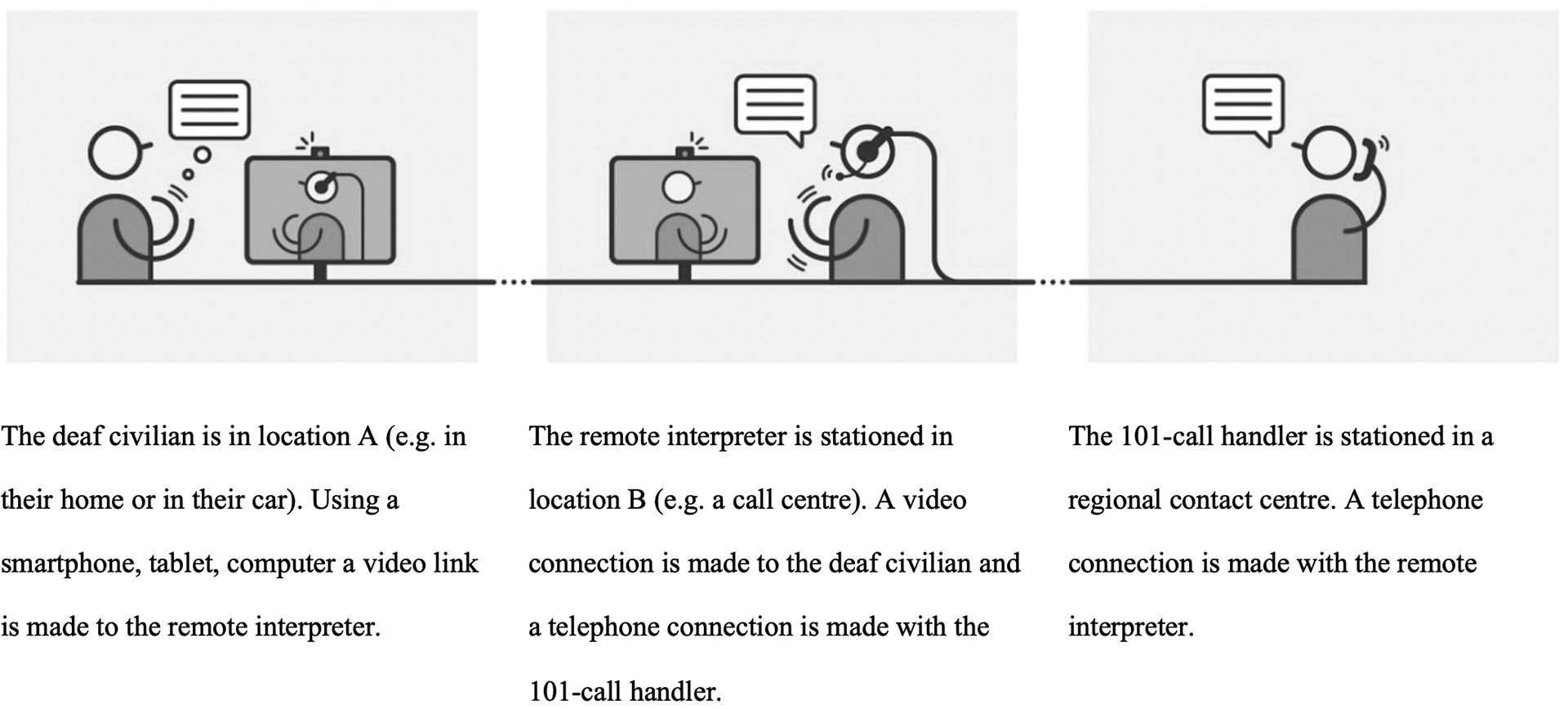
Typical 101VRS non-emergency call.
Alternatively, VRI (Figure 2) can be used to cover different encounters where a police officer may (unexpectedly) come into face-to-face contact with a deaf citizen (Skinner, 2020). VRI could facilitate police–citizen interactions inside or outside the police station. The VRI configuration is not currently made available across UK front-line policing.
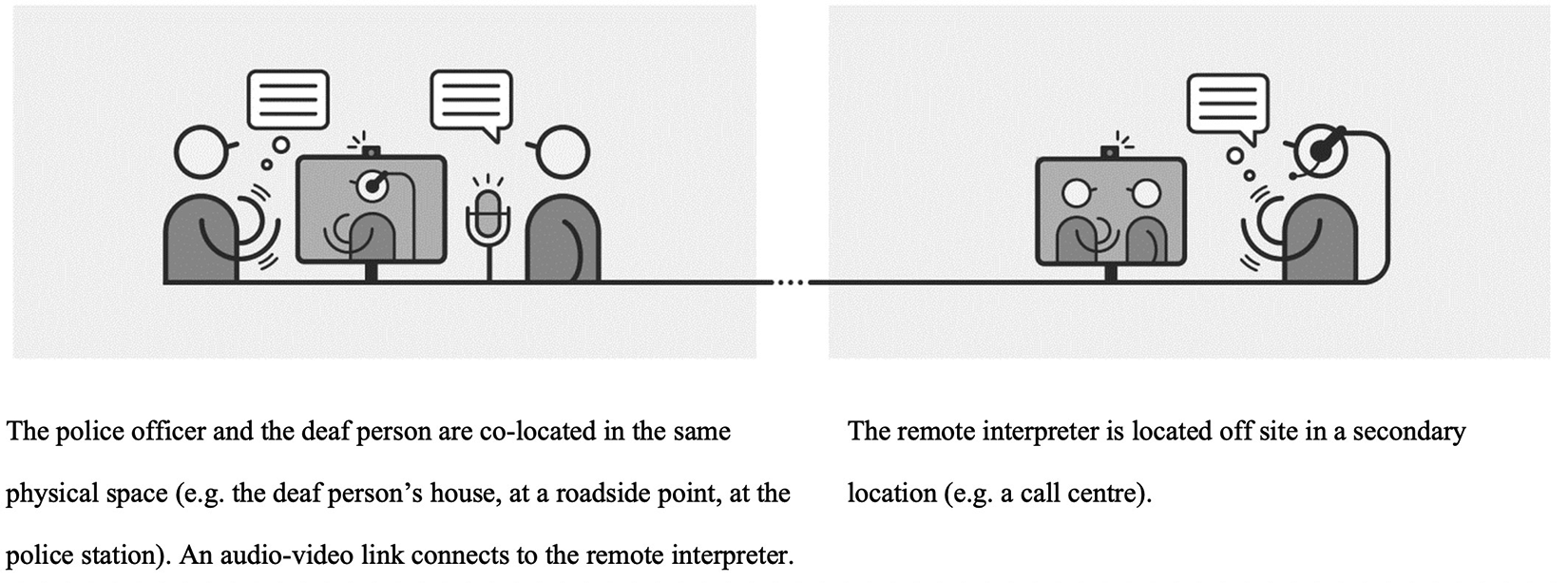
Video remote interpreting (VRI).
We sought to understand how the concept of 101VRS among four police forces was reached, and describe the challenges in delivering this small-scale solution. This article briefly explains the features of the SCOT framework, and how is has been applied to critique the development of remote video interpreting services across European jurisdictions (Braun et al., 2018). We conclude by discussing how the SCOT framework can be used to evaluate the collective input in creating a locally based solution to overcome broader issues in delivering access to deaf BSL users.
Social Construction of Technology (SCOT)
When technology is introduced, there is a social process of communicating and disseminating its purpose and function from decision-makers and commissioners to those who are expected to work with or use the technology. The socio-political process that follows can manifest in resistance to failure or acceptance and broader usage. The SCOT framework was developed by Pinch and Bijker (1984) to respond to how investigators problematise and investigate these social processes in technological innovation. The SCOT framework has four components: technical frame, interpretive flexibility, stabilisation and closure (Table 1) (Prell, 2009).
SCOT concepts.
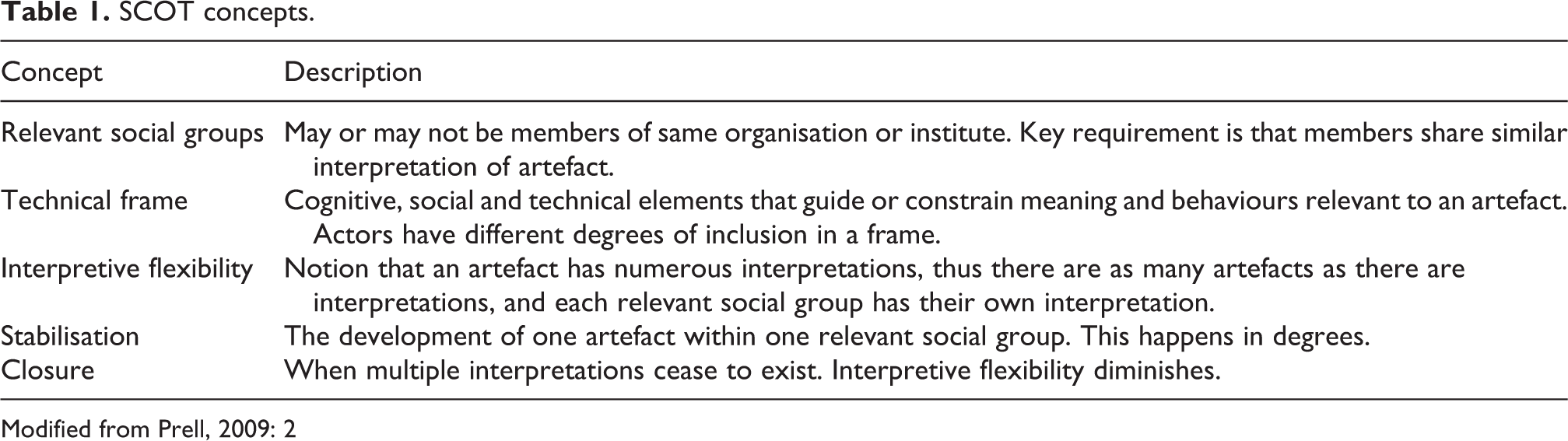
Modified from Prell, 2009: 2
The technical frame seeks to explain the narrative that emerges when a technical artefact is introduced. The drivers that push or pull different relevant social groups (RSGs) towards or away from a technological solution illustrate the interpretive design flexibility that surrounds a technical concept. A central feature of the SCOT is stabilisation, where the technical solution has obtained a level of consensus among RSGs, including a shared understanding of its use and limits (Pinch and Bijker, 1984). The outcome from stabilisation is the progression to closure, where RSGs ‘involved in designing and using technology decide that a problem is solved’ (Pinch and Bijker, 1984: 6).
The social construction of video-conferencing technologies in legal settings
Braun et al. (2018) applied the SCOT framework to critique the development of video-conferencing facilities 5 for spoken language interpreting across police stations, prisons and courtrooms in the European Union (EU). Braun et al. noted the widespread exclusion of interpreters from the procurement and instalment process, whereby interpreters were not properly recognised, or they had not been able ‘to develop successful “micro-political power strategies”, to engage with the institutional stakeholders who make procurement decisions’ (Braun et al., 2018: 16). This lack of involvement flouted the interpretive design flexibility principle of the SCOT framework. Interpreters were placed in what Braun et al. (2018) described as ‘inconsistent’ and ‘unpredictable’ working conditions. These factors can negatively impact the interpreter’s ability to provide remote support and facilitate communication in the legal system.
Unlike Braun et al.’s (2018) findings, VRS and VRI platforms have been developed specifically for spoken–signed language interpreter-mediated communication. These technical solutions are often introduced with conditions of use and subsequently become objects of politics (Alley, 2019; Brunson, 2011; Haualand, 2014; Napier et al., 2017; Skinner et al., 2018). For example, in the USA, VRS is free at the point of use for both public and private interaction. US legislative measures recognise the deaf person’s right to access telephone networks in a functionally equivalent way to non-deaf citizens. This resulted in a federally funded 24/7 nationwide service, so a deaf citizen can independently contact any regional or national police helpline or a named police contact at a time of their own choosing. To prepare for this demand, a substantial pool of interpreters must be ready to field VRS calls. To regulate this online platform the interpreter’s professional autonomy has been restricted, reducing the possibility for a co-constructed approach to the communication (Alley, 2019; Brunson, 2011, 2018). Interpreters experience reduced agency in how they are allocated work and coordinate bilingual interactions. Critically, the US approach does not encourage a formal relationship with how VRS platforms are used as a partnership service to provide access to front-line police services. The 101VRS model being developed in the UK is substantially different, and there is regular communication between a regional force and their nominated VRS provider. Although this network of actors is small scale, how this closed group define and resolve access to front-line police services for deaf BSL citizens is of interest to this study. It is necessary to question how a sociotechnical system (the technology, the way the technology is intended to be used, and the people who use the technology) collectively reduce or increase exclusion. This is because ‘[a]ccessibility cannot be sustained by a narrow focus on single technologies. All technologies are embedded within a network of human and non-human constructions that mediate agency to and from the human actors that use them’ (Haualand, 2014: 288).
This study applies the SCOT framework by describing the roll-out of VRS/VRI services for deaf BSL users by four police forces, and the competing needs and interpretations that surround this technical solution to reform deaf signers’ access to essential police services. Drawing on the SCOT framework, this study was designed with the following aims in mind: To understand the agreement reached to only provide 101VRS and not VRI for police contact and the intended purpose of the provision (the technical frame). To examine how a local 101VRS solution copes with wider issues around how deaf people access the police (interpretive flexibility). To explain how the benefits of 101VRS were managed to cope with competing interpretations to maintain its legitimacy (stability).
This study focuses on the early stages of introducing VRS across four regional police forces and how technology was viewed as a solution to improve access to specific front-line services. The findings for points 1–3 above illustrate concerns interpreters have when introducing VRS/VRI platforms into police settings and how the burden for ensuring access to the police is still unevenly distributed. We conclude with recommendations for adaptations needed to progress to the stage of closure (according to the SCOT framework; see Table 1).
Research design and method
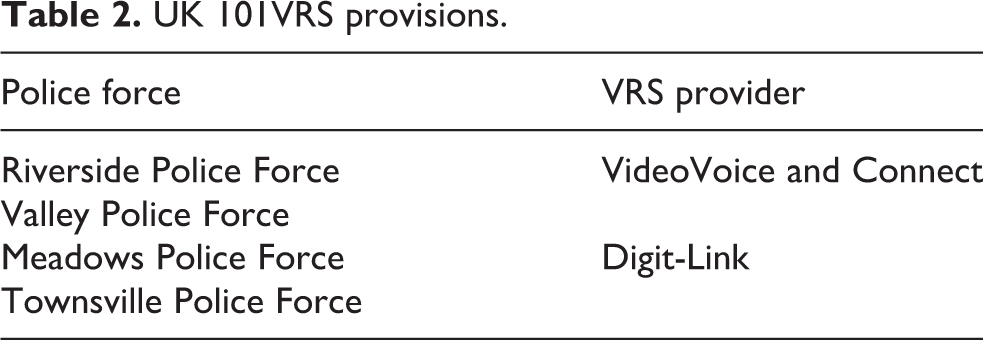
The three relevant social groups in this study were the police, deaf citizens and VRS providers. At the time of data collection, 101VRS across the four police forces were relatively new 6 . Three VRS providers held the contract to field calls from deaf citizens to the police. Two of the VRS providers worked in partnership to deliver a single VRS platform across two police forces. The third VRS provider supplied a separate VRS platform across the remaining two forces. For confidentiality reasons, pseudonyms have been allocated to individuals and organisations (see Tables 2 and 3).
UK 101VRS provisions.
List of participants and data collection method.
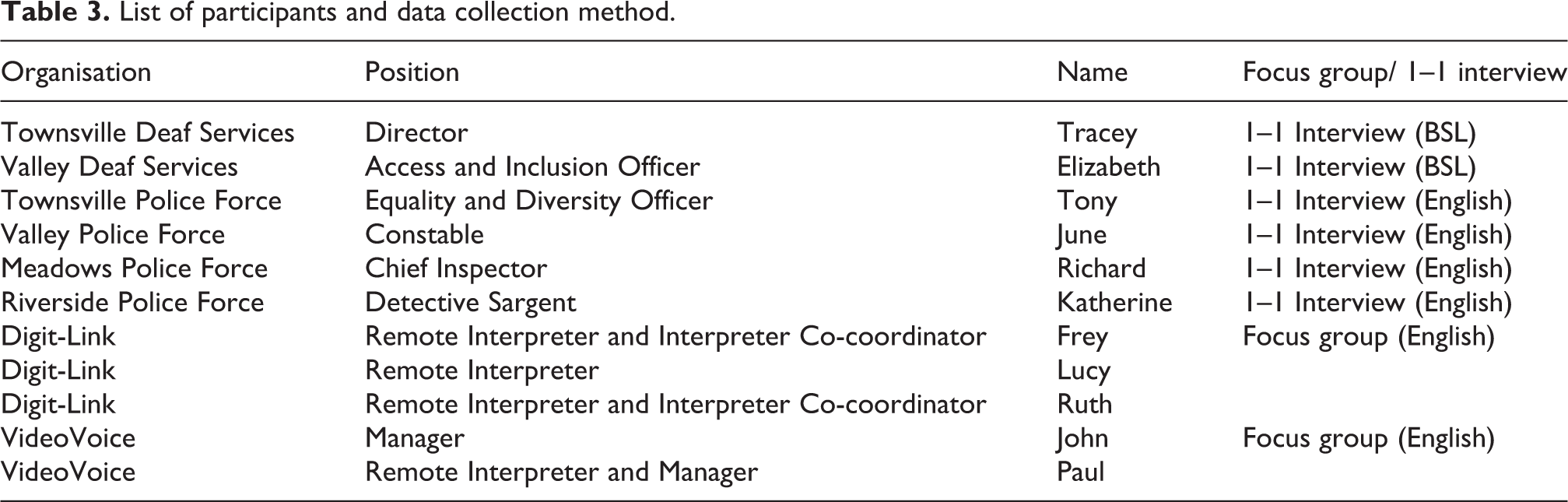
All four police forces and three VRS providers were purposively sampled (Silverman, 2017) and invited to participate in this study. Four officers, whose remit was to introduce the 101VRS platform, consented to be interviewed. Two of the three VRS providers agreed to participate in this study. The absent VRS provider was one-half of the partnership mentioned above. The willing participants from the two VRS companies were interpreters with call centre experience or were of senior rank.
Incorporating the deaf BSL user perspective was problematic, particularly recruiting those with 101VRS experience. All four 101VRS services were new and, according to all four police respondents, uptake was low. Two well-known deaf-led organisations were approached; both were identified by police informants as having a high level of experience in assisting their local deaf residents on policing matters and in using the 101VRS platform. The two representatives were both deaf and could report on their outreach work with local deaf people on policing matters.
It was agreed not to approach police call-handlers themselves as difficulties existed with identifying those who had actual 101VRS call experience.
The participants were interviewed about their perceptions of 101VRS and their experience in using the technology. Interviews were conducted either in English or BSL, and the interviewee determined the language choice. The interview data was either translated from BSL into written English or transcribed from spoken English to written English by the lead author. Using NVivo, a thematic analysis (Saldaña, 2015) was carried out to classify different narratives driving the exploration of VRS/VRI platforms. The four themes from the SCOT framework were used as a priori headings to structure the analysis. Ethical approval was received from the Heriot-Watt University School of Management and Languages Ethics Review Committee.
Results
The presentation of results focuses first on the technical frame: why 101VRS and not a broader solution that included VRI? The discussion moves on to the actual experiences in using the 101VRS platform. This includes the interpreters’ experience, those who held the most experience in fielding 101VRS calls. The comments made by the interpreters illustrate how their ability to stay only in a mediator role becomes challenged because of conflicting understanding of the platform from the others. Finally, the citizen perspective, retold through two representatives from separate deaf-led organisations is discussed.
Commissioning the VRS/VRI technology (technical frame and interpretative flexibility)
Here, we focus on the police perspective, the organisation commissioning the service, and how a technological solution was defined to resolve local issues. The combined VRS/VRI technologies held the potential to revolutionise how the police interact with citizens who use BSL. The technical solutions could have included 999 VRS, VRI in custody, VRI at police stations or equipping officers with a smartphone and app to initiate VRS/VRI calls. These options were being offered by comparable telephone spoken language interpreting contractors. Understanding the complete range of technical solutions is relevant to this study, because it can explain where compromises were made by key people to secure some form of access to the police. These compromises explain why the burden rests on others, i.e. the interpreters and deaf signers, to ensure access to specific police services.
All police respondents explained how their research into providing VRS/VRI access to the local deaf community relied on guidance from VRS providers and local deaf organisations. One police officer explained the importance of implementing changes locally. …you can’t even email particularly, there are no – there are no publicised channels for emailing a request for Meadows Police Service…or…erm. any sort of live chat online or anything like that. At the moment, the only way you can contact Meadows Police Force if you are asking for services is via the telephone which the vast majority of people use or face to face at an enquiry counter. But the telephone is very little use to someone who is a sign language user. And even if they come into the front counter, most of our counter staff are not sign language trained so – erm what we found is that their only real alternative were to contact a speaking sign language friend or colleague who would then phone on their behalf, which is a solution but not ideal. Or if they come into the front desk they would have to wait until we can get a sign language interpreter to turn out and interpret for them. But that could take hours and quite expensive. (Richard, Meadows Police Force)
Each of the officers explained how they held limited powers, where changes to the helpline services were restricted to 101 non-emergency calls only. The 101 service is treated as a devolved matter organised by regional forces, whereas the 999 emergency services is managed on a national level. Local initiatives, such as a local 999 VRS service, were not permitted as this would deviate from national protocols. The VRS option stood out as being low-cost and technically simple solution. We’ve put a link on our website, fairly simple and standard thing to do. There’s a video on our website that explains, that – e – using BSL what the service does. So for someone who has never heard of it that’s – that’s there so it explains to them via BSL and gives them the opportunity of placing a call to Digit-Link but it doesn’t change our business processes at all, which is one of the attractions of the service, and meant it was relatively quick and easy to implement. (Richard, Meadows Police Force).
VRS/VRI was also described as a complement to, not a replacement for, on-site interpreting. For interpreters at Digit-Link, their concerns are grouped into three broad areas: the potential for overuse of VRS/VRI, the unreliability of technology (e.g. home visits relying on 4G or WIFI connectivity), and difficulties in remote communication (e.g. citizens ensuring they are visible on screen). Each of these was viewed as causes that could undermine their ability to deliver over-the-phone access to front-line police services. I am happy taking a broad range of calls here because I know they’re not that (serious or part of a criminal investigation). Now I see police interpreting as a specific discrete domain where you would need training and you would ideally need to do it quite frequently to be practiced and er I don’t do it very often and like Lucy there are some things where I would be happy to do. I’m quite happy doing petty crime things, things like that. I find it an interesting area however there are other things which I find very harrowing, and that would be a big concern for me. That we won’t be in a position to decline something. For example, you know – you know – I interpreted something very recently…you know a minor scuffle in a pub. That was fine. I could choose that content, I could cope with that content, I think I’m the right interpreter for that job. Whereas there have been other things, a sexual nature and certainly I would not want to do er…that is another reason for me wanting to decline a call. (Ruth, Digit-Link) …when we had the interpreter consultation event a lot of people were immediately going ‘no no to video interpreting’ and when you start to say ‘hold on a wee minute, you’re numbers are really low, your capacity you know for some of your is at your max, some of you won’t do police work, you know like leaving custody or giving somebody an update that’s perfect example of when we can use it?’ And some people started ‘oh right!’ And I think the big concern is that we’re going to replace face-to-face and that it will all become online and statements or interviews. And I think they’re the two I’d be most concerned about using video. But again I think we’d have to consider case by case basis. So for example if I was literally taking a statement from you and we had a really good connection, the signal was no problem, you know the interpreter is comfortable they can clearly see your signing and they could clearly see your signing, and it was really a one page statement about ‘I went to bed at this time and I got in the morning and my car had been stolen’. You know, it literally was as simple as that. Then I think we would need to consider, ‘do we need to wait several days for an interpreter to get that statement?’. (June, Valley Police Force)
The 101VRS concept – (interpretive flexibility)
Here, we focus on how 101VRS was realised by those who are expected to use or provide the front-line service by drawing on the interpreter’s reports of experienced in negotiating on-demand requests for their service. The interpreters who work remotely do not work exclusively with the police. These interpreters will field calls from individuals to businesses, public services (e.g. local GP service) or commercial helplines (e.g. utility companies, banks).
Freya and the team at Digit-Link explained how they had interpreted a range of 101VRS calls to police that included domestic violence, hate crime, regular calls to a named officer, and requests to contact another UK police force. The interpreters were versed with fielding calls on-demand, yet all commented on the challenges with police-related calls, which tended to be regarding another person’s vulnerability and immediate need. What was interesting from their account was how calls to the platform did not always align to the intended 101 non-emergency parameters of use. The interpreters at both Digit-Link and VideoVoice explained how they had no control over why and when a deaf citizen would use the service. When asked how they would accommodate on-demand requests that went beyond the 101VRS remit, the interpreters stated they would try to show flexibility and continue with the call as usual. The interpreters explained how the demand to use the VRS platform for more than non-emergency contact came not only came from citizens, but also from police officers. For example, officers had arranged in advance with Digit-Link to assist with a home visit concerning a recent incident. All he wanted was a description of what was inside the van, if I can remember rightly. The description of what was in the van and what time he felt someone broke into. And – and I know this guy he’s always ringing in over time I’m on shift. It’s not someone I don’t know very well. I know him, I know his communication. I said ‘I’ll do it. If it’s something a bit more in depth, or if they need you to go back to the police station, you need to book a face-to-face interpreter’. (Lucy, Digit-Link) I was saying ‘they want to take a statement and I’m not comfortable with taking a statement’, because the signal wasn’t that fantastic either. He (the deaf citizen) was ringing from…I think he was on his phone, on his knee, in the lounge. He was moving around. I thought ‘I’m not doing – I’m not doing a statement like that…’ basically said that ‘he got his phone on his knee, he’s wobbling around, the Wi-Fi is not very good. I can’t 100% tell you if I’m getting the full information. I’m not happy that I can give you full information so I’m not going to do a statement over the phone.’ And I just said to them ‘I need to clarify if that what this system is used for? Because I don’t think I know if it’s for taking full statements or not?’. (Lucy, Digit-Link)) I think we also knew it was fairly a sensitive, emotive conversation as well and we went ‘Hmmm I don’t know that a 2D interpreter is gonna be the best…fit for that situation and best for the client who is making that report’. (Freya [in response to Lucy’s previous comment], Digit-Link)
The issues in handling calls that strayed from the 101VRS remit meant the interpreters were placed in a position beyond their agreed scope of service. Where possible their response would be to maintain a level of ‘temporary stability’, enabling the call to proceed as usual. …the technology is there and there is no other option. People feel forced into having to use it to secure certain outcomes or to meet certain outcomes to make sure people are safe. Which is the reality, which primarily you might not want to do online and then you realise the person is safe, we’re covered all that we can. Now I am going to step away from this because [they] do need a face-to-face interpreter. (Paul, VideoVoice). I still work on the principle, if somebody is in absolutely grave danger and their life is in jeopardy then I’ll do my best to get them moved into a place or situation of safety where they can be dealt with in a more appropriate way. So I will do that initial reports get as much information handed over, even if it’s quite grim, and then make sure the people who are sorting it out have the information, the facilities to support them appropriately. (Ruth, Digit-Link)
Managing the VRS interaction – interpreters
We found that technology relies on certain actors to assume a broader role to enable its success, which gives the appearance of technical stability. Our participants described how adaptations were often to compensate for the police’s lack of knowledge or preparedness on who should assist a deaf signer and how to manage interactions via an interpreter.
With spoken language interpreting provisions, the police officer or call-handler would instigate the conference call. The opposite occurs with the 101VRS services, the responsibility for introducing the service shifts to the interpreter. This pathway in making the non-emergency call benefits the citizen, whose first point of contact is with another who shares their language. This also creates an epistemic asymmetry between the interpreter and call-handler (Skinner, 2020). As such, the interpreters find expedient ways of verbally conveying the VRS configuration to the call-handler. Katherine (Riverside Police Force), who had played an instrumental role in introducing the 101VRS concept to her police force, had introduced a system in which the call-handler would receive a pop-up notification on their computer, alerting the call-handler to the interpreted nature of the call. Supplementing this, she worked with the VRS provider to educate police call-handlers on how to best respond to 101VRS calls. The training generally touched on understanding the difference between English and BSL, how to work with an interpreter, or how a male caller might be using a female interpreter to make contact (or vice versa). The training sought to promote the success of the limited 101VRS concept. The training offered to call-handlers was not reciprocal for interpreters. The interpreters interviewed did not report receiving any training to understand 101 or 999 call-handling procedures.
Despite the interpreters not being offered formal training, June (Valley Police Force) and Freya (Digit-Link) in their respective interviews picked up on the importance of rapport and intonation to guide the call-handler in making their assessment of the civilian’s needs. This is because during a VRS call the police officer and civilian have no direct audio or video input. Both the citizen and call-handler rely on the interpreter to pay attention to intonation or rapport and convey. …the hearing person I think probably don’t feel like they’re talking directly to the deaf person, because they can’t see them and they can’t hear them. Whereas if they’re in the same place they can see them waving their hands, and right ‘right they’re talking to me, okay – but I’m getting the interpreter’s voice – right got it’. If they’re going through the phone it must be more…odd. You say, ‘you’re talking directly to the deaf person’, but they know, ‘well, I can’t see them, and I can’t hear them’. I don’t know how much you get some of that rapport between those two. (Freya, Digit-Link) […] the interpreter is the person who doing this more frequent than the service centre operator. You could phone 101 just now and get me working as a day shift and you could phone two minutes later and get somebody in another service centre in Edinburgh. You could phone two minutes later and get – and the chances of you getting the same service operator twice are very slim – unless you’re a really frequent caller to the police and then you’ll eventually start getting the same person. So you know, the interpreters the common denominator. And I would be really comfortable and happy if an interpreter guided or instructed the service centre operator to make sure that they were dealing with it in the best way possible. We shouldn’t have to do that, but we can’t expect our service centre operators to be experts on everything. So therefore, I think it’s important that the people who are living it day in and day out interpreting calls are the ones who have the specialist knowledge I suppose. (June, Valley Police Force)
The citizen perspective
Two deaf people working within deaf-led organisations provided insights into the experiences of deaf citizens who are expected to learn and understand how bespoke 101VRS auxiliary services operate and how to use more than one VRS platform. They also made suggestions for improvements. They explained that deaf people view the platforms as inadequate and cumbersome to use. How the technology is received or rejected by deaf citizens equally determines the likelihood of progressing to the closure stage.
The patchwork of 101VRS was a concern for Tracey (Townsville Deaf Services) and Elizabeth (Valley Deaf Services). From their perspective, this made it harder to raise awareness and generate support among deaf citizens for the 101VRS platform. Both Tracey and Elizabeth commented on their experience, through their outreach work, that although deaf citizens are capable of using mainstream smartphones and apps and need such a service, they were unaware of its availability or struggled with the technology.
Tracy and Elizabeth’s critique was related to the interoperability between apps, including software provided by VRS companies. A deaf person has to download two types of apps or plug-ins 7 , and learn the technical differences and procedures between VRS providers before contacting one of the four UK police forces. Thus, there are clear inequalities and differences in deaf signers’ experiences, where the level of responsibility to achieve access was incumbent upon them. This suggests a lack of joined up national provisions and interoperability between VRS providers, potentially undermining local efforts to establish good practice.
Finally, the inability of deaf citizens to directly connect with the police, instead of depending on an interpreter, was a factor that led Elizabeth to explain why she was reluctant to use this platform. I prefer having face-to-face provisions because I can see everything. The interpreter working and the police officer (standing next to the interpreter). I can pick up on communication issues and be more involved in the interaction. I can make observations about the officer’s mood and demeanour. With a video call all I see is the interpreter nothing else. Is the officer being friendly, irritated or whatever? The interpreter can decide whether that information is conveyed to me. For me that’s not right. I want to make those judgements. (Elizabeth, Valley Deaf Services)
Limitations of the study
Before we conclude, it is necessary to acknowledge the limitations of the study. Although there are advantages to combining data from interviews and focus groups, it should be recognized that they do yield slightly different types of data (Silverman, 2017). Furthermore, the study did not include call-handlers who had managed 101VRS calls, and the sample size of interpreters and deaf citizens who had used the 101VRS service was small. This study can only be considered as an initial scoping study and cannot be generalized more broadly. To fully understand the success or challenges in using these online platforms it is recommended that further research engage with deaf citizens. Understanding the experiences of deaf signers can provide important insights into how the police remain relevant and open to vulnerable groups that are less visible or harder to reach, including other language minorities and disabled people. Given, however, that only four UK police forces had commissioned 101VRS, the model being developed within this closed group of actors represents a novel and collaborative approach that has not been reported previously.
Conclusions
In the UK, only a small number of police forces have sought to resolve how deaf people access front-line services by exploring the concept of 101VRS. These forces were owning the problem and working with different groups to deliver a local and solution. In applying Pinch and Bijker‘s (1984) SCOT framework, we sought to understand how this specific technology was defined by different social groups and utilised by different actors to resolve the way deaf people access police services. Through this process, competing interpretations of a technical artefact explain why ongoing struggles may exist. Our intention has been to understand the source and cost of these competing interpretations and efforts to sustain meaningful access to police services. These findings offer practical value in determining the future direction of the VRS platform, and the untested VRI platform, in front-line police settings.
The introduction of 101VRS was in its early stages of development. Financial and administrative limitations were the main reasons for opting for a 101VRS service. The scale of resourcing and financing with introducing VRI facilities was too great to proceed. Efforts to introduce a 999 VRS was not permitted as changes had to be led from a national level. From the police perspective, they were entering an agreement with an independent VRS provider to function as a specialist auxiliary service. This was seen as an achievable local solution, one that offered a form of on-demand contact as opposed to nothing.
The process of reaching stabilisation and closure relies on an agreed understanding of the 101VRS platform, which was repeatedly challenged by widespread issues around how deaf people access the police. The actual potential of the 101VRS platform depended upon the assumption that deaf people can engage with other police services in the usual way. With only one limited portal available to deaf citizens, the 101VRS platform became a gateway for general access to the police, for non-emergency matters, emergency matters and taking of statements. The interpreters who participated in these calls were compelled to occupy a broader role, one that involved a gatekeeper and partnership role in making the platform temporarily stable and the police services accessible. For interpreters, there was an uneasy willingness in accepting this expanded duty. This was because dealing with police-related VRS calls can become complex and challenging to manage. The addition of technology, which can be unreliable, increases this overall complexity.
We found interpreters welcomed the concept of 101VRS to spontaneously serve deaf citizens as a first point of contact, but not as a means to replace on-site interpreting provision. This concern was acknowledged by the police respondents; however, in their view how to determine when on-site interpreting is the right response has yet to be defined. The taking of statements or interviews was thought to vary in terms of sensitivity and complexity. Officers viewed the platform as a vital resource to enable the police to evaluate someone’s vulnerability and how best to allocate policing resources. Further research is needed to determine how interpreters support front-line services to conduct their assessments. The VRS/VRI concept is dependent upon the front-line police services and interpreters being able to work together, via technology, to understand a deaf citizen’s needs and current level of risks.
Although the platform seeks to emulate 101 telephone provision, the responsibility for learning and understanding technology is not the same. The deaf citizen has to assume greater responsibility for learning the different VRS platforms, the VRS opening hours, the police force’s jurisdiction as well as locating a designated web page. Further technical developments, led by the VRS providers, are needed to remove this unfair burden on those who may already be vulnerable or victims of a crime.
Achieving access to the police via technology has involved a process of recognising the need of deaf citizens against the limits, such as cost of equipment and capabilities of interpreters to handle the range of calls from the public and police. It is our view that the 101VRS concept will remain vulnerable until other avenues are introduced that offer a variety of on-demand provisions. Any future expansion or review should include other possibilities, such as the PLOD scheme or other forms of direct contact e.g. deaf staff appointed by the police to directly field 999/101 calls. Paying equal attention to other options may improve how the police are viewed by deaf BSL users.
Footnotes
Declaration of conflicting interests
The author(s) declared the following potential conflicts of interest with respect to the research, authorship, and/or publication of this article: The first author was a former employee of a VRS provider who participated in this study.
Funding
The author(s) disclosed receipt of the following financial support for the research, authorship, and/or publication of this article: The lead author was co-funded through a Scottish Graduate School of Arts & Humanities (SGSAH) Applied Research Collaboration Studentship and a Heriot-Watt University, School of Social Sciences PhD studentship.
