




Abstract
This United Kingdom (UK)-based interdisciplinary proof-of-concept study explores the use of video remote interpreting (VRI) platforms to facilitate communication for deaf individuals using signed languages during their entry into Police Scotland's custody. The study employs three custody VRI simulations to assess the efficacy and limitations of VRI in this context. A unique framework is applied to scrutinise the management of equal access to routine police procedures, revealing disparities in the distribution of responsibility and highlighting the constrained capacity of interpreters. The research emphasises the need for law enforcement to move beyond mere interpreter provision – whether on-site or remote – and advocates for a holistic consideration of the overall experience of deaf people during police interactions. Furthermore, it underscores the imperative for interpreters to cultivate versatile skills, enabling them to address procedural and communication challenges, particularly when the welfare and safety of citizens are at stake. This investigation prompts a comprehensive re-evaluation of the support systems in place for deaf individuals in police custody, urging a shift towards a more inclusive and nuanced approach.
This interdisciplinary study investigates the challenges faced by custody sergeants, sign language interpreters and deaf signers during Police Scotland's custody booking-in procedure. In Scotland, custody sergeants must adhere to the Criminal Justice (Scotland) Act (2016) to prevent unfair treatment based on protected characteristics. In the case of a deaf signer, it is expected that the police will promptly locate a registered interpreter to facilitate communication (Police Scotland, 2018). Based on current provisions, a deaf detainee is kept in the custody waiting area until an interpreter is found and is physically present (Skinner and Napier, 2023). This poses a challenge in rural areas of Scotland that have fewer working interpreters (Napier et al., 2021). The delay in sourcing an interpreter often means that the custody sergeant is unable to produce a risk assessment or care plan. During this waiting period, additional police personnel are needed to monitor the safety of the deaf citizen, straining police resources and time.
To address the logistical issues of interpreter availability, video-conferencing facilities, specifically video remote interpreting (VRI), have been considered a potential technical solution (Skinner et al., 2021), see Figure 1.
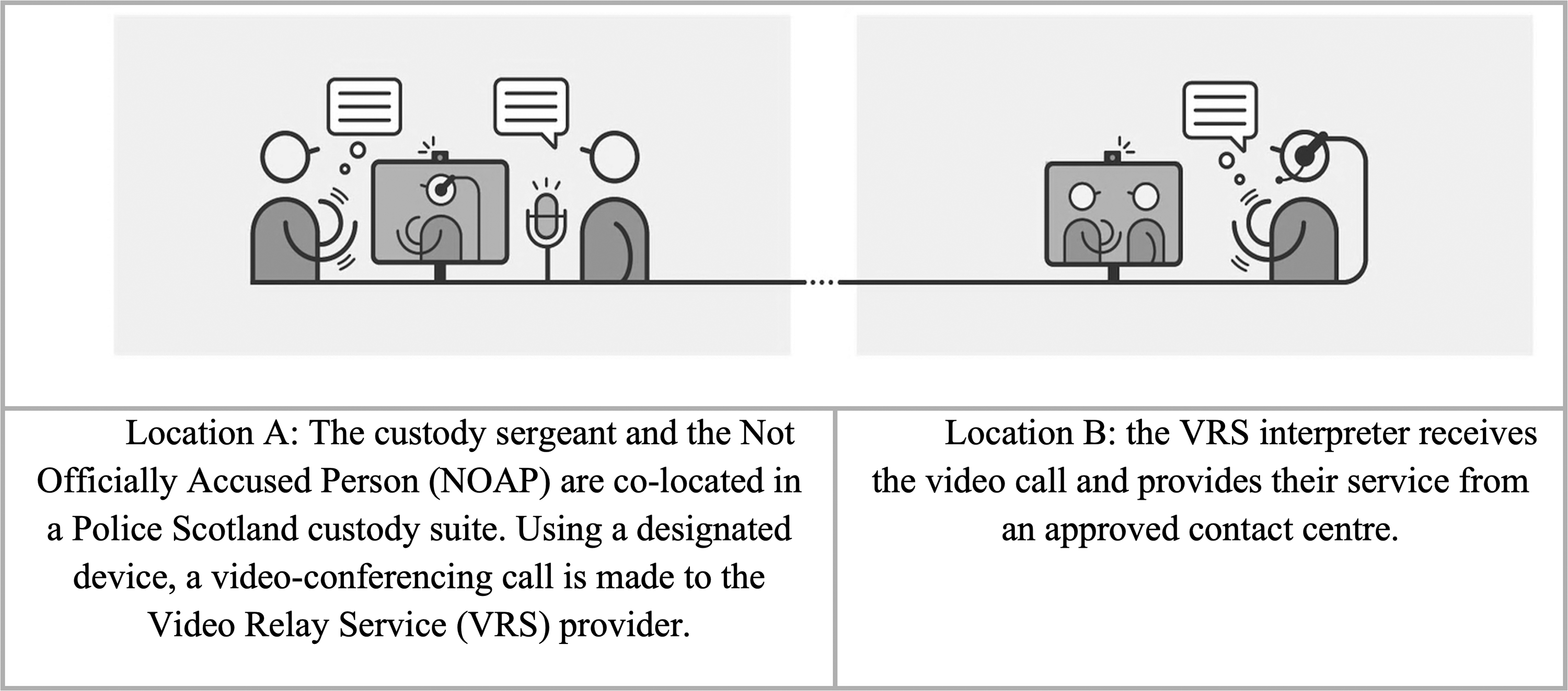
Video remote interpreting custody configuration.
Although VRI can support custody sergeants in communicating with deaf signers, challenges in fairness and equal treatment persist. For instance, once the VRI call has ended, the police are unable to communicate with the deaf detainee. This limitation arises from police procedures and systems assuming that individuals in custody can hear, communicate in English, and that minimal adaptation or assistance, such as sourcing a face-to-face or remote interpreter, is sufficient. This oversight highlights the existence of ableism in the custody procedure and the importance of public service co-design, where the needs of vulnerable consumers are prioritised (Mulvale et al., 2019). As argued by Robinson et al. (2020), deaf people should be regarded as experts on their accessibility requirements, given their unique insights into what accommodations or forms of access are most effective for them.
This study investigates the experience of completing a routine policing task, in which the deaf signer's fair and equal treatment is foregrounded. This is achieved by applying a novel framework that incorporates themes from studies by Brunson (2007) and Skinner and Napier (2023) that emerged from interviews with deaf signers (Brunson, 2007) and focus groups with police officers (Skinner and Napier, 2023). The four themes of the framework are:
obtaining accommodation, such as identifying the individual's linguistic and disability-related needs; understanding accommodation, learning how to use or work with the adaptation or interpreter; adapting routine procedures/advice, this involves identifying issues with institutional procedures or practices and implementing changes to accommodate the specific linguistic or disability-related needs of the individual; dealing with problematic accommodation, such as managing interpreter quality or translation quality.
In this study, these themes are applied to interactive data and focus group discussions. By triangulating themes from previous studies, this study illustrates the lack of consideration afforded to deaf signers within the custody context.
The article begins with an overview of police custody, followed by a review of deaf signers’ encounters with the police. The following section explains the research design, methodology and data collection process. The data and analysis are then presented across the four themes: obtaining accommodation, understanding accommodation, adapting routine procedures/advice and dealing with problematic accommodation.
Custody overview
In Scotland, policing is a devolved matter and there are variations in how the custody process is managed compared with the rest of the United Kingdom (UK). The first step in the Scottish custody process is to complete a background check and inform detainees of their legal rights (Police Scotland, 2019). A risk assessment is then undertaken and a care plan completed (Police Scotland, 2019). This booking-in process includes questions relating to drug or alcohol use, and a health and well-being assessment. In Scotland, the booking-in procedure is formally recorded on the National Custody System (NCS) and has multiple purposes. The first is to develop records that can be used to assist the police with their immediate work; alerting the custody sergeant to potential risks; ensuring consistent information is passed on to other custody staff; and for monitoring and accountability purposes (Leese, 2017). The above measures make the custody process a highly regulated setting.
Research into UK custody practices is limited and most are focused on the custody sergeant's decision-making during the booking-in procedure and how citizen diversity and vulnerability are properly dealt with (Dehaghani, 2019; Skinns, 2011). Several studies have found grounds to challenge the quality and parity of service for suspects from minority populations (Britton, 2000; Cummins, 2012; Leese, 2017; Skinner and Napier, 2023; Vernon and Miller, 2005), and question custody sergeants’ reliance on the law as a moral framework. Providing parity of service is an ambition for police forces across the UK and is a key performance measure used by police inspectors [His Majesty’s Inspectorate of Constabulary in Scotland (HMICS), 2019, 2018]. For the citizen, it is whether they have been understood and managed in a fair and non-stigmatised way.
Bartkowiak-Théron and Asquith (2012, 2015) presented a convincing argument that police staff need to become better prepared to deal with another person's needs by using vulnerability as a benchmark for all police–citizen interactions. These authors, along with other scholars, caution against narrowly defining ‘vulnerability’, recognising its potential to stigmatise individuals as weak or burdensome. For Dehaghani (2019), discussions around vulnerability should focus on restoring inherent power imbalances, enabling suspects to act in their own best interests.
The vulnerability framework serves as a reminder to police officers of their duty to comprehend citizens’ vulnerabilities, take responsibility for safeguarding and provide an equitable service. However, there is a gap in our understanding of how the police apply this framework to comprehend the experiences of individuals with specific vulnerabilities, such as being deaf. In addition, exploring the dynamics between interpreters and custody officers in fostering safeguarding and restoring power imbalances can offer insights into improving the delivery of other partnership services. The incorporation of a vulnerability framework not only informs how law enforcement understands deafness, but also has broader implications for refining collaborative approaches in diverse contexts.
Deaf signers' experience of the police
Deaf signers hold a unique position in society, being legally recognised as both disabled (Equalities Act, 2010) and part of a cultural–linguistic minority (BSL (Scotland) Act, 2015; BSL Act, 2022). 1 These dual characteristics can explain the barriers that hinder the independence and full participation of deaf signers in society. Reforms that seek to address barriers to participation need to recognise how the audiological status and linguistic background of deaf people can and does vary. Deaf signers consistently express a preference for engaging in signed language communication, considering spoken languages – whether spoken or in the written form – as inaccessible and impractical choices for communication (De Meulder and Haualand, 2019).
Police forces across the UK, including England, Wales and Scotland, have faced criticism for their inadequate understanding of deaf signers’ needs and how to address them (Lumsden and Black, 2022; Race and Hogue, 2017; Skinner and Napier, 2023; Skinner et al., 2021). The police have been overly reliant on interpreters (Skinner and Napier, 2023), thereby reinforcing the argument made by DeMeulder and Haualand (2019) that public services buy into an unquestioned belief that sign language interpreters alone can fulfil their legal duty to provide equitable services. Reforms to police services rarely include deaf people in the delivery and design process.
Brunson's (2007) research on deaf signers’ experiences within the broader legal system in the United States revealed three key themes that encapsulate the challenges deaf people face in accessing the legal system equitably. The first was linked to the legal system's ability to establish and understand the appropriate form of adjustment needed. For instance, not all officers appreciate the need to source an interpreter or know how to source one who is appropriately trained. The interpreter's ability and the police officers’ understanding of how to work with interpreters was linked to the second theme, which Brunson (2007) termed problematic accommodation. If an interpreter was unsatisfactory, the deaf individual had to find ways of making communication possible – thus becoming responsible for the interpreter and having their own needs understood (Brunson, 2007). This added challenge illustrated how interpretation services do not improve the situation, but add a new problem; this ties into the next theme of partial accommodation (Brunson, 2007), which was about managing interpreter quality or translation quality.
In a subsequent UK-wide study, I adapted Brunson's themes to document the perspective and experiences of police and custody officers when dealing with interpreters and deaf signers. This research involved interviewing groups of officers based on their previous experiences. The first group consisted of officers with no prior experience of interacting with deaf signers or sign language interpreters. This group were asked to hypothetically describe how they would respond to situations involving a deaf signer. The second group were officers who had practical experience in dealing with deaf signers and using an interpreter in real-life scenarios. The third group included officers who had a connection with the deaf community, through their voluntary work as Police Link Officers for Deaf People (PLOD). PLOD officers exhibited varying levels of proficiency in British Sign Language (BSL) and knowledge of the deaf community. It was observed that officers lacking knowledge of BSL or the deaf community were generally ill-equipped to handle situations involving deaf signers.
Those in the second group, who had some experience in dealing with situations involving deaf individuals, described difficulties in identifying and obtaining adjustments. Once the need for a sign language interpreter was realised, the police were then confronted with logistical challenges in recruiting an interpreter, causing delays in their work. Officers grappled with understanding how to work effectively with interpreters, including adapting lines of questioning and checking the accuracy of the interpretation. As in Brunson's findings, police officers and custody sergeants sometimes struggled to address challenges arising from interpreter use, confirming problematic and partial accommodation as a shared experience between deaf signers and officers. A fourth theme that emerged from the data, adapting routine procedures, was introduced to highlight how officers had limited awareness of how to resolve unequal treatment caused by behavioural or institutional norms, such as contacting deaf relatives or explaining police terminology.
Police Scotland custody sergeants have no formal training in how to manage their interactions with a deaf person, or an interpreter (Skinner and Napier, 2023); this means that the custody sergeants who participated in this study relied on established communication practices and devising in situ solutions. This study seeks to investigate the challenges reported by police officers, interpreters and deaf people, where deaf signers do not feel enabled to act in their own best interests.
Through analysis of interactive data and participant reflections, this research aims to investigate the disproportionate responsibility imposed on deaf individuals in negotiating public services, particularly within the framework of interpreter-mediated routine front-line procedures. In addition, the research aims to outline the institutional changes needed to relieve deaf signers of this burden when accessing front-line police services, thereby contributing to a more inclusive and equitable service provision.
Method
Ethics
In compliance with ethical procedures from Police Scotland and Heriot-Watt University, ethical approval was obtained. 2 The ethics application outlined the investigator's responsibilities, including participant recruitment in BSL or English and securing informed consent. It stressed concealing certain research aspects. This study intentionally hid details from police and interpreters to replicate real-world conditions during simulated VRI calls, as explained later in this section. The goal was to mirror the unforeseen demands faced by police and interpreters, necessitating responses to unexpected situations without prior warning.
Positionality
As with any study, the design and direction of research are guided by the background and motivations of the researcher (Hale and Napier, 2013; Mellinger, 2020). The theme of this research is how deaf signer's access is negotiated, as presented from my viewpoint being a White, male, hearing, heritage BSL signer (Napier, 2008). My status as a heritage signer is linked to my family background of many deaf BSL signers. This means I was brought up within a disempowered minority, where I do not share the same lived experience as someone who is deaf. My career has always seen me work alongside deaf people, as an interpreter, researcher or interpreter educator. The topic of access, as told by those whose lives are impacted, is essential to fully critique this current study.
In my sign language interpreting research I align with the co-participatory model of interpreting (Napier, 2007) and strive to ensure balanced representation and attention for each of the participants. Crucially, I view the custody sergeant and deaf participants as involved actors who can influence and shape the behaviour of others, including the interpreters’ behaviours.
Research design
For this study, I ran VRI simulations involving deaf BSL users during police custody bookings. The rationale for developing simulated VRI custody calls was grounded in ethical, logistical and practical considerations. First, predicting where and when a deaf BSL signer would encounter police custody was challenging. Second, the technology being tested was in the proof-in-concept stage and its appropriateness had yet to be determined. Finally, the custody environments were often in large open spaces and were poorly lit. To overcome the various ergonomic and practical issues I used the following solutions.
A private office space at a Police Scotland station for the custody booking-in procedure. The acoustics and lighting in the private office space were superior to the custody space. A portable mobile wi-fi device to connect to the 4G network. In this room, a laptop linked to the VRI platform was prepared. The custody sergeant would own responsibility for managing the laptop (adjusting sound and video). The detainee was escorted by two officers into the simulated custody room.
Experienced officers were enlisted to adjust the office space, ensuring that the simulations adhered to Police Scotland protocols. Police Scotland consultants confirmed that the adjustments were within the realms of Police Scotland's standard operating procedures.
For each simulation, three types of audio–video-recordings were produced: a cloud-based recording of the platform, a backup screen recording on the main custody device, and recordings from the custody room-cameras (Figures 2 and 3).
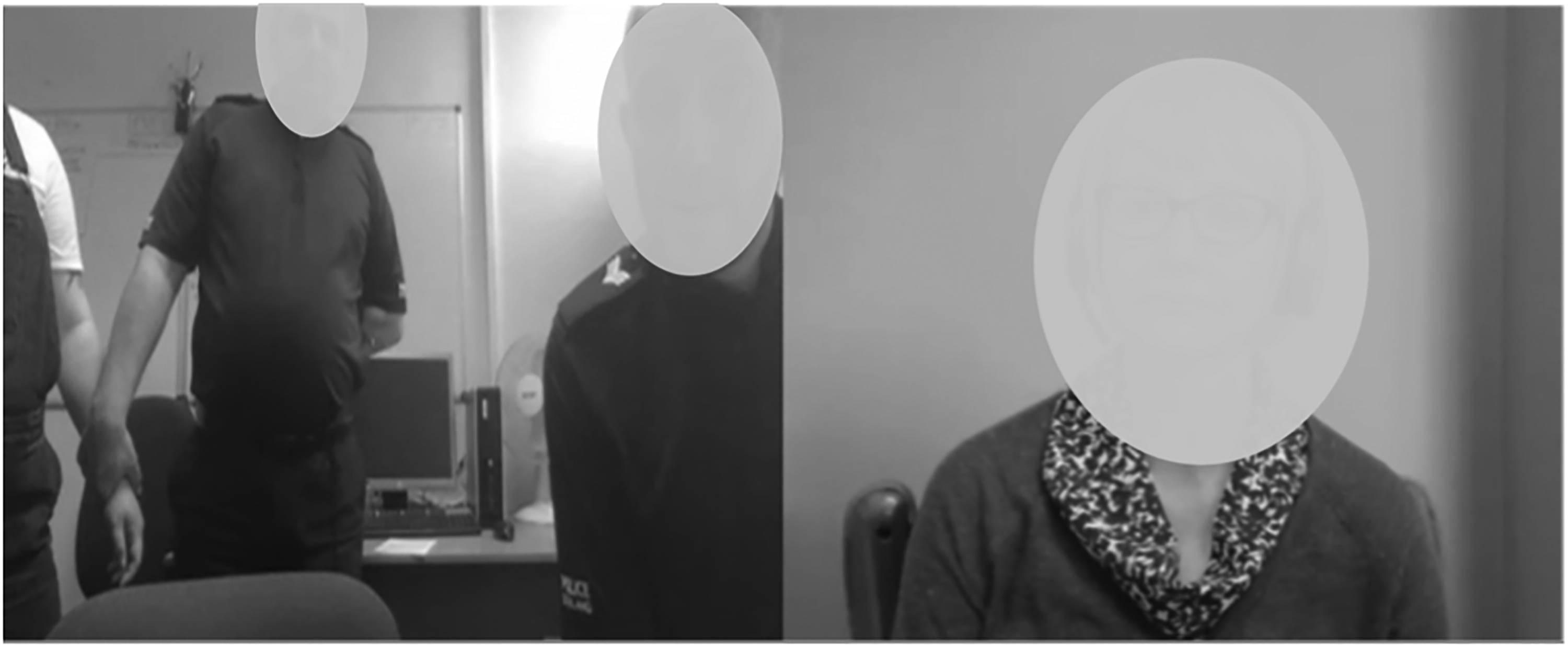
SignVideo platform recording. The left image represents the custody webcam. The right image is the interpreter's webcam.
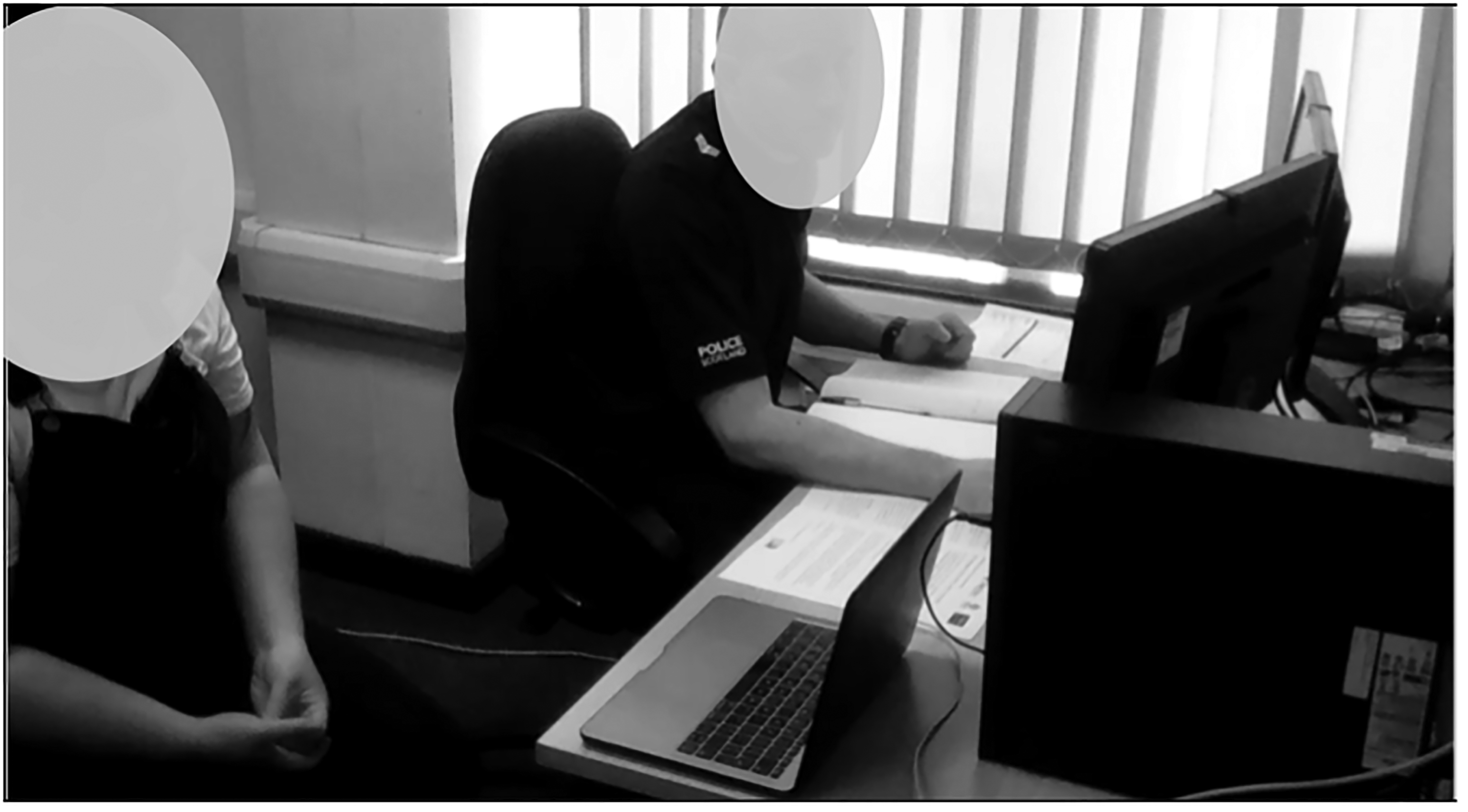
Custody room-cam.
The room-camera provided information concerning where the custody sergeant was physically positioned, when he moved and where he was looking (at the interpreter, at the deaf person or at the computer). Table 1 gives a basic description of each call.
Custody video remote interpreting (VRI) call summary.

In the following section, an explanation of the participant recruitment process is provided, outlining how it aimed to achieve this goal, including the way in which participants were primed for their involvement in this study.
Participants
The participant recruitment process was managed and agreed upon in collaboration with Police Scotland and SignVideo, a private UK company providing online interpreting solutions to UK public and private organisations. SignVideo’s online platform was used for the study. To determine their suitability and comfort with participating in custody VRI, I checked with potential participants before the study, either via email communication (written English with embedded BSL videos) or video calls (in BSL). In total, three deaf actors, three interpreters and three custody sergeants agreed to participate in the study.
For the custody simulations, where a deaf person was to be detained and brought into police territory, I recruited trained deaf actors. Although participants were not encouraged to ‘perform’ per se, the nature of being detained did require a level of pretence. Four final-year student actors from the Royal Conservatoire of Scotland's Bachelor of Art (Performance in British Sign Language and English) programme responded to the call for volunteers and were recruited as the ‘not officially accused person’ (NOAP). One of the actors later withdrew from the study. With the unexpected withdrawal, I decided to reduce the number of VRI simulations from four to three. The deaf actors agreed that they would supply truthful answers when asked for their personal details (e.g. name, address and nationality), health background (e.g. health and well-being issues) and personal habits (e.g. drinking or legal highs). The actors were encouraged to respond truthfully to issues around communication or the experience of being booked into custody (e.g. understanding questions or concerns with treatment). Fictional answers were given when discussing matters linked to their arrest. For reporting purposes, all factual and private details have been replaced with fictional content.
Three custody sergeants with varying levels of experience in working within custody settings took part in the simulations. They were given limited information before their involvement in the study. Each custody sergeant willingly agreed to participate in a simulated booking-in procedure.
The SignVideo administration team managed selection of their own staff. An invitation to participate was sent to all the interpreters who were scheduled to work on the day of data collection. To emulate real-world experiences, the interpreters were not primed with the type of calls to be received or the content of the call.
Interpreters who participated in the study were compensated with a £20 electronic gift card. Actors recruited for the custody simulations were compensated £15 per hour for their time, based on the Independent Theatre Council's rates of pay. 3 Custody sergeants were not offered any form of financial compensation. Participants agreed to the publication of still images for research and dissemination purposes. A description of each simulation is provided below.
Custody simulation 1
Nara (NOAP) was brought in after being caught shoplifting. The supermarket security guard claimed he spotted Nara leaving the shop with a bra and she did not stop when asked to do so. The arresting officers were unable to communicate with Nara or take a statement.
Custody simulation 2
Naomi (NOAP) was reported to the police after a neighbour saw her smacking her child on the street. Social services took her child into care. Naomi did not know why she was arrested or where social services took her child.
Custody simulation 3
The police arrested Nicholas (NOAP) after a domestic dispute. A neighbour reported loud noises and disturbance at the deaf person's property. The police found the partner (who was also deaf) injured. The victim indicated that Nicholas (her partner) had caused the injuries. Officers recognised the seriousness of the incident and detained Nicholas.
Post-simulation focus groups
Following the simulation, participants took part in separate focus groups, with one group for each simulation. The sessions, led by the lead researcher (myself), aimed to delve into the participant's experiences during the calls. Because I was not present during the calls, the discussions relied on participants’ recollections of their recent VRI experience. The questions were designed to encourage participants to articulate their internal thought processes and describe their approaches to interactive issues. The incorporation of participants’ reflections on their recent call experience was a distinctive and novel feature of this study.
Analysis of the focus group discussions followed the principles of content analysis (Wilkinson, 1998, 1999). Participants’ reflections were coded according to the four categories: identifying and obtaining adjustments; understanding accommodation; adapting routine procedures or practices; and dealing with problematic accommodation. Past experiences of using VRI or general opinions about the VRI platform were coded separately.
Results
The data and analysis are presented across the four themes: obtaining accommodation; understanding accommodation; adapting routine procedures; and dealing with problematic accommodation. The pseudonyms for each participant are denoted by initials representing their roles. Pseudonyms for the NOAP (deaf person) begin with the initial ‘N’, those for the interpreter begin with ‘I’ and those for the police custody officer begin with ‘P’.
Identifying and obtaining adjustments
The theme identifying and obtaining adjustments is linked to known criticisms, in which the police at first contact are often unable to establish the communication needs of a deaf signer (Lumsden and Black, 2022; Skinner and Napier, 2023). This is a problem officers themselves have reported (Skinner and Napier, 2023). For the simulation, the deaf actors’ first interaction with the police was the custody booking-in procedure, this meant the simulations were not clouded by earlier communication issues that may have arisen at the time and place of arrest.
The design of the simulations also removed the custody sergeant's duty to determine the type of access the NOAP needed. Instead, the simulations demonstrated an ideal scenario, in which the custody sergeant is made aware of the citizen's communication needs and immediately supplied with the VRI provider’s details, including instructions on how to confirm the availability of an interpreter. Although the practical and logistical challenges in sourcing an interpreter had been removed, the focus group discussion still touched on issues related to identifying and obtaining adjustments.
In the post-simulation focus groups, the custody sergeants recognised their own shortcomings with how to independently understand what accommodation a deaf signer needs and the implications this has on the deaf person's rights, the quality of service and the unequal treatment. We can see the benefit of this [the VRI service] massively because that gap between bringing somebody in and communicate with them. Let them know what's happening with them. Every single person wants to know, why am I here? What's going to happen to me? And you have in that huge gap when that doesn’t happen to anybody else. The most is an hour for somebody who's foreign to get the interpreter here. [00:05:09] [23.3]
Custody sergeants were conscious of the deaf person's isolation and their own inability to communicate. Gaps in the custody officer's knowledge of how to deal or communicate with deaf signers explained why there was a positive response from the officers towards the VRI platform. Access to a remote interpreter was viewed as necessary help that enabled the custody sergeants to manage risk and communicate to the deaf signer the grounds for their arrest and their rights.
Understanding accommodation (establishing roles and context)
For a successful partnership, one that addresses the undue burden on the deaf signer, the custody sergeant and interpreter must establish a collaborative approach that considers immediate environmental, interpersonal, paralinguistic and intrapersonal demands (Dean and Pollard, 2013). This step should entail a pre-briefing between the custody sergeant and VRI provider/interpreter. Currently, Police Scotland has a standard operating procedure for working with interpreting and translation services; this guidance does not include VRI provisions. Ideally, during this pre-briefing, the custody sergeant would discuss the optimal use of technology, conduct an audio–video check, agree on collaborative working methods and address potential issues related to booking a deaf signer into police custody. Two key junctures exist across all simulations for these discussions to occur: a pre-briefing call with the VRI provider and the opening of the VRI call, during which the interpreter joins the booking-in procedure remotely.
Pre-briefing call with the VRI provider
It cannot be assumed that all custody sergeants have the knowledge required to adapt procedures for the fair treatment of deaf individuals or to work effectively with interpreters. Therefore, it is beneficial for the interpreting service and custody sergeant to engage in a pre-briefing before the deaf person is brought to the charge bar. The importance of the pre-briefing extends beyond its advantages for the custody sergeant; the information gathered by the interpreter coordinator during this session can be utilised to identify the most suitable interpreter for the call (e.g. assigning a male interpreter for a male rape suspect).
In each simulation, the custody sergeant and VRI coordinator engaged in minimal conversation. Notably, custody sergeants neither requested nor sought assistance in understanding how to use the technology, the role of the interpreter or possible issues in dealing with a deaf signer. The VRI coordinator, who has more experience with the needs of deaf signers and the platform, was not instructed to assess the custody sergeant’s experience in dealing with deaf signers, awareness of how to work with an interpreter, the officer's confidence in using technology and their knowledge of existing institutional guidelines – such as Police Scotland's standard operating procedure for interpreters and translators or the use of an easy-to-read version of the rights and entitlements.
The absence of this pre-briefing was striking and suggests the need for specific guidance for the VRI provider, who holds specialist knowledge, to make this step routine practice. As we see in the next stage, when an interpreter joined the call remotely, both the interpreter and the custody sergeant had to determine in situ ways of managing each other's needs in the presence of the deaf person. The dyadic interaction between the custody sergeant and interpreter resulted in the temporary exclusion of the deaf person. The temporary exclusion is an example in which a deaf person is treated differently and expected to wait, implicitly trusting others to create an inclusive environment.
Opening the VRI call
In the initial phase of the call, the custody segeants face a multitude of conflicting demands. They must familiarise themselves with the technology, establish a working partnership with the interpreter, and address the needs of the NOAP, who has specific disability, linguistic and cultural requirements. The location of the interpreter, remote from the custody suite, places them in a dependent role, relying on the custody sergeant to co-ordinate the technology and people involved to benefit overall audio and video communication.
In line with Police Scotland's safety and security protocols, the NOAP was physically restrained, with an arresting officer either side of the NOAP holding an arm each. The NOAP was restricted from interacting, such as signing, until seated in front of the camera. The removal of restraints is needed to restore the NOAP’s ability to communicate and feel secure.
[Nara (NOAP) is standing partially off camera and is physically restrained by two arresting officers.]
Bold indicates instances of code-blending, the simultaneous use of speaking and signing. The brackets (.) indicate a brief pause, brackets with numbers (1.0) indicate the length of pause in seconds. Double brackets is to code social acts, the first description describes the act, the second description refers to the recipient (e.g. citizen (Cit), police (Pol), interpreter (Int) or other computer/smartphone/door/window). An increased or decreased rate of speech is marked in the following way, >speed-up< and >slow-down<.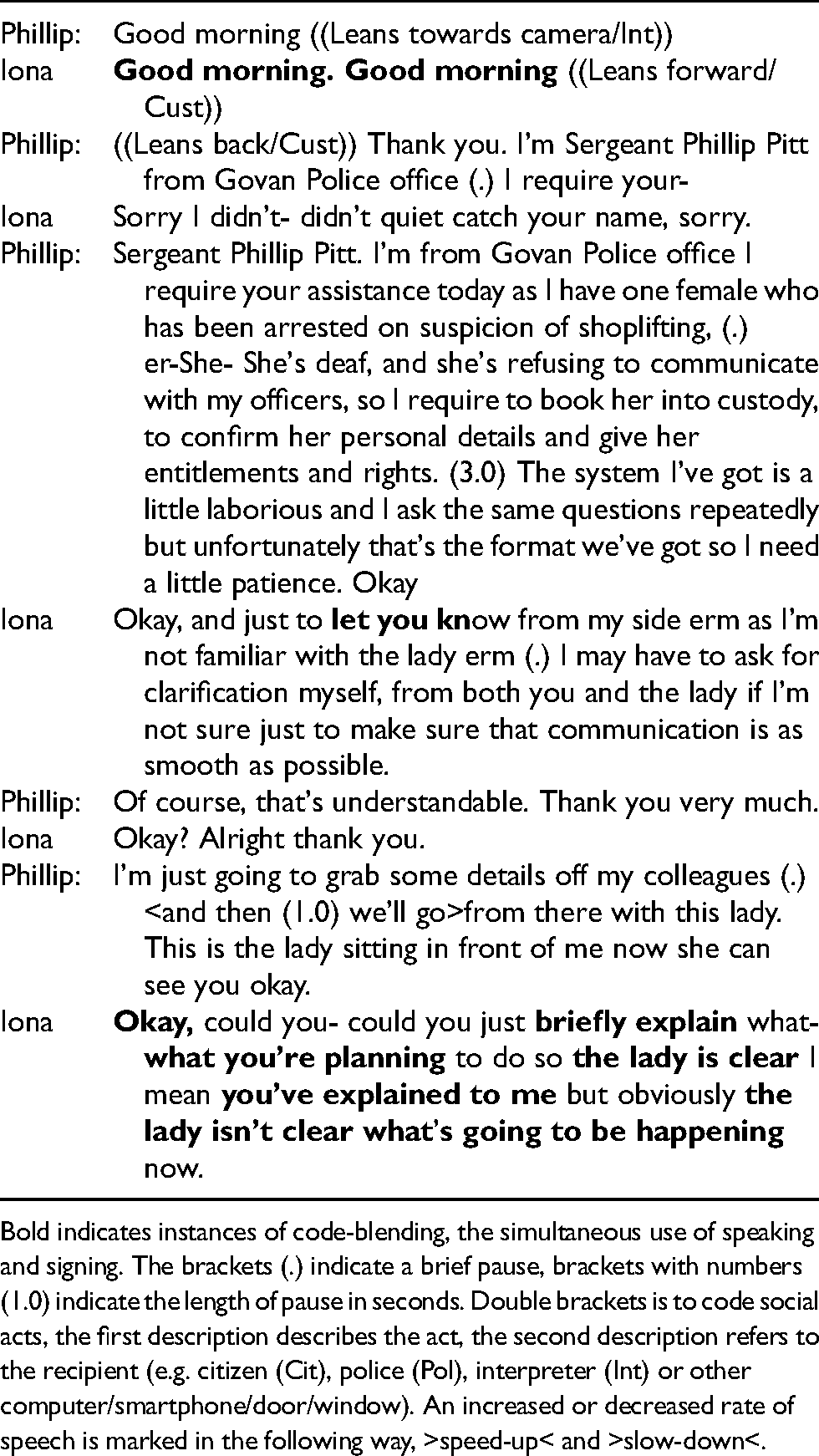
[Nara (NOAP) is seated in front of the camera, where her hands are released.]
The temporary exclusion of the NOAP contributes to the perception that the police are ill-prepared to provide fair and equal treatment to someone who is deaf and uses BSL. Indeed, the presence of the NOAP seemed to prompt the custody sergeant and interpreter to rush through their introductions and side-step the discussions in which expectations and roles are communicated (e.g. the interpreter's primary role is to facilitate communication), how they will manage communication (such as the taking of turns, the resolving of misunderstanding) and inclusion (such as direct communication).
This oversight meant the pair committed to a partnership that involved solving problems as and when they arise; for example, in Extract 1, Iona felt obliged to draw Phillip's attention to Nara's exclusion and repeat his introduction to Nara. Extract 1 demonstrates how the interpreters intervene to comment on the custody sergeant's behaviour. Below I focus on how institutional procedures were negotiated or adapted to ensure the NOAP received equitable and fair treatment.
Adapting routine procedures
The theme ‘adapting routine procedure’ pays specific attention to the action taken by either the custody sergeant or interpreter to respond to access-related issues. This section discusses the way in which adaptations were handled by introducing three sub-themes: unresolved access issues, custody sergeant-led response and interpreter-led response.
Unresolved access issues
Here I discuss a routine or procedure that happened to discriminate against the deaf citizen and was not, or could not, be resolved. In each simulation the arresting officers were tasked with explaining the grounds for arrest to the custody sergeant. The microphone in the room was unable to pick up the voices of the arresting officers. The interpreter faced challenges interpreting crucial details, such as the arresting officer's Police Scotland Identifier number, reasons for arrest and description of the NOAP as ‘refusing to communicate’.
In analysing these moments, it was unexpected to see neither the interpreters nor the citizens addressing the sound or access issues. Both the interpreter and the NOAP sat for an extended period without notifying the custody sergeant. When concern was eventually raised by the interpreter or the NOAP, the custody sergeant responded with minimal information, such as, ‘What I said there was erm I was asking the officers questions about, (.) where he was arrested, (.) what time he was arrested, (5.0) and when they arrived in the office’ (Phillip CustodyVRI#2). Neither the interpreter nor the NOAP pressed the custody sergeant to provide a more complete explanation. The custody sergeant's summary contained no information about the reason for the arrest, the people involved or the description ‘refusing to communicate’. Note in the extract, the custody sergeant referred to the NOAP in third person. Although the officers recognised the value and importance of promoting direct communication, in each of the simulations, they switched between referring to the deaf person in the first person and in the third person. The importance of talking directly to the deaf person was an issue noticed by the two Police Scotland consultants in the post-simulation discussions.
The interpreters were asked why they did not intervene or flag any issues with fairness. Ian (CustodyVRS#2) confessed that he did not want to interrupt the custody process. For Ian, any interruption held the potential to threaten Pierce's authority. Ian held this concern despite Pierce's repeated requests for feedback. The interpreter's failure to promote a shared responsibility for communication meant the deaf person was made responsible to assert and protect his right to access information.
Although Iona (CustodyVRS#1) and Isaac (CustodyVRI#3) did not disrupt or challenge the social order during the early stage (the handover from the arresting officers), they both became more proactive in resolving issues related to communication and access later on, as seen in the section ‘Interpreter-led response’. Interpreter-led interventions were positively received by the custody sergeants. Each intervention slowed the interaction and resolved gaps in the custody sergeant's awareness on how to work with interpreters or consider a deaf signer's needs. The positive response from custody sergeants may have played a part in Iona and Isaac’s increased involvement.
In his post-simulation discussion, Nicholas (CustodyVRS#3) raised a concern with the description of his arrest as ‘refusing to communicate’. Nicholas asserted that he had not refused to communicate and argued that it was the police who were unable to communicate. Nicholas’ criticisms were accepted and supported by the custody sergeant and two Police Scotland consultants. No concrete solution was put forward on how to resolve this institutional practice.
Naomi (CustodyVRS#2) found the initial part of the booking-in process, being detained and watched by three officers, ‘horrible’ and her dependence on the platform made her feel as though she had ‘lost her voice’. During the simulation, Naomi genuinely objected to using the VRI platform and insisted on an on-site interpreter, a non-scripted part of the simulation. This demand was managed, and it was explained how the VRI service was only to be used for the booking-in process, with an on-site interpreter being sourced for her interview. Naomi's objections demonstrated the importance of communicating to the deaf signer the restricted use of the VRI platform for procedural matters and the steps taken to source an on-site interpreter.
The next unresolved area was how to sustain communication during the physical body search and temporary incarnation of the NOAP. In each simulation, the NOAPs raised genuine concerns about how communication with the officers would be managed once the VRI call had ended. Although these concerns were not scripted, the custody sergeants addressed them by explaining that an interpreter had been arranged for the police interview. However, the custody sergeants seemed unaware that booking an interpreter can take several hours or even days to arrange (Skinner and Napier, 2023). Their response to the NOAPs’ requests did not fully consider the immediate concerns or vulnerability of the NOAPs. There was no offer to use the VRI platform to update or re-evaluate an NOAP's well-being.
Ambiguity arises regarding the role of the interpreter: should they suggest the platform to the custody sergeant, and should this choice be put to the NOAP? The threshold for determining the interpreter's involvement is often left undefined, a reoccurring theme in the booking-in process. It could be argued that the threshold for interpreter involvement is greater than might be tolerated in a suspect interview, given the primary focus on identifying risk and well-being concerns. The interpreter possesses specialist knowledge and skills that could be of potential value to the police.
Custody sergeant-led response
The purpose of the booking-in procedure is to complete a care plan and risk assessment. This process involves a mixture of reading scripted text and engaging in a question and answer exchange. For example, the script explains to NOAPs their rights and entitlements, the purpose for asking a set of questions and an opportunity for the NOAP to respond. The inclusion of mandatory questions serves to alert the custody sergeant to potential safeguarding or well-being risks.
The step-by-step process, led by the custody sergeant, enabled the interpreter and NOAP to anticipate what comes next. This approach was possibly more helpful to the interpreter, who could better anticipate what was likely to be discussed and how to interpret. However, the reading of rights, regulations and in some cases, mandatory questions was largely inaccessible and complex. The complex language and legal requirement to deliver the script became a common theme in ‘adapting routine procedures and practices’. Both consultants believed it was incumbent on the custody sergeant to go beyond the scripted text and provide an explanation and check the interpreter's/NOAP's understanding. This could be achieved by clarifying the text and by allowing the NOAP or interpreter to ask questions.
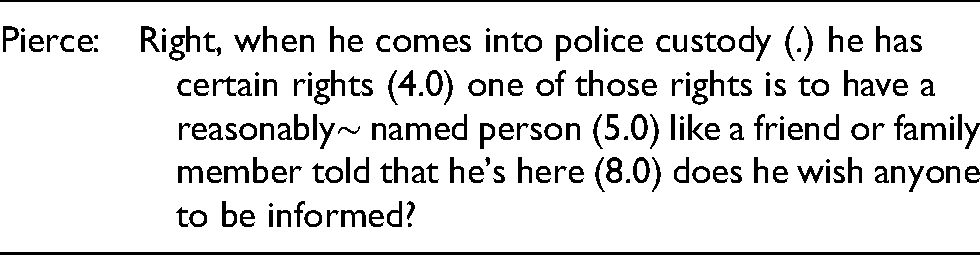
Pierce's cautious approach proved valuable in uncovering essential information, such as that the reasonable adult whose details were provided by Nicholas, in fact, was another deaf person. This unscripted revelation was essential. Without this background knowledge attempts to call the reasonable adult may have ended in failure. The deviations created by Pierce were acknowledged by the two consultants as the preferred response to dealing with citizen vulnerability, recognising and addressing power imbalances. The consultant also saw a need for custody sergeant to manage the NOAP's expectations by first explaining their duty to read complex and ‘wordy’ texts and how this will be clarified after.
For Pierce, citizens (deaf or hearing) brought into custody would normally display a range of emotions, such as tension towards the arresting officer and feelings of anger or distress (including producing tears). Pierce wanted to avoid antagonising suspects. In the current context, Pierce was conscious of how isolating the experience of arrest might be for someone who was deaf. When asked why he omitted questions or deviated from the format, Pierce explained how the NCS content was ‘nonsense at the best of times’ and so his focus was on getting the message across. Clarifying institutional language benefited the interpreter and NOAP, incidentally reducing the burden on the interpreter to develop an explanation of police terminology, where often there is no direct word for sign correspondence.
It was unclear why Phillip and Pamela did not anticipate issues with understanding terminology and eliminate ambiguity without prompt – as seen with Pierce. The consultants felt strongly that it was the custody sergeant's role to be more proactive in explaining terminology (without being asked) and to check whether the interpreter was able to convey English concepts. This shortcoming exemplifies the challenges of adhering strictly to the verbatim NCS and underscores the need to develop an interactive framework that seeks to understand individual needs. The reactive approach, waiting for a request for clarification, places an unfair burden on others to express their need. In the section that follows, I explain how the interpreter assumed responsibility for clarifying terminology and procedures. An important feature of the interpreter-led response was the way in which the custody sergeant positively engaged with their input. Although the custody officers did not always lead with the adaptations, their engagement with the interpreter-led response needs to be acknowledged.
Interpreter-led response
During the opening phases of the call, all three interpreters took a cautious approach, seeming hesitant to assume a broad ‘co-provider’ role (Merlini, 2009), which involves commenting on the way in which the custody sergeant considers the NOAP’s access needs. As the call progressed, where interpreters were repeatedly invited by the officers to comment on the process, Iona and Isaac became more involved, questioning the terminology (e.g. ‘reasonable’, ‘legal highs’ ‘biometric samples’) and aspects of the procedure (e.g. properly documenting the NOAP’s language background as BSL not English). Both Iona and Isaac appeared to gain more confidence, possibly because of positive responses from the custody sergeant. The officers explained definitions when called upon and modified their choice of words according to the interpreter's language.
In the post-simulation discussion, Iona acknowledged that she had made several interventions but questioned their legitimacy, wondering whether she had had an overbearing influence on the process and whether she should have stepped back to allow Nara to create her own interventions. Iona was unsure of her status as co-provider, someone who can advocate for clear and non-technical use of language. Both Phillip and Nara welcomed Iona's interventions because they contributed to confidence in understanding meaning and eliminated uncertainty. Phillip viewed Iona as an expert at working with people who were deaf and from a linguistic minority, and welcomed her interventions. In Phillip's experience citizens who communicated in English did not always admit to their own difficulties in understanding the custody process. It was not clear why Phillip, who was concerned with this wider issue, did not volunteer an explanation himself – as seen with Pierce.
In the focus group, Iona probed the question of her co-provider involvement further and hypothetically asked how Nara and Philip would have felt if she communicated her own judgements about Nara's state of mind, for example ‘Nara appears drunk or intoxicated by looking at the way she signed’. Nara viewed this type of intervention as going too far, whereas Phillip viewed it as essential to monitoring Nara's well-being and safety, which was his primary focus. The two consultants shared Phillip’s view and saw the interpreter as someone who was employed by the police, therefore they should not remain impartial on health and safety matters. The issue here is linked to the type of working relationship that has been agreed between the police and VRI provider, and the transparency about this agreement where the NOAP is made aware. Part of this agreement is related to policy level guidance and how this policy is communicated to everyone involved at the start of (or before) a VRI call.
The focus group discussion revealed how the interpreter's involvement is not always in agreement and the threshold for intervention differs between the NOAP and custody officer. Should an interpreter afford autonomy to assist the officer with his well-being assessment? If so, consideration is needed to establish how much discussion is required prior to the booking-in process to agreed ways of working together, and how this partnership is discussed with the citizen involved.
Dealing with problematic interpretation
Problematic interpretation refers to the impact that the interpretation has on others. Brunson (2007) raised this as an issue in which deaf citizens had to monitor the interpreters’ comprehension and assist the interpreters in performing their task. For deaf signers this meant that they were coping with a sense of mistrust in the interpreter's ability and the knowledge that they were held responsible for the interpreter's inaccurate rendition.
As explained above, Isaac and Iona adopted a more involved approach to managing the interaction by requesting, or providing, an explanation of terminology, and commenting on the process. These interventions intentionally moved the burden for sense-making away from the NOAP. Ian's approach was unlike that of the other two VRI colleagues and he was the least willing to comment on, or modify, Pierce's communication. Ian's approach could be defined as a ‘conservative’ (Dean and Pollard, 2013) or ‘detached interpreter’ style (Merlini, 2009). This style of interpretation places greater responsibility on others for explaining and decoding meaning. The difficulty for custody sergeants is their inability to assess and comment on this translation style. This cannot be done confidently without adequate knowledge of BSL.
The issue with Ian's conservative and cautious approach lay in how it relied on Nicholas’ knowledge of English and Nicholas’ willingness to confirm or reject his understanding. Although Nicholas assumed a higher level of burden in sense-making, he consistently provided an accurate reply. Ian's interpretation style was not challenged, and it is not known how Ian would modify his approach to ensure Nicholas’ inclusion.
In the focus group, there was some discussion around the quality of interpreting provided. Nara and Phillip valued Iona's interventions in which she made changes to the source to ensure specific terms were made accessible to Nara. These interventions were viewed positively because they moved the burden of understanding away from the NOAP. No discussion was had on the poor or problematic quality of interpretation; it is possible that the participant did not feel secure or able to critique the interpreting style, especially without knowing the how the source was originally expressed, and the actual changes created by the interpreter.
Another explanation for the limited impact the interpretation had on the process was the procedural nature of developing a care plan. Questions and answers focused on demographic details, medical background, health and well-being, and so on. The NOAPs were also actors who provided minimal responses. According to the officers in the study, people brought into custody often communicate their fears, concerns or the unfairness of how they have been treated. This type of response was missing in the current study. Problematic interpretation may surface when interpreters are dealing with longer narratives or when they are mediating between two competing version of events.
Limitations
Some limitations to this study are associated with the process adopted. First, the size of the data is a limitation, because only three interactions were researched. Furthermore, the same participants were involved in the simulations and participated in the focus group discussions.
Second, the outcomes might have been different if the interpreter had received training on working in custody settings, and the custody sergeant had been provided with brief guidance notes. I did not instruct the SignVideo coordinator to engage the custody sergeant in a pre-brief. This aspect of relationship-building was overlooked in the research design. The specific instruction to engage in a pre-brief would have enabled the study to critique the way in which information was shared and implemented.
Third, the status of participants in the focus groups was not always equal, and not everyone shared the same characteristics. Although the citizen participant was possibly the least threatened because their professional performance was not under scrutiny, participants were more likely to describe their own actions than be critical of another person's approach. Time constraints during the focus groups posed challenges, especially if the VRI simulation took an unexpectedly long time, reducing the time available for discussion. Longer calls possibly produced a greater variety of topics to be discussed.
Finally, this study did not have the data needed to investigate the broader social context of what it means to be deaf and from a signed language background when unexpectedly coming into police contact. Deaf people, as part of a disabled and linguistic minority, must navigate various attitudinal, behavioural and institutional barriers in their daily lives. When brought into custody, they are transitioned from one social context with specific challenges to another. Understanding the pre-existing social context can enable the police to address and manage these broader social issues, which is crucial in dealing with and mitigating crime.
Conclusion
The UK police system is designed primarily for individuals who can hear and communicate in English. Institutional barriers, such as physically restraining a deaf person's hands, describing them as ‘refusing to communicate’, offering to call a reasonable adult (who may also be deaf) and their eventual isolation in a custody cell, were identified as issues that unfairly subjected deaf citizens to unfavourable conditions. The deaf participants in this study expressed discomfort, fear and concern about how communication would be maintained beyond the VRI call, with no guidance or reassurance provided after the booking-in process.
Only one custody officer proactively considered the deaf suspect's needs and vulnerability, modifying the NCS process to accommodate those needs. These interventions were not always reliant on the interpreter's interventions and represent the types of steps Dehaghani (2019) argued for. The introduction of VRI did not directly address the barriers and unfairness deaf people face. The VRI technology simply functioned as a convenient tool for custody sergeants to access off-site specialist linguistic support on-demand. It was the custody sergeants’ willingness to engage by understanding and managing in power imbalances, either independently or with the interventions created by the interpreter, that enabled the suspect to act in their own best interest.
The custody sergeants' approach to communication, explaining the booking-in process in stages, proved beneficial for interpreters, keeping them informed about the upcoming information and types of details required. Importantly, all the officers responded positively to interpreter-led interventions, contributing to the necessary changes. The approach to working with an interpreter observed in this study aligns with reports of improving perceptions from interpreters regarding how police work with interpreters (Howes, 2019a, 2019b). However, it cannot always be assumed that interpreters or suspects have the knowledge or ability to identify a problem area.
The interpreters’ performance regarding access-related issues was varied. Two of the three interpreters transitioned from a more cautious and restrained involvement during the opening phases to a more visible and ‘access-conscious’ role. These interpreter-led actions included commenting on the custody sergeant's awareness of the deaf individual's needs, questioning the custody procedure, explaining terminology, providing insights into how they modified NCS questions, and raising awareness of translation issues and coordination challenges. Developing interpreters to become more conscious and confident in dealing with access-related issues was one clear outcome of this study. The interpreters in this study admitted to not knowing how, or having the confidence, to sensitively handle such issues.
In the case of custody settings, for the interpreter to not become involved and educate the custody sergeant on matters of equal treatment and access to information about their incarceration can mean the citizen's well-being and rights are at risk. As shown in this study, when public services are geared towards effective communication and management, the interpreter's and citizen's involvement is positively received and learned from. This partnership can inform how appropriate adult schemes are managed to ensure fairness and rebalance power. Training interpreters in how to handle access-related issues may enhance their awareness of where certain failings occur and the strategies required to deal with them.
To approach the theme of access and fairness, this study applied a framework that originally emerged from focus group discussions concerning deaf signers’ access to justice (Brunson, 2007; Skinner and Napier, 2023). The four themes, identifying and obtaining accommodation, understanding accommodation, adapting procedures and reviewing the accommodation, could function as starting points to implementing such a framework in custody settings. This framework was applied to interactive data and focus group reflections. Through this analysis three further sub-themes emerged: unresolved access issues, custody-led response and interpreter-led response. These sub-themes explain the collective efforts of the custody sergeant and interpreter to overcome institutional barriers. As an understudied area, there is much to be learned from utilising this burden-sharing framework as a way to understand how custody procedures deal with a suspect who is a deaf sign language user and engages in a working relationship with interpreters. Incorporating the unique deaf perspective has the potential to reposition and increase the reach of policing diversity reforms and solutions to achieving parity of service.
It is recommended that this framework be further investigated in studies focusing on policing vulnerabilities. Such research could assess the framework's efficacy in elucidating how the burden for ensuring access is negotiated and distributed among different stakeholders. This exploration could deepen our understanding of the dynamics involved in addressing accessibility issues within policing and contribute to more-effective strategies for promoting inclusivity and fairness.
To conclude, there are limits to interpreter-mediated access and reforms are needed to engage with the question of how the burden for achieving access is unfairly distributed. These reforms need to consider the entire process, from the first moment that a deaf person encounters the police (inside or outside the station) until their contact ends (e.g. release on bail). This includes how VRI providers prepare custody officers for working with interpreters and assessing the risk or well-being of a deaf signer. Other possibilities have yet to be explored, especially language concordant services (De Meulder and Haualand, 2019). Deaf people are invisible when it comes to the design and delivery of policing services and their expertise and preferences remain unknown. There has been no exploration of how to use online video-conferencing technology to reach officers (deaf or hearing) with fluent BSL skills. Although the VRI platform can be improved through interpreter and custody training, the police have yet to realise the benefit of involving deaf people in the design and delivery of policing. Considering the issues with and limitations of relying on interpreters, it is argued that the dependence on interpreters should be reviewed and ways of using technology to enable language concordant BSL communication explored.
Footnotes
Declaration of conflicting interests
The author declared no potential conflicts of interest with respect to the research, authorship, and/or publication of this article.
Funding
The author disclosed receipt of the following financial support for the research, authorship, and/or publication of this article: This work was supported by the Heriot-Watt University, Scottish Graduate School of Arts and humanities.
