




Abstract
The outbreak of COVID-19 emphasized the worldwide challenges in emergency communication, especially for Hearing and speech-impaired persons (HSIPs) with communication difficulties. In China, the epicenter of the initial outbreak, HSIPs faced significant communication barriers early on. Promoting the Chinese National Sign Language (CNSL) emerges as a potential solution to this predicament. Despite its potential, CNSL’s adoption rate in China is lower than expected, underlining the need to understand the barriers to its acceptance. Through collaboration with the Disabled Persons’ Federation in Yancheng District, Luohe City, Henan Province, we distributed an online survey via official disability WeChat groups to gather data from HSIPs. The survey design, incorporating single-choice questions for demographic information and a Likert five-point scale to gage the willingness to use CNSL, was intended not only to understand their basic situation but also to identify the determinants influencing HSIPs’ behavioral intention toward CNSL adoption. By using linear regression analysis with SPSS, we found that Perceived Usefulness (PU), Ease of Use (EOU), Social Influence (SI), Facilitating Conditions (FC), and Self-efficacy (SE) all have a significant positive impact on Behavioral Intention to Use (BIU) CNSL. Additionally, one-way ANOVA and post hoc tests revealed significant group differences between annual income and behavioral intention to use CNSL. This research provides profound insights for the global community regarding the acceptance of CNSL among HSIPs in China, offering insights to enhance daily and emergency communication efficiency for HSIPs, and contributing to building a more inclusive and safe society.
Plain language summary
The COVID-19 pandemic highlighted communication challenges across the world, especially for deaf and mute individuals who find it hard to communicate using traditional means. In China, where the pandemic first surged, these individuals faced even greater hurdles in getting their message across. To solve this problem, experts suggested more people should learn and use Chinese National Sign Language (CNSL). However, not as many people are learning CNSL as expected. To understand why, a study was carried out in Yancheng District, Luohe City, Henan Province, in collaboration with the Disabled Persons’ Federation. An online survey was shared through WeChat groups dedicated to disabled individuals to collect their views. The survey asked about their backgrounds, and their thoughts on learning CNSL, using a mix of simple questions and a rating system to measure their interest. Analysis of the survey responses showed that how useful people think CNSL is, how easy they think it is to learn, how much support they feel they have from others, and their confidence in their ability to learn all play a big role in their willingness to use CNSL. Moreover, people’s income levels also influenced their interest in learning CNSL. This study sheds light on why CNSL isn’t as widely used as it could be among deaf and mute people in China. It offers valuable insights on how to improve communication for these individuals, not just in everyday life but also in emergencies, aiming to create a more inclusive and understanding society.
Keywords
Introduction
In the last two decades, coronaviruses have triggered three significant outbreaks, (Ahmad et al., 2020), with COVID-19 emerging as the latest and most severe global health challenge. The critical role of information dissemination during such a crisis cannot be overstated (Wieland et al., 2021). Effective communication not only mitigates panic, dispels misconceptions, and ensures public safety but also promotes international collaboration, boosts the efficiency of epidemic prevention, and reinforces social trust (Malik et al., 2021). The United Nations has acknowledged the profound risks posed by misinformation and has launched a global initiative, “Verified” to actively counter the spread of false information. This highlights the increasing global consensus on the indispensable need for timely, accurate, and transparent communication in addressing public health crises (United Nations, 2020a, 2020b).
Hearing and Speech-Impaired Persons (HSIPs) have demonstrated considerable vulnerability in the face of COVUD-19. Maintaining daily communication already imposes significant pressure on them (Mansutti et al., 2023), and for those with additional physical disabilities, such as dysphagia, cerebral palsy, visual impairments, and developmental disabilities (Hassinen & Lappalainen, 2018), these challenges are further intensified. Although the international community has consistently worked to promote information accessibility for HSIPs and has implemented various initiatives—such as UNESCO’s leadership in developing a series of accessibility standards and the explicit inclusion of disability rights to information and education in Sustainable Development Goals (SDGs) 4, 8, and 10 (United Nations, 2015)—the reality is that HSIPs are often marginalized in emergency situations, facing disproportionately higher mortality risks (Arai & Sang, 2013; Han et al., 2017). Sudden isolation and treatment protocols can disrupt HSIPs’ established channels of information access, leaving them isolated and vulnerable during emergencies, and in some cases, plunging them into an information vacuum. This not only leads to psychological deterioration but also makes it difficult for them to align with public health measures, further exacerbating their risk of infection and health complications (Dai & Hu, 2022). Effectively addressing the communication barriers faced by HSIPs in emergency situations and ensuring their right to access information has emerged as a critical global challenge. This is not only a matter of pandemic response efficiency, but also a fundamental human rights issue (United Nations, 2022).
HSIPs utilize unique modes of communication, specifically oral communication and sign languages. The outbreak of COVID-19, and the widespread use of face masks have severely disrupted their capacity for oral communication. As a result, sign language emerged as a viable alternative in emergency contexts, allowing for the maintenance of safe social distancing while reducing infection risks (Halim & Abbas, 2015). Although sign language is the most practical option for HSIPs during emergencies, it faces significant challenges related to standardization, particularly due to variations in local Homesigns. These discrepancies can hinder the effectiveness of sign language in official and cross-regional emergency communications (Coppola, 2020; Sandler & Lillo-Martin, 2006). The lack of standard sign language (SSL) has impeded HSIPs’ access to accurate and timely information (Napoli et al., 2015), particularly for essential communications such as press briefings, health guidelines, and other vital announcements, leading to significant information loss, omission, or misinterpretation (Areeb et al., 2022). Notably, during the pandemic, the term “coronavirus” was represented by over 15 different sign language expressions worldwide (Castro et al., 2020), exemplifying the inconsistencies that hinder effective dialog, particularly for international collaboration. This non-standardization has curtailed the information accessibility for HSIPs, affecting their right to equal access (Barnett et al., 2011).
The non-standardization of sign language (Coppola, 2020; Sandler & Lillo-Martin, 2006) has garnered global attention, especially during the pandemic, prompting urgent calls s to SSL to ensure the safety of HSIP communities and equitable access to essential services like medical care, housing, and transportation services (Bricout & Baker, 2010). However, the process of standardizing sign language faces numerous complex challenges. Firstly, the inherent complexity (Kemp, 1998) of SSL, along with the substantial costs of acquisition (Olsen, 1988), poses significant barriers to its widespread adoption. Families with greater financial resources are more likely to expose their HSIP children to SSL at an early age and sustain their learning over time. Secondly, parents and communities may hold conservative or resistant attitudes toward SSL. For instance, hearing parents often struggle to transmit their own language and culture to their HSIP children (Napoli et al., 2015), feeling powerless or indifferent toward their child’s acquisition of SSL. Personal biases can lead some to fear that adopting SSL might hinder their children’s oral development (Chamberlain & Mayberry, 1999), contributing to HSIP children’s isolation from SSL communities and exacerbating their linguistic deprivation (Hall, 2017; Rosen, 2020). Additionally, prejudices within Deaf communities that use distinct Homesigns view SSL as divisive (Baker & Cokely, 1980) and may display hostility toward its users (Grant, 2008; Miller, 2008). Psychological challenges such as loneliness and depression (Ellis et al., 2010), compounded by physical impairments, can diminish HSIP’s confidence in learning SSL. Furthermore, the insufficient provision of sign language services in healthcare and social settings (Li, 2023) exacerbates stress and discouragement, further deterring it’s adoption.
The COVID-19 pandemic has underscored the urgent need for sign language standardization gaining substantial significant attention from the global community. During the 2020 International Day of Sign Languages, United Nations Secretary-António Guterres (United Nations, 2020a, 2020b) noted that several countries had delivered public health announcements and information related to COVID-19 through national sign language interpretation. Developed countries, such as the United States (Howley, 2020), the United Kingdom (UK Health Security Agency, 2021), and Norway (World Health Organization [WHO], 2020), integrated SSL interpreters into press briefings and provided online resources featuring sign language explanations. In 2022, the United Kingdom further emphasized the importance of accessible communication by officially recognizing British Sign Language (Bentley, 2020) as a legal language. In contrast, developing countries have encountered greater challenges in sign language standardization during the pandemic, including shortages of trained interpreters, diversity of local sign languages, social stigma, and digital divide (Tufar & Trânca, 2021). China is a signatory to the Convention on the Rights of Persons with Disabilities (United Nations, 2008), bears the responsibility to promote sign language education and reinforce linguistic identity among HSIP communities. As a developing country and the initial epicenter of the COVID-19 outbreak, China encountered challenges in sign language standardization for HSIP populations earlier than many other nations. China’s efforts in this area could provide valuable insights to other developing countries. Prior to the pandemic, China has actively engaged in the research and promotion of SSL, although problems remain. A survey in 2011 revealed that over half of the adult deaf population and workers found the Chinese Sign Language vocabulary inadequate, with nearly 70% identifying inconsistencies in gestures (Ministry of Education of the People’s Republic of China, 2018). The release of the National Universal Sign Language Dictionary in 2018 became a key milestone in the standardization process, marking the official promotion of Chinese National Sign Language (CNSL) in China. Policies such as the Notice on the National Promotion of SSL and Standard Braille, and the National Action Plan for Sign Language and Braille Standardization further supported the widespread adoption of CNSL.
CNSL stands as the optimal solution for addressing the communication challenges of HSIPs in emergency scenarios within China. Nonetheless, challenges persist. According to the China Disability Statistics Yearbook 2022, the total number of certified HSIPs in the country reached 3,818,508. Of these, 3,462 individuals, making up 0.09% of the total, use hearing aids and cochlear implants to assist with oral language learning. The remaining 99.1% of HSIPs probably rely on sign language for communication. In response to the CNSL educational needs of HSIPs, China has set up 225 educational institutions specializing in sign language, encompassing regular high schools for the deaf, vocational schools for the disabled, and tertiary special education colleges. Furthermore, 328 deaf associations scattered across the nation assist and support HSIPs in acquiring universal sign language. Nevertheless, the CNSL educational resources from schools, colleges, and deaf associations fall short of meeting the immense learning needs of this large population. Given that the implementation of CNSL has been in place for less than 5 years, it’s crucial to understand the challenges and barriers faced by HSIPs when encountering and learning CNSL. The experience of COVID-19, along with practical necessity, has strongly underscored the urgency and importance of promoting CNSL in China. Despite the broad attention given to the promotion and application of CNSL, research on the HSIPs’ acceptance remains scant. To gain a deeper insight into the authentic thoughts and demands of HSIPs, it’s paramount to gather their direct feedback. Moreover, even though China’s mega-cities and large urban areas have made significant progress in developing accessible environments and have garnered much attention, cities with moderate economic development still face many challenges in this regard. To address the challenges mentioned above, this paper seeks to investigate the reasons behind the reluctance of HSIPs in cities with moderate economic levels to accept CNSL as their primary mode of communication during the COVID-19 pandemic. Specifically, this article employs a questionnaire-based approach, intertwined with related literature and actual circumstances. It delves into a detailed investigation of HSIPs in the Yancheng District of Luohe City, aiming to explore various obstacles and factors influencing their use of CNSL.
This study provides empirical insights into the determinants influencing the adoption of CNSL among HSIPs in China. It elucidates how Perceived Usefulness, Ease of Use, Social Influence, Facilitating Conditions, and Self-efficacy significantly shape the behavioral intention to use CNSL, thereby enriching our comprehension of sign language within this distinct context. Highlighting the acute communication barriers HSIPs face, especially during emergencies such as the COVID-19 pandemic, this research emphasizes the need for effective communication solutions tailored to HSIPs. Situated within the context of China, the initial epicenter of the outbreak, our findings advocate for the broader adoption and standardization of CNSL as essential steps toward improving both daily and emergency communication for HSIPs, enhancing their overall safety and well-being. Ultimately, by focusing on the unique needs of HSIPs and promoting the widespread use of CNSL, this study aims to contribute to the creation of a more inclusive and secure society. It underscores the critical importance of inclusivity in emergency communication planning to ensure no vulnerable population is overlooked.
Methodology and Theoretical Background
Study Design
This study sought to perform an online survey among the HSIPs in the area with the assistance of the Disabled Persons’ Federation of Yancheng District, Luohe City, Henan Province, China. The study area was chosen for the following considerations: Firstly, Yancheng District has both the necessity and representativeness for the research. Although HSIPs in major cities have access to rich infrastructure, education resources, and advocacy avenues, Henan, being a densely populated province, contributes to 7.3% of the total HSIPs nationwide, highlighting its significant demographic foundation. However, there are only nine schools and colleges in the province that offer official CNSL teaching, revealing its lack of educational resources, which also underscores the importance of paying attention to HSIPs in Henan. Secondly, the accessibility and authenticity of data were also key considerations. Given the communication barriers between hearing individuals and HSIPs, obtaining firsthand data directly from HSIPs is relatively challenging. Fortunately, we have established a cooperative relationship with the Disabled Persons’ Federation in the Yancheng District of Luohe City, allowing us to collect data through WeChat groups for disabled people managed by them. SPSS 26.0 was utilized to process the survey data. It provided tests for validity, reliability, correlation, linear regression, and one-way analysis of variance. GraphPad Prism was used for post hoc tests.
Participants
The Disabled Persons’ Federation of Yancheng District, Luohe City, Henan Province, China, played a crucial role in the dissemination and data collection for this study. This federation serves as the primary grassroots organization for disability-related activities and services in the region. It operates under the governance of the local Disabled Persons’ Federation in Luohe City, Henan Province. As of November 2022, there were a total of 11,793 certified disabled individuals in this district, including 1,288 individuals with hearing and speech-impairments, all of whom were eligible to participate in the online questionnaire survey. This study strictly adhered to the principles of ethical review. At the outset of the research, we meticulously designed the questionnaire to ensure that the entire study design complied with ethical standards. With the assistance of the Disabled Persons’ Federation of Yancheng District, Luohe City, Henan Province, all participants were fully informed about the purpose, procedures, potential risks, and benefits of the study before their participation and had explicitly provided their consent. To protect the privacy and data security of the participants, we implemented stringent measures for data anonymization and confidentiality. Furthermore, participants have the right to withdraw their participation at any stage without suffering any adverse consequences.
Questionnaire Design
Prior to formal data collection, we conducted expert interviews with staff from the local Disabled Persons’ Federation to ensure the validity and scientific rigor of the questionnaire’s dimensions and item design. Given their in-depth understanding of the specific needs of the HSIP population and the promotion of sign language, this process effectively refined the questionnaire, aligning it more closely with the practical requirements of the target population. The questionnaire design of this study is divided into two main parts. The first part collects basic sociological information from respondents, including Gender, Age, Marital status, Education level, Occupation, Annual income, Disability category, Disability level, and familiarity with and usage of CNSL. A multiple-choice format was employed, allowing participants to select the most applicable option from a set of predetermined choices. This facilitates a comprehensive understanding of the basic conditions of individuals with HSIPs and supports the conduct of ANOVA and post-hoc tests.
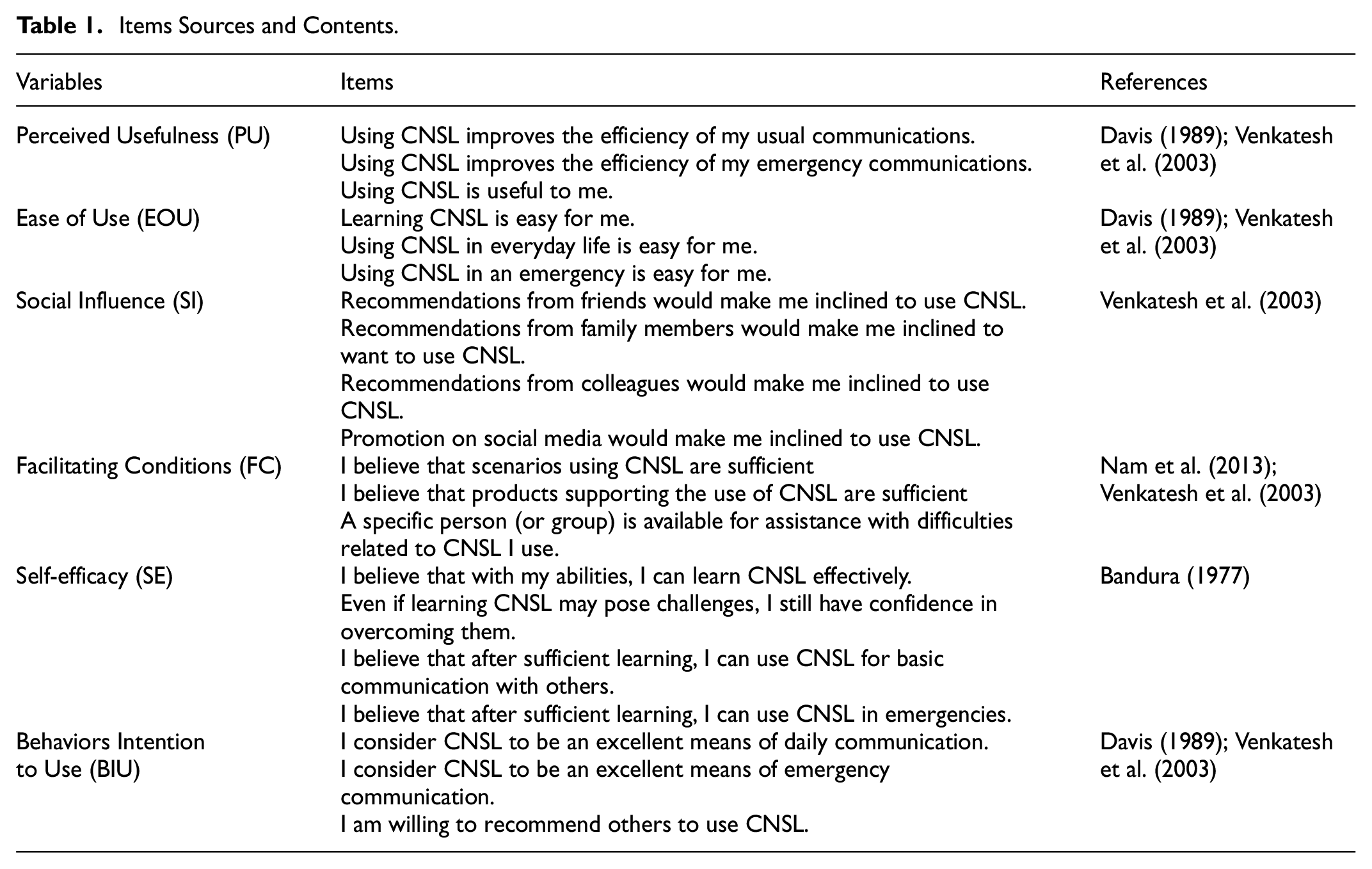
The second part is built upon a carefully selected theoretical framework, which ensures that the questionnaire is a reliable and effective tool for data collection (see Figure 1 and Table 1). In this section, a Likert 5-point scale is utilized to report results, with options ranging from Strongly disagree to Strongly agree, allowing for a nuanced capture of participants’ attitudes toward specific statements. The use of these scales helps to ensure the appropriateness of the statistical analyses and facilitates the processing and interpretation of the data results. The choice of theories was based on the research design, participant characteristics, and prior studies.

Model construction.
Items Sources and Contents.
Perceived Usefulness and Ease of Use
Perceived Usefulness (PU) and Ease of Use (EOU) are considered to be important determinants of the intention to use technology (Davis, 1989). PU mainly examines users’ perceptions of the ability of an object to improve work efficiency and effectiveness, which relates to the performance level of new things (Pfeffer, 1982; Schein, 1980). EOU emphasizes the user’s experience, assessing whether the effort invested in adopting new systems or methods outweighs the performance benefits they provide (Radner & Rothschild, 1975).
Perceived Usefulness has received extensive attention in sign language research. Early exposure to SSL promotes bidirectional parent-child interactions and provides a foundation for motor coordination and visual acclimatization, both critical for acquiring written or spoken language (Supalla et al., 2020). It is also essential for HSIPs’ linguistic development, as limited access to standardized sign or spoken language during childhood can delay language acquisition and hinder the development of neural structures related to language (Hall, 2017). High-quality SSL education not only supports theory of mind development but also enhances creativity and memory (Napoli et al., 2015). In deaf schools, SSL serves as the primary medium of instruction, and delays in its acquisition can negatively affect academic performance (Hermans et al., 2010). Furthermore, the use of SSL not only addresses HSIPs’ personal and social communication needs but also facilitates their integration into communities, enabling them to interact with family, friends, and community members, thus alleviating loneliness and isolation (Hassinen & Lappalainen, 2018). In China, perceived usefulness emphasizes the practical benefits and efficiency of CNSL in real-world applications. It reflects how HSIPs view CNSL as an effective tool for daily communication, language acquisition, cognitive capabilities, and educational engagement. However, existing research often focus primarily on the use of SSL in everyday situations or conflates these with emergencies, failing to adequately distinguish between the two. This narrow focus overlooks the complexities of SSL use, especially in emergency contexts. In light of the COVID-19 pandemic, our study examines HSIPs’ perceived usefulness of CNSL in emergencies in China, aiming to address gaps in the literature and contribute to the advancement of sign language research.
Ease of Use refers to the perceived effort required by HSIPs to learn and employ SSL, which is influenced by factors such as the complexity of sign language structure, physical and cognitive conditions, cultural identity, and resource availability. SSL involves intricate grammar, syntax, and emotional expression, requiring the coordination of facial expressions, body movements, and hand gestures. Additionally, many HSIPs face additional physical challenges such as swallowing difficulties, cerebral palsy, vision impairments, and developmental disorders (Hassinen & Lappalainen, 2018), which further complicate learning. In communities where SSL lacks cultural acceptance, its usage is severely constrained. Adequate time and resources are essential to sustaining HSIPs’ acquisition of SSL, with some up to 9 years to achieve proficiency (Miller, 2008). This process requires specialized textbooks, video tutorials, sign language dictionaries, and modern technological tools to support effective learning. The Ease of Use of SSL is a critical global issue, particularly as protracted crises amplify the challenges of learning and utilizing it. Difficulties in accessing information during such crises can directly endanger the lives and well-being of HSIPs. In economically underdeveloped countries, reducing the barriers to learning and using SSL is essential to encouraging HSIPs to engage with sign language education. Our study aims to explore the additional challenges HSIPs encounter when using CNSL during emergency situations in China, offering insights that may inform strategies in other developing countries.
Social Influence
According to Kelman, the process of Social Influence involves compliance, internalization, and identification, exploring how an individual’s thoughts, emotions, and actions are affected by the actual, imagined, or implied presence of others. Venkatesh et al. (2003) stresses that Social Influence is the extent to which an individual believes that important others expect him or her to adopt a new system.
HSIPs’ acceptance of SSL is markedly affected by family environment and the modes of communication adopted by family members. Families that regularly use gestures may foster greater receptiveness to SSL (Miller, 2008). HSIP children of deaf parents typically acquire SSL at an early age, while those with hearing parents may experience delays in acquiring sign language skills (Hermans et al., 2010). Hearing parents may sometimes discourage their children from learning SSL due to cultural and linguistic barriers, which directly diminishes the child’s motivation to learn it (Hall, 2017).
Support from friends who use SSL also has a positive impact on HSIPs’ learning. Friends not only help alleviate the stress and anxiety associated with learning but also provide practical opportunities to enhance SSL skills. In the workplace, the inclusivity and understanding of colleagues, especially among hearing colleagues, can encourage HSIPs to be more engaged. HSIPs aspire to achieve better career development through the use of SSL, performing according to anticipated workplace norms (Hoffmeister, 2020). Social media has diversified the promotion of SSL, making it more engaging and appealing, which has sparked HSIPs’ interest in learning (Maulida et al., 2019). However, potential drawbacks exist (Saunders, 2016). Misinformation, stereotypes, and over-commercialization in the media can trigger conflicting attitudes in HSIPs, leading to mental resistance toward the adoption of SSL.
Drawing from extensive research and the sociocultural realities within China, we have gained valuable insights into the significant role of SI in the lives of HSIPs. The most impactful sources of SI stem from friends, family, colleagues, and social media. However, there is a noticeable gap in the literature, as previous studies have not sufficiently explored the distinct and profound impact these different sources of SI may have on HSIPs’ acceptance and use of CNSL. In China’s collectivist society, which emphasizes social harmony and interpersonal relationships, SI on the acceptance of CNSL by HSIPs warrants deeper investigation. Endorsement from close social networks, such as friends and family, likely carries more weight compared to some individualistic cultures.
Likewise, colleagues and social media play pivotal roles in disseminating information and shaping perceptions of CNSL in China, where group consensus and social endorsement are highly influential. Understanding these culturally rooted dynamics is essential for developing targeted strategies to promote CNSL adoption. Therefore, our study aims to bridge this gap by examining the specific SI factors influencing HSIPs in China, providing a nuanced understanding of the societal forces shaping CNSL adoption.
Facilitating Condition
Facilitating Condition (FC) refers to the objective factors an individual perceives as helpful in using a specific entity. Its core focus lies in determining whether the user has the necessary resources and support to use technology and identifying external factors that can assist the user. When favorable conditions are present, users are more inclined to accept and use new things (Venkatesh et al., 2003). It emphasizes that, apart from individual subjective cognition, external support and resources play a crucial role in the adoption of new languages.
The acceptance of SSL by HSIPs can be influenced by various external factors. Limited availability of sign language services significantly hinders many HSIPs access to SSL (Hassinen & Lappalainen, 2018). Numerous individuals with hearing impairments have limited exposure to SSL during their childhood (Kacorri et al., 2015), particularly deaf infants in hearing families, who may experience language deprivation due to the lack of access to SSL (Rosen, 2020). While HSIP students may express a willingness to learn SSL in the classroom, the absence of a supportive environment outside may discourage continued adoption. Community attitude also play a key role in fostering SSL learning. In inclusive communities, SSL seamlessly blends into daily routines, promoting active engagement (Hoffmeister, 2020). The presence of skilled interpreters and qualified teachers is essential for providing high-quality SSL education, which enhances learning outcomes and increases adoption rates (Brueggemann, 2020). However, when institutions such as hospitals or psychological consultation entities (James et al., 2022) decline SSL requests, HSIPs may feel additional stress, reducing their motivation to use SSL. Financial support is also key, as high costs can impede sustained interest in learning SSL.
While existing literature provides valuable insights into the external factors affecting the acceptance of SSL by HSIPs, it often overlook the interconnectedness of these factors and their collective impact on adoption behaviors. This gap is particularly evident in the absence of a holistic examination of the support ecosystem that shapes HSIPs’ engagement with CNSL. To address this, our study applies the concept of Facilitating Conditions (FC) to delve into the multifaceted support system required for CNSL adoption. We focuses on three critical areas: the availability of real-life scenarios for CNSL application, the adequacy of supportive products and technologies, and the accessibility of assistance for users encountering difficulties with CNSL.
By examining these aspects, our study not only identifies gaps in the current literature but also considers the unique socio-cultural context of China, offering a framework to address CNSL acceptance issues among HSIPs through the lens of Facilitating Conditions.
Self-Efficacy Theory
Self-efficacy (SE) holds universal relevance in predicting and explaining behavior change, referring to an individual’s belief in their ability to effectively perform specific actions in particular situations (Bandura, 1977). Self-efficacy influences an individual’s behavioral choices, level of effort, and persistence, thereby affecting the outcomes of their actions. This concept is widely applied across various domains, including education, healthcare, and career development, to elucidate individual behavioral changes, learning motivation, and emotional regulation.
Self-efficacy plays a key role in motivating the adoption of SSL (Michael, 2019; Miller, 2008). Many HSIPs struggle with low confidence due to loneliness, depression, anxiety symptoms, and personality disorders (Hassinen & Lappalainen, 2018). When HSIPs believe in their ability to learn SSL, they are more likely to invest time and effort. However, for those using cochlear implants, learning both auditory and oral skills alongside SSL can be overwhelming, as it requires developing two skills simultaneously without a pre-existing language foundation, which may induce self-doubt and hamper motivation (Hall, 2017). Engaging with proficient sign language users, especially adults (Napoli et al., 2015), can aid help overcome the challenges of acquisition, enhancing HSIP children’s Self-efficacy and boosting their confidence in using SSL (Michael, 2019). Self-efficacy not only drives learning motivation but is also closely linked to emotional and psychological well-being.
Although existing literature provides some insights, a significant research gap persists in effectively enhancing the Self-efficacy of HSIPs throughout the process of accepting CNSL. Current studies often fail to account for the influence of diverse cultural and social contexts on the self-efficacy of HSIPs using SSL. Distinct cultural environments present unique challenges and opportunities that significantly shape HSIPs’ experiences. Moreover, there is a relative lack of research on how to build supportive social networks to enhance the Self-efficacy and motivation of HSIPs in learning SSL. By introducing Self-efficacy theory into the study of HSIP adopting CNSL, a deeper understanding of HSIPs’ self-awareness, emotional states, and behavioral patterns could be gained, offering more tailored support for their growth and adoption process. Our research aims to address these gaps, offering more targeted and effective strategies to encourage HSIPs to embrace CNSL more actively.
Data Collection
This study developed an electronic questionnaire based on the theory of Perceived Usefulness, Ease of Use, Social Influence, Facilitating Conditions, and Self-efficacy. In late October 2022, the electronic questionnaires were distributed via Wenjuanxing, utilizing the WeChat group managed by the Disabled Persons’ Federation of Yancheng District, Luohe City, Henan Province, China. To ensure that HSIP participants fully comprehended the questionnaire and completed it independently, they were provided with access to staff through a designated WeChat group for assistance and clarification whenever needed. For participants who were genuinely unable to complete the questionnaire independently (e.g., those with low literacy, or limited comprehension abilities), we ensured they did not participate, or that a trusted family member or friend assisted in the completion process to uphold data accuracy and integrity. Following data collection, we excluded questionnaires that exhibited insufficient completion time or inconsistencies in responses to reverse-coded validation items, further ensuring the quality and reliability of the dataset. A total of 191 questionnaires were collected by November 5, with 147 were deemed valid, yielding an effective recovery response rate of 76.96%.
Results
Descriptive Statistics
Upon analyzing the data, several noteworthy patterns emerge that highlight the characteristics of our surveyed cohort. The gender spread in the dataset is fairly even, fostering a balanced representation. A significant 98% of the participants are adults, suggesting a mature cognitive framework and evaluative capacities. In terms of marital status, around 76.2% of participants are married, indicating a potentially stable familial and social environment. From the disability standpoint, it’s interesting to note that only 25 respondents are categorized under disability level 1, a relatively smaller proportion compared to other levels. The analysis of education, occupation, and financial metrics provides insightful findings. With the 2021 benchmark for per capita disposable income in Luohe City set at 28,000 yuan, it is concerning to discover that 81% of participants earn below this threshold. Moreover, approximately 68% of respondents have attained a high school education or below, indicating limited educational opportunities. The ambiguous occupational tag of “other” chosen by 98 participants further raises questions about potential employment challenges or discrepancies they might face. The combination of restricted educational access and limited income avenues could potentially result in lower life quality, underscoring the urgency for adaptive strategies and robust support mechanisms. Additionally, it is worth noting that 25.9% of respondents had not heard of CNSL, and 37.4% had never used it (Table 2).
Demographic Characteristics.

Note. According to the regulations of the China Disabled Persons’ Federation, the level of disability decreases progressively from Level 1 to Level 4.
Reliability and Validity Tests
The questionnaire consists of seven variables, namely Perceived Usefulness (PU), Ease of Use (EOU), Social Influence (SI), Facilitating Conditions (FC), Self-efficacy (SE), and Behaviors Intention to Use (BIU). The reliability of the questionnaire was analyzed using SPSS 26.0 (Table 3). The results show that Cronbach’s alpha coefficients are all above .8, indicating that the data have good internal consistency and can be used for correlation and regression analyses. The KMO value in Table 4 is 0.876, all exceeding 0.6, suggesting that the questionnaire data is suitable for factor analysis. Bartlett’s test p-value is less than .001, rejecting the null hypothesis and indicating that the data does not conform to a multivariate normal distribution, thereby validating the use of factor analysis.
Reliability Analysis.

KMO and Bartlett’s Test.

In factor analysis, the relationship between variables and factors is assessed through factor loadings. Principal component analysis was employed for factor extraction, and the Kaiser normalizing maximum variance method was used for factor rotation. Table 5 presents the variables and their respective correlation coefficients with each of the six components. Most variables exhibit relatively high correlations with at least one factor, indicating good validity of the data.
Rotated Component Matrix.

Correlation Analysis
Based on the magnitude of correlation coefficients and the significance level, the independent variables that exhibit strong and significant correlations with the dependent variable were selected to be included as explanatory variables in the regression model. Table 6 presents the correlation matrix of questionnaire data, displaying the correlation coefficients among the seven variables. The correlation values between each variable fall within the range of −1 to 1, and the significance levels meet the required criteria. This suggests that the data is suitable for constructing a linear regression model.
Correlation Analysis.

Note. ** and * indicate significant correlation at .01 (two-tailed) and .05 (two-tailed), respectively.
Regression Analysis
Table 7 lists the statistical indicators for the linear regression model. The independent variables in this model are PU, EOU, SI, FC, and SE. The adjusted R-squared is a coefficient of determination adjusted for the number of independent variables. The adjusted R-squared value is .511, indicating that the independent variables can account for 51.1% of the variability in the dependent variable. This suggests that the independent variables possess a certain predictive capability for BIU and can explain a portion of the variability in BIU.
Model Summary.

Table 8 presents the findings of the analysis of variance (ANOVA) for the regression model. According to the results, the sum of squares for regression is 54.888, with 6 degrees of freedom, a mean square of 10.978, an F-value of 31.466, and a significance level of .000. This indicates that the regression model is suitable for predicting BIU, and the six independent variables have a positively significant impact on it.
ANOVA Analysis.

This study employed a linear regression model to explore the relationship between BIU and six variables, as presented in Table 9. The coefficients for PU, EOU, SI, FC, and SE are significant. This indicates a significant positive correlation between these variables and BIU. Finally, VIF (Variance Inflation Factor) measurements were used to evaluate collinearity issues. All VIF values were found to be lower than 1.7, which is much lower than the standard limits of 5 or 10. Therefore, in this regression model, collinearity problems are not expected to affect the accuracy and reliability of the model.
Coefficients.

One-Way ANOVA Test
The one-way ANOVA results (Table 10) indicate that factors such as gender, educational level, annual income, and the level of disability significantly influence the usage of CNSL. Among them, gender stands out as the most influential factor in using CNSL. The F-value is 5.025 with a p-value of .026, which is less than the commonly accepted significance level of .05. This suggests significant differences in the willingness to use CNSL among different genders. Similarly, educational level shows a significant difference with an F-value of 2.408 and a p-value of .039. This means that the educational level can also influence the willingness to use CNSL. The annual income factor is also found to be significant, with an F-value of 2.739 and a p-value of .031. Thus, the willingness to use CNSL might vary among individuals with different annual incomes. The disability level has an F-value of 2.669 and a p-value exactly at the threshold of .050. This suggests a borderline significance, indicating that the willingness to use CNSL might also differ based on the disability level.
One-Way Analysis of Variance (ANOVA).

Moreover, through a deeper post-hoc analysis (Bonferroni) (Figure 2), significant differences in BIU between the annual income group of 5.00 and all other groups have been observed. Especially, the differences between the three groups with annual incomes below 50,000 yuan and those with annual incomes exceeding 100,000 yuan, p-values were .019, .025, and .022, respectively. These findings present compelling evidence for further exploration into the influence of economic status on the acceptance of CNSL among Chinese HSIPs.
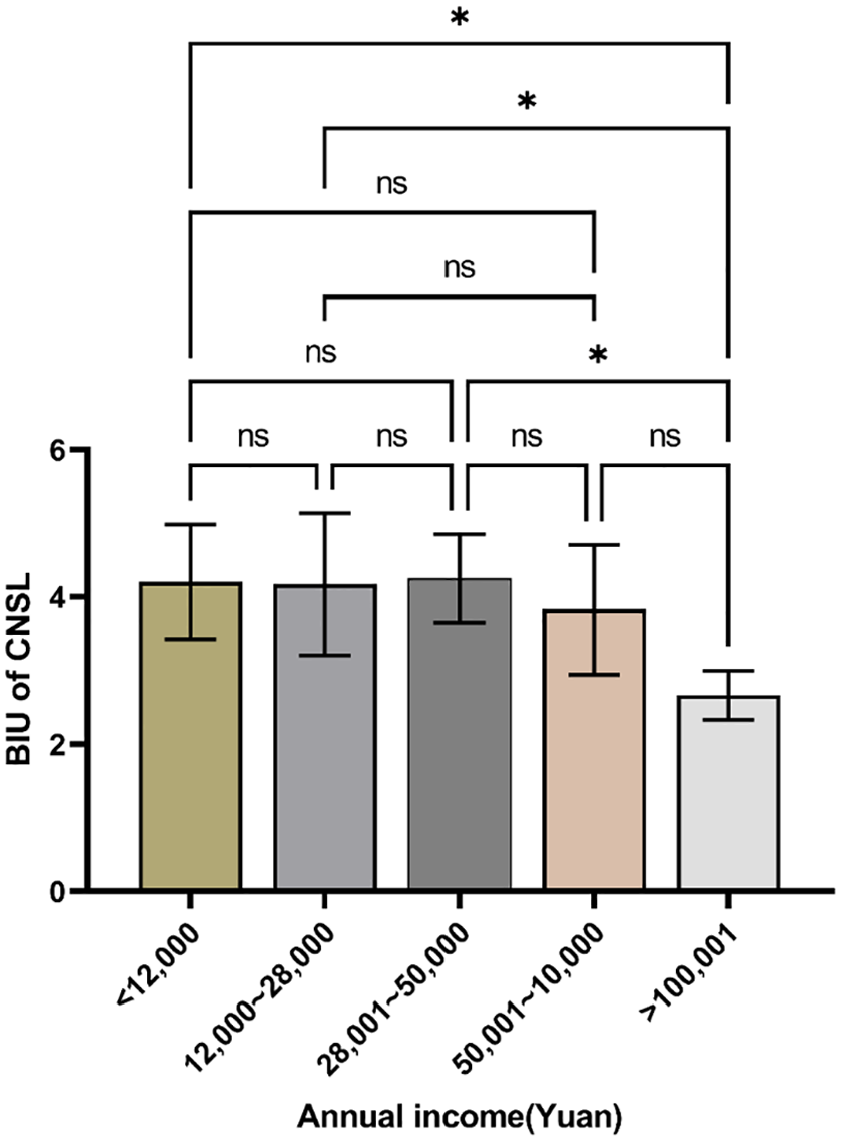
Results of multiple analysis of annual income on BIUs. Note. *indicates a statistically significant difference (p < 0.05); ns indicates no significant difference.
Discussion
This study embarked on an investigation within Yancheng District, Luohe City, Henan Province, China, targeting HSIPs to decode their Behavioral Intention toward CNSL adoption. Centering on five pivotal variables—Perceived Usefulness, Ease of Use, Social Influence, Facilitating Conditions, and Self-efficacy—our analysis unveils a unanimous significant influence of these factors on HSIPs’ acceptance of CNSL. This introduction lays the groundwork for a comprehensive examination of each variable’s role and their collective impact on adopting CNSL, aligning our empirical findings with the theoretical framework posited at the onset of this research.
Perceived Usefulness (PU) and Ease of Use (EOU)
Our research elucidates the profound influence of both Perceived Usefulness and Ease of Use on the Behavioral Intention toward CNSL adoption among HSIPs in China. Perceived Usefulness focuses on the tangible benefits of CNSL, while Ease of Use emphasizes whether extra effort is needed when using CNSL. This suggests that enhancing the practicality and accessibility of CNSL during public health emergencies should be a key priority.
Research has shown that the perceived usefulness of CNSL significantly influences HSIPs’ willingness to adopt it, underscoring the practical advantages within the Chinese context. CNSL offers tangible convenience and serve as a key motivator for HSIPs, functioning much like Mandarin for the hearing population by facilitating communication across disciplines and formal settings (Miller, 2008). During public health emergencies, the standardization of CNSL enables government agencies, healthcare institutions, and public health bodies to consistently deliver policies, medical advice, and emergency measures to HSIPs across the country (Hoffmeister, 2020). This consistency helps prevent miscommunication and information loss, supporting the effective implementation of public health initiatives. In formal and professional settings, CNSL proficiency also aids HSIPs in fulfilling social responsibilities, integrating into society, and reducing feelings of isolation (Hassinen & Lappalainen, 2018). However, in smaller, localized communities, the appeal of CNSL diminishes as Homesign suffices for daily interactions, reducing the motivation to learn CNSL. This lack of engagement weakens CNSL’s communication benefits during crises like the COVID-19 pandemic, where minimizing misinformation and delays is critical for effective emergency responses (Adithya & Rajesh, 2020). Limited CNSL proficiency among HSIPs further hampers the dissemination of news, public health education, community support, and volunteer efforts, both online and offline, compounding challenges like psychological stress, social isolation, and barriers to healthcare access due to inadequate information.
Local communities serve as a critical foundation for promoting and expanding CNSL use. By creating a bilingual sign language environment, HSIPs can use Homesign for daily communication while employing CNSL in formal or emergency settings, gradually reducing resistance to CNSL as a Homesign alternative. Organizations like the Chinese Deaf Association and the Disabled Persons’ Federation could support CNSL adoption by subsidizing training programs and providing free online resources, such as sign language learning games, online courses, and public health policy videos. These initiatives ensure continuous CNSL learning and foster an understanding of public health guidelines. China could also follow Australia’s model during COVID-19 (Levin, 2021), which promoted Auslan courses and integrated sign language support into mental health services. This could be adapted to offer professional counseling for HSIPs in China. Local governments, in collaboration with the Disabled Persons’ Federation, could host regular workshops on digital tools and social media to enhance HSIPs’ knowledge and social engagement. Encouraging HSIPs to manage social media accounts using CNSL would amplify their influence, enabling them to counter misinformation and disseminate accurate emergency information during crises.
The Ease of Use of SSL remains a formidable obstacle to HSIPs’ utilization. Learning CNSL demands substantial time, financial resources, and individual effort, presenting a significant challenge (Miller, 2008). Compounded by the physical and psychological disabilities (Hassinen & Lappalainen, 2018) that many HSIPs contend with, these factors exacerbate the difficulty of adopting CNSL, leading to a preference for informal Homesign. Such preferences hinder HSIPs from leveraging the communicative advantages of CNSL, especially in formal contexts during the COVID-19 pandemic. Furthermore, the diminished perception of CNSL’s utility in emergency communication, alongside a dependency on governmental interventions, prompts HSIPs to seek external solutions to their challenges rather than address their reliance on non-SSL. This dependency reflects a broader issue of autonomy in problem-solving, influencing their receptiveness toward CNSL.
To address challenges related to ease of use, educational support, resource scarcity, and cultural recognition, and to fully leverage the communicative potential of CNSL in daily and emergency situations, strict implementation of the Chinese National Sign Language Standards and related accessibility laws is essential. This would solidify the legal status of CNSL for HSIPs. Unlike the United States, where no sign language is federally recognized—though some states acknowledge ASL as a foreign or instructional language (WorldAtlas, 2018)—China has officially recognized CNSL as its national sign language. This provides a significant advantage, enabling efficient nationwide dissemination of public health policies, vaccination details, and emergency measures issued by the central government. To further promote CNSL, local disability federations, NGOs, and educational institutions should offer customized learning support, such as video tutorials, AI-powered tools, and peer learning groups, tailored to the unique needs of HSIPs to ensure successful CNSL acquisition. China could also take inspiration from the Japanese ASL Signers Society (JASS), which provides not only sign language courses and workshops but also scholarships for HSIPs pursuing higher education, supporting both academic and professional growth. Local governments, in collaboration with disability federations, should foster greater acceptance of CNSL within hearing communities. A professional network of sign language interpreters and volunteers should be established to mobilize quickly in public health emergencies. With the rise of digital communication, enhancing interpreters’ remote interpreting skills is critical. Governments and disability federations must also address the unique challenges interpreters face, such as the lack of real-time feedback, the increased demands for self-monitoring and teamwork, as well as the physical strains of repetitive stress injuries, eye fatigue, and psychological pressures. Occupational health programs and regular assessments would help ensure interpreters can work effectively under pressure.
Social Influence (SI)
This study primarily examines the role of Social Influence through the effects of family, friends, colleagues, and media on HSIPs’ acceptance of CNSL. The results indicate that SI significantly impacts HSIP’s willingness to accept CNSL, with family, mainly parents, playing a crucial role in influencing SSL acquisition among HSIP children. A family environment incorporating sign language provides children with early opportunities to learn SSL (McKee & Smiler, 2016). However, hearing parents often hold differing views. Some financially secure parents without biases encourage early systematic learning, while others, due to financial constraints, a lack of emphasis on SSL, or over-reliance on cochlear implants and hearing aids, might delay their children’s exposure to SSL. This not only deprives HSIP children of their linguistic rights but also impedes their neural development. Furthermore, limited access to information can cause psychological issues in HSIP children. Friends also play a key role, as HSIPs rely on them for communication in both every day and emergency situations. Parent training programs can be an effective solution, such as ASL workshops provided by the American Society for Deaf Children or ASL teaching support through early intervention systems offered by the National Association of the Deaf. Platforms like AccessForce and Sound for Light further aid parents in developing skills to better support their children’s language development. Proficient parents can quickly relay vital information during public health emergencies, reducing delays and misunderstandings, which enhances the security, reduces stress, and improves HSIP children’s ability to respond in emergencies, promoting overall well-being and safety.
Having friends who use SSL can effectively reduce the psychological stress experienced by HSIPs and stimulate their enthusiasm for learning (Napoli et al., 2015). However, there are also limitations to this reliance. Some researchers advocate for the development of community-based communication framework based on SSL (Cripps et al., 2016), aiming to reduce HSIPs’ overdependence on friends and family. In emergencies, relying solely on friend’s interpretation may not always be feasible, and it may fail to fully meet HSIPs’ sign language communication needs (Tannenbaum-Baruchi et al., 2014). Encouraging local communities to establish social support networks based on SSL can provide HSIPs with more opportunities for peer communication using CNSL. Additionally, developing platforms akin to Interpretek and Convo, which provide SSL interpretation services in the U.S., would ensure that HSIPs can access timely emergency information via phone, video, or dedicated apps, regardless of their location. Such infrastructure is essential to prevent HSIPs from being excluded from critical communication channels, especially in emergency situations.
The employment landscape for HSIPs in China is notably complex. According to the China Disability Statistics Yearbook 2022, while the total employment in China stands at 8,816,435, the certified disabled population amounts to 38,049,193, indicating that only 23.18% of individuals with disabilities are employed. It reveals the enormous challenges disabled individuals face in accessing the job market. HSIPs in professional environment may confront stresses from colleagues, supervisors, or subordinates, often due to misconceptions skills, communication obstacles, and entrenched biases regarding their work capabilities. Drawing from the successful model of New Zealand Sign Language Week (NZSL Week), which promotes public awareness through specialized sign language courses, could serve as an effective strategy for increasing CNSL awareness. NZSL Week not only enhances communication between the Deaf and hearing communities but also utilizes advertising, social media, and cultural exhibitions to challenge societal stereotypes. Promoting CNSL among hearing individuals could reduce biases against HSIPs, fostering a more inclusive work environment. Furthermore, such initiatives would be invaluable during emergencies, ensuring that HSIPs’ needs are recognized and their access to critical information is secured.
The rapid development of media has led HSIPs to increasingly rely on it. Positive media promotion of CNSL can support HSIPs in accepting and practicing SSL, as well as strengthening cultural identity (Maulida et al., 2019). However, social media platforms can also foster aggressive behaviors (Saunders, 2016). Coupled with the challenge of discerning credible information and the prevalence of online scams in China, some media might misguide HSIPs, causing emotional distress, financial losses, and ultimately failing to achieve the purpose of promoting CNSL. A more effective approach would be to utilize widely recognized anti-fraud platforms and applications to develop sign language versions, helping HSIPs identify scams and misinformation, especially during emergencies. Social media could also host CNSL-based anti-fraud awareness campaigns aimed at HSIPs. Additionally, training trustworthy HSIP representatives or sign language health ambassadors to disseminate accurate health information via social media and public events would ensure timely, reliable updates, enhancing HSIPs’ ability to respond to public health crises effectively.
Facilitating Conditions (FC)
FC in our research has been proven to significantly positively affect HSIP’s acceptance of CNSL, indicating that external support and resources play a key role in fostering adoption. Consistent with Hoffmeister (2020), our research indicates that HSIPs are more inclined to adopt CNSL in familiar settings such as schools and communities. In China, online communities offer HSIPs more opportunities to practice CNSL through video sharing, online discussions, and simulated communication, helping them enhance their skills and find a sense of belonging. The expansive reach of online communities also incentivizes HSIPs to learn CNSL for broader online engagement. The COVID-19 pandemic exposed challenges in hospital settings where the widespread use of masks reduced the effectiveness of SSL reliant on lip-reading and facial expressions. Even with transparent masks, there is a scarcity of medical personnel proficient in CNSL, limiting the availability of SSL interpretation services for HSIPs in China, reflecting a lack of inclusivity and equity. Furthermore, during the pandemic, many HSIPs encountered psychological issues, but certified CNSL-fluent psychologists remain rare (James et al., 2022), often leaving HSIPs dependent on community workers or self-help for psychological support. The U.S. and the UK are leaders in sign language services within healthcare. In the U.S., the National Institutes of Health (NIH) provides sign language interpretation under the ADA and Section 504 of the Rehabilitation Act. Similarly, the UK’s NHS offers sign language services for medical appointments and emergencies, funded by the government to ensure effective communication. China could develop a professional sign language interpretation team using standardized management to improve access to sign language services in healthcare, including online services during public health emergencies. Addressing the technological challenges associated with SSL assistive tools is essential. While products like the US’s Sign-to-911 (Guo et al., 2023), the JSL CG system from Japan (Uchida et al., 2016), and Indian’s video dataset technologies (Adithya & Rajesh, 2020) have demonstrated their usefulness, they still face significant constraints. For instance, commercial AR glasses supporting Sign-to-911 are priced at around $350, JSL CG’s performance is limited by hardware and browser capabilities, and India’s system relies heavily on stable network connectivity.
Our survey results indicate that 81% of respondents earn less than the average disposable income in Louhe City (28,000 yuan), emphasizing that, despite the availability of CNSL tools, the associated costs (e.g., internet, telecommunication, and transportation) remain a significant burden. Moreover, elderly respondents face cognitive and learning limitations, further complicating the use of assistive products with CNSL. Therefore, the development of SSL assistive tools, especially in developing countries like China, should prioritize both usability and affordability. Collaboration between tech companies, academic institutions, and sign language experts is crucial to simplify device interfaces, making them more user-friendly. Governments should provide financial support, tax incentives, and policies to encourage the production and distribution of these tools. Moreover, charitable foundations and corporate social responsibility initiatives can offer additional support to develop these products and provide financial assistance to underprivileged HSIPs.
The availability of human resources is a critical factor in facilitating the adoption of CNSL. In China, this encompasses professional CNSL interpreters, teachers, and counselors, and trained volunteers or community workers. As highlighted by of James et al. (2022) and Brueggemann (2020), there is an urgent shortage of qualified SSL interpreters and teachers, compounded by a lack of societal recognition of the importance of sign language translation and education. This has led to inadequate investment in the field, where careers career in CNSL interpreters and teachers offer limited social acknowledgment and financial incentives. Additionally, the regional diversity of sign languages complicates the training of skilled professionals. The COVID-19 pandemic further exposed these challenges. Public resources were stretched, leading to the reassignment of CNSL-trained volunteers and community workers to pandemic prevention efforts, reducing their availability for supporting HSIPs.This underscored how vulnerable groups, like HSIPs, can be marginalized during public emergencies when resources are scarce. To address these challenges, China must focus on developing robust policies that not only cultivate skilled professionals but also enhance inclusivity for vulnerable groups. It is essential to ensure that sign language interpretation services remain consistently available, particularly during public health emergencies, to safeguard the communication needs of HSIPs.
Self-efficacy (SE)
The results of this study demonstrate a significant positive relationship between Self-efficacy (SE) and behavioral intention to use (BIU): HSIPs with a stronger sense of SE are more inclined to accept CNSL. This demonstrates the importance of not only emphasizing the practical benefits of CNSL but also fostering and enhancing learners’ Self-efficacy when enhancing HSIPs’ acceptance of CNSL.
Self-efficacy reflects the psychological state of HSIPs when confronted with the challenge of learning CNSL, highlighting the perceived difficulties associated with mastering a new language. A strong belief in their ability to acquire CNSL motivates active engagement in the learning process. However, preliminary discussions with staff from the Disabled Persons’ Federation revealed that local HSIPs, especially the elderly, approach CNSL with caution, fearing that this new undertaking might threaten their established routines. Feelings of self-doubt and inadequacy are common, with some HSIPs believing that mastering such a complex language is beyond their capabilities, resulting in low Self-efficacy. This aligns with Hassinen and Lappalainen’s (2018) findings, which highlighted the negative impact of these emotional barriers on HSIPs’ confidence. Conversely, some HSIPs exhibit initial openness toward CNSL but often hesitate when faced with its systematic nature and learning demands. They view it as time-consuming and costly, with concerns about becoming isolated from their existing Homesign social circles, straying from familiar cultural norms. Additionally, the long-term benefits of CNSL—such as improved emergency communication and expanded social interactions—are not always immediately apparent, further reducing their motivation to pursue it.
Apart from HSIPs with low Self-efficacy, a subgroup demonstrating higher Self-efficacy emerged in our study. These individuals firmly believe in the effectiveness and universality of CNSL, considering it accessible to anyone (Cripps et al., 2016). However, the reasons behind this confidence vary. Some possess inherently high self-esteem, while others place trust the involvement of Disabled Persons’ Federation, convinced of CNSL’s benefits. Notably, none of the participants viewed themselves as minority group using sign language, which contrasts with Engelman et al. (2013) findings. Furthermore, contrasting with Hall’s (2017) findings, where parents had high expectations for HSIPs to master both spoken language (with hearing aids or cochlear implants) and SSL, our study found that parents and relatives of HSIPs held more pragmatic expectations. Their focus was on independent living and achieving financial independence, without imposing excessive pressure on Self-efficacy.
To address the challenges faced by Chinese HSIPs, education and targeted interventions are critical strategies. Strengthening foundational CNSL education is essential to provide HSIPs with a clear understanding of the language and help them objectively assess their proficiency. A tailored learning system should be developed, particularly for elderly individuals, illiterate populations, and children, offering simplified introductory courses. Rather than imposing strict proficiency or grading standards, these courses should prioritize effective communication in emergency situations. The curriculum can include focused training in emergency communication and everyday expressions. Moreover, integrating psychology into CNSL training can boost learners’ confidence in both language acquisition and emergency preparedness. Given that many HSIPs adopt a passive role during crises, making it difficult for them to proactively seek critical information, regular sign language emergency drills should be conducted to enhance their confidence and preparedness for real emergencies.
Annual Income
Our research in Sections 4.1, 4.2, and 4.4 examines the economic impact on HSIPs’ acceptance of CNSL. This encompasses the financial burden of learning CNSL, the supportive role of wealthier families, and the use of economic resources to boost HSIPs’ Self-efficacy. Additionally, our exploratory analysis identified relationships between participants’ annual income and their intention to use CNSL.
Beyond theoretical factors, we conducted a one-way analysis on variance such as age, marital status, educational level, occupation, annual income, type of disability, and disability levels. Results showed that the p-values for gender, education level, annual income, and disability grade were all below 0.05. Post hoc multiple tests showed significant difference in BIU to CNSL between at least two annual income groups. Specifically, the Bonferroni post-hoc test indicated significant differences between income Group 1 and Group 5, Group 2 and Group 5, and Group 3 and Group 5, indicating that participants in lower-income groups exhibited a higher BIU compared to those in the highest income group (Group 5).
This suggest that financial status is not always positively correlated with the use of CNSL. HSIPs with higher annual incomes might adopt a more conservative approach toward CNSL for reasons beyond economics, such as cultural, educational, or social influences. While annual income reflects the economic capability of HSIPs, which directly impacts access to high-quality SSL education, learning materials, and participation in training, wealthier individuals may perceive communication challenges differently. They may not feel the same urgency to address communication issues through CNSL, as they often have alternative methods such as cochlear implants, hearing aids, and other assistive technologies, supported by greater financial resources for spoken language education. Additionally, their access to information and resources may reduce their dependence on CNSL. In contrast, lower-income HSIPs, representing around 95.3% of respondents (81% in Group 1 and 2, and 14.3% in Group 3), may have a stronger motivation to use CNSL due to their limited access to continuous learning opportunities. They might cherish every opportunity to access CNSL.
These research findings suggest that when promoting CNSL, it is necessary to fully consider the impact of economic factors on the acceptance of HSIPs. As a developing country, China’s relatively low GDP per capita limits many measures to protect the rights and interests of HSIPs, while also hindering opportunities for their development. HSIPs with better economic conditions have more communication resources and channels for rights protection, and their attitudes toward CNSL are different as a result. The cognitive differences brought about by economic conditions require us to adopt differentiated promotion policies to compensate.
For higher-income HSIPs, their reluctance to adopt CNSL often stems from a lack of understanding or misconceptions about its benefits. To address this, a diversified promotional strategy should be employed, utilizing various communication platforms such as television, the internet, social media, and public lectures to effectively convey CNSL’s value and importance to this group. During public health emergencies, CNSL is essential for rapid access to information and informed decision-making regarding personal safety. Furthermore, high-income HSIPs can leverage their influence to serve as opinion leaders, helping other HSIPs understand and act on critical information during crises. This dual role not only promotes greater societal equity and inclusivity but also provides high-income HSIPs with a sense of accomplishment and social contribution. For lower-income HSIPs, policy interventions should focus on improving the accessibility and affordability of CNSL education and resources. This could include funding sign language courses, providing free learning materials, and investing in technology that facilitates CNSL learning. Additionally, targeted financial support programs—such as scholarships, grants, and subsidies for assistive technologies—can help reduce economic barriers and promote the widespread adoption of CNSL.
Conclusion
The global debate surrounding whether individuals with Hearing and speech-impaired persons (HSIPs) should learn standard sign language has persisted. However, the outbreak of COVID-19 has underscored a critical message worldwide: in an increasingly risky world, effective communication among HSIPs cannot be underestimated. SSL may offer a solution. China’s experience serves as a compelling example: while CNSL has received legal recognition, its acceptance within the HSIP community remains limited due to its recent emergence. During the pandemic, HSIPs faced communication challenges as lip reading became ineffective, and the lack of CNSL proficiency hindered their access to crucial emergency information. This not only caused psychological distress but also potentially compromised healthcare responses. In a country like China, which frequently encounters emergencies and has gradually improved its emergency management system, promoting CNSL becomes an essential measure for effective communication during crises.
As a developing nation, China shares common challenges with other countries, such as limited employment opportunities and inadequate educational resources for HSIPs. However, China’s vast population also presents an opportunity for CNSL promotion, benefiting a larger number of individuals. Through linear regression analysis of the data from the questionnaires distributed online, this study demonstrated that the Perceived Usefulness (PU), Ease of Use (EOU), Social Influence (SI), Facilitating Conditions (FC), and Self-efficacy (SE) all significantly positively impact the Behavioral Intention to Use (BIU) CNSL. Interestingly, variance analysis and post-hoc tests revealed that HSIPs with higher annual incomes are less willing to use CNSL compared to those in the three lower-income groups. These insights not only reflect the actual situation of the acceptance of CNSL among HSIPs in China but also provide the global community with a valuable reference for understanding the unique circumstances of Chinese HSIPs.
To enhance the adoption of CNSL, it is essential to enhance the usefulness and Ease of Use of CNSL, establish more Facilitating Conditions, and leverage Social Influence by promoting CNSL through social networks and media. Policies should also be tailored to address the diverse needs of HSIPs across different income levels. CNSL must become a routine part of daily life to increase its prevalence, allowing it to serve as a crucial communication tool during emergencies, ultimately saving lives and protecting property. Despite the significant findings this study brings forth, there are some limitations. Firstly, the sample size was restricted, mainly due to the limited response capability of the participants. Although the electronic questionnaire was extensively distributed across multiple WeChat groups, many HSIPs faced challenges in independently completing the questionnaire due to factors such as illiteracy, unfamiliarity with electronic questionnaires, and limited comprehension abilities. They need to rely on assistance from friends, family, staff from the Disabled Persons’ Federation, and community workers. Out of the 1,288 HSIPs locally, only 191 managed to finish the survey. Secondly, the representativeness of the sample may be questioned. While studying HSIPs’ behavior toward accepting CNSL is a valuable direction, the practical constraints of this study limited the sample to HSIPs from a single region. The economic, educational, and cultural backdrop of this city might significantly differ from larger cities, suggesting that the research findings might not fully represent the varied contexts across China.
Future research on the utilization of CNSL among HSIPs can adopt different research methods, such as face-to-face surveys and interviews, to gain deeper insights into the specific challenges they face. Moreover, conducting cross-city and cross-country comparative studies in China and other countries might yield intriguing results. Researching the influence of factors such as economic conditions, culture, and educational levels on their behavior could provide new insights. This multi-dimensional understanding of HSIPs can contribute to the development of CNSL or other SSLs in the future, as it helps explain the diversity in their behavior.
Footnotes

Funding
The author(s) disclosed receipt of the following financial support for the research, authorship, and/or publication of this article: This research is supported by the 13th Five-Year Plan research plan of the State Language Commission in China. The project name is Emergency Language Services for Special Populations, and the project number is ZDI135-119.
Declaration of Conflicting Interests
The author(s) declared no potential conflicts of interest with respect to the research, authorship, and/or publication of this article.
Data Availability
Data sharing not applicable to this article as no datasets were generated or analyzed during the current study.