




Abstract
This article investigates the power dynamics in police interviews with suspects in China by examining a real-life sample. It first overviews some recent developments and legislation in China regarding police interviewing of suspects, followed by outlining the linguistic and psychological research upon which the analyses are based. The interviews are examined using critical discourse analysis that reveals the high-power position of the Chinese police in suspect interviews. However, the large proportion of open questions found in the interviews is encouraging, as this suggests that regulations outlawing use of evidence obtained by torture or other illegal means are taking effect. This article is the first to empirically examine actual Chinese police interviews with suspects, providing valuable insights for theories and practice.
Introduction
In light of psychological research a growing number of countries/organisations have decided to adopt a non-coercive method of interviewing suspects. Indeed, in 2016, the United Nation’s ‘Special Rapporteur on torture and other cruel, inhuman or degrading treatment or punishment’ (law professor Juan E. Mendez) submitted his report which was then transmitted by the United Nations (UN) Secretary-General to the UN General Assembly (2016).
In report summary stated that, The Special Rapporteur…advocates the development of a universal protocol identifying a set of standards for non-coercive interviewing methods and procedural safeguards that ought, as a matter of law and policy, to be applied at a minimum to all interviews by law enforcement officials, military and intelligence personnel and other bodies with investigative mandates.
This ‘universal protocol’ (i.e. guidance document to be available worldwide) is being drafted by a Steering Committee of 15 individuals from a number of countries and includes the third author of this article. One of the states/countries that has expressed an interest in the ‘investigative interviewing’ model (for an overview of it see Milne and Bull, 1999) is China, and some recent influences in China through international exchanges are described.
Relevant international influences
To the authors’ knowledge, one of the very first international influences on Chinese police interview practice started with a European Commission (EC)-funded programme from 2009 to 2012, which involved collaboration between the Great Britain China Centre, Renmin University in Beijing, Maastricht University in the Netherlands and the Belgian police. One of the components of this programme was police interviewing, for which exchanges between European Union (EU) experts and senior instructors from leading Chinese police training academies took place. This resulted in a model for skills workshops (derived from the PEACE model) delivered in China to police trainers and practitioners from 23 Chinese provinces. These workshops resulted in an electronic training manual, consisting of guidance for trainers and a selection of relevant literatures (Vanderhallen and Lei, 2012).
Similar exchanges also happened between the Norwegian police (who developed ‘KREATIV’, a Norwegian version of the PEACE method), University of Oslo, the Great Britain China Centre, Renmin University in China, and the People’s Public Security University of China (PPSUC), which led to training courses for high-ranking officers and experienced detectives in Chinese Police in 2017 and 2018. In light of changes in the Chinese criminal code in 2012, the New York University (NYU) Asia Law Institute also invited international scholars to introduce alternative methods of questioning suspects, including the PEACE method, the scientific basis of investigative interviewing and research on problems created by coercive interrogation (Belkin et al., 2018).
The above-mentioned exchanges and other visits by international scholars over the past decade in various provinces and institutions have set the scene for the UN’s recommendation to be actively considered in China, and made the current study possible. In China, little research had been conducted on pragmatic and semantic aspects of questioning in police interviews. Therefore, the primary aim of this study is to use real police interviews to shed light on current suspect interview practice in China.
Investigative interview research and relevant legal development in China
Investigative interviewing is one of the first and most important law enforcement activities when investigating crime, and its subsequent outcomes have significant implications for criminal justice (McGurk et al., 1993; Milne and Bull, 2006). Because investigative interviewing is an information-gathering process, the types of questions (Bull, 2010; Newlin et al., 2015) posed by an investigator and the way in which these questions are posed (Almerigogna et al., 2007; Bull and Corran, 2003; Teoh and Lamb, 2013) can greatly affect the amount and accuracy of testimony. A large amount of literature has accumulated regarding what best practice should look like and in some countries, practical guidelines and policies have been formulated accordingly, e.g. ‘Achieving the Best Evidence in Criminal Proceedings’ (Ministry of Justice, 2011), the ‘PEACE’ method (Milne and Bull, 1999) and the NICHD interview protocol (Lamb et al., 2007). To evaluate and safeguard the quality of investigative interview practice, the types of questions asked have often been analysed as an index of interview quality (Griffiths and Milne, 2006).
In many Western countries ‘investigative interviewing’ has been adopted instead of ‘interrogation’, illustrating the fundamental change to suspect interviews that are more ethical and less coercive. For example, in England, ‘investigation interviewing’ refers to questioning of suspects, victims and witnesses at any point in the investigative process (Gudjonsson, 1994; Williamson, 1993). This ethical approach to investigation can elicit more reliable information from a person about an alleged offence (Brewer and Williams, 2005), and reduce the risk of suspects making false confessions. Below we summarise recent developments in legislation regarding police interviewing in China.
Legislations about suspect interview in China
In the People’s Republic of China (PRC), the key legislation regulating investigative powers is the Chinese Criminal Procedure Law (CCPL) implemented in 1996, revised in 2012. CCPL Section 43 prohibits the use of torture, threats, inducement, deception and any other unlawful means to obtain evidence. Obtaining evidence by torture is also prohibited in various other legal and procedural guidelines [such as Section 61 of the Supreme People’s Court Legal Interpretation, Section 247 of the Chinese Criminal Law (CCL) 1997, Section 140 of the Supreme People’s Prosecution Institution (SPPI) Regulation of Criminal Procedure 1998, and SPPI Nine Strict Rules for Prosecution Officers 1999]. Guidelines on adopting contemporaneous audio and video recordings during interviews were published in the SPPI in 2005, followed by two technical and procedural support documents in 2006. The SPPI issued the ‘Rules of Holding Prosecution Officers’ Accountability for the Misconduct in Law Enforcement’ in 2007, reiterating the prohibition of using torture or other coercive means to obtain evidence. More discussions on these regulations and their implementation can be found in Belkin et al. (2018), Davies and Shen (2010) and Wu and Vander Beken (2010).
As yet, there are in China no practical interview protocols for practitioners to follow for conducting suspect interviews (see Zalman and Wu, 2017 for an overview), however, according to the regulations mentioned above, a police officer must follow the following legal principles when interviewing a suspect:
Principle of statutory interrogation. Criminal investigation, interrogation procedures and due process must be conducted according to the law. Thus legitimacy of criminal interrogation can be ensured and confessions admitted by a court. The laws and regulations concerning criminal interrogation can be found in the CCPL by the National People’s Congress, the Rules of Criminal Procedure of the People’s Procuratorates by Supreme People’s Procuratorate, and the Procedural Provisions on Handling Criminal Cases by the Ministry of Public Security.
Principle of prohibiting torture. Extorting confessions by torture and collecting evidence by threat, enticement, deceit or other unlawful means are strictly forbidden by Article 50 of the CCPL. During the period of interrogation, meals and necessary rest time of the suspect shall also be ensured (Article 117, CCPL). Moreover, anyone who extracts confessions by torture would be held criminally responsible (Article 247, CCL).
Principle of not readily giving credence to oral statements. Although oral statements provided by suspects are important evidence, innocent suspects may confess falsely if police officers conduct interviews inappropriately (Kassin et al., 2010). Therefore, police officers should obtain oral statements with caution and skill. The procedure to review suspects’ oral statements can be identified in the CCPL and ‘Provisions on the Exclusion of Illegal Evidence in Handling Criminal Cases’ jointly issued by the People’s Supreme Court, the People’s Supreme Procuratorate, Ministry of Public Security, Ministry of State Security and the Ministry of Justice in June 2010. The types and values of evidence are stipulated in Article 48 of the CCPL, which says all materials that may be used to prove the facts of a case can be used as evidence in court, including confession and defence of a suspect or defendant.
Principle of confidentiality with limited openness. Although interviewing of suspects should be conducted in private, a degree of openness is allowed to the public, more specifically, allowing the presence of a suspect’s attorney. Suspect interviewing in China had followed a principle of confidentiality until March 2012, when National People’s Congress adopted and promulgated ‘Decision on Revising the Chinese Criminal Procedure Law’. Article 5 of this Decision, which amends Article 33 of the CCPL, gives suspect the right to retain a defender during the period of investigation, starting from the day when the suspect is interrogated by a criminal investigation authority for the first time or from the day when a compulsory measure is taken against the suspect. Before this amendment, a suspect only had the right to entrust persons as his defenders from the date when the case is transferred for examination before prosecution.
Article 116 of the CCPL regulates the personnel and location of the interrogation. Interrogation of a suspect shall be conducted by the investigators of a people’s procuratorate or a public security authority, and there must be two or more investigators present during the investigation. As for the location, if a suspect is not arrested or detained, they may be summoned to a designated place in the locality where they reside, or their residence for interrogation, but credentials from the people’s procuratorate or public security authority shall be produced. If suspect is in custody, an interrogation must be conducted in the interrogation room in the place of custody.
The duration of interrogation is stipulated in Article 117 of the CCPL, and may not exceed 12 hours. However, if it is necessary to detain or arrest a suspect in an extraordinarily significant or complicated case, the duration of interrogation may not exceed 24 hours. Also, suspects shall not be actually held in custody by successive summons or forced appearances.
Article 118 of the CCPL stipulates in great detail the procedural steps of suspect interrogation. The investigators shall first ask the suspect whether they have committed any criminal act, allow them to state the facts of a crime or explain their innocence, and then ask them questions. The suspect shall truthfully answer the questions of the investigators, but has the right to refuse to answer questions irrelevant to the case. And the legal and other procedural rights of a suspect in the criminal proceedings shall be protected (Article 14 of the CCPL).
Special measures for suspects with different backgrounds are also provided in the CCPL. For instance, a juvenile suspect’s legal representative shall be present during interrogation and trial. And when interrogating a female juvenile suspect, a female staff member shall be present (Article 270). If the suspect is not familiar with the local language, People’s Courts, People’s Procuratorates and Public Security Authorities shall provide interpretation (Article 9). If the suspect is a foreigner, then the Article 16 should apply. However, when a foreigner with diplomatic privileges and immunities commits a crime, it shall be resolved through diplomatic channels.
Below we present the theoretical rationale of critical discourse analysis, which forms the foundation for the analysis of police suspect interviews in the current article.
Power dynamics in conversations such as police interrogations
What is power?
Power has long been studied in various social science and philosophical domains (Bachrach and Morton, 1970; Dahl, 1957; Foucault, 1980; Hall, 1982; Lukes, 1974; Thornborrow, 2002). Since Lukes (1974), power has been associated with ideology. The asymmetrical distribution of power in different groups of people has been reflected as ‘hegemony’ in social-culture; ‘hegemony’, as a way of manipulation, has been seen in various activities, including language; and language (discourse) and power has become the core of critical discourse analysis (CDA).
For the current study, power refers to the ability to take actions to pursue one’s goals and interests, and also the ability to control and manipulate others by mobilising various types of resources. In exercising discourse, a speaker can have access to resources and actions, and succeed in exercising these resources and actions according to their identity and situation. Linguistic forms are considered as discursive resources, but the function and effect of these resources are the results of the interactive context; and the context is constructed partly in the interaction occurring in the local and situated discourse, and partly determined by the institutional relations among the speakers.
The unequal distribution of resources is mirrored in power asymmetry and imbalance in the discourse. Suspect interrogation discourse is a place for both a suspect and a police officer to try to make full use of different speech act resources to maintain, consolidate, challenge and strive for power. Questioning is the basic linguistic resource used by a police officer to obtain a suspect’s (voluntary and genuine) confession. In the following sections, question types and their power are examined and discussed.
Who asks the questions?
The issues of who starts the conversation and how much they talk have been central topics in the study of language use, social status and power relations (Thornborrow, 2002). During a conversation, there is a constant interaction between the acts of questioning and answering, and the person who poses more of the questions in a conversation typically has higher power because their questions steer the direction of the conversation. Questioning, most commonly used in interrogative form, is a discourse behaviour that intends to elicit response/answers from the listener (Chen, 2007; Liao, 2004). According to the response they elicit, questions can be differentiated into four categories: (1) information eliciting; (2) answer eliciting; (3) action eliciting; (4) and mental response eliciting (Ilie, 1999).
Typically, the purpose of questioning is to obtain information by causing a verbal response, so the first two types of questions (information and answer eliciting) are ‘standard’. The other two categories are not information/answer-seeking, thus ‘non-standard’, for example rhetorical questions. Questioning can elicit information and steer the direction of topics, and thus has the power to control others. As Sacks (1995: 49) stated: The person who asks questions seems to have the priority to take action on the answer. It is this power that explains the struggle in the conversation and occupies the position of the ‘questioner’ becoming one of the important things that conversation participants are trying to do. Whoever has the position to ask questions has the power to control the conversation.
What types of questions?
Other than who asks the question, the types of questions asked also can have powerful effects in the conversation. Psychological research has established the significant impact that various types of questions (e.g. open-ended, directive, option-posing and suggestive), as well as the way in which questions are posed (e.g., interviewer support, and interviewer demeanour) can have on the amount and accuracy of information reported by the interviewee (Almerigogna et al., 2007; Bull, 2010; Teoh and Lamb, 2013; Vrij and Granhag, 2014).
Linguistically speaking, according to ‘systemic functional grammar theory’ (Halliday, 1995; Matthiessen and Halliday, 2009), different forms of discourse have different meanings, depending on the use’s purpose and strategic choices. Questions of various linguistic forms have different levels of power and control, and the degree of freedom for the respondent also varies. It is difficult to answer a broad question (such as an open-ended question like ‘Tell me everything that happened’) with a simple word or phrase. Therefore, the broader the question, the greater the speech amount required, hence the greater freedom of expression by the respondent, and the less influence the interviewer has. Closed questions (such as an option posing question like ‘Do you agree or not?’), on the other hand, limit the freedom of the respondent, hence the more specific the question, the greater the control and power the questioner has over the conversation (Liao, 2004). Based on the principles proposed by Liao’s (2004) research, different types of questions were arranged into a continuum (see Figure 1) according to the dominant force or controlling power (from low to high) the questions have over the respondent. (Definitions of the different types of questions are provided in the method section of this paper.)
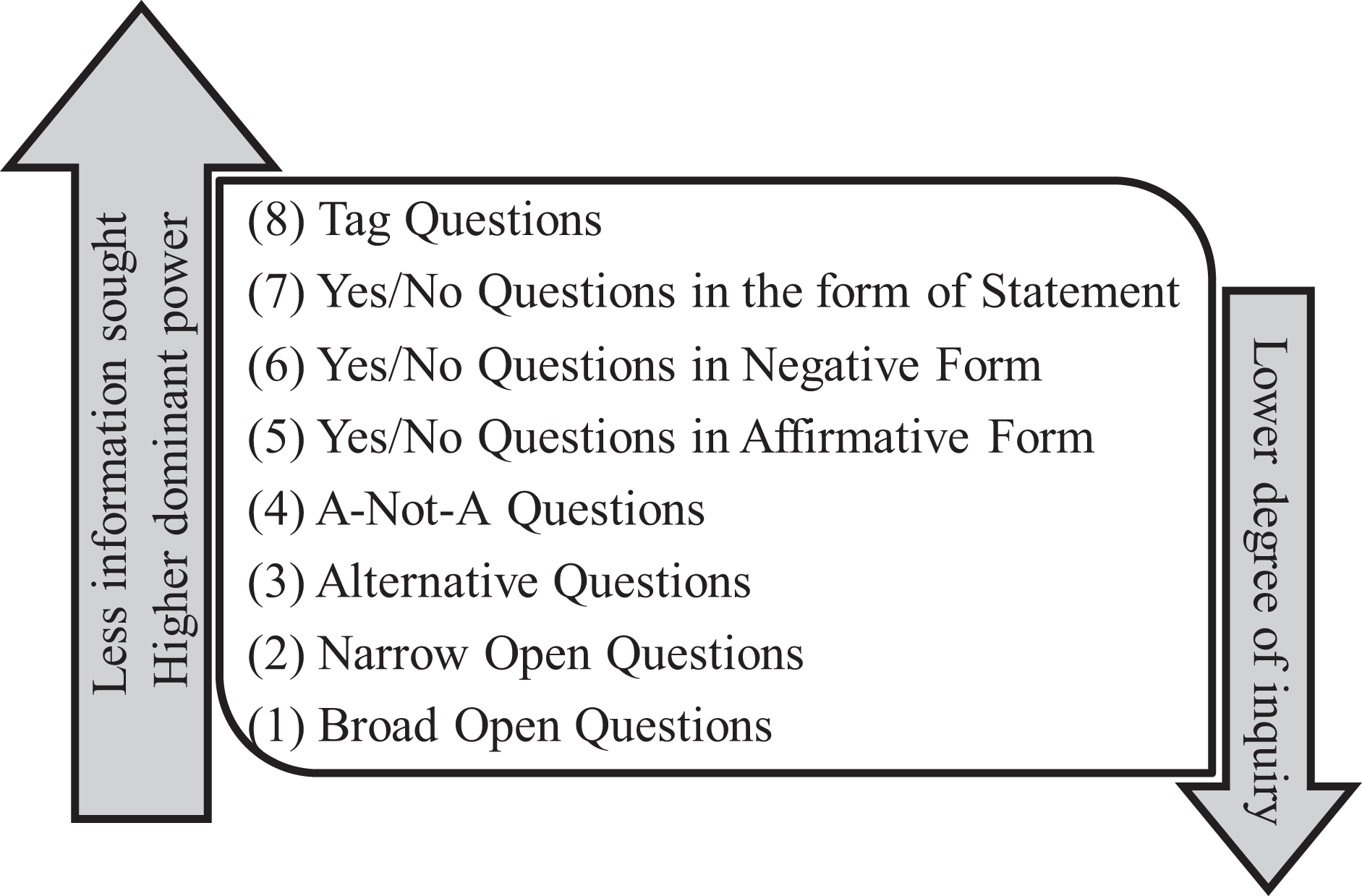
Power of Each Type of Questions from Highest (8) To Lowest (1).
In everyday discourse, the power relations between parties are often equal and the power inequality expressed by the question forms is not obvious. However, in institutional discourse, the more powerful participants tend to use various types of questions to control and influence the weaker members; whereas powerful participants can manipulate others through a variety of ways. The types of question have a significant impact on the quality of the answer a witness gives (Loftus, 1979), and lawyers often focus on the question forms, centring on how it controls witnesses (Stygall, 1994). The content and the syntactic form of questions, in the specific institutional environment, provide a powerful way for judges/magistrates to control interactions (Harris, 1984).
Who talks more?
How much a person talks in a conversation can also reveal their power status. The ‘territory model’ (Thornborrow, 2002) suggests that the more turns a participant possesses, the more ‘floor space’ he or she enjoys, thus having greater power. For instance, Edelsky (1981) demonstrated the differences between men and women in the amount of speech and the right to speak as an indicator of the asymmetry in social power distribution. Quantification of this kind of power relies primarily on the amount of discourse, and we below analyse the power relationship reflected in police interviews in terms of speech amount, turns and adjacent pairs.
Speech amount
The amount of speech refers to the absolute number of words used in the conversation by each party in that conversation. According to the ‘power territory’ model (Thornborrow, 2002), the party with higher power will have a larger amount of speech. For example, in court trial discourse, research in China has found that legal professionals (judges, prosecutors and lawyers) speak more words than non-legal professionals such as witnesses, defendants and victims (Chang W, 2005). This is because legal professionals have several stages of monologues according to the trial system and procedures, such as reading indictments, public prosecution opinions, technical appraisals, crime scene investigation reports, closing statements or reading judgments. Another prominent feature of trial activities in China is that the so-called court debate stage is not a real debate. In fact, the agents of both parties read out prepared speeches. Moreover, Chinese court witnesses have a low rate of court appearances, and cross-examination is mainly based on the prior testimony of witnesses (Chen GZ, 2001; Long, 2001). As a result, analyses of in court trials demonstrated legal professionals’ larger speech amount, hence their greater power (Chang W, 2005).
Although the absolute speech amount can reflect the power relations of participants to a certain extent, it is not the only indicator of power. Speaking more often does not necessarily mean higher power. Police interview discourse is one such example. In investigative interviews, the suspect typically holds a large amount of information about the case. Therefore, during the information-gathering phase, the suspect’s speech amount is often higher than that of the police officer, but we cannot say that suspects have more power than police. An ideal narrative mode during the information-gathering phase is that the police raise open questions, the suspect makes a statement, the police follow-up on the statement, clarifying using questions, and then signal the suspect to continue to talk, and so on.
Turns
Another relevant concept is ‘linguistic turns’ (i.e. a question followed by a response). Investigative interviewing is a communication activity in which the police and suspect interact with each other using words as their main means. A degree of cooperation between the two parties is the premise of an interview. The number of such turns between the police and suspect is usually equal. The number of turns is not in itself an indicator of power. However, who has the right to decide on the initiation, transition, rotation and termination of turns does control the content.
Adjacent pairs
People’s conversations typically alternate between the participants (Schegloff et al., 1974). A conversation consists of at least two turns. The words spoken by the speaker in his or her turn constitute an adjacent pair with the words in the next speaker’s turn. ‘Question and answer’ is one of the most common adjacent pairs. The initiating part of an adjacent pair (the first turn) has a natural expectation of the response (the second turn). Once the question is raised, there is a pressure on the other person to provide an answer (Sacks et al., 1974). There may be multiple responses to the initiating parts of an adjacent pair, but the status and function of these responses are different. Some responses are more in line with the needs of the speaker than other elicitations and therefore have priority. If the preferred response is not selected, the answerer will conflict with the expectation of the interrogator and may thus harm the ‘face’ of the interrogator. This will also put pressure on the answerer. The preference structure of the question and answer pair is to have an answer that conforms to the principle of cooperation. As Grice (1975: 41) said, ‘When you participate in a conversation, you rely on the recognised purpose or direction of the conversation you are engaged in, so that your conversational contributions meet this need’. Therefore, the questioner has dominance over the answerer.
The current study
This study aims to examine police interviews with suspects in China, using critical discourse analyses. Based on ‘systemic functional grammar’ theory (Matthiessen and Halliday, 2009) and the ‘territory model’ (Thornborrow, 2002), we hypothesise that these interviews will illustrate the higher power held by the police interviewers in terms of: (1) proportion of asking questions, (2) turns, (3) adjacent pairs and (4) question types.
Method
Material and procedure
The study used transcripts of audio or video files recorded during police interrogations obtained from a Chinese police force who had agreed to work with the first author. A total of ten criminal cases (three homicide, two drug trafficking, two fraud, one robbery, one theft and a kidnapping) from five provinces in Eastern China were used for analyses. The interviews were anonymised during transcription and pseudonyms were used to ensure confidentiality. Owing to strict data protection for the criminal cases, all recording was transcribed and coded by the first author alone. Therefore, inter-rater reliability of the question coding could not be computed.
Coding and analyses
Coding of question types was based on the form and classification of Chinese questions (Chang J, 1995), and involves new developments (Liao, 2002, 2004) in question research (the openness of questions, the controlling force of a question, the amount of information of a question, the degree of doubt in a question, etc.). Here, we pay attention to not only the formal characteristics of questions but also the pragmatic functions of questions. Figure 2 provides an overview of the types of question coded in this study. There are various systems of question classification in the psychological literature (see Oxburgh et al., 2010 for detailed discussions), however, due to its focus within the Chinese sociocultural and linguistic context, the authors adopted the question classification commonly used in China (Chang, 1995; Liao, 2002, 2004) in this study.
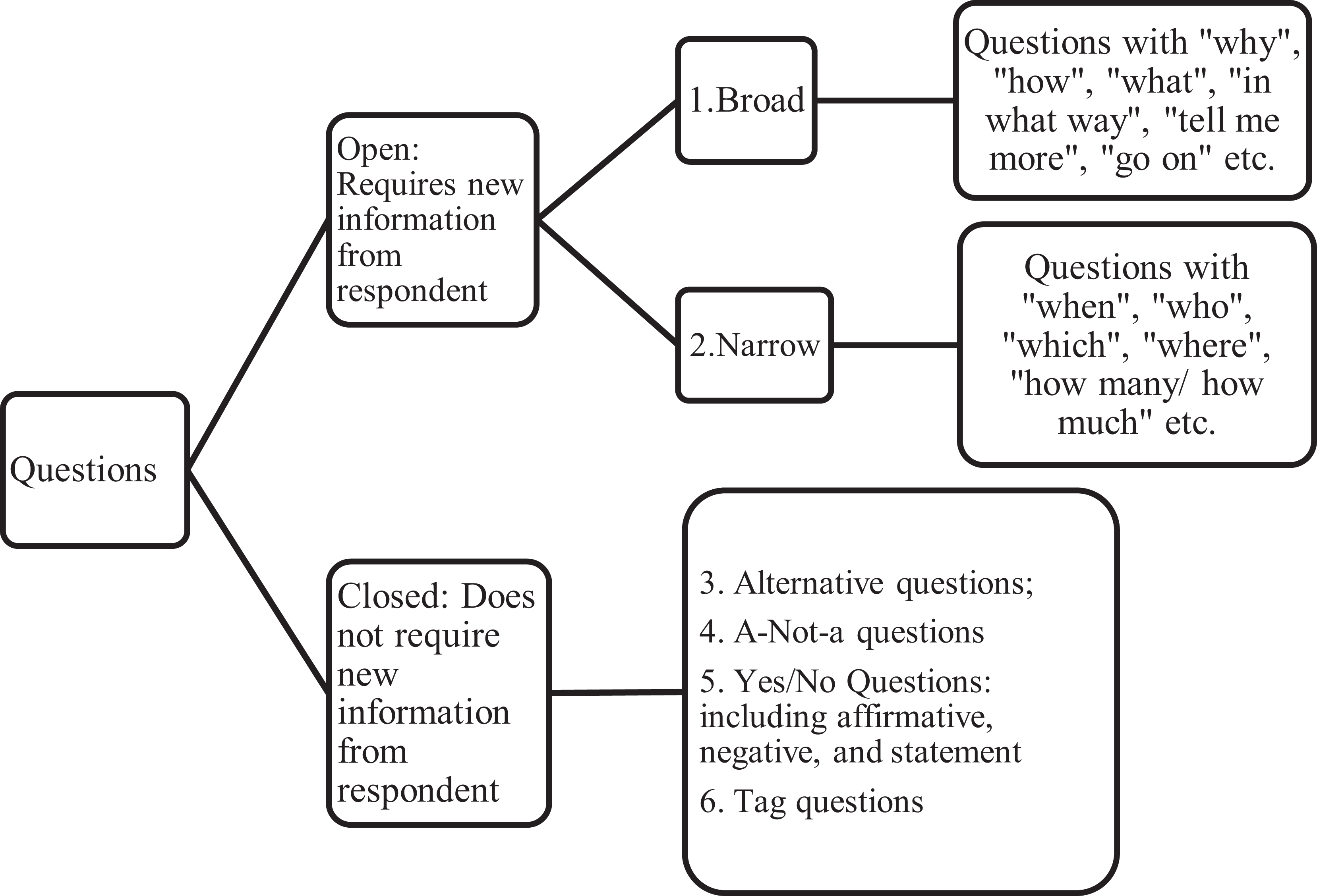
Overview of the types of questions examined in this study.
Open and closed questions
The first level of ‘types’ is the openness/closedness of a question, which refers to the room left to the respondent to answer it. Questions can be divided into open-ended and closed-ended. Open questions provide a larger choice for the respondent, and require the respondent to provide new information rather than a short, factual, yes or no answer. For example, ‘How did you attack him?’. To answer a ‘how’ question, the respondent needs to provide a descriptive answer. The information is more complicated and cannot be summarised in just a few words. Answerers usually need to follow a certain order, for example chronological, to describe the event. Open questions can be further divided into broad or narrow, depending on the degree of information sought. Closed questions limit the scope of the answer. The answer usually can only be selected from the alternatives available such as ‘yes’ or ‘no’, ‘agree’ or ‘disagree’, ‘tall’ or ‘medium’ or ‘short’. Detailed descriptions on each type of question are given in the following paragraphs. Broad open questions. A broad open question requires the respondent to provide a more complex answer, rather than a single word or phrase, and the respondent to it enjoys a greater degree of freedom of expression. These questions typically include ‘why’, ‘how’, and ‘in what way’. For example, ‘How did you do it?’, or ‘Why did you kill the taxi driver?’. Narrow open questions. Narrow open questions are questions involving ‘what’, ‘when’, ‘who’, ‘where’, ‘how much’, and require a short answer. For example, ‘What colour is the taxi you took?’, or ‘Where did the fight take place?’. Alternative questions. These do not require the respondent to provide new information, but only provide two or more propositions for the respondent to choose from. Some alternative questions use explicit selection words like ‘either/or’, such as ‘Was it Li who asked you to call P, or did you call P on your own?’. Some do not use selection words, such as ‘Which hand did you use to stab him?’. A-not-a questions. A-not-a questions put two items together in a positive or negative form, and let the respondent choose one of them. This is similar to the forced-choice question in the literature (Griffith & Milne, 2006). A-not-a questions do not require the respondents to provide information beyond that contained within the question. For example, ‘In the end, did you give or not give the money to the guy?’, or ‘Did you hit her or did you not hit her?’. Yes/no questions. Yes/no questions merely require the respondent to make a positive or negative answer, not requiring new information. The difference between this type of question and others is that it can be answered with body language such as nodding or shaking of the head. Tag questions. Tag questions are a type of yes–no question that consist of two parts. The first part is a statement of affirmation or negation of one thing, and the second part raises a question about the authenticity of the statement for the respondent to answer. This is similar to the leading question labelled in relevant literature, where response in a certain direction is usually expected. For example, ‘After hitting him, you went home, right? (affirmative)’, or ‘You didn’t tell Zhu what to do, right? (negative)’.
Each type of question in the interviews here analysed was noted in terms of the absolute and proportional numbers in each stage of the interviews (opening, information-gathering, and closing). Other than the types of questions, the proportions of who (either the police investigator or suspect) asked questions, the turns, and adjacent pairs were also calculated in both absolute and proportional numbers.
Results
Who asked the questions?
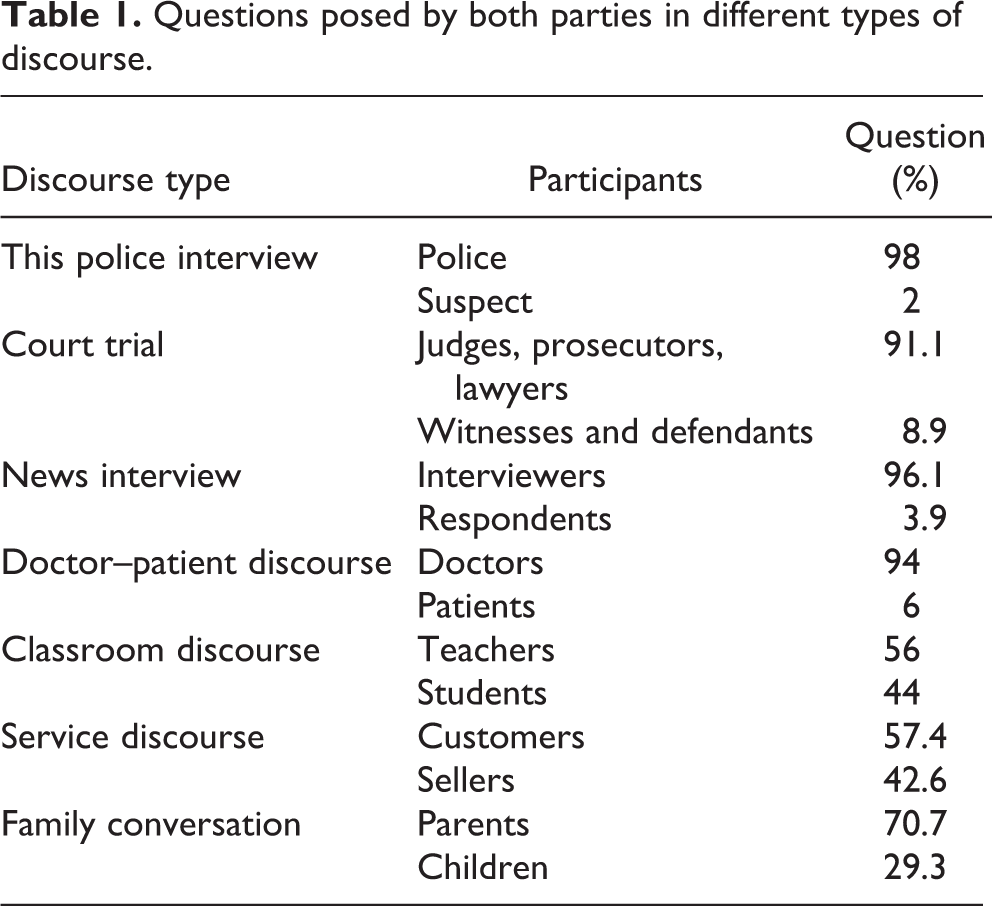
Our analysis found that 98% of questions were proposed by police officers, and questions initiated by suspects were rare. This ratio is much higher than the distribution ratio of questions among participants in daily conversations, and in classroom discourse, doctor–patient discourse, service discourse and court discourse (compared with data collected by Wang PC, 2006), see Table 1.
Questions posed by both parties in different types of discourse.
Turns
In terms of the initiation of conversational turns, our data also revealed that in police interviews, the interviewer initiated 99.4% of the turns. In the turns that the police started, the question turns account for 90%. This reveals that questioning was the main means of interrogating, and that the police interviewer controlled the right to start the turns, thus controlling the process and the direction of the discourse.
Adjacent pairs
Among the total of 1,610 adjacent pairs, the number of question–answer pairs was 1,511, accounting for 93.8%, and the number of non-question–answer pairs was 99, accounting for 6.2%. Thus, the police interview process was mainly composed of questions and answers. As Liao (2002) noted regarding court discourse, conversation participants deal with contradictions through questions and answers, clarify facts through questions and answers, determine evidence through questions and answers, express and exercise power through questions and answers, implement rights through questions and answers, and resolve conflicts through questions and answers.
Question types
The questions that could be used in a police interrogation are: open (divided into broad and narrow questions), alternative questions, A-not-a questions, yes/no questions, and tag questions. The frequencies of such question types in these interviews are shown in Table 2.
Distribution of different types of questions within each phase of the police interviews in absolute numbers and percentages.
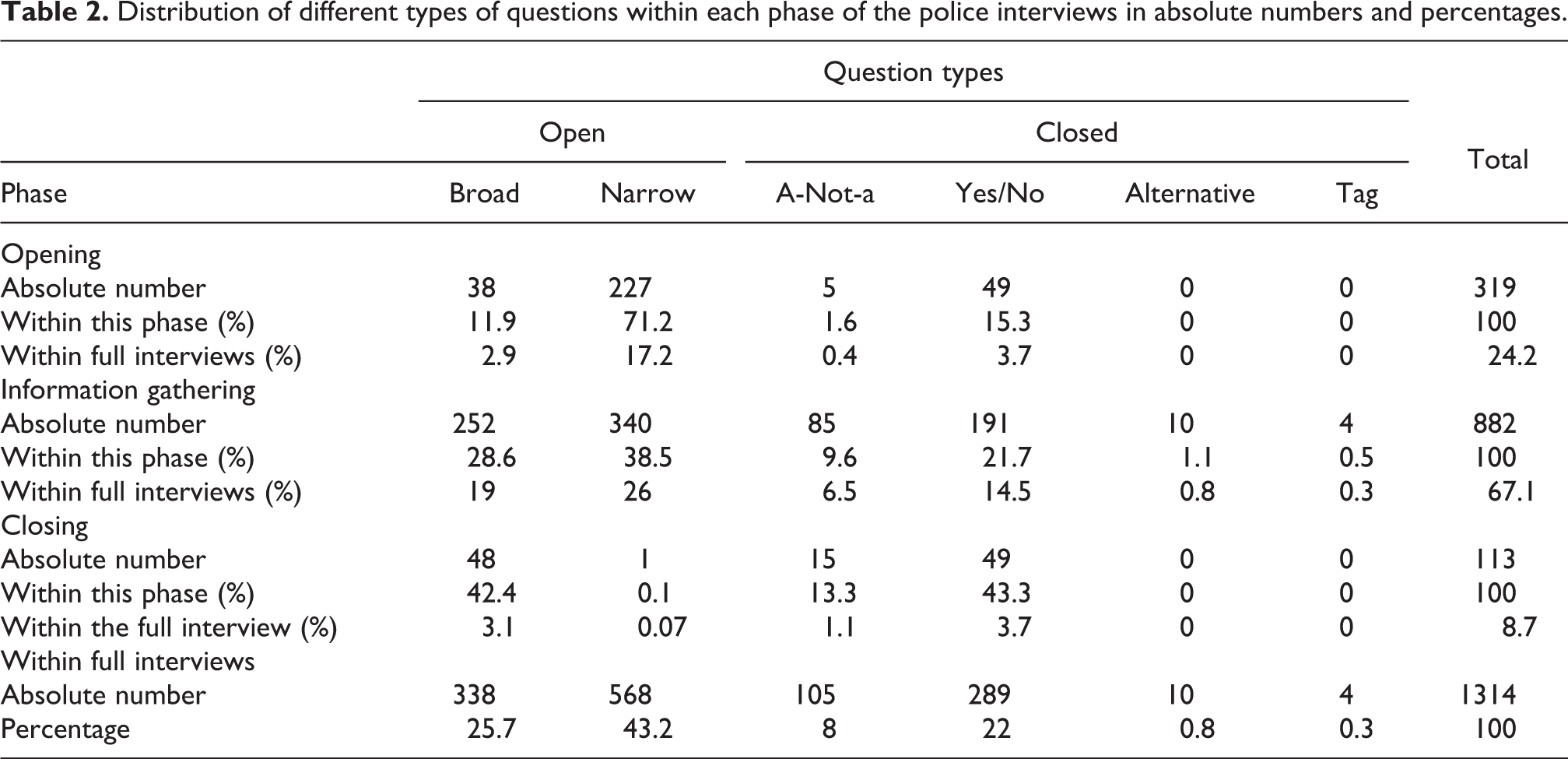
In the opening phase (beginning of the interview, before investigating the target incident), narrow open questions account for 85.7% and broad open questions account for 14.3% of all the open questions. Open questions account for 83.1% and closed questions account for 16.9% of all the questions within this phase. In the information-gathering phase (when the interview focuses on investigating the target incident), narrow open questions account for 57.4% and broad open questions account for 42.6% of all the open questions. Open questions account for 67.1%, and closed questions account for 32.9% of all questions within this phase. In the closing phase (after finishing investigating the target event and before the interview finishes), narrow open questions account for 43.4% and broad open questions account for 57.6% all the open questions; and open questions account for 43.4%, and closed questions 56.6% of the questions within this phase. Overall, across the interviews, narrow open questions account for 62.7% and broad open questions account for 37.3% of all open questions. And open questions account for 68.9%, whereas closed questions account for 31.1% of all questions.
Overall, in these police interviews, most frequent were open questions (68.9%), followed by yes/no questions (22%), a-not-a questions (8%), alternative questions (0.8%) and tag questions (0.3%). The distributions of open questions during the opening phase, the information-gathering phase and the closing phase are noticeably different: at 83.7%, 67.2% and 43.4% respectively (see Figure 3 for illustration of the proportion of each type of question in different phases). At the beginning of the interrogation, the police verified the basic situation and identity of the suspects in accordance with relevant procedures, which were all implemented in the form of open questions. The closing phase specifically had a small number of questions, mainly because the end of the interrogation involved the question ‘Do you have anything to say?’.
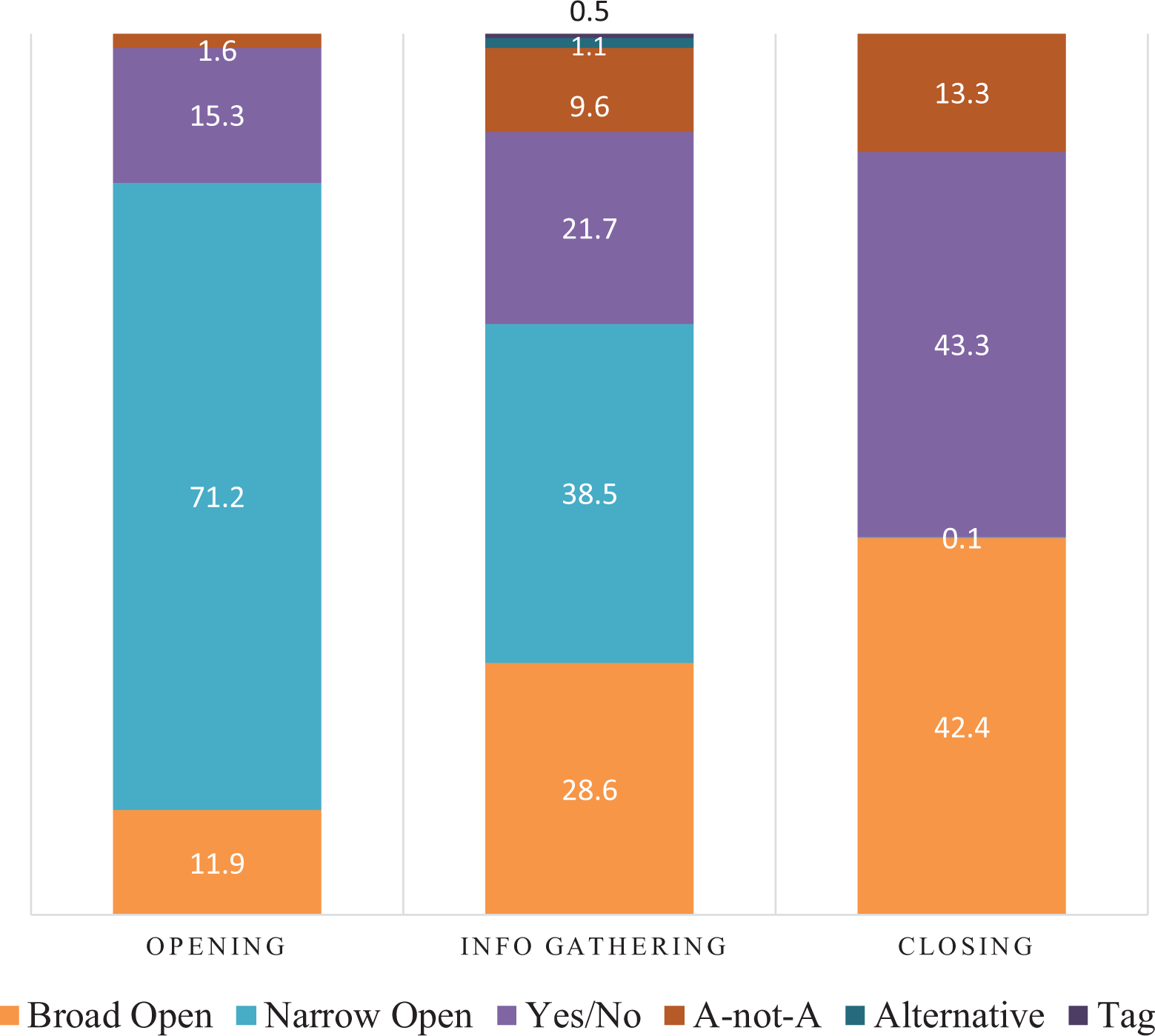
Proportion of question types in each interview phase.
Discussion
Currently, in a variety of countries the techniques used to interview suspects vary considerably (Miller et al., 2019; Walsh et al., 2015) including the manner and type of questioning. However, as yet there has not been published a study of police questioning of suspects in China. The growing international collaboration with police organisations in China has led to the current, admittedly small-scale study, being made publicly available. The vast majority of prior published research on suspect interviewing has been designed, conducted and reported using what could be described as a ‘Westernised’ approach, whereas the current article has a first/primary author who is based in China and therefore has a somewhat different approach. Nevertheless, the findings provide an intriguing first glimpse of current suspect interview practice in China.
Perhaps the most interesting finding was the rather frequent use of open questions (68.9%) in these interviews, especially narrow open questions. This is consistent with Liao’s (2002) finding on the distribution of narrow and broad open questions in court trial discourse in China. However, the data look quite different. Liao’s data show that the proportion of open questions used by judges is as high as 92.87%, much higher than that of open questions used by the police. This may be due to the different institutional and discursive roles taken by judges and police investigators, respectively. The main role of the judge involves use of procedural questions. Narrow open questions asked by the judges are mainly focused on the verification of the identity of the accused before the trial. Judges have less need to seek new information. But police interviewers not only need to verify the basic situation and identity of the suspect, but also need to obtain relevant information during the interview. In addition to the use of narrow open questions to obtain information on the details such as the time, place, personnel, weapons, etc. the investigator also needs more wide-ranging questions to inquire about the case, the suspect’s motives and emotions, etc. Moreover, broad open questions give the suspect a greater freedom to speak, thus the frequent use of open and broad questions can suggest a voluntary nature regarding a suspect’s confession.
However, this finding regarding open questions needs to be interpreted with caution. First, the definition of open questions utilised in this Chinese language research may differ somewhat from previous research conducted in other languages. Also, definitions of open and closed questions varied significantly from study to study (see Oxburgh et al., 2010 for a detailed discussion on definition of question types). If we restricted the definition of open question to include only the TED (tell, explain or describe) questions and categorised the 6WH (who, what, where, when, why and how) 1 questions into specific closed questions (Home Office, 2007; Lamb et al., 2007; Milne and Bull, 1999), then our findings would suggest, similar to previous work (Baldwin, 1993; Clarke and Milne, 2001; Griffith and Milne, 2006; Moston and Engleberg, 1993), that in China police officers did not use many of the most inviting types of open questions (the TED), but engaged more in specific questions (6WH). However, given the small number of cases available to the researchers in this pioneering study, future research would be beneficial if circumstances allow.
Yes/no questions take second place (22%) overall; they gradually increased from the opening phase (15.3%) to the information-gathering phase (21.7%), and nearly doubled at the closing phrase (43.3%). Their main function is for the respondent to confirm the information provided in the question, and there is no need for the respondent to provide new information, and therefore such questions have strong controlling power over the respondent. In the opening and closing phases, yes/no questions are used mainly to confirm whether the suspect understands his or her rights and obligations; the suspect’s answers are responses to his or her understanding of his or her rights and obligations, and he or she assumes responsibility to understand, perform or exercise his or her rights and obligations. However, past experimental as well as field research suggests that simply asking yes/no question is not an adequate way to assess comprehension (Fenner et al., 2002; Hughes et al., 2013; Rock, 2007; Shepherd et al., 1995; Snook et al., 2010), particularly if the suspect is juvenile (Cooke and Philip, 1998; Shepherd et al., 1995; Sim and Lamb, 2018). Nevertheless, police officers and investigators typically assess suspects’ comprehension of their rights (the Miranda warning in the USA; the police caution in UK) simply by asking them if they understand it (Medford et al., 2003; Snook et al., 2010; Walsh and Bull, 2010, 2012), which is considered to be below the minimum standard for the PEACE interview model employed in England and Wales (Walsh and Bull, 2012). Yet interviewers typically do not verify or test suspects’ understanding of the caution (Snook et al., 2010; Sim and Lamb, 2018; Walsh and Bull, 2010, 2012). Explanations are needed to improve suspects’ comprehension of the caution (Eastwood and Snook, 2012; Eastwood et al., 2016; Snook et al., 2014). However, in various countries when officers or investigators do explain, they do so inconsistently (Snook et al., 2010; Walsh and Bull, 2011) or incorrectly (Walsh and Bull, 2010, 2011).
Overall, our analyses of question initiator, adjacent pairs and turns suggest that police officers in China still hold a fairly powerful position in suspect interviews. Although the suspects had certain rights, the police interviewer is clearly in an advantageous position. Such powerful status within police interrogations could be concerning, as Chinese police do have a wide range of functions and discretion within Chinese law. For example, Chinese police can handle minor cases and public order offences (such as gambling and prostitution), issuing administrative punishment (such as detention in police jails or fines) or imposing re-education through labour administrative sanction on any ‘unproductive person’ to work in a labour farm for one to three years without any judicial review or approval (Wang Z, 2000). Chinese police do not need the court’s approval but only the police chief’s permission to conduct searches and seizures (Ma, 2003). Moreover, police in China, can supervise the attorney’s performance and work, for instance, they can set time limits on suspect–lawyer meetings as well as attend the meetings (Ma, 2003). Given the powers that the Chinese police hold, such power dynamics is expected to be reflected in these interviews. Nevertheless, the overall high proportion (68.9%) of open questions (in the current study mainly the WH questions) in the interviews is encouraging, as such questions would not limit the respondent in his or her reply and thus increase the chance for more accurate recall (Newlin et al., 2015; Walsh and Bull, 2015). This also suggests that regulations outlawing evidence obtained by torture, threats or other illegal means to be used in courts are taking effect. Despite legal reforms to CCPL in 1996 and 2012 resembling adversarial procedures, the Chinese criminal justice system has a long tradition of inquisitorial criminal system and culture that is not rights-oriented (Ma, 2003; Ruihua, 2011). During criminal investigation, police and prosecutors often produce dossiers that are closer to the inquisitorial style than the adversarial style (Zuo, 2017). The Chinese judiciary functions more as an executive department of the governmental than as an independent check on the other arms of government (Starr, 2001), and the courts are structured to work in cooperation with police and prosecutors to control crime subject to CCP coordination (Lewis, 2011). Although how the reforms impact legal practitioners’ practice will need to be examined further, our small-scale findings serve as a first step in illuminating how such reforms are taking effect.
Limitation and future directions
Some limitations of the current study need to be acknowledged. First, the findings were based on a small number of interviews, therefore limiting the generalisability of the findings. In addition, the strict data protection agreement between the first author and the practice agencies prevented the examination of inter-rater reliability of the question coding and the suspects’ responses to the questions. The inability to achieve inter-rater reliability in the question type coding severely compromised the objectivity of the current findings. Thus, the current findings need to be interpreted with caution. Moreover, not being able to examine the suspects’ responses also significantly limited the informativeness of our findings. Questions and responses go hand in hand, and suspects’ responses may well affect the investigators’ subsequent questioning strategies. Thus, analysing question and response together could be extremely informative and useful in police interview research. Future research with larger numbers of Chinese police interviews with more researchers to assess the data is much needed, and this article may well serve to ‘open the door’ for more research. Moreover, in China, there is not yet a structured police protocol for interviewing suspects or witnesses. A structured interview protocol could be devised from the wealth of relevant research and expertise mentioned at the beginning of the present article. Although much research had been conducted in many countries around the world, this is the first published empirical study examining real police interviews in China, providing insight into this understudied yet very large population.
Footnotes
Acknowledgement and disclosures
The authors would like to express sincere gratitude to the Chinese police forces who provided the valuable data to make this research possible. The authors had not received any external funds for this research, and declared no conflict of interest.
Declaration of conflicting interests
The author(s) declared no potential conflicts of interest with respect to the research, authorship, and/or publication of this article.
Funding
The author(s) received no financial support for the research, authorship, and/or publication of this article.
