



Abstract
Published survey data on perceptions of interrogations and false confessions have come from Western European and North American countries and have tended to focus on jury-eligible citizens’ perceptions. The present study examined perceptions of police officers from the Royal Malaysia Police. Fifty-nine police officers reported their overall perceptions of confessions, perceptions of personal factors contributing to false confessions, and self-perceived likelihood of false confession. Findings reveal that the Malaysian police did not seem to be cognizant of the fact that false confessions can happen and the contributing risk factors. This emphasises the need to raise awareness in the country – both from the top-down and bottom-up.
Introduction
In the investigative interviewing literature, it is often argued that confessions represent one of the most compelling types of evidence about a defendant’s guilt. However, real life cases in the United States over the past two decades have demonstrated that people can falsely confess, that is, to admit to crimes that they did not commit. According to the Innocence Project, Inc. (no date), as of January 2020, out of the 375 cases of DNA exoneration, 27% involved false confessions. Less is known about the incidence of false confessions in other parts of the world due to the lack of national documentation. To date, there are three Icelandic studies, one German study, and one recent Scottish study that have reported false confessions rates in their respective countries based on self-report surveys by persons who have been convicted. In Iceland, Gudjonsson and Sigurdsson (1994) reported that 11.79% of 229 prison inmates claimed to have made a false confession, whereas the rate was 12.18% of 509 prisoners and 24.44% of 90 prisoners in Sigurdsson and Gudjonsson’s (1996) and Gudjonsson et al.’s (2008) studies respectively. In Scotland, 33.42% of 386 prison inmates reported to have falsely confessed (Gudjonsson et al., 2021). In Germany, 31.76% of 85 detainees reported to be false confessors (Gubi-Kelm et al., 2020). Needless to say, there is no way of checking the validity of the self-report claims of false confessions. In Australia, while there are no published rates of the occurrence of false confessions, Adam and Van Golde (2020) highlighted a few cases of false confessions that happened in the country, calling for reform of investigative interviewing practices.
False confessions represent a major flaw in a criminal justice system and can have detrimental consequences on individuals and our society as a whole. The psychosocial impact on individuals and their families includes loss of reputation, financial hardship, stigma, and trauma (see Clow et al., 2012 for a review). For instance, exonerees who had falsely confessed tended to be seen as actually guilty and less competent (Clow and Leach, 2015a), less intelligent (Scherr et al., 2018), and less deserving of government assistance such as career counselling and subsidised housing (Clow and Leach, 2015b). Kukucka and Evelo (2019) found such negative perceptions to persists even if the confessions were obtained under highly coercive conditions. Furthermore, not only do wrongful convictions due to false confessions undermine public confidence in the criminal justice system, but they also lead to considerable waste of valuable resources used in investigating, prosecuting, and incarcerating innocent individuals. Meanwhile, when innocent people are wrongfully incriminated, the real perpetrator remains at large, potentially jeopardising public safety.
The average person is generally reluctant to believe that one would confess to a crime that they did not commit as this self-defeating behaviour is highly counterintuitive (Kassin, 2017; Loftus 2004). Chojnacki et al. (2008) surveyed 502 jury-eligible citizens of the United States and found that about one third thought that it is unlikely that a person would confess to a crime they did not commit. A large proportion of participants in that study were uncertain about the issue of vulnerable persons’ susceptibility to false confessions, demonstrating a lack of understanding of the problem and its implications. In Henkel et al. (2008), over 80% of survey respondents in the United States exhibited a strong bias against believing that they personally would confess to a crime they did not commit, even though there was a general recognition that false confessions do occur.
False confession risk factors
There are certain vulnerabilities or risk factors that have been identified to be associated with susceptibility to false confessions (Gudjonsson, 2018; see also Kassin et al., 2010). People are generally aware that situational factors such as the use of (and threat of using) physical torture, prolonged custody and isolation put innocent people at risk of falsely confessing (e.g., Henkel et al., 2008). However, people are sometimes unaware that psychologically manipulative tactics can lead to false confessions as well. For instance, in Leo and Liu (2009), jury-eligible student participants did not seem to believe that techniques such as repeated accusations, asking suspects to take a lie detector test, challenging denials of guilt, confrontations with fabricated evidence, as well as explicit and implied promises of leniency can elicit false confessions, despite recognising the fact that these techniques are coercive. Sleep deprivation is also historically used as a potent method of torture to extract information from war prisoners (Suedfeld, 1990), and a laboratory experiment by Frenda et al. (2016) has empirically demonstrated that people who have been deprived of sleep for an entire night were more likely to sign a false allegation statement compared with those with 8 hours of sleep. However, the impact of sleep deprivation in the outcome of interrogations is not necessarily common knowledge. Among student and community samples in Mindthoff et al.’s (2018) study, while being sleep deprived was perceived as contributors to false confessions, it was rated as one of the lowest contributors compared to having a mental illness.
In addition, there are dispositional factors that can increase susceptibility to coercive interviewing techniques which in turn makes one more likely to falsely confess. For example, youth is known as a risk factor, as developmental science has established that certain developmental processes remain incomplete until one reaches their mid-twenties (see Cleary, 2017, for a review). However, in a study by Grove and Kukucka (2021) where participants read a transcript of an adolescent false confessor, 75% still misjudged the confessor as guilty, suggesting that people generally do not intuitively discount the confession of an underaged suspect when judging guilt. Other dispositional factors include cognitive or intellectual impairments, memory problems, and the presence of mental disorders (Kassin et al., 2010). In Henkel et al. (2008), student and community participants viewed mental illness, being under age 10, and low IQ as having a moderate to large contribution to the occurrence of false confessions, but they did not think that having a poor memory contributed largely. Another risk factor associated with increased susceptibility to false confessions is alcohol and/or substance intoxication at the time of the alleged crime or when in custody (Gudjonsson, 2018). In Malloy et al.’s (2014) interviews with incarcerated adolescents, 35.23% of 195 participants reported to have made a false admission of guilt, and approximately 35% of these false confessors revealed that they were under the influence of alcohol or drugs at the time of the admission.
Perceptions and knowledge of false confessions
There is some evidence that the public has awareness about the false confession phenomenon. For example, Woestehoff and Meissner (2016) found participants in their three experimental studies to be sensitive to false confessions risk factors. Specifically, participants were able to recognise interrogation practices that can produce a false confession and showed reluctance to convict a confessor when a situational false confession risk factor – specifically interrogative pressure – was present. These findings were attributed to the improved knowledge about factors that can influence eyewitness identifications and confessions, particularly with the rise of documentary films and fictional portrayals in the media.
Other studies of opinions have focussed on social scientists whose expertise are in interrogations and confessions. Kassin et al. (2018) surveyed 87 experts who had extensive research or courtroom experience; it was noted that they were in consensus that explicit promises of leniency, threats of violence and punishment, as well as torture are factors that put innocent people at risk of false confessions. The experts in Kassin and colleagues’ study also collectively agreed that the risk of false confession is higher among adolescents, those with greater compliant or suggestible tendencies, and individuals with intellectual impairments or diagnosed psychological disorders. In Kaplan et al.’s (2020) study, laypeople’s perceptions of coercive interrogation techniques were compared with those of social science experts and criminal justice officers. It was found that laypeople significantly underestimated the coerciveness of interrogation tactics that have been ruled to be unlawful (e.g., violence, threats, denying basic needs, promises of leniency), as well as maximisation and minimisation techniques. Criminal justice officers – whom presumably have had more experiences with investigative interviews and interrogations – held views that were more in line with the social scientists with regard to the coerciveness of the abovementioned tactics, but their perceptions of suspects’ vulnerable characteristics did not differ from laypeople or social scientists. Scherr and Dror (2021) asked practicing forensic analyst experts from the United Kingdom, United States, and Canada about the likelihood of certain factors leading to wrongful convictions; it appeared that these experts did not think that false confessions were frequently associated with wrongful convictions, although studies have shown that the presence of confessions significantly increases the likelihood of convictions (e.g., Appleby et al., 2013; Brimbal and Jones, 2018) – even if the confession was elicited via coercive means (Kassin and Sukel, 1997), even when the confessor was portrayed as having a mental illness or experienced interrogation-induced stress (Henkel, 2008), and even if a confession was made via an informant who had received incentives to implicate the confessor (Neuschatz et al., 2008). Taken together, the literature points toward the importance of knowledge about interrogations and false confessions, and the ability to integrate this knowledge in practice, in order to prevent false confessions from occurring.
A main gap in the literature is the lack of studies examining police’s perception of false confessions. Kassin et al. (2007) was among the first to examine perceptions of police interrogators. The researchers asked police participants to estimate confession rates for guilty and innocent suspects; it was suggested by the police that an average of only 4.78% of innocent suspects provided partial or complete false confessions. In another study, Hagsand et al. (2022) asked police officers about their perceived likelihood of criminal suspects who were drug- or alcohol-intoxicated providing self-incriminating information during an interrogation. The police officers thought that a suspect who was intoxicated during both the crime and interrogation were at the highest risk of self-incrimination, compared with situations where the suspect was intoxicated only during the interrogation or during the crime. However, it should be noted that the median of this rating was 5 on a 10-point scale (i.e., the midpoint), with 1 = not at all likely and 10 = extremely likely, which is not necessarily indicative of whether Swedish police officers were aware of the effects of substances on one’s susceptibility to false confessions. Most recently, Brimbal et al. (2024) surveyed over 500 American officers about their interrogation practices and beliefs using an adapted questionnaire from Kassin et al.’s (2007) seminal survey. Brimbal and colleagues concluded that there was a positive shift in police’s self-reported practices and beliefs over the last 20 years, evident through an increase in recordings of interviews, higher perceived rates of false confessions, and a reduction in self-reported ability to detect lies.
The current study
The current empirical study is the first in Malaysia and the wider Southeast Asia to examine perceptions of interrogations and false confessions among police officers. Understanding how police practitioners view the matter of false confessions is vital to first identify if they hold misperceptions about how common, and why, false confessions happen. A plethora of studies have shown how investigator bias can increase the use of heavy-handed interrogation techniques that may thereby elicit false confessions; for example, in Narchet et al. (2011), when an interrogator was made to believe that a suspect was guilty (regardless of their actual guilt), they were more likely to adopt minimisation tactics that led to higher occurrence of false confessions. This demonstrates that one’s expectations and false beliefs in a suspect’s guilt can slant their subsequent perceptions and behaviours in a self-perpetuating cycle of confirmation bias (Meissner and Kassin, 2004). It is therefore important to identify police practitioners’ beliefs and expectations of what happens in an interrogation, because failure to address any misperceptions can result in the lack of demand for police practice reform. The fact that the lay public still harbour misconceptions about false confessions is perhaps indicative that police professionals may not necessarily be well-informed of the false confessions risk factors. This then demonstrates the need to increase knowledge in this area, which means that training and capacity building is required.
Besides, very little is known about police investigative interviewing practices in Malaysia as research in this area is still in its infancy. To this end, findings from the present study can be used to compare against international findings. In particular, the current findings were compared with two seminal studies, namely Henkel et al. (2008) and Mindthoff et al. (2018). The study by Henkel and colleagues is one of the first empirical research that has provided a comprehensive report about people’s perceptions toward interrogations and false confessions. Mindthoff and colleagues – whose study is more recent – extended this line of work by providing updated insights into people’s knowledge of these topics among a larger and more varied sample.
In light of the limited literature and science-based trainings on interrogations and confessions in Malaysia, it was expected that Malaysian police officers – just like most people – would harbour misconceptions about interrogations and confessions. It was also hypothesised that Malaysian police officers would underestimate the risk factors of false confessions. Police officers were also expected to display a bias against believing that they would personally succumb to false confessions.
Method
Participants and procedure
The author was invited to deliver a 2.5-h training session on effective investigative interviewing to Royal Malaysia Police officers in May 2023. This training session was part of a larger 3-days train-the-trainers course on community engagement for prevention of violent extremism, organised by the United Nations Office on Drugs and Crime. The attending officers consisted of those serving in the Special Branch’s Counter-Terrorism Division (E8) and the Crime Prevention and Community Safety Department (JPJKK). The same session was delivered twice on two separate days to two cohorts of attending officers; each cohort consisted of 30 officers. Each session was conducted in a hotel meeting room with roundtables, with five officers seated around each table. As the number of attendees was pre-determined by the organisers, an a priori power analysis to calculate the minimum sample size required for the study was not performed.
At the start of the training session, the author provided information about the study, after which paper-and-pencil questionnaires were distributed to the attending officers. Over the two training sessions, a total of 59 out of 60 (98.33%) provided informed consent and completed the questionnaires. The questionnaire was intended to be anonymous, so the officers were asked not to include any identifying information, and to indicate their consent by ticking a consent checkbox. The officers were asked to merely share their perceptions toward investigative interviewing and confessions, and not to discuss their responses with each other. They were not given a time limit to respond. The officers took approximately 10-15 min to complete the questionnaire, which was the expected amount of time taken to carefully respond to all items.
Forty-four officers were from the Special Branch’s Counter-Terrorism Division and 15 were from the Crime Prevention and Community Safety Department. There were 49 males and 9 females (one did not report their gender), aged 27 to 59 (M = 37.57, SD = 7.21; three did not report their age). The majority of the sample were ethnic Malay (n = 51, 86.44%), followed by ethnic Chinese (n = 4, 6.78%), ethnic Indian (n = 2, 3.39%) and other ethnicities (n = 2, 3.39%). The mean length of service was 12.94 years (SD = 8.36 years, range: 1.05–35.03 years). In terms of police rank, 39 (66.10%) were Inspectors, 15 (25.42%) were Assistant Superintendents of Police, four (6.78%) were Deputy Superintendents of Police, and one was a Superintendent of Police (1.69%). Forty-eight (81.36%) officers interviewed suspects or detainees in their current roles while 11 (18.64%) did not, with an average of 6.03 years of interviewing experience (SD = 5.04).
This study was reviewed and approved by the University of Reading Malaysia Research Ethics Committee (reference number UoRM-PCLS-SREC-2023/01).
Materials
There were four sections to the questionnaire (see Supplemental Material). All items were in Malay, the national language of Malaysia. In Section 1, participants provided basic demographic information, including gender, age, race, years of experience as a Royal Malaysia Police officer, and the role they held. They also reported whether they interviewed crime suspects or detainees in their current roles and the years of experience in interviewing. All respondents were asked to rate their current interviewing skills on a 5-point scale (1 = poor to 5 = excellent).
Sections 2, 3, and 4 were designed based on two seminal studies, namely Henkel et al. (2008) and Mindthoff et al. (2018). In Section 2, the officers indicated their level of agreement to nine items about their perceptions of confessions on a 5-point scale (1 = strongly disagree to 5 = strongly agree). This section contains items taken from both Henkel et al. (2008) and Mindthoff et al. (2018).
Section 3 comprised six items that examine the officers’ perceptions of the extent to which each personal risk factor contributes to false confessions. The factors included mental illness, under 18 years of age, low IQ, poor memory of the crime, sleep deprivation, and under the influence of substances. These items were based on Mindthoff et al.’s (2018) study and were rated on a 5-point scale (1 = no contribution to 5 = large contribution).
Finally, in Section 4, participants indicated the likelihood that they would personally falsely confess to a crime they did not commit under six circumstances: the use of physical torture, a confused state of mind, the overall stress of the interrogation, to receive leniency or a lesser charge, to cover for someone else, and the need for notoriety or recognition. The items were taken from Henkel et al.’s (2008) study. Participants rated each item on a 5-point scale (1 = never to 5 = definitely).
As Sections 2, 3, and 4 in the current questionnaire were designed based on two different questionnaires from two different previous studies, comparisons for each of these items were made against the data of the respective study that item was taken from.
Results
Participants were asked to rate their current interviewing skills. Many rated themselves as average (n = 26, 44.07%) or above average (n = 23, 38.98%), five (8.47%) rated themselves as excellent, two (3.39%) rated themselves as below average, but nobody rated themselves as poor. Three (5.08%) participants did not provide a rating. The average rating was 3.55 (SD = 0.71). A Spearman’s rank-order correlation showed no correlation between number of years of interviewing experience and self-rating of interviewing skills, r s (53) = 0.145, p = .29.
Overall perceptions of confessions
Descriptive statistics and results of one-sample t-tests comparing the agreement to each statement about false confessions between the current sample (police officers) and samples from two previous studies (potential jurors).
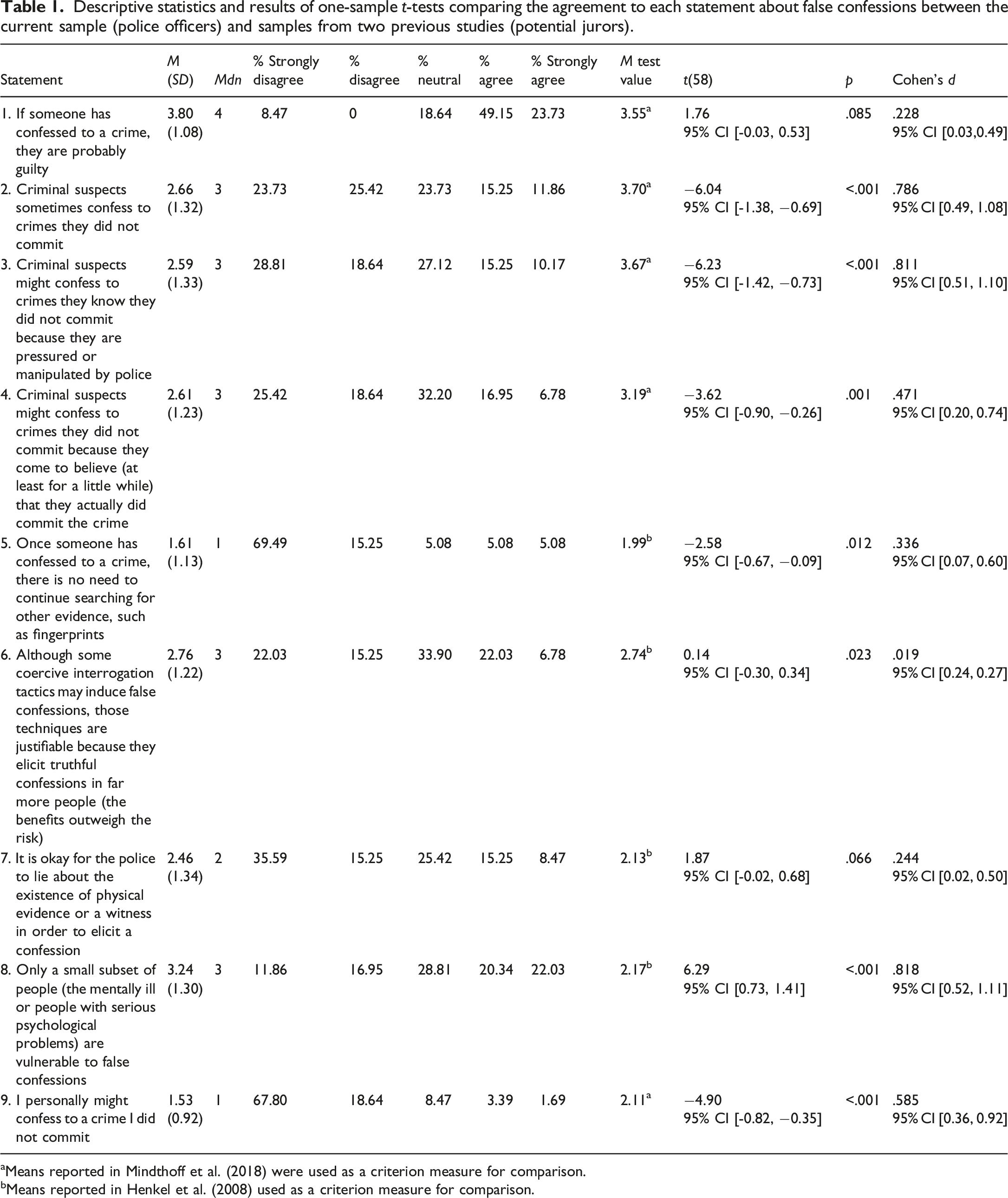
aMeans reported in Mindthoff et al. (2018) were used as a criterion measure for comparison.
bMeans reported in Henkel et al. (2008) used as a criterion measure for comparison.
One-sample t-tests were conducted to determine whether mean scores in the current officer sample were different to the student and community samples in both Henkel et al. (2008) and Mindthoff et al. (2018). The findings are presented in Table 1. Police officers in the present study were significantly less likely to believe that suspects would confess to crimes they did not commit (Statement 2) [t(58) = −6.04, p < .001], whether the false confession were due to police pressure (Statement 3) [t(58) = −6.23, p < .001], or internalised guilt (Statement 4) [t(58) = −3.62, p = .001]. The police officers were also significantly more likely to agree that the search for physical evidence should continue even if a crime suspect has confessed (Statement 5) [t(58) = −2.58, p = .012]. The police sample was more likely to believe that coercive interrogation tactics are justifiable because the benefits outweigh the risks (Statement 6) [t(58) = 0.14, p = .023]. They were also more likely to think that only a small subset of people with mental illness or psychological problems are vulnerable to false confessions (Statement 8) [t(58) = 6.29, p < .001]. Compared to the general public, police officers in the current study were significantly less likely to agree that they would confess to a crime they did not commit (Statement 9) [t(58) = −4.90, p < .001].
Perceptions of personal factors contributing to false confessions
Descriptive statistics and results of one-sample t-tests comparing the perceived extent to which each personal risk factor contributes to false confessions between the current sample (police officers) and the sample from Mindthoff et al. (2018) (potential jurors).
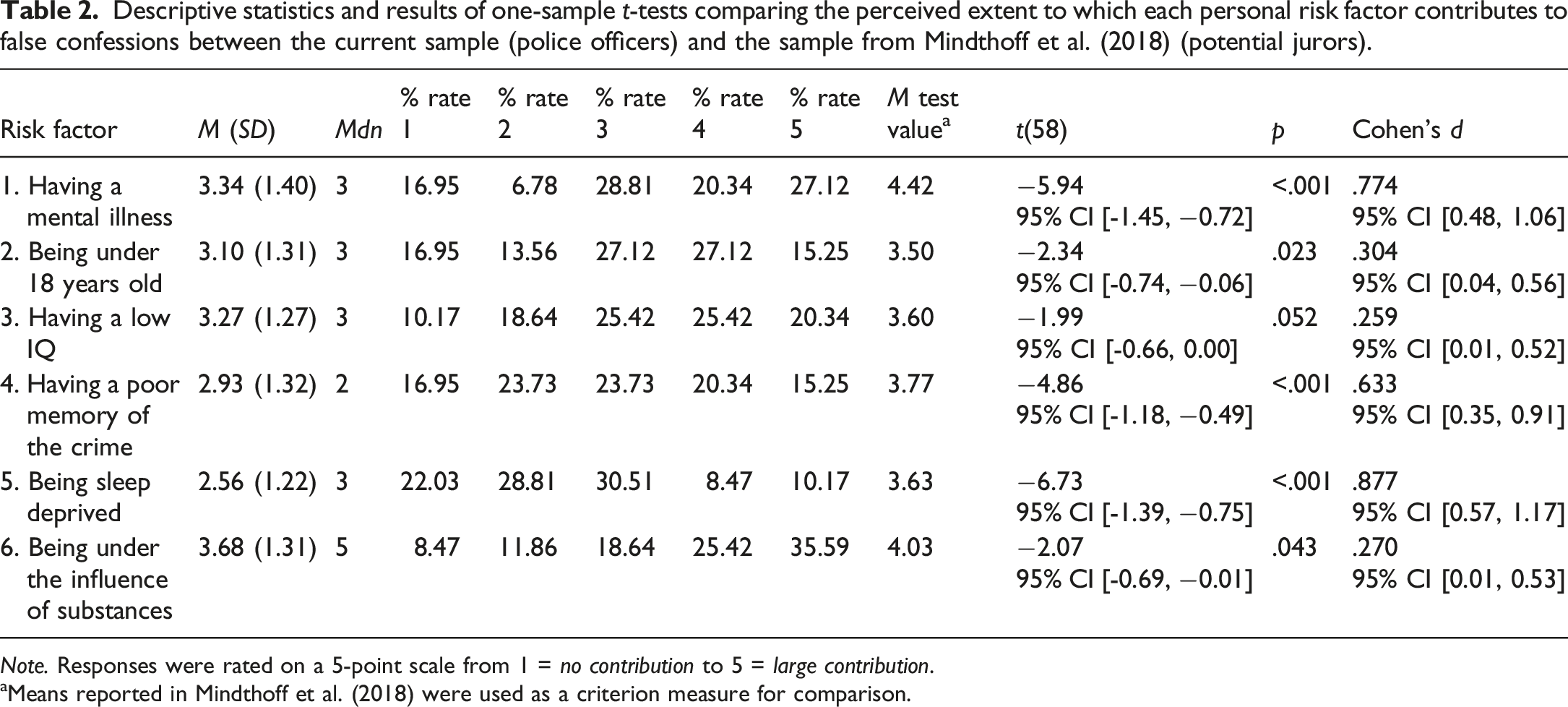
Note. Responses were rated on a 5-point scale from 1 = no contribution to 5 = large contribution.
aMeans reported in Mindthoff et al. (2018) were used as a criterion measure for comparison.
One-sample t-tests were conducted to determine whether mean scores in the current officer sample were different to the student and community samples in Mindthoff et al. (2018). The findings are presented in Table 2. Police officers in the present study were significantly less likely to believe that having a mental illness [t(58) = −5.94, p < .001], being under 18 years old [t(58) = −2.34, p = .023], having a poor memory of the crime [t(58) = −4.86, p < .001], being sleep deprived [t(58) = −6.73, p < .001], and being under the influence of substance [t(58) = −2.07, p = .043] would contribute to the occurrence of false confessions.
Perceptions of personally falsely confessing
Descriptive statistics and results of one-sample t-tests comparing the perceived extent to which respondents personally would falsely confess under each circumstance between the current sample (police officers) and the sample from Henkel et al. (2008) (potential jurors).
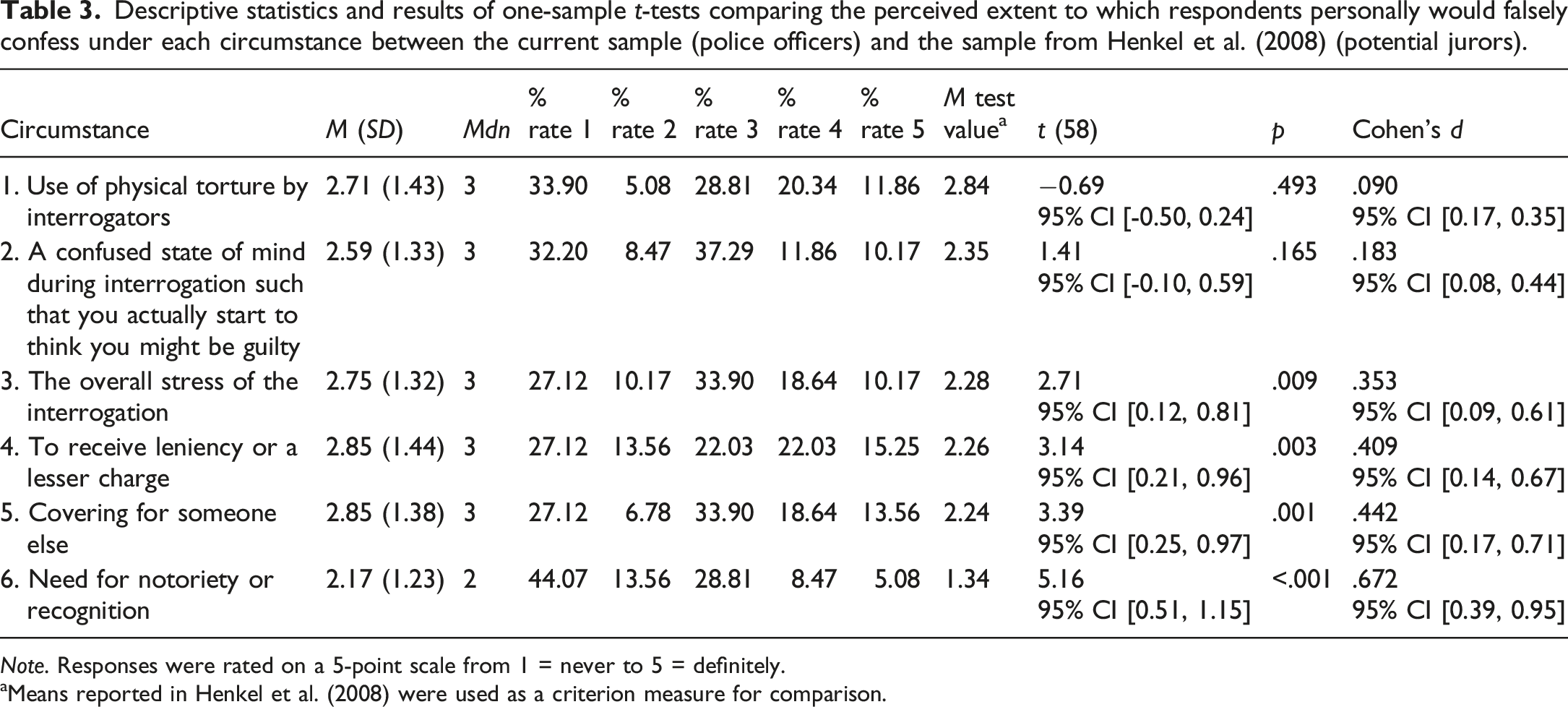
Note. Responses were rated on a 5-point scale from 1 = never to 5 = definitely.
aMeans reported in Henkel et al. (2008) were used as a criterion measure for comparison.
One-sample t-tests were conducted to determine whether mean scores in the current officer sample were different to the student and community samples in Henkel et al. (2008). These findings are presented in Table 3. Compared to the lay public in Henkel and colleagues’ study, police officers in the current study were significantly more likely to believe that the overall stress of an interrogation [t(58) = 2.71, p = .009], the desire to receive leniency or a lesser charge [t(58) = 3.14, p = .003], and the desire to cover for someone else [t(58) = 3.39, p = .001], as well as the need for notoriety or recognition [t(58) = 5.16, p < .001] are factors that would make themselves falsely confess to a crime.
Discussion
The current study sought to understand how Malaysian police practitioners view the matter of false confessions and to gauge the need to enhance knowledge in this area. When asked to rate their investigative interviewing skills, while approximately half rated themselves as excellent or above average, almost half rated themselves as only average. This potentially points toward the need for training and development. This study was unable to measure the police officers’ actual competency of interviewing, so it is possible that they are confident in their skills, but this is not indicative of their ability to carry out effective interviews that yield reliable information and free of false admissions.
Participants’ perceptions were compared against those of two key studies: Henkel et al. (2008) and Mindthoff et al. (2018). Malaysian police did not seem to think that suspects would make false confessions, regardless of whether the false confessions were due to police pressure or internalised guilt. While a number of participants disagreed that coercive interrogation tactics including fabricating evidence are sometimes necessary, many also either thought such tactics are justifiable, or they showed ambivalence. The ambivalence about using questionable techniques to obtain confessions could stem from a few reasons. First, the common belief that suspects would almost always confess or cooperate under police pressure (Leo, 2008) may influence officers to use harsh treatment or manipulation, even if they are not inherently hostile or do not automatically gravitate towards the power of coercion. Second, the customary use of physical force in various settings, including in schools, at home, and in judicial systems (including sharia courts) may explain why officers may not be completely opposed to the use of harsh treatment in an investigation setting (see Chung and Hamid, 2024).
Compared with the general public sample in Mindthoff et al.’s (2018) study, Malaysian police officers were less likely to think that mental illness, adolescence, poor memory, sleep deprivation, and substance influence are false confession risk factors. Being sleep deprived was rated as the lowest contributor of false confessions, despite direct evidence linking sleep deprivation with false confessions (e.g., Frenda et al., 2016). This is an indication that police officers may not fully recognise the risk of individual factors contributing to the occurrence of false confessions.
The current police sample also exhibited a marked bias against believing that they personally would falsely confess. They were significantly more likely than the lay public in Henkel et al.’s (2008) study to believe that they personally would falsely confess due to the overall stress of an interrogation, the desire to receive leniency or a lesser charge, the desire to cover for someone else, and the need for notoriety or recognition. Even so, their mean ratings were less than 3 on a 5-point scale; in other words, similar to the general public, the police did not really believe that they would personally confess to a crime they did not commit under any circumstances.
Taken together, the police did not seem to be cognizant of the fact that false confessions can happen and the contributing risk factors. The discussions above indicate that training and awareness programmes to debunk myths about the use of coercive or manipulative techniques in investigative interviewing may be key to discouraging their use. The challenge in Malaysia is the lack of exposure to science-based methods in the criminal justice system that enable key players to critically evaluate their behaviour and practice. What we know about effective and ineffective practice comes largely from the fields of psychology and law, but the subject area of investigative interviewing – and in fact, the wider field of forensic psychology – has yet to permeate the local psychology and law curriculum. Research publications on this topic in Malaysia is also lacking, clearly signalling that development of the current state of the field is required. Mindthoff et al. (2018) alluded to the notion that media exposure to disputed confession cases can be used as a tool to promote the public’s understanding of certain interrogation techniques and its negative implications. Hence, it is crucial that the accuracy of information presented – apart from sensationalism of content – is considered when such media materials are constructed.
The main strength of this study is in its purposive sample of police officers who have direct contact with terrorist suspects, but one can argue that the small sample size and the lack of a more diverse sample of interrogators are limitations. The predominantly male sample may also be regarded as a limitation, restricting our ability to examine gender differences, but this is a true representation of the current gender ratio in the two police departments.
Given the fact that the data was collected prior to a training session, there was a constraint of conducting a more protracted study or a study using an experimental design, which would have been useful for testing relationships between multiple variables, such as whether police perceptions influence their behaviour. As an example, Holt and Palmer (2023) examined people’s individual attitudes about whether they believed that police should have the power to use coercion during interrogations, and how such attitudes as well as confession inconsistencies affect their verdict decision. Future research could consider including a more comprehensive measure of individual attitudes. It would have been ideal if data was collected before and after the training to evaluate whether the training had any effect on participants’ perceptions, but given the short training duration, it was not expected that perceptions would shift significantly.
With regard to knowledge about interrogations and false confessions, it is also imperative for the public to bear in mind that false confessors may confess voluntarily for strategic reasons and may not necessarily be due to the actual interrogation situation itself. In fact, in Gubi-Kelm et al.’s (2020) semi-structured interviews with detainee participants, a quarter of their sample of false confessors reported having been advised by their lawyer to falsely confess. As the present perception study was focussed on coerced-compliant and coerced-internalised false confessions by the police, specific questions about perceptions toward voluntary confessions were not included, which limits our understanding.
Finally, it is also worth noting that under Malaysian law, a confession is merely a piece of evidence to be used in trial, and sufficient corroboration is required. Additionally, Malaysia has several legislations, including the Security Offences (Special Measures) Act 2012, Prevention of Crime Act 1959, and Prevention of Terrorism Act 2015, which grant law enforcement authorities power to arrest and detain a suspect without trial for a period. Such laws have been criticised by human rights defenders for their heightened risks of abuse (Human Rights Watch, 2024). These points are relevant here because the police’s knowledge of such laws may have influenced their perceptions (as well as practices) of interrogation and confessions, but there was no way in the current study to confirm how such perceptions (and practices) could have been impacted. Focus group discussions would have been useful in elucidating this matter.
Conclusion
The phenomenon of false confessions is rooted in fundamental principles of psychology. There needs to be a concerted effort by psychology researchers in Malaysia to raise awareness about suspect rights and risk factors through professional training and public outreach. According to Kassin (2017), this can be done via a top-down approach, influencing key stakeholders to review and change policies and practice, or with a bottom-up approach, informing the public through public lectures or reputable news media. In Malaysia, there has been some progress in the latter approach, but given the hierarchical nature of the country’s government structure, it may be more effective for academics to use psychological insights to influence political decision-making at a higher level. In Kassin’s (2017) words, “If psychologists do not speak up, that void will be filled by others less informed” (p.960).
Supplemental Material
Supplemental Material - Malaysian police officers’ perceptions of interrogations and confessions
Supplemental Material for Malaysian police officers’ perceptions of interrogations and confessions by Kai Li Chung in The Police Journal.
Footnotes
Acknowledgements
Special thanks to the Royal Malaysia Police officers for their participation in this project. Thanks to research assistant Yi Shan Wong for her assistance in data entry and cleaning.
Declaration of conflicting interests
The author(s) declared no potential conflicts of interest with respect to the research, authorship, and/or publication of this article.
Funding
The author(s) disclosed receipt of the following financial support for the research, authorship, and/or publication of this article: University of Reading School of Psychology and Clinical Language Sciences Research Fund.
Disclosure
The author’s expenses to participate in the training session as a resource person was covered by United Nations Office on Drugs and Crime in accordance with the United Nations Financial Rules and Regulations.

Data availability statement
The data that support the findings of this study are available from the corresponding author upon reasonable request.
Supplemental Material
Supplemental material for this article is available online.
References
Supplementary Material
Please find the following supplemental material available below.
For Open Access articles published under a Creative Commons License, all supplemental material carries the same license as the article it is associated with.
For non-Open Access articles published, all supplemental material carries a non-exclusive license, and permission requests for re-use of supplemental material or any part of supplemental material shall be sent directly to the copyright owner as specified in the copyright notice associated with the article.
