




Abstract
This study investigates the several strongly nonlinear oscillators (Van der Pol, Duffing and Rayleigh) for which we have applied the most powerful and advanced optimal semi-analytical technique: optimal and modified homotopy perturbation method (OM-HPM) for the convergent semi-analytical series solution. The numerical simulation demonstrates the high accuracy of the OM-HPM, which is straightforward, does not require any domain decomposition, special transformation, or pade approximations to get the convergent series solution. The key features for the high accuracy of the OM-HPM lies on the best optimal auxiliary linear operator. Therefore, OM-HPM offering a valuable tool for engineers and researcher to analyze the complex nonlinear oscillator.
Introduction
Many scientific fields, including physics, engineering, and structures including thin-walled structures 1 and active structure 2 use nonlinear oscillators. Many nonlinear differential equations appear in these fields and studying these equations is a major issue. Lots of efforts have been made to explore them in literature, and numerous analytical and numerical techniques have been proposed and employed to solve such problems.3–7 In literature, several analytical methods have been utilized since an exact solution could be too complex to be applied in real-world situations. For instance, the Hamiltonian approach,8,9 the variational iteration method,10–12 the homotopy perturbation method,13–17 the variational approach,18–21 in addition to many other methods.22–25
Nonlinear oscillators come in two varieties: weakly and extremely nonlinear. Weak nonlinearity is indicated by a small coefficient of the nonlinear term; however, some authors have claimed that this is not always enough and that the amplitude and starting conditions must also be taken into consideration. Weak nonlinearity can be quantified by treating it as a disturbance of the corresponding linear oscillator. There are several perturbation techniques available, but not all of them yield consistently reliable results. Modifications have been developed to alleviate these shortcomings.26,27
Numerous researchers have shown interest in a number of notable oscillators that have important applications in physics and engineering.28–32 For example, the excited spring pendulum has been studied in detail utilizing the so-called multi-scale approach, which enables the authors to estimate the equations of motion for the system. 29 Additionally, the Van der Poland Duffing oscillators have been considered in a number of papers.29–31 It is clear from these references that several perturbation approaches were investigated in order to approximate the solution to the dynamic equations of the Van der Pol oscillator.29,30 On the other hand, the Duffing oscillator was also studied in References 29–32, where the authors used the effective analytical approach known as the fourth-order Runge–Kutta method to determine the solution and compare it with a numerical solution.
Semi-analytical approaches, which combine analytical and numerical techniques, are becoming more and more common for approximating and solving nonlinear problems. They are useful for comprehending and handling complicated nonlinear occurrences in a variety of domains because they provide a balance between accuracy and computing efficiency. Among such semi-analytical approaches, homotopy perturbation method (HPM)13,14,32 is one of the most powerful for solving the highly nonlinear oscillators and is widely use to solve such problems. However, the accuracy and convergence of the HPM series solution are slower for few problems.33,34 Even sometimes HPM33,34 fails to provide us the convergent series solution for few highly nonlinear problems. Moreover, others semi-analytical methods including variational iteration method (VIM) 35 and differential transformation method (DTM)34,35 are also fails to provide convergent series solutions. In recent literature, there is most powerful and advance technique: an optimal and modified homotopy perturbation method (OM-HPM). 36 Which is nothing but the optimal form of the classical HPM13,14,32 and it is well established for highly nonlinear differential equations to get the convergence series solution. However, it is seen that the accuracy and convergence of the HPM series solution are slower for few problems.33,34 Even sometimes HPM33,34 fails to provide us the convergent series solution for some of the highly nonlinear problems, particularly, for the van der pol oscillator. Several researchers11,37–41 put effort to solve such van der pol oscillator using other contemporary semi-analytical methods including variational iteration method (VIM), 35 optimal VIM, 42 differential transformation method (DTM).37,38 Unfortunately, they failed to provide convergent series solutions. In the literature, we have added an advanced semi-analytical method, namely, Optimal and Modified Homotopy Perturbation Method (OM-HPM). 36 The traditional Homotopy Perturbation Method (HPM)3,13–16,19,24–29 is updated by defining the linear operator as an auxiliary linear operator, and then optimized this operator by minimizing the residual error. Unlike traditional methods, OM-HPM 36 does not require any auxiliary parameters or functions. In addition, it can be directly applied to singular or non-singular highly nonlinear ordinary differential equations without decomposition, special transformations, or pade approximation. Therefore, in this study, our aim is to analyze the dynamics of some of the strong nonlinear oscillators, namely, duffing oscillator (DO), Rayleigh oscillator (RO), and van der Pol oscillator (vdPO), using this advance optimal analytical technique.
The rest of this paper is organized as follows: In section 2, we present the methodology of the method used. In section 3, analytical and numerical methods have been applied to solve three oscillators (Duffing, Van der Pol and Rayleigh). Finally, we close our paper by a conclusion.
Methodology
In order to solve the considered nonlinear problems, we adopted the recently proposed optimal and modified homotopy perturbation method (OM-HPM). 36 The method is follows:
For the nonlinear differential equation of the form








If we differentiate the zero-th order homotopy equation (3) by




Hence, the general solution becomes


In order to reduce the computational time, we utilize the discretised form of the square residual which is based on newton quotes quadrature rule (simpson’s

Analytical and numerical illustration
Duffing oscillator

As equation (14) is of 2nd order differential equation, so from equation (4) we have the auxiliary linear operator of the form as

For optimal homotopy perturbation based analytical solution at least one root



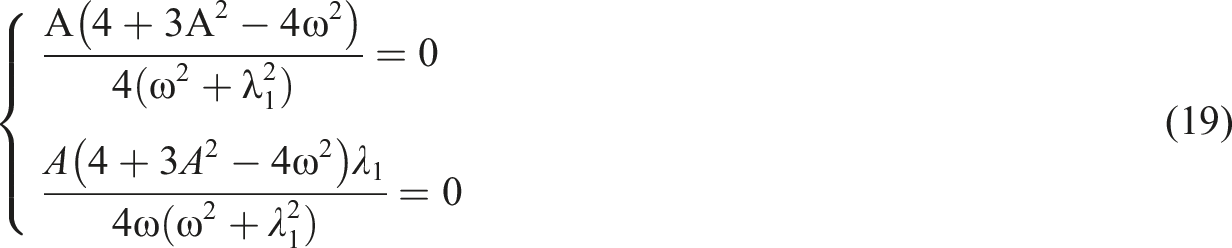
Solving equation (19) we have amplitude
Now substituting the value of amplitude A and frequency



As the first order solution give us a sufficiently enough small residual error, the higher order may be avoided here. It is important to emphasized that all the analyses given in six have been considered as dimensionless. To confirm the solution accuracy we present Fig-1 where we compare the computed OM-HPM series based analytical solution with those of numerical solution obtained by 4th order Rungee-Kutta method.
From Figure 1 it is clear that first order OM-HPM
36
analytical series solution is almost matching with the numerical solution obtained by RK4 method. Therefore, for this problem first order OM-HPM approximation is sufficient. Then we continue upto 5th order OM-HPM approximations. Table 1 represnts the different order of approximations, optimal value of Comparison of the computed 1st order OM-HPM
32
analytical solution with the numerical solution by RK4. (a). Time series solution of x(t) versus t. (b). Time series of velocity Optimal table for duffing oscillator (14). Phase portrait for velocity 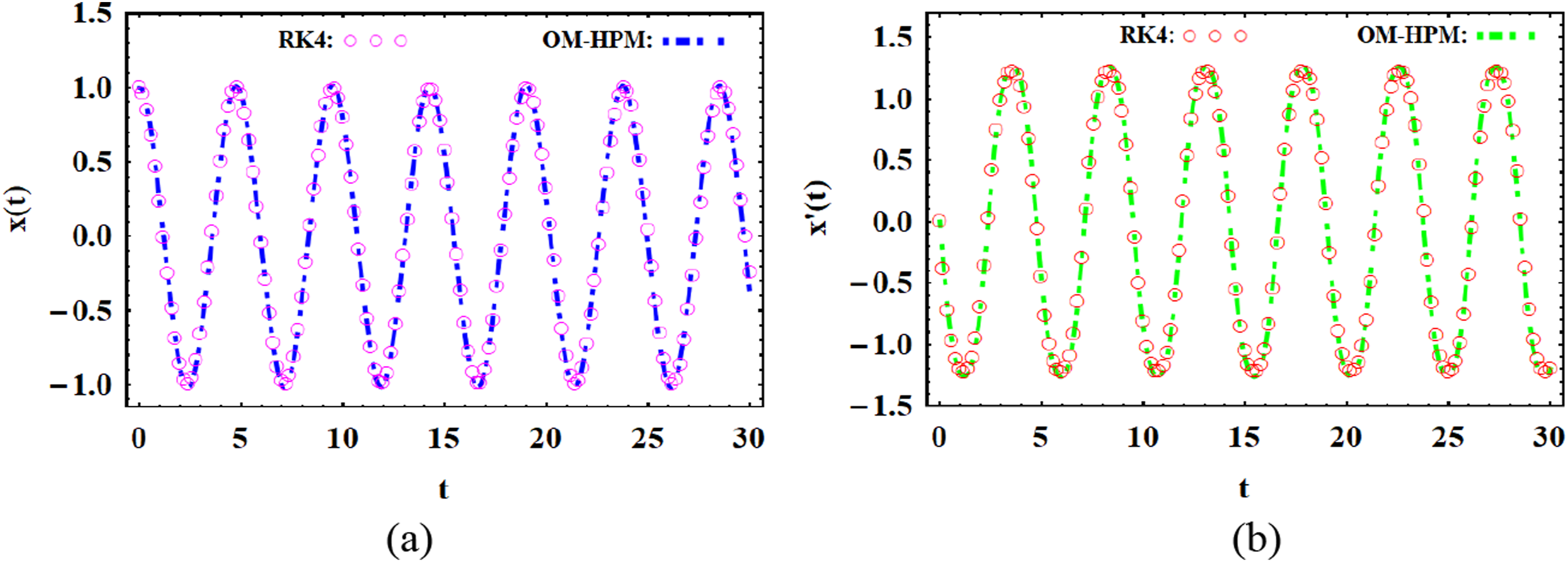

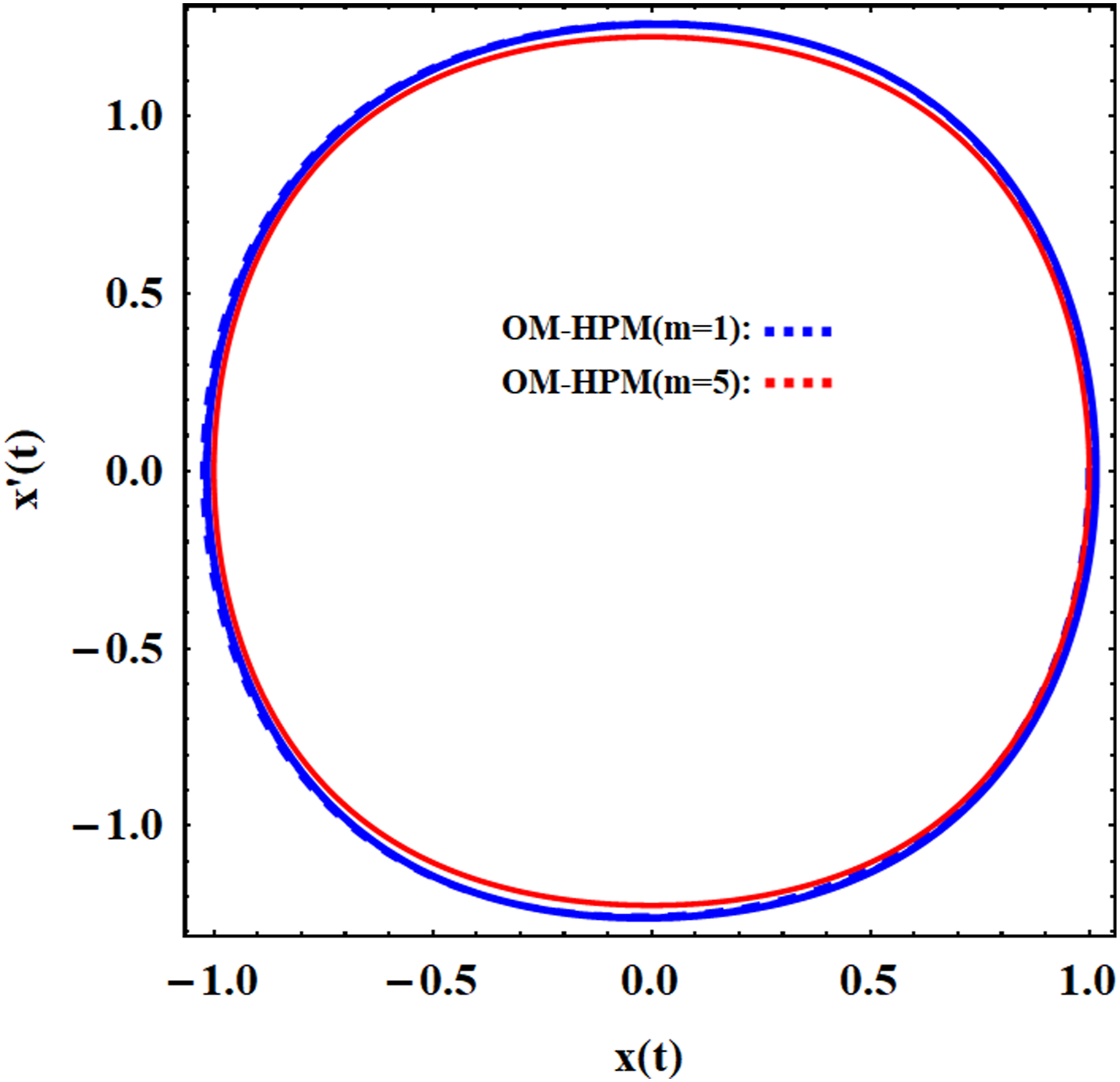
From Figure 2 it is clear that both the lower (m = 1) and higher (m = 5) order OM-HPM approximation are close to each other and providing limit cycle, that is, stable periodic motion over time, forming a closed trajectory in the phase space.
Van der Pol oscillator

Several researchers attempted to solve this van der pol oscillator analytically using the HPM,13,34,35 HAM,40,41 and VIM.11,35 Ozis et al.
34
and others 13,35 solved using the classical HPM and obtained series solution with relative percentage error upto 37.5%. Here, we are interested to apply our recently proposed advanced technique OM-HPM.
34
Similarly, using the linear operator (17), the initial approximation 
we compute successive homotopy perturbation approximations. The first order approximation is of the form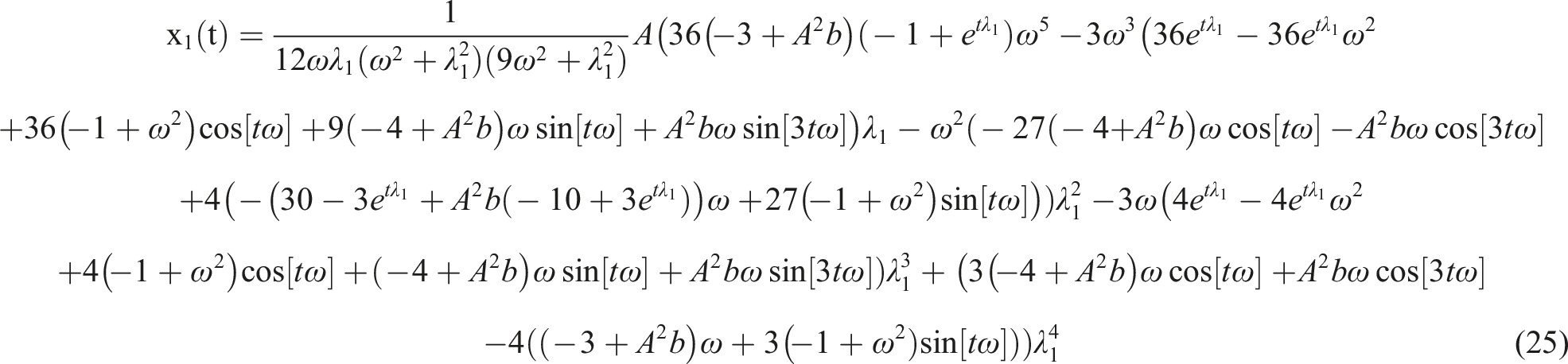
Therefore, for the periodic solution we have


However, here the residual error at 1st order is not satisfactory. Here, we continue upto 5th order approximations and prepare the optimal table as

Optimal table for Van der Pol oscillator (23).

Now, substituting the optimal value of the auxiliary roots 
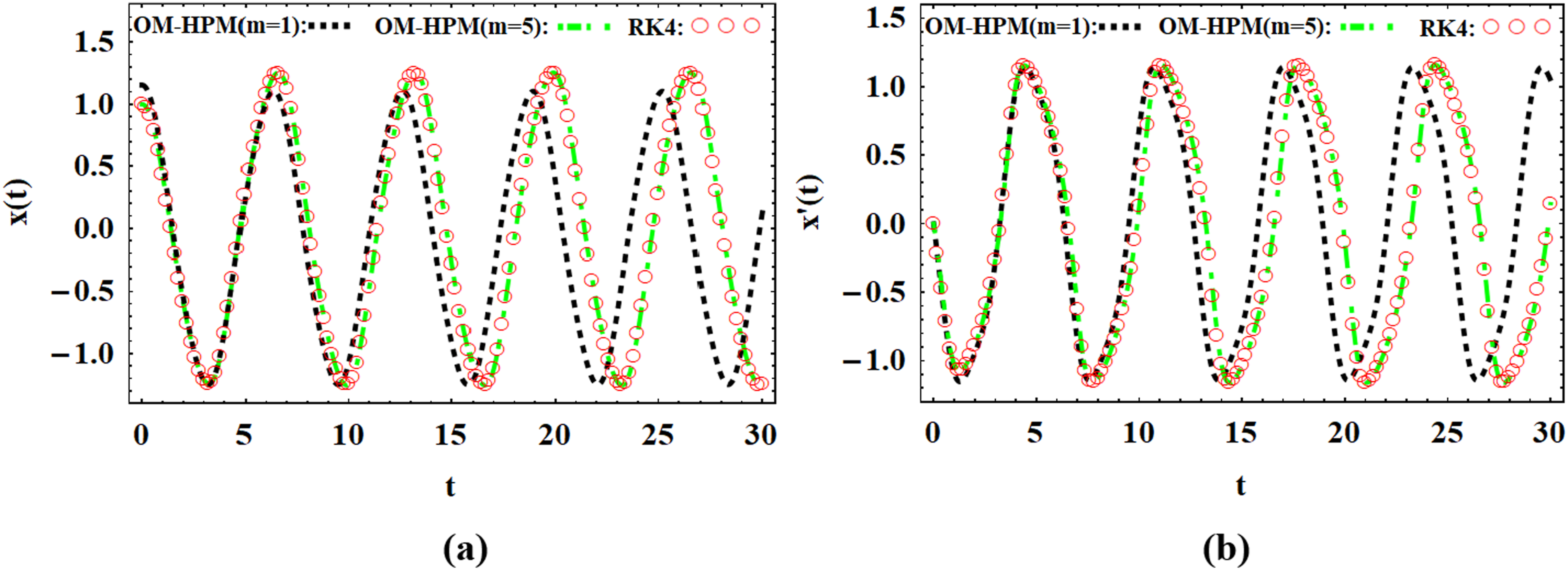
The solutions of the equation (23) are shown in the Figure 3. In the Figure 3 we compare our computed OM-HPM solution with the numerical solution by RK4. Figure 3(a) presents the solution x(t) while Figure 3(b) represents the velocity Comparison of the computed analytical solution with the numerical solution by RK4 at different order of approximations (m = 1,3 and 5) for the limiting case b = 1. (a). Time series solution of x(t) (b). Time series of velocity 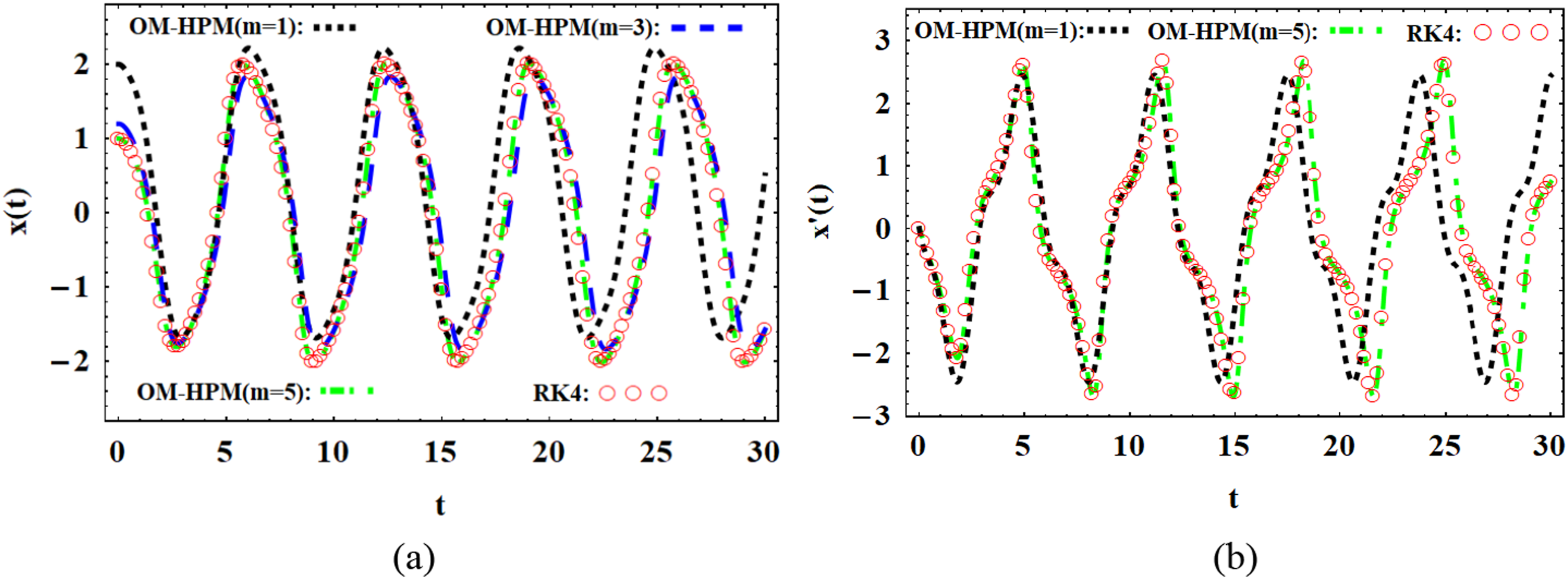
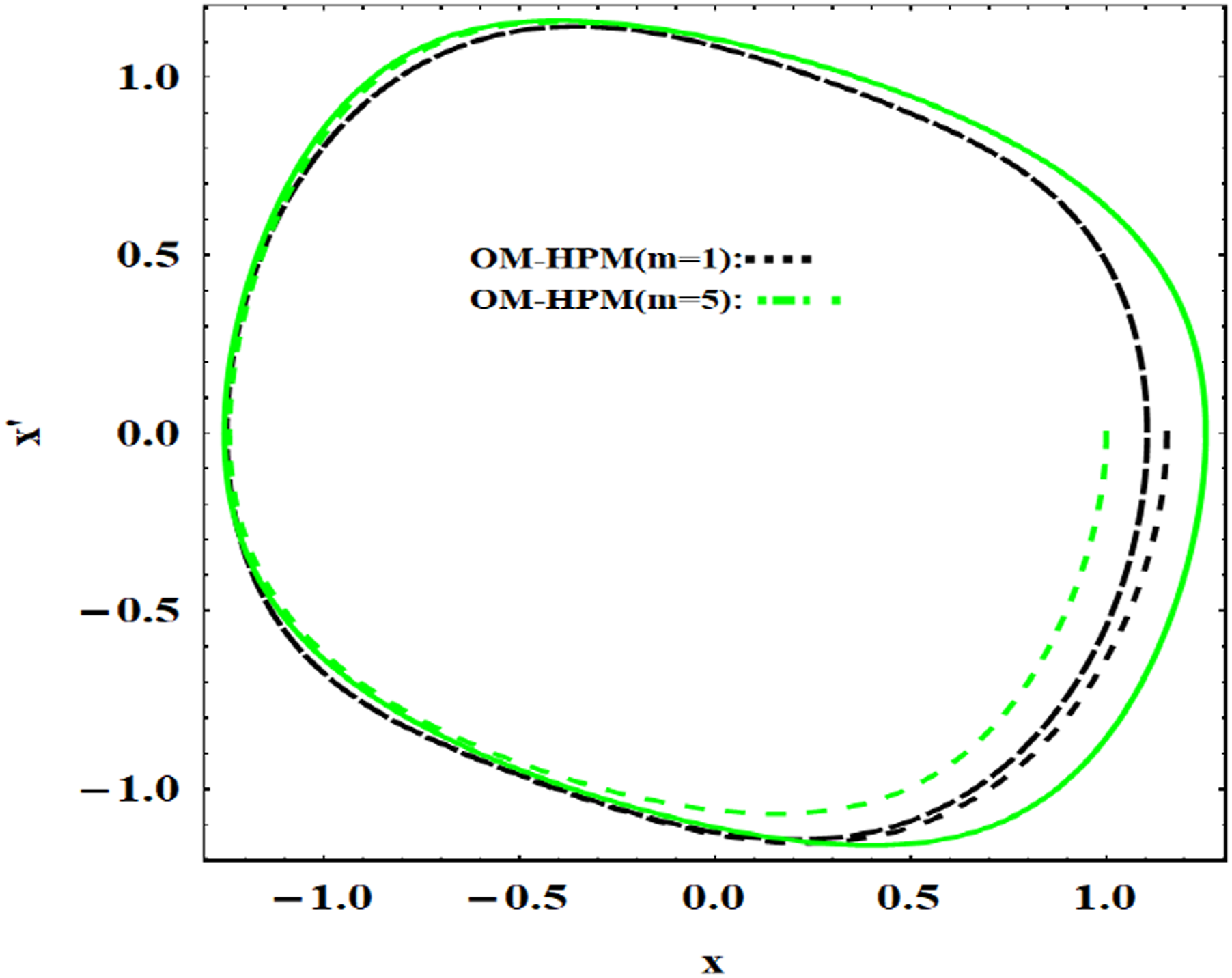
The phase portrait at the different order (m = 1 and 5) of OM-HPM approximations series solutions for the oscillator (23) is shown in the Figure 4. We have seen that there is a closed trajectory surrounding the origin. Hence, the system exhibits limit cycle behavior. The system does not settle down to equilibrium but rather to a periodic solution. Phase portrait for velocity 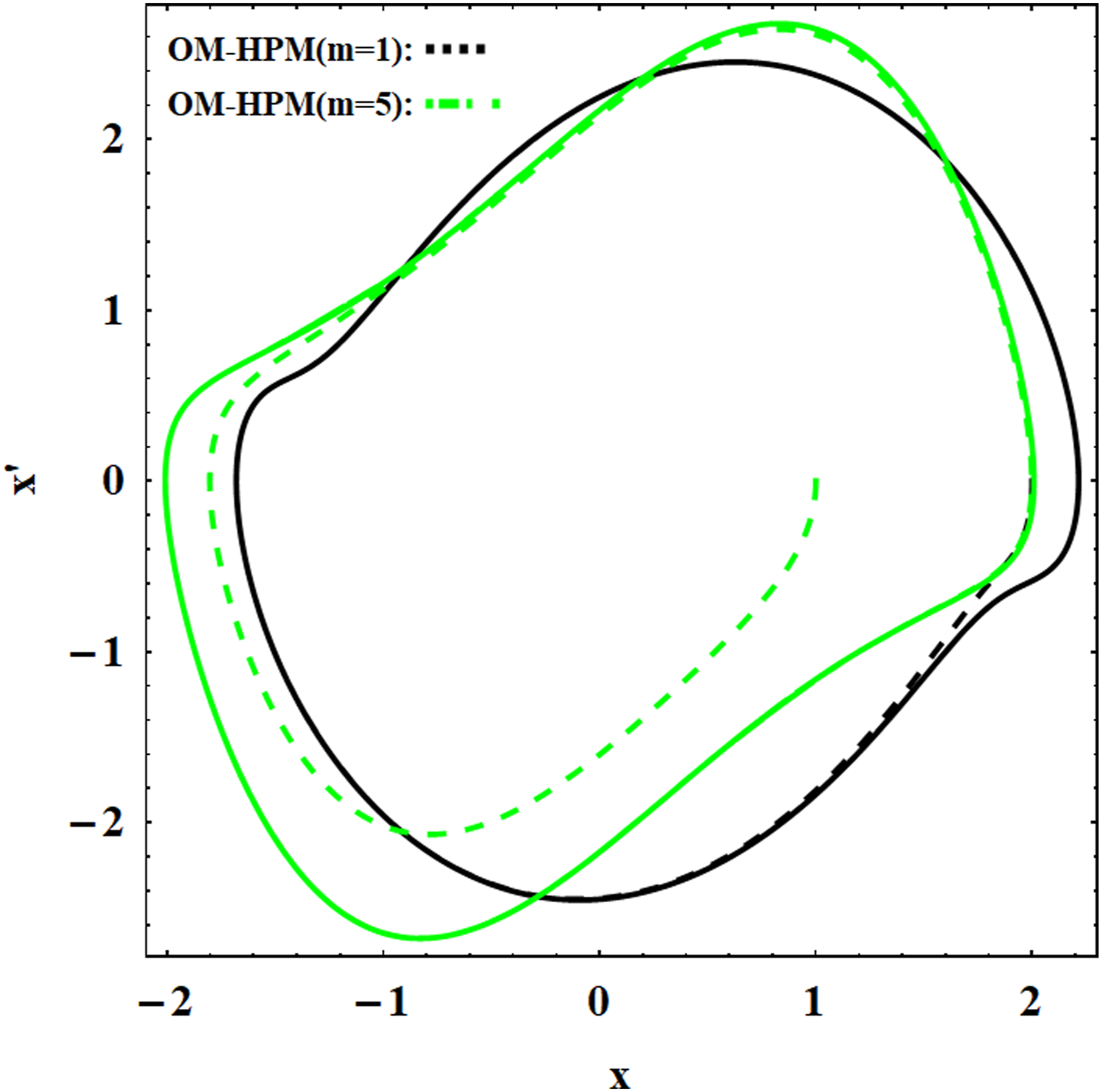
Rayleigh oscillator

Following the similar process with the linear operator (17), the initial approximation 
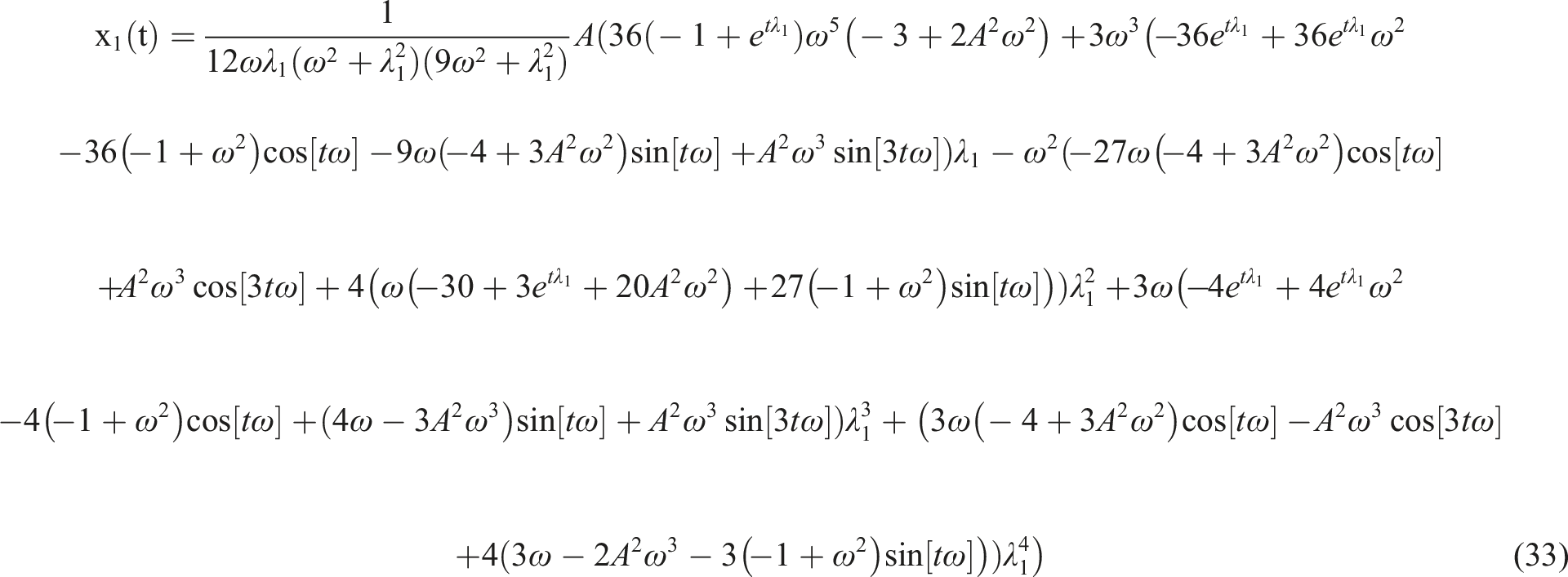
Similarly for the periodic solution we have
Solving we have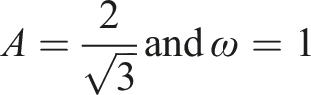


The minimum square residual is computed as Comparison of the computed analytical solution of equation (33) with the numerical solution by RK4 at different order of approximations (a) time series solution of x(t) (b) time series of velocity Phase portrait for velocity 
Similar to the Van der Pol oscillator, here also arise a closed trajectory surrounding the origin. Hence, the system exhibits limit cycle, that is, stable periodic motion over time.
Conclusions
In this paper, we applied the optimal and modified homotopy perturbation method (OM-HPM) technique to provide convergent semi-analytical solutions for three different models: duffing oscillator (DO), Rayleigh oscillator (RO) and van der Pol oscillator (vdPO). The high accuracy of this technique is attributed to the selection of optimal auxiliary linear operator, which makes it a practical tool for engineers and researchers. It has been shown that out of the three models discussed, only the DO is conservative in nature and other two are non-conservative in nature. Surprisingly all the three oscillators are stable oscillators. Our method is suitable as long as the phases remains closed in nature, thereby justifying the stability. Present method will not give encouraging results on unstable cases reflecting open nature of phase portrait. It may be recommended that this advanced approach OM-HPM can be applied to other strongly nonlinear oscillators to explore the complex dynamics. However, OM-HPM need more CPU time than traditional HPM.
Footnotes
Declaration of conflicting interests
The author(s) declared no potential conflicts of interest with respect to the research, authorship, and/or publication of this article.
Funding
The author(s) received no financial support for the research, authorship, and/or publication of this article.