




Abstract
The homotopy perturbation method with an auxiliary term is applied to obtain an approximate analytical solution for the tangent nonlinear packaging system. To further raise the accuracy of the solution, this work has expanded the possibility of the energy method for the homotopy perturbation method with an auxiliary term. And then, the amplitude and frequency of the tangent nonlinear packaging system can be calculated. The results show that the solution is in good consistent with the numerical solution solved by the Runge–Kutta method. It can be concluded that the proposed method is suitable for the optimal design of a tangent nonlinear packaging system.
Keywords
Introduction
Shock and vibration are inevitable situations for the packaged products during transit from the manufacturing plants to the consumers, which are investigated by many scholars.1–3 In fact it should be pointed out that the constitutive models of cushioning package materials are strong nonlinear and further effort is required to reveal the theoretical analysis of the packaging systems.
Recent developments of the analytical solutions of nonlinear problems have attracted much attention. Among the methods for analytical solutions, the perturbation method 4 is one of the most well-known approaches based on the existence of small parameters. As we all know, most nonlinear equations have no small parameters at all, which has limited the application of the perturbation method. In order to eliminate the assumption of “small parameters”, considerable research efforts have been devoted to develop new methods, including the variational iteration method5,6 and the homotopy perturbation method (HPM).7–12 HPM is a coupled method of the homotopy technology and the classical perturbation method, which has been extensively used to solve many nonlinear problems.13–17 Several excellent reviews describing the developments of the HPM are available. Li and He 18 constructed a homotopy equation with a higher order coupled with the basic idea of the enhanced perturbation method. Noor 19 presented a modification of the HPM with an auxiliary term. He 20 proposed an alternative approach by introducing an auxiliary term into the homotopy equation.
This paper investigates the applicability and validity of the HPM with an auxiliary term for the optimal design of a tangent nonlinear packaging system. Combined with the energy method, the amplitude and frequency of the tangent nonlinear packaging system are obtained, which are in accord with the results of Runge–Kutta method.
Homotopy equation with an auxiliary term
Considering a general nonlinear equation

The classic homotopy equation can be constructed as

On the basis of He’s recent study,
20
the homotopy equation can be constructed with an auxiliary term as



The tangent nonlinear packaging system
The tangent nonlinear packaging system commonly exists in packaging engineering, and the governing equations can be expressed as


According to the Taylor series, equation (6) can be simplified as

Introducing these parameters:

According to the homotopy equation with an auxiliary term, equation (9) can be calculated as

Substituting equation (4) into equation (10), the iteration equations can be obtained



Solving equation (11), we have

Substituting equation (14) into equation (12) leads to




In order to eliminate the secular term, it must be satisfied that

A special solution of equation (12) can be obtained as

The second-order iteration equation can be given by substituting equation (20) into equation (13)






No secular term in

Combining equations (19), (27) and the following parameters,
Substituting equation (14) into equation (21) results in

The final solution

And the second-order acceleration iteration approximate expression can be written as

Thus the approximate solutions of the maximum displacement and acceleration can be expressed, respectively.


The energy method
In the analysis of dropping shock response of nonlinear packaging systems, the maximum displacement and acceleration of the products are usually obtained by the energy method. In order to raise the accuracy of the solution, our research extends the knowledge into the energy method, trying to correct the amplitude and the frequency of the tangent nonlinear packaging system. Thus

Solving equation (33), the maximum displacement
According to equation (4), the maximum acceleration can be expressed as

By solving equations (31) and (32) simultaneously, the new frequency
Results
The numerical solution solved by Runge–Kutta method is most equal to the exact solution, which can be plotted in Figure 1 (dotted line). The curve of the HPM with an auxiliary term is shown in Figure 1 (solid line), while the result of HPM with an auxiliary term combined with the energy method (HPM-EM) is also illustrated (dashed line). And a further comparison of the proposed method and Runge–Kutta method is performed, showing overall good agreement. To further verify the presented method, the maximum displacements and accelerations of the tangent nonlinear packaging system are listed in Table 1. On the basis of these results we concluded that good agreement is achieved between HPM-EM solution and the Runge–Kutta method solution.
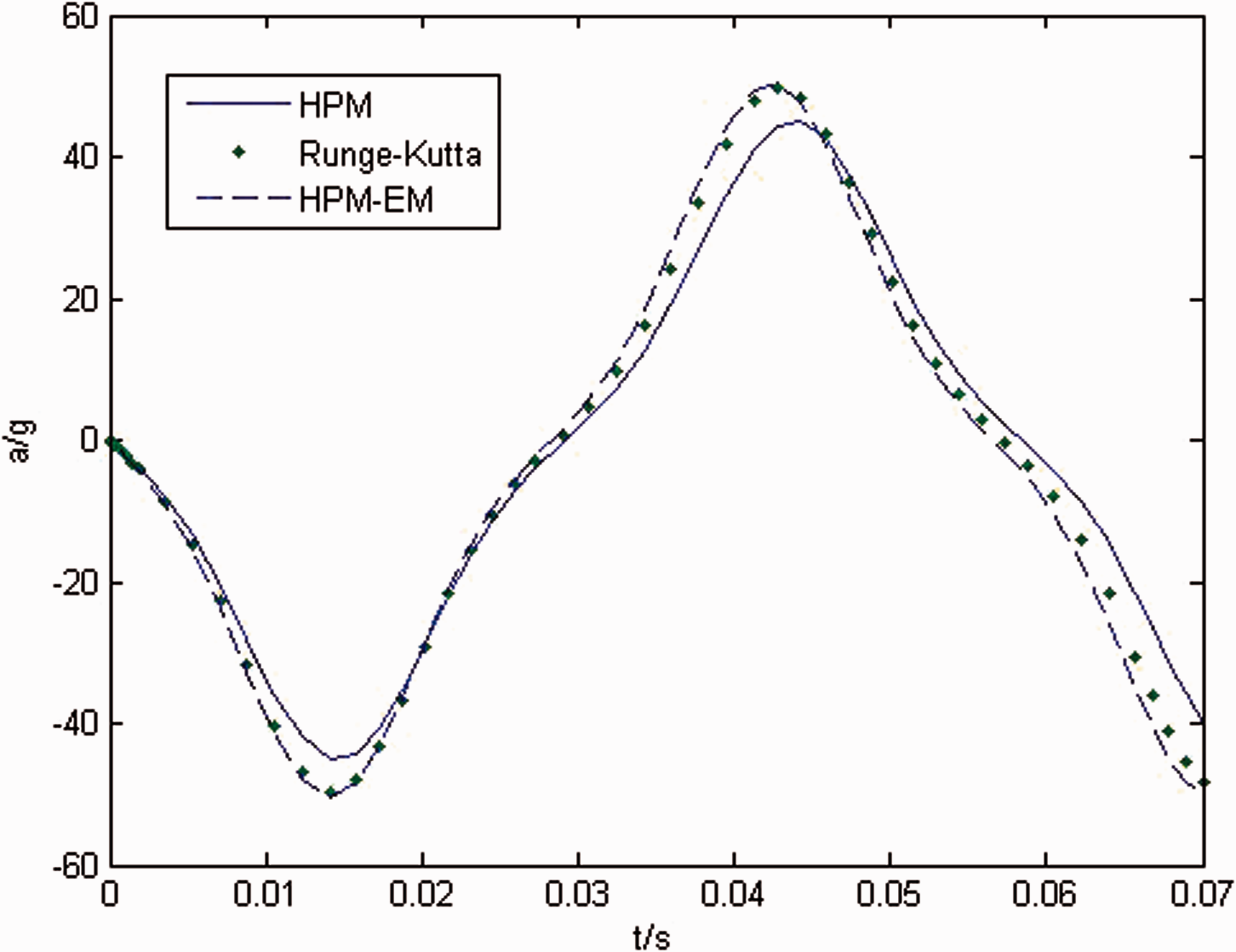
Comparison of solutions obtained by HPM and HPM-EM with that of Runge–Kutta method.
Results of the maximum displacements and accelerations for the tangent nonlinear packaging system.

HPM-EM: homotopy perturbation method with energy method.
Conclusion
The analysis of dropping shock response for the packaged products is an unavoidable procedure in cushioning package design. The major objective of this paper is to develop the HPM with an auxiliary term for the optimal design for a tangent nonlinear packaging system. In order to raise the accuracy of HPM with an auxiliary term, our research extends the knowledge into the energy method. To gain more sight, the solutions of HPM-EM and Runge–Kutta method are compared. From the comparison results shown above, the relative error of HPM-EM can be decreased to 2%, which indicates that the solution of HPM-EM is in good agreement with the numerical solution. Our findings lead us to conclude that this study provides a scientific and effective method for the analysis of dropping shock response of a tangent nonlinear packaging system. Thus, the future looks bright for the presented method for different types of nonlinear packaging systems.
Footnotes
Declaration of conflicting interests
The author(s) declared no potential conflicts of interest with respect to the research, authorship, and/or publication of this article.
Funding
The author(s) disclosed receipt of the following financial support for the research, authorship, and/or publication of this article: Natural Science Foundation of Jiangsu Province, China (Grant No. BK20151128), National first-class discipline program of Light Industry Technology and Engineering (LITE2018-29), the 111 Project (No. B18027), and Natural Science Foundation of Zhejiang Province (Grant number: LY16A020004).