




Abstract
This paper introduces a numerical approach for the fractional-order Rössler chaotic systems and gives error analysis. The effectiveness of the present method is determined by comparing the numerical results of the high-precision difference scheme and predictor-correctors scheme. Some complex dynamical behaviors for the fractional-order Rössler chaotic systems are shown.
Introduction
Nowadays, fractional chaotic system (FCS)1–4 has attracted much attention since it plays an important role in many fields of engineering.5–7 The research on FCS has achieved remarkable results both in breadth and depth. Compared with integer-order chaotic systems, FCSs usually have more complex numerical computation requirements due to their nonlocal properties. In view of this, the development of numerical algorithms for FCS has become an urgent topic.
The Rössler systems are classical models of nonlinear dynamics with a wide range of physical and engineering backgrounds. In recent years, scholars have studied fractional Rössler chaotic systems and found that fractional-order Rössler chaotic systems have unique properties that integer-order Rössler systems do not have.
In this paper, we consider the following fractional-order Rössler chaotic systems:
8


The Caputo fractional derivative of α order of the function u(t) is defined by


Some fractional derivative9–11 and corresponding numerical method have been widely employed in numerical solution of fractal-fractional systems,12–15 such as Adams–Bashforth–Moulton algorithm, 1 predictor-correctors scheme, 2 high-precision difference scheme,16,17 local discontinuous Galerkin method, 18 finite difference method,19,20 reproducing kernel method,21,22,23 spectral method,24–27 homotopy perturbation method,28–30 Li–He’s modified homotopy perturbation method,31,32 and variational iteration method. The variational iteration method was proposed by Ji-huan He and was applied to a kind of nonlinear oscillators,33,34 autonomous ordinary differential systems, 35 the Kaup–Newell system, 36 the nanobeam-based N/MEMS system, 37 and fractal pull-in motion of electrostatic MEMS resonators. 38 However, due to the nonlocal property of fractional derivative and special characteristics of chaotic dynamical systems, many methods involved in solving fractional chaotic system are time consuming and tedious. This paper introduces a numerical approach for the fractional-order Rössler chaotic systems and gives error analysis.
Numerical algorithm
In Ref. 3, Abdon Atangana and Seda Iǧret Araz have given a new numerical scheme with the Newton polynomial. Similar to Ref. 3, we derive a numerical scheme for system (1). To explain the method, we consider the following fractional differential equation based on the Caputo fractional derivative:

By integrating equation (5) with the α-order fraction integral, it gives



To simplify the integral on the right side of equation (8), h(t, u(t)) is approximated by the Lagrange interpolation polynomial,

Thus, we can reorganize the above equation as follows:

The above formula (10) is rewritten as follows:

Because the following equation is true


Thus, substituting (12)–(13) into (10), the following interpolation difference scheme is given
3
:

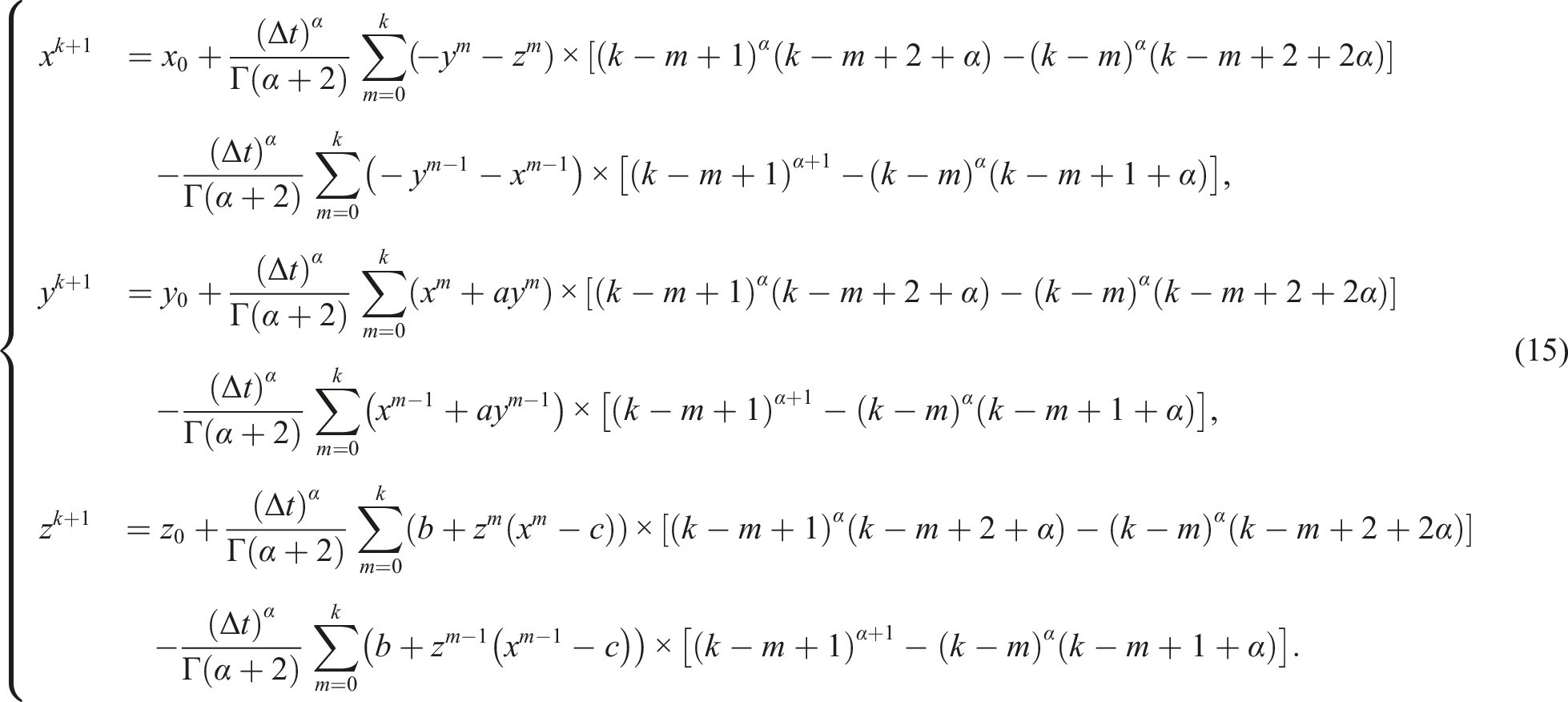
Applying the above method, the corresponding calculation scheme of the fractional-order Rössler chaotic system (1) can be obtained as follows:
Error analysis
By integrating the form (5) with fractional integral of α-order and using Lagrange interpolation scheme, we can get
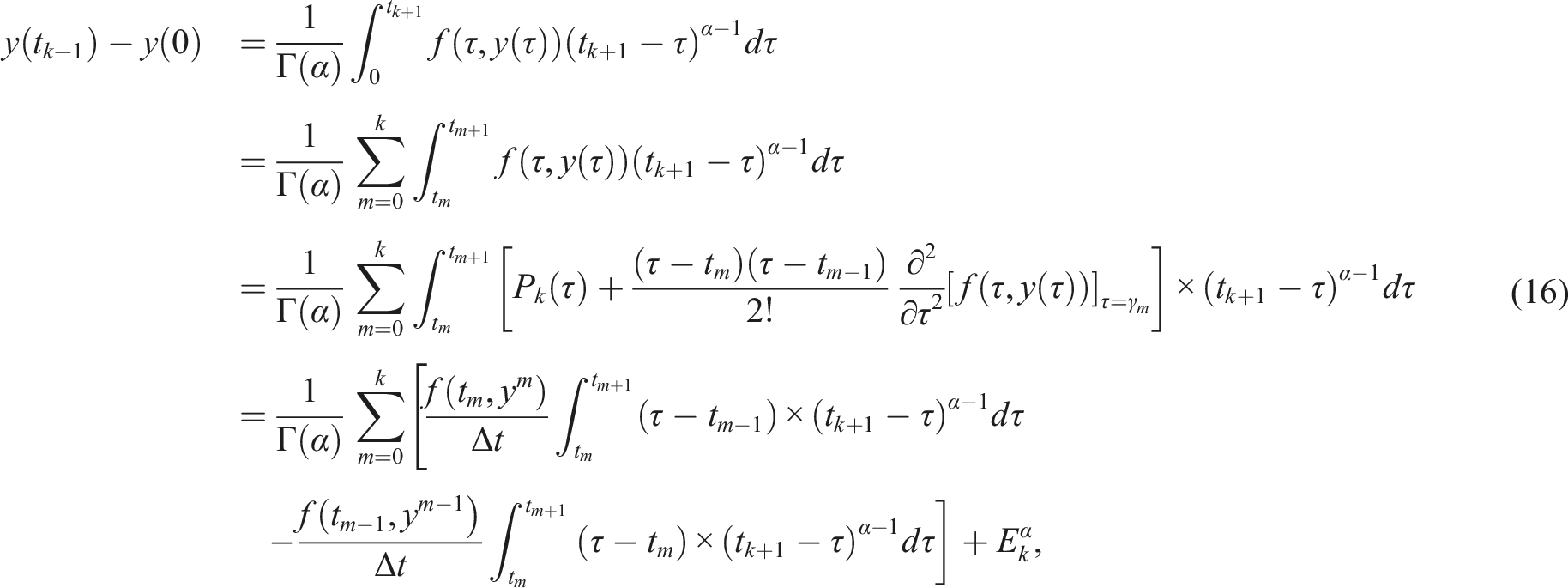

Since
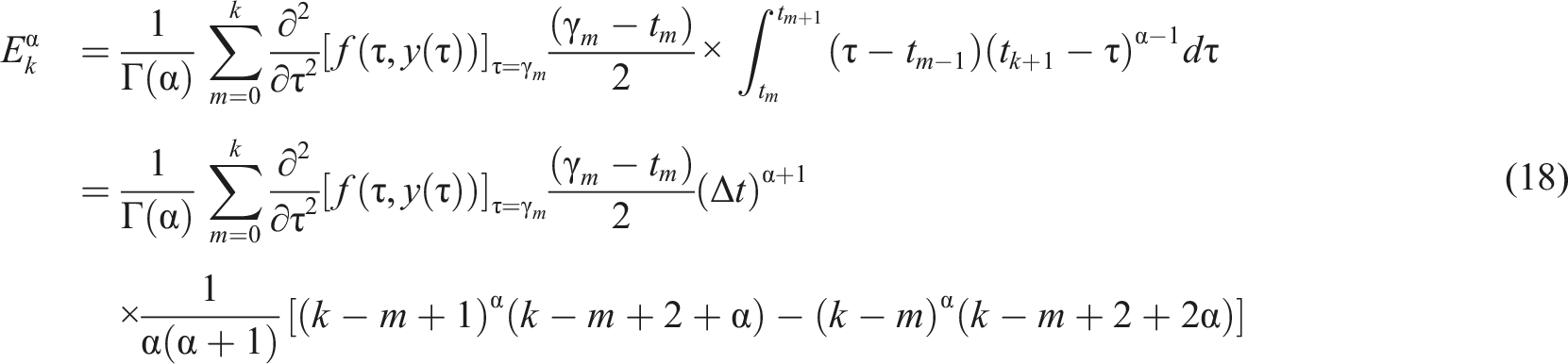
Taking the absolute value of the above formula, we can write the following inequality:

Because the sum at the right hand side of the above inequality can be written

Thus, the error can be obtained:
3

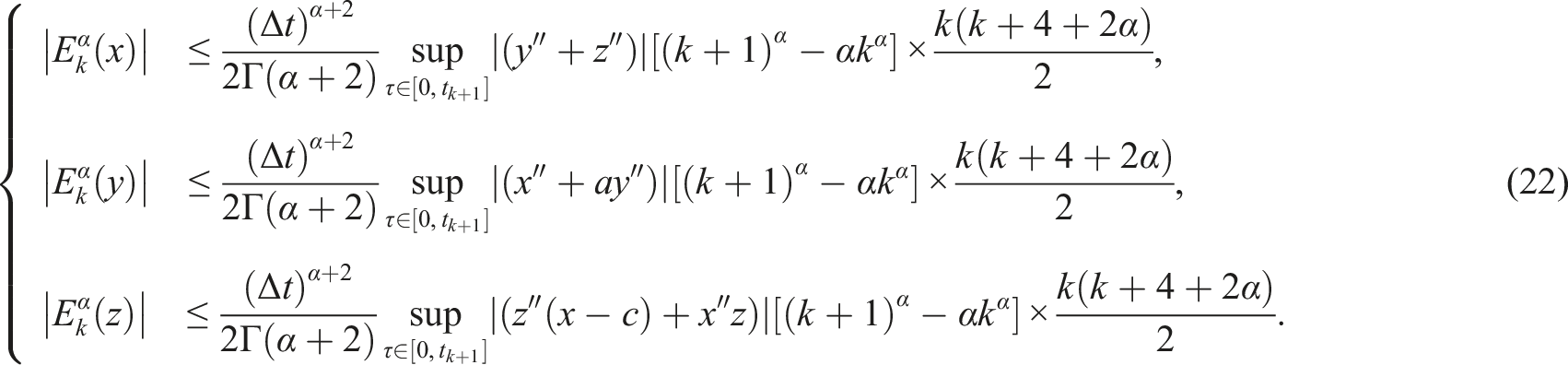
Applying the above method, the corresponding error analysis can be obtained as follows:
Numerical experiment
In order to verify the effectiveness of the present method, we set different parameters and different fractional derivatives to do numerical experiment.
In equation (1), subject to the initial condition c1 = 0.5, c2 = 1.5, c3 = 0.1, time step h = 0.01, and α = [α1, α2, α3] = [0.97, 0.97, 0.97], a = 0.2, b = 0.2, c = 6, T = 200, comparisons of the time series diagram are shown in Figure 1. Comparisons of the time series diagram in Ref. 8 with the present method at α = [0.97, 0.97, 0.97], a = 0.2, b = 0.2, c = 6, T = 200.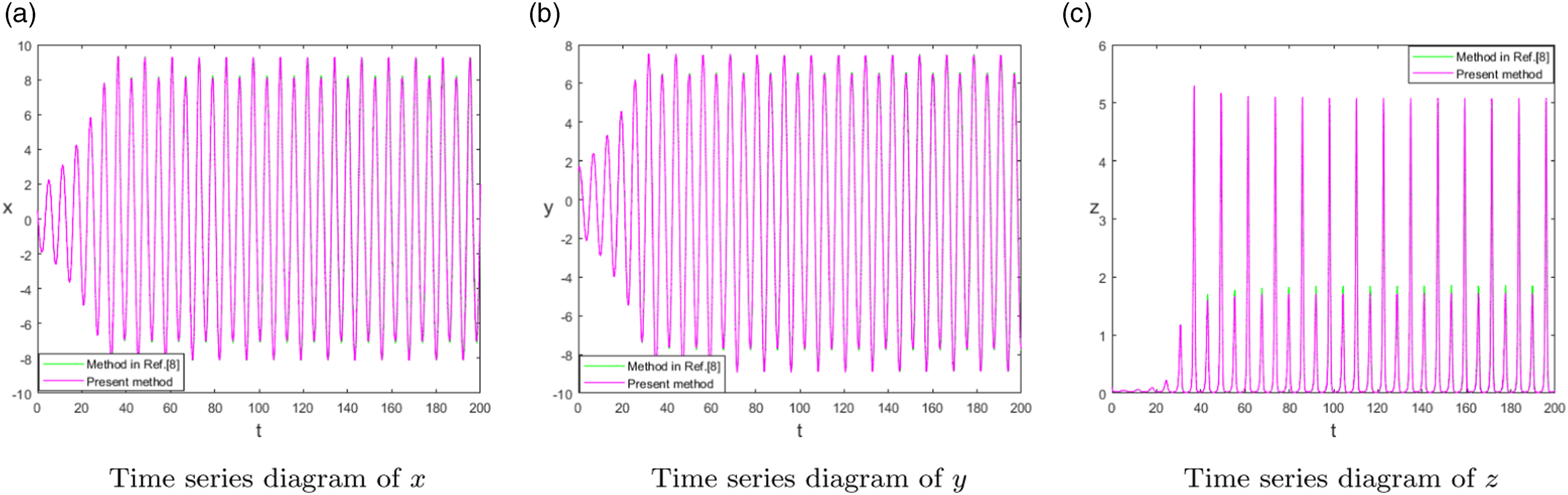
Setting α = [α1, α2, α3] = [0.9, 0.9, 0.9], a = 0.5, b = 0.2, c = 10, T = 500, comparisons of the phase diagram are shown in Figure 2. Comparisons of the phase diagram in Ref. 8 with the present method at α = [0.9, 0.9, 0.9], a = 0.5, b = 0.2, c = 10, T = 500.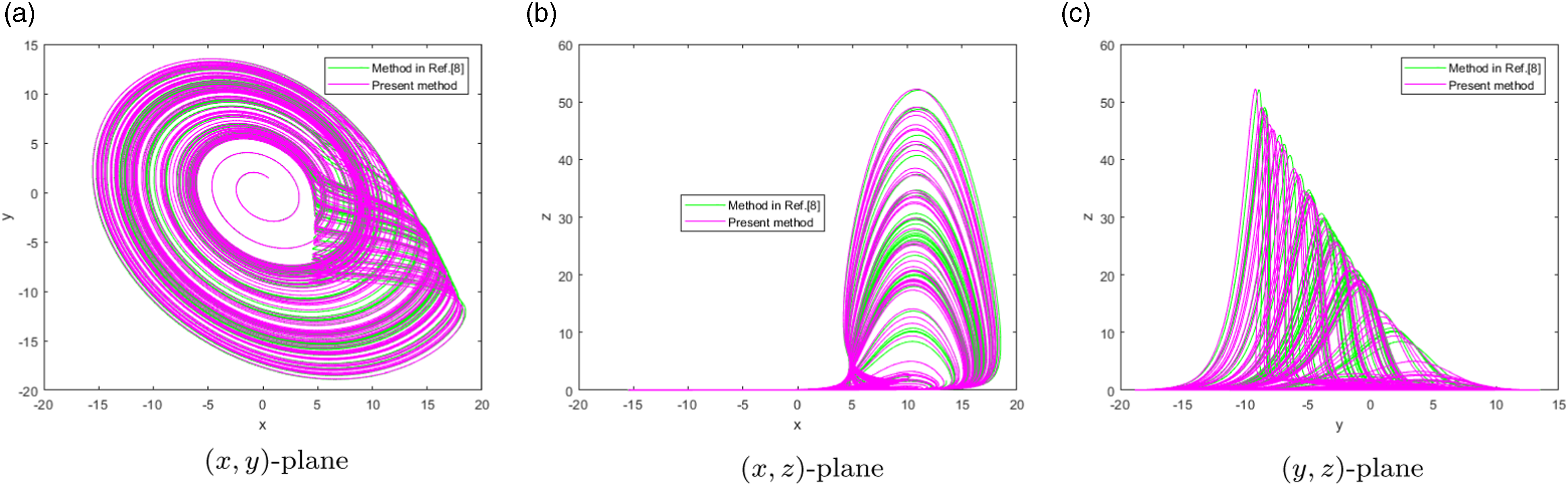
Setting different fractional derivative α and parameters a, b, c, comparisons of the chaotic attractor are shown in Figure 3. Comparisons of the chaotic attractor in Ref. 8 with the present method and predictor-correctors scheme.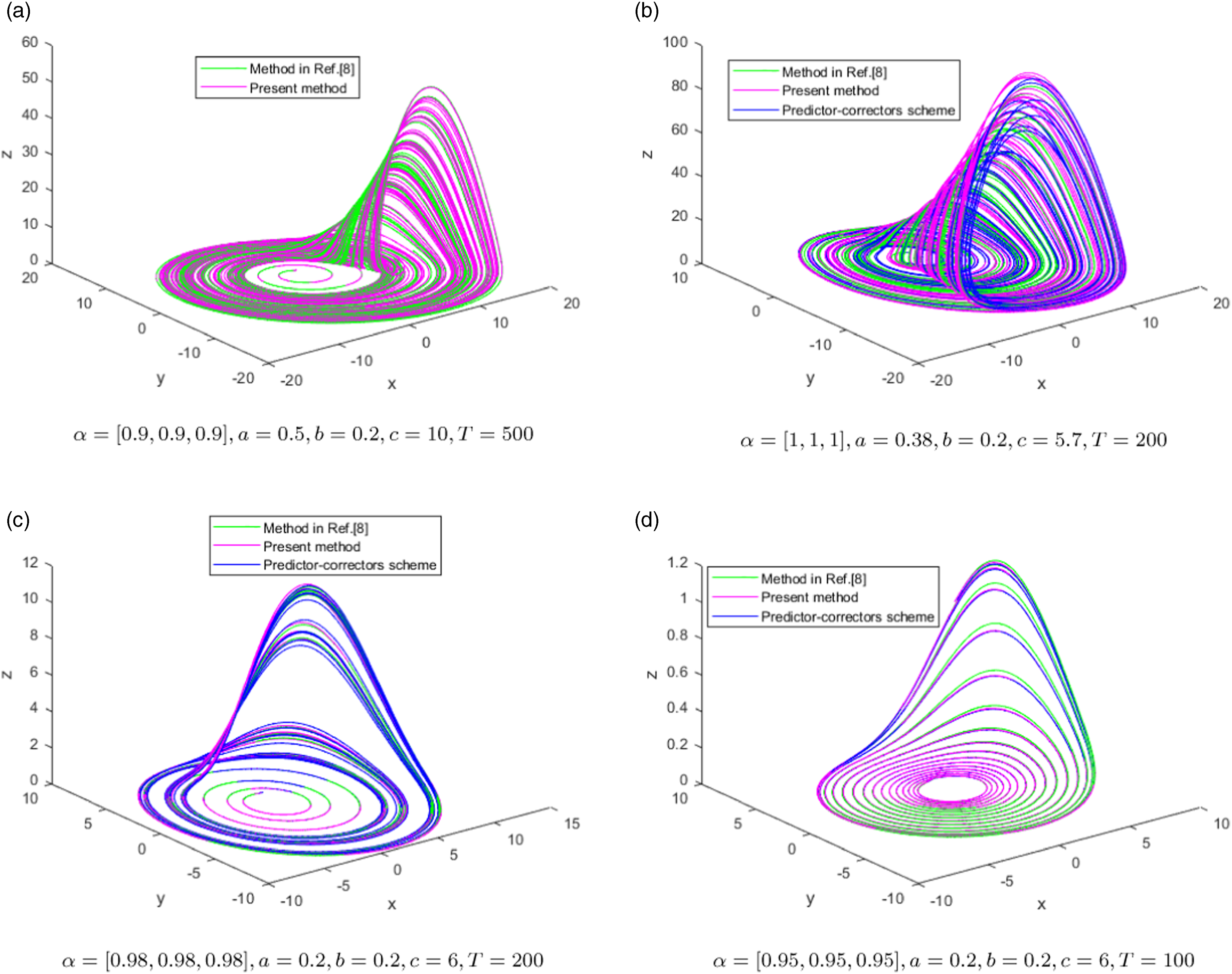
Figures 1–3 confirm the validity of the present method. The present method can effectively capture the dynamic behavior of the fractional-order Rössler chaotic system. Some complex dynamical behaviors for the fractional-order Rössler chaotic systems are shown in Figures 1–3.
Conclusions
In this paper, a numerical approach is proposed for solving the fractional-order Rössler chaotic system. Comparisons of the obtained numerical results show that this method is effective and convenient. The main advantage of the present method is that it can effectively capture the dynamic behavior of the fractional-order Rössler chaotic system. Some complex dynamical behaviors for the fractional-order Rössler chaotic systems are shown. As a natural extension of the integer-order Rössler chaotic system at any order, the fractional-order Rössler chaotic system also inherits almost all characteristics of the integer-order Rössler chaotic system in its dynamic characteristics. In addition, the fractional-order Rössler chaotic system has its own characteristics such as historical memory and dynamic characteristics closely related to system order. Compared with the integer-order Rössler chaotic system, the fractional-order Rössler chaotic system has more complex dynamic characteristics.
Footnotes
Declaration of conflicting interests
The author(s) declared no potential conflicts of interest with respect to the research, authorship, and/or publication of this article.
Funding
The author(s) disclose receipt of the following financial support for the research, authorship, and/or publication of this article: This work was supported by the Natural Science Foundation of Inner Mongolia Autonomous Region: 2021MS01009.
