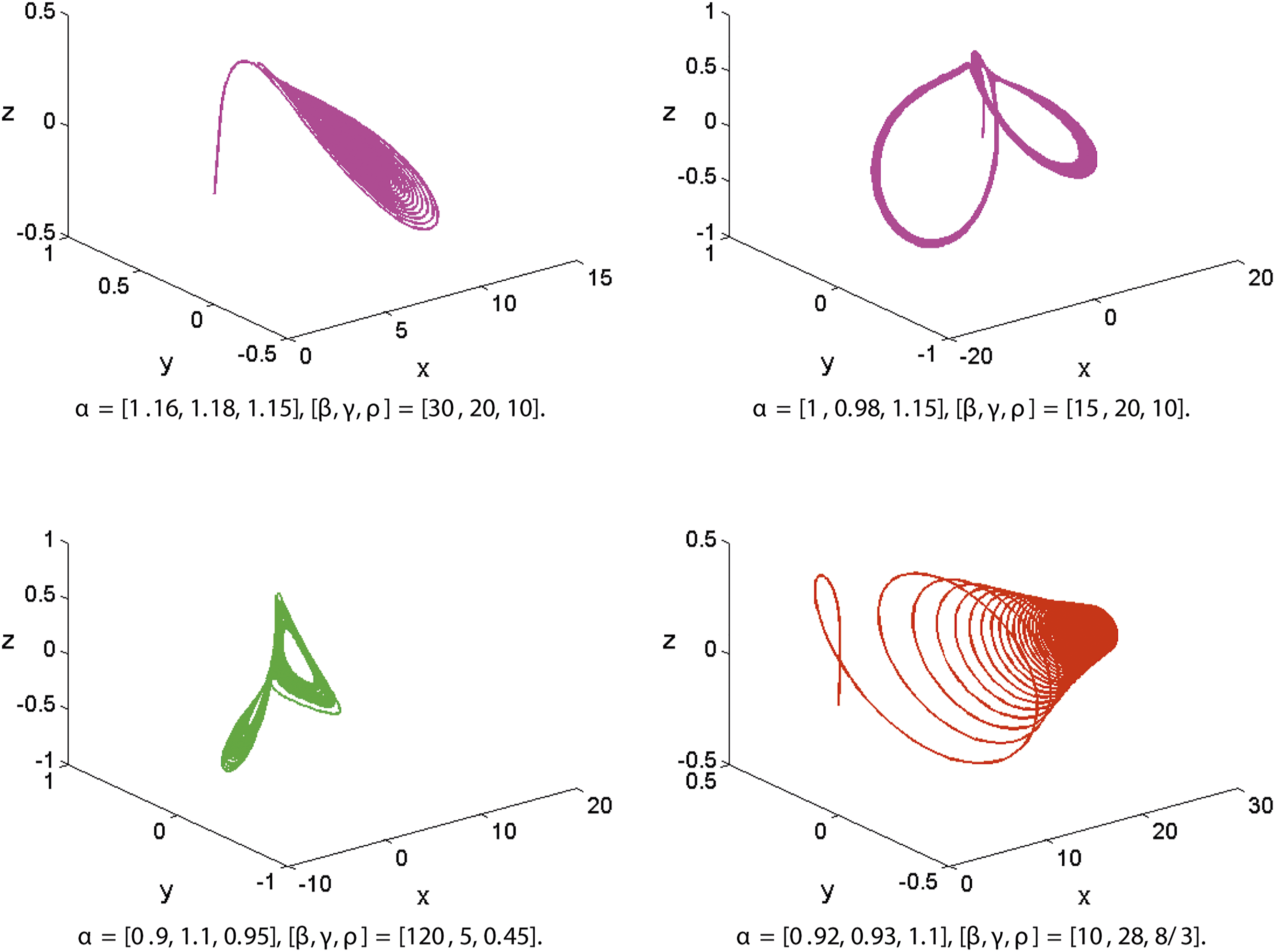
Chaotic systems arise everywhere in control theory and nonlinear vibration. This paper uses a high-precision numerical approach for capturing chaotic attractors of the fractional EI Niño chaotic systems. The numerical results indicate that some of the chaotic attractors of fractional-order systems are topologically equivalent to those discovered in the integer-order systems, and some unusual attractors of fractional EI Niño chaotic systems are found by using the present method.
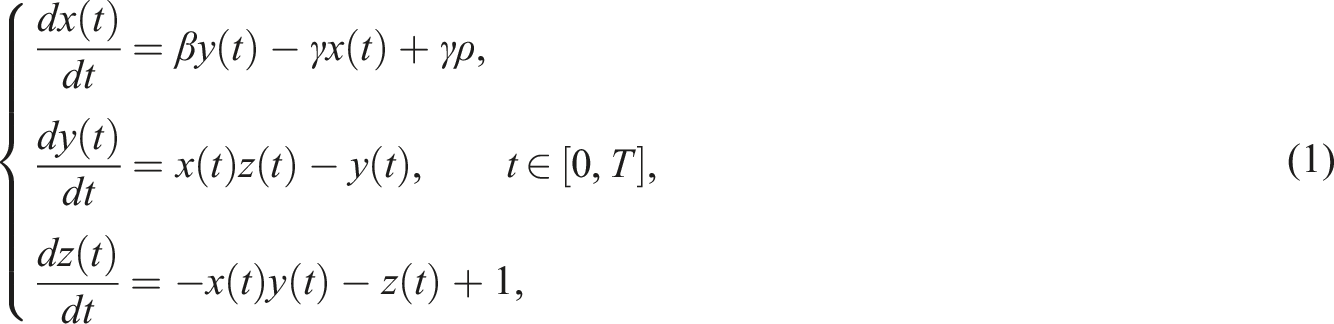
The vallis model1–2 for El Niño consists of a set of three autonomous first-order nonlinear ordinary differential equations. The El Niño chaotic dynamical system is given by Borghezan and Rech3
with the initial conditions
which has been used to describe an anomalous 4-6 of the Peru and Ecuador coastal waters that occurs roughly about every 3–6 years, which has a great impact on global climate. Although the model has been applied with significant degrees of success, irregular and anomalous phenomena cannot be adequately described with the local or classical derivatives, which have been suggested in many research papers, books, and monographs.7–9 Fractional calculus (FC) can accurately describe physical process. It is a very interesting topic of investigation in the field of nonlinear research. Hence, for a more accurate representation, some authors present the fractional EI Niño chaotic systems (1) is the following form
Some numerical methods have been studied for this equation. In Ref.,4 authors carried out numerical simulations by using estimates of the largest Lyapunov exponent to characterize the dynamical behavior of the systems (1). In Refs.,5–6 authors researched the integer-order systems (1). Although some numerical methods of the fractional differential equations have been announced, such as spectral method,10–13 HPM,14–18 RKM,19–23 and so on.24–25 However, due to the nonlocal property of fractional derivative, these methods involved in solving the fractional chaotic dynamical system are time consuming and tedious. High-precision numerical methods have always been the direction that scholars strive to pursue. Based on this problem, this paper uses a high-precision numerical approach for the fractional-order EI Ni o chaotic systems. We observe many novel dynamic behaviors of fractional-order systems in numerical experiments which are unlike any that have been previously discovered in numerical experiments or theoretical studies.
Fractional vibration systems26–32 and fractional equation33–36 have been widely concerned. There are many definitions37–38 of fractional derivatives (FDs). The most famous of these FD that have been widely popularized in the world of fractional calculus are the Riemann–Liouville (RL) FD, Grnwald–Letnikov (GL) FD, and Caputo FD.
Therefore, GLFD of α-order is transformed into the following form
Using Newton’s binomial theorem, we can know
Note
First-order generating function (GF) of GLFD is (1 − z)α.
GLFD and RLFD have the following relationship
For convenience of expression, we denote
In order to obtain higher precision, author has given the construction method of GF.37,39-41
Numerical method
Definition 2.1.A polynomial function of n-order fn(t) is defined as.
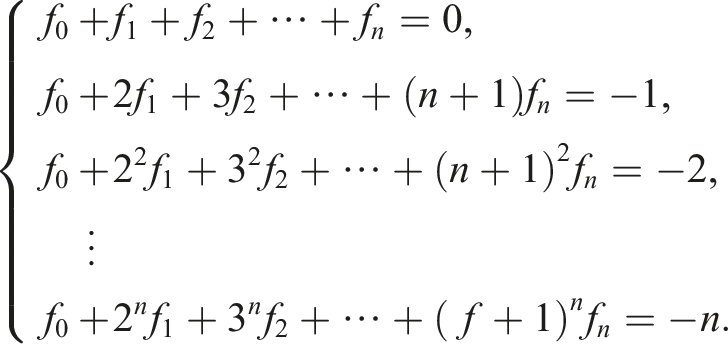
Theorem 2.2.The polynomial function fn(t) could be written as, where fkis the solution of the following equations
Proof. For the details of the proof, one may refer to Refs.37‐41
Definition 2.3.A GFof GLFD is defined as
Theorem 2.4.The GFcan be written as
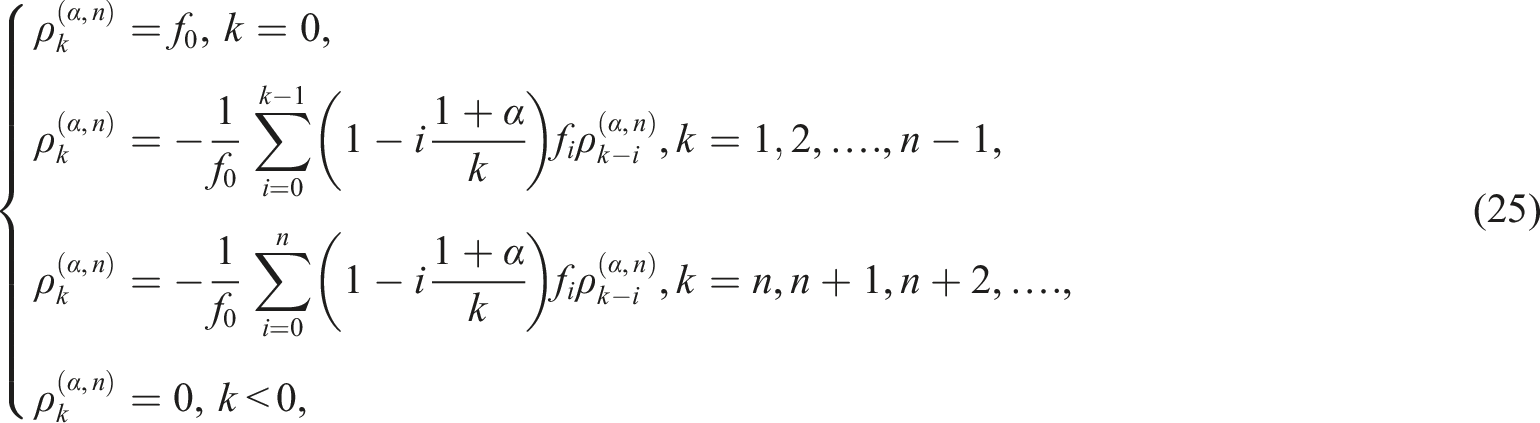
where ρk(α,n) can be calculated by the following formula
Proof. In equation (12), if t = 0, then it has . Rewriting equation (12), it can be found that
where k < 0 , then.
Calculating the first-order derivative on both sides of equation (15), it can be obtained that
Multiplying ( f0+ f2z + ⋯ + fntn) on both sides of equation (16), it can be obtained that
Substituting equation (15) into equation (17), we can know
Using the property, the left side of equation (18) can be written as
then its right side can be written as
Comparing the coefficient of t in equation (19), we can get
Moving equation (21) back one step, then the equation can become
If k ≠ 0, it is thus clear that
where, when k < 0 , . So the theorem is proved. For the details of the proof, one may refer to Refs.37‐41
Corollary 2.5.The GFof GLFD could be written as
where
GLFD with n-order GF is given as
Applying (26), an approximate computation scheme of GLFD with n-order GF is given as
Next, we consider the following nonlinear fractional ordinary differential equations
subject to the initial condition given by .
Constructing the following linearized iterative method
Theorem 2.6. If f1 (t, z1(t), z2(t), …, zn(t)) is a continuous function on 0 ≤ t ≤ T, − ∞ ≤ zj ≤ ∞ and satisfies the local Lipschitz condition, then the solution of equation (35) is convergent.
Proof. In this section, for convenience of expression, we assume that .
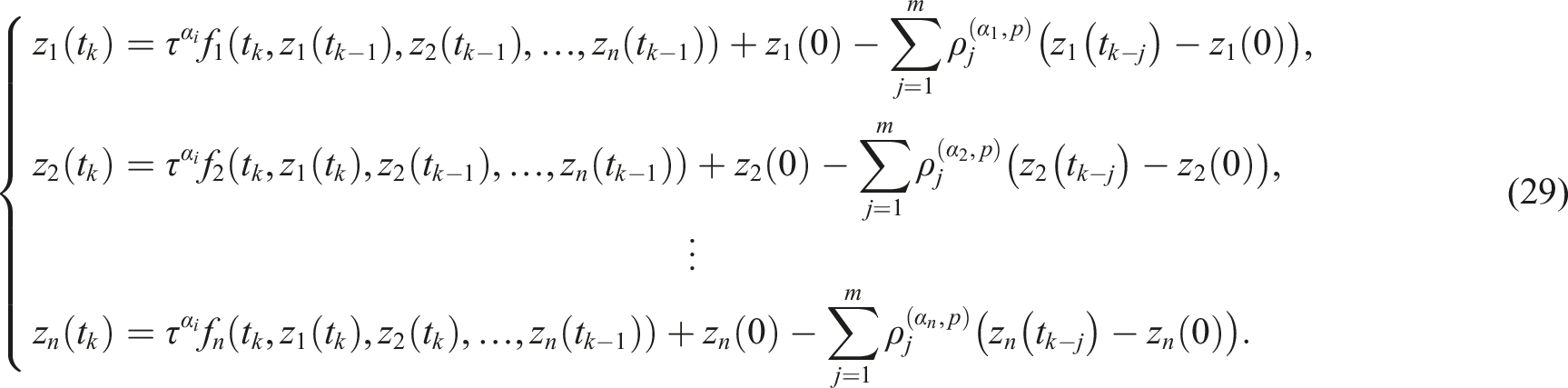
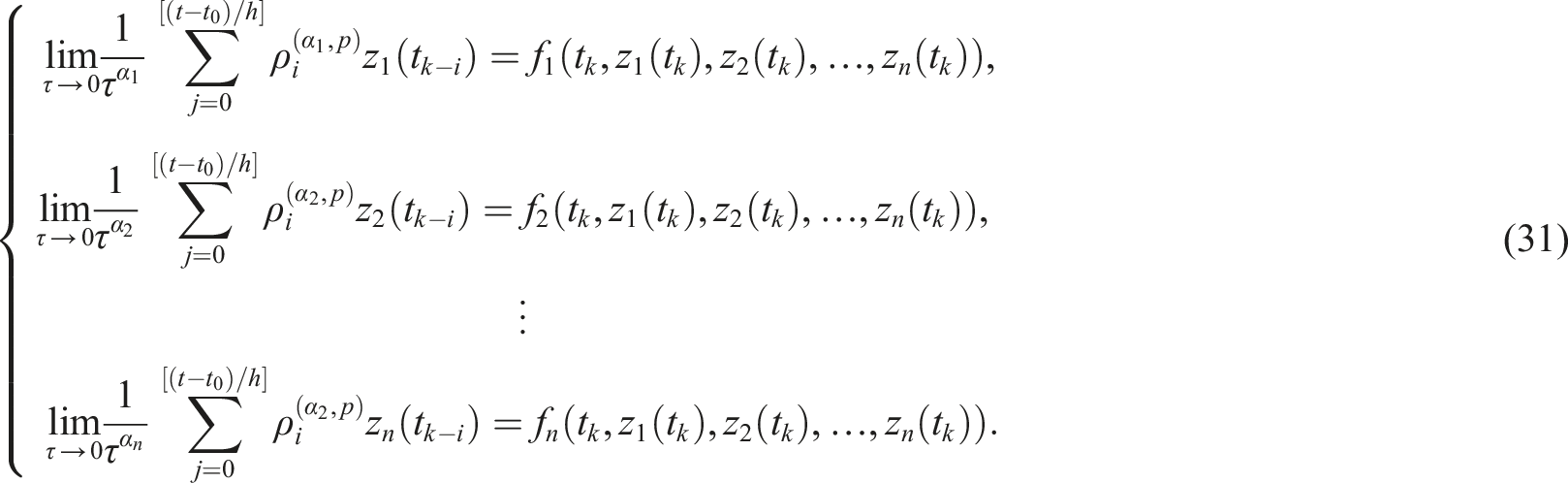
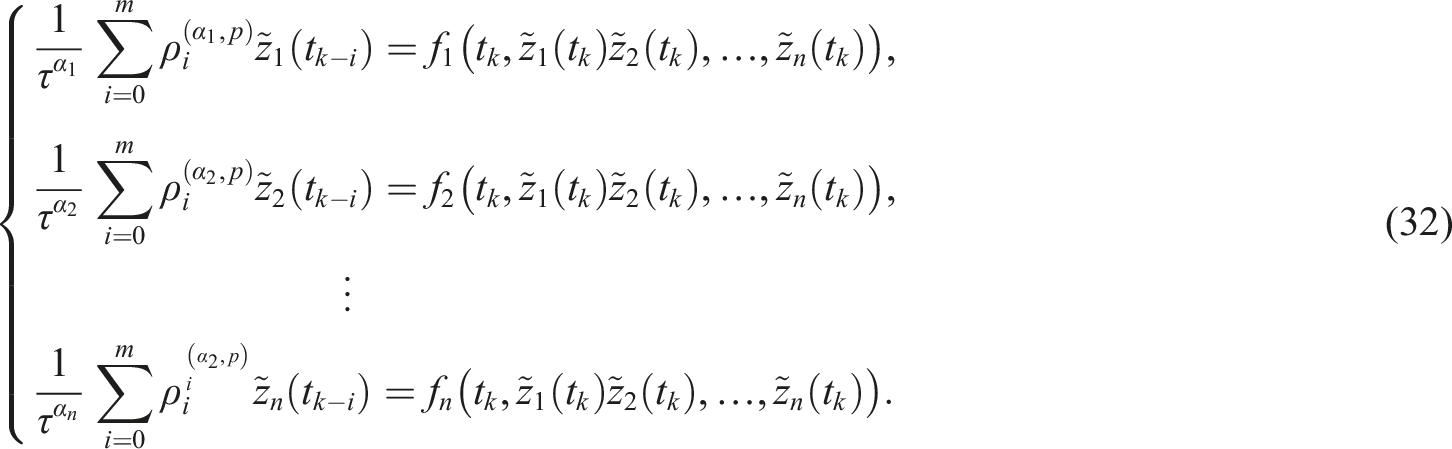
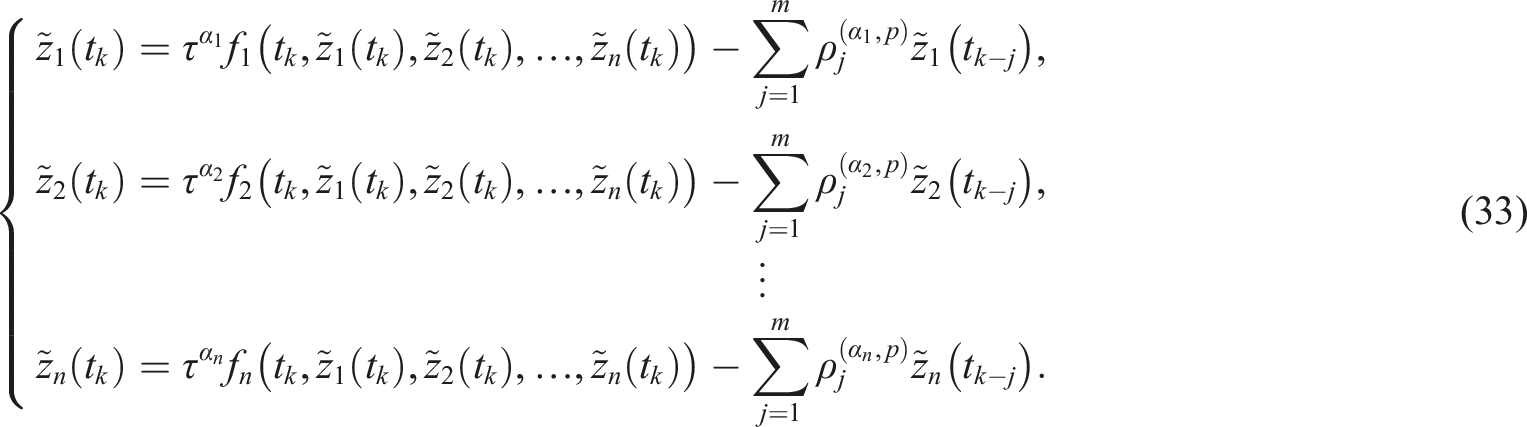
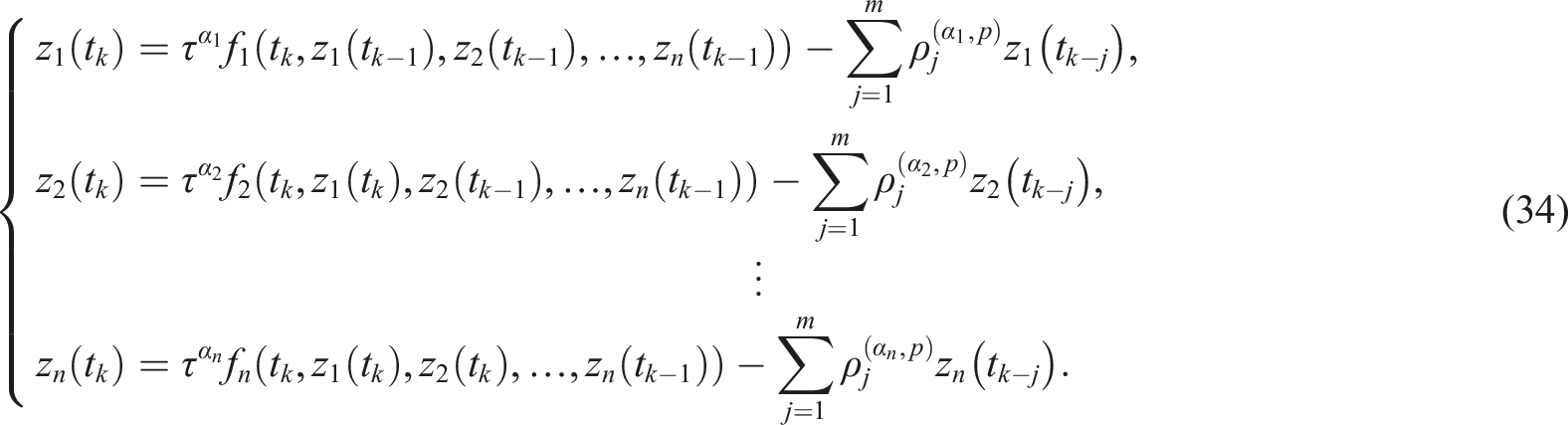
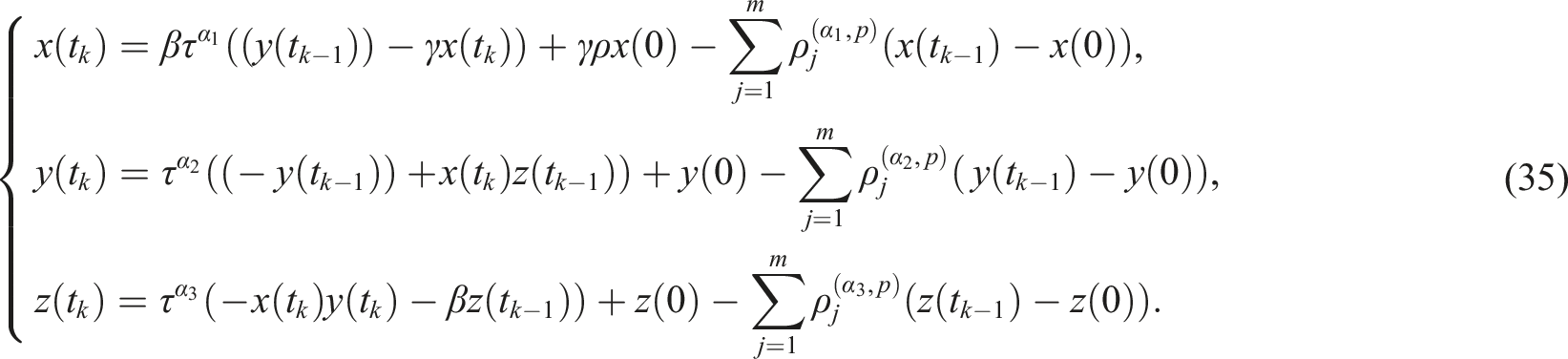
So, numerical approach of the fractional-order EI Nio chaotic systems (3) is given by
Numerical experiment
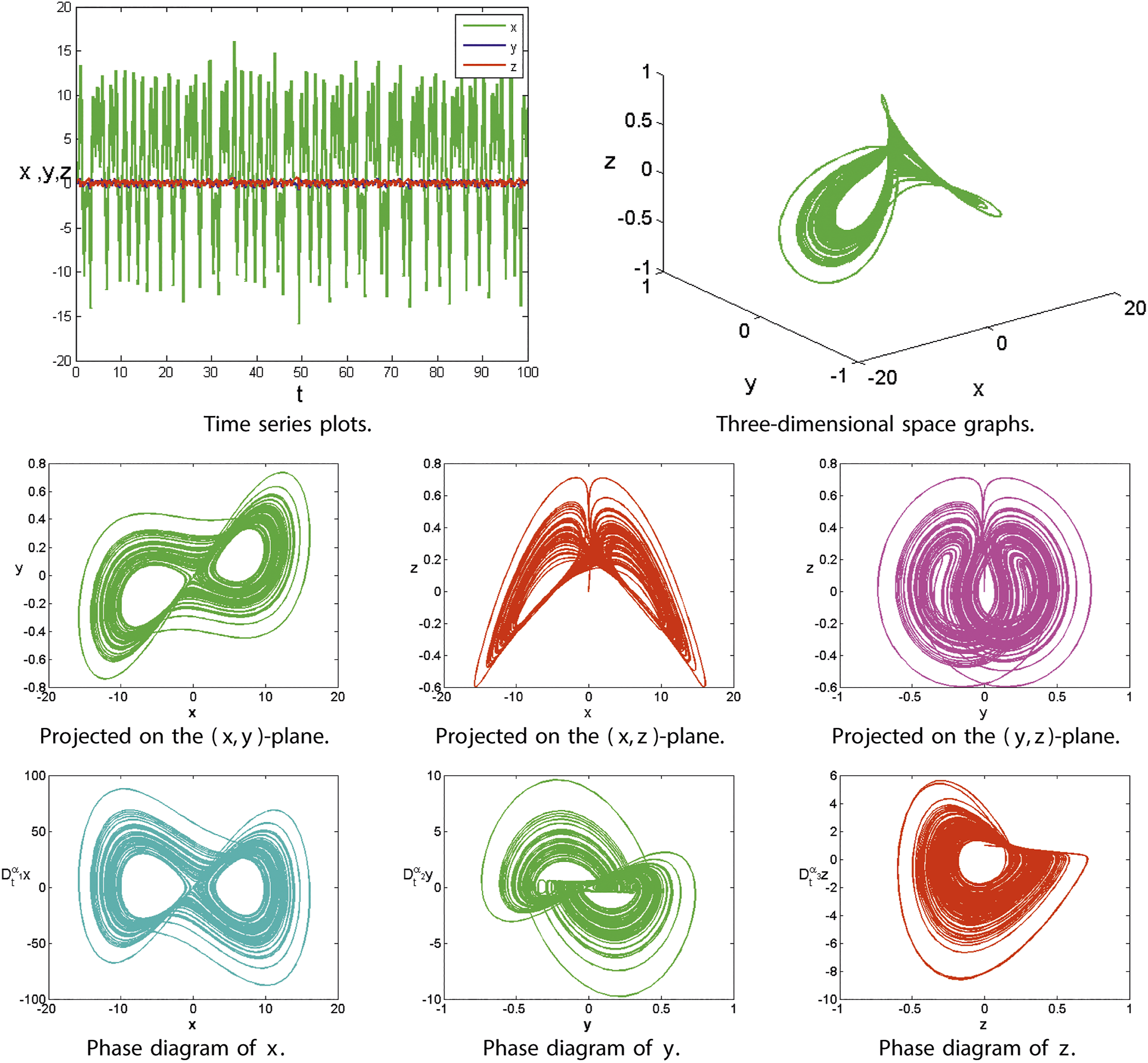
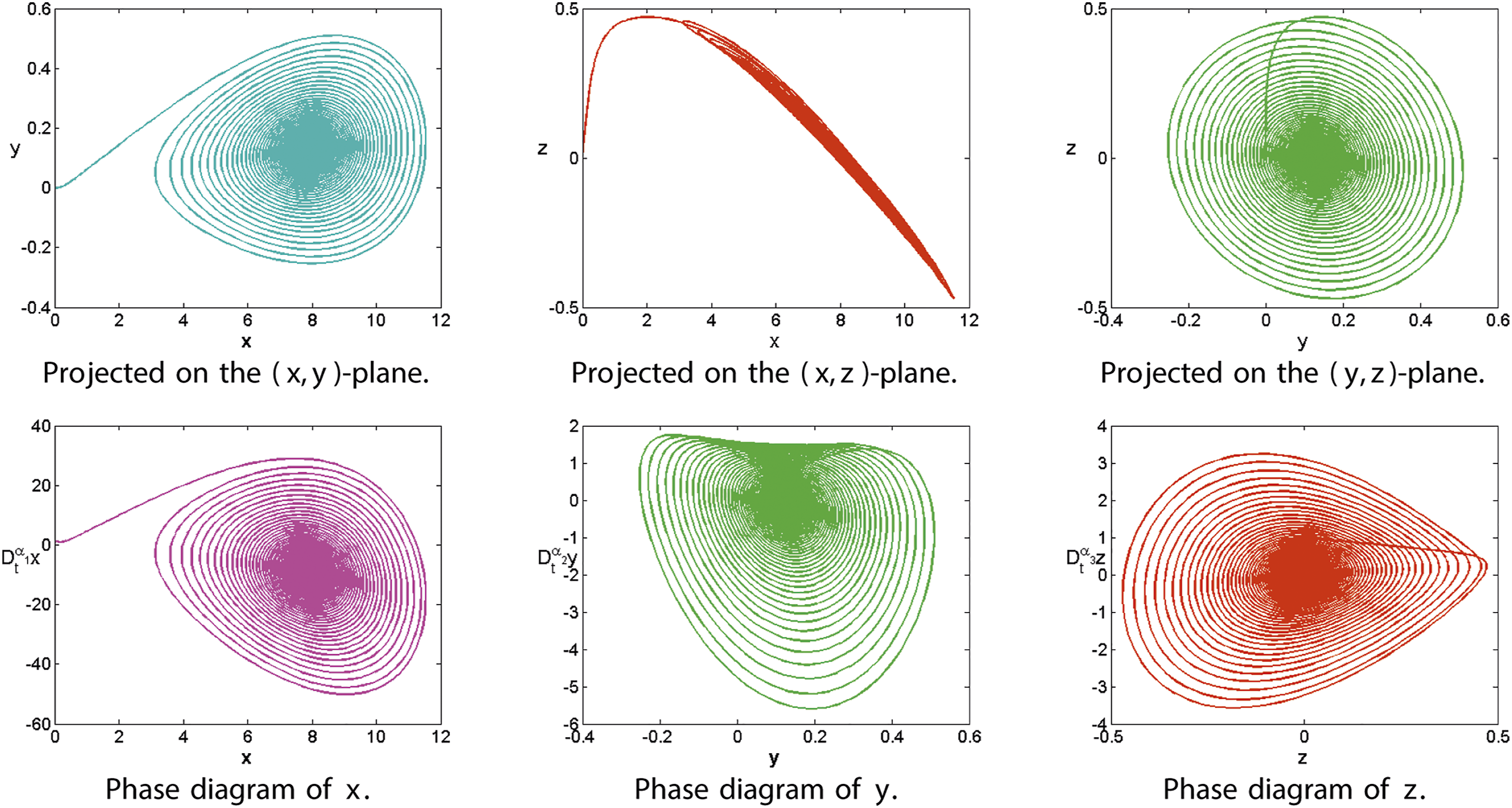
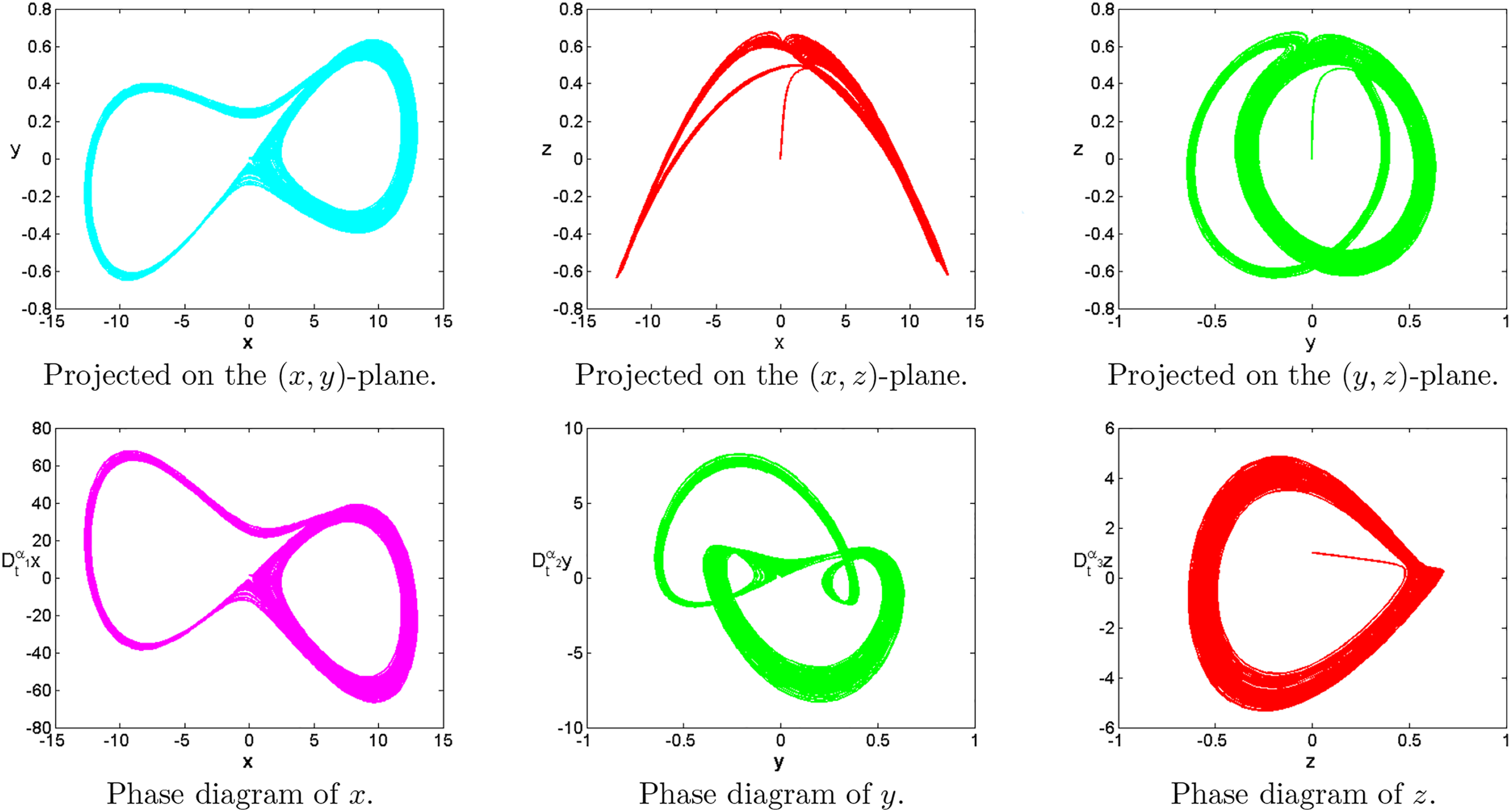
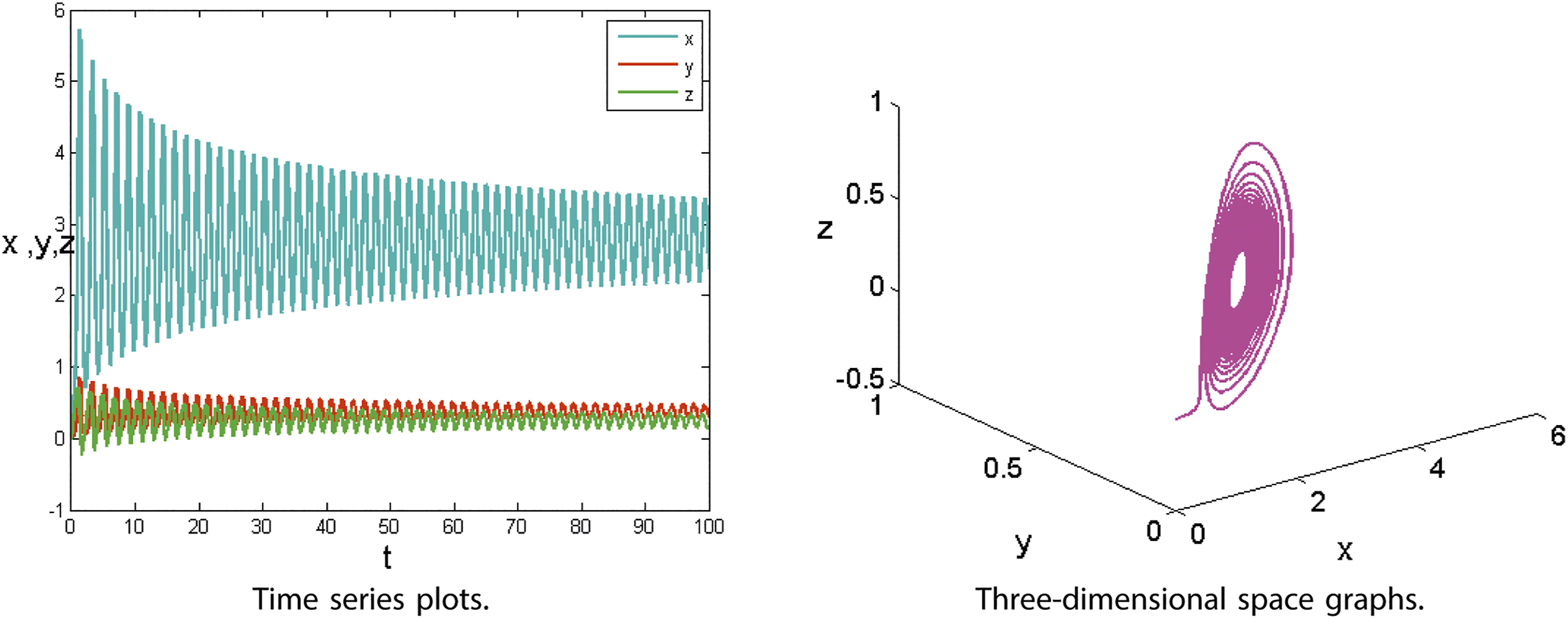
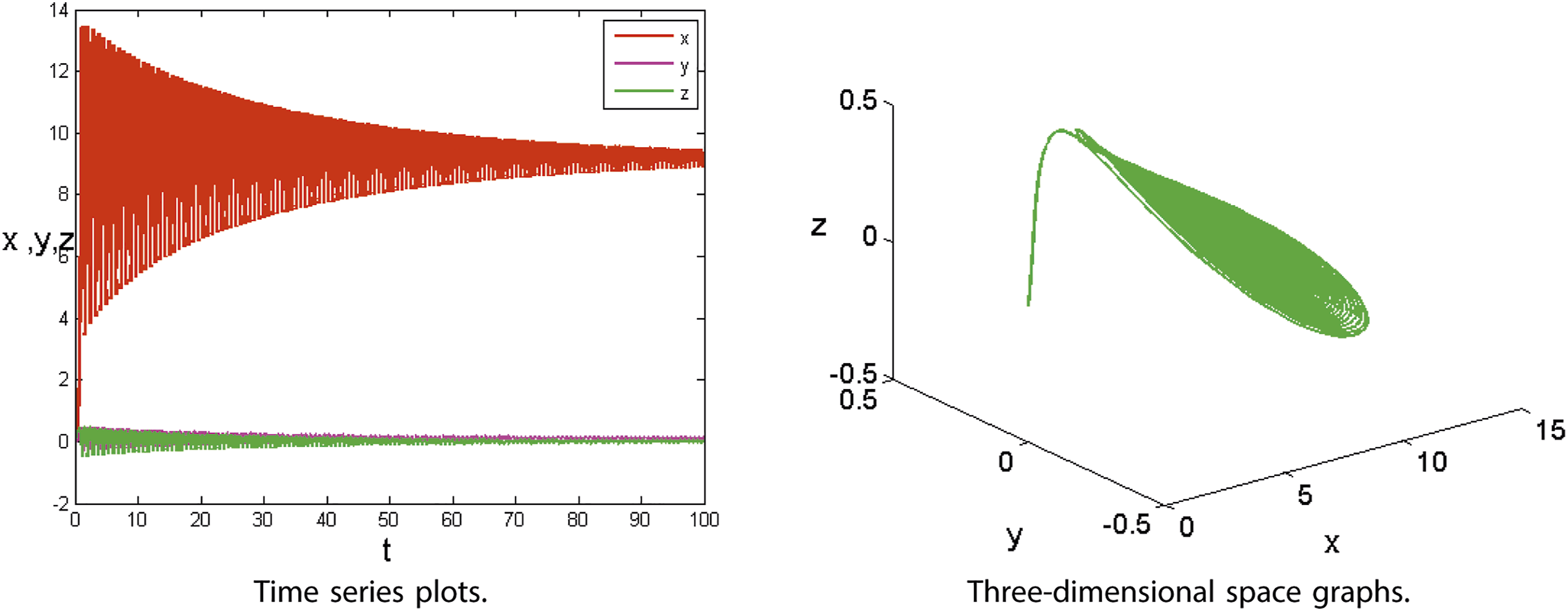
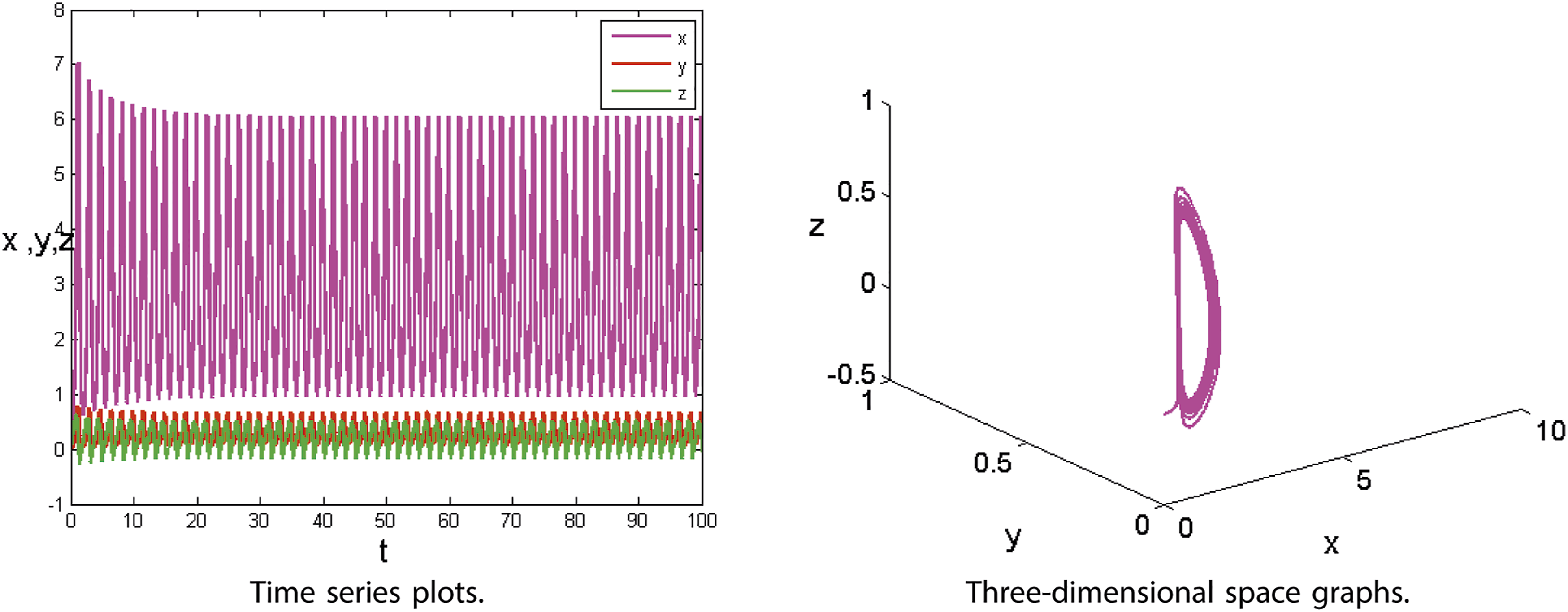
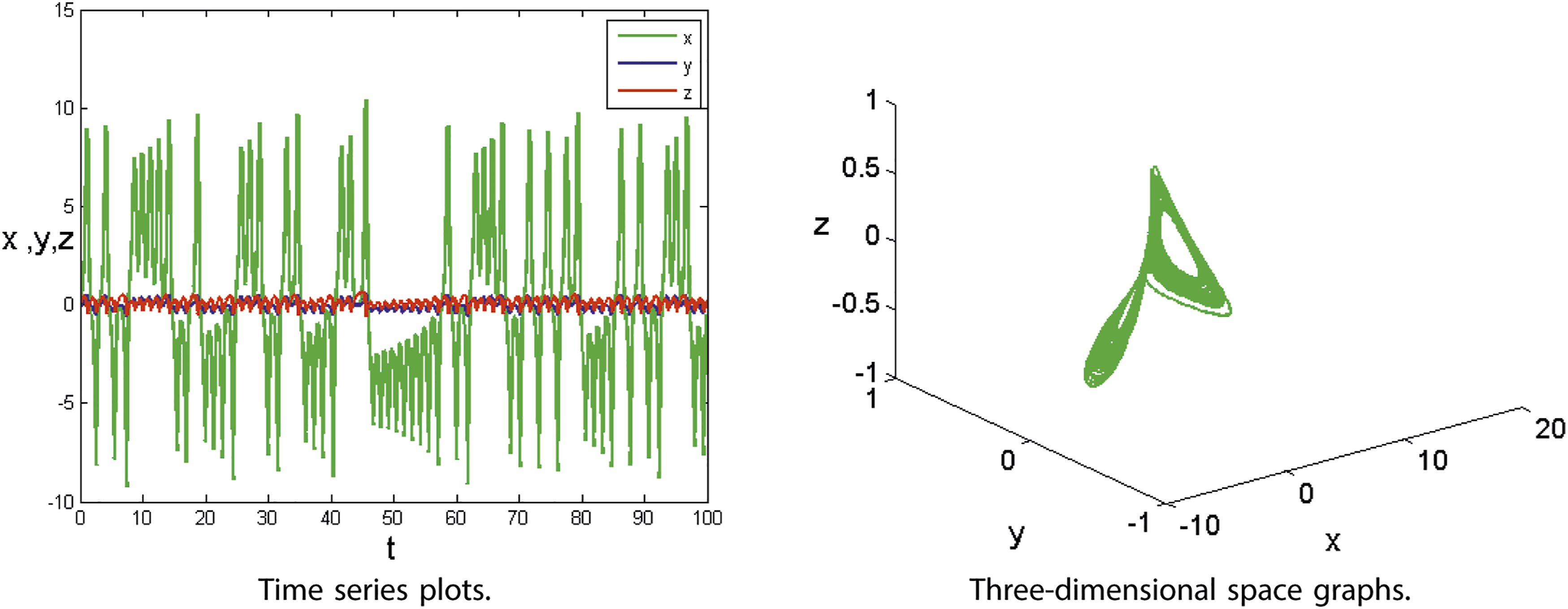
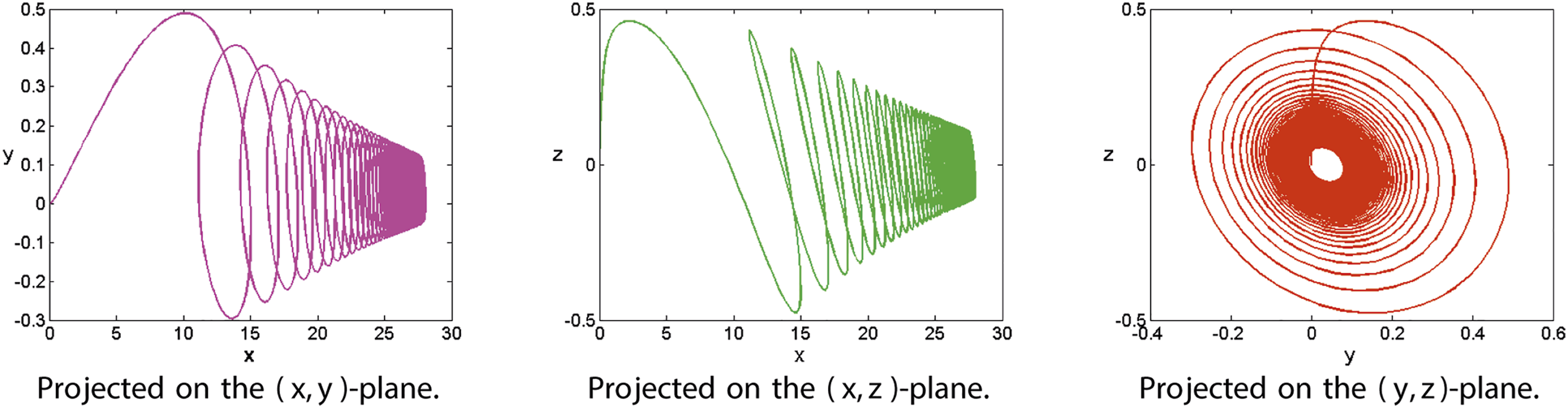
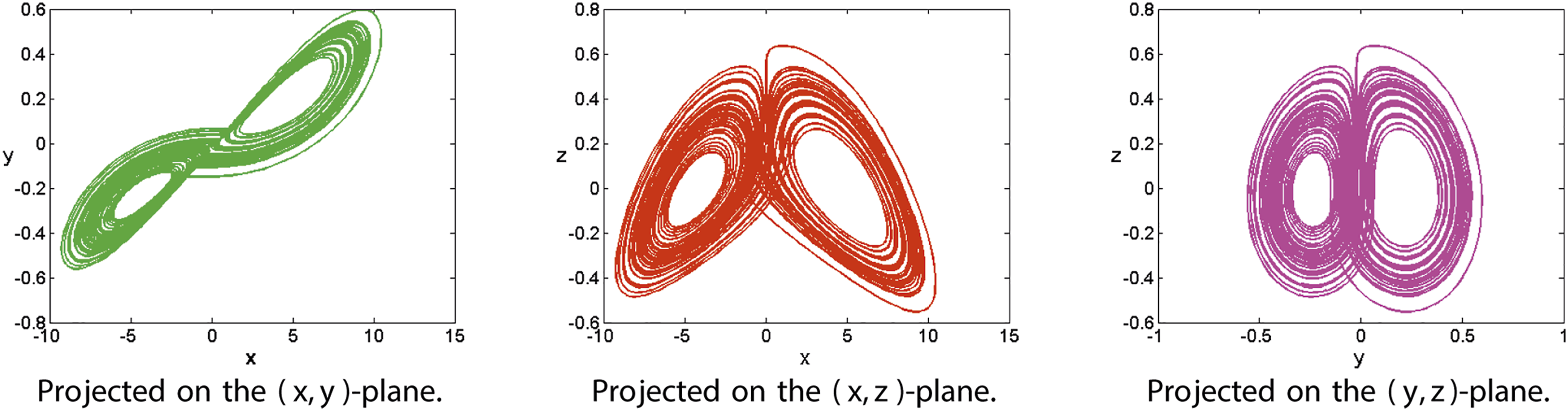
We consider the model (3) with the initial conditions x(0) = y(0) = z(0) = 0. We set h = 0.01, T = 100, p = 20, the numerical results with different parameters and different fractional derivatives are shown in Figure 1, 2, 3, 4, 5, 6, 7, 8, 9, and 10.Figure 1 shows numerical results at α = [1, 1, 1], [β, γ, ρ] = [140, 3, 0.45, 1], it is the integer-order systems. The simulation results are consistent with those of other methods, and confirm the validity of the present method. Next, we set different parameters and different fractional derivatives to capture chaotic attractors of the fractional EI Niño chaotic systems. We set parameters α = [1.1, 1.1, 0.95], [β, γ, ρ] = [102, 3, 0.45, 1], projected on the (x, y), (x, z), (y, z)-plane and Phase diagram are shown in Figure 3.Figure 2 shows projected on the (x, y), (x, z), (y, z)-plane and Phase diagram in parameters α = [1.1, 1.1, 0.95], [β, γ, ρ] = [102, 3, 0.45, 1]. The three-dimensional space graphs of the systems (3) with different parameters are shown in Figure 4. Time series plots and three-dimensional space graphs are shown Figure 9. We set parameters α = [0.95, 0.95, 1.05], [β, γ, ρ] = [102, 3, 0.45, 1], projected on the (x, y), (x, z), (y, z)-plane are shown in Figure 9. We set parameters α = [0.9, 1.1, 0.95], [β, γ, ρ] = [120, 5, 0.45, 1], projected on the (x, y), (x, z), (y, z)-plane are shown in Figure 10.
Numerical results for the systems (3) at α = [1, 1, 1], [β, γ, ρ] = [140, 3, 0.45, 1].
Numerical results for the systems (3) at α = [1.1, 1.1, 0.95], [β, γ, ρ] = [102, 3, 0.45, 1].
Numerical results for the systems (3) at α = [1.1, 1.1, 0.96], [β, γ, ρ] = [102, 3, 0.45].
The three-dimensional space graphs of the systems (3) with different parameters.
Numerical results for the systems (3) at α = [0.95, 0.95, 1.05], [β, γ, ρ] = [102, 3, 0.45].
Numerical results for the systems (3) at α = [1.1, 1.1, 0.95], [β, γ, ρ] = [100, 3, 0.45].
Numerical results for the systems (3) at α = [0.79, 0.9, 1.1], [β, γ, ρ] = [140, 15, 0.45].
Numerical results for the systems (3) at α = [0.9, 1.1, 0.95], [β, γ, ρ] = [120, 5, 0.45].
Numerical results for the systems (3) at α = [0.95, 0.95, 1.05], [β, γ, ρ] = [102, 3, 0.45, 1].
Numerical results for the systems (3) at α = [0.9, 1.1, 0.95], [β, γ, ρ] = [120, 5, 0.45, 1].
Conclusions and remarks
This paper effectively captures chaotic attractors of the fractional EI Nio chaotic systems in different parameters β, γ, ρ and different fractional derivatives α1, α2, α3 by using a high-precision numerical approach. The numerical results indicate that some of the chaotic attractors of fractional-order EI Niño systems are topologically equivalent to those discovered in the integer-order systems, and some unusual attractors of fractional-order chaotic systems are found by using the present method.
Footnotes
Acknowledgments
The authors would like to express their thanks to the unknown referees for their careful reading and helpful comments.
Declaration of conflicting interests
The authors declare that there are no conflicts of interest regarding the publication of this article.
Funding
The author(s) disclosed receipt of the following financial support for the research, authorship, and/or publication of this article: This paper is supported by the Natural Science Foundation of Inner Mongolia [2021MS01009].
Data availability
The data used to support the findings of this study are available from the corresponding author upon request.
ORCID iD
Yu-Lan Wang
References
1.
VallisGK, El Niño. A chaotic dynamical system. Science, 1986; 232: 243–245.
2.
VallisGK .Conceptual models of El Niño and the southern oscillationJournal of Geophys Research, 1988; 93: 13979–13991.
3.
MonikBorghezanRechC. Chaos and periodicity in Vallis model for El Niño. Chaos, Solitons & Fractals, 2017; 97: 15–18
4.
SandroFVYuanHL. The response of the East Asian summer rainfall to more extreme El Niño events in future climate scenarios. Atmospheric Research, 2021; 20: 105983
5.
AlexandrovDVBashkirtsevaLABashkirtsevaB, et al.Noise-induced chaos in non-linear dynamics of El Niños, Physics Letters A, 2018; 382(40): 2922–2926.
6.
Gomez-AguilarJF, Multiple attractors and periodicity on the Vallis model for EI Niño/La Nina-Southern oscillation model. Journal of Atmospheric and Solar-Terrestrial Physics, 2020; 197: 105172.
7.
AtanganaANietoJJ. Numerical solution for the model of RLC circuit via the fractional derivative without singular kernel. Advanced mechanical engineering, 2015; 7: 1–6.
8.
BramsonMDMaximal displacement of branching brownian motion. Communications on Pure and Applied Mathematics, 1978; 31: 531–581.
9.
HanertE. On the numerical solution of space-time fractional diffusion models. Computers & Fluids, 2011; 46: 33–39.
10.
HanCWangYLLiZY. A high-precision numerical approach to solving space fractional Gray-Scott model. Applied Mathematics Letters, 2022; 125(125): 107759.
11.
LiXYHanCWangYL. Novel patterns in fractional-in-space nonlinear coupled FitzHugh-Nagumo models with Riesz fractional derivative. Fractal and Fractional, 2022; 6(3): 136.
12.
HanCWangYLLiZY. Novel patterns in a class of fractional reactionCdiffusion models with the Riesz fractional derivative, Mathematics and Computers in Simulation, 2022; 202: 149–163.
13.
HanCWangYLLiZY. Numerical solutions of space fractional variable-coefficient KdV-modified KdV equation by Fourier spectral method. Fractals, 2021; 29(8): 2150246.
14.
AnjumNHeJHAinQT, et al.Li-he's Modified Homotopy Perturbation Method for Doubly-clamped Electrically Actuated Microbeams-based Microelectromechanical System. Facta Universitatis, Series: Mechanical Engineering, 2021; 19(4): 601–612.
15.
WangK L. New variational theory for coupled nonlinear fractal Schrödinger system, International Journal of Numerical Methods for Heat & Fluid Flow, 2022; 32(2): 589–597.
16.
HeJ H. Homotopy perturbation method: A new nonlinear analytical technique, Applied Mathematics and Computation, 2003; 135: 73–79.
17.
HeJHEl-DibO. The enhanced homotopy perturbation method for axial vibration of strings, Facta Universitatis, Series: Mechanical Engineering, 2021; 19(4): 735–750.
18.
HeJHEl-DibYOMadyAA. Homotopy perturbation method for the fractal toda oscillator. Fractal and Fractional, 2021; 5: 93
19.
WangYLJiaLNZhangHL. Numerical solution for a class of space-time fractional equation by the piecewise reproducing kernel methodInternationalJournal of Computer Mathematics, 2019; 96(10): 2100C2111.
20.
LiXYWangHLWuBY. A stable and efficient technique for linear boundary value problems by applying kernel functions, Applied Numerical Mathematics, 2022; 172(172): 206–214.
21.
WangYLCaoXJLiXN. A new method for solving singular fourth-order boundary value problems with mixed boundary conditions, Applied Mathematics and Computation, 2011; 217(18): 7385–7390.
22.
WangYLDuMJTanFG, et al.Using reproducing kernel for solving a class of fractional partial differential equation with non-classical conditions. Applied Mathematics and Computation, 2013; 219: 5918–5925.
23.
DaiDDBanTTWangYL, et al.The piecewise reproducing kernel method for the time variable fractional order advection-reaction-diffusion equations. Thermal Science, 2021, 25(2B) 1261–1268.
24.
FangJNadeemMHabibM, et al.Numerical investigation of nonlinear shock wave equations with fractional order in propagating disturbance. Symmetry. 2022; 14(6): 1179.
25.
LiuJNadeemMHabibM, et al.Approximate solution of nonlinear time-fractional Klein-Gordon equations using Yang transform. Symmetry. 2022;14(5): 907.
26.
PodlubnyI. Matrix approach to discrete fractional calculus. Fractional Calculus and Applied Analysis, 2000; 3(4): 359–386.
27.
JHHeGalalMMMarwaHZ. Forced nonlinear oscillator in a fractal space. Facta Universitatis, Series: Mechanical Engineering, 2022; 20: 001
28.
TianDQura TulAinNaveedA, et al.Fractal N/MEMS: From pull-in instability to pull-in stability, Fractals, 2021; 29(2): 2150030.
29.
TianDHeCHHeJH. Fractal Pull-in Stability Theory for Microelectromechanical Systems, Frontiers in Physics, 2021; 9(9): 606011.
30.
HeCHLiuC. A modified frequency-amplitude formulation for fractal vibration systems, Fractals, 2022; 30
31.
WangK L. Exact solitary wave solution for fractal shallow water wave model by He's variational method, Modern Physics Letters B, 2022; 36: 2150602, doi: 10.1142/S0217984921506028.
32.
TianDHeCH. From inner topological structure to functional nanofibers: theoretical analysis and experimental verification, Membranes, 2021; 11(11): 870.
33.
WangKJ, Periodic solution of the time-space fractional complex nonlinear Fokas-Lenells equation by an ancient Chinese algorithm, Optik, 2021; 243: 167461
34.
WangKJWangGDShiF. Abundant exact traveling wave solutions to the local fractional (3+1)-dimensional boiti-leon-manna-pempinelli equation. Fractals, 2022; 30(3): 2250064.
35.
ZhangRFLiMCAlbishariM, et al.Generalized lump solutions, classical lump solutions and rogue waves of the (2+1)-dimensional Caudrey-Dodd-Gibbon-Kotera-Sawada-like equation, Applied Mathematics and Computation2021; 403(15): 126201.
36.
ZhangRFLiMCGanJY, et al.Novel trial functions and rogue waves of generalized breaking soliton equation via bilinear neural network method, Chaos, Solitons & Fractals2022; 154: 111692.
37.
PodlubnyI. Fractional Differential Equations: An Introduction to Fractional Derivatives, Fractional Differential Equations, to Methods of Their Solution and Some of Their Applications. New York: Academic Press, 1998.
XueDYBaiL. Numerical algorithms for Caputo fractional-order differential equations. International Journal of Control, 2017; 90(6): 1201–1211.
40.
ZhaoCNXueDY. Closed-form solutions to fractional-order linear differential equations. Frontiers of Electrical and Electronic Engineering in China, 2008; 3(2): 214-217.
41.
XueDYFractional calculus and fractional-order control, Science Press, Beijing, China, 2018.