




Abstract
Inhomogeneous damping distribution leads to the occurrence of complex modes of structures. Complex modes' vibration and acoustic radiation characteristics are different from real modes. This paper studies the complex modal characteristics of inhomogeneously damped plates for forced vibration. We used the state space method to obtain the complex eigenvalues and eigenvectors of the vibration system and calculated the relationship between modal coordinates and frequency under unit force. The results show that the absolute values of the modal coordinates of two conjugate complex eigenvectors are different, and the structure's vibration is dominated by the eigenvectors corresponding to eigenvalues with positive imaginary parts near natural frequencies. When investigating the structural sound radiation in the vibration mode space, each mode's acoustic radiation is not independent but coupled with each other. The influence of the coupling between complex modes on the calculation results of the acoustic radiation power of the plate is studied in this paper. The results show that the coupling effect between modes cannot be ignored when calculating the acoustic radiation power based on complex modes. Finally, the error of calculating acoustic power using the decoupling approximation instead of the complex mode method is analyzed.
Introduction
In engineering industries such as ship, automobile, and aerospace, more and more attention has been paid to the vibration and noise of structures.1,2 It is one of the essential measures to reduce vibration and sound radiation by laying damping materials on the surface of the systems to absorb vibration energy. For example, the common damping composite structures include free damping layer structures and constrained damping layer structures. To reduce weight and save cost, researchers often apply damping materials to locally critical areas of structural surfaces, hoping to achieve a satisfactory reduction of vibration and noise with less additional mass rather than laying damping on the entire surfaces. For example, some scholars have studied the optimization assignment method of damping3–6 and the vibro-acoustic calculation method of locally damped structures. 2
Inhomogeneous damping could lead to the occurrence of complex modes of systems.
7
Complex modes can also arise from gyroscopic effects, aerodynamic effects, wave propagation, and nonlinear structural behavior.
8
The most intuitive difference between real modes and complex modes is shown in mode shapes. In real modes, each element in the eigenvector is a real number, the phase difference between two elements is either 0° or 180°, and all points in the mode shape reach their equilibrium positions simultaneously. In complex modes, however, each element in the eigenvector is a complex number, the phase difference between two elements is no longer only 0° or 180°, and all points in the mode shape no longer reach their equilibrium positions simultaneously. Additionally, an N-degree-of-freedom vibration system has N eigenvectors in the case of real modes. However, the system has N pairs (2N) of conjugate eigenvectors in the case of complex modes. In this paper, we discuss complex modes caused by inhomogeneous damping, let
There are two main methods for calculating the complex modes of a system: one is to use the state space method,
12
and the other is to directly solve the eigenvalues and eigenvectors of the matrix
When structures are forced to vibrate, the sound radiation of each vibration mode is not independent, and there is a coupling between them. Some scholars studied the effect of modal interaction on acoustic radiation in the condition of real modes. For example, Keltie and Peng 19 investigated the acoustic power emitted by one-dimensional lightly damped plates. They said the coupling effect cannot be ignored under off-resonant excitation at low frequency but can be neglected at resonant excitation. A similar conclusion is drawn in Ref. 20, in which the research object is a point-excited rectangular plate. Cunefare 21 took beams as research objects and found that the coupling between vibration modes greatly influences the total sound power well below the coincidence wave number ratio. A little different from the conclusions in Refs. 19,20, Li and Gibeling 22 studied the mutual-radiation resistances of simply-supported rectangular plated and said that the effects of cross-modal coupling cannot always be ignored at resonance frequencies, otherwise, the sound power may be over- or under-estimated. According to their results, the notable error only occurs at individual resonant frequencies among nearly twenty resonant frequencies, and the error value is no more than 3 dB, it can be said that the difference in the conclusions is mainly due to the different tolerance of error. Therefore, when the requirement of calculation accuracy is not extremely strict, it is feasible to say that mutual radiation mainly works at the off-resonant region of low frequency and has little influence on acoustic radiation at resonance frequencies in the case of real modes. Self-radiation efficiency and mutual-radiation efficiency reflect the ability of a mode itself and the interaction between two modes to radiate sound, respectively. Unruh7,23,24 applied inhomogeneous damping to plates to generate complex modes and studied the self-radiation efficiencies and mutual-radiation efficiencies of complex modes. In Ref. 7, Unruh found that the characteristics of acoustic radiation of complex modes are greatly different from real modes. For a uniform rectangular plate, in the case of real modes, the coupling effect only exists in modes of the same type. For example, odd-even modes can only be coupled to odd-even modes and not to odd-odd, even-even, or even-odd modes. In the case of complex modes, however, modes of different types also interact with each other. From the theory of waves, complex modes are dominated by the superposition of traveling waves and standing waves. In Refs. 23,24, the author found that the traveling wave component significantly increases the self-radiation efficiencies of even-order modes and slightly decreases the self-radiation efficiencies of odd-order modes. Wei and Li 25 presented a method to calculate the mutual-radiation efficiencies of complex modes, which can be well combined with finite element method and boundary element method software.
As mentioned above, the system has N pairs of conjugate complex eigenvectors in the case of complex modes, which differs from the system of real modes. However, the relationship between conjugate eigenvectors and the influence of the coupling between conjugate modes on the total sound power are not considered in the studies of complex modes mentioned above. Herein, vibration and acoustic radiation characteristics of conjugate complex eigenvectors are investigated. In this paper, based on the theory of complex modes, the difference between the contributions of a pair of conjugate modes to the total vibration is studied, and the influence of the coupling between complex modes, including the coupling between conjugate modes, on the radiated sound power of the plate is analyzed. Moreover, the error of the acoustic power calculated by the decoupling approximation instead of the complex mode method is discussed.
To our best knowledge, this is the first paper to point out that there exists a coupling effect of acoustic radiation between a pair of conjugate complex modes. This coupling effect could not be ignored when calculating the total radiated sound power.
Theory
Calculation of complex modes
For a system with N degrees of freedom, the equation of motion is









Calculate the complex modes and then normalize them by



Expand the matrix

Calculation of radiated sound power
The radiated sound power P of a structure is given by







Equation (18) shows that only the coupling term's real part (resistive sound power) will affect the total sound power. Even if the imaginary part (reactive sound power) exists, it will not influence the total radiated sound power, and the imaginary part is reactive power.
To obtain the radiation resistance matrix

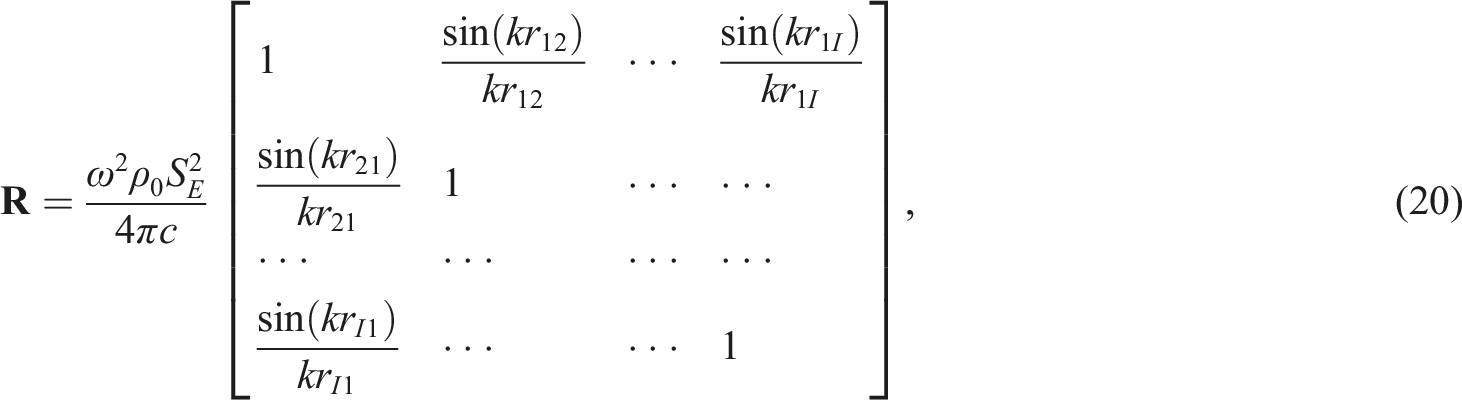
The decoupling approximation
The decoupling approximation is a widely used simplified method to obtain the vibration response of non-classically damped systems. References 15–18 investigated the error of the vibration response calculated by decoupling approximation. For the vibration system in equation (1), the damping matrix



The orthogonality of the real modes to



Numerical results
Forced vibration characteristics of complex modes
Firstly, we study the forced vibration characteristics of inhomogeneously damped plates. The research object is a rectangular aluminum plate, its length l = 348 mm, width w = 304.8 mm, and thickness h = 0.762 mm. Aluminum material properties (ρ = 2700 kg/m3, E = 72.0 GPa, ν = 0.3) are defined. The edges of the plate are clamped. Here, the vibration characteristics of four different local damping distributions are analyzed and compared. The damping distributions are shown in Figure 1, the damping ratio Distribution of inhomogeneous damping: (a) distribution A, (b) distribution B, (c) distribution C, and (d) distribution D. The natural frequencies and the corresponding mode shapes of the plates.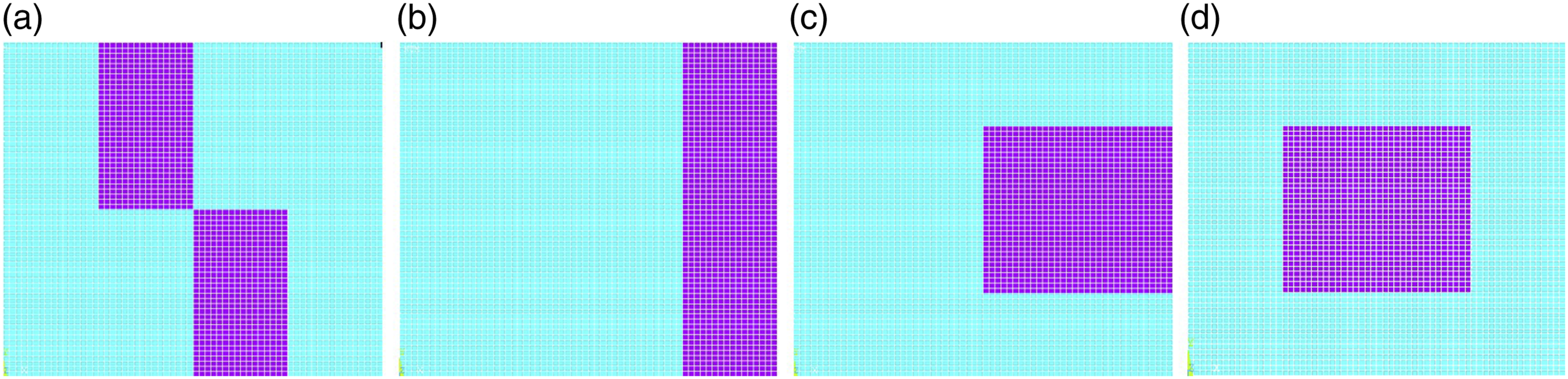
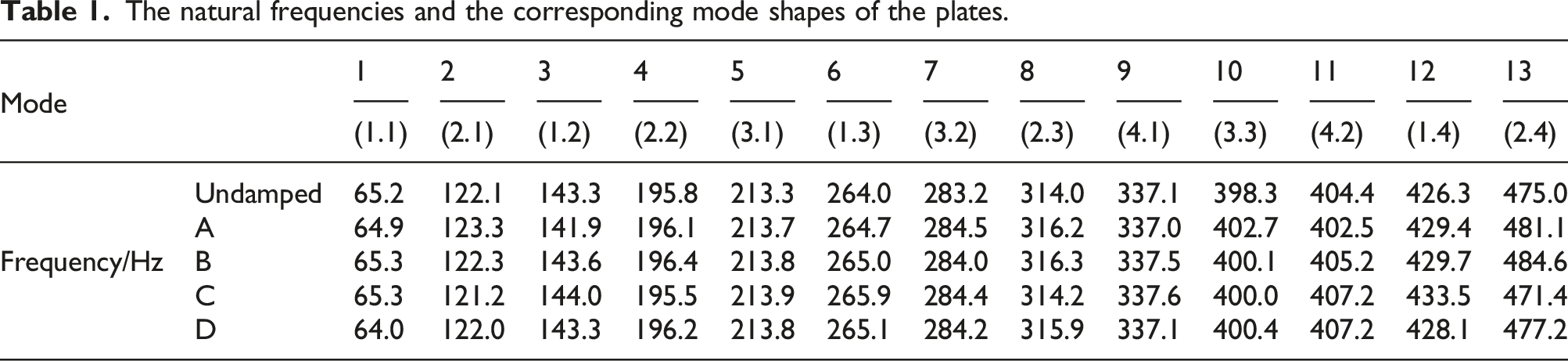
Figure 2 shows the complex mode shapes of mode (2,4) for the four damping distributions, and the Ref shows the real mode shape for the undamped plate. It can be seen from the figure that the inhomogeneous damping generates the complex modes, the phases of the mode shapes are no longer 0° or 180°, and the complex mode shapes are different for different damping distributions. In addition, for real modes, there is one real mode shape corresponding to a resonance frequency, while for complex modes, there are two conjugate complex mode shapes corresponding to a resonance frequency. The real part and the amplitude of the conjugate complex mode shapes are the same, but the imaginary part and the phase are opposite. In the case of complex modes, the vibration response and the acoustic radiation of a structure are the results of the combined action of N pairs of conjugate (2N) complex modes. Mode shapes of mode (2,4) for different damping distributions.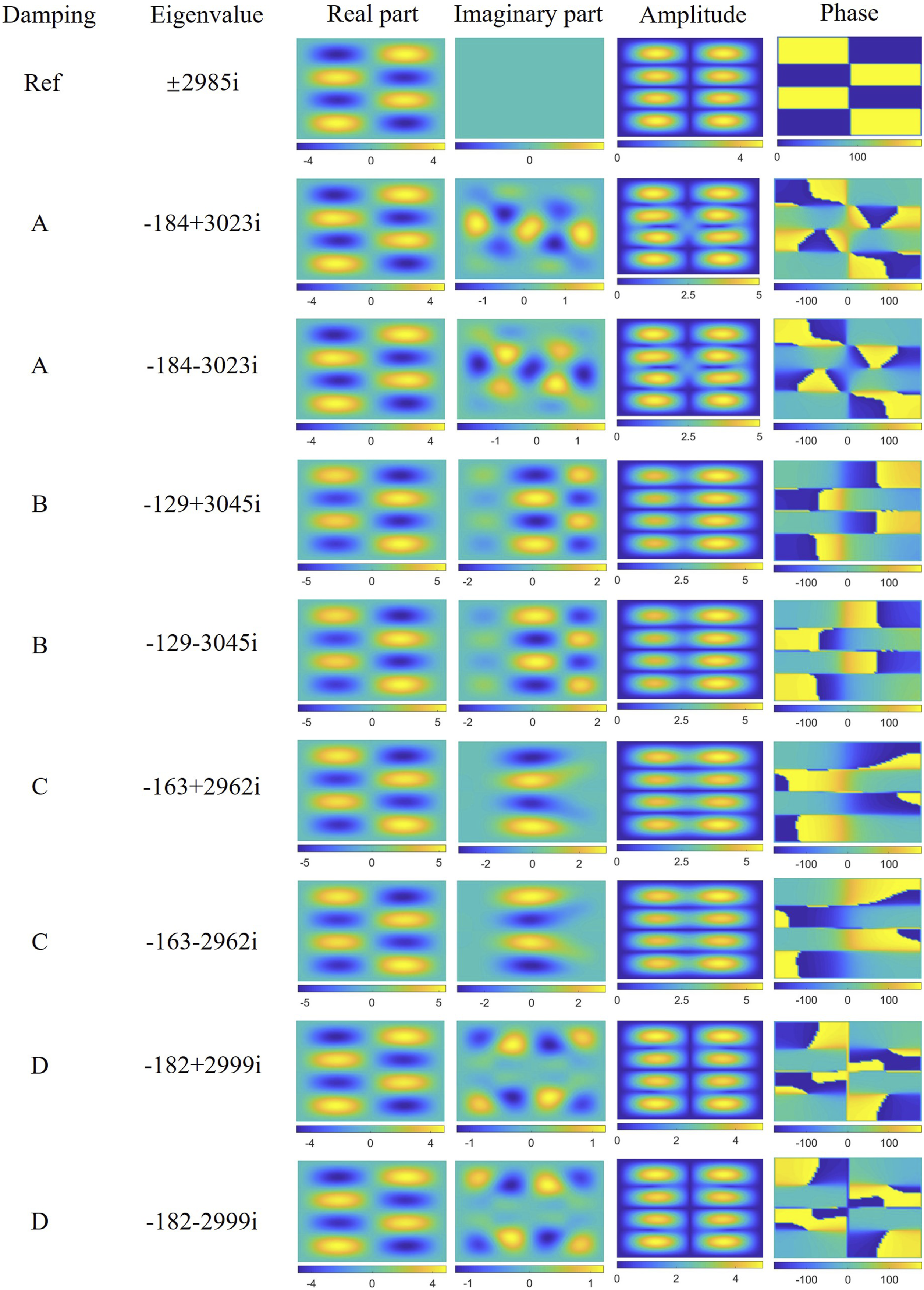
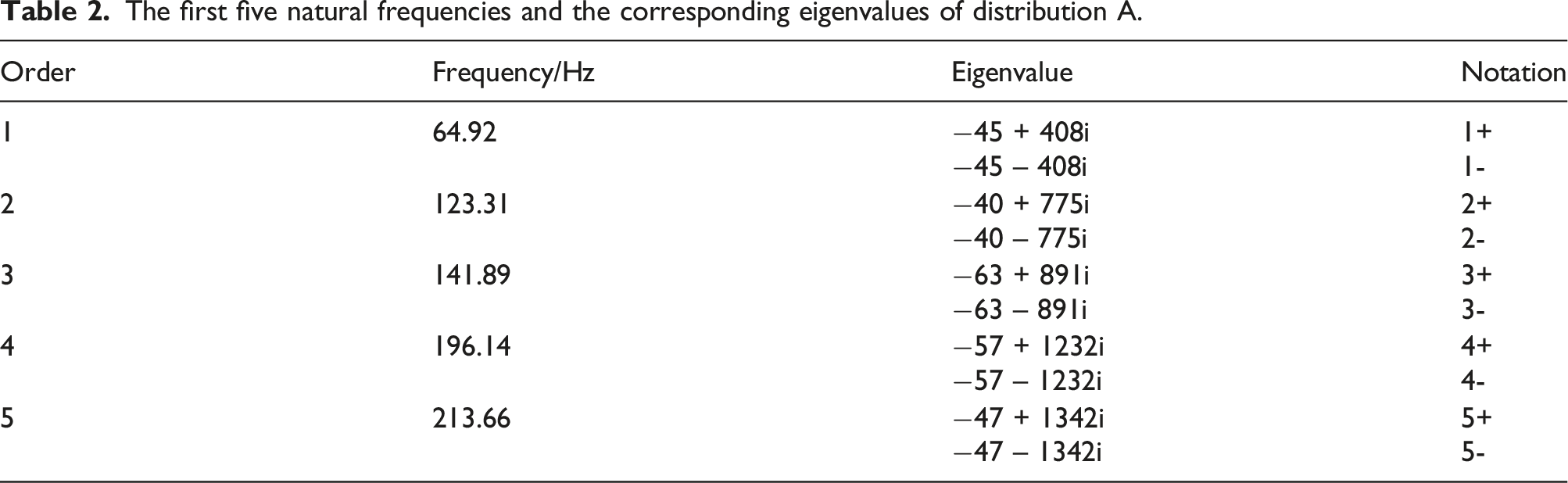
The first five natural frequencies and the corresponding eigenvalues of distribution A.
The amplitude of the excitation force is 1 N at each frequency, and the two positions of the force are shown in Figure 3. The coordinate of point Ⅰ is (L/4, W/4), the coordinate of point Ⅱ is (L*3/8, W*3/8), and each point position corresponds to a calculation condition. The relationships between the absolute values of displacement modal coordinates The positions of the excitation force. The absolute values of displacement modal coordinates of distribution A: (a) condition Ⅰ and (b) condition Ⅱ.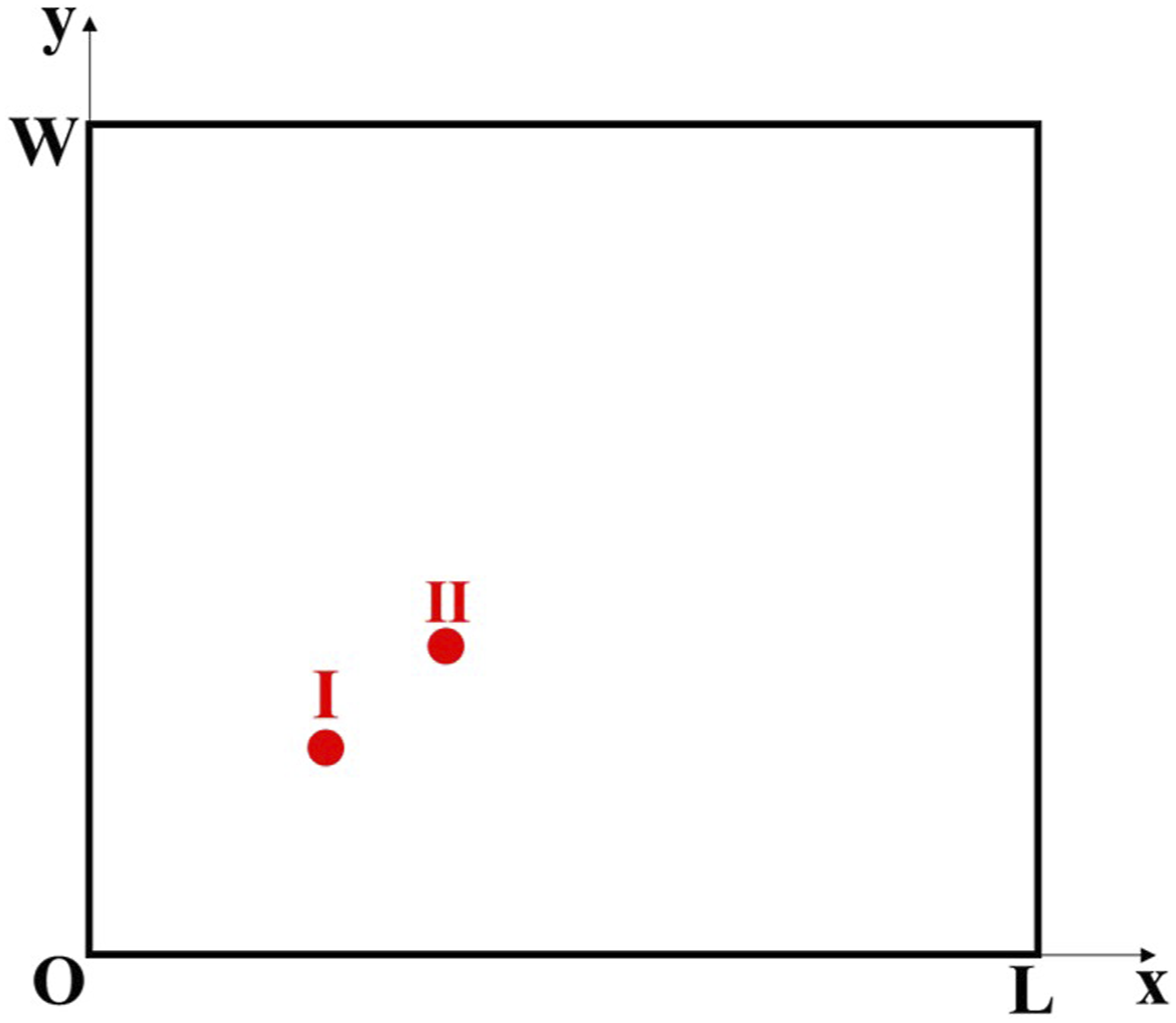
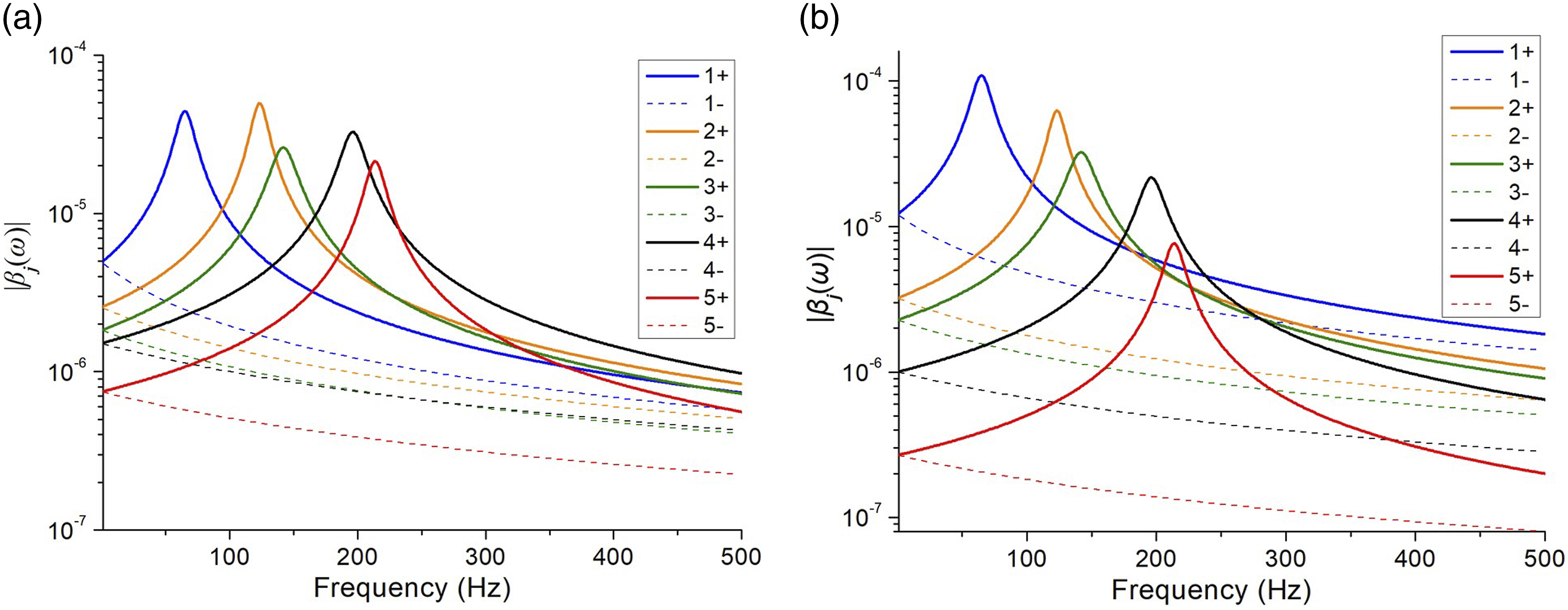
It is shown in Figure 4 that the contributions of two conjugate eigenvectors to the total vibration response are different under forced steady-state vibration. Suppose a pair of conjugate eigenvalues are
To explain the above results, we can see equation (10). Term The physical meaning of |iω-λn+| and |iω-λn-|.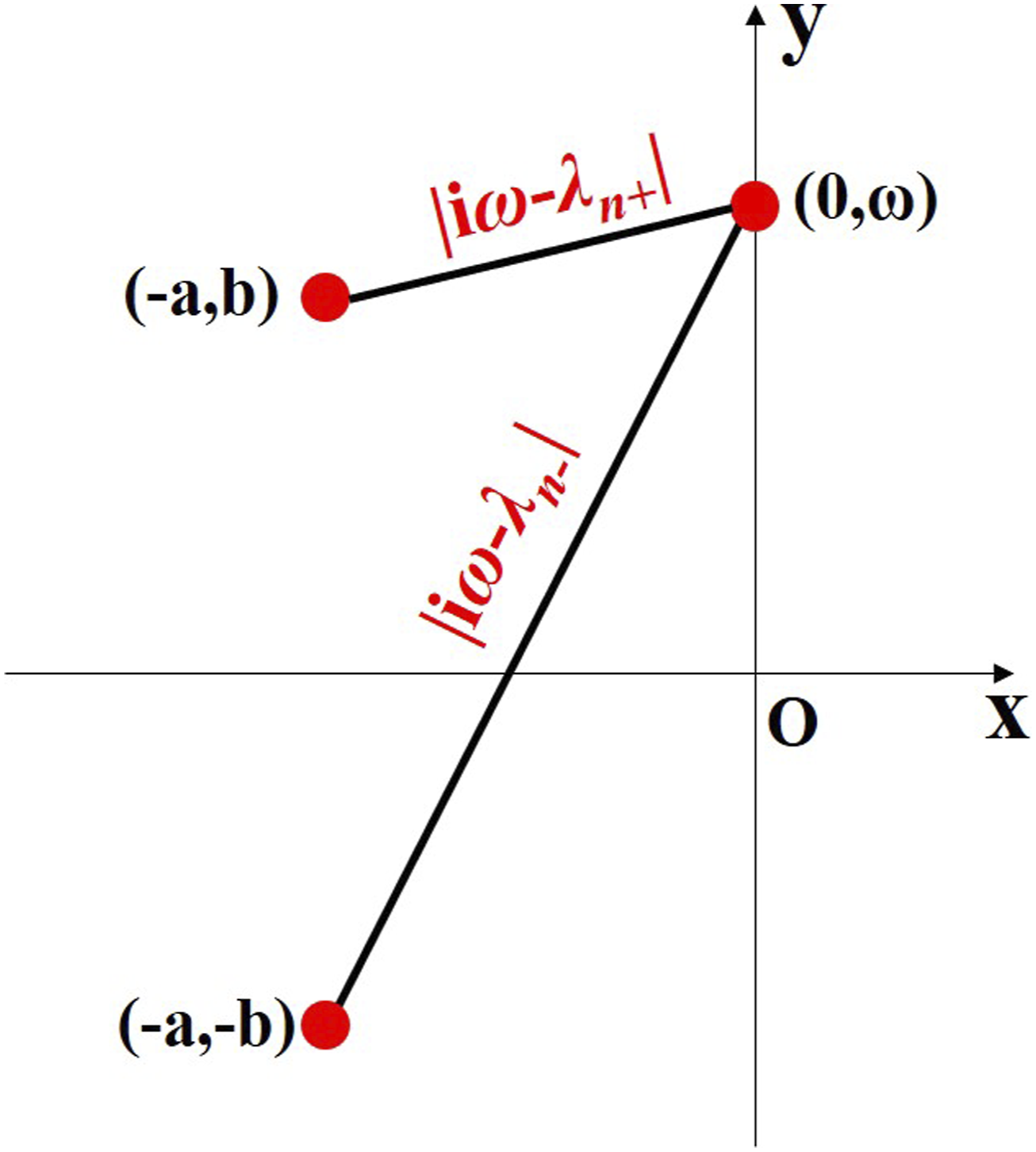
The effect of the coupling between complex modes on sound power
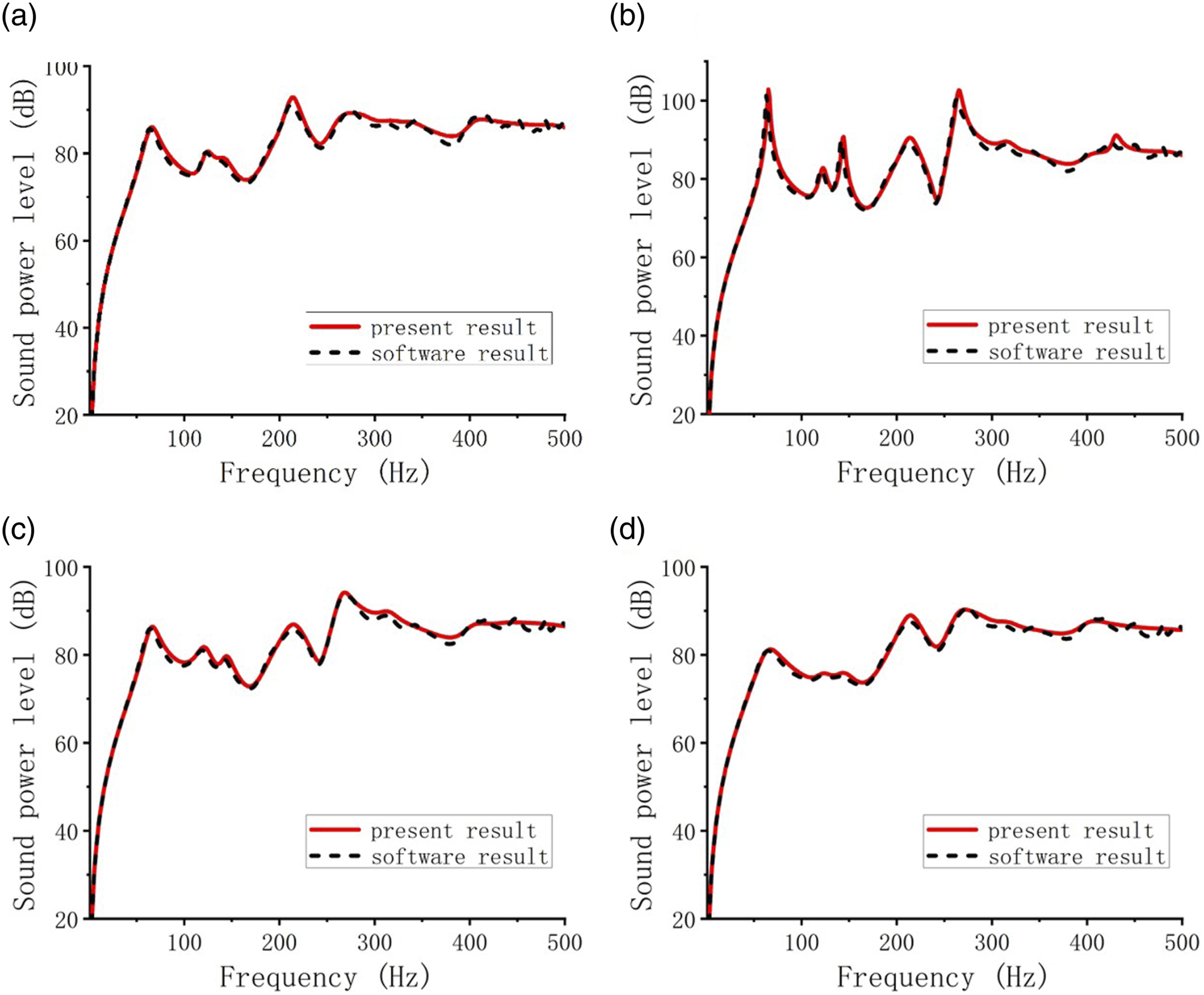
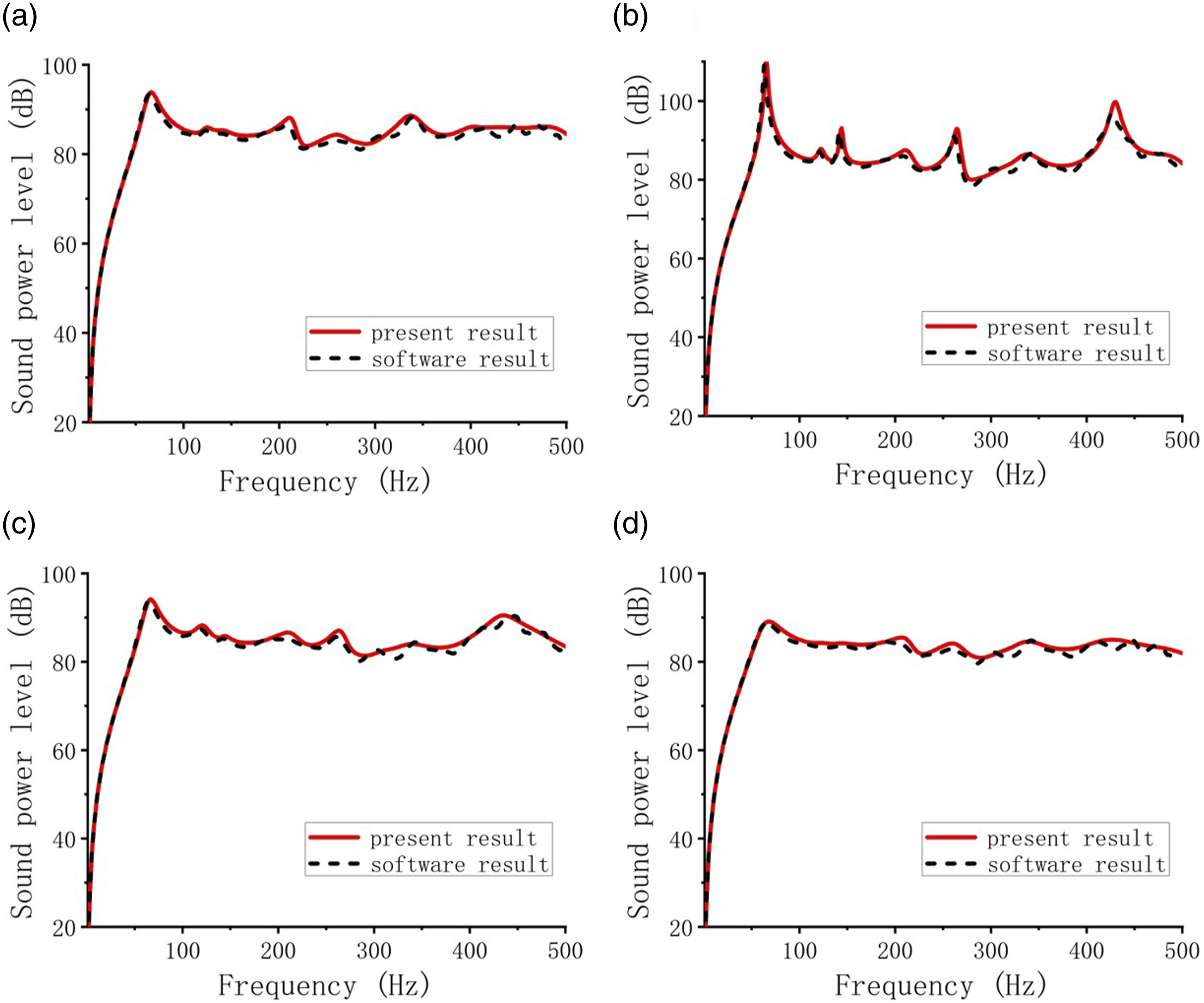
Here, we study the effect of the coupling between complex modes on radiated sound power. Firstly, validation of the acoustic power calculation results is conducted. An acoustics-structure coupled model is established within ANSYS, as illustrated in Figure 6. Vibrational responses and acoustic pressures at various plate nodes are computed in ANSYS. Utilizing equation (12) and performing integration yields the radiated acoustic power of the plate, hereinafter referred to as the software results. Figures 7 and 8 compare the acoustic power obtained using the methodology presented in this paper with the software results. It is evident from the figures that the approach proposed in this paper is reliable. Simplified diagram of finite element calculation model. Comparison of calculation results (Condition Ⅰ): (a) damping distribution A, (b) damping distribution B, (c) damping distribution C, and (d) damping distribution D. Comparison of calculation results (Condition Ⅱ): (a) damping distribution A, (b) damping distribution B, (c) damping distribution C, and (d) damping distribution D.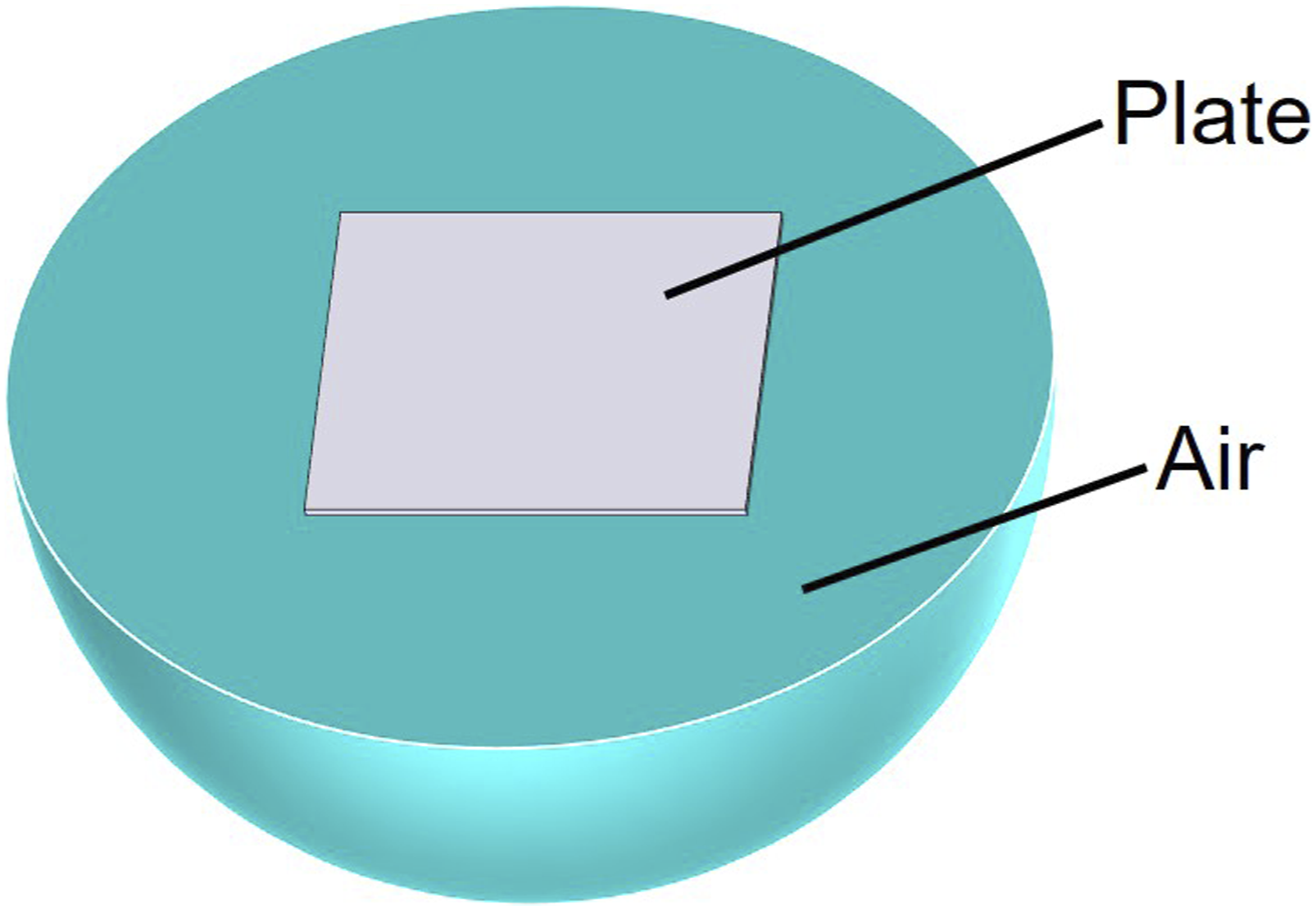
The acoustic power results calculated by equation (16) with and without considering the coupling are compared in Figures 9 and 10. The unit excitation force is at point Ⅰ in Figure 9, and at point Ⅱ in Figure 10. In the figures Sound power with and without the coupling effect considered (Condition Ⅰ): (a) damping distribution A, (b) damping distribution B, (c) damping distribution C, and (d) damping distribution D. Sound power with and without the coupling effect considered (Condition Ⅱ): (a) damping distribution A, (b) damping distribution B, (c) damping distribution C, and (d) damping distribution D.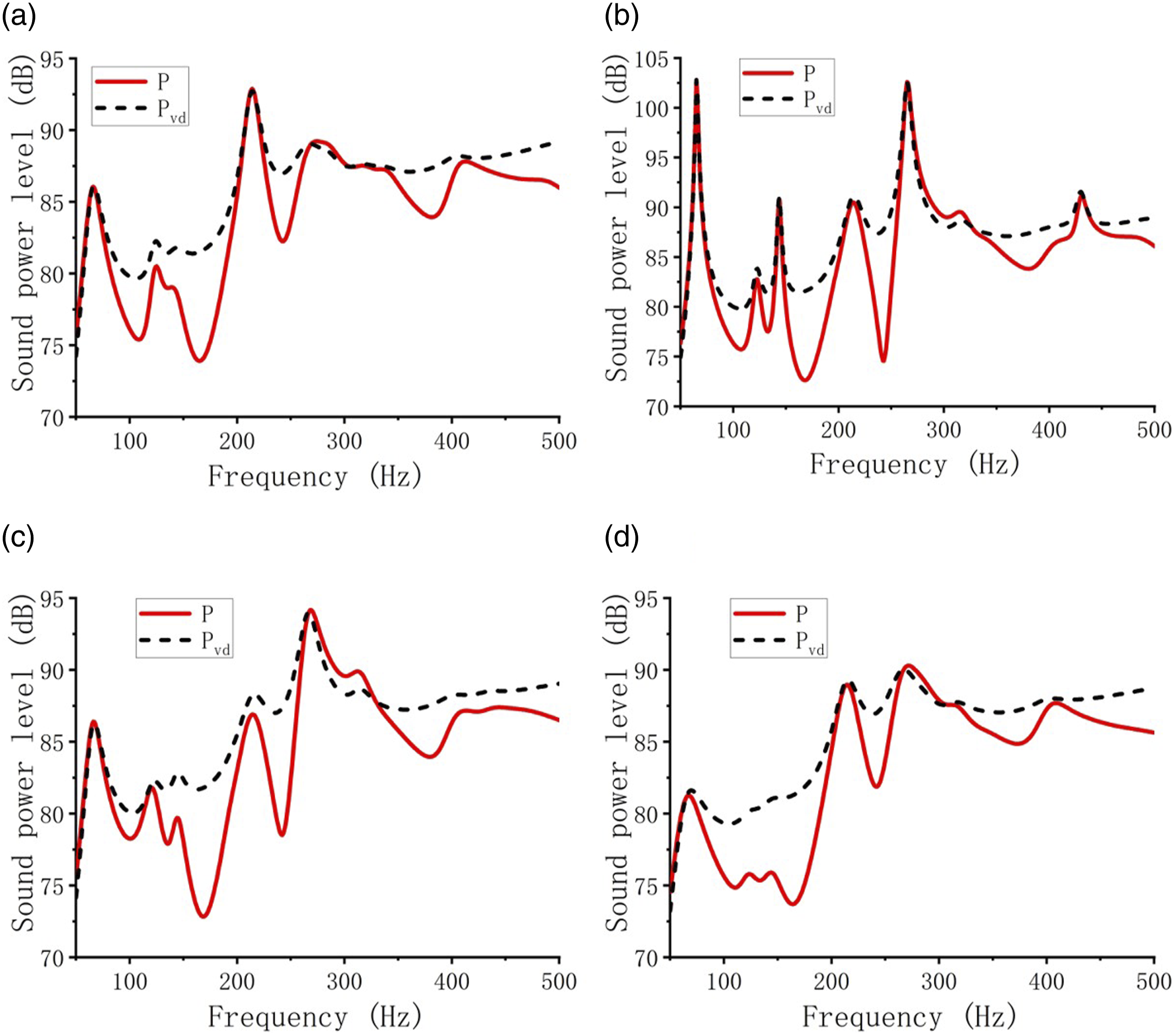
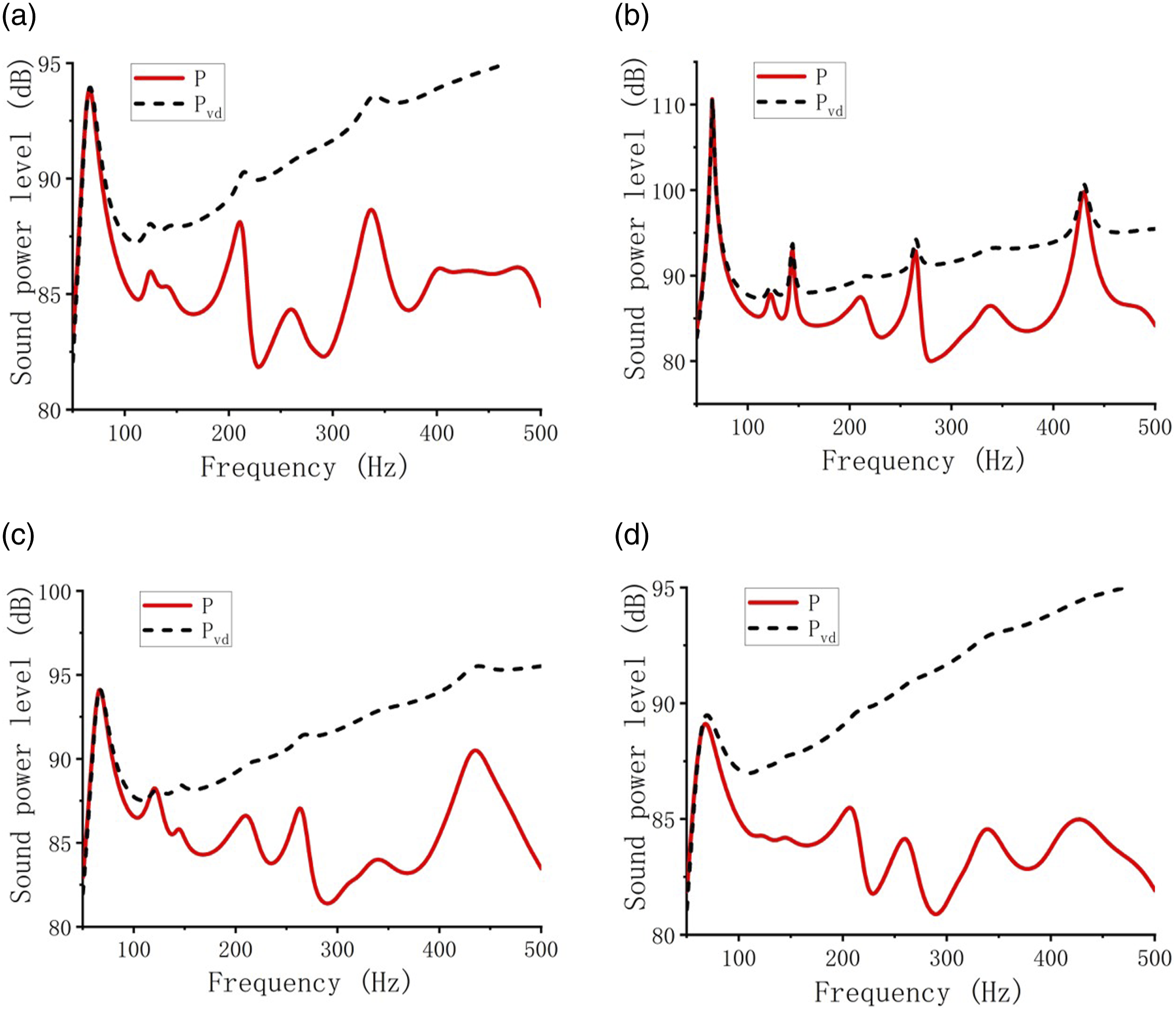
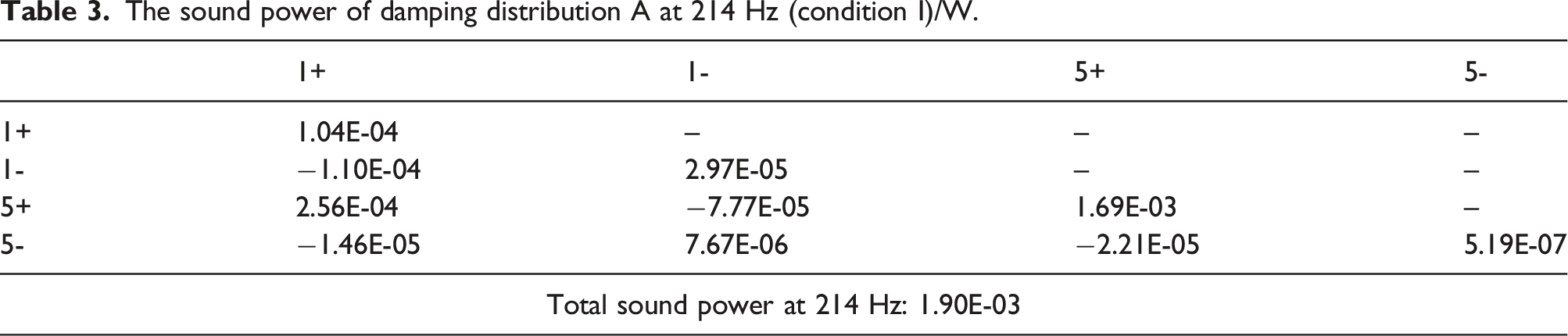
As shown in Figures 9 and 10, the coupling between complex modes has different effects on the total sound power under various damping distributions. Meanwhile, the effects are different under various excitation conditions. For Figure 9(b), the effect of the interaction on sound power mainly works in the off-resonant region and has little influence in the resonant region. For Figures 9(a), (c) and (d), the coupling of modes has little influence on the sound power at most natural frequencies, but there is a significant difference between the acoustic power near the second (about 122 Hz) and third (about 143 Hz) natural frequencies of the structures; For Figures 10(a)–(d), the coupling effect has obvious influence on the sound power in the whole band of low frequency, and the coupling of complex modes cannot be ignored when calculating the acoustic power.
The sound power of damping distribution A at 214 Hz (condition Ⅰ)/W.
The sound power of damping distribution A at 214 Hz (condition Ⅱ)/W.
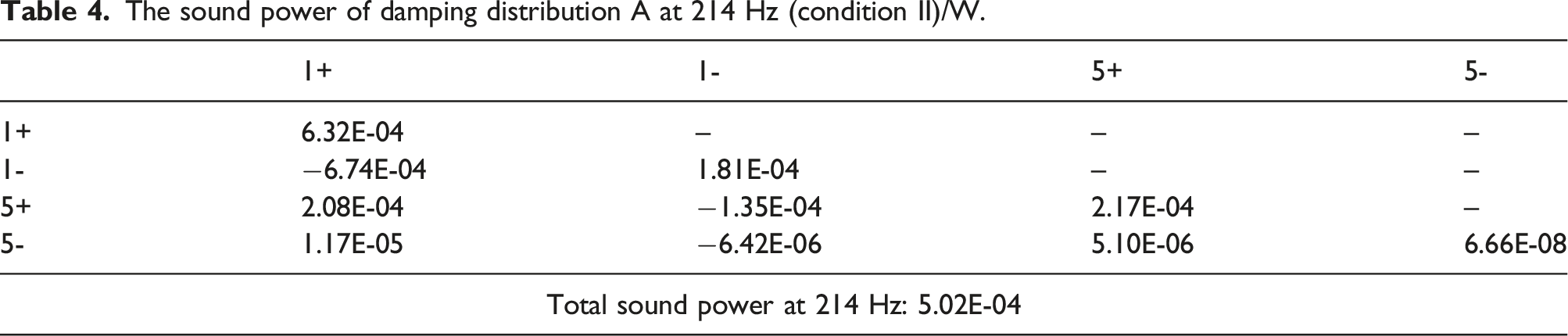
The study in Ref. 7 shows that there is a coupling of acoustic radiation between different types of modes for a rectangular plate in the condition of complex modes. From this example, we can see that in the situation of complex modes, there is also a coupling of acoustic radiation between a pair of conjugate complex modes, and this coupling may be quite strong. In addition, when the complex mode method is used to calculate the total radiated sound power, the coupling effect between the modes should not be ignored arbitrarily, even at resonance frequencies. Otherwise, the calculation may lead to large errors.
The error of the acoustic power calculated by the decoupling approximation
The four damping distributions in Figure 1 under condition Ⅱ are taken as examples for calculation. Firstly, the real modes of the systems are obtained by equations (21) and (26) is used to calculate the approximate vibrational response by neglecting the off-diagonal terms of modal damping matrix Acoustic power calculated by complex mode method and the decoupling approximation: (a) damping distribution A, (b) damping distribution B, (c) damping distribution C, and (d) damping distribution D.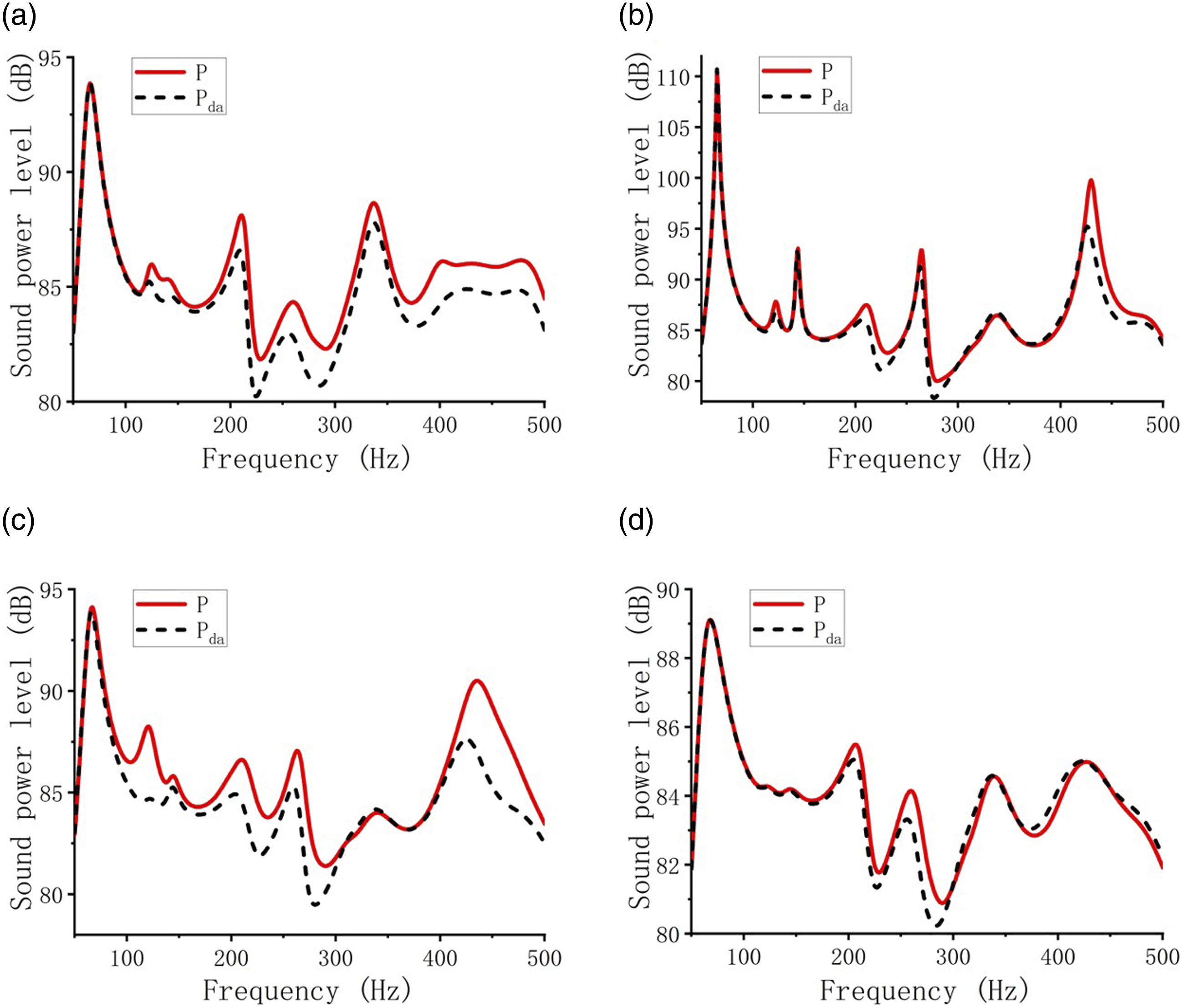
As shown in Figure 11, for distributions B and D, the sound power calculated by the decoupling approximation agrees with the exact solution obtained by the complex mode method. For distribution A, the results of decoupling approximation have obvious errors at many frequency points compared with the precise solution, and the error reaches a maximum of 1.8 dB at 211 Hz. For distribution C, the difference between the two curves is obvious: the peak of sound power at 121 Hz is missed in the resulting curve of decoupling approximation, the value of acoustic power at 121 Hz is even less than the value of the lower peak at 144 Hz, and the error of sound power level reached 3.6 dB at 121 Hz. In addition, for distribution C, the peak of the exact solution in the 400–500 Hz range is 435 Hz, while the peak of decoupling approximation is 425 Hz, and the frequency point error reaches 10 Hz.
It can be seen that the sound power results obtained by the decoupling approximation may not only differ from the exact solution but also have some problems, such as omitting the peak of acoustic power and great calculation error of the frequency point where the peak of acoustic power is located. Therefore, the decoupling approximation should be avoided to calculate the structure's radiated sound power when the calculation results' accuracy requirement is high.
Conclusions
This paper mainly investigates the vibration and acoustic radiation characteristics of conjugate complex eigenvectors of plates under forced steady-state vibration. Additionally, the error of the acoustic power calculated by the decoupling approximation instead of the complex mode method is discussed. The main conclusions are: (1) The contributions of two conjugate complex eigenvectors to the total vibration response are different under a unit normal force. The vibration is dominated by the eigenvector corresponding to the eigenvalue with a positive imaginary part near the natural frequency. The contribution of the eigenvector corresponding to the eigenvalue with a negative imaginary part to the total vibration decreases with the increase in frequency. (2) When plates have real modes with homogeneous damping, Refs. 19,20 have investigated their sound radiation. The results show that the coupling effect cannot be ignored under off-resonant excitation at low frequency but can be neglected at resonant excitation. For real modes, acoustic coupling can only occur between modes of different orders. In this paper, we found that the coupling between a pair of conjugate complex modes can also contribute to sound radiation when employing the complex mode approach to calculate the acoustic radiation from plates. The phenomenon is different from real mode analysis. Furthermore, as shown in Table 4, the coupling between conjugate modes can sometimes be significantly strong. Therefore, neglecting the coupling between modes may result in substantial errors, even at resonance frequencies, when utilizing complex mode analysis for acoustic radiation calculations. (3) The acoustic power, which is calculated using the approximate vibration response obtained by decoupling approximation, may have errors compared with the exact solution. There may also be some problems, such as omitting the peak of sound power and large calculation errors of the frequency point where the peak of acoustic power is located.
Footnotes
Acknowledgments
The authors gratefully acknowledge the support of the National Natural Science Foundation of China under Grant No. 11772080.
Declaration of conflicting interests
The author(s) declared no potential conflicts of interest with respect to the research, authorship, and/or publication of this article.
Funding
The author(s) disclosed receipt of the following financial support for the research, authorship, and/or publication of this article: The authors would like to express their gratitude to National Natural Science Foundation of China (No. 11772080).
