




Abstract
When the structure is forced to vibrate and multiple modes exist simultaneously, each vibration mode contributes to the total acoustic power radiated by the structure. Moreover, the acoustic radiation of each vibration mode is not independent of each other, and the coupling between them will also have an impact on the total radiated power. Mutual-radiation efficiency is an important metric to measure the ability of the coupling of different modes to radiate. In this note, for both real and complex modes, a method to calculate the mutual-radiation efficiencies by finite element method and boundary element method software is presented. Numerical examples are presented to illustrate and validate the approach.
Introduction
In engineering industries, researchers pay much attention to the study of structural vibration and sound radiation characteristics in recent years.1–3 References 1 and 2 derived formulations to analyze the relative panel acoustic contributions of a vibrating structure, and the relative acoustic contributions of a scaled vehicle cabin are ranked. Reference 3 proposed an approach for structural response reconstruction based on the modal superposition method in the presence of closely spaced modes. When considering the vibration of a structure, it can be analyzed in the vibration modal space. The modes of each order are independent of each other, and the modal coordinate represents the contribution of the corresponding vibration mode to the total vibration response. However, when the acoustic radiation of a structure is analyzed by vibration modes, the modes that dominate the vibration response are not necessarily the modes that dominate the acoustic response. Moreover, the vibration modes are not independent of each other, that is, not only they themselves contribute to the sound power, but also the couplings between the modes influence the total radiation. 4 Self-radiation efficiency and mutual-radiation efficiency are two important metrics when studying the contribution of vibration modes to acoustic radiation, and they respectively represent the ability of a mode itself and the coupling of different modes to radiate. It is of great significance to calculate self-radiation and mutual-radiation efficiencies accurately in both active and passive control of noise reduction. Reference 5 determined the self-radiation efficiencies of baffled beams theoretically, with both hinged and clamped supports considered. References 6 and 7 took beams as research objects and implied that the interaction between modes is significant for the total sound power well below the coincidence wave number ratio. Reference 8 derived the formula to calculate the total acoustic power of a rectangular simply supported panel using modal radiation efficiencies. Reference 9 studied the vibration of a simply supported rectangular plate which is reinforced by springs, the result indicates that the coupling effect between modes is normally meaningful. Reference 10 studied the mutual-radiation resistances of simply supported plates, the result shows that modal interaction should not always be neglected at resonant frequencies, and some spurious peaks may be generated at some frequency points if the coupling effect between modes is ignored. So it is hard to determine when the modal interaction could be neglected. Reference 11 presented an analytical solution for the self- and mutual-radiation resistances of a simply supported plate in the form of power series. References 12 and 13 studied the calculation methods of intermodal radiation impedance for fluid-loaded plates. Reference 14 presented a partially coupled modal contribution assumption to identify the dominant noise-contribution mode. Analytical and numerical methods are commonly used to analyze the acoustic radiation of a plate. As one of the numerical methods, the elementary radiator approach is an effective and convenient method. This approach is summarized and introduced in References 15 and 16. Reference 16 used elementary radiator approach to calculate the radiation efficiencies of a simply supported beam and a simply supported plate. Modal radiation efficiencies of complex modes for plates were determined by elementary radiator approach in References 17 and 18.
It is noted that most of the research results on modal radiation efficiencies have been aimed at real modes. When the damping matrix of the vibration system does not satisfy the Caughey and O 'Kelly condition, 19 the modes of the system are complex modes. As described in Reference 20, the distribution of non-proportional or inhomogeneous damping within a structure will lead to the generation of complex modes, if the complexity of the modes is too high, the reliability and accuracy of the analysis using real modes could be adversely affected. References 17, 18, and 21 studied the acoustic radiation efficiencies of complex modes. In Reference 18, inhomogeneous damping was applied to plate structures to generate complex modes, and it was found that the acoustic radiation behavior of complex modes is different from that of real modes. For example, in the case of a uniform rectangular plate, only the modes of similar type can be coupled in the condition of real modes, that is, odd-even modes can only be coupled with odd-even modes, but not with odd–odd, even–even, or even–odd modes. But in the condition of complex modes, the interaction of different types of modes may also occur. Reference 21 shows that the traveling wave component in complex modes could greatly improve the self-radiation efficiency of even-order modes. It can be seen that in the acoustic radiation analysis, if the complexity of the modes is too high, it is necessary to study the acoustic radiation based on complex modes.
It is worth noting that the research objects above are all simple structures such as planar beams or plates. As for complicated structures in practice, finite element method (FEM) and boundary element method (BEM) software is generally used in acoustic analysis. When calculating the mutual-radiation efficiencies of a structure, there is no corresponding module in FEM and BEM software, thus the mutual-radiation efficiencies cannot be obtained directly after the model is built. In this note, for both real and complex modes, a method to calculate the mutual-radiation efficiencies by FEM and BEM software is presented, so that the mutual-radiation efficiencies of complicated structures can be obtained. By using the method, we can calculate the mutual-radiation efficiencies of complicated structures in engineering. It should be emphasized that the commercial software is only used to obtain the radiated acoustic power. This note explains which acoustic power values need to be calculated and how to process them. Numerical examples are presented to illustrate and validate the approach. In addition, the meaning of the mutual-radiation efficiencies in the condition of complex modes is discussed.
Theory
Radiation efficiencies of vibration modes
The relationship between the radiated sound power

The relationship between the sound pressure and the velocities on the structural surface can be obtained by discretizing the Helmholtz integral equation,
22
then be written as



Using the matrix of eigenvectors

Equation (4) can be rewritten as

Radiation efficiency is generally defined as


Suppose that a single vibration mode is excited, that is, the velocity vector is


The mutual-radiation efficiency between modes is written as

A baffled panel could be divided into


Mutual-radiation efficiency estimation from finite element method and boundary element method software
When calculating the self-radiation efficiency by software, the key is to obtain
It should be emphasized before introducing the calculation method of mutual-radiation efficiencies that the values of the mutual-radiation efficiencies are real in the case of real modes and complex in the case of complex modes. In the condition of complex modes, suppose that two vibration modes are excited, and


Let

According to equation (16), if the modal coordinates of structural vibration are known, the radiated acoustic power contributed by mode coupling can be calculated accurately only when both the real part and the imaginary part of
When calculating the mutual-radiation efficiency, we need to know


In the condition of complex modes,

Consider that


Thus the mutual-radiation efficiency of complex modes can be obtained by combining equations (19) and (21).
Numerical results
Example 1
The natural frequencies and mode shapes of the plate.

A fluid-structure coupling model is established in ANSYS, and the radius of the fluid is 5 m. as shown in Figure 1. For complicated structures, we can just model the part in contact with the fluid of the structure to reduce the computational amount. Looping statement of APDL language is applied to input the eigenvector Fluid-structure coupling model in the finite element method software.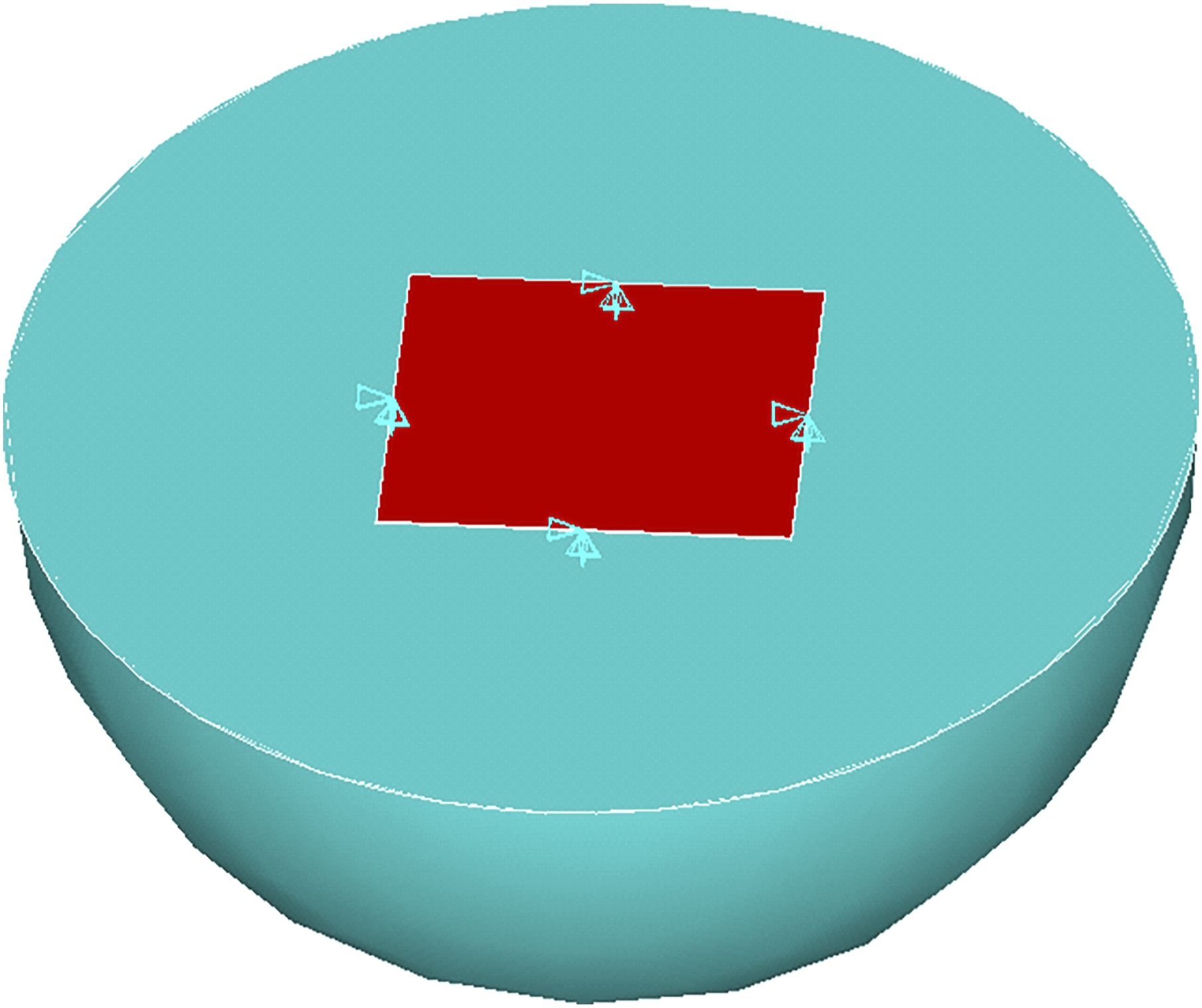
For mode (3, 1) and (3, 3), the self-radiation efficiency results calculated by elementary radiator approach and software respectively are shown in Figure 2. The mutual-radiation efficiency results of mode (1, 1) with (3, 1), mode (1, 2) with (3, 2) are shown in Figure 3. Self-radiation efficiencies of real modes: (a) mode (3, 1) and (b) mode (3, 3). Mutual-radiation efficiencies of real modes: (a) mode (1, 1) with mode (3, 1) and (b) mode (1, 2) with mode (3, 2).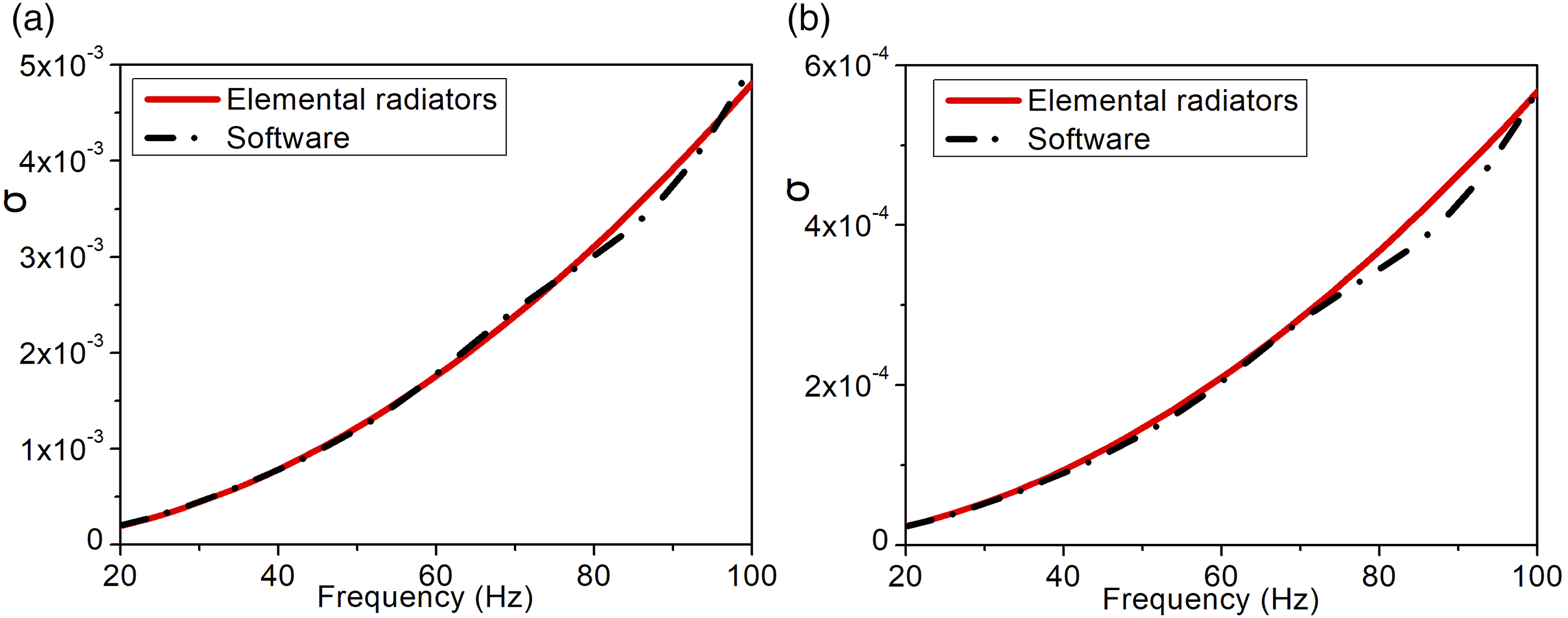
In both Figures 2 and 3, between 20–100 Hz, the relative errors of radiation efficiencies calculated by software method and elementary radiator approach are below 11%. It can be seen that for real modes, the calculation method of radiation efficiencies by software is valid. If more accurate results are needed, or the frequency bandwidth needs to be wider, it can be achieved by reducing the size of grids or using BEM software to calculate the radiated acoustic power.
Example 2
In order to reduce noise emitted by vibrating structures additional damping treatments such as constraint layer damping or embedded elastomer layers can be used. To save weight and cost, the additional damping is often placed at some critical locations of the structure, which leads to spatially inhomogeneous distribution of damping. This inhomogeneous distribution of structural damping leads to an occurrence of complex vibration modes. 18 This example is to verify the method in the condition of complex modes.
The size and material properties of the model, except for damping, are the same as those in example 1. The distribution of inhomogeneous damping is shown in Figure 4, in which the dark area is the location of damping. The damping ratio ζ of the material is 0.2 in the dark area. The operation method of applying damping in ANSYS is as follows: based on the model in example 1, first the “NSEL” command is used to select the nodes in the damping area, then the “ESLN” command is used to select the corresponding elements, finally the “EMODIF” command is used to modify the elements’ material (the damping ratio of the new material is 0.2). Distribution of inhomogeneous damping.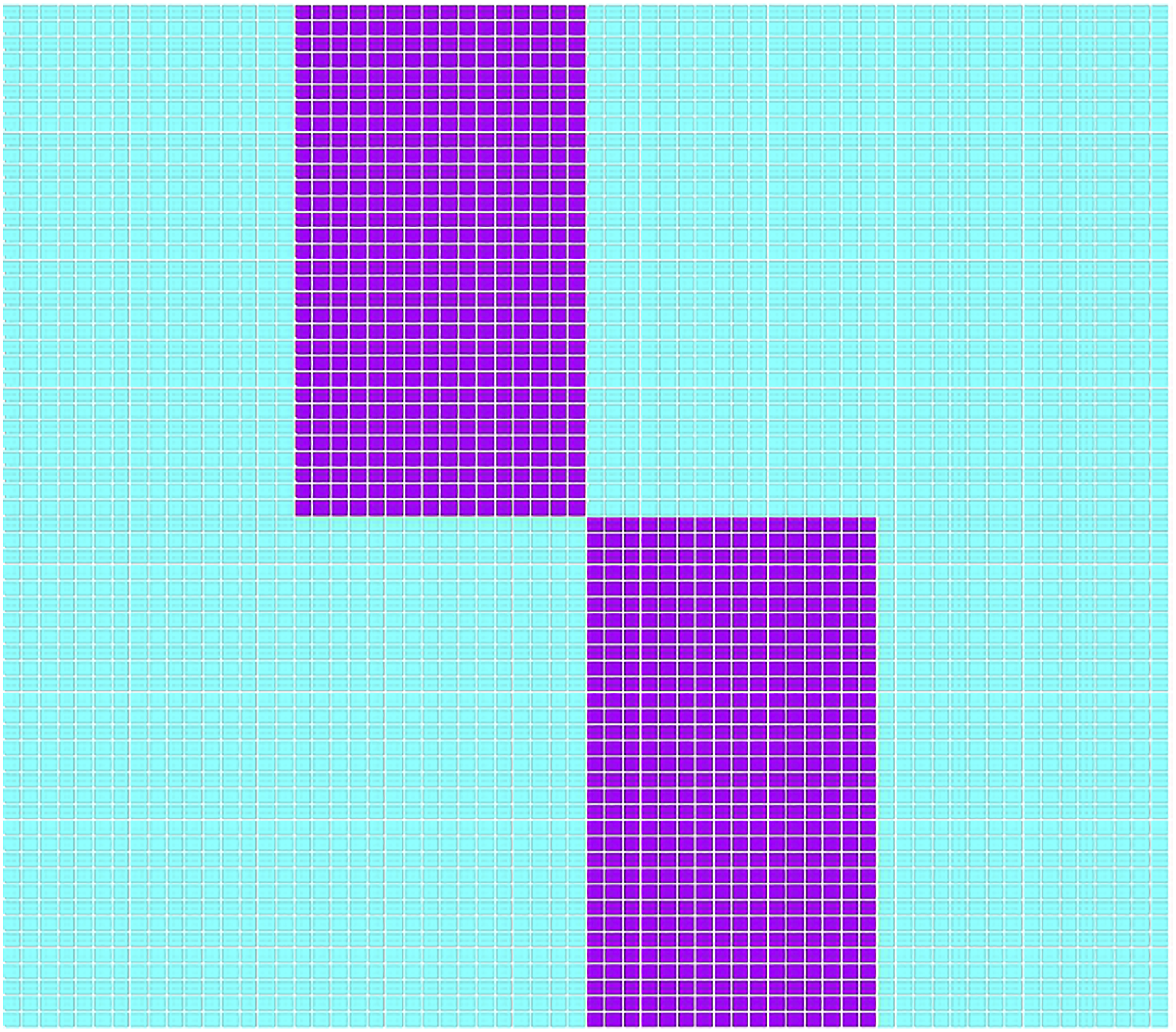
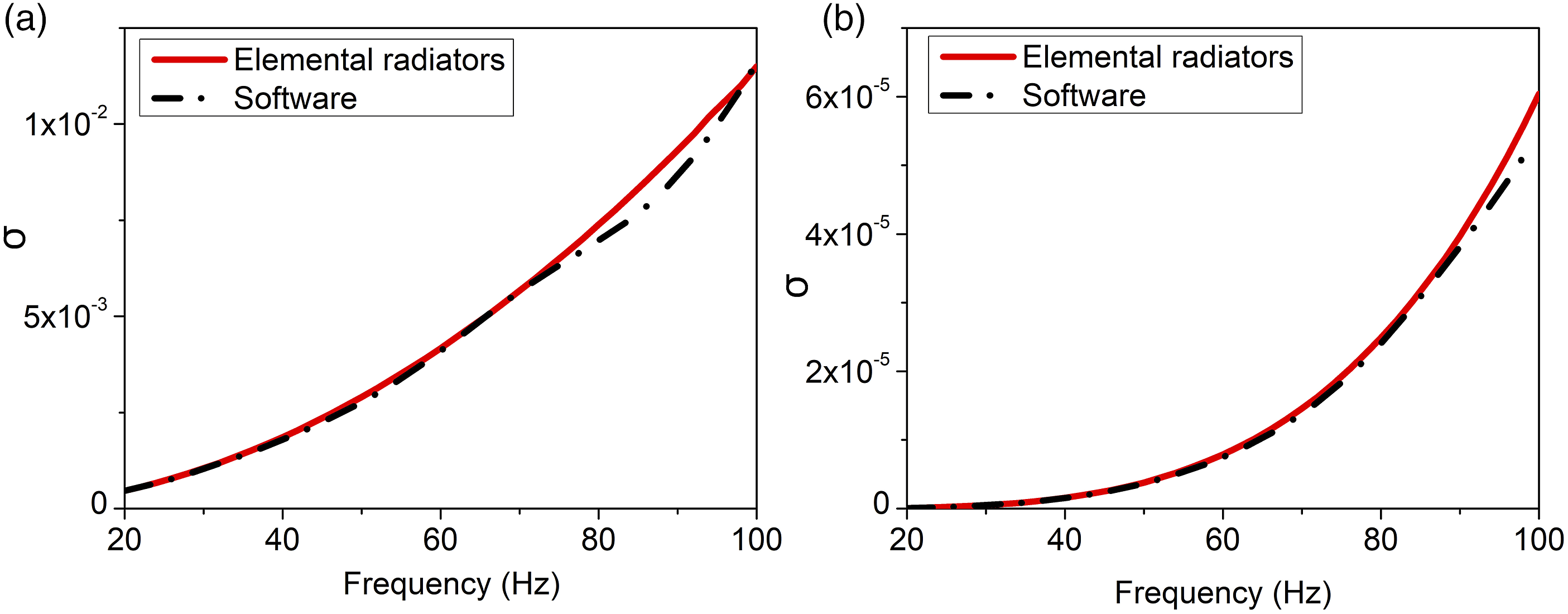
For mode (1, 1) and (2, 1), the self-radiation efficiency results calculated by elementary radiator approach and software respectively are shown in Figure 5. The mutual-radiation efficiency results of mode (1, 1) with (3, 1) are shown in Figure 6, and the mutual-radiation efficiency results of mode (2, 2) with (1, 3) are shown in Figure 7. Self-radiation efficiencies of complex modes: (a) mode (1, 1) and (b) mode (2, 1). Mutual-radiation efficiency of mode (1, 1) with mode (3, 1): (a) real part, (b) imaginary part and (c) amplitude. Mutual-radiation efficiency of mode (2, 2) with mode (1, 3): (a) real part, (b) imaginary part and (c) amplitude.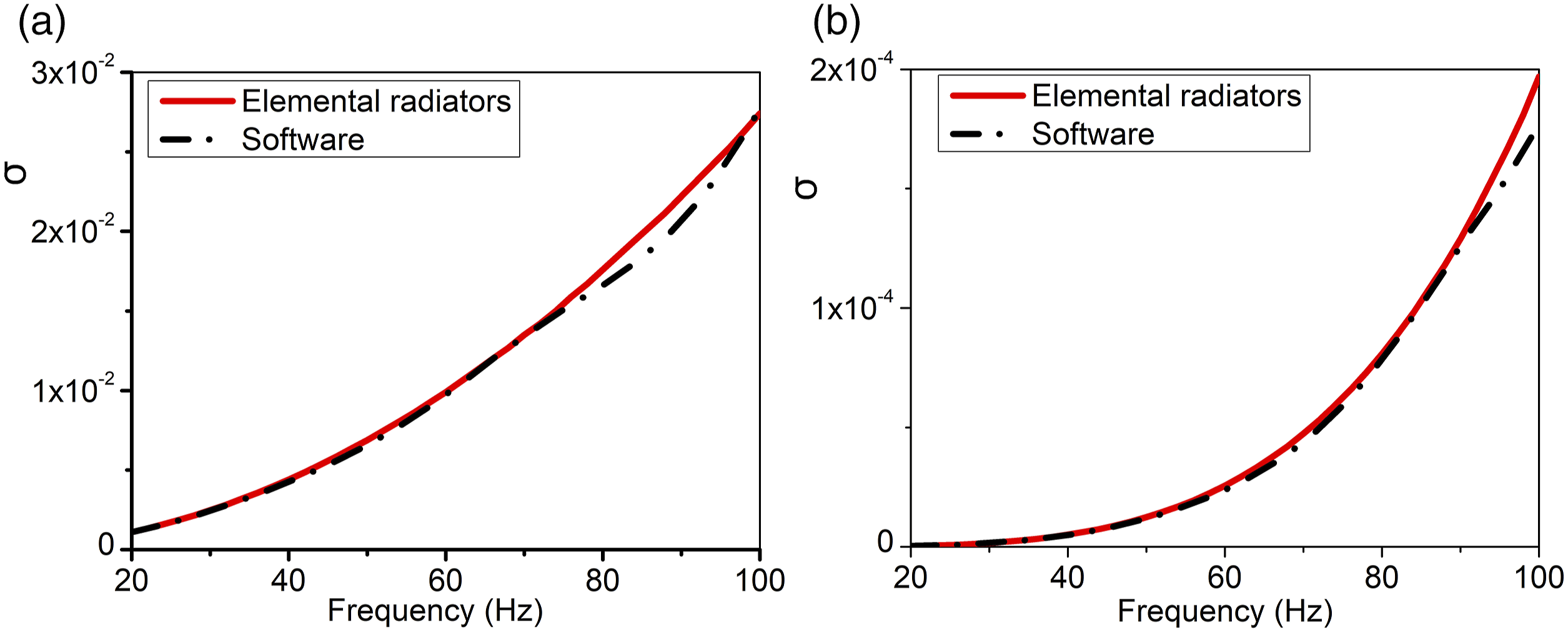
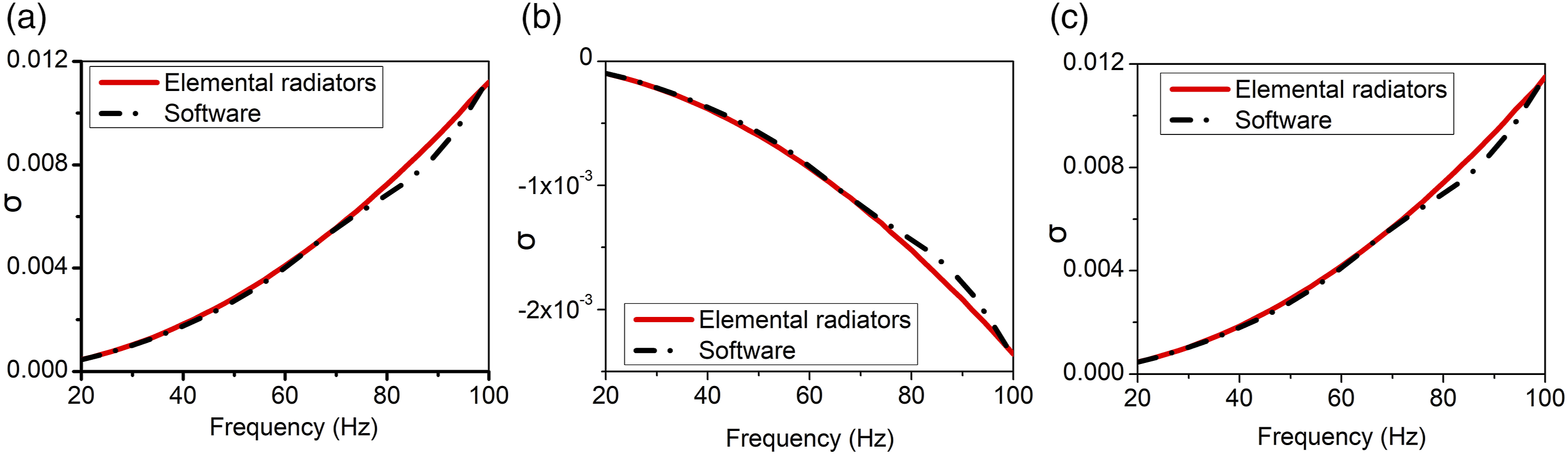
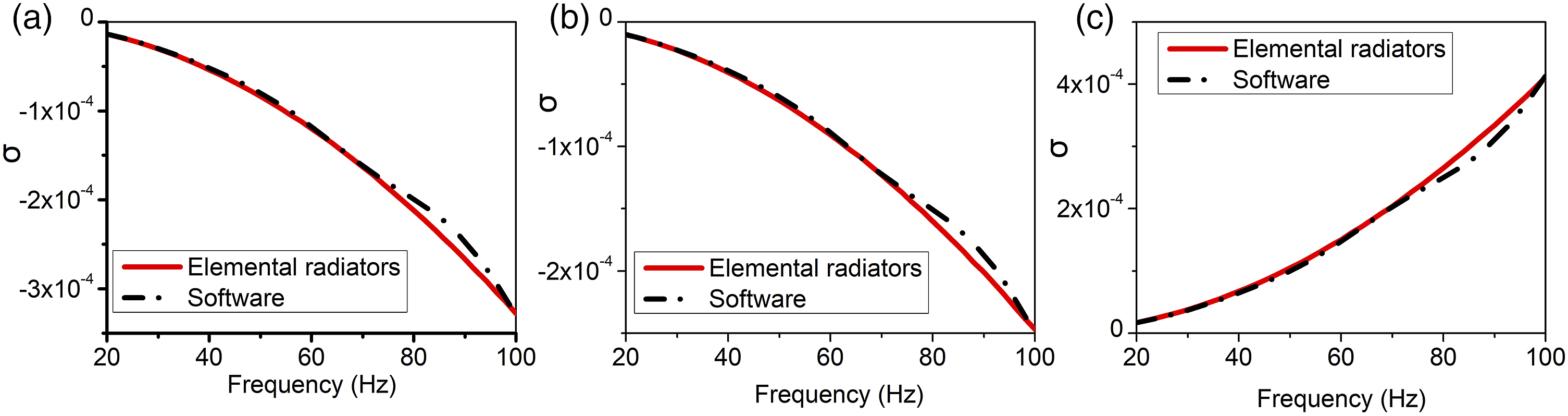
In Figures 5–7, the relative errors of radiation efficiencies calculated by software method and elementary radiator approach are below 11%. It can be seen that for complex modes, the calculation method of radiation efficiencies by software is valid.
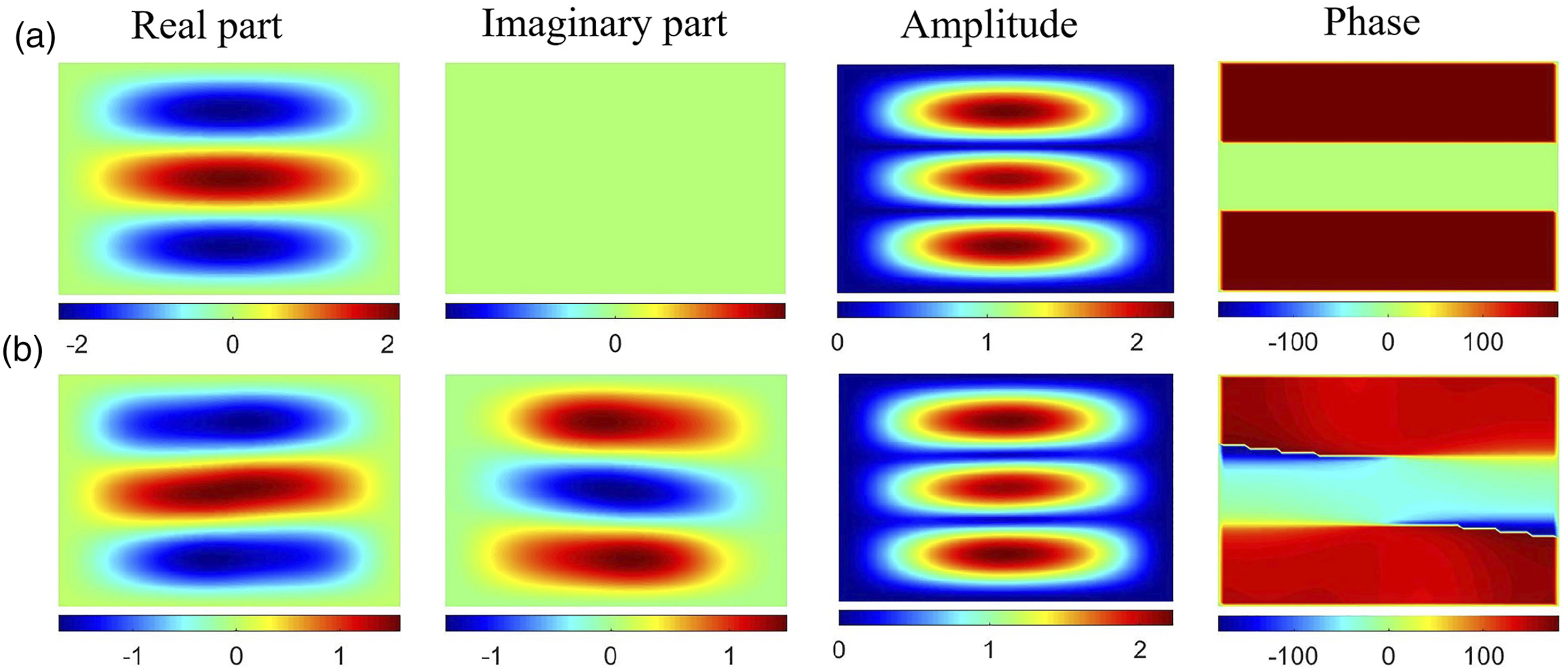
Figure 8 shows the mode shapes of mode (2, 2) for the plates in both example 1 and example 2, and Figure 9 shows the mode shapes of mode (1, 3). The most intuitive difference between real mode shapes and complex mode shapes is that all elements of the modal vectors are real numbers in real modes, and the phase angle difference between each element is 0° or 180°, all nodes reach their equilibrium positions at the same time, however, as for complex modes, the elements are complex numbers and possess different phase angles, and the nodes of mode shapes do not pass through their equilibrium positions at the same time. Mode (2, 2) and mode (1, 3) are different types of modes, and in the case of real modes the mutual-radiation efficiency between them is zero. However, as seen in Figure 7, due to the generation of complex modes caused by inhomogeneous damping, the acoustic coupling between the two modes will exist and the mutual-radiation efficiency is no longer zero in this example. When study the acoustic power of a vibrating plate by modal method, there is no need to consider the coupling between different types of modes for real modes because the mutual-radiation efficiencies of even–even with odd–odd, even–odd, or odd–even order modes are zero, but for complex modes, the coupling between different types of modes is not zero and may not be neglected. Mode shape of mode (2, 2): (a) real mode and (b) complex mode. Mode shape of mode (1, 3): (a) real mode and (b) complex mode.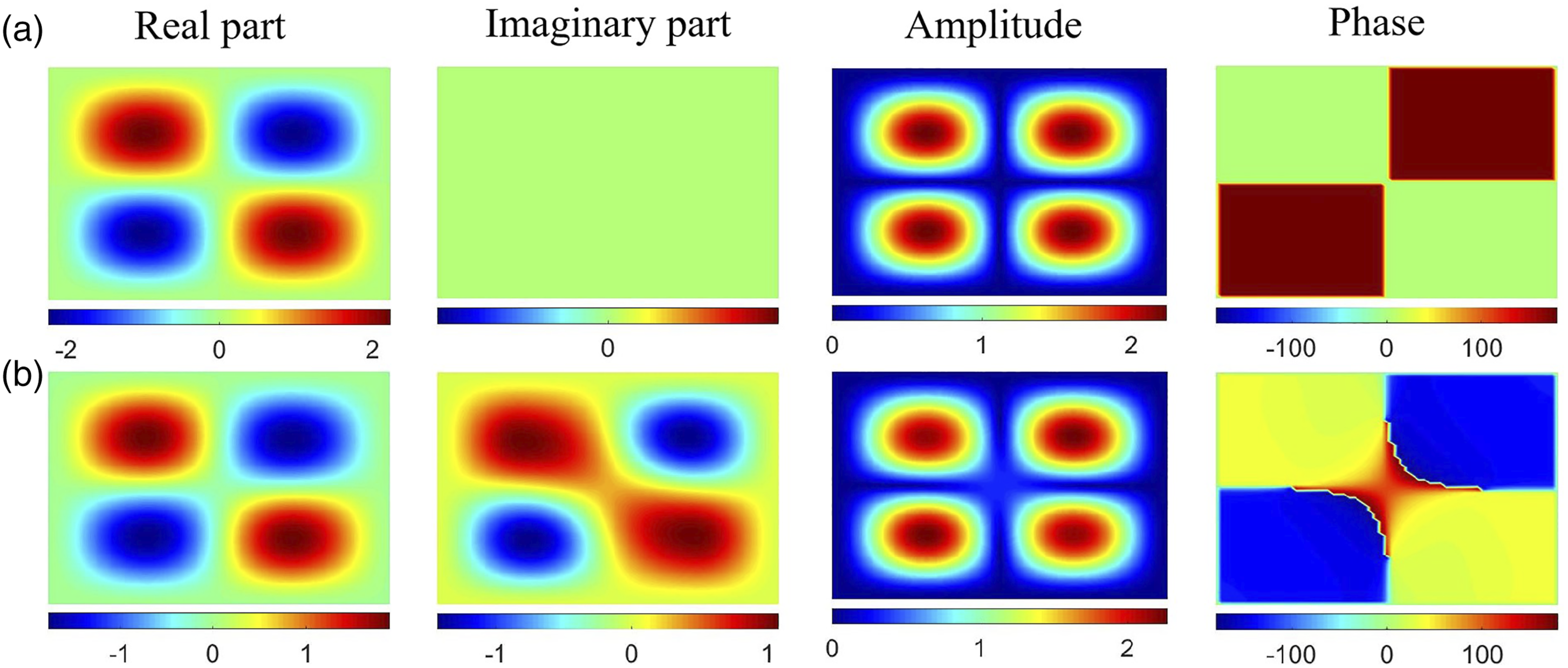
Example 3
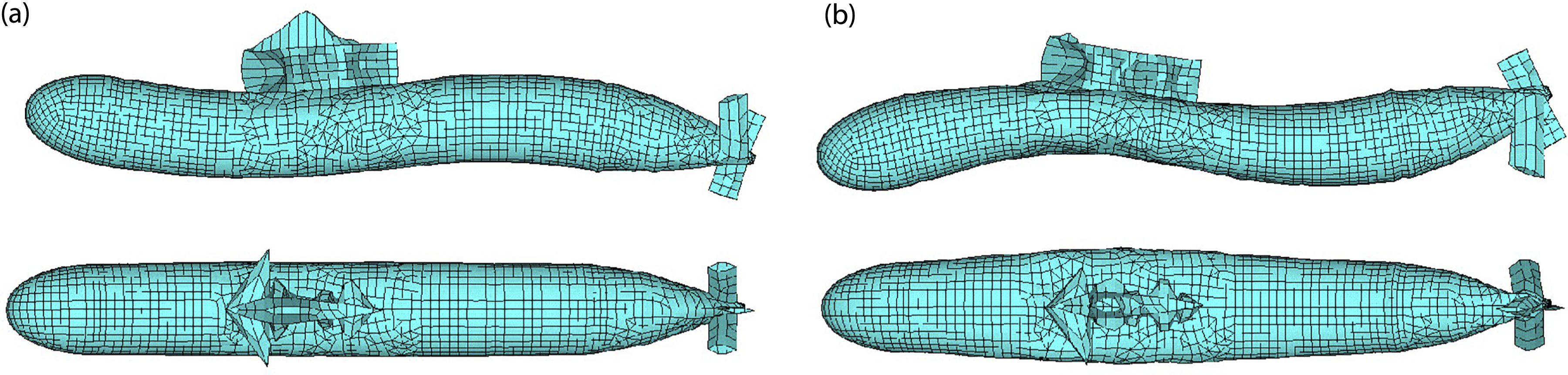
In this example we compute the radiation efficiencies of a benchmark model of a submarine. The model is much more complicated than those in example 1 and example 2. The size of the benchmark model is about 62.0 × 7.5 × 11.0 m, and steel material properties (ρ = 7850 kg/m3, E = 210 GPa, ν = 0.3) are defined. The FEM model of the structure is of free boundary condition. Equation (18) is used to calculate the mutual-radiation efficiencies of the real modes in example 3, the three acoustic powers in the equation should be computed, and the velocity of the structural surface is used as the boundary condition when calculating each acoustic power by BEM. The specific operation process is as follows: First, the mode shapes of the structure are calculated by FEM, then the numerical values needed are applied to each node of the FEM model by looping statement in ANSYS. After the FEM model is imported into BEM software, BEM software can read the node information in the FEM model, convert the node information to the velocities of acoustic elements, then use the velocities as the boundary condition of BEM. Its shape is shown in Figure 10. The vibration modes under fluid loading are calculated by FEM, the radiated acoustic powers are calculated by BEM, then the mutual-radiation efficiencies of the modes are calculated by the method presented in this paper. The selected two vibration modes are shown in Figure 11, the self-radiation efficiencies of the modes and the mutual-radiation efficiencies between the modes are shown in Figure 12. Benchmark model of the submarine. The modes selected to calculate the radiation efficiencies: (a) Mode 1, f1 = 15.78 Hz and (b) Mode 2, f2 = 16.44 Hz. The amplitudes of the self- and mutual-radiation efficiencies.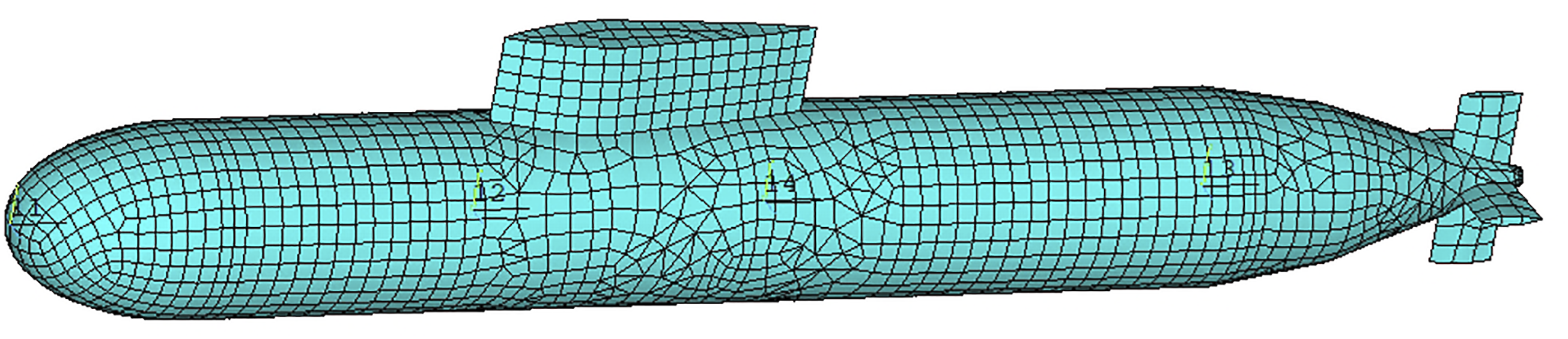
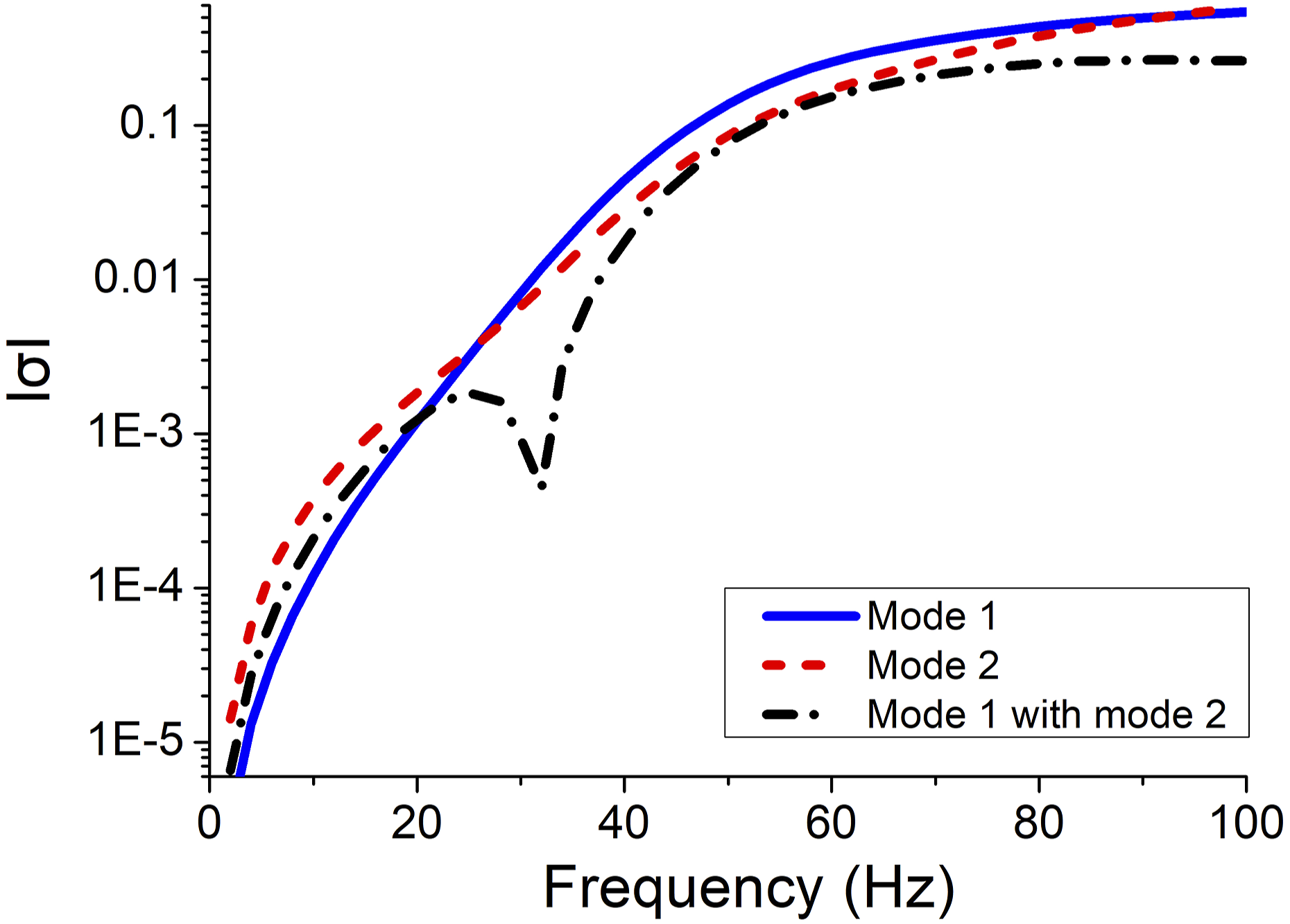
In Figure 12 we can see that the self- and mutual-radiation efficiencies are of the same order of magnitude, which indicates that there is an obvious coupling of the two modes when radiating sound power. The example also shows that it is feasible to calculate the mutual-radiation efficiencies of complicated structures by the method presented in this note.
Discussion
In order to better understand the effect of the coupling between modes on the radiated sound power. First, we take the plate in example 1 as the study object, and assume that the damping ratio of the material is 0.01. We can get the actual modal coordinates of forced vibration by applying an excitation on the structure, and then analyze the results. Set the center of the plate as the origin of coordinates, apply a vertical force F0=1 N at (−0.087, −0.0762), calculate the first 24 real modes and their modal coordinates at each frequency point. Figure 13 shows the radiated sound power between 200 Hz and 600 Hz with and without the coupling between vibration modes considered respectively, where Sound power with and without the coupling effect considered.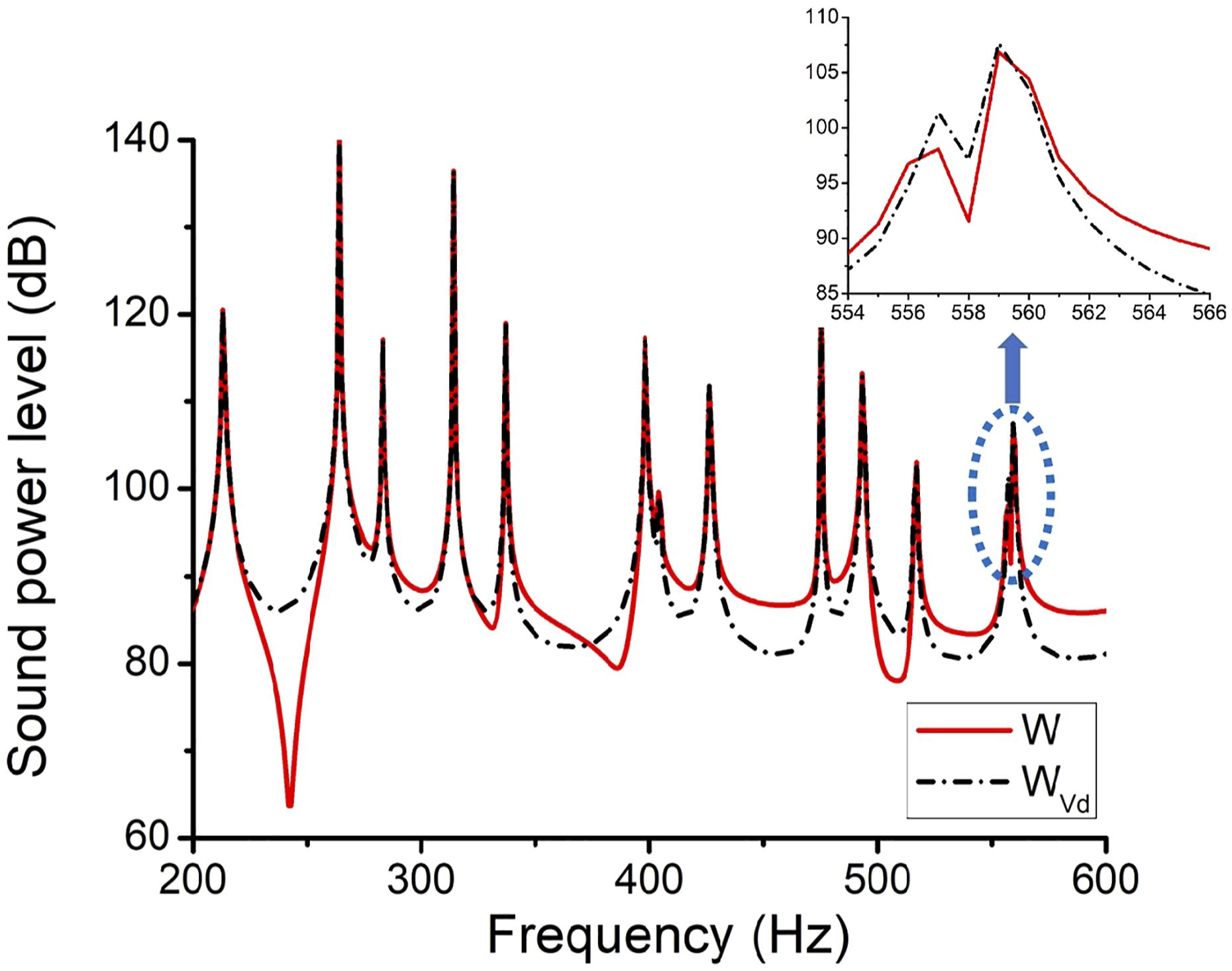
In Figure 13 we can find the coupling effect of modes may increase or decrease the total radiated acoustic power. The difference between
Furthermore, for complicated structures of large size, the interval between their natural frequencies is small, it is more likely that the two modes with close frequencies have strong acoustic radiation coupling. Therefore, the influence of the coupling effect between modes at the resonance frequencies may not be ignored.
In order to better understand the mutual-radiation efficiency of complex modes, we see the plate in example 2. We assume that, at 50 Hz, the modal coordinate of mode (1, 1) remains unchanged (a1 = 1). Assume the modal coordinate of mode (3, 1) has a unit amplitude, and its phase angle changes from 0°to 360° (a2 = cos θ + i sin θ). Use equation (15) to calculate the sound power caused by the interaction of the two modes, and Figure 14 shows how The sound power caused by the coupling of mode (1, 1) with mode (3, 1) at 50 Hz. The modal coordinates are assumed. The modal coordinate of mode (1, 1) remains unchanged, and the modal coordinate of mode (3, 1) has a unit amplitude, and its phase angle changes from 0° to 360°.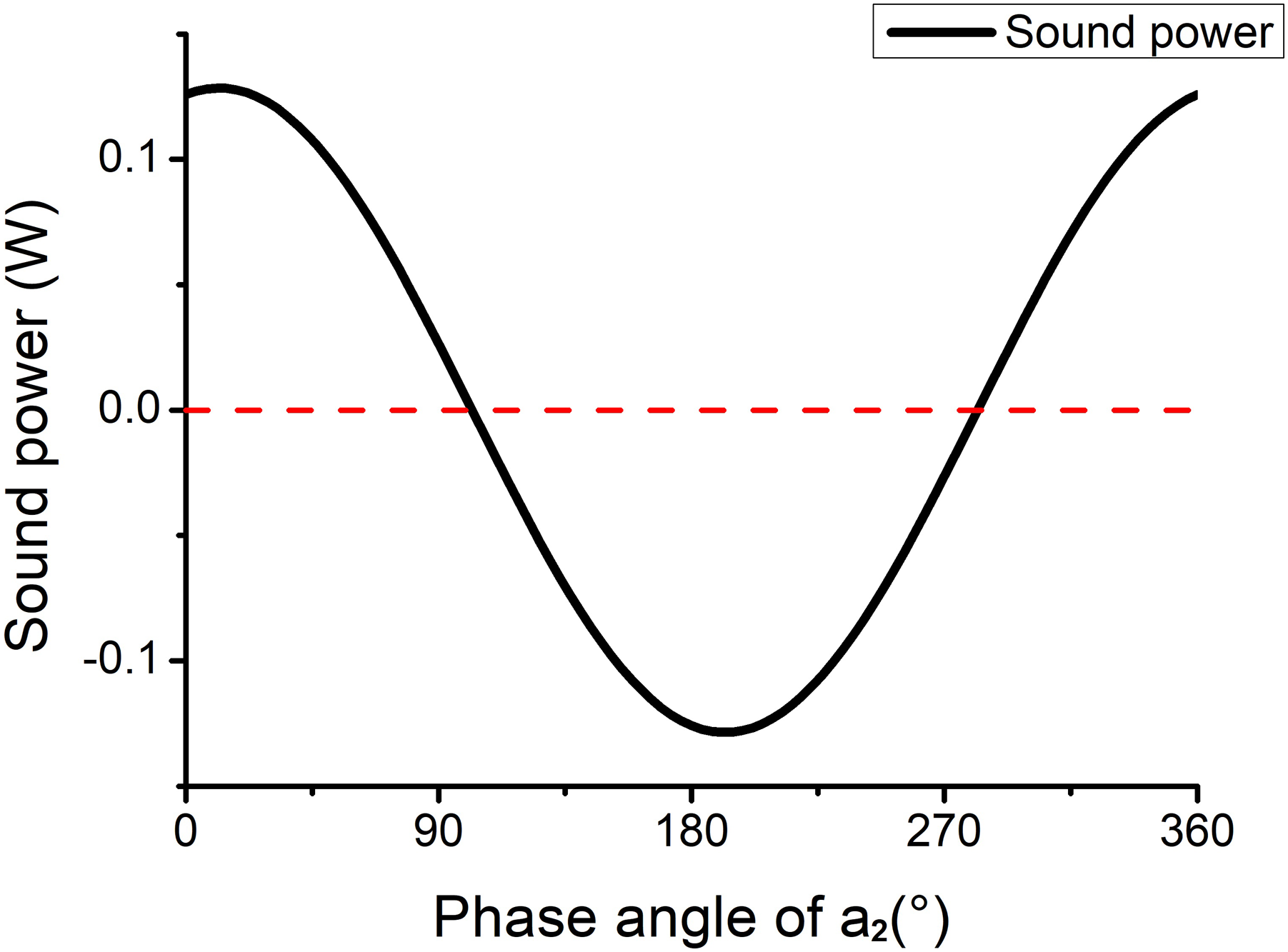
From Figure 14 we can see that, when the structure is forced to vibrate and radiate sound, the coupling between vibration modes may increase or decrease the total radiated acoustic power, and the actual influence is greatly related to the specific values of modal coordinates
Conclusions
In this note, the meaning of the mutual-radiation efficiencies in the condition of complex modes is discussed. A method for estimating the mutual-radiation efficiency between vibration modes is presented, which can be well combined with FEM and BEM software to calculate the efficiencies of complicated structures in practice. Examples are given to validate the method.
Footnotes
Acknowledgements
The authors gratefully acknowledge the support of the National Natural Science Foundation of China under Grant No. 11772080, the Fundamental Research Funds for the Central Universities (DUT20LAB308) and the Funds of Science and Technology on Underwater Test and Control Laboratory (6142407190106).
Declaration of conflicting interests
The author(s) declared no potential conflicts of interest with respect to the research, authorship, and/or publication of this article.
Funding
The author(s) disclosed receipt of the following financial support for the research, authorship, and/or publication of this article: The authors would like to express their gratitude to National Natural Science Foundation of China (No. 11772080), the Fundamental Research Funds for the Central Universities (DUT20LAB308) and the Funds of Science and Technology on Underwater Test and Control Laboratory (6142407190106).
