




Abstract
Poly(methyl methacrylate)-based triply periodic minimal surfaces (TPMS) structures promise great potential in phononic applications, but the complicated TPMS structure induces a design challenge for controlling their properties. Numerical acoustic simulations of seven major PMMA-based TPMS lattice structures are presented for low-frequency sound attenuation applications while varying their relative density. Except for the local resonances in primitive and Neovius-based lattice structures, the acoustic properties of other TPMS structures show a common Bragg bandgap with a central frequency of around 435 Hz and a bandwidth of around 286 Hz, which results from multiple scattering of periodic unit cells. In contrast, the acoustic bandgaps of primitive and Neovius-based lattices have much smaller and larger complete bandgaps, respectively, which are mainly attributed to the local resonances in their geometric cavities with different sizes. Thus, by taking the mechanism of generated bandgaps in the TPMS-based lattice structures into consideration, we can design suitable bandgaps for acoustic applications in the specific frequency range.
Keywords
Introduction
Acoustic metamaterials, or sonic crystals, have attracted much attention owing to their capabilities in manipulating sound waves in gases, liquids, and solids.1–4 One of the most attractive properties is the formation of acoustic bandgaps that prohibit the propagation of acoustic waves at specific frequency ranges. In general, acoustic metamaterials are made from a periodic structure at scales smaller than the wavelengths of the targeted acoustic waves. For instance, Liu et al. reported sound absorption by a periodic lattice structure consisting of a solid lead sphere coated with soft rubber placed inside the epoxy, 5 and Jiao et al. realized directional propagation of acoustic waves by an acoustic metamaterial consisting of an array of units constructed by a square cavity and two symmetric straight channels. 6 In addition to those conventional topologies, 7 recently, there has been an increasing interest in using the topology of the mathematically known triply periodic minimal surfaces (TPMS) to create artificial cellular materials in different applications.8,9
TPMS is a locally area-minimizing surface, that is, the surface that locally minimizes surface area for a given boundary such that the mean curvature at each point on the surface is zero. 10 TPMS are of relevance in natural sciences, having been observed as biological membranes, block copolymers, 11 butterfly wings,12,13 surface areas of soap films, 14 etc. Notably, these minimal surfaces have a crystalline structure by repeating themselves in three dimensions, and thus they are triply periodic and intrinsically metamaterial. The introduction and image of 45 different types of major TPMS can be found in Ref. [15].
Various strategies have been proposed in acoustic/elastic metamaterials to widen or shorten bandwidth band gaps based on Bragg scattering, local resonance, or the interaction between Bragg scattering and local resonance.16–18 However, only a small body of research has applied those resonance mechanisms to interpret the acoustic or elastic properties of TPMS structures due to their complicated geometries.19,20 Most previous studies are mainly limited to the observation of their acoustic/elastic properties. Particularly, with the advanced additive manufacturing (also known as 3D printing) technique, 21 TPMS structures have been utilized in many fields, such as photonic, 22 acoustic, 23 elastic, 24 mechanical, 8 and heat/electrical transport 25 applications. Therefore, further insights into the TPMS structures’ use as acoustic metamaterials are essential.
In this work, a numerical study using the finite element method on seven, most common, different poly (methyl methacrylate) (PMMA)-based TPMS lattice structures, including primitive, Neovius, gyroid, I-graph and wrapped package-graph (I-WP), Fischer–Koch S (FKS), diamond, and F‐rhombic dodecahedra (F-RD), is presented. The acoustic dispersion curves of PMMA-based TPMS structures are investigated as a function of relative density (i.e., the density of the lattice normalized by the density of the constituent materials; PMMA and air), emphasizing the first complete bandgap observed at the lowest frequency. The relationship between unit cell size and the central frequency of the bandgap is also investigated. Moreover, the physical tests and fabrication of lattice structures would provide additional insights into the acoustic properties. However, fabricating triply periodic minimal surfaces (TPMS) structures presents challenges due to their complexity. Advanced 3D printing techniques are required, and difficulties arise in areas such as support structure generation, 26 material selection, 27 and post-processing steps. 28 Given the fabrication challenges mentioned above, in this work, we focus on numerical simulations to provide initial insights into the behaviors and properties of the selected seven TPMS structures.
Numerical methods and material properties



The acoustic properties of the air and PMMA used in the study. 44

TPMS topologies can be represented, to the first order of approximation, by the level-set surface equations in the form of f(x, y, z) = c, as given by the equations 4–10:31–33
Primitive
Neovius
Gyroid
I-graph and wrapped package-graph (I-WP)
Fischer–Koch S (FKS)
Diamond
Schoen's F-RD (F-RD)
Seven different sheet-based TPMS lattice structures are briefly mentioned as follows (see Figure 1): the primitive is the first TPMS lattice structure, which has been considered for prototyping tissue scaffolds owing to its porosity and surface-area-to-volume ratio.
34
The second TPMS system, Neovius-based lattice, the complement of the primitive one, has shown great multifunctional attributes when used as a reinforcement in mechanical composites.
35
The gyroid structure has two layers per unit cell and three-fold rotational symmetry, which is commonly observed in butterfly wings. The I-WP structure can be considered as a sphere extending handles towards the vertices of a cube, and the FKS structure has the highest surface-area-to-volume ratio. The diamond surface has two intertwined congruent labyrinths, each having an inflated tubular version of the diamond bond structure. F-RD can be viewed as a central chamber with tubes to alternating corners of the cube.
36
The sheet-based TPMS unit cells shown in Figure 1 are considered periodic lattice structures with cubic symmetries.
37
The 3D structures of each TPMS unit cell are generated in the STL file format in 3 x 3 x 3 lattices with a highly dense mesh density. Then, these seven TPMS structures with different relative densities are inputted into the COMSOL simulation domain for the band structure study. Their TPMS-based 3 x 3 x 3 lattice structures are shown in Figure S1 of the Supplementary Materials. Seven sheet-based TPMS unit cells based on primitive, Neovius, gyroid, I-WP, FKS, diamond, and F-RD surface types.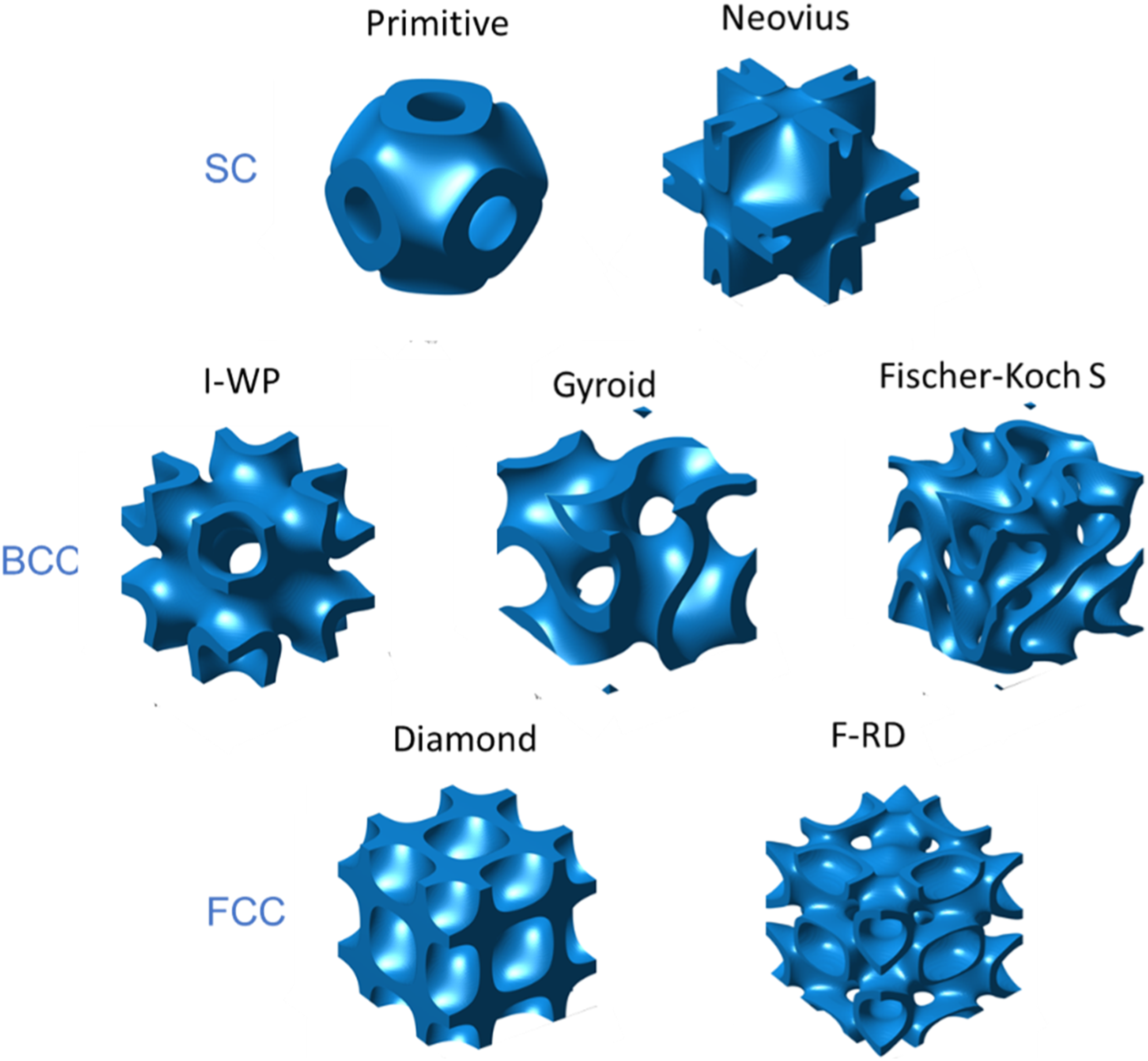
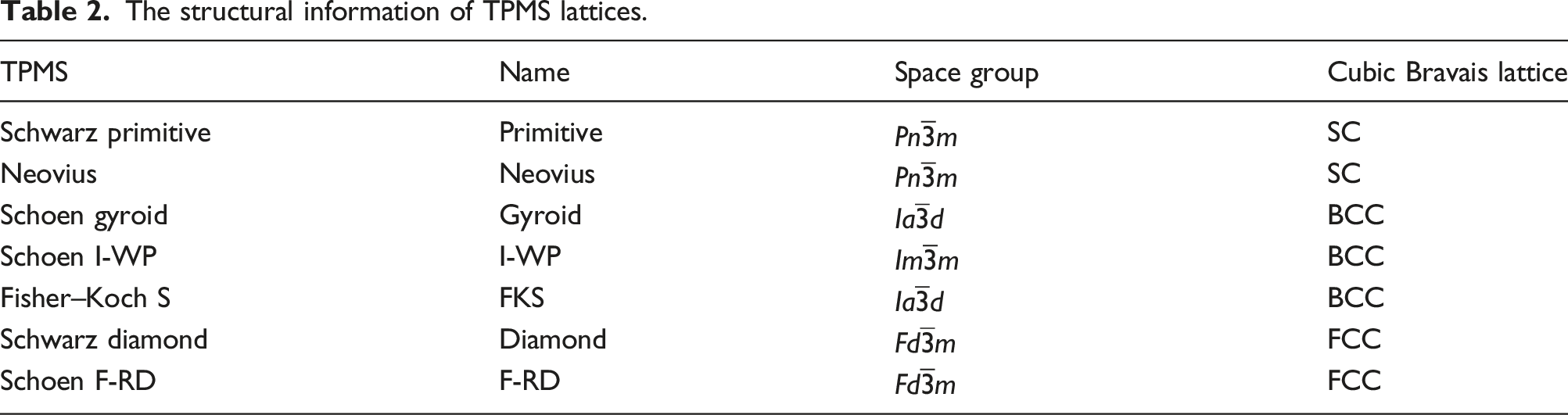
The structural information of TPMS lattices.
Results and discussions
In Figure 2(a)–(g), the dispersion curves of PMMA-based TPMS lattice structures with a unit cell of 30 cm and a relative density of 20% are presented in terms of eigenfrequency versus wavenumber, where the wavenumber is scanned over the special points of different cubic symmetries, as indicated by the Figure S2 of the Supplementary Materials. The dispersion curves refer to the relationship between the frequency and the wave vector of a sound wave propagating through the structure. The black dashed line indicates the dispersion curves. For example, in a cubic crystal, the high symmetry points include the center of the Brillouin zone (Gamma, G), the edges of the zone (X, M, R), and the corners of the zone (L). The path connecting these high symmetry points is often called the “high symmetry path”. (a–g) Acoustic dispersion curves of PMMA-based TPMS structures, including primitive, Neovius, gyroid, I-WP, FKS, diamond, and F-RD with a unit cell size of 30 cm and a relative density of 20%. (f) Summary of the central frequency and the bandwidth of the lowest bandgap in different lattice structures.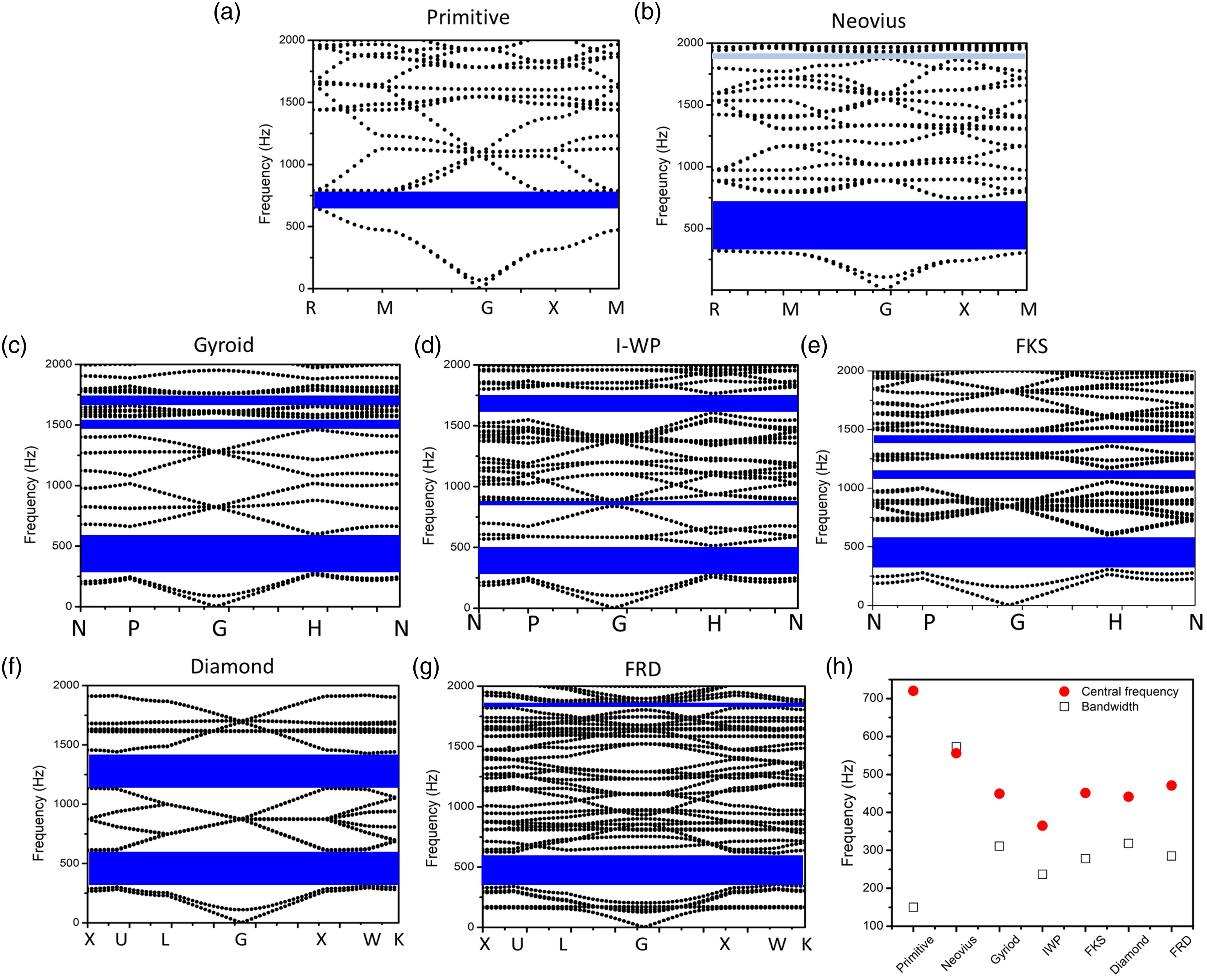
The unit cell size is chosen as 30 cm to target the noise attenuation from reciprocating and centrifugal chillers, where the central frequency is near 500 Hz. All PMMA-based TPMS lattice structures show acoustic bandgaps owing to the periodic arrays of the TPMS-based lattice structures. The physical significance of the acoustic bandgap is that it can be used to create structures that are effective at blocking or absorbing specific frequencies of sound waves. This can be useful in a variety of applications, such as noise reduction in buildings, acoustic isolation in machinery, or soundproofing in vehicles. This effect is similar to the photonic bandgap in optics,13,40 which refers to a range of frequencies in which electromagnetic waves are strongly absorbed or reflected by a material or structure.
We can find that except for a single bandgap of the primitive-based lattice, other TPMS-based structures show multiple acoustic bandgaps in the sub-2000 Hz frequency range. The complete acoustic bandgap regions are shown in a blue color, where the propagation of sound waves in any direction at such a frequency range is forbidden inside the lattice structure. The primitive lattice has one single bandgap, as compared to the other six lattice structures. This difference results from that among these seven structures; the primitive has only one cavity inside the unit cell, which results in a bandgap; Although Neovius has a similar cavity inside the structure, it also has a much smaller cavity around the surface of the unit cell. Therefore, it has two bandgaps, which can be referred to as other structures.
Here, we would like to focus on the lowest (first) complete acoustic bandgap among different lattice structures. The acoustic band structure of the PMMA-based primitive TPMS lattice shows a single complete bandgap at 720 Hz with a bandwidth of 140 Hz. The other PMMA-based Neovius lattice shows two complete bandgaps: one is at 524 Hz with a bandwidth of 440 Hz, and the other one is at the 1902 Hz with a narrow bandwidth of 53 Hz. When it comes to other lattice structures, they commonly have the lowest acoustic bandgap appearing around 435 Hz with a bandwidth of 286 Hz. The lowest acoustic bandgaps of these seven TPMS-based lattice structures are summarized in terms of their central frequency and bandwidth of the lowest frequency bandgap, as shown in Figure 2(h). The comparison of the bandgap shows that except primitive and Neovius lattices, other TPMS lattice structures have a similar central frequency of around 435 Hz and bandwidth of the bandgap of around 286 Hz.
Except for the F-RD lattice structure, we can find that the lowest acoustic bandgaps of the other six TPMS-based lattice structures are located between the second and third band of their acoustic band structures. The lowest bandgap of the F-RD lattice structure is between the 6th and 7th band, owing to the additional four modes of its unit cell resulting from small cavities. By considering one-dimensional periodic sinusoidal modulation, we can estimate the central frequency and the bandwidth of the Bragg bandgap,
41
as given by the following equations
The relationships between the lowest bandgaps in different TPMS structures and their relative density are literally shown in Figure 3. The values of their central frequency and bandwidth are close to 571 Hz/172 Hz, which are derived from 1D periodic sinusoidal modulation. However, the bandgaps of these structures have different trends with increasing relative density. In general, the trend of the central frequency and bandwidth of the bandgap decreases with increasing their relative density. This can be understood as follows: Increasing the density of a structure means more mass is present in a given volume, which results in less transmission of sound energy through the structure. Therefore, we can expect a reduction of bandwidth and a smaller central wavelength for typical TPMS structures with varying topology, such as gyroid, I-WP, and FKS structures. (a–g) Relationships between the first bandgap of different PMMA-based TPMS structures and their relative density.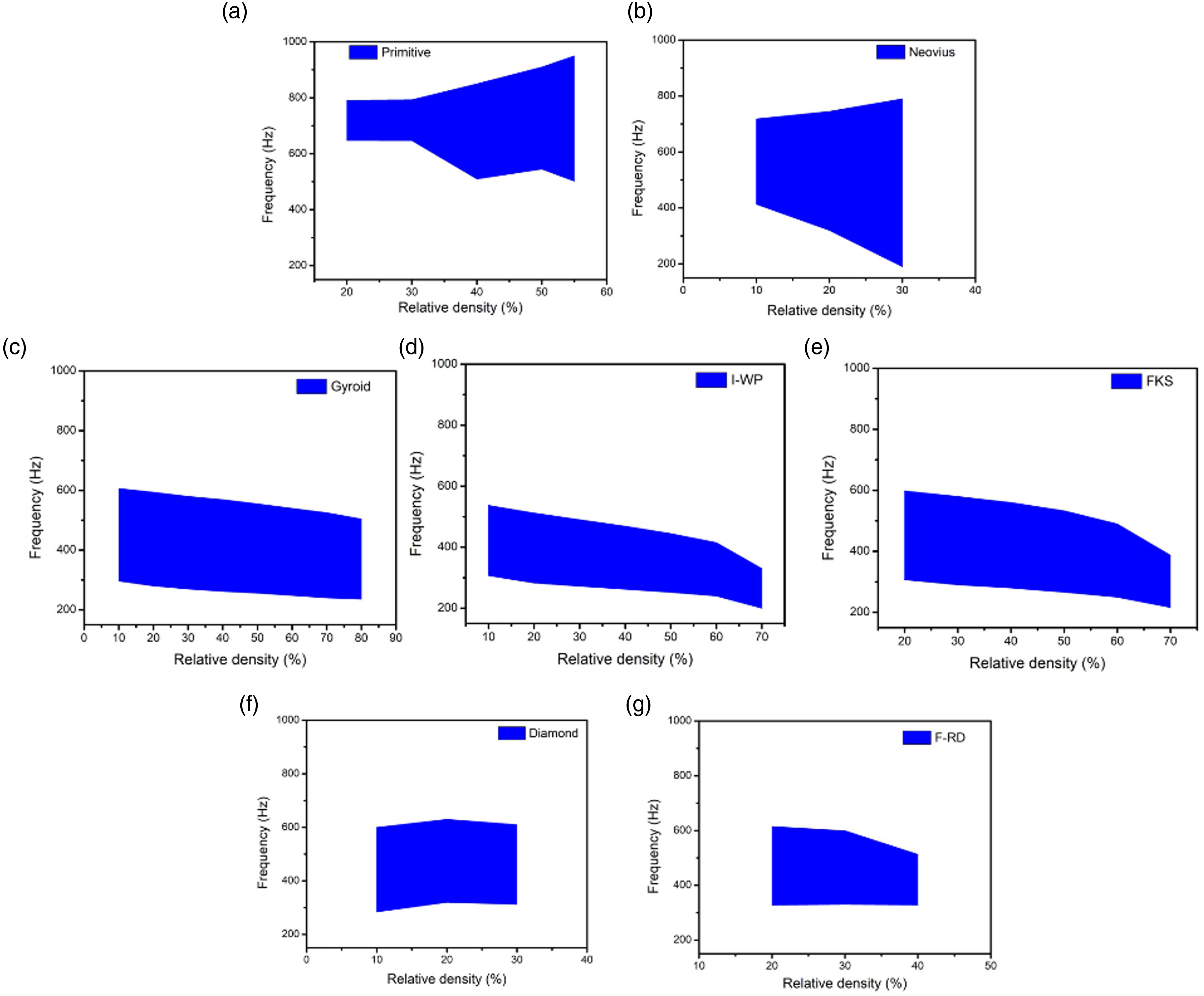
A summary of acronyms.
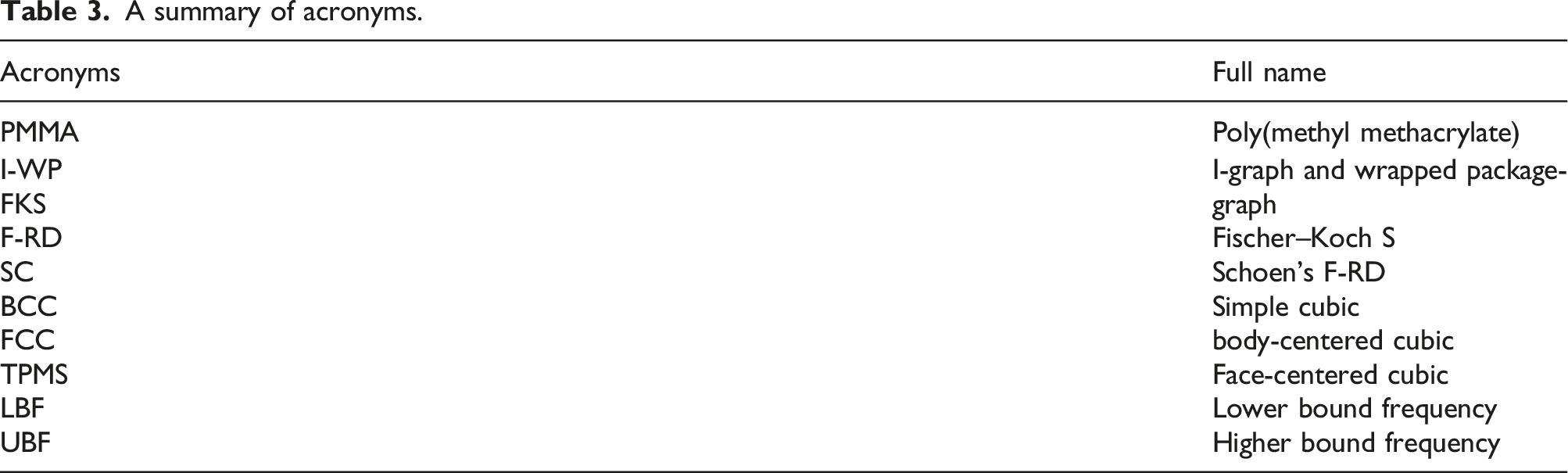
To analyze acoustic bandgaps of these lattice structures, the eigenmodes are calculated at their lower bound frequency (LBF) and upper bound frequency (UBF) For all acronyms used in the manuscript, we have summarized them in Table 3. Firstly, Figure 4(a) shows the dispersion relation of the acoustic band structure in a TPMS with primitive cubic lattice is asymmetric with respect to the origin of the k-space and changes with the wave vector k from G to M or R in a way that results in a smaller bandgap. We can find the complete bandgap appears at k = R and with LBF and UBF of 647 Hz, and 791 Hz, respectively. The corresponding eigenmodes modes (i) and (ii) at the LBF are degenerate at k = R and f = 647 Hz, and four eigenmodes at the UBF are degenerate at k = R and f = 791 Hz, and they are denoted as modes (iii), (iv), (v), and (viii). In Figure 4(b)–(i), the acoustic field distributions of these six modes show that modes (i), (vi), (vii), and (viii) are local resonances, where the sound waves are well confined inside the geometric cavities and mainly depends on natural resonator frequency. The dispersion curves also show the existence of flat bands across the special points of Brillouin zones, which are the typical features of local resonances.
42
The acoustic field distributions of modes (ii), (iii), (iv), and (v) show Bragg scattering resonances, where the constructive interference patterns result from multiple scatterings of the periodic unit cells.
43
For the acoustic bandgap of the primitive-based lattice structure, its LBF and UBF are mainly determined by the local resonances inside the cavity. Therefore, an acoustic bandgap arises when the wavelength of the sound wave is comparable to the size of the cavity inside the unit, as given by (a) Acoustic band structure of PMMA-based primitive lattice structures, where the acoustic bandgap has two eigenmodes at the LBF (647 Hz) and six eigenmodes at the UBF (791 Hz). (b)–(i) Acoustic pressure distributions (Pa) of eight eigenmodes with their frequency and wavenumber are shown in the figure.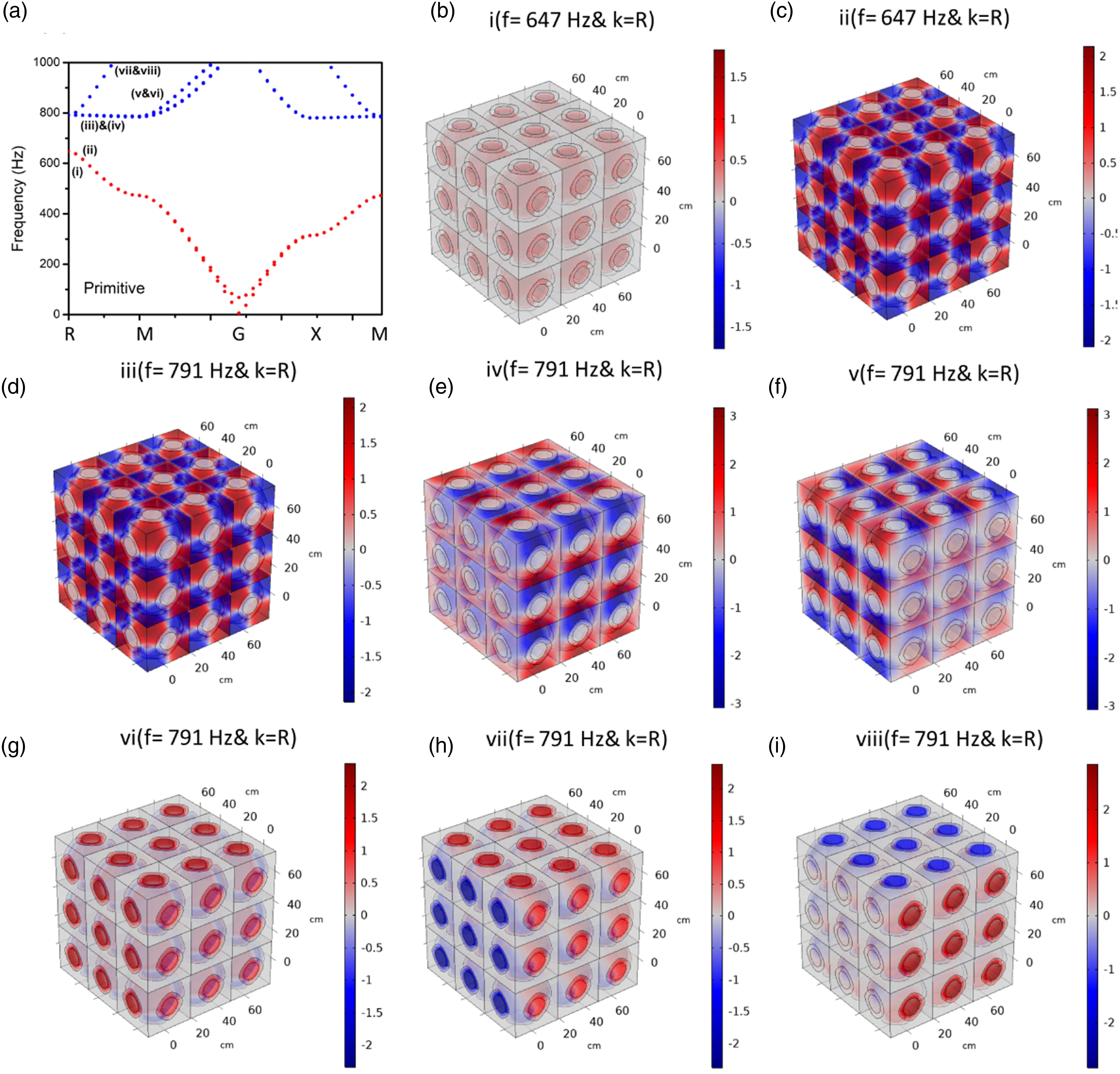
When it comes to the acoustic band structure of PMMA-based Neovius lattice structure shown in Figure 5(a), we can find that their dispersion relation of the acoustic band structure is symmetric to the G point, and changes with the wave vector k from G to M or R in a way that results in a nonmonotonic bandgap width. This results from the LBF and UBF appearing at k = R and k = X, respectively. Therefore, its acoustic complete bandgap is indirect, which is much broader than that of a primitive-based lattice structure. There are two degenerate eigenmodes at the LBF and two degenerate eigenmodes at the UBF, which are less than six degenerate modes at the UBF of a primitive-based lattice structure. Figure 5(b)–(c) shows that at the LBF, mode (i) is the local acoustic resonance mode confined by the geometric cavity of the Neovius surface, and mode (ii) is the Bragg resonance. Figure 5(d)–(e) shows that two degenerate eigenmodes at the UBF and k = X are local resonance modes. Their acoustic field distributions are either localized inside the cavity or concentrated around cavities due to the complexity of Neovius surfaces. However, when k = M, these two eigenmodes turn to be Bragg scattering resonance modes. The transition from local resonance to Bragg resonance explains the dispersion curves at the UBF are not as flat as those UBF eigenmodes of the primitive-based lattice structure. The broader bandwidth of the Neovius-based lattice structure could be explained by different types of local cavity modes at the LBF and UBF. Meanwhile, the bandwidth and central frequencies of primitive and Neovius-based TPMS lattice structures show a log-linearly decrease with increasing their unit cell size, as presented in Figure S3 of the Supplementary Materials. Such a relationship is also valid for other TPMS structures. (a) Acoustic band structure of PMMA-based Neovius lattice structures, where the acoustic bandgap has two eigenmodes at the LBF and two eigenmodes at the UBF. (b)–(c) Eigenmodes at LBF. (d)–(e) Eigenmodes at the UBF, which is 791 Hz. (f)–(g) Eigenmodes at k = M and f = 793 Hz.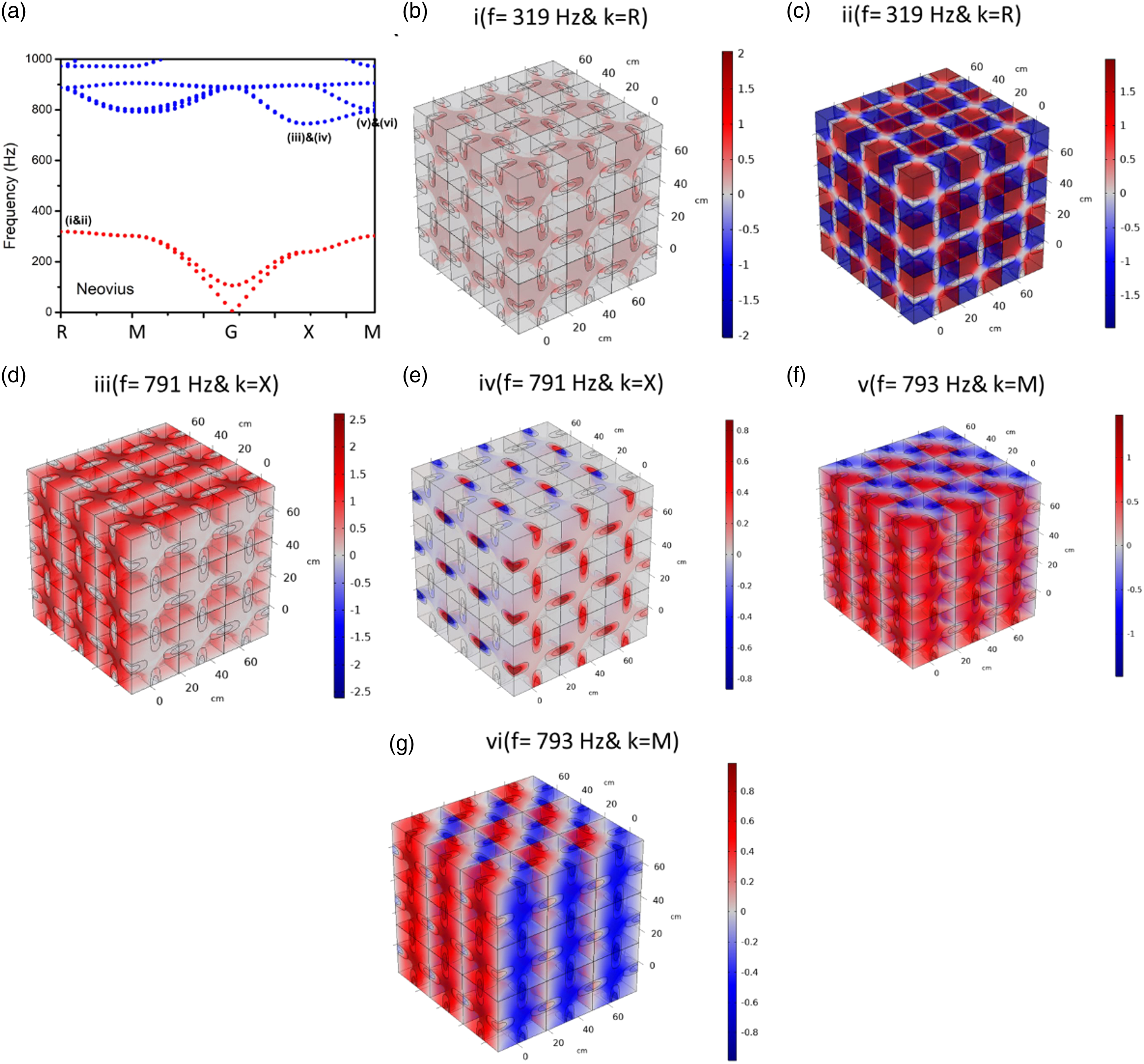
For a PMMA-based gyroid lattice structure with a unit cell of 30 cm, the dispersion relation of the acoustic band structure is asymmetric with respect to the G point and changes with the wave vector k from G to N in a way that results in a nonmonotonic bandgap width. We can find that the LBF and UBF appear at k = H, and thus it is a direct bandgap. It should be noted that the eigenmodes at the LBF and UBF are not degenerate, and this indicates no coupling effect of local resonance and Bragg scattering in the gyroid lattice structure. Figure 6(b) shows the Bragg field distributions at the LBF (280 Hz) and k = H. Figure 6(c)–(d) shows two Bragg field distributions at k = H: one is at the UBF (593 Hz), and the other is 596 Hz, which is above the UBF. (a) Acoustic band structure of PMMA-based gyroid lattice structures, (b)–(d) sound pressure distributions of the eigenmode (b) at the LBF (280 Hz) and k = H, (c) at the UBF (593 Hz) and k = H, and (d) at the f = 596 Hz and k = H, respectively.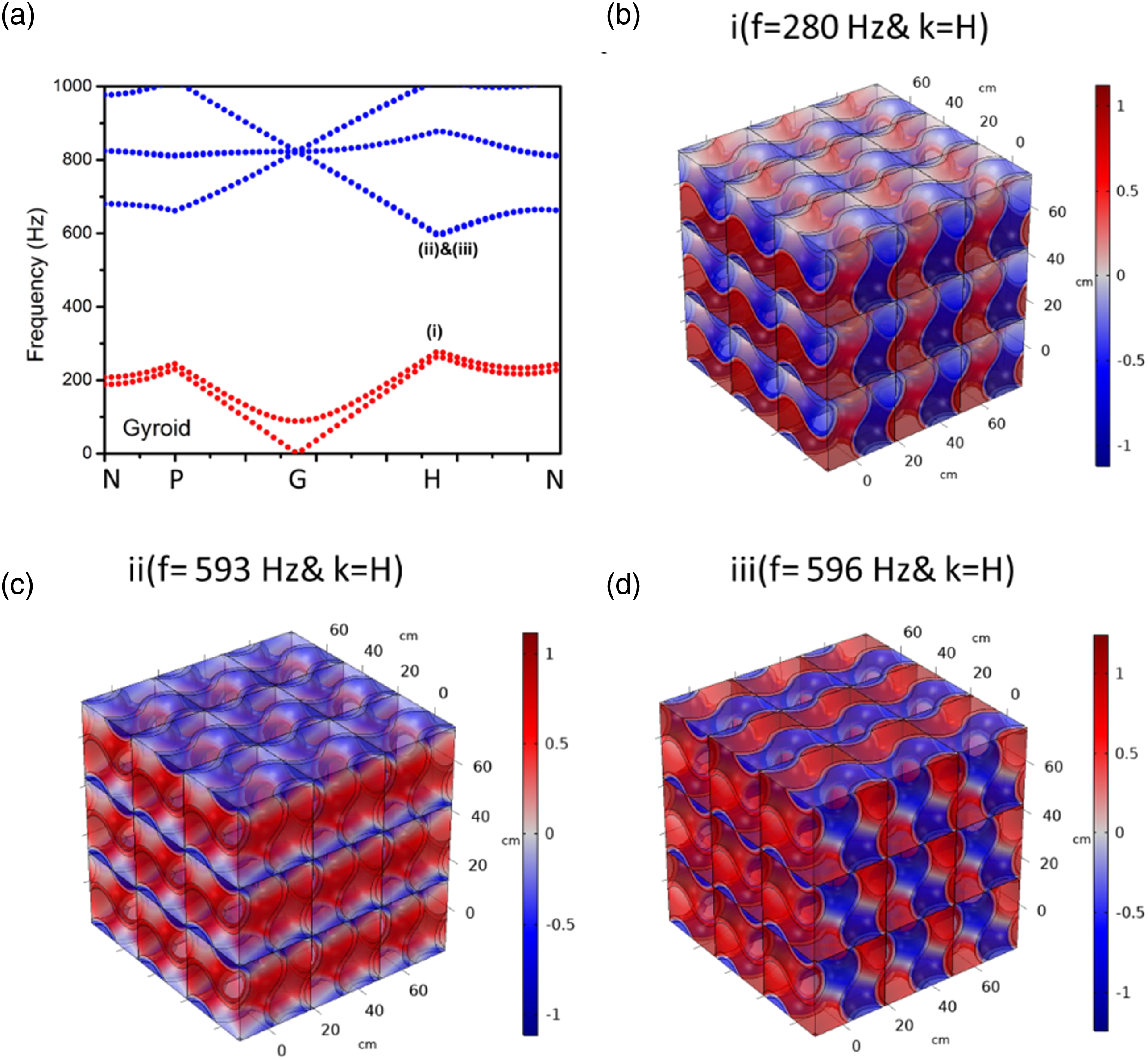
The eigenmodes at (or near) the UBF and LBF of other TPMS-based lattice structures, including I-WP, FKS, diamond, and F-RD, are presented in Figures S4–S7 of Supplementary Material. The analysis shows that their eigenmodes at the LBF and UBF of the lowest bandgap are not degenerate, which is like that of the gyroid-based lattice structure. This explains why the acoustic bandgaps of gyroid, I-WP, FKS, diamond, and F-RD have a similar acoustic bandgap near 435 Hz and bandwidth of the bandgap around 286 Hz since their acoustic bandgaps are mainly defined by Bragg scattering resulting from the periodic unit cells. This conclusion is also supported by the discussion mentioned above of the one-dimensional periodic sinusoidal modulation.
Conclusions
The acoustic bandgap generation in PMMA-based lattices, including seven different TPMS structures, is investigated. Compared to those of other lattice structures with a common acoustic bandgap with a central frequency of 435 Hz and bandwidth of bandgap of around 286 Hz, primitive and Neovius-based lattice structures have complete acoustic bandgaps with the smallest bandwidth of 144 Hz and largest bandwidth of 472 Hz, respectively. The eigenmode study indicates that the difference in results from the local cavities of primitive and Neovius-based lattice structures, and the coexistence of the local acoustic resonance and Bragg scattering resonance at the specific wavenumber makes their acoustic bandgaps different. Therefore, the UBF and LBF of their acoustic properties are mainly determined by the locally resonant bandgaps, which is unlike other lattice structures solely determined by the Bragg resonance. Thus, this finding provides clues to interpret the acoustic or elastic properties of TPMS-based lattice structures, which is beneficial to the sound attenuation application in a few thousand-hertz frequency range.
Supplemental Material
Supplemental Material - Insights into acoustic properties of seven selected triply periodic minimal surfaces-based structures: A numerical study
Supplemental Material for Insights into acoustic properties of seven selected triply periodic minimal surfaces-based structures: A numerical study by Jin-You Lu, Tarcisio Silva, Fatima Alzaabi, Rashid K. Abu Al-Rub, and Dong-Wook Lee in the Journal of Low Frequency Noise, Vibration and Active Control
Footnotes
Acknowledgments
J.-Y Lu, F. Alzaabi and D.-W Lee thank the support from other members in the Advanced Materials Research Centre at Technology Innovation Institute, and also thank Abu Dhabi Government’s Advanced Technology Research Council (ATRC), which oversees technology research in the emirate.
Declaration of conflicting interests
The author(s) declared no potential conflicts of interest with respect to the research, authorship, and/or publication of this article.
Funding
The author(s) received no financial support for the research, authorship, and/or publication of this article.

Supplemental Material
Supplemental material for this article is available online.
References
Supplementary Material
Please find the following supplemental material available below.
For Open Access articles published under a Creative Commons License, all supplemental material carries the same license as the article it is associated with.
For non-Open Access articles published, all supplemental material carries a non-exclusive license, and permission requests for re-use of supplemental material or any part of supplemental material shall be sent directly to the copyright owner as specified in the copyright notice associated with the article.
