




Abstract
Wind turbine drivetrains play a fundamental role in converting wind power into electrical energy. The gearbox is one of the most important and expensive components in a wind turbine drivetrain. Since flexible suspensions mounted on the gearbox are mainly designed for isolating vibration transfer to other turbine components, the gearbox itself still suffers from complicated whole-body vibration. In view of this, a vibration absorption method based on modal interaction is put forward to alleviate the whole-body vibration of the wind turbine gearbox with flexible suspensions. A vibration absorber with adjustable control parameters is utilized to establish modal coupling with the wind turbine gearbox. Internal resonance is analyzed and used to construct a modal interaction mechanism between the vibration absorber mode and the controlled gearbox mode. With the help of modal interaction, the vibration energy of the controlled gearbox mode is successfully absorbed by the vibration absorber mode and effectively dissipated by the damping of the vibration absorber mode. Through numerical simulations and virtual prototyping simulations, its vibration alleviation performance is verified. Since the proposed method is designed in terms of the controlled mode of the wind turbine gearbox rather than external excitations, it is suitable for applications in a complicated working environment. Besides, the proposed method aims to transfer and dissipate vibration energy through nonlinear modal interaction rather than suppress vibration via external energy, and thus can effectively deal with strong vibration problems. More importantly, it can easily work together with the existing vibration isolation method and further alleviate the whole-body vibration of the gearbox. This research will contribute to improving the reliability and service life of wind turbine gearboxes.
Keywords
Introduction
Wind turbine drivetrains play a fundamental role in converting wind power into electrical energy. A typically geared drivetrain used for land-based wind turbines consists of the main shaft, the main bearing(s), the gearbox, the generator, the nacelle, and the tower. 1 Wind loads are directly exerted on the blades attached to the hub of the main shaft. The main shaft is supported on one side by the main bearing(s) and connected on the other side to the planet carrier of the gearbox. The output shaft of the gearbox is connected to the generator through the braking system and the flexible coupling. The generator outputs electricity to the grid. All of them are mounted on the bedplate of the nacelle and supported by the tower.
The gearbox is one of the most important and expensive components in a wind turbine drivetrain. Usually, it is subjected to various loads, for example, wind loads at variable speed and direction, gravitational loads and corresponding bending moments, inertial loads, centrifugal and gyroscopic effects, and loads excited by control actions such as blade pitching or emergency braking. 2 These loads inevitably excite strong gearbox vibration. Therefore, flexible suspensions are mounted between the gearbox and the bedplate to isolate vibration from the rest of the wind turbine drivetrain and other turbine components like the tower.
Recently, many studies have been conducted on the flexible suspensions of the wind turbine gearbox. Helsen et al. 2 utilized a flexible multibody modeling technique to investigate the effectiveness of three different suspension configurations (i.e. the three-point mounting, the double bearing configuration and the hydraulic damper system) and assessed their ability to isolate the main shaft initiated gearbox vibration from the rest of the turbine. Haastrup et al. 3 evaluated three bushing models of the wind turbine gearbox mounting and used the parameter identification method to determine the bushing parameters. Hill 4 solved the load-deflection relations of rubber engineering components using analytical methods and provided theoretical support for the design of rubber stiffness. Lang et al. 5 studied the effects of nonlinear viscous damping on vibration isolation of a single degree of freedom system and contributed to the design of viscously damped vibration isolators for the flexible suspensions of the wind turbine gearbox. Wang et al. 6 analyzed the influence of different elastic support stiffness on the dynamic behaviors of the drivetrain, and provided useful findings for optimizing the elastic support stiffness of the wind turbine drivetrain. Woude et al. 7 investigated the potential use of vibration isolation to reduce the dynamic response of wind turbine structures and proposed a nonlinear vibration isolation approach for the design of wind turbines. Tan et al. 8 considered the flexibility and different suspension configurations of the main shaft, and proposed a dynamic modeling approach for a wind turbine drivetrain based on Timoshenko beam theory and Lagrange’s equation. Wang et al. 9 developed a rigid-flexible coupled dynamic model for a wind turbine gearbox with three-point elastic supporting and investigated the effects of gear tooth modifications on the dynamics of the wind turbine gearbox. Zhang et al. 10 examined the influence of the flexible supporting on the vibration characteristics of the wind turbine drivetrain and analyzed the potential resonance of the wind turbine drivetrain. Nevertheless, since the flexible suspensions of the gearbox are mainly designed for isolating vibration transfer to other turbine components, the gearbox itself still suffers from complicated whole-body vibration. In particular, vibration response close to the natural frequencies of the gearbox system can cause serious damage to components inside the gearbox. Therefore, it is necessary to further alleviate the whole-body vibration of the gearbox on the basis of existing flexible suspensions.
In addition to vibration isolation, vibration absorption is also a useful vibration control approach. One or more vibration absorbers are mounted on the gearbox, and can reduce gearbox vibration without making major modifications to the gearbox structure. More importantly, it can easily work together with the existing vibration isolation method and further alleviate the whole-body vibration of the gearbox.
Usually, vibration absorption methods can be classified into passive vibration absorption, active vibration absorption and semi-active vibration absorption. Although passive vibration absorption methods are simple and cost-effective, they lack enough adaptability.11,12 Therefore, many active vibration absorption methods are developed, characterized by external energy input, active actuators and control algorithms. 13 However, most of them may face challenges when dealing with strong vibration. Due to the limited power of actuators such as PZT, there are potential risks of overload. Besides, a large amount of external energy will be consumed to suppress strong vibration. More seriously, if active control algorithms are not designed correctly, they probably excite rather than mitigate vibration. Unlike active vibration absorption methods, semi-active vibration absorption methods possess the advantages of both passive and active vibration absorption methods. Since only the damping or stiffness of the vibration absorbers needs to be adjusted via external energy input, these methods not only possess enough adaptability but also consume less energy. 14
However, most of the above vibration absorption methods are designed in terms of external excitations. Therefore, they are effective for alleviating vibration caused by external excitations with known frequencies. Since wind turbine gearboxes are often subjected to external excitations with variable, uncertain or wideband frequencies, these methods will face challenges. 15 Furthermore, most of them are implemented to deal with linear vibration problems. Since wind turbine gearbox vibration belongs to nonlinear vibration, these methods based on linear models are not effective anymore. Therefore, it is necessary to seek a new vibration absorption method that does not depend on external excitations and can tackle the nonlinear strong vibration problem of the wind turbine gearbox with flexible suspensions.
Modal coupling is a typical characteristic of a multi-degree-of-freedom nonlinear dynamic system. It can cause a variety of complicated nonlinear problems for a dynamical system. In recent years, remarkable progress has been made in solving approximate analytical solutions16,17 and analyzing stability18–24 for a complex nonlinear dynamical system. These achievements have significantly promoted the study of modal coupling problems. For a nonlinear dynamical system with modal coupling, once internal resonance is established between two vibration modes, a modal interaction mechanism will be constructed, by which vibration energy can be exchanged between these modes. Golnaraghi 25 first investigated the use of modal coupling for reducing the vibration of a cantilever beam. Subsequently, Tuer 26 and Duquette 27 conducted corresponding numerical simulations and experiments to control the vibration of a similar beam using internal resonance. Hui 28 used internally resonant energy transfer for enhancing the isolation performance of a curved beam isolator. Harouni 29 suggested an internal resonance based vibration absorber that works with a negative stiffness mechanism to mitigate vibration. Bian and Gao 30 proposed a semi-active vibration absorption method based on internal resonance to reduce the vibration of the flexible manipulator. Although these research results are prominent, few studies have focused on reducing the whole-body vibration of the wind turbine gearbox with flexible suspensions via modal interaction. Since the dynamic model of a wind turbine gearbox is different from that of a flexible beam, whether modal interaction can be utilized to alleviate the whole-body vibration of the wind turbine gearbox with flexible suspensions has not been researched.
In view of this, a vibration absorption method based on modal interaction is put forward to alleviate the whole-body vibration of the wind turbine gearbox with flexible suspensions. First, the dynamic models of a 750 kW wind turbine gearbox with three-point suspensions and a vibration absorber with adjustable control parameters are established. Second, internal resonance is analyzed through perturbation analysis and the conditions for establishing internal resonance are examined. Third, a modal interaction mechanism is constructed through stability analysis, and the vibration energy of the controlled gearbox mode is absorbed by the vibration absorber mode and effectively dissipated by the damping of the vibration absorber mode. Finally, numerical simulations and virtual prototyping simulations have verified the effectiveness of the proposed method.
Dynamic modeling of wind turbine gearbox and vibration absorber
Description of wind turbine gearbox with three-point suspensions
A 750 kW wind turbine gearbox with three-point suspensions is investigated, as shown in Figure 1. It consists of a main shaft, a main bearing, a gearbox and 2 torque arms.
22
The main shaft, supported by the main bearing, is connected to the gearbox. The main bearing and 2 torque arms are mounted on the bedplate and work as 3 suspensions. Each torque arm is supported by flexible components which are modeled as two orthogonal spring-damper systems. Various wind loads are directly exerted on the blades attached to the hub of the main shaft. Most forces are reacted at the main bearing through the hub, whereas rotor moments and torque loads are transferred to the bedplate through two torque arms. Within the working frequencies of flexible suspensions, the rigid modes of the wind turbine gearbox are overwhelming. As a result, the wind turbine gearbox is treated as a rigid dynamic system with three degrees of freedom, that is, pitch, yaw and roll. Description of a wind turbine gearbox with three-point suspensions.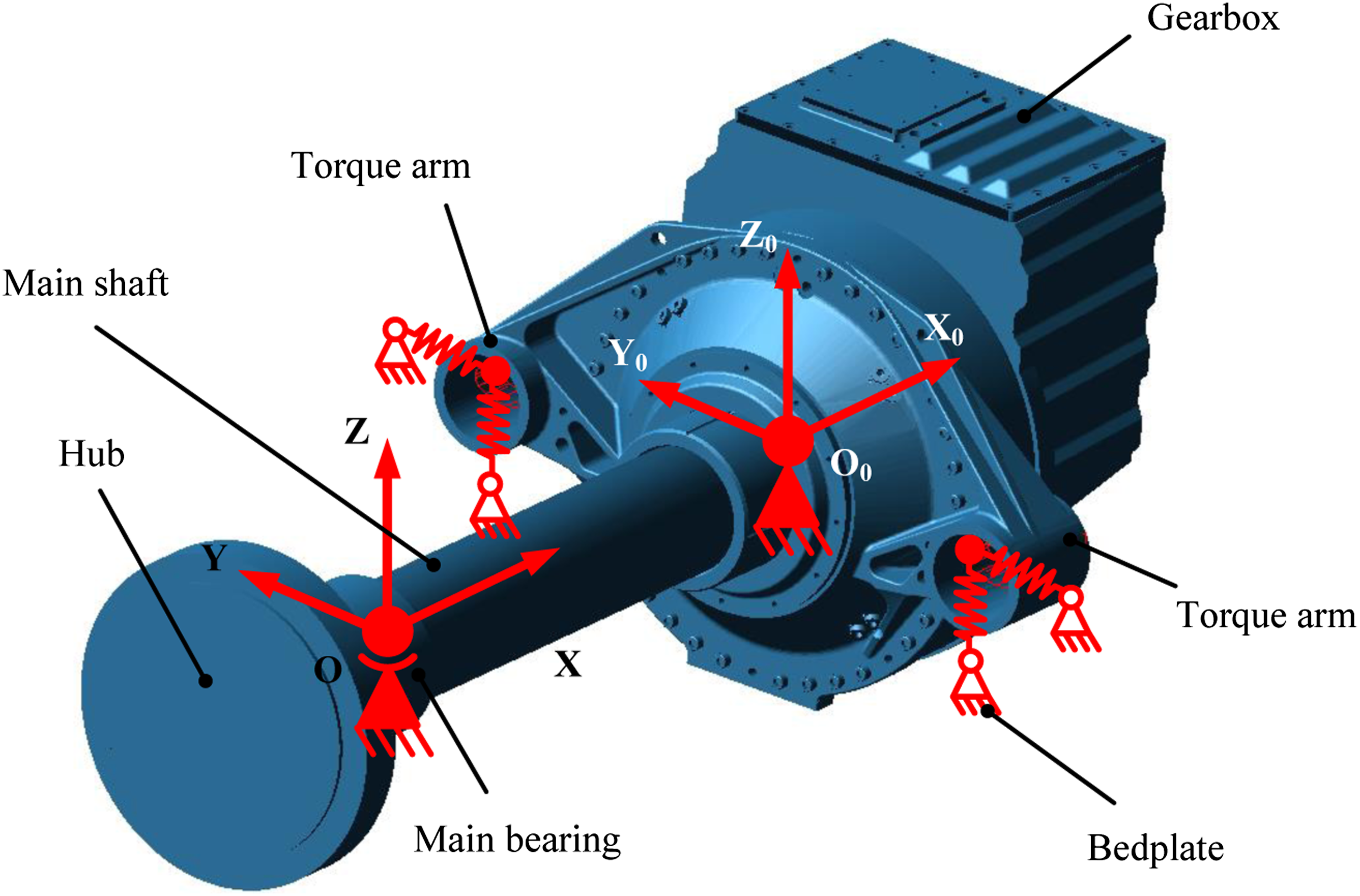
The fixed coordinate system
Control model of vibration absorber
To alleviate the strong vibration response of the wind turbine gearbox, a new vibration absorption scheme based on modal interaction is put forward, as shown in Figure 2. The vibration absorber is mounted on the wind turbine gearbox, and is designed to establish modal interaction mechanism with the controlled mode of the wind turbine gearbox. With the help of this modal interaction mechanism, the vibration energy of the wind turbine gearbox is expected to be transferred to and dissipated by the vibration absorber. Control model of vibration absorber.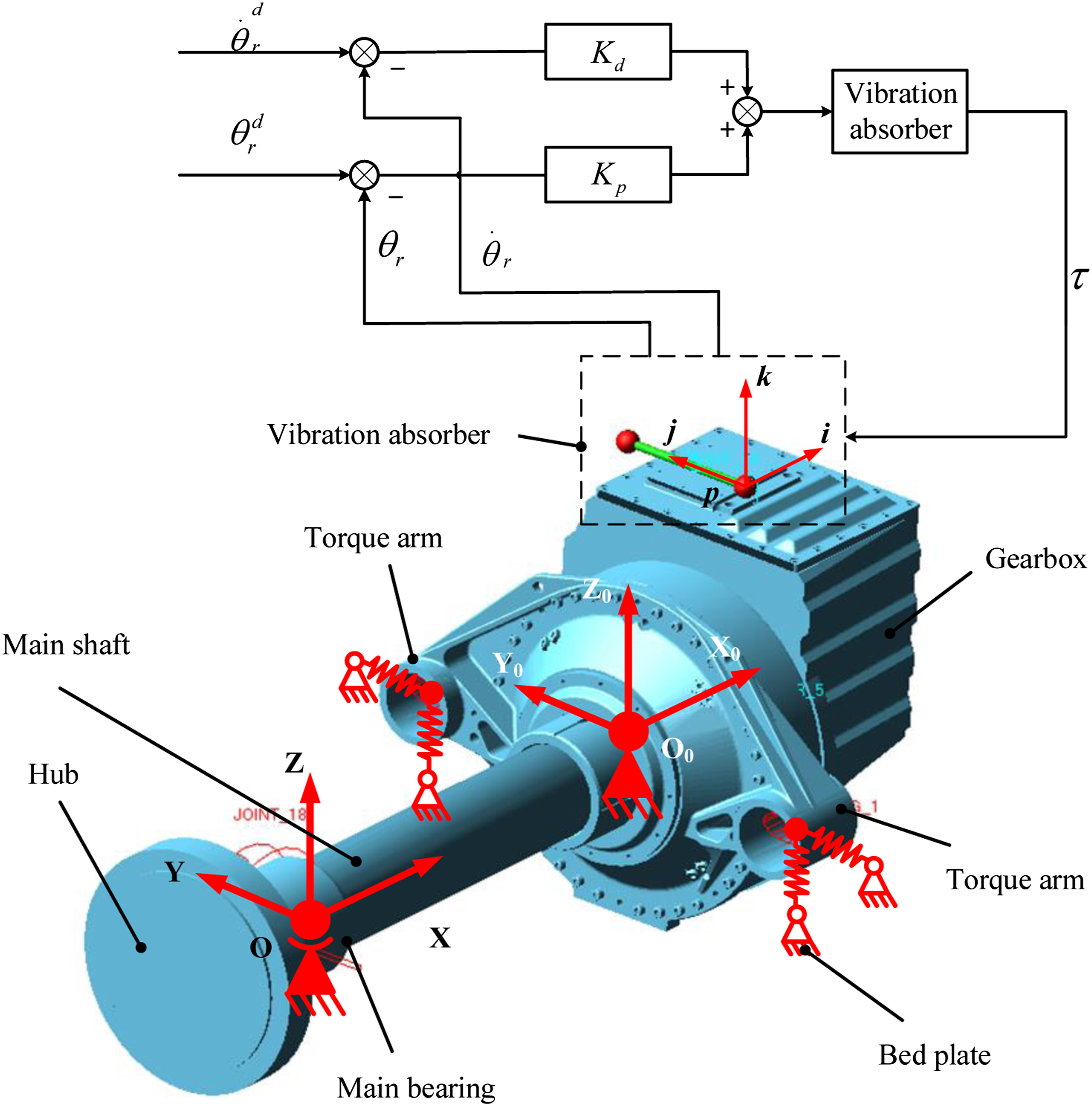
To facilitate the establishment of modal interaction, the vibration absorber is constructed using a servomotor and a swing rod attached to the output end of the former. A PD control strategy is designed based on the servomotor to implement frequency through the position feedback gain and implement damping through the velocity feedback gain. Therefore, the controlled output

To emulate a vibrating system that oscillates near the equilibrium position, the servomotor is commanded to trace a fixed position, that is,

Dynamic models of wind turbine gearbox and vibration absorber
According to above description, the wind turbine gearbox with three-point suspensions has three degrees of freedom, whose generalized coordinates are written as

To describe the rotation of the swing rod of the vibration absorber, as shown in Figure 2, the moving coordinate system
Therefore, the generalized coordinates of the wind turbine gearbox and the vibration absorber are represented as

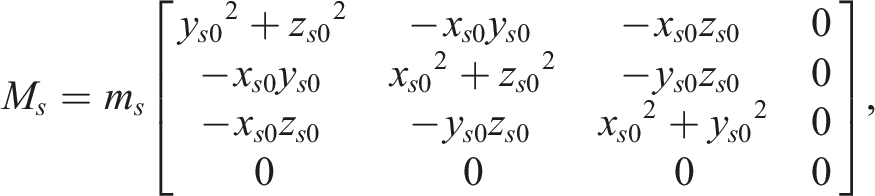
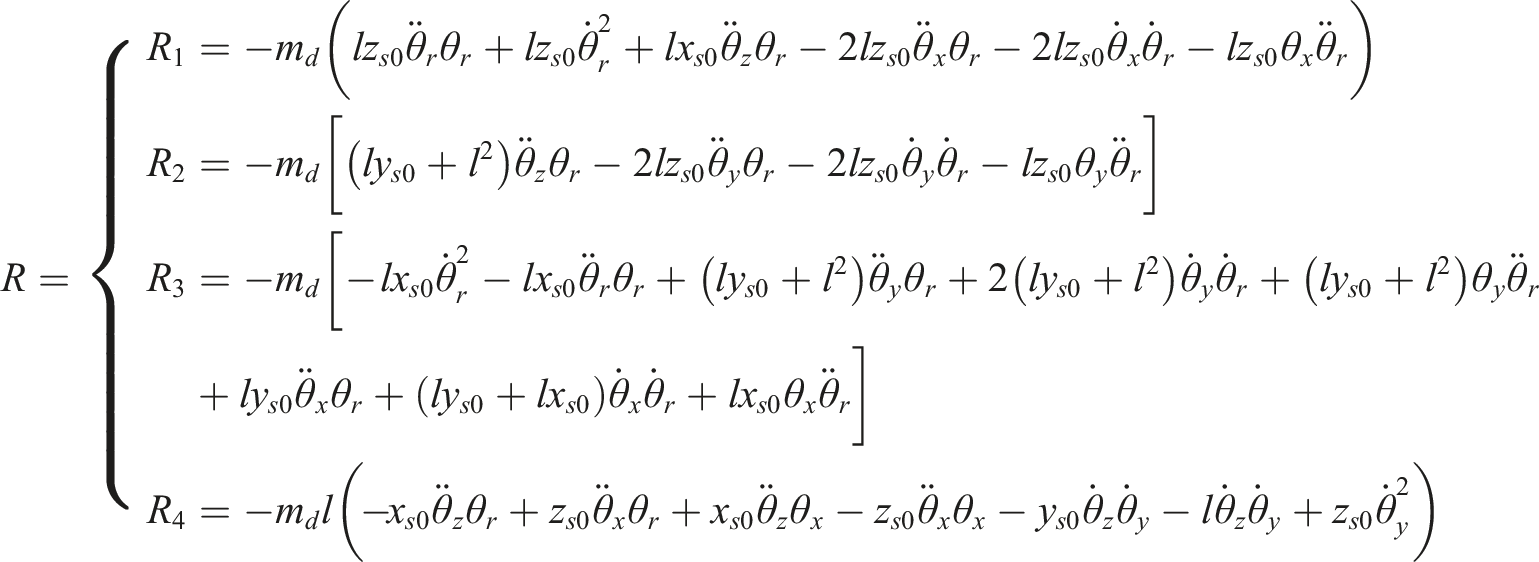
According to the structural parameters listed in the Appendix, the dynamic equations of the wind turbine gearbox and the vibration absorber are derived based on the Lagrange method and are written as




Modal coupling equations about controlled mode and vibration absorber mode
To extract modal coupling relationship between the wind turbine gearbox and the vibration absorber, their dynamic equations are transformed in the modal space by

In this study, we aim to decrease the vibration response of the pitch mode


Perturbation analysis
To study internal resonance and modal interaction, it is necessary to seek the analytical solutions of the modal coupling equations about the controlled mode and the vibration absorber mode.
The following transformations are introduced, that is

Thus, equation (7) is transformed into


Substituting equation (11) into equation (10), one obtains
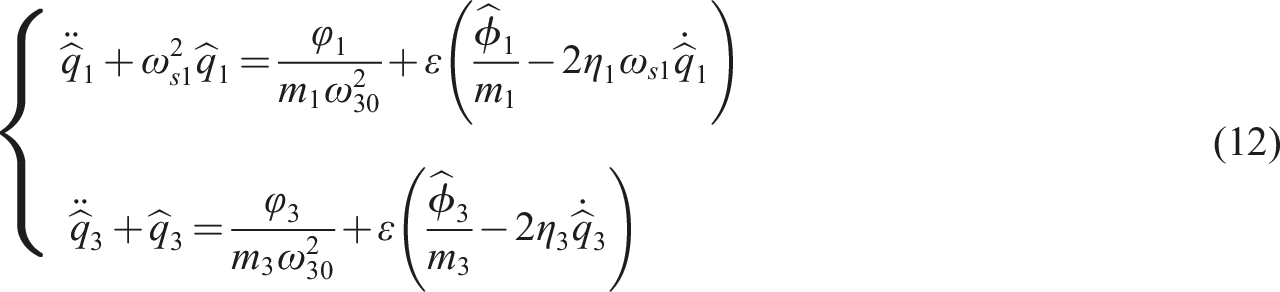
In order to perform perturbation analysis, the following time scales are introduced



The first-order approximate solutions to equation (12) take the form

Order (




The general solutions to equation (17) can be expressed in the form

Substituting equation (21) into equation (18), one has

Modal interaction analysis
Based on the above perturbation solutions of the modal coupling equations, the 1:1 internal resonance is researched, that is,

Substituting equation (23) into equation (22) and eliminating the secular terms, the solvability conditions are

In order to solve equation (24),

Take the derivative of equation (25) with respect to

Inserting equation (25) and equation (26) into equation (24), then setting the real and imaginary parts to 0, respectively, one has





From equations (27) and (28), one obtains


From equation (29) to equation (31), one obtains



The steady-state solutions of the system are
31

If the damping is not taken into account, that is,


Integrating equation (38) yields

In equation (40),
If the damping is taken into account, that is,
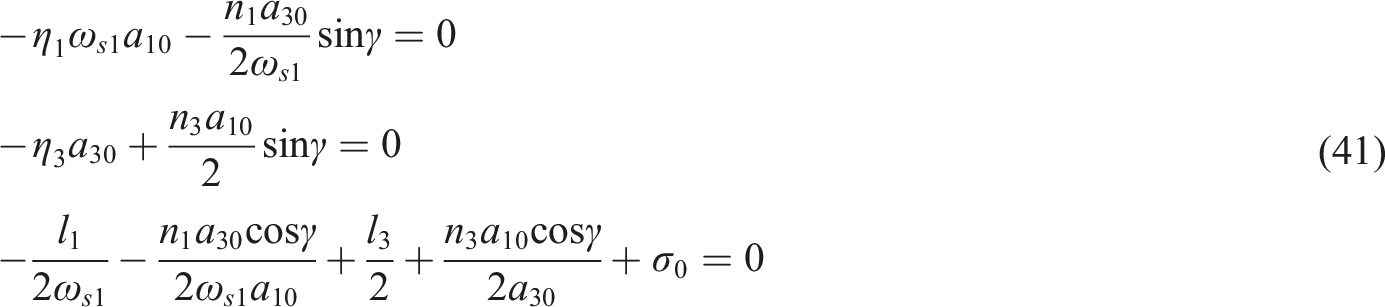
From the Jacobian matrix of equation (41), the following eigenvalues can be obtained, that is

Verification of internal resonance
To verify internal resonance, the proposed vibration absorber is mounted on the wind turbine gearbox, whose frequency has been adjusted to be equal to the frequency of the controlled pitch mode. If the damping of the vibration absorber mode and the damping of the controlled pitch mode is not taken into account, their modal amplitudes are calculated through numerically integrating equations (32), (33), and (36), as shown in Figure 3 and Figure 4. Modal amplitudes (without damping). Modal phase (without damping).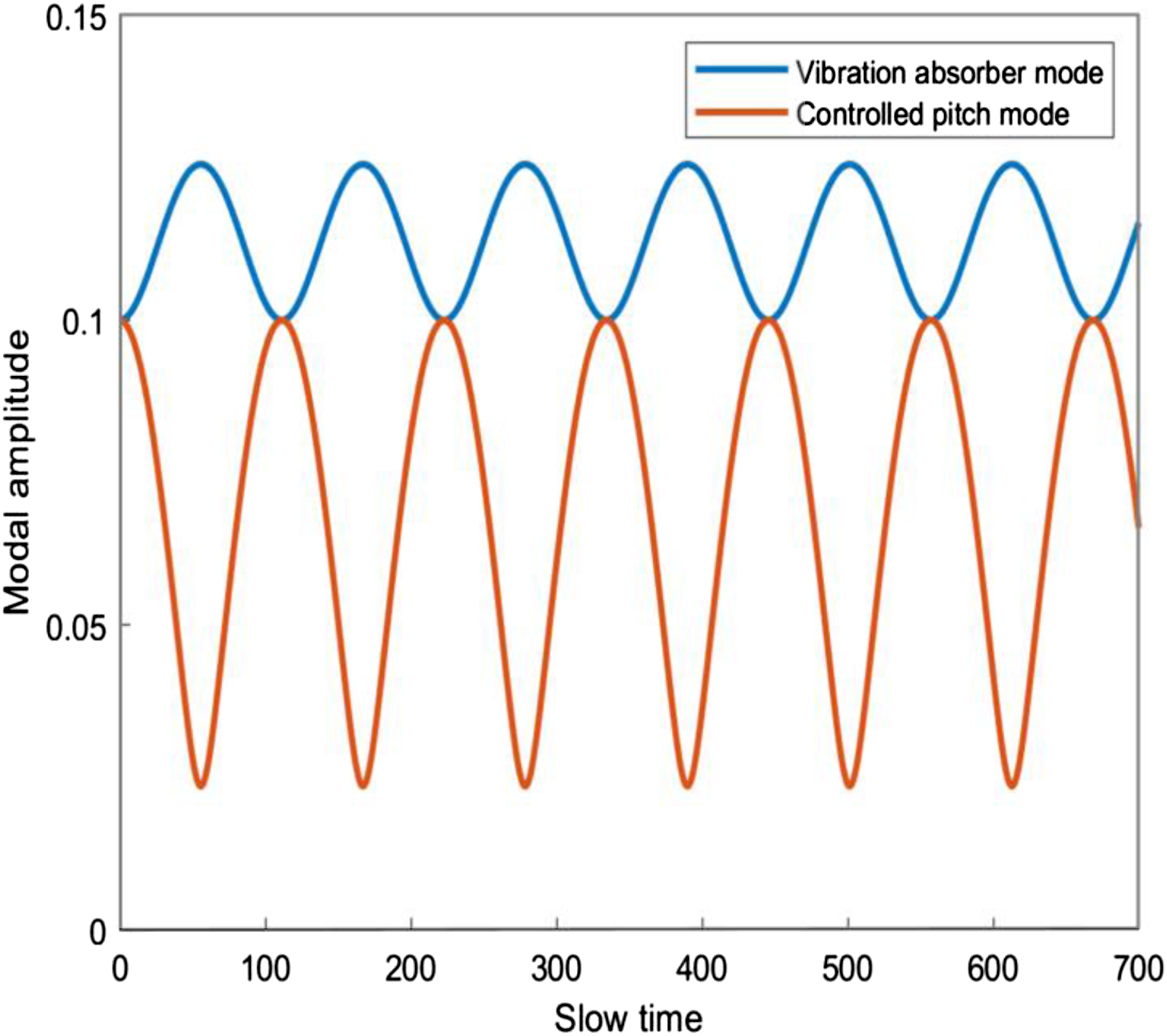
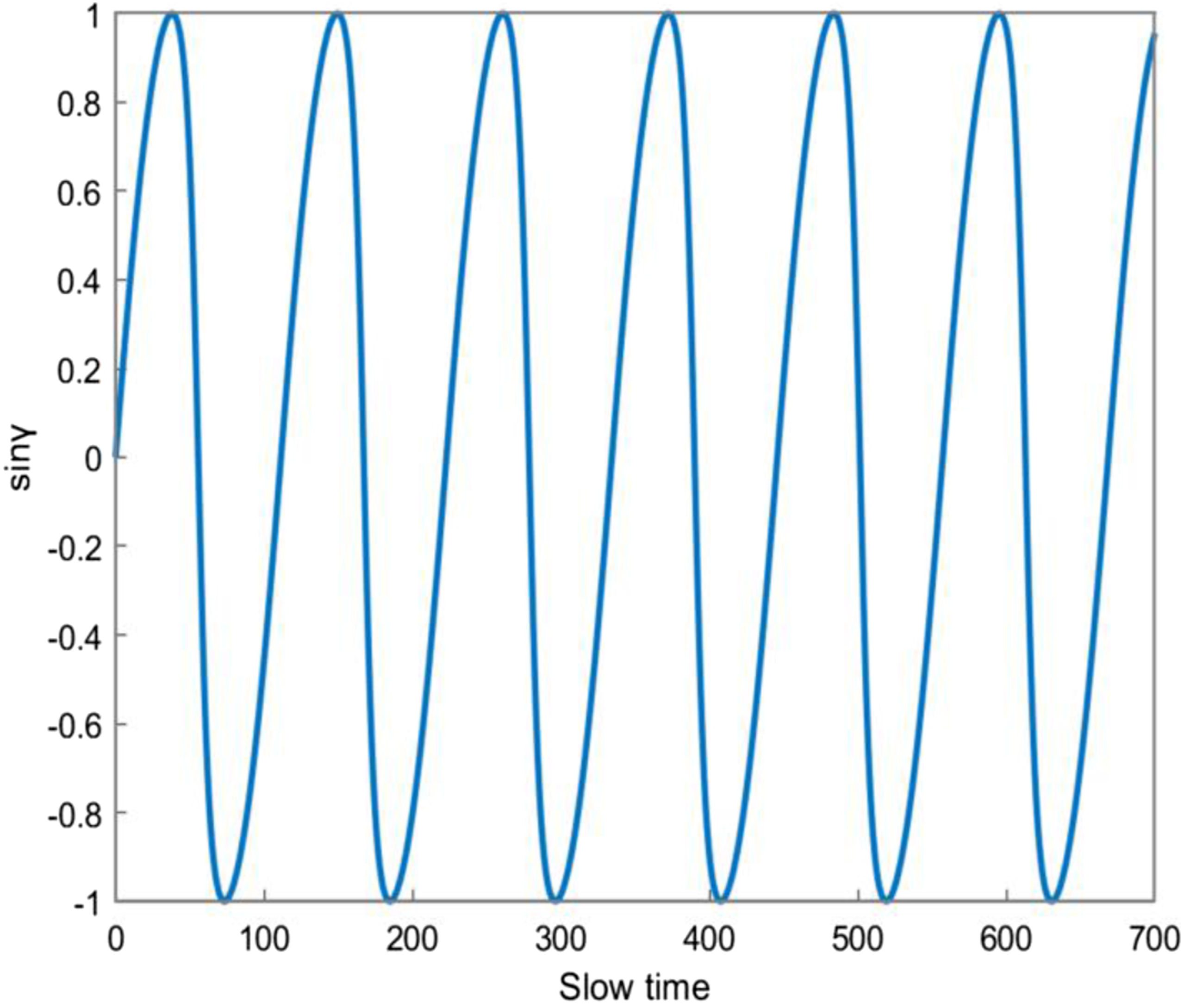
As can be seen, these modal amplitudes are anti-phase. Initially, Vibration responses (without damping). Phase diagrams of the system (without damping).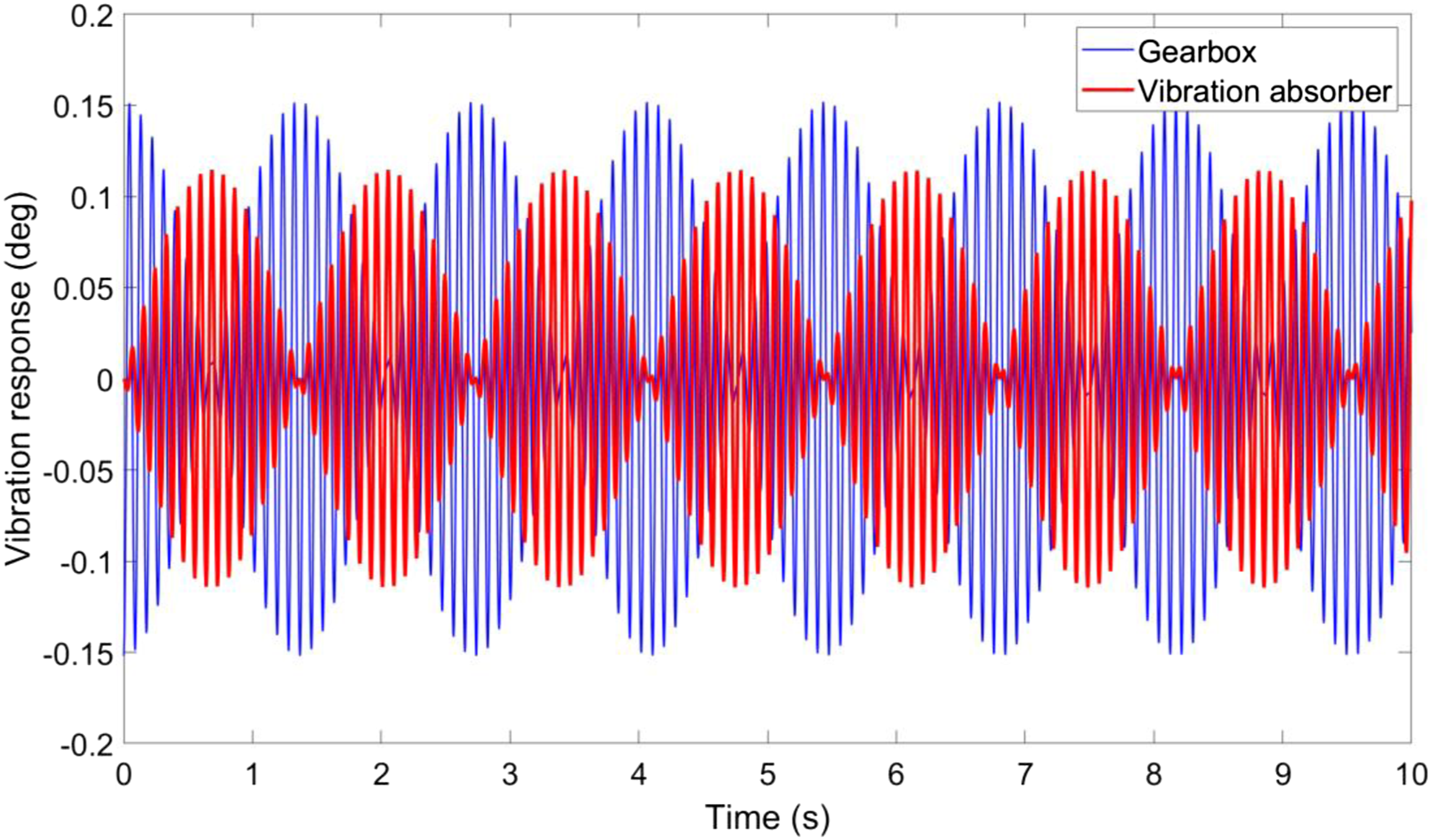
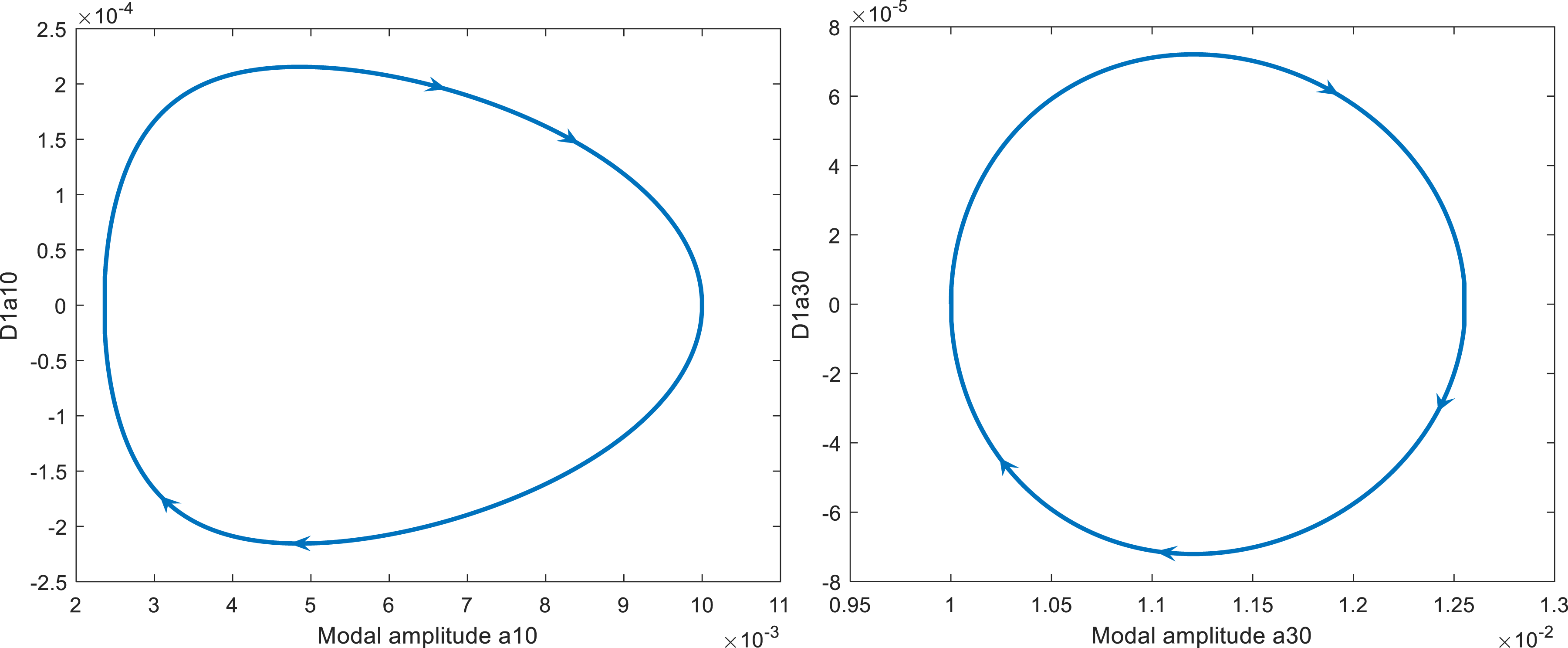
In conclusion, these phenomena have demonstrated that internal resonance has been established and modal interaction has occurred between the wind turbine gearbox and the vibration absorber. Vibration energy is exchanged between the pitch mode and the vibration absorber mode.
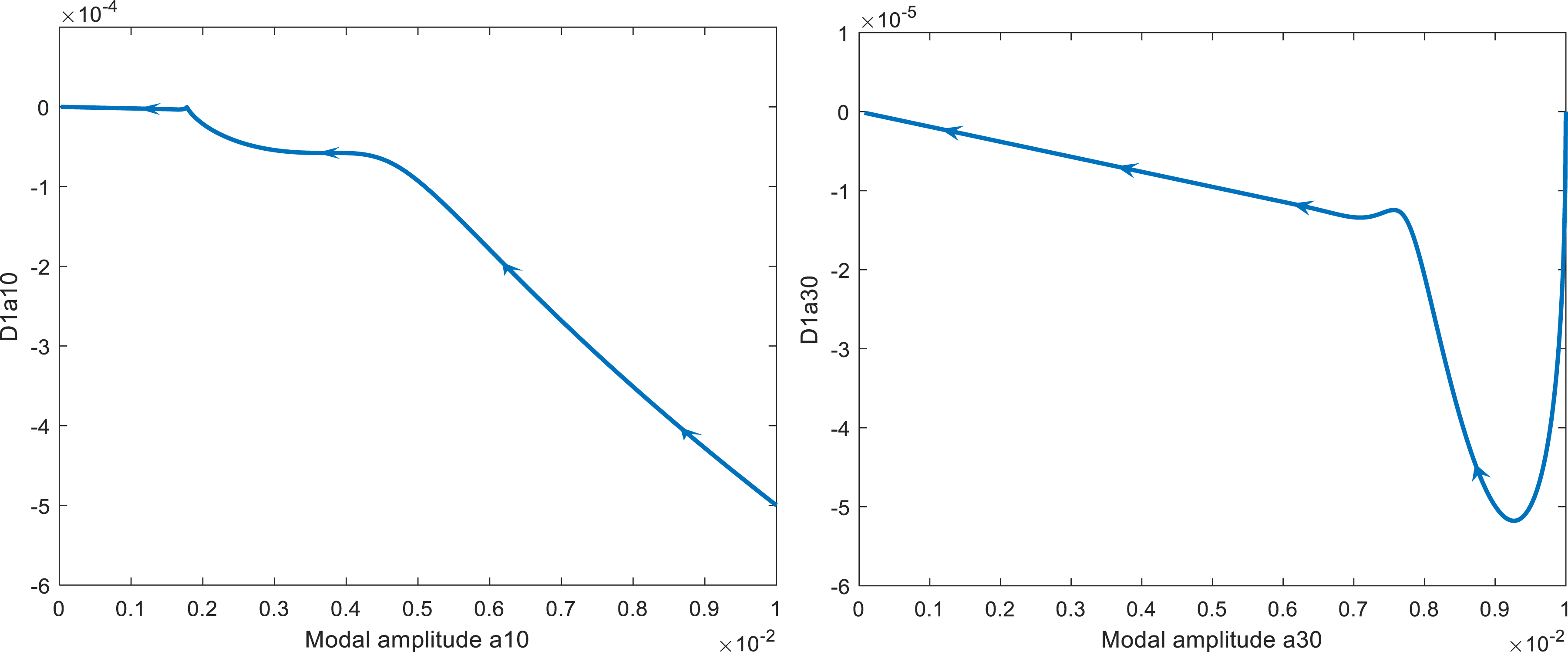
If the damping of the vibration absorber mode is taken into account, for example, Modal amplitudes (with damping). Phase diagrams of the system (with damping).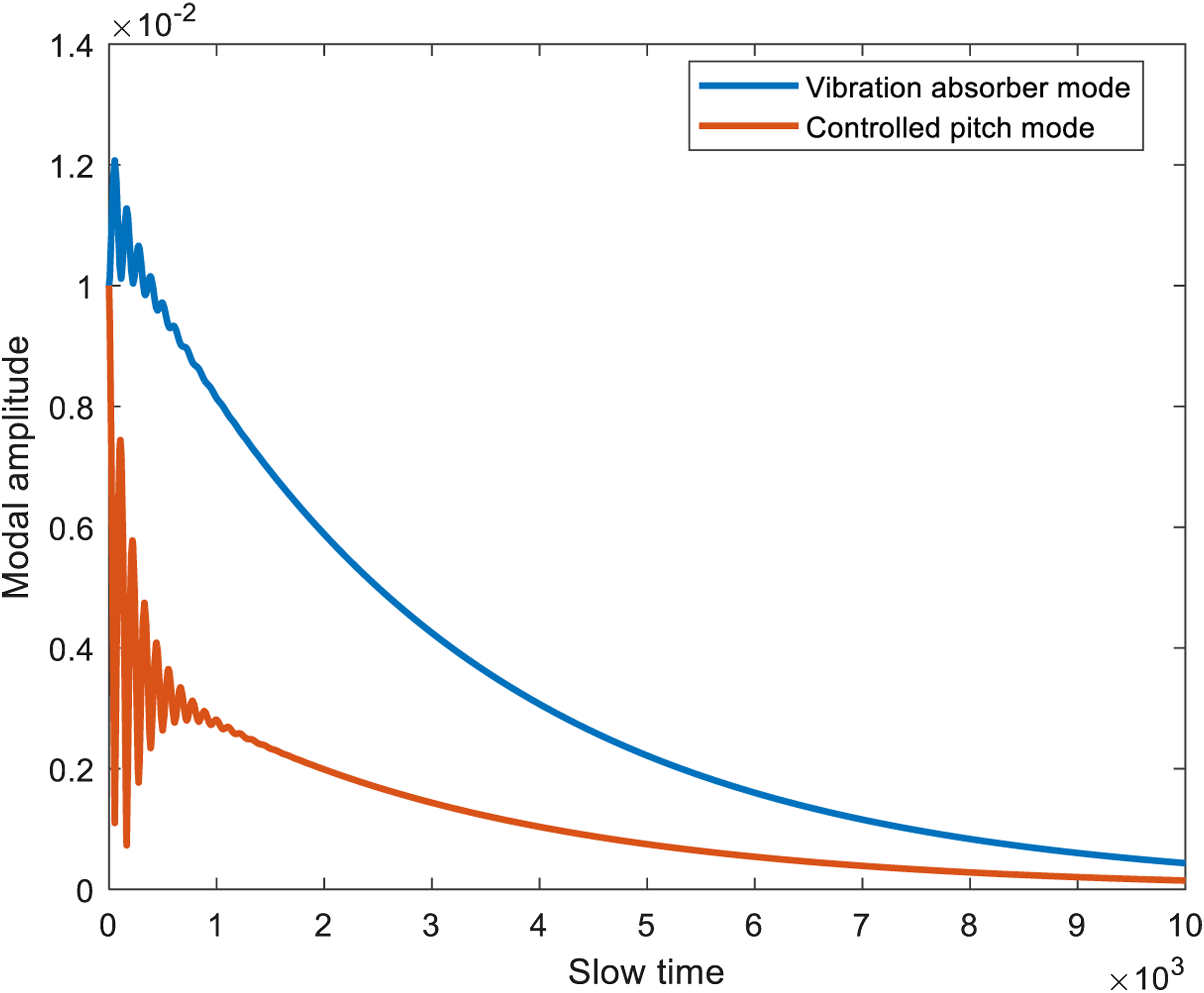
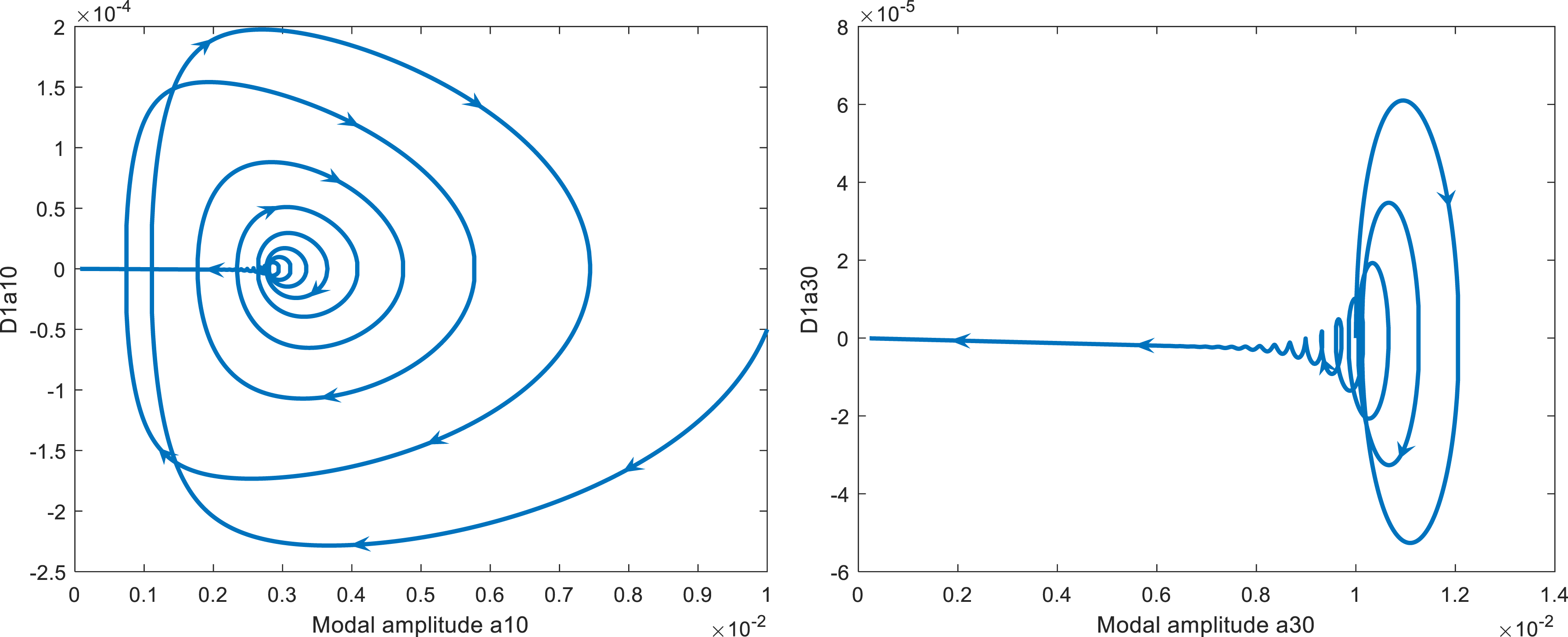
If the damping of the vibration absorber mode is taken into account, for example, Modal amplitudes (with damping). Phase diagrams of the system (with damping).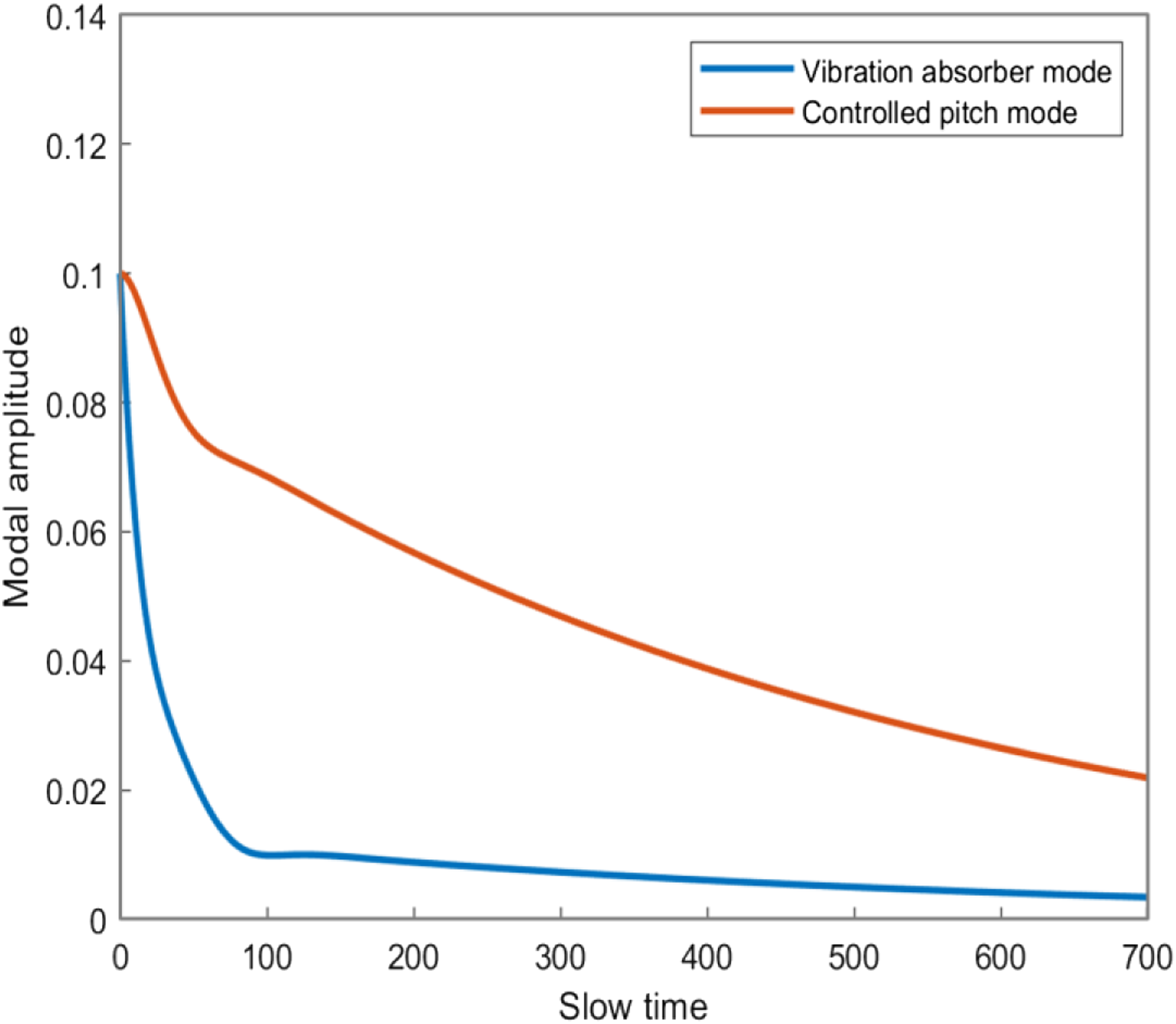
Virtual prototyping simulation
Although the above theoretical study is promising, it is based on our own model. In view of this, two widely- accepted analysis software packages—ADAMS® and MATLAB® are used to conduct a series of virtual prototyping simulations. Since they can not only relative accurately emulate the dynamic behaviors of the wind turbine gearbox and the vibration absorber, but also implement dynamic calculation, vibration analysis and control algorithm in different ways from our model, more trustable results can be obtained to verify the suggested vibration absorption method.
There are 2 main assumptions in the simulations of the examined model, including: (1) the wind turbine gearbox is regarded as a rigid body, because the natural frequency of the wind turbine gearbox is much higher than that of the flexible suspension; (2) each flexible suspension is simplified as two mutually orthogonal spring-damping elements, whose stiffness and damping coefficients are constant.
Virtual prototyping model
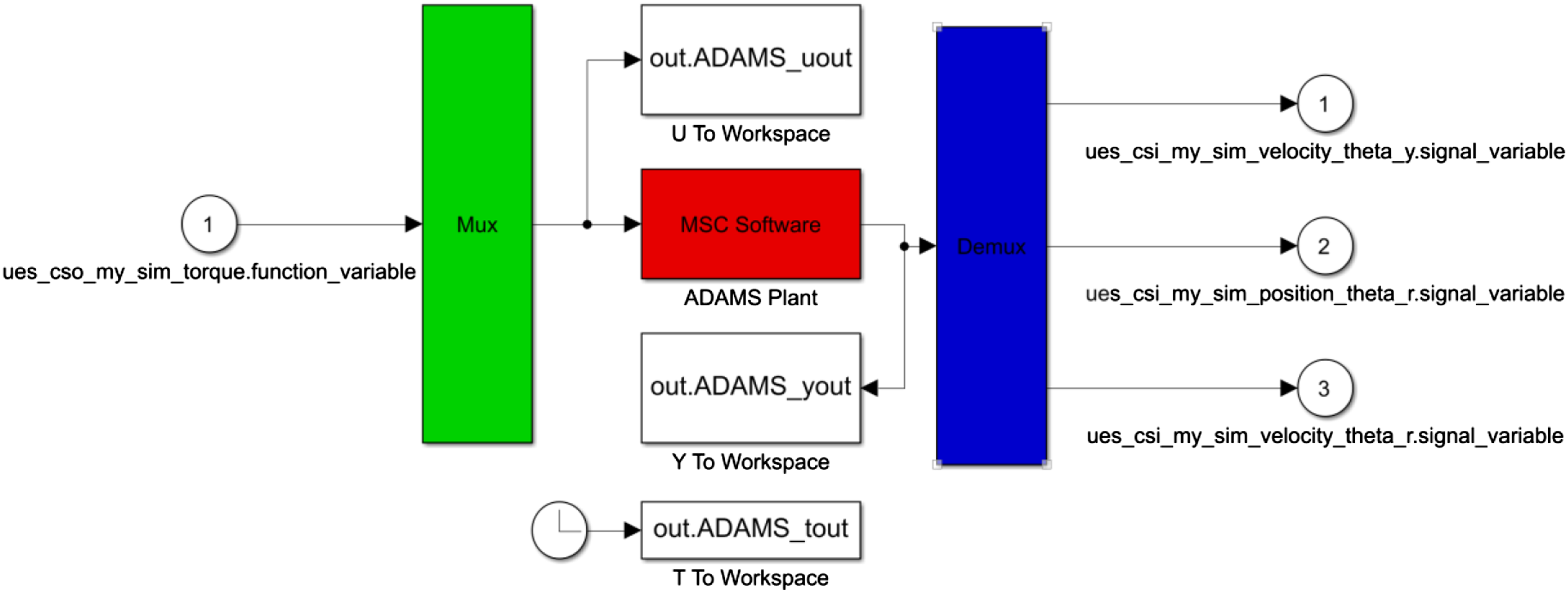
A wind turbine gearbox with three-point suspensions and a suggested vibration absorber are established using the ADAMS software, as shown in Figure 2. Their structural parameters are listed in the Appendix. The control model of the vibration absorber is constructed using the MATLAB/Simulink module and the ADAMS/Control module. As shown in Figure 11, the PD control is implemented according to equation (2), where kd and kp denote the velocity feedback gain and the position feedback gain, respectively. By adjusting these parameters, the damping and frequency of the vibration absorber can be tuned for vibration control. The adams_sub module denotes the ADAMS virtual prototyping model of the wind turbine gearbox, whose detailed configuration is shown in Figure 12. MATLAB/Simulink module. ADAMS/Control module.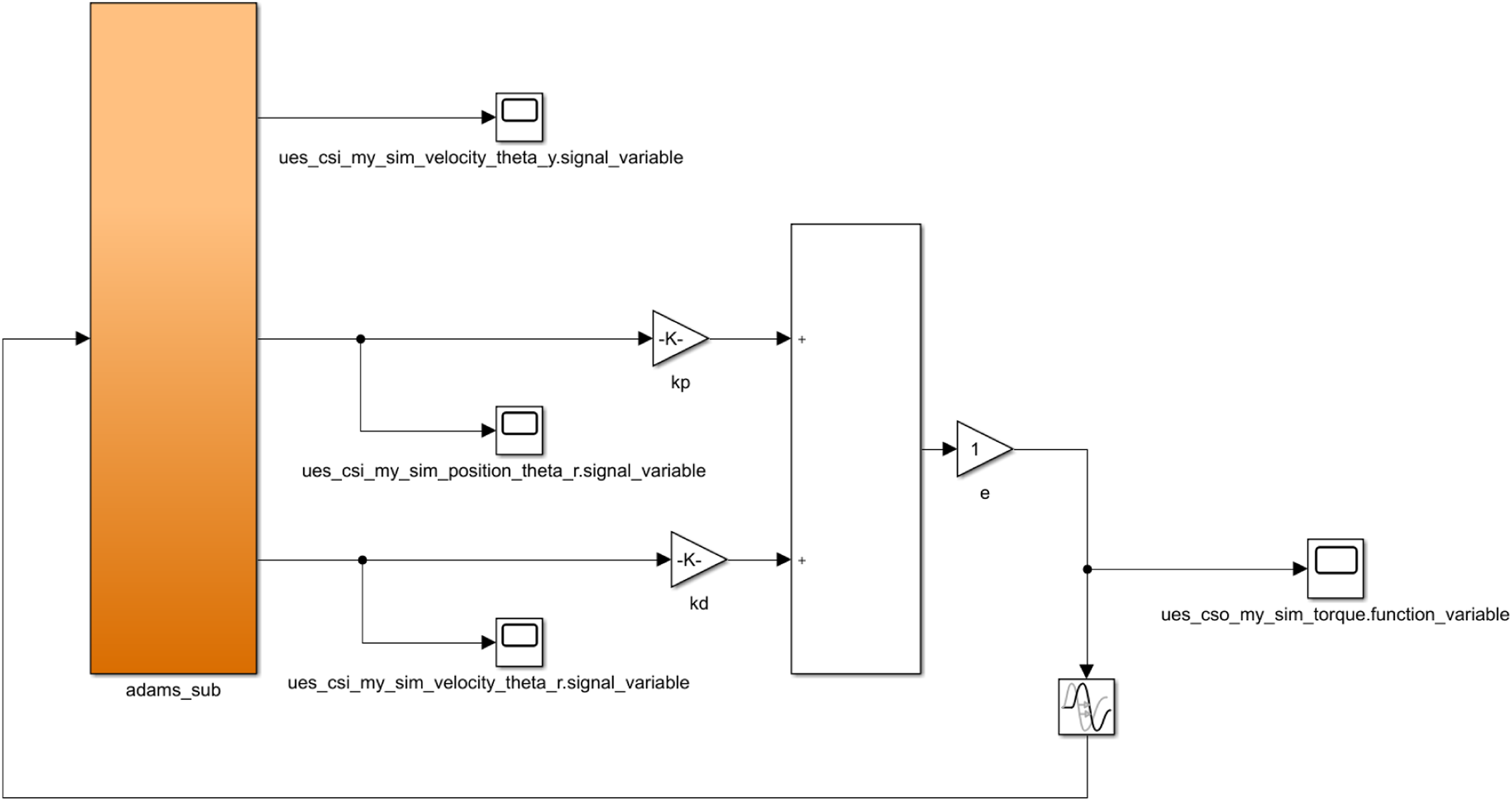
Verification of modal interaction
Based on the above virtual prototyping models, several ADAMS-Simulink simulations are carried out.
Establishment of internal resonance
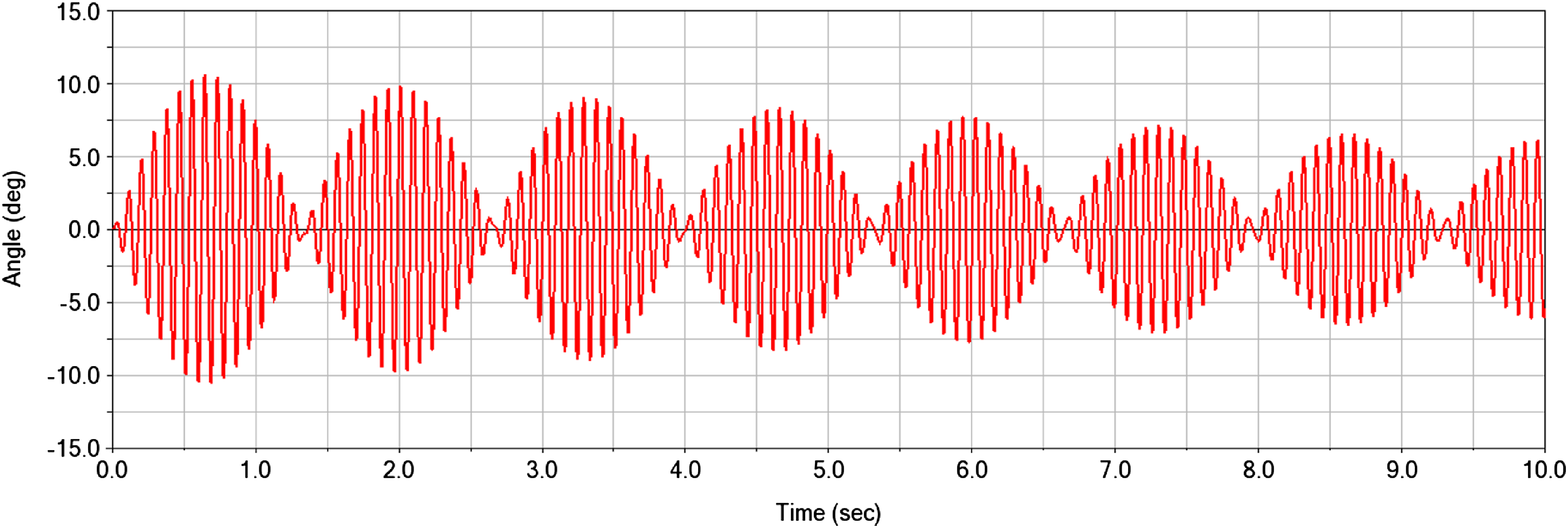
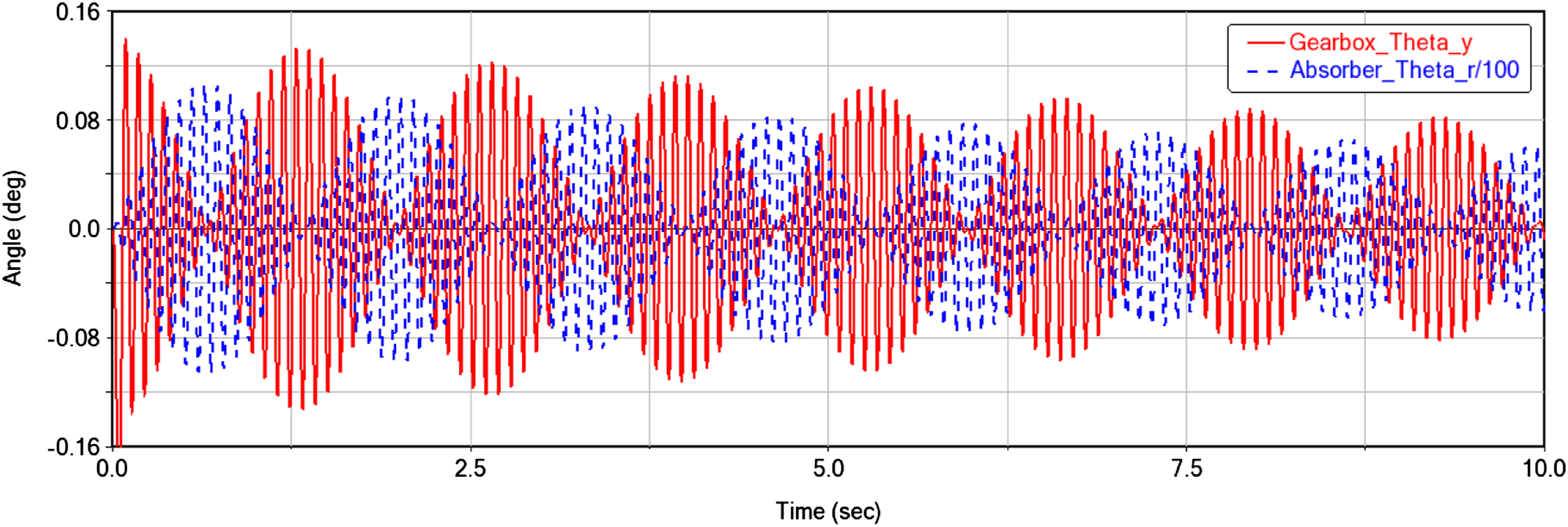
To verify internal resonance, the frequency of the vibration absorber is tuned to be equal to that of the controlled pitch mode, and the damping of the vibration absorber is not considered, that is, Pitch vibration response of wind turbine gearbox. Rotational vibration response of vibration absorber. Comparison of vibration response.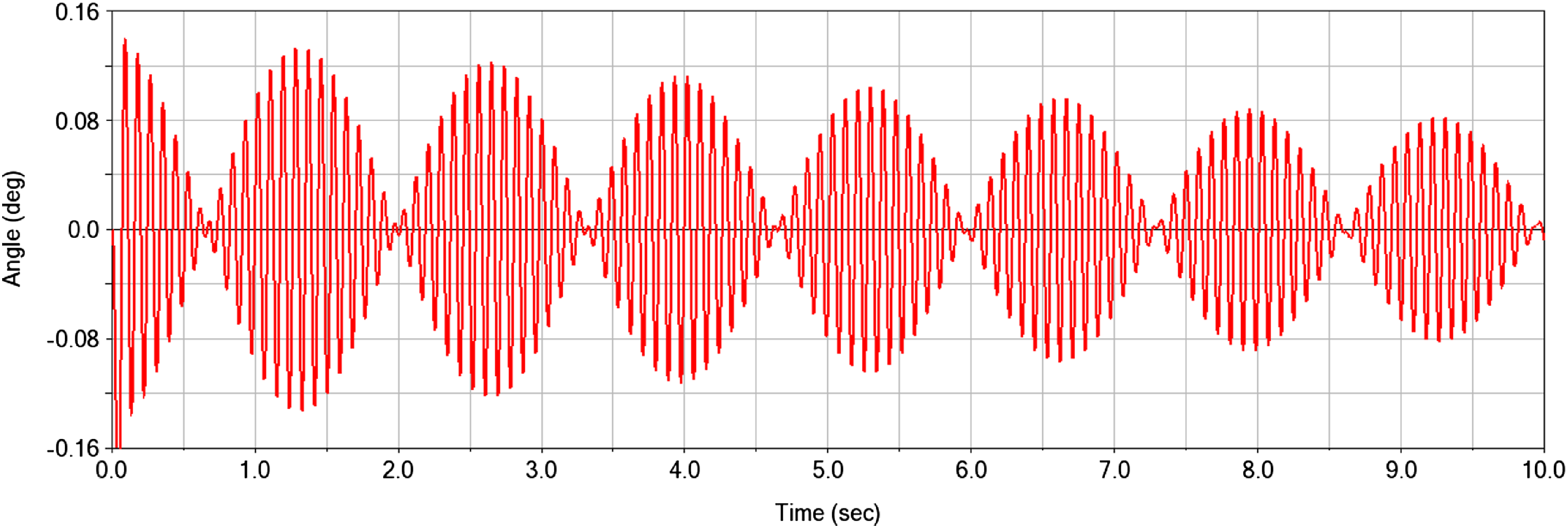
Influence of damping of vibration absorber
Based on internal resonance, the damping of the vibration absorber is introduced to decrease the pitch vibration of the wind turbine gearbox through adjusting Vibration responses of wind turbine gearbox and vibration absorber ( Vibration responses of wind turbine gearbox and vibration absorber ( Vibration responses of wind turbine gearbox and vibration absorber (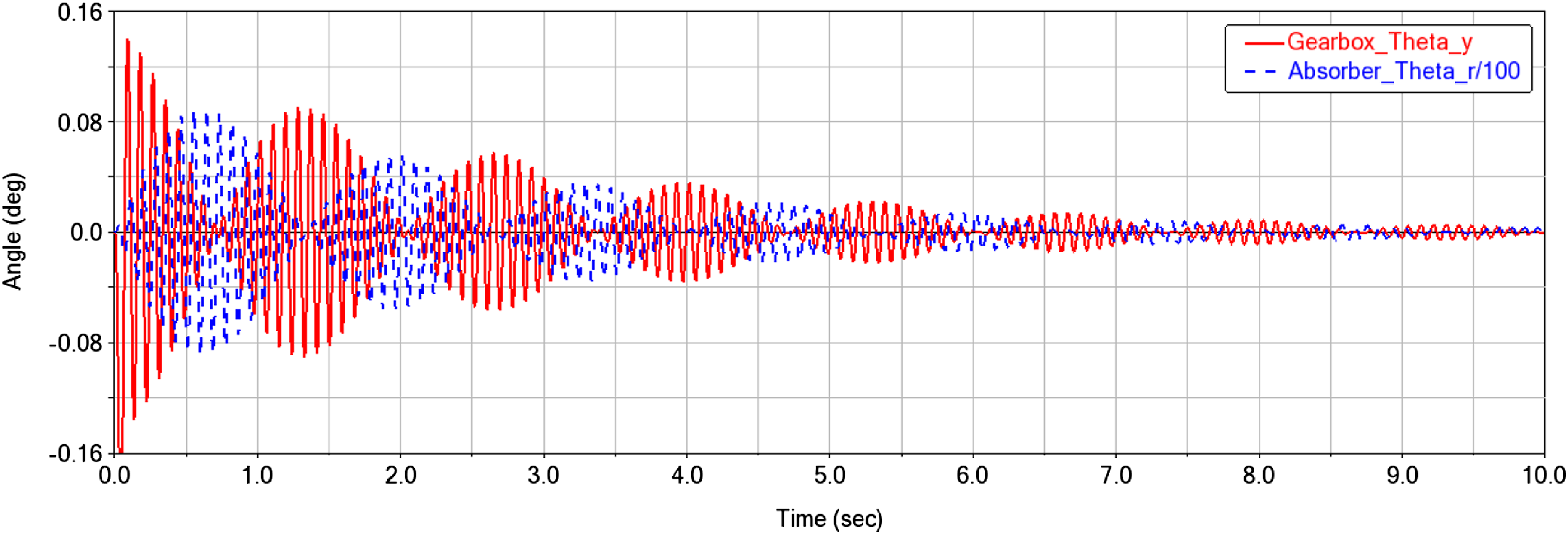
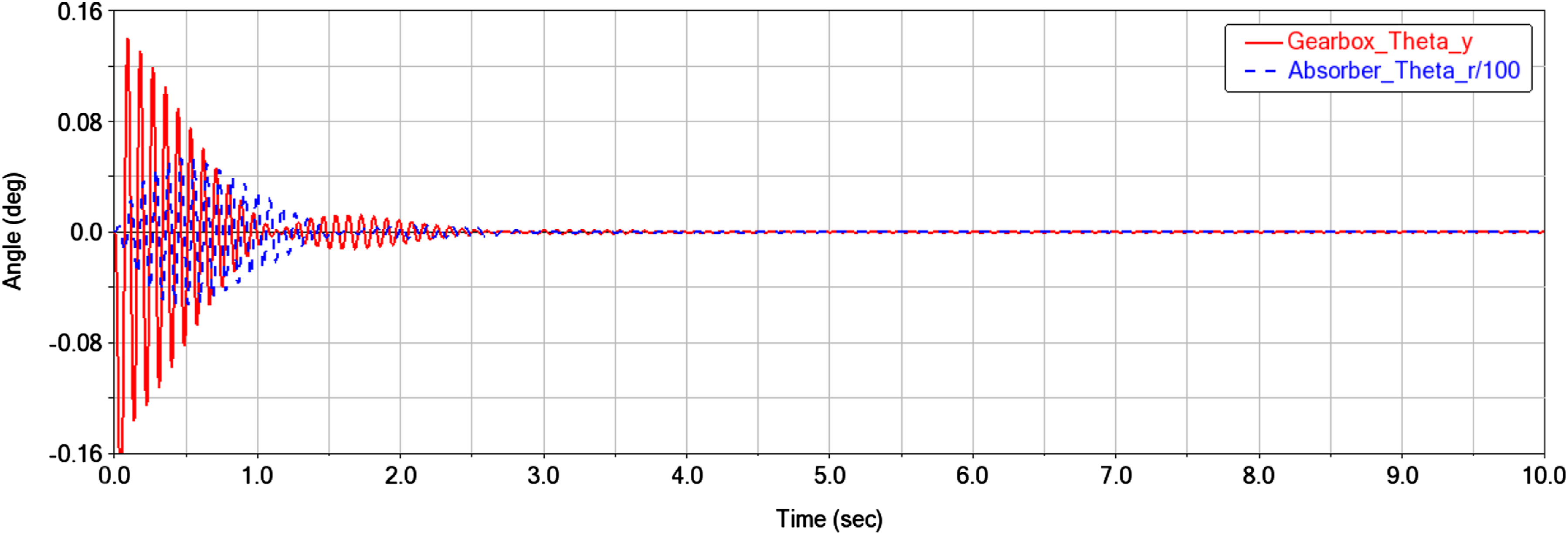
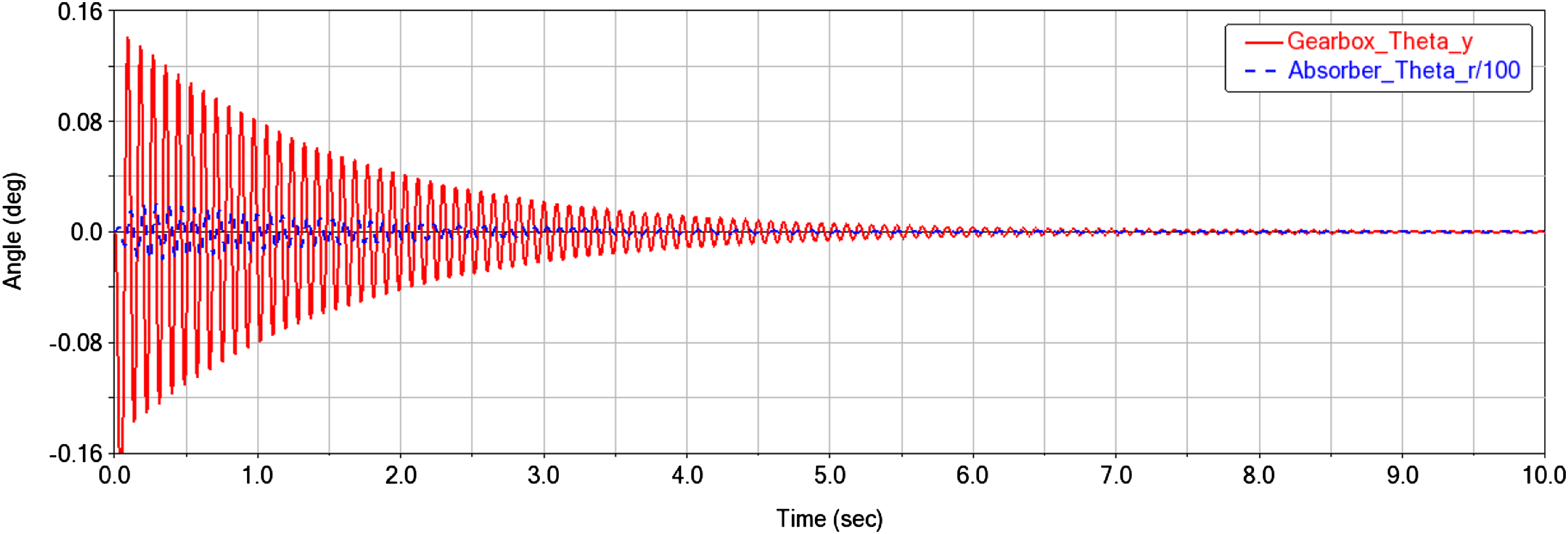
It can be seen that the damping of the vibration absorber can effectively alleviate the pitch vibration response of the wind turbine gearbox when the internal resonance has been established. If increasing the damping of the vibration absorber, vibration attenuation performance will be better, as shown in Figure 17. However, excessively large damping may block vibration energy transfer and deteriorate vibration attenuation performance, as shown in Figure 18. As a result, it is necessary to optimize the damping of the vibration absorber.
In conclusion, the above virtual prototyping simulation results have verified that the internal resonance can be used to establish modal interaction, so as to decrease the pitch vibration response of the wind turbine gearbox.
Analysis of representative operating conditions
Wind loads, as the main input loads of the wind turbine, are unstable in directions and speeds. In addition to supplying useful torque load, it usually exerts a harmful non-torque load on the wind turbine gearbox, exciting the undesired pitch vibration and yaw vibration of the wind turbine gearbox. To further verify the effectiveness of the proposed method, two vibration absorbers are used in this section to control the pitch vibration and yaw vibration of the wind turbine gearbox under two representative operating condition, that is, normal power production case and shutdown case, as shown in Figure 19. Wind turbine gearbox with two vibration absorbers.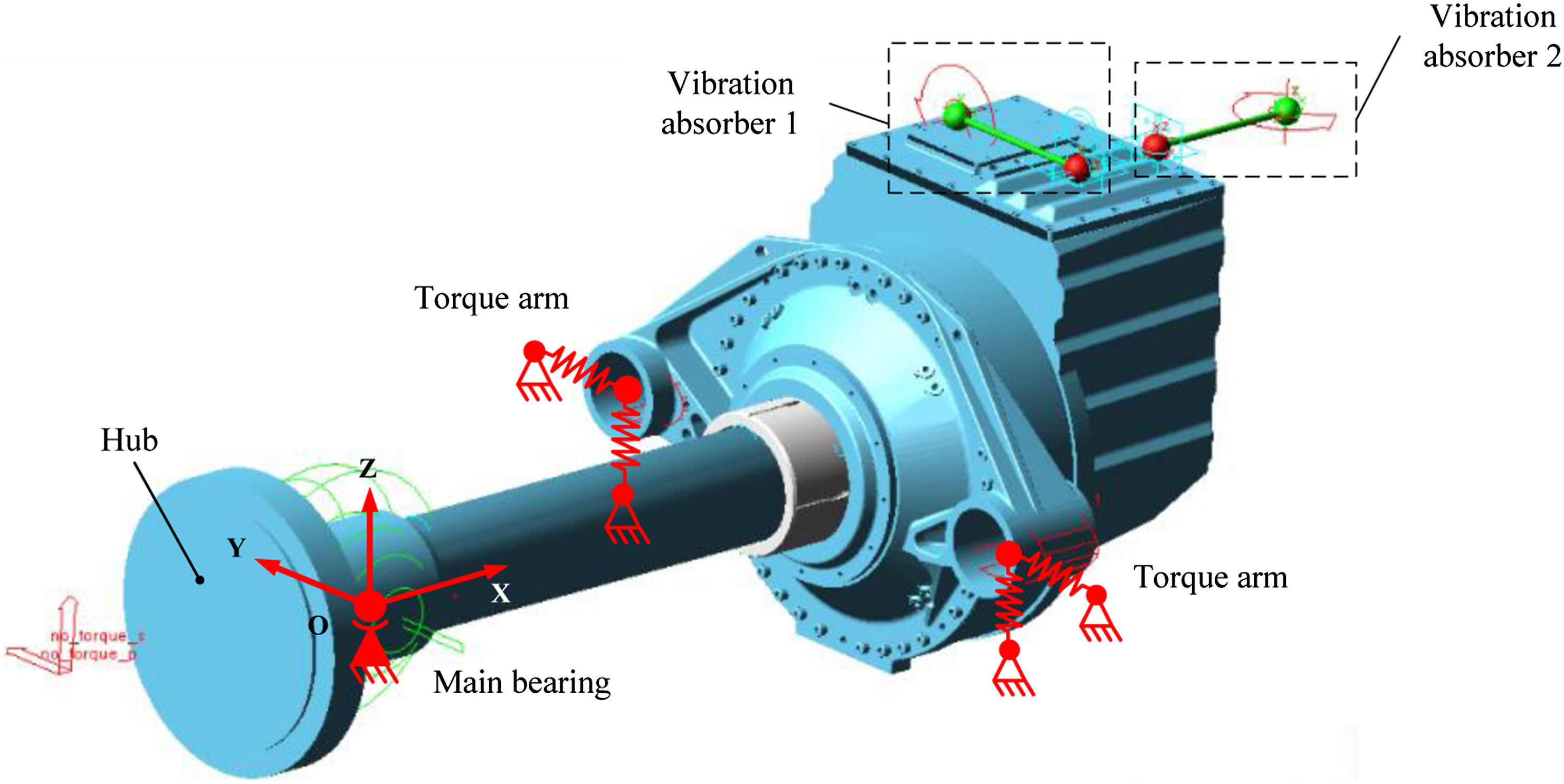
Normal power production
Normal power production is the longest operating condition of the wind turbine gearbox. To conduct virtual prototyping simulation, a series of real test data are used,
32
whose sampling frequency is 2000 Hz and measurement time is 20.0 s. As shown in Figure 20, the high-speed shaft speed fluctuates around 1202.5 r/min (revolutions per minute), the main shaft torque fluctuates around 30.1 kN·m (kilo newton·meter), the non-torque loads along the Y0 axis and Z0 axis can reach a maximum of 20 kN (kilo newton). Experimental data of normal power production case. (a) High-speed shaft speed (b) Main shaft torque (c) Non-torque load along Y0 axis (d) Non-torque load along Z0 axis.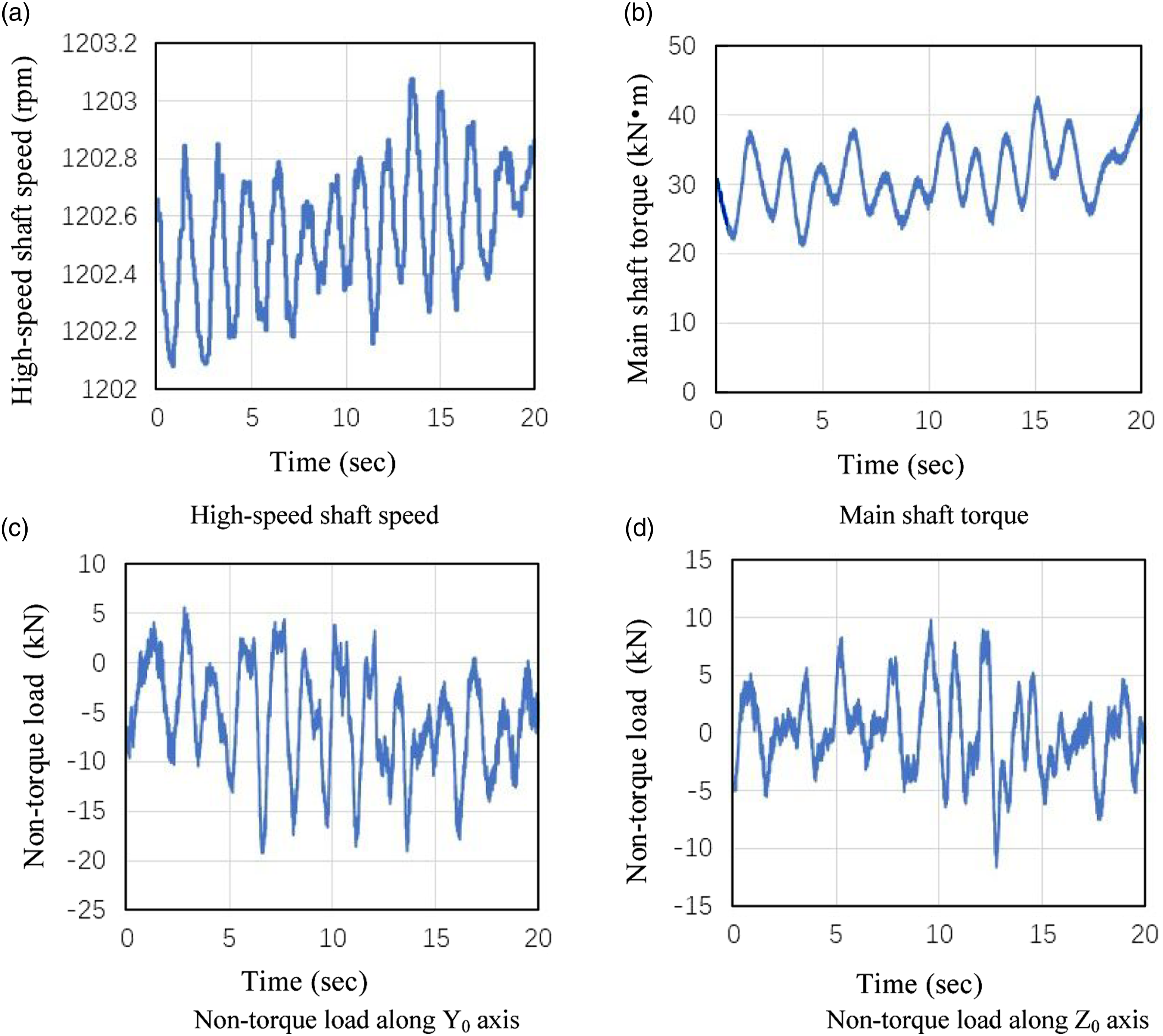
The above test data are input into the ADAMS software in the form of spline curves, and then the ADAMS-Simulink co-simulations are conducted to investigate vibration attenuation for the wind turbine gearbox with three-point suspensions under the normal power production case.
If there is no the vibration absorber, the vibration response of the wind turbine gearbox is shown in Figure 21. It can be seen that the speed fluctuations and torque fluctuations in the normal power production case may excite the strong vibration of the wind turbine gearbox. Vibration response of wind turbine gearbox without vibration absorber. (a) Pitch vibration (b) Yaw vibration.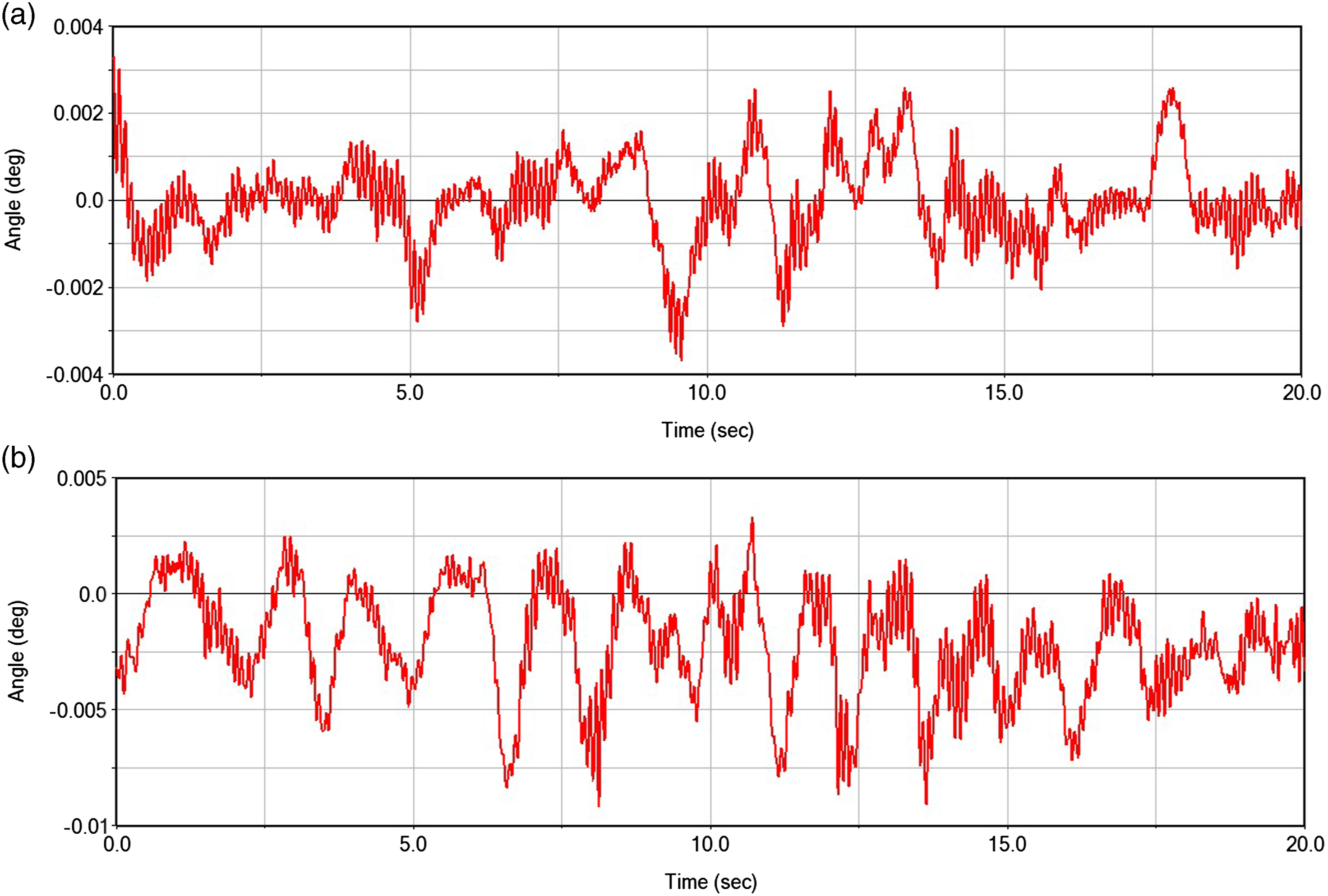
If the vibration absorber is introduced and the appropriate damping is adopted, the pitch vibration and yaw vibration of the wind turbine gearbox is shown in Figure 22. Vibration response of wind turbine gearbox with vibration absorber. (a) Pitch vibration (b) Yaw vibration.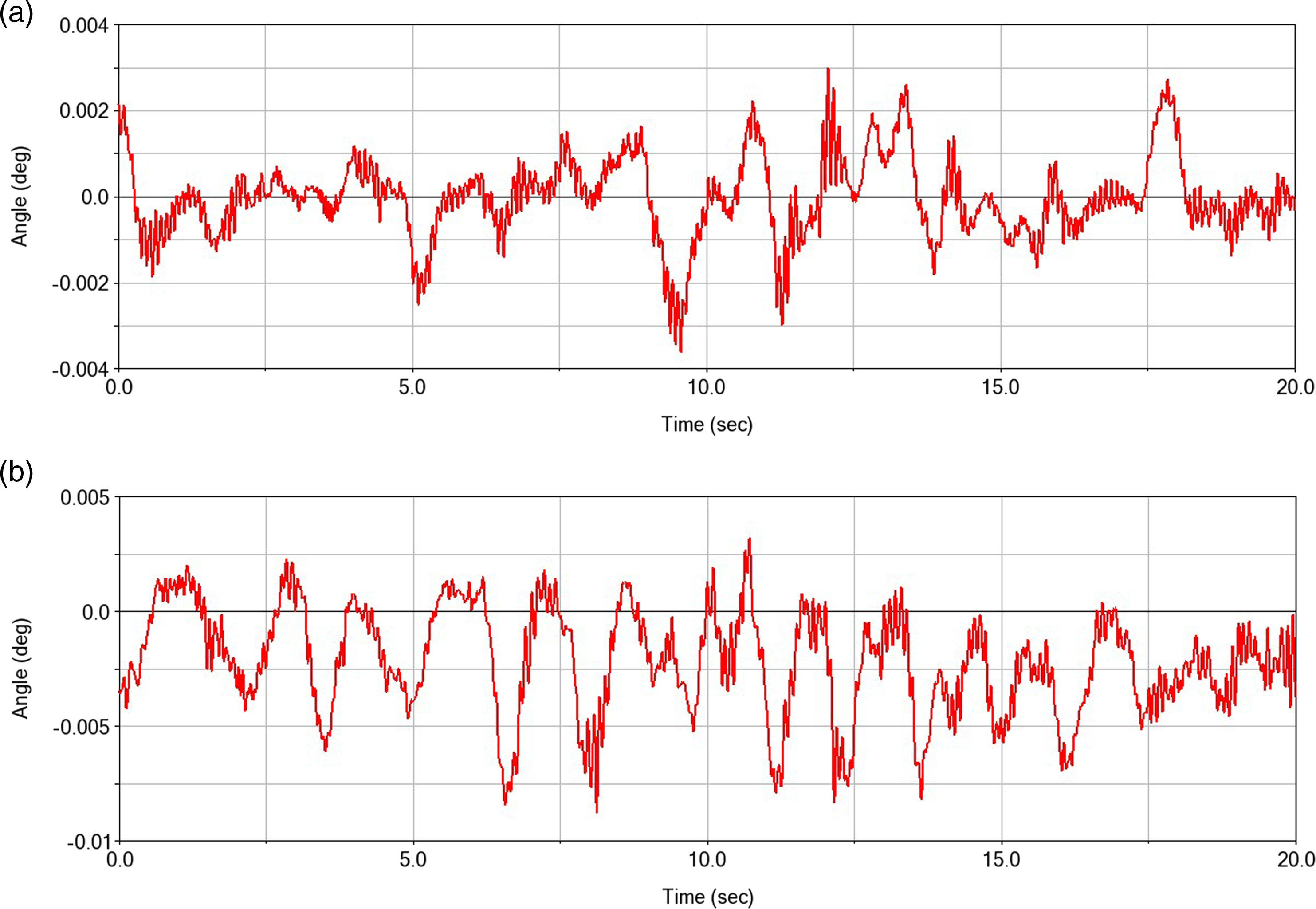
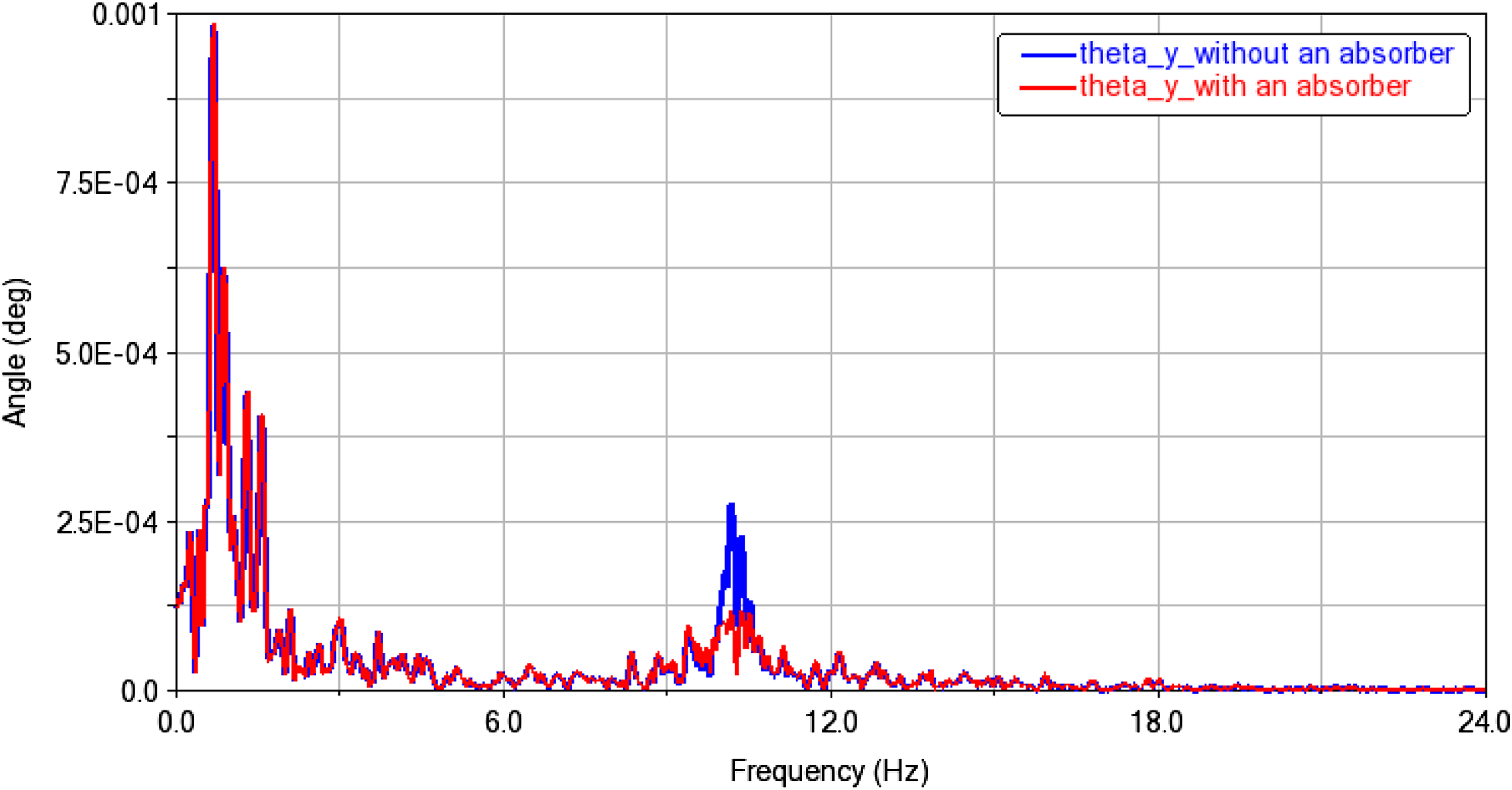
For clarity, the pitch vibration response truncated from 12 to 18 s is compared in the time domain, as shown in Figure 23. It can be seen that the pitch vibration response of the wind turbine gearbox can be effectively alleviated by the vibration absorber. In the frequency domain, the pitch vibration response of the wind turbine gearbox is shown in Figure 24. The pitch vibration energy mainly converges in the neighborhood of the low frequency 0∼2 Hz and the natural pitch frequency 11.3 Hz. Compared with the low frequency vibration, the pitch vibration near the natural pitch frequency may severely influence the reliability and service life of the wind turbine gearbox. When the vibration absorber is effective, it can be seen that the vibration response in 11.29 Hz and 11.52 Hz has been decreased by 57.8% and 49.3%, respectively. It is proven that the suggested method can effectively reduce the pitch vibration of the wind turbine gearbox near the natural pitch frequency. Comparison of pitch vibration response with and without vibration absorbers in time domain. Comparison of pitch vibration response with and without vibration absorbers in frequency domain.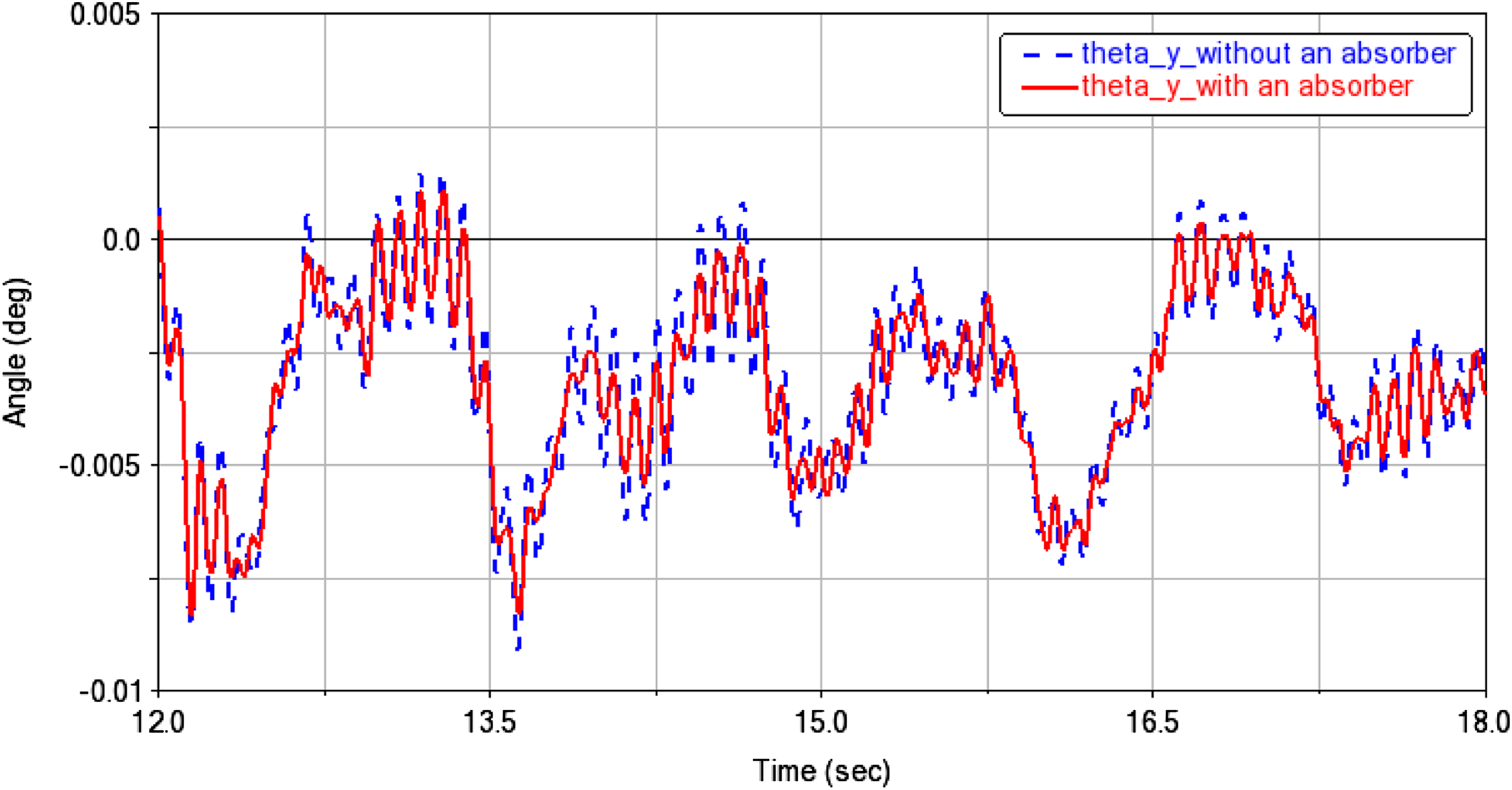
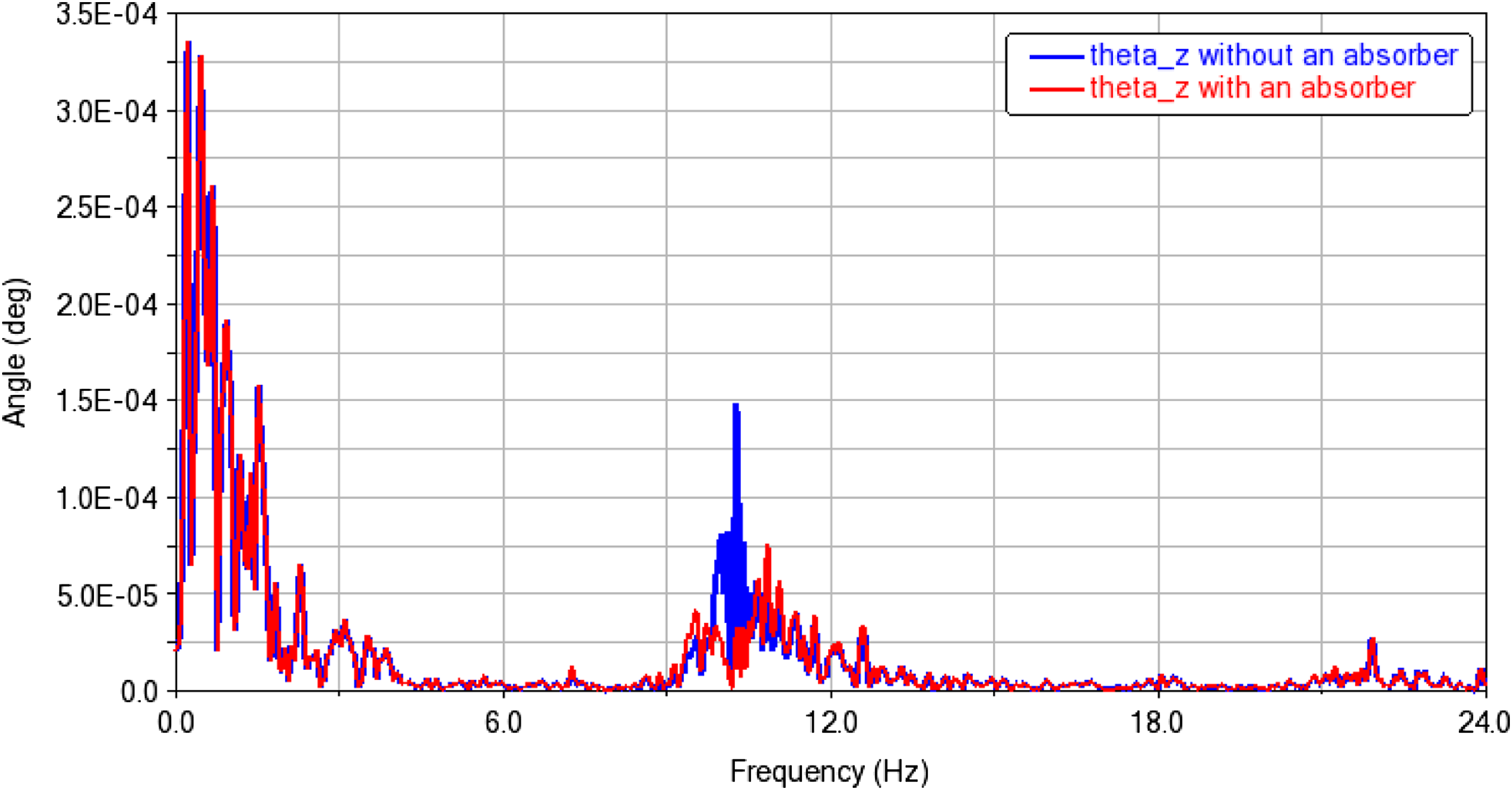
Similarly, the yaw vibration response truncated from 0 to 6 s is compared in the time domain for clarity, as shown in Figure 25. It can be seen that the yaw vibration response of the wind turbine gearbox can be effectively alleviated by the vibration absorber. In frequency domain, the yaw vibration response of the wind turbine gearbox is shown in Figure 26. The yaw vibration energy mainly converges on the neighborhood of the low frequency 0∼2 Hz and the natural yaw frequency 11.3 Hz. Compared with the low frequency vibration, the yaw vibration near the natural yaw frequency may severely influence the reliability and service life of the wind turbine gearbox. When the vibration absorber is effective, it can be seen that the vibration response in 11.10 Hz and 11.41 Hz has been decreased by 58.5% and 77.7%, respectively. It is proven that the suggested method can effectively reduce the yaw vibration of the wind turbine gearbox near the natural yaw frequency. Comparison of yaw vibration response with and without vibration absorbers in time domain. Comparison of yaw vibration response with and without vibration absorbers in frequency domain.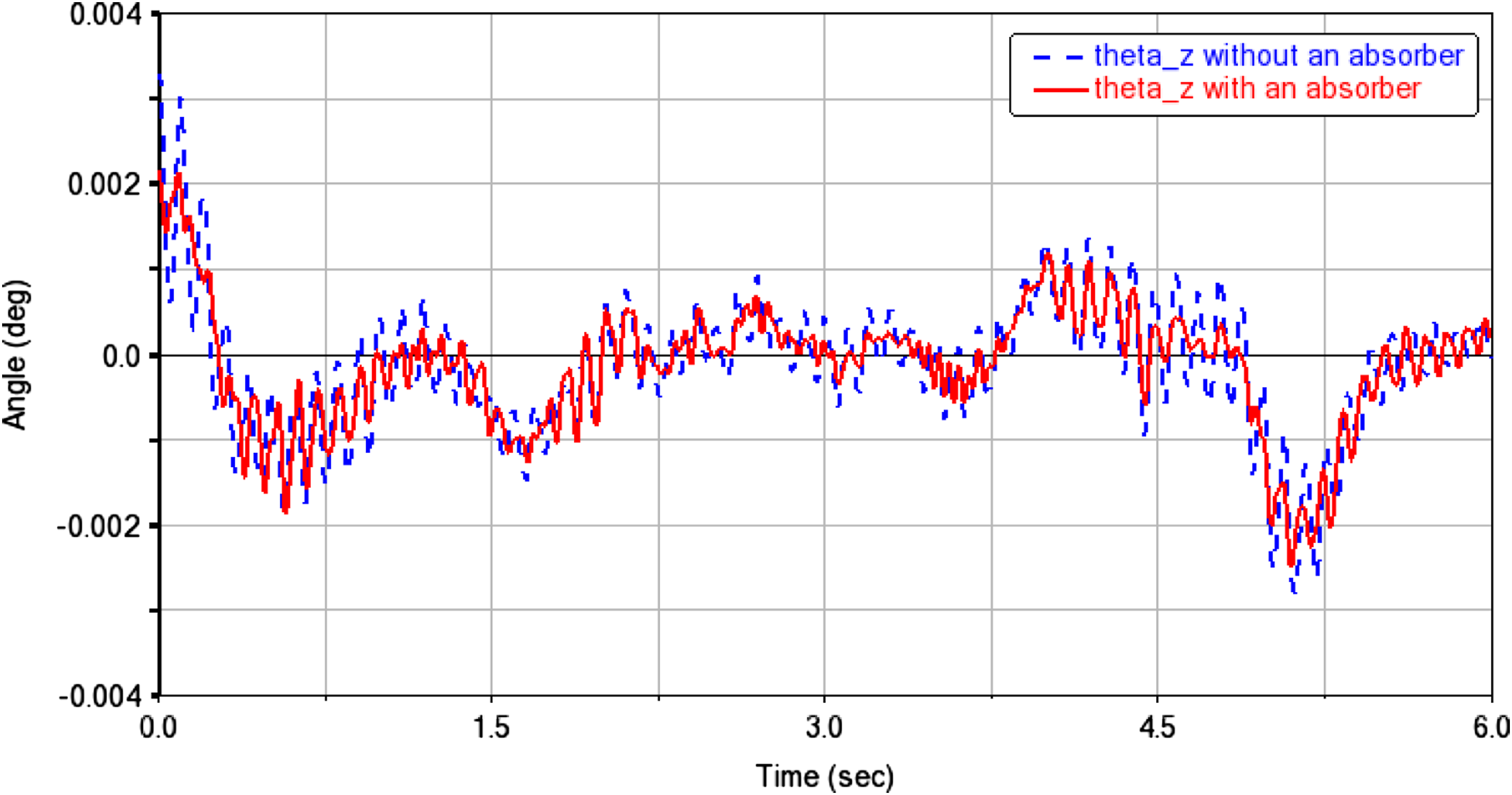
In conclusion, the proposed method can effectively alleviate the harmful pitch vibration and yaw vibration of the wind turbine gearbox under the normal power production case.
Shutdown
Shutdown is one of the worst operating conditions of the wind turbine gearbox. During shutdown, the wind turbine will abruptly decelerate under the control of the braking system, exciting strong vibration response of the wind turbine gearbox.
To conduct virtual prototyping simulation, a series of real test data are used,
22
whose sampling frequency is 2000 Hz and measurement time is 20.0 s. As shown in Figure 27(a), the high-speed shaft speed decreases rapidly from 1000 r/min to 200 r/min in 6 s, accompanied by several speed fluctuations. As shown in Figure 27(b), the main shaft torque fluctuates violently and can reach a maximum of 600 kN·m, about 160% of the rated torque. As shown in Figure 27(c) and (d), the non-torque loads along the Y0 axis and Z0 axis can reach a maximum of 30 kN. Experimental data of shutdown case. (a) High-speed shaft speed (b) main shaft torque (c) non-torque load along Y0 axis (d) non-torque load along Z0 axis.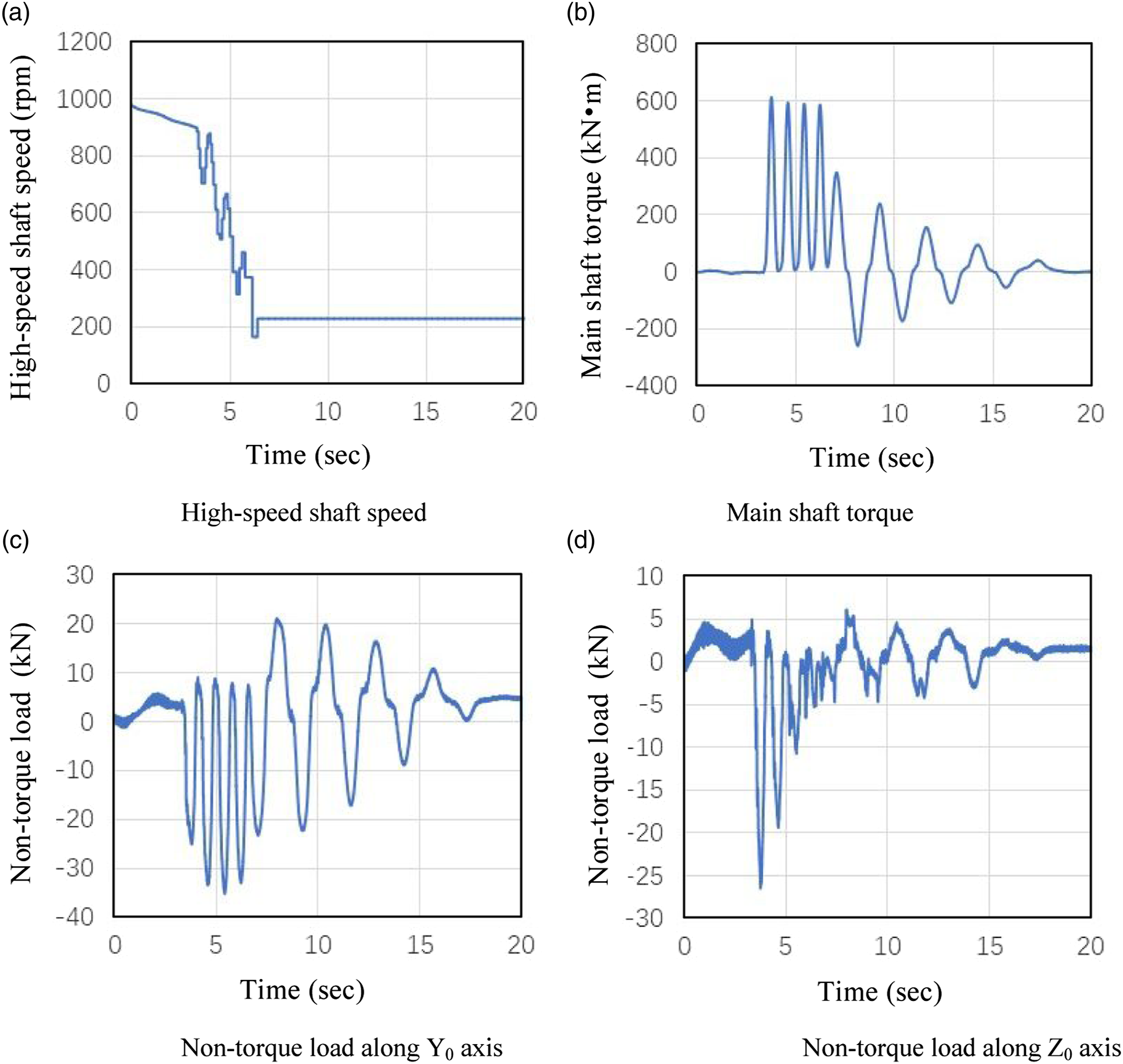
The above experimental data are input into the ADAMS software in the form of spline curves, and then the ADAMS-Simulink co-simulations are conducted to investigate vibration attenuation for the wind turbine gearbox with three-point suspensions under the shutdown case.
If there is no the vibration absorber, the vibration response of the wind turbine gearbox is shown in Figure 28. It can be seen that the speed fluctuations and torque fluctuations in the shutdown case may excite the strong vibration of the wind turbine gearbox. Vibration response of wind turbine gearbox without vibration absorber. (a) Pitch vibration (b) Yaw vibration.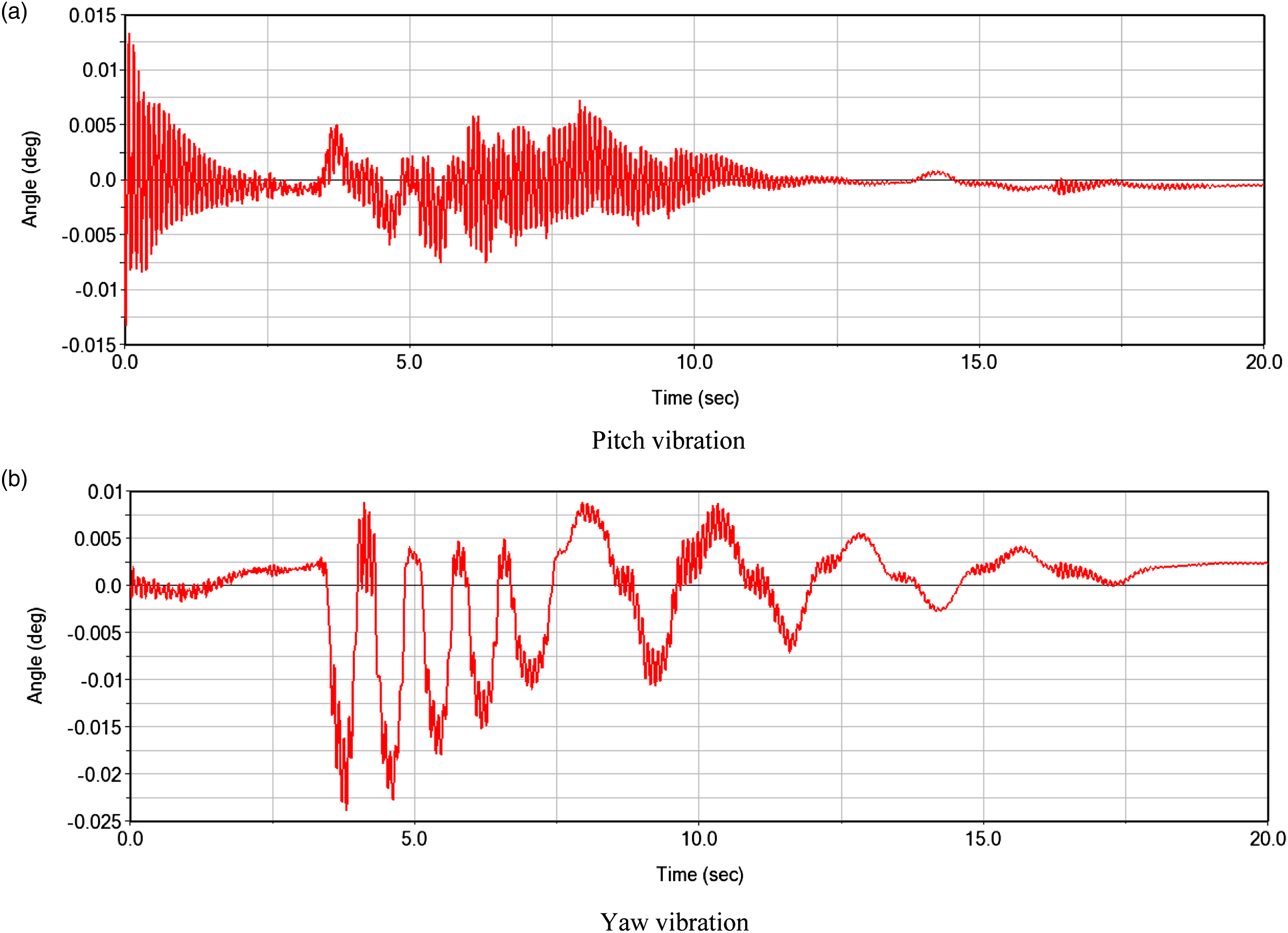
If the vibration absorber is introduced and the appropriate damping is adopted, the pitch vibration and yaw vibration of the wind turbine gearbox is shown in Figure 29. Vibration response of wind turbine gearbox with vibration absorber. (a) Pitch vibration (b) Yaw vibration.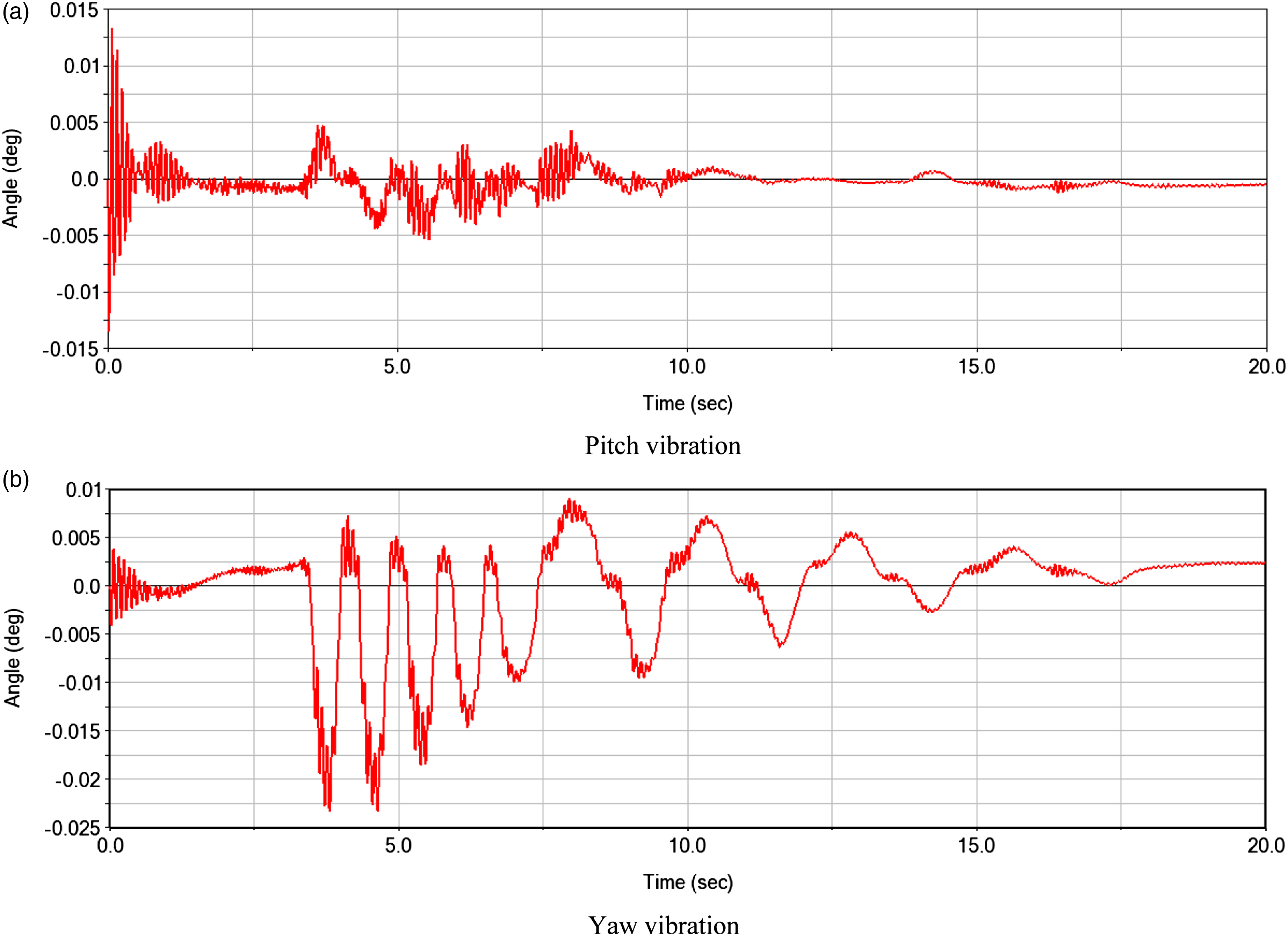
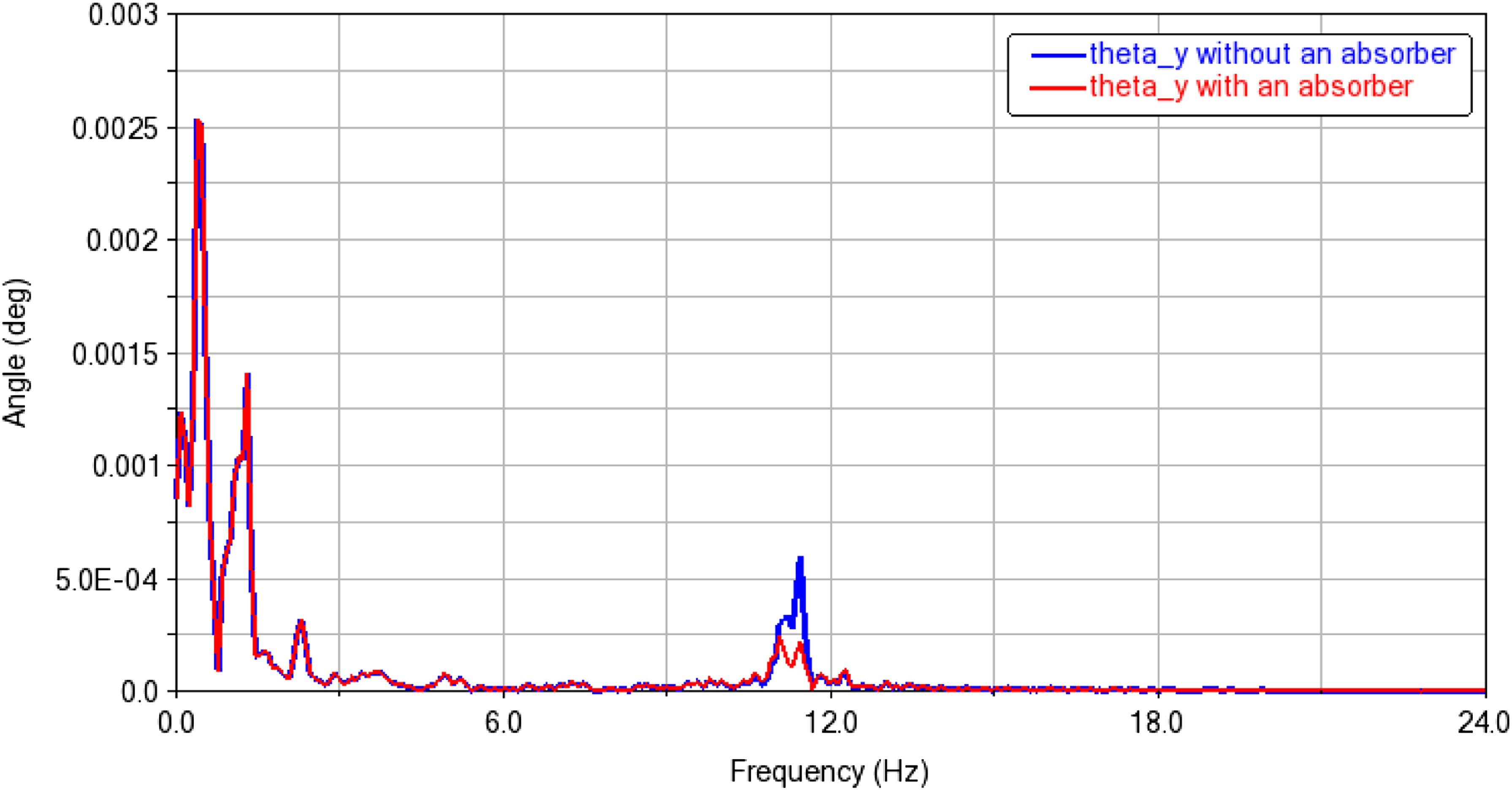
For clarity, the pitch vibration response truncated from 6 to 12 s is compared in time domain, as shown in Figure 30. It can be seen that the pitch vibration response of the wind turbine gearbox can be effectively alleviated by the vibration absorber. In frequency domain, the pitch vibration response of the wind turbine gearbox is shown in Figure 31. The pitch vibration energy mainly converges on the neighborhood of the low frequency 0∼2 Hz and the natural pitch frequency 11.3 Hz. Compared with the low frequency vibration, the pitch vibration near the natural pitch frequency may severely influence the reliability and service life of the wind turbine gearbox. When the vibration absorber is effective, it can be seen that the vibration response in 11.06 Hz and 11.44 Hz has been decreased by 22.6% and 64.2%, respectively. It is proven that the suggested method can effectively reduce the pitch vibration of the wind turbine gearbox near the natural pitch frequency. Comparison of pitch vibration response with and without vibration absorbers in time domain. Comparison of pitch vibration response with and without vibration absorbers in frequency domain.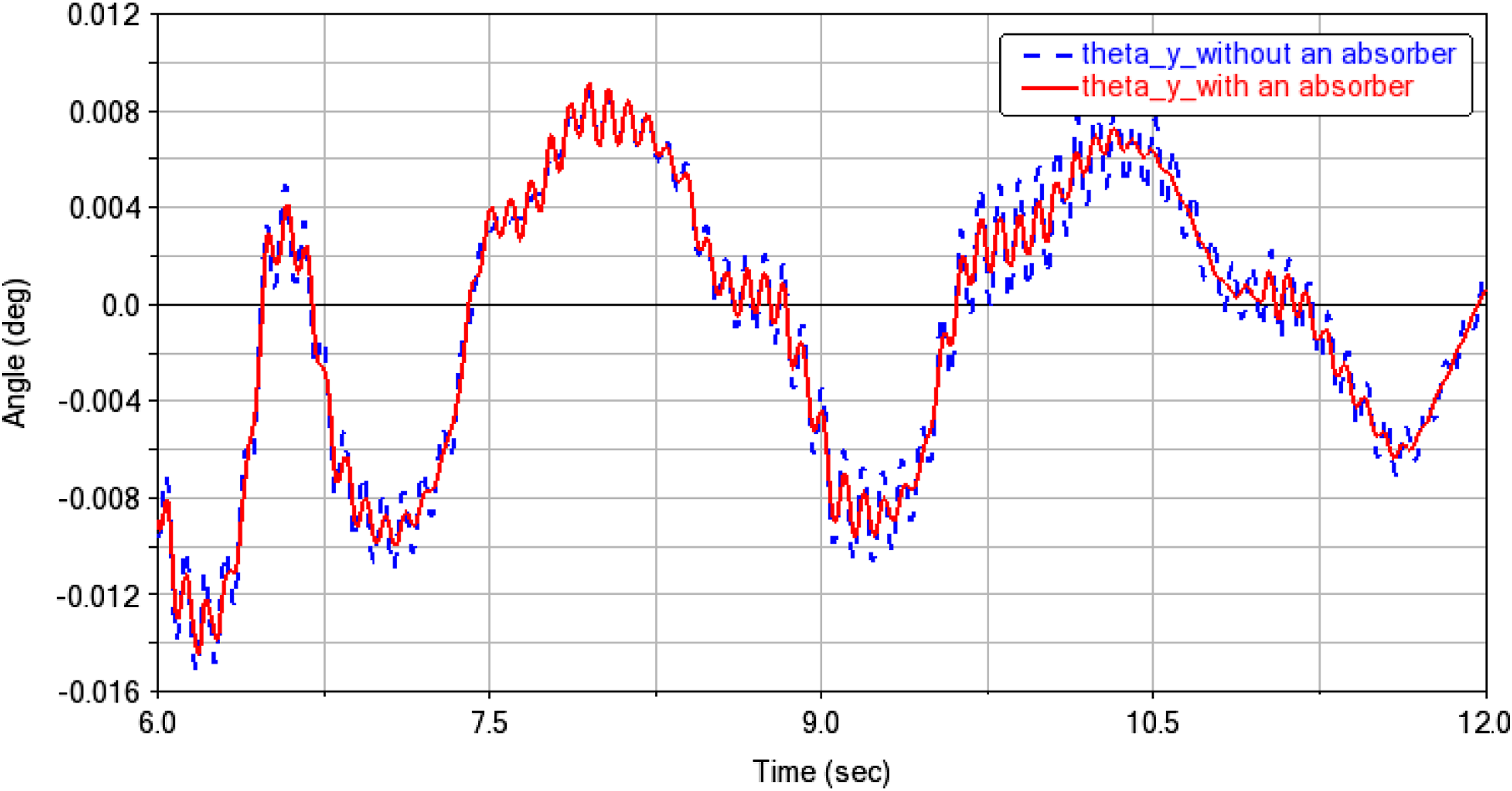
Similarly, the yaw vibration response truncated from 4 to 16 s is compared in time domain for clarity, as shown in Figure 32. It can be seen that the yaw vibration response of the wind turbine gearbox can be effectively alleviated by the vibration absorber. In frequency domain, the yaw vibration response of the wind turbine gearbox is shown in Figure 33. The yaw vibration energy mainly converges on the neighborhood of the low frequency 0∼2 Hz and the natural yaw frequency 11.3 Hz. Compared with the low frequency vibration, the yaw vibration near the natural yaw frequency may severely influence the reliability and service life of the wind turbine gearbox. When the vibration absorber is effective, it can be seen that the vibration response in 11.25 Hz has been decreased by 84.2%. It is proven that the suggested method can effectively reduce the yaw vibration of the wind turbine gearbox near the natural yaw frequency. Comparison of yaw vibration response with and without vibration absorbers in time domain. Comparison of yaw vibration response with and without vibration absorbers in frequency domain.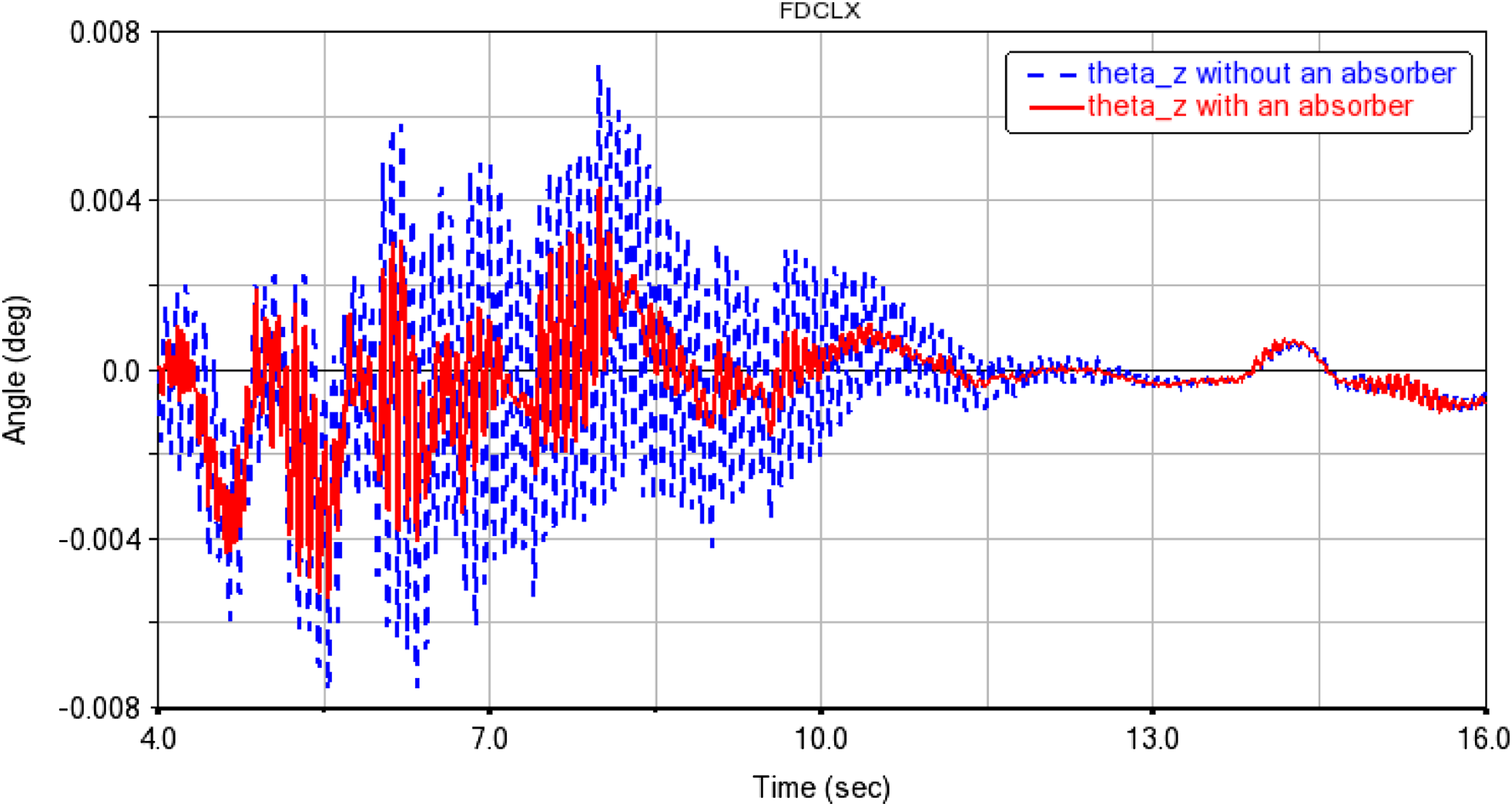
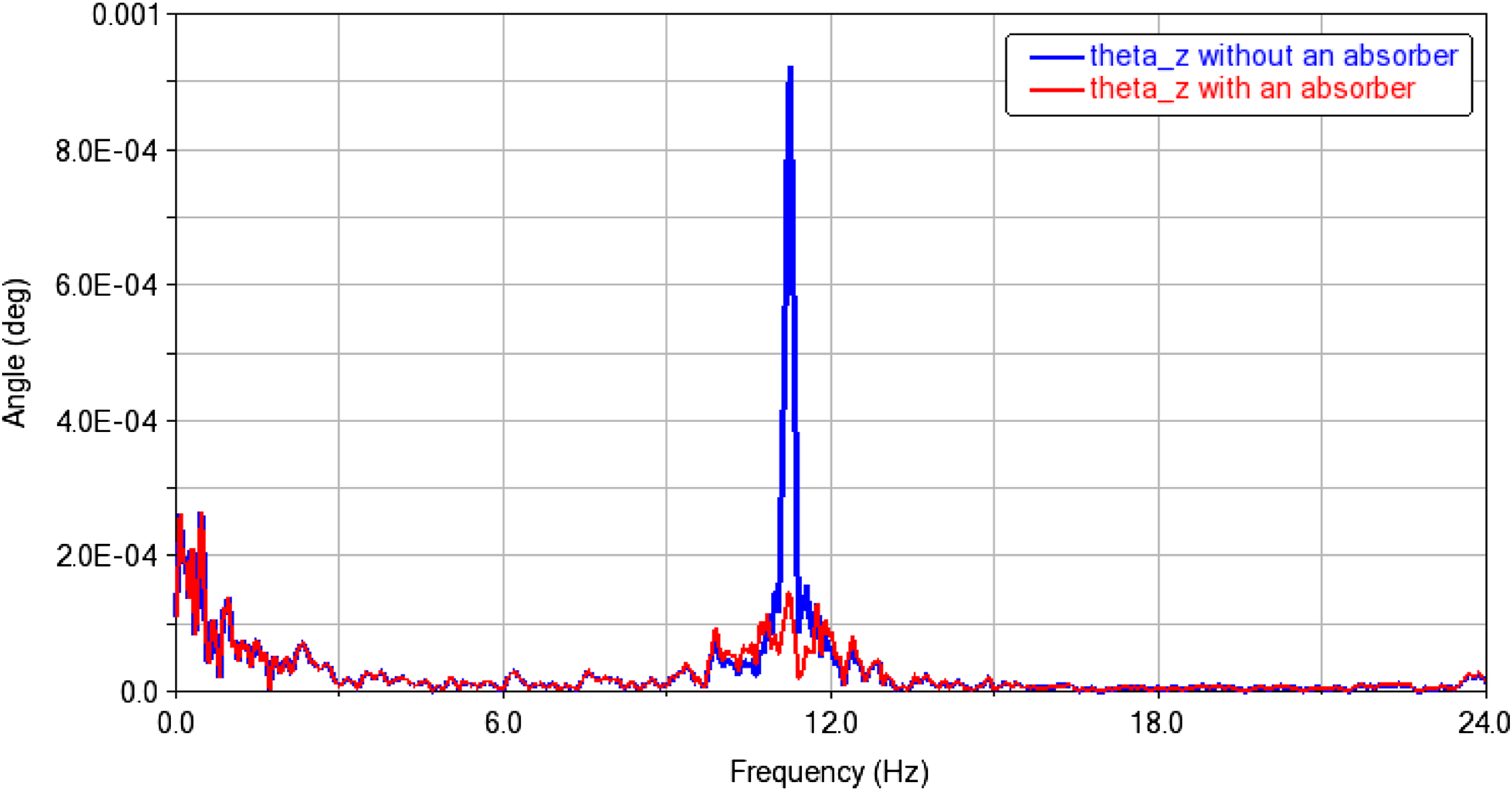
In conclusion, the proposed method can effectively alleviate the harmful pitch vibration and yaw vibration of the wind turbine gearbox under the shutdown case.
Discussion of results
The aim of this study is to put forward a vibration absorption method based on modal interaction to alleviate the whole-body vibration of the wind turbine gearbox with existing flexible suspensions. In order to verify this method, two key issues need to be examined, that is, the establishment of internal resonance and the effect of vibration reduction. To this end, a series of simulations are conducted. First, internal resonance is validated to be able to be established successfully. As shown in Figure 13 and Figure 14, vibration energy has been exchanged between the pitch mode of the wind turbine gearbox and the rotation mode of the vibration absorber. Second, the influence of the damping of the vibration absorber is investigated. As indicated in Figure 16, Figure 17,andFigure 18, the damping of the vibration absorber can effectively alleviate the pitch vibration response of the wind turbine gearbox when the internal resonance has been established, and appropriate damping is required to obtain the best vibration reduction performance. In conclusion, these simulation results have demonstrated that the internal resonance can be used to establish modal interaction and decrease the vibration response of the wind turbine gearbox.
To further verify the effectiveness of the proposed method, a large number of test data about a real wind turbine gearbox are used in the virtual prototyping simulations, as shown in Figure 20 and Figure 27. Under each representative operating condition, speed fluctuations and torque fluctuations can excite the strong vibration of the wind turbine gearbox, as indicated by Figure 21 and Figure 28. If the vibration absorber is introduced and the appropriate damping is adopted, the pitch vibration and yaw vibration of the wind turbine gearbox in time domain and frequency domain are obtained, respectively. Especially, Figure 23 and Figure 24 compare the pitch vibration responses of the normal power production case with and without vibration absorbers; Figure 25 and Figure 26 compare the yaw vibration responses of the normal power production case with and without vibration absorbers; Figure 30 and Figure 31 compare the pitch vibration responses of the shutdown case with and without vibration absorbers; Figure 32 and Figure 33 compare the yaw vibration responses of the shutdown case with and without vibration absorbers. It is proven that the suggested method can effectively alleviate the harmful pitch and yaw vibration of the wind turbine gearbox under the normal power production case and the shutdown case.
Conclusions
In this paper, a vibration absorption method based on modal interaction is put forward to alleviate the whole-body vibration of the wind turbine gearbox with flexible suspensions. Through modal interaction analysis, the necessary and sufficient condition of the establishment of internal resonance is derived, and system stability is proven. As a result, the vibration energy of the wind turbine gearbox can be transferred to the vibration absorber mode via modal interaction and dissipated by the damping of the vibration absorber mode. To verify the effectiveness of the proposed method, a large number of test data about a real wind turbine gearbox are used in the virtual prototyping simulations. Two representative operating conditions, that is, the normal power production case and the shutdown case, are examined. The simulation results have demonstrated that the suggested method can effectively alleviate the harmful pitch and yaw vibration of the wind turbine gearbox under complicated operating conditions.
Compared with conventional vibration absorption methods, the proposed method exhibits the following novel characteristics. (1) It sufficiently utilizes modal coupling rather than linear compensation, and thus can be used to deal with nonlinear vibration problems. (2) It is designed in terms of the controlled mode of the wind turbine gearbox rather than external excitations, and thus is suitable for applications in a complicated working environment subjected to unknown or variable external excitations. (3) It aims to transfer and dissipate vibration energy based on modal interaction rather than suppress vibration via external energy, and thus can effectively deal with strong vibration problems.
In conclusion, the proposed method possesses potential advantages in alleviating the strong vibration of the wind turbine gearbox caused by unpredictable or variable external excitations in a complicated working environment. In the near future, we will carry out experimental research on this proposed method.
Footnotes
Declaration of conflicting interests
The author(s) declared no potential conflicts of interest with respect to the research, authorship, and/or publication of this article.
Funding
The author(s) disclosed receipt of the following financial support for the research, authorship, and/or publication of this article: This research was supported by National Key R&D Program of China (No. 2019YFB2004601).
