




Abstract
In order to monitor the wind turbine gearbox running state effectively, a fault diagnosis method of wind turbine gearbox is put forward based on wavelet neural network. Taking a 1.5 MW wind turbine gearbox as the target of study, the frequency spectrum of vibration signal and the fault mechanism of driving part are analyzed, and the eigenvalues of the frequency domain are extracted. A wavelet neural network model for fault diagnosis of wind turbine gearbox is established, and wavelet neural network is trained by using different feature vectors of fault types. The relationship between fault component and vibration signal is identified, and the vibration fault of wind turbine gearbox is predicted and diagnosed by network model. The analysis results show that the method can diagnose fault and fault pattern recognition of wind turbine gearbox very well.
Introduction
Because the drivetrain of the wind turbine includes the components that directly convert the rotational kinetic energy from the wind to electrical energy, it is essential to ensure the reliability of the design of the transmission system to prevent the downtime of the wind turbine. As the core component of the wind turbine, the gear transmission system is characterized by the following characteristics: First, the wind turbine works in a random wind field and its external load of the gear transmission system is also random. Second, any small changes in input will enlarge several hundred times in the output side due to its large transmission ratio.1–4 Therefore, the tiny fluctuations of design parameters, manufacture errors, or assemble errors will have a very negative impact on the stability and reliability of gear transmission system. Meanwhile, due to the specific factors, such as overhead, difficult installation, and maintenance of the wind turbine gearbox, it is of great significance to the stable and reliable operation of the wind turbine if it can be accurately judged in the early stage of the wind turbine.
Vibration parameters of gearbox in the operation process of wind turbine are important indexes evaluating the working performance of gearbox.5,6 The vibration signal will happen abnormally and the vibration signal energy is also in an unstable state which is significantly different from normal working order when the gearbox failure happens.7–10 In recent decades, with the rapid development of computer technology, many scholars have further studied the problem and put forward various methods.11,12 Teng et al. 13 used cepstrum analysis to diagnose the fault of gearbox of wind turbine, but it is difficult to determine the location and type of fault. The change of gear tooth stiffness and amplitude modulation of gear box vibration signal under variable load are analyzed by Chaaria et al., 14 and the fault diagnosis is made by combining short time Fourier transform and Wigner–Ville distribution. Bai and Wang 15 put forward an early wear fault diagnosis method for fan gear based on EMD and SVM, but the accuracy is low. Barszcz et al. 16 proposed a method based on spectral kurtosis of vibration signals to diagnose tooth faults on planetary gears of fan gearboxes. Zappalá et al. 17 employed the side band algorithm to automatically diagnose fan gearbox faults and applied the algorithm to the actual fan successfully. Because wind turbine is in a special condition of variable load and strong impact for a long time, the vibration signal of gear box is usually nonlinear and nonstationary signal. It is difficult to extract the characteristic parameters of the gear box by traditional method. The single characteristic parameter extracted is difficult to effectively judge the running state of the gear box. Therefore, it is necessary to research on signal analysis method incorporating multiple characteristic parameters and through the comprehensive analysis of various signals to catch early signs of faults and identify the location of faults.
In order to realize the condition monitoring of wind turbine gearbox and the prediction and diagnosis of early nonsignificant fault symptoms, combining the wavelet analysis theory with the neural network theory, the wavelet space is used as the feature space of the pattern recognition, the signal features are extracted by the wavelet analysis, and then the extracted features are sent to the neural network for processing. Taking the gear box of wind turbine as the object, the frequency spectrum of the vibration signal and the fault mechanism of the driving part are analyzed. The characteristic values of the frequency domain are extracted, and the mapping relation between the eigenvalues of the spectrum is established.
The paper is structured as follows: In the next section, a fault diagnosis method based on wavelet analysis and neural network is proposed. Extraction of fault features based on wavelet packet is shown in the subsequent section. In the following section, a wavelet neural network model of wind turbine gearbox is established. And in “Fault diagnosis experiment of wind turbine gearbox” section, fault diagnosis and experimental research of gearbox for wind turbine is carried out. The paper is summed up in the final section.
Wavelet analysis and neural network
The wavelet transform provides a time–frequency window changing with frequency, which can provide a local analysis of time (space) frequency.18 It can gradually lead to multiscale refinement of signal (function) through the translation and scaling operations, and ultimately achieve time segment in high frequency and frequency segment in low frequency to provide a new method of signal analysis which can automatically adapt to the time–frequency transform analysis. 14
Assume that


Scale and translate the wavelet basis function

For arbitrary function

The wavelet neural network is a hierarchical multiresolution artificial neural network based on wavelet analysis theory. It combines wavelet decomposition with feedforward neural network and uses the wavelet function to replace the hidden node function of traditional single hidden layer neural network, and corresponding weights and thresholds of input layer to hidden layer have been replaced by scaling and translation parameters of wavelet function, respectively. Then, the connection between the wavelet transform and neural network is set up using affine transformation.
15
In general, the multidimensional input signal

In this paper, we take the Morlet function as the wavelet basis function, and the formula can be represented as

By using the sigmoid function as the excitation function of output layer, the formula can be represented as

Extraction of fault features based on wavelet packet16
The drive system of wind turbine gearbox is composed of gear, transmission shaft, bearing, and other components. The vibration signal of components will be abnormal when the wind turbine failure occurs. Therefore, extracting the fault signal containing the corresponding frequency from the normal vibration signal is the premise of gearbox fault diagnosis. The characteristic frequency of fault signal is determined by the type of fault, speed, and component parameters and the formula can be represented as

The wavelet packet function can simultaneously decompose the high- and low-frequency signals of each structure layer. When the discrete signal is spread based on the constructed wavelet packet, the frequency range of original function can be decomposed into 2n bands with the same size. If sampling frequency and decomposition level are enough, the smaller frequency difference will fall in different frequency bands, and the signal can be accurately analyzed.
The wavelet packet decomposition algorithm of discrete signal can be expressed as

Vibration signal often contains some noise components and it is necessary to denoise with the collected vibration signal. Threshold selection is a key step in the process of wavelet denoising. In this article, we select manageable soft threshold as

After the denoising process, the low-frequency approximation coefficient and the high-frequency detail coefficient are reconstructed, and the time-domain signal characteristics of each frequency band are extracted.19 The wavelet packet reconstruction algorithm can be expressed as

According to Parseval energy integral formula, the energy of signal

The wavelet transform of

According to Parseval theorem, we can get

According to formula (10), the wavelet transform coefficient

In order to facilitate the research, normalize formula (15) to extract the feature vector of wavelet packet
20

Wavelet neural network model of wind turbine gearbox
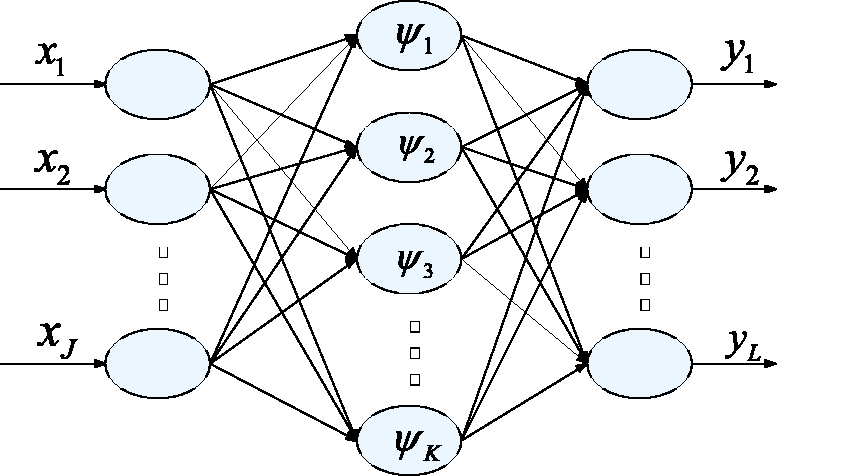
According to the characteristic of wavelet function and the relationship between factor and index in system fault diagnosis, the structure model of wavelet neural network is set up as shown in Figure 1.
The structure model of wavelet neural network.
In Figure 1, the input layer node is J, the number of nodes in hidden layer is K, and the output layer node is L. The activation function of the hidden layer is wavelet basis function. The number of nodes in input and output layers directly affects the construction of wavelet neural network model. If the number of nodes is too large, the structure of the wavelet neural network will be more complex and contain more noise information.
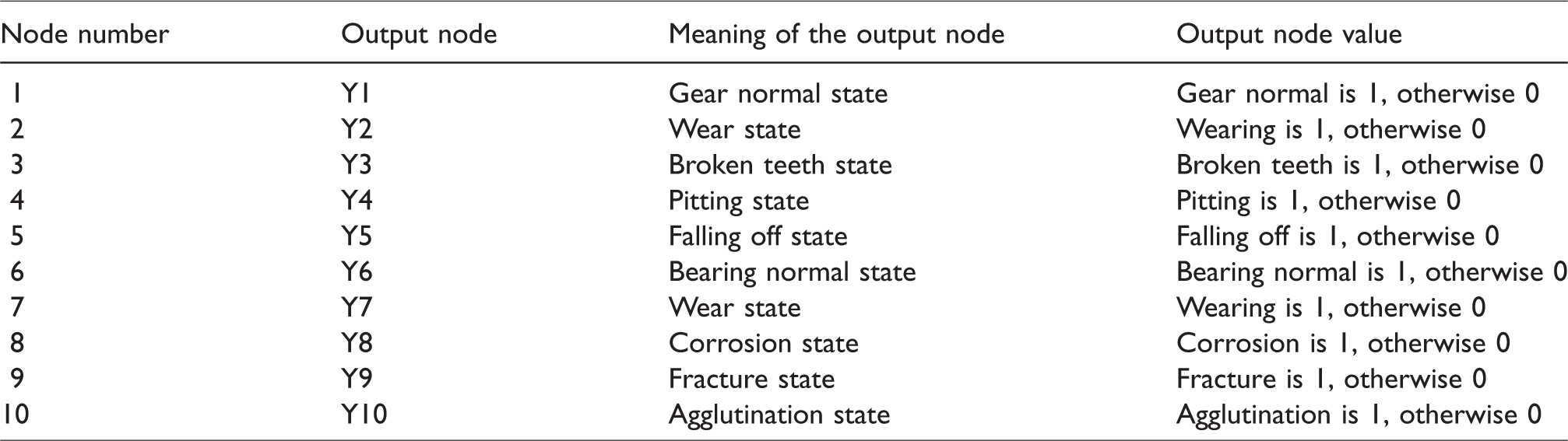
At present, the fault of gear box occupies a large proportion in the operation of wind turbines, and the failure rate of some wind gearboxes is as high as 40–50%. In gearbox failure, the probability of gear breakage and tooth surface fatigue failure is high and other common faults are pitting, falling off state, bearing failure, and so on.21 In this paper, five fault models of the fault of the wind turbine gearbox are selected, including the normal state, wear state, broken teeth state, pitting state, falling off state, and five fault modes of bearing, including the normal state, wear state, corrosion state, fracture state, agglutination state, as the research objects. So the number of nodes at the input layer is 10 and the number of nodes at the output layer is 10. Fault modes are shown in Table 1.
The category of gear box fault mode.
The function of hidden layer is to realize the signal conversion between input layer and output layer. The number of hidden layers is not only related to the fault mode, but also to the complexity of the input variables. The more the number of hidden layers, the longer the training time. In this paper, we choose the wavelet neural network with only one hidden layer. The number of hidden layer nodes is determined according to formula (17)

In order to ensure the training speed of the network, this paper selects the initial value of the weights between [−1,1].
Fault diagnosis experiment of wind turbine gearbox
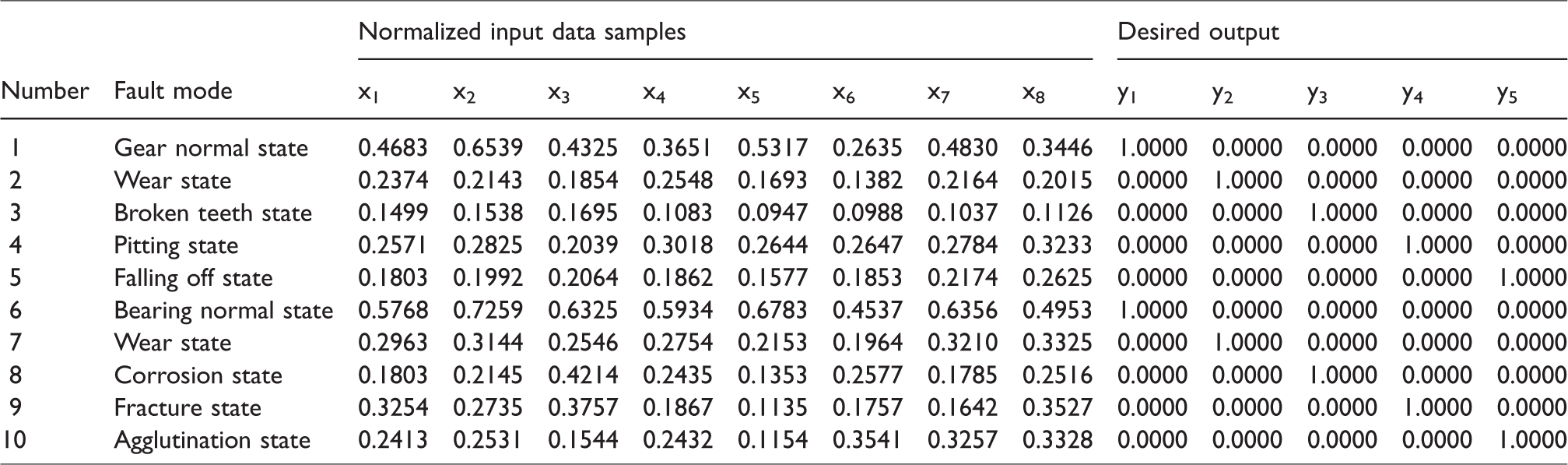
The signals under various working conditions are decomposed into three-layer wavelet by Daubechies wavelet. The signal characteristics of the eight frequency components are extracted from third layers in turn from low-frequency to high-frequency level, and the extracted signals are normalized and then used as input samples for wavelet neural network. The normalized input data samples and output target data are shown in Tables 2 and 3.
The training samples.
The output of training samples and EMD method.
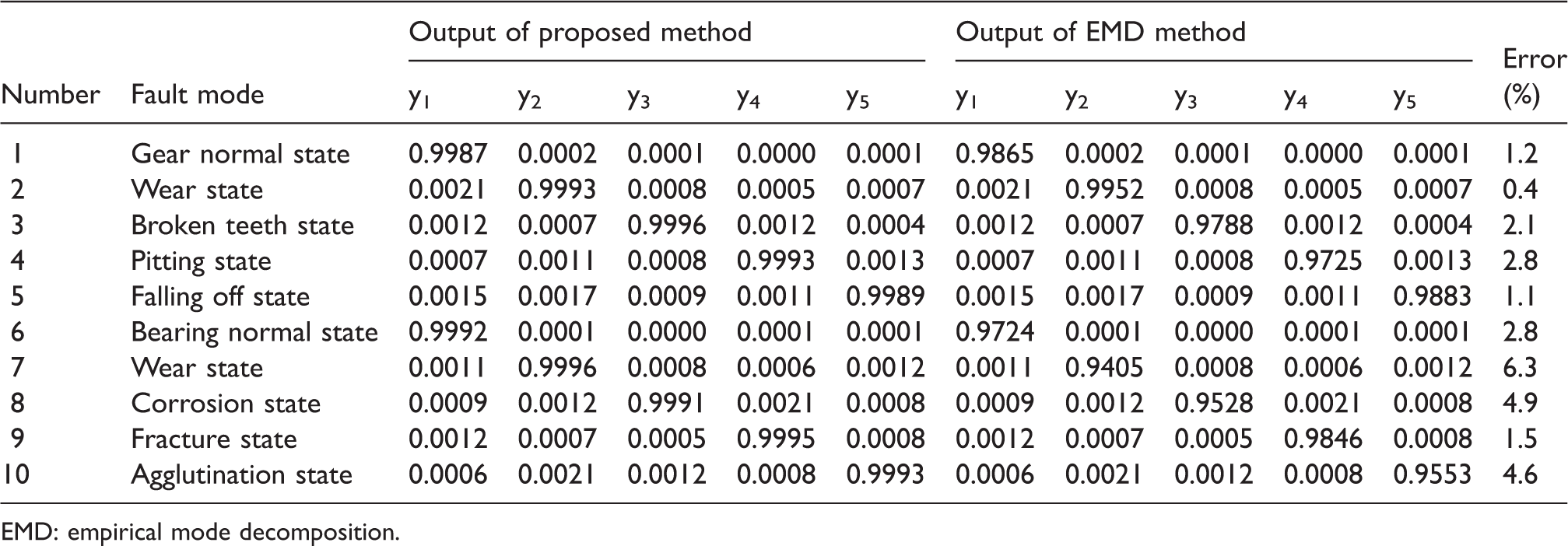
EMD: empirical mode decomposition.
In this paper, we take a 1.5 MW wind turbine gearbox as the research object. As shown in Figure 2, the test bench consists of drive motor, torque speed sensor, coupler, tested gearbox, accompanying gearbox, load motor, etc. The entire drive motor, back-to-back gearbox, and load motor are connected with coupler installed on a platform. The load motor and tested gear box are connected with elastic coupler, so are the drive motor and accompanying gear box. These two gearboxes are connected with universal coupling.
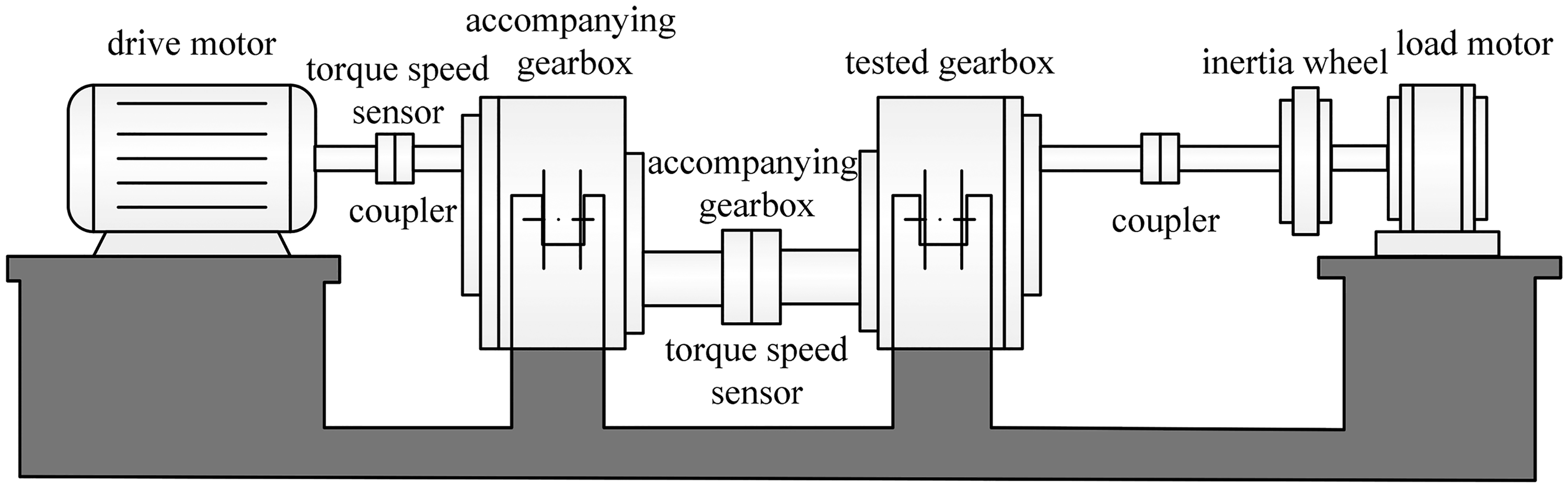
The test bench of wind turbine gear transmission system.
The vibration test bench layout of gear transmission system is shown in Figure 3. Required test equipment include B&K 4382 acceleration sensor, B&K2635 charge amplifier, LMS digital data acquisition system, and LMS Test.Lab signal processing system. The vibration signal is picked up by the acceleration sensor, and then collected and analyzed by LMS data acquisition system after amplified by the charge amplifier to get all the vibration samples.
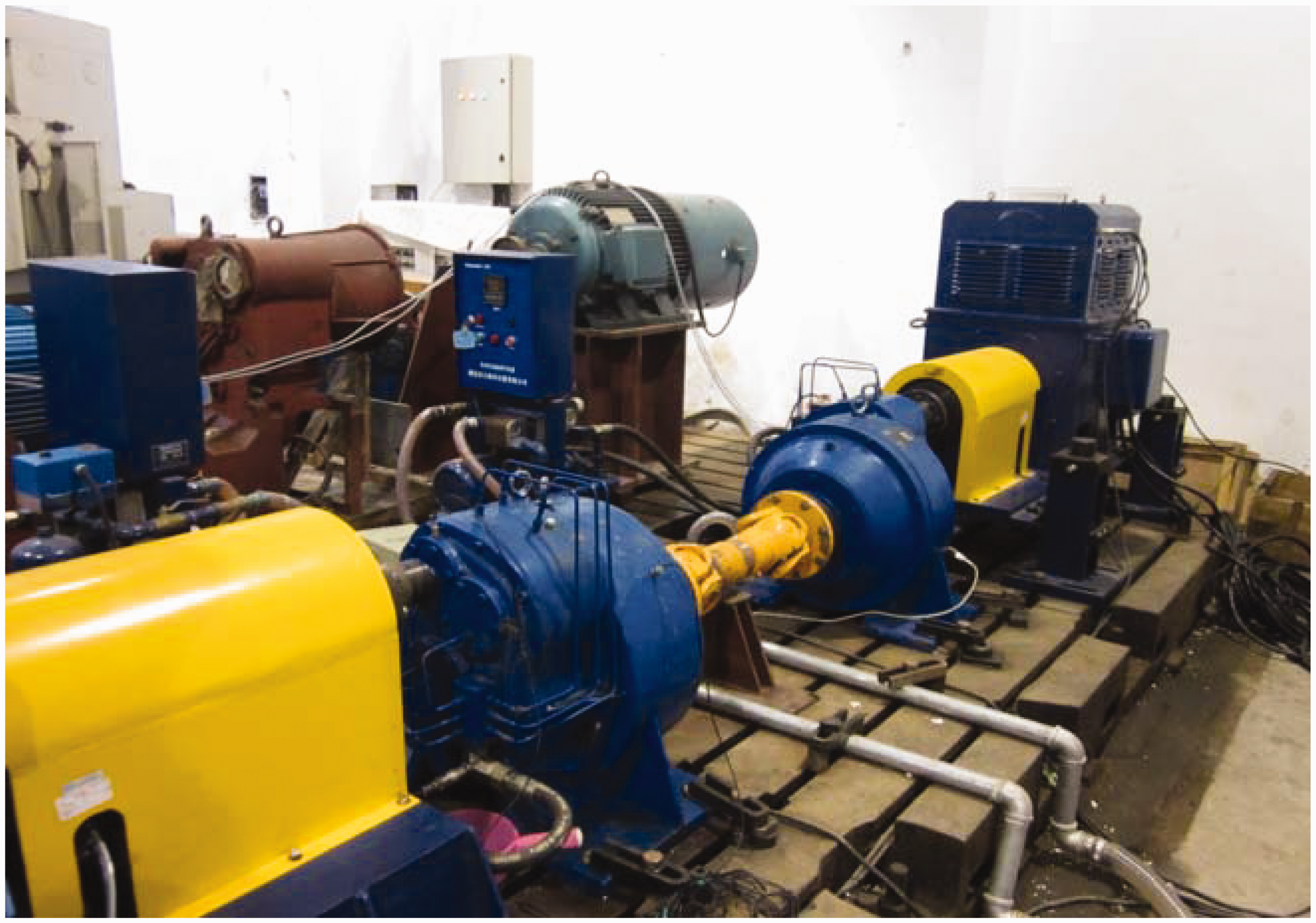
The picture of wind turbine gearbox test system.
The test points of gearbox are the output bearing of high-speed level, the output bearing of middle-speed level, gear ring, and the input bearing of low-speed level. As shown in Figure 4, the sampling frequency is 12,800 Hz and the sampling length is 6280. Collect the signal date of each point under 1440 r/min for 10 kinds of mode of gear and bearing in turn. The basic components of vibration test system are shown in Figure 5.
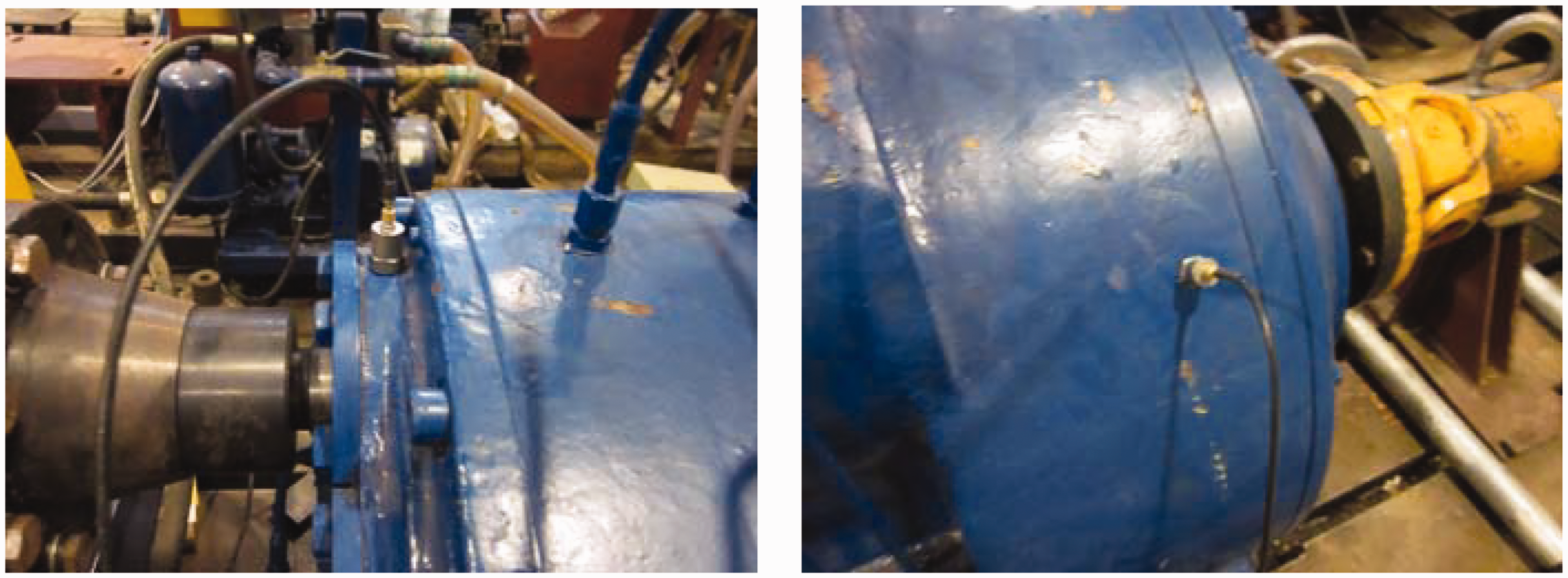
The picture of test points.
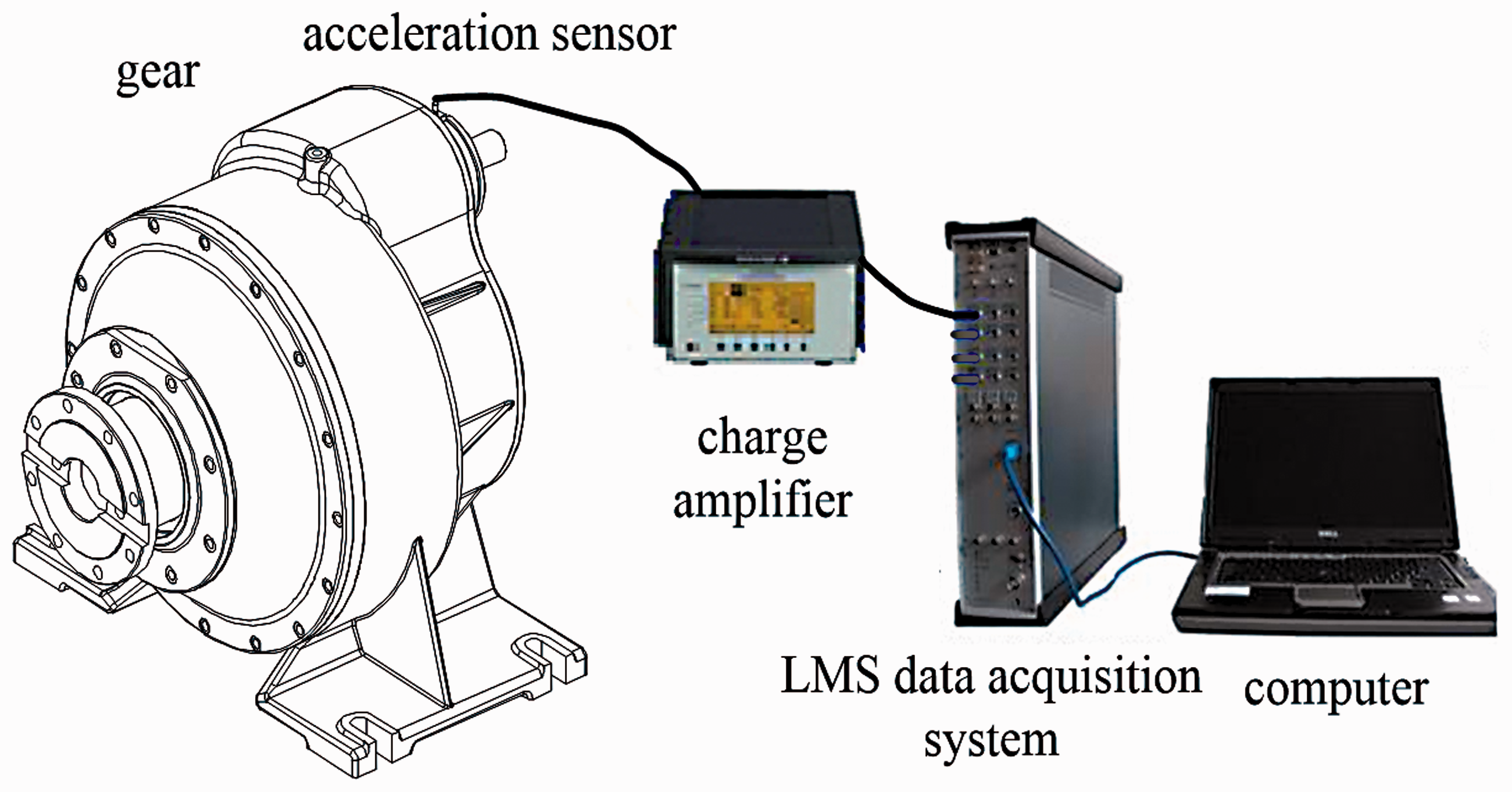
The basic components of vibration test system. LMS: learning managed systems.
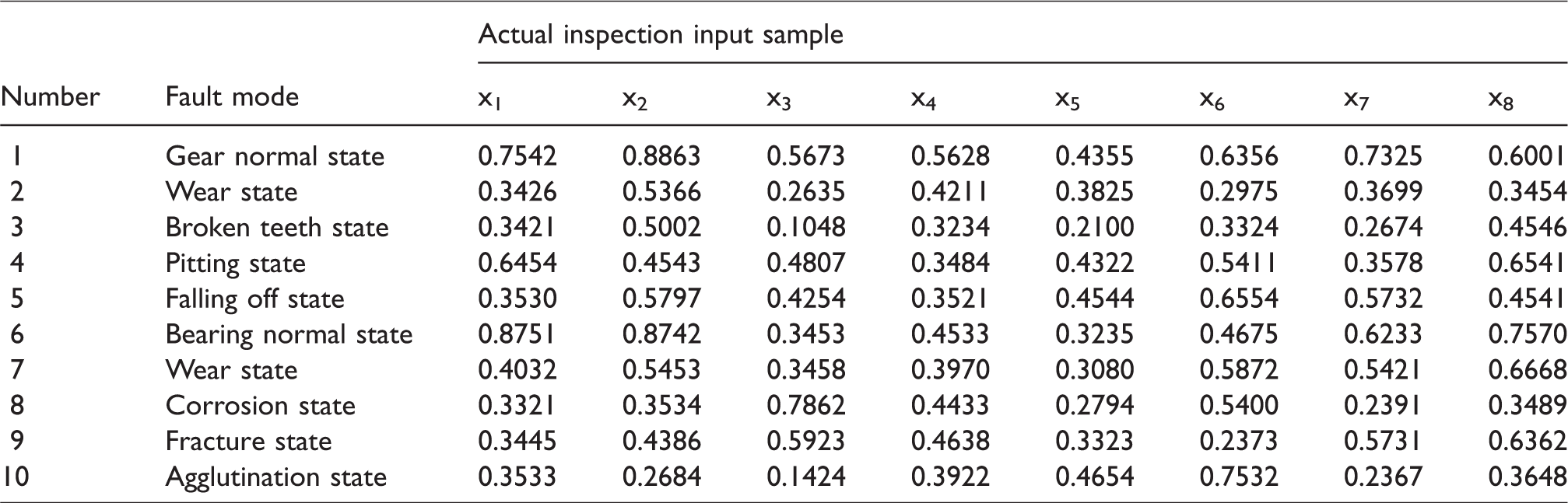
In order to compare and analyze the sampled signals, a measurement point is selected to get multiple measurement results and fault analysis is carried out successively. Wavelet transform and noise reduction are applied to the 10 kinds of fault mode data and bearing sample data sets for single reconfiguration. Then we can get actual inspection input sample as shown in Table 4. The trained wavelet neural network model is used for diagnosis and analysis; the diagnosis results are shown in Table 5.
Actual inspection input sample.
Diagnosis results.
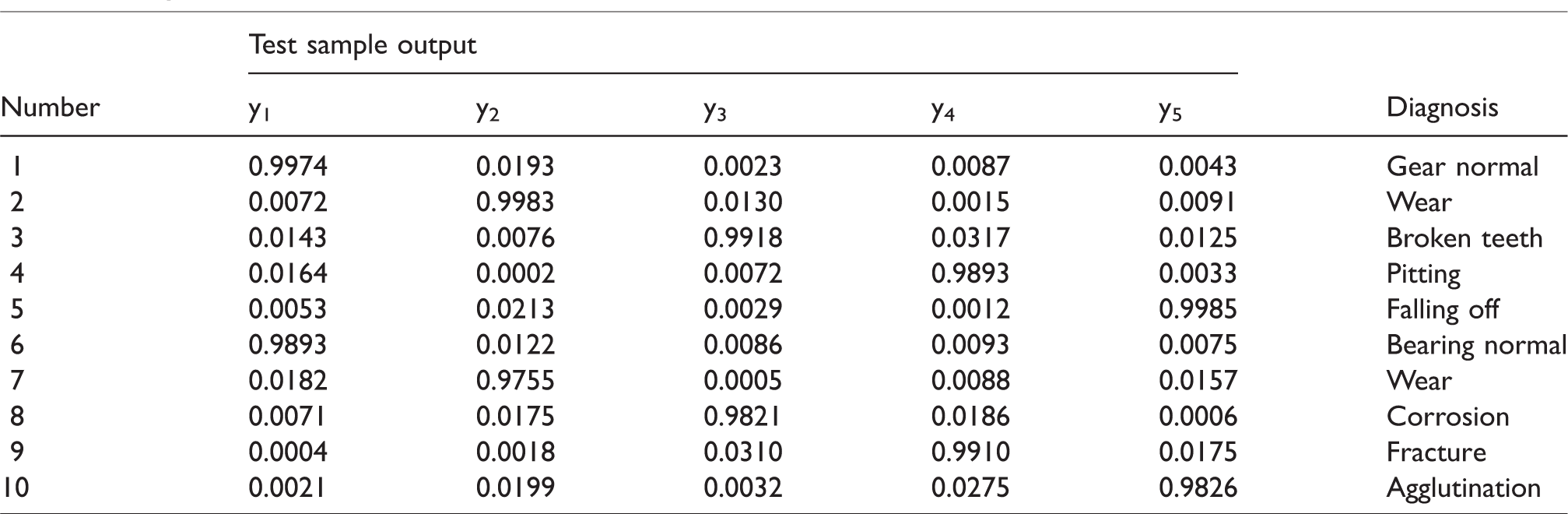
In order to verify the correctness of the proposed method, the training results are compared with the results of the empirical mode decomposition (EMD) method. The maximum error is only 6.3%, which is shown in Table 3. By contrasting the expected output in Table 3 and the actual output in Table 5, it can be seen that the output of trained wind gearbox wavelet neural network model basically coincides with the expected output. Moreover, it is closer to the experimental results than the EMD method. The diagnosis results show that the failure characteristics of wavelet neural network model system established in this paper have better recognition ability and can be used for the actual fault diagnosis of wind turbine gearbox.
Conclusion
Use Daubechies wavelet to deal with and analysis gear fault signal. Extract the fault features of gears based on the wavelet packet and take it as input of the wavelet neural network. Establish a wavelet neural network model used for wind turbine gearbox fault diagnosis, and use feature vector of different fault types to train the wavelet neural network. Identify the relationship between fault components and vibration signal, and use the network model to forecast and diagnose the vibration faults of wind turbine gearbox. Analysis results show that the method can well diagnose the fault and fault mode of the wind turbine gearbox, and make the diagnosis result reliable and achieve the expected result. As the scale of wind turbines continues to expand, monitoring data continues to accumulate. How to extract deep data from massive monitoring data and realize intelligent fault diagnosis will be the future research direction.
Footnotes
Acknowledgements
The constructive comments provided by the anonymous reviewers and the editors are also greatly appreciated.
Declaration of conflicting interests
The author(s) declared no potential conflicts of interest with respect to the research, authorship, and/or publication of this article.
Funding
The author(s) disclosed receipt of the following financial support for the research, authorship, and/or publication of this article: This work was supported by the Innovative Research Team Project of Henan Polytechnic University (T2017-3), the postdoctoral fund in China (2017M622342), the Doctor Funds for the Henan Polytechnic University (B2014-030), the key scientific research project of colleges and universities in Henan Province of China (17A460017), and the major scientific and technological research projects of Henan Province, China (171100210300–03).