Recently Shen suggested a modification of He’s frequency formulation using Lagrange interpolation with great success for the cubic-quintic Duffing oscillator. This paper proposed an alternative modification of He’s frequency formulation by dividing the oscillators into two extreme conditions when the amplitude is either extremely small or remarkably large, and He’s frequency formulation is used for each case, and a final frequency formulation is obtained by matching the two extreme conditions. Comparison of the approximate frequency with the exact one for various amplitudes shows good agreement.
Recently Shen studied the following cubic-quintic Duffing equation1
and obtain the following frequency-amplitude relationship
where . Eq.(2) is called as He’s frequency formulation.2–4 Eq.(2) gives large error when the amplitude tends to infinity, Shen1 overcame the difficult by choosing different location points:
where . By choosing different values of k and using the Lagrange interpolation, Shen1 obtained a much better result. He’s frequency formulation has been widely applied and extended to fractal vibration systems,5–8 many modifications were appeared.9–12 He’s frequency formulation can give a very fast insight into the physical properties of a complex oscillator, e.g. the MEMS oscillator.13–15
Modification of He’s frequency formulation
In this paper we consider two extreme conditions when and . Eq.(1) can be simplified as
and
Eq.(4) is the standard Duffing oscillator. By He’s frequency formulation,2–4 we have
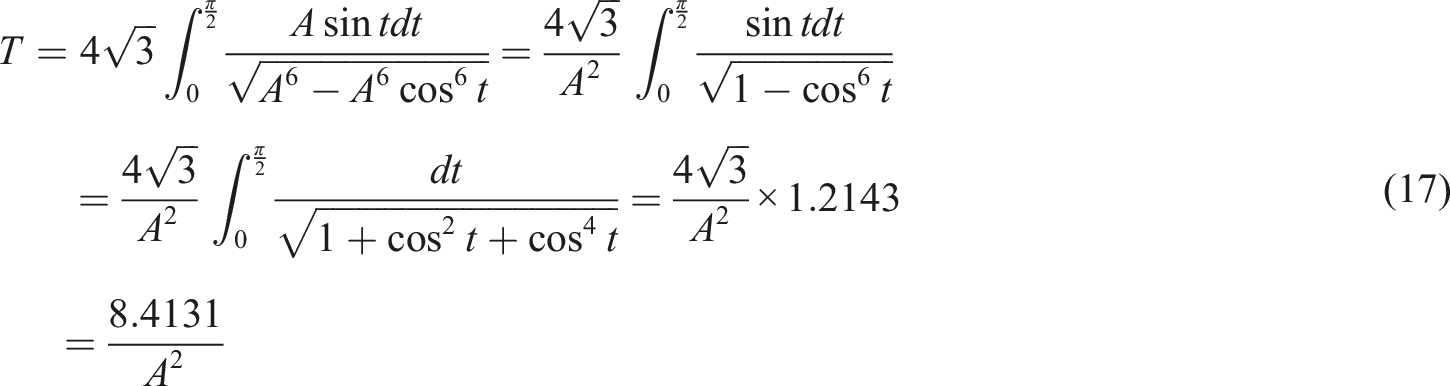
Eq.(7) leads to a large error when Fortunately Eq.(5) can be solved exactly with ease. We write Eq.(5) in the form
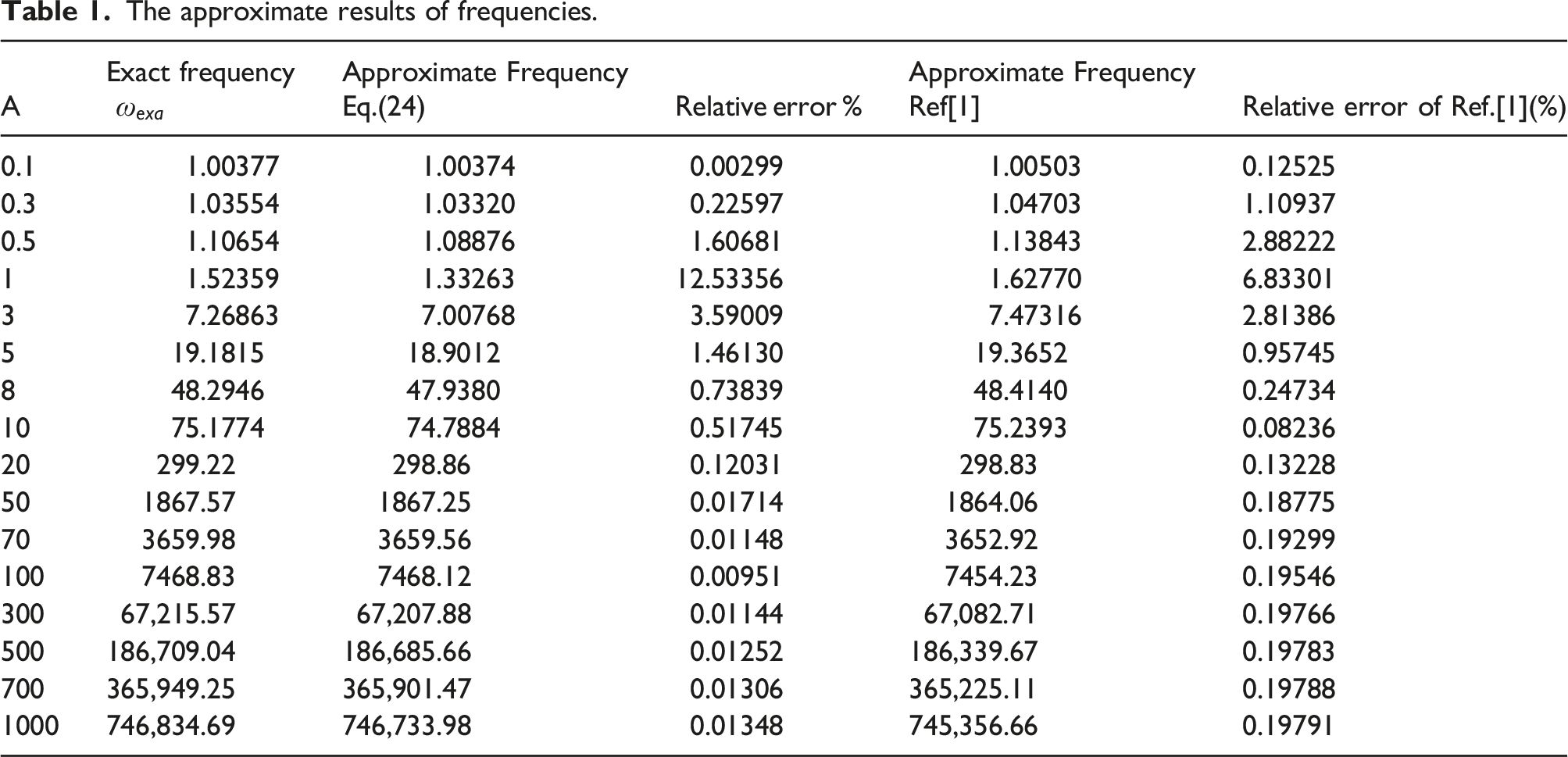
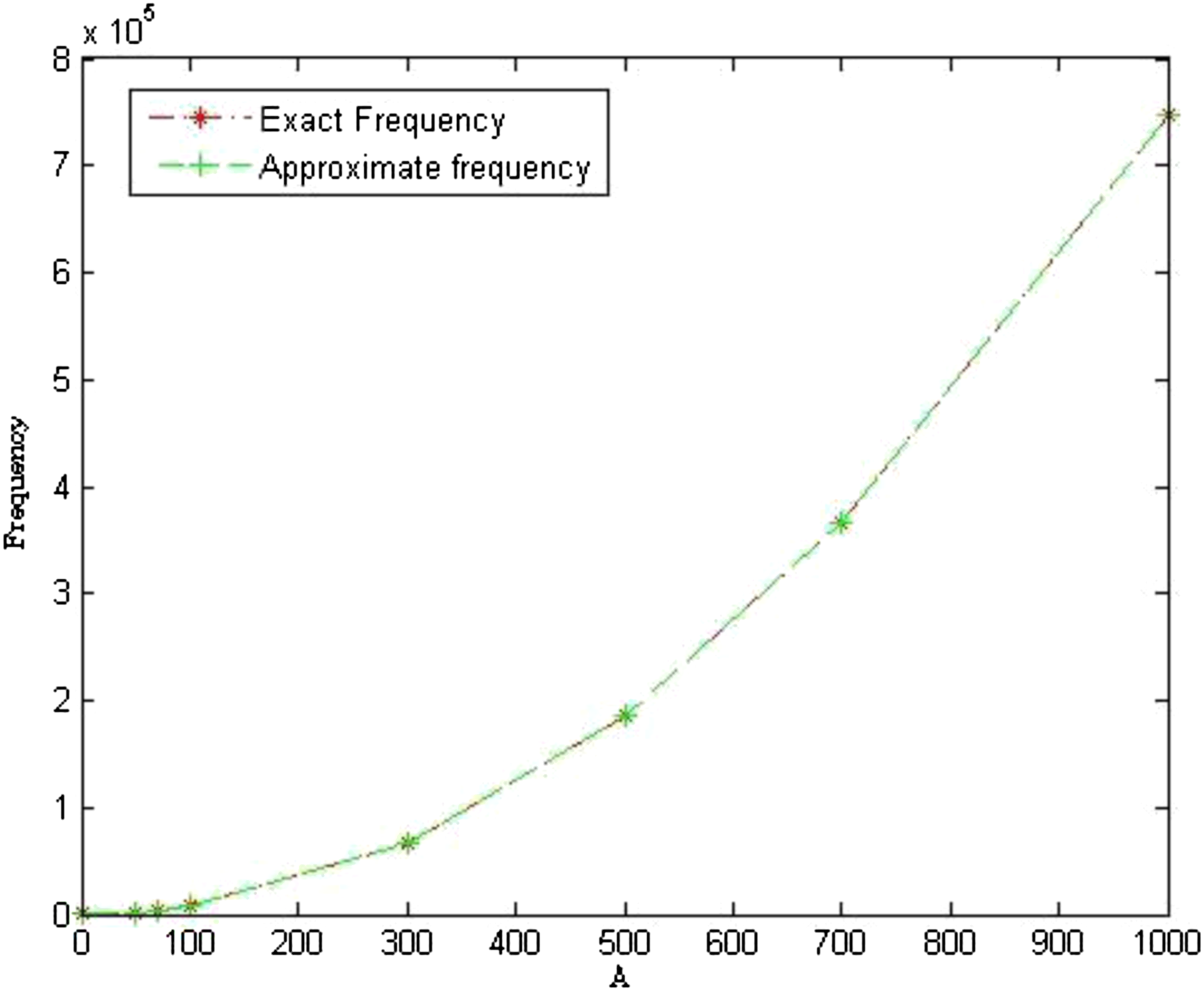
Comparison of the approximate frequency with the exact one.
Discussion and conclusion
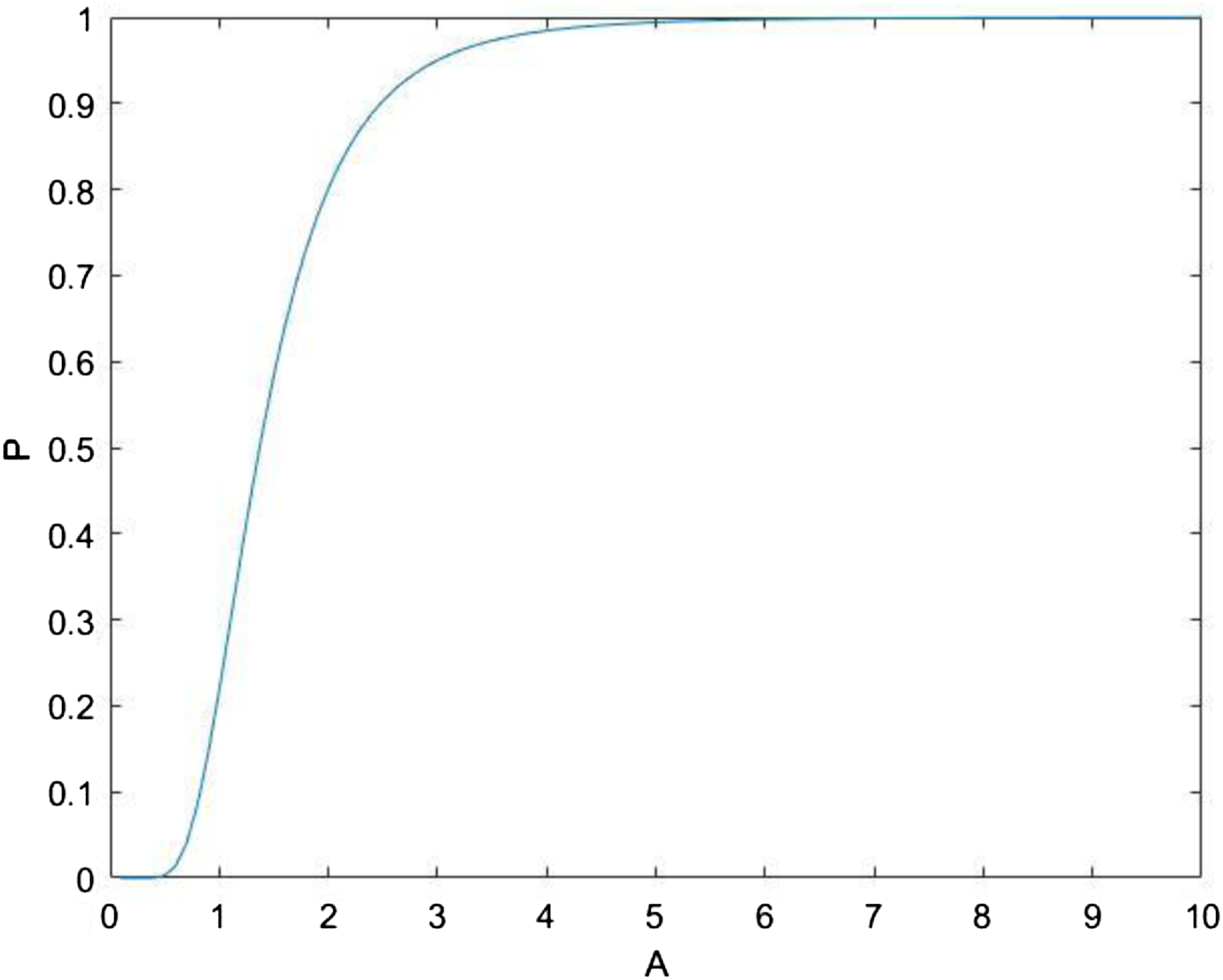
The matching theory is very famous in economics, and the matching technology in this paper reminders the well-known Nobel Matching, which is relative to the Nobel prizes to Al Roth and Lloyd Shapley.20 This paper suggests a totally new modification of He’s frequency formulation, which considers two extremes of A<<1 and A>>1. The late case leads to an exact frequency, while the former case sees a high accuracy when He’s frequency formulation is applied. The two extremes are then matched using a homotopy parameter. The results show the our results are much better than those given in Ref.[1]. The largest error occurs at A=1, this is the turning point for A<<1 and A>>1. The present modification can be applied to nonlinear oscillators with more than one nonlinear terms.21,22
Footnotes
Declaration of conflicting interests
The author(s) declared no potential conflicts of interest with respect to the research, authorship, and/or publication of this article.
Funding
The author(s) disclosed receipt of the following financial support for the research, authorship, and/or publication of this article: The work is supported by Shaanxi Provincial Education Department (No. 20JK0716) and Shaanxi Province Natural Science Fund of China (2021JQ-493).
ORCID iD
Hongjin Ma
References
1.
ShenY. The Lagrange interpolation for He's frequency formulation. J Low Freq Noise V A2021; 40: 1387–1391.
2.
HeJH. The simplest approach to nonlinear oscillators. Results Phys2019; 15: 102546.
3.
HeJHYangQHeCH, et al.A simple frequency formulation for the tangent oscillator. Axioms2021; 10: 320.
4.
HeJHKouSJHeCH, et al.Fractal oscillation and its frequency-amplitude property. Fractals2021; 29: 2150105.
TianY. Frequency formula for a class of fractal vibration system. Rep Mech Eng2022; 3(1): 55–61.
7.
HeJHMoatimidGMZekryMH. Forced nonlinear oscillator in a fractal space. Facta Univ-Ser Mech. DOI: 10.22190/FUME220118004H
8.
HeJHEl-DibYO. A tutorial introduction to the two-scale fractal calculus and its application to the fractal Zhiber-Shabat Oscillator. Fractals2021; 29: 2150268.
9.
HeCHLiuC. A Modified Frequency-Amplitude Formulation for Fractal Vibration Systems. Fractals. DOI: 10.1142/S0218348X22500463
10.
Elias-ZuigaAPalacios-PinedaLMJimenez-CedeoIH, et al.Enhanced He's frequency-amplitude formulation for nonlinear oscillators. Results Phys2020; 19: 103626.
11.
QieNHouWFHeJH. The fastest insight into the large amplitude vibration of a string. Rep Mech Eng2020; 2: 1–5.
12.
HeJHGarcíaA. The simplest amplitude-period formula for non-conservative oscillators. Rep Mech Eng2021; 2: 143–148.
13.
SkrzypaczPEllisGHeJH, et al.Dynamic pull-in and oscillations of current-carrying filaments in magnetic micro-electro-mechanical system. Commun Nonlinear Sci2022; 109: 106350.
14.
TianDAinQTAnjumN, et al.Fractal N/MEMS: from pull-in instability to pull-in stability. Fractals2021; 29: 2150030.
15.
AnjumNHeJHHeCH, et al.A brief review on the asymptotic methods for the periodic behaviour of microelectromechanical systems. J Appl Math Comp Mech2022; 8: 1120–1140.
16.
HeJHEl-DibYO. Homotopy perturbation method with three expansions for Helmholtz-Fangzhu oscillator. Int J Mod Phys B2021; 35: 2150244.
17.
HeJHAmerTSEl-KaflyHF, et al.Modelling of the rotational motion of 6-DOF rigid body according to the Bobylev-Steklov conditions. Results Phys2022; 35: 105391.
18.
AnjumNHeJHAinQT, et al.Li-He’s modified homotopy perturbation method for doubly-clamped electrically actuated microbeams-based microelectromechanical system. Facta Univ-Ser Mech2021; 19: 601–612.
19.
HeJHEl-DibYO. The enhanced homotopy perturbation method for axial vibration of strings. Facta Univ-Ser Mech2021; 19: 735–750.
20.
DieboldFAzizHBichlerM, et al.Course allocation via stable matching. Bus Inform Syst Eng2014; 6(2): 97–110.
21.
WangCCYauHTJangMJ, et al.Theoretical analysis of the nonlinear behavior of a flexible rotor supported by herringbone grooved gas journal bearings. Triblol Int2007; 40(3): 533–541.
22.
ChenJHYauHTHungTH. Design and implementation of FPGA-based Taguchi-chaos-PSO sun tracking systems. Mechatronics2015; 25: 55–64.