We consider the isothermal Euler model with non-vacuum initial data. We extract the Riemann invariants of the isothermal Euler model, which admits vital applications. We also design the modified Rusanov (mR) scheme to solve the isothermal Euler model. This scheme consists of two steps, the first step of the scheme depends on a local parameter allowing to control diffusion. The second stage recovers conservation equation. This technique is a straightforward to implement and precise. We compare this scheme with the Rusanov scheme via three numerical examples. This numerical study verifies the efficiency of the mR scheme. Finally, the mR scheme can be used to solve many other models in applied science.
The nonlinear hyperbolic systems of conservation laws take the form
These equations allow shocks and rarefaction wave solutions. A comprehensive survey on hyperbolic conservation laws and their applications can be found, for instance, the monographs of Majda1 Godlewski and Raviart,2 Glimm,3 Evans,4 Dafermos,5 Smoller,6 and LeVeque.7,8 Indeed the solutions for the general initial value problems of hyperbolic conservation laws admit very vital features in applied science, such as the ultra-relativistic Euler equations,9,10 the shallow water equations,11 and the phonon-Bose model.12 Behind several mathematical models, actually there is the very important “conservation law,” 13,14. In particular, equation (1) is a particular conservation law, where essentially a precise flux is fixed. Exactly by changing accordingly to the model the expression of the flux, equation (1) can read in other ways; in particular, it can become also a second-order PDE (partial differential equation) with diffusion and sources. In this sense, Keller–Segel problems from mathematical biology may involve nonlinear diffusion and external actions. Moreover, there are recent development in numerical techniques for solving various models arising in applied sciences and engineering, such as Volterra integro-differential equations of pantograph-delay type,15 Telegraph equations,16 linear complex differential equations,17 systems of high-order Fredholm integro-differential equations,18,19 nonlinear fractional Volterra integro-differential equations,20 systems of high-order linear differential–difference equations,21 system of linear Volterra integral equations with variable coefficients,22 second-order hyperbolic partial differential equation,23 nonlinear stochastic Itô-Volterra integral equations,24 and nonlocal reaction chemotaxis model.25
One of the most important models in fluid dynamics is the Euler equations, which are a set of quasilinear PDE equations governing adiabatic and inviscid flow. The linearized Euler equations are derived from Euler’s equations, with no thermal conduction and no viscous losses. The fluid in the linearized Euler physics interface is assumed to be an ideal gas. Indeed, a linearized Euler equation method is developed to investigate the choked combustor.26
In this paper, we consider the isothermal Euler model, which given as follows
and denote the density and the velocity resp. Indeed, p represents pressure and the equation of state is
c is a non-zero constant propagation speed of sound. Sometimes one also refers this as pressure law. The isothermal equations become
Equation (4) models the flow of gas at constant temperature and flow of fluids for pressure ranges. The physical fields are supposed to rely on time ; space , 27,28. In fact, this model has so many interesting applications in fluid dynamics and physics. Marchesin and Paes-Leme27 investigated the Riemann problem of model equation (4) in a duct with discontinuous cross-sectional area by attaching the stationary wave curve to the first and third wave curves. LeFloch and Shelukhin29 used the symmetry and scaling properties of both the isothermal Euler equations and the entropy-wave equation. Chen and Wang investigated the Cauchy problem for the Euler equations for compressible fluids.30 In the operation of the gas pipelines, there are strict upper bounds for the velocities in order to avert noise pollution by pipeline vibrations, which can be generated by the flow.31,32 For further details concerning the isothermal Euler model, we refer to33,34 and references therein.
In the case of a non-vacuum initial data, density stays positive for t ≥ 0. First equation of model equation (4) shows that the ρ(t, x) is determined by ρ0(x) and an exponential function through a characteristic curve.
If ρ0(x) > 0 for all , then ρ(t, x) > 0 ∀ t ≥ 0 and .35
Here the numerical mR scheme is used to solve one-dimensional isothermal Euler equations of gas dynamics. Actually, the Rusanov’s method is a local Lax–Friedrichs method that one seeks a local maximum rather than a global maximum of the wave speed, which is illustrated.36 In the proposed scheme in this paper, we used the local Rusanov velocity for extension in two dimensions because the calculation of Rusanov velocity is very easy with respect to the mesh Δ x with triangular mashes. The mR scheme has been implemented to solve a scalar conservation laws with stochastic time-space dependent flux function37 and non-homogeneous systems of conservation laws.38,39 The mR technique has many advantages. First, it can compute the numerical flux corresponding to the real state of solution in the absence of Riemann problem solvers. Second, reasonable accuracy can be obtained easily and no special treatment is needed for the numerical solution of the isothermal Euler model with non-vacuum initial data because it is performed automatically in the integrated numerical flux function. Third, it is easy to implement, it is accurate, and moreover it avoids the solution of Riemann problems during the time integration process. On the other hand, the first stage (predictor) of the scheme depends on a local parameter allowing us to control diffusion, which modulates by using the limiters theory and Riemann invariant. In some models, the computation of Riemann invariant is so difficult, which is considered the only weakness point of this method. The mR scheme is linearly stable provided the condition for the canonical Courant–Friedrichs–Lewy (CFL) is satisfied. Moreover, this scheme is robust and efficient tool for solving many other hyperbolic systems of conservation laws, like the Ripa model,40 the blood flow in human artery,41 and the Chaplygin gas model.42 Actually, the presented results can be described the isothermal Euler equations with phase transition between a liquid and a vapor phase.43
The domains Λ, Ω of the (ρ, v), and (U1, U2) state spaces are
respectively.
The mapping ϒ : Λ → Ω
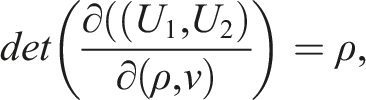
is 1-1. Indeed, the corresponding Jacobian determinant is continuous and not equal zero.
Proof. First, we show that the mapping is injective. Let (ρ1, v1), (ρ2, v2) ∈ Λ with U1(ρ1, v1) = U1(ρ2, v2), U2(ρ1, v1) = U2(ρ2, v2). First, we have that v1 = v2 then ρ1 = ρ2. Second, we prove that this mapping is surjective: For each (U1, U2) ∈ Ω, there is
System equation (4) is strictly hyperbolic and genuinely nonlinear for ρ > 0 and .
Proof. The system equation (4) is strictly hyperbolic, since
Indeed
which admits the genuine nonlinearity.
For the details about the parametrization of shock waves and rarefaction waves, we refer to.[28,43]
The structure of this article is given as follows. The Riemann invariants of the isothermal Euler model equation (4) are formulated in Riemann Invariants. In Modified Rusanov scheme, we design the proposed scheme to solve the 1-D isothermal Euler equations. The numerical applications, numerical results, and comparison with the Rusanov scheme and HLL scheme are given in Numerical Results. Conclusion is drawn in Conclusions.
Riemann invariants
The Riemann invariants admit various interesting applications in different fields of applied science.11,28 We deduce these invariants for isothermal Euler model equation (4).
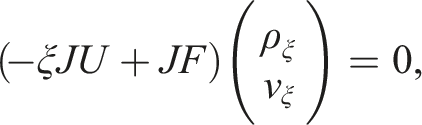
Assuming that eigenvalue , then satisfies
where
and
If , then is an eigenvector of JU−1JF. There are two types of rarefaction waves, 1-rarefaction wave and 2-rarefaction wave associated with the two different real eigenvalues, μ1 < μ2 of JU−1JF.
represents the 1-rarefaction wave. Similarly, the solution
denotes the 2-rarefaction wave.
Because Riemann invariants are constant across rarefaction curves, one can realize
and
are, respectively, the 1, 2-Riemann invariant of equation (4).
The mapping (ρ, v)↦(w, z) is 1-1 accompanied by nonsingular Jacobian with , .
Proof. Consider
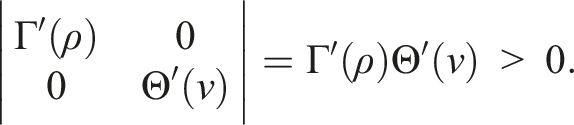
therefore Θ = Θ(v) is a function of v, Γ = Γ(ρ) is a function of ρ, and Θ′(v) = 2 > 0, for ρ > 0. Thus the mapping (ρ, v)↦(Θ, Γ) is 1-1.The corresponding determinant is given by
The mapping (Θ, Γ)↦(w, z) is
which is a nonsingular linear mapping, hence (Θ, Γ)↦(w, z) is 1-1. Thus, (ρ, v)↦(w, z) is 1-1, indeed the determinant corresponding to the Jacobian not equal zero for ρ > 0 and .
Modified Rusanov scheme
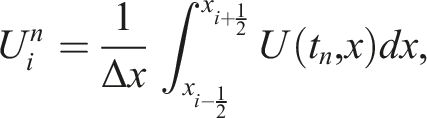
We first explain the numerical implementation of the 1-D mR scheme. Integrating equation (1) with reference to time and space in a domain gives
where and is the space-time of the solution U through the domain at time tn, that is,
is the numerical flux. Generally, the formulation of numerical fluxes needs Riemann solutions at the cell interfaces. Suppose that the self-similar solution to Riemann problem of equation (1) with initial condition
given by
Rs is Riemann solution that has to be determined exactly or approximated. Hence, the intermediate state in equation (25) at is
To get an approximation of , we adjust the mR technique given in44–46 for conservation laws with source terms. To build that will be utilized in the corrector stage equation (25), we integrate equation (1) over a control domain . Here, is an approximation of Riemann solution Rs over the control volume [x−, x+] at . Hence, the resulting intermediate state is
where the distance measures are defined by
We put x− = xi and x+ = xi+1 in equation (28), then the predictor stage is given by
where is an approximate average of solution U in control domain defined as
To finish the structure of the mR scheme, the time parameter has to be chosen. The choosing of parameter relies on the stability analysis given in.[38] The variable is given by
where is a local parameter to be determined locally, whereas is local Rusanov velocity defined as
with is the k-th eigenvalue in equation (5). Thus, the predictor stage equation (29) can be represented as follows
It is clear that one recovers the Lax–Wendroff technique47 and in the linear case the mR scheme goes to classical Rusanov scheme48 and in the nonlinear case one goes to first-order scheme written as the following
Another choice of the slopes can be written as
; is an appropriate limiter that defined by using a flux limiter function Φ acting on a quantity, which measures the ratio of the upwind varies to the local change by utilizing Riemann invariants in equations (21) and (22).49 Here, the van Albada function
and Minmod function
are utilized. The limiter functions for example Van Leer or Superbee functions can be utilized.47,50 Finally, we formulate mR scheme of equation (1) as follows
Numerical results
We introduce numerical simulation to isothermal Euler equations to validate the efficiency of the mR scheme by using Matlab Release 18. We take the following CFL condition with time step Δt
CFL is a constant to be taken less than one.
Test 1
In the first test, we consider a Riemann problem with the following initial condition
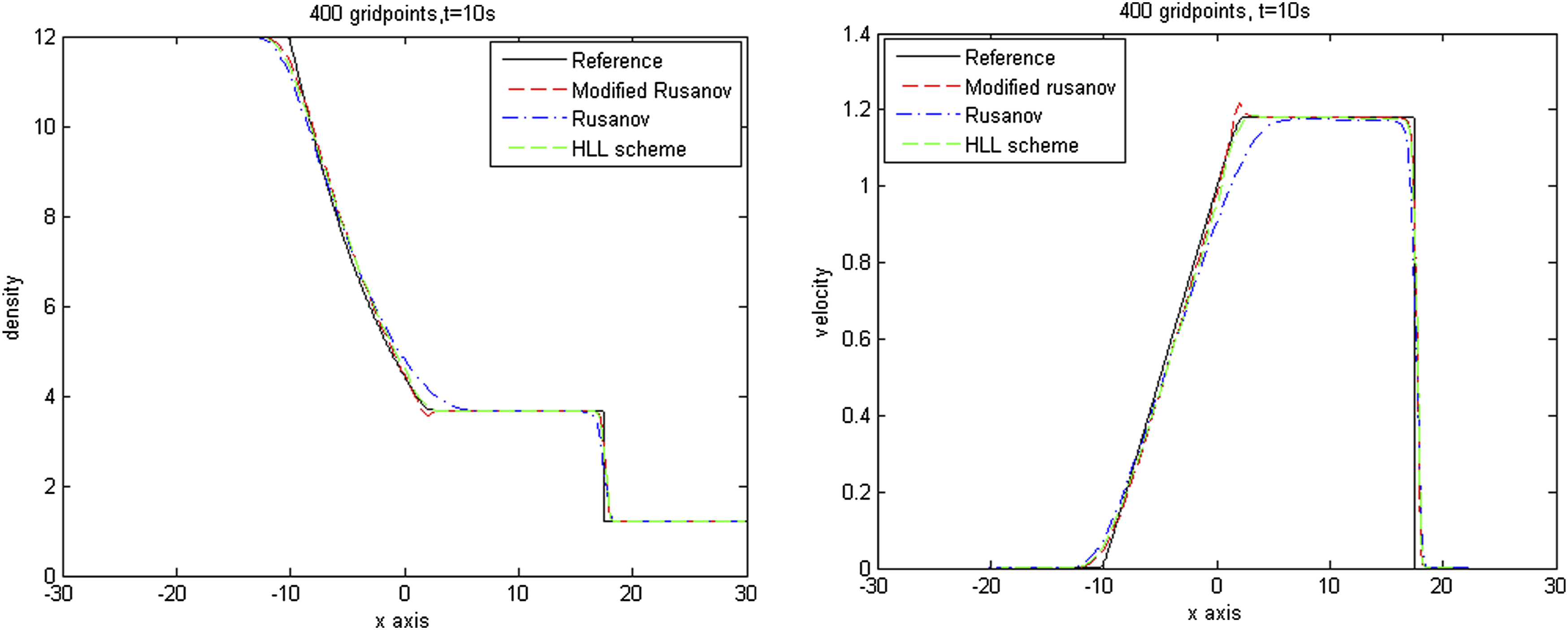
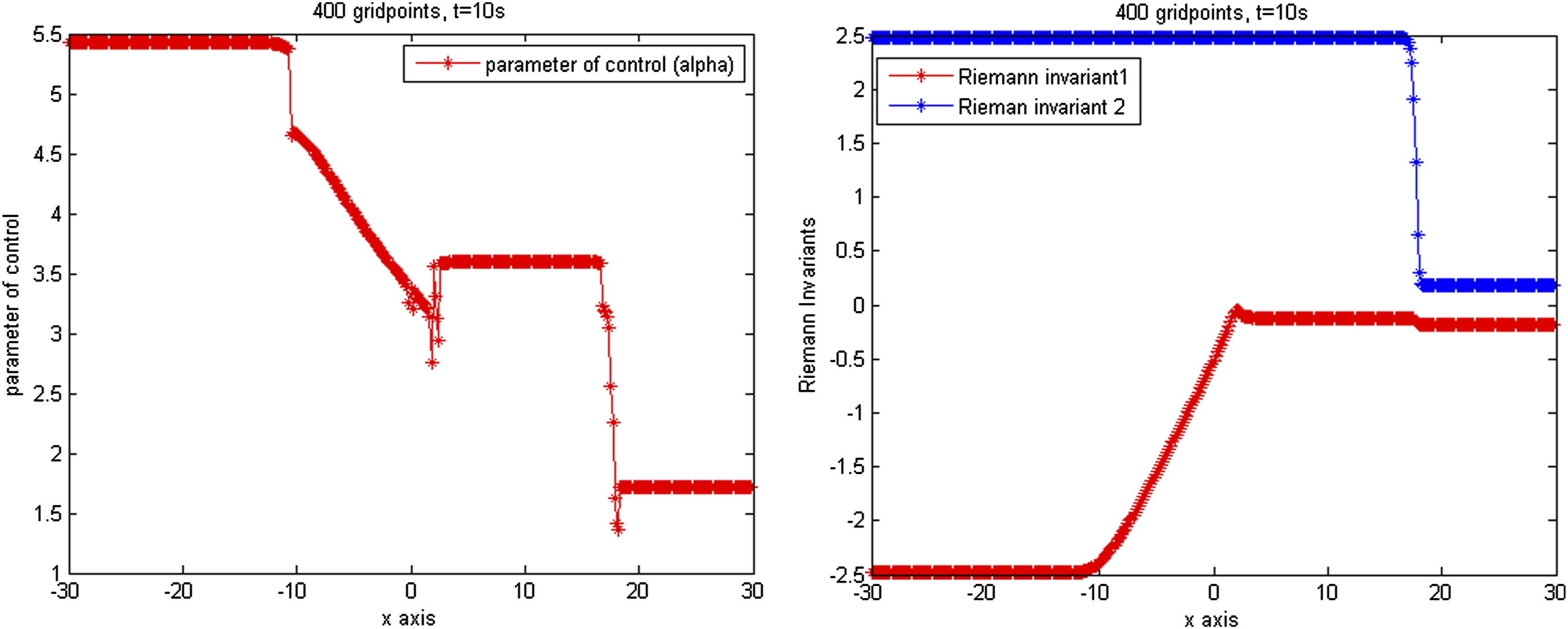
The solution consists of a rarefaction followed by a shock. We implement the mR scheme, classical Rusanov, and HLL schemes, utilizing 400 mesh points at time t = 10s. Figure 1 displays that the density and velocity for the mR scheme with limiter parameter of control, the Rusanov scheme, and HLL scheme with reference solution on 20000 gridpoints. We note that the results of Rusanov scheme are less accurate than mR and HLL schemes, whereas all the three schemes capable of capture the rarefaction and shock waves. The left part of Figure 2 shows the variation of parameter of control , whereas right part illustrates the variation of Riemann invariants.
Density (left) and velocity wave (right) at t = 10s.
Parameter of control (left) and Riemann invariants (right) at t = 10s.
Test 2
In the second test case, we present a Riemann problem with the following initial condition
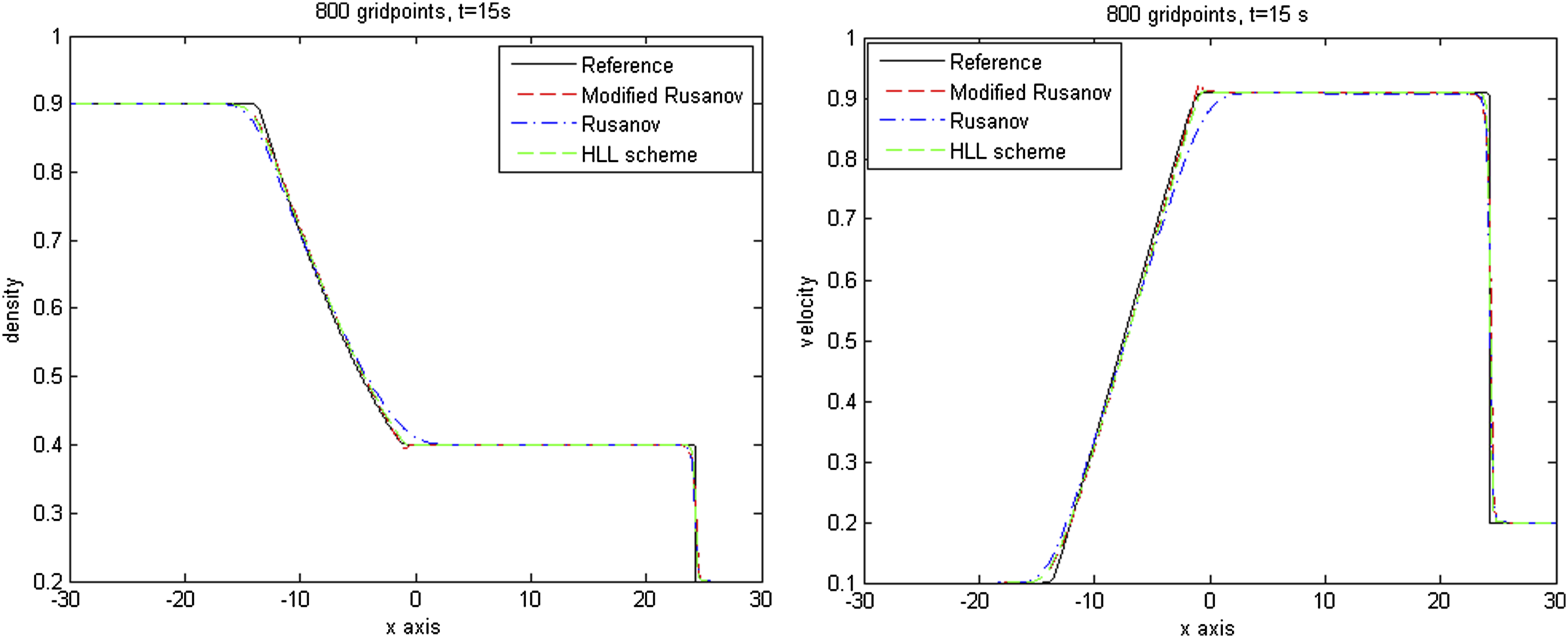
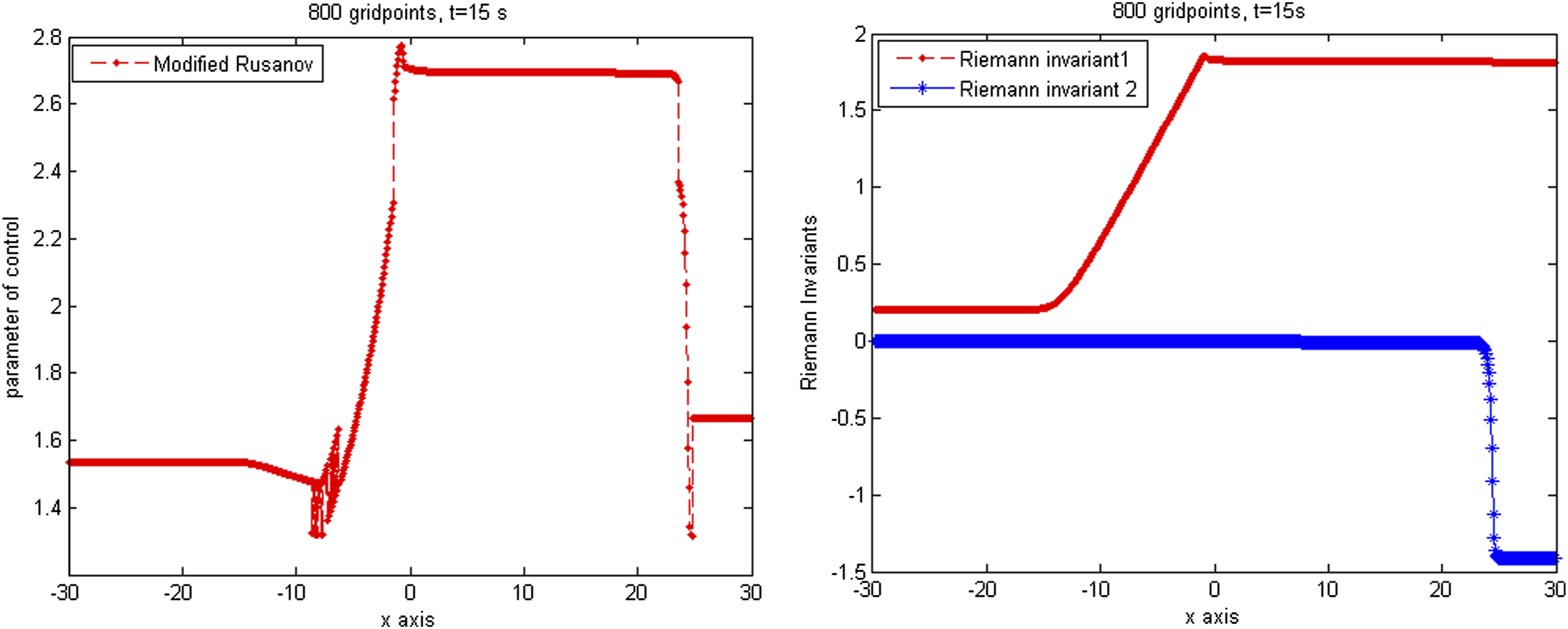
We implemented the mR scheme, classical Rusanov, and HLL scheme for isothermal equations, utilizing 800 mesh points at time t = 15s and the solution of this test case consists of a rarefaction followed by a shock. Figure 3 shows the density and velocity profile for three schemes and reference solution on 20000 gridpoints. We note that the mR method is more accurate than the Rusanov method and is as accurate as HLL scheme; also, the three schemes are capable of capturing the rarefaction and shock waves. The left part of from the Figure 4 shows the variation of parameter of control , whereas right part shows the variation of Riemann invariants.
Density (left) and velocity wave (right) at t = 15s.
Parameter of control (left) and Riemann invariants (right) at t = 15s.
Test 3
This test case was introduced in [51] and consists of a one-dimensional rectangle tube a shock; we present a Riemann problem with the following initial condition
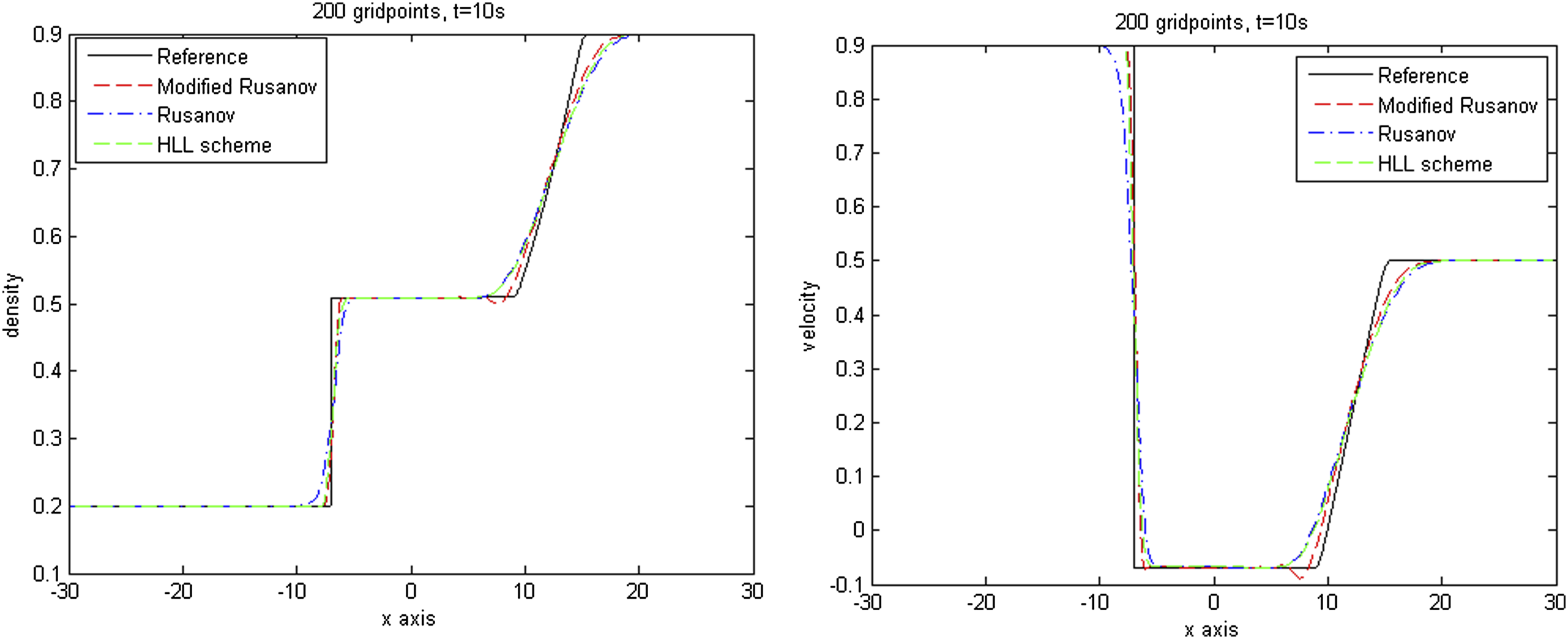
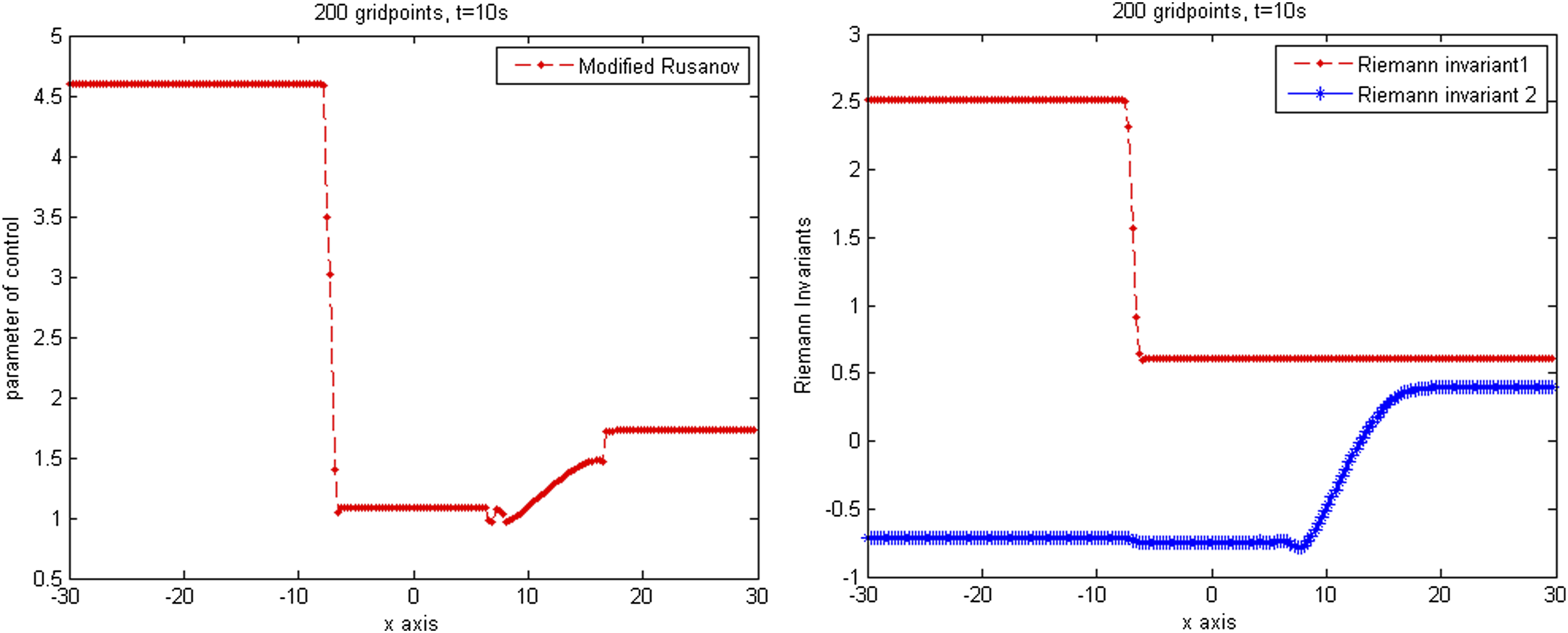
The solution of this test case consists of a shock followed by a rarefaction, utilizing 200 mesh points at time t = 10s. Figure 5 shows the comparison of density and velocity profile, using three schemes and reference solution on 20000 gridpoints. The left part of from the Figure 6 shows the variation of parameter of control , whereas right part depicts the variation of Riemann invariants.
Density (left) and velocity wave (right) at t = 10s.
Parameter of control (left) and Riemann invariants (right) at t = 10s.
Conclusions
We have investigated the isothermal Euler model with non-vacuum initial data. The derivation of Riemann invariants corresponding for the isothermal Euler model is introduced. The mR scheme was introduced for solving the 1-D initial value problems for the isothermal Euler model. This scheme has substantially different technical structure from the well-known schemes like finite difference. For comparison, Rusanov scheme was also implemented for solving the proposed model. Our results show that the results of the mR scheme are better and more accurate. Hence, it is concluded that mR scheme is a robust and efficient technique for solving such models.
Despite this success, this work is still a preliminary development of the isothermal Euler model. A more feasible way is to develop new conserved scheme for the 2D isothermal Euler system. We also consider the interaction of the elementary waves for the isothermal Euler model, which will be done in the future work.
Footnotes
Authors’ contribution
Mahmoud A.E. Abdelrahman: Data curation, formal analysis, software, and writing—review editing. Hanan A. Alkhidhr: Data curation, investigation, software, and writing—original draft. Kamel Mohamed: Data curation, methodology, software, and writing—review editing.
Declaration of conflicting interests
The author(s) declared no potential conflicts of interest with respect to the research, authorship, and/or publication of this article.
Funding
The author(s) received no financial support for the research, authorship, and/or publication of this article.
ORCID iDs
Mahmoud AE Abdelrahman
References
1.
MajdaA. Compressible fluid flow and systems of conservation laws in several space variables. In: Applied Mathematical Sciences. New York, NY: Springer, 1984.
2.
GodlewskiERaviartPA. Numerical approximation of hyperbolic systems of conservation laws. New York, NY: Springer, 1996.
3.
GlimmJ. Solutions in the large for nonlinear hyperbolic systems of equations. Comm Pure Appl Math1995; 18: 697–715.
4.
EvansL.C. Partial differential equations. Providence, RI: American Mathematical Society, 1998.
5.
DafermosCM. Hyperbolic conservation laws in continuum physics. New York, NY: Springer-Verlag Berlin Heidelberg, 2000.
6.
SmollerJ. Shock waves and reaction-diffusion equations. 1st ed.Springer, 1994.
LeVequeRJ. Finite volume methods for hyperbolic problems. Cambridge, UK: Cambridge University Press, 2002.
9.
AbdelrahmanMAEKunikM. The ultra-relativistic Euler equations. Math Meth Appl Sci2015; 38: 1247–1264.
10.
AbdelrahmanMAE. Global solutions for the ultra-relativistic Euler equations. Nonlinear Anal2017; 155: 140–162.
11.
AbdelrahmanMAE. On the shallow water equations. Z Naturforsch2017; 72(9a): 873–879.
12.
AbdelrahmanMAE. Cone-grid scheme for solving hyperbolic systems of conservation laws and one application. Comp Appl Math2018; 37(3): 3503–3513.
13.
FrassuSViglialoroG. Boundedness in a chemotaxis system with consumed chemoattractant and produced chemorepellent. Nonlinear Anal2021; 213: 112505, Art.
14.
LiTPintusNViglialoroGG. Properties of solutions to porous medium problems with different sources and boundary conditions. Z Angew Math Phys2019; 70(3): 1–18. Art. 86.
15.
MirzaeeFBimesSTohidiE. A numerical framework for solving high-order pantograph-delay Volterra integro-differential equations. Kuwait J Sci2016; 43(1): 69–83.
16.
MirzaeeFBimesS. A uniformly convergent Euler matrix method for telegraph equations having constant coefficients. Mediterr J Mathematics2016; 13(1): 497–515.
17.
MirzaeeFBimesSTohidiE. A new complex-valued method and its applications in solving differential equations. Scientia Iranica2015; 22(6): 2424–2431.
18.
MirzaeeFBimesS. Numerical solutions of systems of high-order Fredholm integro-differential equations using Euler polynomials. Appl Math Model2015; 39(22): 6767–6779.
19.
MirzaeeFBimesS. Application of Euler matrix method for solving linear and a class of nonlinear Fredholm integro-differential equations. Mediterr J Math2014; 11: 999–1018.
20.
MirzaeeFBimesSTohidiE. Solving nonlinear fractional integro-differential equations of Volterra type using novel mathematical matrices. J Comput Nonlinear Dyn2015; 10(6): 061016.
21.
MirzaeeFBimesS. Solving systems of high-order linear differential–difference equations via Euler matrix method. J Egypt Math Soc2015; 23(2): 286–291.
22.
MirzaeeFBimesS. A new Euler matrix method for solving systems of linear Volterra integral equations with variable coefficients. J Egypt Math Soc2014; 22(2): 238–248.
23.
MirzaeeFBimesS. A new approach to numerical solution of second-order linear hyperbolic partial differential equations arising from physics and engineering. Results Phys2013; 3: 241–247.
24.
MirzaeeFSamadyarNHoseiniSF. Euler polynomial solutions of nonlinear stochastic Itô-Volterra integral equations. J Comput Appl Mathematics2018; 330: 574–585.
25.
LiTViglialoroG. Boundedness for a nonlocal reaction chemotaxis model even in the attraction-dominated regime. Differential Integral Equations2021; 34(5–6): 315–336.
26.
LiLZhaoD. Prediction of stability behaviors of longitudinal and circumferential eigenmodes in a choked thermoacoustic combustor. Aerospace Sci Technol2015; 46: 12–21.
27.
MarchesinDPaes-LemePJ. A Riemann problem in gas dynamics with bifurcation. Comp Maths Appls1986; 12: 433–455.
28.
ToroEF. Riemann solvers and numerical methods for fluid dynamics: A practical Peer Review Only introduction. Berlin, Germany: Springer, 2009.
29.
LeFlochPGShelukhinV. Symmetries and global solvability of the isothermal gas dynamics equations. Arch Ration Mech Anal2005; 175: 389–430.
30.
ChenG-QWangD. The Cauchy problem for the Euler equations for compressible fluids. In: Handbook of Mathematical Fluid Dyn. Amsterdam, The Netherlands: Elsevier, 2002, 1, pp. 421–543.
31.
ZouGPCheraghiNTaheriF. Fluid-induced vibration of composite natural gas pipelines. Int J Sol Structures2005; 42: 1253–1268.
32.
GugatMSchultzR. Boundary feedback stabilization of the isothermal Euler equations with uncertain boundary data. Siam J Control Optim2018; 56(2): 1491–1507.
DongJ. Blowup for the compressible isothermal Euler equations with non-vacuum initial data. Applicable Anal2018; 99(4): 585–595.
35.
WongSYuenMW. Blow up phenomena for compressible Euler equations with non-vacuum initial data. Z Angew Math Phys2015; 66(5): 2941–2955.
36.
HesthavenJS. Numerical methods for conservation laws: from analysis to algorithms. Philadelphia, PA, USA: SIAM, 2018.
37.
MohamedKSeaidMZahriM. A finite volume method for scalar conservation laws with stochastic time-space dependent flux function. J Comput Appl Math2013; 237: 614–632.
38.
MohamedK. Simulation numérique en volume finis, de problémes d’écoulements multidimensionnels raides, par un schéma de flux á deux pas, Dissertation, 13. Paris, France: University of Paris, 2005.
39.
BenkhaldounF.MohamedK.SeaidM.A Generalized Rusanov method for Saint-Venant Equations with Variable Horizontal Density. In: FVCA international symposium, 610. Prague: Springer Proceedings in Mathematics, 2011, pp. 96–112.
40.
MungkasiSRobertsSG. A smoothness indicator for numerical solutions to the Ripa model. J Phys Conf Ser2016; 693: 012011.
41.
SherwinSJFormaggiaLPeiroJ, et al.Computational modelling of 1D blood flow with variable mechanical properties and its application to the simulation of wave propagation in the human arterial system. Int J Numer Methods Fluids2003; 43(6–7): 673–700.
42.
GuptaPChaturvediRKSinghLP. The generalized Riemann problem for the Chaplygin gas equation. Eur J Mech - B/Fluids2020; 82: 61–65.
43.
HantkeMDreyerWWarneckeG. Exact solutions to the Riemann problem for compressible isothermal Euler equations for two phase flows with and without phase transitions. Q Appl Mathematics2013; LXXI(3): 509–540.
44.
MohamedKBenkhaldounF. A modified Rusanov scheme for shallow water equations with topography and two phase flows. Eur Phys J Plus2016; 131: 207.
45.
MohamedK. A finite volume method for numerical simulation of shallow water models with porosity. Comput Fluids2014; 104: 9–19.
46.
MohamedKAbdelrahmanMAE. The modified Rusanov scheme for solving the ultra-relativistic Euler equations. Eur J Mech - B/Fluids; 90(2021): 89–98.
RusanovVV. Calculation of interaction of non-steady shock waves with obstacles. J Comp Math Phys USSR1961; 1: 267–279.
49.
SwebyPK. High resolution schemes using flux limiters for hyperbolic conservation laws. SIAM J Numer Anal1984; 21: 995–1011.
50.
Van LeerB. Towards the ultimate conservative difference schemes V. A second-order Ssequal to Godunov’s method. J Comp Phys1979; 32: 101–136.
51.
MutuaSKKimathiME. Comparison of Godunov’s and relaxation schemes approximation of solutions to the Euler equations. J Appl Math Bioinformat2015; 5(2): 69–83.