




Abstract
The optimal control of a system governed by an elliptic equation has been widely applied in engineering, and it requires twice differentiability. Furthermore, the optimal control cannot effectively deal with unsmooth boundaries. Now, the condition will not be maintained for a long time because this paper suggests a fractal optimal control of a system governed by a fractal variational principle to deal with unsmooth boundaries. The new optimal theory has obvious advantages in low differentiability for an unsmooth boundary problem. The air conditioning in a room is used as an example to show how to maintain maximum comfortableness of the workplace and maximum efficiency of energy saving.
Keywords
Introduction
The variational theory is a key mathematical tool in various numerical methods; Kang-Jia Wang and his colleagues successfully established variational principles for the modified equal width-Burgers equation, 1 the Benney–Lin equation, 2 nano-electro mechanical resonators, 3 Sasa–Satsuma equation, 4 and Kundu–Mukherjee–Naskar equation. 5 A Hamilton principle for a nonlinear vibration was established in Refs. [6,7], and now, the fractal variational theory has become an ever more useful mathematical tool for unsmooth boundary problems. 8 Kang-Le Wang 12 established variational principles for various unsmooth boundary problems, for example, shallow water wave, 9 the nonlinear Bogoyavlenskii system, 10 fractal Schrodinger system, 11 and the fractal Lane–Emden equation. However, the fractal variational theory for optimal control problems has never appeared in the literature.
In recent years, both comfortableness and energy saving of air conditioning have caught increasing attention. Various numerical methods were used to study its performance and efficiency, and an optimal solution could be obtained by the trial-and-error method. Choong et al. numerically studied a nanofluid, 13 Li and his colleague suggested a variational-based numerical method for two-phase fluid along an unsmooth tube,14–16 Vosniakos et al. suggested a numerical scheme for single-point incremental forming, 17 Dmitriev gave a numerical approach to nanocomposite, 18 and He et al. gave a powerful block-pulse function for numerical simulation. 19
All the numerical methods require given boundary conditions, and an unsmooth boundary has always led to heavy computation and limited accuracy. Additionally, a numerical solution has to be given for the whole solution domain, though our concern is mainly focused on some a special point or a limit space. For example, we want to have the most comfortable temperature in a workplace, near the chair in the room where various furniture or bookshelves are located on its boundary, making the real boundary unsmooth. The concern of the unsmooth boundary and the comfortable temperature in a limited space has led to the incorporation of fractal calculus and optimization theory into air conditioning design.
This paper adopts the two-scale fractal calculus, which was first proposed by Ain and He. 20 It uses two different scales to observe the same problem. As claimed by Ji-Huan He, a single scale is often unbelieving, and sometimes a wrong result might be obtained.21,22 When we see a blackboard, it is smooth when we evaluate it with our eyes; however, it is unsmooth on a micro-scale. If we want to study the effect of surface morphology on a chalk’s friction property, two-scale fractal theory21,22 has to be considered. Now, the two-scale fractal calculus has been widely applied to discontinuous mechanics. Ji-Huan He and colleagues suggested a fractal Chen–Lee–Liu equation for ultrashort pulses in optics 23 ; He and El-Dib gave a tutorial review on its properties; Liu, et al. proposed for the first time ever an optimal model for charge transport 24 ; Liu et al. gave an optimal model for charge transport 25 ; Ling and Wu established a fractal shallow water wave 26 ; He et al. studied a fractal Toda system with great success 27 ; C.H. He et al. studied the porous concrete and some new findings were found28,29; and Zou and Liu obtained fractal resistance law for composites. 30 Finally, the fractal oscillators are also a hot topic in mathematics and engineering.31,32
The traditional optimization theory33–36 is used to couple, for the first time ever, the two-scale fractal calculus in this paper, improving its applicability in engineering. For example, we can use a flexible temperature sensor immersed in a cloth to guarantee an optimal temperature during the working time, yet the air conditioning would maintain the maximum energy efficiency. These requirements can be achieved by a new optimal control theory, which we call the fractal optimal control theory with constraints of fractal differential equations.
In this paper, we will discuss that the fractal derivative model is a key requirement for unsmooth boundary problems, and a suitable minimax objective function is chosen, which is subject to minimum of a fractal variational principle,37–41 as this bilevel optimization is totally new in control theory.
Fractal optimal control
The fractal optimal control system has a fractal domain (e.g., a porous medium) or a fractal boundary (e.g., an unsmooth boundary). We first consider a traditional optimal control.
Let us consider a body that is to be heated or cooled which occupies the domain

Equation (1) ensures the comfort of the working place. Additionally, the most efficient energy saving requires

For both comfort and energy saving, we obtain the following cost function

subject to the following minimum condition of the variational principle

and the pointwise control constraints are


The optimal control of a system governed by a differential equation has been widely used in open literature. This paper, for the first time, suggests an optimal control of a system subject to the minimum condition of a variational principle, and the multiple-level optimization makes the solution process much simpler and more effective. The variational-based optimization requires first-order differentiation for
Now, we consider a room as a solution domain and an air-conditioning device as the control Smooth boundary of the studied room.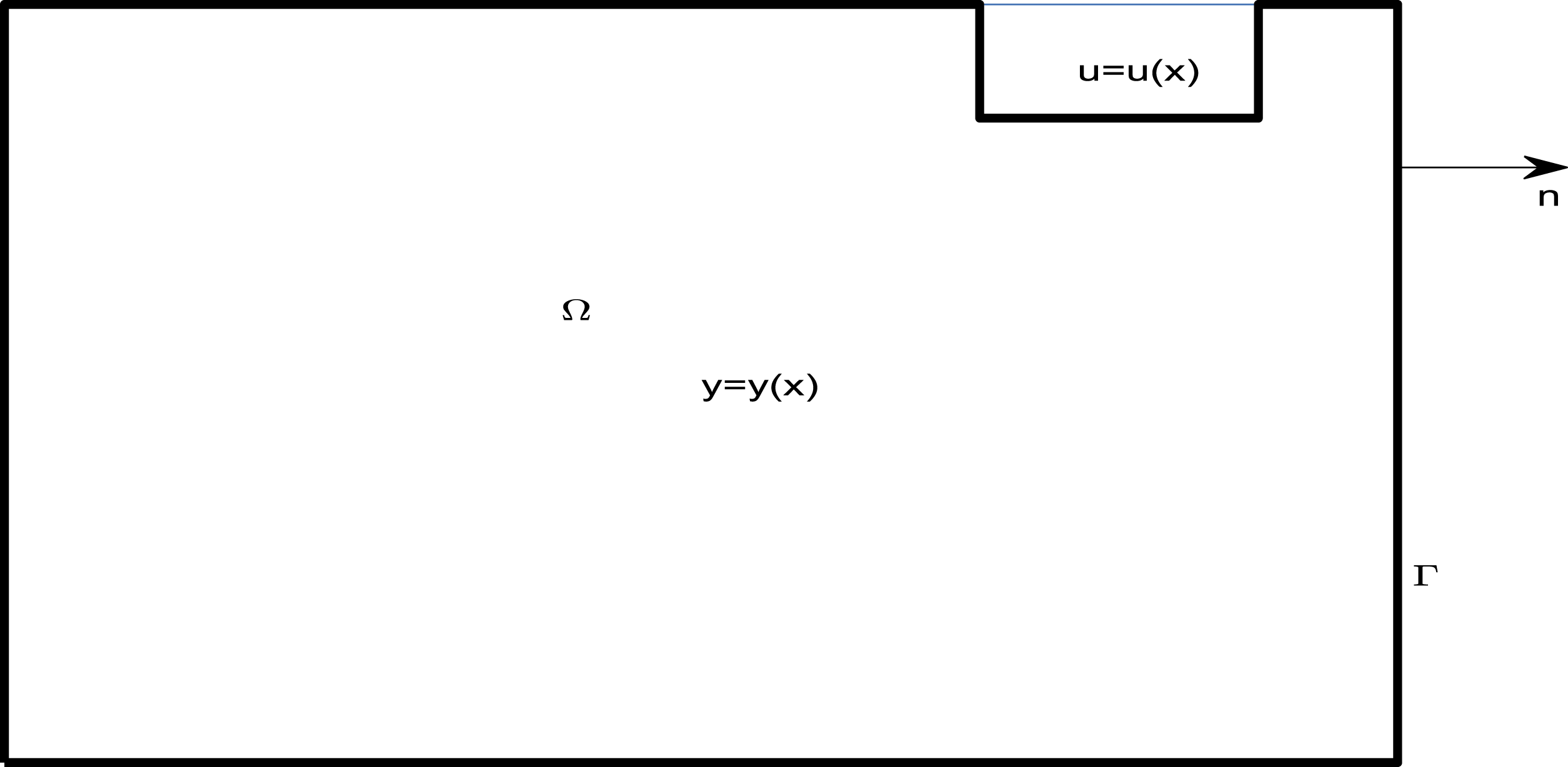
However, in general, there will be a lot of obstacles in a room, such as furniture or bookshelves, which affect the temperature distribution greatly. We consider the obstacles as a part of the boundary, which make the boundary unsmooth (see Figure 2). Unsmooth boundary morphology of the studied room.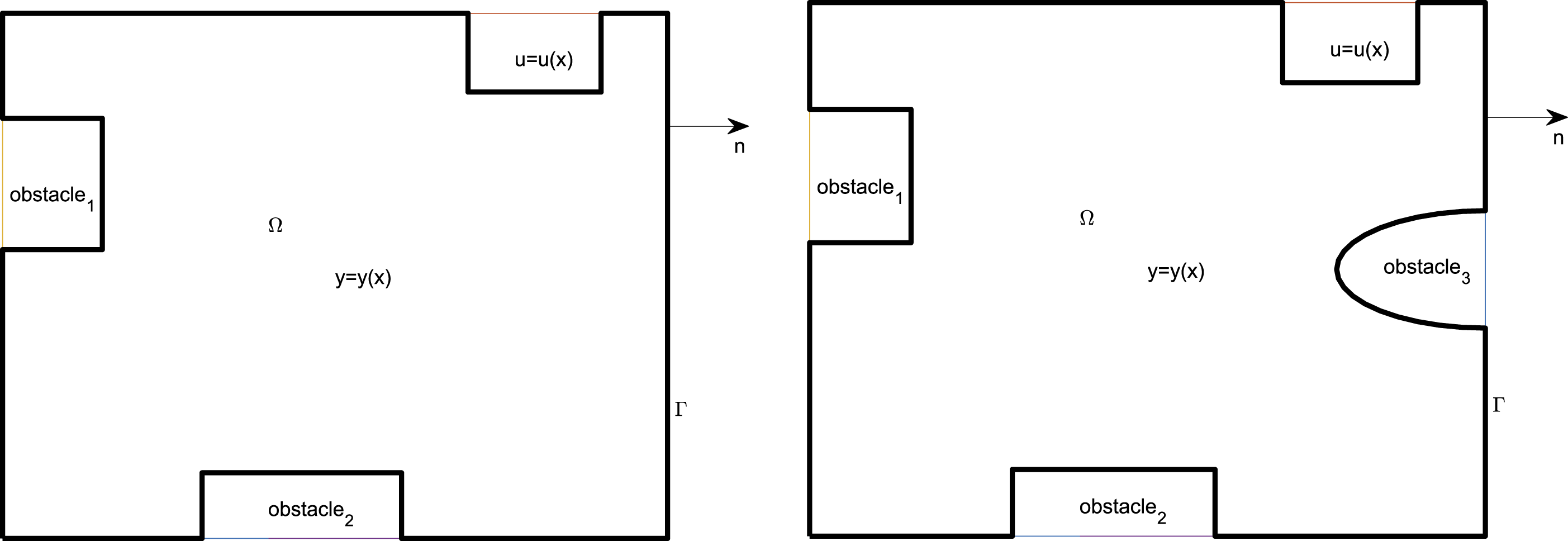
The boundary dimensions of the section given in Figure 2 are different from unit. It is a common fact that a three-dimensional cube has a two-dimensional square, which has a one-dimensional boundary. We assume that the fractal dimensions of the boundary given in Figure 2 is Fractal boundary of the controlled domain.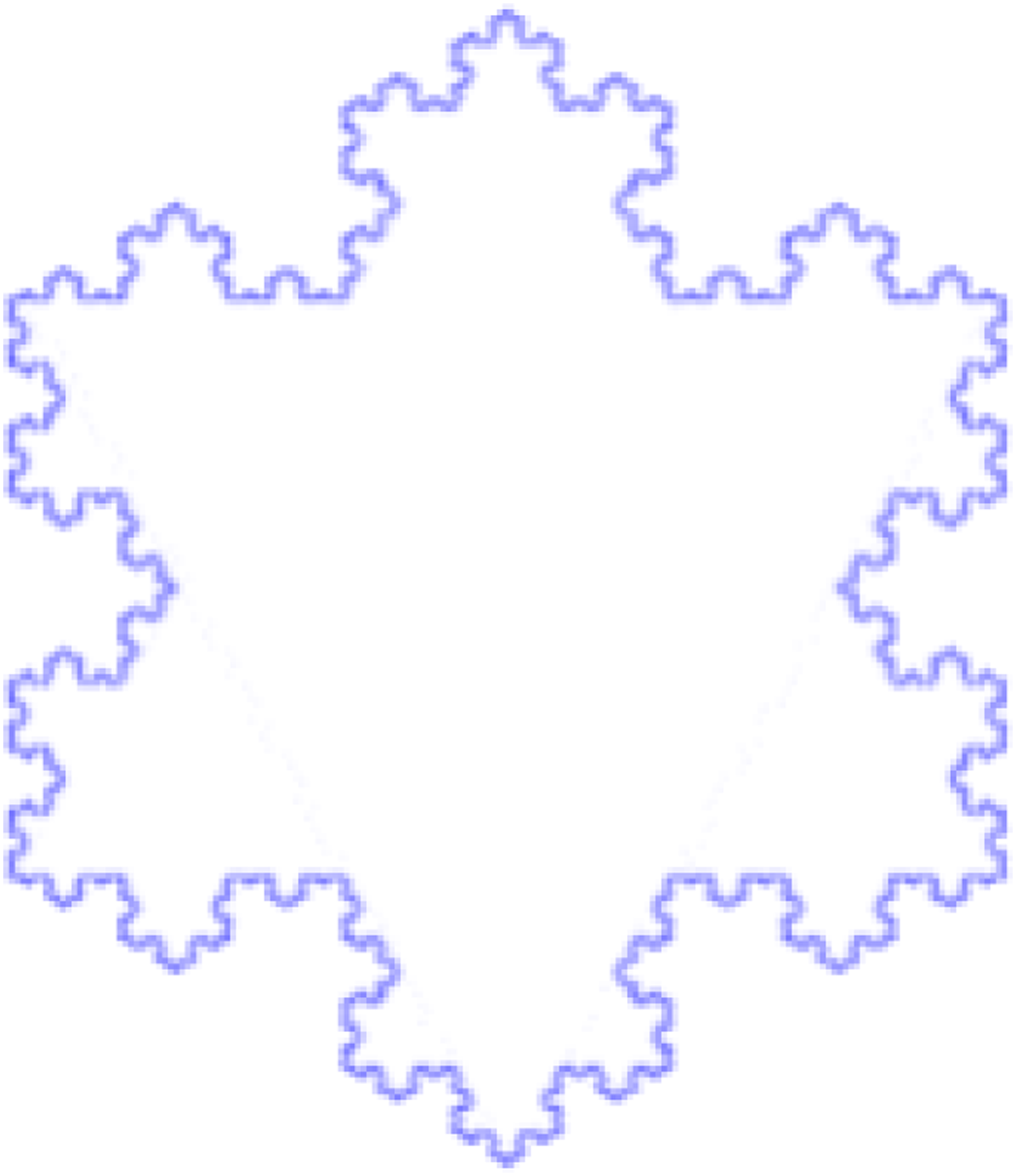

Let the fractal dimensions along


The fractal derivatives with respect to different variables are defined as
20


The fractal derivative has the following properties



It is obvious that the fractal derivative becomes the traditional one for smooth space.
It is clear that the objective functional

The stationary condition of equation (15) is

Integrating equation (16) results in

The integration by parts yields that

Therefore, we have


Thus, we obtain the first-order optimality system consisting of equations (15), (19), and (20) in the fractal space. For the linear problem, which is equivalent to equations (7) and (8) (for details, see Refs. 35,36), the adjoined state equation (19) can be rewritten as

Discussion and conclusion
Fractal patterns are rare in nature, and the self-similarity on any scales cannot be found in practical applications. In the literature, a porous medium is always considered an approximate fractal space, and its porosity can be used to estimate its two-scale fractal dimensions.
For a genuine fractal boundary as illustrated in Figure 3, the fractal dimensions are


In practical applications, the two-scale fractal dimensions are calculated as Two cascades of a Sierpinski carpet.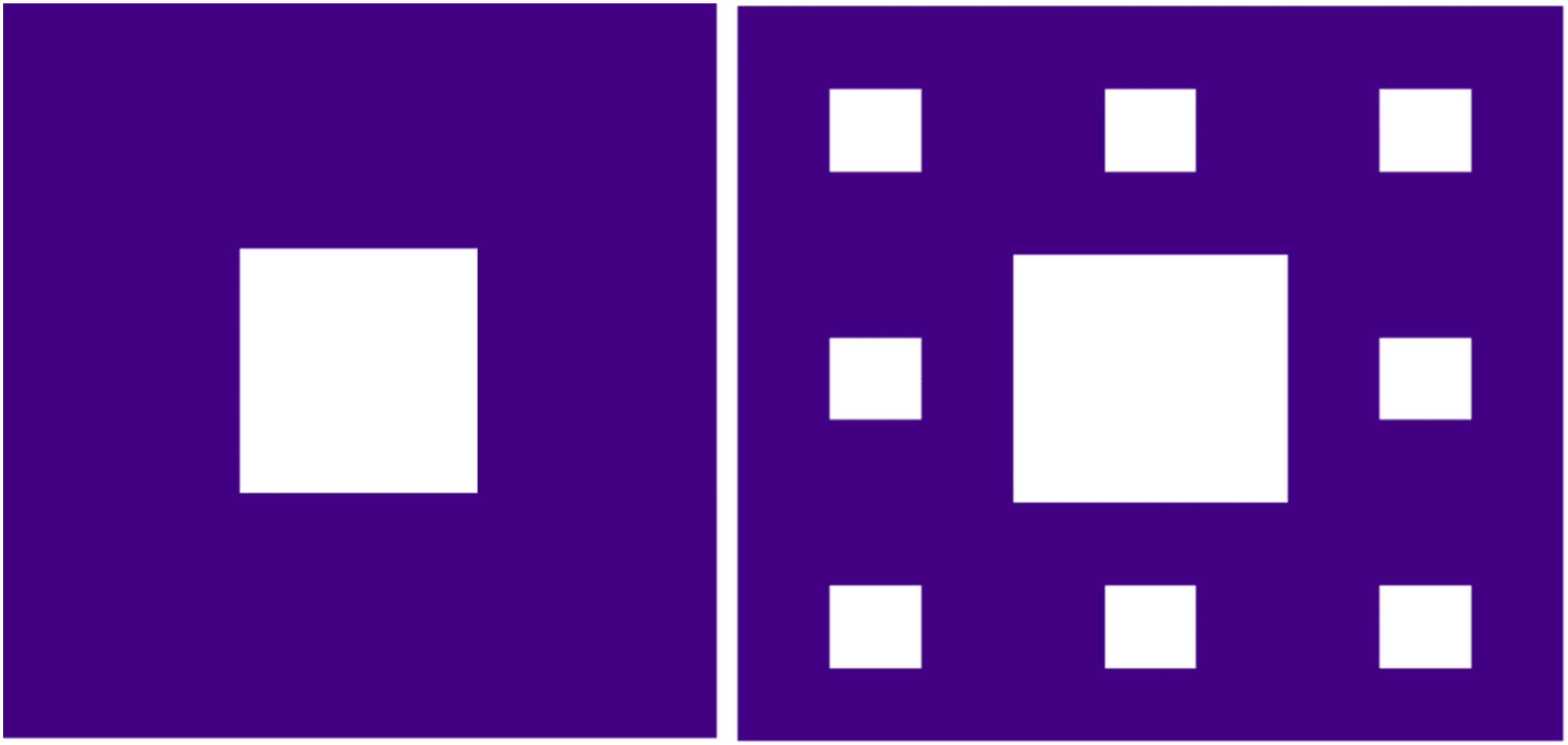

The fractal dimensions of a Sierpinski carpet are

while the two-scale fractal dimensions for Figures 4(a) and (b) are, respectively, as follows


This paper, for the first time ever, proposes a fractal variational principle for an optimal control problem governed by a partial differential equation with fractal derivatives for unsmooth boundary problems. The numerical treatment can be coupled with the Fourier spectral method, 42 the reproducing kernel method, 43 and the genetic algorithm. 44 Though this paper discusses the two-dimensional optimal problems, it can be easily extended to the three-dimensional cases, and some known control technofixes45–51 can also be used for the fractal optimal control problems.
Footnotes
Declaration of conflicting interests
The author(s) declared no potential conflicts of interest with respect to the research, authorship, and/or publication of this article.
Funding
The author disclosed receipt of the following financial support for the research, authorship, and/or publication of this article: The work is supported by Shaanxi Provincial Education Department (No. 20JK0716) and Natural Science Foundation of Shaanxi Province (2021JQ-492).
