




Abstract
Artificial bone mimicking its living partner has porous structure and should have same fractal dimensions with the bone. This paper studies the transverse vibration of the artificial bones which is considered as a porous plate. The result is helpful for designing artificial bones for different uses.
Introduction
Due to the rapid development of nanotechnology, especially the electrospinning technology and 3D bio-printing technology, bio-medicine and tissue engineering have caught much attention, and artificial bones are now used in some hospitals.
Artificial bones are fabricated mainly by the electrospinning,1–5 three dimensional (3D) nanofibers mimicking the porous topography of natural extracellular matrix (ECM) can be now successfully fabricated. The fractal harmonic law 6 should be followed during the biomimetic design, that is the fractal dimensions of the artificial bone should be almost same with that of the living one. As the fractal dimensions of a living bone change with age, the artificial ones should be suitably fabricated by adjusting spinning parameters. This paper focuses on the vibration property of the artificial bone which is always subject to an external force, and the principal vibration frequency should be same with that of the living one, which can be obtained experimentally.
In an orthopedic treatment, the injured or defective bone can be repaired by an artificial bone consisting of 3D nanofibers with good biocompatibility. How to produce the needed artificial bone for various cases becomes a critical problem.
3D nanofibers have been attracting much attention from various communities, and there is an extremely increasing need in the bone tissue engineering to fabricate biocompatible nanofibers. Chen et al. suggested an advanced technology to produce 3D nanostructured biomaterials. 7 The bubble electrospinning8–13 is a promising candidate for mass-production of 3D nanofibers with controllable porous structure and fiber diameters.
Normal bone can be easily repaired; however, osteoporotic bone is extremely difficult, and its repair strongly depends upon the geometrical property of the artificial bone. 14 Figure 1 gives a schematic figure showing the porous structure of a bone (Figure 1(a)) and porous nanofibers (Figure 1(b)). It would be perfect that the artificial bone would have an exact same porous structure with that of the repaired bone, but this is totally impossible. The fractal harmonic law suggests a way to fabricate a needed artificial bone. We can use trabecular bone quality analysis 15 to calculate the fractal dimensions of the injured bone using the same method given in Wang et al. 16
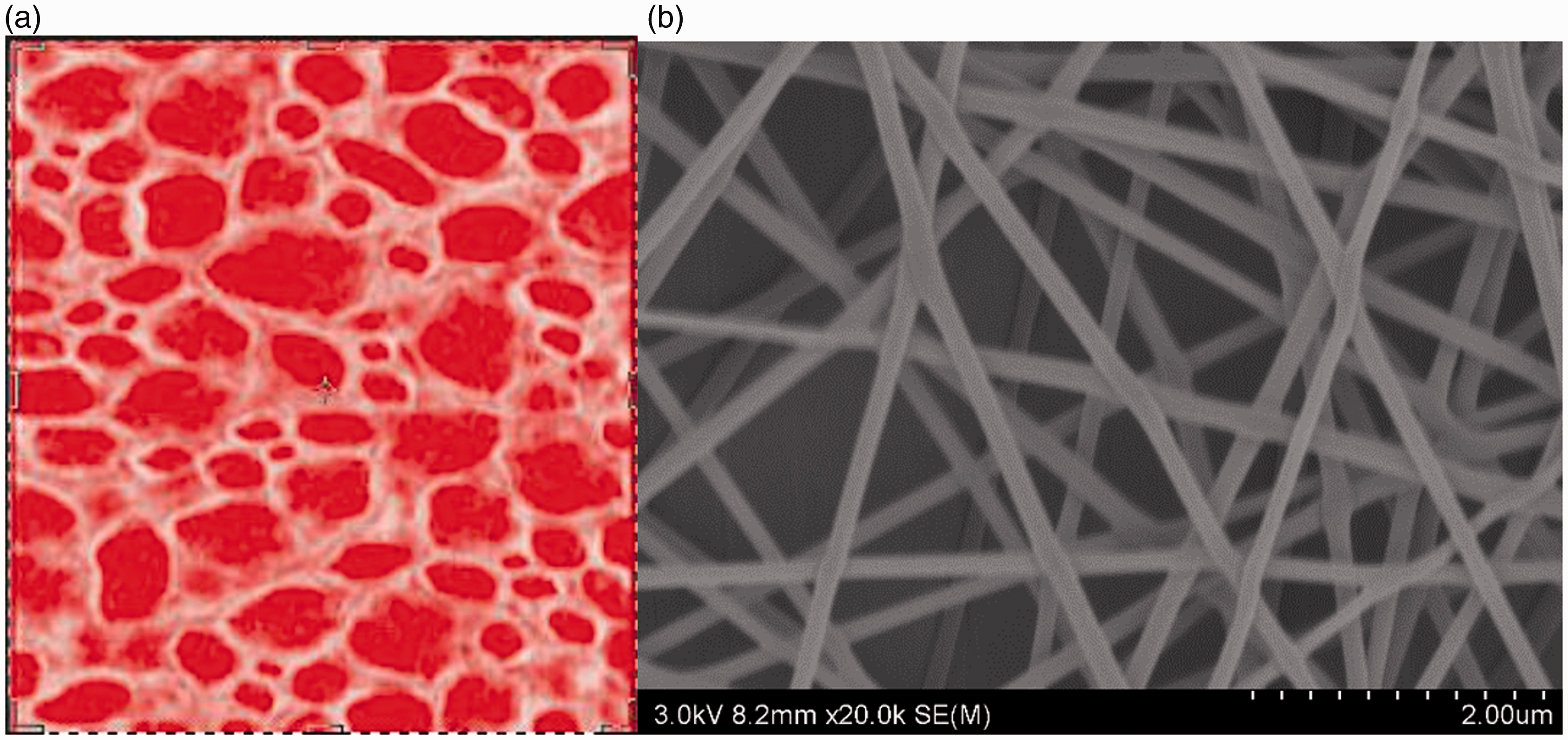
Bone morphology (a) and 3D nanofibers (b). The fractal dimensions of the porous structure of an osteoporotic bone are larger than that of the normal bone. The fractal harmonic law requires bone’s fractal dimensions to be equal to that of the 3D nanofibers as the artificial bone.
Vibration of an artificial bone
Bone is an important tissue for mechanical support and vibration absorption. An artificial bone is always fixed in the bone’s axial direction using a metal material such as stainless steel. All axial vibration can be absorbed by the metal material. Therefore, the axial vibration of the artificial bone is not important in orthopedic treatment or patient’s everyday motion.
Cell proliferation is an important factor in the repair of a damaged bone. A small perturbation will affect cell proliferation, so it is important to know how to control transverse vibration of the artificial bone in bone tissue engineering.
We begin with a plate’s transverse vibration; its vibration equation can be expressed by the following equation
17


In this paper, we consider the artificial bone as a porous plate; equation (2) has to be modified as


Equation (6) can be converted into the following one

This paper focuses on the principal modal frequency by assuming the solution has the form


This equation can be exactly solved using Bessel function, as the exact solution is not our aim, the principal modal frequency scales with

The transverse vibration of the artificial bones does not depend upon porous structure.
Conclusions
The artificial bones should follow the fractal harmonic law; this requires the porous artificial bone has the same fractal dimensions with its living partner, but the transverse vibration mainly depends upon 3D nanofibers’ mechanical properties including the density, thickness and fiber’s mechanical property. The porous structure of the artificial bone will greatly affect permeability, and as a result, the density will be affected. To accurately predict the effect, we need a fluid–solid model which will not be discussed in this paper. This paper provides physicians with an easy way to applying artificial bones to bone tissue engineering.
Footnotes
Declaration of conflicting interests
The author(s) declared no potential conflicts of interest with respect to the research, authorship, and/or publication of this article.
Funding
The author(s) received no financial support for the research, authorship, and/or publication of this article.