



Abstract
This article mainly studies the vibration of the carbon nanotubes embedded in elastic medium. A new novel method called the Hamiltonian-based method is applied to determine the frequency property of the nonlinear vibration. Finally, the effectiveness and reliability of the proposed method is verified through the numerical results. The obtained results in this work are expected to be helpful for the study of the nonlinear vibration.
Keywords
Introduction
The carbon nanotube (CNT) has attracted wide attention since it is first discovered by Japanese scientist Iijima
1
in 1991. The vibration of the CNT is usually used to directly or indirectly measure the elastic modulus or other mechanical behaviors of the CNTs.2–5 Therefore, the study of the vibration characteristics of the CNT is important. In this study, we will investigate the vibration of CNT embedded in the elastic medium, which can be governed as6,7

The variational principle and the Hamiltonian
The variational principle of equation (1.1) can be easily established via the semi-inverse method,13–22 which reads as

Where He–Weierstrass function can be obtained as
23
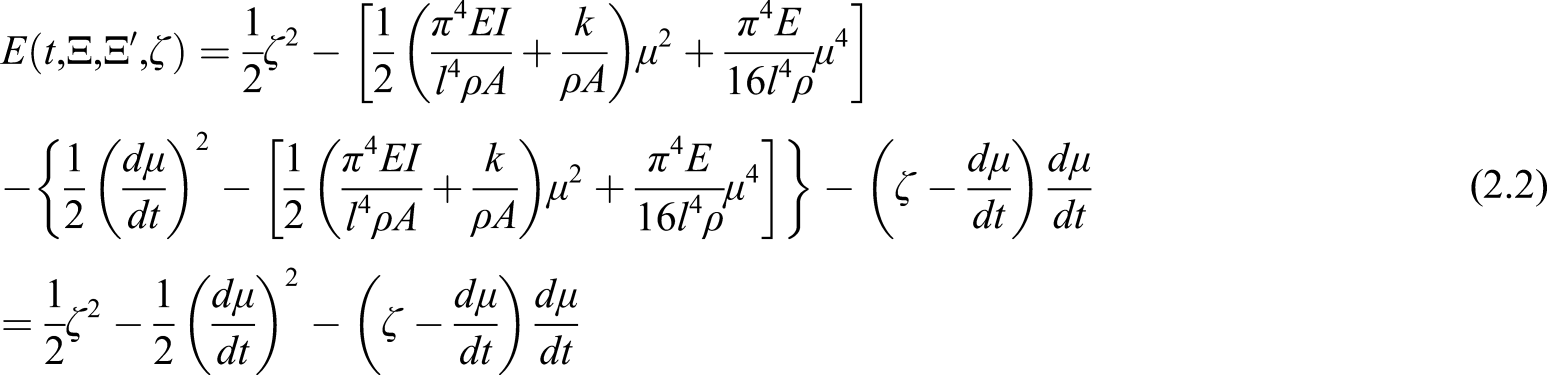

From equation (2.2), it can be proved that

In equation (2.1),

Equation (2.5) can be simplified as

Hamiltonian-based method
In this section, we will apply the Hamiltonian-based method to obtain the solution of equation (1.1). As is known to all, the kinetic energy and the potential energy are changed during the oscillation process, but the total energy will keep unchanged for a conservative oscillator. The Hamiltonian-based method is based on this and the variational theory, so it can present a more accurate solution compared with the VIM or HPM. Here the solution of equation (1.1) is assumed with the following form


Substituting equation (3.2) into equation (2.6), there is

Taking equation (3.1) into equation (3.3) leads to the residual equation,
24
which is

Now we define two average residuals


So the frequency–amplitude formulation can be obtained as follows
24

Here we select two arbitrary frequencies as


So the two average residuals are obtained as


According to equation (3.7), there is



Results and discussion
Recently, He’s frequency formulation, which is first proposed by Chinese mathematician Ji-Huan He, has been widely used to solve the nonlinear vibrations arising in three-dimensional printing technology,
25
micro-electromechanical,
26
N/MEMS,
27
and so on .28,29 By using He’s frequency formulation, we can get the frequency–amplitude formulation of equation (1.1) as

Then the solution of equation (1.1) can be obtained as

For Comparison between the Hamiltonian-based method and He’s frequency formulation.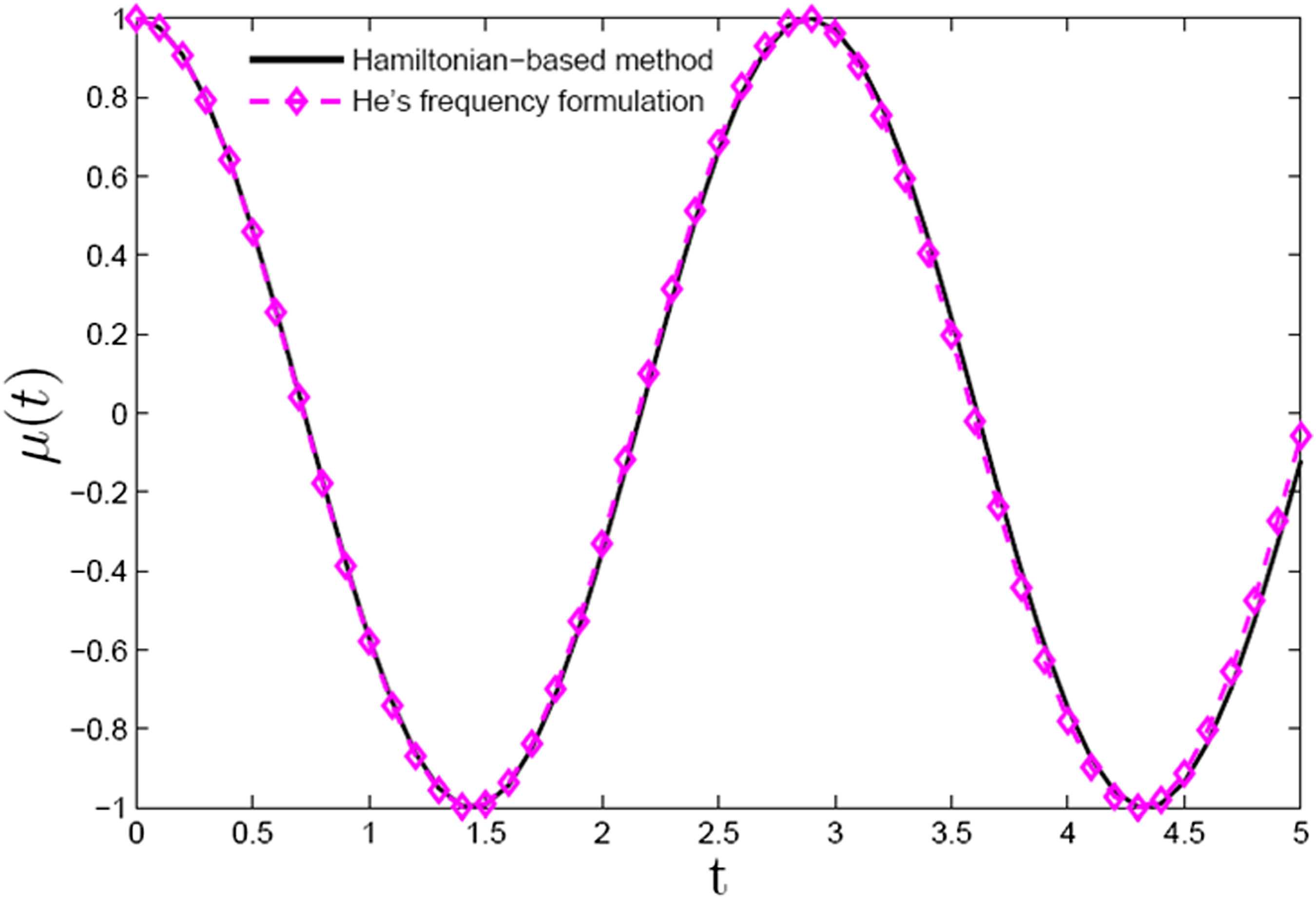
When we select Comparison between the Hamiltonian-based method and He’s frequency formulation.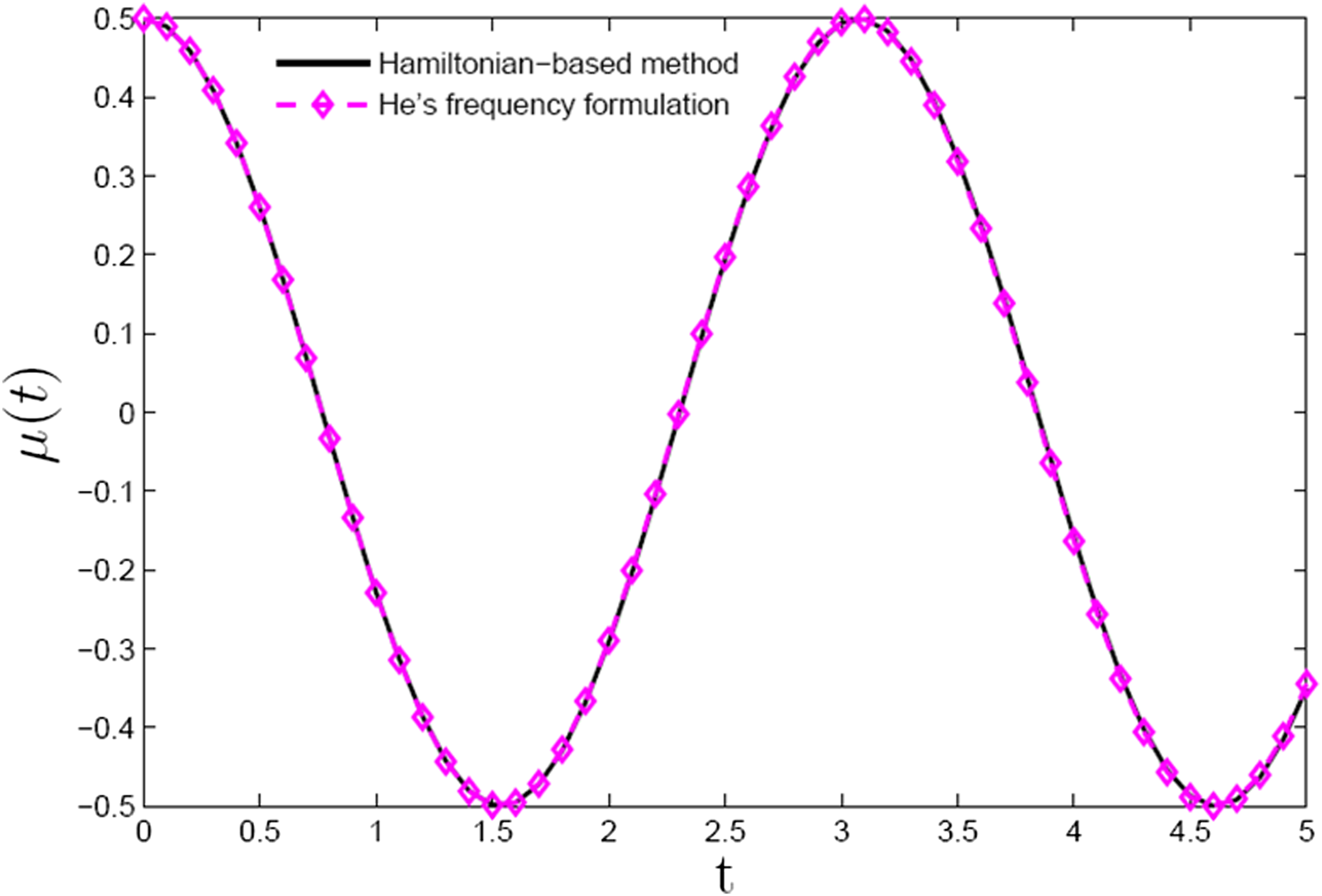
Conclusion and future recommendation
In this study, a novel and effective method called the Hamiltonian-based method is used to study the nonlinear vibration of the CNT embedded in elastic medium. The comparison between our proposed method and He’s frequency formulation shows a good agreement, which strongly proves the correctness of the Hamiltonian-based method. The finding in this study is expected to open up new horizons for the study of the nonlinear vibration.
Recently, the fractal and fractional calculus have been widely used to model many complex problems arising in circuit,30,31 physics,32–35 filter,36–38 biomedical science, 39 and so on.40–46 The proposed method in this work is also extended to the fractal cases.
Footnotes
Declaration of conflicting interests
The author(s) declared no potential conflicts of interest with respect to the research, authorship, and/or publication of this article.
Funding
The author(s) disclosed receipt of the following financial support for the research, authorship, and/or publication of this article: This work is supported by Program of Henan Polytechnic University (No.B2018-40), the Fundamental Research Funds for the Universities of Henan Province (NSFRF210324), Innovative Scientists and Technicians Team of Henan Provincial High Education (21IRTSTHN016), and Key Project of Scientific and Technology Research of Henan Province (212102210224).
