Nonlinear dynamical characteristics of carbon nanotube-reinforced composite beams with piezoelectric actuators and elastically restrained ends under thermo-electro-mechanical loads
Free accessResearch articleFirst published online November, 2024
Nonlinear dynamical characteristics of carbon nanotube-reinforced composite beams with piezoelectric actuators and elastically restrained ends under thermo-electro-mechanical loads
Nonlinear free vibration and dynamical responses of carbon nanotube (CNT) reinforced composite beams with surface-bonded piezoelectric layers and tangentially restrained ends under thermo-electro-mechanical loads are investigated in this paper. The properties of constitutive materials are assumed to be temperature-dependent and effective properties of nanocomposite are estimated using an extended rule of mixture. Unlike previous studies, the present work considers the effects of tangentially elastic constraints of two ends on the nonlinear dynamic characteristics of hybrid beams. Motion equation is established within the framework of Euler-Bernoulli beam theory taking into account von Kármán nonlinearity. Analytical solution is assumed to satisfy simply supported boundary conditions and Galerkin procedure is employed to obtain a time ordinary differential equation including both quadratic and cubic nonlinear terms. This differential equation is numerically solved employing fourth-order Runge-Kutta scheme to determine the frequencies of nonlinear free vibration and nonlinear transient response. Parametric studies are executed to examine numerous influences on the nonlinear dynamical characteristics of hybrid nanocomposite beams. The study reveals that tangential constraints of ends substantially effect the frequencies and dynamic response of the beam, especially at elevated temperatures. The results also indicate that nonlinear dynamic responses can be controlled effectively by means of piezoelectric actuators and elasticity of tangential constraints of ends should be considered in design of piezo-CNTRC beams.
Due to unprecedentedly superior mechanical properties along with very large aspect ratio, carbon nanotubes (CNTs) are used as reinforcements into homogeneous matrix to constitute carbon nanotube reinforced composite (CNTRC), an advanced class of nanocomposites. In order to reach optimal distributions of CNTs and desired response of CNTRC structures, Shen1 proposed the concept of functionally graded carbon nanotube reinforced composite (FG-CNTRC) in which CNTs are reinforced into matrix according to functional rules of volume fraction. Shen’s proposal motivated subsequent studies on the static and dynamic responses of FG-CNTRC structures. Linear vibration, bending and buckling analyses of FG-CNTRC beams have been carried out by Wattanasakulpong and Ungbhakorn2 employing various shear deformation theories and analytical solutions. Linear free vibration of FG-CNTRC beams was explored by Lin and Xiang3 utilizing Ritz method within the framework of first order shear deformation beam theory (FSDBT) and higher order shear deformation beam theory (HSDBT). Linear vibration and buckling problems of FG-CNTRC beams under axial compression was dealt with by Nejati et al.4 using generalized differential quadrature method (GDQM). Based on the theory of elasticity and differential quadrature method (DQM), Alibeigloo and Liew5 carried out the linear bending and vibration analyses of FG-CNTRC beams. Basing on Timoshenko beam theory and DQM, the linear vibration and mechanical buckling analyses of FG-CNTRC beams resting on elastic foundation and sandwich beams with FG-CNTRC face sheets were performed in works of Yas and Samadi6 and Wu et al.,7 respectively. Linear bending, free vibration and buckling behavior of CNTRC beams under non-uniform thermal loads have been analyzed by Mayandi and Jeyaraj8 employing finite element method (FEM). Using a HSDBT and Navier-type analytical solutions, Ebrahimi and Farazmandnia9 investigated the linear free vibration of sandwich beams with FG-CNTRC face sheets. The effects of uniform temperature rise on the vibration of rotating FG-CNTRC beams are considered in work of Khosravi et al.10 employing differential transformation method (DTM). Recently, Karamanli and Vo11 used FEM to investigate the linear bending, free vibration and buckling of shear deformable nanocomposite beams with CNT and graphene nanoplatelet reinforcements. Vibration and wave propagation problems of CNTRC beams have been dealt with by Tounsi and coworkers12,13,14,15 using analytical methods and different beam theories. Linear vibration analyses of single-layered and laminated CNTRC plates have been executed in works of Zhang and coauthors16,17,18 employing mesh-free method. Thermal postbuckling analyses of FG-CNTRC rectangular and annular sector plates were performed by Tung19 and Gholami and Ansari,20 respectively. More results on vibration and buckling analyses of FG-CNTRC structures are reviewed in works of Liew et al.21,22
Nonlinear vibrations of composite structures in general and FG-CNTRC beams in particular are important and essential problems paying much attention of researchers. Nonlinear free vibration of FG-CNTRC beams resting on nonlinear elastic foundations was studied by Fallah and Aghdam23 basing on Euler-Bernoulli beam theory. Shen and Xiang24 employed a HSDBT and asymptotic solutions to investigate the large amplitude vibration, nonlinear bending and thermal postbuckling of FG-CNTRC beams. Ke et al.25 utilized direct iterative method to compute the nonlinear vibration frequencies of FG-CNTRC beams with different end supports. The influences of piezoelectric layers and geometric imperfection on the nonlinear vibration of thin and shear deformable CNTRC beams have been examined in works of Rafiee et al.26 employing multiple scale method and Wu et al.27 using an iteration procedure, respectively. Ritz method based on shear deformable beam theories is employed in work of Lin and Xiang28 studying the nonlinear free vibration of FG-CNTRC beams with different end supports. Shen et al.29 used a HSDBT and perturbation technique to examine the linear and nonlinear vibrations of thermally postbuckled CNTRC beams resting on elastic foundations. The frequencies of nonlinear free vibration of rotating beams reinforced by CNTs were computed by Heidari and Arvin30 utilizing Timoshenko theory and direct method of multiple scale. By employing a GDQM, Ansari et al.31 dealt with the nonlinear forced vibration of Timoshenko beams with CNT reinforcements. Yang et al.32 presented a HSDBT-based analysis of nonlinear vibration of FG-CNTRC laminated beams with negative Poisson’s ratio. Timoshenko theory-based Ritz method was used in work of Mirzaei and Kiani33 for the nonlinear free vibration analysis of sandwich beams with FG-CNTRC face sheets. There are very little studies on the transient response of FG-CNTRC beams. Linear transient response of sandwich beams with FG-CNTRC face sheets was dealt with by Salami34 employing Ritz method. Linear dynamical response of FG-CNTRC cylindrical shells under impact loads was treated by Zhang et al.35 making use of Fourier series expansion. Linear vibration and nonlinear transient response of single-layered and sandwich FG-CNTRC cylindrical shells with thermal and electrical effects have been investigated by Ninh and coworkers36,37,38 using analytical solutions.
Aforementioned studies only considered special cases of in-plane boundary conditions, namely movable and immovable ends. Nevertheless, in practical applications, boundary edges of structures are frequently restrained elastically. Hence, it is essential to account for elastic constraints of boundary edges in behavior analyses of structures. The effects of elastic restraints of ends on the linear and nonlinear vibrations of functionally graded beams with porosities have been analyzed in work of Wattanasakulpong and Ungbhakorn39 employing DTM. By making use of Timoshenko beam theory and Chebyshev collocation method, Wattanasakulpong and Mao40 considered the influences of elastic boundary conditions on the linear vibration and stability of CNTRC beams. Recently, Xu et al.41 used Rayleigh-Ritz method to investigate the effects of classical and non-classical boundary conditions on the linear vibration of rotating FG-CNTRC beams. More recently, Peng et al.42 treated the linear free vibration of shear deformable FG-CNTRC beams taking into consideration elastically restrained ends and geometric imperfections. Zhang et al.43,44 used element-free Ritz method to study the static and postbuckling responses of shear deformable FG-CNTRC plates with elastically restrained edges. Recently, the influences of tangentially elastic constraints of boundary edges on the linear and nonlinear free vibrations of FG-CNTRC plate and panels made of FG-CNTRC and porous functionally graded materials have been examined in works of Thinh and collaborators.45–49 Besides, the thermal buckling and postbuckling analyses of FG-CNTRC plates and shells with tangentially restrained edges have been performed in works.50–57 The influences of electrical loads on the bending, buckling, vibration and dynamical response of some nanocomposite plates and shells have been analyzed in works of Ansari and coauthors.58–61 Very recently, the effects of piezoelectric layers on the thermal postbuckling of CNTRC beams with elastically restrained ends have been analyzed by Thinh and Tung.62
CNTRC beams with piezoelectric layers are extensively applied in nanoelectromechanical systems and microscale control devices. In these applications, tangential constraints of beam ends may be elastic. In spite of practical importance, it is evident from the literature that the influences of elasticity of tangential end restraints on nonlinear vibration and dynamic response of CNTRC beams with piezoelectric actuators under thermo-electro-mechanical loads have been not investigated, to the best of authors’ knowledge. In this paper, for the first time, the influences of tangentially elastic constraints of simply supported ends on the nonlinear vibration and transient response of FG-CNTRC beams with surface-bonded piezoelectric actuators under thermo-electro-mechanical loads are investigated. The motion equation is derived using Euler-Bernoulli beam theory including von Kármán nonlinearity and solved by means of analytical solution and Galerkin procedure to yield a time nonlinear ordinary differential equation. This equation is solved employing fourth-order Runge-Kutta numerical integration scheme to determine nonlinear frequencies and transient response of hybrid CNTRC beams. Parametric studies are carried out to examine numerous influences on the linear frequency, nonlinear to linear frequency ratio and thermo-electro-mechanical nonlinear dynamical response of CNTRC beams with piezoelectric layers.
Structural model and effective properties
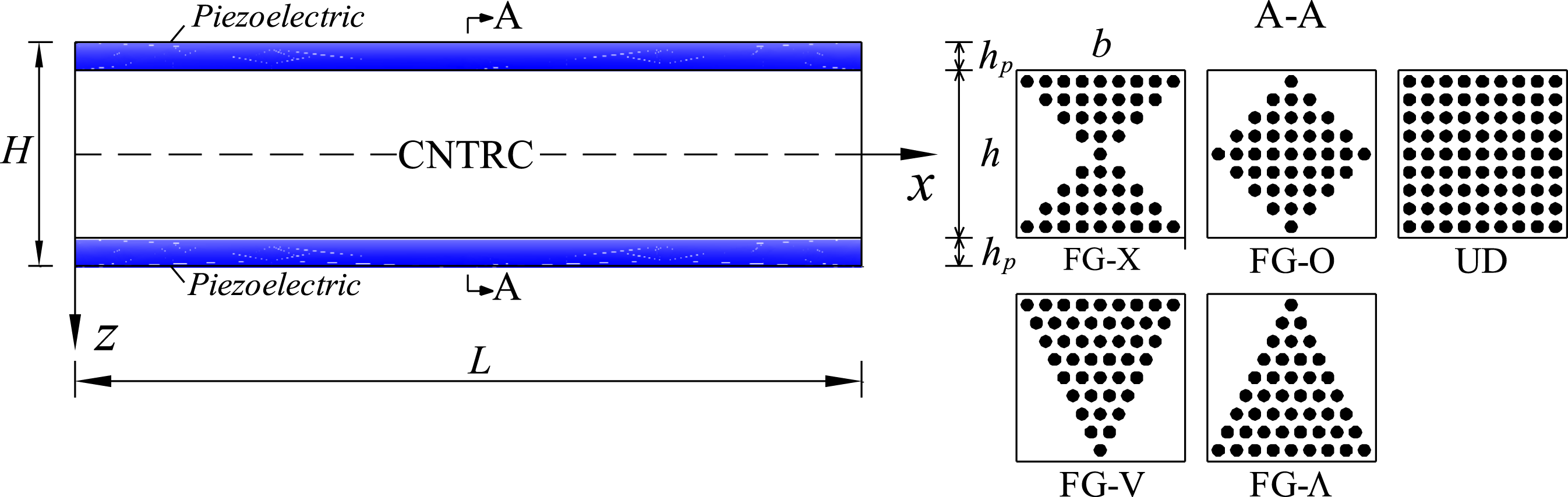
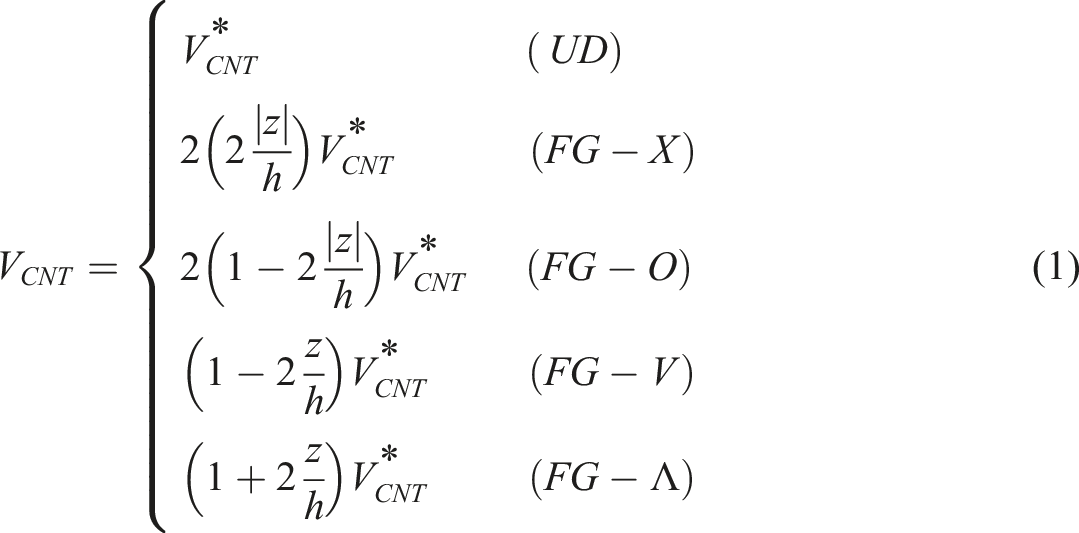
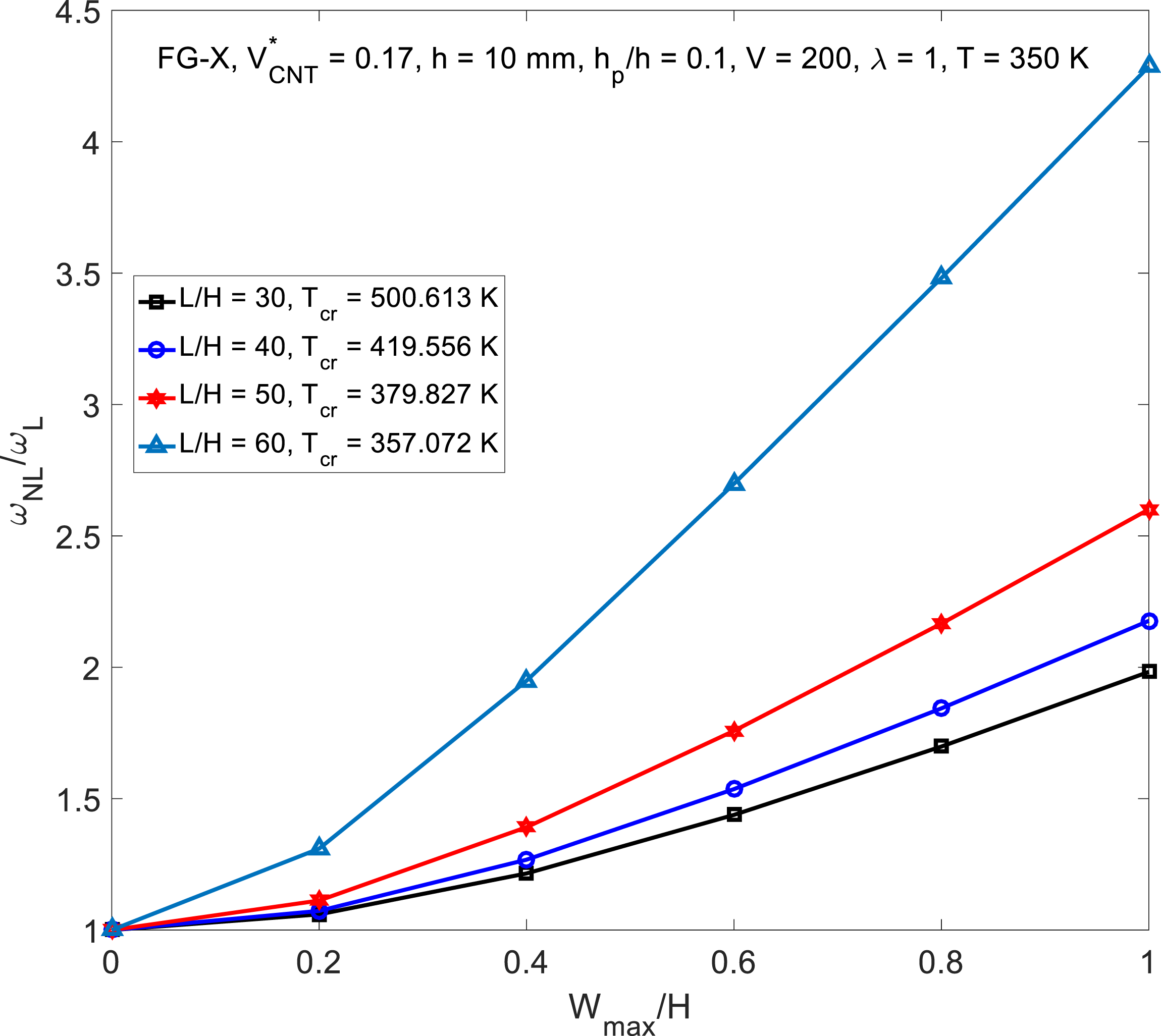
This study considers hybrid beams constituted from CNTRC substrate and two surface-bonded piezoelectric actuator layers. The length and width dimensions of the beams are denoted by and , respectively. The thickness of CNTRC host, thickness of each piezoelectric layer and total thickness of hybrid beam (neglecting thickness of adhesive) are , and , respectively, as shown in Figure 1. The beam is located in a plane Cartesian coordinate system origin of which is fixed at one end, axis lies on the mid-surface of the beam and axis is perpendicular to the mid-surface with positive direction downwards. CNTs are assumed to be straight and aligned in the direction of axis. In this study, CNTs are embedded into matrix through uniform distribution (UD) or functionally graded (FG) distributions, namely FG-X, FG-O, FG-V and distributions, as illustrated in Figure 1. The volume fraction of CNTs corresponding to five distribution patterns are defined as1
where total volume fraction of CNTs is defined as1
in which is the mass fraction of CNTs, and are the densities of CNT and matrix, respectively. In this study, the effective mass density and effective elastic modulus in the longitudinal direction of CNTRC are determined using conventional and extended versions of linear mixture rule, respectively, as follows24
where is longitudinal elastic modulus of CNT, and are elastic modulus and volume fraction of homogeneous matrix, respectively. In the equation (4), is CNT efficiency parameter which is added to account for the effect of nano-size reinforcements on the effective elastic modulus. The effective thermal expansion coefficient in the longitudinal direction of CNTRC is estimated according to Schapery model as24,29
in which and are thermal expansion coefficients of CNT and matrix, respectively. The properties of CNT and matrix like are assumed to be temperature-dependent and, hence, the effective properties of CNTRC depend on both temperature and position. Unlike aforementioned effective properties, effective Poisson’s ratio is assumed to be constant and evaluated using conventional rule of mixture as1
where and are Poisson’s ratios of CNT and matrix, respectively. Furthermore, piezoelectric layers are made of isotropic homogeneous material with temperature-independent properties. Specifically, the elastic modulus, thermal expansion coefficient and Poisson’s ratio of piezoelectric material are denoted by , and , respectively.
Geometry of piezoelectric CNTRC beam and five types of CNT distribution.
Mathematical formulations
In the present study, hybrid CNTRC beams are assumed to be thin and geometrically perfect. The Euler-Bernoulli beam theory including von Kármán nonlinearity is used to establish basic relations and motion equations. Based on the Euler-Bernoulli beam theory, the displacement components and in the axial and lateral directions, respectively, are expressed in the form26
where and are axial and lateral displacements of a point on the middle surface, respectively. Herein, is time variable and subscript comma indicates the partial derivative with respect to the followed variable, e.g. . Axial strain including von Kármán nonlinear term of the beam has the form26
in which is uniform rise of temperature from reference value assumed to be room temperature in the present work. Axial stresses in the layers are determined by means of constitutive relations. Specifically, the axial stress in the substrate CNTRC host is expressed as26
and axial stresses in the piezoelectric layers are calculated as26
where is piezoelectric strain constant and is thickness direction electric field concerned potential field via relation . In point of fact the thickness of piezoelectric layers is very thin, with the result that self-induced electric potential is marginal. Hence, electric field within a piezoelectric actuator is evaluated as26
where is applied voltage across the piezoelectric layer. The force and moment resultants per unit length are calculated in terms of stresses through the thickness as follows
Using equations (9) and (10) into equation (12), the force and moment resultants are expressed as the following
where are stretching, bending and bending-stretching coupling stiffness parameters, respectively; and are thermal force and moment resultants, respectively; whereas and are electrical force and moment resultants, respectively. Specifically, above parameters and symbols are defined as follows
in which
Specifically, quantities in equation (14a) and (14b) are expressed in the form
Based on the Euler-Bernoulli beam theory and assumption that in-plane and rotary inertias are negligibly small, the motion equations of hybrid CNTRC beams are written as26
where is transverse load uniformly distributed in the upper surface of the beam and is the mass moment of inertia the definition of which is the following24
From equation (17a) it is evident that which is independent of variable. Placing this expression of into equation (13a) yields
Using the above into equation (13b) and substituting the obtained expression of into equation (17b), we receive motion equation in the form
where is fictitious force resultant at tangentially restrained ends and concerned with average end-shortening displacement according to the following expression62
in which is average stiffness of tangential constraint of two ends. It is found that movable, immovable and partially movable ends will be measured by , and , respectively. By putting equation (19) into equation (21), we get
In this study, two ends of the beam are assumed to be simply supported and the deflection of beam is assumed in the form63
where is time-dependent amplitude of deflection and is number of half wave representing the mode shape of vibration. By introducing the deflection solution into motion equation (20) and applying Galerkin procedure, we receive the following equation
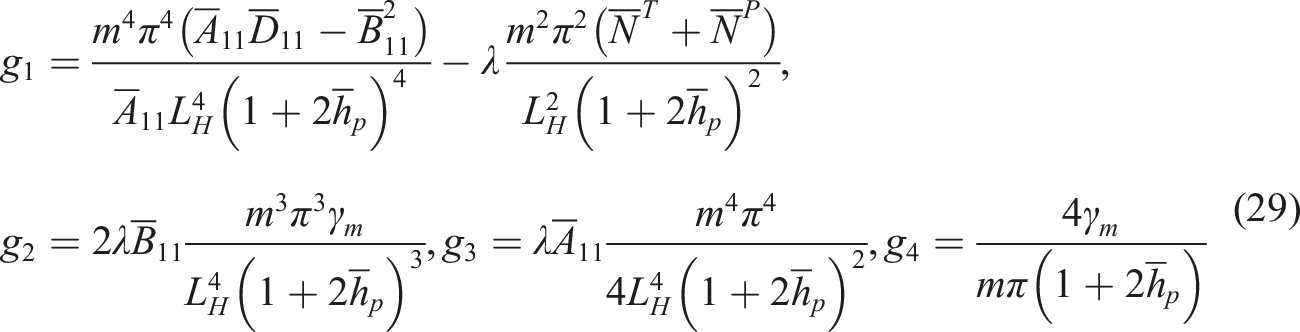
where
Introduction of the deflection solution equation (23) into equation (22) gives the following expression of fictitious force resultant
where
Above-defined quantity is non-dimensional stiffness parameter and will be used to measure the degree of tangential constraints of ends in parametric studies later. It is readily recognized that movable (), immovable () and partially movable () cases of in-plane boundary condition will be characterized by values of , and , respectively. Introduction of from equation (26) into equation (24) leads to the following expression
where a
Above equation (28) describes the nonlinear dynamic response of hybrid CNTRC beams subjected to combined action of thermo-electro-mechanical loads. In case transverse load is omitted, equation (28) is rewritten in the form
This equation exhibits the nonlinear free vibration of CNTRC beams with piezoelectric layers and tangentially restrained edges in thermal environments. In this study, the frequencies of nonlinear free vibration are computed by means of fourth-order Runge-Kutta numerical integration scheme. Initial conditions of numerical integration are and in which is the maximum amplitude of deflection. Specifically, from the obtained time response, the period of nonlinear free vibration is determined through an algorithm and then the frequency of nonlinear free vibration can be computed. As a particular case, when geometrical nonlinearity is neglected, equation (30) results in linear differential equation representing the linear free vibration of piezoelectric CNTRC beams as the following
It is readily found that natural frequencies of linear vibration are computed as
It is evident from equations (29) and (32) that will be zero-valued when which means thermal or electrical buckling occurs. However, in the present study, it is assumed that temperature and voltage only induce pre-existent and non-destabilizing thermal and electrical forces. In parameter studies later, the dimensionless fundamental natural frequencies are defined as follows
in which and is value of calculated at room temperature K. The advantage of above-presented solution procedure is obtaining a closed-form expression of natural frequencies of thin beams with simply supported ends. The limitation and disadvantage are that this approach is inappropriate for thick beams with mixed boundary conditions.
Numerical results and discussion
Parametric studies of the linear and nonlinear free vibrations and nonlinear transient response of CNTRC beams with piezoelectric actuators in thermal environments are carried out in this section. The Poly (methyl methacrylate), referred to as PMMA, is selected for matrix material and (10, 10) single-walled carbon nanotubes (SWCNTs) are selected as reinforcements. The properties of PMMA are , kg/m3, GPa, K in which and K (room temperature).24,29 The temperature-independent Poisson’s ratio and mass density of CNT are , kg/m3.1 The temperature-dependent properties , of (10, 10) SWCNTs are adopted as previously reported work of Shen et al.29 and omitted here for the sake of brevity. In numerical results, piezoelectric material is PZT-5A. Because the piezoelectric layers are very thin, the influence of temperature on properties of piezoelectric material can be marginal. In this study, the temperature-independent properties PZT-5A are chosen as previous works of Rafiee et al.26 and Ansari et al.60 as follows GPa, kg/m3, K, and m/V. In addition, CNT efficiency parameter is chosen as that given in the work,29 specifically , 0.142 and 0.141 for the values of , 0.17 and 0.28, respectively.
Verification
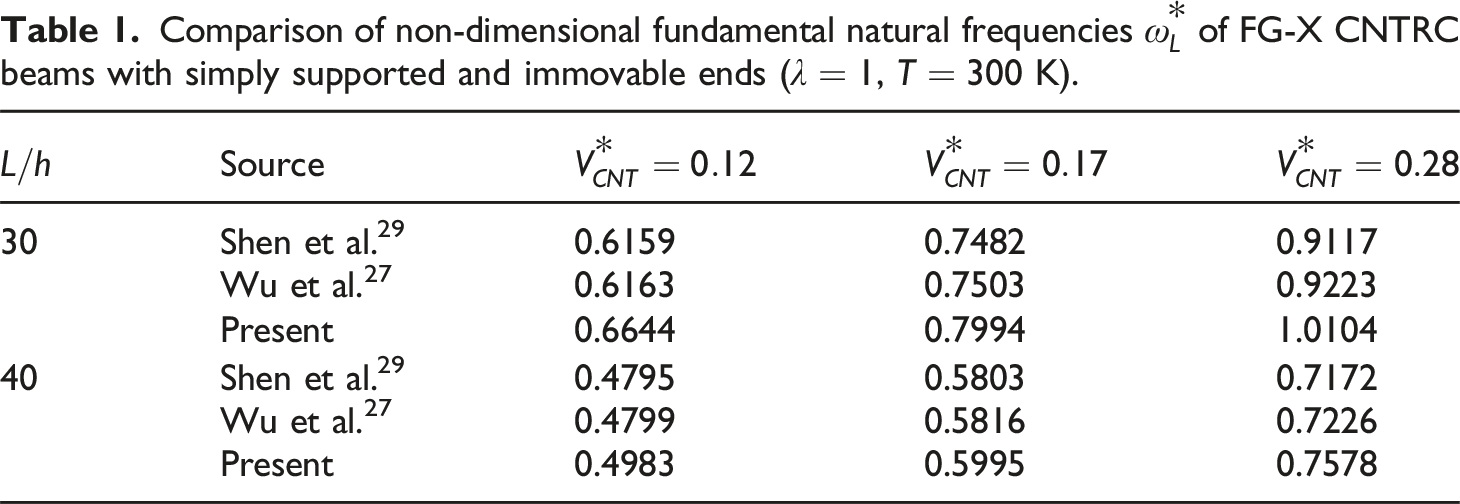
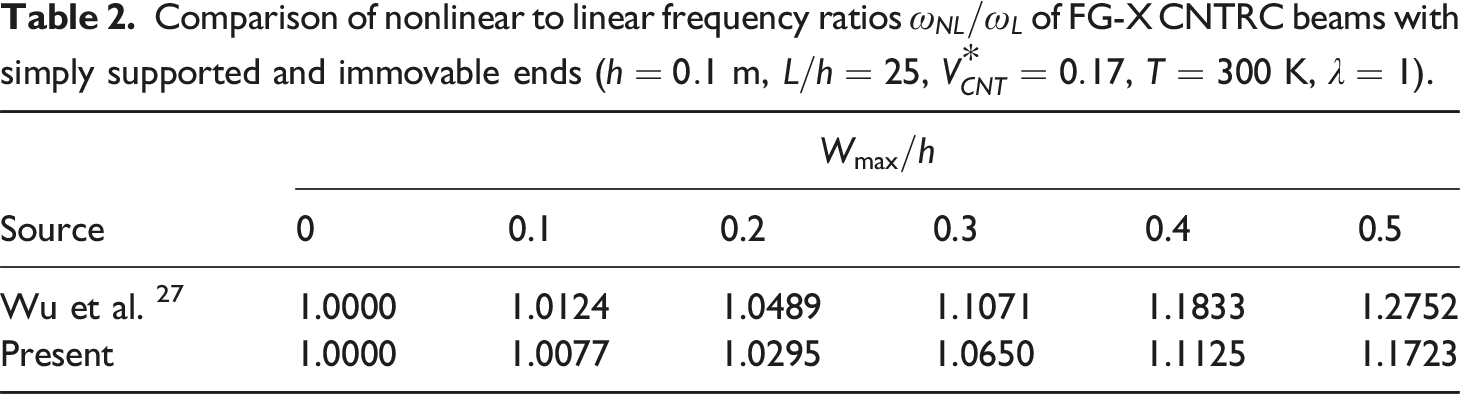
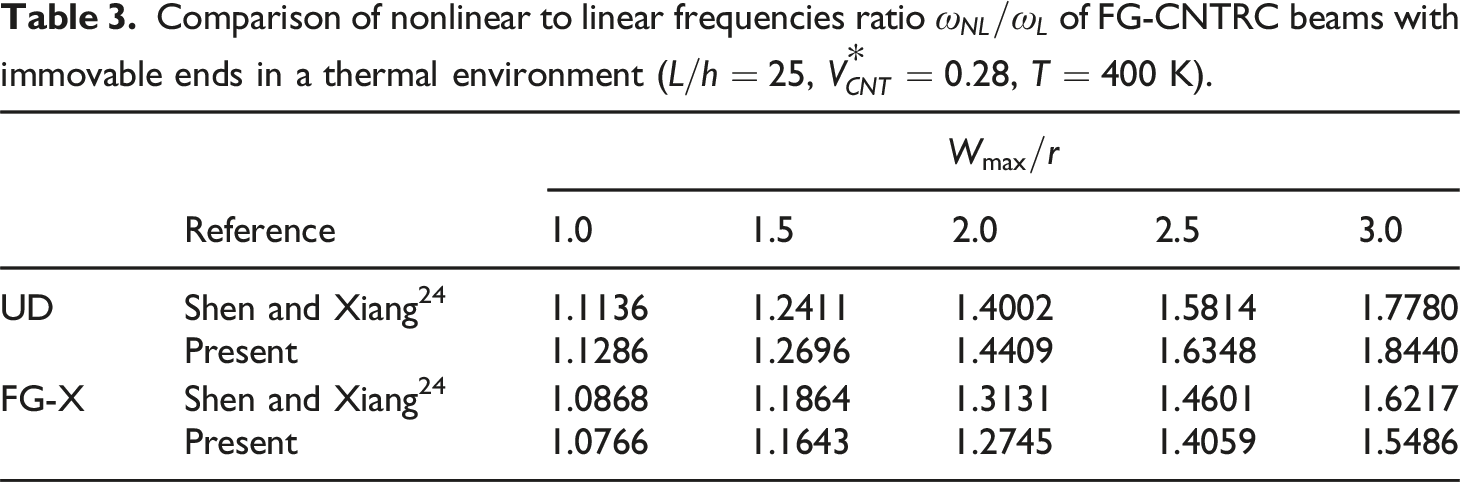
To verify the proposed approach, two comparative studies are carried out for the linear and nonlinear vibration analyses of moderately thick FG-X CNTRC beams without piezoelectric layers. First, the linear free vibration of single-layer FG-X CNTRC beams with simply supported and immovable ends is considered. This problem was also dealt with in works of Shen et al.29 using asymptotic solutions and a HSDBT-based perturbation technique and Wu et al.27 employing FSDBT-based Ritz method. Dimensionless fundamental natural frequencies computed using equation (33) are compared in Table 1 with results presented in the works27,29 for different values of slenderness ratio and CNT volume fraction . As can be seen, the present results are slightly higher than those presented in the works.27,29 This difference is expected because the present study employs the classical beam theory overestimating natural frequencies of shear deformable beams. As the second comparative study, the nonlinear free vibration of shear deformable single-layer CNTRC beams () with FG-X distribution and immovable ends is investigated. The nonlinear to linear frequency ratios computed by the present work with are given in Table 2 in comparison with those reported in the work of Wu et al.27 using FSDBT and Ritz method. Since the beam is moderately thick, the present results basing on the classical beam theory are slightly lower than those reported in the work.27 As final verification, the nonlinear to linear frequency ratios of FG-CNTRC beams with immovable ends and temperature-dependent properties in a thermal environment ( K) are compared in Table 3 with results of Shen and Xiang24 using HSDBT and a two-step technique. Within Table 3, is the radius of gyration of the beam cross section. Obviously, this comparison achieves a good agreement.
Comparison of non-dimensional fundamental natural frequencies of FG-X CNTRC beams with simply supported and immovable ends (, K).
In what follows, parametric studies of linear and nonlinear free vibrations and nonlinear dynamical response of CNTRC beams with piezoelectric layers and tangentially restrained ends will be executed. In the numerical results, the thickness of CNTRC substrate and mode shape of vibration are selected as mm and , respectively. Furthermore, the degree of tangential constraints of two ends is measured by non-dimensional tangential stiffness parameter defined in equation (27). The beams are assumed to be placed at room temperature and with immovable ends (), unless otherwise specified.
Linear free vibration analysis
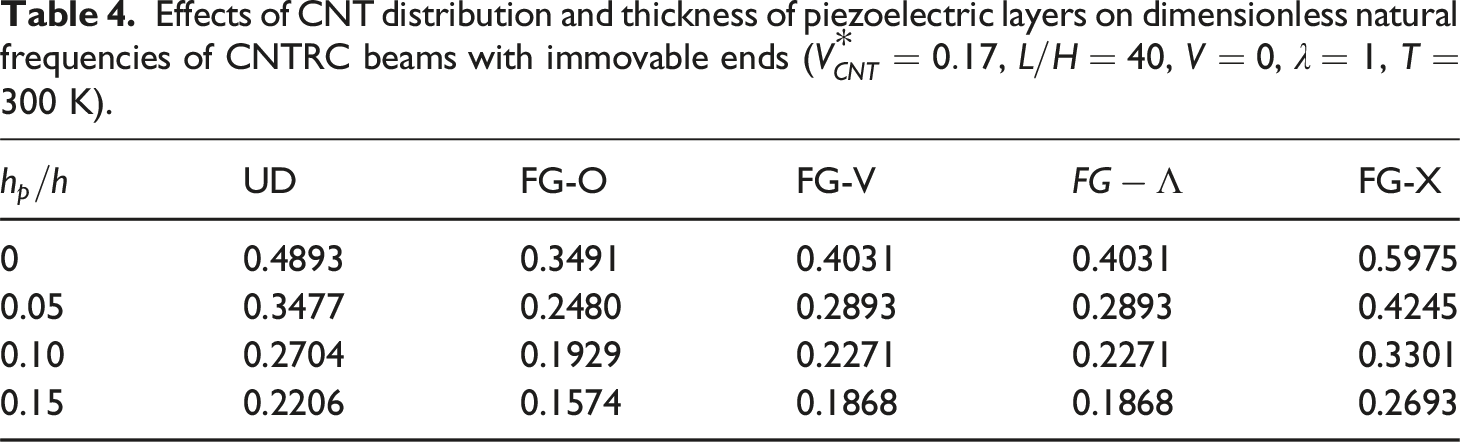
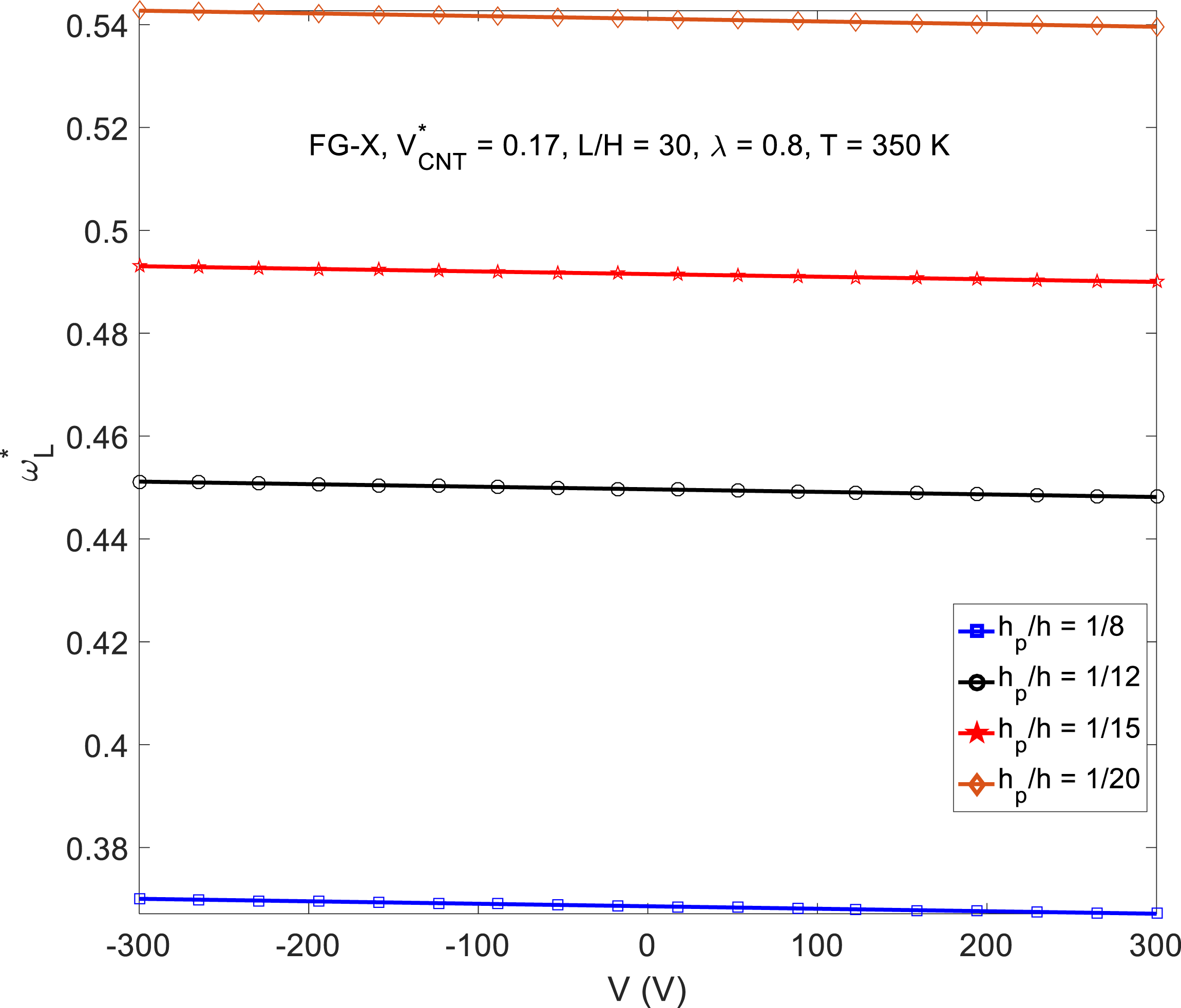
Numerous influences on the non-dimensional fundamental natural frequencies of linear vibration of CNTRC beams with piezoelectric layers are considered in this subsection. As the first example, the effects of CNT distributions and ratio of piezoelectric layer-to-CNTRC host thicknesses on the linear frequencies of CNTRC beams under a grounding condition () are shown in Table 4. As can be seen, the linear natural frequencies of FG-O and FG-X beams are the lowest and highest, respectively. This result is explained is that the flexural rigidity of FG-O and FG-X beams are the weakest and strongest, respectively. Moreover, the linear frequencies are considerably reduced when the piezoelectric layer is thicker. Next, the combined effects of applied voltage and ratio on the non-dimensional frequencies of linear free vibration of FG-X CNTRC beams with immovable ends are plotted in Figure 2. It is again confirmed that decreases as ratio increases for any value of control voltage. Figure 2 also indicates that is slightly dropped due to increase in the applied voltage. More specifically, the natural frequencies are significantly increased and decreased when the absolute values of negative and positive voltages are increased, respectively. A physical interpretation for this result is that tensile and compressive axial forces are induced in the beam as negative and positive voltages are applied, respectively.
Effects of CNT distribution and thickness of piezoelectric layers on dimensionless natural frequencies of CNTRC beams with immovable ends (, , , , K).
UD
FG-O
FG-V
FG-X
0
0.4893
0.3491
0.4031
0.4031
0.5975
0.05
0.3477
0.2480
0.2893
0.2893
0.4245
0.10
0.2704
0.1929
0.2271
0.2271
0.3301
0.15
0.2206
0.1574
0.1868
0.1868
0.2693
Effects of applied voltage and thickness of piezoelectric layers on fundamental natural frequencies of FG-X CNTRC beams with partially movable ends at elevated temperature.
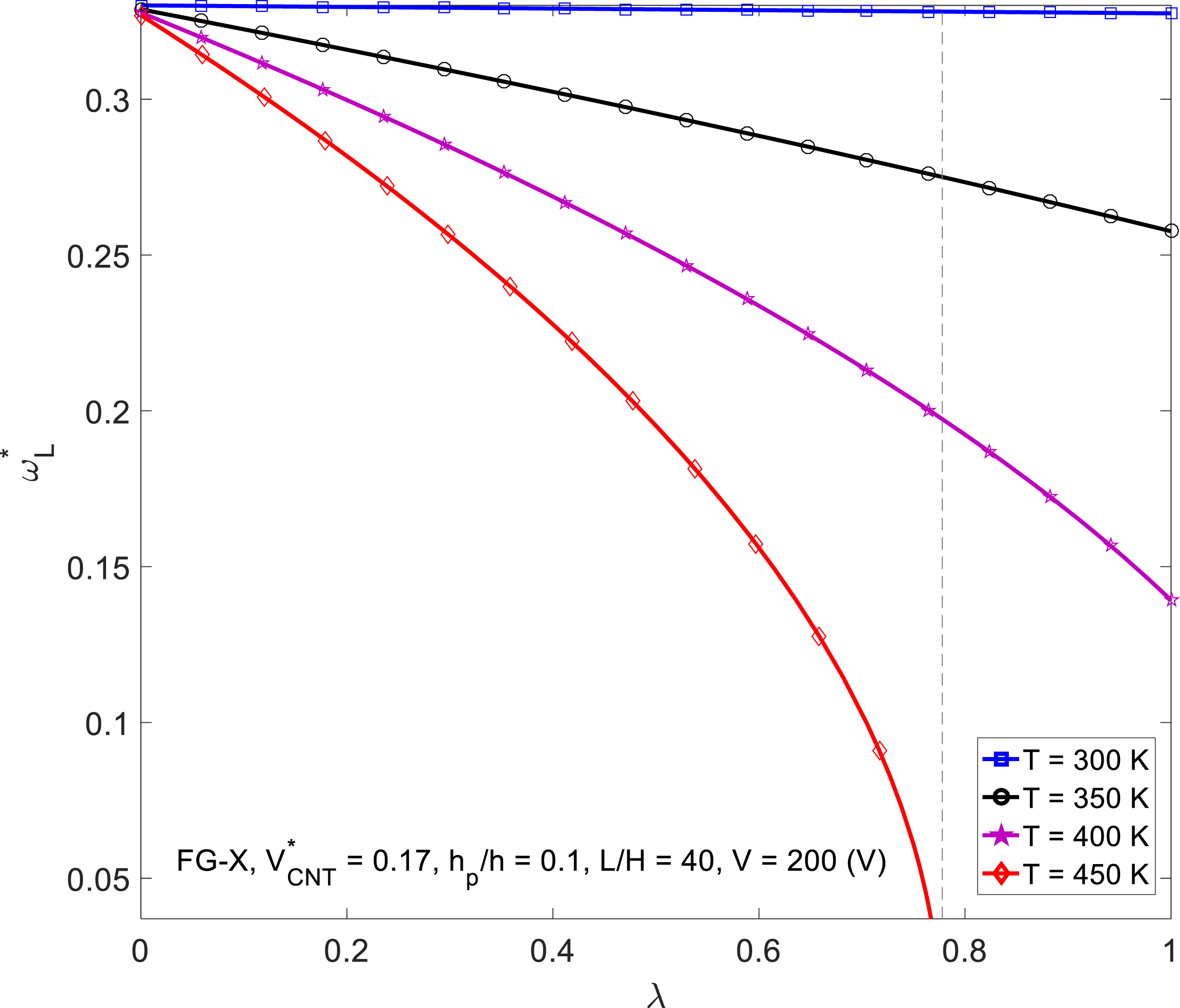
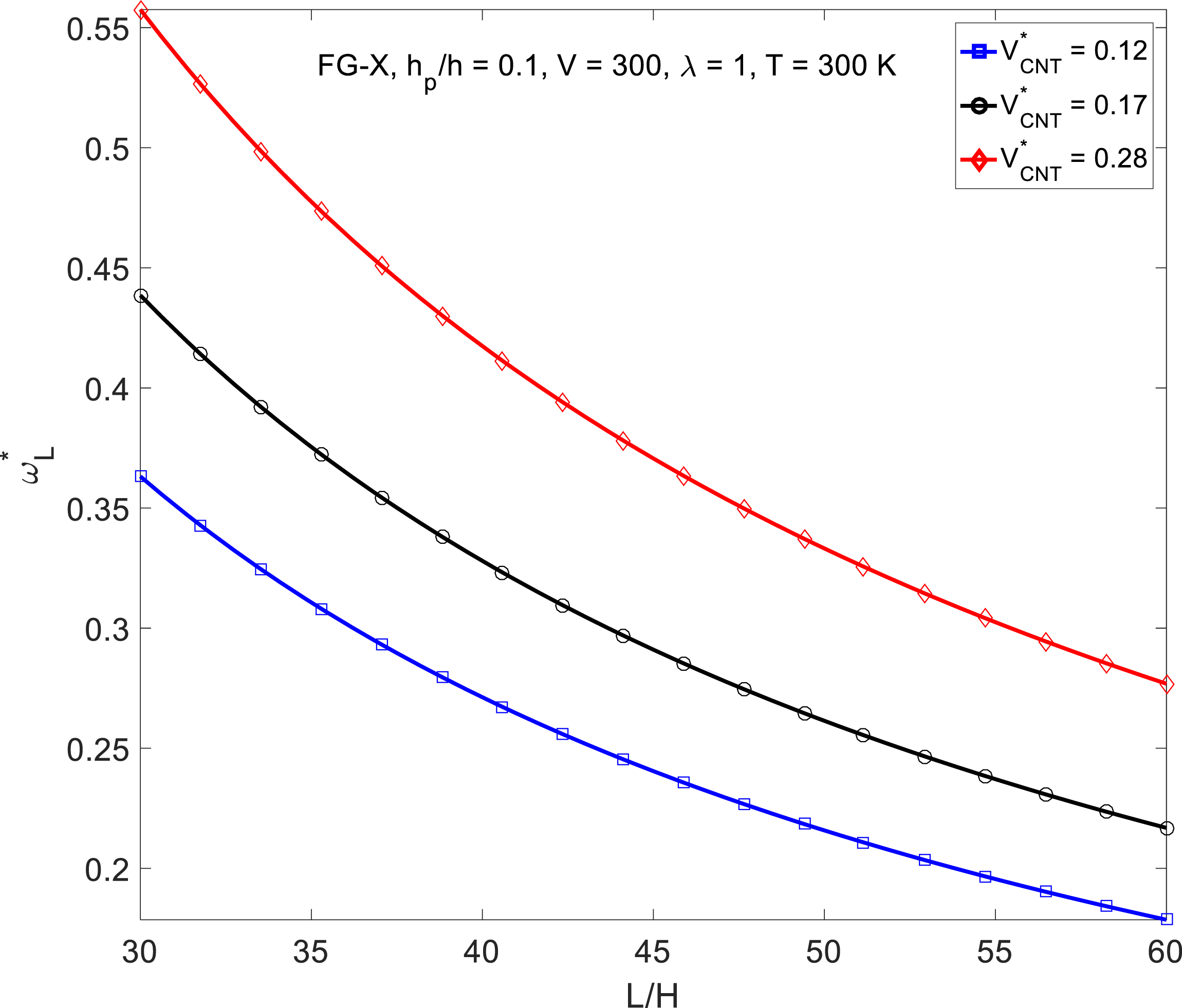
Next numerical result is shown in Figure 3 considering the effects of elevated temperature and in-plane constraint of two ends on the frequencies of linear vibration of FG-X CNTRC beams under a positive voltage ( V). Obviously, increase in parameter leads to slight and substantial decreases in the frequencies at reference and elevated temperatures, respectively. As a physical significance of this result, thermally-induced axial compressive forces are substantially developed as a result of increases in degree of in-plane end constraints along with temperature and these forces render the natural frequencies considerably smaller. Particularly, the frequency can be zero-valued at enough large values of parameter and . As an ultimate analysis in this subsection, Figure 4 shows the influences of slenderness ratio and CNT volume fraction on the frequencies of FG-X beams with piezoelectric layers under a positive voltage ( V). Evidently, the frequencies are remarkably reduced and enhanced due to increases in ratio and fraction, respectively. This result is reasonable because lateral bending rigidity of beam is decreased and increased as a result of increase in the values of and , respectively.
Effects of tangential constraint of ends and thermal environments on fundamental natural frequencies of FG-X CNTRC beams with immovable ends.
Effects of slenderness ratio and CNT volume fraction on fundamental natural frequencies of FG-X CNTRC beams with immovable ends.
Nonlinear free vibration analysis
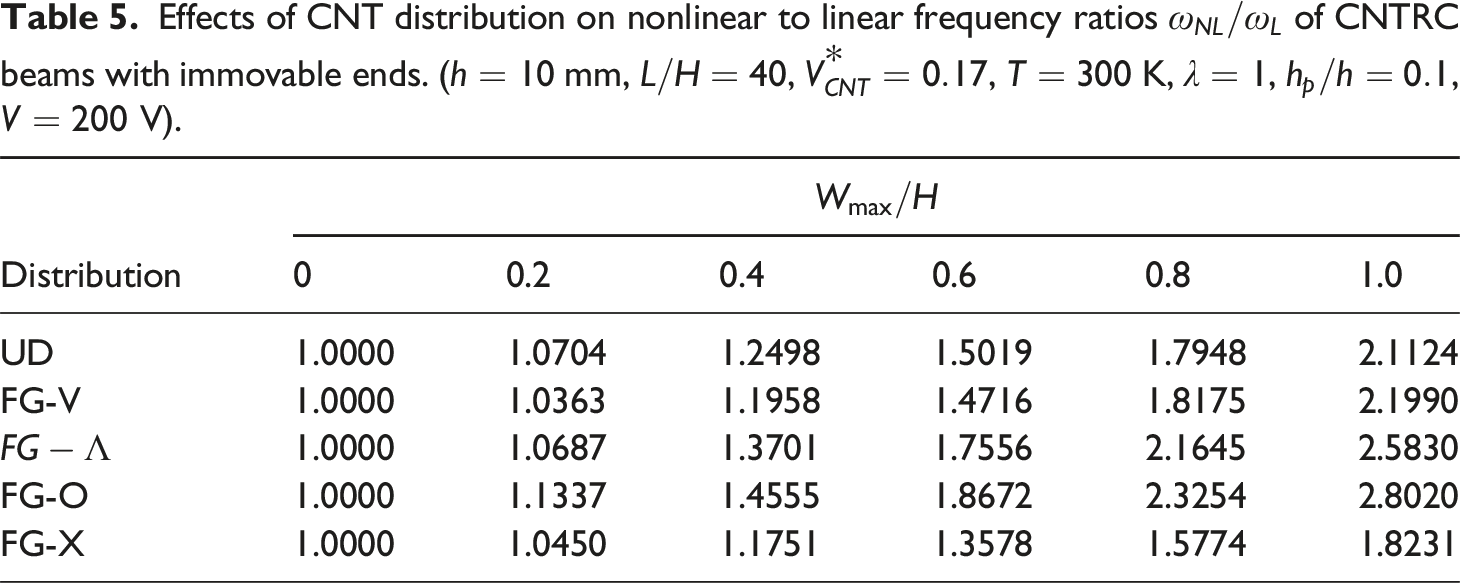
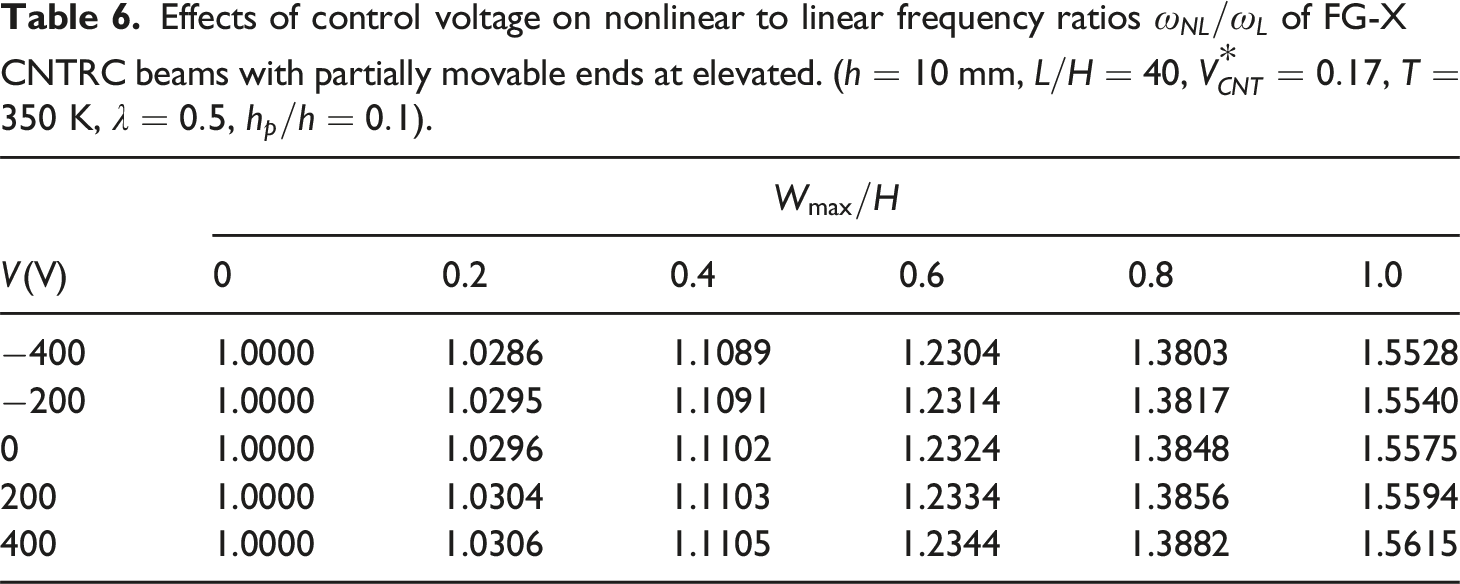
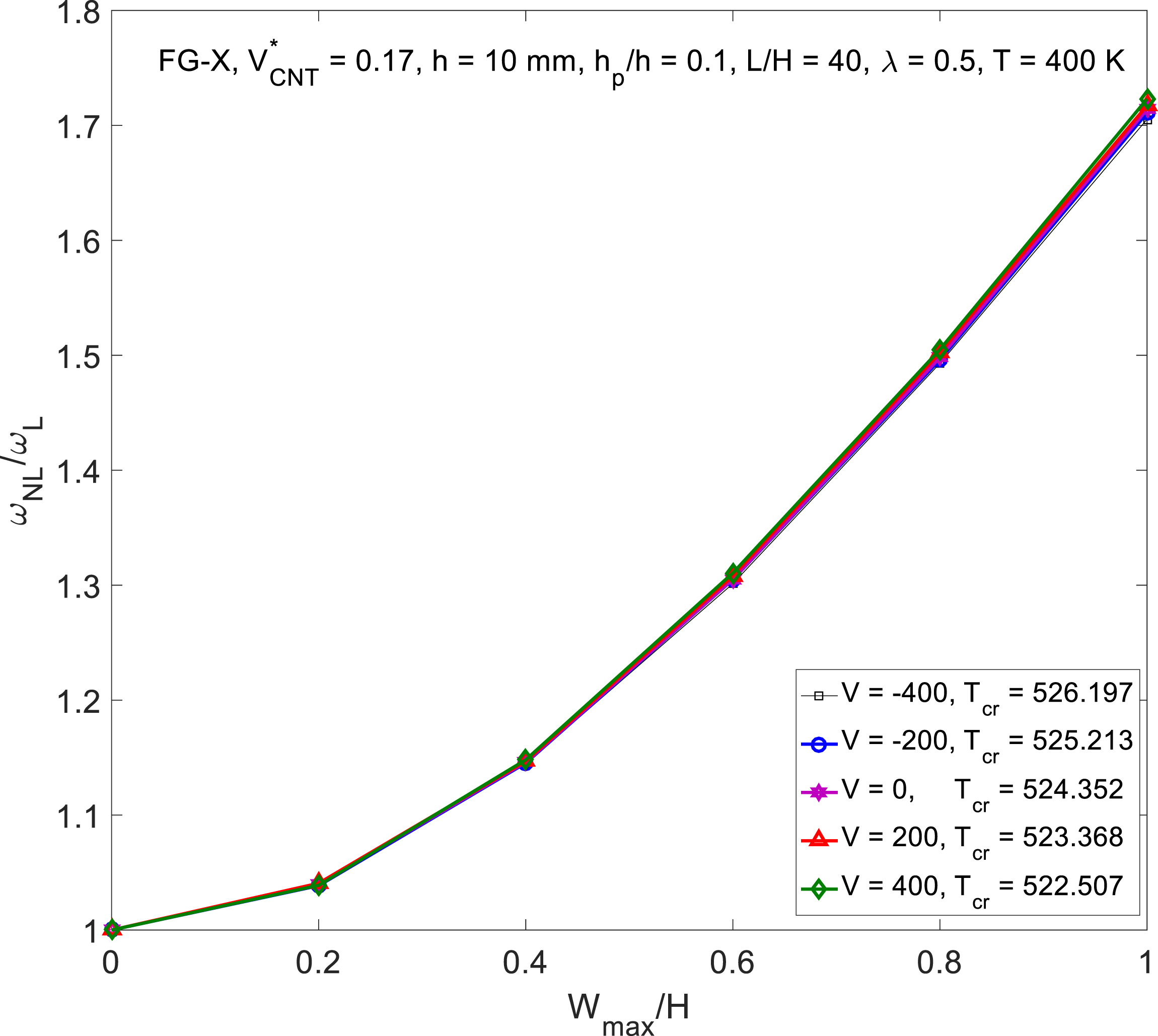
The frequencies of nonlinear free vibration of hybrid CNTRC beams are computed by solving nonlinear differential equation (30) by means of fourth-order Runge-Kutta scheme. To ensure the accuracy of numerical integration scheme, a time step of s is selected. The relation between the nonlinear to linear frequency ratio and ratio of maximum amplitude of deflection to total thickness of beam are analyzed in this subsection. Table 5 shows the effects of CNT distributions on the nonlinear to linear frequency ratio of CNTRC beams with piezoelectric layers and immovable ends under a positive voltage ( V). It is obvious that, contrary to situation shown in Table 4, ratios of FG-O and FG-X beams are the largest and smallest, respectively. Subsequently, the influences of applied voltages on the nonlinear to linear frequency ratios of FG-X beams with partially movable ends are examined in Table 6. Generally, positive and negative voltages slightly increase and decrease the frequency nonlinearity, respectively, and ratios become mildly larger when the control voltage is increased from to .
Effects of CNT distribution on nonlinear to linear frequency ratios of CNTRC beams with immovable ends. ( mm, , , K, , , V).
Distribution
0
0.2
0.4
0.6
0.8
1.0
UD
1.0000
1.0704
1.2498
1.5019
1.7948
2.1124
FG-V
1.0000
1.0363
1.1958
1.4716
1.8175
2.1990
1.0000
1.0687
1.3701
1.7556
2.1645
2.5830
FG-O
1.0000
1.1337
1.4555
1.8672
2.3254
2.8020
FG-X
1.0000
1.0450
1.1751
1.3578
1.5774
1.8231
Effects of control voltage on nonlinear to linear frequency ratios of FG-X CNTRC beams with partially movable ends at elevated. ( mm, , , K, , ).
(V)
0
0.2
0.4
0.6
0.8
1.0
1.0000
1.0286
1.1089
1.2304
1.3803
1.5528
1.0000
1.0295
1.1091
1.2314
1.3817
1.5540
0
1.0000
1.0296
1.1102
1.2324
1.3848
1.5575
200
1.0000
1.0304
1.1103
1.2334
1.3856
1.5594
400
1.0000
1.0306
1.1105
1.2344
1.3882
1.5615
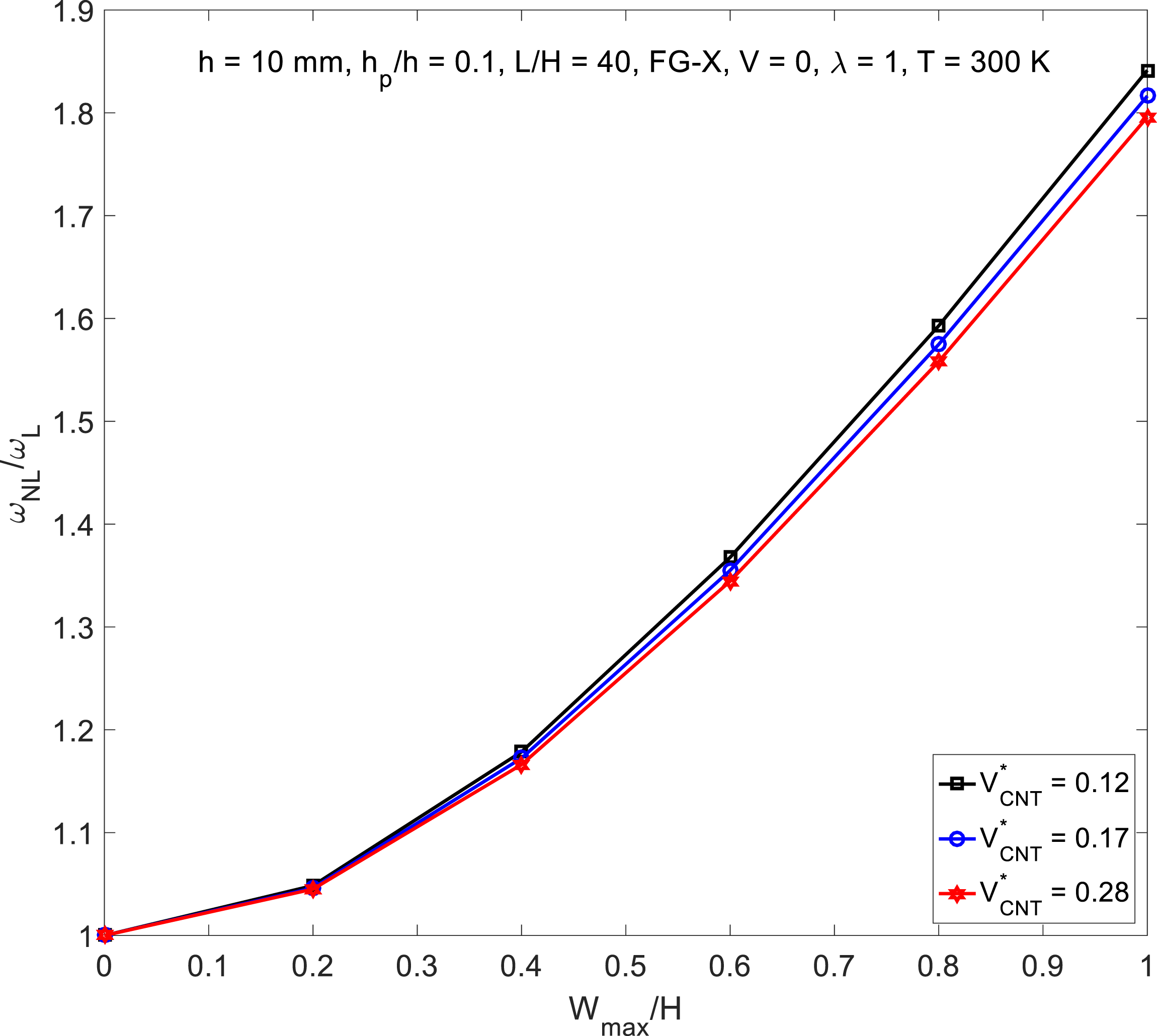
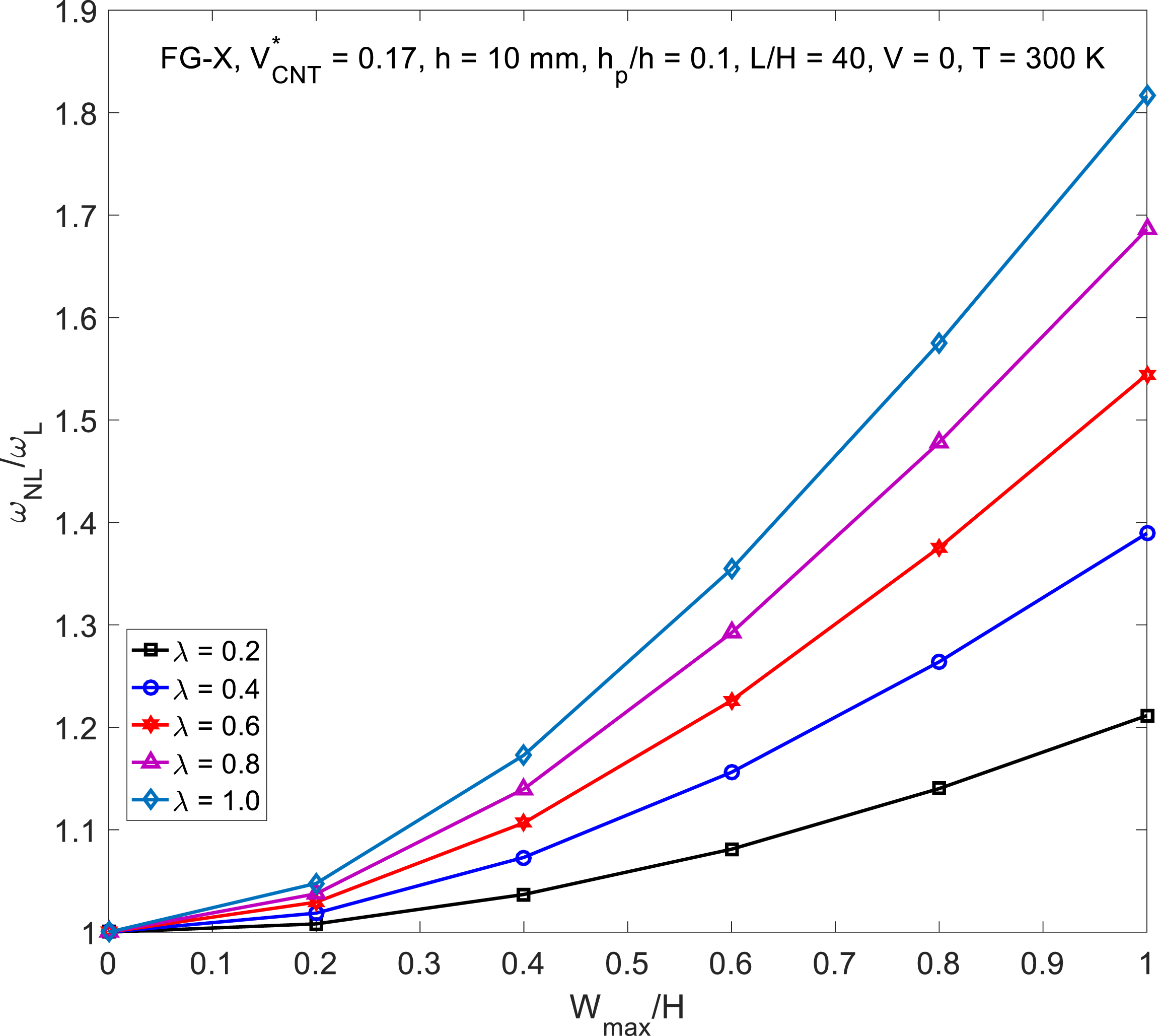
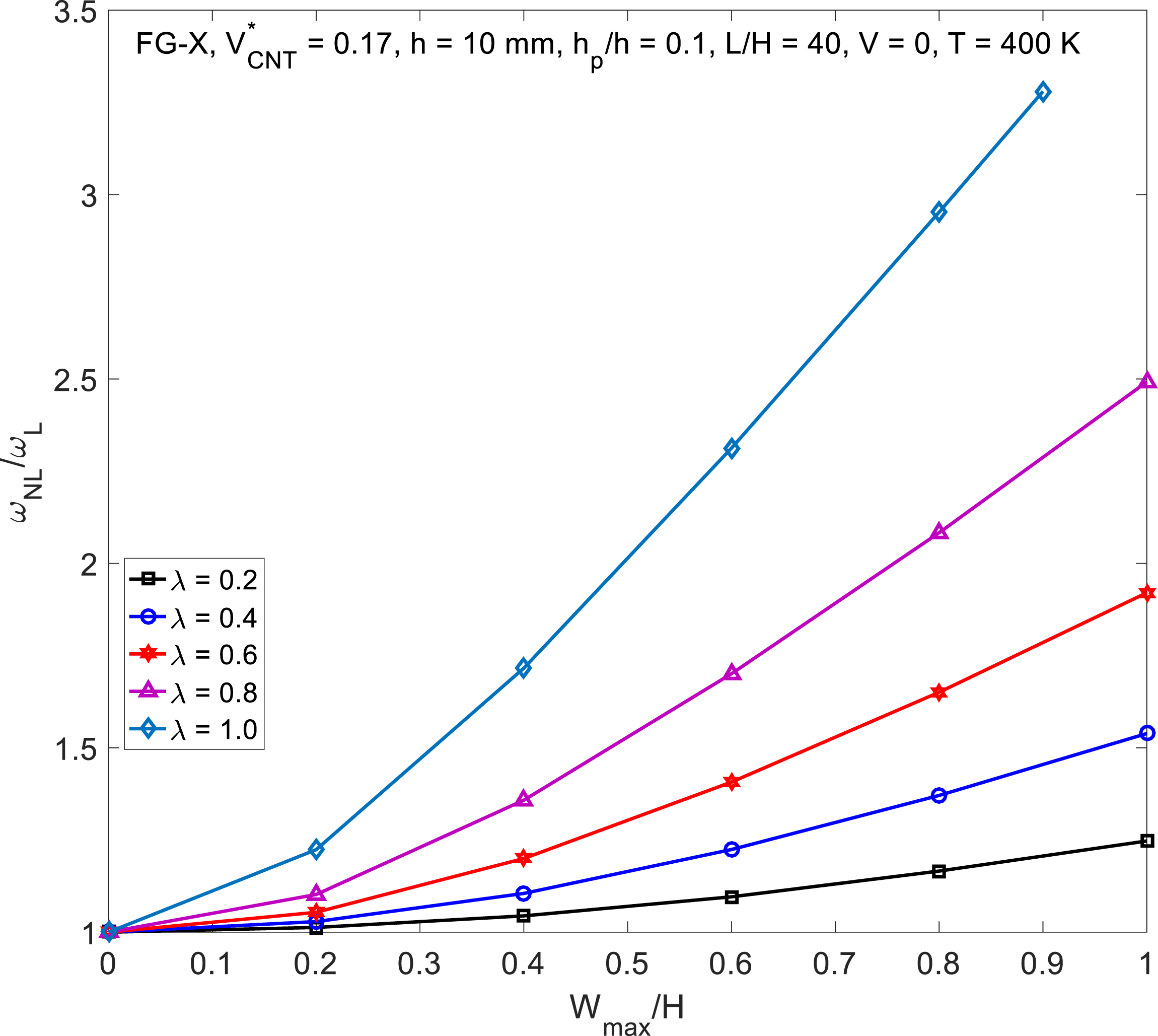
Next, different influences on the frequency ratio–dimensionless maximum amplitude curves of FG-X CNTRC beams with piezoelectric layers are graphically analyzed. Figure 5 is a graph of the maximum amplitude of nonlinear free vibration versus nonlinear to linear frequency ratio for different values of . As can be observed, the frequency ratio is slightly decreased when the volume percentage of CNTs is increased. From Figures 4 and 5, it is interpreted that both linear and nonlinear vibration frequencies are enhanced when is increased, nevertheless the effect of on linear vibration frequency is more dramatic. The effects of tangential constraints of ends on the frequency ratio–maximum amplitude curves of FG-X beams under a grounding condition at reference and elevated temperatures are examined in Figures 6 and 7, respectively. Obviously, in-plane boundary condition substantially affects the frequencies of nonlinear vibration and, in general, the frequency nonlinearity is more significant when the ends are more severely restrained in tangential direction. Moreover, it is found that the frequency nonlinearity is much stronger when the hybrid CNTRC beams are exposed to an elevated temperature.
Effects of CNT volume fraction on nonlinear to linear frequency ratio of FG-X CNTRC beams with immovable ends.
Effects of tangential constraints of ends on nonlinear to linear frequency ratio of FG-X CNTRC beams with piezoelectric layers at reference temperature.
Effects of tangential constraints of ends on nonlinear to linear frequency ratio of FG-X CNTRC beams with piezoelectric layers at elevated temperature.
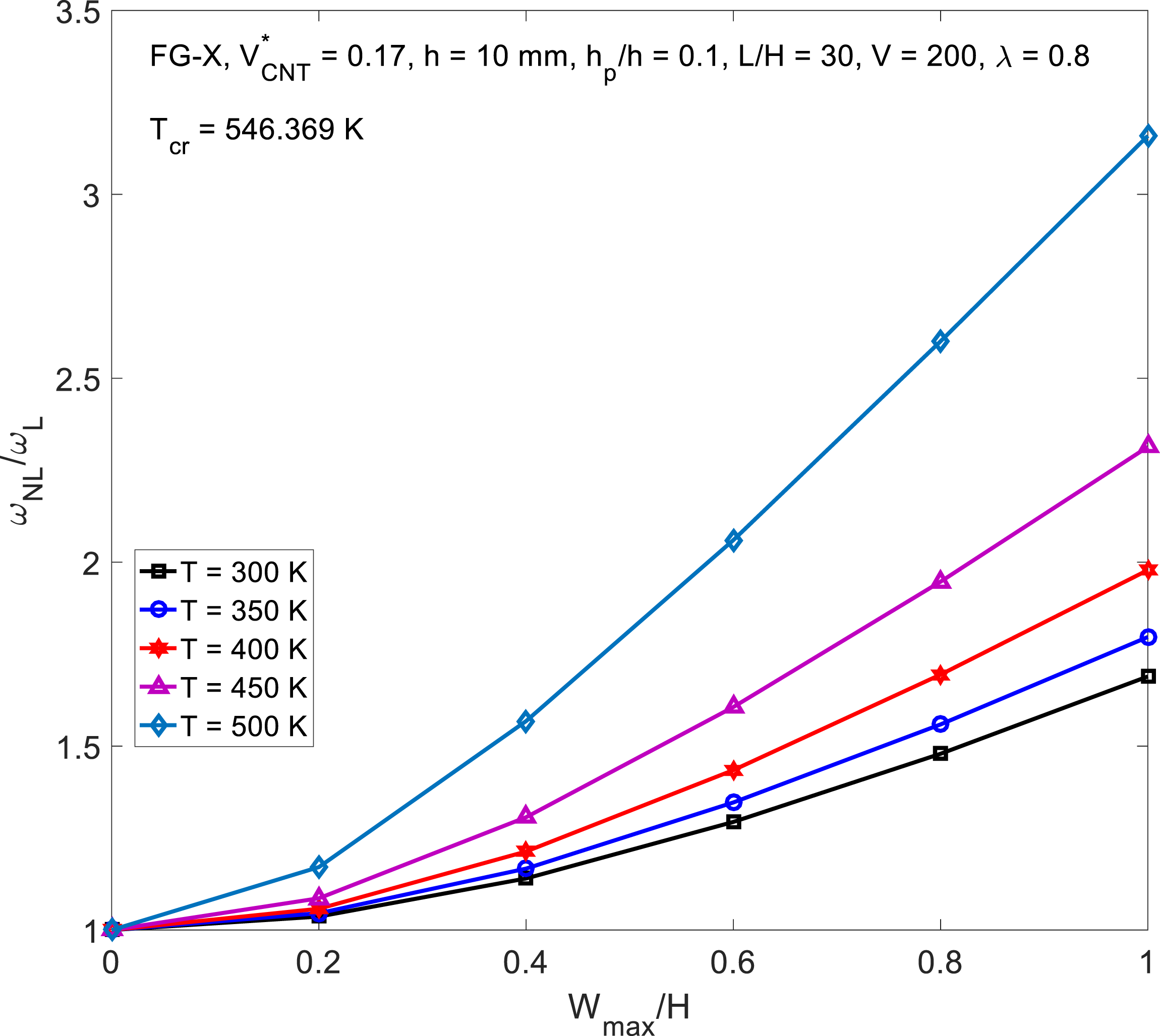
As a subsequent numerical result, Figure 8 plots frequency ratios versus maximum amplitude of deflection for various levels of temperature of FG-X beams with almost immovable ends () under a positive voltage ( V). For specific parameters in Figure 8, critical temperature can be computed is K which larger than considered values of temperature T. This means thermal buckling does not occur. It is clear that the enhancement of temperature renders the frequency nonlinearity more significant. Results in Figures 6–8 can be interpreted that the axial forces induced at restrained ends make the frequency ratio pronouncedly larger, i.e., frequency nonlinearity is considerably stronger. Next, a graph of dimensionless maximum amplitude of deflection versus ratio of nonlinear to linear frequencies of FG-X beams with immovable ends under a positive voltage for various values of slenderness ratio is depicted in Figure 9. The beam is exposed to an elevated temperature K which is lower than critical buckling temperatures. It is obvious from Figure 9 that the frequency nonlinearity is considerably stronger when slenderness ratio is increased. It seems that linear and nonlinear frequencies are strongly and relatively decreased, respectively, when slenderness ratio is increased and therefore ratio is larger when the beam is slenderer. Final numerical result in this subsection is shown in Figure 10 assessing the influences of control voltage on the frequency–amplitude curves of the nonlinear free vibration of FG-X beams with piezoelectric layers and partially movable ends () in a thermal environment ( K). It is again confirmed that the frequency nonlinearity is less and more significant when the control voltage is negative and positive, respectively, and frequency–amplitude curves are benignly enhanced as the value of control voltage is increased. This result can be interpreted that tensile and compressive axial forces induced by negative and positive voltages render frequency nonlinearity is slightly weaker and stronger, respectively.
Effects of thermal environments on nonlinear to linear frequency ratio of FG-X CNTRC beams with almost immovable ends.
Effects of slenderness ratio on nonlinear to linear frequency ratio of FG-X CNTRC beams with immovable ends at elevated temperature.
Effects of applied voltage on nonlinear to linear frequency ratio of FG-X CNTRC beams with partially movable ends.
Nonlinear transient response analysis
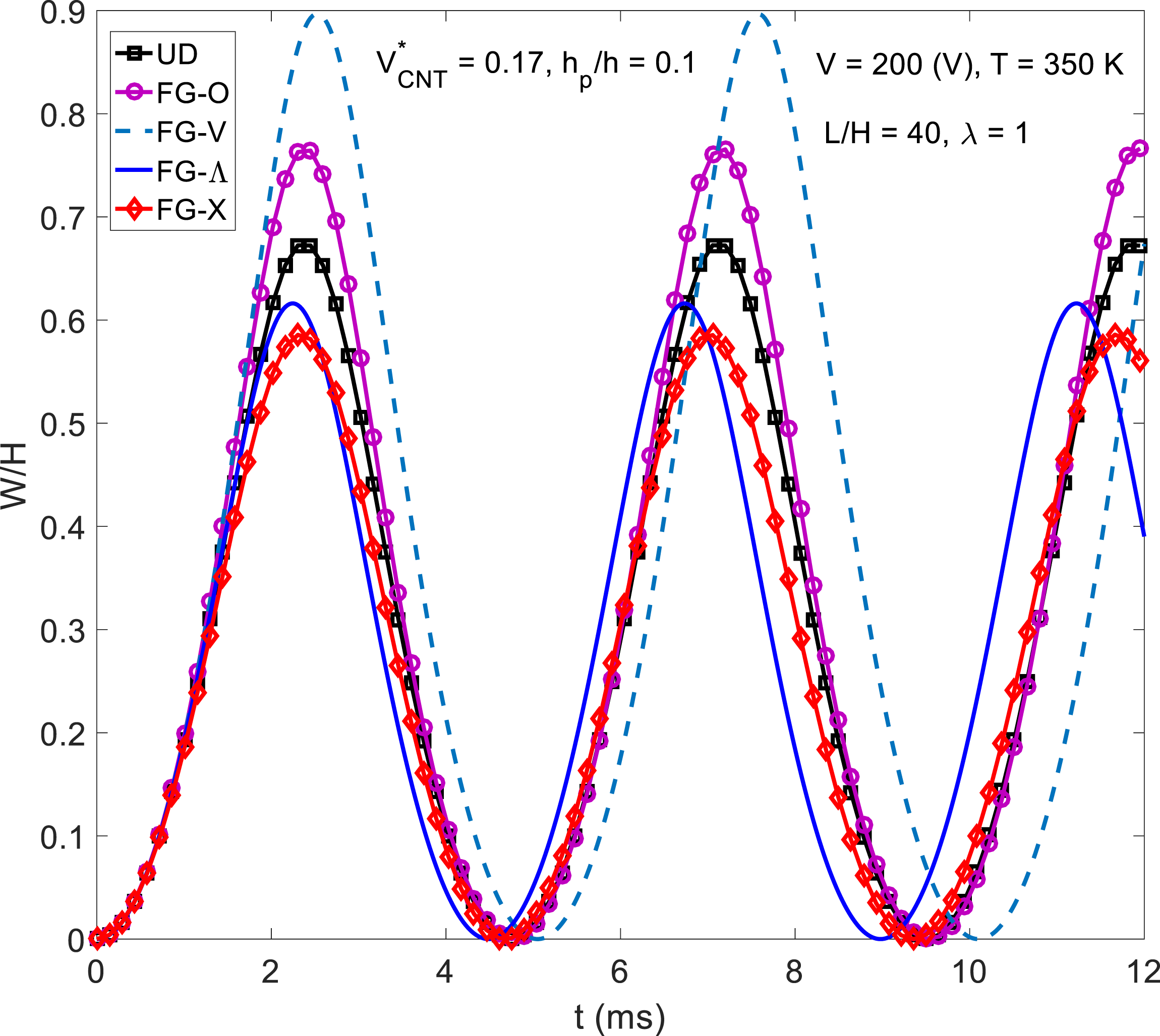
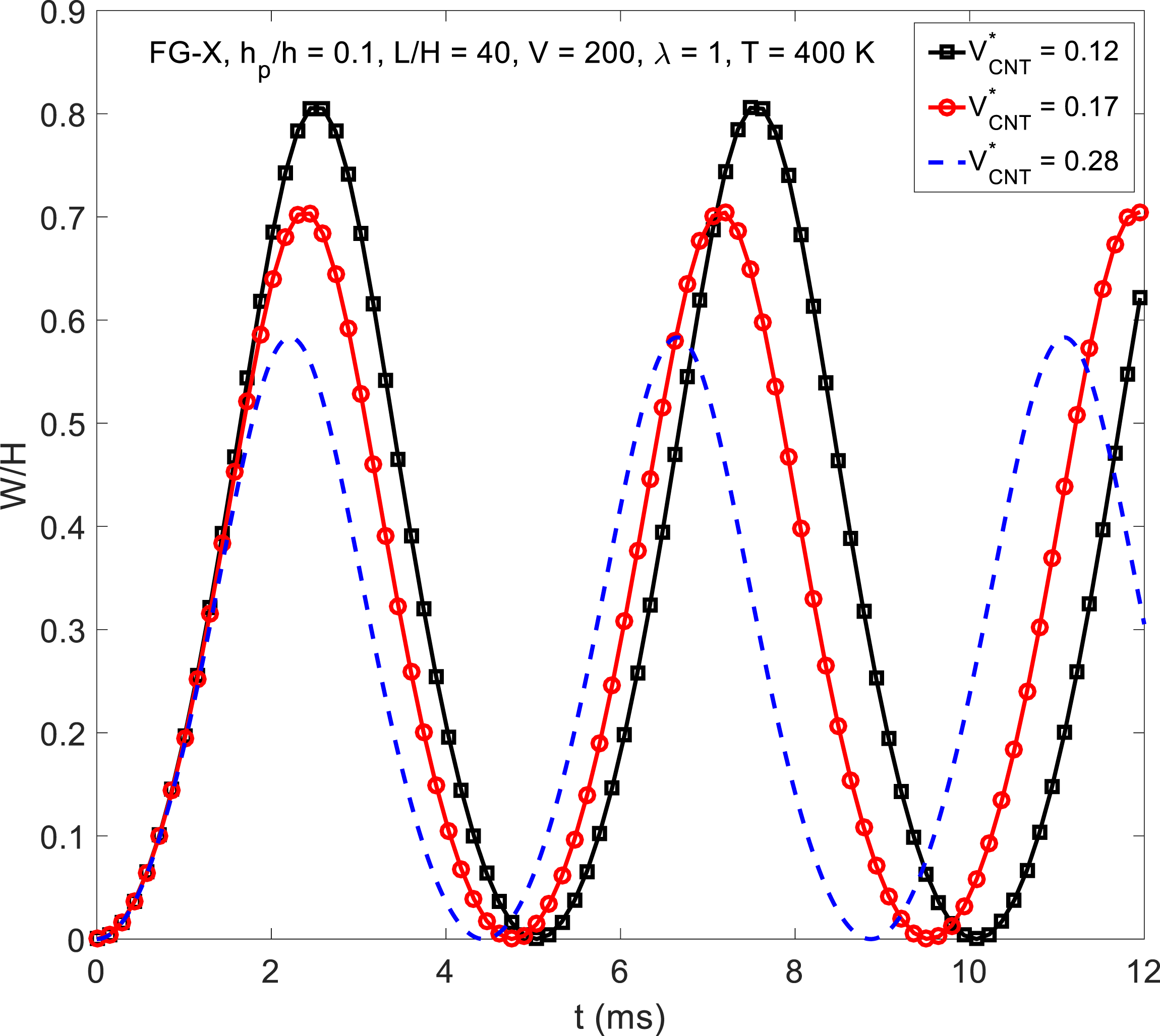
The nonlinear transient response of hybrid beams with CNTRC host thickness mm under a suddenly applied uniform transverse load N/m is investigated in this subsection. Dimensionless deflection amplitude–time paths are traced employing fourth-order Runge-Kutta numerical integration scheme with initial conditions , and a time step s. First analysis is described in Figure 11 considering the effects of CNT distributions on the nonlinear transient response of CNTRC beams with piezoelectric actuators and immovable ends under a positive voltage at elevated temperature. As can be seen, among five types of CNT distributions, the dynamical deflections of FG-V and FG-X beams are the largest and smallest, respectively. Moreover, beam possesses quite small deflection and the smallest period of vibration. Figure 12 shows that volume percentage of reinforcements has remarkable effects on nonlinear dynamical response of FG-X beams under a positive voltage in a thermal environment ( K). Concretely, the dynamical deflection and vibration period of beam are strongly dropped when is increased. The remaining parametric studies are carried out for FG-X CNTRC beams with .
Effects of CNT distributions on nonlinear dynamic response of CNTRC beams with piezoelectric layers and immovable ends at elevated temperature.
Effects of CNT volume fraction on nonlinear dynamic response of FG-X CNTRC beams with piezoelectric layers and immovable ends.
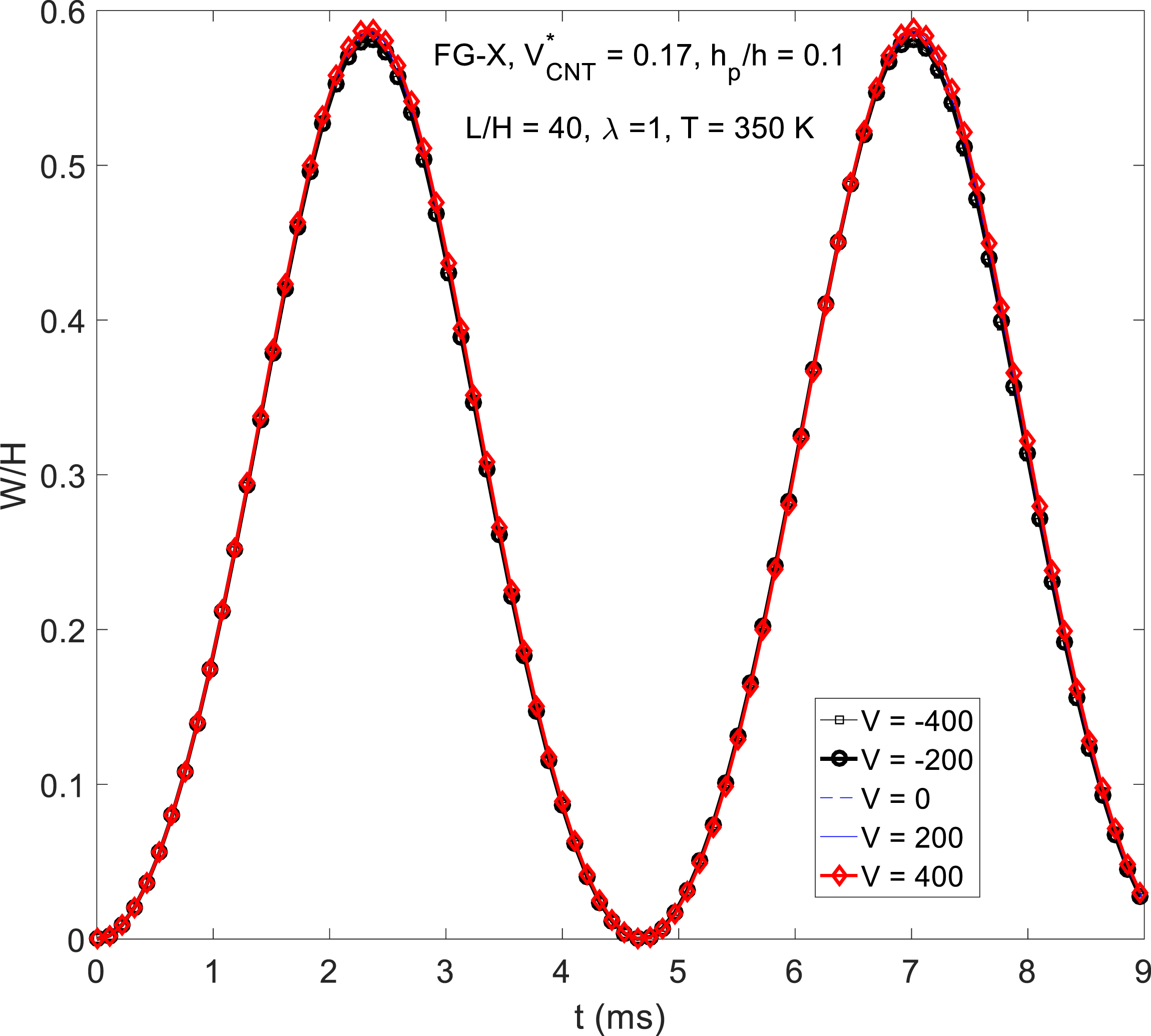
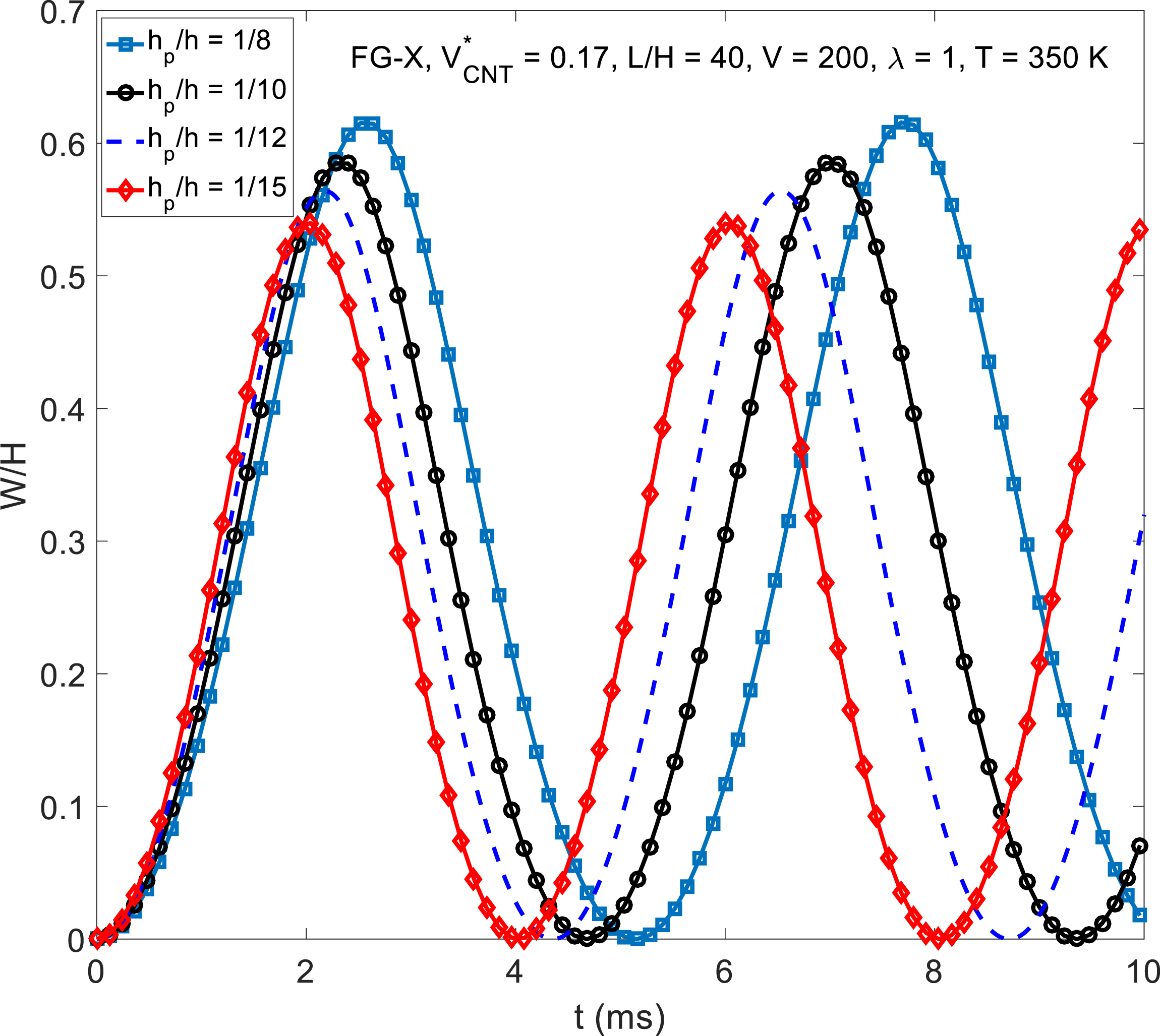
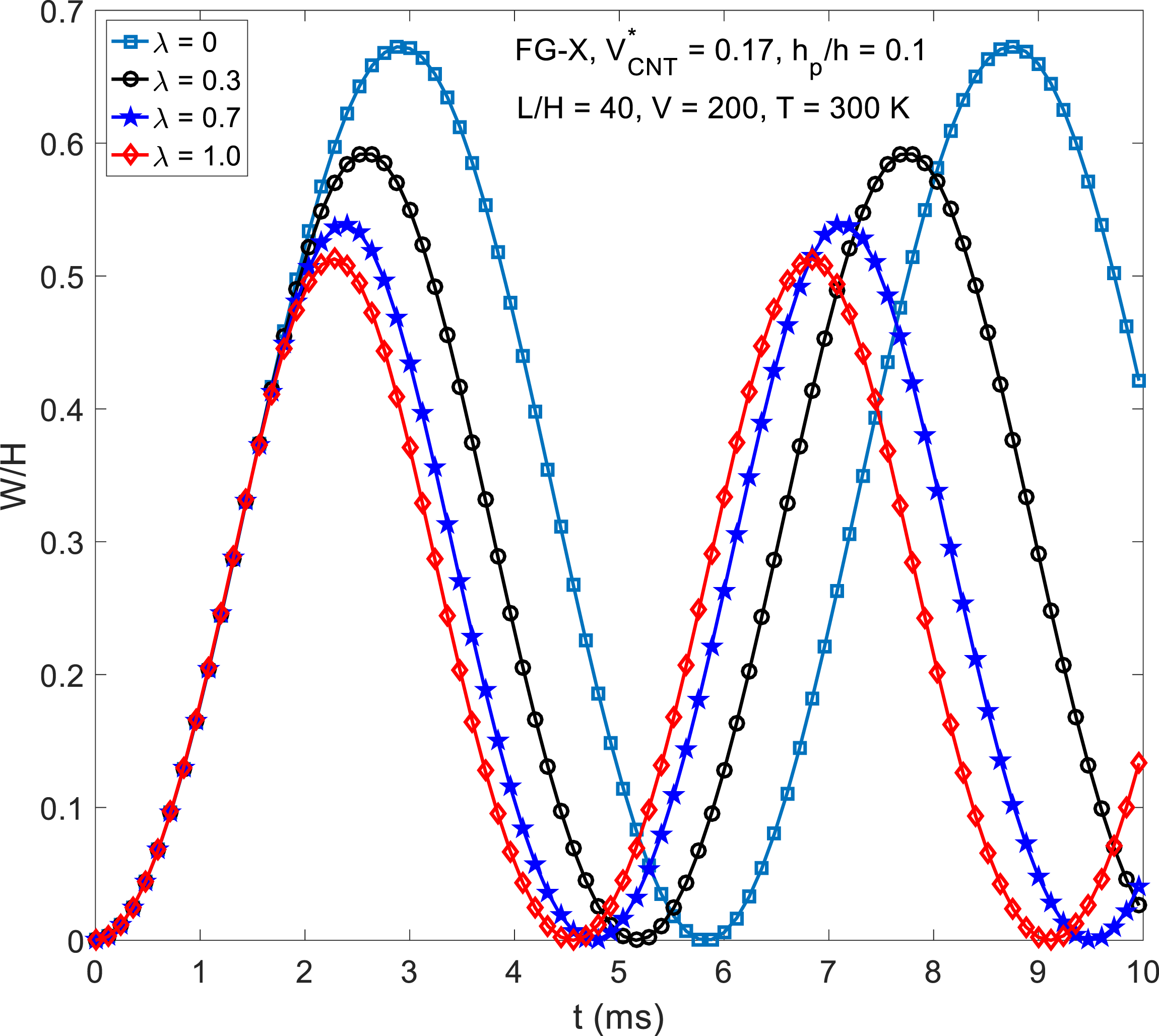
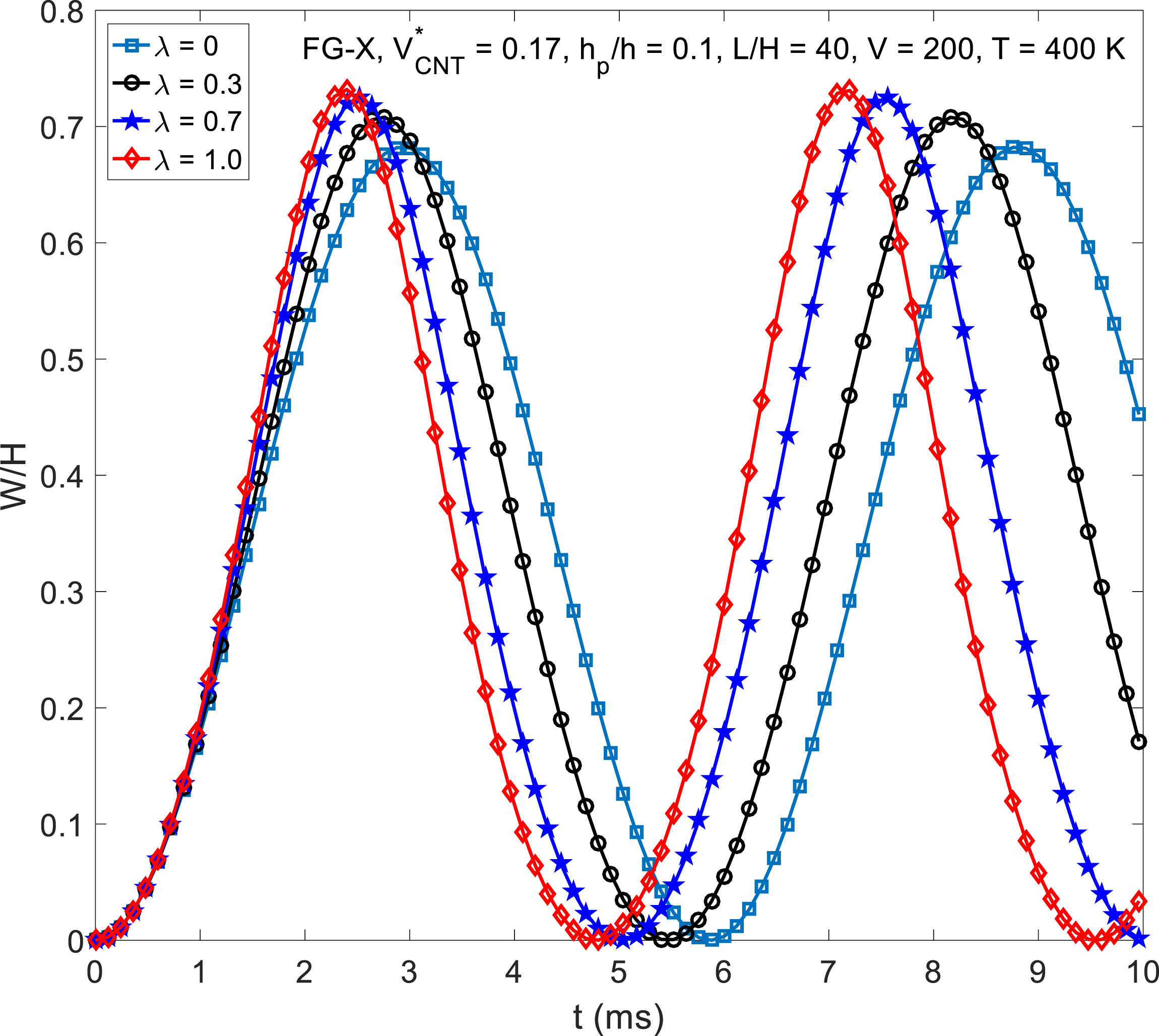
The influences of control voltage on the nonlinear transient response of CNTRC beams with piezoelectric actuators and immovable ends in a thermal environment are analyzed in Figure 13. As can be observed, the positive and negative voltages very slightly increase and decrease the dynamical deflection of the beam, respectively. Next, Figure 14 shows the effects of thickness of piezoelectric layers on the nonlinear transient response of CNTRC beams with immovable ends under a positive voltage. It is found that the amplitude of dynamical deflection and period of vibration are lowered when the ratio is decreased. Next, the influences of tangential constraints of ends on the nonlinear dynamical response of FG-X beams with piezoelectric actuators under a positive voltage at reference and elevated temperatures are examined in Figures 15 and 16, respectively. Figure 15 shows that, under electro-mechanical load, the deflection amplitude and vibration period of the beam are considerably reduced when the ends are restrained more rigorously, i.e. parameter is larger. Otherwise, Figure 16 demonstrates that, under thermo-electro-mechanical load, the amplitude of dynamical deflection and vibration period of the beam increases and decreases when the ends are more severely restrained in the tangential direction, respectively.
Effects of applied voltage on nonlinear dynamic response of FG-X CNTRC beams with piezoelectric layers and immovable ends at elevated temperature.
Effects of thickness of piezoelectric layers on nonlinear dynamic response of FG-X CNTRC beams with immovable ends.
Effects of in-plane constraints of ends on nonlinear dynamic response of FG-X CNTRC beams at room temperature.
Effects of in-plane constraints of ends on nonlinear dynamic response of FG-X CNTRC beams at elevated temperature.
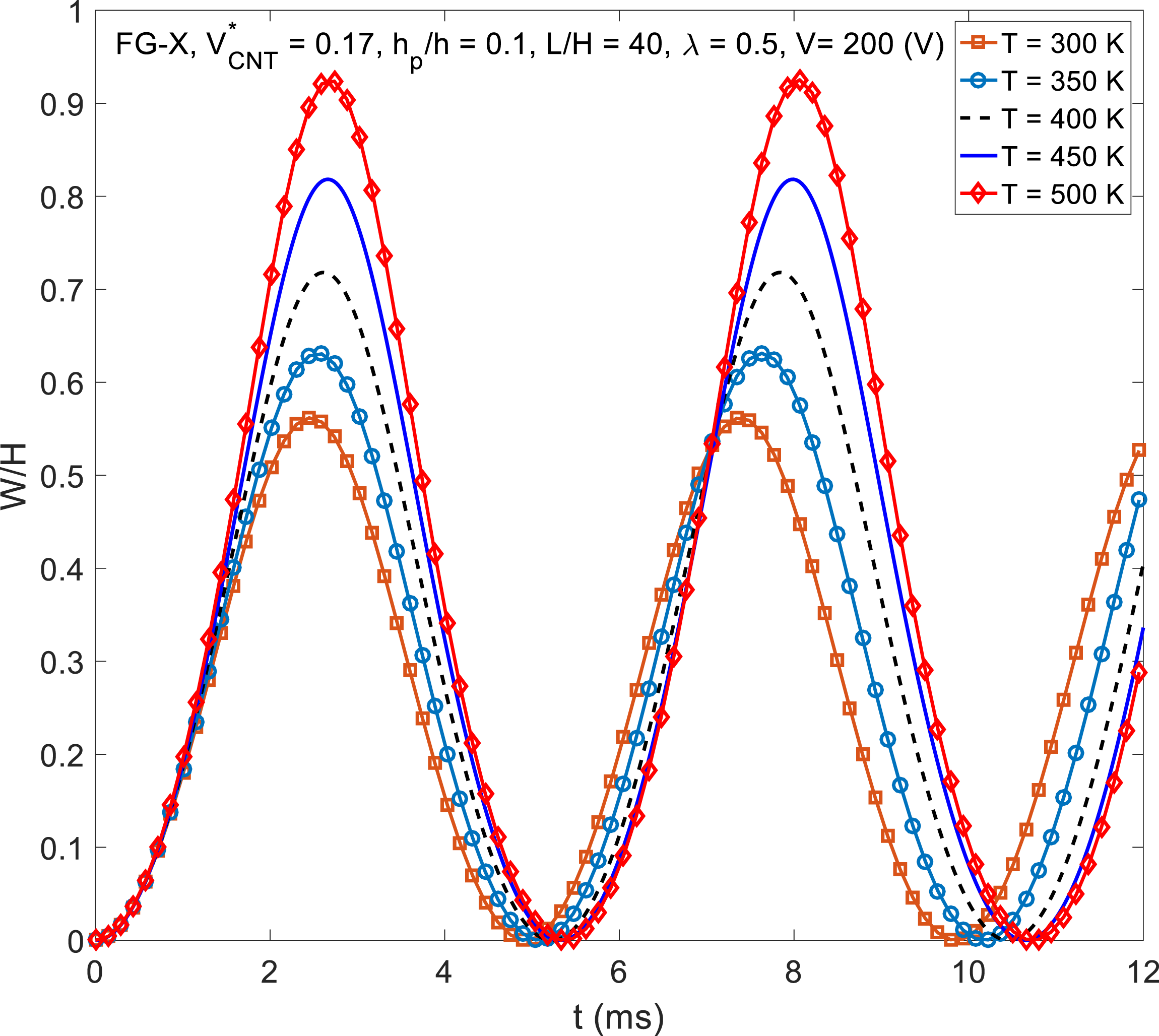
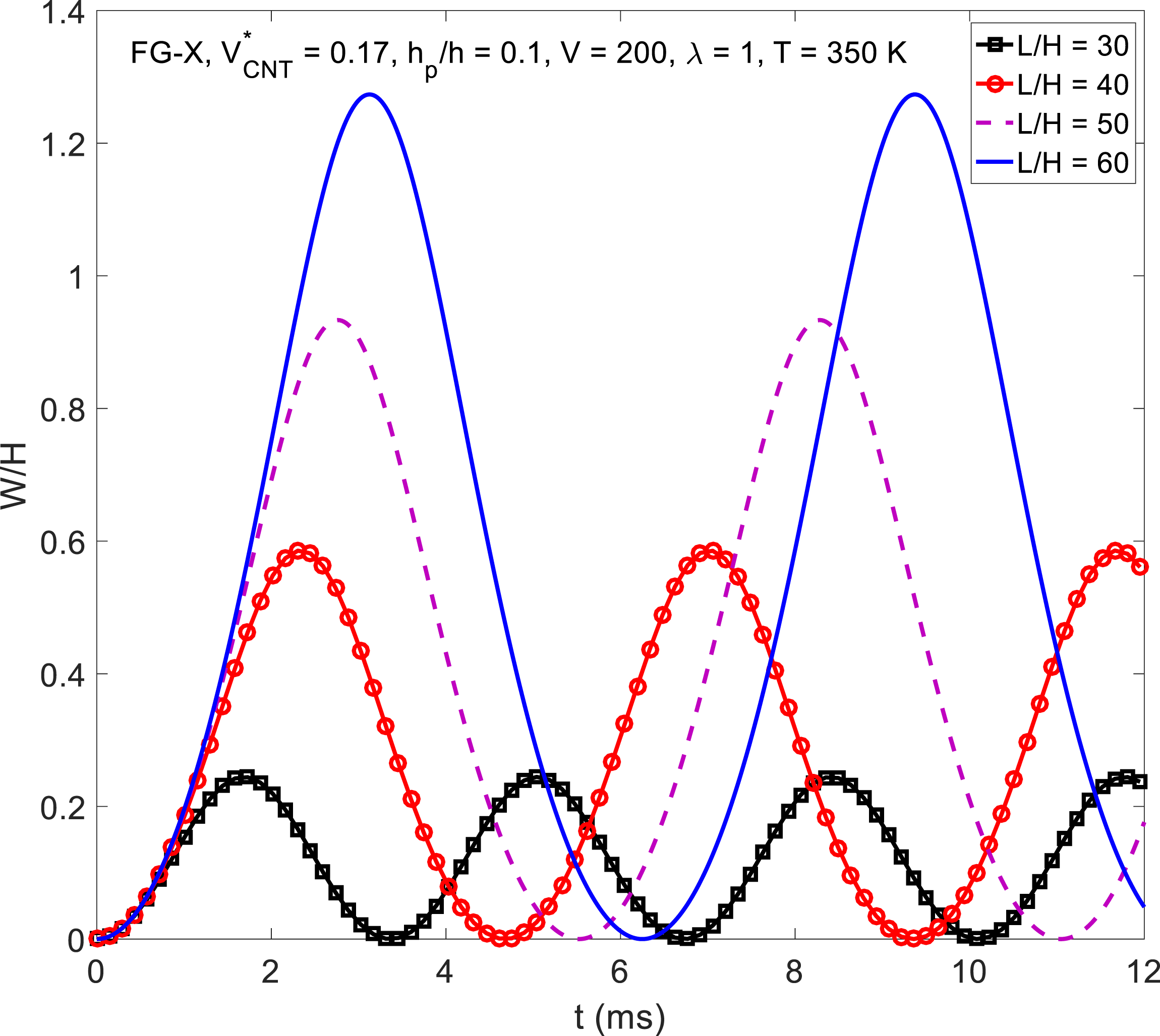
Figure 17 presents the effects of thermal environments on the nonlinear transient response of hybrid beams with partially movable ends in a positive voltage. It is found that thermal environments profoundly affect the nonlinear dynamical response of hybrid beams undergoing thermo-electro-mechanical loads. Specifically, the amplitude of dynamical deflection and vibration period are raised as a result of enhancement of temperature. Finally, the effects of slenderness ratio on the nonlinear transient response of CNTRC beams with immovable ends and piezoelectric actuators in a thermal environment are depicted in Figure 18. This figure shows that ratio substantially influences the behavior tendency of the beams. More specifically, the amplitude of dynamical deflection and period of vibration are significantly larger as a result of increase in ratio. In other words, the beam vibrates with lager amplitude and smaller frequency when it becomes slenderer.
Effects of thermal environments on nonlinear dynamic response of FG-X CNTRC beams with partially movable ends.
Effects of slenderness ratio on nonlinear dynamic response of FG-X CNTRC beams with immovable ends at elevated temperature.
Concluding remarks
The linear vibration, nonlinear free vibration and nonlinear transient response of simply supported CNTRC beams with surface-bonded piezoelectric layers and tangentially restrained ends under thermo-electro-mechanical loads have been investigated employing analytical solutions along with numerical integration scheme. The main remarks of the present work are the following:
(i) The natural frequency of linear free vibration and nonlinear to linear frequencies ratio of hybrid CNTRC beams are decreased and increased, respectively, as ends are more rigorously restrained and/or temperature is more elevated.
(ii) Tangential constraint of ends decreases and increases the amplitude of dynamical deflection of hybrid CNTRC beams at reference and elevated temperatures, respectively.
(iii) Positive and negative voltages decrease and increase the frequency of linear free vibration, respectively. In contrast, the frequency nonlinearity of free vibration is less and more significant when piezoelectric layers are actuated by negative and positive voltages, respectively.
(iv) Increase in thickness of piezoelectric layers leads to decrease in frequency of linear vibration and increases in ratio of nonlinear to linear frequencies and amplitude of dynamical deflection of hybrid CNTRC beams.
(v) Overall, the results of study find that thermally- and electrically-induced axial forces strongly affect both linear and nonlinear frequencies and, thus, tangentially elastic constraints of ends must be considered in the design of piezo-CNTRC beams. On the other hand, the goal of vibration control can be achieved by means of flexible variations of various factors.
Footnotes
Declaration of conflicting interests
The author(s) declared no potential conflicts of interest with respect to the research, authorship, and/or publication of this article.
Funding
The author(s) received no financial support for the research, authorship, and/or publication of this article.
ORCID iD
Hoang Van Tung
References
1.
ShenHS. Nonlinear bending of functionally graded carbon nanotube-reinforced composite plates in thermal environments. Compos Struct2009; 91: 9–19.
2.
WattanasakulpongNUngbhakornV. Analytical solutions for bending, buckling and vibration responses of carbon nanotube-reinforced composite beams resting on elastic foundation. Comput Mater Sci2013; 71: 201–208.
3.
LinFXiangY. Vibration of carbon nanotube reinforced composite beams based on the first and third order beam theories. Appl Math Model2014; 38: 3741–3754.
4.
NejatiMEslampanahANajafizadehM. Buckling and vibration analysis of functionally graded carbon nanotube-reinforced beam under axial load. Int J Appl Mech2016; 8(1): 1650008.
5.
AlibeiglooALiewKM. Elasticity solution of free vibration and bending behavior of functionally graded carbon nanotube-reinforced composite beam with thin piezoelectric layers using differential quadrature method. Int J Appl Mech2015; 7(1): 1550002.
6.
YasMHSamadiN. Free vibrations and buckling analysis of carbon nanotube-reinforced composite Timoshenko beams on elastic foundation. Int J Pres Ves Pip2012; 98: 119–128.
7.
WuHLKitipornchaiSYangJ. Free vibration and buckling analysis of sandwich beams with functionally graded carbon nanotube-reinforced composite face sheets. Int J Struct Stabil Dynam2015; 15(7): 1540011.
8.
MayandiKJeyarajP. Bending, buckling and free vibration characteristics of FG-CNT-reinforced polymer composite beam under non-uniform thermal load. Proc Inst Mech Eng Part L2013; 229(1): 13–28.
9.
EbrahimiFFarazmandniaN. Thermo-mechanical vibration analysis of sandwich beams with functionally graded carbon nanotube-reinforced composite face sheets based on a higher-order shear deformation beam theory. Mech Adv Mater Struct2017; 24(10): 820–829.
10.
KhosraviSArvinHKianiY. Vibration analysis of rotating composite beams reinforced with carbon nanotubes in thermal environment. Int J Mech Sci2019; 164: 105187.
11.
KaramanliAVoTP. Finite element model for carbon nanotube-reinforced and graphene nanoplatelet-reinforced composite beams. Compos Struct2021; 264: 113739.
12.
AlsubaieAMAlfaqihIAl-OstaMA, et al.Porosity-dependent vibration investigation of functionally graded carbon nanotube-reinforced composite beam. Comput Concr2023; 32(1): 75–85.
13.
MadenciEOzkilicYOHakamyA, et al.Experimental tensile test and micro-mechanic investigation on carbon nanotube reinforced carbon fiber composite beams. Advances in Nano Research2023; 14(5): 443–450.
14.
ZhangYWDingHXSheGL, et al.Wave propagation of CNTRC beams resting on elastic foundation based on various higher-order beam theories. Geomechanics and Engineering2023; 33(4): 381–391.
15.
MangalasseriASMaheshVMukundaS, et al.Vibration based energy harvesting performance of magneto-electro-elastic beams reinforced with carbon nanotubes. Advances in Nano Research2023; 14(1): 27–43.
16.
ZhangLWSongZGLiewKM. Optimal shape control of CNT reinforced functionally graded composite plates using piezoelectric patches. Compos B Eng2016; 85: 140–149.
17.
ZhangLWSelimBA. Vibration analysis of CNT-reinforced thick laminated composite plates based on Reddy’s higher-order shear deformation theory. Compos Struct2017; 160: 689–705.
18.
LeiZXZhangLWLiewKM. Analysis of laminated CNT reinforced functionally graded plates using the element-free kp-Ritz method. Compos B Eng2016; 84: 211–221.
19.
TungHV. Thermal buckling and postbuckling behavior of functionally graded carbon nanotube-reinforced composite plates resting on elastic foundations with tangential-edge restraints. J Therm Stresses2017; 40(5): 641–663.
20.
GholamiRAnsariR. Thermal postbuckling of temperature-dependent functionally graded nanocomposite annular sector plates reinforced by carbon nanotubes. Int J Struct Stabil Dynam2021; 21(2): 2150026.
21.
LiewKMLeiZXZhangLW. Mechanical analysis of functionally graded carbon nanotube reinforced composites: a review. Compos Struct2015; 120: 90–97.
22.
LiewKMPanZZZhangLW. The recent progress of functionally graded CNT reinforced composites and structures. Sci China Phys Mech Astron2020; 63: 234601.
23.
FallahAAghdamMM. Thermo-mechanical buckling and nonlinear free vibration analysis of functionally graded beams on nonlinear elastic foundation. Composites Part B2012; 43: 1523–1530.
24.
ShenHSXiangY. Nonlinear analysis of nanotube-reinforced composite beams resting on elastic foundations in thermal environments. Eng Struct2013; 56: 698–708.
RafieeMYangJKitipornchaiS. Large amplitude vibration of carbon nanotube reinforced functionally graded composite beams with piezoelectric layers. Compos Struct2013; 96: 716–725.
27.
WuHLYangJKitipornchaiS. Nonlinear vibration of functionally graded carbon nanotube-reinforced composite beams with geometric imperfections. Composites Part B2016; 90: 86–96.
28.
LinFXiangY. Numerical analysis on nonlinear free vibration of carbon nanotube reinforced composite beam. Int J Struct Stabil Dynam2014; 14(1): 1350056.
29.
ShenHSHeXQYangDQ. Vibration of thermally postbuckled carbon nanotube-reinforced composite beams resting on elastic foundations. Int J Non Lin Mech2017; 91: 69–75.
AnsariRFaghih ShojaeiMMohammadiV, et al.Nonlinear forced vibration analysis of functionally graded carbon nanotube-reinforced composite Timoshenko beams. Compos Struct2014; 113: 316–327.
32.
YangJHuangXHShenHS. Nonlinear vibration of temperature-dependent FG-CNTRC laminated beams with negative Poisson’s ratio. Int J Struct Stabil Dynam2020; 20(4): 2050043.
33.
MirzaeiMKianiY. Nonlinear free vibration of temperature-dependent sandwich beams with carbon nanotube-reinforced face sheets. Acta Mech2016; 227: 1869–1884.
34.
Jedari SalamiS. Dynamic extended high order sandwich panel theory for transient response of sandwich beams with carbon nanotube reinforced face sheets. Aero Sci Technol2016; 56: 56–69.
35.
ZhangLWSongZGQiaoP, et al.Modeling of dynamic responses of CNT-reinforced composite cylindrical shells under impact loads. Comput Methods Appl Mech Eng2017; 313: 889–903.
36.
NinhDGTienND. Investigation for electro-thermo-mechanical vibration of nanocomposite cylindrical shells with an internal fluid flow. Aero Sci Technol2019; 92: 501–519.
37.
NinhDGTienNDHoangVNV. Analyses of nonlinear dynamics of imperfect nanocomposite circular cylindrical shells with swirling annular and internal fluid flow using higher order shear deformation shell theory. Eng Struct2019; 198: 109502.
38.
NinhDGHaNHLongNT, et al.Thermal vibrations of complex-generatrix shells made of sandwich CNTRC sheets on both sides and open/closed cellular functionally graded porous core. Thin-Walled Struct2023; 182: 110161.
39.
WattanasakulpongNUngbhakornV. Linear and nonlinear vibration analysis of elastically restrained ends FGM beams with porosities. Aero Sci Technol2014; 32(1): 111–120.
40.
WattanasakulpongNMaoQ. Stability and vibration analyses of carbon nanotube-reinforced composite beams with elastic boundary conditions: Chebyshev collocation method. Mech Adv Mater Struct2017; 24: 260–270.
41.
XuJYangZYangJ, et al.Free vibration analysis of rotating FG-CNT reinforced composite beams in thermal environments with general boundary conditions. Aero Sci Technol2021; 118: 107030.
42.
PengXXuJYangE, et al.Influence of the boundary relaxation on free vibration of functionally graded carbon nanotube-reinforced composite beams with geometric imperfections. Acta Mech2022; 233: 4161–4177.
43.
ZhangLWLiewKMJiangZ. An element-free analysis of CNT-reinforced composite plates with column supports and elastically restrained edges under large deformation. Compos B Eng2016; 95: 18–28.
44.
ZhangLWLiewKMReddyJN. Postbuckling of carbon nanotube reinforced functionally graded plates with edges elastically restrained against translation and rotation under axial compression. Comput Methods Appl Mech Eng2016; 298: 1–28.
45.
Van ThinhNVan TungH. Nonlinear vibration of geometrically imperfect CNT-reinforced composite cylindrical panels exposed to thermal environments with elastically restrained edges. Acta Mech2023. In Press DOI: 10.1007/s00707-023-03791-0.
46.
AnhNDThinhNVTungHV. Thermoelastic nonlinear vibration and dynamical response of geometrically imperfect carbon nanotube-reinforced composite plates on elastic foundations including tangential edge constraints. J Thermoplast Compos Mater2023: 1–27. In Press DOI: 10.1177/08927057231191454.
47.
Van ThinhNVan TungH. Free vibration and dynamical analyses of FGM plates with porosity and tangential edge constraints. J Vib Eng Technol2023. In Press DOI: 10.1007/s42417-023-01205-y.
48.
AnhNDVan ThinhNVan TungH. Nonlinear thermomechanical vibration of initially stressed functionally graded plates with porosities. Z Angew Math Mech2023: e202300528, DOI: 10.1002/zamm.202300528.
49.
TrangLTNThinhNVTungHV. Vibration and thermomechanical transient response of doubly curved FGM panels with porosities and elastically restrained edges. Mech Des Struct and Mach2023. In Press DOI: 10.1080/15397734.2023.2242486.
50.
Van TungHTrangLTN. Thermal postbuckling of shear deformable CNT-reinforced composite plates with tangentially restrained edges and temperature-dependent properties. J Thermoplast Compos Mater2020; 33(1): 97–124.
51.
LongVTVan TungH. Thermal postbuckling behavior of CNT-reinforced composite sandwich plate models resting on elastic foundations with tangentially restrained edges and temperature-dependent properties. J Thermoplast Compos Mater2020; 33(10): 1396–1428.
52.
TrangLTNVan TungH. Thermally induced postbuckling of thin CNT-reinforced composite plates under nonuniform in-plane temperature distributions. J Thermoplast Compos Mater2022; 35(12): 2331–2353.
53.
TrangLTNVan TungH. Thermoelastic stability of thin CNT-reinforced composite cylindrical panels with elastically restrained edges under nonuniform in-plane temperature distribution. J Thermoplast Compos Mater2023; 36(2): 768–793.
54.
TrangLTNTungHV. Thermally induced postbuckling of higher order shear deformable CNT-reinforced composite flat and cylindrical panels resting on elastic foundations with elastically restrained edges. Mech Base Des Struct Mach2022; 50(8): 2812–2835.
55.
HieuPTTungHV. Thermal buckling and postbuckling of CNT-reinforced composite cylindrical shell surrounded by an elastic medium with tangentially restrained edges. J Thermoplast Compos Mater2021; 34(7): 861–883.
56.
Nhu TrangLTTungHV. Thermo-torsional postbuckling of CNT-reinforced composite toroidal shell segments with surrounding elastic media and tangentially restrained edges. J Thermoplast Compos Mater2023; 36(8): 3137–3167.
57.
HieuPTVan TungH. Thermal and thermomechanical buckling of shear deformable FG-CNTRC cylindrical shells and toroidal shell segments with tangentially restrained edges. Arch Appl Mech2020; 90(7): 1529–1546.
58.
AnsariRGholamiR. Size-dependent nonlinear vibrations of first-order shear deformable magneto-electro-thermo elastic nanoplates based on the nonlocal elasticity theory. Int J Appl Mech2016; 8(4): 1650053.
59.
GholamiRAnsariRGholamiY. Size-dependent bending, buckling and vibration of higher-order shear deformable magneto-electro-thermo-elastic rectangular nanoplates. Mater Res Express2017; 4(6): 065702.
60.
AnsariRPourashrafTGholamiR, et al.Analytical solution for nonlinear postbuckling of functionally graded carbon nanotube-reinforced composite shells with piezoelectric layers. Compos B Eng2016; 90: 267–277.