Thermoelastic nonlinear vibration and dynamical response of geometrically imperfect carbon nanotube-reinforced composite plates on elastic foundations including tangential edge constraints
Free accessResearch articleFirst published online March, 2024
Thermoelastic nonlinear vibration and dynamical response of geometrically imperfect carbon nanotube-reinforced composite plates on elastic foundations including tangential edge constraints
The combined influences of initial geometrical imperfection, elasticity of in-plane constraints of edges, elastic foundations and elevated temperature on the nonlinear vibration and dynamical response of carbon nanotube-reinforced composite rectangular plates are investigated in this paper. Carbon nanotubes (CNTs) are reinforced into matrix according to functionally graded distributions. The properties of CNTs and matrix are assumed to be temperature dependent and effective properties of nanocomposite are determined using an extended rule of mixture. Governing equations in terms of deflection and stress function are established within the framework of thin plate theory including von Kármán nonlinearity, geometric imperfection and interactive pressure from elastic foundation. Analytical solutions are assumed for simply supported plates and Galerkin method is applied to result in nonlinear time differential equation. This nonlinear equation is solved using fourth-order Runge–Kutta scheme. Parametric studies are executed to examine numerous influences on the natural frequency, nonlinear to linear frequency ratio and nonlinear dynamical response of CNT-reinforced composite plates. The results reveal that increase in imperfection size results in increase and decrease in natural frequencies and the amplitude of forced vibration, respectively. In contrast, it is found that the elevated temperature reduces the natural frequencies and enhances the amplitude of forced vibration.
Due to unprecedentedly superior properties, Carbon Nanotube (CNT) are used as fillers into isotropic matrix to constitute Carbon Nanotube Reinforced Composite (CNTRC). Functionally Graded Carbon Nanotube Reinforced Composite (FG-CNTRC) is a nanocomposite in which carbon nanotubes (CNTs) are embedded into the matrix according to functional rules in order to achieve the optimal distribution of CNTs and desired response of structures.1 The generation of FG-CNTRC has motivated numerous investigations on the static and dynamic behavior of structural components made of this class of advanced nanocomposite. The linear buckling behavior of FG-CNTRC plates have been addressed in works.2–7 Shen and Zhang8 used a higher order shear deformation theory (HSDT) to investigate the buckling and postbuckling behavior of CNT-reinforced plates under two types of thermal loading. Thermal postbuckling problems of CNTRC plates and sandwich plates with CNTRC face sheets undergoing various boundary conditions have been dealt with by Kiani9,10 using a first order shear deformation theory (FSDT) and Ritz method. Postbuckling analysis of CNTRC plates resting on Pasternak elastic foundation under uniaxial compression was executed by Zhang and Liew11 using an element-free approach. Based on different plate theories, Tung and coworkers12–18 presented the analytical investigations on the nonlinear stability of simply supported FG-CNTRC rectangular plates under thermal, mechanical and thermomechanical loads taking into account initial geometric imperfection and various degrees of in-plane constraint of edges.
Linear free vibration of FG-CNTRC plates has been examined in numerous studies. Zhu et al.19 analyzed the linear vibration of CNT-reinforced plates with clamped and simply supported edges using FSDT-based finite element method. Linear vibration analyses of simply supported CNT-reinforced rectangular plates have been carried out in works of Karami et al.5 and Bouazza and Zenkour20 employing Navier’s series solution within the framework of second-order and th-order shear deformation theories, respectively. The linear vibration problems of first-order and higher-order shear deformable plates with CNT reinforcements and various boundary conditions have been dealt with by Lei et al.21 and Zhang and coauthors22,23 employing element-free kp-Ritz method. Natural frequencies of small-amplitude vibration problem of CNT-reinforced rectangular and skew plates without and with piezoelectric layers were computed in works24–26 making use of Ritz method with different shape functions. The influences of point supports and in-plane forces on the natural frequencies of CNTRC rectangular and skew plates have been examined in works of Kiani27 and Zhang28 using Lagrangian multipliers and element-free Ritz methods, respectively. Linear free vibration response of moderately thick CNT-reinforced composite plates was studied by Duc et al.29 employing Navier series solution. In the work of Fantuzzi et al.,30 a numerical approach was used to explore the effect of agglomeration of CNTs on the free vibration of FG-CNTRC plates with arbitrary shape. By using classical plate theory (CPT) and Kantorovich-Galerkin method, Wang et al.31 looked at the buckling and free vibration of CNT-reinforced thin plates. The natural frequencies of shear deformable FG-CNTRC plates in thermal environments have been calculated by Mehar et al.32 utilizing the finite element method. Recently, Shi33 developed isogeometric analysis integrated with three-dimensional elastic model for linear vibration and buckling analyses of FG-CNTRC plates. More results of CNTRC linear vibration analyses can be found in survey papers of Liew and collaborators.34,35 Nonlinear vibration of CNT-reinforced composite plates has been addressed in a few studies. Wang and Shen36,37 used HSDT-based asymptotic solutions to deal with the large–amplitude vibration problems of CNTRC plates and sandwich plates with CNTRC face sheets in thermal environments. Recently, Tang and Dai38 employed analytical solutions for displacements and harmonic balance method to explore the nonlinear vibration of CNTRC plates with hygrothermal effects. More recently, Cho39 developed two-dimensional natural element method to investigate the nonlinear vibration characteristics of FG-CNTRC plates. Based on numerical approaches within the framework of first-order and higher-order shear deformation plate theories, the linear dynamic responses of FG-CNTRC cylindrical shells and plates with various shapes and boundary conditions subjected to transverse sudden dynamic loads have been analyzed by Zhang and coauthors40–43 employing element-free Ritz method, Phung et al.44 utilizing isogeometric analysis (IGA), Do et al.45 using Bézier extraction based IGA, and Frikha et al.46 making use of double director finite element. Geometrically nonlinear dynamic response of thick CNTRC single-layer and sandwich plates was treated in work of Wang and Shen47 employing two-step perturbation technique.
In practical situations, the boundary edges of structures are usually restrained in part. Hence, the elasticity of edge constraints should be taken into consideration in order to obtain more accurate predictions. The influences of geometric imperfections and tangential edge constraints on the nonlinear vibration of laminated composite panels were examined in analytical study of Librescu and Lin.48 Static, free vibration and postbuckling analyses of moderately thick CNTRC plates with elastically restrained edges were performed by Zhang and collaborators49–51 using element-free Ritz method. The effects of tangentially elastic constraints of boundary edges on the nonlinear stability of functionally graded ceramic-metal and CNT-reinforced plates and shells have been addressed in analytical works of Tung and coworkers.52–58 To the best of authors’ knowledge, there is no investigation on the nonlinear vibration of FG-CNTRC plates with tangentially restrained edges in the literature.
In the present study, for the first time, the influences of tangential edge constraints, initial geometrical imperfection, foundation interaction and elevated temperature on the nonlinear vibration and dynamic response of thin CNTRC plates are investigated. CNTs are reinforced into matrix through functionally graded distributions and effective properties of CNTRC are estimated using an extended rule of mixture. Governing equations are established basing on classical plate theory and solved using analytical solutions and Galerkin method. Nonlinear frequency and dynamic response are determined using fourth-order Runge-Kutta scheme. Parametric studies are carried out to analyze numerous influences of CNT distribution, various degrees of in-plane edge constraint, geometrical imperfection, elevated temperature and elastic foundation on the natural frequency, nonlinear to linear frequencies ratio and dynamic response of CNTRC plates.
Structural model and effective material properties
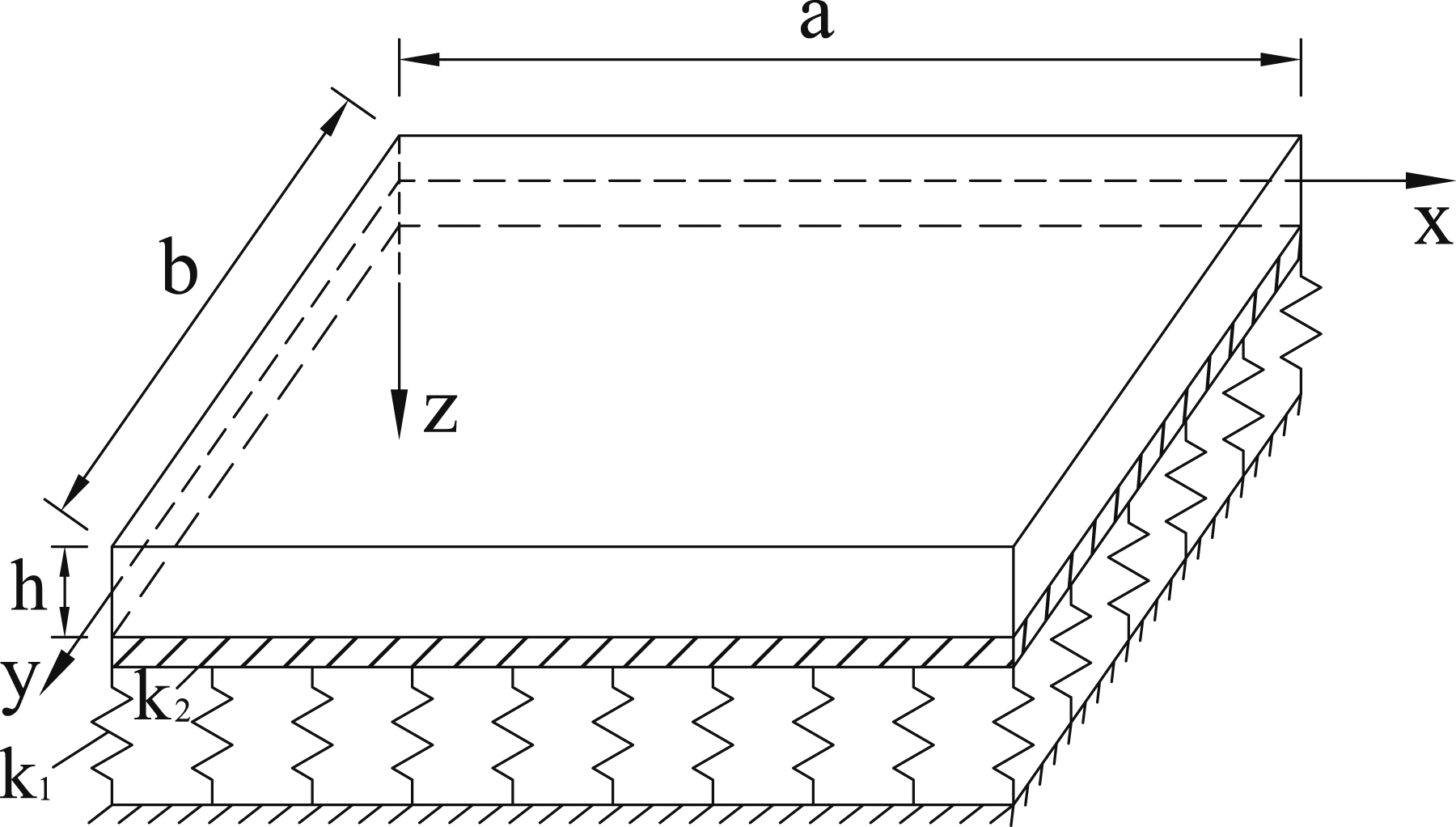
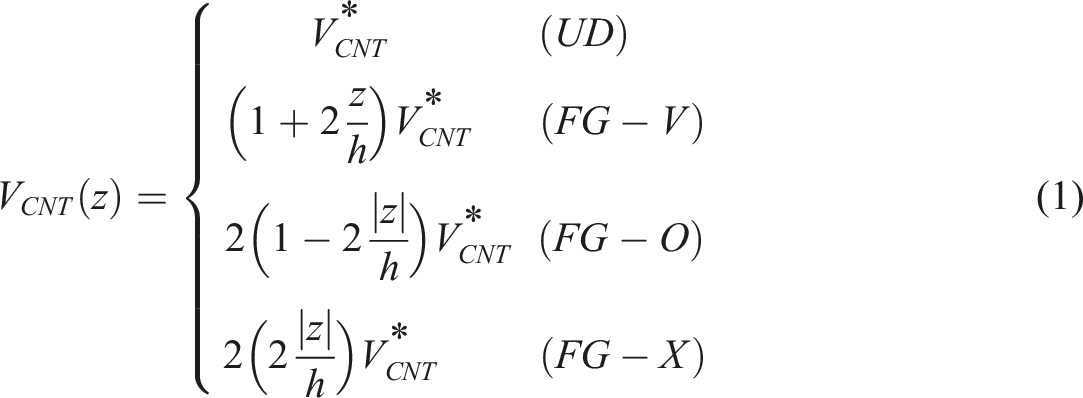
Structural model considered in this study is a rectangular plate of length , width , and thickness . The plate is defined in a Cartesian coordinate system origin of which lies on the middle surface at one corner, and axes are located on length and width sides, respectively, whereas is thickness coordinate with downward positive points, as shown in Figure 1. The plate is rested on a two-parameter elastic foundation. The plate is made of carbon nanotube reinforced composite (CNTRC) in which CNTs are assumed to be single-walled, straight and aligned according to direction. CNTs are reinforced into isotropic matrix through uniform distribution (UD) or three patterns of functionally graded distributions named FG-V, FG-O and FG-X. Specifically, the volume fraction of CNTs corresponding to these distributions are defined as follows1,2
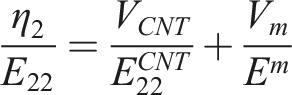
in which is total value of volume percentage of CNTs. In this study, the effective elastic moduli , and effective shear modulus of CNTRC are determined using an extended rule of mixture as1
where , and are volume fraction, elastic modulus and shear modulus of matrix material, respectively, whereas , and are elastic moduli and shear modulus of CNTs, respectively. As an extension in comparison with conventional rule of mixture, coefficients , , called the CNT efficiency parameters are introduced in equation (2) to account for the size dependent material properties. Due to weak dependence on position and temperature, the effective Poisson’s ratio is assumed to be constant and evaluated using conventional mixture rule as1
where and are Poisson’s ratios of CNT and matrix, respectively. Similarly, the mass density of the CNTRC is defined by a conventional of mixture as36
where and denote the mass densities of CNT and matrix, respectively.
Geometry and coordinate system of a rectangular plate on an elastic foundation.
The effective coefficients of thermal expansion and in the longitudinal and transverse directions of CNTRC, respectively, are determined basing on Schapery model as3,9
in which , and are the thermal expansion coefficients of CNT and matrix, respectively.
Governing equations
In this study, CNTRC plates are assumed to be thin and geometrically imperfect. The classical plate theory (CPT) including von Kármán nonlinearity is used to establish basic equations governing the nonlinear vibration and dynamic response of CNTRC plates. Based on the CPT, strains at a distance from the middle surface are expressed in the form
where are the strains of corresponding point on the mid-plane and are changes of curvature and twist which are expressed as
in which and are displacements of a point on the middle surface in the and directions, respectively. Herein, subscript comma implies partial derivative with respect to the followed variable, e.g. .
The stress components are determined via constitutive relations as
where
and is uniform temperature rise from reference temperature assumed to be room temperature in the present study.
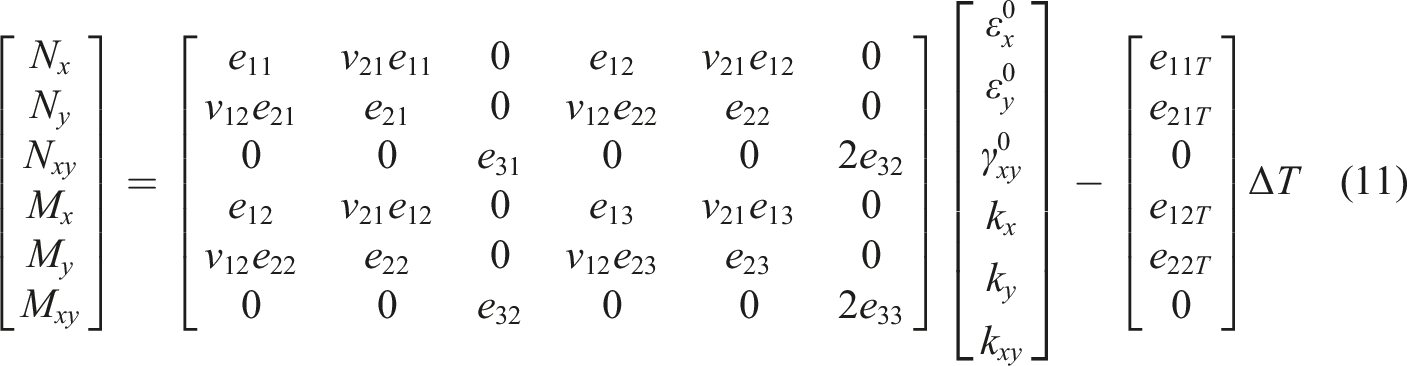
In-plane force resultants and moment resultants are computed as
Using equations (6) and (8) into equation (10), the force and moment resultants are expressed in the form
where stiffness coefficients () and thermal coefficients () are defined as in work.14
By neglecting in-plane inertia forces and introducing a stress function defined as , , , the motion equation of geometrically imperfect CNTRC plate resting on an elastic foundation is written in the form
where denotes time variable, is uniform lateral pressure suddenly applied on the top surface of the plate, is a known function representing initial geometric imperfection, and coefficients ,…, can be found in the work.12 Additionally, and are stiffness parameters of Winkler elastic layer and Pasternak shear layer, respectively, and is the mass moment of inertia defined as
Strain compatibility equation of a geometrically imperfect CNTRC plate is written in the form12,14
where coefficients have been defined in the work.12
In this work, all edges of the plate are assumed to be simply supported and elastically restrained in the tangential direction. The associated boundary conditions are expressed as
where and are reactive force resultants on the restrained edges and , respectively, and are concerned with average end-shortening displacements as12,14,48
in which and are average tangential stiffness parameters on opposite edges and , respectively. It is readily recognized that values of , and represent movable, immovable and partially movable edges , respectively. Similarly, movable, immovable and partially movable edges are characterized by values of , and , respectively.
Solution procedure
Approximate solutions of deflection and stress function are assumed in the form48
where and are the amplitude of deflection and size of imperfection, respectively, whereas , with are positive integers. In addition, , , are time-dependent coefficients to be determined.
By substituting solutions equations (17a) and (17b) into the compatibility equation (14), time-dependent coefficients in the stress function are determined as
Now introducing the solutions (17a) and (17b) into the motion equation (12) and applying Galerkin method lead to the following time differential equation
where
and the expressions of are given in equation (A1) in Appendix.
Next, the expressions of and will be determined. From equations (7) and (11), and are expressed in terms of partial derivatives of deflection and stress function. Afterwards, introducing the solutions (17a) and (17b) into the expressions of , and substituting the obtained expressions into equation (16), one obtains
where coefficients and () can be found in equation (A3) in Appendix. By using equations (21a) and (21b) into equation (19), we obtain
where coefficients are displayed in equation (A5) in Appendix. Equation (22) is used for nonlinear dynamic analysis of CNTRC plates subjected to suddenly applied uniform lateral pressure . In the absence of lateral pressure, equation (22) is written in the form
Equation (23) is used for nonlinear free vibration analysis of CNTRC plates with elastically restrained edges. In this study, the temporal response and frequency of nonlinear free vibration are determined by solving equations (22) and (23) using fourth-order Runge-Kutta scheme, respectively. When nonlinear terms are omitted, equation (23) has the form
This equation represents linear free vibration response of geometrically imperfect CNTRC plates with elastically restrained edges exposed to a thermal environment. Natural frequencies are determined as follows
Numerical results
This section presents a parametric study of numerous influences on the natural frequencies as well as nonlinear free vibration and dynamic response of CNTRC plates made of Poly (methyl methacrylate), referred to as PMMA, as matrix and (10,10) single walled carbon nanotubes (SWCNTs) as reinforcements. The material properties of the PMMA are kg/m3, , and GPa, in which and K.36 The Poisson’s ratio and mass density of (10,10) SWCNTs are , kg/m3.36 The material properties , , , , of (10,10) SWCNT at some specific temperatures and as continuous functions of temperature have been given in works8,36 and,3,9 respectively, and are not specified here for the sake of brevity. Moreover, the CNT efficiency parameters corresponding to values of , 0.17, 0.28 are the same as those reported in works.8,36
Verification
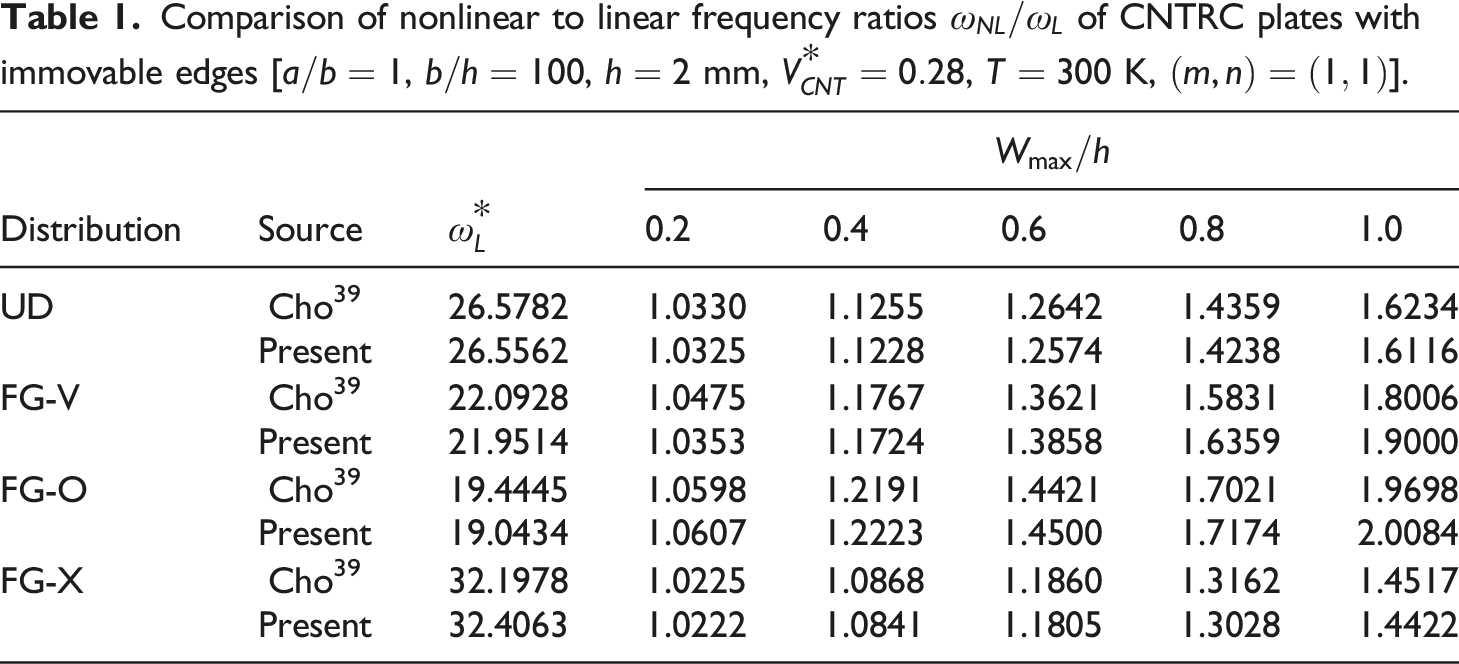
To verify the proposed approach, linear and nonlinear free vibrations of geometrically perfect CNTRC plates with immovable edges and without elastic foundations are considered. Non-dimensional fundamental natural frequency and nonlinear to linear fundamental frequency ratio corresponding to different patterns of CNT distribution are given in Table 1 in comparison with results reported in the work of Cho39 using two-dimensional natural element method. Specifically, fundamental natural frequency and its non-dimensional value are defined as
in which is value of computed at room temperature K. It is evident from Table 1 that a good agreement is achieved in this comparison.
Comparison of nonlinear to linear frequency ratios of CNTRC plates with immovable edges [, , mm, , K, ].
In what follows, parametric studies of various influences on the linear natural frequency, nonlinear to linear frequency ratio and nonlinear dynamic response will be carried out for square plates, excepting Table 2 and Figure 4, with geometry properties mm, and . In these studies, the degrees of tangential constraints of edges will be measured by non-dimensional values , defined as the following
in which is value of corresponding to uniform distribution calculated at room temperature. It is realized from equation (27) that movable, immovable and partially movable edges are measured by , and , respectively. Similarly, movable, immovable and partially movable edges are characterized by , and , respectively. Furthermore, in parametric studies, effects of elastic foundations are measured by non-dimensional stiffness parameters and defined in equation (A2) in Appendix. In nonlinear vibration and dynamic analyses, time step of fourth-order Runge-Kutta scheme is chosen to be s. For the purpose of conciseness, the CNTRC plate is assumed to be geometrically perfect, exposed to room temperature and without foundation interaction, unless otherwise specified.
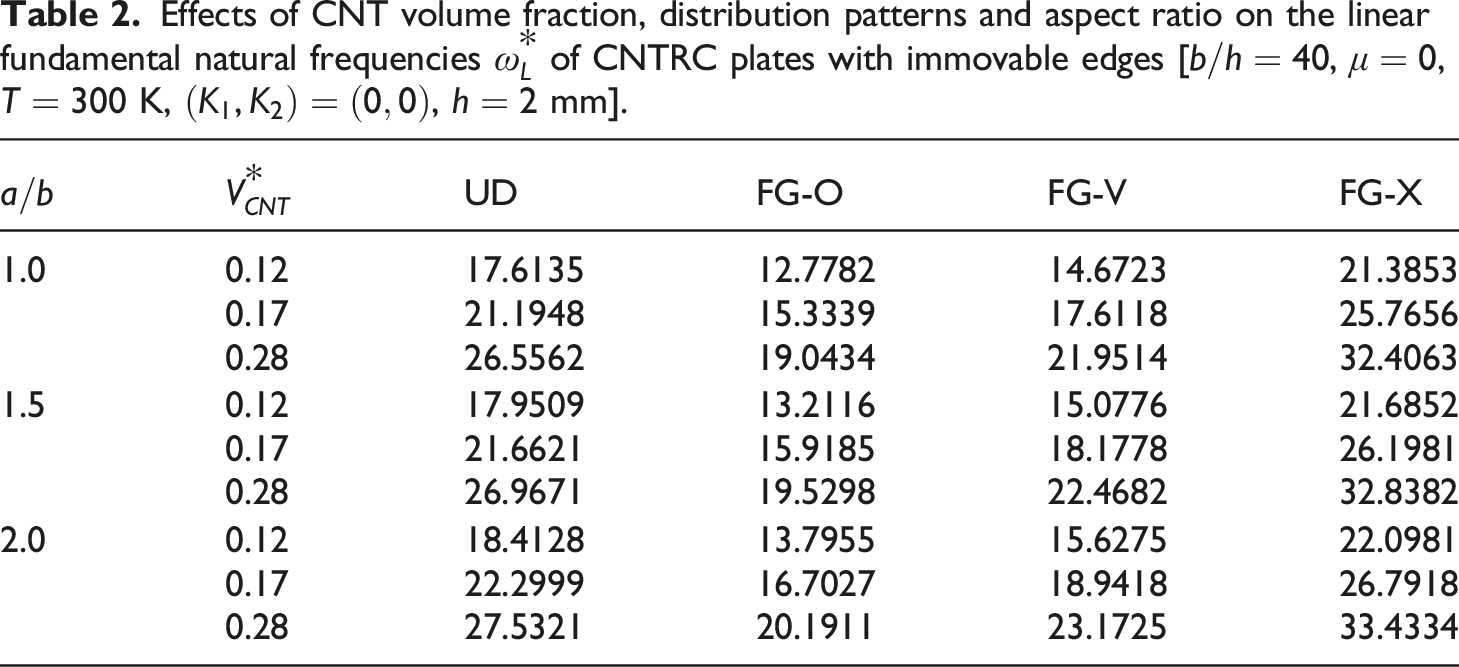
Effects of CNT volume fraction, distribution patterns and aspect ratio on the linear fundamental natural frequencies of CNTRC plates with immovable edges [, , K, , mm].
UD
FG-O
FG-V
FG-X
1.0
0.12
17.6135
12.7782
14.6723
21.3853
0.17
21.1948
15.3339
17.6118
25.7656
0.28
26.5562
19.0434
21.9514
32.4063
1.5
0.12
17.9509
13.2116
15.0776
21.6852
0.17
21.6621
15.9185
18.1778
26.1981
0.28
26.9671
19.5298
22.4682
32.8382
2.0
0.12
18.4128
13.7955
15.6275
22.0981
0.17
22.2999
16.7027
18.9418
26.7918
0.28
27.5321
20.1911
23.1725
33.4334
Linear free vibration analysis
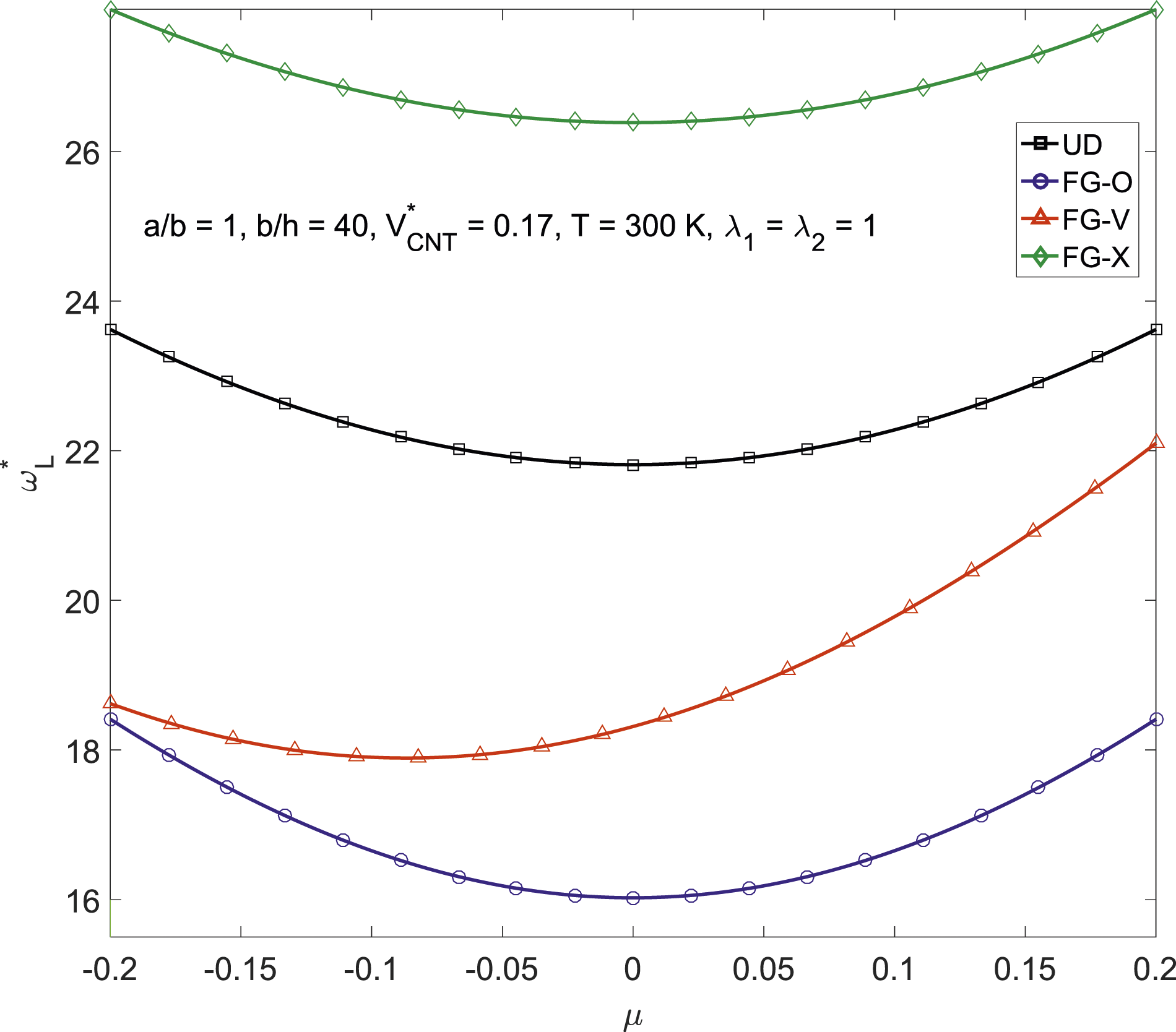
This subsection presents numerical results for linear free vibration analysis of perfect and imperfect CNTRC plates with restrained edges in thermal environments. Non-dimensional fundamental natural frequencies are computed using equations (25) and (26). First, the effects of CNT volume fraction , distribution patterns and aspect ratio on the non-dimensional natural frequencies of CNTRC plates with immovable edges are indicated in Table 2. As can be seen, the natural frequencies are obviously enhanced as CNT volume fraction is increased. An interpretation for this result is that the flexural rigidity of CNTRC plate is higher when volume percentage of CNTs is larger. In contrast, the non-dimensional fundamental natural frequencies are slightly raised due to increase in aspect ratio. Among four types of CNT distribution, FG-X and FG-O plates have the highest and lowest natural frequencies, respectively. This fact is again confirmed in Figure 2 plotted with different distributions and various values of imperfection size . Positive and negative values of represent the initially downward and upward deviations of plate surfaces, respectively. Generally, the effect of imperfection is mid-plane symmetry for distributions which are symmetric with respect to mid-plane, that is UD, FG-O and FG-X distributions, and natural frequencies are increased as the amplitude of imperfection is larger. Particularly, asymmetric distribution in FG-V plate leads to unlike effects of positive and negative imperfection sizes.
Effects of initial geometrical imperfection on the fundamental natural frequencies of CNTRC plates with immovable edges.
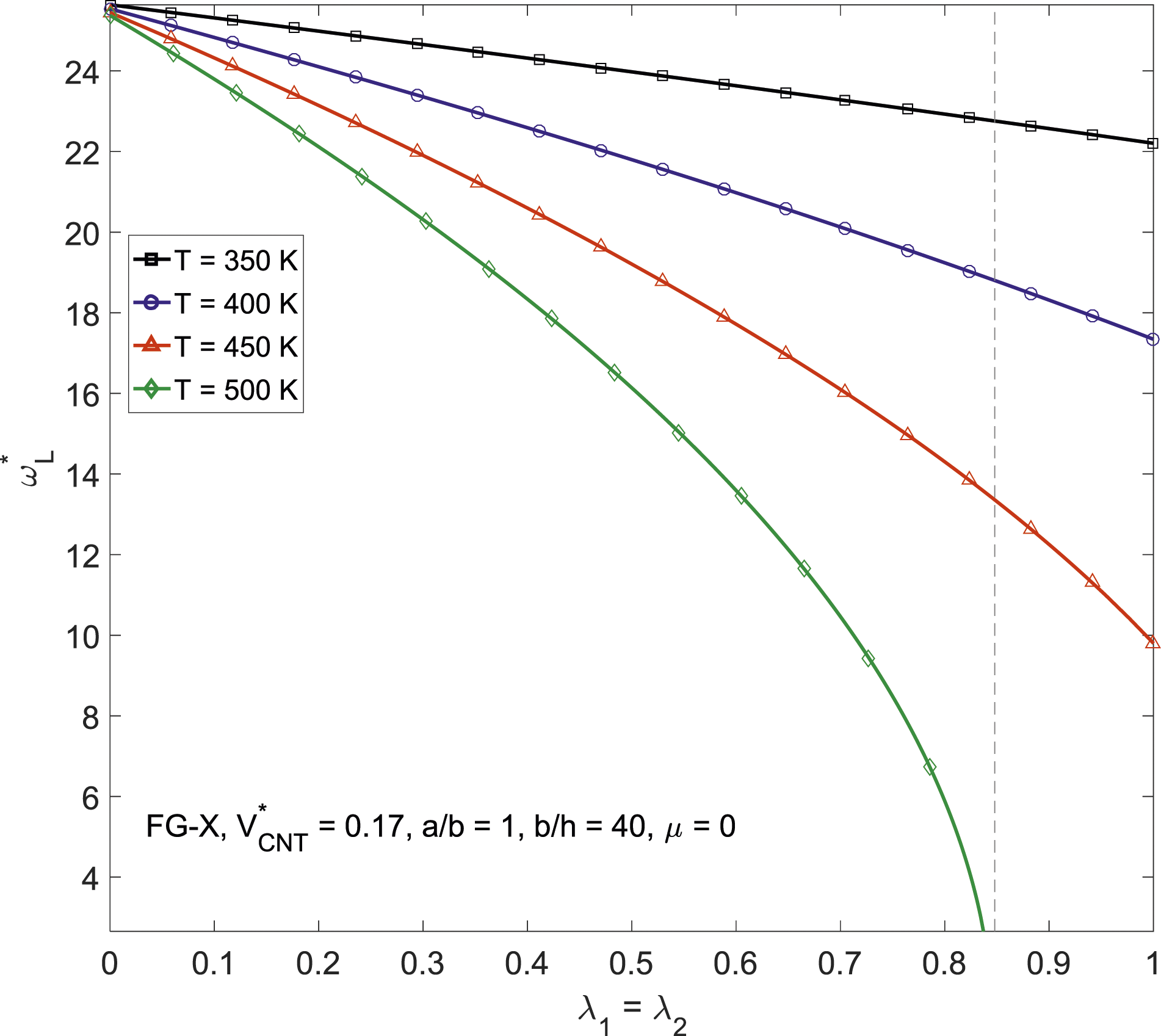
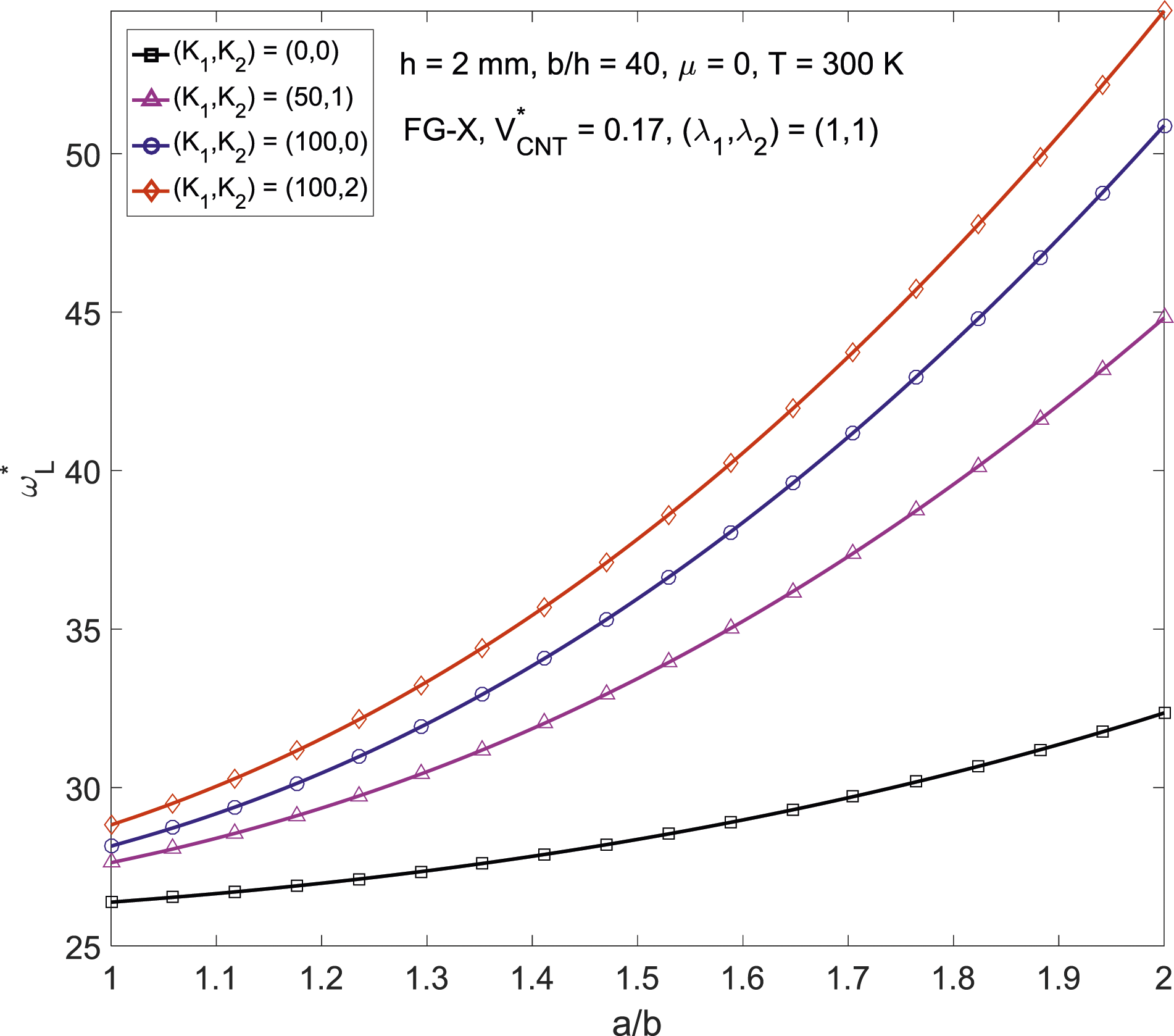
The influences of in-plane boundary conditions and thermal environments on the non-dimensional natural frequencies of FG-X CNTRC plates are assessed in Figure 3 sketched with various values of parameters and temperature . Overall, the natural frequencies are decreased when temperature is more elevated and/or edges are more rigorously restrained. More concretely, the natural frequencies are more slightly and significantly reduced by increase in parameters at lower and higher temperatures, respectively. Especially, the natural frequency tends to zero at enough large values of and for which a thermal buckling occurs. As final example in this subsection, the effects of elastic foundations and aspect ratio on the natural frequencies of FG-X plates with immovable edges are considered in Figure 4 plotted with four couples of non-dimensional stiffness parameters . As shown, the natural frequencies are increased when aspect ratio and/or foundation stiffness parameters are enhanced, respectively. More specifically, the influences of elastic foundations in enhancing the natural frequency become more pronounced as aspect ratio is larger.
Effects of in-plane restraint condition and thermal environments on the fundamental natural frequencies of CNTRC plates.
Effects of aspect ratio and elastic foundations on the fundamental natural frequencies of CNTRC plates with immovable edges.
Nonlinear free vibration analysis
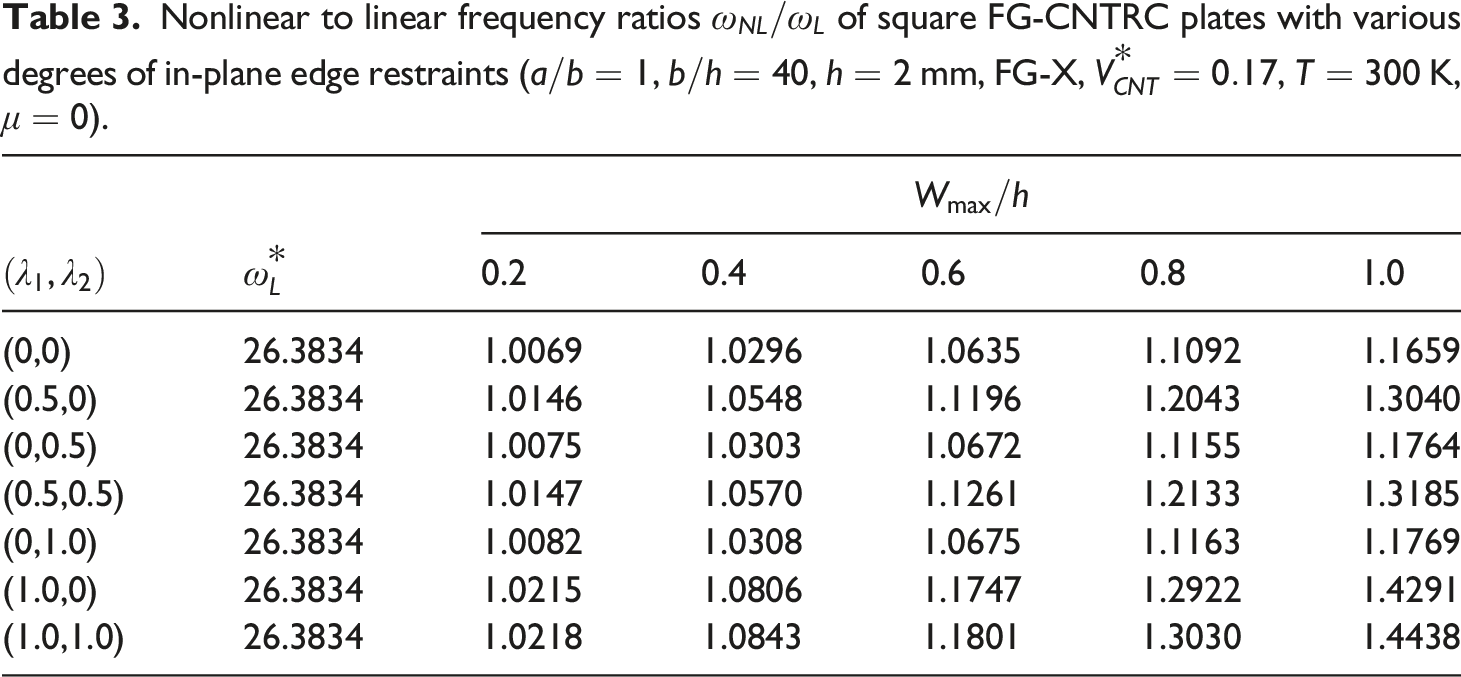
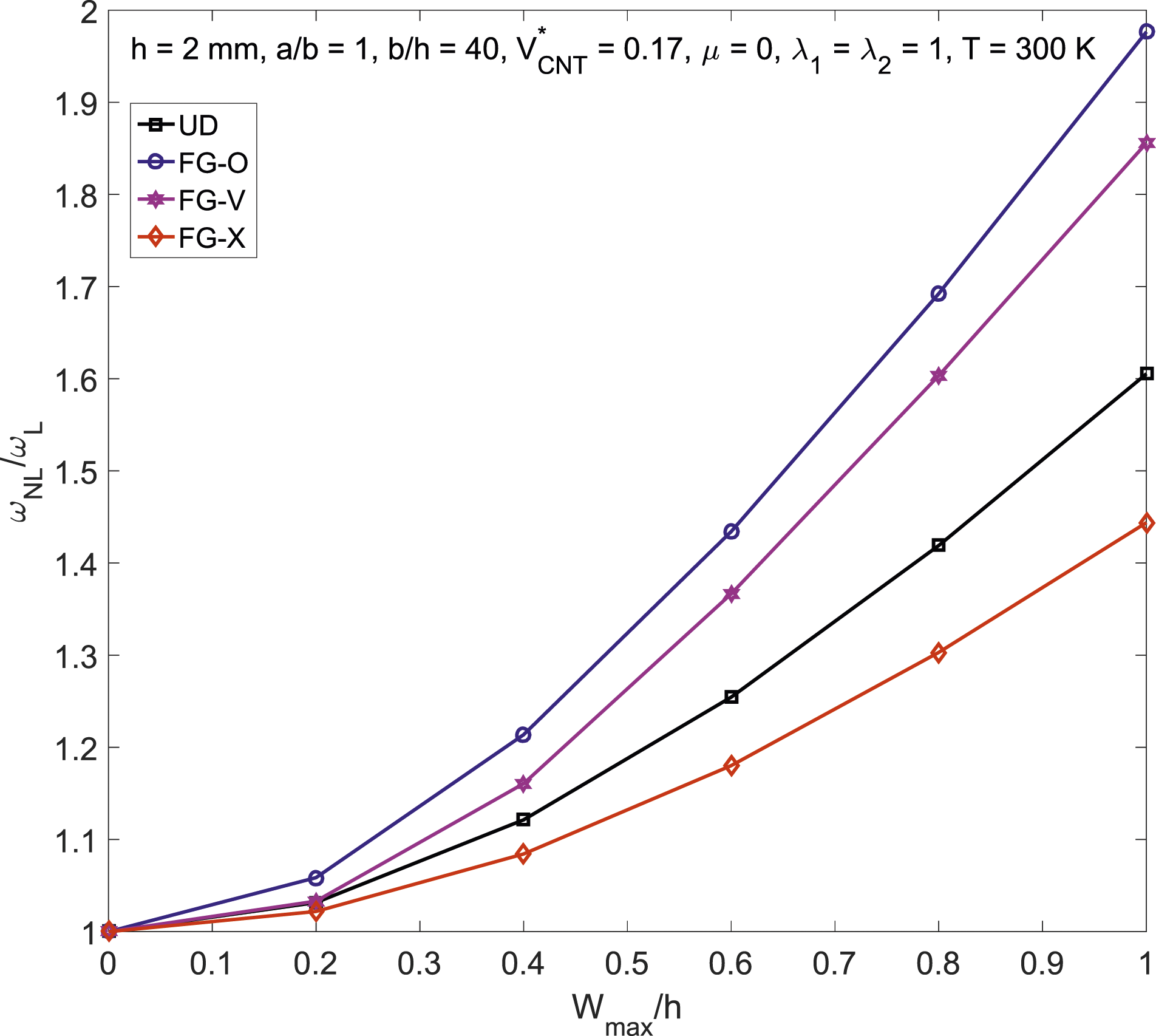
Numerous influences on the nonlinear to linear frequency ratio corresponding to fundamental mode of free vibration of square CNTRC plates are analyzed in this subsection. The present analysis employs fourth-order Runge-Kutta scheme with initial conditions at are and . As a first consideration, the effects of in-plane restraints of edges on the frequency ratio of perfect FG-X plates at room temperature are examined in Table 3 for five different values of maximum vibration amplitude ratio . This table also indicates results of non-dimensional fundamental natural frequencies . It is interesting to note that at room temperature natural frequency has no dependence on in-plane restraints of edges. Meanwhile, frequency ratio is increased due to increase in parameters . More specifically, frequency ratio is significantly and very slightly raised when and parameters are enhanced, respectively. Table 3 also shows that frequency ratio is increased as ratio becomes larger which implies that the nonlinearity of vibration frequency is more significant as the vibration amplitude is larger. The rest parametric studies are carried out for CNTRC plates with all immovable edges, unless otherwise specified. Next, the effects of CNT distributions on the nonlinear vibration of CNTRC plates are analyzed in Figure 5. Contrary to fundamental natural frequencies displayed in Table 2, Figure 5 demonstrates that the nonlinear to linear frequency ratios corresponding to FG-X and FG-O distributions are the lowest and highest, respectively. In other words, the frequency nonlinearity is less and more significant for nanocomposite plates in which CNTs are more reinforced at near two surfaces and middle surface, respectively. In the rest of this subsection, analyses are performed for plates with FG-X type of CNT reinforcement.
Nonlinear to linear frequency ratios of square FG-CNTRC plates with various degrees of in-plane edge restraints (, , mm, FG-X, , K, ).
0.2
0.4
0.6
0.8
1.0
(0,0)
26.3834
1.0069
1.0296
1.0635
1.1092
1.1659
(0.5,0)
26.3834
1.0146
1.0548
1.1196
1.2043
1.3040
(0,0.5)
26.3834
1.0075
1.0303
1.0672
1.1155
1.1764
(0.5,0.5)
26.3834
1.0147
1.0570
1.1261
1.2133
1.3185
(0,1.0)
26.3834
1.0082
1.0308
1.0675
1.1163
1.1769
(1.0,0)
26.3834
1.0215
1.0806
1.1747
1.2922
1.4291
(1.0,1.0)
26.3834
1.0218
1.0843
1.1801
1.3030
1.4438
Effects of CNT distribution patterns on frequency–amplitude curves of CNTRC plates with immovable edges.
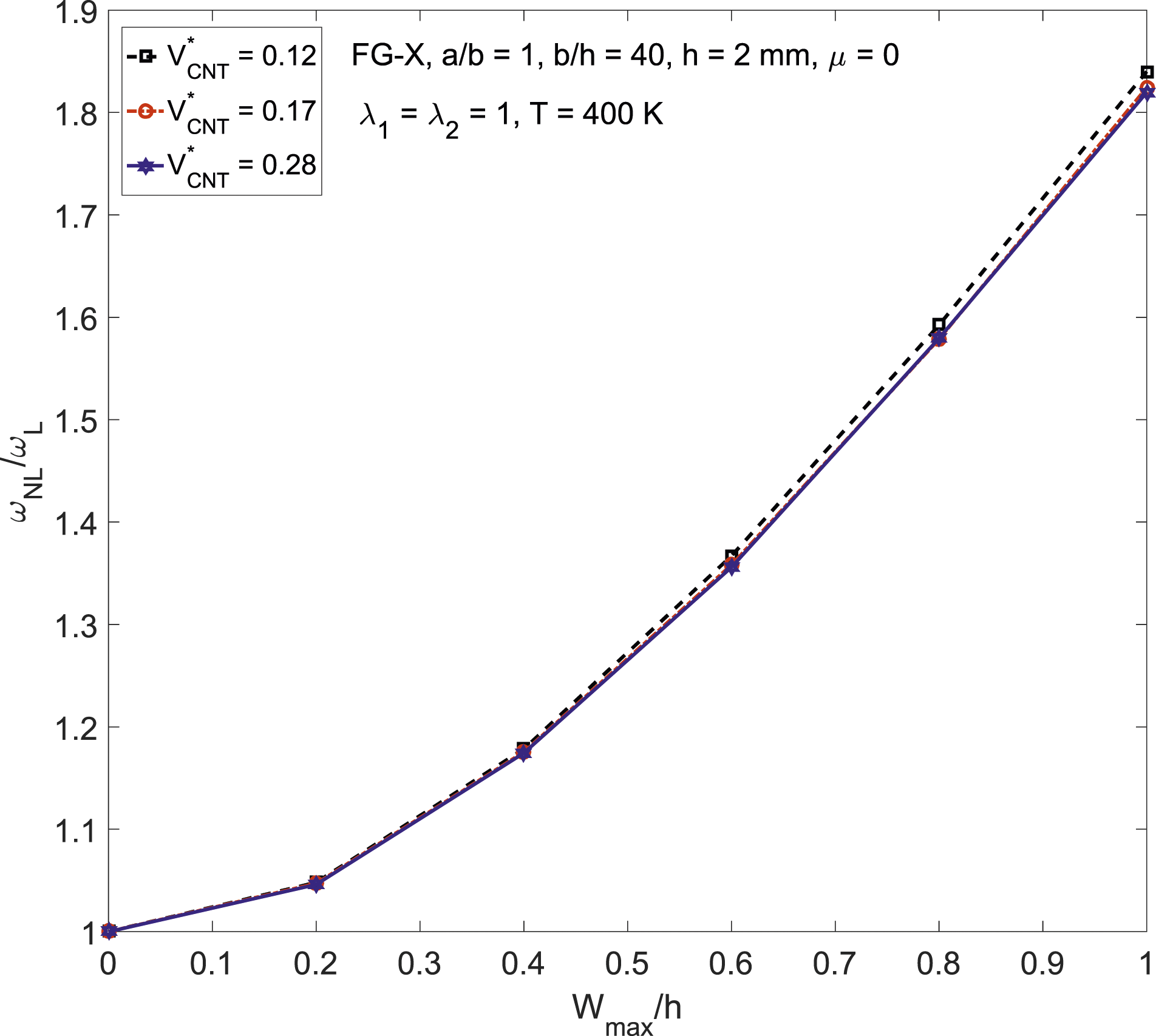
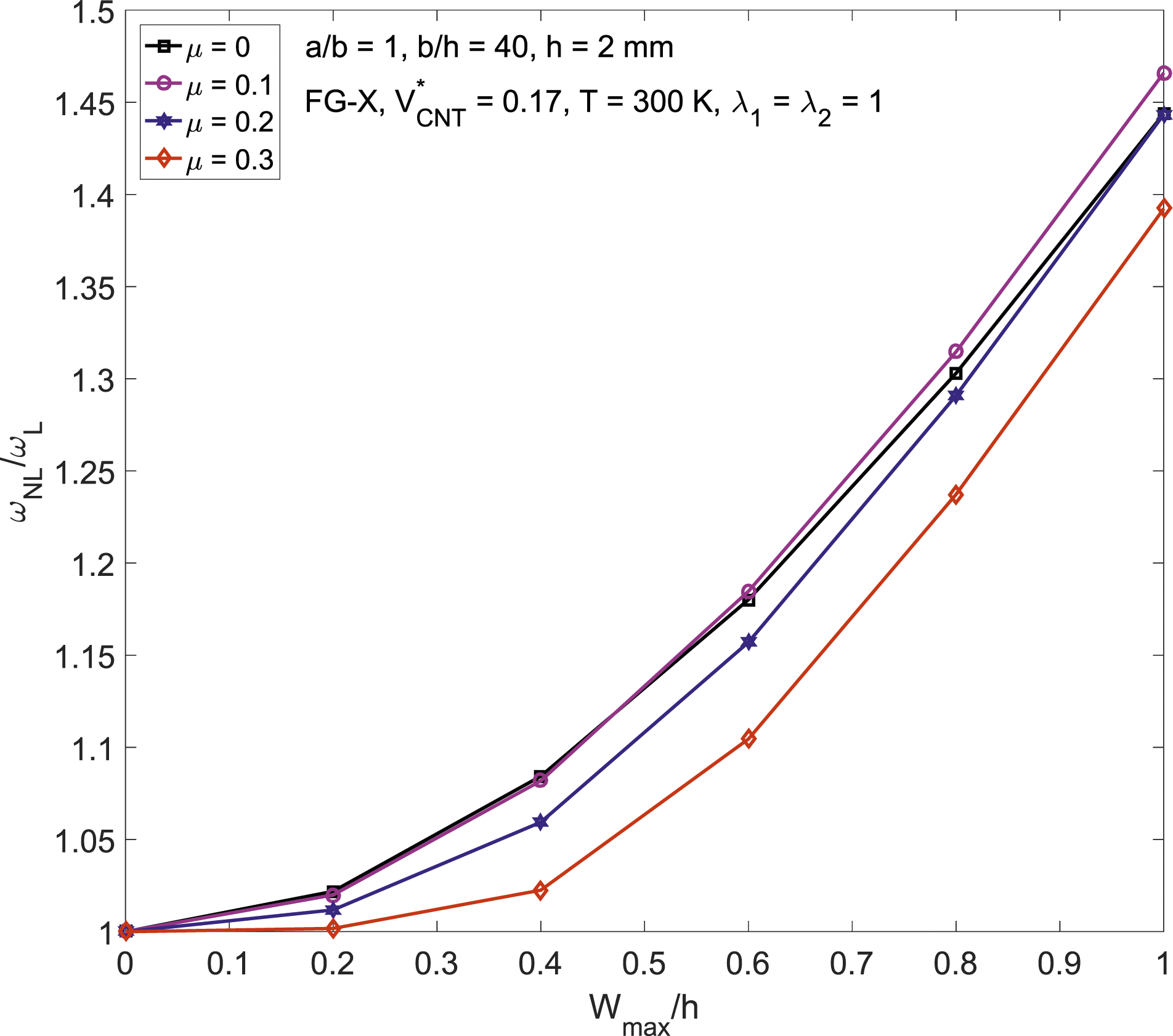
The influences of CNT volume fraction on the nonlinear vibration behavior of CNTRC plates exposed to a thermal environment ( K) are depicted in Figure 6. It is recognized that the has a marginal effect on the frequency–amplitude curves as the amplitude is small. When the vibration amplitude is larger, increase in leads to a very slight reduction of frequency ratio . Next study is displayed in Figure 7 examining the effects of initial geometrical imperfection on the frequency–amplitude response of nonlinear free vibration of CNTRC plates. Unlike natural frequency–size imperfection curves shown in Figure 2, frequency–amplitude curves are dropped by virtue of increase in size imperfection in the small region of amplitude. Otherwise, as the amplitude becomes larger, a small value of may result in the largest value of frequency ratio.
Effects of CNT volume fraction on frequency–amplitude curves of CNTRC plates with immovable edges.
Effects of initial geometrical imperfection on frequency–amplitude curves of CNTRC plates with immovable edges.
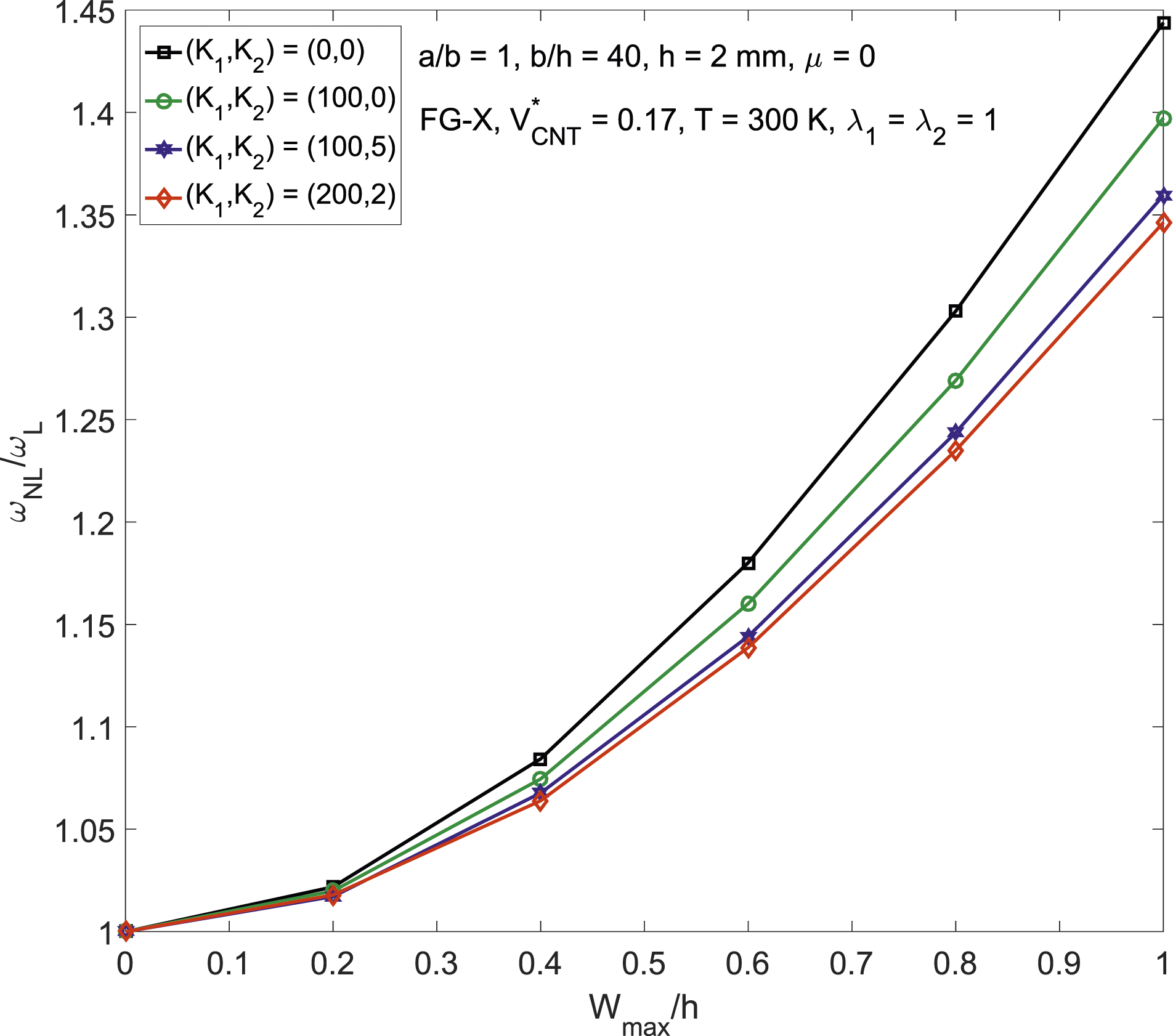
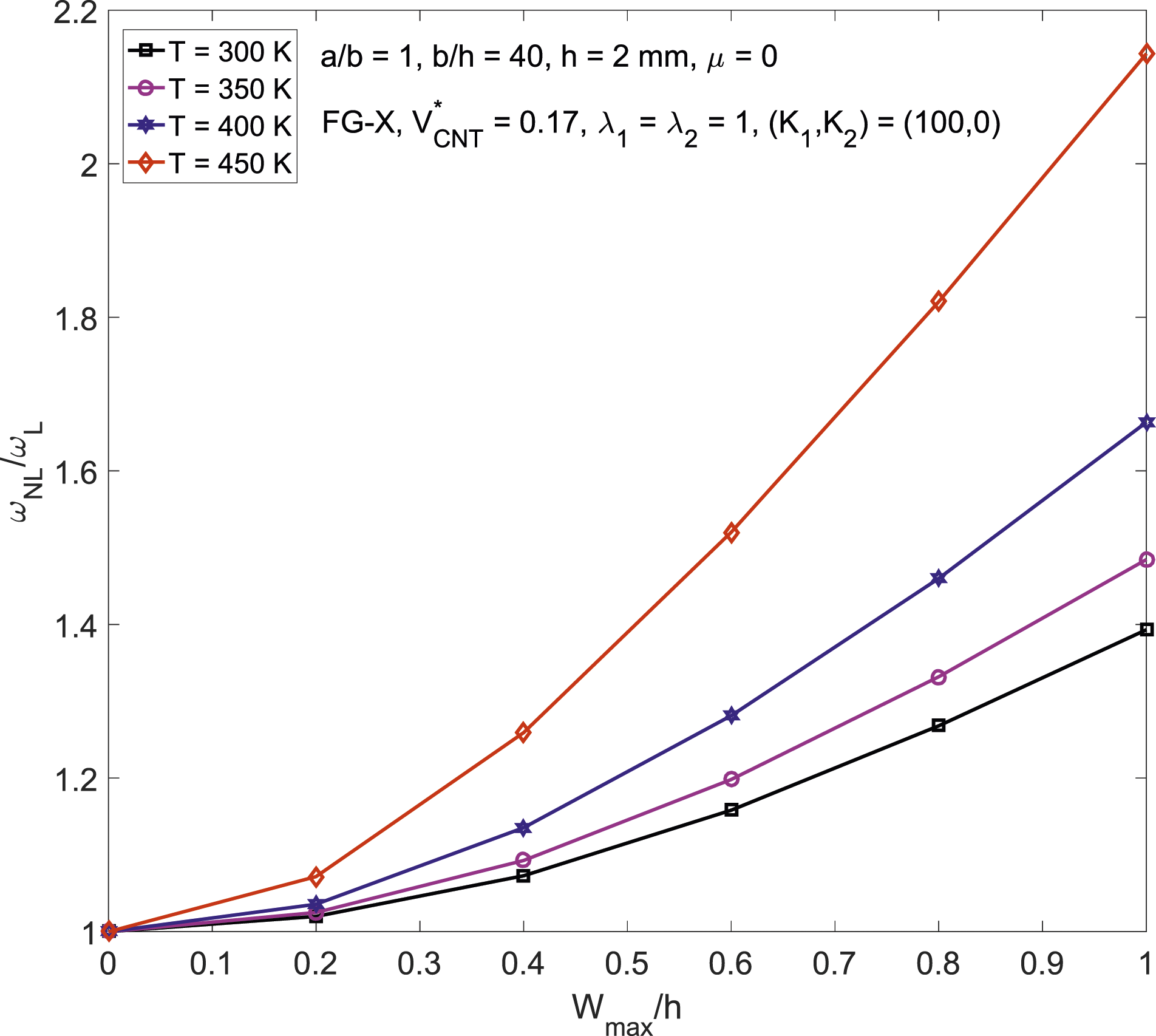
Next, the influences of elastic foundations on the nonlinear vibration behavior of CNTRC plates are analyzed in Figure 8. While linear natural frequencies are increased by increase in foundation stiffness parameters as demonstrated in Figure 4, the frequency ratio is lessened as stiffness parameters become larger as confirmed in Figure 8. This means the frequency nonlinearity becomes less significant because of the presence of elastic foundations. Ultimate analysis in this subsection is executed in Figure 9 illustrating the influences of environment temperatures on the nonlinear vibration response of CNTRC plates resting on a Winkler foundation. As can be observed, the frequency ratio is increased as the environment temperature is elevated and the frequency–amplitude curves are higher when the temperature is more elevated. This tendency is opposite to situation indicated in Figure 3 at which the elevated temperature reduces the natural frequencies of the plate.
Effects of elastic foundations on frequency–amplitude curves of CNTRC plates with immovable edges.
Effects of thermal environments on frequency–amplitude curves of CNTRC plates with partially movable edges.
Nonlinear transient analysis
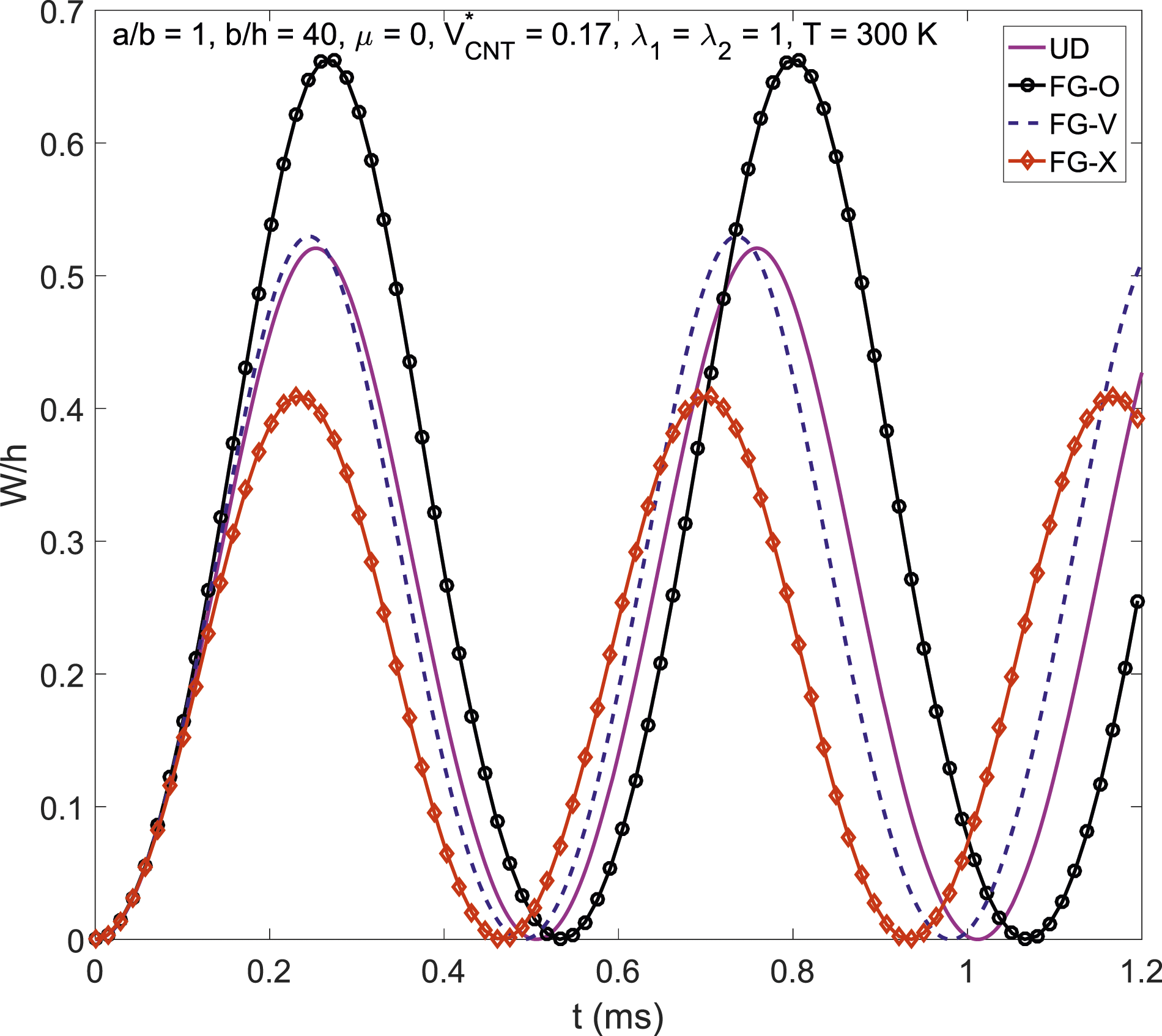
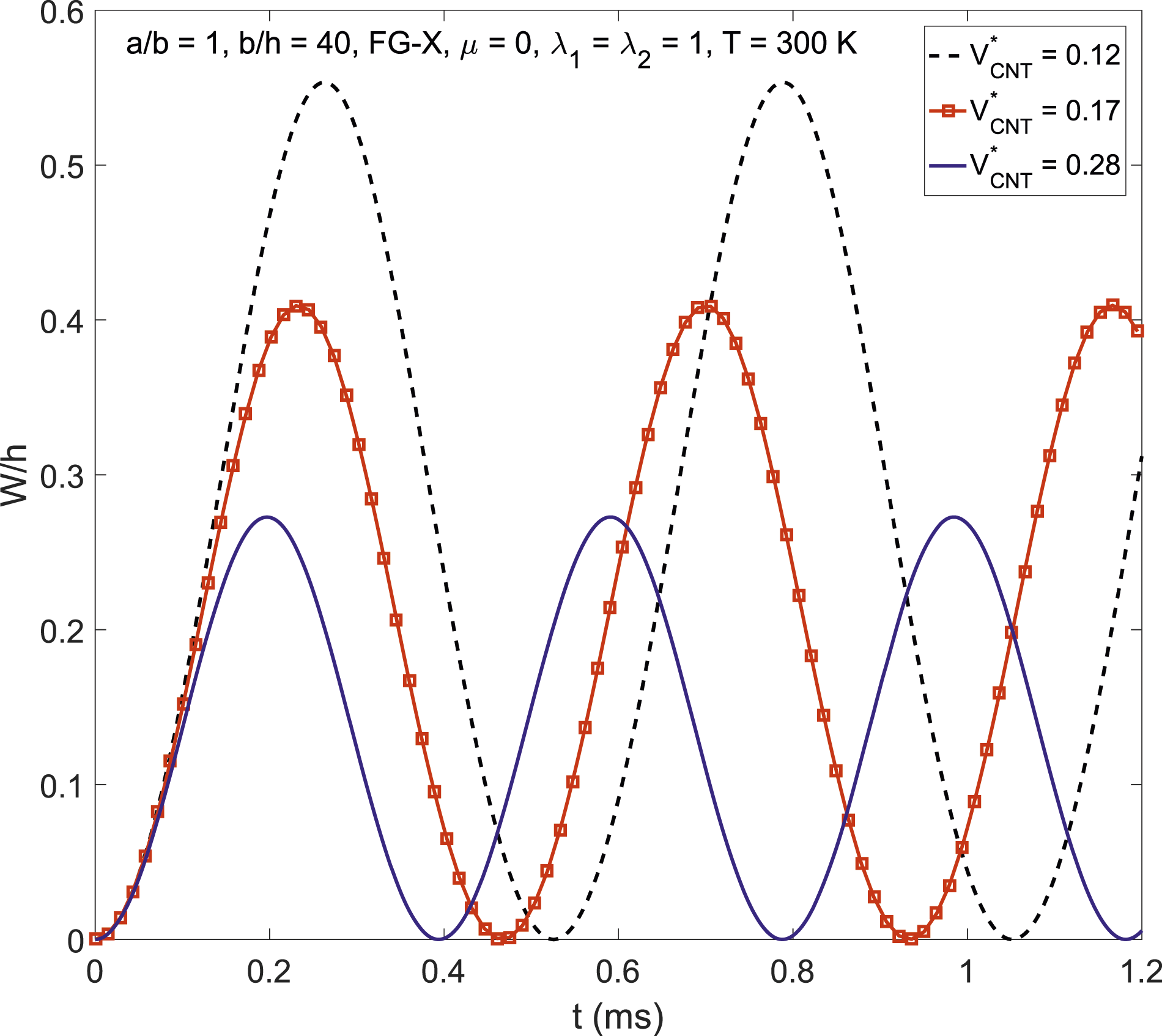
This subsection presents parametric studies of nonlinear transient response of square CNTRC plates with geometry properties mm, and subjected to suddenly applied uniform lateral pressure N/m2. Equation (22) is numerically solved by fourth-order Runge-Kutta scheme with initial conditions at are and in which is maximum deflection reached at the center of the plate. As a first example, the nonlinear transient response of CNTRC plates with different patterns of CNT distribution is analyzed in Figure 10. As can be seen, the deflection along with period of vibration corresponding to FG-X and FG-O distributions are the smallest and largest, respectively. Hence, the remaining analyses are performed for CNTRC plates with FG-X type of CNT reinforcement. Next, the influences of volume percentage of CNTs on the nonlinear dynamic response of CNTRC plates are explored in Figure 11. It is clear that both the amplitude and period of dimensionless center deflection–time response are lowered as is increased. It can be explained that the flexural rigidity of the plate is enhanced and, as a result, the deflection is lessened due to increase in volume percentage of CNT reinforcement.
Nonlinear dynamic response of CNTRC plates with immovable edges and different types of CNT distribution.
Nonlinear dynamic response of FG-CNTRC plates with immovable edges and different values of CNT volume fraction.
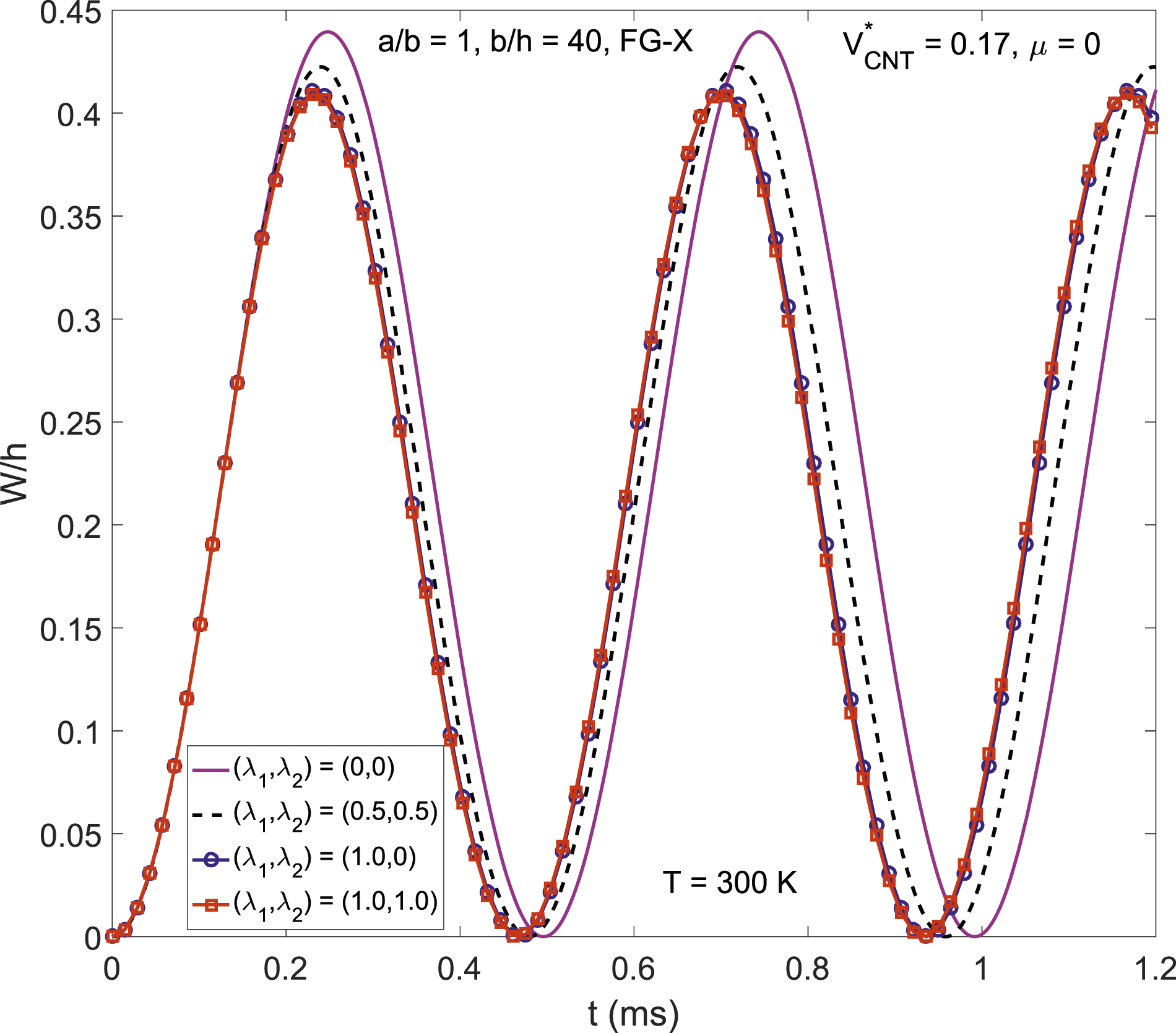
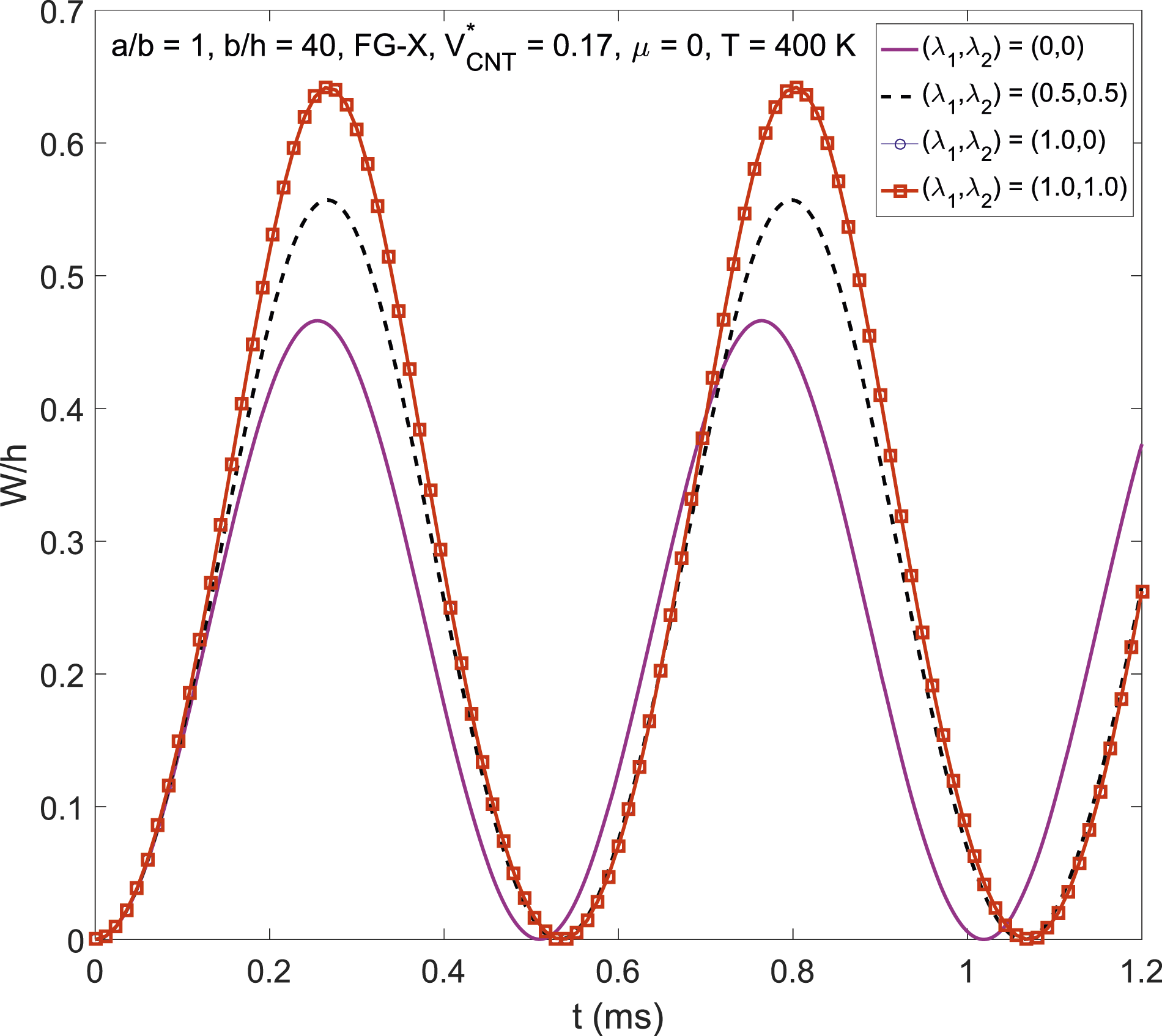
Next, the influences of in-plane edges constraints on the nonlinear transient response of CNTRC plates exposed to room and elevated temperatures are considered in Figures 12 and 13, respectively. Figure 12 indicates that both the maximum deflection and vibration period are lowered as the edges are more rigorously restrained at room temperature. In contrast, Figure 13 plotted with
Nonlinear dynamic response of CNTRC plates with various degrees of in-plane edge constraints at room temperature.
Nonlinear dynamic response of CNTRC plates with various degrees of in-plane edge constraints at elevated temperature.
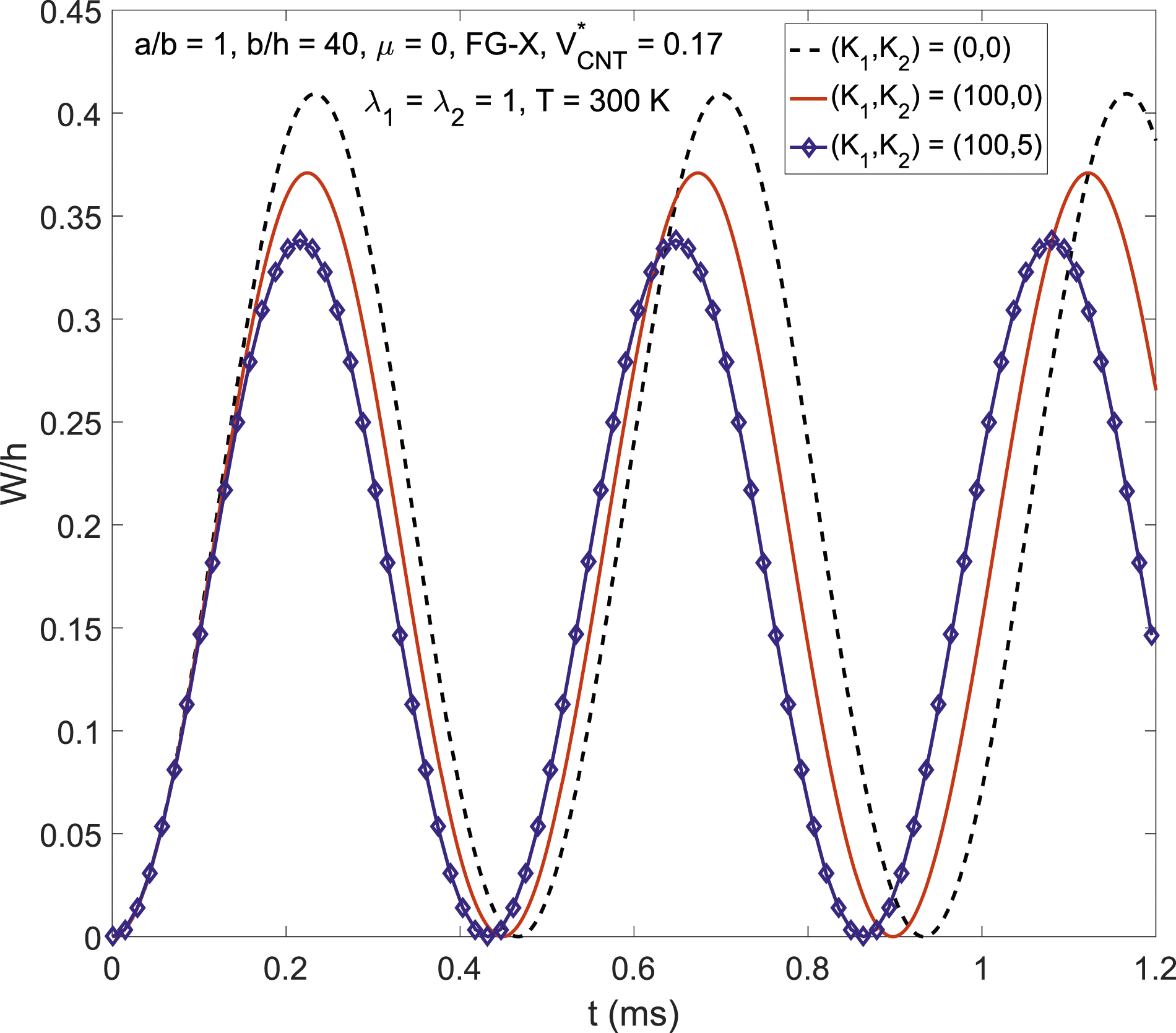
K demonstrates that the amplitude of deflection and period of deflection–time response are pronouncedly increased when the edges are more severely restrained at elevated temperature. Obviously, thermally induced compressive force resultants at restrained edges make the plate more deeply deflected. Particularly, Figures 12 and 13 prove that the restraints of edges and which are perpendicular and parallel to CNTs have significant and marginal influences on the nonlinear transient response of CNTRC plates, respectively. The effects of elastic foundations on the temporal response of CNTRC plates are depicted in Figure 14. It is evident that the deflection amplitude and vibration period are significantly decreased as the stiffness parameters of elastic foundations are increased.
Effects of elastic foundations on nonlinear dynamic response of CNTRC plates with immovable edges.
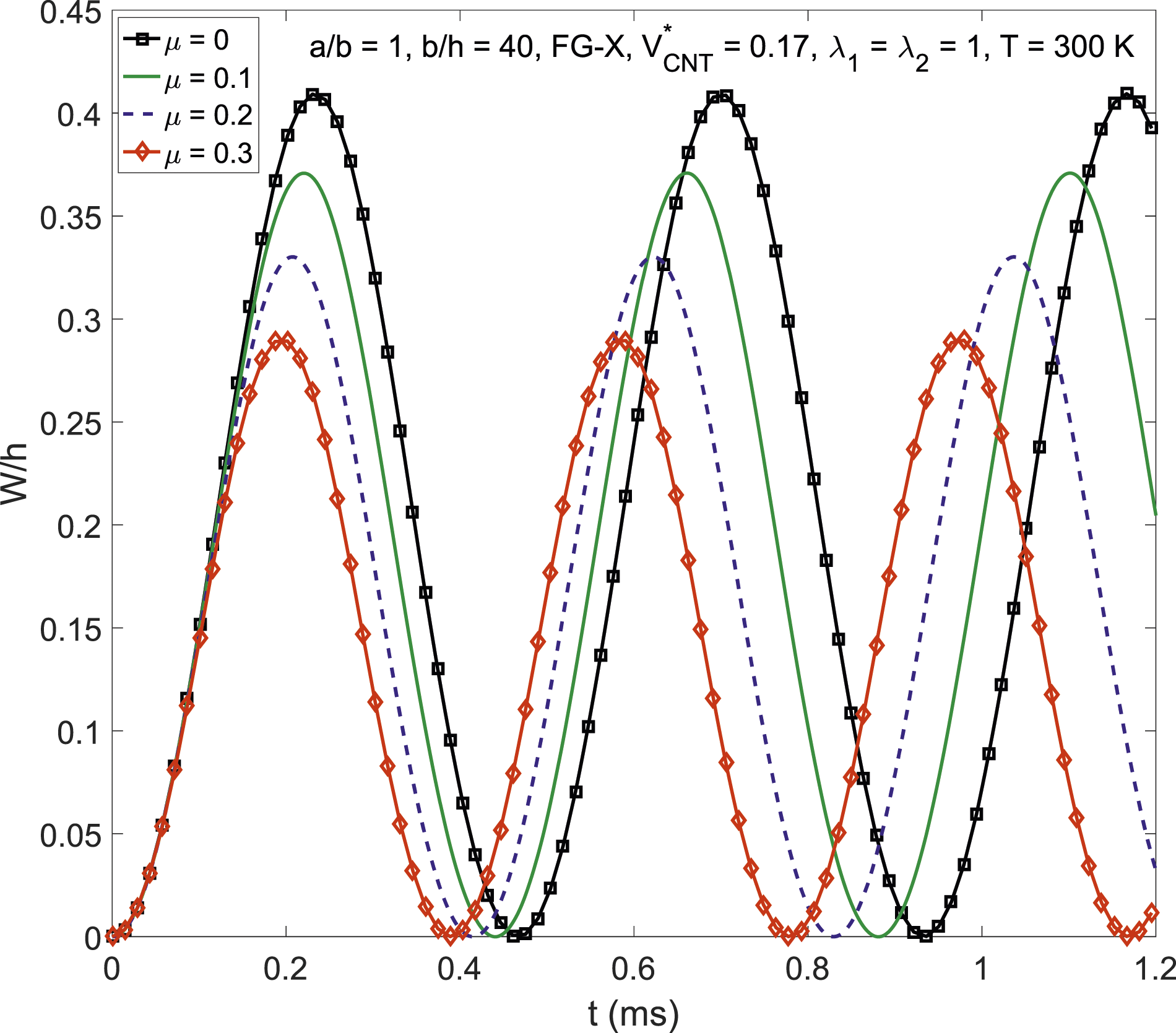
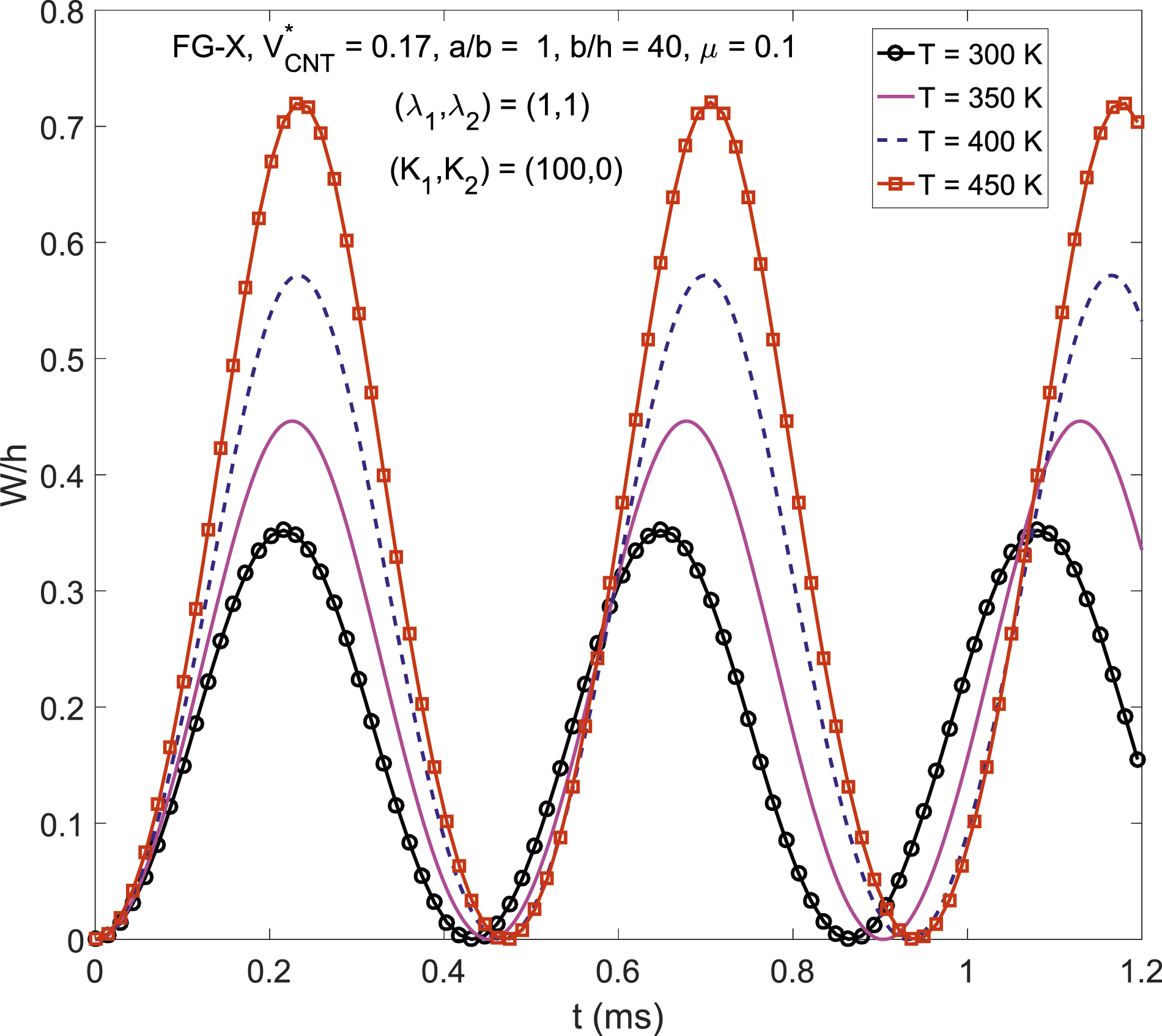
The effects of initial geometrical imperfection on the dimensionless center deflection–time response of CNTRC plates are traced in Figure 15. It is worth to note that the imperfection beneficially affects the nonlinear transient response of CNTRC plates because center deflection is obviously dropped when the size imperfection becomes larger. Finally, the effects of thermal environments on the nonlinear temporal response of geometrically imperfect CNTRC plates on a Winkler foundation are explored in Figure 16. As can be observed, the elevated temperature detrimentally influences the center deflection–time behavior of CNTRC plates as deflection amplitude is significantly developed when environment temperature becomes more elevated.
Effects of initial geometrical imperfection on nonlinear dynamic response of CNTRC plates with immovable edges.
Effects of thermal environments on nonlinear dynamic response of CNTRC plates with immovable edges.
Concluding remarks
An investigation on the influences of in-plane edge constraints, initial geometrical imperfection, elastic foundations and elevated temperature on the nonlinear vibration and dynamic response of simply supported CNTRC plates has been presented. From the above analyses, the following remarks are reached:
1. Fundamental natural frequency is unchanged and significantly reduced due to in-plane constraints of edges when CNTRC plates are exposed to room and elevated temperatures, respectively. Meanwhile, the dynamic deflection amplitude is decreased and increased due to in-plane restraints of edges when the plate is exposed to room and elevated temperatures, respectively.
2. Natural frequency is significantly increased while the nonlinear to linear frequency ratio and transient deflection amplitude are obviously decreased when the plates with restrained edges are supported by elastic foundations.
3. For CNTRC plates with tangentially restrained edges, the natural frequency is remarkably dropped while the frequency nonlinearity and dynamic deflection amplitude are considerably augmented as environment temperature is enhanced.
4. FG-X type of CNT distribution results in the highest value of natural frequency, the lowest ratio of nonlinear to linear frequencies, and minimum amplitude of transient deflection.
5. Increase in imperfection size leads to an increase and a decrease in the natural frequency and transient deflection amplitude, respectively. Furthermore, a small imperfection may make the frequency nonlinearity increased in larger region of deflection amplitude.
Footnotes
Declaration of conflicting interests
The author(s) declared no potential conflicts of interest with respect to the research, authorship, and/or publication of this article.
Funding
The author(s) received no financial support for the research, authorship, and/or publication of this article.
ORCID iD
Hoang Van Tung
Appendix
The expressions of in the equation (19) are given as the following
where
in which is value of computed at room temperature K.
The coefficients and () in the equations (21a) and (21b) are given as follows
in which
and specific expressions of and () were given in the work.12
The detail of coefficients in the equation (22) are defined as follows
References
1.
ShenHS. Nonlinear bending of functionally graded carbon nanotube-reinforced composite plates in thermal environments. Compos Struct2009; 91: 9–19.
2.
LeiZXLiewKMYuJL. Buckling analysis of functionally graded carbon nanotube-reinforced composite plates using the element-free kp-Ritz method. Compos Struct2013; 98: 160–168.
3.
MirzaeiMKianiY. Thermal buckling of temperature dependent FG-CNT reinforced composite plates. Meccanica2016; 51: 2185–2201.
4.
Moradi HaghighiSAlibeiglooA. Thermal buckling and vibrational analysis of carbon nanotube reinforced rectangular composite plates based on third-order shear deformation theory. J Eng Mech2023; 149(6). 04023026. DOI: 10.1061/JENMDT.EMENG-6875. in Press.
5.
KaramiBShahsavariDJanghorbanM. A comprehensive analytical study on functionally graded carbon nanotube-reinforced composite plates. Aero Sci Technol2018; 82-83: 499–512.
6.
KhosraviSArvinHKianiY. Interactive thermal and inertial buckling of rotating temperature-dependent FG-CNT reinforced composite beams. Compos B Eng2019; 175: 107178.
7.
KianiYMirzaeiM. Rectangular and skew shear buckling of FG-CNT reinforced composite skew plates using Ritz method. Aero Sci Technol2018; 77(1): 388–398.
8.
ShenHSZhangCL. Thermal buckling and postbuckling behavior of functionally graded carbon nanotube-reinforced composite plates. Mater Des2010; 31(7): 3403–3411.
KianiY. Thermal post-buckling of temperature dependent sandwich plates with FG-CNTRC face sheets. J Therm Stresses2018; 41(7): 866–882.
11.
ZhangLWLiewKM. Postbuckling analysis of axially compressed CNT reinforced functionally graded composite plates resting on Pasternak foundations using an element-free approach. Compos Struct2016; 138: 40–51.
12.
TungHV. Thermal buckling and postbuckling behavior of functionally graded carbon nanotube-reinforced composite plates resting on elastic foundations with tangential edge restraints. J Therm Stresses2017; 40(5): 641–663.
13.
TungHVTrangLTN. Thermal postbuckling of shear deformable CNT-reinforced composite plates with tangentially restrained edges and temperature-dependent properties. J Thermoplast Compos Mater2020; 33(1): 97–124.
14.
TrangLTNTungHV. Thermally induced postbuckling of thin CNT-reinforced composite plates under nonuniform in-plane temperature distributions. J Thermoplast Compos Mater2022; 35(12): 2331–2353.
15.
TrangLTNTungHV. Tangential edge constraint sensitivity of nonlinear stability of CNT-reinforced composite plates under compressive and thermomechanical loadings. J Eng Mech2018; 144(7): 04018056.
16.
TrangLTNTungHV. Thermomechanical postbuckling of higher order shear deformable CNT-reinforced composite plates with elastically restrained unloaded edges. Polym Polym Compos2021; 29(9S): S857–S875.
17.
LongVTTungHV. Thermal postbuckling behavior of CNT-reinforced composite sandwich plate models resting on elastic foundations with tangentially restrained edges and temperature-dependent properties. J Thermoplast Compos Mater2020; 33(10): 1396–1428.
18.
LongVTTungHV. Thermomechanical postbuckling behavior of CNT-reinforced composite sandwich plate models resting on elastic foundations with elastically restrained unloaded edges. J Therm Stresses2019; 42(5): 658–680.
19.
ZhuPLeiZXLiewKM. Static and free vibration analyses of carbon nanotube-reinforced composite plates using finite element method with first order shear deformation plate theory. Compos Struct2012; 94: 1450–1460.
20.
BouazzaMZenkourAM. Vibration of carbon nanotube-reinforced plates via refined nth-higher-order theory. Arch Appl Mech2020; 90: 1755–1769.
21.
LeiZXLiewKMYuJL. Free vibration analysis of functionally graded carbon nanotube-reinforced composite plates using the element-free kp-Ritz method in thermal environment. Compos Struct2013; 106: 128–138.
22.
SelimBAZhangLWLiewKM. Vibration analysis of CNT reinforced functionally graded composite plates in a thermal environment based on Reddy’s higher-order shear deformation theory. Compos Struct2016; 156: 276–290.
23.
ZhangLWSelimBA. Vibration analysis of CNT-reinforced thick laminated composite plates based on Reddy’s higher-order shear deformation theory. Compos Struct2017; 160: 689–705.
24.
Abdollahzadeh ShahrbabakiEAlibeiglooA. Three-dimensional free vibration of carbon nanotube-reinforced composite plates with various boundary conditions using Ritz method. Compos Struct2014; 111: 362–370.
25.
KianiY. Free vibration of functionally graded carbon nanotube reinforced composite plates integrated with piezoelectric layers. Comput Math Appl2016; 72(9): 2433–2449.
KianiY. Free vibration of carbon nanotube reinforced composite plate on point supports using Lagrangian multipliers. Meccania2017; 52: 1353–1367.
28.
ZhangLW. On the study of the effect of in-plane forces on the frequency parameters of CNT-reinforced composite skew plates. Compos Struct2017; 160: 824–837.
29.
DucNDLeeJNguyen-ThoiT, et al.Static response and free vibration of functionally graded carbon nanotube-reinforced composite rectangular plates resting on Winkler-Pasternak elastic foundations. Aero Sci Technol2017; 68: 391–402.
30.
FantuzziNTornabeneFBacciocchiM, et al.Free vibration analysis of arbitrarily shaped functionally graded carbon nanotube-reinforced plates. Compos B Eng2017; 115: 384–408.
31.
WangMLiZMQiaoP. Semi-analytical solutions to buckling and free vibration analysis of carbon nanotube-reinforced composite thin plates. Compos Struct2016; 144: 33–43.
32.
MeharKPandaSKDehengiaA, et al.Vibration analysis of functionally graded carbon nanotube reinforced composite plate in thermal environment. Jnl of Sandwich Structures & Materials2016; 18(2): 151–173.
LiewKMLeiZXZhangLW. Mechanical analysis of functionally graded carbon nanotube reinforced composites: a review. Compos Struct2015; 120: 90–97.
35.
LiewKMPanZZZhangLW. The recent progress of functionally graded CNT reinforced composites and structures. Sci China Phys Mech Astron2020; 63(3): 234601.
36.
WangZXShenHS. Nonlinear vibration of nanotube-reinforced composite plates in thermal environments. Comput Mater Sci2011; 50: 2319–2330.
37.
WangZXShenHS. Nonlinear vibration and bending of sandwich plates with nanotube-reinforced composite face sheets. Composites Part B2012; 43: 411–421.
38.
TangHDaiHL. Nonlinear vibration behavior of CNTRC plate with different distribution of CNTs under hygrothermal effects. Aero Sci Technol2021; 115: 106767.
LeiZZhangLLiewK. Elastodynamic analysis of carbon nanotube-reinforced functionally graded plates. Int J Mech Sci2015; 99: 208–217.
41.
ZhangLWLiuWHXiaoLN. Elastodynamic analysis of regular polygonal CNT-reinforced composite plates via FSDT element-free method. Eng Anal Bound Elem2017; 76: 80–89.
42.
ZhangLWXiaoLN. Mechanical behavior of laminated CNT-reinforced composite skew plates subjected to dynamic loading. Compos B Eng2017; 122: 219–230.
43.
ZhangLWSongZGQiaoP, et al.Modeling of dynamic responses of CNT-reinforced composite cylindrical shells under impact loads. Comput Methods Appl Mech Eng2017; 313: 889–903.
44.
Phung-VanPAbdel-WahabMLiewKM, et al.Isogeometric analysis of functionally graded carbon nanotube-reinforced composite plates using higher-order shear deformation theory. Compos Struct2015; 123: 137–149.
45.
Van DoVNJeonJTLeeCH. Dynamic analysis of carbon nanotube-reinforced composite plates by using Bézier extraction based isogeometric finite element combined with higher-order shear deformation theory. Mech Mater2020; 142: 103307.
46.
FrikhaAZghalSDammakF. Dynamic analysis of functionally graded carbon nanotubes-reinforced plate and shell structures using a double directors finite shell element. Aero Sci Technol2018; 78: 438–451.
47.
WangZXShenHS. Nonlinear dynamic response of nanotube-reinforced composite plates resting on elastic foundations in thermal environments. Nonlinear Dynam2012; 70: 735–754.
48.
LibrescuLLinW. Vibration of thermomechanically loaded flat and curved panels taking into account geometric imperfections and tangential edge restraints. Int J Solid Struct1997; 34: 2161–2181.
49.
ZhangLWLiewKMJiangZ. An element-free analysis of CNT-reinforced composite plates with column supports and elastically restrained edges under large deformation. Compos B Eng2016; 95: 18–28.
50.
ZhangLWCuiWCLiewKM. Vibration analysis of functionally graded carbon nanotube reinforced composite thick plates with elastically restrained edges. Int J Mech Sci2015; 103: 9–21.
51.
ZhangLWLiewKMReddyJN. Postbuckling of carbon nanotube reinforced functionally graded plates with edges elastically restrained against translation and rotation under axial compression. Comput Methods Appl Mech Eng2016; 298: 1–28.
52.
TungHV. Thermal and thermomechanical postbuckling of FGM sandwich plates resting on elastic foundations with tangential edge constraints and temperature dependent properties. Compos Struct2015; 131: 1028–1039.
53.
TungHVTrangLTN. Imperfection and tangential edge constraint sensitivities of thermomechanical nonlinear response of pressure-loaded carbon nanotube-reinforced composite cylindrical panels. Acta Mech2018; 229(5): 1949–1969.
54.
TrangLTNTungHV. Thermoelastic stability of thin CNT-reinforced composite cylindrical panels with elastically restrained edges under nonuniform in-plane temperature distribution. J Thermoplast Compos Mater2023; 36(2): 768–793.
55.
TrangLTNTungHV. Nonlinear stability of CNT-reinforced composite cylindrical panels with elastically restrained straight edges under combined thermomechanical loading conditions. J Thermoplast Compos Mater2020; 33(2): 153–179.
56.
HieuPTTungHV. Thermal buckling and postbuckling of CNT-reinforced composite cylindrical shell surrounded by an elastic medium with tangentially restrained edges. J Thermoplast Compos Mater2021; 34(7): 861–883.
57.
HieuPTTungHV. Thermomechanical postbuckling of pressure-loaded CNT-reinforced composite cylindrical shells under tangential edge constraints and various temperature conditions. Polym Compos2020; 41: 244–257.
58.
Nhu TrangLTTungHV. Thermo-torsional postbuckling of CNT-reinforced composite toroidal shell segments with surrounding elastic media and tangentially restrained edges. J Thermoplast Compos Mater2022; 36: 3137–3167.