



Abstract
Euler’s instability criterion is widely used in engineering to design a column. However, this criterion is not suitable for judging the instability of a three-dimensional printing process because the axial motion of the printing jet has to be considered. A variational principle is established, and an equivalent Eulerian load is obtained. The theoretical results show that a higher printing velocity makes the moving jet much more stable, and an experiment is designed to verify our theoretical prediction.
Introduction
The three-dimensional-printing technology is now playing an important role in materials science, constructional engineering, and food engineering.1–5 It can print micro/nano devices, e.g. micro-electromechanical systems
6
and Fangzhu-like devices for collecting water from air.7–9 An accurate printed object requires an exact sprinting process, and any small instability is not allowed. However, when a column subjects to a buckling load, an instability occurs when the axial pressure reaches the Eulerian load



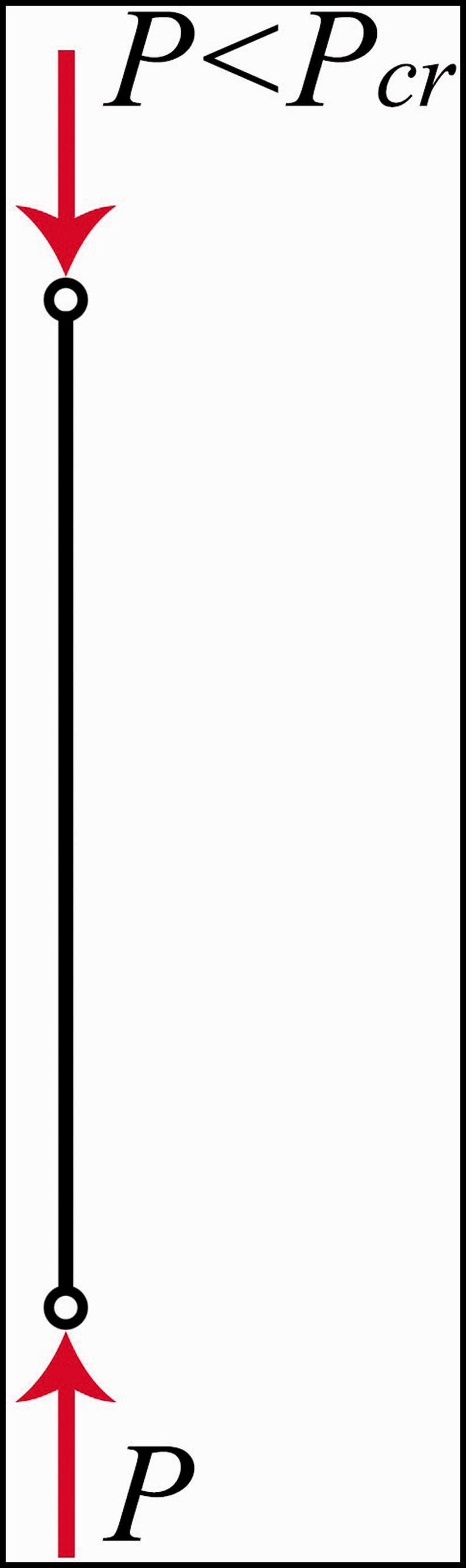
Stability of columns.
When
In the three-dimensional-printing process1–5 (see Figure 2), an instability often occurs for the slender axially moving jet, and the instability always leads to morphology change of the printed object. The instability also occurs in some spinning process, see, for example, the following works.10–17 In this paper, the moving jet is approximated as an axially moving cylindrical rod-like viscoelastic fluid, and its Eulerian load is studied.
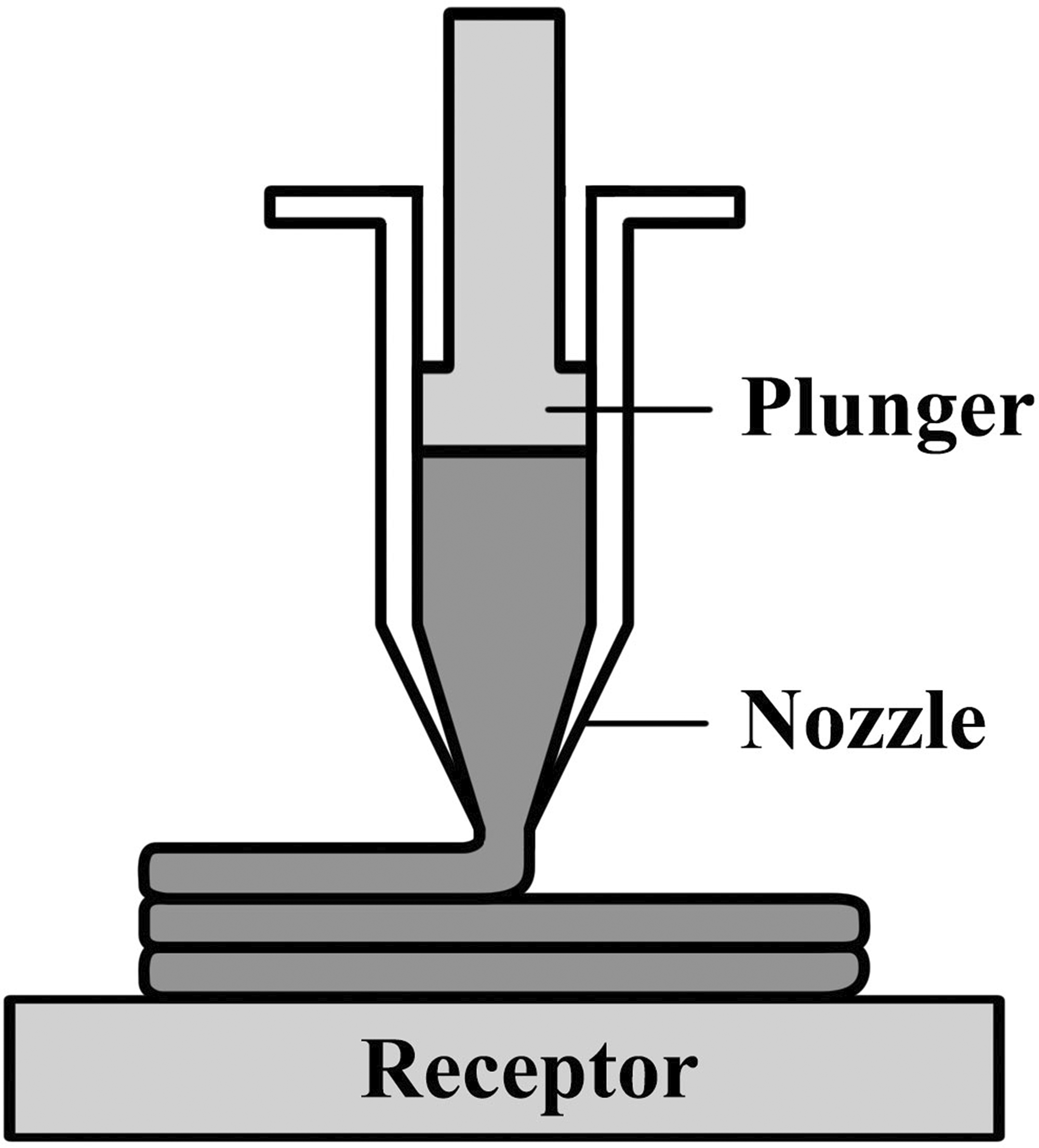
Extrusion-based 3D printing.
Newton’s law and variational principle
The Newton’s second law is widely used to establish a differential model. Consider the pendulum motion as illustrated in Figure 3, the Newton’s law leads to the following equation


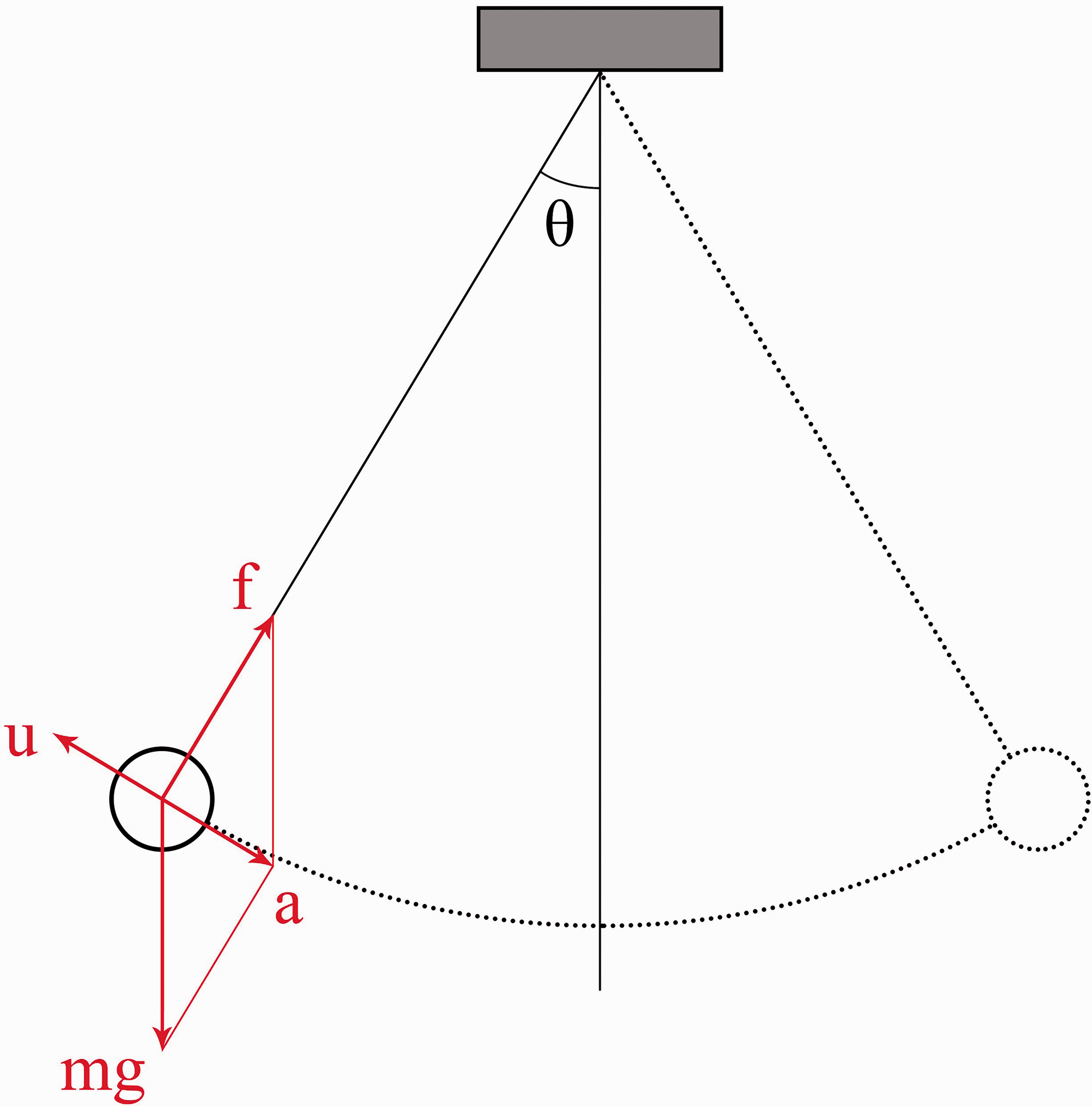
The pendulum.
The governing equation of the pendulum can be also derived from the variational principle, which is

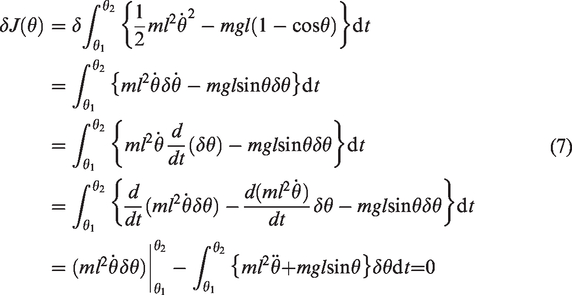
For any arbitrary

Equation (8) can also be obtained directly from the Euler–Lagrange equation, which reads


Both Newton’s law and the variational principle can be used to establish a governing equation for simple problems, but the latter is more suitable for a complex problem.
Instability of the printing jet
Figure 4 shows the printing process, the printing velocity is
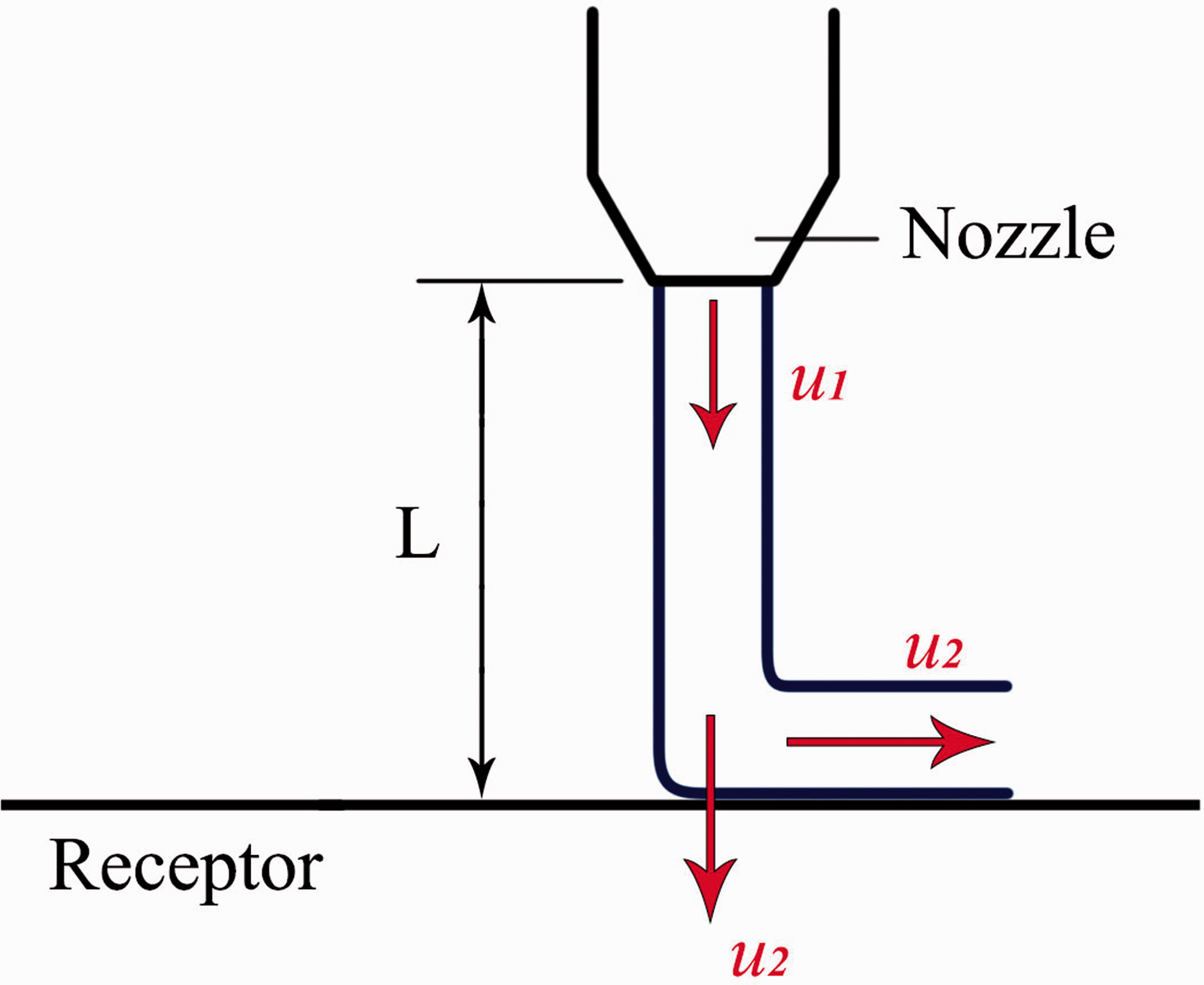
The printing jet.
According to literature,18–22 the printing jet has the following bending energy similar to an elastic column




The variational principle22–28 for the bending jet is


The stationary condition of equation (16) is


It is obvious that

According to equation (17), the governing equation is

We assume that the velocity at the nozzle is

In view of equation (21), equation (20) becomes


In practical applications, we always assume

If
The bending equation becomes

We introduce an equivalent rigidity


This is exactly same with the Euler equation, so the critical Eulerian load reads

Equation (28) predicts that a larger nozzle diameter, or a higher printing velocity, or a shorter printing distance between the nozzle and the receptor leads to a more stable printing process.
Experimental verification
SiC/graphene composites can be printed by the 3D-printing technology.1–3,29 In our experiment, SiC paste was prepared with 54.8 wt.% SiC particles, 4 wt.% TMAH, 0.8 wt.%PEG1500, 3.2 wt% glycerol, 6.4 wt.% carrageenan, 30.6 wt.% water, and 0.2 wt.% graphene.
Figure 5 shows the effect of the printing distance between the nozzle and the receptor on the printed objects. A shorter distance always leads to a stable printing process, see Figure 5(a), while a longer distance results in instability (see Figure 5(b)).
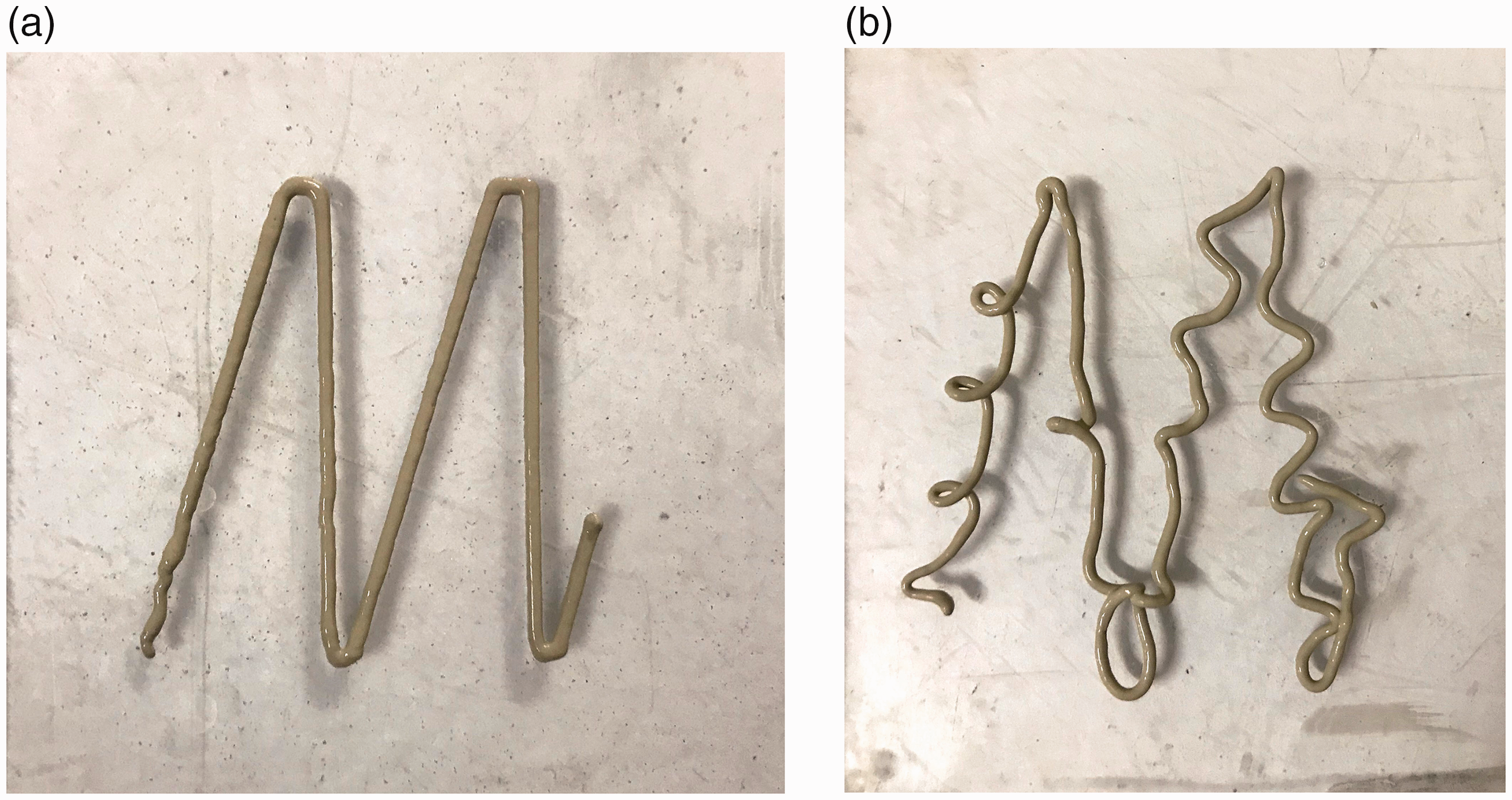
Effect of the printing distance on the printing instability with u = 6 mm/s and d = 0.86 mm: (a) L = 1 mm and (b) L = 5 mm.
The printing velocity also affects the printing instability, and a higher velocity leads to a more stable printing process (see Figure 6).
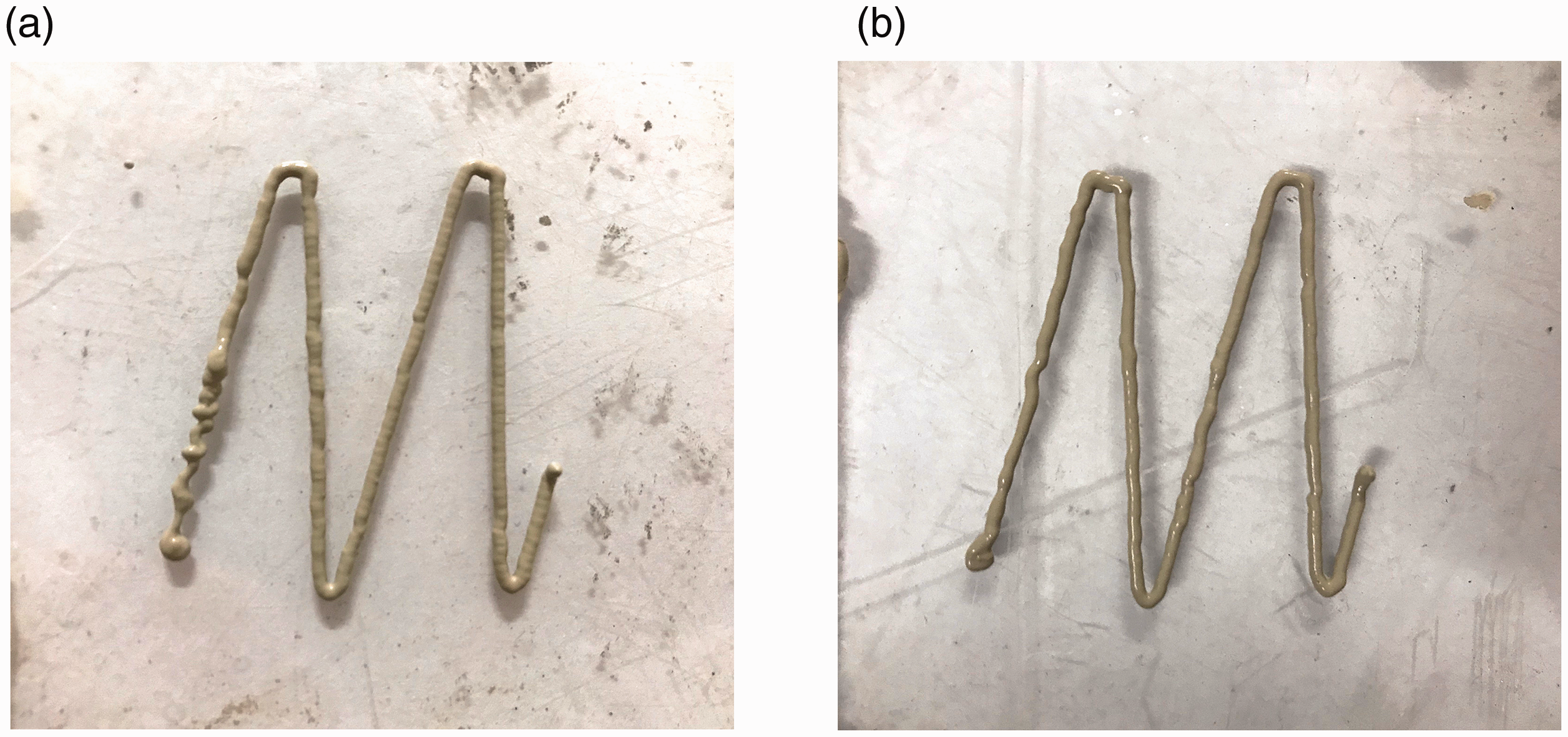
Velocity-induced stability, L = 1 mm, d = 0.86 mm: (a) u= 2 mm/s and (b) u = 4mm/s.
As shown in equation (28), the nozzle diameter also affects the printing instability. Figure 7 shows the experimental results for the different nozzle diameters, which agree with our theoretical prediction.
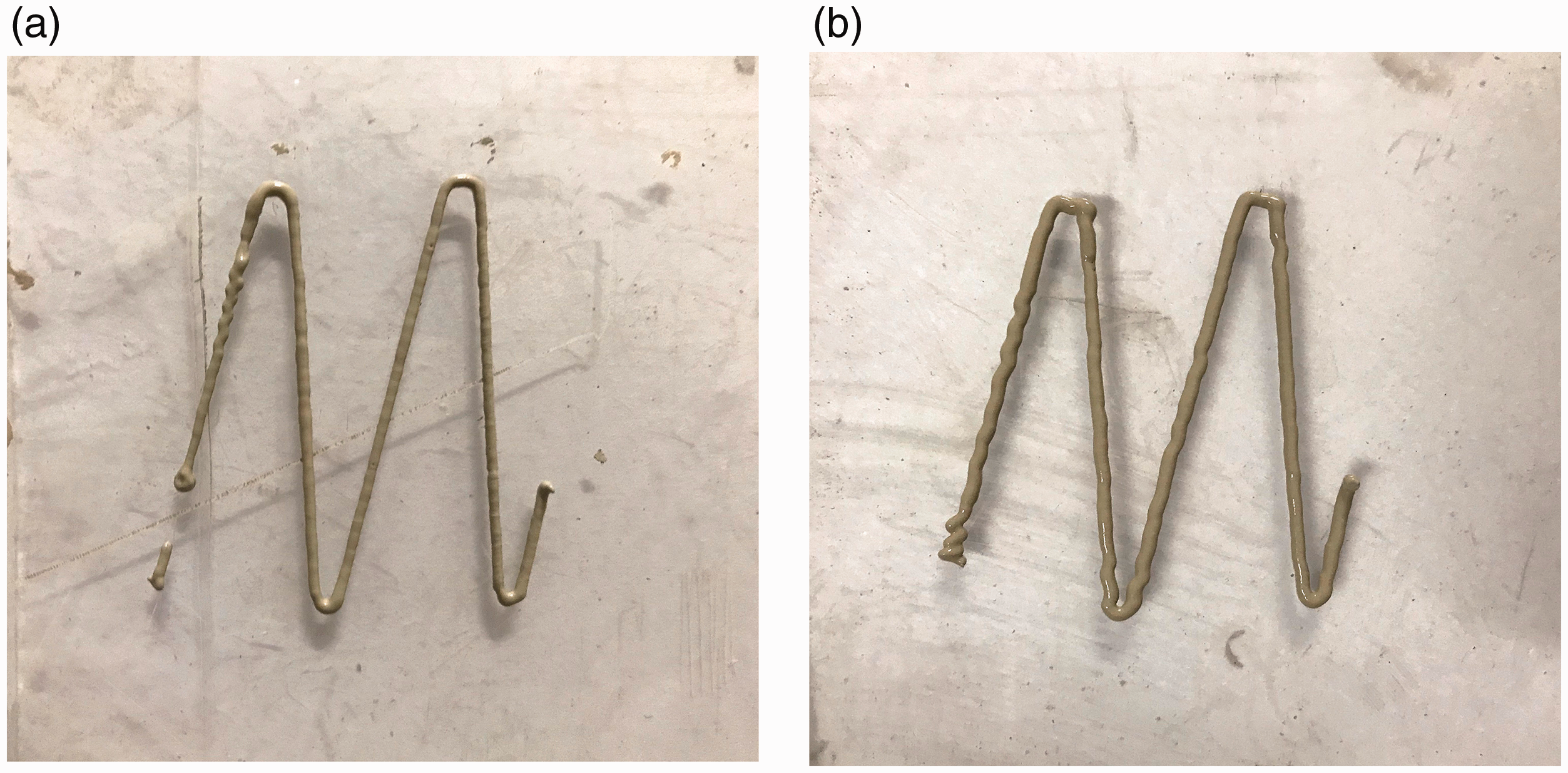
Effect of the nozzle diameter on morphology of the printed object, u = 4 mm/s, L = mm: (a) d = 0.5 mm and (b) d = 0.86 mm.
Discussion and conclusion
For the first time ever, this paper suggests an instability criterion for axially moving jet of a 3D-printing process. A longer printing distance always results in a more instable printing process, see Figure 5, while a higher velocity always makes the moving jet much more stable, see Figure 6, and we call this phenomenon as the motion stability. Due to extremely low elastic modulus of the most printing materials, it is necessary to increase the printing velocity to make the printing process stable. However, due to the solvent evaporation is incomplete for a fast printing process, the printed object is easy to be deformed. We will discuss the problem in a forthcoming paper by establishing a fractal vibration model.3,30,31 The instability of the printing jet will also affect the mechanical and electrical properties of graphene/sic composites. 2
Footnotes
Acknowledgements
The author wishes to thank teachers from State Key Laboratory of Advanced Processing and Recycling of Non-ferrous Metals for the technical support.
Declaration of conflicting interests
The author(s) declared no potential conflicts of interest with respect to the research, authorship, and/or publication of this article.
Funding
The author(s) disclosed receipt of the following financial support for the research, authorship, and/or publication of this article: The authors acknowledge the financial support for this work from School of Materials Science and Engineering of Lanzhou University of Technology. This research was supported by National Natural Science Foundation of China (Grant No. 52062029).
