




Abstract
This paper couples Li–He’s homotopy perturbation method with the energy method to obtain an approximate solution of a tangent nonlinear packaging system. A higher order homotopy equation is constructed by adopting the basic idea of the Li–He’s homotopy perturbation method. The energy method is used to improve the maximal displacement and the frequency of the system to an ever higher accuracy. Comparison with the numerical solution obtained by the Runge–Kutta method shows that the shock responses of the system solved by the new method are more effective with a relative error of 0.15%.
Keywords
Introduction
The homotopy perturbation method (HPM),1,2 which couples the homotopy technique with the perturbation method (PM), is one of the most popular methods to obtain approximate solutions of nonlinear problems.3–12 Recently, some effective modifications of HPM and PM have been developed. Filobello-Nino et al. 13 first introduced differential operators into HPM and proposed the differential operators HPM. Filobello-Nino et al. 14 also proposed the enhanced perturbation method, which expanded the value range of the perturbation parameter by improving the order of equations. Li and He 15 suggested an effective modification of the HPM combined with the enhanced perturbation method, and an extremely high accuracy of an approximate solution could be obtained for a nonlinear oscillator. Except for the above methods, other effective methods for nonlinear solutions have been found, like the variational iteration method16,17 and the max–min approach.18,19
The dropping shock responses of a nonlinear packaging system are very important for packaging protection. Chen 20 and Li and Wang 21 respectively combined the variational iteration method and the max–min approach with the energy method to solve the nonlinear problems of different kinds of packaging systems. The energy method mentioned is similar to the variational approach22–26 to nonlinear oscillators. In this paper, a tangent nonlinear packaging system is considered and a new modification of Li–He’s homotopy perturbation method (LHHPM) 15 is developed.
Basic idea of Li-He’s homotopy perturbation method
LHHPM
15
uses the enhanced perturbation method
14
to construct a homotopy equation with a higher order. To introduce the enhanced perturbation method,
14
we take the linear vibration equation as example

Equation (1) can be written in the form

According to the enhanced perturbation method, the so-called annihilator operator

To introduce the HPM,1,2 we consider the following nonlinear equation

Introducing an embedded variable

To construct a homotopy equation

When

When

Putting

Basic idea of the energy method
For a nonlinear packaging system without damping, the gravitational potential energy of the system will all be ideally converted into elastic potential energy when the deformation of the buffer reaches its maximum value

For nonlinear packaging systems,

The maximal displacement
A tangent nonlinear packaging system
The dynamic equation of dropping shock response of a tangent nonlinear packaging system is shown in equation (12)

The initial conditions of equation (12) are as follows

To solve equation (12), first we carry out the Taylor expansion of

Substituting equation (14) into equation (12), we have

By introducing parameters


Applying the annihilator operator


Substituting


According to the HPM, we construct the equation as follows

Assuming that the solution can be expanded into a series of

The parameter expansion technology can be used to expand the coefficient of the linear term

Substituting equations (23) and (24) into equation (22) leads to

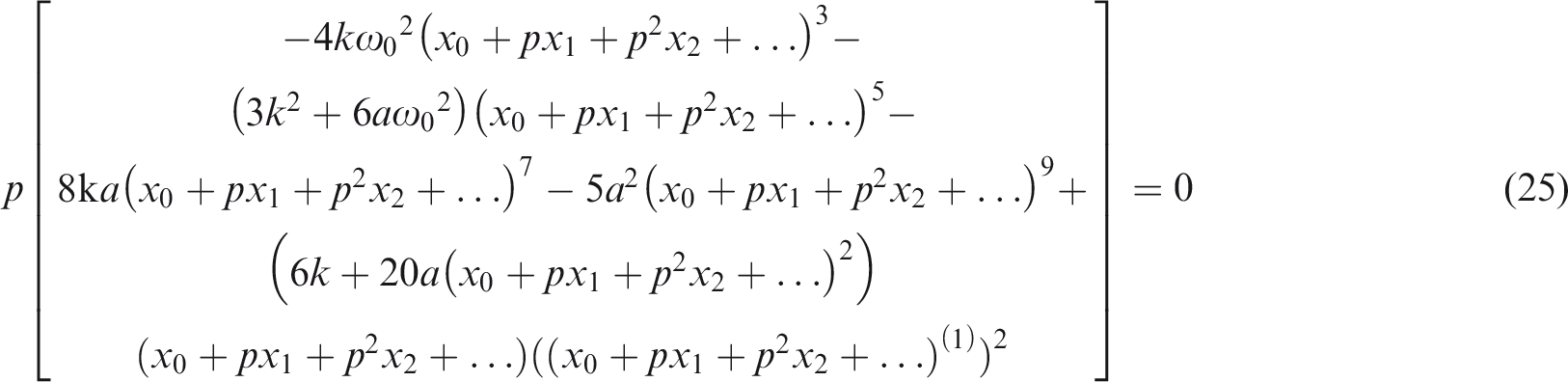
Arranging the same powers of


Using the initial conditions, equation (13),

By substituting






In order to avoid the secular terms in the solution of

Combining with

After solving equation (36) with the parameters provided in Table 1, we can obtain

Comparison of the maximal displacement and the maximal acceleration obtained by He,27 LHHPM, and MLHHPM with the ones by the R-K.
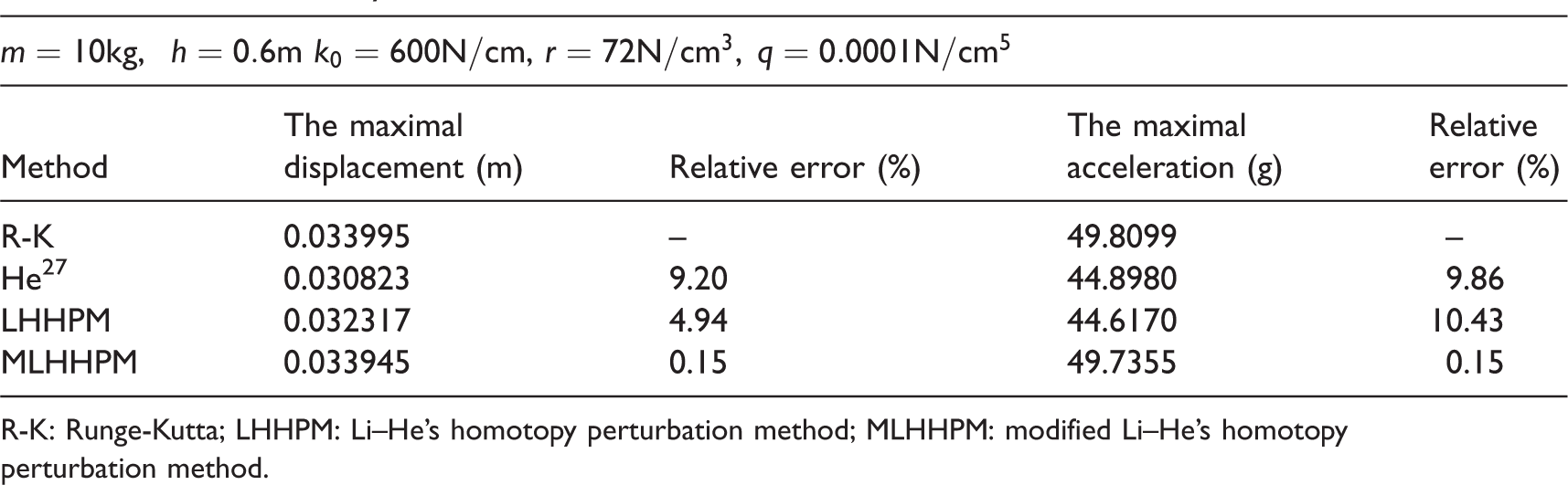
R-K: Runge-Kutta; LHHPM: Li–He’s homotopy perturbation method; MLHHPM: modified Li–He’s homotopy perturbation method.
If we only focus on the first-order approximate solution, we set 
According to the energy method, we have

We can obtain the maximal displacement 
Then replacing 
To set 

Combining equations (40), (43), and (44), we can obtain the modified frequency
To evaluate the dropping shock responses of a tangent packaging system, we are highly concerned about the maximal displacement response and the maximal acceleration response of the system. Therefore, in order to illustrate the validity of the new method for the tangent nonlinear packaging system, we compare the solutions obtained by literature,27 LHHPM, and the modified Li–He’s homotopy perturbation method (MLHHPM) with the exact solution obtained by the R-K method, respectively. The results are shown in Table 1, Figure 1, and Figure. 2. It is obvious that the new method MLHHPM gives more accurate results than others for this nonlinear equation both in the maximal displacement and the maximal acceleration, and the relative error of the solutions obtained by MLHHPM is less than 0.15%.
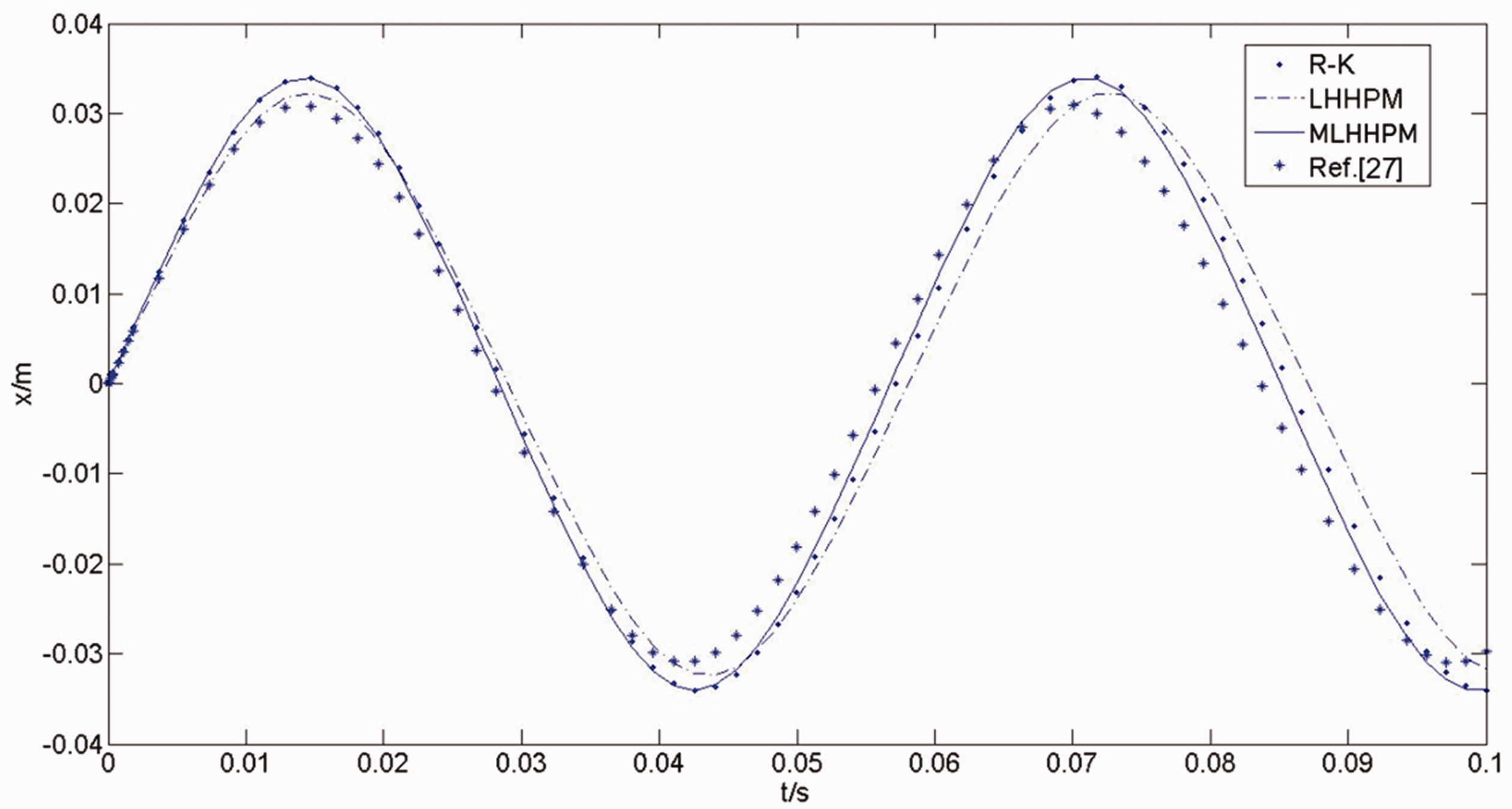
Comparison of LHHPM, He, 27 and MLHHPM with the R-K solution for the displacement.
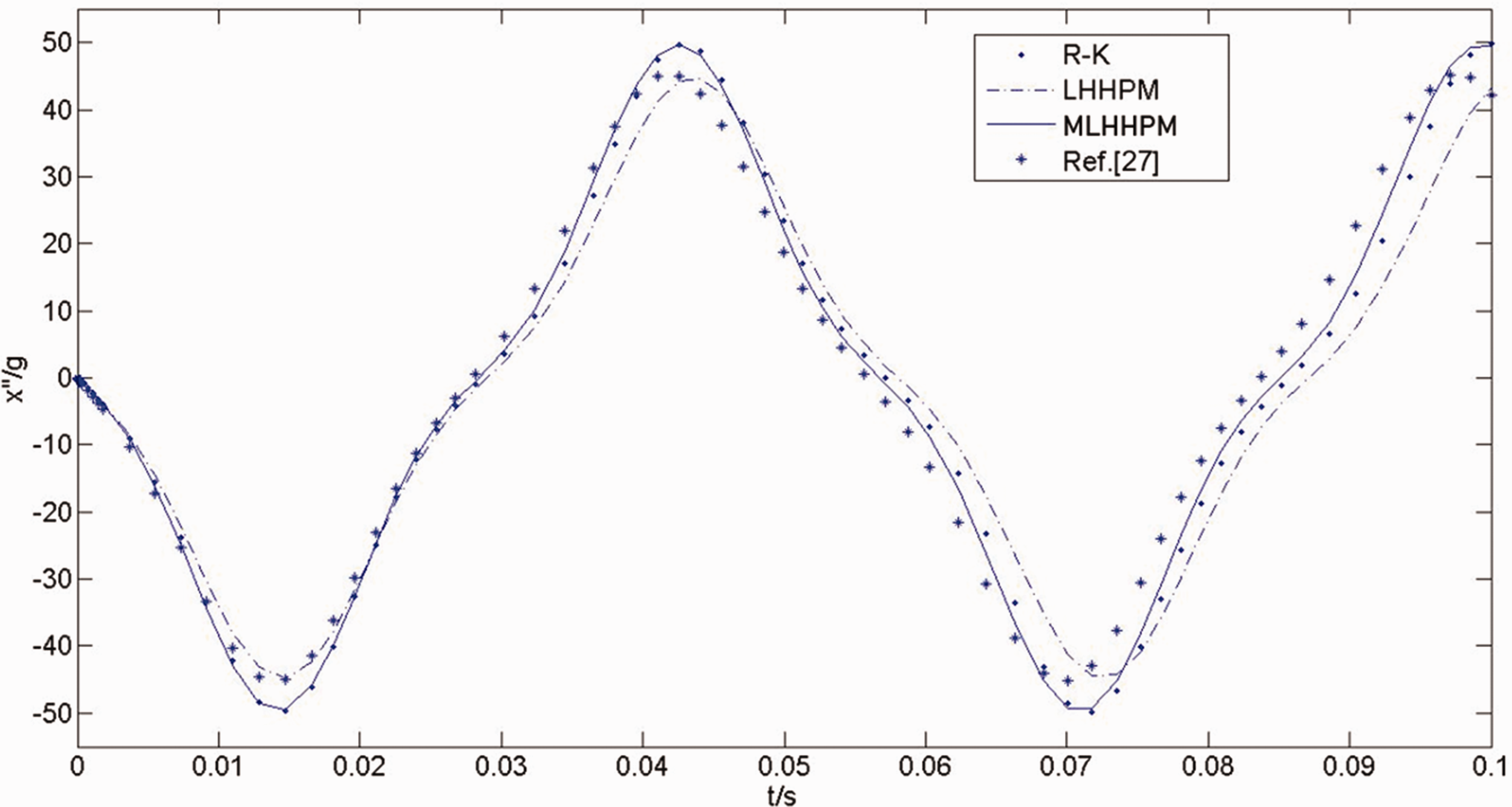
Comparison of LHHPM, He, 27 and MLHHPM with the R-K solution for the acceleration.
Conclusions
In this paper, a novel method (MLHHPM) coupled the LHHPM 15 with the energy method is proposed and applied to study the dropping shock response of a tangent packaging system. The results show that the maximal displacement and acceleration responses obtained by the new method are very close to the numerical ones obtained by the Runge–Kutta method. This new method can also have wide applications to other nonlinear packaging systems, jet vibration in electrospinning, 28 and nonlinear transverse vibration of a nanofiber-reinforced concrete pillar. 29
This paper sheds a bright light on the nonlinear vibration theory, the method is especially effective for nonlinear packaging systems, and our method can be easily extended to fractal vibration systems with fractal derivatives, which will be discussed in a forthcoming paper.
Footnotes
Declaration of conflicting interests
The author(s) declared no potential conflicts of interest with respect to the research, authorship, and/or publication of this article.
Funding
The author(s) disclosed receipt of the following financial support for the research, authorship, and/or publication of this article: This work was supported by Natural Science Foundation of Jiangsu Province, China (Grant No. BK20151128), National first-class discipline program of Light Industry Technology and Engineering (LITE2018-29), the 111 Project (No. B18027), and Natural Science Foundation of Zhejiang Province (Grant number: LY16A020004).
