




Abstract
The capillary oscillation in a hollow fiber greatly affects the process of ions release. Its approximate frequency is obtained, revealing a lower frequency predicts a longer release process, and the main factor affecting the frequency is studied theoretically and verified experimentally. The oscillation release can be also extended to drug release in tissue engineering.
Introduction
Hollow fibers containing sliver ions are widely applied in the textile engineering,1–3 the medical science, and the environment science. Sliver ions in the inner wall of the hollow fibers can be released when immersed in water, and they are widely used as an antibacterial material. The diffusion process is important for the initial release, ions at the open ends of the hollow fiber can be released immediately, but the ions inside of the hollow fiber can be gradually released due to the capillary oscillation, and its frequency will greatly affect the release efficiency. The mechanism of oscillation release is also valid for drug release in tissue engineering. 4
Figure 1 illustrates a hollow fiber immersed in water, the capillary fluid will vibrate and the sliver ions on the inner wall will gradually be released due to capillary oscillation.
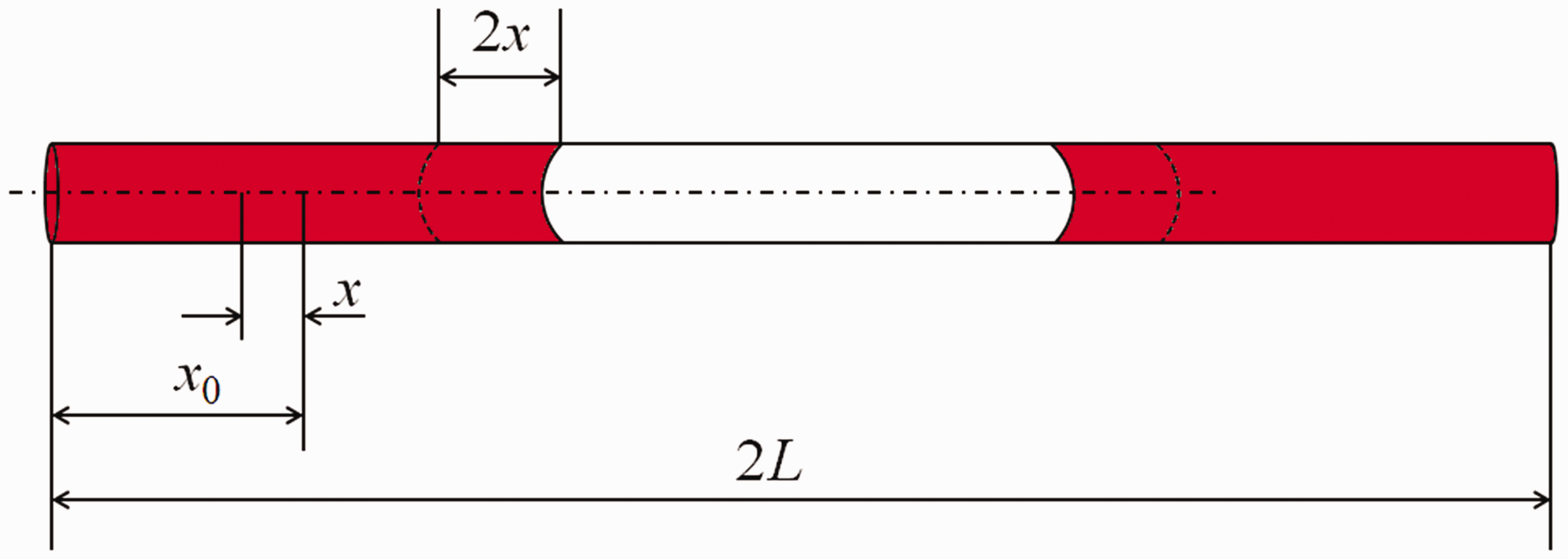
Nano-/micro-flow in a capillary tube, where
The capillary oscillator can be written as
1

The initial conditions are

A detailed derivation of the capillary oscillator was given in Lin and Yao.
1
The oscillator can be effectively solved by the variational iteration method,5–7 the homotopy perturbation method,8–12 He’s frequency formulation,
13
and the Taylor series method.
14
A complete review on various methods for nonlinear oscillators is available in He
13
The frequency of equation (1) can be approximately obtained as
1

The effect of its frequency on ions release
We write equation (3) in the form

We want to study the effect of fiber length on the frequency, so we differentiate equation (4) with respect to L, this results in

It is obvious that

or

This implies that a longer fiber has smaller frequency. As a result, a lower ions release is predicted.
Experimental verification
In order to verify the theoretical prediction, we choose samples with different length from 5 mm to 54 mm to check the release process of ions from the hollow fibers. Sliver ions are distributed uniformly on the inner surface, the sliver ion concentration is same for all samples. Six samples with length of 5 mm, 10 mm, 20 mm, 30 mm, 38 mm, and 54 mm, respectively, were used in the experiment. Each sample was then put into deionized water at temperature of 37°C. The concentration of silver ion on water was measured at different periods, and the results were shown in Figures 2 and 3; all the given data were the mean values of three measured data.
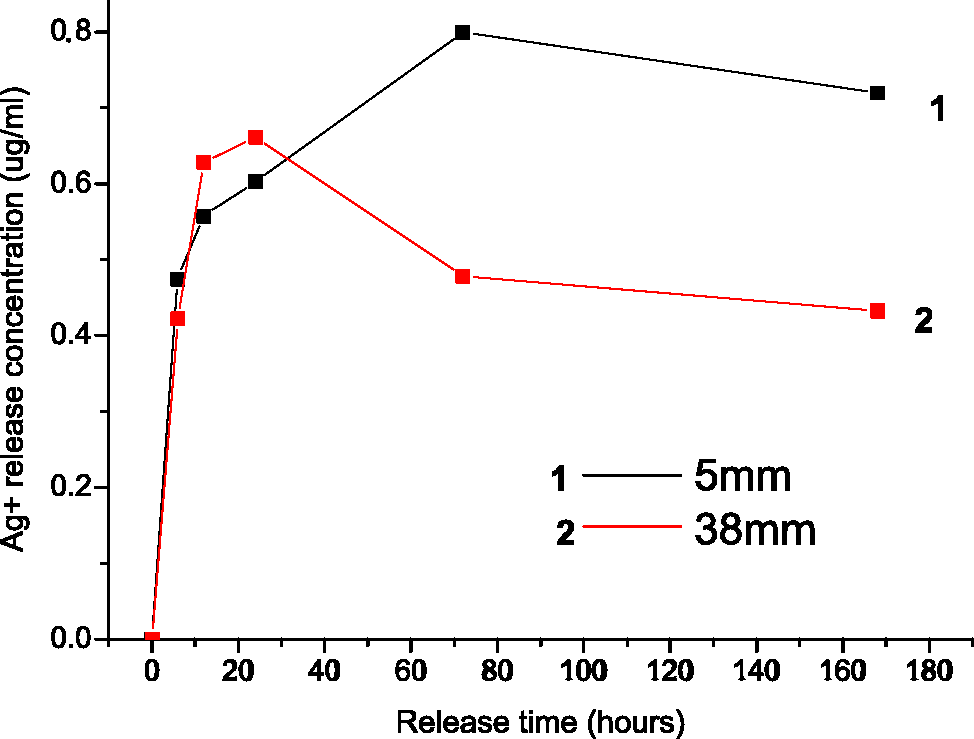
Release rate of silver ion on pure water vs. time. The numbers 1 and 2 represent the hollow fibers with length of 5 mm and 38 mm, respectively.
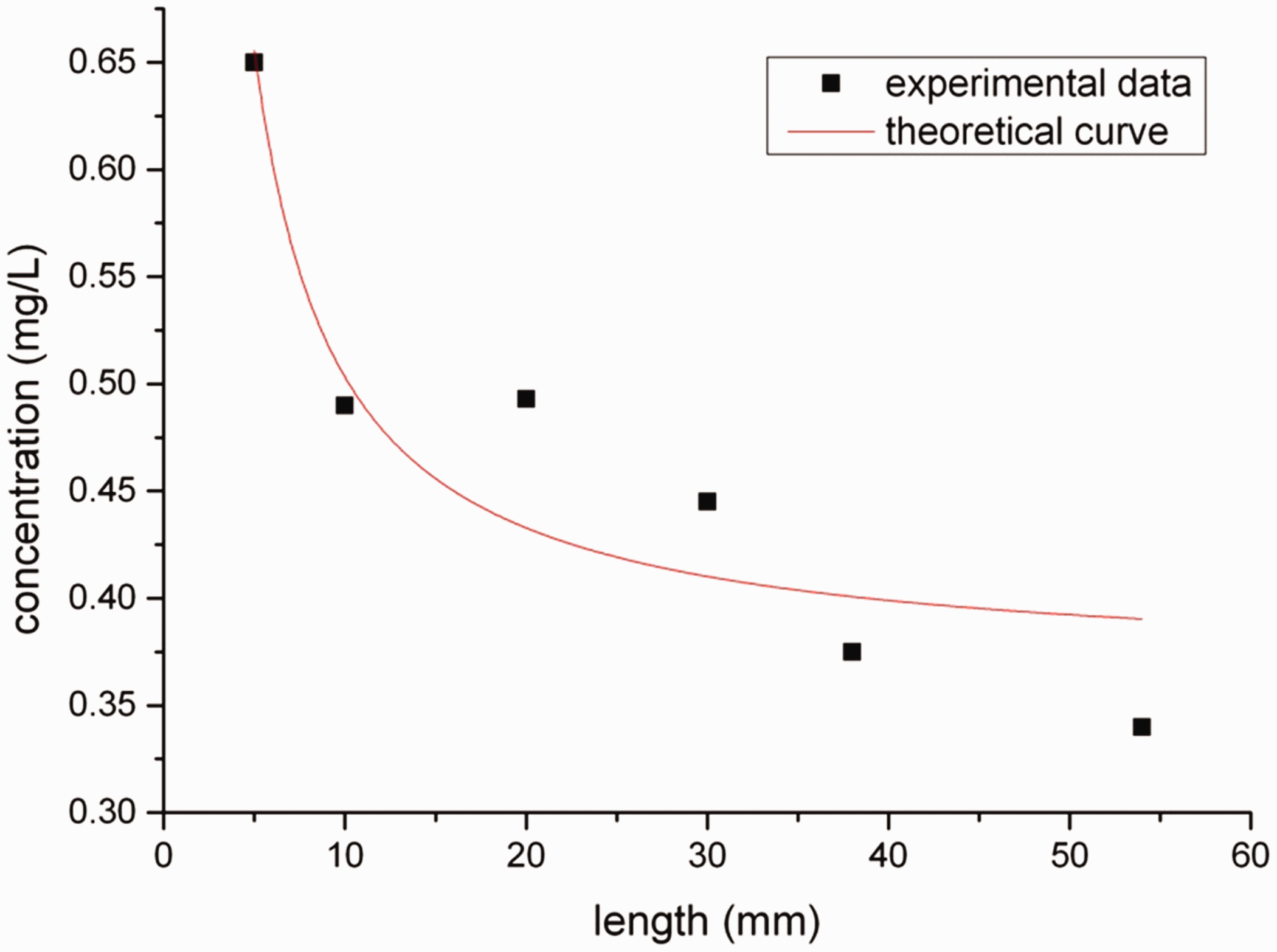
Release rate of silver ion on pure water vs. the fiber length at period of 24 h.
Figure 2 gives a comparison of the ions release between samples with different fiber length. An immediate release of silver ions at the initial stage was observed for both samples, and it is also obvious that ions release after the initial release process in a longer fiber is slower than that in a shorter fiber.
The concentration of the released ions after the initial release process scales with the frequency



seeing a good agreement between the theoretical prediction and experimental data.
Discussion and conclusion
For the first time ever, we show the effect of fiber’s length on the release process. We can control the release process effectively by fiber length, making its applications accessible to various fields, where the controllable release is of great importance. The main effect affecting the frequency is the fiber length; a longer fiber requires a lower frequency and a longer release period.
The unsmooth inner surface can be more effectively modeled by fractal calculus, 14 which can reveal some properties beyond the traditional calculus. Fractal calculus and fractional calculus are main tools to deal with discontinuous problems.14–21 Additionally, nanoscale hollow fibers can be fabricated by electrospinning,22–24 the results of which we will report in a forthcoming paper.
Footnotes
Declaration of conflicting interests
The author(s) declared no potential conflicts of interest with respect to the research, authorship, and/or publication of this article.
Funding
The author(s) received no financial support for the research, authorship, and/or publication of this article.
