Harmonic vibration synchronization of the two excited motors is an important factor affecting the performance of the nonlinear vibration system driven by the two excited motors. From the point of view of the hysteresis force, the nonlinear dynamic models of the nonlinear vibration system driven by the two excited motors are presented for the analysis of the hysteresis force with the asymmetry. An approximate periodic solution for the nonlinear vibration system with the hysteresis force is investigated using the nonlinear models. The condition of harmonic vibration synchronization is theoretically analyzed using the rotor–rotation equations of the two excited motors in the nonlinear dynamic models and the stability condition of harmonic vibration synchronization also is theoretically analyzed using Jacobi matrix of the phase difference equation of two excited motors. Using Matlab/Simlink, harmonic vibration synchronization of the two excited motors and the stability of harmonic vibration synchronization for the nonlinear vibration system with the hysteresis force are analyzed through the selected parameters. Various synchronous processes of the nonlinear vibration system with the hysteresis force are obtained through the difference rates of the two excited motors (including the initial phase difference, the initial rotational speed difference, the difference of the motors parameters). It has been shown that the research results can provide theoretical basis for the design and research of the vibration system driven by the two-excited motors.
Harmonic vibration synchronization of the two excited motors has been an important factor in the vibration system driven by the two excited motors. Harmonic vibration synchronization is usually explained that the two eccentric rotors on the two excited motors must be done synchronous operation when the excitation frequency is close to the definite range of the first natural frequency in the vibration system driven by the two excited motors, namely, the phase difference of the two eccentric rotors is 0 or constant when the excitation frequency is close to the definite range of the first natural frequency. The vibration system driven by the two excited motors can be named as the self-synchronous vibration system. The large amplitude can be obtained in the self-synchronous vibration system with harmonic vibration synchronization. The large amplitude of the vibrating system is very favorable in many engineering field, especially in the vibrating compaction system. So the harmonic vibration synchronization in the self-synchronous vibrating system is very important for performances.
The research on vibration synchronization can be found in many references.1,2 Many models of the self-synchronous vibrating system, such as the linear model with the linear stiffness and the simplified ideal model, have been investigated and can be found in many references.3–5 It is no doubt that linear model is a very good model for the analysis of the vibrating system driven by the multi-excited motors, but it is of very limited to describe vibration synchronization in the vibrating system. With the development of nonlinear vibration theory, many nonlinear models about the vibration synchronization, such as the nonlinear model of the duffing equation, the nonlinear model of the piecewise linear stiffness and so on, have been investigated and found in many literature.6–10 The relationship between the excitation frequency and the natural frequency in the vibrating system driven by the multi-excited motors has been investigated and can be found in many references.11–14 In addition, in order to ensure the synchronous operation of the multi-excited motors and the synchronous stability of the vibrating system, most of the traditional vibration machines can be run on the far-super resonance state,11 but it is of very limited to obtain the stable operation and the large vibration.With the development of vibration theory, the frequency range of the vibrating system driven by the multi-excited motors, such as a super-resonant vibrating system,12 a non-resonant vibrating system13,14 and the combination of the resonance and non-resonance vibrating system,15–17 has been greatly expanded. Obviously, the occurrence of vibration synchronization in the vibrating system driven by the multi-excited motors can also be impacted by the relationship between the excitation frequency and the natural frequency. The large amplitude can be obtained in the vibration system with harmonic vibration synchronization. Thus the investigations on harmonic vibration synchronization for a nonlinear vibrating system with the hysteresis force have become one of the key issues in the nonlinear vibrating system driven by the multi-excited motors.
In this paper, from the point of view of the hysteresis force with the asymmetry, the nonlinear dynamic models of the self-synchronous vibrating system also are presented for the analysis of the hysteretic characteristics. The condition and the stability condition of harmonic vibration synchronization for the self-synchronous vibrating system with the hysteresis force is theoretical analyzed using the rotor–rotation equations of the two excited motors. Using Matlab/Simlink, the synchronous operation of the two-excited motors and the synchronous and stable operation of the self-synchronous vibrating system with the hysteresis force are analyzed through the selected parameters.
Mathematical model and solution
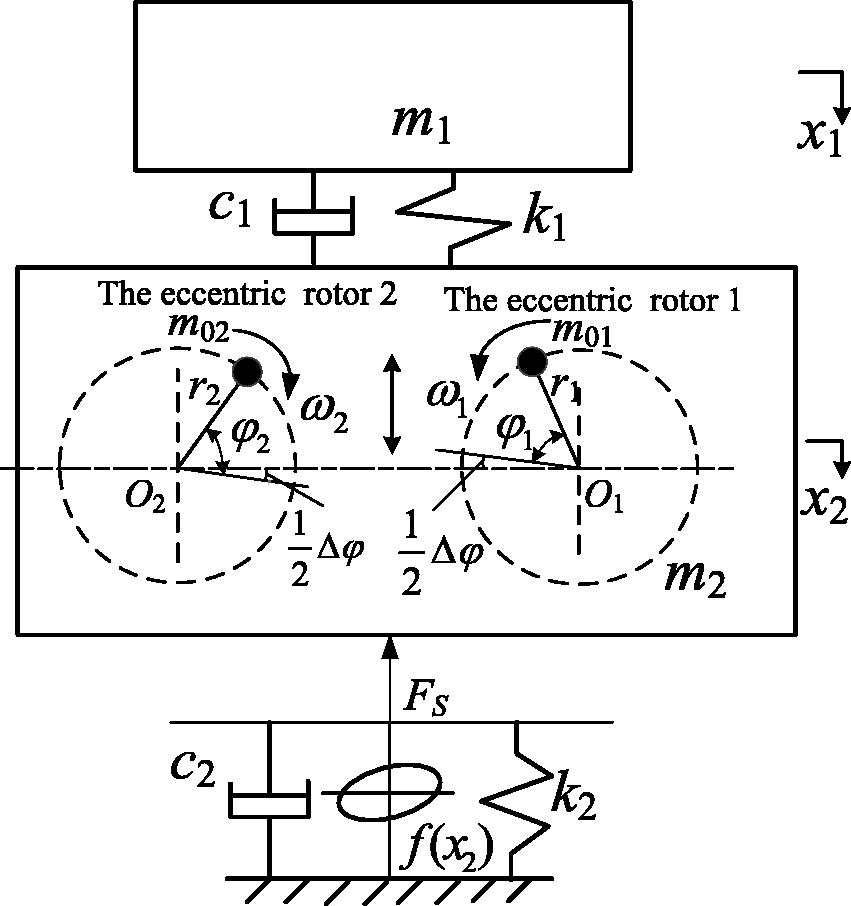
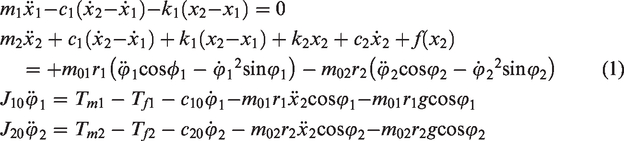
The nonlinear dynamic model of the nonlinear vibration system driven by the two excited motors are presented and shown as Figure 1. As shown in Figure 1, The nonlinear model of the nonlinear vibration system has two vibrating bodies. The two excited motors are installed on the vibrating body 2. Δφ is named as the phase difference angle of the eccentric blocks on the two excited rotors. The vibrating force in the vertical direction can be generated by the two eccentric rotors with the reverse rotation on the two excited motors in the nonlinear vibration system. O1, O2 is the center of the rotating shaft for the two excited motors. Using Lagrange equation, the differential equations of the self-synchronous vibrating system under the action of the hysteresis force are defined as
The model of the nonlinear vibration system driven by the two excited motors.
In this equation, , and are the vibration displacement, the velocity and the acceleration of the vibrating body 1 of the nonlinear vibration system in the vertical direction, respectively. , and are the vibration displacement, the velocity and the acceleration of the vibrating body 2 of the nonlinear vibration system in the vertical direction, respectively. m1 is the total mass of the vibrating body 1 in the nonlinear vibration system, m2 is the total mass of the vibrating body 2 in the nonlinear vibration system and the total mass m2 is composed of two components, the mass of the vibrating body 2 and the mass of two eccentric rotors on two excited-motors m01 and m02. m01 and m02 are the mass of two eccentric rotors on two excited motors, respectively. ri (i =1,2) is the radiuses of the eccentric rotor around Oi (i =1,2). (i = 1,2) is the angular phase of the eccentric rotor i, respectively. (i = 1, 2) is the angular velocity of the eccentric rotor i, respectively. (i = 1, 2) are the angular acceleration of the eccentric rotor i, respectively. c1 is the linear damping between the vibrating body 1 and the vibrating body 2 and k1 is the linear stiffness between the vibrating body 1 and the vibrating body 2. c2 is the linear damping of the vibrating body 2 and k2 is the linear stiffness of the vibrating body 2. (i = 1, 2) is the rotating damping of the excited motor i. (i = 1, 2) is the moment of the inertia of eccentric block i, (i = 1, 2) is the electromagnetic torque on the excited-motor i, (i = 1, 2) is the friction torque on the excited-motor i. g is the acceleration of gravity. is expressed as the hysteretic force with the asymmetry.
The hysteretic force can be presented as the compaction force in the engineering field, especially in the engineering field of the vibratory compaction. If it was be assumed that the total volume of the compacted materials could be approximately unchanged and the compacted materials could be regarded as a continuous medium and the continuity hypothesis of the compacted materials deformation could be satisfied, a certain degree of the vibratory compaction could be reached in the process of the progressive compaction and the particles of the compacted materials could be rearranged in the process of the progressive compaction and the compacted materials in this state could be treated as interstitial media. So the compaction force on the nonlinear vibration system can be provided with the hysteretic characteristics of the asymmetric quadrilateral.
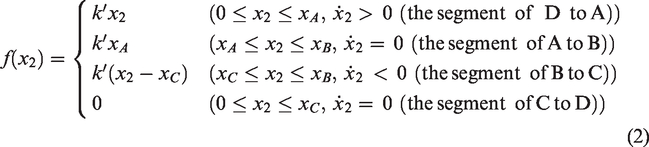
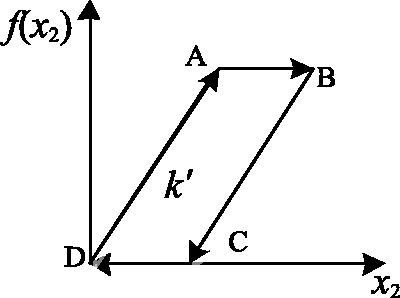
The hysteretic force can be expressed as the asymmetric quadrilateral and shown in Figure 2. As shown in Figure 2, the hysteretic force with the asymmetric quadrilateral can be defined as
The hysteretic force with the asymmetry.
In this equation, x2 is described as the direction of displacement of the hysteretic force. f(x2) is the hysteretic force with the asymmetric quadrilateral. is the stiffness of the hysteretic force, where . As shown in Figure 2, the coordinate of point A is , the coordinate of point B is , the coordinate of point C is , the coordinate of point D is (0,0). and .
The first and second equations in equation (1) can be arranged in matrix form and transformed into
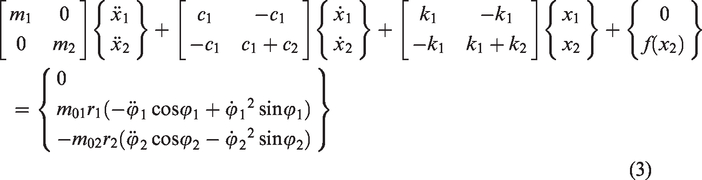
In this equation, ,
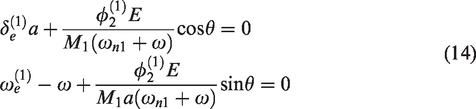
When harmonic vibration synchronization occurs in the nonlinear vibration system driven by the two excited motors, the excitation frequency of the two excited motors must be close to the definite range of the first natural frequency of the nonlinear vibration system. When the excitation frequency of the two excited motors is close to the first natural frequency of the primary resonance for the nonlinear vibration system in the theoretical analysis, the vibration excited by the hysteretic force at the second natural frequency can be reduced. So the first approximate stable solutions of the nonlinear vibration system with the hysteretic force can be solved using nonlinear asymptotic method. The characteristic equation of equation (3) can be expressed as

In this equation, is the natural frequency of the nonlinear vibration system. The first natural frequency of the nonlinear vibration system can be solved and written as

If the mode function at the first natural frequency was defined and expressed as , the following formulas with the mode function should be satisfied and written as

Using the above equation, the mode ratio at the first natural frequency can be expressed as

In this equation, if ,
The vibration displacements of the vibrating body 1 and the vibrating body 2 in the nonlinear vibration system with the hysteretic force can be assumed and expressed as

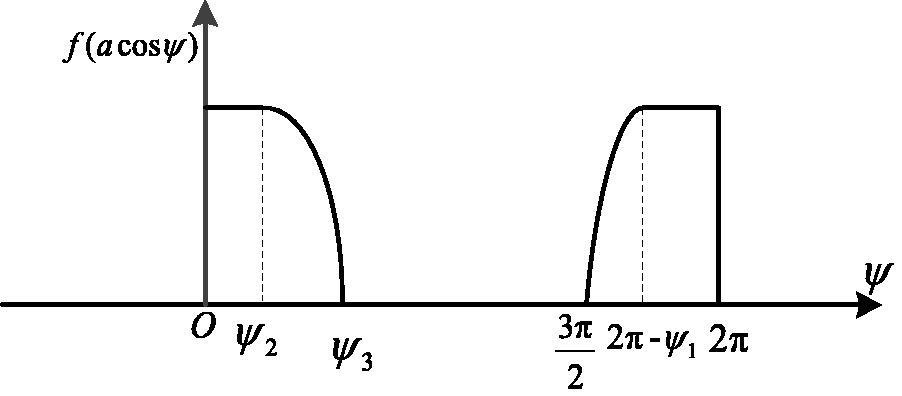
In this equation, is the amplitude of an approximate solution in the nonlinear vibration system with the hysteretic force. is the initial phase angle of an approximate solution in the nonlinear vibration system with the hysteretic force. If , is named as an approximate periodic solution in the nonlinear vibration system with the hysteretic force, , is named as the phase angle of an approximate solution in the nonlinear vibration system with the hysteretic force. So the hysteretic force with the asymmetric quadrilateral in equation (2) can be derived (as shown in Figure 3) and expressed as
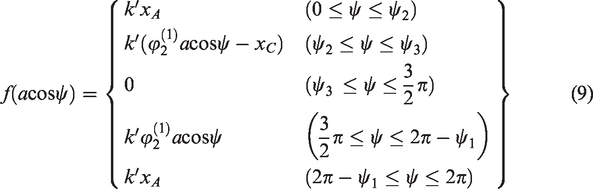
The hysteretic force expressed as a trigonometric function.
In this equation, , , . They are all the first quadrant angles.
The principal mass at the first natural frequency can be expressed as and the principal stiffness at the first natural frequency can be expressed as . Based on the relevant parameters in equations (3) and (7), the principal mass at the first natural frequency can be rewritten as and the principal stiffness at the first natural frequency can be expressed as . A matrix form of equation (8) can be expressed as
In this equation, and .
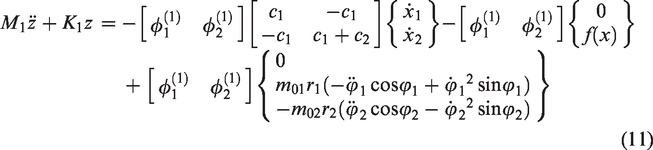
Equation (3) on the first principal coordinate can be transformed into and expressed as
In this equation, the angular velocity is generated through the rotation of the eccentric rotor on the excited motor around Oi. can be replaced by (i =1,2) ( is the angular frequency). When , the synchronous operation of the two excited motors can be obtained in the self-synchronous vibrating system. If the synchronization stability of the self-synchronous vibrating system with the hysteresis force can be obtained, the angular acceleration of the eccentric rotor should be named as 0, namely = 0. The two angular phases can be defined as and . is the average angular phase of the two excited motors; is the phase difference angle of the two eccentric rotors on the two excited motors; is the average angular velocity of the two eccentric rotors; may be expressed as ( is the excitation frequency), and can be defined and expressed as . So the exciting force of the eccentric rotors in equation (12) can be defined as , if m01 = m02 = m0 and r1 = r2 = r0, . Equation (12) can be transformed into and expressed as
In the vibration equation about z, the parameter terms of the nonlinear vibration system with the hysteretic force, such as the damping term and the hysteretic force term and the exciter force terms, are of very small quantity. An approximate periodic solution z in equation (13) at the first natural frequency can be solved using nonlinear asymptotic method and has been defined as . The following equations with the amplitude and the initial phase angle can be satisfied and expressed as
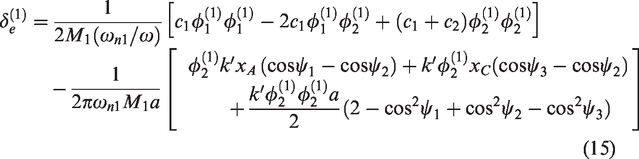
In this equation, is the equivalent damping coefficient of the nonlinear vibration system with the hysteretic force. is the equivalent natural frequency of the nonlinear vibration system with the hysteretic force. The equivalent damping coefficient can be deduced and expressed as
Using the parameters of the hysteretic force in equation (2) and the triangular function transform of (i = 1,2,3) in equation (9), equation (15) can be transformed into

When and in equation (7), the equivalent damping coefficient in equation (16) can be deduced and rewritten as
In this equation, (namely, , .
The equivalent natural frequency in equation (14) can be deduced and expressed as
In this equation, . The equivalent natural frequency is greater than the first natural frequency . When the nonlinear vibration system driven by the two excited motors creates harmonic vibration synchronization, the excitation frequency of the two excited motors must be close to the first natural frequency . For example, in equation (14). Using equation (14), the amplitude–frequency characteristic equation of the nonlinear vibration system with the hysteretic force can be expressed as
In this equation, , m01 = m02 = m0 and r1 = r2 = r0. When the excitation frequency of the two excited motors is close to the first natural frequency , an approximate periodic solution of the nonlinear vibration system with the hysteretic force is expressed as . In this equation, and . So the vibration displacements of the vibrating body 1 and the vibrating body 2 in equation (8) can be obtained.
Theoretical analysis about harmonic vibration synchronization
Theoretical analysis about the synchronization condition
The two excited motors must done synchronous operation when the excitation frequency is close to the definite range of the first natural frequency, and harmonic vibration synchronization can be obtained in the nonlinear vibration system with the hysteretic force. Namely, the phase difference of the two eccentric rotors on the two excited motors is 0 or constant in a certain range when the excitation frequency is close to the definite range of the first natural frequency, and then the synchronous operation of the two excited motors can be realized to run safely and stably in the nonlinear vibration system with the hysteretic force. The rotor rotational motion equations (the last two formulas in equation (1)) may be transformed to obtain the synchronization condition of harmonic vibration synchronization through the theoretical analysis. In the last two formulas in equation (1), (i =1,2) of the rotor rotational motion equations can be named as the vibration torque caused by the vibrating eccentric rotor. The vibration torques can be changed with the acceleration of the nonlinear vibration system with the hysteretic force, which can be replaced by the average vibration torques. The average vibration torques using the definite integral method can be obtained. The average vibration torque is named that the vibration torque in one 2π period is averaged. So the average vibration torques can be written as
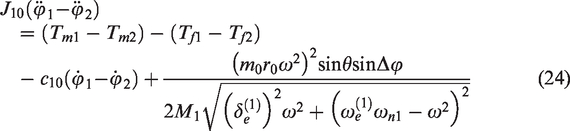
It has been assumed that the relevant parameters of the two excited motors is equal, namely, , , m01 = m02 = m0, r1 = r2 = r0. The vibration torques of the last two formulas in equation (1) are replaced by the average vibration torques. Then, the last two formulas in equation (1) are subtracted from each other. Using the last two formulas in equation (1), the rotary motion equation about the phase difference can be defined as
In this equation, . Equation (24) can be re-written as
If , , the state equation of equation (25) can be expressed as
In equation (26), and is named as the difference between the electromagnetic torque and the friction torque. If the state of the stable equilibrium is achieved in the nonlinear vibration system with the hysteretic force, , equation (27) must be satisfied and expressed as
In this equation,
If , the synchronization condition of harmonic vibration synchronization can be obtained is that the absolute value of H is greater than or equal to 1. So the synchronization condition in the nonlinear vibration system with the hysteretic force can be expressed as
The absolute value of H can be used to characterize the synchronization of the self-synchronous system.When is the bigger, the realized synchronization for the nonlinear vibration system with the asymmetrical hysteresis is the easer. If , the synchronization condition of the nonlinear vibration system with the hysteresis force is weak. As shown in equation (28), when reducing or increasing , the synchronization condition of the nonlinear vibration system with the hysteresis force can be improved. In addition, and it is the ideal condition, but the most unsatisfactory condition is that W =0 in equation (27).
When harmonic vibration synchronization can be obtained in the nonlinear vibration system with the hysteresis force, the excitation frequency is close to the definite range of the first natural frequency (namely, ). As shown in equation (21), the equivalent natural frequency cannot be identical to the natural frequency. For example, , so . Therefore in equation (27) is unequal to 0 (namely, ), and the most unsatisfactory condition (namely, ) in equation (27) cannot be presented in the self-synchronous vibrating system with harmonic vibration synchronization. As shown in equation (21), the equivalent natural frequency in equation (21) is greater than the first natural frequency , namely, , so . When , equation (28) can be rewritten as
In this equation, , . When equation (29) is satisfied (namely, harmonic vibration synchronization can be obtained) in the nonlinear vibration system with the hysteresis force, the reverse synchronous rotation of the two-excited motor can be achieved.

As shown in equations (27) to (29), if the synchronization condition H is positive, namely, is positive, the phase difference or . If H is negative, namely, is negative, the phase difference or . Namely, there are two solutions of the phase difference at each H value, but only one solution of the phase different is stable and the other one is unstable. Therefore, the synchronous stability of the nonlinear vibration system with the hysteresis force should be analyzed to determine the stable solution of the phase difference.
Theoretical analysis about synchronous stability condition
Using Jacobian matrix in equation (26), the synchronous stability condition of harmonic vibration synchronization can be deduced to present the synchronization stability of the nonlinear vibration system with the hysteresis force. Namely, the stable solution of the phase different for the two excited motor should be analyzed. Jacobian matrix of equation (26) can be expressed as

The characteristic equation of Jacobi matrix in equation (30) can be written as

When the real part of the characteristic root is negative in equation (31), the phase difference equation is asymptotically stable. Using Hurwits theorem, equation (32) must be satisfied and can be expressed as the following

As shown in equation (21), the equivalent natural frequency in equation (21) is greater than the first natural frequency , namely . If equation (32) can be satisfied, must be greater than zero in equation (32), namely . When in equation (32), namely, the phase difference is at (namely, and ), the phase difference of equation (26) is asymptotically stable. The synchronization stability condition of harmonic vibration synchronization can be satisfied in the nonlinear vibration system with the hysteresis force. So the synchronous operation of the two excited motors in the nonlinear vibration system with the hysteresis force is stable when the phase difference is at or . But when the phase difference is at (namely, and ), the synchronous operation of the two excited motors in the self-synchronous system with the hysteresis force is unstable. So the stable value of the phase difference is 0 rad at . In addition, when is 0 and the phase difference is stable at 0, which is the ideal state to meet the synchronous operation of the two excited motors in the nonlinear vibration system with the hysteresis force. As shown in equations (27) to (29) and (32), if is positive and the phase difference is at , the synchronization condition and the synchronization stability condition of harmonic vibration synchronization can be satisfied, and then the synchronous operation of the two excited motors and the synchronous stability operation of the nonlinear vibration system with the hysteresis force can be achieved. If is positive and the phase difference is at , the synchronization condition and the synchronization stability condition can be satisfied, and then the synchronous operation of the two excited motors and the synchronous stability operation of the nonlinear vibration system with the hysteresis force can be achieved.
Simulation analysis about harmonic vibration synchronization
Using the model of the nonlinear vibration system with the hysteresis force about equations (1) and (2), some parameters for the nonlinear vibration system with the hysteresis force are selected as follows m1 = 89 kg, m2 = 56 kg, k1 = 6,500,000 N/m, k2 = 4,000,000 N/m, c1 = 100 Nm·s/rad, c2 = 100 Nm·s/rad, m01 = 3.5 kg, m02 = 3.5 kg, r1 = r2 = 0.08 m, c01 = 0.01 Nm·s/rad, c02 = 0.01 Nm·s/rad, J01 = 0.01 kg·m2, J02 = 0.01 kg·m2. Using Matlab/Simlink, the response of the parameters in the model of the nonlinear vibration system with the hysteresis force can be obtained using the combination of equations (1) and (2) with the electromagnetic torque equations and the rotor motion equations about the motors. The first natural frequency of the nonlinear vibration system is 23.5 Hz and the excitation frequency of the excited motors is 25 Hz (about 157 rad/s).
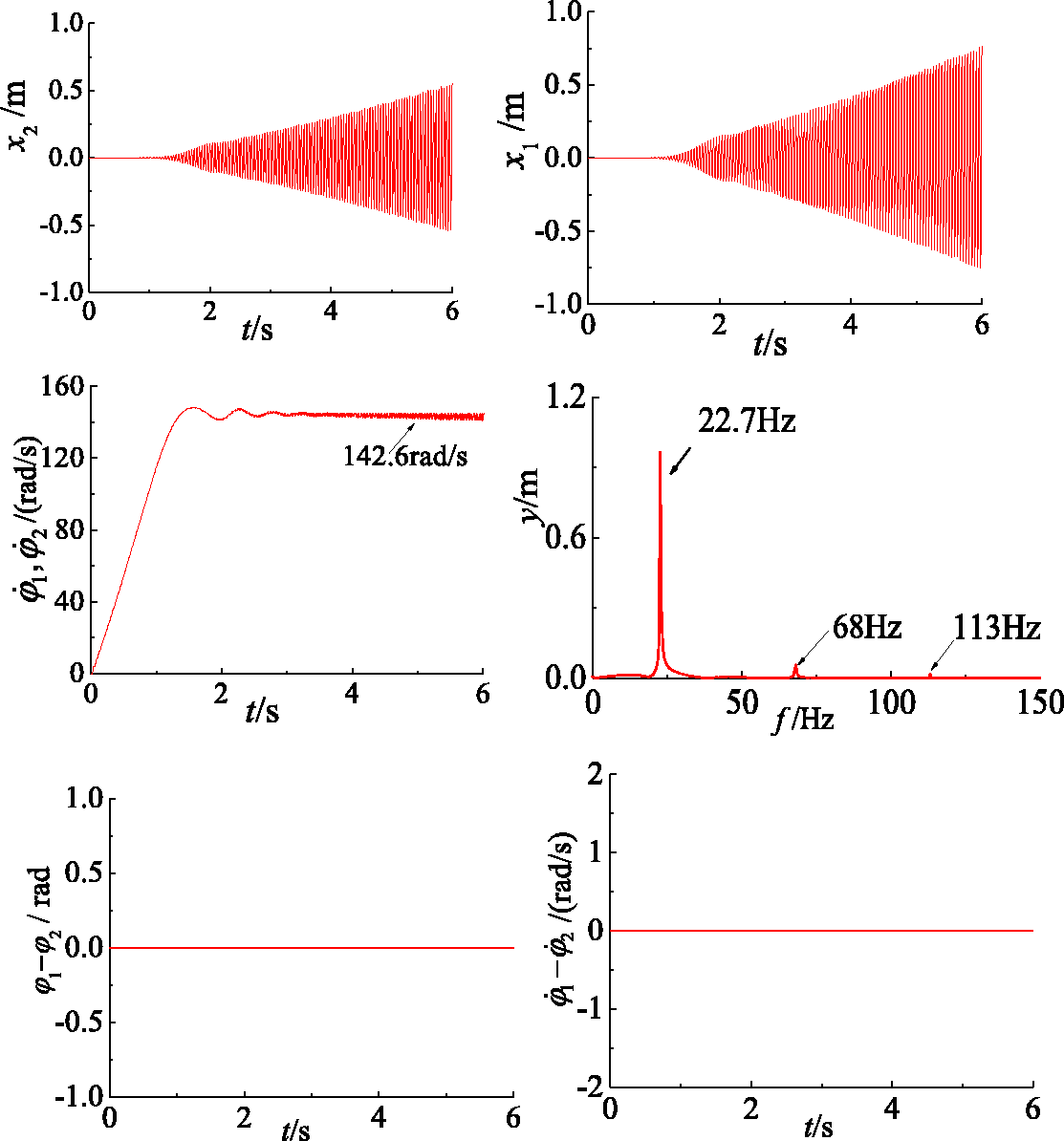
The first natural frequency of the vertical direction is 23.5 Hz for the nonlinear vibration system with the hysteresis force. Namely, . When there are no difference rates in the initial parameters of the two excited motors, the responses of the parameters and the spectrum map of the vibration displacement for the nonlinear vibration system under the action of the hysteretic force with the asymmetry has been obtained and shown in Figure 4. As shown in Figure 4, the angular velocity of the two excited motors is eventually stabilized at about 142.6 rad/s. And then the operating frequency of the nonlinear vibration system with the hysteresis force is about 22.7 Hz and is close to the first natural frequency (23.5 Hz). It has been shown that the nonlinear vibration system driven by the two excited motors does not work at the excitation frequency. As shown in Figure 4, the angular velocity difference and the phase difference are also stable at 0 rad and 0 rad/s. It has been shown that the synchronous operation of the two excited motors can be obtained when the operating frequency of the nonlinear vibration system is not at the excitation frequency of the two excited motors. So the harmonic vibration synchronization of the nonlinear vibration system with the hysteretic force can occurs. As shown in the spectrum map of Figure 4, the amplitude at the operating frequency is the biggest and the relatively small amplitudes are also presented at three times of the operating frequency and five times of the operating frequency. It has been shown that the self-synchronous system is the nonlinear vibration system under the action of the hysteretic force with the asymmetry. When there are some differences in the initial parameters of the two excited motors, such as the different initial phase, the different initial angular velocity or the different excited motor parameters, the synchronous operation of the two excited motors and the synchronous stability operation of the nonlinear vibration system are analyzed as follows:
When the initial phase difference of the two excited motors is −3.14 rad, such as the initial phase of the excited motor 1 is −rad and the initial phase of the excited motor 2 is 0rad/s, the responses of the parameters for the nonlinear vibration system under the action of the hysteretic force with the asymmetry, such as the angular velocities responses of the two excited motors, the responses of the phase difference, the responses of the angular velocity difference, the phase plane of the phase difference and the angular velocity difference, can be obtained and shown in Figure 5. When the initial phase difference of the two excited motors is rad or −rad, the responses of the parameters for the nonlinear vibration system under the action of the hysteretic force with the asymmetry are shown in Figures 6 and 7.
Responses and the spectrum under no difference rates conditions.
As shown in the angular velocity curves of Figures 5 to 7, when the initial phase difference of the two excited motors is within a range, the synchronous operation of the two excited motors is obtained in the nonlinear vibration system under the action of the hysteretic force with the asymmetry. The violent irregular vibration of the angular velocities is presented and then the stable values of the angular velocities are about 142.6 rad/s. As shown in Figures 5 to 7, when the initial phase difference of the two excited motors is within a range, the violent irregular vibrations of the angular velocity difference and the phase difference are presented and the angular velocity difference is stable at 0 rad/s and the phase difference is finally stable at about 0 rad or rad (namely, a cycle of 0 rad). The phase difference is finally stable at , this analysis is consistent with theoretical analysis. As shown in the last small graphs of Figures 5 to 7, when the initial phase differences of the two excited motors started from rad or −rad, the initial angular velocity differences of the two excited motors are from 0 rad/s. The limit cycles can also be appeared after the movements of the irregular oscillations for the angular velocity differences and the phase differences. Namely, the synchronous stability operation has been obtained. So it has been shown that the synchronous operation of the two excited motors and the synchronous stability operation of the nonlinear vibration system with harmonic vibration synchronization can be obtained and the nonlinear vibration system with harmonic vibration synchronization has the ability to restore synchronization. It has been shown that the nonlinear vibration system with harmonic vibration synchronization is with the self-synchronizing characteristics.
b. When the two excited motors are with the different initial angular velocities, such as the initial angular velocity of the excited motor 1 is −10 rad/s and the initial angular velocity of the excited motor 2 is 0 rad/s, the responses of the parameters for the nonlinear vibration system with the hysteretic force are shown in Figure 8.
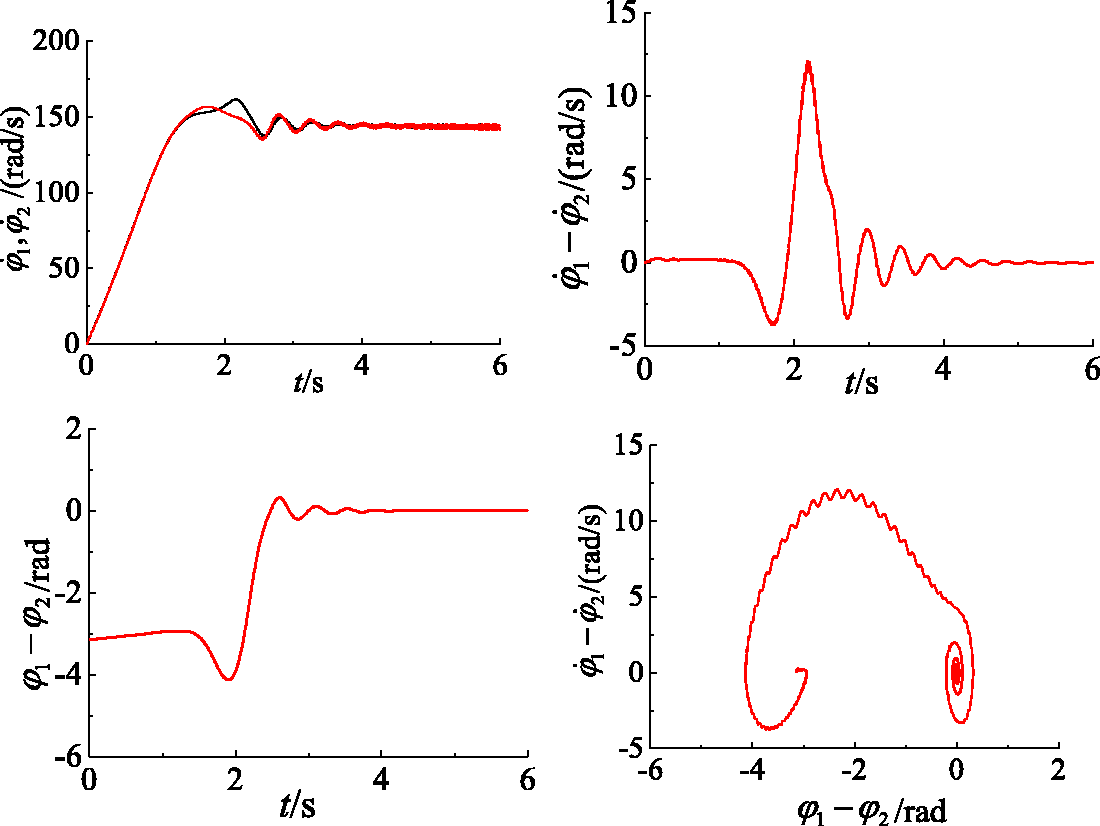
Simulation of the system under the different initial phase (- π rad) conditions.
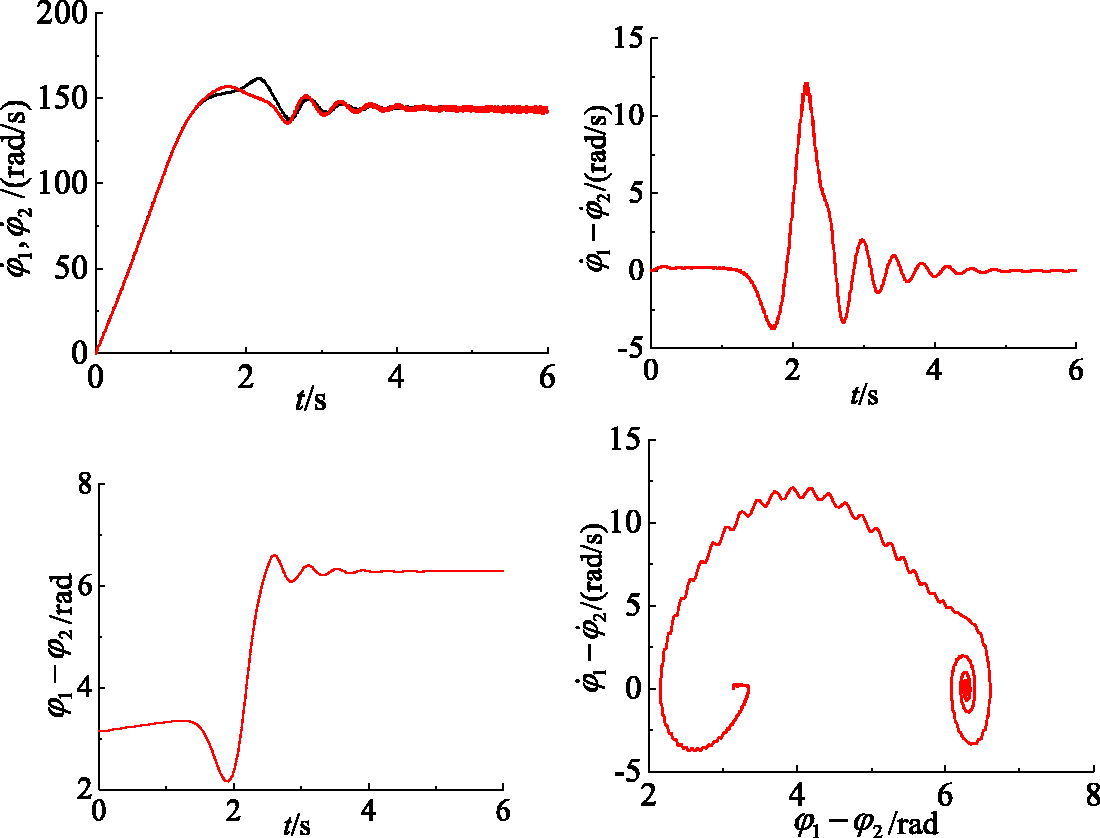
Simulation of the system under the different initial phase (π rad) conditions.
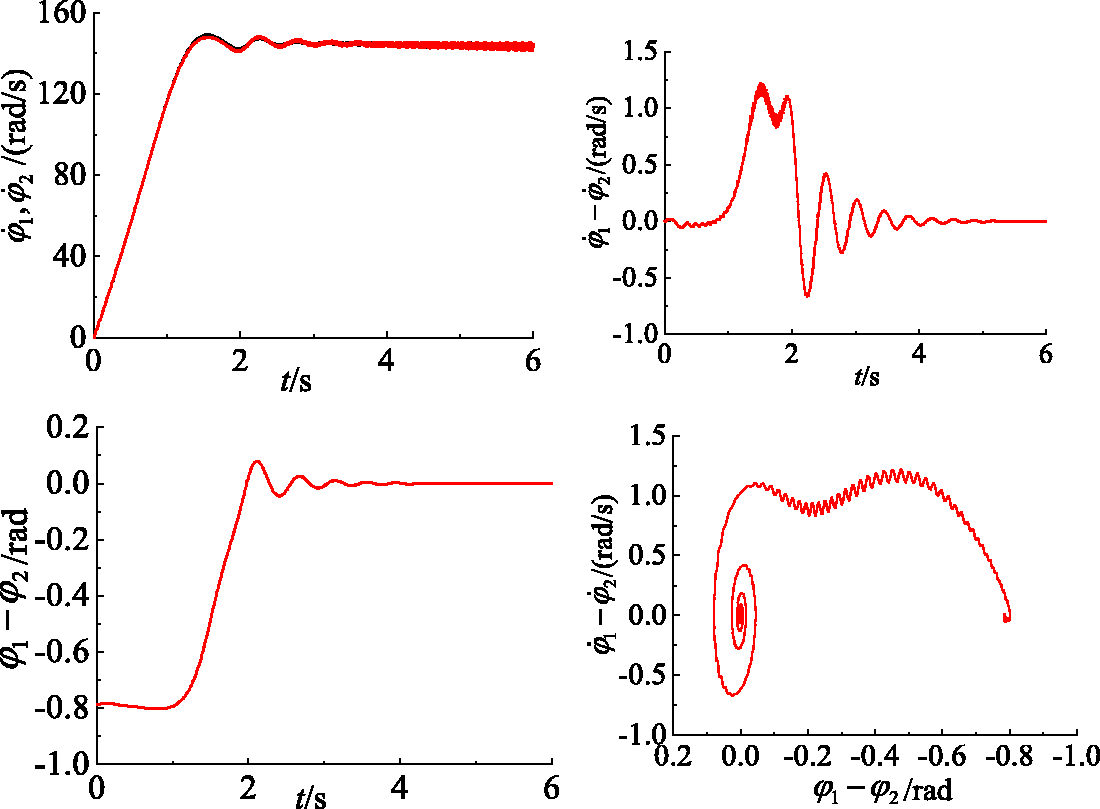
Simulation of the system under the different initial phase (- π 4 rad/s) conditions.
As shown in the angular velocity curve of Figure 8, the angular velocities are with obvious repeated shocks after 2 s and then the stable values of the angular velocities are also about 142.6 rad/s after 4 s. The excited motor 1 and the excited motor 2 do the synchronous operation, together. The synchronous operation of the two excited motors can be achieved. As shown in Figure 8, the big shocks of the angular velocity difference and the phase difference are presented for the two excited motors, subsequently. Finally, the angular velocity difference and the phase difference are also stable, such as the angular velocity difference can be stable at about 0 rad/s and the phase difference can be eventually stabilized at rad (namely, two cycles of 0 rad). The limit cycle is also appeared in Figure 8. The stable solutions of the angular velocity difference and the phase difference can be obtained and the synchronous stability operation of the nonlinear vibration system with the hysteretic force has been revealed. It has been shown that harmonic vibration synchronization of the nonlinear vibration system with the hysteretic force can be also obtained and the nonlinear vibration system with the hysteretic force has the ability to restore synchronization.
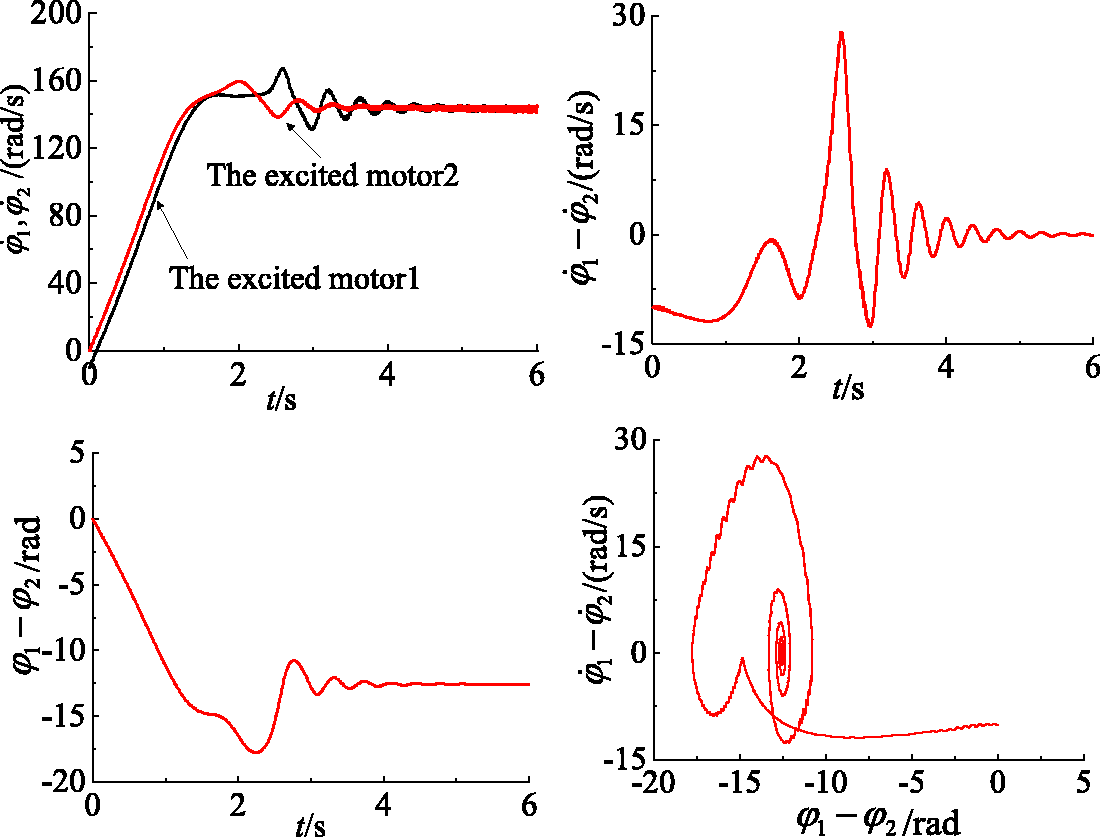
Simulation of the system under the different initial angular velocity conditions.
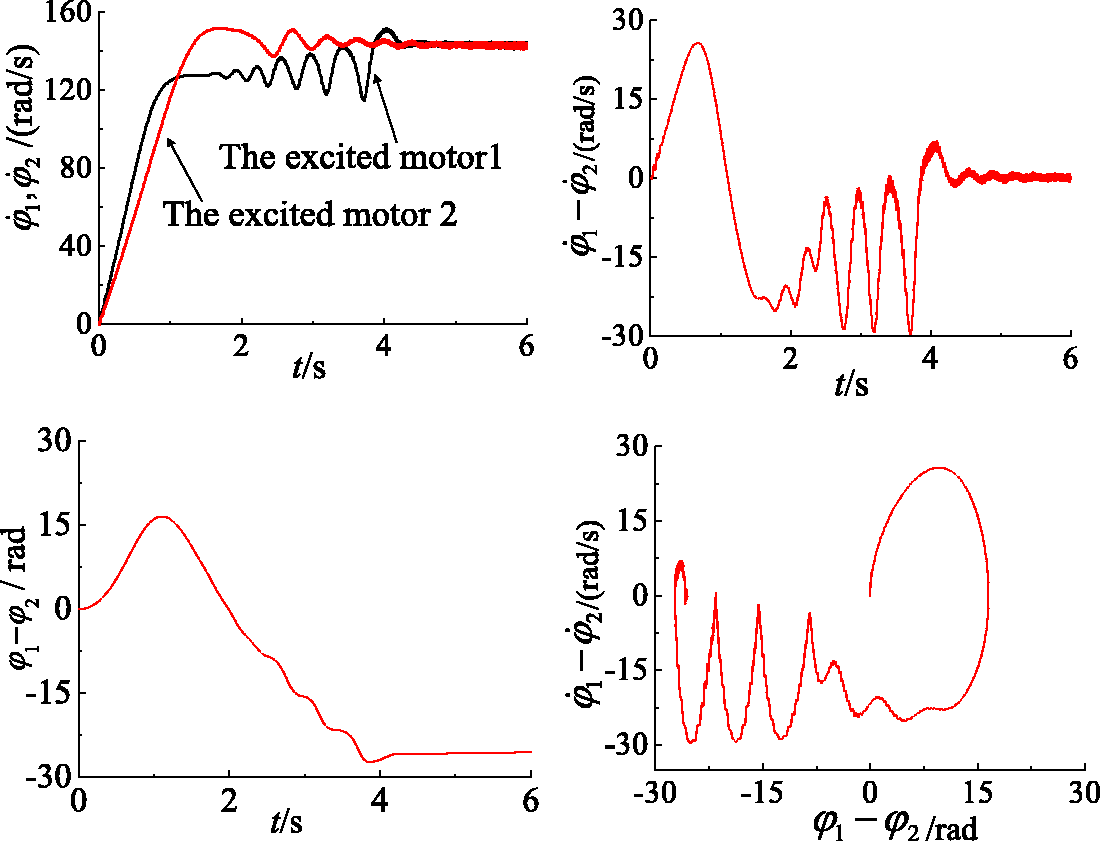
Simulation of the system under the different excited-motor parameters conditions.
c. When the difference rate of the excited-motors parameters is in a certain range, the responses of the parameters for the nonlinear vibration system with the hysteresis force can be obtained and shown in Figure 9. The angular velocities are with obvious repeated shocks in 4 s, and finally, the stable values of the angular velocities are also about 142.6rad/s. Finally, The angular velocity difference can be eventually stabilized at 0 rad/s and the phase difference can be eventually stabilized at rad (namely, four cycles of 0 rad). It has been shown that the phase difference should be within . A limit cycle can be also appeared in the nonlinear vibration system with the hysteresis force. So the synchronous operation of the two excited motors and the synchronous stability operation of the nonlinear vibration system with harmonic vibration synchronization can be obtained.
Conclusions
In this paper, the self-synchronization characteristics of the nonlinear vibration system with the asymmetrical hysteresis have been proposed when harmonic vibration synchronization occurs. Firstly, nonlinear dynamic model of the self-synchronous vibrating system is presented for the analysis of the hysteretic characteristics of the compacted soil. An approximate periodic solution for the self-synchronous vibrating system with the asymmetrical hysteresis has been investigated using nonlinear asymptotic method. Second, the synchronization condition of the two excited motors is theoretically analyzed using the rotor–rotation equations of the two excited motors, and the synchronization stability condition of the self-synchronous vibrating system with the asymmetrical hysteresis are theoretically analyzed using Jacobi matrix of the phase difference equation of the two excited motors. Thirdly, using Matlab/Simlink, the synchronous operation of the two excited motors and the synchronous stability operation of the nonlinear vibration system with the hysteretic force have been quantitatively analyzed through the difference rates of the two excited motors (including the initial phase difference, the initial angular velocity difference and the difference of the motors parameters).
Finally, it has been revealed that the synchronous operation of the two excited motors and the synchronous stability operation of the self-synchronous vibrating system with the asymmetrical hysteresis can still be achieved when the harmonic vibration synchronization of the nonlinear vibration system with the hysteretic force can occur. So the self-synchronous vibrating system under the action of the hysteretic force with the asymmetry has the ability to restore synchronization and the self-synchronous vibrating system is with the self-synchronizing characteristics.
Footnotes
Declaration of conflicting interests
The authors declared no potential conflicts of interest with respect to the research, authorship, and/or publication of this article.
Funding
The author(s) disclosed receipt of the following financial support for the research, authorship, and/or publication of thisarticle: The author gratefully acknowledges that this project was supported by the National Natural Science Foundation of China (Grant No. 51605022), the Fundamental Research Funds for Beijing University of Civil Engineering and Architecture (Serial Numbers: X18096 and X18116) and the science research foundation of Beijing University of Civil Engineering and Architecture under the Project Number ZF16082.
References
1.
BlekhmanIIFradkovALTomchinaOP, et al.
Self-synchronization and controlled synchronization: general definition and example design. Math Comput Simulat2002;
58: 367–384.
2.
BlekhmanIIVasil’kovVB.On some opportunities for improving vibration machines with self-synchronizing inert vibration exciters. J Mach Manuf Reliab2013;
42: 192–195.
3.
YamapiRWoafoP.Dynamics and synchronization of coupled self-sustained electromechanical devices. J Sound Vibrat2005;
285: 1151–1170.
4.
ZhaoCYWenBCZhangXL.Synchronization of the four identical unbalanced rotors in a vibrating system of plane motion. Sci China Technol Sci2010;
53: 405–422.
5.
PotapenkoMA.Slow vibrations of unbalanced rotors (vibration exciters) during the disturbance of self-synchronization conditions. J Mach Manuf Reliab2008;
37: 228–229.
6.
BanerjeeTBiswasDSarkarBC.Anticipatory, complete and lag synchronization of chaos and hyperchaos in a nonlinear delay-coupled time-delayed system. Nonlinear Dyn2012;
72: 321–332.
7.
SenatorM.Synchronization of two coupled escapement-driven pendulum clocks. J Sound Vibrat2006;
291: 566–603.
8.
ZhangN.synchronous characteristics of a vibration piling system with electromechanical coupling. J Vibroeng2016;
18: 3305–3317.
9.
ZhangXKongXWenB, et al.
Numerical and experimental study on synchronization of two exciters in a nonlinear vibrating system with multiple resonant types. Nonlinear Dyn2015;
82: 987–999.
10.
Zhang, X, LZhao, C, , et al.
Theoretical and experimental study on synchronization of the two homodromy exciters in a non-resonant vibrating system. [J]. Shock & Vibration. 2013;
20: 327–340. 10.1155/2013/472407
11.
ZhaoCZhaoQZhangY, et al.
Synchronization of two non-identical coupled exciters in a non-resonant vibrating system of plane motion. J Mech Sci Technol2011;
25: 49–60.
12.
KandahMMeunierJ.Theoretical and experimental study on synchronization of the two homodromy exciters in a non-resonant vibrating system. Shock Vibrat2015;
20: 327–340.
13.
ZhangXLWenBCZhaoCY.Synchronization of three homodromy coupled exciters in a non-resonant vibrating system of plane motion. Acta Mech Sin2012;
28: 1424–1435.
14.
ZhangXWenBZhaoC.Vibratory synchronization transmission of a cylindrical roller in a vibrating mechanical system excited by two exciters. Mech Syst Signal Process2017;
96: 88–103.
15.
PotapenkoMA.On the self-synchronization of inertial vibration exciters with an internal degree of freedom. J Mach Manuf Reliab2015;
44: 319–323.
16.
JoséMBalthazar FelixJLPBrasilRM.Some comments on the numerical simulation of self-synchronization of four non-ideal exciters. Appl Math Computat2005;
164: 615–625.
17.
PanovkoGYShokhinAE.Experimental analysis of the oscillations of a mechanical system with self-synchronized inertial vibration exciters. J Mach Manuf Reliab2015;
44: 492–496.