




Abstract
The self-synchronization characteristics of the two excited motors for the nonlinear vibration system with the asymmetrical hysteresis have been proposed in the exceptional circumstances of cutting off the power supply of one of the two excited motors. From the point of view of the hysteretic characteristics with the asymmetry, a class of nonlinear dynamic model of the self-synchronous vibrating system is presented for the analysis of the hysteretic characteristics of the soil, which is induced by the relation between the stress and the strain in the soil. The periodic solutions for the self-synchronous system with the asymmetrical hysteresis are investigated using nonlinear asymptotic method. The synchronization condition for the self-synchronous vibrating pile system with the asymmetrical hysteresis is theoretical analyzed using the rotor–rotation equations of the two excited motors. The synchronization stability condition also is theoretical analyzed using Jacobi matrix of the phase difference equation of the two excited motors. Using Matlab/Simlink, the synchronous operation of the two excited motors and the synchronous stability operation of the self-synchronous system with the asymmetrical hysteresis are analyzed through the selected parameters. Various synchronous phenomena are obtained through the difference rates of the two excited motors, including the different initial phase and the different initial angular velocity, and so on. Especially, when there is a certain difference in the two excited motors, the synchronous operation of the two excited motors and the synchronous stability operation of the self-synchronous vibrating system with the asymmetrical hysteresis can still be achieved after the power supply of one of the two excited motors has been disconnected. It has been shown that the research results can provide a theoretical basis for the research of the vibration synchronization theory.
Keywords
Introduction
The vibration synchronization has been an important factor in the vibrating system driven by the multi-excited motors, the vibration synchronization is usually explained that the two eccentric rotors on the two excited motors in the vibrating system driven by the multi-excited motors must be done synchronous operation, namely, the phase difference of the two excited motors is 0 or a constant value and the self-synchronization is realized through the phase difference with a constant value. The vibrating system driven by the multi-excited motors can be named as the self-synchronous vibrating system. The synchronous operation of the excited motors is very favorable in many engineering field, especially in the vibratory compacting system with the multi-excited motors. So the investigation on the vibration synchronization has become one of the key issues in the self-synchronous vibrating system.
The phenomenon of self-synchronization can be found in our life. Huygens observed that the two clocks soon ran at a common rate, using clocks that he had designed for determining a ship’s longitude. 1 Subsequently, the problem of synchronization of clock 2 and the lay synchronization 3 had also been paid attention by many scholars. The research on vibration synchronization can be found in many references.4,5 Many models of the self-synchronous vibrating system, such as the linear model with the linear stiffness and the simplified ideal model, have been investigated and can be found in many references.6–8 It is no doubt that linear model is a very good model for the analysis of the vibrating system driven by the multi-excited motors, but it is of very limited to describe vibration synchronization in the vibrating system. With the development of nonlinear vibration theory, many nonlinear models about the vibration synchronization for the self-synchronous vibrating system, such as the nonlinear model of the duffing kinetic equation,9,10 the nonlinear model of the piecewise linear stiffness,11,12 and so on, have been investigated and found in many references. The relationship between the excitation frequency and the natural frequency in the vibrating system driven by the multi-excited motors has been investigated and can be found in many references. In addition, in order to ensure the synchronous operation of the multi-excited motors and the synchronous stability of the vibrating system, most of the traditional vibration machines can be run on the far-super resonance state. 13 But it is of very limited to obtain the stable operation and the large vibration. With the development of vibration theory, the frequency range of the vibrating system driven by the multi-excited motors, such as a super-resonant vibrating system, 14 a nonresonant vibrating system,15,16 and the combination of the resonance and non-resonance vibrating system, 17 has been greatly expanded. When the excitation frequency is close to the definite range of the natural frequency in the vibrating system driven by the two excited motors, namely, the resonance can occur in the vibrating system driven by the two excited motors, the synchronous operation of the two excited motors and the synchronization stabilities of the vibrating system driven by the two excited motors have been obtained.12,18 Obviously, the occurrence of vibration synchronization in the vibrating system driven by the multi-excited motors can also be impacted by the relationship between the excitation frequency and the natural frequency. From the point of view of the nonlinear dynamics, the vibration synchronization of the vibrating system with the hysteresis force should be investigated. But these investigations can be rarely found in many references. Thus, the investigations on the vibration synchronization for a nonlinear vibrating system with the hysteresis force have become one of the key issues in the nonlinear vibrating system driven by the multi-excited motors.
In this paper, from the point of view of the hysteretic characteristic, the nonlinear dynamic models of the vibratory compacting system also are presented for the analysis of the relation between the stress and the strain in the soil. The periodic solutions for the self-synchronous vibrating system with the asymmetrical hysteresis are investigated. The synchronization condition and the synchronization stability condition for the self-synchronous vibrating system with the asymmetrical hysteresis are theoretical analyzed. Using Matlab/Simlink, the synchronous operation of the two excited motors and the synchronous and stable operation of the self-synchronous vibrating system in the exceptional circumstances of cutting off one of the two excited motors are analyzed through the selected parameters.
Mathematical model
The interaction between the compaction machinery and the soil has been a nonlinear issue in the engineering field of the compacted soil, so its model cannot be analyzed using the simple nonlinear model. From the point of view of the influence of the elastic-plastic deformation in the soil, the hysteretic characteristic with the asymmetry is usually shown on the relation between the stress and the strain in the soil. So the hysteretic characteristic with the asymmetry can be expressed using the hysteretic force with the asymmetry in the process of the compacting soil. As shown in Figure 1, the hysteretic force with the asymmetry can be defined as

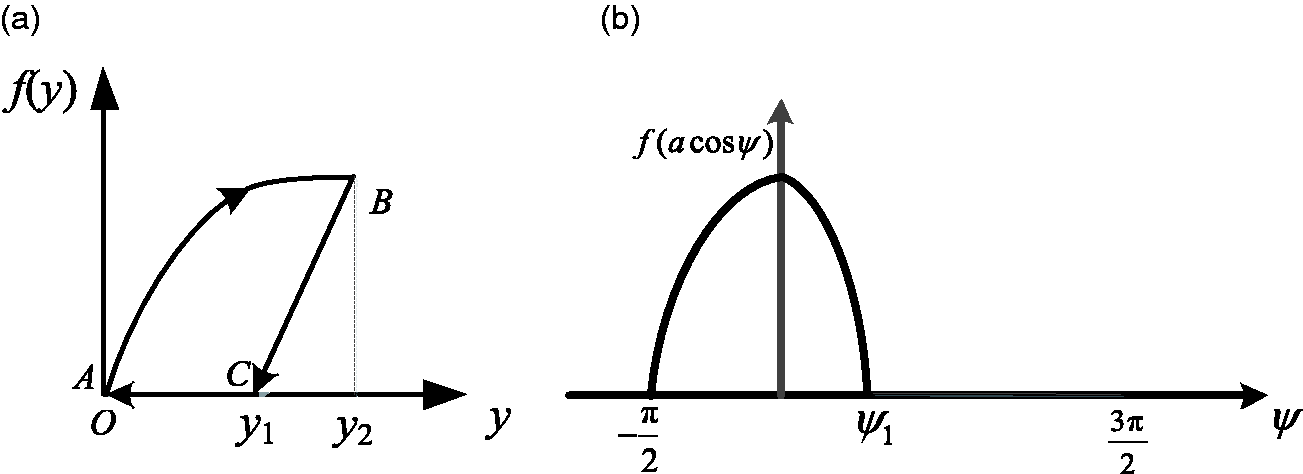
The hysteretic force with the asymmetry.
In equation (1), y is described as the displacement in the direction of the hysteretic force. b1, b2, and b3 are expressed as the coefficients of the hysteretic force. y1 and y2 are the coordinate points on y-axis, and they should be satisfied and expressed as
From the point of view of the vibration compaction engineering of the soil, the dynamic model of the self-synchronous vibrating system with the asymmetrical hysteresis is shown in Figure 2. As shown in Figure 2, when the self-synchronous vibrating system driven by the two excited motors is the vibratory compacting system, the vibrating force in the vibratory compacting system is in the vertical direction. oy is the coordinate system of the self-synchronous vibrating system with the asymmetrical hysteresis, O is the center of the self-synchronous vibrating system (it is also the midpoint of the line of the shaft for the two excited motors), O1, O2 is the center of the shaft for the two excited motors. Using Lagrange equation, the differential equations of the self-synchronous vibrating system driven by the two excited motors under the action of the hysteretic force with the asymmetry are defined as

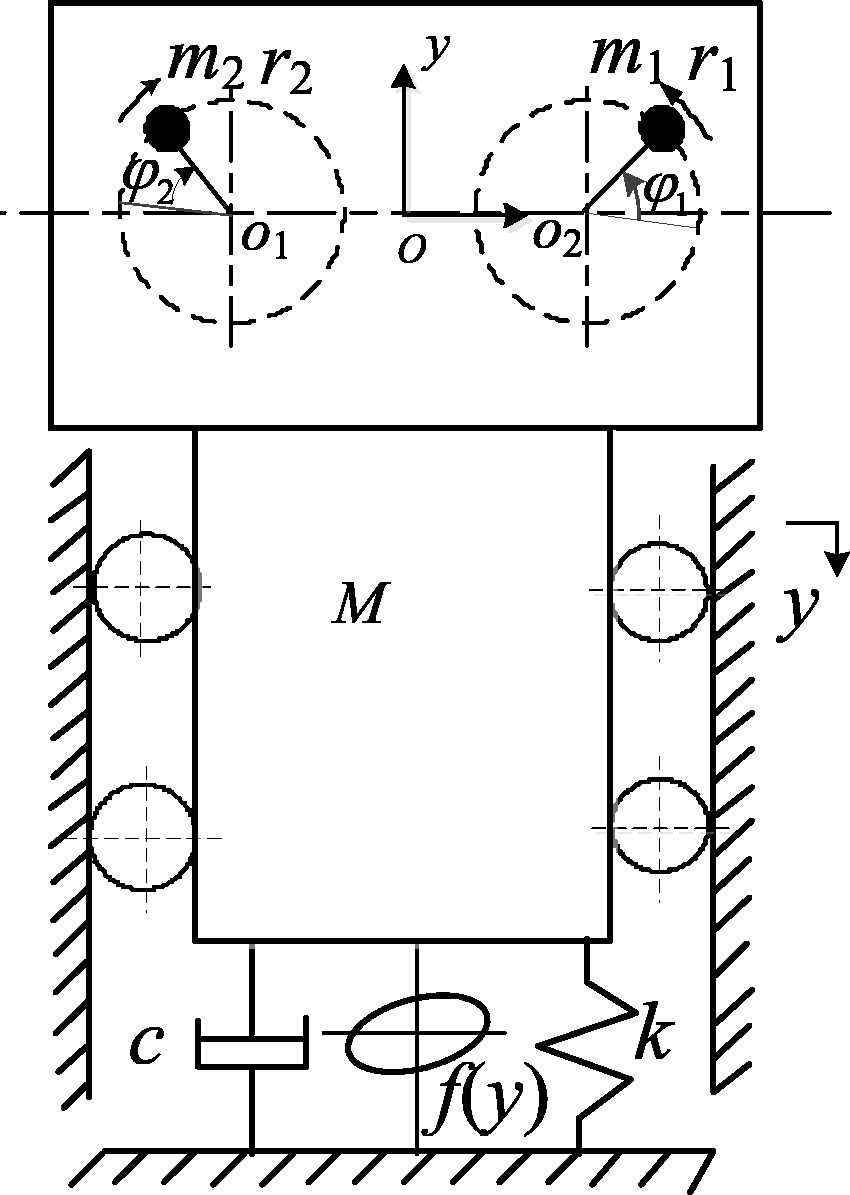
The model of the self-synchronous vibrating system with the asymmetrical hysteresis.
In equation (2), y,
The angular velocity

In equation (3),
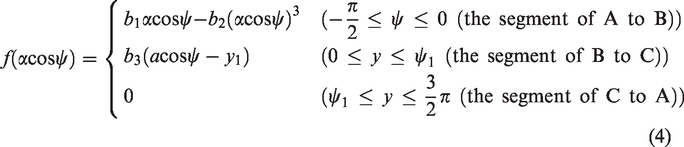
In equation (4),
In equation (3), the parameter terms of the self-synchronous vibrating system with the asymmetrical hysteresis, such as the damping term and the hysteretic force term with the asymmetry and the exciter force terms, are very small quantity. The periodic solution of the self-synchronous vibrating system under the action of the hysteretic force is solved using nonlinear asymptotic method, and then the periodic solution can be calculated to solve the following equation

In equation (5),

Equation (6) can be transformed into and rewritten as

In equation (6),

Equation (8) can be transformed into and rewritten as

In equation (9),
The amplitude frequency characteristic equation of the periodic solution about the self-synchronous vibrating system with the asymmetrical hysteresis under the action of the hysteretic force is written as

Theoretical analysis
1. Theoretical analysis about the synchronization condition
When the phase difference of the two excited motors is in a certain range, the synchronous operation of the two excited motor can be realized to run safely and stably in the self-synchronous vibrating system with the asymmetrical hysteresis. The rotor rotational motion equations (the last two formulas in equation (2)) are transformed to obtain the synchronization condition through the theoretical analysis. In the last two formulas in equation (2), the vibration torque of the axis i can be expressed as

In equation (11), i = 1,2. The vibration torques can be changed with the acceleration

The average vibration torque using the definite integral method can be obtained. The average vibration torque is named that the vibration torque in one

It has been assumed that the relevant parameters of the two excited motors is equal, namely

Equation (14) can be rewritten as

If

In equation (16),

In equation (17),

In equation (18),
In equation (18), when

The absolute value of D can be used to characterize the synchronization condition of the self-synchronous vibrating system with the asymmetrical hysteresis. If
After the power of one of the motors was cut off, such as

Equation (20) can be transformed into and rewritten as

When the self-synchronous vibrating system with the asymmetrical hysteresis is subject to a primary resonance, the excited frequency

When

If the synchronous operation of the two excited motors had been achieved after the two excited motors has be activated at the same time, the synchronous operation of the two excited motors could still be obtained after the power supply of one of the two excited motors has been disconnected. In other words, when the synchronization condition (namely, equation (20)) of the self-synchronous vibrating system with the asymmetrical hysteresis is still satisfied, the synchronous operation of the two excited motors could still be achieved. But the vibration track of the vibration system will be changed. The two-excited motors being cut off power can get energy to overcome the friction torque in the process of the vibration.
In addition,
2. Theoretical analysis about synchronous stability condition
Using the Jacobian matrix in equation (16), the synchronous stability condition is deduced in the self-synchronous vibrating system with the asymmetrical hysteresis. Namely, the synchronous stability condition for the phase different of the two-excited motor are analyzed. The Jacobian matrix of equation (16) can be expressed as

The characteristic equation of Jacobi matrix in equation (24) can be written as

When the real part of the characteristic root in equation (25) is negative, the phase difference in equation (16) is asymptotically stable. Using Hurwitz theorem, equation (26) must be satisfied and can be expressed as the following

If equation (26) can be satisfied,
As shown in equations (16)–(26), if
Self-synchronization characteristics
Using the model of the self-synchronous vibrating system with the asymmetrical hysteresis about equations (1)–(2), some parameters for the self-synchronous vibrating system with the asymmetrical hysteresis are selected as follows m = 78 kg, m1 = m2 = m0 = 3.5 kg, r1 = r2 = 0.08 m, k = 15,52,000 N/m, J01 = 0.01 kg·m2, J02 = 0.01 kg·m2, c1 = 0.01 Nm·s/rad, c2 = 0.01 Nm·s/rad, g = 9.8 m/s, b1 = 40, b2 = 20, b3 = 40, y1 = 0.1, y2 = 0.2. The simulation is performed using Matlab/Simlink. The response of the parameters in the model of the self-synchronous vibrating system with the asymmetrical hysteresis can be obtained using the combination of equations (1)–(2) with the electromagnetic torque equations and the rotor motion equations about the motors. The first natural frequency of the vertical direction is 22.5 Hz and the angular frequency of the self-synchronous vibrating system is 25 Hz (about 157 rad/s), namely,
The specific analysis is using the above parameters, in addition, c = 1000 Nm·s/rad. When there is no difference in the initial parameters of the two excited motors, the responses of the parameters and the spectrum map of the vibration displacement for the self-synchronous vibrating system under the action of the hysteretic force with the asymmetry has been obtained and shown in Figure 3. As shown in Figure 3, the two excited motors are started slowly at the same time and the stable displacement of the self-synchronous vibrating system with the asymmetrical hysteresis is achieved after a big shock, finally the vibration displacement is stable at around 0.05 m. The angular velocity of the two excited motors is eventually stabilized at about 153.6 rad/s. The excited frequency is about 24.2 Hz and is close to the angular frequency of the two excited motors (25 Hz). It has been shown that the excited frequency of the two excited motors is close to the first natural frequency (about 22.5 Hz). As shown in the spectrum map of Figure 3, the amplitude at the excited frequency
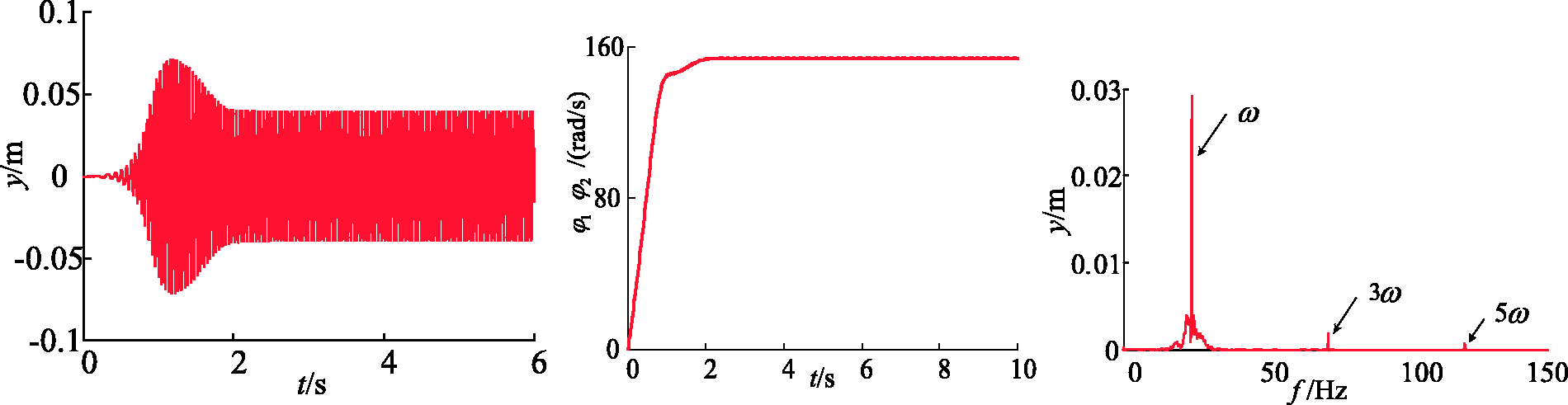
The responses and the spectrum under normal working conditions.
When there are some differences in the initial parameters of the two excited motors, such as the different initial phase, the different initial angular velocity or the different excited motor parameters, the synchronous operation of the two excited motors and the synchronous stability operation of the self-synchronous vibrating system in the exceptional circumstance, such as cutting off one of the two excited motors, are analyzed as follows:
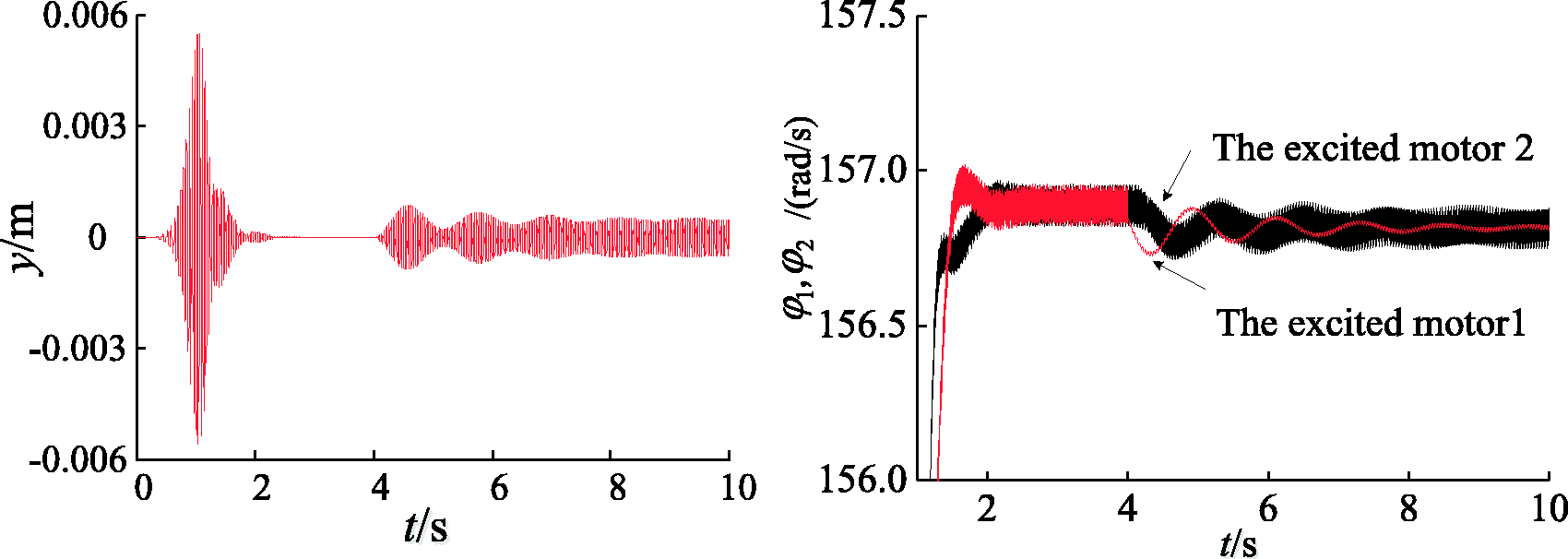
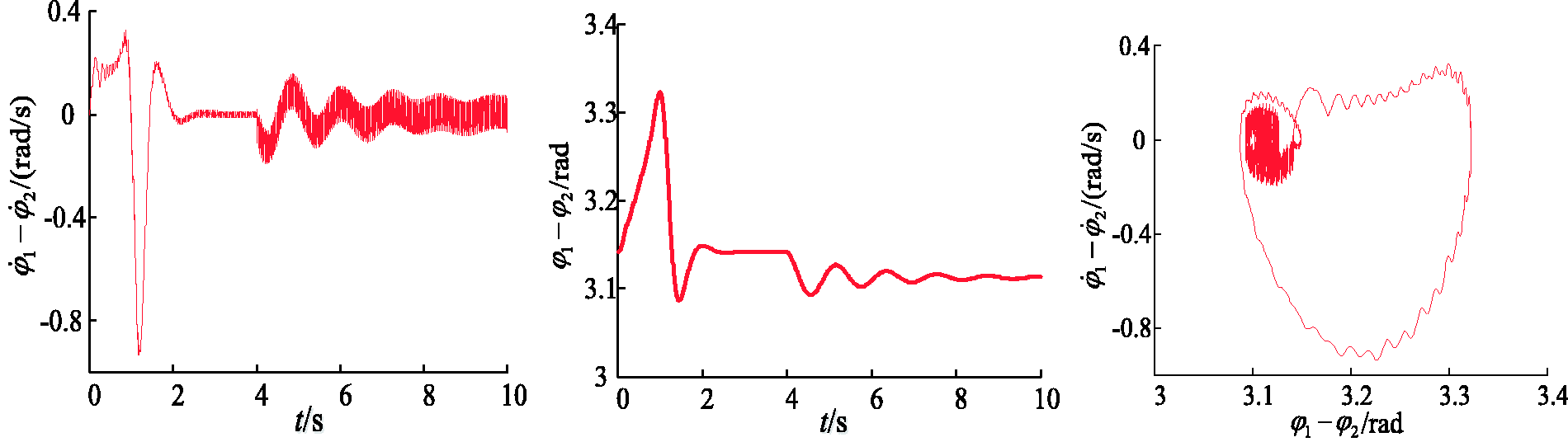
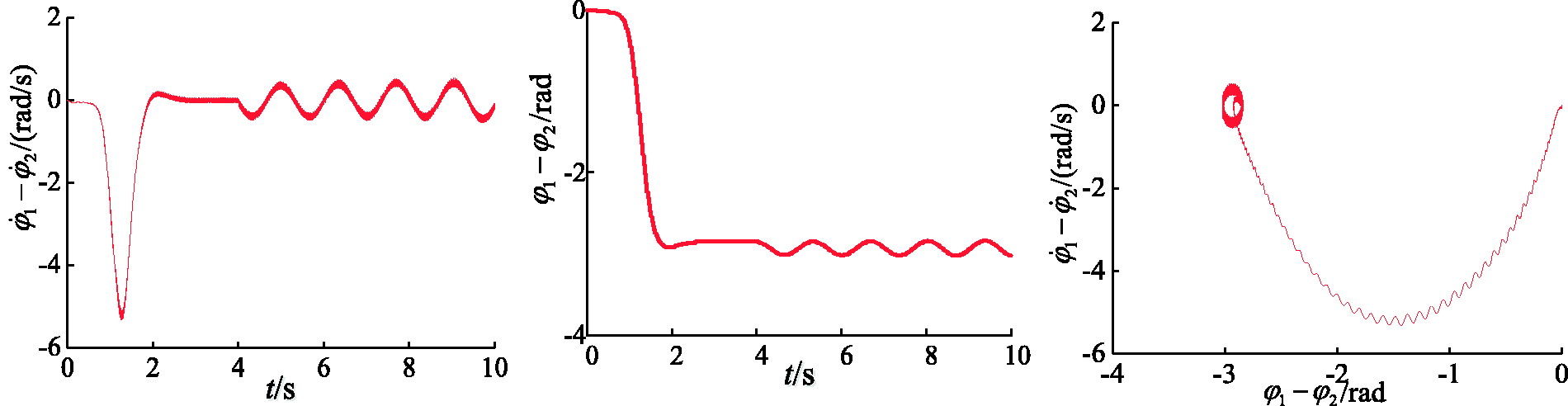
(a) When the difference rates of the excited motors parameters is in a certain range, the power supply of the excited motor 1 is disconnected after four seconds. The displacement response of the self-synchronous vibrating system and the angular velocities response of the two excited motors are shown in Figure 4. The responses of the parameters for the self-synchronous vibrating system with the asymmetrical hysteresis, such as the responses of the phase difference, the responses of the angular velocity difference, the phase plane of the phase difference, and the angular velocity difference, have been obtained and shown in Figure 5.
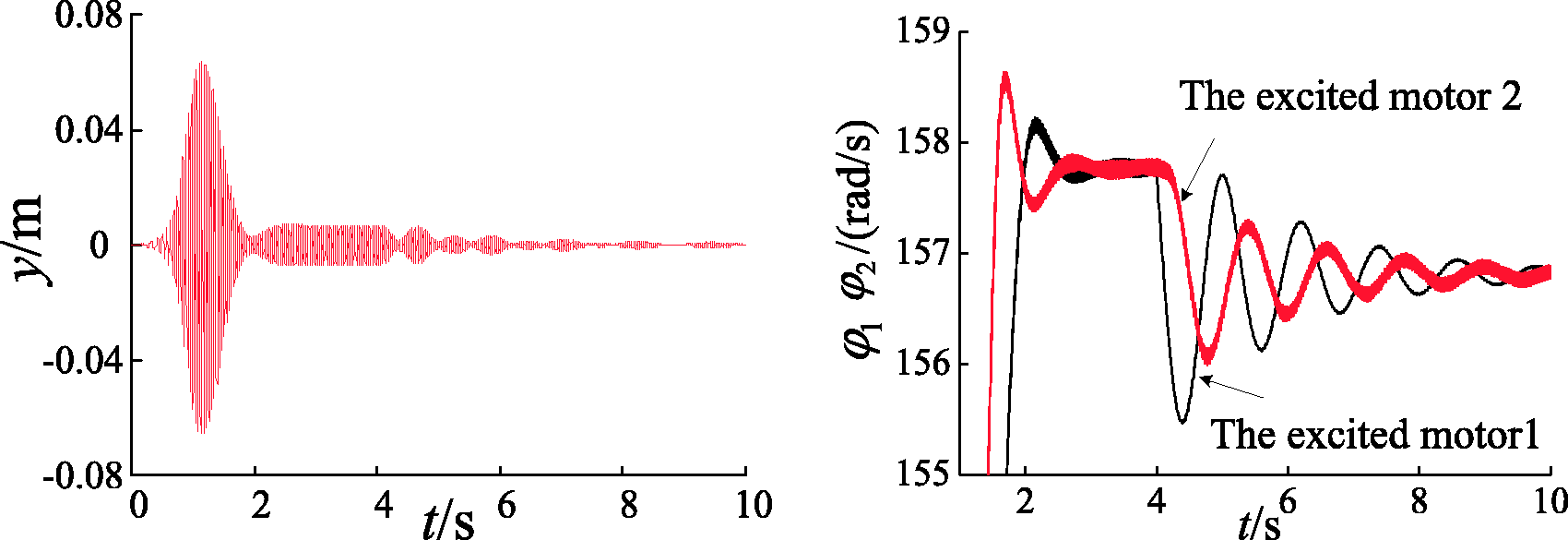
The response of the system under the different excited motor parameters conditions.
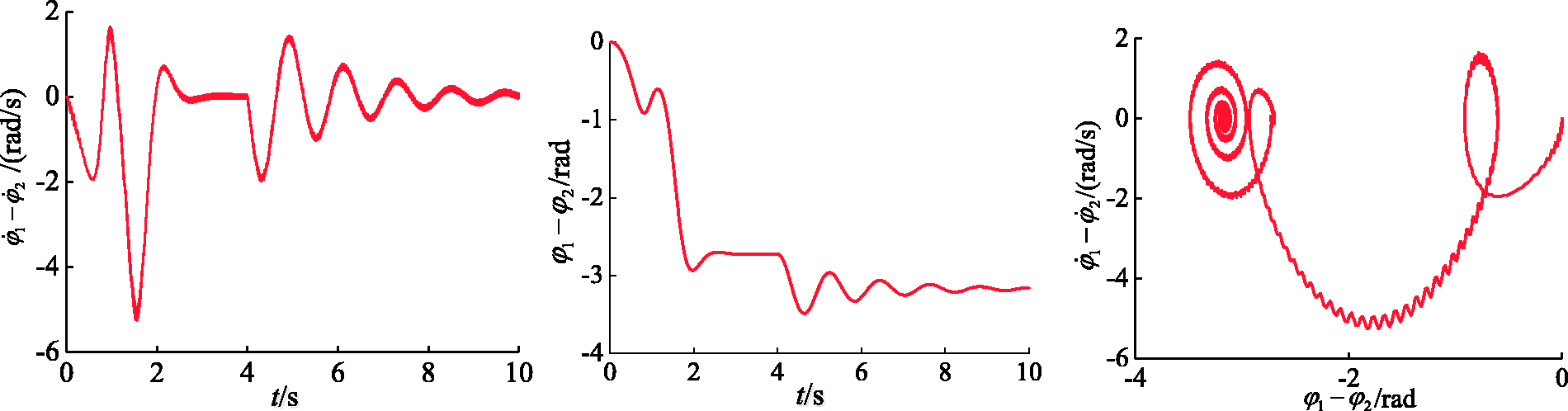
Simulation of the system under the different excited motor parameters conditions.
As shown in Figure 4, the two excited motors are started slowly at the same time, a big shock has been presented for the displacement response before two seconds, subsequently and then the small amplitude is achieved after about two seconds. The beat vibration is formed after the power supply of the excited motor 1 has been disconnected and then the amplitude is gradually stable after 8 s. As shown in the angular velocity curve of Figure 4, the angular velocities have been stable at about 157.7 rad/s before 4 s. But after 4 s, the big shocks of the crossing rules are appeared for the angular velocities on the two excited motors, subsequently. Finally, the shocks of the angular velocities are reduced to be stable at about 156.8 rad/s. It has been shown that the motor being power off (the excited motor 1) from the motor being power supply (the excited motor 2) can be still to get the energy and complete its operation, the synchronous operation of the two excited motors can be achieved. Only the stable value of the angular velocities after 4 s (namely, after the power supply of the excited motor 1 has been disconnected) is less than the stable value of the angular velocities before 4 s (namely, before the power supply of the excited motor 1 has been disconnected).
As shown in Figure 5, the big shocks of the angular velocity difference of the two excited motors and the phase difference of the two excited motors are presented before 4 s, subsequently. Finally, the angular velocity difference and the phase difference are also stable, such as the angular velocity difference is stable at 0 rad/s and the phase difference is stable at about −2.8 rad. After 4 s, the angular velocity difference is with the repeated shocks at 0 rad/s and finally stable at 0 rad/s. The phase difference is with the slight-repeated shocks and stable at about −
(b) When there is the different initial angular velocity for the two excited motors, such as the initial angular velocity of the excited motor 1 is 0.8 rad/s and the initial angular velocity of the excited motor 2 is 0 rad/s, the power supply of the excited motor 1 has been disconnected after 4 s. The responses of the parameters for the self-synchronous vibrating system with the asymmetrical hysteresis are shown in Figures 6 and 7.
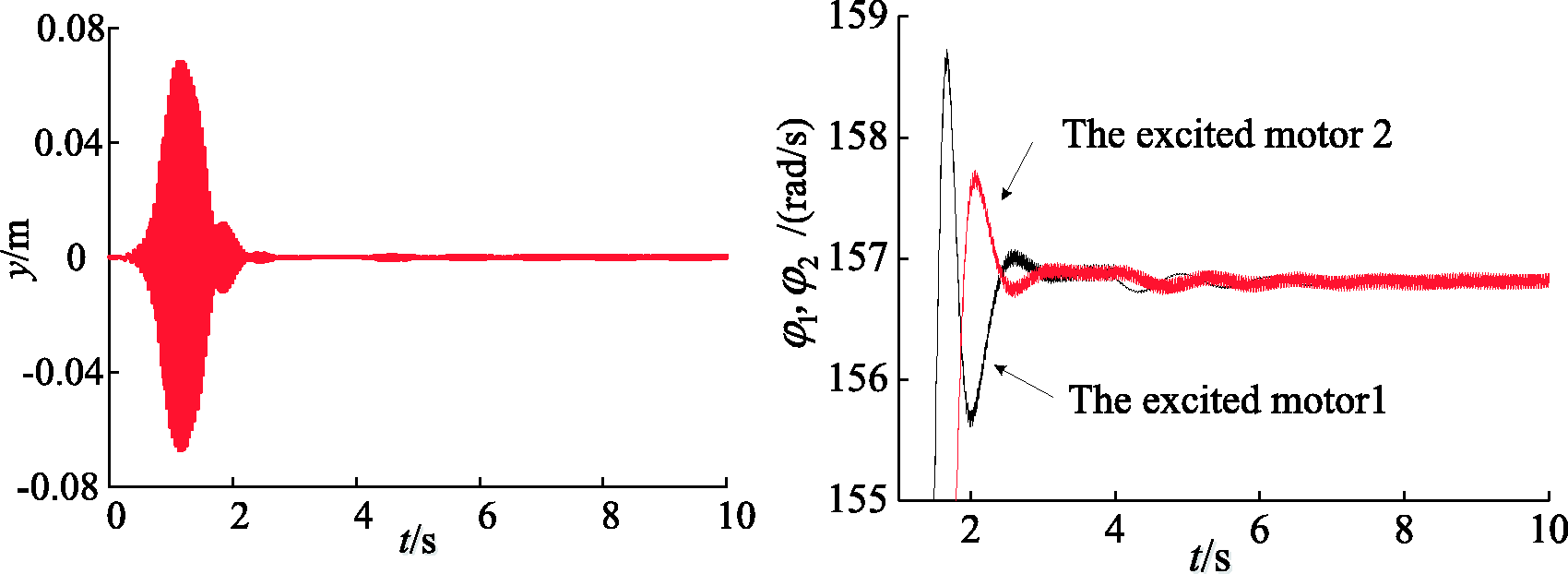
The response of the system under the different initial angular velocity (0.8 rad/s) conditions.
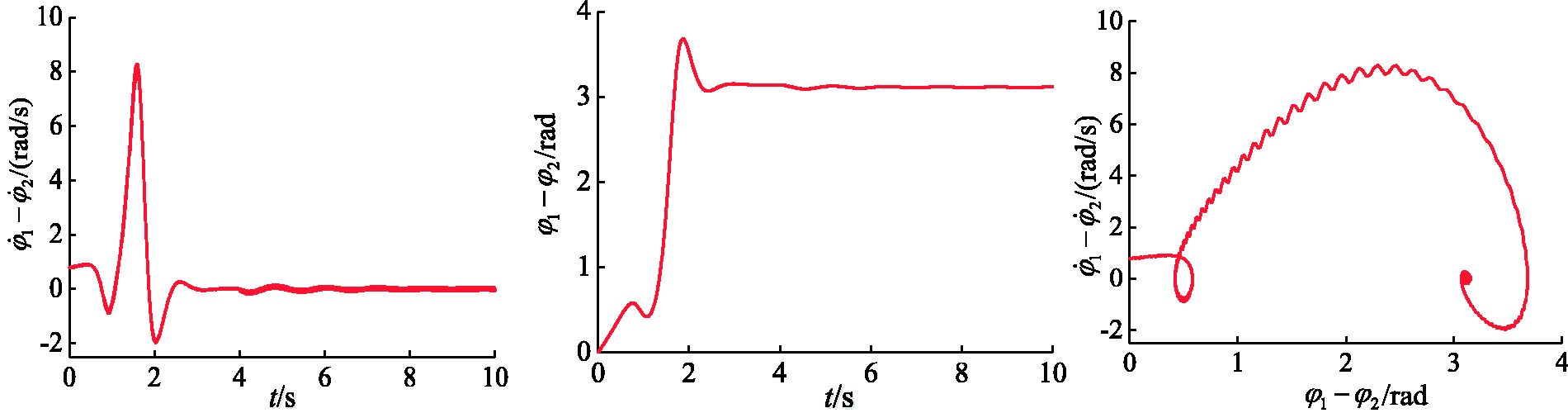
Simulation of the system under the different initial angular velocity (0.8 rad/s) conditions.
As shown in Figure 6, when the initial angular velocity difference of the two excited motors is 0.8 rad/s, the stable amplitude in the vertical direction is relatively small before 4 s and subsequently the amplitude is a slight increase after four seconds. As shown in the angular velocity response diagram of Figure 6, the angular velocity of the motor being power off (the excited motor 1) is represented by the black line, the angular velocity of the motor being power supply (the excited motor 2) is represented by the red line. The angular velocity of the motor being power off (the excited motor 1) is turned into a very thin line after 4 s. Finally, the motor being power off (the excited motor 1) and the motor being power supply (the excited motor 2) are synchronous operation, together. The synchronous operation of the two excited motors can be achieved. The stable value of the angular velocities (about 156.8 rad/s) after 4 s is a little smaller than the stable value of the angular velocities (156.9 rad/s) for the two excited motors before 4 s. So it has been shown that the motor being power off (the excited motor 1) from the motor being power supply (the excited motor 2) can get the energy and complete its operation, so that the stable angular velocity after 4 s is less than the stable angular velocity before 4 s.
As shown in Figure 7, when the initial angular velocity difference of the two excited motors is 0.8 rad/s, the angular velocity difference and the phase difference are with no obvious repeated shocks after 4 s (namely, after the power supply of the excited motor 1 has been disconnected), subsequently, the angular velocity difference and the phase difference are also stable, such as the angular velocity difference is stable at 0 rad/s and the phase difference is stable at about
(c) When the initial phase difference of the two excited motors is 3.14 rad, such as the initial phase of the excited motor 1 is 3.14 rad and the initial phase of the excited motor 2 is 0 rad/s, the power supply of the excited motor 1 has been disconnected after 4 s. The responses of the parameters for the self-synchronous vibrating system with the asymmetrical hysteresis are shown in Figures 8 and 9.
The response of the system under the different initial phase (3.14 rad) conditions.
Simulation of the system under the different initial phase (3.14 rad) conditions.
As shown in Figure 8, when the initial phase difference of the two excited motors is 3.14 rad, the amplitude tends to be stable and almost 0 after a big shock has been presented for the displacement response in 4 s. When the power supply of the excited motor 1 is disconnected in the fourth second, the amplitude of the vertical direction is immediately increased and then the amplitude tends to be stable at about 1.5 mm after the beat vibration has been formed for the amplitude. The angular velocity of the motor being power off (the excited motor 1) is represented using the black line in the angular velocity response diagram of Figure 8, and the angular velocity of the motor being power supply (the excited motor 2) is represented using the red line. As shown in the angular velocity curve of Figure 8, the line of the angular velocity is relatively thin for the motor being power off (the excited motor 1) after the power supply of the excited motor 1 has been disconnected, and then the line of the angular velocity is relatively coarse for the motor being power supply (the excited motor 2). It can be showed that the amplitude of the repeated vibration for the motor being power supply (the excited motor 2) is much larger than the amplitude of the repeated vibration for the motor being power off (the excited motor 1). Finally, the synchronous operation of the two excited motors is obtained in the self-synchronous vibrating system with the asymmetrical hysteresis. The stable value of the angular velocity (about 156.8 rad/s) after 4 s is less than the stable value of the angular velocity (about 156.9 rad/s) before 4 s. It has been shown that the motor being power off (the excited motor 1) from the motor being power supply (the excited motor 2) can get the energy to complete the synchronous operation of the two excited motors.
As shown in Figure 9, when the initial phase difference of the two excited motors is 3.14 rad, the violent irregular vibration of the angular velocity difference is presented after the power supply of the excited motor 1 has been disconnected. Finally, the amplitude for the angular velocity difference is with the repeated vibration up and down in 0 rad/s. The irregular vibration of the phase difference is presented after the power supply of the excited motor 1 has been disconnected, and then the phase difference is final stable at about
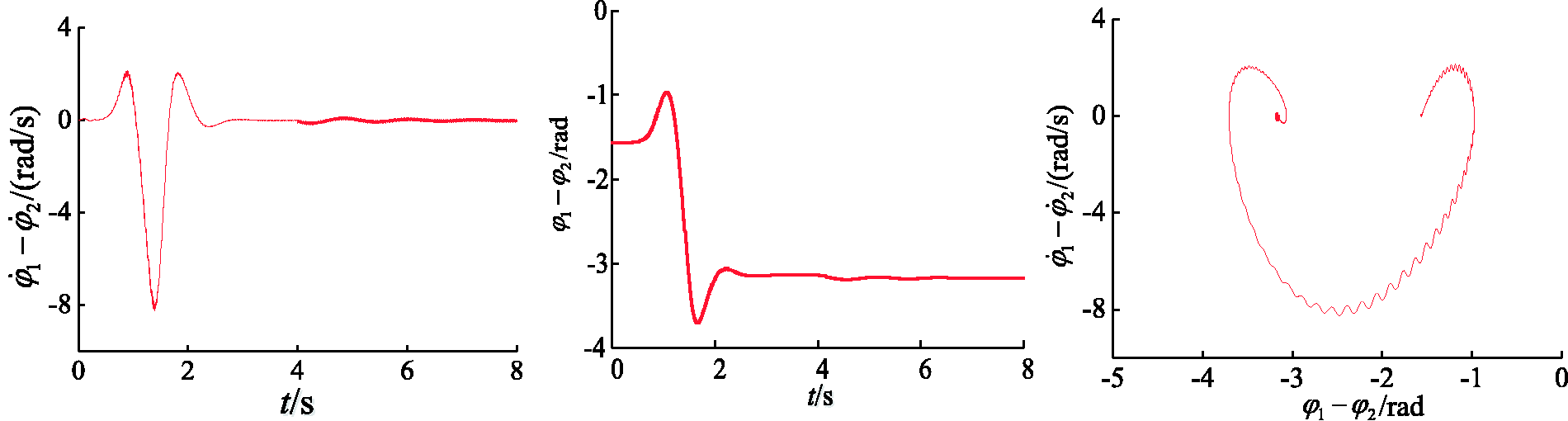
When the initial phase difference of the two excited motors is −1.57 rad and the power supply of the excited motor 1 has been disconnected after four seconds, the responses of the phase difference and the angular velocity difference and their phase plane can be obtained and shown in Figure 10. When the initial phase difference of the two excited motors is started from −1.57 rad, the angular velocity difference and the phase difference are presented with the irregular vibration. The angular velocity difference and the phase difference can be eventually stabilized at 0 rad/s and about −
Simulation of the system under the different initial phase (−1.57 rad) conditions.
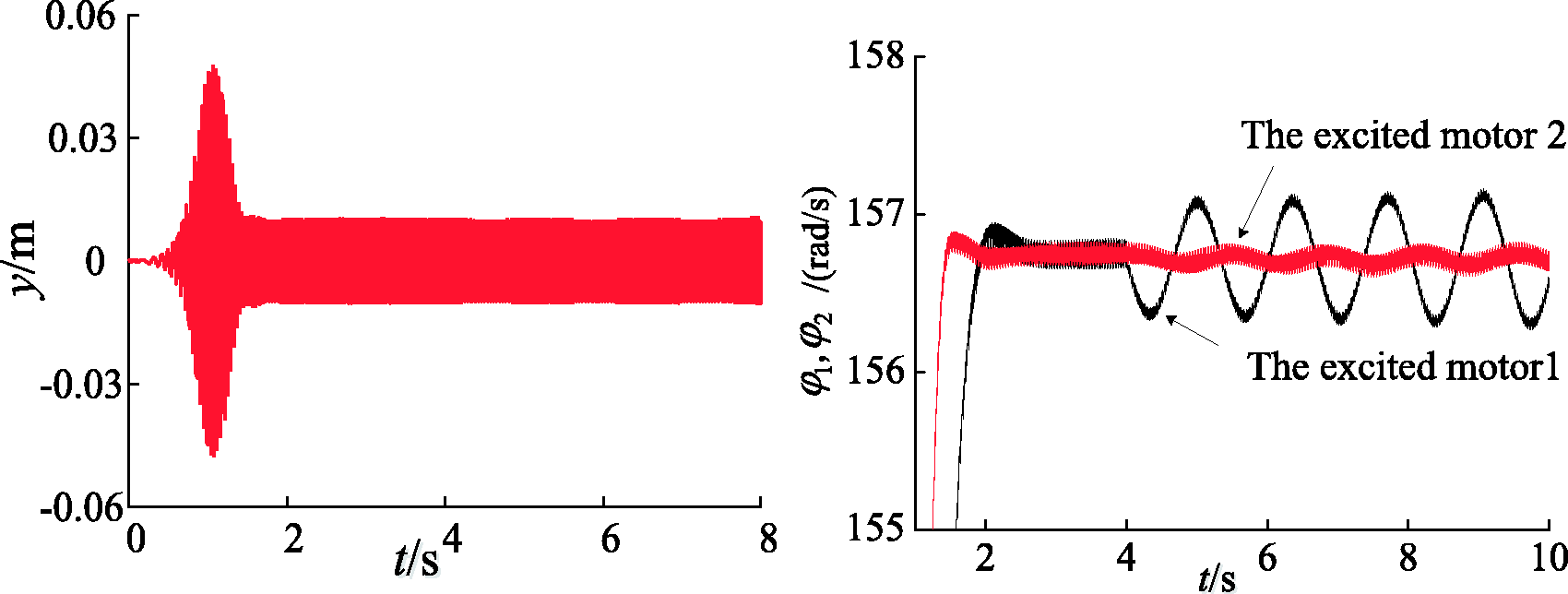
(d) When the exciting forces of the eccentric rotors in the two excited motors are different, such as the mass of the eccentric rotor for the excited motor 1 is transformed into 1.5 kg (namely, m1 = 1.5 kg), the power supply of the excited motor 1 has been disconnected after 4 s and then the responses of the parameters for the self-synchronous vibrating system with the asymmetrical hysteresis are shown in Figures 11 and 12.
The response of the system when m1 = 1.5 kg.
Simulation of the system when m1 = 1.5 kg.
As shown in Figure 11, when the mass of the eccentric rotor on the excited motor 1 is changed in the self-synchronous vibrating system with the asymmetrical hysteresis, namely, the exciting forces in the vertical direction are not equal, the amplitude in a vertical direction is presented with the repeated vibration at about 15 mm after the power supply of the excited motor 1 has been disconnected. As shown in the angular velocity diagram of Figure 11, the angular velocity of the excited motor 1 is presented with the regular repeated motion of the large wave at about 156.8 rad/s, and then the angular velocity of the excited motor 2 is presented with the steady motion of the small wave at about 156.8 rad/s after the power supply of the excited motor 1 has been disconnected. The synchronous operation of the two excited motors can be obtained.
As shown in Figure 12, the angular velocity difference of the two excited motors is presented with the repeated motion of the wave at 0 rad/s, and then the phase difference of the two excited motors is presented with the steady motion of the small wave at about −
As shown in Figures 4 to 12, when there are some differences in the initial parameters of the two excited motors, the synchronous operation of the two excited motors and the synchronous stability operation of the self-synchronous vibrating system with the asymmetrical hysteresis can still be achieved in the exceptional circumstance, such as the power supply of one of the two excited motors is disconnected after the synchronous operation of the two excited motors and the synchronous stability operation of the self-synchronous vibrating system with the asymmetrical hysteresis has been obtained. The stable angular velocity of the two excited motors after cutting off one of the two excited motors is only less than the stable angular velocity of the two excited motors before cutting off one of the two excited motors. The phase difference is final stable at about
Conclusions
In this paper, the self-synchronization characteristics of the nonlinear vibration system with the asymmetrical hysteresis have been proposed in the exceptional circumstances of cutting off the power supply of one of the two excited motors. Firstly, from the point of view of the hysteretic characteristics with the asymmetry of the compacted soil, nonlinear dynamic model of the self-synchronous vibrating system is presented for the analysis of the hysteretic characteristics of the soil, which is induced by the relation between the stress and the strain in the soil. The periodic solutions for the self-synchronous vibrating system with the asymmetrical hysteresis are investigated using nonlinear asymptotic method. Secondly, the synchronization condition of the two excited motors is theoretical analyzed using the rotor–rotation equations of the two excited motors, and the synchronization stability condition of the self-synchronous vibrating system with the asymmetrical hysteresis are theoretical analyzed using Jacobi matrix of the phase difference equation of the two excited motors, after the power supply of one of the two excited motors has been disconnected. Thirdly, using Matlab/Simlink, the synchronous operation of the two excited motors and the synchronous stability operation of the self-synchronous vibrating system with the asymmetrical hysteresis have been quantitative analyzed through the difference rates of the two excited motors (including the initial phase difference, the initial angular velocity difference, and the difference of the motors parameters), when the power supply of one of the two excited motors has been disconnected.
Finally, it has been revealed that the synchronous operation of the two excited motors and the synchronous stability operation of the self-synchronous vibrating system with the asymmetrical hysteresis can still be achieved after the power supply of one of the two excited motors has been disconnected. So the self-synchronous vibrating system under the action of the hysteretic force with the asymmetry has the ability to restore synchronization in the exceptional circumstance of cutting off one of the two excited motors. So the self-synchronous vibrating system is with the self-synchronizing characteristics.
Footnotes
Declaration of conflicting interests
The author(s) declared no potential conflicts of interest with respect to the research, authorship, and/or publication of this article.
Funding
The author(s) disclosed receipt of the following financial support for the research, authorship, and/or publication of this article: The author gratefully acknowledges that this project was supported by the National Natural Science Foundation of China (Grant No. 51605022), the Fundamental Research Funds for Beijing University of Civil Engineering and Architecture (Serial Numbers: X18096 and X18116) and the science research foundation of Beijing University of Civil Engineering and Architecture under the Project Number ZF16082.