




Abstract
The second-order nonlinear oscillators have rich dynamics. We proposed a novel analytical method based on both variational iteration method and Adomian method. The variational iteration method is used to establish an equivalent integral system. So then Adomian polynomials are adopted to linearize the strong nonlinear terms in nonlinear oscillators and analytical solutions are obtained successively.
Introduction
Variational iteration method1,2 was proposed to find analytical solutions for nonlinear equations, i.e. algebraic equations, nonlinear differential and partial differential equations.3–16 Concerning the method, there is no need to linearize or treat the nonlinear terms. With the initial iteration and Lagrange multipliers, more accurate solutions can be obtained in comparison with that by the Picard method. Up to now, it has been developed as a powerful method as well as in the applications of nonlinear problems. Various modified versions have been summarized in the survey. 17
Nonlinear oscillator often holds the following expression as

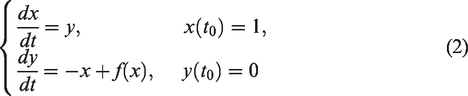

This is a differential system of first order. As we know, the variational iteration method has many important results. Hence, equation (3) is more convenient for us to solve and that is the main reason why we directly write equation (1) as equation (3).
Naturally, we will have such questions. What is the variation iteration formula for equation (3) in matrix? How to establish the correction functional? And how to identify the Lagrange multipliers then? Hence, we adopt the famous Adomian polynomials to speed the convergence of the method and give analytical solutions for equation (3).
Variational iteration method for vector functions
Recently, Huang 18 proposed a Lagrange multiplier for the system (2) or (3) which is based on matrix theories. Let us revisit the general methodology.
First, establish a correction functional as

Second, by Laplace transform, the Lagrange multiplier can be identified as

Meanwhile, the initial iteration can be provided as

The novelty of the method in this paper is that we use the matrix Lagrange multiplier (5) here.
Finally, the variational iteration formula is obtained

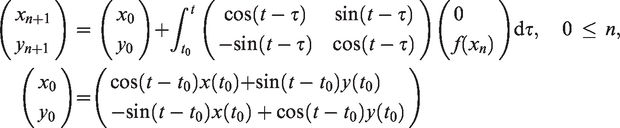
The matrix Lagrange multiplier can be calculated by matrix theories



The uniqueness and existences can be proved by the method in differential equation.
19
We do not give the details here. In view of this point, equation (7) leads to an integral equation as

This integral equation idea was proposed in the paper. 20
Analytical solutions of strong nonlinear oscillators
In this subsection, we consider the following nonlinear oscillator


We use the equivalent integral system (7) to derive


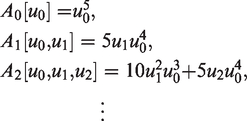
The Adomian decomposition method is one of the nonlinear techniques for integral equations. We adopt the Adomian polynomials21,22 to linearize the strong nonlinear terms

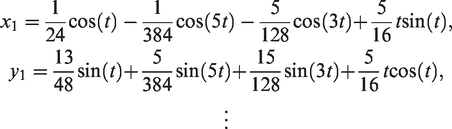
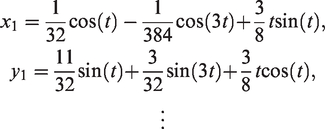
Hence, we get the approximate solutions of Case 1 and Case 2 which are illustrated in Figures 1 and 2, respectively
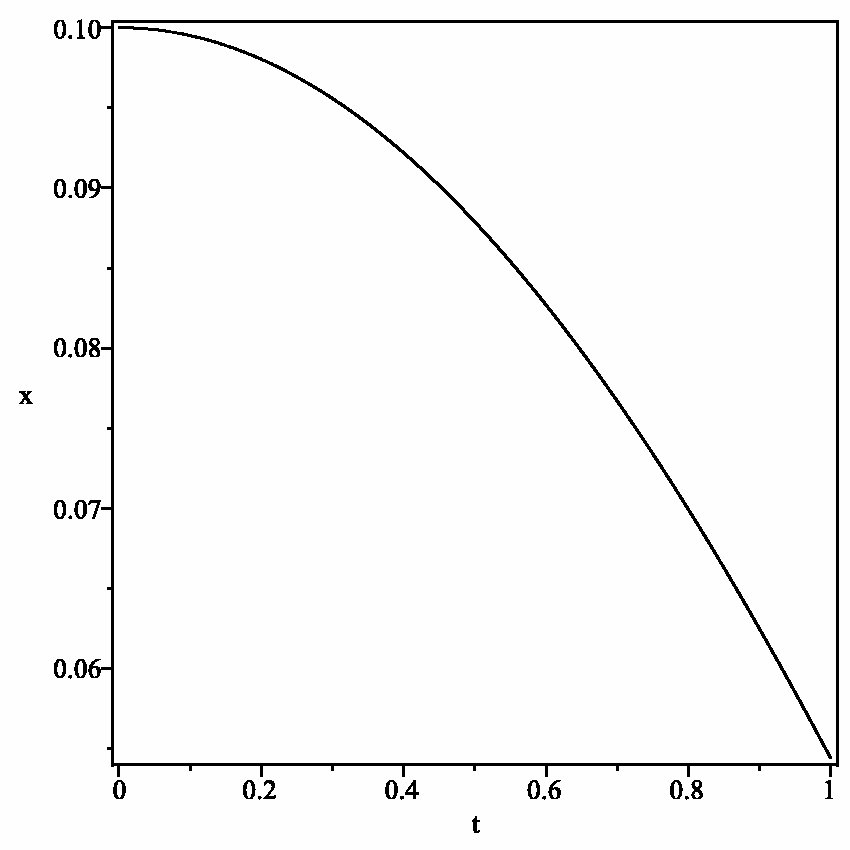
Analytical solution of (12) x:
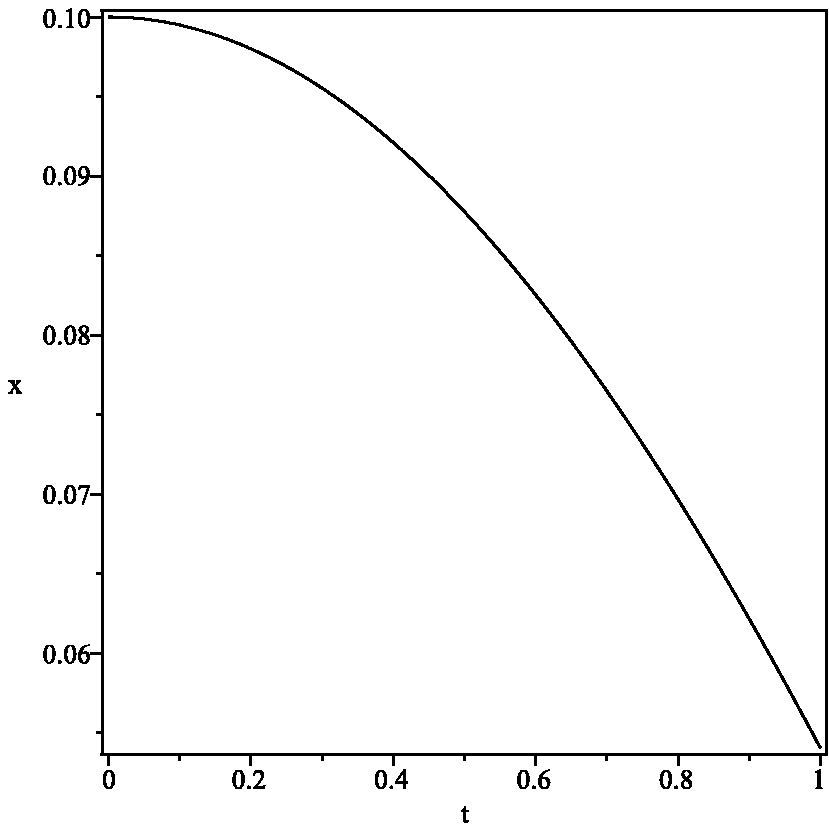
Analytical solution of (13) x:
Case 1
Case 2
Conclusions
We consider some novel variational iteration formulae in this paper where the Lagrange multiplier is identified by use of a matrix function and more accurate than the classical one. Furthermore, the new integral expression of nonlinear oscillators of second order is given with the convergence of variational iteration method. Finally, the Adomian polynomials are adopted and series solutions are obtained more quickly. Hence, this paper mainly contributed to the following points:
A matrix Lagrange multiplier is provided for oscillator equations. New integral equation is found by use of the variational iteration method so that many methods for integral equation can be used in the future. Many other nonlinear techniques can be used to modify the variational iteration method and provide more highly accurate solutions for different engineering applications. We will adopt He’s polynomials
23
and consider other modified variational iteration method in the nearest future.
Footnotes
Declaration of conflicting interests
The author(s) declared no potential conflicts of interest with respect to the research, authorship, and/or publication of this article.
Funding
The author(s) received no financial support for the research, authorship, and/or publication of this article.