




Abstract
The capillary effect has wide applications from biology and textile engineering to nanotechnology especially the micro-electromechanical systems and microfluidics device. The capillary vibration significantly affects its mass transmission. This paper establishes a nonlinear oscillator of a deforming capillary tube. The geometric potential theory is used to estimate the capillary force. The paper reveals that the low-frequency property of capillary vibration plays an important role not only in life but also engineering applications.
Introduction
Capillary phenomenon appears everywhere in our everyday life, and it plays an important role in blood transmission in animals, water transmission in plants, and heat transmission in porous media. Capillary vibration significantly affects the capillary rise or capillary pressure, as a result the mass transfer or heat transfer will be greatly affected. The air permeability1,2 through a nanofiber membrane3–6 is mainly affected by the capillary effect, which can be explained by the geometric potential theory,7–9 implying that any boundary can produce a boundary-induced force. Liu et al. 10 established a fractional oscillator for ion release from a follow fiber. Lin and Yao 11 gave an experimental verification of the fractional model, and suggested a simple method to estimate its frequency. 12 All the above capillary vibrations assumed that the capillary tube is small and uniform. However, in most porous media, capillary flows are nonuniform capillaries. For example, wicking efficiency in the small nonuniform capillary between fibers is crucial for the comfort of fabric. It has been reported that the degree of nonuniform decided by yarn twist has a close relationship with the liquid transport efficiency by capillary. 13 The alternative frequency between the diverging section and converging section of the capillary greatly affected the wicking velocity. This paper will study a deforming capillary with periodic boundaries and study the low frequency of capillary frequency on the capillary rise.
Lotus-rhizome-node-like deforming capillary
In this paper, we consider a deforming capillary tube with Lotus-rhizome-node-like structure as illustrated in Figure 1. Such a model can be used to describe a nonuniform capillary in porous media, especially the fabrics.
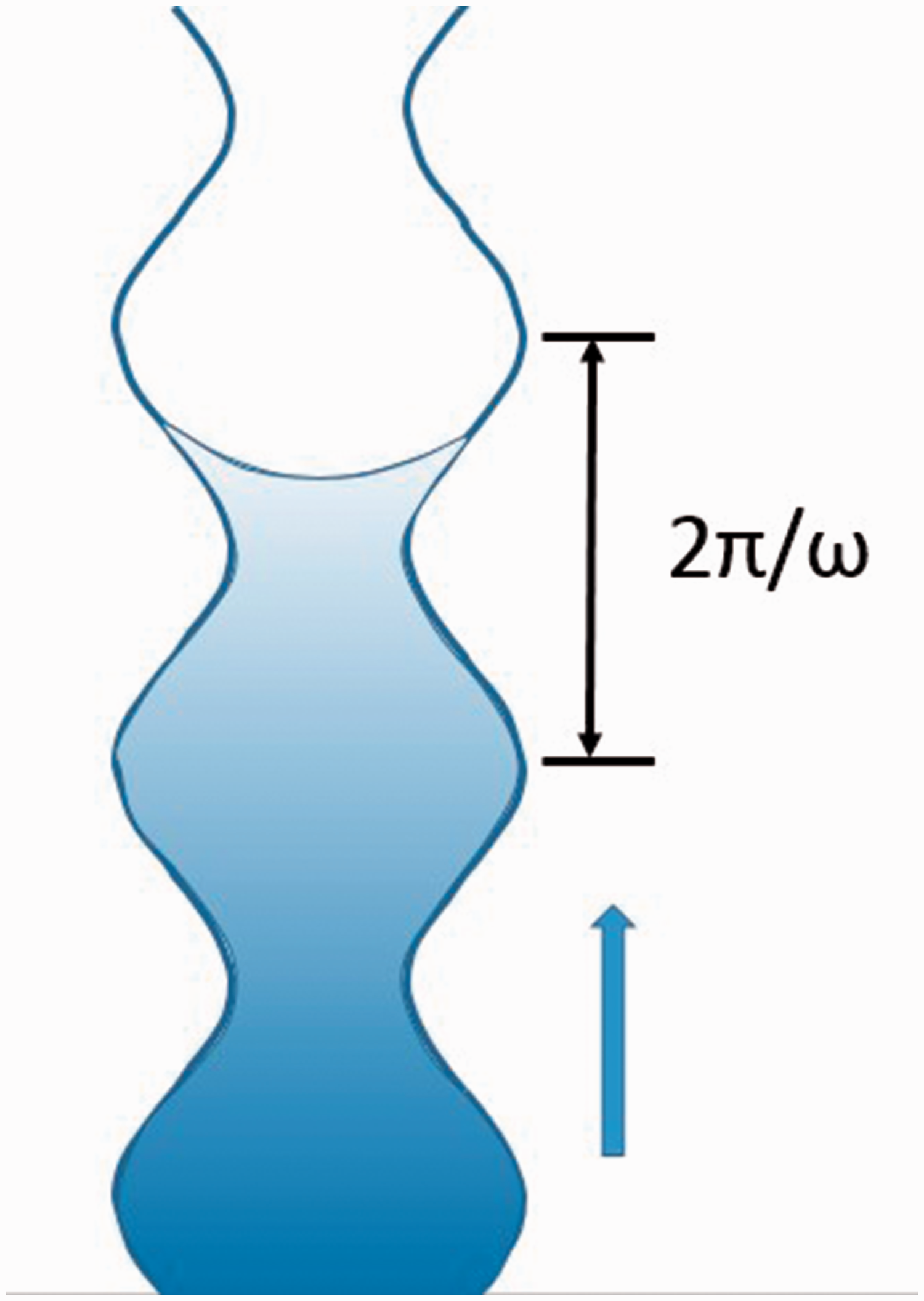
A deforming capillary tube with Lotus-rhizome-node-like structure.
As a preliminary study, we consider deforming capillary tube as a periodic boundary, which can be written as

By Newton’s second law, capillary vibration can be written as

The mass in the tube is

The capillary force can be calculated by the geometric potential theory7–9


The capillary force can be written as

The acting force F given in equation (2) can be calculated as

At equilibrium, the force balance requires

Equation (7) can be simplified as

We, therefore, obtain the following oscillator for the capillary vibration


Equation (11) can be approximated by the following Duffing equation

Homotopy perturbation method
Equation (12) can be effectively solved by the variational iteration method, 14 the homotopy perturbation method,15,16 or He’s frequency formulation. 17
We construct the following homotopy equation

We assume that the solution can be expanded into the form





In view of equation (18), equation (17) becomes

By the following identity

Equation (19) becomes

No secular term in

From equation (22), we can find the value of

If the first approximate is searched for, we set p = 1 and

This results in


Discussion and conclusions
The capillary fluid moves extremely slow, and its vibration near its equilibrium has extremely low frequency, which plays an important role in both life and applications. For a high tree, the water transmission in a hot season is of great importance. The low frequency can effectively guarantee both safe water transmission and extremely low loss of water. In textile engineering, the low frequency of capillary vibration leads to an effective perspiration absorption.
In this paper, we obtain an oscillator for the capillary vibration on the tube with periodic boundary. The frequency of the capillary vibration affects greatly the capillary effect, and this paper elucidates the main factors affecting the frequency, which can be used for optimal design of a porous medium. In the forthcoming papers, we will study the capillary effect numerically and experimentally.
Footnotes
Declaration of conflicting interests
The author(s) declared no potential conflicts of interest with respect to the research, authorship, and/or publication of this article.
Funding
The author(s) disclosed receipt of the following financial support for the research, authorship, and/or publication of this article: This work was supported by the National Key R&D Program of China (Grant Number 2017YFB0309100) and the Science and Technology Plans of Tianjin (Grant Number 15PTSYJC00230).