




Abstract
A complete numerical comparison is given between the He’s frequency–amplitude formulation and its modification with average residuals for both weak and strong nonlinear oscillators, showing both methods have good accuracy. This paper concludes that both methods provide a simple but effective tool to various nonlinear oscillators.
The accuracies of He’s frequency–amplitude formulation1–4 and also its modification with average residuals 5 were discussed by Wang et al.; 6 although their finding is reasonable, their conclusion is doubtful.
We analysed the generalized Duffing oscillator in the form
5


According to He’s frequency–amplitude formulation, the frequency–amplitude relationship can approximately be written as1–4


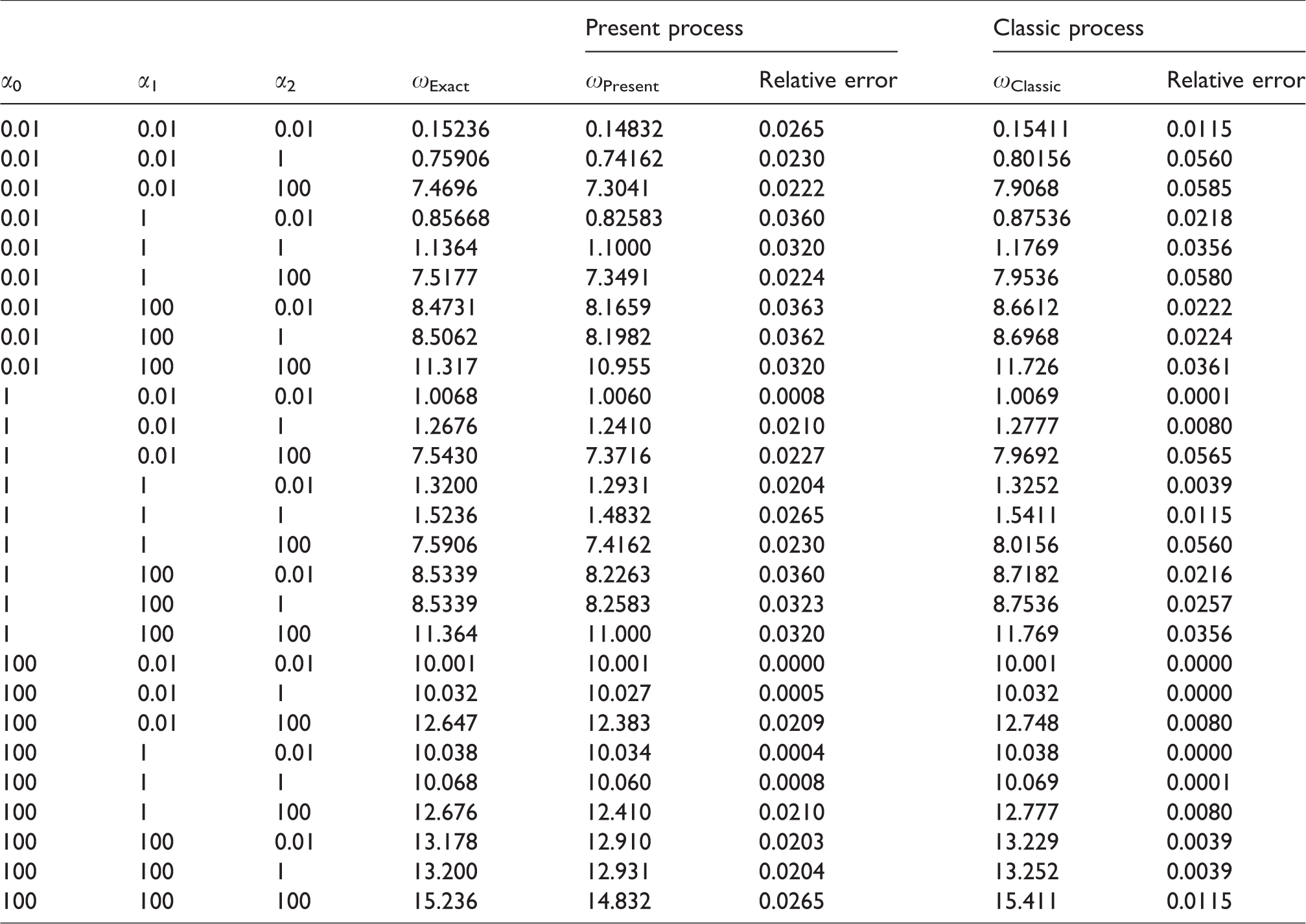
However, the two results given in equations (3) and (4) are a little different. When α1 = α2 = 0, both cases result in an exact result; Table 1 gives other cases for comparison with exact ones, showing both He’s formulation and its modification give ideal results; although the accuracy might be different for some special points, when α1 or α2 tends to infinity, equation (4) is much better than equation (3), showing that the modification 5 is good enough for practical applications.
Comparison of He’s formulation and its modification with the exact one for the case of A = 1.
We conclude that both He’s formulation and its modification are suitable for fast estimation of the period property of any conservative oscillators, and there is no obvious evidence showing that He’s formulation is advantageous over its modification. We consider any modification of a known method will contribute to the development of the science and technology, and we consider that Wang et al.’s conclusion is doubtful.
Due to the simple calculation of the modification of He’s formula, the obtained frequency can be effectively used as an initial guess for the variational iteration method, 7 the homotopy perturbation method,8–12 for a better accuracy if necessary. The modification can be also used for a recently hot topic on fractional oscillators. 13
Footnotes
Declaration of conflicting interests
The author(s) declared no potential conflicts of interest with respect to the research, authorship, and/or publication of this article.
Funding
The author(s) received no financial support for the research, authorship, and/or publication of this article.